



Abstract
Research on information need has a long-standing tradition. Within this body of research, certain lines of inquiry have been more predominant; for example, research on how information need is satisfied and the role of information need in everyday life. Undeniably, these lines of inquiry are of immense value; however, other avenues concerning information need deserve even more attention to ensure theoretical developments in the field of information behavior. These aspects include domain specification of the concept of information need, its operationalization and empirical validation. This study attempts to specify the conceptual domain of information need and articulates this domain through five aspects. These aspects shed light on the antecedents and consequents of information need, its descriptions, its role in life, and the relationship of information need with other needs. The proposed articulation should help in better theorization and operationalization of information need in empirical studies.
Introduction
The importance of information need in a highly service-oriented discipline like library and information science cannot be overstated. Naumer and Fisher (2009) noted that libraries and information systems would cease to exist without information needs. There are, however, other reasons of importance that can be attributed to information need. For instance, information need can be considered a starting point for various information behaviors, including seeking, searching, and using information. Beyond information behavior and information services, there are significant research problems that warrant a detailed understanding of information need. Specifically, questions about the role of information need in expanding available choices, shaping emotions, feelings, and cognition, and servicing other primary needs (e.g. safety, belongingness) have not been addressed in library and information science research. These questions cannot be answered without knowing what is at the heart of information need: its nature, its aspects, and how it is related to and distinct from other basic needs. There have been efforts to study the concept of information need (e.g. Cole, 2012; Line, 1974; Roberts, 1975; Savolainen, 2012a, 2017; Taylor, 1968) in library and information science. There have also been attempts to study this concept in other disciplines, including nursing (e.g. Ormandy, 2011; Timmins, 2006). Lately, some studies have investigated information need using neuroimaging (e.g. Michalkova et al., 2022; Moshfeghi et al., 2016) which is a promising approach; however, this line of enquiry is still in initial stages and will require further work to be able to offer some conceptual fruits to information need research.
Despite quite a significant body of research on information need, there is still no consensus on its meanings (e.g. Case and Given, 2016; Sarkar et al., 2020; Savolainen, 2017), and there is also no consistency in its assessment or measurement (Afzal, 2017b). Some of these concerns are voiced by scholars in other disciplines as well. In nursing, for example, Timmins (2006) noted that the definition of information need is overlooked in most studies and is little understood. Similarly, Ormandy (2011) stated that there is no clear definition of the term information need in healthcare. In addition to conceptual ambiguity, there are also methodological issues in operationalizing information need. Many studies purporting to evaluate information need use information sources and services as proxies for its measurement (e.g. Perley et al., 2007; Zreik et al., 2021). Such an approach equates the use and demand of information sources and services with information need evaluation, which presents an important theoretical and methodological problem.
Hence, formal methodological frameworks based on sound theoretical foundations are needed to study the conceptual domain of information need, including boundaries, identification of its antecedents and consequents, and its relationship with other needs. A detailed step-by-step framework for such a methodology was proposed by this author in an earlier paper (Afzal, 2017a) with a hope that it will pave the way for the consistent operationalization and measurement of this concept and will help develop a cumulative tradition of information need research. The current research aims to take a step in that direction by specifying the conceptual domain of information need and using this specification to shed light on different aspects of this concept.
Research methodology
The current study relies on the methodology proposed earlier (i.e. Afzal, 2017a) to specify the conceptual domain of information need. This methodology is based on works of Loevinger (1957), Churchill (1979), Clark and Watson (1995), DeVellis (2003), and Fleming-May (2014). According to Churchill, specification of the domain of a concept starts with its clear definition, identification of what is included in it and what is excluded from it. Fleming-May suggested to consider antecedents and consequents of a concept, whereas Clark and Watson advised to give serious attention to descriptions of a concept, its theoretical context and doing a literature review. These guidelines can be summarized as a step-by-step process involving studying a concept’s nature, identifying its antecedents and consequents, and determining its relationship with other related concepts.
Using these works as a foundation, the following four steps were taken to specify the conceptual domain of information need:
(1) a review of the relevant literature, giving special attention to (a) the description of information need, (b) feelings and emotions ascribed to information need, (c) the antecedents of information need as well as its consequents, and (d) the relationship of information need with other needs;
(2) use of a focus group session and semi-structured interviews to gain an in-depth understanding of the aspects of information need identified through the literature review as well as the insights not covered in the literature;
(3) thematic analysis of data from a focus group session and semi-structured interviews; and
(4) corroboration and explication of findings with the relevant research in library and information science and cognate disciplines.
For the literature review, studies about the above aspects were reviewed using the Library and Information Science Technology Abstracts (LISTA) database, Web of Science, and Scopus. LISTA was selected as it is considered by some seasoned scholars in information behavior (see e.g. Julien et al., 2011) as a key database for library and information science literature. Web of Science and Scopus have a vast coverage of citations and therefore were also used in this study. Search terms such as “information need,” “information need” AND “emotions,” “information need” AND “feelings” were used, and the searches were refined using the criterion of relevance. The searches were limited to peer-reviewed journal articles, peer-reviewed conference proceedings, books, and literature reviews written in English. Subsequent articles citing the papers identified during initial searches were traced through web searches and from these articles, the studies that seemed to address the aspects of information need outlined above were selected. The Annual Review of Information Science and Technology (ARIST) was also searched for literature reviews about information need.
A focus group session and semi-structured interviews were carried out to further understand the concept of information need. A focus group was used because, according to Duggleby (2005), interaction data from such sessions can increase the depth of inquiry and reveal less accessible aspects of a phenomenon. Interviews, on the other hand, can provide detailed and in-depth data; furthermore, combining data from focus groups and interviews can benefit researchers as complementary views of a phenomenon may emerge (Lambert and Loiselle, 2008).
Purposeful sampling was used to select information-rich participants, which, according to Patton ( 1990, p. 169 as cited in Coyne, 1997), “Information rich cases are those from which one can learn a great deal about issues of central importance to the purpose of the research, . . .” Participants for the focus group session were recruited from a university through a university-wide electronic news bulletin. All participants except one (a Ph.D. student) were working in different roles (e.g. administrator, researcher, fixed-term contract worker). To increase the diversity in views, interview participants were recruited from outside the university through a research assistant. Five participants were recruited for a 1-hour focus group session, and four were recruited for individual interviews. Each interview lasted 30–35 minutes. Ethics approval for research involving human participants was obtained from the university ethics committee. The participants were provided with (1) a consent form and (2) an information statement well before the focus group and interview sessions. Information statement described the main purpose of this study, the way in which focus group or interview sessions will be conducted, and the way in which participant’s information will be handled. All participants, including those for the focus group and individual interviews, signed an informed consent form.
At the start of focus group and each individual interview, the researcher briefly explained the project and also invited questions that a participant may have about any aspect of the project. An interview guide was prepared for focus group and individual interviews (Table 1). The guide was developed to explore focus group participants’ and interviewees’ (1) understanding of information need, (2) feelings and emotions preceding and consequent to an information need, (3) activities followed by an information need, (4) views concerning the role of information need in life, and (5) its relationship with other needs (e.g. need for safety, need for belongingness). Keeping in view the abstract nature of information need, when necessary, different probing questions (e.g. can you explain that more? Can you give me an example?) and guiding questions (e.g. if somebody asks you to give a definition, then how would you describe it?) were also used to help participants to fully verbalize their thoughts about the questions in the interview guide and any other aspects related to information need.
Questions.

Steps to specify the conceptual domain of information need
The domain of a concept represents a collection of relevant ideas and literature as well as ideas that are distantly and closely related to the concept under study. Identification of the conceptual domain helps identify the boundaries of a concept. This phase is important in clarifying what is included in a concept and what is excluded, enabling a researcher to identify the concept-relevant content.
Review of relevant literature
Both Churchill (1979) and Clark and Watson (1995) suggest doing a careful literature review to identify the conceptual boundaries of the target construct. According to Fleming-May (2014), the literature of a discipline or sub-discipline provides context-relevant data about a concept. For the literature review, the LISTA database, Web of Science, and Scopus were used to identify the relevant studies. Each article was carefully reviewed to determine its relevance to (1) conceptual articulation of information need, (2) feelings and emotions ascribed to this need, (3) antecedents and consequents of information need, and (4) relationship of this need with other primary needs. The review was also informed by this author’s earlier work on information need (Afzal, 2017a, 2017b). Forty studies were selected after this review for further analysis. The studies in this final sample were used to identify the instances of information need description, specific feelings and emotions mentioned in relation to information need, instances that trigger information need, what follows in terms of steps to satisfy an information need, and description of relationship(s) that information need has with other needs. Details of this review are provided below, along with a table delineating the conceptual domain of information need (Table 2).
Conceptual domain of information need derived from relevant literature.

The reviewed studies shed light on the following aspects of information need: (1) its description, (2) feelings and emotions ascribed to information need, (3) subsequent actions, and (4) the relationship of information need with other needs.
It is evident from the literature that there have been efforts to examine the concept of information need (e.g. Line, 1974; Roberts, 1975; Taylor, 1962). For instance, it has been defined as an anomalous state of knowledge (Belkin et al., 1982), a gap in knowledge (Dervin and Nilan, 1986), a feeling of uncertainty (Kuhlthau, 1991), the perception of a difference between an ideal state of knowledge and the actual state of knowledge (van de Wijngaert as cited in Case and Given, 2016, p. 79), and a motivational force behind information seeking (Naumer and Fisher, 2009). Despite the presence of many well-conceived definitions of information need, ambiguity concerning this concept was noted (e.g. Case and Given, 2016; Naumer and Fisher, 2009; Savolainen, 2017) and terms such as “want,” “demand,” “requirements,” and “question” were considered very early on as close correlates of the concept of information need. For example, Line (1974) suggested that the term “requirement” is an overarching term that includes need, want, and demand. Roberts (1975) proposed using the term “total potential demand” to denote information need. Derr (1983) even questioned the utility of the concept of information need and proposed the term “question.”
Some scholars argued the need to consider contextual, cognitive, affective, and physical factors to better understand the concept of information need. For instance, MacMullin and Taylor (1984) contended that understanding the contexts in which information need arises is fundamental in ensuring the adequacy of information-providing systems. Kuhlthau (1991) argued for understanding the cognitive and affective aspects of information need, which she noted in her groundbreaking work on the information search process. In terms of information need’s precursors, some have identified accidental antecedents (e.g. Williamson, 1998) and others (e.g. Choo et al., 2000; Sarkar et al., 2020) have discussed the subsequent information seeking and searching strategies used.
Many feelings and emotions ascribed to the presence of information need have been noted in the literature. Examples include anxiety, worry, dissatisfaction, fear, and uncertainty. Negative feelings and emotions have been more predominant in the literature, though there is a recognition that positive emotions do arise as well. Ruthven (2019, p. 79) wrote that positive emotions relate more to the later stages of information need than the initial stages.
Within psychology, the role of information need in helping people to satisfy their basic needs has been acknowledged—very early on—by human need theorists.
Maslow (1943) presented five basic needs in his theory of human motivation. In addition to these needs, he discussed several preconditions for satisfying basic needs. These preconditions include, for example, freedom to speak, freedom to express oneself, freedom to investigate and seek for information (p. 383). According to Maslow, any danger to these preconditions can be considered a direct danger to the basic needs. Other human needs theorists, for example, Alderfer (1969) noted, though sometimes implicitly, the importance of information need. Specifically, Alderfer proposed a set of three needs: existence-relatedness-growth; he went on to state that the satisfaction of existence need will partly depend on the information a person will gather by comparing what they get with what others get in the same situation (p. 146). It can, therefore, be reasoned that a person’s need for information will play a key role in satisfying the primary need of existence. Deci and Ryan (2000) argued that positive feedback received through 1’s informational environment is important for meeting the basic psychological needs of autonomy and competence. According to Deci and Ryan, satisfying these needs will intrinsically motivate people. The preceding argument can be used to reason that information need will be pivotal in enabling a person to gather positive feedback and satisfy their needs of competence and autonomy—all of which will contribute to vitality and well-being.
Focus group and semi-structured interviews
After the literature review, the next step for domain specification was to gain further understanding of the concept of information need as understood by people in everyday life. For this purpose, a focus group session and semi-structured interviews were used. These sessions were digitally recorded and then transcribed verbatim. A thematic analysis strategy was used to analyze the data. This approach was in accordance with the research purpose of this study, which was to identify patterns in data so that different aspects of the concept of information need could be identified. According to Braun and Clarke (2006, p. 79), “thematic analysis is a method for identifying, analyzing, and reporting patterns (themes) within data.”
Thematic analysis
For thematic analysis, a general qualitative data analysis framework was used, as proposed by Yin (2011) and contextualized by Castleberry and Nolen (2018) in their study. It included the following five steps: (1) the compiling of data: for this step, the transcribed data was first read to gain familiarity with various ideas and themes running through the datum. Detailed notes were taken to document important phrases and terms. Then, the transcripts were read again to develop greater immersion in the data and to review the notes taken during the first round of reading; (2) disassembling: in this phase, the coding of the data was done to identify thoughts, ideas, and concepts running through the data. As coding was done by the researcher, to ensure accuracy two strategies were used: (a) the whole coding scheme and datum were revisited sometime after the initial coding and (b) any changes made in the coding scheme along with the reasoning underpinning those changes were also documented resulting in a detailed decision trail; (3) reassembling: during this phase, codes belonging to each idea were mapped to create themes. These themes represented patterns in codes and demonstrated broader categories. In this stage of analysis, core themes were formed to account for all of the data; (4) interpreting: during this phase, themes across the whole datum were reviewed, and five major aspects of the concept of information need were identified (Figure 1), and (5) concluding: finally, during this phase, conclusions were drawn by summarizing the key findings of this study. The methodological and theoretical implications of this research for library and information science were also noted.
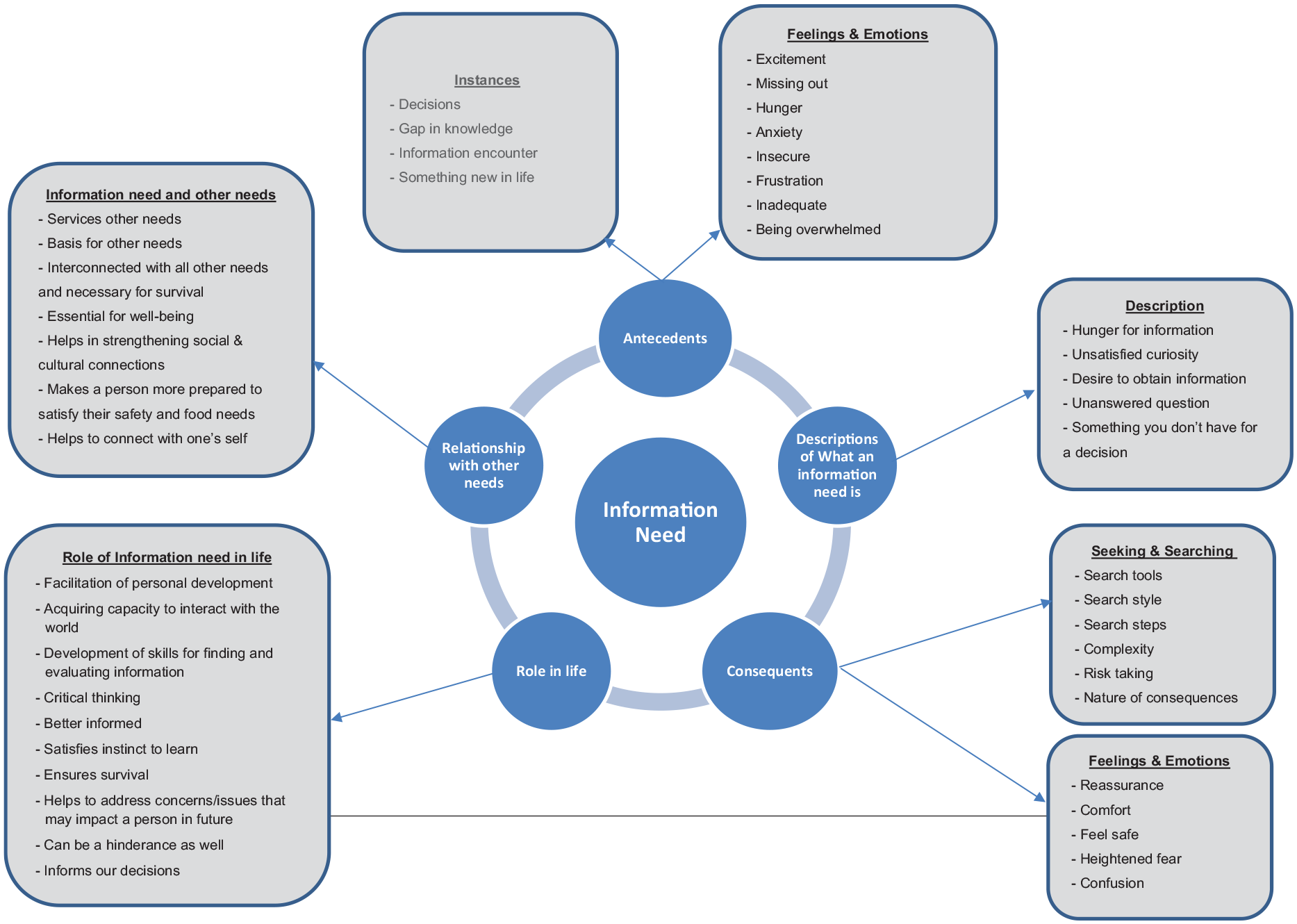
Aspects of the information need concept.
The five aspects in Figure 1 are labeled as (i) antecedents of information need, (ii) descriptions of information need, (iii) consequents of information need, (iv) role of information need in life, and (v) relationship of information need with other needs. Based on what Corbin and Strauss (2008) described, these five aspects can be considered as the overarching explanatory concepts demonstrating the conceptual domain of information need. Some aspects, such as “antecedents” and “consequents,” are represented through two sub-aspects each. Each aspect and sub-aspect is reflected by various descriptors that can be used to know what is included in an aspect and by that extension in the conceptual domain of information need.
Results from focus group session and interviews
Descriptions and explication of information need aspects
The description and explication of these aspects of information need are supported with quotes from the participants in the focus group (FGP) and interviews (IP1, IP2, IP3, IP4), as follows.
Antecedents of information need
The first aspect sheds light on the “instances” that trigger this need as well as the “feelings and emotions” participants have had while experiencing an information need.
Instances
In terms of instances that trigger information need, the participants noted things like “decisions,” “something new in life,” “information encounter,” “gap in knowledge,” “complaints,” and “my world or my situation” as common precursors.
For example, one participant stated that “something you don’t have that you need for decision-making or to inform you what you want to do.. . .” (FGP); “when you want to compare two things, buy something, faced with a problem in life, or have to make a decision – in all of these situations you need information. . .” (IP3). Another participant stated, “Okay, so I just wanted to say that, basically, information need comes when you’re experiencing something new. . ..” (FGP); this view was echoed by another participant as well when they stated that “anything in your life which is a necessity or new will need information” (IP4). The participants also used the notion of my world or my situation to account for spontaneous triggers of information need – “. . .but sometimes you listen to news. . .I don’t know, like cyclone something what does it do with my life [italics added]? So, then it becomes broader and deeper and you just go and do maybe proper information needs. . ..” (FGP). Notions such as a gap in knowledge were also mentioned by participants as instances of information need, “. . .so I’d describe it as an unsatisfied curiosity where you’re curious about something and want to find information . . .a gap in knowledge where you need information to fill a gap in knowledge or a general question or enquiry” (IP1).
Feelings & emotions at the initial stage of information need
Participants noted a wide range of feelings and emotions when they felt a need for information. It is important to note that these feelings and emotions did not have solely negative undertones like anxiety, confusion, or worry. For example, feelings of “excitement” and “being comfortable” were noted as signaling a need for information. The feeling of “missing out” was noted as a sign of needing information when a person was maintaining an active social media life.
Many other feelings and emotions, some noted in the literature, were described, including hunger, anxiety, insecurity, frustration, being overwhelmed, and inadequacy. “I’d be feeling confused, sometimes a little overwhelmed” (IP2); “Well I sort of put it down to feelings or emotions – whether it might be curiosity, simple curiosity; frustration. . .” (IP2); “You might be feeling inadequate to make a decision. . ..” (FGP); “[without information] the task starts to look difficult. . .” (IP4); “. . .you can be hungry for information. . ..” (FGP); “it is a fear of missing out. . ..” (FGP).
Description of information need
Information need was described by some participants in ways identical to the descriptions we find in library and information science literature. Examples include a gap in knowledge, a lack of knowledge, and unanswered questions. However, some participants, presumably while acknowledging the elusive nature of this concept, defined information need as “something broad.” Similarly, the all-pervasive nature of information need also emerged in participants’ descriptions as something that you do instinctively; it is something to inform you and a need for everything.
Examples of information need descriptions are as follows: “Probably the desire to obtain information that you are lacking or to. . . yeah, something like that.” (IP2); “[information need is like] . . .you can be hungry for information. . ..” (FGP); “it is [the] answer to anything that I don’t know already. . .” (IP3); “it is a gap between what I know and what I want to know” (IP4); “I need it [information need] for everything. . ..” (FGP); “information need comes when you [are] experiencing something new. . ..” (FGP). The last two descriptions point to a need that is nested in everyday life and relevant to a broad range of human activity.
Consequents of information need
This aspect is represented by the sub-aspects of (a) seeking and searching for information and (b) emotions and feelings experienced once information need is either satisfied or thwarted.
Seeking and searching
Seeking and searching for information emerged as a very important phase once an information need is activated. Participants mentioned steps such as searching, finding sources during a search, different search strategies, evaluating information for use, and the role of experience and personal abilities while seeking and searching for information. For example, they stated that: “You search. You search for it, yes.” (FGP); “. . .will find means to get information. . .” (IP3); “. . .still you have to have a question and you have to know where to look . . ..” (FGP); “. . .so it is trying to think about what system or where you can got [sic] to get that information that you need. . ..” (FGP).
An interesting observation was that a more relaxed/informal search approach was used when faced with questions concerning everyday life.
I think if you’re doing it, if you’re looking for information in relation to everyday living, or something that’s, I suppose, a mundane activity in your life, it might be mundane but you still need the information. I suppose that’s something that you just do instinctively. . .. (IP1)
However, when faced with problems involving greater complexity and higher stakes, then more formal search approaches were used.
Whereas if it was a need that related to employment, for instance, where it’s a complex need, I suppose. Once again, I suppose that comes down to the complexity and the need. If you need specific detailed information about a job . . . then you may have to search in more detail. . .. (IP1)
The correspondence of search sources with the need at hand came into discussion repeatedly. That is, the importance and complexity of a need influenced the choice of information sources and the steps taken by individuals to evaluate information—the more serious the consequences of using information in satisfying a need, the greater the caution taken by people in evaluating sources of information and then evaluating information for further use. The role of personal abilities as related to the overall seeking, searching, and use process also became evident. Sometimes, a person’s prior experience enabled them to rely on the information they had access to cognitively or to gather it from reliable sources and use their experience to evaluate this information.
Feelings and emotions at the later stage of information need
Many positive feelings and emotions were noted by the participants associated with the later stages of information need. This stage represented instances where a person finds needed information either in their accumulated experiences, encounter it in their information environment, or gather it through seeking and searching in external information sources. Participants voiced feelings of “comfort,” “safety,,” “accomplishment,” “affirmation,” and “being re-assured.” Few negative feelings, associated with the later stage of information need, such as “fear” and “confusion” were also mentioned. A large quantity of and diversity in information was attributed to “confusion” whereas information gathered in response to a risk-laden need led to feelings of heightened fear.
Role of information need in life
The fourth aspect was the role of information need in life and was described at length by participants. Their views reflected a vast role in terms of ramifications ranging from social to personal aspects of life. At the same time, the elusive nature and, hence, largely hidden role of information need was also acknowledged.
Their comments referred to the wide-ranging nature of information need and presented this need as essential—“. . .is informing every other one of your decisions. . ..” (FGP), “. . .it is a basic need. . .it is integral part of life” (IP4); significant—“I think it’s really important in my life. . .” (IP2), “. . .its role is very important, if you don’t get information you will stuck into a problem . . .” (IP3); frequently needed—“. . .I thought I need[ed] it for everything. . ..” (FGP), “. . .whatever activity you will be doing during a day you will need information . . .” (IP4); in service of other needs—“no it [information need] services the other needs” (FGP); helpful in prediction—“. . .if you have adequate information . . .we can 80% predict the outcome. . ..” (FGP); decision-making—“. . .it is a decision-making thing, but it is also an information thing. . ..” (FGP); “. . .you go like to the chemist. . .well hang on is there any more information [I need]. . ..” (FGP).
From a social standpoint, information need was described as central in facilitating interactions and relationships. On the contrary, exposure to negative information concerning a person—while satisfying an information need—was regarded as an important hindrance in getting to know that person more (IP2). The gathered information arguably plays a role in shaping perceptions about a person.
The effects of information need at the personal level also reflected the gradual development of information seeking, searching, and use skills on the one hand and, on the other, depicted the role of information need in a person’s long-term development. For instance, a participant remarked that “It is your basic need and without it your life will come to a halt. . .growth will stop and life will become stagnant. . .” (IP4). Some participants made the point that due to their information needs, they realized how important it is to know where to look for information and how to evaluate sources of information to ensure that quality information is acquired and then used.
Look the impact of my need for information means that I need to know how to research and how to find information and so I have developed those skills and I have developed the skills of being able to assess the quality of the information. . .. (FGP)
Participants voiced the necessity of having certain abilities to ensure that an individual could successfully go through the information seeking, searching, and use processes. For instance, knowing where to look for information, exercising extra care when seeking information for a high-stakes need, evaluating the overall quality of information, and also having skills to apply the acquired information. The participants also recognized the changing nature of the information environment, which is now hyperactive and, at times, overwhelming in terms of the quantity of information that it offers. In this backdrop, time and again, the ability to discern, to recognize high value information, and having a critical mind were considered essential. The role of experience and an individual’s current situation were considered important in the acquisition and further development of the aforementioned abilities in seeking, searching for, and using information.
It’s a job based on information. And it’s very critical that when you’re seeking out policy or procedures or information relating to your work that you get it correct, that you have to be very careful how you use it and how you interpret it. . .. (IP1)
Participants also noted that the effects of information need are not always helpful. For instance, a participant noted that during an Ebola outbreak, the more information they sought, the more fearful they became, while at the same time, they got better informed about a health risk (IP2). Another participant stated that information gathered in response to an information need can lead to confusion and even be slightly deceptive (FGP).
These statements highlight the broad role of information need in life and its rather complex relationship with the social, psychological, and personal aspects of a person’s life.
Relationship of information need with other needs
The fifth aspect helped to illustrate the relationship of information need with other needs. It was almost a consensus among participants that information need services other needs and hence is important. Some participants even considered information need equal in importance to other basic needs, such as food and safety. Information need was recognized as something generally of benefit and important for survival.
“Information satisfies needs in different ways, but I think in some ways, they’re all necessary for survival . . . I suppose. . .” (IP1); “I think information need actually is more important than—you know, is a basis for everything else . . . it’s just so there in our lives .. . .” (FGP); “. . . I guess like the need for food, for instance, it [information need] is beneficial to you . . .and helps your understanding of a certain subject. . ..” (IP2).
Some important observations were made in terms of the similarity between information need and other basic needs. For instance, participants commented that we need diversity in food and like to have variety in our social connections; similarly, we also want to have a variety in sources when satisfying our need for information.
Another similarity was noted involving a condition in which the value of a need is taken for granted or remains largely unrecognized. A person getting their meals day-in-day-out may lose appreciation for the role played by the activation of hunger in their physical well-being—the argument is also true for the activation of information need and its role in satisfying the variety of human needs in everyday life.
. . .food you need it, and it is just a given. . .and we take information needs that same way we take it for granted and it is something that you don’t really think about, it’s something that you do. (FGP)
The effect of information need on a person’s ability to maintain social connections and have motivation was also voiced. An interview participant said, “And once again, I think that might come down to social interaction. Two people sit down and talk about current affairs – you’re not going to know about that unless you’ve sought the information” (IP1). Whereas a focus group participant highlighted the role of information need in personal development along with social connections, “And I think it makes for more social and personal engagement. You get connected with the people, with yourself.” (FGP)
It is a common belief that moderation in terms of satisfying our basic needs is good and excesses can be harmful; participants made a similar observation about information need. The sphere of information need can expand due to unnecessary curiosity whereby a person spends an excessive amount of time browsing information. Excessive acquisition of information in response to an information need can be counter-productive from both social and psychological aspects. A person may end up knowing too many irrelevant things, which may lead to cognitive overload and confusion.
And sometimes I feel that too much information is a bit deceptive at times. . .so much information from different sources. . .well you can get lost in it. . .lost in your own thoughts. (FGP)
Discussion
The five aspects discussed above specify the domain of the information need concept. The description demonstrates the boundaries of this concept, encompassing aspects such as the nature of its instances, the kinds of feelings and emotions experienced at the onset of an information need, the subsequent information seeking, searching, and use practices along with the feelings experienced. Furthermore, the broader role of information need in life and its relationship with other needs are also highlighted.
Description of information need
The work of many library and information science scholars gives us a good idea about the nature of information need. Belkin et al. (1982) described information need as an anomalous state of knowledge, whereas Dervin and Nilan (1986) considered information need as a knowledge gap. These and other descriptions of information need also appeared in the participants’ narratives. For example, the participants identified notions like “unanswered question,” “lack of knowledge,” and “gap in knowledge” as information need. Some unusual descriptions of information need were also noted by the participants including “hunger for information,” “learning need,” and “unsatisfied curiosity.”
After canvassing various descriptions of information need in the literature, one cannot miss the repetition and overlap in these definitions. For example, many definitions that construed information need as a “condition of inadequacy,” “anomaly,” “a difference between two states” all refer to some “gap” that should be filled by getting information. Some definitions consider information need as a “want or desire,” “development of a desire,” “what an individual should have” and all point to a “purpose” underlying an information need. Then there are conceptualizations of information need that characterize this need as a “motivational force,” and “human adaptive mechanism,” alluding to a psychological base of this need. It is therefore safe to say that seemingly very different definitions of information need can be used to arrive at a holistic understanding of this concept, which can be articulated as a gap that arises either due to a desire or a need and produces a motivation in an individual to look for information.
Instances
Instances of information need are those tasks, situations, or problems that trigger this need. These instances are situated in a context that shapes an individual’s everyday life. In addition to the context, a person’s inherent basic needs continue to bring information need into action. We have a need to know, a need to belong, and a need to experience autonomy and competence. Due to these needs, we often desire information to satisfy our curiosity or to develop social connections. We also develop a need to seek information that could affirm our sense of self-worth and agency. It can be stated that instances of an information need will be context-bound and situation-specific; however, some of our basic needs are not like fixed instances that will only be activated at certain points. Instead, they are like water that we need year-round to maintain health and well-being. Need to know and need to belong are good examples of such needs that will require an almost constant, throughout 1’s life, interplay with information need to grow personally and socially.
Feelings and emotions
In terms of feelings associated with information need, we know that anxiety, unease, and frustration have been noted in the literature (e.g. Kuhlthau, 1991; Timmins, 2006). Two important observations are worth mentioning: (1) a broad range of feelings and emotions, in addition to those mentioned in the literature, were described by the participants in this research, thereby enlarging the inventory of feelings and emotions that can be conceptually associated with an information need. These feelings and emotions included confusion, fear of missing out, insecurity, frustration, being overwhelmed, and worry; (2) there was a range of positive feelings associated with an information need, including excitement, elatedness, reassurance, accomplishment and feeling safe. It is important to note that, in this study, information need was felt not only with the so-called disturbing or negative feelings. Depending on the situation and stage of an information need, participants experienced highly positive feelings as well. This finding makes an important contribution to the research on information need because the affective attribute—in the words of Savolainen (2012b)—is rarely considered in conceptualizing information need and there has been a tendency in information science research to focus more on motivational aspects of negative emotions (Savolainen, 2014).
Consequents
Feelings and emotions
Another important finding was the difference in the nature of feelings at the onset of an information need and at the point of its satisfaction or denial. For example, the onset of an information need is associated with feelings of inadequacy, missing out, difficulty, hunger for information, and excitement. Whereas when information is sought and found of value and relevance to the purpose at hand, participants described this achievement with the feelings and cognitive states of comfort, reassurance, and being assured. However, some negative feelings such as heightened worry was also experienced when need for information about an unfolding pandemic was satisfied.
A question arises: why is it that, on the one hand, the feelings of anxiety, confusion, and frustration signal the presence of an information need, yet on the other hand, a very different set of feelings like comfort and excitement signal the presence of the same need? Yet another question can be about the possibility of instances without such explicit feelings and emotions being experienced. The answer may lie in three plausible explanations: (1) it can be argued that feelings and emotions will depend on a situation – so if a person is pressured by time to resolve a need then they may feel anxiety whereas when a person encounters something new they may feel excitement while experiencing a need for information; (2) the nature of a need that is initiating information need in a person will also influence the kinds of feelings and emotions experienced. For example, feelings experienced after satisfying a need for finding information about a new recipe can be very different to the feelings experienced after satisfying a need for finding information about the dates on which a friend will visit; and (3) another argument can be that the stages of onset and satisfaction/denial of an information need will also have a role in evoking certain kinds of emotion and feelings.
Seeking and searching
One can find other connections between the findings above and the research on information need. For example, Savolainen (2012a) proposed that different contexts will impact how information need will be expressed. This interaction between context and information need also emerged in this research. It can be proposed that when participants acknowledged variation in terms of feelings, search tools, and extent of complexity in response to an information need, they pointed implicitly to the impacts of different contexts on information need. The preceding point was reinforced by a study of members of the clergy’s everyday life information needs (e.g. Dankasa, 2016). He found that situation and broader context played an important role in shaping the content of information need (i.e. what kind of information a user wants) and in the ensuing information-seeking behavior.
Role of information need in life
The current study has also provided important insights concerning the role of information need in a person’s life and its relationship with other needs. Information need’s subtle yet key role in life emerged in varied ways, ranging from a need for everything to a need playing a very specific role as an enabler of meeting unanticipated expectations. Information need also prompted—as noted by participants—seeking and searching for information in 1’s inner self. Such information-seeking enables using 1’s past experiences to address a current need. In this way, information need helped a person deeply connect with themselves to access past experiences and associated knowledge. This is an important outcome because connecting to self or gaining self-awareness is a noteworthy factor in developing mindfulness (see e.g. Klussman et al., 2020), which can impact well-being.
Relationship of information need with other needs
Higher-level needs of competence, autonomy, and belongingness and the role that information need plays in supporting these needs surfaced at several places in the findings of this study. Participants noted that their need for information helps them to strengthen their social and cultural connections, to grow physically, emotionally, and personally, and is essential for well-being. These findings provide a theoretical link between information need and higher-level needs proposed by various need theorists. For instance, Deci and Ryan’s (2000) argument that a positive informational environment will be crucial in satisfying needs for autonomy and competence signals the role that need for such information will have in ensuring a person’s long-term development and well-being. Similarly, recalling Maslow’s (1943) statement that “freedom to seek for information” is one of the preconditions to satisfy basic needs and tying it with what participants’ said about the role of information need in servicing all other needs, provides a link between information need and basic needs.
Conclusions, implications, and limitations
The current study attempted to specify the domain of the information need concept. The relevant literature was reviewed and informed by four guiding questions aiming to find (1) how this concept was defined, (2) emotions and feelings ascribed to information need, (3) subsequent processes, and (4) the relationship of information need with other needs. Guided by the literature review, further investigation was done to discover how everyday people view information need and its aspects. Analysis of the resulting data revealed that the conceptual domain of information need can be articulated through five aspects. These are (1) antecedents of information need, including [a] feelings and emotions experienced, and [b] the instances signaling the presence of an information need, (2) descriptions of information need, (3) its consequents, including [a] seeking and searching process and [b] feelings and emotions experienced, (4) the role of information need in life, and (5) the relationship of information need with other needs.
From a theoretical standpoint, this research helps to better understand the concept of information need, which will hopefully alleviate the concerns about the slow progress toward a theoretical understanding of this concept, as mentioned early on by Wilson (1981, p. 5) and acknowledged by Case and Given (2016), Savolainen (2017), and Sarkar et al. (2020). Methodologically, the proposed conceptual specification provides a theoretical context and rich content that can be used to generate questions for empirical validation of the concept of information need. DeVellis (2003) recommended careful identification of the content domain to ensure correspondence between questions and a concept. With this recommendation in mind, the findings of this study can be a steppingstone to empirically investigate the concept of information need.
Research on information need accounts for different feelings and emotions (e.g. Dervin and Reinhard, 2007; Haasio et al., 2020); however, these accounts have mostly documented negative feelings. The current research has noted several positive feelings that participants experienced at the onset and satisfaction of an information need. It will be important to further investigate the affective aspects of pre and post information need to better understand the relationship between positive affect and information need.
Another aspect is feelings and emotions experienced due to information gathered in response to an information need as well as the information produced by the feelings and emotions preceding an information need. This aspect is largely unexplored in the library and information science literature and this study has not shed light on it. However, the participants’ descriptions of the information they get in response to or for an information need and the feelings this information generates raise a question about the informative function of affect. Schwarz (2002) noted that “. . .our feelings serve informative functions” (p. 3) and can influence judgment and choice of processing strategies. So, three questions arise that warrant investigation: (1) what is the informative function of feelings and emotions that we experience pre and post to our need for information, (2) what is the impact the pieces of information associated with feelings and emotions has on cognition and behavior, and (3) can an imbalance in information need lead to irregularities in emotions and feelings we experience?
There is compelling evidence in psychology that needs can be broadly categorized into physiological and psychological needs (e.g. Alderfer, 1969; Deci and Ryan, 2000; see Hull, 1943 for physiological needs; Maslow, 1943; see Murray, 1938 for psychological needs). This body of research also demonstrates that information need—though at times in a very indirect and peripheral manner— is important in satisfying both sets of needs. However, research on information need in library and information science has mostly focused on the role of this need in satisfying users’ specific problems. This approach has helped us to understand the processes users go through to resolve their information problems; however, our understanding of the place of this need in the totality of major physiological and psychological needs is still in its infancy. A natural outcome of this gap is that we don’t clearly understand how information need facilitates the satisfaction of the higher-level psychological needs of autonomy, competence, and belongingness. The preceding gap also leads to another yet-to-be investigated area of the role that information need has in increasing the vitality, well-being, and long-term development of an individual.
We also should not ignore the other side of the coin – that is, an imbalance in information need can also be detrimental. It is well-known in research on human needs that over-satisfaction or denial of these needs can give rise to serious imbalances. For example, Deci and Ryan (2000) convincingly argued that thwarting innate psychological needs will lead to poor motivation, performance, and well-being. Similarly, Yam et al. (2014) noted that deprivation of physiological needs can lead to a myopic state in which an individual will ignore other goals and may engage in unethical behavior to satiate their physical need.
In a thought-provoking article, Bawden and Robinson (2009) noted some of the pathologies—namely, information anxiety and information overload—associated with a large quantity and diversity of information. It can be argued that part of the information overload and information anxiety can be attributed to an imbalanced information need, which motivates a person to seek and search for excessive amounts of information. At the end of their article, the authors note, “But satisfactory progress will depend on a better understanding of the fundamentals of human information behavior, and the ways in which it changes over time. . .” (p. 188). This statement can be used to support the assertion that an imbalance in information need, which is a starting point of human information behavior, will have a trickle-down effect leading to irregularities in information seeking, searching, use, emotions, and feelings.
The findings of this study should be understood and interpreted by considering the following points: (1) Though an attempt was made to include all of the studies relevant to the conceptual domain specification of information need in the literature review, the omission of studies that could have highlighted some other conceptual aspects of information need or shed more light on the aspects already discussed in this study is quite possible; (2) all participants in this study had some level of formal education and were either working or studying. Aspects not mentioned in this study may likely emerge if a set of participants very different from this study provides views on information need; (3) studies with different samples will be important to demonstrate the extent to which the proposed conceptual specification is stable across populations.
Footnotes
Acknowledgements
I would like to thank the participants who contributed their valuable thoughts and time to this research study. This paper greatly benefited from the reviewers’ feedback – my heartfelt thanks to them as well.
Declaration of conflicting interests
The author declared no potential conflicts of interest with respect to the research, authorship, and/or publication of this article.
Funding
The author received no financial support for the research, authorship, and/or publication of this article.
Generative AI use
The author(s) confirm that we did not use generative AI tools/services to author this submission.
