



Abstract
This study used a case study approach to explore how librarians understood lean principles and the extent to which they used these principles to improve their practices. Lean principles have the potential of improving the process in the operation of organisations. The application of lean principles in many organisations, including academic libraries, seems to be limited. Although there is much scholarly communication on the successful implementation of lean principles, no research could be found on the implementation of lean principles in the processes and workflows of creating access to e-resources in academic libraries. An exploratory qualitative case study design within an interpretive paradigm informed this study. A purposive sample of 12 participants was interviewed and the data were analysed, using the reflexive thematic analysis supported by ATLAS.ti 22. The participants were not familiar with lean principles. However, they could articulate their responsibilities of the processes and workflows in creating and managing access to e-resources in their workspaces. The empirical data from the lean waste exercises affirmed that should lean principles be implemented in the processes, and workflows to streamline access to e-resources at the academic library it will enhance the delivery of an excellent customer service. The findings of this study can inform policymakers and librarians on how the implementation of lean principles to the processes and workflows can enhance and streamline access to e-resources.
Keywords
Introduction and background
The trajectory of evolving technological advances, constrained budgets and diverse user information needs demands that academic libraries seek new innovative ways of serving their users. One way of achieving this is through applying business improvement initiatives. There are various business improvement initiatives such as total quality management (TQM), Six Sigma, lean manufacturing, re-engineering, PDCA and 5 s, to name but a few (Salah and Rahim 2019; Zaini and Saad 2019). However, Ahmad et al. (2016) explain that it is imperative to choose the correct improvement method to obtain the outcome of what the improvement is intended to achieve. Lean principles have the potential of improving business processes in an academic library. Powell et al. (2013) observe that lean implementation and enterprise resource planning systems are often quoted as being the two most important strategies for achieving competitive advantage.
Some professionals are not convinced and contend that the methodologies used to streamline manufacturing processes cannot simply be replicated in other industries (Elias 2016). Liker and Morgan (2006) concur, explaining that applying lean principles to service industries is not straightforward, because the work is less repetitive and predictable and not as tangible as in manufacturing environments. Jadhav et al. (2014) argue that practically two-thirds of implementations fail and less than one-fifth of those implemented show sustained results.
However, there is much scholarly literature to be found on the successful implementation of lean principles, as a business improvement tool, in the manufacturing and services sectors (Alefari et al. 2017; Prasad et al. 2020; Sahoo 2020) and at higher education institutions, internationally and nationally (Allu 2019; Hines and Lethbridge 2008; Malange 2013). Lean implementation has been assisting universities to reduce and eliminate non-added value waste in their services and operations (Zighan and El-Qasem 2021). However, Klein et al. (2020) mention that several higher education institutions have not yet explored lean principles as a business improvement initiative.
The goal of the study was to ascertain the degree to which lean principles were applied and adopted as a business improvement programme, using an academic library in South Africa as a case study. Core to the lean philosophy is the principle that anything that does not add value to the final product or service for the end customer is wasteful; and should therefore be a target for elimination. The philosophy could be applied to every sphere of human activity, including the management of library systems. To instil lean thinking in one’s everyday activities, irrespective of work or home, would require adopting a culture change of applying lean principles in everything. Initially, such changes could be tiresome. However, as the new simple yet effective steps become a habit, everyday living becomes simpler, less demanding, and more productive.
Problem statement
As with universities, academic libraries are facing complex and overwhelming challenges in delivering streamlined services compounded by technological innovation and budget constraints (Ashiq et al. 2021). For instance, the delivery of e-resource products and services necessitate seeking new ways of implementing continual changes to remain relevant, cost-efficient, and current in serving users’ information needs. When it comes to balancing resource constraints with the demand for smarter ways of working, the notion of lean principles provides a good fit for this work-based problem. The purpose of the research study was to explore how lean principles could enhance the processes and workflows of e-resources to ensure seamless access at the Nelson Mandela University (NMU). The question was: How do participants understand and use lean principles?
Literature review
During the 1970s, Toyota management realised that the production of cheap and poor-quality products was the result of too many unnecessary workarounds in their service supply chain, too many delays, too many imbalances and too many obstacles (Huber 2011). Lean manufacturing principles were introduced to improve the Toyota Production System (TPS) (Mund 2011). Although lean practice originated in manufacturing, its core beliefs are found across various kinds of enterprises and are applied in diverse ways (Coetzee et al. 2019; Jedynak 2015). Moreover, Gaza (2011) stresses that lean principles need to be implemented on every level in the organisation and require a complete transformation of the current business system.
Scholarly works are saturated with the significant role lean principles play in driving efficiency across organisations; impacting increasing customer satisfaction; reducing costs; reducing lead time and enhancing sustainability (Hanken 2011; Novak and Zwiercan 2015; Pillai et al. 2014; Thomas 2015; Van der Merwe 2011). Increasing global competition is forcing organisations to find more efficient and flexible means for managing challenges and meeting ever-increasing customer expectations and requirements (Yadav et al. 2017). Orelia (2020) argues that problems are not solved by adding resources, problems should be eliminated instead so that fewer resources are required and then the excess resources can be used to improve customer services.
Businesses and organisations in the service sectors are constantly under pressure to deliver an excellent customer service with faster response times and valuable support. Customers play a much more active role in service organisations than in manufacturing sectors. Simultaneously, a highly diverse customer environment makes the application of lean principles increasingly challenging. It is important to understand that lean implementation is a journey, not a destination. Hence, Martensson (2017:8) points out that, depending on the scope and service sector, “full implementation can be reached in five to 10 years and the application of lean never ends.”
Numerous studies in a South African context have been conducted in the manufacturing and services sectors (Bruinders 2021; Burcu 2019; Erasmus 2020; Govender and Jasson 2018; Grewan 2019; Katts 2021; Marshall and Thesis 2018; Naidoo 2021; Smith et al. 2018), to name but a few published in the last 4 years. In South Africa, lean principles have been successfully implemented in blended learning, as an instructional strategy (Marshall and Thesis 2018) − leadership behaviours for employee engagement (Grewan 2019); game-based learning (Burcu 2019); the impact of uniquely African traditional leadership principles (Katts 2021); and small and medium enterprises operating in the IT sector (Torri et al. 2021).
Balzer (2020) confirms that implementing lean principles as a problem-solving framework and management system to increase the value and performance of university processes can dramatically improve the effectiveness of their institutions. There are several factors to consider including viewing lean as a quick fix, a lack of process thinking and process ownership, a lack of visionary leadership and a lack of understanding the voice of the customer (Antony et al. 2012). Petrusch et al. (2019) further suggest that systems and organisational processes at universities are usually less efficient than they should be; and that the elimination of waste requires a systematic approach, yet virtually no study deals with this problem in academic literature (Al-Aomar and Hussein 2019). The same can be said about academic libraries serving the strategic goals of their institutions. Nelson (2016) advocates that lean principles offer specific strategies to organisations of all sizes and types, such as libraries, in building strong ethnic customer service, focusing on responding to user information needs.
Nelson (2016) affirms that the goal of a lean organisation is to deliver more services faster and with excellent quality to library users, online visitors, staff and the wider community. To achieve this, academic libraries must initiate projects to drive change (Huber 2011). Lean principles may enable libraries, specifically academic libraries, to better respond and adapt to changing technological demands from users while maximising employees and resources under static or declining budgets (Nelson 2016).
Identified lean waste in a library environment.
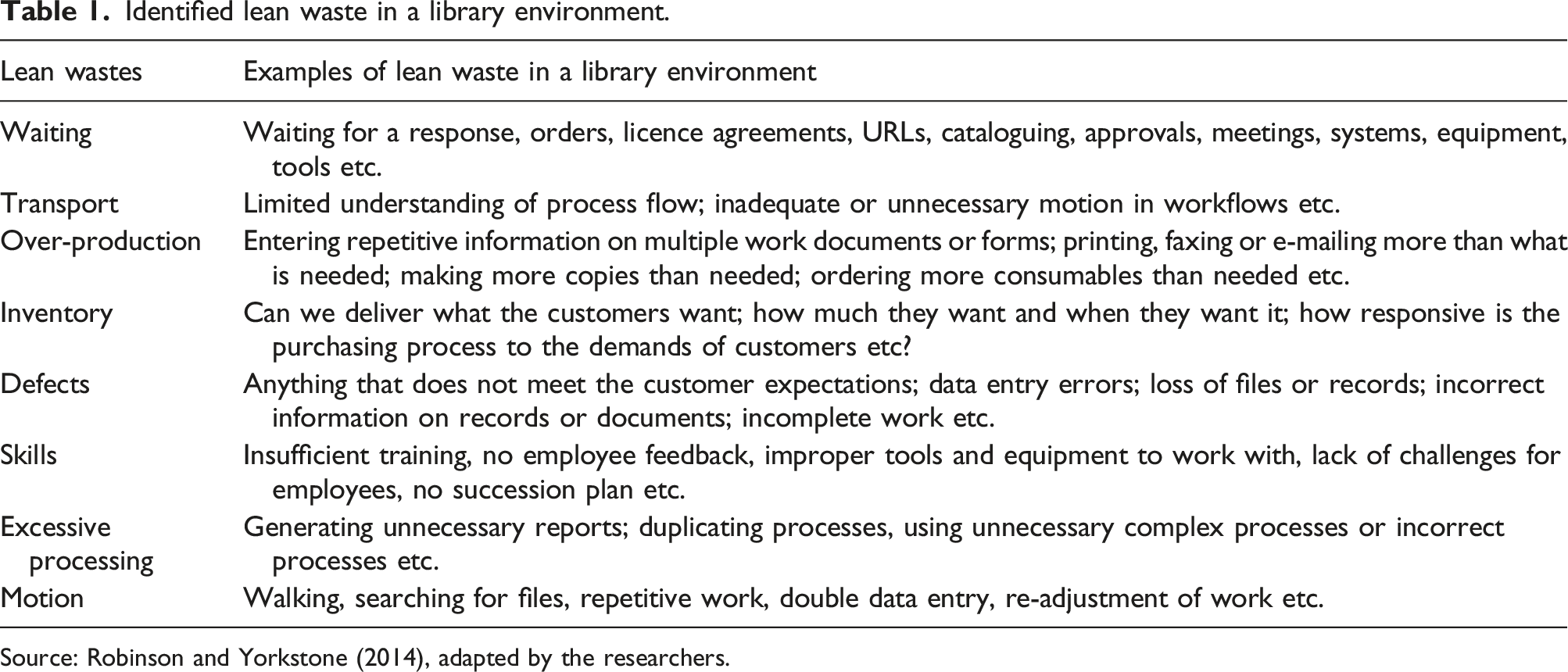
Source: Robinson and Yorkstone (2014), adapted by the researchers.
In conclusion, Yeh et al. (2021) believe that because academic libraries are considered public service providers, the susceptibility to waste such as duplication, excessive amounts of guidance, handoffs, rework and unnecessary actions to obtain authorisation, and the lean concept of over-burden is specifically relevant. The authors further mention that there is a common misconception that eliminating lean waste will result in job losses; and those that believe this, do not keep in mind that the core purpose of removing the waste from essential service activities is to make jobs easier, more efficient and more effective to ensure increased employee engagement and greater long-term benefit to institutions (Yeh et al. 2021). Lean implementation success hinges on workers actively participating in problem-solving and process improvement efforts for the sake of reducing waste, increasing productivity and flexibility, and enhancing quality (Bhasin and Burcher, 2006).
Methodology and data analysis
An exploratory qualitative case study in an interpretive paradigm was adopted for this research study. The intention of exploring was to gain insight and knowledge on how librarians understand lean principles by looking through a qualitative lens. This was further explored by means of lean waste exercises in which participants had to identify any form of lean waste in their workspaces, as outlined in table 1 with possible solutions on how the waste could be mitigated.
Flowchart used for the lean waste activities.

Source: Author’s own compilation, from process flow diagram by Malanga (2013).
Key symbol guide.
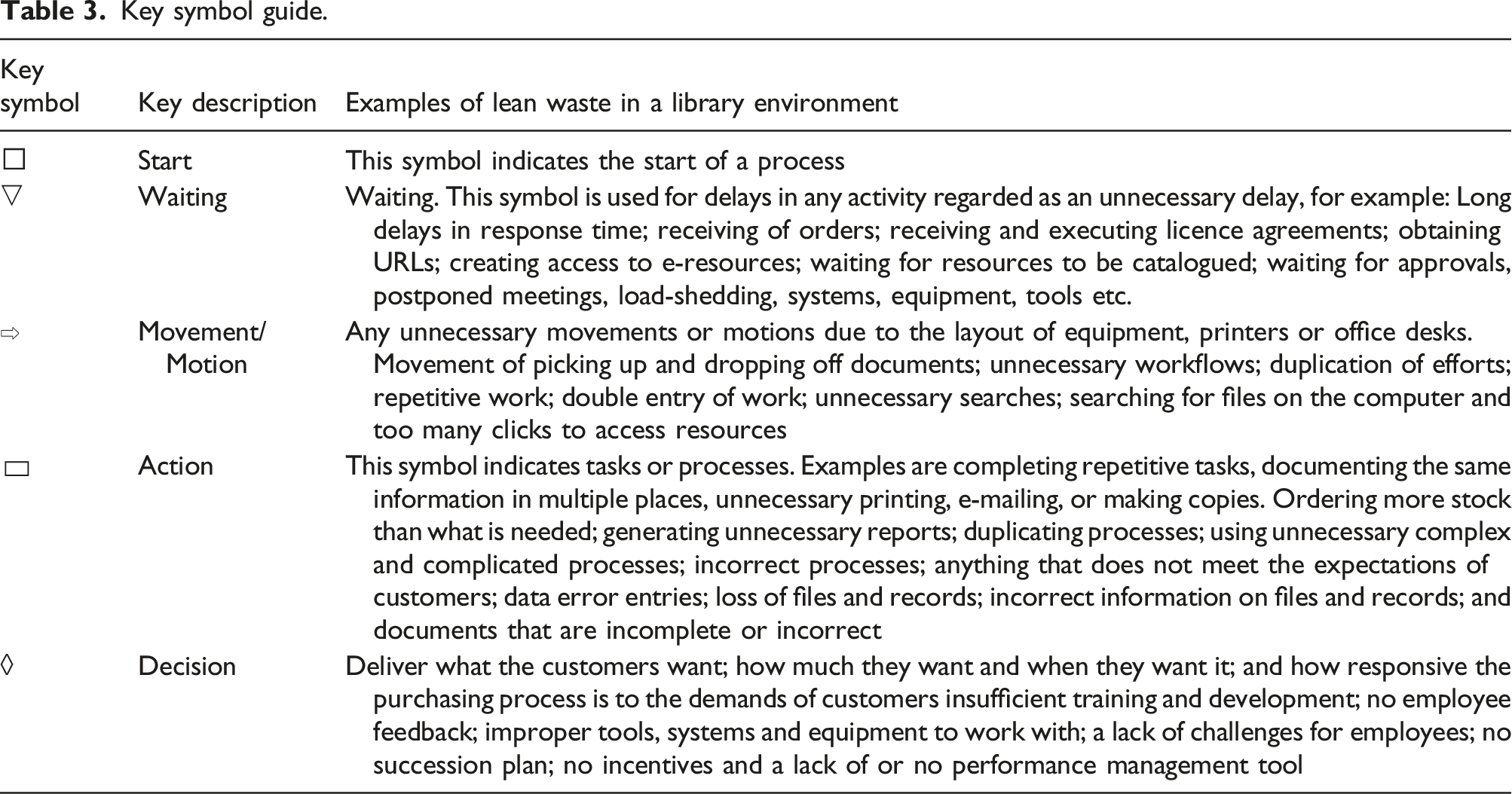
The flowchart illustrated the steps, department, flowchart symbol, process details and sequence of each step. The reason for using a flowchart as a data collection instrument for the lean waste exercise was the visuality the chart presented. The participant could select more than one lean waste in a step, and it was an easy way to follow the process from start to finish.
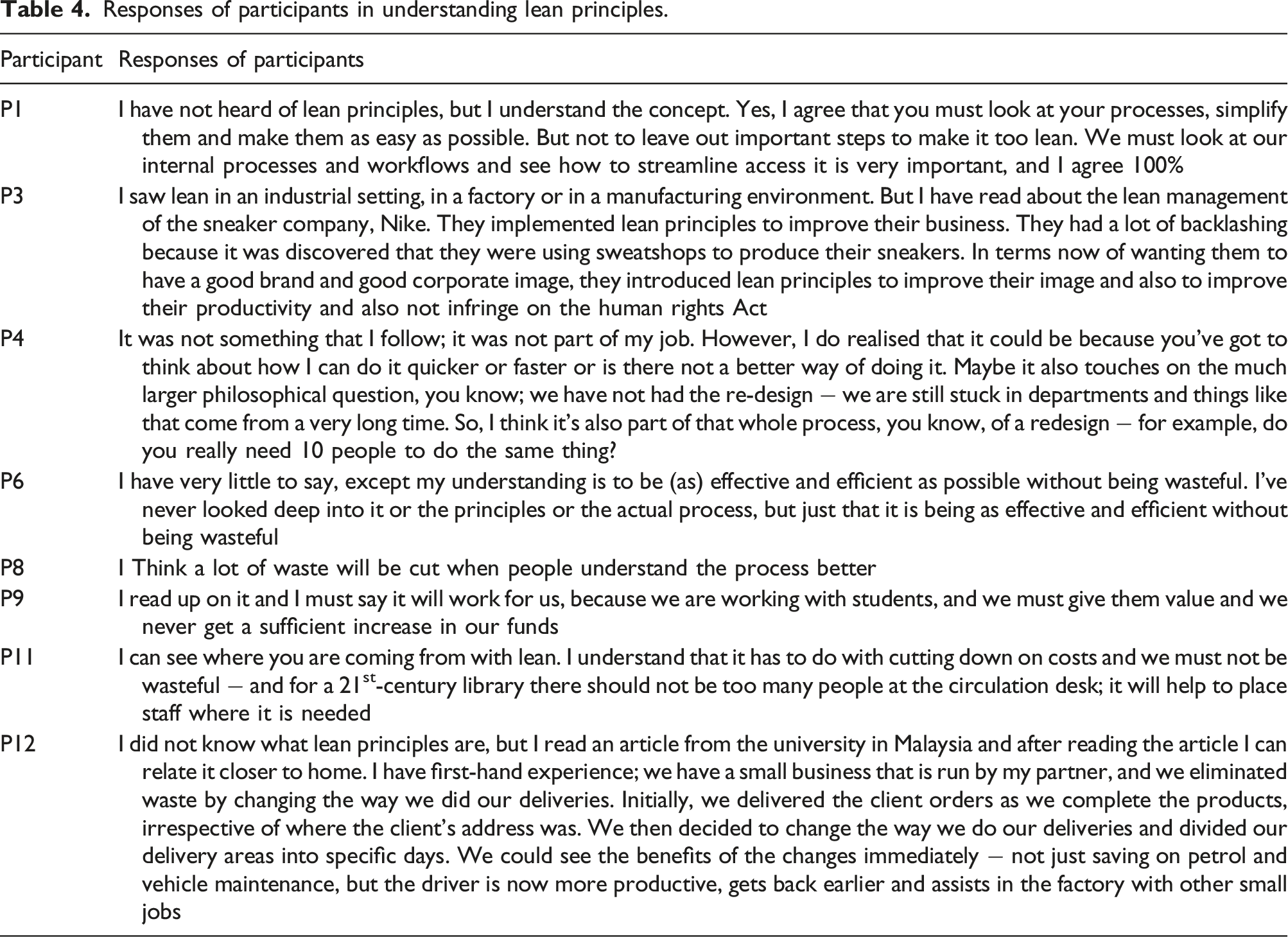
Responses of participants in understanding lean principles.
Presentation of findings
The researchers noted the positive attitudes of participants towards lean principles. Although the participants were not familiar with the concept, as demonstrated by their responses in Table 2, they could articulate their responsibilities of processes and workflows in creating and managing access to e-resources in their workspaces. More importantly, by applying Table 1, they could identify possible lean waste, not only in their processes and workflows, but also in the value chain of accessibility to e-resources.
The researchers employed ATLAS.ti software for this research study in support of Braun and Clarke’s reflexive thematic analysis (RTA) (2022) to assist with the coding. Figure 1 is the ATLAS. ti network view, conceptualising the participants' responses by connecting the data in a visual diagram. Perceived acceptance and utilisation of lean principles as a business improvement initiative.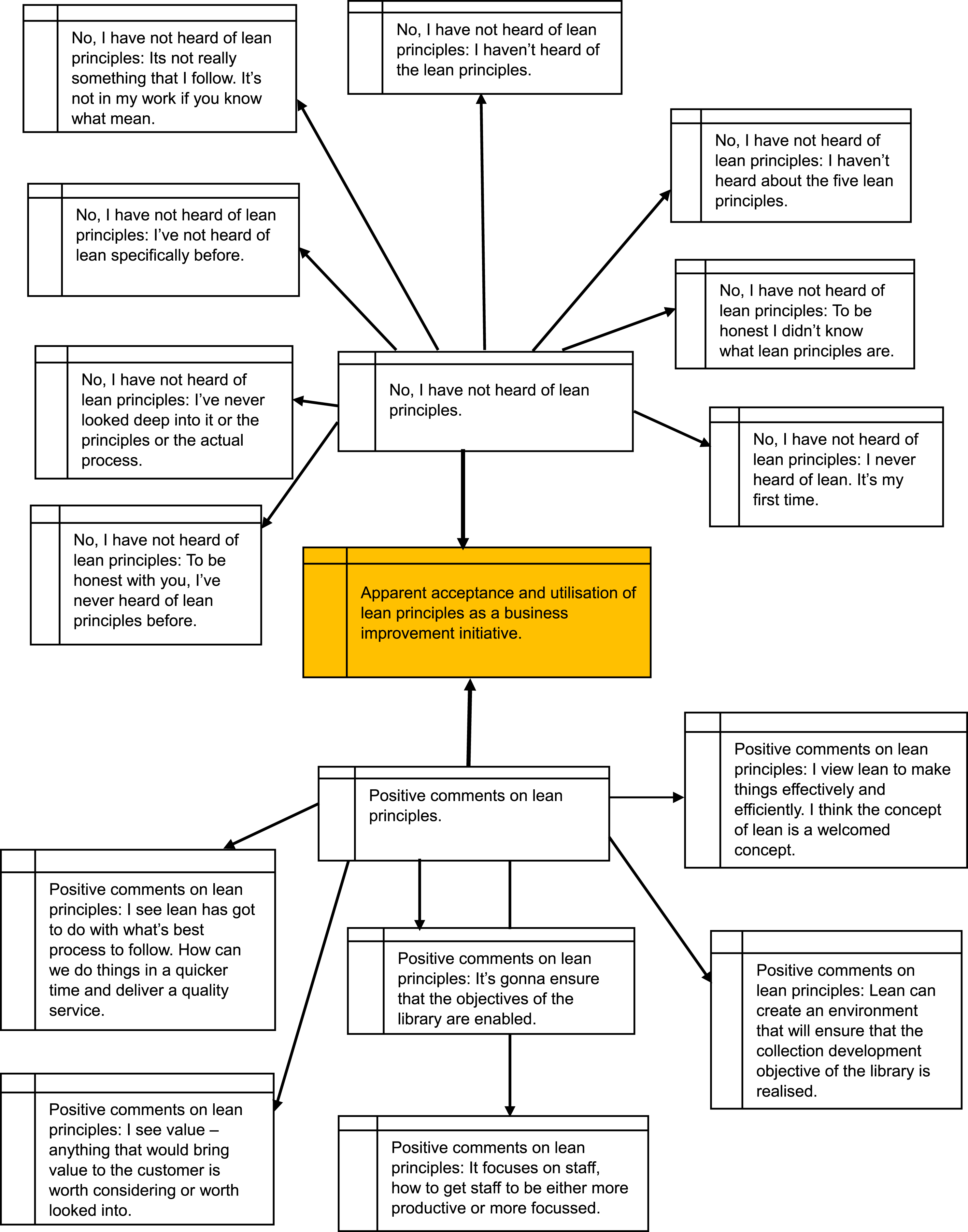
Discussions
All the participants indicated that they have never heard of lean principles before, yet they showed genuine interest once they read the introduction to the topic that accompanied the invitation to participate. One of the participants could immediately relate to the concept and how it benefitted the business financially and improve customer satisfaction, after reading a research article on lean principles.
The data indicated that all new orders placed with publishers or vendors were requests the ERM Department received from lecturers or heads of departments. This is indicative of the lean principle of pull, where the information needs are procured at the right time and in the right quantities, based on actual need. Another example of the principle of creating flow was when a participant mentioned that the first step of a single-titled e-book request needed to be streamlined. According to the respondent, there were unnecessary delays in waiting related to new requests received from the faculty librarians. The lecturers use the online request form on the NMU library portal to order or place requests for new e-books. The online request form is on SharePoint. As a website-based collaboration system, the web administrator at NMULIS oversees and manages the SharePoint system.
The acquisitions team has on many occasions experienced non-receipt of online requests when lecturers query the status of their requests. The participant felt that a new script should be written for SharePoint for placing orders to create a better flow that is more transparent and streamlined to include all the stakeholders in the value chain. The participant is currently in the process of setting up meetings with NMU ICT in this regard.
Another example of the lean principles of value stream and creating flow could be found in the processes and workflows of a single-title perpetual access e-book. One of the participants felt that checking with the various publishers, vendors and access management platforms for availability, pricing and access models is time-consuming. The participant mentioned that there is currently an investigation underway, seeking alternate ways of managing the acquisition process. Moreover, “the idea is to automate the ordering process in collaboration with NMU ICT to find the best product within the institution.”
A participant from the cataloguing department identified lean waste in unnecessary movement and action. The participant mentioned receiving email requests to download bibliographic records. However, since COVID-19 and one of the new ways of working remotely, spreadsheets were introduced and placed on SharePoint. The participant felt it is unnecessary to send an email if the information required is also on the spreadsheet, centrally extractable from the SharePoint portal. What the participant would prefer is that the request is rather accompanied by the URL of the e-resource. This would allow the cataloguer to open the link on the e-resource and view the title page, ensuring that the correct bibliographic record is downloaded, thereby saving time and eliminating unnecessary errors. One participant mentioned that some publishers delay access by sending URLs only three to 4 days after the order was placed. Library management must also review the 360Core discovery platform because it is very slow; it sometimes it takes 15 min to profile one e-book, the response elaborated.
Apart from the similarities of the processes and workflows of single-titled, e-books and e-journals, as previously stated, a participant mentioned that e-journal requests are only received by email. The participant felt that requests for e-journals should also be made online, using the request form because in most instances the information in the email is either incorrect, insufficient or incomplete. This complication results in e-mails going back and forth until the information required is correct and sufficient to forward the request to the publisher or vendor. “This way of doing things is not right − it delays the process and access for the user. Going forward, I think single-title e-journals should follow the same route as the e-books, using the online form on the library website. This will eliminate the lean waste of unnecessary movements and waiting.”
Another instance of lean waste a participant pointed out is the waste of action. The participant mentioned that the lack of training on how to create contact and resource records is a waste and could be eliminated if the permissions to do these tasks had been granted. The participant stated: “I know I am only assisting in the ERM department, but I have now been helping in the department for a while and I would like to take the process from start to finish.” The participant felt that understanding the complete process would contribute towards staff development.
Another clear indication arising from the data was the lean waste involved in the licensing phase of a database. The process of obtaining approvals and signatories to licence agreements were done manually. The number of product signatories required for the approval and sign-off on the licence agreements amounted to six, sometimes seven, depending on the cost involved. During COVID-19, e-mails were used as a mode of routing documents between stakeholders. This method was time-consuming, work-intensive and had no alert system or track and trace capabilities. A project was initiated by the ERM Department for a more sustainable method, which resulted in an interim solution of using AdobeSign. In 2023, a new automated Document Management System will be installed by NMU ICT. This system will have end-to-end capabilities in facilitating the workflow and allowing for trusted digital embedded signatures and a central storage of the licence agreements in the digital environment. Through automating the licensing process, the steps of the processes and workflows will be reduced from seven to three; thus, eliminating four steps from the original plan.
During the lean waste exercises, data revealed that everyone could identify areas of improvement across all the various lean waste key guides. Furthermore, the implementation of lean principles is not a one-off process − processes and workflows require continuous improvement and regular updates to stay current and relevant, thereby reaching the fifth lean principle of “perfect”. In turn, once perfection has been reached, the first lean principle of customer value is realised. The intention of the five lean principles would then be achieved through eliminating waste.
Roslin et al. (2019) stress that employees play a pivotal role in implementing lean principles. For the implementation to be successful, Van Assen (2021) emphasises the importance of staff empowerment and involvement. Hines et al. (2011) state that, dedicated and willing staff are required as a prerequisite for lean implementation to be successful. Data findings indicated that the culture of the staff and their willingness and perseverance in delivering an online library service without professional training, speak volumes about the calibre of the NMULIS staff. They are acutely aware of what their roles require of them as custodians to integrate the know-how and skills to implement ICT. They could point out exactly where lean waste occurs; the actions causing the waste; and how supply solutions could be mitigated, in most instances.
Unfortunately, due to the vacancies in the ERM and the non-participation of The South East Academic Libraries System (SEALS) departments, the researchers believe that more lean waste could have been identified. Nonetheless, the fact that lean wastes of start, waiting, action, movement/motion, and decision have been identified, as well as solutions, such as automation and optimisation tendered, the research results led to the firm conclusion that, the implementation of lean principles can enhance access to e-resources without a doubt.
Conclusion and recommendations
Libraries continue seeking new ways of adapting to continual technological changes to stay relevant, cost-effective and user-centric. Lean implementation success hinges on workers actively participating in problem-solving and process improvement efforts for the sake of reducing waste; increasing productivity and flexibility and enhancing quality (Bhasin and Burcher, 2006).
Although all the participants acknowledged that they never heard of lean principles before, they showed genuine interest once they read the introduction to the topic that accompanied the invitation to participate. The data findings indicated that the culture of the participants and their willingness to participate, speak volumes about the calibre of the participants. This study showed that the NMULIS staff were eager to participate in the study and voice their opinions. The study also showed that the participants were hungry for change; and indicated that if lean principles were to be implemented in the processes and workflows when creating and managing e-resources, it would enhance access at NMULIS. Furthermore, empirical evidence indicated that the participants were knowledgeable and skilled in their line of work. They were able to point out exactly where lean waste occurred; the actions that caused the waste; and, in most instances, provided solutions as to how it could be mitigated. Hence, Roslin et al. (2019) stress that employees play a pivotal role in implementing lean principles.
The current research was conducted as a single case study. NMULIS is part of a consortium that shares systems, tools and bibliographic records. A suggestion for further research is for members of the various South African consortia to conduct a similar study. This will also assist with the current dearth of literature on the application of lean principles in academic libraries in a South African context and on the application of processes and workflows in creating and managing access to e-resources globally in contributing to building theory.
This study recommended that NMULIS seek more clarification on understanding the challenges and implications of the utilisation of lean principles as a tool in streamlining access to e-resources to craft a strategic trajectory that will underpin a structure with a meaningful implementation plan. Additionally, an assessment or investigation into the effectiveness and efficiency of the current systems and tools play a huge role and can negatively impact the outcomes, should lean be implemented. Lastly, the library management should develop a clear strategy on lean principles as a business improvement tool, because it will reduce the anxiousness and apprehension about lean principles, should management consider implementation.
Footnotes
Declaration of conflicting interests
The author(s) declared no potential conflicts of interest with respect to the research, authorship, and/or publication of this article.
Funding
The author(s) received no financial support for the research, authorship, and/or publication of this article.
