



Abstract
In this annual review article, we revisit the relationship between ethics and entrepreneurship, one that has hitherto been framed in the field using paired conceptual opposites: normative versus descriptive, intrinsic versus extrinsic or retrospective versus prospective approaches. Using the categorical clarity offered by these binary pairings, studies have explored how entrepreneurs act for the good or ought to act; whether new ventures possess inherent worth, or if and how they contribute to society; and how to evaluate ventures normatively, whether in hindsight or by envisioning desirable futures. While acknowledging these insights, we advocate a critical engagement with these binaries. To this end, we inquire into how studies have twisted and threaded these binaries into one another, complicating the patterns and bringing the binaries into uneasy but also productive proximity with one another. We follow this with a discussion section where, in light of the review, we propose three vectors along which future studies of ethics in entrepreneurial life might move: from moral certainties to ethical otherness; from a third-person distance to a second-person scrutiny; and from the generalising of theory-building towards studies of everyday practices. In making movements along these vectors, we argue, studies would develop an awareness that ventures qua ventures are inherently ethical, insofar as the dilemmas, challenges and opportunities associated with ‘doing good’ and ‘doing the right thing’ are immanent to their flourishing and that of others.
Introduction
There has been a resurgence of interest in the ethics of entrepreneurship (Bosse et al., 2023; Cordasco, 2024; Hughes, 2022; Lee, 2020; McVea and Dew, 2022; West, 2024; Zankl and Grimes, 2024). In part, this interest has been sparked by the recent moral ‘failings’ of high-profile entrepreneurs, motivating researchers to revisit the ‘dark side of entrepreneurship’ (Garud et al., 2025), as well as by an emerging recognition that normative concerns related to social and environmental challenges are integral to new venture creation: in confronting and shaping futures, venture activity affects the well-being of natural and social, as well as commercial, life (Anderson and Smith, 2007; Hägg et al., 2024). Moreover, as entrepreneurs create ventures that address current problems, the new solutions they offer might also create new problems and exacerbate existing ones, leading to questions about how to balance the desirable and undesirable effects of entrepreneurship (Zankl and Grimes, 2024). For example, while start-ups developing new AI technologies address problems of knowledge capacity by having algorithms predict internet text, new ethical challenges emerge such as the erosion of human autonomy as users are subjected to perpetual market surveillance, heightened job anxiety associated with role redundancy, and significant increases in energy consumption. Against this backdrop, we revisit the dynamic and plural relationship between ethics and entrepreneurship by reflecting on current research and discussing possibilities for further exploration. While there are already systematic literature reviews on ethics and entrepreneurship that provide a comprehensive overview of existing research (Uriarte et al., 2024; Vallaster et al., 2019), there is room for further engagement that situates normative questions more centrally in new venture creation. To date, discussions on ethics and entrepreneurship have taken place within two distinct fields – business ethics and entrepreneurship studies, respectively. However, we see considerable potential for bringing these fields into closer dialogue.
An encounter with business ethics research encourages entrepreneurship scholars to consider the wider value-producing effects of entrepreneurial activity, along with the inherently ethical aspects of new venture creation (Anderson and Smith, 2007; Cordasco, 2024; Hägg et al., 2024). Conversely, while several philosophical traditions have dominated the business ethics debate, including deontology (Hägg et al., 2024), utilitarianism (Cordasco, 2024) and virtue ethics (West, 2024), entrepreneurship research highlights the normative dimension of the entrepreneurial goal of creating a future that differs from the present (Harmeling et al., 2009; McVea and Dew, 2022), potentially opening new perspectives for the study of business ethics. As Islam and Greenwood (2021: 3) argue, ‘ethics has a fundamentally “imaginative” character, because it is about understanding not only how the world is now, but how it might become’, suggesting that ethics itself has an entrepreneurial character. Bringing these fields together, therefore, elicits reflection on the ‘moral space of entrepreneurship’ (Anderson and Smith, 2007) as a catalyst for advancing both fields, especially for understanding how entrepreneurs imagine alternative futures in ethically salient ways (Harmeling et al., 2009).
We argue that closer alignment between ethics and entrepreneurship can be facilitated, first, by recognising various binaries threading the existing literature, and second, by transitioning beyond these categorical distinctions. While neither denying nor collapsing these distinctions, we seek to hold them in view as a multiple, as if along woven vectors. This allows for a more nuanced, critical reflection concerning the limits of these binaries as they appear within the texture of entrepreneurial life. Hence, rather than treating ethics as a normative layer added to existing conceptual categorisations of entrepreneurial life, we propose ways of understanding how ethics appears within the very practice of new venture creation. To do so, we highlight three shifts in emphasis that studies might undertake: acknowledging the tension between invoking general moral principles and admitting ethical otherness, extending studies from third-person to first-person perspectives and finessing theoretical structure with situational, practical experience. By outlining these three vectors, we highlight not only the normativity inherent in the process of new venture creation and the multiple ways ventures might ‘do good’ and ‘do the right thing’ (Markman et al., 2016; Shir and Ryff, 2022; Spence and Rutherfoord, 2001), but also how this good is itself riven with concern for human flourishing.
Why ethics and entrepreneurship?
Since there are no settled definitions of either ethics or entrepreneurship, understanding their relationship depends on their conceptual framing. Within entrepreneurship, there has been considerable debate following Shane and Venkataraman’s (2000) influential call for research to focus on how entrepreneurs identify, evaluate and exploit opportunities, understood as market failures that enable the introduction of new products, services and production methods. Recently, there has been an increased focus on how entrepreneurs act prospectively to create new ventures (Shepherd et al., 2021), understood as organised activities aimed at delivering new products or services to potential consumers (Davidsson, 2023), while facing uncertainty. While conditions such as prevailing needs, access to resources and available technologies must be in place for entrepreneurship to be possible (Ramoglou, 2021), an opportunity here denotes an imagined venture offering novel products or services that enable a desired future for entrepreneurs and stakeholders (Dimov, 2020; Ramoglou and McMullen, 2024).
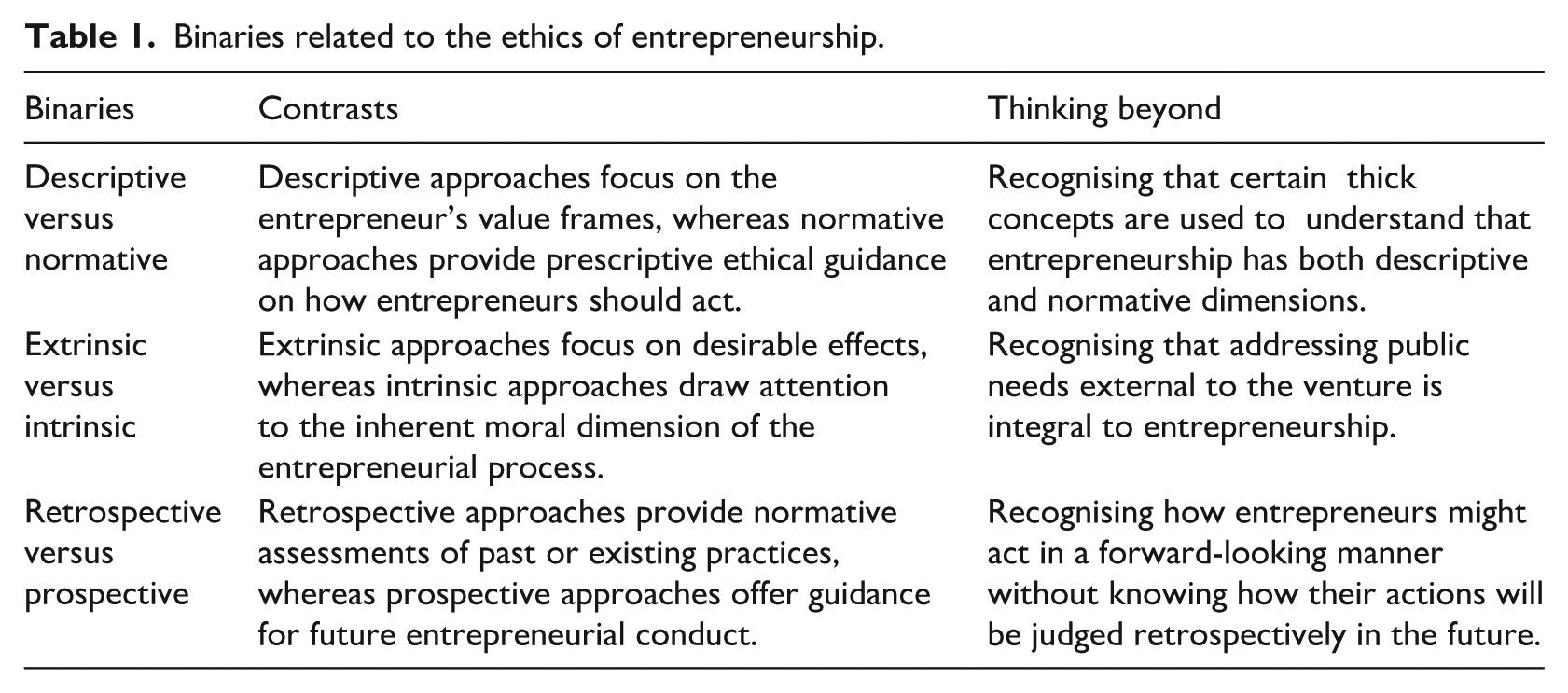
With regard to entrepreneurship, studies explicitly considering ethics - discussions centre around three prevailing binaries: descriptive–normative, intrinsic–extrinsic and prospective–retrospective. We take each in turn (Table 1).
Binaries related to the ethics of entrepreneurship.
Descriptive–normative
Descriptive approaches focus on an entrepreneur’s own value frames, whereas normative approaches provide prescriptive ethical guidance on how entrepreneurs should act (Vallaster et al., 2019). Descriptive approaches tend to start with the moral convictions held by entrepreneurs and then explore the extent to which they compromise or remain consistent with them (Baron et al., 2015), compare the entrepreneur’s moral values with broader, prevailing values (Bucar et al., 2003; Payne and Joyner, 2006), or examine how moral norms legitimise entrepreneurship in society (Kibler and Kautonen, 2016). For example, Drover et al. (2014) show that the ethical reputation of venture capitalists (VCs) influences the willingness of entrepreneurs to accept their investment, although fear of failure, such as potential bankruptcy, may make them more inclined to partner with VCs with questionable ethical reputations. In contrast, normative approaches invoke the values, duties and codes to which entrepreneurs ought to be morally bound, regardless of actual conduct. Examples of such normative standards are Kant’s (1998) ‘categorical imperative’ (Hägg et al., 2024), Korsgaard’s (1996) modified version of Kant’s imperative in the form of ‘practical contradiction’ (Hughes, 2022), or, in contrast to Kant, the utilitarian principle of ranking actions according to the net benefits and harms they produce (Rutherford et al., 2009: 955). Using these moral principles, scholars can judge business practice; for example, labelling rule-breaking as morally indefensible (Hughes, 2022) or arguing that lying can be justified from a utilitarian perspective if the benefits outweigh the costs (Rutherford et al., 2009: 960). From a normative perspective, the justification of gain has also been debated, such as Kirzner’s (2019) argument that entrepreneurs are morally entitled to the profits – arbitrage gains that arise from the discrepancy between current and future prices or other sources of information asymmetry (Kirzner, 1997, 2009) – that they attain from their attention to market failures. Contrary to Kirzner, Lee (2020) suggests that entrepreneurs should distribute the rent generated beyond the compensation for invested capital and labour to other market participants, as this rent is generated by a collective effort within the market process.
Werhane (1994: 179), however, argues that normative and descriptive approaches cannot be completely separated, in large part because ‘some terms escape [. . .] careful separation of the normative and the descriptive’. Werhane is referring to what Van Der Linden and Freeman (2017) call ‘thick concepts,’ which are terms that simultaneously describe and evaluate, where descriptions depend on appropriate evaluations. For example, the concept of ‘liar’ describes someone who tries to deceive others by telling untruths. However, some forms of deception do not deserve this pejorative term. The undercover police officer, for example, would not normally be called a liar, even though their behaviour may be empirically indistinguishable from that of a fraudster who would be so called. Similarly, Harris and Freeman (2008) reject the separation thesis that facts and values can be kept apart, arguing that normative values are so embedded that descriptions are inevitably skewed by value commitments, and normative principles are invariably experienced as situationally contingent. We return to this point below.
Intrinsic–extrinsic
Beyond the contrast between normative and descriptive approaches is the binary pairing of intrinsic versus extrinsic. Extrinsic approaches focus on the desirable effects (e.g. job creation, social welfare) and negative consequences (e.g. environmental externalities or income inequality) of venture activity, regardless of the moral beliefs held by entrepreneurs (Venkataraman, 2014; Zankl and Grimes, 2024). Famously, Baumol (1996) distinguishes between productive entrepreneurship, which provides goods, services and technologies that improve the overall quality of life and drive economic growth; unproductive entrepreneurship, which involves the redistribution of existing wealth without adding value to the economy; and destructive entrepreneurship, which has a negative impact on society (Young, 2022). Baumol’s main concern is the normative institutional frameworks – the rules of the game – that promote productive entrepreneurship (Antony et al., 2017; Minniti, 2008).
Extrinsic approaches often invoke venture effects to distinguish morally justified from unjustified entrepreneurship. However, Shepherd et al. (2024) complicate a strict distinction between ethical and unethical entrepreneurship: entrepreneurs might encounter ethical dilemmas, leading some to compromise their own moral codes by cutting moral corners, thereby operating in grey zones (see also Spivack et al., 2025). Similarly, some entrepreneurs might cause harm to others, despite good intentions, because they are unaware of, naïve about or unable to assess the range of possible effects resulting from their actions (Shepherd et al., 2024). Moreover, the focus on problematic consequences of entrepreneurial activities raises questions about whether these result from ‘bad apples’ or ‘bad barrels’ – a further binary of agent and context that can be challenged by paying attention to the relational and reciprocal quality of interactions between entrepreneurs and their environments (Spivack et al., 2025). In contrast to extrinsic approaches, which focus on the outcomes of new venture creation, intrinsic approaches draw attention to an inherent moral dimension of the entrepreneurial process (Harmeling et al., 2009; Harris et al., 2009). For example, Buchholz and Rosenthal (2005) suggest that responsiveness to market needs and creativity in the entrepreneurial process involve the formation of normative conceptions focused on improving the lives of others (see also Harris et al., 2009). Cordasco (2024) suggests that an inherent ethical value of entrepreneurship is to provide ‘experiments in living’: entrepreneurs can express their subjective moral beliefs about what is good in practice and thereby, autonomously carry out a life plan by building a business that benefits society.
Many of these arguments are grounded (often implicitly) in Schumpeter’s (1994) characterisation of the entrepreneur as stubborn, wilful and assertive, even in the face of disapproval and indifference; capable of an altered way of sensing and seeing things; and emotionally as much as rationally implicated in trading activity. In this characterisation, Schumpeter was attempting to differentiate the entrepreneurial from purely technical development on the one side (which can be awfully dry and repetitive) and invention on the other (which can be wildly erratic). Entrepreneurship, somewhat akin to an ancient virtue, occupies a golden mean: it is passionate but without the délire, and it is organised but without bureaucratic rigidity. Under its imperative, ideas become practised, and practices are gathered into new organisational forms (Hjorth and Holt, 2022).
Retrospective–prospective
Finally, scholars have also distinguished between retrospective and prospective approaches to entrepreneurship (Bosse et al., 2023; Cordasco, 2024; Hägg et al., 2024). Retrospective approaches provide normative assessments of past or existing practices. For example, a recent study of Theranos identifies the moment when Elizabeth Holmes, the company’s notorious founder, slipped from questionable and dubious actions to those that were plainly wrong (Garud et al., 2025). Here, the ethically problematic venture is assessed in relation to moral yardsticks that can be run over history, so to speak. The assumption is that there are discoverable constellations of events or a distinct period during which moral drift ultimately marks or stigmatises (Singh et al., 2015) the entrepreneurial experience and venture. While retrospective approaches judge past practices, prospective approaches consider the moral salience of possible outcomes of the entrepreneurial process (Cordasco, 2024; Hägg et al., 2024), despite the fact that although entrepreneurs might act in a forward-looking manner, they can never know how their actions will be judged retrospectively in the future. Spinosa et al. (2023), for example, argue that founders engaging in questionable activity are often forgiven if the venture succeeds, displaying what Williams (2002) calls ‘moral luck.’ The entrepreneur cannot always govern the kind of person they are, cannot always influence the situations into which they are thrown and must cope with, cannot always fully understand the antecedents of their decision-making, and cannot always follow or predict the effects of their venturing activity. On all counts, the entrepreneur can only be partially responsible, and when combined with acting under uncertainty, it is the result rather than the intention that tends to determine the ‘rightness’ or ‘goodness’ of entrepreneurial action. During its early inception and growth, had Holmes’s Theranos invented the technology upon which its prospects had been founded, her culpability for lying would have dissipated. It would have been more a case of her acting ‘as if’ the technology existed (which it then did) rather than outright lying. Yet, it is only in hindsight that such actions are redeemed. From this perspective, breaking norms during the entrepreneurial process is a ‘moral risk’ (Spinosa et al., 2023): if the venture succeeds, the rule-breaking is excused; if it fails, the entrepreneur slips into recklessness and irresponsibility.
Thinking beyond binaries
The tendency to use binaries (e.g. normative or descriptive, intrinsic or extrinsic, prospective or retrospective approaches) to characterise the ethics of entrepreneurship has tended to divert attention from the possibility of considering these categories in less polarising and more complementary, or mutually provocative, terms. For example, by appealing to abstract moral principles, normative approaches run the risk of passing judgements on new ventures that remain detached from the concrete everyday activities of entrepreneurs and fail to appreciate the plurality and opacity of normative considerations in everyday situations (Vallaster et al., 2019), where dilemmas and issues cannot be reduced simply to compliance with or compromise of established moral values (Dimov et al., 2021). Similarly, descriptive approaches often treat ethical considerations merely as discrete factors driving entrepreneurial behaviour, grounded in an assumption that ethics is a distinct phenomenon – one aspect of being in business among others.
Relatedly, intrinsic approaches risk elevating the entrepreneurial figure as a self-sustaining decision-maker, a sovereign subject separate from a context which nevertheless, while unacknowledged, sustains their venture. Extrinsic approaches however, treat the decision-maker and agent almost as a black box – a space where analysis need not venture, given ethics and entrepreneurship both concern themselves with outward effects. Finally, retrospective approaches espouse a loftiness and righteousness built on hindsight, thereby foreclosing understanding of what can be the nuanced, partial and continually evolving circumstances of ‘the now’. If distant in time, they also risk importing the norms of the present into assessments of a historically distant past (Wadhwani et al., 2020). Prospective approaches, a little like extrinsic ones, tend to elevate what remain historically and regionally situated ends as justifying the means, thereby, in cases of moral luck, potentially absolving entrepreneurs of personal duplicity and responsibility for exposing others to significant huge and unnecessary risks.
Given these concerns with what we accept have been useful categories for apprehending the ethical resonance of entrepreneurial life, we wonder whether it is possible to recognise that, in the process of realising opportunities for new ventures, entrepreneurs often need to consider both what is happening and what they should be doing; both the inherent dimensions of the venture and the external consequences; both facts about current conditions and values describing desirable goals; both taking stock of the past and looking toward the future. This means, for example, that entrepreneurs face certain normative questions, such as how their ventures have a purpose beyond maximising profits, or how they create value for different stakeholders, while being embedded in resource constraints, community values, or a perpetual state of technological uncertainty. We explore this concern further by discussing existing studies that examine the issue of ethical decision-making at the individual level, the organisational level of new venture creation, and the societal level of entrepreneurial influence, affording us an overview by blending different levels of analysis.
Who is a (un)ethical entrepreneur?
In this section, we look more closely at the question of who is an (un)ethical entrepreneur. While research on ethics and entrepreneurship that places the entrepreneur at the centre of analytical attention tends to revolve around a descriptive–normative binary, some of the work we highlight goes beyond this dualism. Since its inception, entrepreneurship research has revolved around the question of ‘Who is an entrepreneur?’ Despite Gartner’s (1988) warning against trait-based approaches – noting that the differences between entrepreneurs themselves are greater than those between entrepreneurs and managers – there is a contined focus on identifying specific personality markers and cognitive styles of entrepreneurs. In the context of ethics and entrepreneurship research, the ethical personality of entrepreneurs and their mode of moral reasoning remains a central focus (Baron et al., 2015; Buchholz and Rosenthal, 2005; Solymossy and Masters, 2002; Teal and Carroll, 1999). This has allowed researchers to examine how entrepreneurs deal with the tensions and conflicts inherent in questions of good and bad, right and wrong (Vallaster et al., 2019).
One strand of research focuses on the ethical differences between entrepreneurs and managers, paying particular attention to the specific moral dilemmas faced by entrepreneurs (Hannafey, 2003; Robinson et al., 2007; Solymossy and Masters, 2002). Unlike managers who work within established organisational structures with procedural codes of conduct, entrepreneurs often find themselves in rapidly changing, uncertain and ambiguous environments that both heighten and limit the space for ethical reflection (Neubaum et al., 2004). Within this setting, particular dilemmas arise, such as managing tensions between personal and professional relationships, as friends and family are often the first to invest in new ventures, typically without tight governance structures in place. These murky situations often require the entrepreneur to compensate through a sense of individualism, self-determination and control (Hannafey, 2003).
Uncertain conditions, lack of sufficient resources and low chances of success, combined with the determination by entrepreneurs to see their ventures succeed and their propensity to act, often leads them to ignore, bypass or skirt ethical considerations (Fassin, 2005; Harris et al., 2009) or openly compromise their own moral standards (Baron et al., 2015; Morris et al., 2002). In this sense, Baron et al. (2018) suggest that financially constrained entrepreneurs may be inclined to bribe resource providers to gain access to necessary assets. However, others have argued that entrepreneurs often exhibit higher levels of moral reasoning than managers (Teal and Carroll, 1999). Studies have also analysed the cognitive mechanisms that enable or constrain moral reasoning in entrepreneurs. For example, Baron et al. (2015) use the concept of ‘moral disengagement’ – the cognitive process of setting aside moral self-regulation – to explore the psychological drivers of unethical decision-making, suggesting that entrepreneurs driven primarily by financial motives are more likely to be morally disengaged than those driven by other motives.
Although studies focusing on personality traits, cognitive style and the particular environments that entrepreneurs navigate offer insights into the ethical challenges and opportunities they face, scholars have also questioned the conception of agency that informs this strand (Dey and Steyaert, 2016). Ramoglou et al. (2020) argue that trait-based, cognitive approaches that focus on the psychological causes of entrepreneurial behaviour betray the very nature of agency, which is the ability to make autonomous choices within a given environment (Dimov et al., 2021). Along similar lines, philosopher Sebastian Rödl (2007: 46–51) argues that agency is inherently self-conscious and therefore, cannot be understood mechanistically. Accordingly, entrepreneurship research needs to do more to understand how ‘causal antecedents’ are embedded in self-conscious processes of practical reasoning. An alternative approach, which does not ground the ethics of entrepreneurship primarily in cognitive mechanisms that serve as psychological antecedents of moral reasoning or in abstract moral principles external to the entrepreneurial process, considers how ethical factors are embodied in entrepreneurial action by focusing on virtues – that is, morally salient character traits – exhibited in the process of new venture creation. These virtues include imagination (McVea and Dew, 2022), courage (Naughton and Cornwall, 2006), prudence (West, 2024) and judgement (Clarke and Holt, 2010). As we explain in more detail below, research on entrepreneurial virtues goes beyond a sharp normative–descriptive dualism, as virtue concepts contain both descriptive and normative components (Williams, 1986).
Research on imagination, a central concept in entrepreneurship (Kier and McMullen, 2018) and business ethics (Werhane, 2002), encourages a non-mechanistic perspective on agency. Accordingly, McVea and Dew (2022) integrate insights from these fields to understand how imagination is involved whenever entrepreneurs interact with others (McVea, 2009). They argue that agency often invokes a ‘dramatic reimagining of reality through mental rehearsal of new futures, new actions, new artefacts, and ultimately new ways of being’ (McVea and Dew, 2022: 302). This reimagining has different qualities; for example, empathetic imagination – adopting the perspectives of other to imagine stakeholder problems – can be distinguished from creative imagination – imagining solutions through new products or services – both of which move beyond a purely mechanistic perspective (McVea and Dew, 2022). Similarly, McMullen (2015: 668) uses the concept of empathetic accuracy – ‘the ability to infer accurately the specific content of other people’s thoughts and feelings’ – to describe how entrepreneurs can imagine themselves in the situations of others and thereby, see challenges and opportunities anew.
As scholars have argued, entrepreneurs must rely on judgement rather than rational calculation when forming expectations about the future (Foss and Klein, 2020; McMullen and Shepherd, 2006). Clarke and Holt (2010) highlight the ethical dimensions of entrepreneurial judgement. In their view, ethics in entrepreneurship cannot be reduced to creating ventures that conform to prevailing cultural norms and expectations, but rather involves using judgement to gain reflective distance that allows for autonomous consideration of new possibilities. Following Kant, Clarke and Holt (2010) distinguish between determinate judgement, which brings particular experiences under general concepts that are prior to experience, and reflective judgement, which involves considering whether a particular experience warrants a general reason – a reason that entrepreneurs can autonomously legislate for themselves, often requiring the formulation of novel concepts. Where determinate judgement can be important in setting down ground rules that protect practices (Sinnicks, 2014), reflective judgement, according to Clarke and Holt (2010), finds entrepreneurs using self-legislating maxims to imagine ventures that break with current conventions.
Emphasising the ethical qualities required for entrepreneurship provides a normative basis for distinguishing types of entrepreneurs. For example, drawing on Adam Smith’s dual work on moral sentiments and the market process, West (2024) distinguishes between the projective and the prudent entrepreneur. Unlike the projector, who seeks risky projects with high short-term financial returns, the prudent entrepreneur is alert to opportunities that lead to long-term prosperity for themself and their community by being industrious, diligent, reliable and honest. While it is widely accepted that Smith sees humans as ‘simultaneously self-regarding and other-regarding’ (Smith, 1998: 3), it is often assumed that he relegates other-regarding behaviour to non-market contexts and sees markets as primarily the expression of self-regarding concerns. However, West (2024) shows that Smith’s figure of the prudent entrepreneur displays the virtues of justice by balancing profit with the creation of social benefits for communities. Similarly, in contrast to views that equate courage with risk-taking for the sake of profit maximisation, Naughton and Cornwall (2006) show how courage emerges from leavening recklessness with fear, especially in the start-up phase, when both the assistance of others and the refusal to be cowed by their objections are of equal weight.
By acknowledging that the qualities required to engage in entrepreneurship – including imagination, judgement, courage, prudence and other virtues – have an inherent ethical dimension, we can see how these concepts are what Van Der Linden and Freeman (2017) call thick concepts that simultaneously describe and evaluate what entrepreneurs do. Descriptively, imagination, prudence, courage and judgement capture the process by which entrepreneurs arrive at decisions about what actions to take. In addition, these concepts are also ethical capacities, concerned with determining the right course of action, so that an accurate description using one of these terms requires an accurate evaluation. For example, to suggest that entrepreneurs exercise judgement implies more than just making decisions under uncertainty; it also involves being able to effectively balance important goals (see Topan et al., 2022), to imagine solutions that benefit others (McMullen, 2015), and to reflect critically on, and even deviate from, prevailing conditions (Clarke and Holt, 2010). As such, the application of concepts such as judgement or courage inevitably invokes not only normative criteria about what is right or good, but ethical criteria concerning the conditions for human flourishing. Thus, the concepts used by scholars to explain what entrepreneurs do may often include evaluative and prescriptive dimensions that go unacknowledged.
What is an (un)ethical opportunity?
Beyond the focus on individual decision-making, research has also explored the ethical dimensions of new venture creation. While studies have often taken a retrospective or prospective approach as well as focused on either the intrinsic or extrinsic normative dimensions, there are emerging tendencies in the literature to bridge these distinctions. In this section, we will explore these tendencies in more detail.
Some scholars have argued that the opportunity view adopts an overly static account of entrepreneurship, portraying price discrepancies as discrete market imperfections perceived by alert entrepreneurs, and that new venture creation rather involves recursive feedback loops in which actions trigger stakeholder reactions that unfold over time (Davidsson, 2023; McMullen and Dimov, 2013; Wadhwani et al., 2020). Research on ethical entrepreneurship has increasingly considered how moral considerations permeate the dynamic entrepreneurial process. For example, taking a normative approach, Hägg et al. (2024) divide new venture creation into two phases: exploration and exploitation, arguing that the former requires a prospective deontological approach to assess the entrepreneur’s responsibility before the fact, and the latter a retrospective teleological approach to assess the consequences of the venture. In the iterative process of new venture creation, the moral evaluation of the initial exploratory opportunity may be revised, leading to new activities that require ethical evaluation. This allows entrepreneurs to consider the responsibility of their ventures both prospectively and retrospectively.
Similar to Rorty’s (1989) figure of the ‘strong poet’ struggling to align private obsessions with public needs, Harmeling et al. (2009) argue that entrepreneurs can exploit contingency by collaboratively creating new ways of living – a process they call ‘worldmaking’ (p. 347). Traditionally, they suggest, ethics has debated whether normative values that provide standards for good behaviour are universal or relative, while entrepreneurship has debated whether opportunities are created or discovered. The concept of ‘contingency’, they argue, transcends these dualisms: as entrepreneurs create new ventures they base their ideas on private obsessions that gain traction by resonating with specific contexts and fulfilling public needs (Harmeling, 2011), such that a venture dovetails, always imperfectly, with ideas of the good organisation. Viewing entrepreneurship as a process of creating new values allows Harmeling et al. (2009) to observe how established societal norms depend on specific situations that entrepreneurs can change by introducing new ventures that offer new ways of living, acting and thinking – ways that have been taken up by studies of the creation of good organisational forms (Hjorth and Holt, 2022).
Cordasco (2024) moves beyond backward-looking approaches that confine entrepreneurship to existing normative frameworks and forward-looking approaches that evaluate new ventures solely in terms of their impact on social welfare. Cordasco introduces a third perspective: some entrepreneurial activities have intrinsic value as ‘Millian experiments in living’, allowing entrepreneurs to manifest their vision of the good, to foster individuality and originality, to test their ethical beliefs, and to refine or revise their beliefs accordingly. Such experimentation can expand one’s freedom of thought and fosters personal growth and moral reflection. Moreover, these experiments can benefit both the individuals who conduct them and others who are exposed to these expressions of individuality, promoting social innovation by stimulating reflection on prevailing beliefs and practices and encouraging further experimentation. These views challenge the prospective–retrospective dualism by suggesting that experimentation itself is beneficial and by highlighting the fact that the criteria used to assess consequences is itself often a function of the entrepreneurial process.
The conditions under which entrepreneurs embed normative beliefs in ventures have similarly been examined. Wempe (2005), for example, suggests that tensions arising from competing normative expectations – such as perceived trade-offs between the market imperative of profit maximisation and the social imperative of promoting welfare – provide opportunities for entrepreneurs to forge new values and modes of organisation that reconcile apparent conflicts. Similarly, Kaptein (2019) argues that entrepreneurs can establish new moral norms in situations where established behavioural guidelines are lacking. Fuller (2013: 122) suggests that the entrepreneurial nature of what entrepreneurs do lies not only in how their actions shape market dynamics but also in how they reshape our understanding of who or what is considered ‘right’ or ‘wrong’, ‘good’ or ‘evil’ – and ultimately, what those very terms mean. Spinosa et al. (2023) use the idea of normative orders to show how founders navigate tensions between competing standards of behaviour. Entrepreneurs can challenge existing norms and work to institutionalise new ones (Spinosa et al., 1997). For example, Anita Roddick, founder of The Body Shop, exposed the beauty industry’s norm that women should feel dissatisfied with their bodies and sought change by promoting natural products.
This dynamic navigation of wider contexts is especially marked in the identification, selection and engagement of stakeholders, including potential consumers, employees and investors, each with different interests, stakes and expectations (Mitchell et al., 2021; Ramoglou et al., 2023). This process of stakeholder engagement raises normative questions about which stakeholders to include (Chowdhury et al., 2024) and the ethical responsibilities towards engaged stakeholders (Bosse et al., 2023). Vandekerckhove and Dentchev (2005) argue that entrepreneurship should be viewed as fundamentally a ‘network activity’, involving the creation of a community of diverse actors working towards common goals. A preference for control and independence often places entrepreneurs at the centre of a network of stakeholders, although this may limit their ability to adapt to the complexity of stakeholder relationships. To ensure the success of their ventures, Vandekerckhove and Dentchev (2005) emphasise the importance of paying close attention to stakeholder relationships and the critical issues raised by these stakeholders, allowing them to gain perspectives on the venture that are not solely limited by subjective perceptions and cognitive abilities. However, Rutherford et al. (2009) raise the concern that entrepreneurs sometimes engage in unethical behaviour, such as lying, to gain stakeholder support. This raises the ethical question of where to draw the line between overpromising and deception (Garud et al., 2025).
While stakeholder support is critical to the success of new ventures, Chowdhury et al. (2024) highlight a tendency to prioritise primary stakeholders – such as investors, employees and consumers – at the expense of so-called secondary stakeholders – such as local communities, who are perceived as less essential to the success of the venture. This hierarchical division is problematic because it overlooks opportunities to develop relationships that could be mutually beneficial with stakeholders not immediately recognised by entrepreneurs. Chowdhury et al. (2024) propose a normative perspective on what they call marginalised stakeholder-centred entrepreneurship, arguing that stakeholder engagement is a dynamic process that offers opportunities for collaboration. They define marginalised stakeholders as those predominantly from vulnerable social identities or lower social classes. Drawing on Sen’s capabilities approach, which emphasises well-being as a precondition for functioning, Chowdhury et al. (2024) explore how entrepreneurship can involve collaborative efforts that contribute to both the well-being of marginalised stakeholders and the economic success of the venture. This approach recognises situations where stakeholder concerns are aligned with the purpose of the venture. More broadly, this work highlights the way that normative perspectives often shift, in practice, from internal to external and vice versa, as well as, by implication, extending ethical consideration to those being excluded from stakeholder status.
When is entrepreneurship (un)beneficial to society?
Much attention has been paid to assessing whether new ventures benefit society. While studies have often taken either a backward-looking or a forward-looking approach to assessing the value of new ventures to society and the wider environment, there are tendencies in the literature to move beyond this retrospective–prospective dualism. We will explore this further in this section.
Smith’s (2007) foundational insight that self-interested market actors can contribute to social welfare through the products and services they offer has been used to explain how profit-driven entrepreneurs can enhance social welfare (Venkataraman, 2014). Conversely, concerns have been raised about the negative impacts of entrepreneurial ventures, as exemplified by Ahsan (2020), who argues that platform-based entrepreneurial ventures exacerbate income inequality by undermining worker rights. Shepherd et al. (2024) suggest that entrepreneurial actions that have destructive effects by harming others not only include inherently harmful opportunities, such as human trafficking, but also occur within productive forms of new venture creation, such as compromising product safety to increase profitability. This debate hinges on the extent to which entrepreneurs should be relied upon to address pressing social and environmental challenges. Although many argue for the social benefits of entrepreneurship (Vedula et al., 2022), Keim et al. (2024) warn against what they call the ‘panacea myth’: the belief that entrepreneurship alone can solve all major challenges, which often distracts from the reality that solving complex social and environmental problems requires concerted efforts from multiple actors. By acting at the vanguard, ventures might carry significant influence as catalysts for change, yet they lack scale. A key concern is how much trust should be placed in entrepreneurs to address societal challenges, and their capacity to deliver on such trust.
Extrinsic perspectives on the ethics of entrepreneurship often adhere to the market failure approach, where the moral value of entrepreneurship derives from its ability to correct market inefficiencies such as unmet consumer needs, information asymmetries or sub-optimal resource allocation (Shane and Venkataraman, 2000). By addressing such market failures, entrepreneurs can steer the economy towards equilibrium (Kirzner, 1997: 63). However, applying macroeconomic constructs designed to explain the dynamic market process to specific entrepreneurial endeavours can be problematic, as it imposes a retrospective view on ventures (Dimov, 2020). Nevertheless, extrinsic approaches based on the market failure approach are often more nuanced and sophisticated than commonly perceived. Kirzner (1997), for example, emphasises that markets are not necessarily in equilibrium at any given time, suggesting that current entrepreneurial activity may not be optimal. Rather, markets are dynamic processes in which current ventures capitalise on past mistakes, but they are also prone to errors of human judgement or ignorance that can spur future entrepreneurial innovation. Kirzner (1997: 81) defends this dynamic process of continuous market improvement rather than suggesting that the market is ‘socially optimal’ at any point in time.
Critiquing the market failure approach to business ethics, Young (2022) argues that Kirzner’s model of entrepreneurship suffers from a static conception of market efficiency, assuming entrepreneurial interventions merely steer existing markets towards equilibrium between supply and demand, thereby overlooking the potential emergence of entirely new markets. Young (2022: 490) draws on Schumpeter’s (1947: 153) concept of entrepreneurship, which focuses on new commercial combinations – such as innovative production technologies or novel products and services that create new market spaces – to shift analytical attention to wealth creation, defined as the versatile economic means that individuals use to pursue their goals through exchange with others. However, Schumpeter’s portrayal of creative destruction – ‘the process of industrial mutation which incessantly revolutionises the economic structure from within, constantly obliterating the old and creating the new’ (Schumpeter, 1994: 82) – raises important questions about the contested relationship between the creation of new ventures and established institutional orders (Harris et al., 2009; Venkataraman, 2014). Thus, while entrepreneurship may generate new combinations, it does so at the expense of dismantling existing market frameworks. Similarly, the fact that entrepreneurs disrupt existing social norms, legal structures, policies and cultural expectations has raised ethical concerns about rule-breaking (Ahsan, 2020; Brenkert, 2009; Hughes, 2022). Brenkert (2009) argues that entrepreneurial rule-breaking should not be universally condemned, since departures from established norms can be essential for innovation and social flourishing. From a virtue ethics perspective, he suggests that while some acts deserve censure, others – though morally questionable in narrow terms – may be ethically acceptable or even praiseworthy when they express entrepreneurial virtues and advance societal progress. Strict rule-following, he concludes, overlooks the dynamic and creative nature of entrepreneurial life.
Hughes (2022) highlights the paradox of ventures that defy the very legal rules they rely on to function. Uber and Lyft, for example, entered cities by ignoring taxi regulations on fares, licensing and medallions, instead connecting riders to private drivers via apps. Hughes (2022) critiques the notion of regulatory entrepreneurship as ethically problematic, arguing that firms have a duty to comply with laws they oppose when these are reasonably justified, democratically enacted and tied to property rights and fair competition. Such defiance, Hughes contends, undermines fairness, silences diverse perspectives and risks mutual disregard for legal rights. Referring to Spinosa et al. (2023), however, one might defer judgement on the pretext of ‘moral luck’, arguing that the impact of Uber’s transgressions is far from clear because, having violated local and regional conventions, Uber’s mediation may well have created a more open, affordable transport solution, notwithstanding the expansion of the precariat and the transgressions of social and economic justice this may entail.
Zankl and Grimes (2024) discuss how entrepreneurial disruption, while often beneficial in reforming markets and institutions, also leads to the displacement of occupations, industries and livelihoods, among other social and environmental externalities. They challenge the assumption that such disruption and externalities are inevitable and propose instead a shift towards responsible venture creation. To do so, they separate the neoliberal ideology of entrepreneurship, which focuses on short-term gains for funders and investors, from a responsible ideology of entrepreneurship, which prioritises collective stakeholder value and internalises negative externalities. By focusing on the governance mechanisms, such as incentives and monitoring, that can promote the latter rather than the former, they call for a reorientation of institutional foundations to prioritise the reformative aspects of disruption while mitigating negative impacts. Specifically, they argue for governance reforms at the societal level to manage tensions and facilitate a transition to responsible entrepreneurship, such as promoting progressive tax systems that encourage responsible innovation or public fund investments in ventures with social and environmental goals.
Discussion
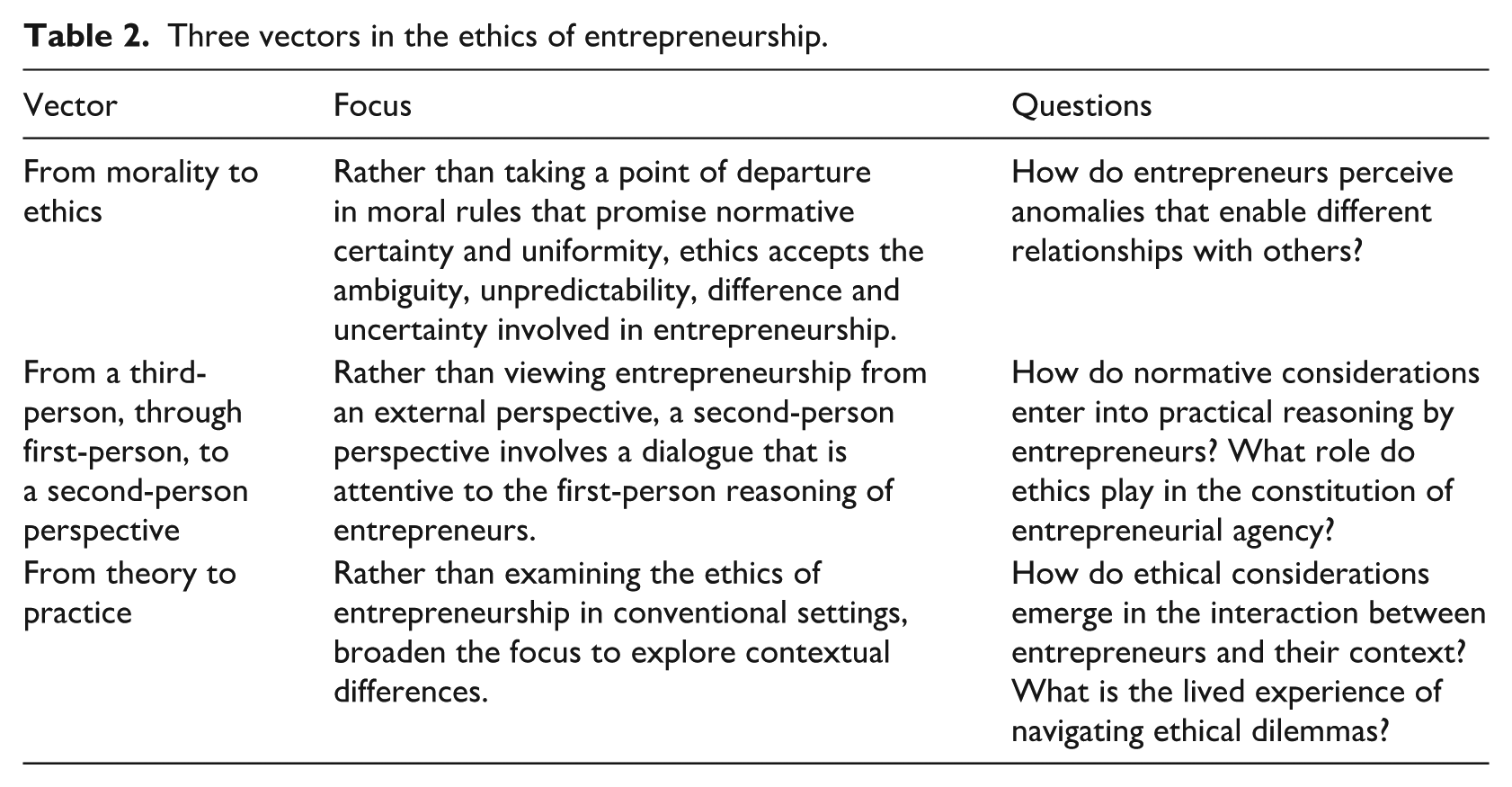
In the light of our review, several important themes can be developed further. Below we highlight three such vectors (Table 2).
Three vectors in the ethics of entrepreneurship.
First vector: From morals to ethics
Moral principles act as rules to regulate behaviour within particular practices. Morality and ethics are typically used as synonyms, and we have used them interchangeably so far. However, while morality insists on adherence to rules that classify and subordinate particular actions under general principles (e.g. doing this or that is either ‘good’ or ‘bad’), ethics reverses the hierarchy (Clarke and Holt, 2010). Hence, ethics draws attention to how what is considered ‘good’ or ‘right’ arises from specific practices. In entrepreneurship studies, the distinction between morality and ethics is evident in two areas. First, recent applications of Ludwig Wittgenstein’s ordinary language philosophy (Ramoglou and McMullen, 2024) and, more broadly, developments in entrepreneurship as practice (Thompson et al., 2016) have argued that insights can be gained from examining how words such as ‘good’ or ‘right’ are used and reused in language games whose rules are made meaningful in their enactment (Wittgenstein, 1953: 198–201). That the meaning of words arises from use is why Wittgenstein speaks of rules involving technique – the dispositional but also learned ability to enable and express oneself within the ebb and flow of prevailing agreements on what counts as good or bad. The rules organise, but their force is provisional, since they stabilise without conferring certainty. The rule conveys what has been agreed as good or bad in the past but cannot determine its continuation. As Duska (2014: 123) explains, Wittgenstein’s advice is to be content with the instruction ‘stand roughly here’. That is as certain as it gets. Many advocates for morality aver from such an admission, appealing instead to a rational capacity of each individual subject to make the correct choice irrespective of the immediate array of feelings, sensory experiences and local histories that mottle subjective experience. Morality bypasses lived life and aims for a general standard applicable to reasoning beings in all instances. Unconditional maxims (such as utilitarian principles or bills of rights) perform a similar unifying role, though rather than inner, subjective reasoning they are the product of organised, political assertion. By invoking Wittgenstein, entrepreneurship scholars are alluding to the lifelessness of these unifying commitments to morality. Even where rules are clear and comprehensive, their normative force is dissipated rather than enhanced, if they are followed blindly, without imaginative engagement. Moreover, to understand the ‘good’ and what is ‘right’ is not a separating, separate occasion, set aside from everyday living, and used as a yardstick to measure experience and find it compliant or wanting. In short, they conclude, any search for moral unity and certainty is misguided, a confusion: no rule contains the script of its own extension (see McDowell, 1979).
This is especially so in entrepreneurial practice, where any threshold between good and bad, or right and wrong, occurs as a bright but temporary patch of light amid a fog of ambiguity and contingency. Here, ethics demand we stay with life and work out how to live better from within the language game. This can involve maxims or principles that transcend the immediacy of an event or feeling, but only provisionally, so that a whole can be intuited by a partial perspective, but only ever from that perspective, which is taken from within one or other, or a mixing, of language games. The ethical condition of entrepreneurship is constituted by the demands of linguistically embedded images and concepts conveying ideas of the good (or bad) in the form of discriminatory allegiances to and divergences from the vast meshwork of grammatical rules in ordinary language. The ordinariness of these movements belies their potential effects, that is if the entrepreneur is able to connect prevailing ideas of the good and bad with the multiplicity of common experience in such a way that new, more compelling unities appear. They can do so by first noticing and holding onto anomalies that others ignore, or simply accept (Spinosa et al., 1997). Turning these anomalies into questions – Why are computers only business machines and not personal ones? Why should women accept lower pay for similar work? Why is value limited to economic returns? – stimulates entrepreneurial action insofar as they act as a provocation or spur to thinking and acting differently. The responses can create newer unities which will themselves belong to ordinary experience, acting as organised invitations through which others, if they take up the entrepreneurial offering, might move from worse to a better state of affairs.
Second, drawing on continental European philosophy, is the sense that ethics, unlike morality, conveys the experience of living with difference, the experience of putting the self into the world amid things that are not the self. To be ethical is to promote proximity to difference, and accompany that difference on its own terms, rather than trying to convert it to one’s own terms. We learn from difference; we are provoked and even humbled by it. Morality imposes a sameness that can be unethical. We act ethically to the extent that we are affected by the other’s presence (which limits or challenges my spontaneity, cf. Levinas, 1991) and in turn affect the other with our presence, given it is the relation itself (between the self and the other) that is consciousness, which is felt, not thought. Levinas (1991) calls this ethical consciousness an intuitive, intellectual sympathy with objects that allows one to encounter what is unique, without slipping into the forms of analysis which discover elements and patterns that confine objects to being things held in common. As both Jones and Spicer (2009) and Dey and Steyaert (2015) attest, the question of otherness brings ethics and entrepreneurship into close communion. In keeping with intuitive feeling, and by attending to the absorbing presence of other things, the concrete world appears richer than it does through analysis. Not only richer but also replete with possible new worlds, ones hitherto unassigned, and which imaginatively provoke the entrepreneur into transcending the limits of the actual world, whether in smaller or larger ways. A scene of disorientation ensues, a queering, which then prompts a search or stretching for alternative ways of acting through which this richness might be experienced by others (Dey and Steyaert, 2015; Poldner et al., 2019).
A shift from morals to ethics, along with an acknowledgement that difference is pervasive, further erodes the three dichotomies we highlighted above, showing that entrepreneurial agency involves both an intrinsic and prospective normative dimension as well as an extrinsic and retrospective normativity constituted by the perspective of other relevant stakeholders – just as it is constituted by adherence to various conventional ways of being an entrepreneur, which is followed in a manner sensitive to their normative import.
Second vector: From third-person to first-person and thence second-person perspective
A second vector, involving a shift from a third-person to a first-person and ultimately a second-person perspective on entrepreneurial agency (Dimov et al., 2021; Sergeeva et al., 2021), complements a turn from morality to ethics by further highlighting not just the inherent normativity of entrepreneurial agency but also its touching upon questions of human flourishing. Dimov et al. (2021), for example, have emphasised the importance of the work of philosopher Christine Korsgaard in understanding the distinction between first- and third-person perspectives in order to reveal the inherently normative dimension of entrepreneurial agency. Korsgaard (2009) brought the notion of self-constitution to the fore, developing a Kantian perspective (see Rawls, 1980) on agency that emphasises the fact that acting is acting for reasons taken to be valid (see also Rödl, 2007).
For Korsgaard, self-constitution is the process by which individuals constitute themselves as agents by committing to universalisable moral principles, specifically Kant’s (1998: 30) first Categorical Imperative: ‘Act only according to that maxim whereby you can at the same time will that it should become a universal law’. Acting according to this principle, argues Korsgaard, enables agents to be unified individuals who can separate themselves from external environmental influences and internal psychological impulses that might otherwise merely cause them to behave in various ways. As Korsgaard (2009: 81) says, ‘Conformity to the categorical imperative renders us autonomous [. . .] These imperatives are therefore, constitutive principles of action, principles to which we necessarily are trying to conform insofar as we are acting at all’. In other words, without a commitment to act for reasons that are universally valid, desires for control, status, money or anything else – fuelled by various cultural influences – effectively dominate one’s psyche, undermining one’s identity as a unified agent capable of evaluating reasons for action and acting upon those that are (perceived to be) valid. In this light, acting is not simply a process driven by ‘desires’ (immediate wants shaped by culture and perceived as psychological needs) that causally determine what one does. Instead, action is a product of practical reasoning whereby one evaluates one’s desires in light of one’s constitutive principles, that is, one’s commitment to the Categorical Imperative (Korsgaard, 2009). From this perspective, adopting what Dimov et al. (2021) call a second-person perspective on entrepreneurial agency involves interrogating an entrepreneur’s constitutive principle of action, their fundamental moral ideals. As they note, ‘adopting a second-person perspective to interpret the first-person perspective of entrepreneurs means understanding the reasonableness of their reasons in our own light’ (Dimov et al., 2021: 1194). In other words, a second-person perspective on entrepreneurial agency requires understanding – and evaluating – an entrepreneur’s reason for action to determine whether they are cogent or the result of extraneous social factors that lead them to act for bad reasons. Yet, Korsgaard’s account is problematic because it is committed to a notion of morality involving abstract moral principles associated with a specific sense of reasonable action (consistent, coherent and general).
Entrepreneurs, like other plain persons, rarely act for reasons because they are universalisable in Kant’s sense. Instead, they typically act for reasons that promote or are constitutive of good ends within the context of local, everyday practices, that is, offering flexible working hours to allow employees to commit to meaningful projects in their lives such as parenting or political activism. LeBar (2008, 2013) offers an Aristotelian approach to constitutivism that both captures this more mundane way of engaging in practical reasoning and aligns closely with the notion of ethics as inherently contextual, introduced in the previous section. Accordingly, LeBar argues that individuals constitute themselves as agents, not by adhering to universal principles, but rather by endorsing concrete ways of realising human flourishing in particular contexts. In this light, entrepreneurship research might consider when and how individuals come to see new venture creation as a distinct way of living well or flourishing (Shir and Ryff, 2022).
Constitutivism allows scholars to recognise the inherent normativity of human action: acting for a reason is always a matter of distinguishing oneself from the many social and psychological factors that may be affecting one’s psyche at any given time and endorsing a particular consideration as a valid reason. Adopting a second-person perspective means engaging in dialogue with entrepreneurs to consider whether the reasons they are acting on are valid – that is, whether they genuinely contribute to their own flourishing and that of others. Normativity is therefore, not tied to a principle that determines what is right and wrong, but rather to a concern for the various ways human flourishing (e.g. living well) can be achieved for those who affect and are affected by a new venture. As such, this more contextual approach to constitutivism also incorporates a focus on difference: insofar as a second-person perspective involves the interaction between potentially diverse normative perspectives, that is, that of the researcher and the entrepreneur, it may lead the former to revise their own ethical commitments in light of an engagement with the latter’s novel perspective.
More broadly, this Aristotelean second-person perspective provides additional insights into the limitations of the three dualisms identified above: normative versus descriptive perspectives, intrinsic versus extrinsic approaches and retrospective versus prospective evaluations of entrepreneurial agency. Insofar as human agency as such is inherently normative, researchers must, at least implicitly, make judgements about the validity of the reasons for action endorsed by entrepreneurs. And to the extent that these reasons are judged to lack validity, they will look for environmental factors that lead entrepreneurs to act on such bad reasons. Consider, for example, the difference between an individual who is myopically driven by the desire for profit and one who is focused on benefiting multiple stakeholders while having the autonomy to create a meaningful career that also provides financial stability (see Fauchart and Gruber, 2011). In the case of the first entrepreneur, scholars are likely to look for various societal factors that have instilled in her a myopic and seemingly misguided view of which reasons for action are valid. In contrast, in the case of the second entrepreneur, scholars who consider these reasons to be valid may see no reason to identify such extraneous factors. Instead, it can be argued that the second entrepreneur acted on a valid conception of human flourishing in the pursuit of new venture creation. Similarly, a constitutive framework overcomes the distinction between intrinsic and extrinsic approaches to entrepreneurship by claiming that while all agency, including entrepreneurial agency, involves an intrinsic normative dimension, this intrinsic normativity can only be properly understood in the light of extrinsic norms that interlocutors bring to bear as they observe and evaluate the entrepreneur’s actions – just as scholars bring their own normative perspective to bear in distinguishing between the two entrepreneurs in the example above. Likewise, the contrast between prospective and retrospective approaches can be understood, in the light of a constitutivist framework, as a distinction between the norms endorsed by entrepreneurs and those endorsed by temporally distant interlocutors who are aware of the consequences of the entrepreneur’s action – again raising questions about the perspicacity or lack thereof of entrepreneurs and the environmental factors that lead them to act for reasons that are not valid.
Third vector: From theory to practice
While broadening the theoretical horizon allows for moving beyond rigid dualisms that fail to capture the embedded nature of ethics in entrepreneurship, it is equally important to enhance empirical sensitivity to how ethics manifests in different contexts. Departing from theoretical assumptions about the entrepreneur, the venture and the (market) context – without grounding them in empirical reality – risks overlooking the cultural, social and contextual factors that shape the relationship between ethics and entrepreneurship. Thus, moving beyond dualisms also requires that research be more attuned to contextual differences, which are often neglected in studies that prioritise generalisations and universal insights over the specific challenges and opportunities faced by entrepreneurs in their everyday lives.
To move beyond the so-called ‘Silicon Valley’ model of entrepreneurship – which focuses predominantly on high-growth, technology-based ventures – researchers have increasingly called for studies of ‘everyday entrepreneurship’ (Welter et al., 2017) that capture how entrepreneurship unfolds and takes different forms in different, specific settings. Similarly, research on ethics and entrepreneurship has begun to explore normative questions about what should be done, while remaining sensitive to who does what in what contexts. This shift highlights the importance of understanding the specific identities of entrepreneurs and the cultural and social conditions that both influence and are influenced by their actions. Attention to intersecting factors such as gender, social roles, religion and geography thus becomes central to understanding how ethics operates in entrepreneurial contexts.
Broadening the empirical horizon also allows research on ethics and entrepreneurship to engage with other scholarly conversations. For example, studies on emancipation have sought to broaden entrepreneurship research to consider how entrepreneurship challenges societal norms and offers new ways of thinking and acting that transcend established conventions (Rindova et al., 2009). Insightful empirical work, such as the study by Benali and Villesèche (2024), exemplifies this approach by examining how women beneficiaries of a social enterprise in post-revolutionary Tunisia actively enact emancipation. Rather than being passive recipients of aid, these women emerge as agents of change – pursuing personal dreams, navigating gender relations and asserting the value of their work. By challenging traditional notions of the role of the ‘beneficiary’, the study highlights the intersectional constraints faced by entrepreneurs and underlines the importance of grounding normative questions about what should be done in the lived realities, socio-economic contexts and decision-making processes of those directly involved.
Methodologically, this emphasis on contextualised ethics poses new challenges for entrepreneurship research. Capturing the lived experiences of entrepreneurs as they face ethical dilemmas and engage in moral reflection requires more than mapping traits, analysing decisions or comparing environments. Researchers need to explore the reasoning underlying observed behaviours and examine how this reasoning unfolds in specific contexts. This can be achieved through methods such as ethnographic interviews and participatory observations, which allow for a ‘second-person’ dialogue with entrepreneurs (Dimov et al., 2021). This approach enables researchers to engage directly with entrepreneurs about how ethical concerns shape their reflections on what they do, why they do it, and how they perceive themselves and their environment. Here, ethics is not a separate branch of reflection or a purely cognitive operation; it is embedded in the very thinking that accompanies entrepreneurial action. This move does not render theory unimportant, as concepts are always required to capture practice. But it does suggest that theory does not determine everything without allowing practice to challenge or surprise what theory defines as ethical.
Conclusion
In this annual review article, we have called for scholars to avoid thinking about ethics as an additional normative layer that is concerned with how the world ought to be, placed on top of what entrepreneurship is – a detached mode of reflection providing a yardstick against which to measure what entrepreneurs actually do. Instead, we have argued that ethics is embedded in entrepreneurship. To do so, we have drawn attention to some of the binaries that tend to influence how we think about the relationship between ethics and entrepreneurship but also offered conceptual resources for thinking beyond these binaries. Specifically, we have suggested that moves along three vectors – a move from morality to ethics, a move from a detached third-person perspective to an engaged second-person perspective and a move from theory to practice – can help us recognise that entrepreneurship is not only inherently normative since it is concerned not with how the world is but also how the world should become in the future, and not just with the advancing of a specific set of interests, but also with a more open-ended concern with human flourishing. In short, we might conclude with the claim that entrepreneurship is ethical, or it is not entrepreneurship.
Footnotes
Declaration of conflicting interests
The authors declared no potential conflicts of interest with respect to the research, authorship, and/or publication of this article.
Funding
The authors received no financial support for the research, authorship, and/or publication of this article.
Informed consent
Consent has been obtained from all informants.
Research involving human participants and/or animals
The study incorporates participant and non-participant observations, as well as interviews.
