



Abstract
This paper explores when and how entrepreneurs who operate new organizations in environments where corruption is endemic can resist it. Despite the continued scholarly interest in corruption, anticorruption efforts by micro, small, and medium enterprises have been largely overlooked. Instead, studies have focused on the intraorganizational actions of larger established organizations (local and multinational) without sufficiently considering their interdependence with other actors in their external environments. Given the social exchange nature of corruption, we collected and analyzed data from interviews with Tanzanian entrepreneurs, and theorized about when and how they circumvent or resist corruption. Our findings illuminate the complex relationship between entrepreneurs’ motivations and capability, and highlight the strategies entrepreneurs use when they seek to resist corruption without compromising their resource needs. Subject to their leverage (i.e., resource endowments and available alternatives), entrepreneurs resist corruption by avoiding powerful focal firms, restructuring their resource dependence in a firm-focused manner, and managing risks. Considering social-relational dynamics, entrepreneurs also find ways to avoid interactions with corrupt agents and to use power strategically (through political tactics, such as co-opting and challenging) that influence agents to act in the entrepreneurs’ best interests and against corruption.
Keywords
Introduction
In the past 2 decades, researchers, practitioners, and policymakers have made a strong case for the proliferation of anticorruption strategies at the organizational level, emphasizing the critical role of private sector actors in combating corruption and promoting socioeconomic development (Calderón, Álvarez-Arce, & Mayoral, 2009; Luo, 2005; Sartor & Beamish, 2020). Indeed, corruption is a negative phenomenon that impairs how entrepreneurship is leveraged in the economy (Anokhin & Schulze, 2009; Boudreaux, Nikolaev, & Holcombe, 2018; Dutta & Sobel, 2016), costing the world economy 3.6 trillion USD annually (Schuler, 2018). Corruption is costly (Castro, Phillips, & Ansari, 2020) because it inhibits production choices (Kong, Wang, & Wang, 2017), reduces innovation (Xu & Yano, 2017), and inhibits or delays needed investments (Doh, Rodriguez, Uhlenbruck, Collins, & Eden, 2003; O’Toole & Tarp, 2014) and organizational growth (Fisman & Svensson, 2007). Given the negative effects of corruption (Dutta & Sobel, 2016; Eddleston, Banalieva, & Verbeke, 2020), it would be ideal for entrepreneurs to develop strategies to resist corruption. Organizations resist corruption by resisting legal and economic sanctions, reputational damage, legitimacy threats, inefficiency, and competitive disadvantage (Azim & Kluvers, 2019). Furthermore, organizations’ strong anticorruption efforts enhance their access to external funds and innovative capabilities (Xu & Yano, 2017). Nevertheless, despite the strong business case for anticorruption efforts at the organizational level (Koessler & Lambert-Mogiliansky, 2013), questions remain as to whether local entrepreneurs who operate small and medium enterprises, as well as newer organizations, can resist corruption in corrupt environments.
Defined as “the misuse of authority for personal or organizational gain” (Ashforth & Anand, 2003, p. 2), corruption is often interpreted as a normative institutional pressure (Eden & Miller, 2004) that existing and new organizations must respond to (Rodriguez, Uhlenbruck, & Eden, 2005; Ufere, Gaskin, Perelli, Somers, & Boland, 2020). Studies have argued that local entrepreneurs are likely to be so embedded in their “corrupt” cultures that they are less likely to find alternatives to act otherwise (Qian & Sandoval-Hernandez, 2016). Unlike their multinational enterprise (MNE) counterparts, which face multiple sets of expectations and norms (Liu, Al Asady, & Fu, 2020; Spencer & Gomez, 2011), and are presumed to have the flexibility to exercise organizational control (Hauser & Hogenacker, 2014), local entrepreneurs are predominantly expected to conform to corrupt demands (Ashforth & Anand, 2003; Castro, Phillips, & Ansari, 2020; Kistruck, Webb, Sutter, & Bailey, 2015; Persson, Rothstein, & Teorell, 2013). This corruption expectation is particularly strong for newcomer entrepreneurs, whose ventures tend to be small and typically lack slack resources, formal structures, and legitimacy (Acheampong & Rand, 2023; Dwibedy, 2022). They are thus assumed to lack the capacity to resist corruption pressures (De Jong, Tu & van Ees, 2012; Svensson, 2003) and become entrapped (Mohammad & Husted, 2021).
Recent scholarship on organizational corruption resistance has been instrumental in challenging the assumption that local entrepreneurs lack the agency to resist widespread corruption. This scholarship has shown that organizations can control corruption in their operations (Lange, 2008). For example, despite facing pervasive corruption in Bangladesh, the region’s leading microfinance bank has successfully instituted policies and practices that deter corruption at the organizational level (Azim & Kluvers, 2019). Motivated by their values and/or the benefits of resisting corruption, organizations that resist corruption tend to focus on building organizational structures, cultures, and systems that limit the situations in which corruption typically occurs within organizations (Azim & Kluvers, 2019; Cuervo-Cazura, 2006; Liu, Al Asady, & Fu, 2020; Velamuri, Venkataraman, & Harvey, 2017). Through mechanisms like organizational policies that promote transparency, fairness, clarity, and ethical standards among their members, organizations can enhance their capabilities to promote ethical behavior and/or minimize malfeasant behavior among their members (Azim & Kluvers, 2019; Koessler & Lambert-Mogiliansky, 2013; Luo, 2005).
Despite their strengths, these few studies have mainly focused on corruption control within large organizations (local or international). Unlike new businesses (typically small), large organizations usually have the resources, formal structures, and legitimacy to resist corruption pressures (Azim & Kluvers, 2019; Luiz & Stewart, 2014; Luo, 2005). However, larger organizations’ anticorruption mechanisms do not work well for newer businesses (United Nations Industrial Development Organization [UNIDO] & United Nations Office on Drugs and Crime [UNODC], 2012). Thus, there is a gap in our understanding of how entrepreneurs of new ventures can resist corruption. Filling this gap is critical because over 90% of businesses globally are micro, small, and medium enterprises (World Trade Organization [WTO], 2022).
Crucially, this research stream has also insufficiently considered an organization’s reliance on other organizations—namely, interdependence (Casciaro & Piskorski, 2005)—which is critical for new organizations as entrepreneurs seek to acquire necessary resources for their firms’ survival (Warburton, 2013). Despite scholars acknowledging the influence of external environments on corrupt organizational action (e.g., inefficient public services, the influence of informal institutions, and lack of market access), extant corruption resistance mechanisms emphasize building organizational structures and cultures that reduce corruption among employees (Azim & Kluvers, 2019; Luo, 2005). Specifically, the literature has focused on intraorganizational tactics, such as having organizational policies, implementing internal controls, and offering anticorruption training to employees (Azim & Kluvers, 2019; Hauser, 2019), but without a holistic strategic approach to understanding these tactics, we only have a limited perspective of what happens as entrepreneurs and organizations resist corruption (Koessler & Lambert-Mogiliansky, 2013). Additionally, the role of entrepreneurs in anticorruption efforts tends to be understated. Instead, the literature has centered on organizational architecture (i.e., structures, cultures, and systems; Luo, 2005) as having a unidirectional impact on organizational members’ behavior. While this may be true in established organizations, newer organizations depend heavily on their founders’ personal value systems (Morris, Schindehutte, Walton, & Allen, 2002; Shepherd, Breugst, & Patzelt, 2023). In newer and smaller firms, entrepreneurs can develop structures and cultures that influence venture members and interfirm interactions. Therefore, it is essential to understand the resource and social exchange dynamics between entrepreneurs and the entities they interact with, to better understand entrepreneurs’ responses to corruption, including their efforts to resist (see Cuervo-Cazurra, 2016).
To address these gaps in the literature on corruption resistance, this study focuses on the decisions and actions of individual entrepreneurs operating new local organizations in the context of endemic corruption. Given the difficulties entrepreneurs face in the context of endemic corruption, we ask why some entrepreneurs try to resist corruption, how they do so, and why some are more successful at resisting corruption than others. We conducted 37 interviews with entrepreneurs and informants from the public, private, and nongovernment organization (NGO) sectors. We adhered to high ethical and data-protection standards, enabling our participants to feel at ease and to share their experiences candidly. Also, we used two videos from 2019 and 2020 that incited a debate about corruption and the ensuing social commentary as supplemental data.
This study shows why, when, and how entrepreneurs of new local organizations (hereafter entrepreneurs) who are strapped for resources and need legitimacy resist corruption pressures. Our study contributes to the literature by developing a model that considers both individual factors (motivations) and organizational factors (resource endowments and available alternatives) and how they jointly influence whether and how entrepreneurs resist corruption from interdependent actors. In the context of widespread corruption, we inductively generate insights into entrepreneurs’ motivations to resist corruption and the strategies they employ to do so. Crucially, we demonstrate that these strategies for corruption resistance depend on resource dependence dynamics and the social and relational dynamics in corruption interactions.
Theoretical Background
Entrepreneurs’ Vulnerabilities to Endemic Corruption
Entrepreneurs worldwide tend to be vulnerable to corruption (Palmer & Weiss, 2022), which is costly to their organizations and the economy (Boudreaux, Nikolaev, & Holcombe, 2018; Fisman & Svensson, 2007; Mauro, 1995). Scholars have emphasized that it is difficult, if not impossible, for entrepreneurs to operate non-corrupt businesses in contexts where corruption is prevalent (Castro, Phillips, & Ansari, 2020; Nichols, 2009). Where there is an ineffective and uncertain regulatory environment (Bardhan, 2015; Coffman & Anderson, 2018; Rose-Ackerman, 1999), corruption may help entrepreneurs create shortcuts to achieve their goals (Krammer, 2019). However, conforming to corruption in the quest for legitimacy is contentious and may negatively affect organizations and communities (Boudreaux, Nikolaev, & Holcombe, 2018). Corruption can threaten a new venture’s internal and external legitimacy due to its illegal and often unethical nature (Azim & Kluvers, 2019; Rodriguez, Uhlenbruck, & Eden, 2005). Indeed, corruption can damage the reputation and image of an organization, lead to punishment by law enforcement, increase the organization’s operating costs, and magnify the risks and uncertainty of doing business (Luo, 2005). For instance, corruption increases the costs of starting and operating a business (Anokhin & Schulze, 2009) by increasing the costs of procuring contracts (Castro, Phillips, & Ansari, 2020).
The impact of corruption is disproportionately negative on local small and medium business entrepreneurs (O’Toole & Tarp, 2014). For example, corruption tends to be an additional business tax (Castro, Phillips, & Ansari, 2020), which can be particularly onerous to entrepreneurs of new organizations as they often lack bargaining power in exchanges (Svensson, 2003). Indeed, the direct costs of operating in a corrupt environment can be attributed to the financial costs of engaging in corruption, the opportunity costs, the costs of unproductive actions, the costs of bureaucratic delays, the costs of avoidance, the costs of engaging in illegal activities (Doh, Rodriguez, Uhlenbruck, Collins, & Eden, 2003), and the costs of uncertainty associated with corrupt transactions (Rodriguez, Uhlenbruck, & Eden, 2005). These costs are burdensome for entrepreneurs who face unique challenges because of their businesses’ newness and smallness (Acheampong & Rand, 2023), such as connecting services to a new store or winning government contracts (Ufere, Gaskin, Perelli, Somers, & Boland, 2020). Indeed, entrepreneurs of new organizations tend to pay relatively more bribes than managers of established organizations (De Jong, Tu, & van Ees, 2012). Therefore, entrepreneurs face financial and operational performance pressures in uncertain business environments that make them particularly vulnerable to corruption pressures (Bucar & Hisrich, 2001). They also often operate in institutional environments where there is only weak deterrence against making corrupt payments (Palmer & Weiss, 2022).
While resisting corruption may be difficult for entrepreneurs, it is not impossible. Several studies have explored individuals’ decision-making when faced with contradicting logics or institutional complexities (Pache & Santos, 2013; Raaijmakers, Vermuelen, Meeus, & Zietsma, 2015; Schilke, 2018). For example, Pache and Santos (2013) outlined the possible responses individuals may resort to when facing competing logics: ignoring, complying, resisting, combining responses, or compartmentalizing. Other studies, such as those by Simons, Vermeulen, and Knoben (2016) and Schilke (2018), focused on resistance to environmental pressures. Indeed, there is evidence that some local entrepreneurs (Vorley & Williams, 2016) and organizations (Azim & Kluvers, 2019; Velamuri Venkataraman, Harvey et al., 2017) resist corruption even though the practice is endemic. The following subsections provide a theoretical background on why and how some entrepreneurs resist corruption.
Why Do Entrepreneurs Resist Corruption?
The motivations that trigger individuals and organizations to conform to (or, by implication, resist) corruption have been widely explored in the literature. Organizations operating under pervasive corruption tend to face the conundrum of choosing between the costs of engaging in corruption, the reputational risk of engaging in corruption, and the business opportunity at hand (Spencer & Gomez, 2011). Incidentally, scholars have predominantly described entrepreneurs’ motivations to engage in corruption as rational, based on cost-benefit deliberations (Dickel & Graeff, 2018), where conformity is often seen as part and parcel of being an entrepreneur in their contexts (Ufere, Gaskin, Perelli, Somers, & Boland, 2020). For example, Vorley and Williams (2016) showed how entrepreneurs in Bulgaria and Romania could not escape the “devil’s circle” of corruption and were either compliant or complicit in it. In the absence of efficient formal systems, entrepreneurs are likely to be influenced by informal institutions that are efficient and trustworthy even when they are corrupt (Tonoyan, Strohmeyer, Habib, & Perlitz, 2010). Moreover, entrepreneurs are also influenced by situational factors, such as the size of the bribe (Carrillo, 2000), time pressure, and the abstractness of the business code (Rabl, 2011). These factors are predominantly rational. According to this “rational” perspective, if entrepreneurs perceive corruption as effective and beneficial in accessing resources or reducing uncertainties, they are likely to engage in it (Iriyama, Kishore, & Talukdar, 2016). Conversely, if the costs of corruption outweigh its benefits, entrepreneurs and managers will decide not to engage in corruption.
Remarkably, the literature has overlooked the role of entrepreneurs’ values in corruption decisions, despite acknowledging that organizations depend on their founders for all decision-making in their early stages, making these founders’ personal value systems synonymous with those of their organizations (Morris, Schindehutte, Walton, & Allen, 2002; Shepherd, Breugst, & Patzelt, 2023). Although a few studies have shown that the motivations driving organizations’ anticorruption efforts can come from their owners’ or top leaders’ values (Azim & Kluvers, 2019; Cuervo-Cazura, 2006; Liu, Al Asady, & Fu, 2020), examples of how personal values of founders of local organizations influence anticorruption efforts in their organizations (e.g., Muhammad Yunus of Grameen Bank; Azim, Sheng, & Barutet, 2017) are few and far between. In contrast, some scholars have argued that founders’ entrepreneurial orientation likely makes them more likely to act corruptly (Karmann, Mauer, Flatten, & Brettel, 2016), further cementing the idea that entrepreneurs (risk-oriented, proactive, and competitive) are more motivated to engage in corruption than to resist it. In contrast, larger organizations and multinationals tend to be afforded the flexibility to consider ethical conduct as good business sense and utilize organizational controls to resist corruption (Azim & Kluvers, 2019; Hauser & Hogenacker, 2014). For example, MNEs can build zero-tolerance cultures that reduce ambiguities and deter corruption (Luiz & Stewart, 2014). In contrast, entrepreneurs from contexts where corruption is widespread do not have the same resources to resist corruption.
Therefore, while we know a lot about what may lead entrepreneurs to conform (in this case, lead them to engage in corrupt practices), we know little about what may lead them to go against the grain to resist corruption. Accordingly, we need to explore the motives of entrepreneurs of new local organizations to resist corruption where corruption is endemic. Entrepreneurs who recognize, discover, or develop opportunities for venture creation (Gartner, 1985) likely play multiple roles in creating structures, shaping cultures, and coming up with alternatives to corruption when building their ventures in the context of endemic corruption. With this background in mind, we ask: Why and how do some entrepreneurs resist corruption where it is widespread?
How Do Entrepreneurs Resist Corruption?
Most of the literature on corruption resistance has focused on organization-level dynamics, particularly within larger and more established local and multinational firms. Furthermore, the strategies organizations employ for corruption resistance tend to be risk management mechanisms through the implementation of organization-level anticorruption policies and structures (Azim & Kluvers, 2019; Lange, 2008; Luiz & Stewart, 2014) that influence the institutional and task environments (Luo, 2005). Overall, this approach entails building cultures and structures that reduce ambiguities and deter corruption among organizational members. Organizations can build such cultures through employee training and development, performance management, and compensation tools to encourage ethical behavior (Luiz & Stewart, 2014). For example, they can minimize corrupt behavior among organizational members by implementing multidimensional corruption control measures, such as bureaucratic control, punishment, incentive alignment, and legal and social sanctioning (Lange, 2008).
However, these organizational corruption resistance control measures tend to overlook the interdependence of organizations as well as the influence of various actors within corrupt exchange relationships, despite the understanding that corruption occurs within social exchange interactions to acquire necessary resources for survival (Cuervo-Cazurra, 2016; Schwartz, 2017; Warburton, 2013). For example, Luo (2005) and Azim and Kluvers (2019) highlighted the external environment (e.g., inefficient public services, the influence of informal institutions, and lack of market access) as a critical influencer of an organization’s action. Still, the extant understanding of resistance involves constructing an organization’s “architecture” to minimize corrupt behavior among its members. Organizations, whether new or established, do not act in isolation but are constrained (or enabled) by their interactions with other organizations (Casciaro & Piskorski, 2005; Pfeffer & Salancik, 2003) and by social relationships with other actors in their environments (Granovetter, 1985; Uzzi, 1996). This interdependence means entrepreneurs maintain competitive and symbiotic relationships with various actors for their ventures’ survival, including relationships with government and business entities (Aldrich & Fiol, 1994; Hannah & Eisenhardt, 2018).
However, we have only a limited understanding of how an entrepreneur’s interdependence with others affects their decision to resist corruption. For example, in the Tanzanian context, entrepreneurs encounter corruption when they seek formal registration and approvals from institutions like the tax authority and other government authorities (Mashenene & Rumanyika, 2014), as well as during customer acquisition—primarily through the tendering process—in both government and private sectors (Castro, Phillips, & Ansari, 2020). These interactions are critical sources of external legitimacy and, thus, venture survival. However, although formal business registration improves access to financial and human capital, it may also increase a business’s susceptibility to corruption (Kistruck et al., 2015). Considering entrepreneurial organizations’ interdependence with other actors in their environments, and informal corruption norms, we need to learn more about how, when, and why entrepreneurs resist endemic corruption.
Given the scope of these research questions, the limited literature on entrepreneurs’ resistance to corruption, and the challenge of collecting data on corruption at the micro level of analysis (given its illegality), we chose an inductive research method through which we generated conceptual categories by constantly comparing the emerging insights and extant theory.
Methods
Research Context
According to the World Bank, Tanzania is one of the most challenging places to conduct business globally, ranking 141 out of 190 economies in the “Doing Business 2020” report (World Bank, 2020). Fragile and bureaucratic institutions, severe government involvement, overregulation of business, and low levels of trust characterize the Tanzanian business environment (Hansen, Langevang, Rutashobya, & Urassa, 2018). Ineffective regulations have created institutional voids that impede inclusive market participation (Murithi, Vershinina, & Rodgers, 2019). Additionally, businesses face uncertain regulatory conditions, including ambiguous standards and volatile changes in policy (Hansen, Langevang, Rutashobya, & Urassa, 2018), which often burden entrepreneurship and create corruption opportunities (Mbaku, 2009). Incidentally, it takes 29.5 days to start a business in Tanzania compared to 9.2 days in the developed countries that are members of the Organization for Economic Co-operation and Development (World Bank, 2020). Moreover, 19.1% of Tanzanians active in the labor force are self-employed in the informal sector, many of whom have cited difficulties formalizing their businesses (United Republic of Tanzania [URT], 2022). As such, corruption (mainly in the formalizing and business acquisition processes) is cited as a barrier to entry for startups and small businesses in the country and a constraining factor for business growth and regional prosperity (Andreoni, 2017; Mashenene & Rumanyika, 2014; Panga & Kazungu, 2015). Despite these challenges, Tanzania was one of Africa’s fast-growing economies before the pandemic (African Development Bank [AfDB], 2021).
More than three million micro and small businesses operate in Tanzania (URT, 2012). Of all the businesses in Tanzania, 41.6% are engaged in manufacturing activities; 40.4% in wholesale, retail trade, and repairs; and only 18% in other industries (URT, 2015). Only 51.5% of business establishments in Tanzania are registered, and 77.3% of these are sole proprietorships, 4.5% are companies, 0.5% are NGOs, 2% are religious institutions, 1.9% are cooperatives, and 13.2% are public organizations (URT, 2015). Although the entrepreneurship literature has considered informal businesses at the fringes of an economy as extra-legal (Cavotta & Dalpiaz, 2022), this is not the case in Tanzania. The Tanzanian government acknowledges the informal sector as a significant contributor to its economy (Maziku, 2022; Mhando, 2018), employing about 29% of its population and 66% of self-employed individuals. Nevertheless, the government has tried to institute policies to make it easy for businesses to formalize to capture tax revenues. Still, informal sector organizations have grown faster than their formal counterparts (Abdallah, 2017).
Toward the end of 2015, Tanzania elected a new government administration that has been tougher on corruption: it began increasing convictions, publicly shaming corrupt individuals, and communicating an intolerance of corruption (Bamwenda, 2018). Compared to the administrative period between 2010 and 2015, new corruption cases increased by 32% between 2016 and 2020, corruption convictions increased by 74%, and reported incidents of corruption decreased by 4% (as shown in Table A2). Indeed, the country’s Corruption Perception Index, which measures the extent to which business experts perceive the public sector to be corrupt, improved from 30/100 in 2015 to 38/100 in 2020 (Qorro, 2021; Transparency International, 2015). Despite these improvements, business corruption continues to be pervasive and, some have argued, more costly as the people and systems that allow corruption to prosper remain in positions of power (Misangyi, Weaver, & Elms, 2008; Rahman, 2019). Indeed, Tanzanian entrepreneurs find pervasive corruption to be one of the top barriers in their operations (Andreoni, 2017).
Data Collection and Sample
We used purposeful sampling (Nag & Gioia, 2012), selecting entrepreneurs, procurement professionals, and other informants from the public, private, and NGO sectors in Dar es Salaam (which contains 66.56% of the nation’s startups, 45.6% of the entrepreneurship support organizations [Tanzania Startup Association, 2022], and 10% of the labor force [URT, 2022]). We selected entrepreneurs around the major startup hubs in Dar es Salaam and through personal contacts. Our study focused on entrepreneurs involved in business-to-business (B2B) sales of goods or services, a form of business in which corruption is prevalent. The unspoken cost of customer acquisition for many B2B transactions in the public and private sectors (i.e., corrupt payment) is 10%. It was essential to gain multiple perspectives to explore the similarities and differences across entrepreneurs engaging in the B2B sector. As such, our respondents included entrepreneurs and buying specialists from industries heavily monopolized by the government, such as construction, and from industries with more diverse buyers, such as information technology (IT) and business advisory. For comparison, we also interviewed entrepreneurs with experience in business-to-consumer (B2C) sales and some who operate informally. Most entrepreneurial organizations we interviewed were microenterprises, employing fewer than five people, including the owners. Only two entrepreneurs we interviewed had small businesses (5–49 employees), classed as small professional services firms. Most organizations in Tanzania are small businesses like these (URT, 2012).
We used semistructured interviews for data collection (Crosina & Pratt, 2019). The university research ethics committee and the Tanzania Commission for Science and Technology (COSTECH) reviewed and approved our research plan and interview guide. We conducted 37 interviews: 21 face-to-face and 16 online via WhatsApp or Skype. Each interview lasted between 50 and 90 minutes (M = 70) and, when transcribed, all interviews together filled 297 single-spaced pages. Depending on the interviewees’ preference, the first author conducted the interviews in English or Swahili. Swahili is the first author’s native language and the preferred language of the region. We transcribed the interviews and translated those in Swahili into English. The first author is fluent in both languages. In 14 cases, the interviewees did not consent to be recorded for various reasons, such as concerns over safety (despite assurances of anonymity and data security). With consent, we took notes during the interviews and wrote up accounts immediately after.
We collected data in three rounds from February 2019 to January 2020. The first round was exploratory: we conducted eight semistructured interviews with eight entrepreneurs from different industries—construction, IT, communication, manufacturing, medical services, professional business services, food and beverage, and horticulture. We also interviewed one operations manager for a construction company. In this phase, we wanted to select a broad range of B2B and B2C operations in various industries to understand how corruption manifested in the context. We conducted these interviews remotely through WhatsApp and Skype. This phase allowed us to test our questions and the feasibility of our study.
In the second round of interviews, we interviewed 15 entrepreneurs, three procurement officers from government and private entities, and two managers who were members of tender boards that made buying decisions, focusing on prominent and growing sectors of the economy. In this round, the entrepreneurs came from construction, IT, communication, fashion, advisory, learning and development, imports, and food and beverage. We selected the construction industry because it is one of the most corrupt industries worldwide, particularly in Tanzania (Chan & Owusu, 2017). The service sector (including information and communication) has recently been among Tanzania’s economic growth drivers (World Bank, 2024). Many small and medium-sized enterprises in the country engage in textile and apparel manufacturing and trade, including 27.5% of registered businesses (Taifa & Lushaju, 2020; URT, 2015). As a bonus, the entrepreneurs we interviewed also had experience in other sectors, such as imports, food and beverage, and manufacturing. We conducted 16 interviews face-to-face and four remotely.
Since the entrepreneurs also talked about facing corruption when interacting with government agencies in their day-to-day operations, in the third round of interviews, we sought to explore the Tanzanian regulatory environment from multiple formal and informal perspectives. We interviewed two entrepreneurs with informal businesses, three members of tender boards from private, public, and NGO sectors, and one advisor to entrepreneurs from a large microfinance firm. We also sought insights from regulators by interviewing informants from the Prevention and Combating of Corruption Bureau (PCCB) and the Tanzania Revenue Authority (TRA). One interview was conducted remotely, and the rest were face-to-face. Except for the two entrepreneurs, these interviewees also had a university education and consistently mentioned corruption as a pain point for entrepreneurs.
Our sample (detailed in Table A2) included two nascent entrepreneurs from organizations less than a year old, 16 entrepreneurs from organizations between 1 and 5 years old, and six entrepreneurs and one operations manager from organizations between 6 and 8 years old. These can be considered new ventures (McDougall, Robinson, & DeNisi, 1992). We also had one entrepreneur whose informal business had been operational for over 10 years. We conducted additional interviews with procurement officers and members of tender boards to understand the demand side of the equation because, in the first-round interviews, the entrepreneurs identified procurement as one of the critical areas where they face corruption demands. Seventeen of the entrepreneurs we interviewed were between the ages of 25 and 35, seven were between 36 and 45, and one was over 45. Most entrepreneurs were also well educated, having at least a university degree. Nine entrepreneurs had less than 5 years of professional experience at the time of founding their businesses, seven entrepreneurs had between 5 and 10 years of professional experience, five had 11 to 15 years of professional experience, and four had more than 16 years of professional experience at the time of founding their businesses. Of the 25 entrepreneurs, only four had no other professional experience besides entrepreneurship. On average, entrepreneurs in the Tanzanian startup ecosystem have at least 5.4 years of professional (technical) experience in 1.6 companies before starting their businesses. Still, only 35% had prior business experience (Mulas, Qian, & Henry, 2017).
Our interview guide for entrepreneurs covered six themes: entrepreneurial identity, entrepreneurial context, the entrepreneurs’ experience entering the market, the nature of corruption, the use of anticorruption strategies, and gender-related issues. We asked broad questions about these interviewees’ entrepreneurial journeys, motivations, industries, challenges, and successes, as well as more specific questions about what they considered corruption, how they responded to corruption, and the reasons underlying their responses.
Our interview guide for buyers (procurement officers and tender board members) covered the buyers’ role and identity, the buying context, the buyers’ experience and criteria for selecting providers, the impact of anticorruption strategies, and gender-related issues with corruption.
In the interview with the TRA official, we asked about the official’s opinions about the media complaints about the TRA and corruption, Tanzania’s regulatory environment, whether they believed this environment was conducive to entrepreneurship, and whether things were different under the current “stricter anticorruption” government. Although this official did not consent to be recorded, they were still open about their opinions and experiences (we suspect they were more relaxed because we were not recording the interview).
In our interview with the advisor for entrepreneurs, who worked as a learning and development manager for a microfinance organization that trained entrepreneurs before they received microfinance loans, we sought insights into the business environment, challenges for entrepreneurs, and the business of corruption. Given the advisor’s experience as a consultant for entrepreneurs, we had access to more general perceptions of entrepreneurship in Tanzania.
The interview with the PCCB official was more challenging since we walked into their office to request an interview rather than contacting them through personal contacts. At first, the official was suspicious, but they eventually agreed to be interviewed. We discussed the PCCB’s role and mandate, the organization’s overall activities and challenges in executing anticorruption strategies, the extent of business corruption, and the strategies’ effectiveness in reducing it.
We collected and analyzed data until we reached theoretical saturation—namely, when our concepts were sufficiently well developed and we believed we had achieved considerable depth in our theorizing through the data we had collected (Corbin & Strauss, 2015). At the end of the three rounds, we had interviewed 25 entrepreneurs, eight buyers, two regulators, one operations manager, and one advisor for entrepreneurs. Despite our efforts, we managed to interview only six women entrepreneurs and four women procurement professionals. This low gender representation is mainly because men dominate both professions. For example, 77% of startups in Tanzania are owned by men, 17% are owned by women, and 6% are co-owned by men and women (TSA, 2022). A detailed list of our interviewees can be found in Appendix A.
Building Trust
Given the illegal and often secretive nature of corruption and the political climate at the time, we adhered to high ethical standards for data protection. The anonymity of our informants was an essential aspect of our study to ensure openness and honesty in our interviews (McDonald & Eisenhardt, 2020). The ethics committee proposed countermeasures to ensure data, participant, and interviewer safety, including using verbal consent, password protecting interview data, and using devices not connected to the internet for recording purposes. To ensure anonymity and to safeguard the privacy of our participants, we approached our informants directly through our contacts or local business associations and hubs supporting entrepreneurs in Dar es Salaam, the business capital of Tanzania. We avoided finding informants through official organizational channels to safeguard our participants’ privacy. We conducted all the interviews individually—with just the interviewer and interviewee—to create a more comfortable atmosphere for participants to share their experiences. Before meeting any interviewees, we prepared an interview guide, and discussions between authors allowed us to avoid leading questions. For confidentiality, we used pseudonyms.
In our inductive theorizing, we also conducted member checking (Carlson, 2010; Crosina & Pratt, 2019) with five participants. We sent them our initial findings and discussed the results, and they gave their feedback and thoughts about our interpretations and proposed models. This included discussing whether the identified resistance tactics represented what entrepreneurs generally did in the field. The five participants were representative of the interviewees and understood and communicated in English to discuss the findings in depth. This process allowed us to validate our interpretations of the data and the findings that led to our theoretical framework.
Archival Data
Although the measures we took in the interview process allowed us to collect data we could trust, we also used archival sources to complement and validate our data. Specifically, we reviewed annual reports from Tanzania’s PCCB, various government documents and statistics, news articles, and social media reports and discussions about corruption in Tanzania. We were particularly interested in two viral videos and subsequent social media discussions. The first viral video included the story of Ramadhani Ntunzwe (Azam TV, 2019), who blew the whistle on TRA and police corruption to the prime minister of Tanzania, Kasim Majaliwa, during a meeting with members of a business association and lobby organization on February 28, 2019. This meeting was live-streamed on YouTube, television, and radio outlets. Ntunzwe’s viral video clip (14:14 minutes; 2.5 single-spaced pages of transcript) sparked considerable debate on social media. On the Azam TV News Facebook page, the video had 372,000 views and 952 comments as of August 15, 2022, when we last accessed the video. In the comment section, various individuals discussed and shared their experiences with corruption, giving us a rare opportunity to witness a debate on an issue that is often private and secretive. We also used a follow-up interview (the transcript was two single-spaced pages) with Ntunzwe on Mwananchi, a Swahili news outlet, generated on June 10, 2019. We translated the transcripts into English (Mwananchi, 2019).
The second viral video (Azam TV, 2020) was that of a businessperson who admitted to the president of Tanzania why they (and other business owners) paid bribes in a meeting between the president of Tanzania and business owners who were members of the Tanzania National Business Council (TNBC) held on June 7, 2020, which was live-streamed online and through TV and radio stations. The shock factor of this person’s admission in front of a feared president sparked another interesting debate online. The video (7:20 minutes; 1.2 single-spaced pages of transcript) had 182,000 views and 410 comments on the Azam TV Facebook page. We transcribed and translated the viral video. Although we did not use the entire meeting footage or the resulting social media comments directly, they helped validate our interviews. We opted to exclude corruption scandals featured in the news because they frequently involve political elites (Gray, 2015) implicated in grand corruption, including state capture and the embezzlement of public and development funds (Brazys, Elkink, & Kelly, 2017), often with impunity (Kapinga & Gores, 2020).
Data Analysis
As is characteristic of grounded theory, our analysis was iterative: we moved between our data and emerging insights, reviewing our codes and emergent model after each round of interviews and going back and forth between our emerging model, the data, and the literature. However, below, we linearly present our process of creating first-order codes, second-order themes, and aggregate dimensions, consistent with Crosina and Pratt (2019).
First-order categories
We created first-order categories using informant-centered codes for questions of when and how the entrepreneurs resisted corruption (Gehman et al., 2018). We iterated between our data and emergent categories and themes until we could no longer create new categories. We ended up with 18 codes that outline the variables of a corruption response. We kept modifying our first-order codes even as we created second-order themes. For example, we merged time, information, money, and legitimacy leverage as “resource endowments.” Ultimately, the 18 codes leading to corruption are further linked to five first-order codes. For the question of how resistance happened, we outlined 29 mechanisms for corruption resistance that we later grouped into 12 resistance tactics.
Second-order themes
We continuously compared our first-order categories to understand the similarities, differences, and relationships and grouped them into second-order theoretical themes with specific descriptive elements. First, we looked at where corruption happened. Based on the data, we split corruption into three interaction points: formalization, regulation, and customer acquisition. Then, we analyzed the relationships between the entities, motives, and actions at each point of interaction. We employed memos and diagrams to change informant-centered codes into more theoretical language (Corbin & Strauss, 2015).
Second, we analyzed how the entrepreneurs responded to corruption. In this analysis, we separated the entrepreneurs and buyers/others and categorized the entrepreneurs into three groups: compliant, sometimes resistant (relativists), and always resistant (absolutists). We matched how the different variables we identified led to specific responses. We made comparisons within and between groups. We mapped out the instances when the entrepreneurs engaged in and resisted corruption. At this point of our analysis, theoretical themes related to resource needs, leverage, and transactional and values-based motivations emerged as critical factors for engaging in corruption. We coded the combination of resource endowments and alternative paths to success as leverage in exchange interactions involving corruption.
For how the entrepreneurs resisted corruption, we grouped the tactics into strategies. While in the first-order categories we listed the tactics as the entrepreneurs mentioned them, in this part of the analysis we explored how each tactic worked, what it was meant to fix or achieve, and if it had any shortcomings. For example, tactics for resistance, such as using professionals to meet compliance requirements and minimize information asymmetry, often provide opportunities for bribe solicitation when working with regulatory agencies. We grouped these tactics into the resistance strategy theme. Theoretically, we consider a strategy a “pattern in a stream of actions” (Mintzberg, 1987, p. 12). During our analysis of the entrepreneurs’ actions to resist corruption, it became clear that they deployed these actions or strategies based on who they were interacting with. Considering these multiple levels of engagement, we condensed the first-order resistance tactics into five second-order organization-level strategies and five second-order agent-level strategies to resist corruption.
Aggregate dimensions
We collated our second-order theoretical themes into more abstracted aggregate dimensions, which form our grounded theoretical framework (Corbin & Strauss, 2015). In this analysis phase, we compared and contrasted the second-order themes with our emergent aggregate dimensions while following our guiding questions of when and how the entrepreneurs resisted corruption. We also iterated between our emerging findings and existing theory (Soderstrom & Weber, 2020). For the question of when the entrepreneurs resisted corruption, we compared the resource needs, leverage in exchange interactions, and motivations for both the resistant and compliant groups of entrepreneurs, which led us to the aggregate dimensions of capability and motivations as the conditions for entrepreneurs to select resistance as a strategy. Using the identified themes, we also linked and compared emergent organization-level and agent-level resistance strategies to how the entrepreneurs resisted corruption. In analyzing the strategies, we examined each strategy’s leverage to abstract the strategic orientation. We define strategic orientation as the comprehensive direction or broad outline of the entrepreneurs’ strategies (Chaganti & Sambharya, 1987).
Findings
Motivations to Resist Corruption
In our data, the entrepreneurs we interviewed shared the frequency with which they resisted corruption—whether they resisted corruption periodically, all the time, or not at all. The never-resistant (or compliant) and always-resistant entrepreneurs tend to hold strong beliefs about corruption in business, with the former believing that corruption is inevitable and the latter believing it must be avoided at all costs. However, most entrepreneurs are relative resisters—somewhere along the spectrum between conformity and resistance. They decide whether to conform to or resist corruption based on various motives (also depicted in Table 1). We explore these motivations in the following paragraphs.
Motivations to Resist Corruption
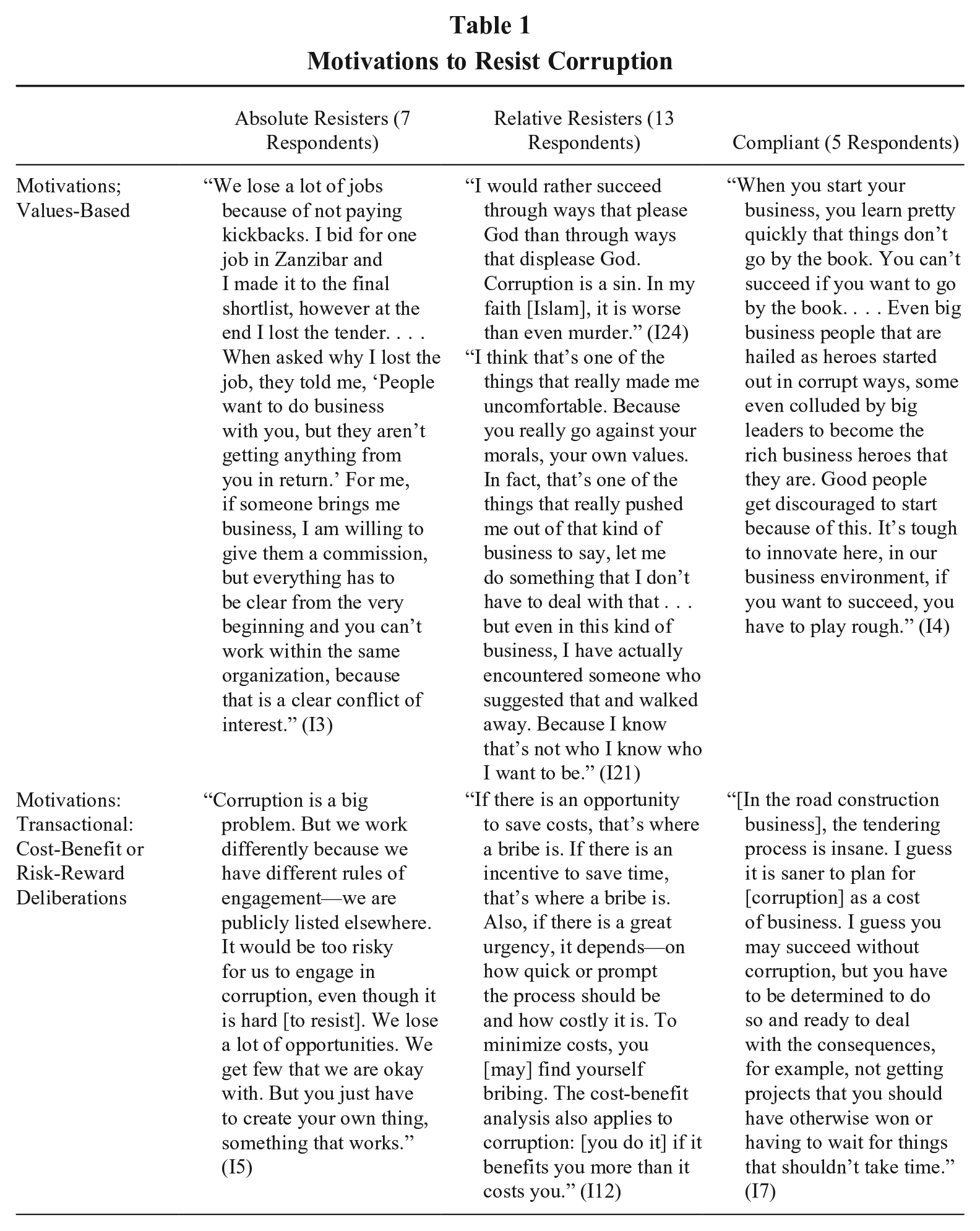
Transactional resistance motivations
Some Tanzanian entrepreneurs engage in cost-benefit deliberations when deciding whether to resist or conform to corruption demands. The function of corruption in uncertain regulatory environments is to reduce these uncertainties and the costs associated with them. Some entrepreneurs we interviewed noted that resistance to corruption may have a higher transactional value than corruption. As such, these entrepreneurs’ resistance decisions are driven by the determination that “corruption is too costly” or “resisting corruption is rewarding to their business.” Below, we provide an example of the former, whereby the entrepreneur of a marketing/communication organization explained how the unreasonable costs of kickbacks led them to resist corruption: Obviously, though, kickbacks are a big part of the tendering process, but sometimes you can find unrealistic demands. For example, you find someone asking for a 10% commission on a job that has 5% profit, which is more expensive than what you would make. . . . I think you just have to be okay with the no’s because, at some point, you either have to say no or operate on a loss. (I17)
Determining whether the costs are “sensible” can be quite flexible for entrepreneurs. For example, Entrepreneur I21 explained how they and their cofounders of a marketing/communication organization decide to accept or walk away from kickback solicitations when tendering for jobs from other businesses.
So, the first thing is the magnitude of the ask. If someone is asking for 1%, you can easily cover that, and it would have absolutely no impact on the overall big picture. When they are asking for 20%, that’s a different story because you know you practically can’t do a good job. It affects the whole thing. You can’t deliver, and even if you do, you will deliver substandard work, which will affect you in getting future jobs. So, in some of those jobs, you just walk away. And sometimes, it’s maybe the nature of the client—some clients, you know this is a client you are trying to get in business with, and if you get into this client, there is a lot more work in the future, whereas another client you can let them go because it doesn’t really matter. (I21)
Other entrepreneurs decide to resist because they find it rewarding for their businesses to do so. For example, Entrepreneur I3 expressed that resisting corruption builds a positive reputation that adds to the competitiveness of entrepreneurial organizations, especially for clients who value integrity. Indeed, this entrepreneur told us, Avoiding corruption can become a major competitive edge. . . . We don’t have a strategy but make daily decisions to act a certain way. It is not just with corruption [but] anything that affects our quality and our core values. For example, sometimes you will get a forensic accounting job, but the client wants you to come up with specific results that they need. Of course, we say no to that. (I3)
Since this organization offers forensic audit services that demand high integrity, resisting corruption and building a reputation for integrity adds to the company’s competitive edge. Similarly, another entrepreneur with a construction business (I12) noted that they must resist corruption with specific clients even when solicited because initiating or complying with corruption could disqualify them from working with them. According to this entrepreneur, some solicitations may be traps set by clients to test potential providers before working with them, as indicated in the following statement: For example, if you hear that the government tender has been announced through the Prevention and Combating of Corruption Bureau [PCCB] and you try to bribe someone, that is clearly a trap. But you have clients that naturally, without bribing, you will never get a tender—Chinese or Indian firms. And they are the ones that are dominating construction contracts. You can’t think of bribing when you are bidding for church or mosque projects. Those guys would mostly have fair competition and hire people who qualify. (I12)
The above indicates that not all clients require bribes or kickbacks and that corruption is not always worth it. These findings on transactional resistance motivations suggest that the value of any particular response depends on whether it facilitates the focal business’s survival. When the benefits of resistance outweigh the costs or when the rewards of resistance outweigh the risks, an entrepreneur is likely motivated to resist corruption.
Values-based resistance motivations
The findings highlight that some entrepreneurs do not weigh the costs and benefits when deciding how to respond to corruption. For example, a few entrepreneurs, such as I13 and I24, cited fear of God, due to their religious beliefs, as motivation to resist corruption. Similarly, entrepreneur I18 explained, In the cases where I have avoided paying, it has been because of guilt out of my religious faith perspective. As a Christian, you know that it is a sin. So, depending on my spiritual situation at the time—if I were very spiritual at the time, then I would go the hard way and wouldn’t pay a bribe, and I would feel proud of myself for resisting corruption when I was in the spotlight to give. (I18)
Although Tanzania is a secular state, religion and spirituality play a significant role in the identities of Tanzanians who subscribe to Christianity, Islam, and/or African spirituality (Nguyahambi & Kontinen, 2020). Therefore, it is not surprising that religion offers some entrepreneurs moral guidance. However, this does not mean that individuals who conform to corruption do not belong to any of these faiths. Interestingly, entrepreneurs who are sometimes motivated to resist corruption because of their faith also mention instances when they conform to corruption. As such, a religious motivation can be situationally applied rather than a constant motivation for resistance.
While some may be motivated by their faith to resist corruption, others are not. Some entrepreneurs cited values like fairness, integrity, and trust without referring to religion as motivating their corruption resistance. For example, an entrepreneur of a 2-year-old communication agency who claimed to always resist corruption in their business talked about the importance of integrity in their business, If you have a bid, and the bid is public, and I submit just like an innocent bidder, and then the guy from inside tells me, you have a good chance of getting this if you give me this, that for me is not fair for other guys who submitted. I don’t get involved with that kind of game. One of my big, big things is that I would rather not do business if it means I can maintain integrity. For me, that’s why the current clients I have come back to me, why people trust me. Trust is a big thing for me. I want to maintain it. There is very little I can do to go against that kind of compromise. (I15)
This finding shows that specific values of integrity, fairness, and trust can drive corruption resistance.
In our data, while some entrepreneurs stated values-based motivations much more strongly than others (for example, some entrepreneurs tied their motivations to their religious identities by saying, “I am a Christian” or “I am a Muslim”), this did not mean that the same entrepreneurs do not sometimes consider their transactional motivations; after all, they are also entrepreneurs. These motivations seem more situational than fixed; however, for a few respondents, their values overshadow their transactional motives. Nevertheless, the transactional and values-based motivations for corruption resistance (illustrated in Table 1) show that, despite the endemic nature of corruption in the Tanzanian business environment, entrepreneurs think about their responses and may be motivated to exercise a level of agency in their decision-making. Despite the widespread nature of corruption, there are still pull factors for corruption resistance, such as costs/benefits, risks/rewards, religious beliefs, and the desire to operate with strong values, that may cause entrepreneurs to go against the grain of corruption. Many entrepreneurs exhibit situational flexibility in their motivations, evoking values and transactional factors as triggers for their decisions.
Capability to Resist Corruption
In our data, we noted that not all entrepreneurs who are motivated to resist corruption can do so. This means motivation, although necessary for resistance, is insufficient to ensure corruption resistance is feasible for all entrepreneurs. As one entrepreneur (I5) with an IT business stated, “The stance [to resist] doesn’t always work.” Not every entrepreneur motivated to resist can develop successful strategies to enact their resistance. Indeed, although entrepreneurs may desire to resist corruption, they are often constrained from doing so by their conditions and environment. As our findings indicate, entrepreneurs encounter corruption solicitations from regulators during the formalization or regulatory approval process or from intermediaries (employees and third-party intermediaries) during customer acquisition, customer retention, and financing operations. Of these operations, formalization, regulatory approval processes, and customer acquisition processes tend to affect new organizations the most. We summarize the forms of corruption entrepreneurs encounter in Table 2. Through these processes, entrepreneurs acquire critical resources for venture survival. Therefore, to resist corruption without compromising their resource needs, entrepreneurs must pit their resource needs against any leverage they may use in exchange interactions, as illustrated below.
Corruption Encounters Among Entrepreneurs
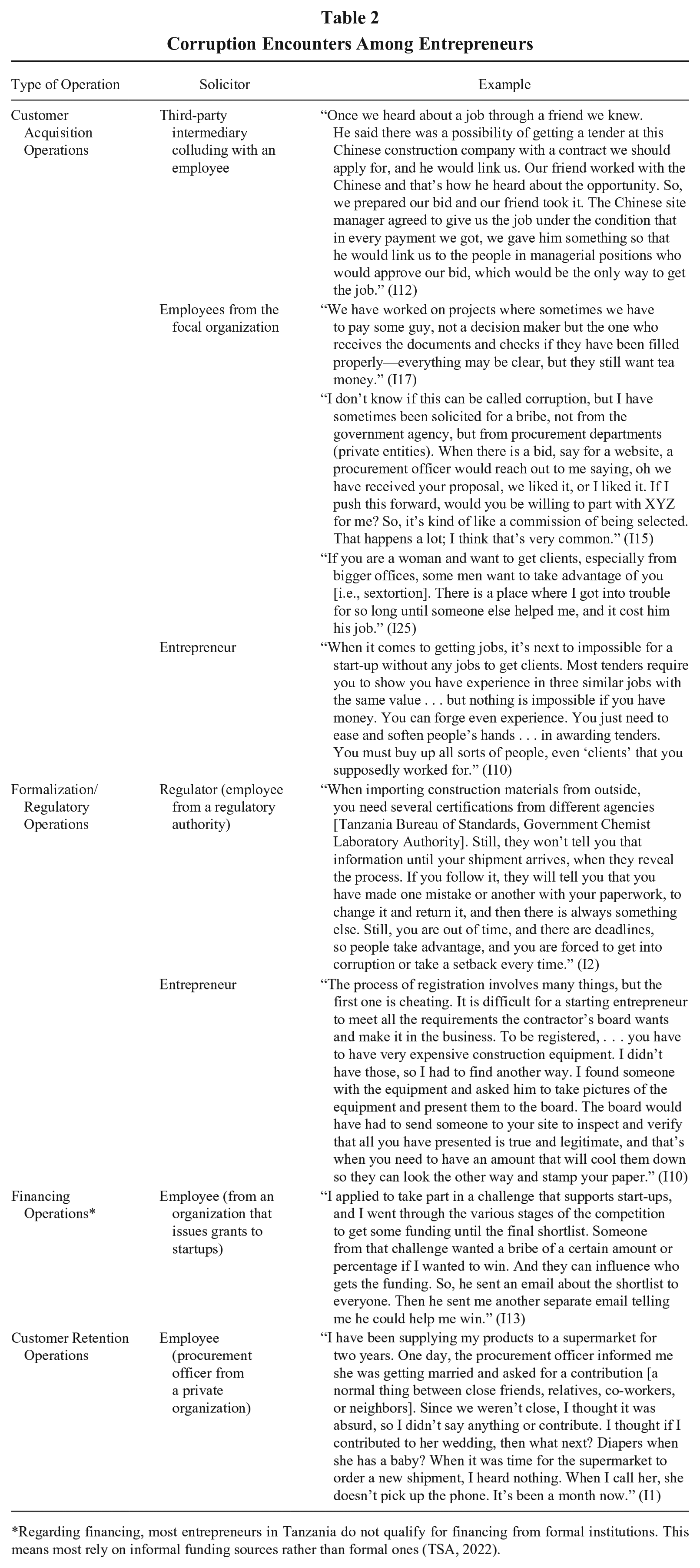
Regarding financing, most entrepreneurs in Tanzania do not qualify for financing from formal institutions. This means most rely on informal funding sources rather than formal ones (TSA, 2022).
Resource needs
According to our data, entrepreneurs are constrained by resource needs when deciding how to respond to corruption demands. For example, in the early phases of business formation, most entrepreneurs need legitimacy from formalizing and licensing organizations to acquire their initial customers. Another entrepreneur, of a communication agency, spoke about the requirements to secure a contract in their industry, It’s just harder for someone to start a business and work with different organizations, and most of the time you would have to use whatever opportunity you get to build up enough [of a] portfolio because, if you look at all the work that comes out, people want to see what previous work you have done and the kinds of contracts you have been working on. For example, if I want to give you a job for 70 million [TZS, approximately 27,000 USD], I want to see that you have done some work of similar value for me to be comfortable. (I16)
Indeed, various entrepreneurs identified unrealistic requirements by B2B customers and regulators as a trigger for corruption. Corruption happens in exchange interactions when entrepreneurs seek to acquire resources for their ventures’ operations and survival. Consequently, when faced with corrupt demands in the quest for resource acquisition, entrepreneurs also assess the criticality and urgency of those required resources to determine their responses. A motivation for resistance alone is not sufficient in making such decisions. The factors influencing corruption resistance decisions vary between industries and businesses. For example, before starting their communication agency, Entrepreneur I16 operated a highly regulated food processing business that required certification from the former Tanzania Food and Drug Authority (TFDA). This certification represented a critical resource which this entrepreneur urgently needed for their business. Any delays in acquiring this certification would have been detrimental to the business, making time an essential consideration in the exchange process. As illustrated in the quote below, the criticality and urgency of the needed resource determined how this entrepreneur responded to the corruption pressure: Let’s say if someone from TFDA needs to come and inspect your business for you to operate; if they don’t come, it kills you. For those, some of the time, you just have to pay [a bribe]. You can’t say that you aren’t going to do it—you just have to do what you have to do to survive. . . . If you don’t produce for a day or two or if you have produced but can’t distribute, it can kill you, because your margins are very small, and you milk everything out of you. (I16)
Indeed, bureaucrats use delays to solicit bribes, and entrepreneurs pay “speed money” to grease the wheels of bureaucracy in their quest to acquire symbols of legitimacy more quickly. Entrepreneurs also face corruption when seeking financing, such as grants or loans, and when retaining customers, as seen in Table 2. Therefore, resource needs likely influence entrepreneurs’ decisions of whether to conform to or resist corruption pressures.
Leverage
Despite the constraints, entrepreneurs with sufficient leverage in an exchange interaction acquire the necessary resources without succumbing to corruption. This leverage, we found, is often in the form of entrepreneurial organizations’ resource endowments or alternative paths to success. One of the critical resources entrepreneurs can possess is information/knowledge about processes and procedures. As an entrepreneur of a communications agency intimated below, information is power, especially when dealing with regulators, When it comes to challenges when starting, I think one of the biggest is not knowing what you are supposed to know. . . . Not knowing what taxes you have to pay or what provisional taxes mean. If you go to TRA, they give you half-baked information so that they can catch you not knowing when to submit what. You really have to dig deep for this information; it is not information that you can just easily access. (I16)
Working with professionals, such as tax consultants, gives these entrepreneurs a buffer from corrupt regulators. The same entrepreneur explained, So far, we have been able to work with professionals, like a tax consultant, but we can do that now because we have grown. However, the lack of information was challenging and time-consuming when we started. All kinds of issues are harder to navigate when you start. (I16)
This buffering through experts indicates that entrepreneurs need financial resources to hire tax consultants or other professionals who can bridge the knowledge gap to resist corruption. For some entrepreneurs, partnering with knowledgeable individuals in their founding teams has a similar effect. For example, in an interview with an entrepreneur of an app business who belongs to a startup hub, the entrepreneur shared that they did not feel pressured to pay bribes because they were not in a hurry to obtain the organization’s registration and had a knowledgeable partner to help navigate the corrupt waters of formalization, But when we started, besides having someone with the knowledge to deal with all government entities, we were also not in a hurry to get things done. You know, if you want things to be expedited, you have to give something if you want to get things done. (I13)
This entrepreneur has an alternative path to legitimacy. The venture is part of a startup hub, which likely gives the entrepreneur and their business legitimacy even without formal registration. Thus, legitimacy from the hub is a crucial leverage point for this entrepreneur in the face of bribe solicitations. However, not every entrepreneur has the same luxury of time or an alternative legitimacy source.
For example, Entrepreneur I6, who operates a polyclinic, described how they felt compelled to pay a bribe to regulators to speed up the processing of the license needed to start the clinic because there were no alternatives to the license or other approvals required from the Ministry of Health. Moreover, there are no alternatives to expedite the Ministry’s process. As Bardhan (2015) stated, bureaucratic delays are a significant driver of corruption. However, we note that it is not just bureaucracy or the greed of bureaucrats (which, in this case, compelled the entrepreneur to succumb to corruption) that is the problem. The lack of alternatives for entrepreneurs to reach their goals within this bureaucratic system also makes resistance nonviable for them. If there were alternative inspectors or license providers or even an alternative process whereby they could pay for an expedited inspection, this entrepreneur would have had a chance to resist corruption. Therefore, even when bureaucracy may be necessary (e.g., for consumer protection), resistance could be possible if alternative paths to success are provided.
Regarding customer acquisition and retention processes, an entrepreneur of an advisory organization told us that despite the highly corrupt tendering process, they find it easier to resist corruption solicitations from clients when they have a vast pool of potential clients to choose from. This entrepreneur explained, There are cases where we bid for an assignment, and we can read that these people are looking for something, and immediately when we see that, we really don’t care; we just give up. Sometimes, we get contracted, but when they find out you are not ready to give them anything, they terminate you. That has happened. . . . [But] we still believe that there are still clients that will be just happy with our service, and they don’t look for anything else other than the service from us. (I22)
Entrepreneur I21, who operates a training business, similarly stated, “For my industry, there are thousands of companies that need training, so if you just suggest it [corruption], I can easily walk away and go to the next one.” We noticed that entrepreneurs who rely on few customers are more likely to succumb to corruption to acquire or keep those customers than those with a larger customer pool. Larger customers also tend to have more power, which they use to acquire corrupt payments. For entrepreneurs in the road construction business, such as I1 and I7, the choices for clients are limited. Therefore, their ability to resist corruption is hampered unless they choose a different type of business altogether. Entrepreneurs seem aware of what they can and cannot do in their industries. They also know that their circumstances do not necessarily apply to other industries.
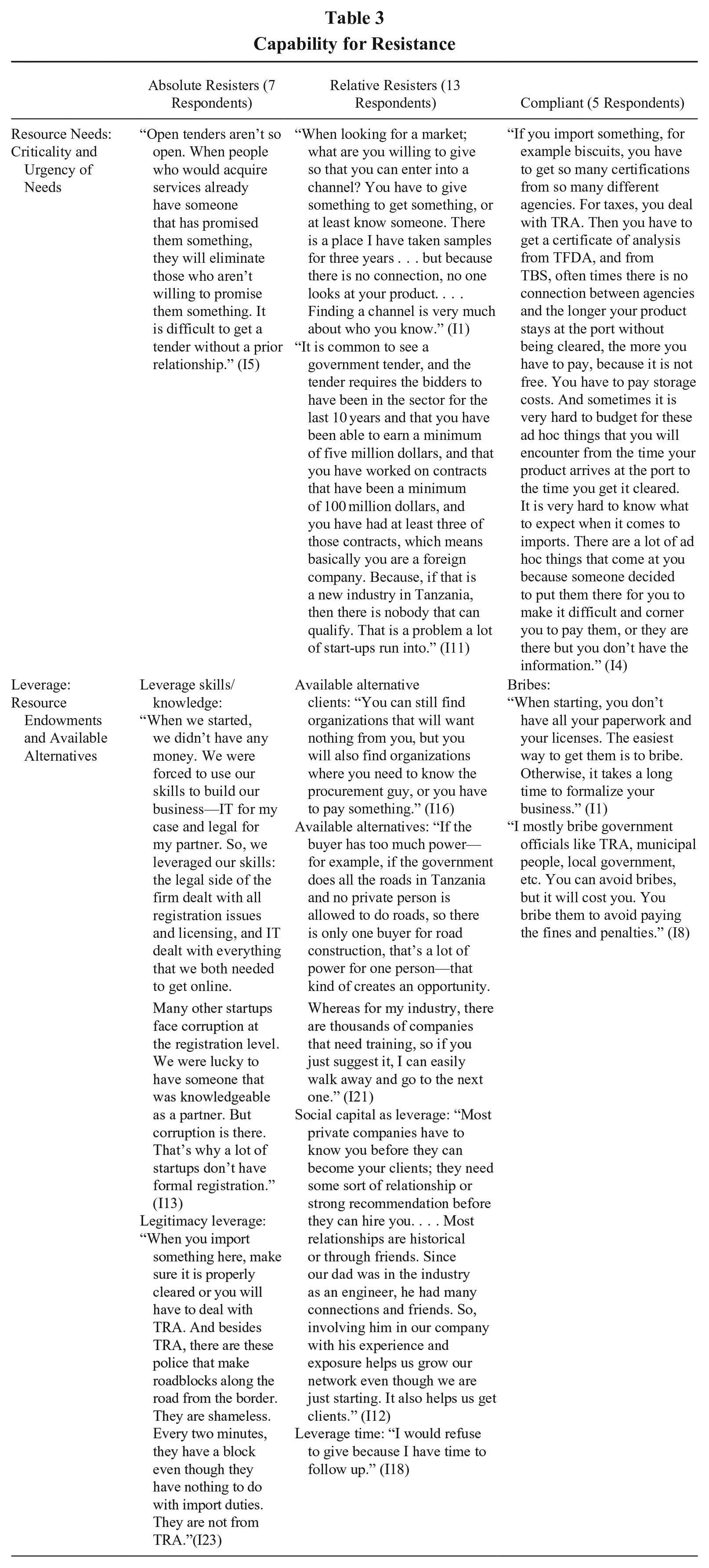
Having alternative paths to success (in the form of resources, alternative resource providers, and/or alternative solutions offered by the same providers) is vital to corruption resistance. However, for some entrepreneurs, such alternatives are not always immediately available. In some instances, the belief that there will be alternatives in the future is sufficient to give entrepreneurs a nudge toward resistance, as we learned from Entrepreneur I13. When this entrepreneur was solicited by an organizational employee who runs entrepreneurship competitions to provide seed funding for promising startups, they refused to pay a bribe to win the competition because they believed they could win something better in the future. In addition, not all alternative paths to success involve tangible resources. Entrepreneurs also find alternative paths to acquire needed resources, such as leveraging their networks and relationships in exchange interactions. Several interviewees spoke about leveraging relationships to win jobs/customers, including entrepreneur I5, whose IT company sells enterprise solutions: “When dealing with the private sector, getting a tender is often a result of who knows you or respects you. In many cases, you have to build a relationship. Many relationships are built out of incentives.” Therefore, entrepreneurs adjust their responses based on their resource endowments and the availability of alternative paths to success in various situations, as we illustrate in Table 3.
Capability for Resistance
How Motivations and the Capability to Resist Corruption Interact to Influence Resistance
We noted that some entrepreneurs’ motivations are subdued because they lack the capability to resist. For example, Entrepreneur I6, who operates a polyclinic, intimated that despite their motivations, they paid a bribe to health inspectors to obtain a license: So, like at the Ministry of Health level, the meeting to approve new facilities is supposed to be held once every 3 months—and usually, it’s postponed and might be held after 6 months. So, if the people at the DMO’s office ask for a little something and the meeting is closed, you give it to them. I hated doing that, but they kept pushing us around for months. When the meeting was a week away, my partner said, “Ah, let’s just give it to them.” (I6)
However, not all entrepreneurs who lack the capability to resist succumb to corruption. As noted previously, absolute resisters try to resist corruption regardless of the consequences. For example, Entrepreneur I13 decided to forgo a grant opportunity altogether when they were solicited to give 10% of the grant to the administrator if they wanted to win, and Entrepreneur I21 exited their marketing venture after developing the will to resist corruption but realizing it was difficult to do in the industry.
For many entrepreneurs (often relative resisters), being motivated but facing constraints requires flexibility and pragmatism to do what is possible in a given situation. This means entrepreneurs resist whenever possible and conform when not. This flexible approach often entails entrepreneurs carefully analyzing their capabilities in light of what a particular situation requires for them to succeed. For example, an entrepreneur in construction (I7) described how they felt it was “rational to plan for [corruption as] a cost of business” since it was almost a requirement to secure contracts in the industry when they started in 2019. However, in 2023, this entrepreneur told us, I have had to get smarter because some people are leeches. One officer was so greedy that [they] tried to get so much money from everyone without any scruples. I and the other contractors had enough of [them], so we decided to report [them] to the Public Procurement Regulatory Authority [PPRA] even though it could mean losing future jobs with the client. We simply couldn’t deal with [their] nonsense anymore. (I7)
This comment suggests that an increased capability to resist corruption can enhance entrepreneurs’ motivations (banding together with other entrepreneurs). As such, some entrepreneurs’ motivations are strongly tied to their capability to resist. Therefore, as we saw in our data, entrepreneurs are likely to gain more leverage (e.g., legitimacy, experience, and knowledge), increasing their capability to resist corruption, and they may also reach a “corruption tolerance” limit over time. Thus, this capability to resist corruption and the underlying motivations are dynamic and may vary depending on an entrepreneur’s particular situation, industry, and experience.
We also noted that some entrepreneurs change their stance on corruption when moving from one stage of the business lifecycle to the next. This change in stance suggests that the capability to resist corruption may increase with time as entrepreneurs gain more leverage. For example, Entrepreneurs I1 (3 years in the food processing business) and I12 (1 year in the construction business) told us they believed they could not resist corruption in the early stages of their ventures’ development. However, they are now able to deter future solicitations from regulators after obtaining legitimacy leverage from securing various licenses and permits (albeit through paying bribes). Indeed, many of the entrepreneurs we interviewed noted how obtaining their first permit or client was difficult (without corruption).
Although we could not explicitly determine if the capability to resist matters more than the motivations, or vice versa, we noticed that the two factors are tightly intertwined. Entrepreneurs who are motivated to resist seem to operate in some spectrum of capability that determines their success in resisting. Armed with the appropriate leverage, some entrepreneurs resist corruption while meeting their resource needs. Without any leverage, some entrepreneurs either conform to corruption to meet their resource needs or resist corruption while forgoing acquiring resources. When a motivated entrepreneur lacks the leverage to resist, the strength of their resource needs (i.e., criticality and urgency) is weighed against the strength of their motivations to determine the appropriate response. Interestingly, in our data, we did not find any entrepreneurs who explicitly admitted to always lacking motivation to resist corruption, even among those who are always compliant (attributing this compliance to the nature of their industries).
The overall individual and business goals that motivate entrepreneurs significantly impact how they run their businesses (Dunkelberg, Moore, Scott, & Stull, 2013), including how they respond to corrupt demands. The decision to resist corruption is likely to be made on a situational basis within the interplay between resource needs, entrepreneurs’ leverage, and their motivations to resist corruption. Against entrepreneurs’ larger aspirations, their resource needs are pitted against their leverage to establish whether corruption resistance is feasible for those motivated to resist. While individual and environmental constraints influence these factors, ultimately it is up to the entrepreneur to decide what success looks like. To some, success comes from resisting corruption, no matter the cost. To others, success comes from their ability to meet their business goals (with or without corruption). However, entrepreneurs who believe success comes from meeting their resource needs (or business goals) while resisting corruption likely need a healthy dose of motivation and leverage to use against possible corrupt demands from interdependent actors. Figure 1 illustrates the relationship between motivations, resource needs, and capabilities (i.e., resource endowments and available alternatives) in entrepreneurs’ decisions to resist corruption and the strategies for doing so. In the following section, we dive deeper into corruption resistance mechanisms and illustrate how leverage plays a role in some of them.
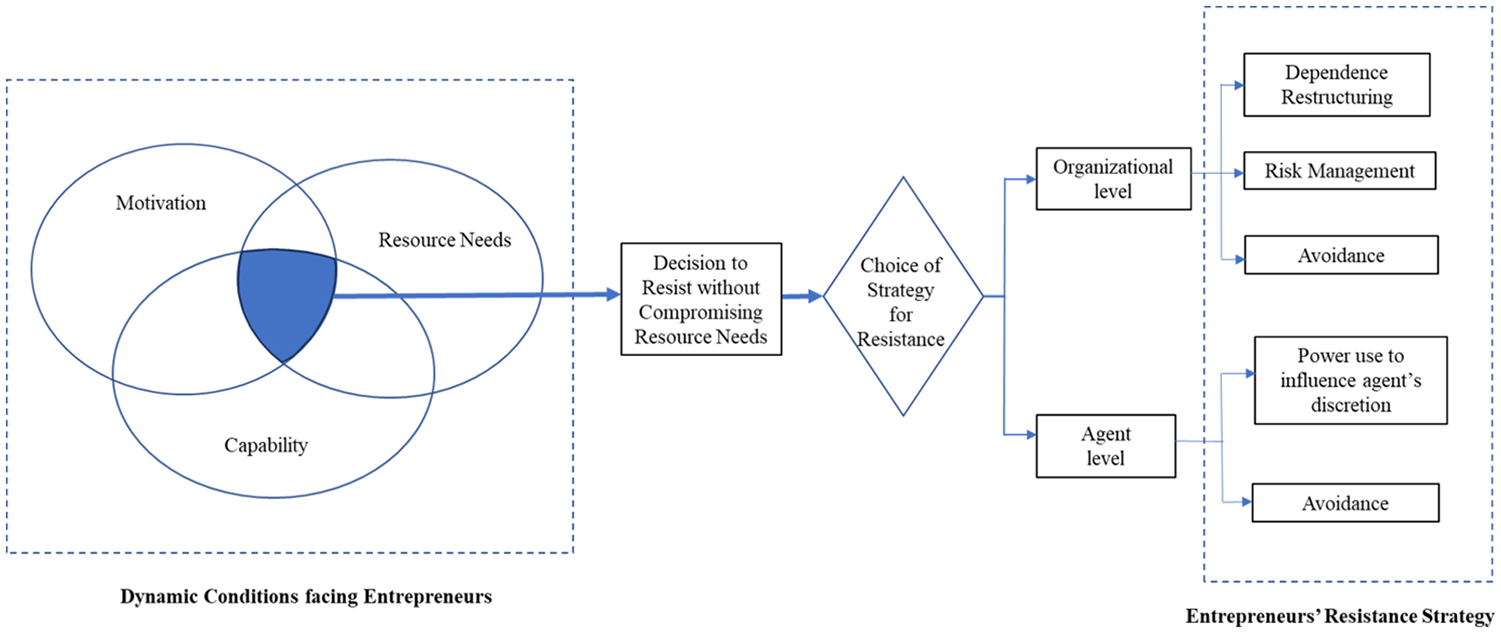
Entrepreneurs’ Corruption Resistance Model
Mechanisms for Corruption Resistance
As illustrated above, entrepreneurs who aim to resist corruption without compromising their resource needs require leverage from resource endowments or available alternatives to pursue exchange interactions and overcome corrupt demands. In our data, the entrepreneurs revealed myriad creative ways to obtain and use this leverage to resist corruption in their exchange interactions with interdependent actors. The mechanisms (which we ultimately grouped into strategies) whereby entrepreneurs use their leverage to resist corruption are focused on either organizations or agents. The organization-focused mechanisms represent entrepreneurs’ strategies for resisting corruption pressures from other organizations, and the agent-focused mechanisms represent entrepreneurs’ strategies for resisting corruption pressures from individuals.
Organization-level resistance strategies
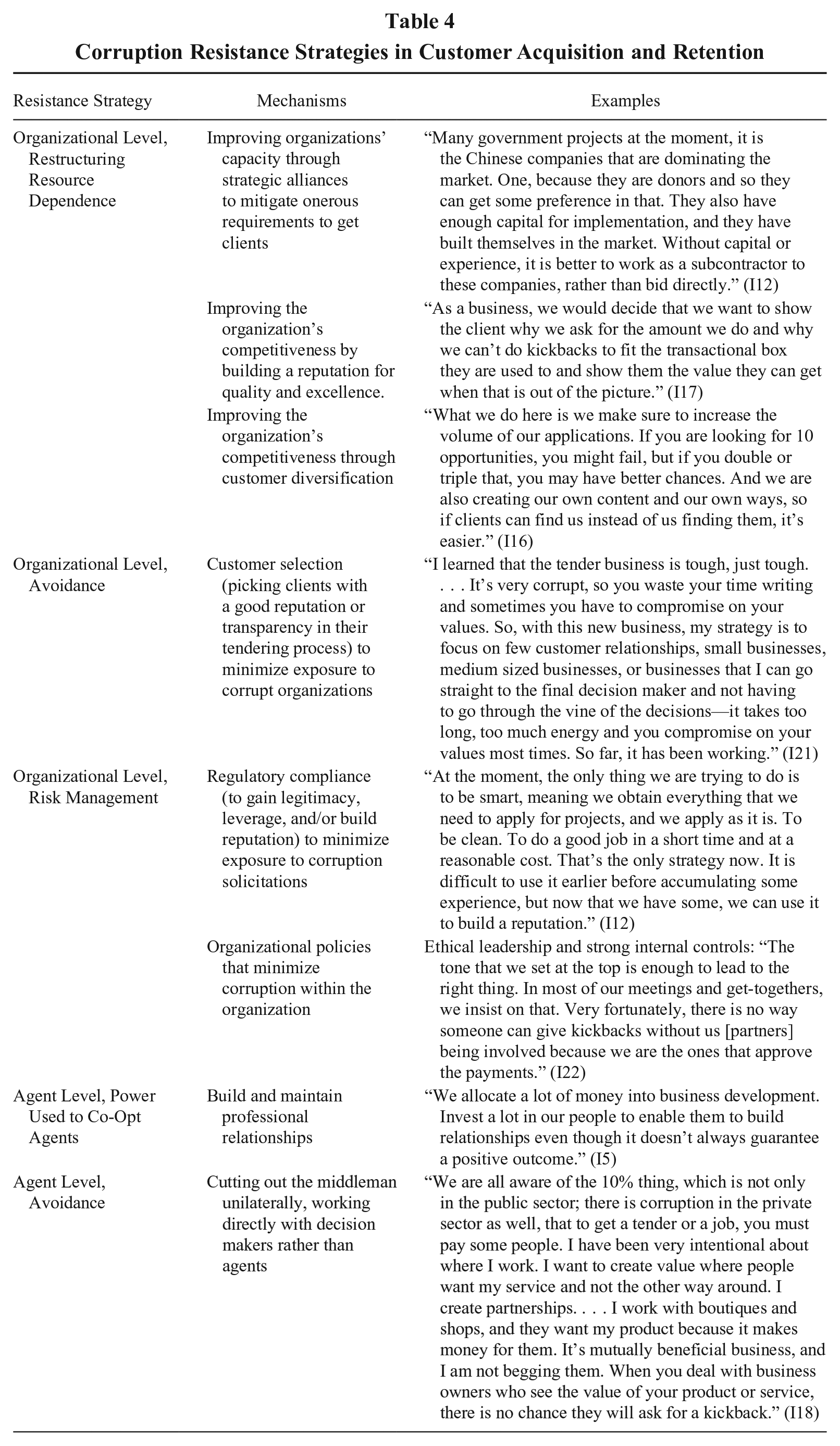
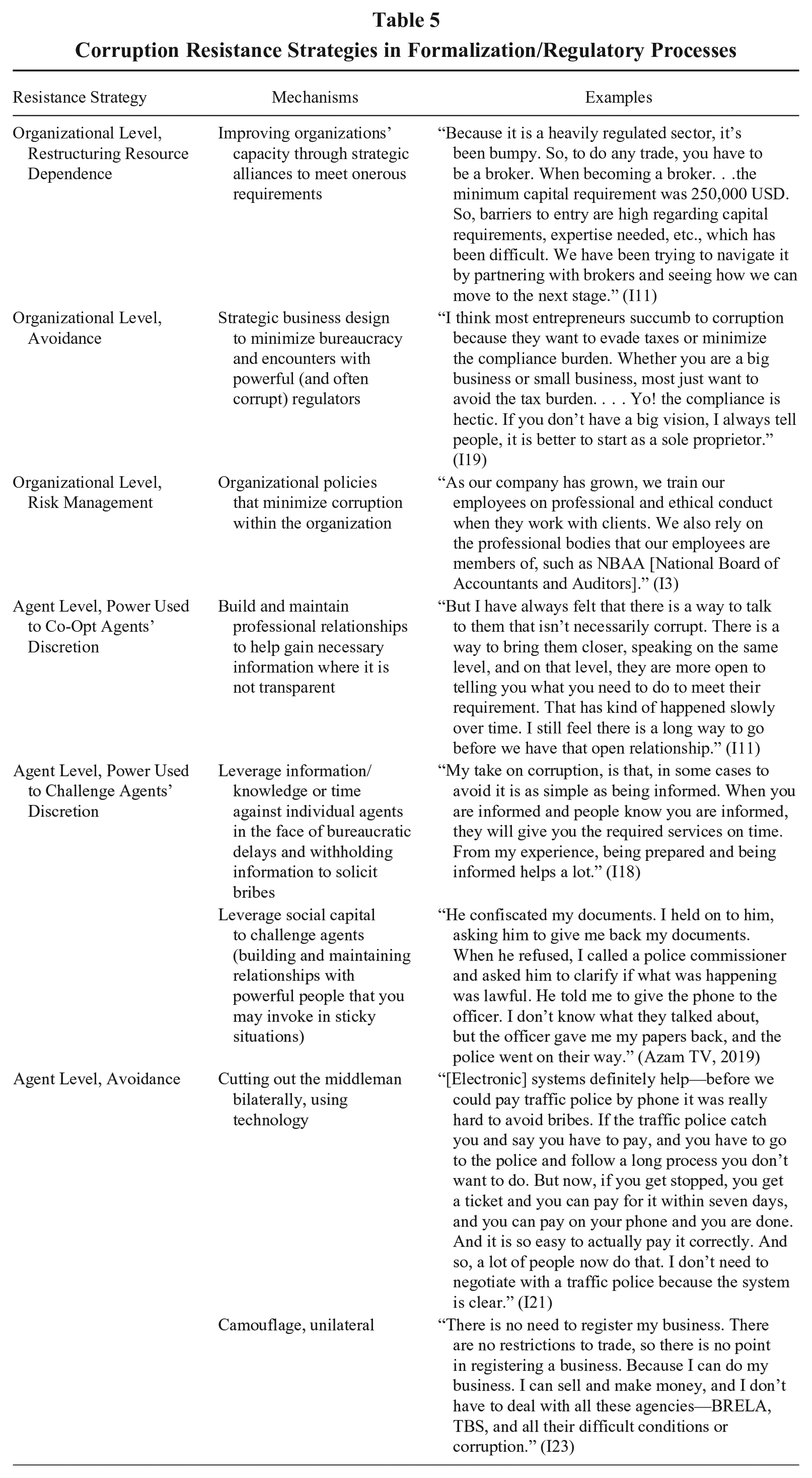
According to our interviewees, entrepreneurs approach focal organizations with corruption resistance strategies orientated toward three key areas: (1) dependence restructuring, (2) avoidance, and (3) risk management. The application of these strategies depends on the type of interaction—formalization and regulatory processes or customer acquisition processes—as illustrated in Tables 4 and 5.
Corruption Resistance Strategies in Customer Acquisition and Retention
Corruption Resistance Strategies in Formalization/Regulatory Processes
Dependence restructuring strategy
The first organization-focused strategy entrepreneurs use to resist corruption is restructuring their entrepreneurial organizations’ dependence on other organizations to minimize their vulnerability to corrupt demands. To build their capacity to resist corruption, entrepreneurs use different tactics as part of this strategy that minimize their resource dependence—namely, forming strategic alliances, building a reputation for quality and excellence, and diversifying their customer bases.
First, entrepreneurs use strategic alliances to restructure their dependence. Strategic alliances help entrepreneurs to build their organizations’ capacity to push through market entry barriers and regulatory hurdles. Corruption is often used to grease the wheels when a market or regulatory environment has challenging requirements and barriers for new entrants (Dutta & Sobel, 2016). Many new entrants face difficulties in being accepted into such a market or environment. Many buyers do not want to bear the risk of dealing with a new business, so the requirements are meant to minimize this risk. As one procurement officer from the NGO sector stated, “There is no likelihood that someone who is just starting in the market will be selected [as a supplier by us] because our organization is big, and we don’t want people who are trying to get experience from us” (I27). One way to overcome the challenges and strict requirements for this selection is through bribes. However, some entrepreneurs opt to build strategic alliances as an alternative.
Strategic alliances help entrepreneurs to circumvent onerous customer acquisition requirements that often attract corruption. Many large and medium-sized organizations (public and private) tend to establish a pool of trusted suppliers called preferred or prequalified vendors to avoid the need to vet suppliers every time they need to purchase products or services. Vendors are qualified and certified by the Government Procurement Services Agency (GPSA). As detailed above, many organizations want vendors with experience. Therefore, it is challenging for a new venture to meet the experience criteria of such customers. To secure customers, organizations need experience, but to obtain experience, organizations need customers. Strategic alliances help organizations enhance their market and social power, increasing their competitive advantage (Xia, Wang, Lin, Yang, & Li, 2018). For example, Entrepreneur I25 uses subcontracting to mitigate the barriers in the market, such as the high costs of compliance, capital requirements, and experience requirements: “If I see a big job that would require corruption if I bid by myself, I go as a subcontractor. I ping someone bigger that can bulldoze the process, and I remain underground” (I25).
Entrepreneurs also use strategic alliances to navigate complex regulatory requirements. For example, smaller food vendors, such as Entrepreneur I24, opt to become subcontractors for a larger vendor to avoid needing certificates or the capital required to bid if they were to operate as a standalone vendor. As the entrepreneur told us, being under the umbrella of a larger vendor provides a buffer against regulators, which also serves as a buffer against harassment and corruption solicitations. This entrepreneur stated, I don’t meet regulators directly, not like someone who would have a standalone food joint or restaurant. The boss [main vendor who won the tender with the focal university] has a formal business which deals with regulators and has all the required permits and certificates. I work under him [informally]. I make and sell bites. Other smaller vendors have similar arrangements for juice or other things in the cafeteria. We all pay the boss daily rent. My business is not known to the regulators or the client [the university]. (I24)
As such, these entrepreneurs’ organizations may gain access to customers without needing the legitimacy leverage that comes from having various permits. While this could mean these entrepreneurs may avoid direct bribe solicitations, this situation is subject to change if their arrangements become known to regulators or if they seek formality, which the ventures sometimes need to grow.
Therefore, strategic partnerships and alliances can empower new organizations to gain market access, obtain experience, establish legitimacy, and avoid regulators, reducing their susceptibility to corruption solicitations.
Second, entrepreneurs build a reputation for quality and excellence to restructure their dependence. With this tactic, entrepreneurs find ways to improve their competitiveness in a cutthroat market, minimizing the need for corruption to enroll customers. For example, several entrepreneurs told us that providing superior value compared to their competitors helps them avoid making corrupt payments to obtain jobs. Indeed, Entrepreneur I25, who runs a renewable energy business, told us: In a job where I can contest by myself, I do my best, you understand, I do my very best that it is the real deal, the cream. If you don’t select me, it is not just a loss for your business, you also look stupid to your investors. I make sure you have no choice but to select me, and I let you come to me, instead of me coming to you and ask for an opportunity. . . . It’s hard, but that builds your reputation that you are not paying to get tenders, and your work is the best, and that sets you apart from your competition. (I25)
In an environment where you can bribe your way to obtain clients, doing quality work can set entrepreneurial organizations apart from their competitors. Buying work through corruption reduces the entrepreneur’s incentive to do excellent work since the organizations’ attractiveness mostly depends on the amount of the bribe they can pay rather than the work they can do. Such organizations often perform at the bare minimum standard. Interestingly, stricter anti-corruption efforts tend to weed out mediocre competitors that previously could simply bribe their way into the market, as intimated by Entrepreneur I17 regarding the changes occurring in the marketing and communication industry because of stricter measures: In our space, there are a lot of bullshitters that are forced to quit. With things getting tougher, brand managers are less inclined to entertain the same things they used to because of kickbacks, simply because the pie has decreased and, thus, there is a lot more at stake. Companies are no longer willing to spend more for less. This is a huge advantage for us because this is the ground we have been playing anyway; we have been underdogs and always forced to deliver in order to compete. (I17)
Finally, some entrepreneurs diversify their customer base in markets outside Tanzania to restructure their dependence. For example, Entrepreneur I20 was looking for opportunities for their IT consulting organization in other East African countries, including Rwanda and Uganda. They told us, The good thing about our business is that we can work in any country, so we can go beyond Tanzania and look for other markets. So, if it doesn’t work out in Tanzania, [and] we end up getting all these bribery requests, then we can look for outside markets. (I20)
The opportunities within regional markets such as the East African community can expand entrepreneurs’ customer base, providing additional alternatives for finding clients whose values and practices align with those of the entrepreneur.
Avoidance strategy
The second organization-focused strategy entrepreneurs use to resist corruption is to avoid powerful (and corrupt) organizations altogether. This strategy entails two tactics: (1) strategic business design to minimize exposure to regulators and (2) customer selection to avoid working with clients that have a reputation for corruption (see Tables 4 and 5).
First, to avoid exposure to powerful (and corrupt) regulators, entrepreneurs adopt a strategic business design (Zott & Amit, 2007) that comprises a business registration type that is less regulated, and a business model that can minimize corruption. For example, some entrepreneurs register their businesses as sole proprietorships rather than companies to resist corruption. A sole proprietorship has less regulatory burden and is a preferred business design to resist corruption. For example, one entrepreneur explained how their experience with corruption in the regulatory process drove them to register their new venture as a sole proprietorship, When I moved into this new venture, I was very intentional to structure it in a way that I would have very little admin. So, even not doing a limited company and doing a sole proprietorship reduced quite a lot in how you deal with taxes and how you deal with the government. I didn’t want to put myself in that situation where I had to deal with the same things I have run away from [i.e., corruption]. (I21)
However, while this form of business registration can buffer against corruption, it can create other risks and opportunity costs in B2B channels. Specifically, some entrepreneurs mentioned that having a sole proprietorship makes it challenging to secure specific clients or external financing: The main advantage is that you minimize the number of issues you need to comply with [those associated with corruption], but, at the same time, you bear the risk. Because, for a sole proprietor business, if anything goes wrong, then you are liable. The law allows any creditor or tax authority to take your house or confiscate your personal property. If it is a company, it is a legal entity, and the liability remains with the company. (I22)
Our data shows that entrepreneurs employ a strategic business design when they cannot change their relationship dynamics with regulators. To shield themselves from corruption, entrepreneurs remove themselves from compliance burdens by starting and staying small. The less entrepreneurs must comply with regulations, the less they are exposed to government entities and, thus, corruption. This tactic may sometimes entail avoiding the B2B business model altogether, as indicated by Entrepreneur I4. However, starting and staying small or avoiding B2B sales is not always practical. Some entrepreneurs want or need to scale their businesses.
Second, entrepreneurs use strategic customer selection to avoid working with actors with a corrupt reputation. Customer selection involves rejecting or selecting specific customers in the local market. With this strategy, some entrepreneurs select customers based on their values and needs. For example, Entrepreneur I5, whose organization provides enterprise solutions to businesses, told us that after learning the way the market worked, they decided to minimize kickback solicitations by working with clients who are more transparent in their vendor selection process: “We have an aggressive strategy when choosing our customers. We develop our strength and work only with donor-funded projects whose objectives are clear, and the evaluation procedures are transparent” (I5). Absolute resisters prefer stricter customer selection to avoid corruption. For example, an entrepreneur of a digital agency (I15) told us they only work with small and medium-sized businesses, and Entrepreneur I21 explained how they refuse to work with government agencies in their training business to avoid corruption.
Risk management strategy
The third and final organization-focused strategy entrepreneurs use to resist corruption is risk management. According to our data, entrepreneurs use unilateral and bilateral risk management tactics that minimize their susceptibility to bribe solicitations or build their internal capacity to reduce maleficent behavior among their members or employees (see Tables 4 and 5).
First, entrepreneurial organizations use regulatory compliance to manage the risk of corruption solicitations bilaterally. Some entrepreneurs cited complying with regulations as a technique to resist corruption. Entrepreneurs use compliance with rules and regulations to strengthen their positions in meeting requirements for customer acquisition while minimizing their susceptibility to bribe solicitations. This strategy is especially useful when entrepreneurs cannot bypass regulators in their operations. For example, Entrepreneur I1, who operated a food processing business, told us, Having all the required licenses and registrations allows you to have more options for customers. You may have to bribe to get these from the government agencies, but once you have them and you are legitimate and established, you can be compliant, and you won’t have to bribe anymore. (I1)
The legitimacy leverage gained from having specific licenses or registrations allows entrepreneurs to resist corruption. Nevertheless, another entrepreneur (I12) who uses a similar approach conceded that it is difficult to use this tactic before accumulating some experience in the market. Moreover, this tactic has several drawbacks. Indeed, complying with rules and regulations does not necessarily insulate entrepreneurs from intimidation by corrupt officials. For example, Ntunzwe, in the first viral video we used, noted the following: The police came to me and asked me for all the paperwork regarding taxes and levies. I gave them the paperwork, and I had everything that was required. One of the police officers told others, “Don’t bother with the paperwork; he has to give us a significant (worth-dying-for) sum so we can let him go or just say he is smuggling drugs.” When I refused to give them money, the officer called a person from TRA, telling him that there was a deal in Mbezi, and he should come through. He confiscated my documents. I held on to him, asking him to give me back my documents. (Azam TV, 2019)
Furthermore, while compliance with regulations can help entrepreneurs resist corruption, gaining compliance certificates from regulators is one of the critical reasons entrepreneurs succumb to corruption in the first place. Nonetheless, those who comply with regulations have a fighting chance to shield their operations against corrupt regulators.
Second, entrepreneurial organizations unilaterally manage corruption risks by creating organizational policies that help them to deter corruption (Azim & Kluvers, 2019; Misangyi, Weaver, & Elms, 2008), especially as their organizations grow to include more owners and employees. For instance, organizations may establish robust internal controls to deter corruption, The tone that we set at the top is enough to lead to the right thing. In most of our meetings and get-togethers, we insist on that. Very fortunately, there is no way someone can give kickbacks without us [partners] being involved because we are the ones that approve the payments. The only way for an employee to do that would be to pay from their own pockets, not from company funds. The culture is very clear that we don’t do that, and I very much believe it has changed our employees’ thinking. (I22)
Entrepreneurs use various tools, including having a code of conduct and procedures for their teams instead of relying on team members’ judgment. Entrepreneurs also communicate their core values to align their teams and stakeholders. For example, entrepreneurs use training to enhance team members’ knowledge regarding what is and is not corruption in their daily dealings and what is and is not acceptable in their organizations. As Entrepreneur I3 stated, “We communicate our expectations from the beginning . . . both internally and externally. I am not responsible for all the business . . . so we communicate our core values, what we can do, and what we can’t do.” When entrepreneurial organizations create such policies, it empowers their members to resist or minimize corruption from within. Indeed, Entrepreneur I21 spoke about the importance of having the right partners who are like-minded regarding corruption.
Our findings above illustrate that entrepreneurs employ organization-focused strategies to resist corruption. These strategies entail restructuring their dependence, avoiding interactions with powerful (and corrupt) organizations, and implementing risk management. Entrepreneurs use these strategies in customer acquisition and formalizing/regulatory operations.
Agent-level strategies for corruption resistance
Our findings show that entrepreneurs also use corruption resistance strategies focused on individual agents (i.e., employees and representatives from focal organizations). Entrepreneurs who resist corruption recognize the power individuals have in exchange interactions, including interactions over corrupt payments. In interorganizational interactions, individual agents influence processes and outcomes due to their control over specific critical resources in exchanges and their positions. We define this influence on processes and outcomes as discretion. Knowing the influence of individual agents in exchange interactions, entrepreneurs can make overt and covert efforts to sway, coerce, and/or manipulate others to achieve the desired outcomes (Fleming & Spicer, 2014; Schildt, Mantere, & Cornelissen, 2020). In our data, entrepreneurs use their power to influence agents’ discretion or avoid interacting with agents on the demand side of corrupt dealings.
Power is used to influence agents’ discretion
The first agent-level strategy entrepreneurs use to resist corruption entails influencing agents from focal organizations to act in the entrepreneurs’ interests, without resorting to corruption through challenging or co-opting tactics. First, entrepreneurs challenge agents’ discretion by leveraging knowledge/information against corrupt regulators. Information is power. In previous examples, we showed how corrupt regulators can use information asymmetry and time to create bureaucratic delays and opportunities for corruption. When entrepreneurs lack the necessary information, regulators can use that situation as an opportunity to intimidate, mislead, and extort bribes from entrepreneurs. For example, Entrepreneur I11, who founded a fintech business, expressed the challenges of dealing with regulators: “For a lot of people, it is about creating a doorway to corruption by withholding critical information that would allow you to go forward.” Thus, to resist, entrepreneurs leverage knowledge and information to reduce the power asymmetry with individual agents, as illustrated in the following: If someone approaches me, they immediately learn that I am knowledgeable, because what they do is intimidate those who are ignorant, and most small businesses can’t afford to have consultants. They intimidate you to get you to pay them a bribe. (I19)
Similarly, entrepreneurs challenge agents’ discretion by collaborating with knowledgeable partners on their founding teams or consulting mentors with experience. For example, Entrepreneur I13 included a cofounder with corporate and tax law experience to complement their technical knowledge and ensure that it was easier to navigate the corrupt regulatory landscape.
Second, entrepreneurs challenge agents’ discretion by engaging specialized consultants with ample know-how and experience to work with regulators. For example, Entrepreneur I16 engaged tax consultants to mitigate the lack of information that makes entrepreneurs vulnerable, as this entrepreneur told us: So far, we have been able to work with professionals, like a tax consultant, but we are able to do that now because we have grown. But when we had started, the lack of information was a challenge and time-consuming. (I16)
Such engagements reduce entrepreneurs’ chances of being intimidated or misinformed by agents, thus preventing them from being cornered into paying bribes. They also reduce the information gap between entrepreneurs and agents and provide clear feedback channels, reducing entrepreneurs’ uncertainty.
However, consultants are not free, and entrepreneurs must decide whether the cost is worth it. Additionally, as with their large multinational counterparts (Luiz & Stewart, 2014), local entrepreneurs may also use professionals as a scapegoat to feign ignorance and shield them from dealing with corruption directly, as indicated by Entrepreneur I20, who operated an IT consulting organization: “But what we have mostly done is engage with a consultant, so we just tell the consultant what we need and where we are stuck, so whatever he or she does to maneuver, that we don’t know” (I20).
Finally, entrepreneurs challenge agents’ authority by engaging more powerful actors in their dealings. Although this tactic is not widely used, some entrepreneurs involve agents’ superiors to undermine the agents’ intentions to solicit bribes. For example, some individuals contact agents’ superiors via official communication, like this fashion entrepreneur: “Someone else at the same office had also told me that if I was dissatisfied with the service, I could write a complaint letter to the commissioner general [of TRA], and I did” (I18). In the case of Ntunzwe (Azam TV, 2019), the entrepreneur challenged agents’ authority by involving others (with power) who acted as a buffer against intimidation and looked after the entrepreneur’s interests. For example, Ntunzwe called a police commissioner when stopped by a tax officer who was colluding with a police officer to solicit an unlawful payment: He confiscated my documents. I held on to him, asking him to return my documents. When he refused, I called a police commissioner and asked him to clarify if what was happening was lawful. He told me to give the phone to the officer. I don’t know what they talked about, but the officer gave me my papers back, and the police went on their way. (Azam TV, 2019)
Admittedly, police commissioners are not readily accessible to most entrepreneurs in Tanzania, nor are they likely to side with entrepreneurs over their officers. Ntunzwe had access to social capital that enabled resistance to corruption. When whistleblowing channels are available, and individuals believe justice can be achieved through such channels, entrepreneurs challenge agents by (threatening) whistleblowing, like Entrepreneur I7 (and their colleagues), who reported a corrupt procurement officer to the regulatory authority. The results of whistleblowing might not be direct or immediate, but the future benefits might be worth it.
In addition to challenging tactics, entrepreneurs build and maintain professional relationships that influence agents by co-opting them to work in entrepreneurs’ best interests and avoid corruption. Building such relationships helps entrepreneurs to mitigate corruption, while minimizing the conflicts of interest that are prevalent in many personal and patron relationships, as illustrated in the following example by an entrepreneur from a communications agency, My way of navigating a lot of the complications, though, was to build relationships—genuine relationships that have clear value propositions and clear attribution to the business. . . . These guys also have their interests; they want to look good to their bosses and show that they did something good, so what we try to do is to fulfill those nontransactional needs. (I17)
However, not all relationships are equal. Some entrepreneurs we interviewed told us they seek to develop relationships with more powerful agents to invoke interactions or look after their interests, eradicating the need to pay less powerful agents. Indeed, co-optation often involves less powerful actors offering more powerful actors a resource of value, such as status, in the hope that the more powerful actors will not use their power against them (Emerson, 1962). Therefore, building and maintaining professional relationships with powerful actors may help entrepreneurs in transactions and exchange interactions without resorting to corruption. However, professional relationships built on trust (Barney & Hansen, 1994) will likely be more effective and minimize the risk of conflicts of interest.
Avoidance
At the agent level, entrepreneurs avoid corrupt agents in three ways: (1) they cut out brokers in customer acquisition operations, (2) they use technology when dealing with their regulators, and/or (3) they camouflage against regulators. First, entrepreneurs avoid corrupt agents in customer acquisition operations by unilaterally cutting out brokers. As discussed in previous examples, when faced with endemic corruption, the more individuals that entrepreneurs must deal with in the exchange process, the higher the risk that they will be solicited for corrupt payments. In the example below, an entrepreneur of a communications agency explained that they only work with a business when they can deal directly with the decision-maker: I am very afraid to say this—but it is not a good strategy to work with the government or big organizations. . . . I think those are the kinds of businesses that are more prone to 10% and corruption. . . . When we were starting, we worked with smaller companies where, most of the time, we were talking to decision-makers rather than a third party. The moneys are small, but they are big in the sense that it enables you to stay above the water. (I16)
When entrepreneurs can deal directly with business owners, they reduce situations in which they must make corrupt payments, as owners have no (or fewer) incentives to solicit bribes.
Second, entrepreneurs avoid corrupt regulators by using digital solutions that eliminate or minimize human intervention. Entrepreneurs and regulators advocate for using technology whenever possible, as indicated in the following: The only way is to use technology. If you use technology and there is no human contact, you can avoid [many] of these things. If you have to upload something, upload something. If you have to pay for something, pay using digital means. That way, you will remove all the middlemen who want to get something out of it, so technology is the best solution. (I20)
These digital solutions seem to work well when dealing with regulatory authorities. They minimize human intervention and reduce information asymmetry, decreasing the need for entrepreneurs to bribe regulators due to a lack of information or misinformation.
Finally, entrepreneurs employ a more controversial form of avoidance through camouflage, hiding the extent of their businesses from regulators (seen as potential bribe solicitors; Vorley & Williams, 2016). In the following example, an entrepreneur of a fitness and play venture who needed to keep their business registered as a company (and thus could not avoid regulators) used camouflage to deter bribe solicitations, The alternative to this would be to look small even if you aren’t. . . . Looking small is a cover; they don’t even look at you. When you take your tax estimate, even if it is smaller than what you earn, but, by your appearance, it’s plausible, then you just get away with it. When they come to inspect your office, your office is tiny, and nothing is fancy. Some of these entrepreneurs would go to the tax office with a bajaj [auto rickshaw] or Uber because TRA people are very visual—they look at the person, they look at the place of business. If you look big, even if you aren’t big, they will come after you with a lot of force. (I19)
Camouflage deceives regulators because entrepreneurs make their ventures appear less desirable as corruption targets. With camouflage, entrepreneurs make themselves or their organizations seem small by reducing or avoiding any visible markers of prominence or success when interacting with agents. However, besides resisting corruption, camouflage likely facilitates illegal activities, such as tax evasion, since it can hide the true extent and nature of entrepreneurs’ businesses from regulators. According to the tax officer we interviewed, entrepreneurs often hide the extent of their revenue and are likely to bribe to minimize their tax burdens (I35). Camouflage also goes against honesty and transparency, essential to combating corruption (Kaufmann & Bellver, 2005).
As shown in previous examples and Tables 4 and 5, agent-level corruption resistance strategies reflect how entrepreneurs avoid or influence agents’ discretionary power in exchange interactions to gain positive results without paying bribes. This use of power to influence agents’ discretion illustrates the possibility for entrepreneurs to act even when they have a relatively less advantaged position in the context. However, not all of these tactics are available to all entrepreneurs. Most tactics require having a specific resource or social capital as leverage.
Ultimately, entrepreneurs tend to use a combination of strategies to resist corruption in various exchange interactions with other businesses or the government (as both customers and regulators), as illustrated in Tables 4 and 5. These interactions often aim to obtain legitimacy and critical resources for organizational survival. Corruption complicates this endeavor as entrepreneurs who resist corruption must do so while interdependent with the same actors. As such, entrepreneurs act against focal organizations to restructure resource dependence, minimize risks, and/or avoid exposure to specific actors in their exchanges. They also use power to influence agents’ discretion and/or avoid dealing with corruption-prone agents altogether. By including these cross-level dynamics, this study extends the discussion on corruption resistance by showcasing the corruption resistance strategies that entrepreneurs use when dealing with other organizations and government officials (see Tables 4 and 5).
Discussion
This study answers the broader call to include entrepreneurs of micro, small, and medium enterprises, which encompass more than 90% of global businesses, in the global anticorruption discussion (UNIDO & UNODC, 2012). Despite the continued scholarly interest in corruption resistance, anticorruption efforts by micro, small, and medium enterprises from contexts where corruption is endemic have been largely overlooked. Research has proposed that large formal organizations (especially MNEs) have the motivation and resources to control organizational corruption (Lange, 2008; Luiz & Stewart, 2014). However, scholars are skeptical about the will and ability of local organizations (particularly new ventures and small and medium enterprises) to resist corruption (Qian & Sandoval-Hernandez, 2016; Ufere, Gaskin, Perelli, Somers, & Boland, 2020). Fundamentally, extant literature has mostly regarded local entrepreneurs of new organizations as cultural followers who cannot resist corruption (Persson, Rothstein, & Teorell, 2013; Nichols, 2009) or has seen them as weak actors who lack the resources to act against corruption (Acheampong & Rand, 2023; Baron, Tang, Tang, & Zhang, 2018). Consequently, their strategies for corruption resistance remain underexplored. Our data allowed us to theorize why, when, and how entrepreneurs of new organizations resist corruption in a context where corruption is the norm. Our grounded theory approach yielded a model illustrating how entrepreneurs resist corruption while meeting their resource needs from interdependent actors (see Figure 1). Our study advances the understanding of why and how entrepreneurs resist corruption and how interdependence impacts their strategies for their corruption resistance. In the following paragraphs, we highlight the novelty of our findings regarding the motivations, capabilities, and strategies for corruption resistance with interdependent actors.
Contributions to Research on Conditions for Corruption Resistance
Regarding entrepreneurs’ willingness to resist corruption, scholars have cast doubts about whether entrepreneurs are motivated to resist endemic corruption for two reasons. First, the extant literature has tended to see entrepreneurs as calculating actors who only think about the transaction value of corruption by weighing its costs/risks against the business opportunity at hand (Iriyama, Kishore, & Talukdar, 2016; Spencer & Gomez, 2011) mainly due to their entrepreneurial orientation (Karmann, Mauer, Flatten, & Brettel, 2016). As Lange (2008) stated, “Corruption that emerges from the amoral pursuit of a legitimate organizational goal, such as cost savings or competitive advantage, is particularly difficult to control” (p. 719). Indeed, the push for corruption is stronger when “the need for resources is great, and access is uncertain” (Schwartz, 2017, p. 270). Thus, it is not surprising that the extant literature has emphasized transactional factors as the key motivators for entrepreneurs’ responses to corruption (Dickel & Graeff, 2018), and has assumed that entrepreneurs conform to corruption when doing so can lead to positive outcomes, such as reducing costs, overcoming bureaucratic hurdles, or accessing business opportunities (Bardhan, 2015; Krammer, 2019; Ufere, Gaskin, Perelli, Somers, & Boland, 2020). Second, the extant literature has also emphasized that a lack of resources deters entrepreneurs from resisting corruption (Acheampong & Rand, 2023; De Jong, Tu, & van Ees, 2012). Additionally, research has claimed that a lack of market power and resources demotivates entrepreneurs from resisting corruption (UNIDO & UNODC, 2012).
While these two arguments may be valid occasionally, our findings illuminate a more complex picture of entrepreneurs’ motivations and actions in the context of corruption. First, we show that entrepreneurs in this context are not monolithic; they “exhibit cognitive heterogeneity” (Harris, Sapienza, & Bowie, 2009, p. 409) with various sensitivities toward ethical issues. Despite their unique challenges, entrepreneurs can be motivated (transactionally and based on values) to resist corruption. Crucially, our findings show that entrepreneurs operating newer organizations may resist corruption due to values-based motivations—that is, nonrational moral and religious beliefs with no transactional value. Vu (2021) also found that faith and spiritual traditions influence perceptions about corruption, shaping people’s ethical orientations. Indeed, new organizations are primarily influenced by their founders’ values (Morris, Schindehutte, Walton, & Allen, 2002; Shepherd, Breugst, & Patzelt, 2023), but it is also noteworthy that these values tend to be heterogeneous (Harris, Sapienza, & Bowie, 2009). Culture shapes perceptions and attitudes about corruption and is informed by disparate and fragmented institutions and networks (DiMaggio, 1997). As such, policymakers interested in anticorruption efforts may consider tapping into aspects of culture that can support these efforts. Moreover, the influence of multiple value systems on entrepreneurs underscores the importance of incorporating ethics in entrepreneurial education so that founders can confront ethical dilemmas—like corruption—with tools that may help their decision-making (Wilhelm, 2002).
Second, the relationship between entrepreneurs’ motivations and the capability to resist corruption is complex. While there are some entrepreneurs whose motivations to resist corruption are overshadowed by a lack of resources (De Jong, Tu, & van Ees, 2012; Svensson, 2003), there are also absolute resisters who resist corruption no matter their capability, which includes exiting their ventures or proactively avoiding interactions that might lead to corruption. However, most entrepreneurs tend to be relative resisters whose motivations must be met with the capability to resist corruption—that is, they must be willing and able to resist (Durand, Hawn, & Ioannou, 2019; Oliver, 1991). What entrepreneurs deem successful (in determining their motivations and capability level) is highly subjective.
A crucial argument of our study is the need to consider entrepreneurs’ interdependence with other actors within the social context (both organizations and individuals) in our understanding of corruption resistance. To be successful in their resistance, entrepreneurs must also meet their overall business (resource) needs. Thus, interdependence cannot be ignored. This interdependence is necessary because corruption occurs in social exchange interactions, providing entrepreneurs with resources critical for their ventures’ survival (Cuervo-Cazurra, 2016; Schwartz, 2017; Warburton, 2013). In the extant literature, the relationship between resource needs and corruption is highly salient, but the prevailing assumptions tend to be that the need for resources motivates and necessitates corruption (De Jong, Tu, & van Ees, 2012; Schwartz, 2017), and that corruption is somehow the only leverage available to underdog entrepreneurs (i.e., of new organizations) in exchange interactions with interdependent actors (e.g., Baron, Tang, Tang, & Zhang, 2018). This study offers a more holistic view of entrepreneurs’ bargaining power with interdependent actors by considering resource needs, resource endowments, and available alternatives as critical factors that make corruption resistance viable or nonviable. Specifically, entrepreneurs assess their resource needs against their leverage to establish their capability to resist corruption in exchanges. Understanding their resource needs requires entrepreneurs to evaluate the criticality and urgency of these resources, which, in part, influences entrepreneurs’ responses to corruption pressures. The other part of the decision to resist corruption is influenced by the leverage entrepreneurs can use to bargain and gain access to the resources they need without subscribing to corruption. As noted in our findings, entrepreneurs’ leverage can come from various resource-based and social relational-based sources.
As expected, not all entrepreneurs who are motivated to resist can successfully do so. Still, the answer to what makes some entrepreneurs more successful than others at resisting corruption is not just in their resource endowments, as is predominantly assumed. By factoring in interdependence in social exchanges involving corruption, we can explain how entrepreneurs may exercise control in corrupt interactions. We also note that entrepreneurs’ motivations and capability to resist corruption are not static; they may change as entrepreneurs gain more experience and amass more resources and relationships to leverage in exchanges. Organizations may reevaluate their positions situationally and over time to establish whether they can resist corruption.
Contributions to Research on Strategies for Corruption Resistance
Finally, we advance our understanding of organizational anticorruption strategies. Most research on the subject has focused on the actions of large, established organizations. In particular, studies have examined how organizations create structures and cultures that enable them to exercise control and minimize corrupt behavior among employees (Lange, 2008; Luo, 2005). We label these risk management strategies, whereby organizations exercise organizational control through policies and structures that influence the institutional and task environments and corrupt behavior (Azim & Kluvers, 2019; Luiz & Stewart, 2014; Luo, 2005). This risk management approach is also documented in international business (Cuervo-Cazurra, 2016; Lange, 2008), public finance (Pick, Issa, Hughes, Sawyer, & Teo, 2012), and accounting (Gorta, 2006) literatures. Indeed, we note that, like MNEs and larger corporations (Azim & Kluvers, 2019; Hauser, 2019; Koessler & Lambert-Mogiliansky, 2013; Luo, 2005), new micro and small businesses in these contexts can also use risk management operations, such as establishing organizational policies that may help deter corruption and comply with regulations. However, the risk management strategies detailed in previous research have tended to be inward-looking (Azim & Kluvers, 2019; Hauser, 2019) and have failed to sufficiently consider organizations’ interdependence with external actors. Thus, these strategies are not entirely suitable for newer organizations due to their unique vulnerabilities (UNIDO & UNODC, 2012; e.g., the liabilities of newness [Freeman, Carroll, & Hannan, 1983] and smallness [Aldrich & Auster, 1986]). For these organizations, their interdependence with other actors in their environments (Aldrich & Fiol, 1994; Hannah & Eisenhardt, 2018) impacts their responses to corruption, making corruption resistance a delicate balancing act whereby entrepreneurs tend to consider their dependence on external actors.
Adding the interdependence lens (Casciaro & Piskorski, 2005; Emerson, 1962) deepens our understanding of risk management operations in resisting corruption. First, we show that risk management strategies do not restructure entrepreneurial organizations’ dependence on focal organizations or use power against other organizations. Akin to Emerson’s (1962) idea of “cost reduction,” which entails “adjusting one’s personal, social or economic values to minimize the cost of meeting the demands of a powerful counterpart, risk management tactics do not change the existing dependencies. However, they are less about minimizing the cost of conformity to corruption demands from powerful counterparts and more about minimizing the organization’s exposure to corruption without changing its power-dependence dynamics. Second, although these risk management operations happen at the organizational level, not all must be inward-looking. In addition to unilateral risk management operations (e.g., instituting policies and robust internal controls that influence organizational members’ behavior; Luo, 2005), entrepreneurs also engage in bilateral risk management, which considers other actors (e.g., regulatory compliance to minimize regulators’ solicitations or strengthen their bargaining positions with clients).
Moreover, our findings show that entrepreneurs’ strategies to resist corruption go beyond managing corruption risks at the organizational level. Entrepreneurs do much more (including restructuring their dependence and enacting avoidance strategies). Indeed, entrepreneurs use organization-focused corruption resistance strategies that unilaterally or bilaterally restructure their dependence. That is, organizations that are highly dependent on other organizations tend to be more vulnerable to corrupt demands. As such, entrepreneurs strategize to minimize this vulnerability in the long run by increasing their resource capabilities and overall competitiveness, thus giving their organizations a better chance against corrupt actors. Entrepreneurs restructure their organizations’ dependence by employing strategic alliances, customer diversification, and tactics that build a reputation for quality and excellence to improve their organizations’ capacity and competitiveness, thus reducing the need to use corruption to gain favorable outcomes in exchange interactions. Entrepreneurs also tend to avoid certain organizations, thus minimizing corruption. They can do so through strategic business design or customer selection that enables them to bypass certain actors more prone to corrupt dealings.
In addition to resistance mechanisms geared toward focal organizations, entrepreneurs act against agents from focal organizations. Specifically, they resist corruption by influencing agents’ discretion through co-optation and challenging tactics or using avoidance tactics. Using these agent-focused strategies suggests that entrepreneurs perceive power in terms of societal relationships—namely, how they see themselves and other actors within their environments. Using agent-level resistance mechanisms emphasizes the many social and relational dynamics present within resource exchanges. More explicitly, they illustrate that entrepreneurs rely on individual agents to achieve specific processes and outcomes in exchange interactions (Castelfranchi, Miceli, & Cesta, 1992), not only because of these agents’ possession or control of specific resources but because of their social capital (i.e., their positions in the social structure as well as their relationships with other actors; Adler & Kwon, 2002). Indeed, entrepreneurial organizations (based on their willingness and capability) may exercise agency, power, and influence over external pressures (Oliver, 1991). This finding implies that organizational control includes all three sources of power proposed by Astley and Sachdeva (1984): resource control, hierarchical authority, and network centrality. By adding social and relational dynamics to this discussion, we emphasize the connection between resource control and the social environment, and consider the individuals involved in exchanges as an essential part of interdependence. Therefore, although power may be derived from controlling relevant resources or from influencing those who hold those resources (Casciaro & Piskorski, 2005), it is often a property of social relationships and context rather than an attribute of an actor (Emerson, 1962; Pfeffer, 1981).
Moreover, using power to manage interdependence typically explains how established or powerful organizations infiltrate less powerful organizations to influence them, for example, through board infiltration (Casciaro & Piskorski, 2005) or engaging in political activity, such as lobbying to influence and manipulate their environments (Hillman, Withers, & Collins, 2009; Oliver, 1991). These power-use tactics tend to be beyond the reach of many new organizations (Choi, Jia, & Lu, 2015; Yli-Renko, Denoo, & Janakiraman, 2020). Although relatively little is known about how weaker (or power-disadvantaged) actors influence dominant actors, a few studies have highlighted the use of power to influence agents’ discretion. For example, Biru, Arenius, Bruton, and Gilbert (2024) found that entrepreneurs enlist various political strategies, such as humanizing themselves and evoking social relationships, to minimize pressures to comply with regulations. Our findings also illustrate that despite their disadvantaged positions, entrepreneurs can challenge or co-opt agents, thus influencing them to act in the entrepreneurs’ best interests and ultimately resist corruption. Similarly, Santos and Eisenhardt (2009) found that entrepreneurs can subtly use soft power to influence organizations to gain a competitive advantage. These findings illustrate that using power is not just for more powerful actors; less powerful entrepreneurs can also use power (and political actions) to influence those in more advantaged positions to act in the entrepreneurs’ best interests.
As consistently illustrated in this paper, interdependence complicates the decision to resist corruption if entrepreneurs do not have all the necessary resources. As such, entrepreneurs motivated to resist corruption (i.e., having transactional or values-based motivations) must also have sufficient leverage to resist corruption while meeting their resource needs (i.e., capability). To resist, entrepreneurs may restructure their organization-level resource dependence, avoid interactions with specific organizations, and/or engage in risk management. They may also use power to influence individual agents in interactions and/or avoid agents with a high propensity for corruption. The corruption resistance strategies used can partly be explained by exchange theory, which states that interdependent organizations may unilaterally or bilaterally restructure their dependence on others and/or use power in a way that does not alter their power dependence dynamics (Casciaro & Piskorski, 2005; Emerson, 1962). However, in addition to these mechanisms, our findings illuminate the use of risk management and avoidance strategies in situations in which the power dependence dynamics cannot easily be changed. Moreover, we note that these corruption resistance strategies can be focused on organizations or agents, thus expanding the discussion to include social-relational dynamics in exchange interactions (Gulati, 1995; Uzzi, 1996). Ultimately, we show that even weak, resource-strapped entrepreneurs have the power (derived from resource control and contextual social-structural dynamics; Astley & Sachdeva, 1984) to resist endemic corruption without adversely affecting their ventures’ chances of survival.
Limitations and Future Research
The inductive nature of our qualitative study makes it vulnerable to generalizability challenges. Specifically, in this research, we studied Tanzanian entrepreneurs within a limited number of industries to learn how they understand and respond to corruption while exhibiting symbiotic interdependence with the actors in their corrupt environments. Due to the nature of corruption (illegal and secretive), we could not conduct direct observations of corrupt transactions. We had to rely on interviewer accounts and validations to study the phenomenon. We hope other researchers within other contexts and methodological traditions can test our findings and thus expand the discussion about corruption resistance. Finally, our study focused on a single period. Future research could consider taking a longitudinal approach to gain valuable insights into entrepreneurs’ responses to corruption and how their views on resistance and strategies change.
Conclusion
This study delves into the decisions of entrepreneurs of new organizations that are strapped for resources, and need legitimacy, yet face corruption pressures from interdependent organizations, providing insights into why, when, and how these entrepreneurs resist corruption demands. Despite their vulnerabilities and challenges, entrepreneurs are motivated by transactional and values-based factors to resist corruption. Nonetheless, entrepreneurs’ capability to resist corruption without compromising their resource needs is constrained by their leverage (i.e., resource endowments and available alternatives). Influenced by their interdependence with other actors (which considers the social-relational dynamics present in exchange interactions involving corruption), entrepreneurs strategize against focal organizations and individual agents from these organizations to resist corruption while maintaining symbiotic relationships with them.
Footnotes
Appendix A
Summary of Corruption Cases in Tanzania: 2010 to 2020
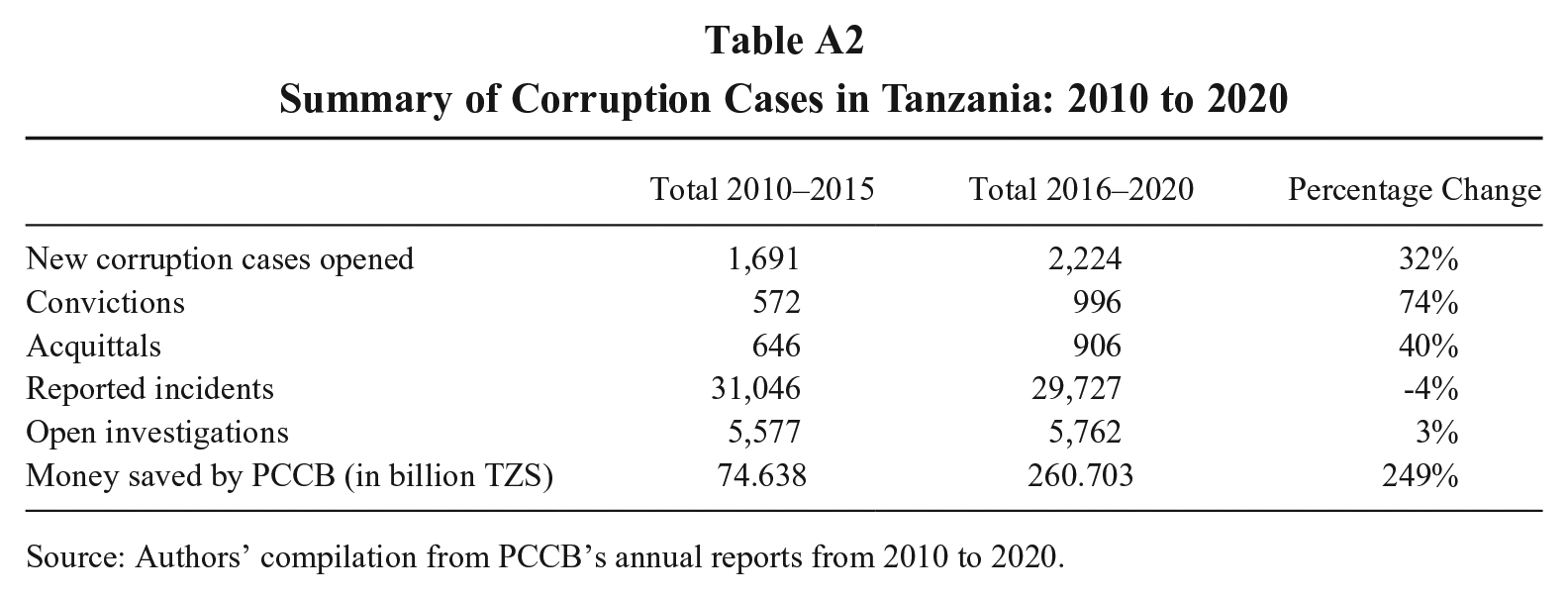
| Total 2010–2015 | Total 2016–2020 | Percentage Change | |
|---|---|---|---|
| New corruption cases opened | 1,691 | 2,224 | 32% |
| Convictions | 572 | 996 | 74% |
| Acquittals | 646 | 906 | 40% |
| Reported incidents | 31,046 | 29,727 | -4% |
| Open investigations | 5,577 | 5,762 | 3% |
| Money saved by PCCB (in billion TZS) | 74.638 | 260.703 | 249% |
Source: Authors’ compilation from PCCB’s annual reports from 2010 to 2020.
Acknowledgements
We extend our sincere gratitude to all our respondents, the action editor, Melissa Cardon, and the anonymous reviewers for their invaluable contribution. We also thank Ali Ferguson for her help in preparing the manuscript.
Funding
The author(s) disclosed receipt of the following financial support for the research, authorship, and/or publication of this article: This work was partly supported by Liikesivistysrahasto (Foundation for Economic Education) [grant number 190184 and 200143, awarded to Neema Komba to support of her doctoral studies in 2021 and 2022].
