



Abstract
Entrepreneurial ecosystems comprise a range of different actors, structures and processes that support entrepreneurs in starting and growing their ventures. They are governed through collective action, which helps ecosystem actors achieve common goals that otherwise would be beyond the scope of their individual abilities. However, we have a limited understanding of the key mechanisms through which they organise their interactions. This article explores how ecosystem actors engage in collective action based on a case study of the Scottish entrepreneurial ecosystem. The main contribution is the introduction of a novel ecosystem governance mechanism coined ‘ecosystem pipelines’, which are logical pathways between ecosystem actors through which entrepreneurs can access support and resources as they progress their ventures. This article highlights that entrepreneurial ecosystems are purpose-driven networks based on horizontal relationship building among actors – as opposed to top-down or bottom-up organising – in pursuit of a common purpose to promote entrepreneurship.
Introduction
The literature increasingly recognises entrepreneurship as a collective rather than individual undertaking (Drakopoulou et al., 2007; Iurchenko et al., 2023; Wigger and Shepherd, 2020), meaning that diverse actors work together to achieve a common objective (Kenis and Provan, 2009; Ostrom, 1990; Provan and Kenis, 2008). Such collective action can occur among entrepreneurs within entrepreneurial teams who grow their ventures (Dufays and Huybrechts, 2016; West, 2007), impact-driven as well as institutional entrepreneurs and their private or public sector partners who work in collaboration to address global challenges (Doh et al., 2019; Wijen and Ansari, 2006), or actors regionally clustered within entrepreneurial ecosystems who aim to promote entrepreneurship (Hechavarria and Ingram, 2014; Theodoraki and Messeghem, 2017).
Entrepreneurial ecosystems explain how a range of entrepreneurial actors, structures and processes jointly contribute to the creation and growth of businesses in a particular geographical area (Mason and Brown, 2014; Stam and van de Ven, 2021; Wurth et al., 2022). Ecosystems recognise that entrepreneurship is a collective endeavour among the founding team and the actors around them, including mentors, support organisations, investors, corporations, universities and the government, who directly or indirectly support the entrepreneurship process and therefore, engage in collective entrepreneurship (Auerswald and Branscomb, 2003). Even though the presence and development of ties with diverse actors within an ecosystem help increase startup rates (Prokop and Thompson, 2022), we still know little about how ecosystem actors work collectively to assist entrepreneurs with starting and scaling their ventures despite considerable interest by both academics (Autio and Levie, 2017; Knox and Arshed, 2021; Porras-Paez and Schmutzler, 2019) and practitioners (Feld, 2012; Feld and Hathaway, 2020; Techstars, 2019).
The study of collective action in ecosystems is especially pertinent because ecosystem actors exhibit a complex dynamic: whilst they are independent entities (Ryan et al., 2021; Stam, 2014), they are also interconnected (Isenberg, 2011; Mason and Brown, 2014), interdependent (Acs et al., 2017; Wurth et al., 2022), and to a greater or lesser extent share a common goal of supporting entrepreneurial activity (Hechavarria and Ingram, 2014; Theodoraki and Messeghem, 2017). This leads to a seemingly contradictory dynamic whereby ecosystem actors have the autonomy to pursue their own agenda and self-interested goals at the organisational level, but they are nevertheless relationally connected with other autonomous actors at the ecosystem level because of their common objective, and, consequently, the actions of one actor may affect others, as well as the ecosystem as a whole (Ostrom, 1990).
Therefore, the purpose of this article is to understand how ecosystem actors undertake collective action with respect to supporting entrepreneurial activity. Specifically, the following research questions are explored: ‘How do ecosystem actors engage in collective action? How does collective action manifest?’ The focus is upon a case study of the Scottish entrepreneurial ecosystem based on 51 semi-structured interviews with representatives of key ecosystem actors. The main finding is the introduction of a novel ecosystem governance mechanism coined ‘ecosystem pipelines’, which are logical pathways between ecosystem actors developed through collective action that enable entrepreneurs to secure resources as they launch, develop and grow their venture. They are formed through relationship building between actors, specifically referrals and signposting, which allows entrepreneurs to access different types of support as they progress through different stages of development.
This article contributes to the entrepreneurship as a collective action debate by showcasing how different ecosystem actors support the entrepreneurship process over time (Auerswald and Branscomb, 2003; Meyer, 2020; Rippa et al., 2022). By extension, it also addresses the bottom-up versus top-down debates on ecosystem governance (Cantner et al., 2021; Colombo et al., 2019; Scott et al., 2022). Ecosystem pipelines illustrate how relational self-organising in pursuit of a common purpose helps ecosystem actors work together more productively and, in doing so, facilitate collective entrepreneurship. They highlight the importance of horizontal relationships among actors in collectively producing benefits for entrepreneurs which would otherwise be beyond the scope of individual actor’s abilities (Cantner et al., 2021; Cornforth et al., 2015; Ostrom, 2007). This has important implications for policymakers and ecosystem builders, who may wish to use this concept to map out the pipelines across the full lifecycle of a business from startup to scaleup and across different sectors to better understand whether/how the different support touchpoints connect and how this affects local entrepreneurs.
Theoretical background
Entrepreneurial ecosystems are complex and dynamic socioeconomic structures that comprise heterogeneous agents who are embedded in the broader institutional environment (Han et al., 2021; Neumeyer et al., 2019; Wurth et al., 2022). Although ecosystems require a multifaceted interplay between local resources and institutions to provide a nurturing environment for entrepreneurial activity (Cavallo et al., 2019, p. 1299), they ultimately emerge through the agency of actors and their interactions (Stam and van de Ven, 2021, p. 812). As a result, it is not only the systematic and framework conditions but also the interactions and subsequent relationships among actors that have a significant impact on ecosystem performance (Alvedalen and Boschma, 2017, p. 891).
The main debates in the literature revolve around bottom-up versus top-down approaches to governing ecosystems (Colombo et al., 2019; Isenberg, 2016). On the one hand, the bottom-up approach argues that, similarly to natural ecosystems, such as forests, entrepreneurial ecosystems emerge organically (Isenberg, 2011, p. 6) through serendipitous, unintentional interactions among actors (Isenberg and Onyemah, 2016, p. 64) in environments that provide ‘fertile soil’ (Mason and Brown, 2014, p. 13). Although they are sensitive to initial conditions (Roundy et al., 2018, p. 5), ecosystems can be developed from the ground up through the actions of key actors (Thompson et al., 2018). Most importantly, some authors (Feld, 2012; Feld and Hathaway, 2020) consider entrepreneurs to be the ‘leaders’ in their ecosystem, meanwhile the remaining ecosystem actors undertake the role of ‘feeders’ who support their ecosystem building activities. However, this possibly places too much emphasis on entrepreneurs, who are unlikely to have the capacity to purposefully lead and coordinate the ecosystem alone (Isenberg, 2016, p. 569). In contrast, other bottom-up perspectives highlight the stewardship role that may be played by the various non-entrepreneur ecosystem actors, such as ‘entrepreneurship enablers’ (Thompson, 2010), ‘dealmakers’ (Feldman and Zoller, 2012), and ‘liaison-animateurs’ (Sweeney, 1987), who typically support entrepreneurs with new venture formation and business growth or build the necessary infrastructure that supports nascent entrepreneurs. Overall, the role of entrepreneurial leaders is to act as champions who provide a driving force (Haines, 2016) and help mobilise, grow and evolve their ‘startup community’ as well as to maintain a long-term commitment to the ecosystem (Feld, 2012; Feld and Hathaway, 2020).
On the other hand, the top-down approach argues that entrepreneurial ecosystems are more akin to gardens or even farms, which can be managed and controlled through policy-making (Nordling, 2019), stakeholder engagement and coordination (Autio and Levie, 2017), and deliberately attracting or injecting resources into the ecosystem (Bhawe and Zahra, 2019; Harima et al., 2021; Knox and Arshed, 2021). This implies that ecosystems may even be created from scratch (Colombelli et al., 2019, p. 423) despite initial conditions. Perhaps the most prominent example of a somewhat top-down approach is the Regional Entrepreneurship Acceleration Program (REAP), developed by the Massachusetts Institute of Technology, which aims to develop ‘programmatic and policy interventions’ (MIT, 2018, p. 4) to accelerate innovation-driven ecosystems. Although it builds on the principles of ‘collective impact’ (Hanleybrown et al., 2012; Kania and Kramer, 2011) and engages representatives from different stakeholder groups, it is often driven by public sector representatives from the government, its economic development agencies, or universities (MIT, 2018).
However, it has recently been argued that neither the bottom-up nor top-down approach adequately captures the dynamic through which ecosystems are governed (Colombo et al., 2019, p. 423) and that ecosystems may alternate between hierarchical and relational modes of governance depending on their degree of maturity (Colombelli et al., 2019). In any case, it is important to adopt a holistic approach so that all actor groups are included in ecosystem governance (Kuckertz, 2019) and recognise their diverse (and potentially competing) motivations, power relationships, and urgency (Autio and Levie, 2017, pp. 16, 32) in order for them to achieve desired outcomes (Rampersad, 2016, p. 1123). Thus, the ‘bottom-up and top-down’ approach (Colombo et al., 2019, p. 423) recognises that ecosystem governance is a collective endeavour by actors whose activities or interventions shape their environment (Han et al., 2021, pp. 547–548), provide assistance to entrepreneurs (Hruskova et al., 2023; Spigel, 2016), and help optimise resource exchange (Hernandez-Chea et al., 2021) in an iterative manner that enables more effective support mechanisms for entrepreneurs (Abootorabi et al., 2021; Knox and Arshed, 2021). In other words, ecosystems are governed through collective action based on horizontal relationships as opposed to hierarchical command-and-control (Ostrom, 2010b).
What is more, ecosystems are self-organised (Han et al., 2021, p. 547) and self-regulated by the interests of their numerous actors (Colombo et al., 2019, p. 422). This notion of self-organisation and self-regulation refers to governance, that is, ‘the diverse mechanisms and strategies of coordination that are adopted by autonomous actors, organizations and functional systems in the face of complex reciprocal interdependence among their actions, activities and operations’ (Jessop, 2017, p. 74). This implies that due to their networked nature, ecosystems are subject to a dichotomy between an actor’s autonomy to pursue their own (sometimes competing) agendas and their interdependence on the actions of others (Ostrom, 1990, p. 38). It is these interdependencies and interactions among actors that play a key role in ecosystem performance (Scott et al., 2022). Therefore, entrepreneurial ecosystems are governance networks (Provan and Kenis, 2008; Provan et al., 2007), in which these autonomous yet, interconnected and interdependent actors use multilateral interactions to govern their relationships and co-produce commonly desirable outcomes (Ostrom, 2010b). These interactions involve the exchange of knowledge, resources or even narratives about the rules governing the ecosystem (Roundy, 2016). There may also be a degree of ecosystem coordination, whereby ecosystem actors deliberately seek to build their ecosystem, which is likely to reinforce the interdependence between them (Roundy and Fayard, 2020).
However, there are only very limited insights into what ecosystem governance entails and how it works. It has been recognised that ecosystem governance involves a range of different actors voluntarily engaging in cooperative behaviour to contribute to the creation, preservation and distribution of ecosystem collective goods (Ostrom, 2010b, p. 645; Autio and Levie, 2017, p. 9; Cao and Shi, 2020, pp. 84–85). This means that governing ecosystems is about governing relationships. This relational organising may include forming, structuring and interrupting the network of ecosystem actors (Knox and Arshed, 2021, p. 7). Additionally, resource dependency among actors shapes the governance practices within the ecosystem (Hernandez-Chea et al., 2021, p. 12), but it is the agency of actors that plays a key role (Scott et al., 2022). The remainder of this article explores how collective agency is deployed in ecosystems and its implications.
Methodology
This qualitative, exploratory study is approached from a critical realist perspective, which implicitly underpins the entrepreneurial ecosystems framework (Wurth et al., 2022, p. 8). Critical realism allows for the investigation of both observable and unobservable entities and recognises that they have causal powers (Bhaskar, 2008). As a result, it helps us better understand how the mutually interacting ecosystem actors, structures and processes generate outputs and outcomes (Wurth et al., 2022). By extension, it helps us understand cascading cause and effect chains in entrepreneurial ecosystems and their consequences (Autio and Levie, 2017), including how the complex interplay between structure and agency affects ecosystem performance (Stam and van de Ven, 2021). Finally, the critical realist lens implicitly accounts for the fact that context mediates the relationship between cause and effect (Danermark et al., 2002, p. 55), which is beneficial because both ecosystems (Harima et al., 2021, p. 83) and their governance (Audretsch et al., 2021, pp. 2–3) are context dependent.
Case study methodology
This study adopts the case study methodology, which is common in the highly context-driven field of entrepreneurial ecosystems (Kapturkiewicz, 2021; Scheidgen, 2021; Scheidgen and Brattström, 2022). The critical realist case study helps us understand the dynamics of a phenomenon within a specific setting (Easton, 2010) and, in doing so, identify, explore, and explain the causal powers, processes and mechanisms at work (Ackroyd and Karlsson, 2014). For the purposes of this study, the entrepreneurial ecosystem in Scotland was selected as a ‘critical case’ because it exhibits both ecosystem (Hruskova et al., 2023; Logan, 2020; TechCrunch, 2021) and governance dynamics (Autio and Levie, 2017; Rocha et al., 2021; Spigel, 2016) and is therefore, representative of the phenomenon under study.
Scotland has an up-and-coming ecosystem, with its two biggest cities having a vibrant startup scene. Edinburgh is well-known for its tech and fintech sectors, meanwhile Glasgow has developed a reputation in the space sector and creative industries (UK Tech News, 2021). Nevertheless, the Scottish ecosystem is yet to reach a critical tipping point (Financial Times, 2022; Logan, 2020; Startups Magazine, 2019). Scotland’s biggest success stories include an exited unicorn Skyscanner, a former unicorn FanDuel, and a most recent unicorn BrewDog, with a number of high-growth companies expected to join the unicorn ranks in the future (GOV.UK, 2021). However, Scotland lags behind the rest of the UK in terms of its population of high-growth firms (Beauhurst, 2020) and has a performance gap (Turnbull and Richmond, 2018). Compared to the rest of the country, Scottish high-growth firms seem to contribute less to creating employment and economic development more broadly (Mason et al., 2015) and they generally struggle to maintain high growth for long periods of time which suggests that their growth is episodic and discontinuous (Hart et al., 2020). Therefore, there are various support interventions in place, typically funded by the public sector, to help entrepreneurs start and grow their ventures (Hruskova et al., 2023; Spigel, 2016). This includes Scotland’s participation in the MIT Regional Entrepreneurship Acceleration Programme (2014) between 2012 and 2014 to further develop its entrepreneurial ecosystem and the Scottish Government’s (2013) Scotland Can Do agenda to promote entrepreneurship in order to make Scotland ‘a world-leading entrepreneurial and innovative nation’.
Data collection
The data for this article were derived from a dataset for a larger research project on ecosystem governance, which was undertaken using semi-structured interviews with key ecosystem actors in Scotland between April and November 2019 and resulted in a total of 61.5 hours of audio recordings. Data collection continued until saturation, which was reached when there were no new insights or explanations being generated, and concluded after 51 interviews.
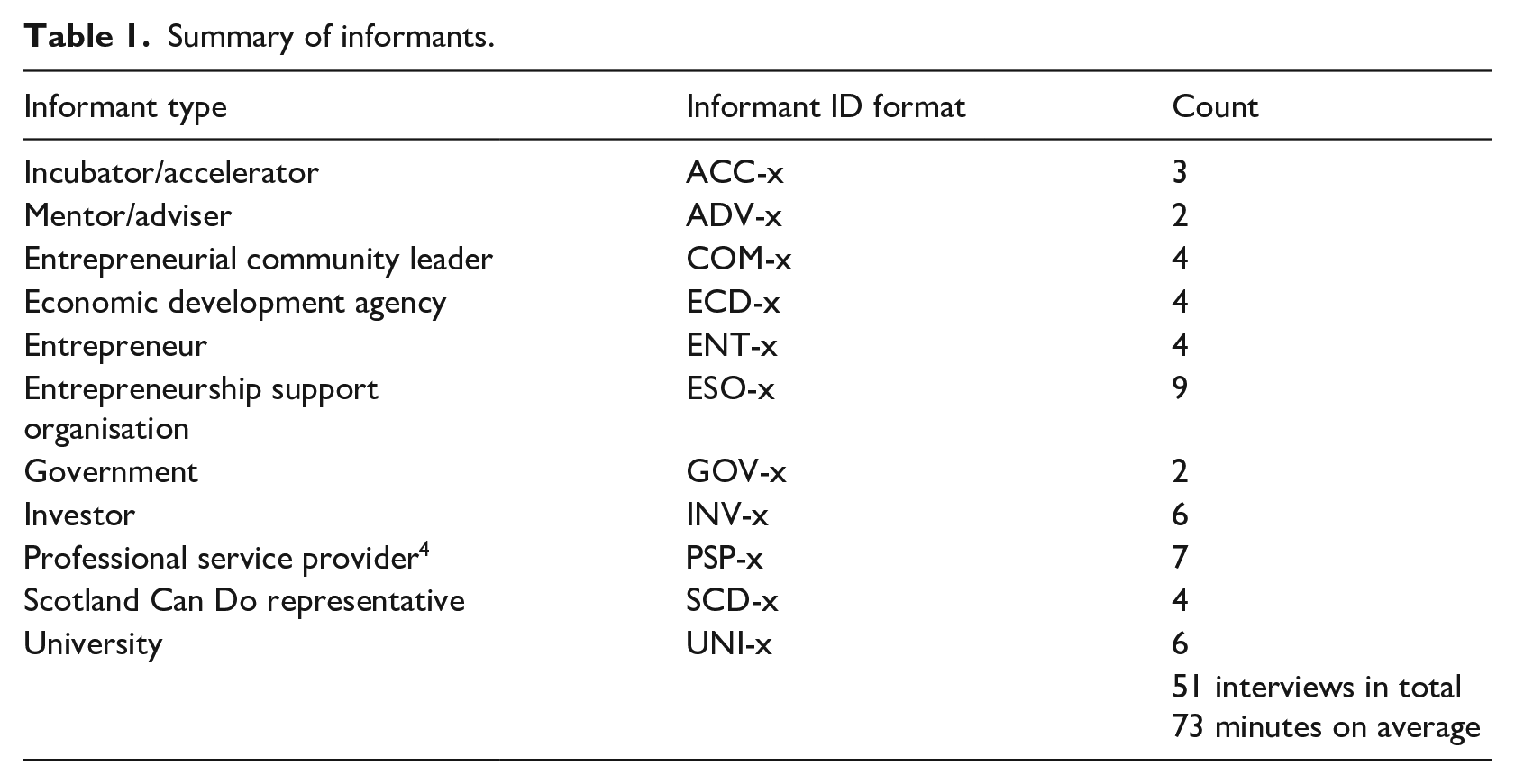
The informants were leading ecosystem ‘movers and shakers’, who were knowledgeable about ecosystem governance and could therefore, provide valuable insights into the various formal and informal actors, structures, processes and activities that govern the ecosystem. They were identified and recruited through purposive sampling, which allowed for their deliberate selection to generate or extend theory. The sampling process included multiple representatives of key ecosystem actors, namely entrepreneurs, advisers, investors, (mostly public) entrepreneurship support organisations, (mostly private) professional service providers, corporate organisations, universities and representatives from the local and national government (see Table 1). Although most informants typically held multiple roles in the ecosystem and reducing them to just one actor category was somewhat arbitrary, it helped ensure that different ecosystem actor types were included in the study. It should also be noted that several individuals with an entrepreneurial background were approached in their capacity as advisers or community leaders rather than entrepreneurs. As a result, whilst there are only four informants classified as entrepreneurs in Table 1, there were in fact at least 11 informants with entrepreneurial experience in this study.
Summary of informants.
The interviews were supplemented by documentary evidence, gathered during the interview preparation stage when I collated background information about each informant and their organisation via desk research, typically from websites, brochures, reports, press releases, news articles, and even occasionally blogs and social media posts. A few additional documents were provided by the informants themselves which were also in the public domain. The supplementary data were helpful in contextualising the study and for the purposes of data triangulation.
Data analysis
Data analysis was undertaken using thematic analysis (Braun and Clarke, 2006) and supported by visual aids (Langley and Ravasi, 2019). Thematic analysis helped identify, analyse and interpret repeated patterns of meaning within and across the dataset (Braun et al., 2019). The data analysis process occurred in three stages: organising, describing, and explaining (Spencer et al., 2014).
The first stage of data analysis focused on the preparation and organisation of data, including transcribing interviews, importing all data into NVivo 12 Pro, and devising a preliminary analytic strategy to manage the dataset in a systematic and effective manner.
The second stage of data analysis involved creating an initial thematic framework, separating data into large conceptual sections, iterative coding and developing themes. It was at this stage that the thematic analysis approach was most salient as it guided the process of generating initial codes, searching for themes and revising them (Braun and Clarke, 2006; Braun et al., 2019). Three cycles of thematic coding were undertaken: preliminary, first and second. The preliminary cycle was merely used to structure the extensive dataset, meanwhile the first cycle was deployed to generate provisional codes and themes, which were subsequently refined in a second cycle of coding. The coding process comprised both in-vivo codes (derived from the informants’ own words) and inferential codes (based on my interpretation of the meaning) (Saldaña, 2013). After the completion of the first cycle of the thematic coding process, the next step involved reviewing the codes and developing themes in an iterative manner (Braun and Clarke, 2006). It started with a revision of bulky codes, which were broken down into sub-codes, and identification of duplicate codes, which were either merged together or re-coded into more accurate and distinct codes (Miles et al., 2014). In the process, a second cycle of coding was undertaken which included searching for patterns and clustering related codes into themes or related themes into categories. Overall, themes and categories were developed abductively, in a back-and-forth manner between the data and the literature. An example of the coding approach is shown in Table 2.
Coding and theme development examples.

SIE: Scottish Institute for Enterprise.
The third stage of data analysis included mapping linkages, explaining causality, and drawing and verifying conclusions – in other words, theorising about how the different parts of data are connected. It was at this point the analysis changed to manual approaches, especially mind mapping and drawing diagrams, which helped to compare and contrast competing interpretations and refine the relationships between key concepts. Thus, visual artefacts were critical for analysing and theorising (Langley and Ravasi, 2019). As a result, a particular standardised template was not followed during the process of data analysis, but rather rigour was ensured by deploying a range of different approaches to ‘stabilise’ the analytical objects towards theoretically satisfying explanations (Locke et al., 2020, pp. 16–17).
Findings
The empirical findings will be discussed in two sections. The first section explains how ecosystem pipelines are formed, how they function for different businesses, and how they may lead entrepreneurs astray. Subsequently, the second section discusses the underlying factors for collective action and how they help facilitate the functioning of the pipelines.
Ecosystem pipelines
Ecosystem pipelines are logical pathways between actors in entrepreneurial ecosystem through which entrepreneurs may progress to secure resources or knowledge as they launch, develop and grow their venture. Similarly to entrepreneur pipelines (Lichtenstein and Lyons, 2006, 2010; Yang et al., 2018), they recognise that entrepreneurs need different support as they progress from startup to scaleup (Mason et al., 2020), meanwhile they also resemble global pipelines (Bathelt et al., 2004) in that they facilitate the transfer of resources and knowledge between actors.
Entrepreneurs are accessing a range of mixed and varied support that is hopefully connected and joined-up so there are linkages – whether it’s partnerships or whether it’s different ways where people will refer to different organisations – so there’s natural ways in which an individual can navigate through the system and where the support is sort of nurturing them, pushing them through. (SCD-4)
Therefore, at their core, ecosystem pipelines are relational structures that operate on a referral and signposting basis and transfer entrepreneurs between different ecosystem actors to help them secure the necessary support, advice and resources.
Formation of ecosystem pipelines
The formation of ecosystem pipelines occurs through the integration of a number of organisations, either formally or informally, for the purposes of coordinating the delivery of services for clients (Provan and Sebastian, 1998, p. 453). Typically, they are formed through ongoing informal interactions and relationship building between support providers, which then encourages them to signpost and refer entrepreneurs from one organisation to the next (ESO-1–ESO-7). As more overlapping linkages are developed between organisations, the pipelines eventually become meso-level network structures (Rowley et al., 2005, p. 500). Pipelines may also develop due to formal strategic partnerships or the distribution of public funding (ESO-2). However, in some cases, there may also be unwanted pipelines that lead to organisations with a dominant position in a niche sector but insufficient resources receiving large numbers of referrals: ‘people default to us – they’re just steering everybody at us, but that’s not our role, we don’t have the resources to deal with that’ (ESO-7). As a result, the strength of the pipelines varies, depending on the relationship between the organisations in question, but they tend to be particularly strong between organisations that have similar and overlapping areas of focus (Provan and Sebastian, 1998, p. 462) but maintain their own area of specialism (Lichtenstein and Lyons, 2010, p. 119).
Benefits of ecosystem pipelines
The main beneficiaries of ecosystem pipelines are entrepreneurs, but they also have advantages for pipeline partners. By going through the pipelines, entrepreneurs can access the most appropriate support and resources required at that time (SCD-4). Meanwhile the pipeline partners can deploy their resources more effectively (ECD-2) and maintain their specialism on a particular type of clients whilst avoiding mission creep (ESO-2). In other words, ecosystem pipelines recognise not only that different entrepreneurs have different needs (Lichtenstein and Lyons, 2006) but also that the provision of support is highly fragmented across numerous organisations due to different areas of focus and funding streams (Provan and Sebastian, 1998, p. 453).
However, a key issue with the fragmentation of support providers is that there is no obvious starting point so ‘people don’t know where to start’ to get advice (ACC-1; ACC-3; COM-1; ENT-2; ENT-4; INV-1; ESO-7; PSP-4; UNI-5). There is often significant confusion among early-stage first-time entrepreneurs 1 about where they can find the best advice, so they often resort to online searches or recommendations from their peers (ENT-2).
I have no idea who I should be talking to, when, or how. All I keep hearing is that there’s a lot of organisations, a lot of support. Okay, where do I start from? I really have no idea where I should start. (ENT-4)
Ecosystem pipelines help to overcome this issue because they allow for a ‘no wrong door’ model, whereby any organisation can signpost, refer, and introduce a client to the most relevant ecosystem actor: ‘the reality is that if you make contact at one point, if it’s not the right contact, generally people can pass you on and introduce you’ (ESO-2). Therefore, the referral-based integration of the different resource providers into pipelines helps entrepreneurs overcome some issues that stem from having to navigate a high number of different organisations which, in turn, makes the system more effective (Turrini et al., 2010, p. 528). However, the full extent of the pipelines and all potential branches are not generally known – ‘people will know their immediate neighbours, but they won’t know the whole wider system’ (ESO-2) – but this not necessarily an issue because full network integration is neither needed nor desirable (Provan and Sebastian, 1998, p. 460; also see Autio and Levie, 2017, p. 9). Instead, it is the formation of integrated pipelines within ‘network cliques’, i.e. ‘ties among a few organizations that provide the bulk of relationships and services to clients’, that are much more important to the overall effectiveness of ecosystem pipelines rather than attempts to integrate the entire network (Provan and Sebastian, 1998, p. 454).
Linear pipelines
One of the best examples of strong internal pipelines at work is within a clique of support organisations that specialise in supporting university-based entrepreneurs. It includes the Scottish Institute for Enterprise (SIE), which supports college and university students; Converge, which supports both university students and staff and has a strong focus on research commercialisation; the RSE Enterprise Fellowship, which supports the commercialisation of innovative ideas in science and technology; Scottish EDGE, which is a business competition for companies with growth potential; and Informatics Ventures, which supports globally ambitious tech companies and organises the EIE investment conference. Within this sub-set of support organisations, there is a relatively clear pipeline through which founders progress: typically, after an initial discussion with their university’s enterprise adviser, student entrepreneurs tend to start at SIE, move onto Converge, then potentially progress to the RSE Enterprise Fellowship, and eventually apply for Scottish EDGE and/or EIE (ESO-2-ESO-6; SCD-2; UNI-5; also Spigel, 2016; and Mason et al., 2020). This sequence also applies to spinouts, but they start at Converge.
Although few founders go through the pipeline in a perfectly linear and stepwise manner – some may skip some steps or even ‘drop out and then come back into the [support] ecosystem again later’ (ESO-2) – they nevertheless seem to progress through this particular pipeline sequentially, meaning they engage with different organisations as they reach different stages of their entrepreneurial journey. For example, a student entrepreneur with an early-stage idea is generally considered well-suited for support from SIE, which focuses on helping their clients flesh out their emerging business ideas, rather than Converge, which supports more advanced business concepts. As a result, if a student was to apply with an early-stage idea to Converge, they would likely get referred to SIE instead: ‘Converge are getting applications in from students and actually saying “look, you’re too early, go and speak to SIE”’ (ESO-2). In fact, an important element which enables the effective functioning of the pipelines is the fact that these organisations have an implicit understanding of their position along the pipeline ‘continuum’ (ESO-6) which helps them better understand their relative value proposition and offering for entrepreneurs:
We see the RSE Fellowship as the next stage after Converge. They are a wonderful potential pipeline of applicants to us, because they go to Converge and they are testing out their business ideas, having to learn how to pitch, getting a bit of training, and then if they still feel confident, and want to start a business or started a business, and need the Fellowship, they will then apply to us. (RSE)
As such, ecosystem pipelines give a sense of structure, order and one-on-one alignment between the partner organisations. This also means that organisations towards the end of the pipeline somewhat depend on those organisations that serve as the first point of contact and work with entrepreneurs to help them develop their business ideas so that they eventually become ready to progress through the pipeline 2 : ‘if SIE didn’t exist and we weren’t doing what we are doing, then Converge wouldn’t see as many good students going through, or they would need to do something to replace what we do’ (SIE). Coincidentally, SIE ceased to exist in early 2021 (after the data collection period for this study), so the demise of this core member of this tightly-knit clique may affect the pipeline. It remains to be seen what the precise impact will be, but it is possible that either individual universities, which used to ‘feed into’ SIE, or Converge will need to (at least partially) replace SIE’s place in the pipeline by offering additional support activities to compensate for the loss of their former pipeline partner.
Hub and spoke pipelines
For the majority of entrepreneurs, who are not affiliated with a university, the most logical starting point is the business advisory service Business Gateway, which provides generalist support to all types of businesses at different stages of development and across all sectors. Some entrepreneurs approach Business Gateway directly, but many come through referrals from other organisations: ‘there are businesses that would approach us that are unsuitable to work with us, so we would absolutely refer them out to another part of the ecosystem straight away – if they’re not at a quality stage then they need support from, for example, Business Gateway’ (PSP-1). Similarly, some early-stage entrepreneurs also try to directly approach some of the most prominent incubators or co-working spaces, but they typically get referred to Business Gateway anyway: ‘we get so many companies that come to us because they had an idea in the pub, or they’re just really, really early, so Business Gateway are great for that because we can just send those people to them’ (ACC-1). Business Gateway therefore see themselves ‘at the front end of all of this, to both assess directly and to point our client to where other support might be available’ which makes them an important ‘feeder’ organisation for pipeline (ESO-1–ESO-5; ESO-7; ESO-8; PSP-1; PSP-2; PSP-4; PSP-7).
Alternatively, most social entrepreneurs begin their journey at FirstPort, which is a support organisation specialising in the third sector. It was created in response to a lack of dedicated support for the sector: ‘[it] was built when a lot of community-based enterprises weren’t understood by some of the national agencies’ (ESO-7), and over the years it became so prominent that they are now effectively the default first point of contact. In other words, they are the social enterprise equivalent to Business Gateway even though it is not their official remit, but ‘there’s nowhere else to point them’ (ESO-7) in terms of entry-level business support for social enterprises. Nevertheless, further along the ecosystem pipeline are other social enterprise-oriented actors to whom entrepreneurs can be signposted, including an incubator, a loan scheme and a few other support and development programmes. However, once again, entrepreneurs who approach more advanced actors with an underdeveloped business idea often get referred back to FirstPort (ACC-2).
Therefore, both organisations are perceived to be the first point of entry into their respective ecosystem pipelines. As a result, other ecosystem actors frequently refer (pre-)start entrepreneurs to them with the assumption that they will conduct a needs assessment, provide entry-level support and then chart a course towards the next most suitable pipeline partner. However, the pipelines no longer operate on a linear basis but rather on a hub and spoke/star network basis. This means that as some of the beneficiary businesses develop and progress over time, they may be able to return to the hub organisation with a new issue and start navigating the pipelines in a different direction (ACC-1; ESO-2; ESO-6; PSP-1). Inevitably, different pipeline branches start to overlap. In fact, some generalist support organisations have launched dedicated competition tracks for social and impact oriented businesses (ESO-4), which means that the general and specialist pipelines are now ‘cross-cutting’ (ECD-1). Nevertheless, outside of the university clique, the pipelines do not typically follow a sequential process. Instead, they rely on multilateral referrals among ecosystem actors to help entrepreneurs find the best route based on their needs.
Pipelines convergence
The entrepreneur’s journey through the support infrastructure typically culminates in one of the following milestones: applying for Scottish EDGE, pitching at EIE, and/or being accepted on the High-Growth Pipeline programme at the economic development agency Scottish Enterprise. Scottish EDGE is a business competition which offers grant and loan funding to ambitious companies with growth potential. It is inclusive in the sense that it does not have any restrictions on sectors, which helps it attract most promising early-stage companies within the entrepreneurial ecosystem: ‘EDGE sits at the heart of the ecosystem [because] just about any business in Scotland can come up to us through our partners’ (Scottish EDGE). In addition, tech startups often apply for the investor pitching competition EIE, which is ‘the natural place for them to go after Converge’ (ESO-6).
The High-Growth Pipeline at Scottish Enterprise is perhaps the ultimate support destination for entrepreneurs (ECD-2; ECD-3) because it provides a dedicated account manager for each startup and a package of intensive, tailored support. Notably, it may be accessed via the business advisory service Business Gateway that identifies promising ‘technology businesses with high-growth potential’ and then goes through ‘a proper, structured process to refer clients onto the pipeline’ (Business Gateway). As such, it is a rare example of a formal pipeline with clear eligibility criteria which allows companies to progress in an organised fashion (ECD-2; ECD-3). It is a legacy process from a previous organisational governance structure when both Business Gateway and the High-Growth Startup Unit used to operate from within Scottish Enterprise, so there was a straightforward internal process for referral. However, the pipeline has rather strict criteria and limited capacity, so few companies reach this stage. Instead, many of them conclude their journey at Scottish EDGE and/or EIE, both of which help them secure funding for their next stage of growth.
Unintended consequences
Both Scottish EDGE and EIE represent a perceived jumping-off point at which entrepreneurs start engaging with investors (ESO-3) because founders and their advisers often believe that their success in the various business competitions gives them credibility (ACC-3) and demonstrates their investment readiness (INV-4). This is illustrated by the following quote from a business adviser:
We’re connected to all the major competitions so when we have a client business, we’re always saying ‘what competitions are they going to go for to access both money and extra support, plus they build their reputation, so they become more investable?’ (UNI-2)
However, going through the various competitions and support organisations is not, in fact, the optimal pipeline to raising investment according to investors themselves:
Most of the best propositions for us come directly from the founders themselves. . . . I think a lot of companies can waste a lot of time doing all of these competitions and being part of all of these little programmes and things like that, whereas actually you should be focused on your business, trying to drive forward the business. And if you can do that well, then the funders will be there, ultimately, for you. (INV-4)
This suggests that it is not actually necessary to complete ‘the competitions circuit’ (UNI-5) because the competitions do not necessarily add value from the investors’ perspective but instead may be a dangerous distraction for entrepreneurs. For example, some investors see applying for too many competitions as a sign that entrepreneurs are getting side-tracked (INV-6) or ‘hanging on to the wrong hallmarks’ (ACC-3). As such, they may waste the founders’ time: ‘you can have the same person go through all of that. You can be doing that for about seven years if you think about it. Is that healthy? I don’t know. For some people it may be, but for others, no.’ (SCD-2). In fact, they may even artificially extend a company’s lifespan and prevent it from failing fast because success in competitions may give some founders a false sense of accomplishment even though they ‘should have failed by now’ (COM-1). Additionally, investors do not consider most support organisations to be providing adequate referrals: ‘We have never, ever had one [referral from a specific support organisation] we could work with. The entrepreneurs should never have been sent here. They’re completely unsuitable for equity investment, they’re lifestyle businesses. The advisers are just trying to get them off the desk.’ (INV-1). This shows that the outflow pipelines from support organisations are not necessarily compatible with the preferred inflow pipelines for investors.
Instead, investors prefer that entrepreneurs approach them directly via their gatekeeper, get introduced by a dealmaker, or, in the case of spinouts, through their university’s commercialisation department: ‘most of the best propositions for us come directly from the founders themselves [or] from the universities [which are] an active source of pipeline for us’ (INV-4). In either case, entrepreneurs need to have the right credentials to successfully raise investment, but these typically involve building a strong founding team and having a good market traction rather than going through business competitions (INV-3–INV-6).
This indicates that some pathways through the ecosystem pipelines may lead entrepreneurs into a dead end because they are not necessarily the right route that will get them to their desired destination: ‘the perfect golden path for entrepreneurs is to raise money, build a great team, build a great product, and exit’ (COM-1), but ‘some founders end up in the wrong support channels and then that support channel will start to actually influence where they’re going’ (INV-6). This suggests that the pipelines are sometimes driven by the supply of support rather than entrepreneurs’ demand (Lichtenstein and Lyons, 2010, p. 171). Therefore, many experienced entrepreneurs do not tend to engage with the support organisations, but rather grow their businesses with help from their peers, mentors, and independent advisers who understand the most effective ways of engaging with the various actors in the entrepreneurial ecosystem and can help them become ready to approach investors directly (ACC-1; ACC-3; COM-1; ENT-3; INV-4). They may occasionally use some support organisations, but these tend to be deliberate, one-off interactions with a specific purpose (ENT-2; INV-4). In doing so, they avoid getting stuck ‘in the wrong tracks’ (INV-6).
Collective action
Ecosystem pipelines are the result of ecosystem actors working collaboratively as part of their shared commitment to nurturing entrepreneurial activity. They are a tangible outcome of collective action, underpinned by relational organising (Powell, 1990), specifically referrals and signposting. The key factors affecting collective action are structural and relational (Ostrom, 2007). The structural factors include the number of participants, the heterogeneity of participants, the forms of communication between them, the nature of benefits being generated and shared, information about participants’ past actions, opportunity for voluntary exit and the nature of linkages between them (Ostrom, 2010a). The relational factors are comprised of reputation, trust and reciprocity (Ostrom, 2010a). Together these factors also highlight the interplay between the structural and relational dimensions of governance networks (Ramia et al., 2018, pp. 335–336) and how network configuration affects their governance mechanisms and processes (Huxham and Vangen, 2000, p. 1167). The following section will first discuss the antecedents of collective action in Scotland, followed by an explanation of each of the factors from Ostrom’s (2007) framework, including two additional ones: awareness of partners’ activities and shared purpose.
Antecedents of collective action in Scotland
The pipelines in the Scottish ecosystem are highly concentrated among (predominantly publicly funded) entrepreneurship support organisations. This partially reflects the fact that, historically, the public sector in Scotland has maintained a dominant role in the funding and provision of entrepreneurship support due to a perception of market failure (Hruskova et al., 2023; Spigel, 2016), which is not uncommon in entrepreneurial ecosystems (Mazzucato and Penna, 2014, p. 5; Bramwell et al., 2019, p. 276). In fact, one informant stated that ‘we don’t have a military industrial complex in Scotland, we have an entrepreneurial support industrial complex’ (SCD-1), meaning that entrepreneurship support has become a self-serving industry of its own. Additionally, the support providers are so dominant that they have effectively become synonymous with the term ecosystem: ‘when people say “ecosystem” in Scotland, what I automatically hear is the support organisations for entrepreneurs’ (COM-3). This is in contrast with other places that tend to use the term to refer to the peer community of entrepreneurs (Feld, 2012; Feld and Hathaway, 2020).
But, most importantly, the prevalence of ecosystem pipelines among support organisations is likely a consequence of the Scotland Can Do movement, whose vision is for Scotland to become ‘a world-leading entrepreneurial and innovative nation’ (Scotland Can Do, 2021). Notably, the Scotland Can Do movement’s governance framework is grounded in the principles of ‘collective impact’, which is a form of collective action that highlights the importance of a coordinated action by a range of different actors – rather than an isolated intervention by an individual organisation – to achieve a goal or solve a problem (Kania and Kramer, 2011). Yet, Can Do membership is dominated by (publicly funded) support organisations and lacks involvement from other actors, especially entrepreneurs. The collective impact framework was introduced during Scotland’s participation in the MIT Regional Entrepreneurship Acceleration Programme in 2012 (MIT REAP Team Scotland Initiative, 2014) and is based on five pillars: common agenda, shared measurement, mutually reinforcing activities, continuous communication and backbone organisation (Kania and Kramer, 2011).
Structural factors of collective action
Large number of homogeneous participants
The Scotland Can Do movement represents a long-term public agenda for entrepreneurship and innovation. It serves as a symbolical rallying point (Roundy, 2016) for actors in the entrepreneurship development space who have formed a ‘coalition of the willing’ (Mazzucato, 2018, pp. 805–806), mainly comprising entrepreneurship support organisations, enterprise agencies, and the government itself (Scotland Can Do, 2021). This has led to a large number of relatively homogeneous participants in the collective action movement. On the one hand, this is beneficial because homogeneity of actors enables cooperation (Ostrom, 2010a). But on the other hand, it unintentionally excludes many of the other types of actors who operate in the ecosystem but may not be interested in what they perceive to be government-led initiatives (ACC-3; ESO-5; INV-4; INV-6; PSP-5). Although the dominant focus on the support providers rather than beneficiaries helps Can Do achieve important collective outcomes within the movement and get it off the ground (Provan et al., 2007, pp. 505–506), it is likely to limit the buy-in from diverse actors in the long term.
Communication between participants
Entrepreneurial Scotland is the designated ‘backbone organisation’ of the Can Do movement 3 . This makes it the ‘custodian’ (SCD-4) on behalf of all members, who are meant to have shared ownership of the movement (GOV-1). Its main role is to facilitate the functioning of the movement and encourage collaboration among its members (SCD-4). It provides a centralised supporting infrastructure and dedicated staff, who help coordinate the movement through administrative work around organising meetings, measuring and reporting impact, sharing communications internally and externally across the ecosystem, and maintaining the Can Do brand (SCD-4; Kania and Kramer, 2011). The most important means of communication is the so-called Scotland Can Do Collective, which is a quarterly face-to-face meeting of Can Do partners in various cities across the country. They are often attended by the leaders or key decision-makers of the member organisations, whose presence is important because they have the power to channel their organisation’s resources for collaborations, which helps increase the buy-in to attend (Huxham and Vangen, 2000, p. 1170). Although many organisations also interact and meet on a one-to-one basis during the year, the Collective is a rare opportunity for most of the players to meet in one room together. In fact, it plays an important role in helping organisations to develop mutual awareness of one another’s activities, which is the first new addition to the collective action framework.
Awareness of partner activities
The effectiveness of ecosystem pipelines requires that each pipeline partner delivers not only adequate but also different and complementary services (Turrini et al., 2010, p. 530). High-quality referral-based linkages between the various pipeline partners and their mutual alignment (Cao and Shi, 2020, p. 84) help integrate overlapping but loosely connected cliques of key actors (Provan and Sebastian, 1998, p. 460) and thus strengthen the overall pipeline. However, due to the sheer size of collective action participants, pipelines can only work effectively if the actors have a good understanding of the services offered by others (Harper-Anderson, 2018). Otherwise, there is a risk that entrepreneurs may get signposted to organisations that do not offer the desired service and leave them disappointed and dissatisfied, which could eventually undermine their reputation (ECD-2; COM-4; ESO-7).
The relational linkages are developed via the Collective. The most valued benefits of participating in the Collective include being in the same room with key actors, fostering relationships, awareness raising and knowledge sharing (ESO-1–ESO-6; PSP-1; PSP-2; PSP-4; SCD-2; ECD-1). It helps organisations develop an understanding of ‘who the players are and what they are doing’ (PSP-2), which strengthens the links between them for the purposes of signposting and referrals: ‘finding out what everybody else is up to means that we are able to do a better job for our clients because we know what’s going on in the scene so we can signpost and share’ (ESO-2). Therefore, the Collective plays a key role in facilitating network ‘bonding’ and ‘bridging’ – it helps strengthen existing connections between actors and build new connections with previously unknown actors (Lyons, 2022), both of which are beneficial because they not only promote the development of trust among the members but also increase access to new resources (Hoppe and Reinelt, 2010, p. 601). Overall, it helps form and structure the relationships within the ecosystem and guide collaborative activities (Knox and Arshed, 2021, pp. 7–10).
Benefits being generated
Ostrom’s (2007) original framework differentiates between subtractive and non-subtractive benefits, i.e. whether consumption by one actor decreases the benefits available to others. The main benefits that entrepreneurs derive from entrepreneurial ecosystems are the resources specific to the entrepreneurship process (Spigel, 2017, p. 52), some of which are limited (e.g. funding and incubator capacity), meanwhile others are unlimited (e.g. knowledge and information). A key function of ecosystem pipelines is that they help transfer entrepreneurs towards the providers of the required resources suitable to their needs. Therefore, it is entrepreneurs who are the beneficiaries of collective action, not the pipeline partners. This is likely due to the shared public source of funding for most pipeline partners, which does not require them to charge for their services to survive (Hruskova et al., 2023; Spigel, 2016) but instead allows them to focus on delivering rather than selling their services. This is not to say that the pipeline partners do not benefit in any way, but rather that they and their public funders are motivated by the long-term prospect of increased economic growth and the resulting tax revenues (ESO-7; ECD-1; ECD-2; ECD-4).
Partial voluntary exit
Membership in the Can Do movement is voluntary and generally open to any organisation, public or private, that wants to be involved. Whilst prospective Can Do members need to go through an application process (Scotland Can Do Collective, 2021), they do not have to actively participate and can leave freely. In fact, no membership is required to participate in the pipelines, but typically pipeline partners are Can Do members. Regardless, an exit from the pipelines is not straightforward. Although there is no requirement for actors to facilitate referrals, which means that they can stop engaging at any time, they cannot influence the actions of others who may continue signposting entrepreneurs to them anyway. As such, others may still recommend their services to entrepreneurs, especially if they have a unique offering or maintain a good reputation for the quality of services they provide. For example, there is a flagship organisation that ‘gets recommended all the time’ (ACC-1) but does not actively engage in referrals and has thus developed a reputation for being ‘uncollaborative’ (COM-1). Therefore, actors may disengage from the outflow pipelines but remain connected to the inflow pipelines despite their withdrawal from the collective action movement.
Linkages between participants and information about their past actions
The nature of linkages between pipeline partners is not identical. As the previous discussion on linear and hub and spoke pipelines showed, some pipelines are linear ‘funnels’ that help entrepreneurs progress as their venture evolves, meanwhile others are star-shaped ‘corridors’ that do not have clear progression conditions. In either case, they are not necessarily reciprocal, meaning that it is not always appropriate for two organisations to signpost entrepreneurs in both directions. As a result, this presents another dimension of complexity because organisations then have a perception that they give more referrals than they receive from others (ESO-2; ESO-3; ESO-5; PSP-1; PSP-2):
Our challenge is sometimes we feel like we’re doing more for other people and other organisations than they are doing for us. So the flow seems to be from us to them. And we don’t get so much of the kind of backflow, which is disappointing, really. (ESO-2)
This is not surprising because if Organisation A, which offers early-stage support, signposts entrepreneurs to Organisation B, which specialises in more advanced ventures, and then refers them to Organisation C, which works with scaleups, Organisations A and B are unlikely to receive referrals back from C. Likewise, if Organisation D specialises in leadership development, meanwhile Organisation E offers sales training, their beneficiaries do not necessarily have similar needs that would justify cross-referral at the same time. However, it is an issue because most organisations have specific performance metrics that they need to meet and they often refer to the number of applicants or clients to justify their funding and survival (ECD-1; ECD-4; ESO-3; ESO-7). Therefore, the criteria that determine pipeline client satisfaction (i.e. quality and appropriateness of referrals) is not always aligned with the performance criteria of pipeline partners. This is also exacerbated by the fact that the referrals are not being monitored, which means that information about the past actions of actors is not readily available and the source of referrals is not always clear. Consequently, this is where trust-based relational factors come into play.
Relational factors of collective action
Trust, reputation and reciprocity
The three core relational factors of trust, reputation, and reciprocity are closely connected. In particular, trust plays a key role in ‘creating and maintaining positive relationships’ (ESO-4) which underpin the interactions between participants in collective action:
Trust is everything. I can’t introduce somebody to do business with somebody if I don’t trust that this relationship that I’m facilitating is going to be beneficial for both parties. If you can’t be trusted and you’re not doing business in the correct way, then that message will move very quickly. And people will be less likely to refer you, to give testimonials for you, and recommend you. So trust and reputation are very important. (PSP-4)
This is particularly crucial because collective action, and pipelines specifically, require ongoing interactions between the partners: ‘you deal with the same people all the time [and] everybody knows everybody else’ (INV-3). In fact, there are very strong interpersonal relationships among the leaders of the various organisations, built on mutual trust and respect (PSP-1; PSP-3; COM-4; INV-3; SCD-2; UNI-2; UNI-3; UNI-4), which mitigate this dynamic. Many leaders know each other well because they ‘have been in this game for a long time, [so] everybody knows the individuals as well as the organisations’ (UNI-3). Their relationships develop and deepen through regular meetings, including via the Collective (ESO-3; ESO-4; ESO-6; PSP-2). They are critically important because they enable productive collaborative work: ‘it is the strength of those personal relationships underlying it all which actually greases the wheels’ (UNI-3). Indeed, this underscores the fact that repeated engagement between actors requires relational (as opposed to transactional) organising (Ostrom, 2010a; Powell, 1990). Additionally, due to the shape of the pipeline and linkages between actors, participants may not receive immediate reciprocal referrals. Instead, they follow a give-first mindset: ‘I never ask for anything in return. . . . It’s a culture of give, give, give, ask.’ (PSP-4). But this is only possible if there is engagement between like-minded actors with a shared purpose, which is the second new addition to the collective action framework.
Shared purpose
Given that collective action participants generate benefits for their clients rather than themselves, it is very important that they share the same purpose. This allows them to focus on the aggregate benefits being generated by all pipeline partners rather than isolated contributions by individual participants. In turn, it is likely to help at least partially overcome the perceived imbalance between referrals because successful collective action and effective pipelines are not about mutual cross-referral but rather about the effective handovers between partners at the (eco)system level, as and when appropriate for their clients.
Collective action also benefits from shared values around the importance of working together rather than in isolation. Prior to the Scotland Can Do movement, most support organisations perceived one another as competitors, which led to territorialism, siloes, mistrust, and lack of communication (ESO-4; ECD-4; COM-3; SCD-4; also Knox and Arshed, 2021, p. 10). But once the Scotland Can Do Collective started convening, the organisations realised that ‘we’ve all got similar visions and values so we should be talking to each other’ (ESO-4). As the movement has grown, it started to generate a narrative (Roundy, 2016) about a shared purpose (ESO-2) that ‘keep[s] everyone on the same wavelength’ (COM-1). This ‘common agenda’ aspect of the collective impact framework (Kania and Kramer, 2011) helps break down barriers and siloes between organisations (SCD-4) and therefore facilitates communication among its members (PSP-4). The participants’ shared values help them see themselves as contributing to an important cause they could not accomplish alone (ESO-7; GOV-1; PSP-5; SCD-2) and they also represent useful rules of engagement that guide their interactions (Harper-Anderson, 2018).
Discussion
The entrepreneurship process is a collective endeavour during which the founding and management team benefits from being embedded in an entrepreneurial ecosystem, which provides them with key resources and knowledge that help bring their idea to market (Spigel and Harrison, 2018). Collective entrepreneurship may involve any ecosystem actor (Auerswald and Branscomb, 2003), as each actor has its own role to play (Theodoraki and Messeghem, 2017). For example, mentors and support organisations provide advice, meanwhile investors supply funding, and universities offer intellectual capital. In the Scottish context, the empirical data shed light particularly on the role of support organisations.
The findings illustrate how these ecosystem actors undertake collective action that leads to a key outcome in the form of ecosystem pipelines, which facilitate collective entrepreneurship. In the process, they generate benefits for entrepreneurs, who are the core beneficiaries of ecosystems (Acs et al., 2017; Isenberg, 2011; Mason and Brown, 2014). The functioning of ecosystem pipelines relies on not only the archetypical structural and relational factors of collective action (Ostrom, 2010a) but also a shared purpose, which motivates the partners to focus on client interests. By forming and maintaining ecosystem pipelines, support organisations facilitate collective entrepreneurship both directly by providing assistance to companies appropriate for their stage of development (Hruskova et al., 2023) and indirectly when their beneficiaries subsequently share knowledge with their peers in the ecosystem (Andrade-Rojas et al., 2022, p. 3). This provision of peer-to-peer support also helps entrepreneurs develop their social capital (Lichtenstein et al., 2004) both within and beyond their local community (Lyons, 2022).
However, this means that the contributors and beneficiaries of collective action are different. This makes collective action in ecosystems unique: not only do ecosystem actors need to navigate their mutual interdependencies on other individuals and organisations who share a common goal of enabling the entrepreneurship process, but also they do not reap the immediate benefits of their collective efforts despite being the main contributors. This means that they need to balance generating benefits for their clients with activities required for their own sustainability and survival (Provan et al., 2007, pp. 505–506). One of the foundational studies on collective action (Olson, 1965) argues that in order for self-interested actors to pursue a common goal they need to be either incentivised or coerced, separate from the achievement of the common goal, especially if the number of participants is large or they are heterogeneous. However, the empirical data contradicts this by demonstrating that a compelling shared purpose can be a sufficient motivator for actors to engage in collective action.
By extension, this suggests that due to the collective nature of organising, entrepreneurial ecosystems may be considered ‘purpose-driven networks’, in which actors work together in a semi-organised manner for the benefit of their beneficiaries (Provan et al., 2007) without sacrificing their own goals (Antivachis and Angelis, 2015, p. 589; Cantner et al., 2021, p. 411). This is another departure from the existing literature, which only differentiates between serendipitous and goal-driven networks: serendipitous networks lack an organising principle and typically function on the basis of random dyadic relationships, meanwhile goal-directed networks are created strategically to pursue a clearly defined goal (Kilduff and Tsai, 2003, pp. 88–90). But in purpose-driven networks collective action participants do not interact based on haphazard interactions and they do not necessarily engage in a strategic and highly coordinated pursuit of clearly defined goals either. Instead, they share a common purpose which motivates them to work together to generate benefits for others.
Finally, collective entrepreneurship and collective action have important implications for ecosystem theory. This study has demonstrated that ecosystem governance need not be either top-down or bottom-up, but rather horizontal (Colombo et al., 2019). Ecosystem governance is based on relationship building (Powell, 1990) and therefore trust, reciprocity and joint problem-solving (Uzzi, 1997), although it may evolve over the course of an ecosystem’s lifecycle (Colombelli et al., 2019). It is predominantly based on ongoing cooperative efforts, which are not necessarily coordinated by a lead actor, among ecosystem actors with a shared purpose of supporting entrepreneurship. In doing so, ecosystem actors’ activities or interventions shape the entrepreneurial environment (Han et al., 2021). This type of intentional organising among actors is greater than disparate bottom-up interactions (Thompson et al., 2018) but lesser than top-down policy interventions (Nordling, 2019). It is collaborative rather than competitive in nature and helps generate capacity building for collective entrepreneurship within the ecosystem (Lichtenstein, 2016). In fact, it is this general lack of competition between the various ecosystem actors (Cao and Shi, 2020, p. 81) that promote trust-based relational rather than self-interested transactional interactions (Reypens et al., 2021, p. 64). In turn, trust-based organising around a collective purpose helps mobilise networks and unlock valuable resources for ecosystem actors, including entrepreneurs (Thompson et al., 2018).
Limitations and future research recommendations
There are several limitations associated with this study. The most notable stems from the single case study methodology. Although it has significant benefits because it allows for a deep immersion into the functioning of one entrepreneurial ecosystem, it is also a weakness because of the lack of comparison with ecosystems in other settings. Most importantly, it is not clear to what extent ecosystem pipelines are general features of entrepreneurial ecosystems or whether they are context-specific. Another key limitation is that this article has mostly focused on studying ecosystem pipelines from the perspective of the pipeline partners rather than the entrepreneurs who go through them.
Therefore, future studies should examine whether ecosystem pipelines exist in other ecosystems and, if so, whether their functioning varies in differently configured ecosystems and what the key factors facilitating ecosystem pipelines are. For example, the effectiveness of ecosystem pipelines may be contingent on a shared source of (public) funding among support providers, which then encourages collaboration and referrals between support organisations. In contrast, ecosystems that lack public funding may be much more reliant on private actors, who are likely to operate on a commercial basis and who may depend on competition rather than collaboration to secure paying customers, which may undermine the strong reciprocal relationships evident in this study. Last but certainly not least, future studies should also examine how entrepreneurs navigate the pipelines in practice to access the key resources and how this affects the performance of their ventures.
Conclusion
This article illustrates how different ecosystem actors facilitate the collective entrepreneurship process over time (Auerswald and Branscomb, 2003; Meyer, 2020; Rippa et al., 2022). Simultaneously, it also demonstrates that entrepreneurial ecosystems are governed through collective action among diverse actors, which allows them to produce benefits for entrepreneurs that would otherwise be beyond their individual abilities (Cantner et al., 2021; Cornforth et al., 2015; Ostrom, 2007). Ecosystem governance is not necessarily either bottom-up or top-down, but rather horizontal (Colombo et al., 2019). It requires relational organising (Powell, 1990), underpinned by trust, reciprocity, and joint problem-solving (Uzzi, 1997), among actors who collectively pursue a shared purpose of nurturing entrepreneurial activity. In other words, this type of collective organising embodies the principle that it takes an ecosystem to raise a successful startup (Mason and Hruskova, 2019; Mason et al., 2020).
The key outcome of collective organising are ecosystem pipelines, which are logical pathways between ecosystem actors that help ensure the provision of support and resources for entrepreneurs as they progress from startup to growth and scaleup. Ecosystem pipelines rely on referrals and signposting among ecosystem actors. Many can be navigated in a ‘zig-zag’ manner depending on the needs of the entrepreneurs, but some are relatively sequential. Also some pipelines may be restricted or may not necessarily lead to the desired destination. Therefore, it is important for pipeline partners to carefully consider which routes, if any, are appropriate and in the client’s best interests to help them achieve their entrepreneurial goals.
Practical and policy implications
Entrepreneurs can draw on support from a variety of sources, but it is likely that having too many support providers in an entrepreneurial ecosystem may lead to a perception of saturation, clutter and chaos (Hruskova et al., 2023). This is especially concerning when support services are sponsored by the government on the presumption of market failure (Bramwell et al., 2019; Mazzucato and Penna, 2014). However, this article has demonstrated how a number of diverse, well-connected support providers – as opposed to a single organisation – can benefit entrepreneurs as their ventures progress and their needs evolve over time (Lichtenstein and Lyons, 2006). Therefore, an abundance of entrepreneurship support organisations with some overlapping areas of activity is not necessarily problematic (Hruskova et al., 2023) as long as the organisations develop strong reciprocal relationships and signpost entrepreneurs to the most appropriate support provider regardless of which organisation they approach in the first instance.
There are likely to be unique challenges to establishing ecosystem pipelines in different contexts, but there are several steps that can increase the likelihood of them emerging organically. First of all, it is important for ecosystem actors to engage in open communication with potential pipeline partners because it promotes transparency and mutual awareness of activities. This in turn strengthens the relationships between organisations, who become trusted and reputable partners with interest in reciprocal interactions. Ideally, there should also be attempts to generate a narrative about a shared purpose among the partners to forge long-term relationships and to encourage a focus on long-term benefits not just to the organisations themselves but also the entrepreneurs.
As pipelines are established, support providers need to focus on delivering high-quality services for their clients that add value. This also applies to being careful about signposting them to other ecosystem actors only if it helps move their business forward. In other words, they need to ensure their activities are demand-driven rather than supply-driven (Lichtenstein and Lyons, 2010, p. 171). In particular, it is important to bear in mind that although there may be plenty of support available from the various pipeline partners, it is not necessarily desirable to encourage entrepreneurs to seek support from all providers. Instead, support interventions need to be strategic, so in some cases it may be best for support providers to let entrepreneurs focus on generating revenue as opposed to encouraging them to apply for yet another business competition. Though, this would also require the funding bodies to revise how they evaluate performance because counting the number of entrepreneurs that receive support from any individual provider may not be the best metric. It may be more appropriate, albeit also more challenging, to consider the aggregate performance of all pipeline partners instead, both in terms of the volume of entrepreneurs supported and how well the overall pipeline helps entrepreneurs reach their business goals.
Nevertheless, entrepreneurship support organisations are not the only source of support; peer-to-peer support is just as – if not more – important. Although support organisations are a valuable source of advice and resources, more experienced entrepreneurs are less likely to engage with public support services (Audet and St-Jean, 2007) so peer-to-peer learning may be their preferred approach. Therefore, the formal support infrastructure is only one part of the entrepreneurial ecosystem, but since it often benefits from the power and resources of the public sector, care should be taken to ensure the formal organisations do not crowd out informal sources of support or stifle grassroots community activities run by entrepreneurs.
Finally, ecosystem pipelines may be a useful tool for ecosystem analysis. Ecosystem builders may wish to map out the various pipelines that exist in their ecosystem across the full lifecycle of a business, from startup to scaleup, and across different sectors to identify the key pipeline partners, whether/how the different support touchpoints connect, and how this affects local entrepreneurs. This may uncover gaps in support provision or a range of unintended consequences that could undermine the effectiveness of support within the ecosystem.
Footnotes
Acknowledgements
I would like to thank Dr Katharina Scheidgen, Professor Oliver Mallett, Professor Colin Mason, and Professor Andrew Cumbers for their developmental feedback on an earlier version of this manuscript. I am also very grateful to the people who participated in the study and without whom this research project would not be possible.
Funding
The author(s) disclosed receipt of the following financial support for the research, authorship, and/or publication of this article: This study was supported by the Economic and Social Research Council (grant reference number ES/J500136/1). For the purpose of open access, the author has applied a Creative Commons Attribution (CC BY) public copyright licence to any Author Accepted Manuscript version arising from this submission.
