



Abstract
This article compares contemporary views of who and what constitutes entrepreneurship with dimensions captured in established scales for determining gender role stereotypes associated with entrepreneurship. In so doing, we respond to ongoing debates about the timeliness, contextualisation and predetermination of scales, such as Schein’s Descriptive Index (SDI), Bem’s Sex Role Inventory (BSRI) and the Personal Attribute Questionnaire (PAQ). Our empirical study consists of 422 descriptions of an entrepreneurial ideal provided by a sample of young adults, which we analysed using quantitative content analysis. The comparison between participants’ perceptions and the items captured in the gender role stereotype scales shows only a partial overlap. Although masculine qualities are mentioned, we find various androgynous (e.g., passion, team player, willingness to learn) qualities of entrepreneurs not covered in SDI, BSRI or PAQ. Based upon this, we can derive several recommendations on how established scales can be revised through future research.
Introduction
In terms of gender, socioeconomic class and ethnicity, most entrepreneurs look nothing like the hoodie-and-sandal-wearing stereotype Zuckerberg exemplifies. (Finkelstein, 2018)
Developing measurement instruments to operationalise stereotypical ideas and beliefs about who and what constitutes entrepreneurship is invaluable to advancing research at the intersection of gender and entrepreneurship. An influential body of research relying on these scales addresses how gender role stereotypes associated with entrepreneurship account for the comparatively low proportion of women entrepreneurs in Western societies (Bullough et al., 2022; Gupta et al., 2019; Laguía et al., 2019). These stereotypes are prevalent in every society and refer to the gender-typing of certain jobs or professions as tending to be rather masculine or feminine (Cejka and Eagly, 1999; Gupta et al., 2009; Heilman, 1983). By using scales to measure and compare characteristics associated with femininity, masculinity and entrepreneurship (Gupta et al., 2019; Martiarena, 2020; Wilson and Tagg, 2010), research has repeatedly shown that the commonly held image of a successful entrepreneur is that of a white, middle-aged Western man (Lewis et al., 2017; Marlow and Martinez Dy, 2018). This ideal is found to exhibit primarily masculine characteristics such as competitiveness, need for achievement, independence and risk-taking (Byrne et al., 2019; Díaz-García and Welter, 2013; Gupta and Bhawe, 2007). Different kinds of gender role stereotypes scales enabled scholars to uncover this ‘think entrepreneur, think male paradigm’ (Laguía et al., 2019, p. 750), the persistence of which is surprising (Hancock et al., 2014; Jennings and Brush, 2013; Jones, 2014), as more similarities than differences have been found in the actual characteristics of male and female entrepreneurs (Ahl, 2006; Hughes et al., 2012; Robb and Watson, 2012).
To advance knowledge about gender role stereotypes, Bem’s (1974) Sex Role Inventory (BSRI), the Personal Attribute Questionnaire (PAQ) by Spence et al. (1975) and Schein’s (1973) Descriptive Index (SDI) are widely used measurement instruments in entrepreneurship literature (Donnelly and Twenge, 2017; Hoffman and DiAnne Borders, 2001). Despite the valuable contributions that have been generated in the field of gender and entrepreneurship research on the basis of such measurement scales, entrepreneurship scholars increasingly question as to whether these scales are still suitable and objective in capturing the contemporary image of who and what constitutes entrepreneurship (Laguía et al., 2019; Martiarena, 2020; Wilson and Tagg, 2010).
Following the advice by Henry et al. (2016) on how to advance research of gender in the entrepreneurship field, we draw upon a social constructionist perspective on gender role stereotypes to unpack prevailing criticism directed towards the timeliness, contextualisation and predetermination of these established scales. We therefore adopt the assumption that gender is socially constructed within cultural contexts (Beall, 1993). However, these constructions, that is, the commonly shared beliefs about characteristics and behaviours associated with femininity and masculinity, are subject to change as traditional roles and views of gender change over time (Bussey, 2011; Gupta et al., 2020; Lopez-Zafra and Garcia-Retamero, 2012). Since established scales have been adjusted only slightly since their initial development (Duehr and Bono, 2006; Gupta et al., 2019), the question arises as to whether the social constructions of gender and the entrepreneurial role operationalised in the scales that originated in the 1970s are still timely (Duehr and Bono, 2006; Laguía et al., 2019; Meyer et al., 2017). Moreover, gender constructions are highly contextual (Allen, 2005; Holmes, 2007), varying across social groups with different cultural and socioeconomic backgrounds and regional and national borders (Bhatia and Bhatia, 2021; Diekman and Eagly, 2000; Gupta et al., 2020). In light of this, scholars express concerns about the transferability of the SDI to entrepreneurial contexts (Gupta et al., 2019; Laguía et al., 2019), as it was originally developed to capture stereotypes associated with managers, who differ from entrepreneurs in various regards (Busenitz and Barney, 1997). Nevertheless, neither entrepreneurs nor men nor women are heterogeneous groups, as there are large differences in characteristics, behaviours and attitudes within each group (Ahl, 2006; Henry et al., 2016). As a consequence, it is argued that fewer predetermined and more open measurement approaches are needed to fully capture the diversity within each group (Martiarena, 2020; Wilson and Tagg, 2010).
This synthesis of prevailing discussions about the timeliness, contextualisation and predetermination of measurement instruments to operationalise gender role stereotypes associated with entrepreneurship prompted us to ask: To what extent do established measurement instruments of gender role stereotypes cover and reflect contemporary beliefs about who and what constitutes entrepreneurship? To address this question, we analysed data from 422 participants in a massive open online course (MOOC) on entrepreneurship and digital transformation. Participants were asked to candidly describe the characteristics and behaviours they would commonly attribute to entrepreneurs and their profession. We then compared their answers to the dimensions captured in established gender role stereotype scales (BSRI, PAQ and SDI). The findings and contributions we can derive on this basis are two-fold.
First, our work contributes to Ahl and Marlow’s (2012) quest to question taken-for-granted norms in entrepreneurship as our findings suggest only a partial overlap between contemporary descriptions by our participants of who and what constitutes entrepreneurship and the dimensions captured in established scales. In particular, we found that the contemporary image of an entrepreneur seems to include more androgynous characteristics, including passion, a willingness to learn and creativity, than captured by standard scales. This is important as this finding can be taken as an indication that the social construction of gender role stereotypes in the context of entrepreneurship is evolving. Second, based on the findings mentioned, we have developed recommendations that have been lacking to date to enable scholars to address the prevailing criticism and derive contemporary, sufficiently open-ended measurement instruments that are suitable for identifying gender role stereotypes in entrepreneurial contexts.
The remainder of the article is structured as follows: we begin with an introduction to the theoretical background on gender role stereotypes and established scales for determining them and then unpack the related criticism from a social constructionist perspective. We then introduce the methodological approach of our empirical study, present our findings and then discuss the contributions of our study to the literature at the intersection of gender and entrepreneurship, particularly gender role stereotypes in the context of entrepreneurship and their operationalisation. The article ends with a conclusion and an outline of limitations and opportunities for future research.
Theoretical background
Gender role stereotypes associated with entrepreneurship
Research has repeatedly shown that entrepreneurship is not a meritocratic career path because it is socially constructed as a masculine domain that is deemed less suitable for women (Achtenhagen and Welter, 2011; Díaz-García and Welter, 2013; Gupta et al., 2009). This commonly held view that entrepreneurship is a man’s world that requires primarily masculine characteristics to succeed is referred to as gender role stereotyping (Cejka and Eagly, 1999). The shaping and dissemination of this stereotype occur at different stages of life, for example, childhood and adolescence, and through different institutions and actors, for example, society, education, parents, peers, mass media and culture (Laguía et al., 2019; Liñán et al., 2021; Miller and Budd, 1999). For instance, the constant prominence of male role models such as Bill Gates, Mark Zuckerberg, Jeff Bezos and Elon Musk in the mass media reinforces the commonly held perception that entrepreneurs tend to be men (Bird and Brush, 2002; Gupta et al., 2008; Sharen and McGowan, 2019). Gender role stereotypes associated with entrepreneurship are difficult to overcome, as they are deeply rooted in society and therefore, require time to change (Bruni et al., 2004; Lueptow et al., 2001). Gradual changes are shown to be initiated by changes in social roles, such as a visible increase in the number of women working and holding managerial or entrepreneurial positions (Auster and Ohm, 2000; Charlesworth and Banaji, 2022). In addition, changes in the legal and social environment, such as the establishment of gender equality as one of the 17 Sustainable Development Goals defined by the United Nations (United Nations, 2015), an increasing public interest in equal employment practices, and a heightened awareness of biases in resource allocation to the detriment of women, also contribute to changing gender role stereotypes (Bullough et al., 2022; Duehr and Bono, 2006; Kanze et al., 2018). A recent study by Bhatia and Bhatia (2021) found that stereotypes associated with women are more dynamic and subject to greater changes compared to those associated with men, which can be explained by the steady increase of women in the business world.
Established operationalisations for determining gender role stereotypes
The insights into gender role stereotypes mentioned earlier show that they are deeply rooted in society and so, difficult to uncover (Charlesworth and Banaji, 2022; Laguía et al., 2019; Liñán et al., 2021). Nonetheless, scholars in this field often draw on established gender role stereotype scales from psychology and organisational studies to determine what stereotypes are associated with entrepreneurship. Thereby they aim to determine to which extent stereotypes about men and women align with characteristics commonly assumed as necessary to successfully perform the entrepreneurial role by using the following measures: BSRI (Bem, 1974, 1981), PAQ (Spence et al., 1975) and (enhanced (e-)) SDI (Schein, 1973).
Bem’s Sex Role Inventory
The BSRI, developed by the American psychologist Sandra Bem in 1974, is a self-rating inventory consisting of 60 personality characteristics that are equally divided into three categories of masculine (e.g., assertive, ambitious), feminine (e.g., gentle, warm) and androgynous (e.g., gullible, cheerful) qualities. Bem (1974) was the first researcher to argue that gender is multidimensional and that people, irrespective of their biological sex, can be clustered into four groups: androgynous (M+, F+), masculine (M+, F−), feminine (M−, F+) and undifferentiated (M−, F−) (Bem, 1981). To this end, the BSRI operationalises masculinity (M) and femininity (F) as independent from each other. Contemporary entrepreneurship studies that have used the Bem scale to determine gender role stereotypes associated with entrepreneurship have found that there is no congruence between the traits categorised as feminine in the BSRI and the traits typically attributed to entrepreneurs (Ahl, 2006). These findings caused scholars to conclude that entrepreneurship is viewed as a masculine profession (Achtenhagen and Welter, 2011; Bullough et al., 2022; Gupta et al., 2009) and led to a considerable increase in research interest in gender and entrepreneurship (Henry et al., 2016). Similarly, Liñán et al. (2021) found that irrespective of one’s biological sex, individuals with a masculine or androgynous gender role orientation (GRO) were more likely to initiate the launch of a new venture than those with a feminine or undifferentiated GRO. Gupta et al. (2008, 2020) found that stereotypical perceptions of entrepreneurial characteristics were related to both feminine and masculine traits in the BSRI scale.
Personal Attribute Questionnaire
The PAQ, developed by Spence et al. (1975), is a 24-item self-report questionnaire consisting of three scales: masculine (8), feminine (8) and masculine–feminine (8) characteristics. The main intention of the PAQ is to determine the sex-typing of personality traits. People are asked to indicate the extent to which they can be characterised in terms of various adjectives, forming the basis to measure the degree to which a person can be classified according to masculine or feminine adjectives. Fagenson and Marcus (1991) applied the scale in the context of entrepreneurship to examine what kind of sex role stereotypical characteristics women attributed to successful entrepreneurs. It was found that, overall, women gave greater weight to masculine characteristics in the profile of the successful entrepreneur, but those who worked in firms run by women viewed female characteristics as more important to entrepreneurs than those with a man at the helm. This finding suggests that female role models may positively influence women’s characterisation of the entrepreneurial profession.
Schein’s Descriptive Index (SDI & e-SDI)
The original version of the SDI consists of 92 items and was developed by organisational psychologist Virginia Schein in 1973. The scale was designed to support the examination of relationships between sex role stereotypes and requisite management characteristics (Brenner et al., 1989; Schein, 2001). To this end, Schein (1973) developed three identical versions of the SDI, all of which contain the same 92 items and instructions, except that each variant asks for either a description of (1) women in general, (2) men in general or (3) successful middle managers. As such, the SDI asks respondents to use the items provided to assign the characteristics that either they (personal view) or society (societal view) would attribute to men, women and, for example, managers or entrepreneurs. Over time, the original SDI has evolved into an ‘enhanced’ SDI (e-SDI) to capture both relationship-oriented (RO) and transformational (TF) leadership styles that have proven equally important to modern management. To this end, Duehr and Bono (2006) added 26 new items to the original scale, resulting in a total of 118 items to be rated by survey participants on a 5-point Likert scale.
Gupta et al. (2009) were among the first to apply the original scale to determine gender role stereotypes associated with entrepreneurs. The scholars found that male business students rated primarily masculine characteristics as important for entrepreneurs, while female students saw ‘entrepreneurs as possessing attributes similar to males and females’ (p. 410). Going a step further, recent studies by Gupta and colleagues examine gender role stereotypes for high-growth and low-growth businesses and commercial and social entrepreneurship in the general population in the United States using the e-SDI (Gupta et al., 2019, 2020). In addition, they compared stereotypes held by working professionals and business students from the United States and India. Findings from the United States show that the perceived congruence between commercial and high-growth entrepreneurship is high for men but low for women. The opposite is true for low-growth entrepreneurs, who are more likely to be perceived as women. Interestingly, social entrepreneurs are ‘uniquely perceived as similar to both men and women, though they are also considered higher on agency than communality’ (Gupta et al., 2019, p. 131). In contrast to the coherent picture prevalent in the United States, the results in India were much more fragmented and contradictory. Not only did Indian respondents rate both masculine and feminine characteristics as important, painting a rather androgynous picture of entrepreneurs, but ‘gender was simply irrelevant for the mental image Indian respondents reported about high-growth and low-growth entrepreneurs’ (Gupta et al., 2020, p. 11).
The findings, obtained using the scales mentioned earlier, show that the masculinisation of entrepreneurship persists. However, there are differences in perceptions that depend on target groups, national cultures, gender, experience with women in leadership positions and the type of entrepreneurial activity. Most studies to date have been conducted in the United States, using the SDI as the measurement scale and with a sample consisting mostly of business students. In sum, there is little evidence of feminine or androgynous characteristics that are positively associated with entrepreneurs in today’s society and could overturn persistent gender role stereotypes (Gupta et al., 2008, 2020).
A social constructionist critique on established scales
From a social constructionist perspective, gender (i.e., femininity, masculinity, transgender) and biological sex (i.e., being female, male, intersex) are independent constructs (Bussey, 2011; Goktan and Gupta, 2015). This means that all individuals are seen as carrying feminine and masculine qualities that are uniquely combined in each individual (Bem, 1974; Constantinople, 2005). While biological sex generally remains static throughout life, gender is socially constructed and culturally shaped, resulting in temporal and contextual variations (Ahl, 2006; Henry et al., 2016). Long-term changes in societal views of traditional roles associated with each gender are related to changes in gender role stereotypes (Bhatia and Bhatia, 2021; Bussey, 2011). Thus, the social constructionist perspective posits that the gender-typing of entrepreneurship as a primarily masculine profession less suitable for women is not necessarily static and equally applicable across all contexts (Fagenson and Marcus, 1991; Gupta et al., 2020; Martiarena, 2020). This conceptualisation of gender and gender role stereotypes enables us to unpack the rising criticism in relation to established scales used to determine gender role stereotypes associated with entrepreneurship (Martiarena, 2020; Meyer et al., 2017; Wilson and Tagg, 2010). Criticisms relate to the timeliness, contextualisation and predetermination of established scales, as discussed later.
Timeliness
According to this social constructionist view of gender role stereotypes, they are not given statically but result from interaction processes between members of different social groups (Ahl, 2006). This means gender role stereotypes change when the socially shared gender-typing of certain roles and occupations changes (Bussey, 2011; Gupta et al., 2020; Lopez-Zafra and Garcia-Retamero, 2012). However, since the original scales to determine stereotypes were developed about five decades ago and have been only slightly adjusted over time (Duehr and Bono, 2006; Gupta et al., 2019), the question arises regarding whether the items included are still representative for a contemporary perception of who and what constitutes entrepreneurship (Duehr and Bono, 2006; Laguía et al., 2019; Meyer et al., 2017). The potential need for a renewal of established scales is supported by various research findings showing that the traditional image of ‘the entrepreneur as the conqueror of unexplored territories, the lonely hero, the patriarch’ (Bruni et al., 2004, p. 407) is increasingly outdated (Ben-Hafaïedh, 2017; Rudic et al., 2021).
Contextualisation
The social construction of gender role stereotypes and related changes are context-specific and can vary across social groups and cultures as well as regional and national borders (Bhatia and Bhatia, 2021; Bruni et al., 2004; Holmes, 2007). This implies that perceptions of who is an entrepreneur and what constitutes entrepreneurship and whether the associated characteristics are more likely to be categorised as masculine or feminine are highly dependent on the cultural and socioeconomic backgrounds of the respondents (Gupta et al., 2020). Against this background, the question therefore arises of whether established scales such as the SDI, which were originally developed to assess gender role stereotypes associated with managers in larger organisations, are transferable to the start-up context with its particular contextual conditions and requirements (Gupta et al., 2019; Laguía et al., 2019). Research into the similarities and differences between managers and entrepreneurs has a long interdisciplinary tradition, and although the findings are not without controversy (Busenitz and Barney, 1997), scholars wonder whether characteristics and traits associated with management are transferable on a one-to-one basis to entrepreneurship (Laguía et al., 2019).
Predetermination
Since men, women and entrepreneurs are inherently heterogeneous groups in which − according to social constructionism − individuals carry particular combinations of feminine and masculine qualities, the question arises as to whether the differences within the groups can be adequately captured by the established scales (Wilson and Tagg, 2010). To this end, there is discussion regarding whether the scales constrain respondents in describing their perceptions because they predetermine the entrepreneurial qualities that can be selected. Moreover, the items seem to portray men and women in their classical stereotypical roles as ‘breadwinners’ and ‘homemakers’ (Auster and Ohm, 2000; Donnelly and Twenge, 2017). Feminist scholars argue that these characteristics chosen to represent femininity and masculinity ‘embody sexist and essentialist assumptions, which serve to reproduce the gender status quo, disparage gender nonconformists, encourage gender polarization, and limit individual choice in the domain of gender’ (Lippa, 2001, p. 179). To avoid these reproductions of stereotypes and the exclusion of relevant dimensions that are also considered important, more open measurement approaches are encouraged (Martiarena, 2020).
To overcome the limitations mentioned earlier, scholars increasingly suggest that future research should consider more open measurement approaches as ‘an essential next step for understanding the impact of gender stereotypes on entrepreneurship in contemporary society’ (Martiarena, 2020, p. 16) and to avoid overlooking any relevant dimensions and characteristics not yet covered by the scales currently used (Meyer et al., 2017; Wilson and Tagg, 2010). To the best of our knowledge, no study to date has critically assessed whether and to what extent the characteristics chosen in the BSRI, PAQ or (e-) SDI are representative for the field of entrepreneurship today. This gap in existing research motivated our study, for which we collected empirical data as described in the following.
Methodology
The overall objective of this study is to investigate the extent to which established measurement instruments such as BSRI, PAQ and (e-)SDI still cover and reflect contemporary gender role stereotypes associated with entrepreneurship. To this end, we adopted an exploratory research design that involved two steps: First, we analysed the descriptions provided by 422 participants in an entrepreneurship MOOC to determine their views on who and what constitutes entrepreneurship today. Second, we compared our findings to dimensions captured in established measurement instruments to determine gender role stereotypes. Below, we describe in more detail how we proceeded.
Data and sample
Following the approach by Meyer et al. (2017), we collected data from a sample of young adults interested in entrepreneurship. While the sample is not representative of an entire society, identifying their views on this career path is of great importance. Young adults, in particular, are seen as pioneers of change (Drucker, 2004; Goktan and Gupta, 2015), and so, most likely to challenge the stereotypes associated with entrepreneurship and initiate change to that end (Meyer et al., 2017). Therefore, our sample consists of 422 individuals who voluntarily participated in a MOOC on entrepreneurship and digital transformation, which covered topics such as ‘become a startup founder’, ‘the disruptive power of digital startups’ and ‘entrepreneurship personality’ in a total of 27 modules. The MOOC was taught in English and is offered regularly by several German higher education institutions leading in these fields. We collected data during the episode of the MOOC conducted between March 2019 and December 2020.
To capture participant perceptions of who is an entrepreneur and what constitutes entrepreneurship, all were asked to describe in detail, in a free-text field, characteristics and behaviours they believe are important for entrepreneurs. The assignment was intentionally placed at the beginning of the course to avoid unwanted bias after topics related to entrepreneurial personalities had been covered. The assignment was mandatory and course instructors had to manually verify that the task was completed given it was a requirement for passing the course. However, to comply with the General Data Protection Regulation (GDPR), all responses had to be submitted anonymously and without demographic data. This imposes certain limitations on the assessment of the sample, but these are mitigated by the fact that one of us assumed the role of project manager, designer and instructor of the MOOC at the time. She maintained close contact with participants, knew who was enrolled and discussed gender role stereotypes and other topics related to entrepreneurship with the 422 participants. As a result of this close interaction, the sample is best described as an international, entrepreneurial and digitally aware group of people from a wide range of professional backgrounds (from data analysts to high school students, entrepreneurs or aspiring entrepreneurs, CEOs and college students) from all five continents.
Analytical approach
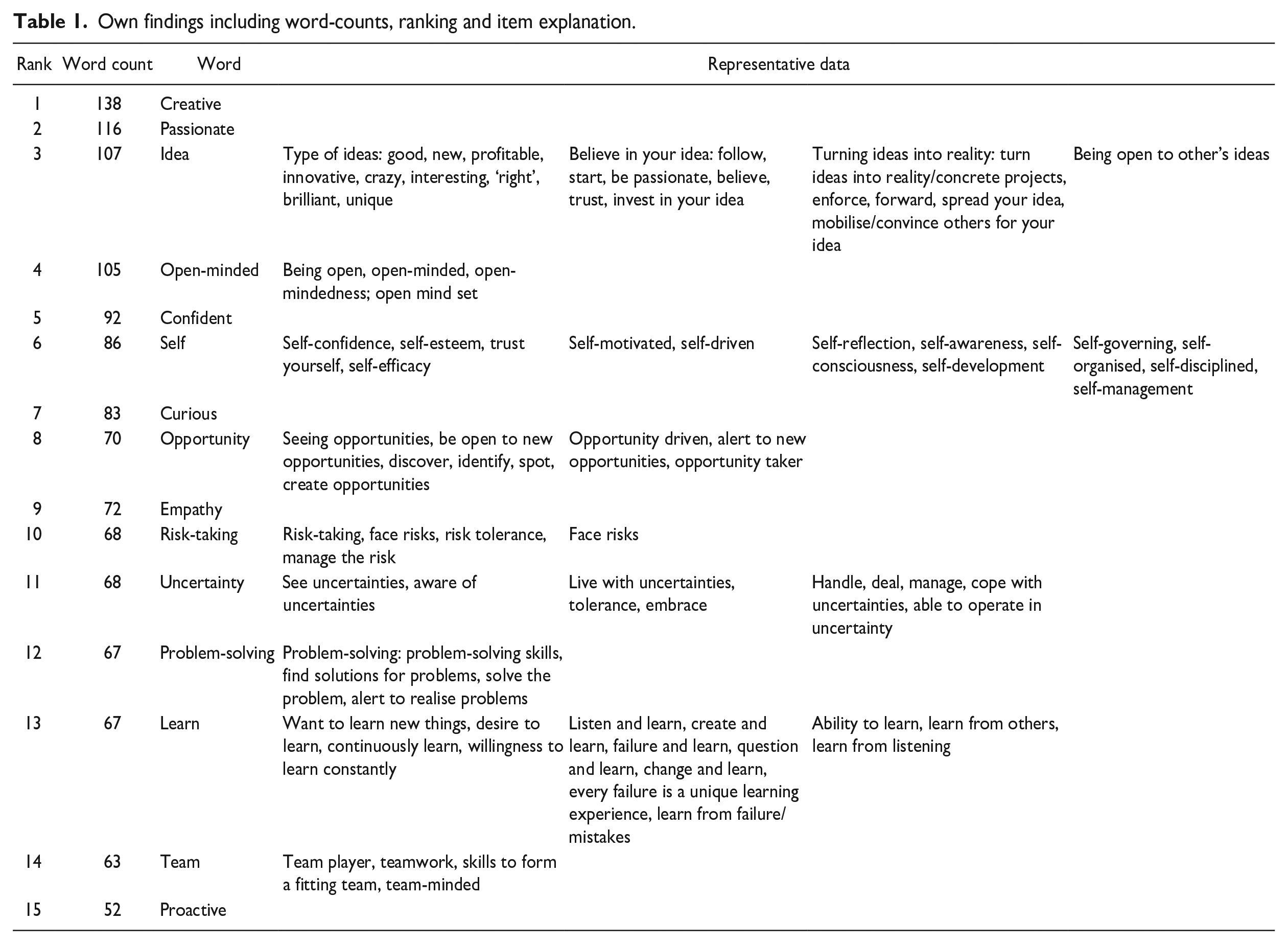
Participant descriptions of who and what they think constitutes entrepreneurship exceeded 1000 words. Given the large volume of text, we began with a quantitative content analysis to identify the various themes and concepts in the data using Atlas.ti software. This approach is based on the assumption that the frequency of certain words correlates with the importance respondents afford to them (Lincoln and Guba, 1985). Two scholars familiar with the topic of gender role stereotypes in entrepreneurship independently assessed the themes identified by the software. To do this, they assessed how the themes were represented in the data to ensure that there were no misinterpretations. All discrepancies and peculiarities were then discussed with a third scientist and two research assistants in the field to reach a consensus on the best possible interpretation of the data. Based on this, we identified a total of 15 words that describe the characteristics and behaviours most often attributed to entrepreneurs and their profession by the MOOC participants (see Table 1).
Own findings including word-counts, ranking and item explanation.
The second step of our data analysis involved comparing participant perceptions of who and what constitutes entrepreneurship with the dimensions covered in established scales used to assess gender role stereotypes (see Table 2). The comparison of the identified characteristics with the dimensions in BSRI (60), PAQ (24) and (e-) SDI (92; 111) are grouped into three categories:
x = not covered in established scales
0 = partially covered in established scales, that is, by a synonymous word
+ = fully covered in established scales, that is, the same wording
Comparison of own findings with BSRI, PAQ and (e-)SDI.
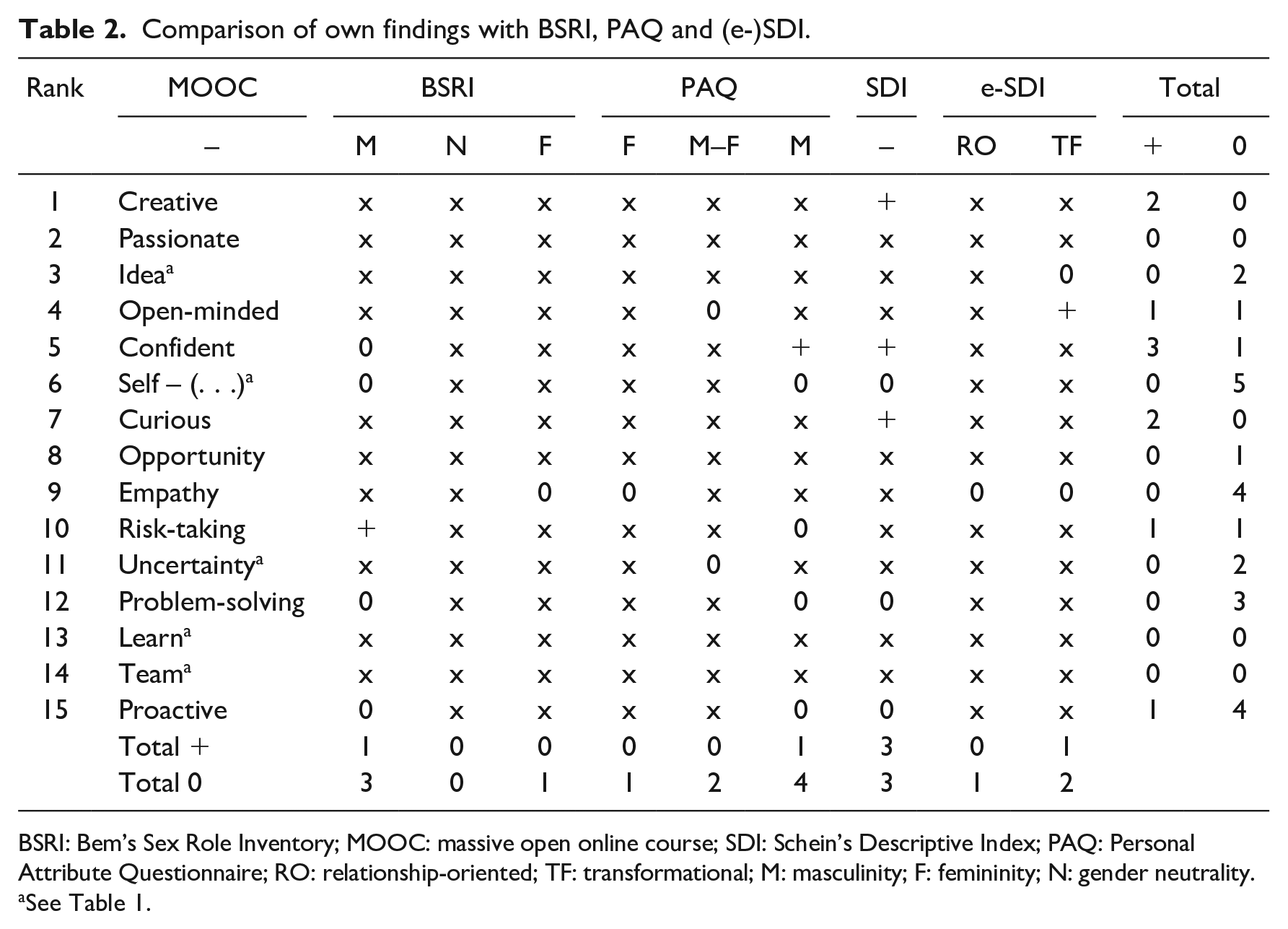
BSRI: Bem’s Sex Role Inventory; MOOC: massive open online course; SDI: Schein’s Descriptive Index; PAQ: Personal Attribute Questionnaire; RO: relationship-oriented; TF: transformational; M: masculinity; F: femininity; N: gender neutrality.
See Table 1.
This comparison allows us to identify similarities and differences and interpret our data more thoroughly. To that end, PAQ and BSRI enable us to assess whether the characteristics we identified are associated with femininity, masculinity or gender neutrality (M, F or N/M-F-scale). In addition, the comparison with the e-SDI allows us to assess whether the entrepreneurial characteristics identified relate to a RO or TF leadership style (see Table 2).
Analysis and findings
In total, we identified 15 characteristics and behaviours our respondents considered to be important qualities of an entrepreneur and, thus, prerequisites for engaging in entrepreneurship (see Table 1). These included being creative or possessing creativity (138 wordcounts), being passionate or having passion (116), being full of ideas or having an idea (107) and being open-minded (105). The ideal image of an entrepreneur more than 100 of our participants have in mind can therefore be characterised as a creative and passionate personality who is full of ideas and open-minded when it comes to identifying or creating new opportunities. In addition, more than 50 participants described entrepreneurs as confident (92), self-motivated (86) and driven by curiosity (83), qualities they perceive to correlate with an entrepreneur’s desire to learn (67) and alertness for new opportunities (70). Also, an entrepreneur who faces uncertainty (68) is perceived as someone who is more likely to take risks (68) yet respond with empathy (72) and problem-solving skills (67) to address and overcome challenges. In addition, entrepreneurs are described as being team players (63) with a proactive personality (52).
Comparing the characteristics and behaviours respondents in our sample attributed to entrepreneurs with the dimensions captured in established gender role stereotype scales reveals only partial overlap (see Table 2). Explicit congruence between participant descriptions and the established scales was found only for the following characteristics ascribed to an entrepreneur: confident (covered in PAQ and SDI), creative (SDI) and curious (SDI). In contrast, three other characteristics and behaviours our participants felt were important in describing who and what constitutes entrepreneurship are not captured in any of the three established scales. These are passion (rank 2), desire to learn (rank 13) and ability to work in a team (rank 14). With a total word count of 116, passionate or having passion ranks second among the entrepreneurial qualities mentioned by our sample. Also, our respondents frequently mentioned desire to learn, that is, ‘wants to learn new things’, ‘listen and learn’, ‘fail and learn’ or ‘continuous learning’ and team, that is, ‘team player’, ‘teamwork’ or ‘team-oriented’.
Most of the characteristics and behaviours we identified are covered to some extent by the established scales, but there is no absolute congruence. Particularly in PAQ and BSRI, we found some overlap in traits that were classified as masculine, but these were represented by different words than those used in our entrepreneurial context. For example, while our results suggest that problem-solving is an important entrepreneurial characteristic, the BSRI and PAQ contain the item ‘is able to make decisions easily’. This can certainly be seen as a prerequisite for problem-solving, but the overlap is only partial. Contemporary entrepreneurship literature, however, indicates that the problem-solving capacities of entrepreneurs are crucial to deal with being continuously confronted with new problems and hurdles they should be able and willing to overcome (Hsieh et al., 2007; Zhang et al., 2023). The same applies to the word empathy (rank 9), which is the only characteristic partially included in the F-scale of the BSRI and PAQ (hence, regarded as a feminine quality) but described there with terms such as ‘compassionate’, ‘understanding’ and ‘being aware of others’. Nevertheless, being empathetic has been found to be an important characteristic of entrepreneurs, who should be able to understand the needs of customers or target audiences (Fairchild, 2011; Korte et al., 2018; Sundermeier and Kummer, 2022).
Another interesting finding is that none of the entrepreneurial characteristics and behaviours deemed important by our respondents are represented as the exact same word (+) in any of the F-scales, and only one (being creative) is part of the N-scale. With regard to the M-scales, we identified a stronger congruence between our findings and the dimensions covered in BSRI (risk-taking, confident, problem-solving, proactive) and PAQ (confident, risk-taking, problem-solving, proactive). Based on the findings mentioned earlier, it can be concluded that there is only a partial overlap between what our respondents perceive to be a contemporary image of an entrepreneur and the dimensions covered in gender stereotypes scales. The highest congruencies have been identified between our findings and dimensions covered in e-SDI (10), followed by PAQ (8), SDI (6) and BSRI (5). One reason for this could be that the e-SDI contains more recent research and thus provides a better basis for comparison of our results.
Discussion
The findings of our study show only a partial overlap between the contemporary image our sample of young adults has of entrepreneurs and the dimensions captured in established scales used to determine gender role stereotypes associated with entrepreneurship. Consistent with existing evidence (Byrne et al., 2019; Lewis et al., 2017; Marlow and Martinez Dy, 2018), we find that the stereotypical belief that an entrepreneurial career requires primarily masculine characteristics such as risk-taking, proactivity and confidence remains prevalent. Nevertheless, our participants also mention various androgynous (e.g., passion, team player, willingness to learn) qualities of entrepreneurs that are only partially covered by established scales such as BSRI, PAQ and (e-) SDI. These findings are a preliminary contribution to the ongoing discussion of potential issues related to the timeliness, predetermination and contextualisation of established scales (Duehr and Bono, 2006; Laguía et al., 2019; Wilson and Tagg, 2010). In the following, we interpret our findings from a social constructionist perspective and derive several recommendations on how established scales can be revised to strengthen their contribution at the intersection of gender and entrepreneurship research.
Timeliness: Extension of scales to include contemporary views on entrepreneurship
A social constructionist perspective on gender role stereotypes suggests that the gender-typing of entrepreneurship as masculine can be subject to change when societal views on gender and their roles change (Bussey, 2011; Gupta et al., 2020; Lopez-Zafra and Garcia-Retamero, 2012). Consistent with recent empirical insights (Ben-Hafaïedh, 2017; Rudic et al., 2021), our findings are an indication that commonly held perceptions of entrepreneurship might be changing. In particular, our data show that instead of a predominantly masculine image of entrepreneurship, a more androgynous view prevails among the young adults in our sample. Rather than a ‘lonesome’ hero (Bruni et al., 2004), our participants portray the entrepreneur as − among other qualities − a team player (undefined) who is creative (BSRI: neutral), confident (BSRI: masculine), passionate (undefined), full of ideas (undefined), open-minded (PAQ: masculine/feminine) and empathic (BSRI/PAQ: feminine). These findings indicate that our sample has a perception that entrepreneurship requires a mix of masculine and feminine characteristics, as well as several traits that are not (yet) defined as one or the other. As such, they align with recent calls that promoting a non-stereotypical image of entrepreneurship would require disseminating the association of entrepreneurship with androgynous characteristics such as creativity, innovativeness and being open-minded (Hancock et al., 2014; Laguía et al., 2019; Wilson and Tagg, 2010). Such an androgynous representation of entrepreneurship is seen as a crucial factor in debunking the ‘think entrepreneur, think male paradigm’ and increasing the proportion of women who consider entrepreneurship a suitable career path for themselves (Jones and Warhuus, 2018; Meyer et al., 2017; Pérez-Quintana and Hormiga, 2015).
Given these findings and the social constructionist notion that gender role stereotypes can change over time, we propose revising established scales for determining such stereotypes that date back to the 1970s. This would involve conducting representative studies to identify gender role stereotypes related to entrepreneurship in different contexts to derive items that express commonly perceived characteristics about who and what constitutes entrepreneurship. On this basis, it would be possible to update the established scales by either expanding or deleting the dimensions they cover and then conducting a validation study to determine how well the updated scales represent contemporary gender role stereotypes related to entrepreneurship. Our study is a first step in this direction, providing initial indications of which additional dimensions might be of relevance (e.g., passion, team player and willingness to learn). In total, we identified 15 characteristics and behaviours relating to the stereotypical image of the entrepreneur, of which only some have been captured in established scales.
Contextualisation: Determination of qualities for the entrepreneurial context
Social constructionism suggests that gender role stereotypes are highly contextual and differ among social groups, cultures and regional or national borders (Bhatia and Bhatia, 2021; Bruni et al., 2004; Holmes, 2007). With this in mind, the question arises as to whether scales such as the SDI developed for the management context are universally applicable to the entrepreneurial context, as gender role stereotypes associated with each profession might differ (Gupta et al., 2019; Laguía et al., 2019). Our findings contribute to this discussion because several characteristics our respondents considered important for entrepreneurs are not included in the established scales (e.g., being full of ideas, curious and alert for new opportunities). As discussed earlier, this could be interpreted either as insufficient coverage of contemporary views of entrepreneurship in established scales or an indication that the items need to be critically examined as to their suitability for the entrepreneurial context. In order to determine whether the scales in their current form are sufficiently suitable to represent entrepreneurial characteristics or whether they need to be adapted, we propose drawing on the literature on entrepreneurial personality (Denisi, 2015; Obschonka and Stuetzer, 2017; Zhao and Seibert, 2006). On this basis, it would be possible to identify characteristics important for pursuing an entrepreneurial career. The results could then be incorporated into a study investigating the extent to which characteristics identified in the literature as important for entrepreneurs are also perceived as typical for entrepreneurs across different social groups and contexts. This could be a fruitful first step to adapting established scales to make them (even) more representative of the entrepreneurial context. Alternatively, this may lead to a version of the SDI scale representative of the entrepreneurial context, for example, the Entrepreneurship-SDI or eship-SDI for short.
The evidence also indicates that hardly any of the entrepreneurial characteristics perceived by our respondents as relevant to entrepreneurial contexts can be classified as feminine according to the established scales. Initially, this may not be surprising as it is consistent with the masculinisation of entrepreneurship observed by many scholars (Ahl, 2006; Lewis et al., 2017; Marlow and Martinez Dy, 2018). Upon closer examination however, participant descriptions and the dimensions of qualities the established scales classified as feminine are not overlapping. On the contrary, words included in femininity scales, such as loves children (BSRI), cheerful (BSRI), emotional (PAQ), gullible (BSRI), childlike (BSRI) or warm (PAQ), were not covered at all. We argue that these characteristics are generally poorly associated with entrepreneurship, regardless of the biological sex of the founders. The fact that they were included in the scales is probably because the items selected were mainly from a time when women stereotypically fell into the role of homemakers or caretakers, while men were seen as breadwinners (Bullough et al., 2022). Another explanation might be that masculinity scales mainly contain characteristics of agency (Gaucher et al., 2011), more commonly used to describe entrepreneurs (Ahl, 2006; Jones and Warhuus, 2018). These views seem to be outdated and no longer appropriate in the entrepreneurial or business context. In addition, this incongruence may cause another lack of fit, namely between alleged feminine characteristics expressed through the items in the scales and women’s contemporary self (Auster and Ohm, 2000), especially in their role as entrepreneurs. We hence, propose that more research is needed to explore contemporary (feminine/masculine/androgynous) characteristics associated with the role of the entrepreneur. To respond to the rising demand for methodological innovation in this regard (Henry et al., 2016), we propose that life histories, ethnography and in-depth interviews are best suitable to uncover who and what constitutes entrepreneurship for entrepreneurs. To this end, both male and female entrepreneurs could be asked to what extent they identify with the items of the M-F-N scales of the BSRI or the PAQ and which characteristics they consider important but are still missing.
Predetermination: Combination of closed- and open-ended measurements
The contextualisation of gender role stereotypes discussed earlier adds to the complexity of revising established scales to be representative across contexts. As a first step in this direction, our findings suggest that an open-ended approach to measuring gender role stereotypes can help provide a comprehensive overview of relevant dimensions associated with the role of an entrepreneur among different target groups. To this end, we agree with Martiarena (2020) that it seems advisable to openly ask people about their views on who and what entrepreneurship is and to apply appropriate methodological approaches that allow rigorously aggregating their views (Gioia et al.’s (2013) methodology) and comparing them with the dimensions captured in established scales. Dimensions that are not yet covered can be translated into appropriate items to test with different target groups and determine how these newly included items compare to the original items.
To avoid overlooking relevant dimensions and reproducing stereotypes, we suggest that an open-ended survey element be regularly included when measuring gender stereotypes in entrepreneurship. Before participants are presented with the predetermined items, they should be able to openly express which characteristics and behaviours they consider important for entrepreneurs. This would allow for continuous expansion and iteration of the items included in the gender role stereotype scales used in entrepreneurship studies and lead to results that more accurately capture contemporary views on entrepreneurship. For future studies, we suggest not providing additional information (e.g., on gender/gender role stereotypes) to participants before the request to openly describe images of an entrepreneur to avoid biased responses.
Limitations and future research
Decisions for and against empirical designs always involve trade-offs in data collection and analysis that impose limitations on any empirical study, including ours. One of the limitations of our study is that we had to comply with the GDPR. Therefore, we were unable to link participant descriptions of who and what constitutes entrepreneurship to their demographic background (e.g., age, sex, country of origin and previous experience with entrepreneurship). Even though scholars have argued that a direct comparison between men and women, or especially the comparison of women ‘against’ a male norm, is not beneficial (Ahl, 2006; Ahl and Marlow, 2012; Ogbor, 2000), controlling for whether and how boundary conditions such as experience with entrepreneurship and/or country of origin would add another interesting layer to the discussion. Future research could therefore examine how gender role stereotypes differ across social groups in order to determine a list of characteristics that translate into items representative of gender role stereotypes in different contexts.
Since our study was exploratory in nature, another limitation is that we cannot provide a universal solution for an appropriate measurement tool to capture contemporary gender role stereotypes in entrepreneurship. Nonetheless, our findings and insights provide a good starting point for future research aimed at examining the validity of existing scales and revising them accordingly, as we discussed in detail. This could include studies that examine perceptions of entrepreneurial characteristics and behaviours with open-ended measurement instruments (to contrast findings with closed-ended established scales and determine missing dimensions) and across different groups such as investors, policymakers or entrepreneurship educators (to ensure that items covered are representative across contexts). The findings obtained on this basis could serve as a starting point for developing and validating an entrepreneurial version of the SDI scale (eship-SDI for short) that contains both new items and a combination of open-ended and (already existing) predetermined items of relevance for the entrepreneurial context.
Conclusion
Entrepreneurs, policymakers, business associations and other stakeholders strive − with varying degrees of success − to convey a diverse image of who and what constitutes contemporary entrepreneurship. Despite these efforts, the widely held belief that entrepreneurship requires primarily masculine characteristics persists (Bullough et al., 2022; Lewis et al., 2017; Marlow and Martinez Dy, 2018). Recent contributions to the entrepreneurship literature discuss whether the conclusions regarding the persistence of this gender role stereotype may not be due in part to the measurement tools used, which appear less suited to identifying contemporary perceptions of entrepreneurship (Laguía et al., 2019; Martiarena, 2020; Wilson and Tagg, 2010). We unpack prevailing criticism, drawing on a social constructionist perspective on gender role stereotypes that informs our empirical study. In it, we compare contemporary views of who is an entrepreneur and what constitutes entrepreneurship among our sample of young adults, utilising dimensions covered in established scales for determining gender role stereotypes, and find that they overlap only partially. On this basis, we conclude that testing the validity of established scales is important to ensure progress in the entrepreneurship literature on gender role stereotypes. To this end, we provide recommendations on how established scales such as PAQ, BSRI and (e-)SDI can be revised to ensure their validity for contemporary determination of gender role stereotypes in the context of entrepreneurship.
Footnotes
Funding
The author(s) received no financial support for the research, authorship, and/or publication of this article.
