




Abstract
Gender stereotypes continue to exist and are transmitted through media, and through social, educational and recreational socialization, which promote gender prejudice and discrimination. This paper argues that contemporary management culture does not critically engage with the social theories of gender studies, which could help in developing gender-neutral affirmative action-oriented managerial perspectives. The paper outlines different aspects of gender stereotyping and their impact on women’s career progressions from a managerial perspective, which engages with the critical theories of gender studies. The paper contributes to existing literature by identifying the antecedents of gender stereotypes and their impacts on the career progressions of women in management. It advances theoretical understanding of three clear conceptual shifts, that is, (a) Women in Management, (b) Women and Management and (c) Gender and Management. The theoretical transition from Women in Management to Women and Management led to progressive conceptual shifts in management literature but gender stereotypes continue to exist in society.
Introduction
Many gender-related barriers and biases have declined over the years but gender stereotypes continue to create problems in the progress of women’s careers. The availability of opportunities for the career progressions of women continues to be negatively affected by gender stereotypes, which shape managerial behaviour and occupational outlooks in the workplace with patriarchal expectations. There are only 29 per cent women in senior management positions worldwide (IBR, 2020). The World Economic Forum (2017) suggested that an average gender gap of 32.0 per cent existed in four areas, namely, ‘Economic Participation and Opportunity’, ‘Educational Attainment’, ‘Health and Survival’ and ‘Political Empowerment’. This shows an increase from an average gender gap of 31.7 per cent since previous years. Despite many policies to increase gender equality in recent decades, gender discrimination based on gender stereotypes continues to exist. This paper argues that there are progressive and radical shifts in the management theories from Women in Management, Women and Management and Gender and Management. The theoretical transition from Women in Management to Women and Management did not change the practice of gender stereotyping in society.
Gender stereotyping is considered to be a significant issue obstructing the career progressions of women in management. The continuation of minimal representation and participation of women in top-level management positions (Elacqua, Beehr, Hansen, & Webster, 2009; World Economic Forum, 2017) forms the basis of this research. After critically reviewing the existing literature, it was noticed that although numerous studies have been undertaken in the area of sex-role stereotyping, its causes are still under-researched. Unless the causes are found, the phenomenon will continue to exist (Desvaux, Devillard-Hoellinger, & Baumgarten, 2007). Therefore, it is essential to explore management literature in detail to identify key factors of gender stereotyping in relation to the career progressions of women.
Stereotyping emerges in numerous contexts to aid functions demanded by those contexts. Multiple purposes are served by stereotyped thinking reflecting a variety of cognitive and motivational processes (Hilton & Von Hippel, 1996). The emergence of stereotyping can be understood as a way of simplifying the demands on the perceiver (Macrae, Milne, & Bodenhausen, 1994), allowing the perceiver to rely on previously stored knowledge in place of incoming information, and to respond to several environmental factors, such as different social roles (Eagly, 1995), group conflicts (Robinson, Keltner, Ward, & Ross et al., 1995) and differences in power (Fiske, 1993). Stereotypes can also emerge as a way of justifying the status quo (Jost & Banaji, 1994) or in response to social identity (Hogg & Abrams, 1988). Moreover, it is vital to remember that discriminatory viewpoints are not necessarily intentionally adopted (Agars, 2004).
Gender stereotyping persists despite the provision of equal opportunities in workplaces. Though an improvement has occurred, with increasing numbers of women acquiring various management positions in the workplace, Schein’s (1973) Think Manager–Think Male attitude is still very much in existence among men. However, Schein’s (1973) Think Manager–Think Male association is attenuated in the case of successful companies and Think Crisis–Think Female is noticed being associated with female leaders. Women’s perceived suitability for senior positions is likely to increase under conditions of organizational crisis (Ryan, Alexander, & Postmes, 2007).
Women continue to experience high levels of pressure from their jobs, and they have been found to experience high levels of mental ill-health when they utilize an interpersonally oriented leadership style in male-dominated industries (Gardiner & Tiggemann, 1999). Gender-specific behaviour demotivates and demoralizes women in the workplace. In organizational settings, negative beliefs about women’s performance or efficacy may damage their aspiration for career advancement (Dickerson & Taylor, 2000). Women may opt not to apply due to challenging or leadership roles if they fear that they lack the ability to perform such roles.
The challenges women face due to gender stereotypes can be devastating. For example, Singh and Sebastian (2018) in their state-wide study of Gujarat, India found that women’s main links to entrepreneurship are through the business occupations of their fathers and kinfolk. The process of their inclusion into the family enterprise is a matter of birth, not choice; and despite the exposure of these women to business practices, as women, they are not regarded as potential successors in business. Moreover, the traditional attitude poses a threat to the career progressions of women because they are not allowed to seek work outside the household or interact with persons outside the family. Such patriarchal culture produces masculine working environment, where women managers tend to idealize ‘men as managers, managers as men’ (Collinson & Hearn, 1995) and women managers become part of patriarchal working culture.
The impact of gender stereotyping on women is evident irrespective of the level of position women belong to in an organization. However, it is more salient when managerial or leadership positions are concerned (Koenig et al., 2011; Kang, 2012). For example, Schein (1973, 1975) in her studies found that both male and female respondents agreed that successful leaders possess characteristics commonly associated with men, such as leadership ability, competitiveness, self-confidence, objectivity, aggressiveness, forcefulness, ambition and desire for responsibility. By contrast, women are associated with qualities related to concern for the sympathetic treatment of others. These include being affectionate, helpful, friendly, kind and sympathetic, as well as interpersonally sensitive, gentle and soft-spoken (Eagly & Carli, 2007). Kanter (1977) mentions that women in boardrooms may be regarded as ‘token females’ rather than as board members in their own right. Women, who are usually a minority in boardrooms, are often not listened to or valued on equal terms with male board members. Brescoll (2016) found that the participants in study considered the decisions of female leaders to be driven by emotions and therefore; they are less interested in hiring women in leadership positions. Similarly, Fischbach, Lichtenthaler and Hosrtmann (2015), investigating the Think Manager–Think Male paradigm, found that the emotions displayed by successful managers are the same as the emotions considered to be characteristic of men as opposed to women. The above discussion shows the stereotypical views on women as managers.
Over more than four decades, a number of researchers have explored gender stereotypes and requisite management characteristics (Heilman, Block, Martell, & Simon, 1989; Brenner, Tomkiewicz, & Schein, 1989; Schein & Muller, 1992; Orser, 1994; Schein, Mueller, Lituchy, & Liu, 1996; Elsaid & Elsaid, 2012; Berkery, Morley, & Tiernan, 2013) following different paradigms of gender stereotyping to undertake research in different country contexts. The findings of these studies show that the stereotyping reported in the earlier studies continue to persist. Both men and women believe that men are more suitable than women in leadership positions, though this belief is endorsed more by men than by women. The findings also indicate that the Think Manager–Think Male mindset is a global phenomenon. A change in women’s perception has been noticed in recent studies mainly in the USA where women have been less inclined to view management as the domain of men (Powell, 2011). Similarly, Stoker, Van der Velde and Lemmers (2012) found that although the general stereotype of a manager is masculine and although most prefer a man as a manager, female employees, employees with a female manager and employees working in an organization with a high percentage of female managers have a stronger preference for feminine managerial characteristics and female managers. The above discussion shows that socio-cultural factors play a significant role in increasing or reducing the level of adherence to stereotyped modes of cognition and that individual-level agency is required to change societal structures of gender inequality.
Methodological Approach
This paper is a conceptual paper based on a review of literature. It draws its methodological lineages to non-linear narrative around the concept and construction of the idea and language of ‘gender stereotyping’. The paper uses discourse analysis (Fairclough, 2003) to identify ways in which gender stereotypes are incorporated within the language of management praxis by reviewing existing literature. The literature review is conducted by selecting and synthesizing 1 existing literature on the causes and consequences of gender stereotyping and its impact on women’s career progressions. The thematic narrative was developed and classified based on conceptual frameworks 2 around individual, cognitive, family, social, cultural and organizational factors of gender stereotyping. Table-1 was designed to reflect the structure, categorization and analysis of arguments within existing literature. The scope of the research is generic by nature but focuses more on South Asian contexts.
Theorisation of Different Antecedents of Gender Stereotyping in South Asia and Beyond
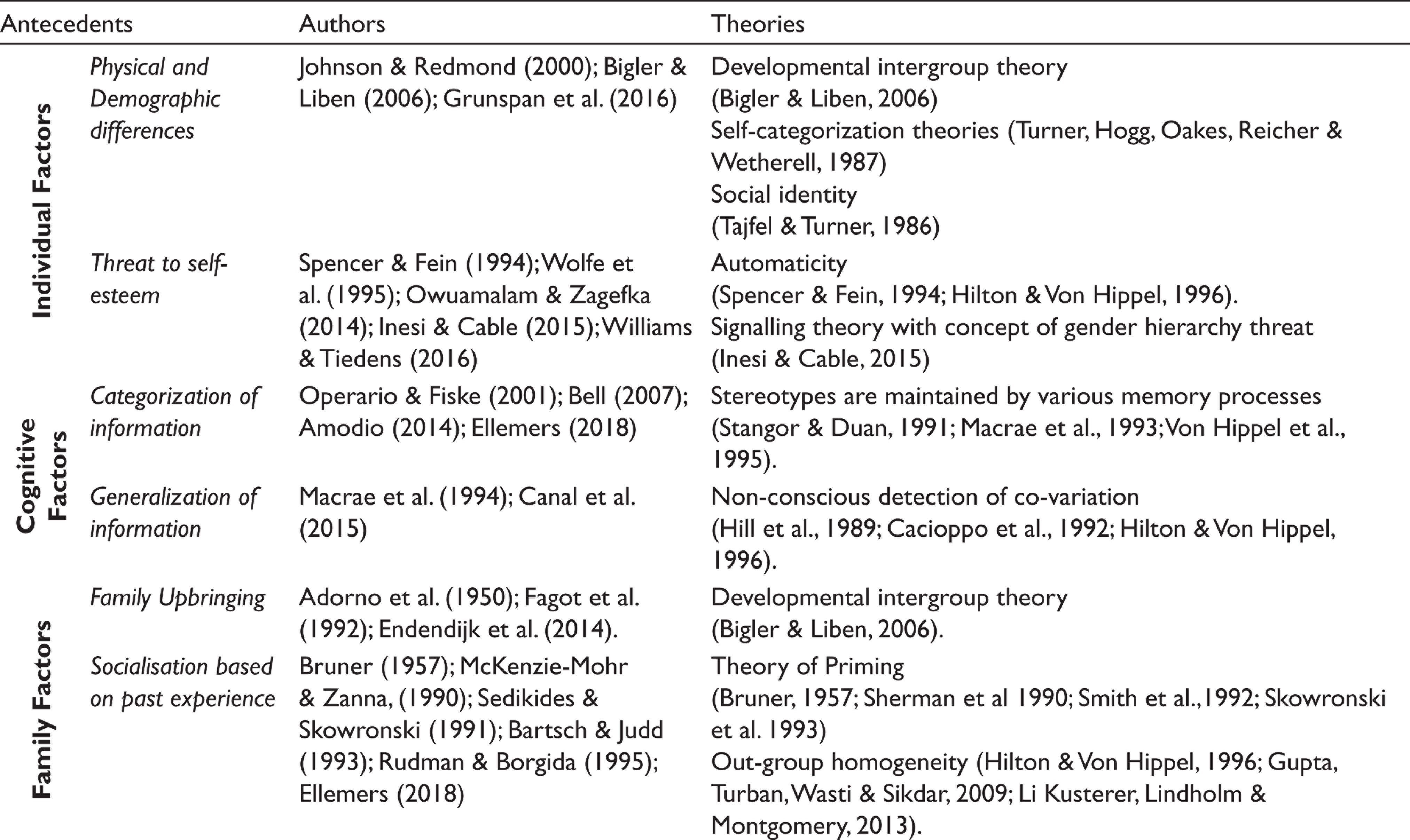
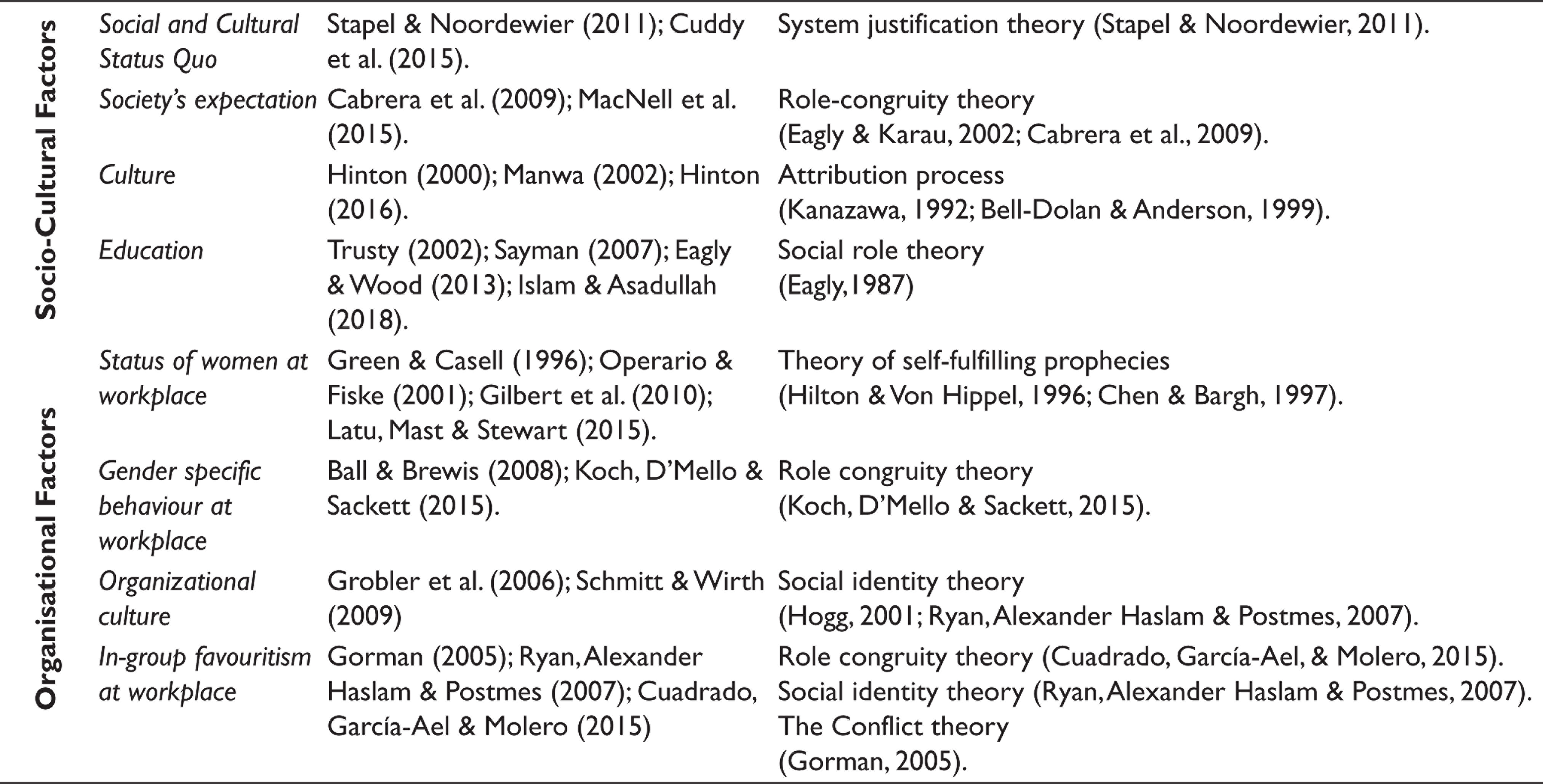
Methodologically, the paper belongs within a tradition of critical thematic content analysis of gender stereotyping. It engages with contextual interpretation of relevant theories to avoid overlapping in the paper. The following paragraphs discuss some of the relevant theories followed by the themes/factors. The theorisation of individual-level agency in changing societal structures of gender-inequality seems a missing piece in multi-level research on gendered stereotypes in management. Therefore, it is essential to understand relevant theories in relation to different themes/factors of gender stereotyping. We hope that social role theory, role-congruity theory and moderate feminist theory will ultimately prove valuable in achieving an understanding of the social stereotypes and prejudices women face in society and organizations and will also serve to guide social and organizational interventions that can prevent the development of gender stereotypes.
Theorizing Gender Stereotyping in Management
Gender stereotyping owes its origin to the gendered division of labour whereby the means of production and distribution is controlled by men within a patriarchal social, economic and cultural structure. Socialization of individuals, families and other institutions within such a structure is central to the creation and perpetuation of gender stereotypes (Ruble, Martin, & Berenbaum, 2006). There are theoretical attempts to break away from such a system by challenging existing patriarchal norms and values based on gender stereotypes with the help of ‘theory of mind’. Theory of mind offers a social cognitive basis to challenge gender stereotypes (Mulvey, Rizzo, & Killen, 2015). However, the cognitive approach of everyday life is shaped by the environment where cognition takes place. Therefore, theory of mind is not sufficient to counter different factors influencing gender stereotypes. As Hinton (2016) emphasizes, in Lippmann’s view (1922), it is not the individual but the culture which is responsible for creating stereotypes. Similarly, Fiske and Taylor (2013) suggest that stereotyping should be considered as ‘culture in mind’, that is to say, it should be viewed as a characteristic of the cognition of cultural groups rather than as a cognitive bias affecting individuals.
Theory of Social Role, Gender Stereotypes and Management
Social role theory is considered to be significant in explaining the existence of gender stereotyping. According to this theory, managers have expectations about candidates relating to behavioural tendencies and activities which are concordant with their social roles and which can be based on gender, economic standing or other demographic subsets (Skelly & Johnson, 2011). Social role theory explains that men and women acting in accordance with their social roles are often segregated along gender lines and that this functions to confirm gender stereotypes (Eagly, 1987, 1997; Koenig & Eagly, 2014). Because women are more involved in caregiving work, the characteristics ascribed to them are those of being nurturing, caring, and concerned with personal relationships. By contrast, men are typically seen by society as exhibiting masculine characteristics, such as leadership, strength and assertiveness (Vogel, Wester, Heesacker, & Madon, 2003; Skelly & Johnson, 2011). Candidates required for managerial positions are expected to have technical and rational expertise along with an acceptable level of attributes which are perceived as masculine and those applicants who are more qualified and who are better able to fulfil the social expectations of a leader will be favoured more by the hiring manager. Women may be perceived by some managers or executives as not possessing enough of the male-type or leadership qualities required for promotion to senior-level positions and this may hamper their progress (Skelly & Johnson, 2011). A study undertaken by Akanbi and Salami (2011) found that women’s career advancement in management faces obstacles and limitations and gender-related preconceptions and biases, stereotypes and feelings about women’s managerial and administrative abilities were believed to be the reason for these inhibitions. Surprisingly, it was found that the majority of the respondents prefer to work for men rather than women because women were considered as hard to work. The analysis also suggested that women managers were seen to lag behind their male counterparts in terms of possessing some significant attributes needed in managerial job performance and success. Therefore, the existence of stereotyping against females in leadership positions are proposed by the social role theory (Lyness & Heilman, 2006; Skelly & Johnson, 2011). Jain and Mukherji (2010) focus on the struggle of women to fulfil the roles of being a wife, a mother and a successful manager. They go on to highlight the impact of societal norms and traditions in creating gender roles for men and women in India where male characteristics are accepted as successful managerial characteristics and female characteristics are resisted. Bombuwela and Alwis (2013) have discussed how the career development of women is affected by the culture in Sri Lanka. Jamali, Sidani, & Safieddine (2005) mention cultural constraints in Lebanon and Pillai, Prasad and Thomas (2011) draw attention to the existence of social prejudice against women in Bahrain.
Role Congruity Theory, Leadership and Gender Stereotypes
The role congruity theory developed by Eagly and Karau (2002) suggests that as leadership skills are ascribed more to men than to women, a prejudice exists against prospective female leaders.
Because women who are effective leaders tend to violate standards for their gender when they manifest male-stereotypical, agentic attributes and fail to manifest female-stereotypical, communal attributes, they may be unfavourably evaluated for their gender role violation, at least by those who endorse traditional gender roles. (Eagly & Karau, 2002, p. 575)
Heilman (2001) stated that the female gender role contrasts with the leader role whilst the male gender role is consistent with the leader role. Dambrin and Lambert (2012) further added that even stronger causes to increase women in the workforce feel weak as women continue to face discrimination and remain scarce at the senior management positions. For example, Al-Manasra (2013) points out how the employees in a male-cultured organization in Jordan are influenced to perceive men as always performing better than women. Stereotyped belief is also visible in Islamic traditions like Iran where, due to the belief that women are emotional, they usually get excluded from leadership positions (Ghorbani & Tung, 2007). Furthermore, the stereotyped perception that women lack effective leadership characteristics is a consistent characteristic of Thai corporations and causes women to experience barriers to career progressions (Napasri & Yukongdi, 2015). Yang (2011) identifies the persistence of similar gender-stereotyped images of women in organizations in China.
Feminism and Gender Stereotypes
The third wave of feminism seeks to examine the construction of gender and experiences of women within different areas of gender social order where masculinity and femininity are being exchanged (Budgeon, 2012). McRobbie (2009) suggests that empowered and independent working women are considered to be a symbol of progressive femininity. However, Gill (2007) points out that self-improvement and self-discipline are key features of women’s access to freedom and empowerment. McRobbie (2009) adds that success and failure are therefore understood to be the responsibility of individuals and structural concerns are dismissed. Lewis (2012) emphasized on the masculinity and femininity aspects attached to the third wave of feminism. Women are suggested to be careful in engaging in feminine displays that benefit the business and not involve in unwarranted feminine demonstrations. As Lewis (2014) reveals, feminine behaviour exhibited by women is not accepted in positions governed by masculine norms of conduct. A notable issue here is that women adopting a post-feminist approach might face rejection due to hyper-feminine characteristics. This rejection would attach to them as individuals rather than to their minority status within the workplace. This suppression of structural constraints is caused by socio-cultural issues (Bauman, 2001). Unlike developed countries where women have a powerful voice and have attained senior positions in organizations, in developing countries women tend to take more of a moderate feminist approach and in most cases, are silent (Khayria & Feki, 2015). Male dominance and cultural barriers are still very much a reality in many countries (IBR, 2017). The lowest-performing region on gender equality was found to be South-Asia with a score of 0.44, whilst North America and Oceania scored 0.74 to be the best performing region. For example, in a country like Bangladesh, cultural, family and religious issues usually dominate women’s lives and there is a rigid division of labour in the workplace that controls their mobility and sexuality. The patriarchal social system and upbringing teach women to be self-sacrificing and to accept unequal treatment in life without complaint (Sogra, 1995). However, a change has been noticed in recent years with increasing participation of women in the workplace, which is affecting the present condition of Bangladeshi society (Sogra, 2014). The new wave of feminist theory aims to recognize the present behaviour of women in different organizations and management cultures within different societal, economic, cultural and religious conditions.
Different Factors and Lineages of Gender Stereotyping
There are several aspects that are essential to consider when categorizing the factors of gender stereotyping. For instance, stereotypes are reflected in people’s beliefs and expectations about social groups (Eagly & Wood, 2013). However, even if there are differences between these groups, the overall perceived differences are not applicable to all individuals in each group. It can be said that although socio-cultural factors have a significant impact on individual thinking and organizational context, biological differences and cognitive factors play an important role in shaping individuals’ beliefs. The cognitive factors as Barreto and Ellemers (2015) suggested that the motivational processes that make individuals conform to gender stereotyping. It is the result of individual differences in preferences and abilities or reflects biological differences. These gender differences are embedded in people’s brains and deeply rooted in the society’s growth reflecting the different roles of men and women (Ellemers, 2018).
Individual Factors
Physical and demographic differences. Human beings’ physical differences such as race and gender can cause stereotypes. For instance, Grunspan, Eddy, Brownell and Wiggins (2016) states that in a biology course, even when female students actually achieved higher grades, male students were still considered to outshine them and were named by peers as being knowledgeable about the course content. Due to this perception, people tend to self-categorize themselves into different categories as suggested by social identity theory and self-categorization theory (Hornsey, 2008). Stereotyping takes place when people have expectations that because of some characteristics such as colour, race, age, nationality, marital status, education or upbringing, individuals will have particular norms, values and modes of behaviour (Johnson & Redmond, 2000; Bigler & Liben, 2006). Bigler and Liben (2006) show that perceptually discriminable characteristics of people are more likely to become the foundation of stereotyping. Developmental intergroup theory (Bigler & Liben, 2006) suggested that once a categorization based on certain factors becomes prominent, people tend to interpret new information received along the same dimension of categorization, thereby triggering the process of stereotyping. Women employees tend to face discrimination due to being categorized by their gender dimension and this hampers their career progressions.
Threat to self-esteem. People are likely to stereotype when they experience a threat to their self-esteem. It can be an automatic response as stated by the automaticity theory (Spencer & Fein, 1994; Hilton & Von Hippel, 1996). Inesi and Cable (2015) used signalling theory and investigated whether evaluators give worse performance evaluations to women with stronger competence signals than they do to women with weaker competence signals. Across four studies, data were collected from US military officers, college-educated adults living in the US and male and female adults from a business school in London, UK. The findings strongly suggested that women receive biased evaluations for strong competence signals as evaluators are threatened by their status incongruence. Some supervisors may perceive stronger competence signals as a threat to the gender hierarchy and provide lower performance evaluations as a result. On the other hand, female supervisors who display leadership in a feminine manner are less likely to stimulate threat responses in their male subordinates (Williams & Tiedens, 2016). This shows that threats to self-esteem can be an antecedent but also a consequence of gender stereotyping.
Cognitive Factors
Categorization of information. People usually give greater consideration to observations that match their stereotypical beliefs than they do to counter-stereotypical observations when they process information (Ellemers, 2018). The specific brain areas that help people to identify, interpret and remember things that they see, hear and learn are activated by the stereotypical expectations that they possess (Amodio, 2014). Similarly, Operario and Fiske (2001) argue that a static generalization of a group as a result of stereotyping. It is often indicated bias and inequality, stem from categorization. Supporting this idea, Bell (2007) states that stereotyping occurs when people categorize and then evaluate the person categorized. Moreover, stereotypes are maintained by various memory processes (Stangor & Duan, 1991; Macrae, Hewstone, & Griffiths, 1993; Von Hippel, Sekaquaptewa, & Vargas, 1995). Employers tend to evaluate women candidates based on their gender and not their skills, hampering the progression of women employees.
Generalization. Generalization from the behaviour of one group member to the evaluation of others is one possible route to stereotype formation, which can be best explained using the theory of non-conscious detection of co-variation. The process of co-variation detection is suggested to be a non-conscious one (Hilton & Von Hippel, 1996). Once non-conscious initiation of a possible relation between two events is made, people tend to behave in the same manner even after the possibility has long been removed (Hill, Lewicki, Czyzewska, & Boss 1989). The role of non-conscious detection of co-variation in forming stereotypes tends to be influenced by self-perpetuating effects. Similarly, Canal, Garnham and Oakhill (2015) found that people are likely to interpolate information about unknown others that is consistent with gender stereotypes where information about specific individuals is scarce.
Family Factors
Family upbringing. The way people are brought up causes stereotypes. It could be difficult to change stereotyped thinking which is embedded from childhood. Fagot, Leinbach and O’Boyle (1992) suggest that gender stereotyping is acquired at a very young age and the identification of genders is heavily influenced by social interactions and associations. Adorno, Frenkel-Brunswik, Levinson and Sanford (1950) suggest that the personality development of a child mainly happens in the family setting but is heavily influenced by social factors. A child’s personality is shaped by his/her parents’ behaviour towards him/her and society has an immense impact on the parents’ behaviour. Girls and boys are likely to be treated differently by parents who implicitly make gender-stereotypical associations, and in this way, children learn about gender stereotyping at an early age and reproduce it in their own behaviours (Endendijk et al., 2014). Through this process, children learn to recognize the target groups of stereotyping as explained by the developmental intergroup theory (Bigler & Liben, 2006). Parents’ behaviour towards their children is usually affected by several factors—mainly economic, but also social, ethnic and religious. Therefore, broad changes in social conditions and institutions affect the kinds of personalities that develop in a society (Adorno, Frenkel-Brunswik, Levinson, & Sanford 1950).
Socialization based on past experience. Past experiences play an important role in the formation of stereotypes. In this context, group stereotyping, prejudice and discrimination might be critically associated with perceptions of out-group homogeneity (Diehl & Jonas, 1991) and theory of priming (Bruner, 1957; Sherman, Mackie, & Driscoll, 1990; Smith, Stewart, & Buttram, 1992; Skowronski, Carlston, & Isham, 1993). Out-group members are perceived to hold less suitable traits than in-group members and are considered to be more homogeneous (Hilton & Von Hippel, 1996). The minority groups (women) are considered as more homogeneous than majority groups, an effect that holds even in minority group members’ impressions of the members of their own group (Bartsch & Judd, 1993). Similarly, there is a stereotypical perception that on average men are taller than women although this is not the case for every individual and this stereotypical belief leads people to underestimate the disparities within the groups and to overestimate the differences between the groups (Ellemers, 2018). Priming, variously known as category accessibility or implicit memory occurs when current perception and cognition gets influenced by past experiences by making certain categories more accessible during the analysis of incoming information (Bruner, 1957). Therefore, it can be assumed that priming a particular domain makes people more likely to use that domain in later evaluations, even if the earlier priming experience is completely irrelevant to the current task (Sherman, Mackie, & Driscoll, 1990).
Socio-Cultural Factors
Social and cultural status quo. Stapel and Noordewier (2011) use the system justification theory to give an account of the way in which people usually stereotype. It is easier for people to gender stereotype in order to maintain their perception of a fair world and to defend the patriarchal social system and the status quo dominated by men. People stereotype because stereotypes are convenient tools which permit them to blame poor people by stating that they are just lazy and to admire the rich people by stating that they simply work hard. The existence of male versus female stereotypes clarifies the stereotyping experiences of women. Stereotypes aid people in understanding and provide meaning to social behaviour. Moreover, attribution processes contribute to maintaining stereotypes. As Cuddy et al. (2015) found, the likelihood of individualism being associated with the stereotype of men is predicted by the degree of national acceptance of individualism versus collectivism.
Society’s expectation. Society’s expectation regarding women’s role is consistent with role congruity theory (Eagly & Karau, 2002). Cabrera et al. (2009) argue that as a result of women being allocated to household work and men to paid work roles, women and men actively develop skills. Society then accepts these skills as being normative and they are incorporated into fundamental gender roles, which are both descriptive and prescriptive in defining how women and men typically do and should behave. This process leads to biases against women. In particular, it results in lower expectations of women’s potential for leadership because leadership abilities are associated with being male. This is also evidenced in a study by MacNell, Driscoll and Hunt (2015) where the behaviour of teachers during an online course was rated more highly by the evaluators when the instructor was identified by a male name instead of a female name.
Culture. Culture plays an essential role in the formation of stereotyping. People’s perceptions of traits that are connected to each gender and essential to get appointed into senior management positions are influenced by culture (Manwa, 2002; Hinton, 2016). Culture affects how people make attributions. Attribution processes are expected to be instigated by behaviours rather than being influenced by prior experiences (Kanazawa, 1992; Bell-Dolan & Anderson, 1999). Gender stereotyping of managerial positions has been examined by numerous authors in different country contexts such as the USA (Schein et al., 1989), Germany and the UK (Schein & Muller, 1992), Canada (Orser, 1994), Japan and the Peoples’ Republic of China (Schein et al., 1996) and New Zealand (Sauers, Kennedy, & O’Sullivan, 2002). Men in all seven countries considered characteristics necessary for management success to be attributes more commonly ascribed to men in general than to women in general. This established a strong and robust tendency for leadership to be viewed as culturally masculine. However, women in USA and Canada were found to perceive attributes of both men and women to be necessary for management success.
Education. Despite educational reforms and curriculum modifications intended to incorporate equal conceptions of occupational identification for boys and girls, differences in what is expected from each sex are as glaring today as they were decades ago. This is consistent with social role theory (Eagly, 1987; Eagly & Wood, 2013). Such attitudes are powerfully perpetuated both in the classroom and in the textbooks students read (Islam & Asadullah, 2018). Teachers possess an unparalleled authority to construct social reality but are often not fully aware of the powerful effects of their actions (Sayman, 2007).
Organizational Factors
Organizational culture. Organizations play an important role in influencing stereotypes. ‘Stereotypes are responsive to human intent, so they can be held in check with personal motivation and social norms created in organizations’ (Operario & Fiske, 2001, p. 46). Although stereotypes are initially formed in childhood and schooling, workplaces influence the development of stereotypes through various practices such as recruitment, promotion and the culture of the organization. Social identity theory suggests that the social groups feel a sense of belonging and consider their group culture as a source of pride and self-esteem (Hogg, 2001; Ryan, Alexander Haslam, & Postmes, 2007). Schmitt and Wirth (2009) claim that stereotyping is promoted in the workplace through the division of labour according to gender. This suggests that the gendered division of labour influences stereotyping to justify the division of labour. Grobler et al. (2006) bring out an important characteristic of the causes of stereotyping by suggesting that stereotypes do not stem from individual experiences but usually come from outside sources. The authors state that stereotypes require that exaggerated views about a group are sustained by confirmations from the social environment. For instance, when overstated beliefs about how women are perceived to perform in the workplace are repeatedly recounted, they produce or sustain stereotypical attitudes; and the impact of this stereotyping limits people’s potential and negates their individuality.
Status of women in the workplace. Women in workplaces are usually perceived as emotional, illogical and intuitive decision makers (Green & Casell, 1996). Gilbert, Burnett, Phau and Haar (2010) suggest that in different countries, work preferences differ between male and female professionals. The embedded social stereotype of women as intuitive decision makers could have been influenced by the different preferences women possess compared to those of men in a workplace setting. This concern for women being considered as intuitive decision makers is consistent with the expectancy-driven model of behavioural confirmation effects (self-fulfilling prophecies) (Chen & Bargh, 1997).
Gender specific behaviour in the workplace. Perceptions of different work preferences of women and men and justifications of women’s behaviour were identified as causes of stereotypes. Privileges offered to women, such as the ascription of less risky projects or the provision of the nearest parking spaces can cause stereotypes. For example, stereotyping can be caused by the approach taken by a company to support the career advancement of women, which might in fact result in women withdrawing from the paths leading to career success. People tend to perceive that the part-time jobs are designed for mothers and therefore, people take up these roles have less opportunity to succeed (Ball & Brewis, 2008). This discussion is supported by role congruity theory (Koch, D’Mello, & Sackett, 2015), which suggests that attitudes are less positive towards female than male leaders and potential leaders; besides, it is more difficult for women to become leaders and to achieve success in leadership roles.
In-group favouritism in the workplace. In-group favouritism influences the formation of stereotypes. A small number of new women are hired when the selection criteria include a large number of stereotypically masculine characteristics. Similarly, more women are hired when the selection criteria include more feminine characteristics. Moreover, more women are likely to get hired when the decision makers are female than male but this effect gets reduced among enter-level hires as more women start to fill the higher ranking positions moving towards gender equality (Gorman, 2005). As social identity theory (Ryan, Alexander Haslam & Postmes, 2007) suggests that people tend to categorize themselves and others into various social categories and this is the reason why people belonging to different social groups can have a conflict of interests and opinion as suggested by the conflict theory (Gorman, 2005). This is also evidenced in the role congruity theory (Cuadrado, García-Ael, & Molero, 2015) which suggests the prejudice prospective women candidates face towards their journey to leadership positions.
Impact of Gender Stereotyping on Women in the Workplace
Organizations play a key role in propagating discrimination. The judgments made by personnel in organizations regarding selecting and hiring of female applicants are affected by gender stereotyping (Davison & Burke, 2000).
Stereotype threat. Stereotype threat is the unpleasant recognition that one can be judged in terms of a negative stereotype or indeed that one might in some way appear to confirm a negative stereotype because the stereotype appears personally pertinent, perhaps in providing an apparent explanation of one’s behaviour or an experience one is having (Steele, Spencer, & Aronson, 2002). In other words, stereotype threat arises when an individual anticipates the prospect of being judged or treated negatively based on the negative perception of his or her group (Goff, Steele, & Davies, 2008).
Disparate treatment. Bell (2007) explores the impact of gender stereotyping, looking specifically at disparate treatment. The author affirms that stereotypes regarding performance or competencies of people may cause disparate treatment or unintentional discrimination, meaning the differential treatment of certain employees because of involvement in a negatively stereotyped group. For example, the assumption that women are not competent in calculation or maths could lead to disparate treatment, with women not being assigned to jobs requiring maths skills. Similarly, gender stereotypes implicitly guiding people’s judgement impact the job and career opportunities for women. Unfortunately, unlike men, women, when they become a parent, are assumed to be likely to prioritize care for their children over commitment at work (Ellemers et al., 2018). It can be said that disparate treatment is an antecedent as well as a consequence of gender stereotyping.
Prejudice. Cabrera, Sauer and Thomas-Hunt (2009) examine the impact of stereotyping using role congruity theory to explain how women leaders may be perceived differently from men across varying industry contexts. Perceptions of the incongruity of women’s attributes with those associated with leaders result in lower expectations of women’s potential for leadership and lower evaluations of female leaders’ actual behaviour. As Zahidi and Ibarra, (2010) suggested, the gender, racial and cultural composition of the board of directors faced by the managers, directors and shareholders of the modern corporation continues to be the most significant contemporary governance issues.
Tokenism. Bilimoria, Godwin and Zelechowski (2007) refer to tokenism as one of the negative consequences of gender stereotyping. The authors found that women in managerial positions still face tokenism from their male counterparts. The factors influencing tokenism, according to the authors, are discriminatory visibility, polarization and assimilation. A study by Gatrell and Cooper (2007) exploring the association between tokenism and gender stereotyping found that as women managers progress to higher positions they are more likely to experience tokenism and that the first woman to progress often experiences discrimination and stereotyping from the majority group.
Women are emotionally unstable, weak and timid. Heilman (2001) emphasizes that men are considered to be emotionally strong, assertive and workplace achievers whereas women are often considered to be emotionally unstable, weak and timid. These attitudes were found to be exemplified in a study conducted by Zafarullah (2000) looking at the status of women in workplaces in Bangladesh. The author observed discriminatory attitudes prevailing in the organizations, including the perception that women are less capable physically, mentally and emotionally in confronting certain challenges, being temperamental and lacking in motivation.
Women are risk-averse. Maxfield, Shapiro, Gupta and Hass (2010) claim that it is a common belief in the business world that women are risk-averse but argue on the basis of their findings that women are in fact not risk-averse, but are able to embrace risk. The authors found that women are seen as risk-averse as risk-taking is unrecognized because they mitigate costs when undertaking risk. Role-congruent behaviour contributes to the perception that women are risk-averse.
Women are intuitive decision makers. Women managers at workplaces are viewed as emotional and illogical whilst men are believed to exhibit gender-neutral rationality and decision-making (Green & Casell, 1996). However, a study conducted by Hayes et al. (2004) on intuition and women managers, found that there is no difference between male and female managers in terms of intuitive decision-making, disproving the perception that women managers are more intuitive than their male counterparts. Supporting this argument, Robbins and Judge (2007) report that women tend to over-analyse problems before making decisions, contrary to the stereotyped perception of women as intuitive decision makers. Moreover, a study conducted by Gilbert, Burnett, Phau and Haar (2010) to examine the differences between male and female business professionals in USA, Jamaica and Australia found that in different countries male and female professionals have different work preferences. It is tempting to conclude from this that the embedded stereotype of women as intuitive decision makers is influenced by the differing preferences of women and men in workplace settings.
Anger is not feminine. Brescoll and Uhlmann (2008) examine the relationship between anger, gender and status conferral. The authors note that emotion theorists have argued that the expression of certain emotions, such as anger, can convey whether an individual is capable and is eligible for high social status. Moreover, as stated by Heilman (2001), women and men who do not exhibit the culturally expected womanly or manly attributes are viewed unfavourably and evaluated as psychologically unhealthy by people who do exhibit these gendered attributes. Expressions of anger by men in a professional context are seen as appropriate conduct in a higher status role, whereas women’s expressions of anger are viewed as inconsistent with high social status and accordingly, women who express anger in a professional context are regarded as less competent (Brescoll & Uhlmann, 2008).
Consequences of violating the descriptive and prescriptive elements of gender stereotypes. The consequences of violating the descriptive and prescriptive elements of gender stereotypes are discussed by Heilman (2001). Firstly, women face devaluation of performance because of gender stereotyping. Women are perceived due to stereotypical expectation as incapable of being successful when they do manly work. When women do in fact succeed, disconfirming the stereotype, evaluators tend to devalue women’s performance by interpreting the same behaviour differently depending upon who the actor is. Secondly, stereotypes affect women’s performance by denying credit to women for their successes. Women are often viewed as incapable of succeeding in a male work domain even when their successes are undeniable. The expectation that a woman will fail is maintained by treating instances of success as not being due to the woman herself or by regarding a women’s success as an exception that depended upon exceptional circumstances. Finally, women succeeding in male-typed jobs are personally derogated and seen as counter-communal. Women are thus penalized for violating prescriptive aspects of stereotypes and often disliked and considered as unfeminine (Heilman, 2001).
Think Manager–Think Male. Schein (2007) emphasizes the importance of the Think Manager–Think Male perspective as one of the most common stereotypes at workplaces fostering bias against women in managerial selection, placement, promotion and training decisions. The author states that the persistent stereotype which associates management with being male is one of the main hurdles for women in management in all countries. Schein (1973) initiated research into the Think Manager–Think Male attitude by developing an index containing 92 descriptive terms and instructions to test the relationship between gender role stereotypes and requisite management characteristics. The findings of the study confirmed that there is a relationship between gender role stereotypes and perceptions of requisite management characteristics, especially among male respondents. This suggested that people usually associate men candidates with managerial roles and that therefore women face biased treatment when seeking to enter and advance in management positions. A number of studies such as Brenner, Tomkiewicz and Schein (1989), Heilman et al. (1989), Schein and Muller (1992), Schein et al. (1996), Fullagar et al. (2003), Jackson, Engstrom and Emmers-Sommer (2007), Elsaid and Elsaid (2012) and Berkery, Morley and Tiernan (2013) have replicated Schein’s (1973) study and confirmed the functioning of the Think Manager–Think Male perspective with slight variations in either description, place of study, participants’ profile or seating arrangements.
Think Manager–Think Male is considered to be a global phenomenon, suggesting that leadership positions have traditionally and historically been believed to be a male domain (Schein et al., 1996). A research study by Mirza and Jabeen (2011) in South Asian countries contributes to the limited literature on the impact of gender stereotyping. The study looks specifically at the banking sector in Pakistan, examining the influence of gender stereotypes on women bankers in management positions and finds that stereotypes have a negative impact on perceptions of women in management (Mirza & Jabeen, 2011). As in other developing nations, stereotypical views of women’s role in society and public affairs are quite commonly held in Bangladesh. Gender stereotyping results in differing attitudes towards men and women in diverse industries and service sectors in Bangladesh. A study undertaken by Zafarullah (2000), looking at Bangladesh, reported that performance appraisal systems were heavily prejudiced and often contained inconsistent remarks or statements.
However, several antecedents and consequences are overlapping and considering them under the antecedent and consequence umbrella helped to broaden knowledge. It provided a holistic overview of the factors of gender stereotyping. Recent studies suggest that contemporary women are typically viewed as agentic beings rather than as communal beings. It is worth empirically testing the impact of the antecedents of gender stereotyping on the women’s changed attitude. Agentic characteristics are more associated with masculinity than with femininity (Diekman & Goodfriend, 2006; Garcia-Retamero, Muller, & Lopez-Zafra, 2011; Bosak, Eagly, Diekman, & Sczesny, 2017). Although the perceived change in agency has been stated to be the reason for women’s increased participation in the labour market and very demanding roles. It is important to consider how the factors impacted in this shift will provide newer information and perspectives. Koenig and Eagly (2005) suggest that while gender stereotypes do prevent people from excelling in counter-stereotypical domains, they also help people to perform well in domains which are endorsed as gender-appropriate by stereotypical attitudes. In order to overcome the negative motivational impacts of gender stereotyping, extra effort is needed from individuals (Ellemers et al., 2018). Change will happen when women are provided with enough support to develop resilience skills in organizations and a larger number of women are visible in leadership roles (Tabassum et al., 2019).
Conceptual Shifts in Gender Stereotyping
There are three clear conceptual shifts in management literature, which it is necessary to understand if we are to adequately analyse and address issues of gender stereotypes in management. These are (a) Women in Management, (b) Women and Management and (c) Gender and Management. The theoretical transition from Women in Management to Women and Management led the conceptual shift to address the issues of gender stereotyping and its impact on women’s career progressions in different levels of management environment.
The first conceptual shift started with the publication of the journal Women in Management Review in 1985. From 1985 onwards, the advocates of Women in Management argued that positive actions (Cooper, 1985) based on equal opportunities (Marshall, 1985) are essential to the realization of the full potential of women in management. Such steps are necessary for the mainstreaming of women in management and to tackle gender stereotyping. This theoretical narrative is based on the premise of higher representation and more participation of women in management. This approach regards women as a target group and aspires to capture the untapped labour-power of women for managerial productivity. As part of this process, it is envisaged that gender stereotypes will be removed. The Women in Management approach was criticized because while it helped towards greater participation of women in management and greater gender equality, it did not adequately address the issue of gender stereotyping. As a result, gender stereotyping remained a major barrier to women’s progress in management worldwide (Schein, 2007).
The Women in Management was an initial step to move away from the society’s expectation (Cabrera, Sauer, & Thomas-Hunt, 2009), family upbringing (Fagot, Leinbach, & O’Boyle, 1992), education (Sayman, 2007) and cultural barrier (Hinton, 2000) allowing women to participate in the workplace. As Schien (2007) emphasized the Think Manager–Think Male phenomenon was persistent and reflected in the organizational culture (Grobler et al., 2006). Women were categorized (Operario and Fiske, 2001) based on their physical and demographic differences (Johnson & Redmond, 2000). As a result, women faced disparate treatment (Bell, 2007), prejudice (Zahidi and Ibarra, 2010) and victim of stereotype threat (Steele, Spencer, & Aronson, 2002).
The second conceptual shift took place in response to the failures of Women in Management with the development of the theory of Women and Management during the 1990s. Crampton and Mishra (1999) argued that organizations need to change in order to address issues surrounding women and management and to utilize the diversity of women’s skills and talents. Such arguments are an extension of earlier approaches of Women in Management. The advocates of Women and Management argued for both theoretical and practical approaches to consider women as partners and shareholders in the process of management and decision making. The approach moved beyond the issue of the representation and participation of women in management: it emphasized equality and the distinctive nature of women’s knowledge, work, goals, and responsibilities in management processes. However, this approach also failed to adequately address the issue of gender stereotyping. Like the Women in Management approach, the Women and Management approach worked within a patriarchal managerial perspective which viewed women as a productive force. In this respect, it conformed to the domain perspective of economic empiricism within managerial science. UNHR (2014), by contrast, asserted that gender stereotyping is an obstacle to human rights and is a violation of women’s rights.
The Women and Management approach helped in improving participation of women in the workplace but women were deprived of equal opportunities. Women were negatively evaluated due to generalization of information (Canal, Garnham, & Oakhill, 2015), threat to self-esteem (Inesi & Cable, 2015) and in-group favouritism (Gordon, 2005). The status of women in the workplace (Gilbert, Burnett, Phau, & Haar 2010) was inferior as compared to men and faced gender-specific behaviour in the workplace (Ball & Brewis, 2008). This resulted in women experiencing tokenism (Bilimoria, Godwin, & Zelechowski, 2007) in the workplace. Women were considered emotionally unstable, weak and timid (Heilman, 2001), risk-averse (Maxfield, Shapiro, Gupta, & Hass, 2010), intuitive decision maker (Gilbert, Burnett, Phau, & Haar 2010) therefore, was not considered for progression to managerial positions.
The third conceptual shift took place with the growth of a rights-based approach to management which regarded women and men as having equal rights in different aspects and different levels of managerial processes. The Gender and Management approach focused on gender-based social constructions and stereotypes which disempower women in management. It highlighted the gender-based value system that creates the foundation for stereotypes and gender inequalities. Authors like Berkery, Morley and Tiernan (2013) and Ellemers (2018) argued for developing a more inclusive and gender-sensitive managerial culture free from gender stereotypes emanating from existing unequal gender relations in the society. Brescoll (2016) and Bosak, Eagly, Diekman and Sczesny (2017) argued that management needs to create conditions of gender equality in workplaces and to address gender stereotypes in managerial praxis. All these three theoretical transitions and conceptual shifts shaped women’s empowerment in management processes, but still, stereotypes continue to hurt women’s career progressions.
The Gender and Management approach focused on social constructions, which influence gender stereotyping. Ellemers (2018) emphasized the impact of categorization and socialization based on past experience. Social constructions such as social and cultural status quo (Cuddy et al., 2015), society’s expectation (MacNell, Driscoll, & Hunt, 2015), culture (Hinton, 2016), education (Islam & Asadullah, 2018) and family upbringing (Endendijk et al., 2014) influence gender stereotypes, which create barriers for women in management. The representation of women in management and leadership has increased over the years but gender stereotypes did not decline. The theoretical shifts in management literature did not entail transitions in the practice of gender stereotypes in society. Gender stereotyping continues to exist in the workplace that halts women’s career progression.
Conclusion
This paper provides an in-depth conceptual analysis of the antecedents and consequences of gender stereotyping and its theoretical transition. Further empirical research in a range of different cultural and organizational contexts would increase our understanding. The paper noted conceptual shifts in the literature and the understanding of aspects of gender stereotypes. The progressive theoretical shift in management literature did not change managerial practices based on gender stereotypes. The critical review of existing literature reflects that individual factors, family factors, socio-cultural factors and organizational factors shape stereotyped thinking in human beings thereby perpetuating gender discrimination and obstructing the career progressions of women in organizations. Therefore, theories of management need to engage with critical social theories of gender to understand the patriarchal social, economic, cultural, political and religious conditions in which gender stereotypes are rooted.
Footnotes
Declaration of Conflicting Interests
The authors declared no potential conflicts of interest with respect to the research, authorship and/or publication of this article.
Funding
The authors received no financial support for the research, authorship, and/or publication of this article.