




Abstract
The global spread of coronavirus disease 2019 (COVID-19) caused by the novel coronavirus SARS-CoV-2 (severe acute respiratory syndrome coronavirus–2) has led to drastic infection control measures that have dramatically affected societies and economies worldwide. Against this background, it is the purpose of this commentary to illustrate how innovative entrepreneurial activity in particular has been affected by the rising uncertainty caused by the first COVID-19 wave. By comparing innovative North American and European startups established pre-crisis and during the first wave of the pandemic, this commentary suggests that startups founded in the crisis are characterised less by entrepreneurial teams and more by habitual entrepreneurs. Interestingly, female entrepreneurial activity seems not to have been affected by the crisis when measured as the proportion of women founders involved in innovative startups pre-crisis and during crisis. The commentary thus, illustrates what particular type of entrepreneur persists during rising uncertainty and allows us to draw conclusions for policy-making and further research on the interface of entrepreneurship, crisis and uncertainty.
Introduction
Proverbially, any crisis is said to be accompanied by opportunity, which is a central component of entrepreneurship (Shane and Venkataraman, 2000). The coronavirus disease 2019 (COVID-19) crisis has already triggered empirical research aiming to illuminate how the crisis has affected innovative entrepreneurial activity. For instance, Kuckertz et al. (2020) illustrate the challenges for innovative startups posed by infection control measures and how they cope, Nummela et al. (2020) describe the challenges faced by cosmopolitan entrepreneurs, Brown and Rocha (2020) document a decline in available early-stage financing for nascent entrepreneurs and Manolova et al. (2020) provide initial evidence of entrepreneurs adjusting their business models.
However, the main focus of this emerging research stream has been on entrepreneurs and startups (and Small and medium-sized enterprises (SMEs), for example, Lim et al., 2020) that were active prior to the crisis and how they are affected. Some have already criticised this approach for being too focused on entrepreneurial resilience (Greene and Rosiello, 2020), thereby neglecting opportunities for growth and new ventures that might follow from the crisis. Hence, less evidence is available with respect to the early-stage entrepreneurial activity of startups that were formed during crisis, having perceived an opportunity to establish something new despite adverse circumstances, and that potentially respond with their business models to the changing business landscape.
The present commentary therefore, attempts to determine how the rising uncertainty caused by the exogenous COVID-19 shock has affected innovative startups founded during the first wave of the pandemic. Ebersberger and Kuckertz (2021) were able to show that innovative startups indeed, follow Sir Winston Churchill’s famous call to ‘never let a good crisis go to waste’ and introduced numerous innovations to markets, in fact even faster than more established players. The flipside of entrepreneurial opportunities resulting from a crisis is, however, the rising overall uncertainty associated with it. In this regard, it has remained unclear until now how innovative startups respond to this uncertainty.
The analysis of 889 innovative startups drawn from the Crunchbase database illustrates how entrepreneurs who established their businesses during the first wave of the COVID-19 crisis have responded to rising uncertainty. More precisely, the analysis illuminates how the exogenous COVID-19 shock has affected entrepreneurial team composition, in particular with respect to the basic decision to start a venture as a team or not, the involvement of experienced, that is, habitual entrepreneurs, and the involvement of women founders in those innovative startups. This empirical view on the composition of entrepreneurial teams potentially furthers our understanding of how innovative startups address uncertainty.
COVID-19, uncertainty and entrepreneurial team composition
The COVID-19 pandemic brings with it various negative consequences for entrepreneurs and their ventures resulting from rising levels of uncertainty. Not only have entrepreneurs been taken by surprise first, by the pandemic as such and then by the infection control measures imposed by governments. It is moreover, also unclear how many waves of the pandemic are to be expected, what measures governments might additionally take or not take to control future waves and whether and how governments will or will not support entrepreneurial activity. This unprecedented level of uncertainty causes significant financial pressure on entrepreneurs (Block et al., 2021; Cowling et al., 2020). In particular, with respect to early-stage financing of innovative startups; the withdrawal of venture capitalists that has been documented in the literature (Brown and Rocha, 2020) indicates how uncertain key actors in entrepreneurial ecosystems worldwide perceive the situation to be. The financial volatility (Patel and Rietveld, 2020) resulting from customers withholding orders and investors postponing funding rounds has caused considerable psychological stress among entrepreneurs. Consequently, this is an all-encompassing crisis affecting demand side and supply side at all levels (Manolova et al., 2020).
However, with uncertainty comes opportunity. Morgan et al. (2020) remind us that for many existing businesses, past crises brought not only the necessity but also the opportunity to pivot – that is, to radically adjust the business model to new entrepreneurial opportunities. This is likely to also apply to the COVID-19 crisis – and it not only holds for established but also for yet-to-be-founded innovative startups. This consideration should mitigate the prevailing focus on resilience and entrepreneurship in light of the crisis, which has been rightly criticised as being just too short-sighted, given that (Greene and Rosiello, 2020: 588) ‘the great lockdown and its aftermath pre-figure a further wave of Schumpeterian “creative destruction”’. Understanding entrepreneurial activity under crisis conditions is thus, not only about understanding the specifics of the adversity entrepreneurs encounter but also about the opportunities they perceive and act upon.
Rising uncertainty triggers such opportunity, and in the case of the COVID-19 crisis, this goes well beyond simple health issues. Björklund et al. (2020), for instance, illustrate how the disruption of supply, production, sales and consumption throughout society helped entrepreneurs to innovatively rearrange value creation in the food and beverages industry. In a similar vein, Farhoud et al. (2021) illustrate emerging opportunities following from necessary solutions that need to be enacted for people affected by the COVID-19 crisis in various ways beyond only health aspects.
Uncertainty is likely to have effects (a) on whether ventures are started by individuals or by entrepreneurial teams and (b) on whether novice or experienced entrepreneurs are involved. Moreover, the crisis had gendered effects on existing businesses (Martinez Dy and Jayawarna, 2020), and this is (c) likely to apply to newly founded ventures.
First, starting a new venture as a team, in contrast to starting as an individual, entrepreneur is one possible solution to uncertainty (Harper, 2008). Teams combine competencies, resources and experience, all potentially useful in increasing the probability of success even in light of rising uncertainty. Over the COVID-19 crisis, ‘local entrepreneurs and communities have come together in mutual support’ (Korsgaard et al., 2020: 2) to reap the potentially positive effects from teams. Such positive effects result not only from higher levels of various resources single team members contribute but also from social ties within the team. These help to buffer the extent of stress caused by progressing in the entrepreneurial process, be it economically or emotionally induced pressure (Giones et al., 2020). A consequence is that, for instance, at hackathons, where solutions to pressing problems are developed in an extremely short time span (an event format that has been applied to the COVID-19 crises as well; Fisher et al., 2020), it is almost exclusively teams who are active, and this is encouraged by the organisers. Hence, the following hypothesis is proposed:
Second, for inexperienced or novice entrepreneurs, the overall uncertainty of a startup is a combination of the uncertainty of the firm (e.g. its market acceptability) and the uncertainty of the entrepreneurial process as such (e.g. what steps to take, how to register a company). In particular, this latter form of uncertainty does not apply to habitual entrepreneurs, that is, individuals who have started several ventures in sequence (so-called serial entrepreneurs) or simultaneously (so-called portfolio entrepreneurs) (Westhead et al., 2005). Their experience from previous or other entrepreneurial projects has supported the emergence of human capital specific to the entrepreneurial process (Unger et al., 2011) which – even against rising overall levels of uncertainty throughout the COVID-19 crisis – leads them to perceive less total uncertainty compared to less experienced entrepreneurs. They are thus able to pursue entrepreneurial opportunities more easily and faster even in times of crisis – not least because habitual entrepreneurs perceive more entrepreneurial self-efficacy (Brändle et al., 2018). Hence, the following hypothesis is proposed:
Third, the COVID-19 crisis seems to have put particular pressure on women with a resurgence of traditional responsibilities for family and care work that impedes entrepreneurial activity. Manolova et al. (2020: 4) even go as far as calling the crisis ‘a perfect storm for women entrepreneurs’. Infection control measures such as physical distancing at home combined with school closures clearly limit women’s economic capacity. Martinez Dy and Jayawarna (2020) asses this situation quite pessimistically and equate women entrepreneurs with ‘marginalized entrepreneurs’ due to more general gendered social inequalities. Such inequalities are likely to lead to a negative impact on women entrepreneurship and self-employment over the crisis.
This is not only true for existing businesses led by women entrepreneurs, nascent entrepreneurial activity is likely to be affected as well. And although claiming that women seek to reduce risks while men embrace opportunity is clearly a stereotypical gender dichotomy (Manolova et al., 2020), nonetheless risk perception varies with gender because of gendered ideology and gendered practice (Gustafson, 1998). The combination of rising levels of uncertainty and reduced economic capacity is thus likely to affect female participation in new innovative ventures as well. Hence, the following hypothesis is proposed:
Empirical analysis
Data
The analysis of innovative entrepreneurial activity to test the three hypotheses is based on data provided by Crunchbase, a database focusing primarily on innovative companies. Although published research relying on Crunchbase data has mostly analysed venture capital investments in innovative startups, Crunchbase in fact covers the global entrepreneurial ecosystem in all of its aspects. That is, the database contains a plethora of daily updated information about innovative startups worldwide (whether they raised funding or not), about individual entrepreneurs, venture capital firms, individual investors, funding rounds and even about universities and the entrepreneurial activities of their alumni. Over the years, this database has become a premier resource that can be used to understand and analyse the startup world (Dalle et al., 2017). Moreover, it has already been successfully utilised for research on entrepreneurship and prior crises (e.g. Block and Sandner, 2009) as well as on the COVID-19 crisis (Brown et al., 2020; Brown and Rocha, 2020), speaking for its reliability.
For the present analysis, the data on startups were extracted from Crunchbase using 11 March 2020, as a reference point; this was the date on which the World Health Organization (WHO, 2020) declared COVID-19 a pandemic. To be able to compare pre-pandemic and in-pandemic entrepreneurial activity, two 100-day periods were selected, each of which was 100 days away from the date of the WHO announcement. In other words, data were retrieved for European and North American for-profit startups founded during the 100-day period from 24 August 2019, to 2 December 2019, designated as unambiguously pre-pandemic startups, and data were retrieved for European and North American for-profit startups founded during the 100-day period from 19 June 2020, to 27 September 2020, designated as unambiguously in-pandemic startups that were started during the first COVID-19 wave. The database was checked on 15 October 2020, and after data cleaning, N = 889 innovative startups, for which information on founders and industries were available, formed the sample.
Variables
Dependent variable
The dependent variable is a binary variable describing whether a particular startup is a pre-pandemic startup (0) or an in-pandemic startup (1) founded after the WHO’s pandemic declaration.
Control variables
On the basis of country information from Crunchbase, every case is classified as either a North American startup (0) or a European startup (1). To control for the severity of the exogenous shock of the COVID-19 pandemic in the economy in which the startup operates, the logged number of infections in the middle of the second observation period (8 August 2020), as reported by Johns Hopkins University and relative to UN estimates of the country’s population, is included as a proxy variable in the analysis (Johns Hopkins Coronavirus Resource Center, 2020). In total, 51 different industry groups are adopted from Crunchbase as industry control variables; startups may be simultaneously active in different industries.
Independent variables
The rising uncertainty is likely to affect how entrepreneurs approach their individual entrepreneurial process. Hence, the analysis includes whether a startup involves a woman founder (1) or not (0), given that gender correlates with risk tolerance in the entrepreneurial context (Verheul et al., 2012). Second, the analysis accounts for whether a startup was founded by a team (1) or not (0) because teams may help to mitigate uncertainty (Harper, 2008). Third, Crunchbase makes it possible to deduce whether an individual can rely on prior (or additional) entrepreneurial experience, which affects how the uncertainty of a new entrepreneurial initiative is perceived (Unger et al., 2011). If an individual who has founded more than one organisation is involved in a startup, the case is coded as involving a habitual entrepreneur (1) whereas cases with no apparent entrepreneurial experience in the founder or team are coded as (0). Table 1 reports the descriptives and the correlations among the key variables of the analysis.
Descriptives and correlations (N = 889).
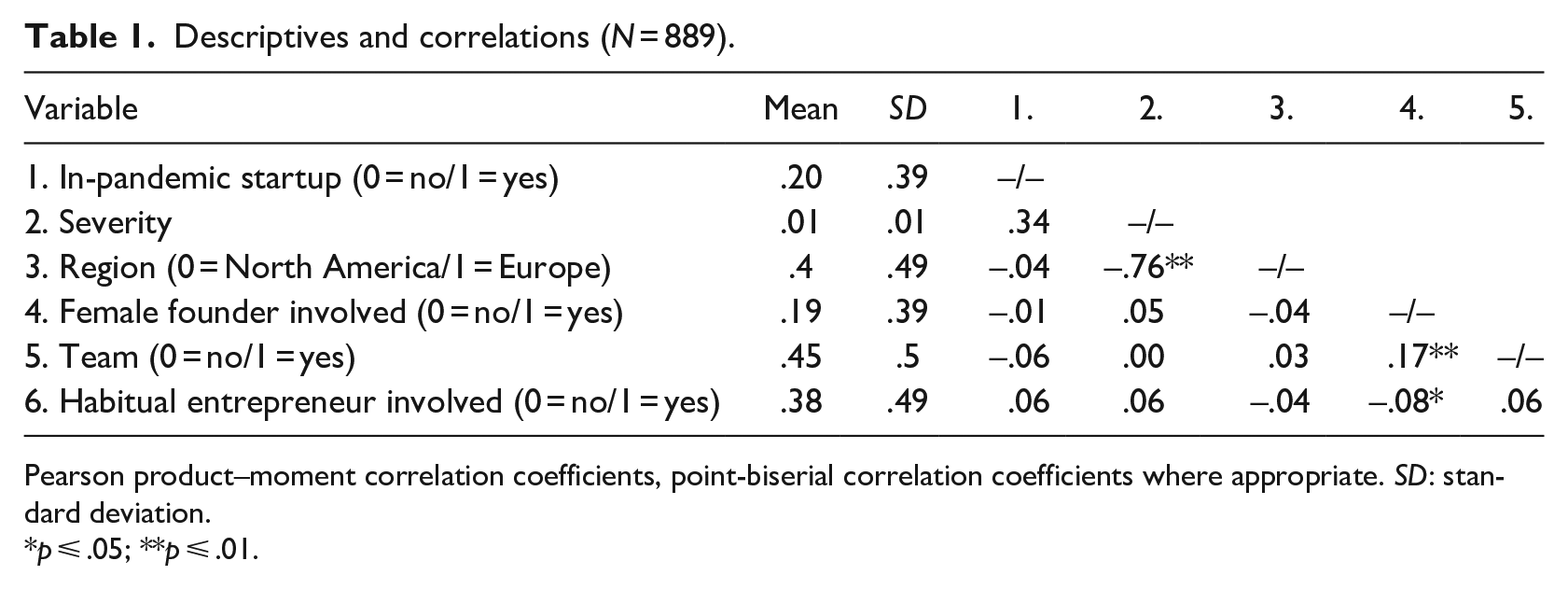
Pearson product–moment correlation coefficients, point-biserial correlation coefficients where appropriate. SD: standard deviation.
p ⩽ .05; **p ⩽ .01.
Results
The sample suggests that innovative entrepreneurial activity has declined with the COVID-19 crisis. Whereas the pre-pandemic period contains n = 713 startups, the pandemic phase features n = 176 startups.
Table 1 reports the results of a logistic regression model for pre-pandemic versus in-pandemic startups. The baseline model contains environmental control variables. Here, none of the variance is explained by whether a startup was founded in North America or Europe or by how severely a particular economy was hit by the COVID-19 pandemic. Entering Crunchbase industry groups into the equation in the second step, however, shows initial differences in innovative entrepreneurial activity. Real estate, gaming, artificial intelligence and the residual category termed ‘other’ play a reduced role, whereas payments, Internet services, and content and publishing seem to benefit significantly from the crisis (Table 2).
Logistic regressions for pre-pandemic versus in-pandemic startups (N = 889).
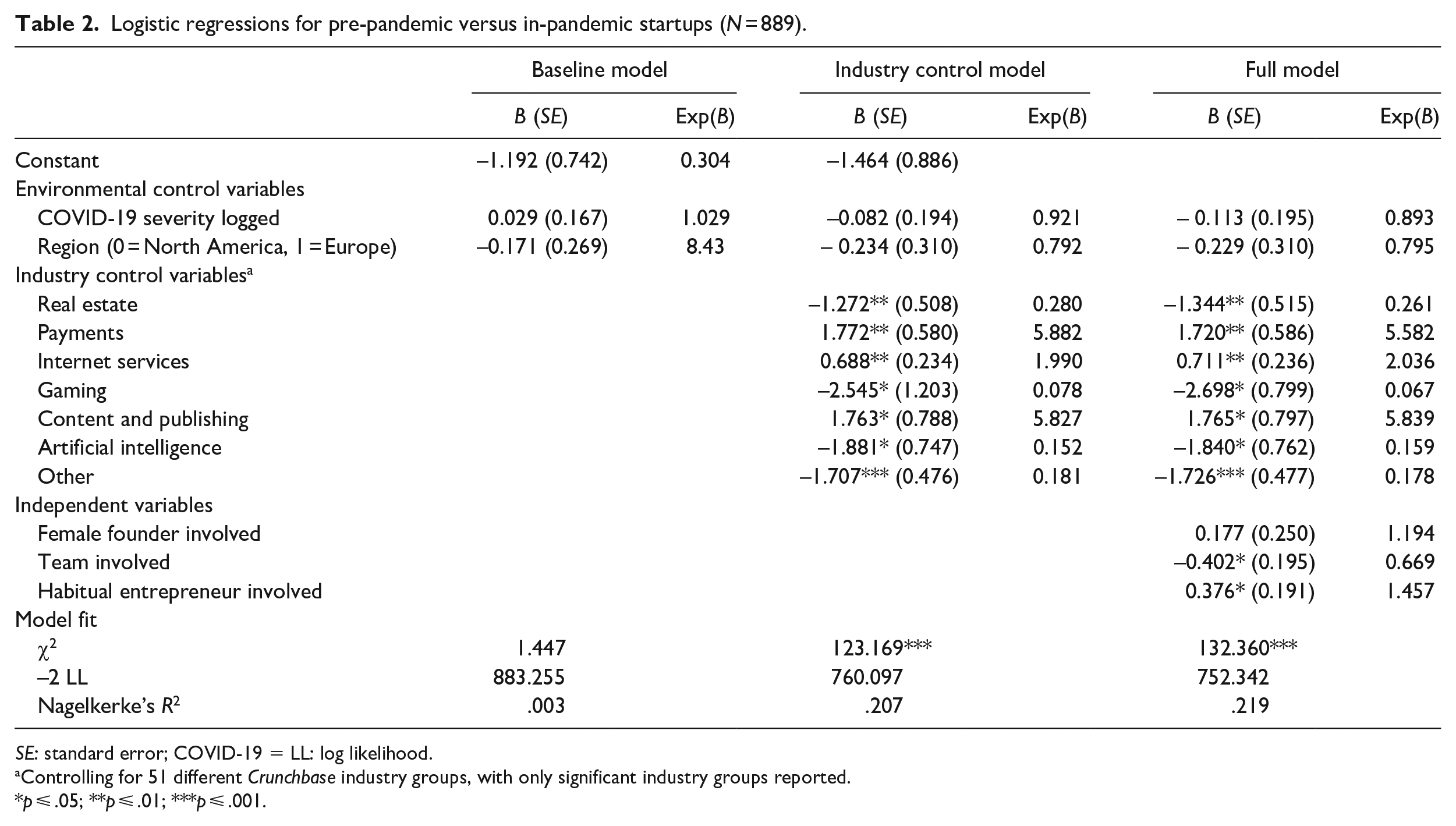
SE: standard error; COVID-19 = LL: log likelihood.
Controlling for 51 different Crunchbase industry groups, with only significant industry groups reported.
p ⩽ .05; **p ⩽ .01; ***p ⩽ .001.
The full model, which includes the independent variables reflecting the composition of the startups, shows a satisfying Nagelkerke’s R2 of .219. Contrary to H1, the analysis suggests that in-pandemic startups are characterised by the involvement of fewer teams (B = –0.402, p ⩽ .05). H1 thus has to be rejected. H2, however, is supported, as the results indicate a greater involvement of habitual entrepreneurs driving these new initiatives (B = .376, p ⩽ .05). Finally, there is no significant difference between pre-pandemic and in-pandemic startups with respect to a woman founders involvement (B = 1.77, ns). H3 is thus, not supported.
Discussion
Thorgren and Williams (2020) have already called for more evidence on the interplay of entrepreneurial team characteristics and entrepreneurial crisis management, and the present commentary answers to this call. Obviously, any crisis may have both positive and negative impacts (Lim et al., 2020), and it seems promising that despite the decline in innovative entrepreneurial activity, entrepreneurs are still active and embrace discovery-driven approaches as one option to manage risk (Manolova et al., 2020). These are the ventures that potentially contribute to the proverbial ‘new normal’ that will follow the COVID-19 crisis.
The decline in innovative entrepreneurial activity is in line with other recent studies reporting reduced entrepreneurial activity, as in Canada (Beland et al., 2020) and the United States (Fairlie, 2020). However, although it is a large database, Crunchbase is not representative, and thus, the decline may at least be partially ascribed to other factors such as coverage and recency effects. Nonetheless, while the magnitude of the decline should be interpreted cautiously, the negative direction of the development seems unambiguously clear. Moreover, the timeliness of Crunchbase that allows it to be considered a ‘real-time data’ source (Brown et al., 2020: 382) makes it a powerful tool that can inform additional and timely future research on the crisis effects on, for instance, business model adjustments in innovative ventures, changing financing strategies, or a generally better understanding of a changing entrepreneurial and innovation landscape.
Out of the three formulated hypotheses, only one found empirical support, and this requires explanation and warrants future research efforts. H1 argued that entrepreneurial teams would be useful to mitigate and manage uncertainty and hence, expected more entrepreneurial teams establishing innovative ventures in crisis. The finding that in-pandemic startups have instead been established to a lesser degree by teams is therefore, somewhat counterintuitive and requires deeper analysis. It might be that physical distancing over the COVID-19 crisis hampers team building, although this is unlikely with the intensified use of digital technologies. Rather, it might help if we turn to the effects of entrepreneurial teams in the earliest phases of the entrepreneurial process, that is, the pre-startup phase that has not been part of the present analysis. When entrepreneurs perceive an opportunity and aim to establish a team prior to startup, it seems that rising uncertainty will result in potential team members postponing or withdrawing from the initiative. That is, aiming to establish a team – and failing to do so – could already be part of the checks and balances that go along with entrepreneurial teams and thus help to mitigate uncertainty, admittedly in the COVID-19 crisis in the form of not exploiting opportunity at all rather than carrying uncertainty together.
As a consequence, it seems that primarily habitual entrepreneurs are able to deal with the rising uncertainty triggered by the COVID-19 crisis – and this was H2, which is supported by the data. While the arguments for H2 primarily circled around the effects of entrepreneurial experience, alternative explanations should also be considered. Compared to novice entrepreneurs, habitual entrepreneurs can rely on various additional forms of capital, among them not only more financial capital, but especially social capital. Habitual entrepreneurs are established actors in their respective entrepreneurial ecosystems (Spigel, 2017); their networks with potential investors, potential co-founders or other ecosystem actors are likely to be leveraged to address crisis-induced uncertainty. While the mechanisms that allow for the higher share of habitual entrepreneurs in the sample thus seem clear, habitual entrepreneurs nonetheless run the danger of making overconfident decisions that might even go as far as to be considered ‘hubris’ (Hayward et al., 2006). The fact that habitual entrepreneurs are standing up against the crisis does not imply that doing so is a wise decision. This is especially relevant as the present analysis can only provide evidence that habitual entrepreneurs act under rising uncertainty, but this does not necessarily need to mean successful action.
Regarding H3, which had to be rejected, the results indicate that the involvement of women founders in innovative startups does not differ significantly from pre-pandemic levels. In particular, with respect to technology-driven, innovative startups, women’s representation has traditionally been an issue in many economies and entrepreneurial ecosystems (Berger and Kuckertz, 2016), but the situation does not seem to be exacerbated by the exogenous COVID-19 shock. Rather, as Manolova et al. (2020) report qualitatively that women founders of existing startups have pivoted and taken advantage of the COVID-19 crisis, the present quantitative analysis indicates that women founders of newly established innovative startups act in a similar way by embracing opportunity and also suggests that gender diversity in entrepreneurial teams is robust to crises-induced uncertainty. Of course, the 19% share of women founders in the present sample still points to a large potential for improvement in terms of gender equality. The results are thus, not necessarily positive, but rather indicate that an undesirable situation (Rose, 2019) at least did not worsen with the rising COVID-19 uncertainty.
It is, however, important to highlight the distinctiveness of the present sample so as not to confuse the results with the overall population of female entrepreneurs. Crunchbase focuses on innovative startups that not necessarily but quite likely will receive venture capital funding over the course of their entrepreneurial journey. The ventures in the sample are thus, special (some would go as far as considering them the elite of startups – Baum and Silverman, 2004; Berger and Kuckertz, 2018), and hence, the entrepreneurs in the sample may be special as well, which also applies to the women entrepreneurs. Only a minor fraction of women-led ventures in the overall population acquires venture capital funding (Rose, 2019), and there is hence, reason to assume that women founders establishing innovative startups are exceptionally well qualified and also more resilient than average. When Martinez Dy and Jayawarna (2020) thus, theorise in particular negative crisis effects for women entrepreneurs, these assumptions do not seem to hold for the ‘elite’ cohort establishing innovative ventures. Consequently, and in light of the results of the present analysis, in future research a more balanced perspective on gendered entrepreneurial situations seems appropriate that accounts for positive and negative effects simultaneously.
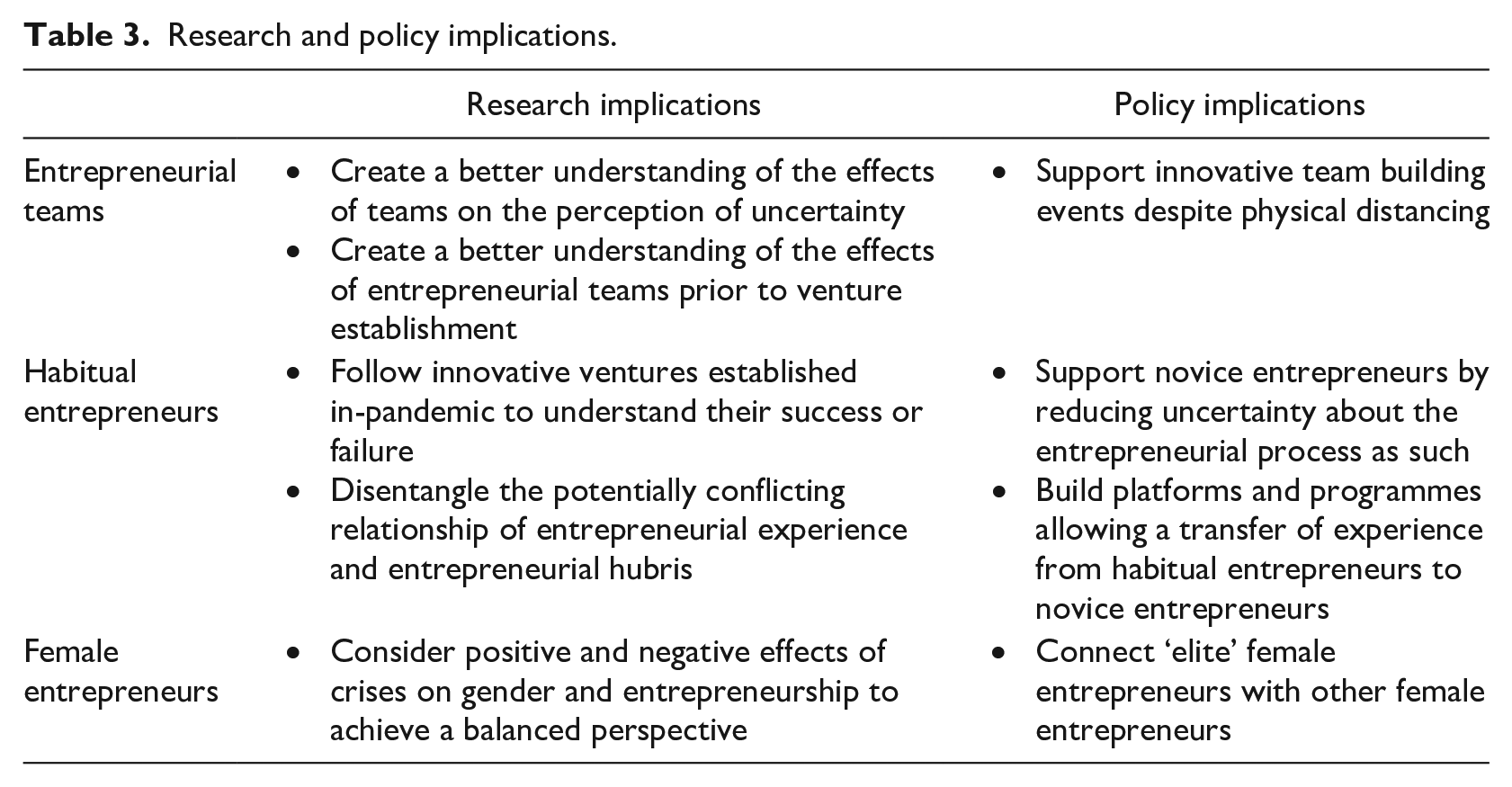
Table 3 summarises the arguments of this discussion and transforms them to concrete suggestions for future research on crisis-induced uncertainty and (innovative) entrepreneurship. Moreover, it also highlights implications for policy makers aiming to support innovative startups in crisis. Such policy initiatives will primarily focus on a better knowledge transfer among key actors in the entrepreneurial ecosystem in order to create a level playing field.
Research and policy implications.
Conclusion
The first wave of the COVID-19 pandemic clearly caused rising levels of uncertainty for societies and economies worldwide. Naturally, entrepreneurial activity is affected as well. These effects are, however, not only negative. The present commentary was able to illustrate that some entrepreneurs indeed perceive opportunity and act upon it. As a first step, the analysis characterised these innovative ventures as more likely to be established by habitual entrepreneurs and less often by teams, whereas potential gender effects found no support. However, the data are silent about whether in-pandemic startups were established despite the pandemic or because of the pandemic, that is, whether they were resilient or opportunity-driven. Thus, there is an ample field for further research more closely following in-pandemic startups in the months and years to come – in particular, it will be interesting to see how well in-pandemic startups will perform in the ‘new normal’ that is going to emerge over the near future.
Footnotes
Acknowledgements
Elisabeth Berger, Bernd Ebersberger, Patrick Röhm and Julius Tennert helped to shape my thinking during the conceptualisation of this research. Leif Brändle, Sebastian Hinderer and Kathrin Steinbrink challenged an earlier draft of this manuscript.
Author’s Note
This commentary results from the University of Hohenheim’s ‘Innovation, Entrepreneurship and Finance (INEF)’ research area. All errors are the sole responsibility of the author.
Funding
The author(s) received no financial support for the research, authorship, and/or publication of this article.
