



Abstract
Economic crises, natural disasters, armed conflict and infectious disease outbreaks, amongst others, present interlinked challenges for small businesses and have generated a recent wealth of research across varied fields. Therefore, this article outlines an analytical lens suggesting how SMEs experience shocks and crises that focuses on the interlinked nature of (i) the business, (ii) the shock and (iii) the response within a given context. We thematically draw out key trends, knowledge gaps and tensions and highlight promising research and engagement avenues for future scholarship and practice. We contextualise (i) how small businesses are distinct from large firms in how they experience shock and crisis events; (ii) how different types of crises impact small business; (iii) how shocks and crises shape SME-specific responses and (iv) how the COVID-19 pandemic as a ‘novel exogenous shock’ influences all of the above. We conclude by emphasising emerging knowledge avenues for future small business, shock and crisis research.
Introduction
Shocks to economic, political and social systems are becoming more pronounced, and the crises they generate are more severe and long-lasting. Financial crises, natural disasters, conflicts and global health emergencies have become commonplace, upending established discourses around precarity, vulnerability and resilience, such that they are increasingly central features of our interconnected global system (Katsos and Miklian, 2021). As events such as the 2008–2009 Global Financial Crisis and the COVID-19 pandemic revealed, small and medium-sized enterprises (SMEs) are particularly vulnerable to crises and shocks. Demand and supply-side interruption, business contraction and economic losses, restricted access to finance and restrictions on physical movement are just some of the consequences firms face from exogenous shocks.
Broadly, research on business and exogenous shocks has focused on large firms, particularly multinational corporations (MNCs) (Li and Tallman, 2011). But the diverse collection of small and medium-sized enterprises are often more vulnerable than large firms under different shock conditions (Adian et al., 2020; Chowdhury, 2011; Wasileski et al., 2011). Moreover, there is considerable diversity in how SMEs experience and are impacted by different types of shocks (e.g. by size, turnover and socio-economic parameters), how they respond to shocks and their inherent vulnerability or resilience abilities. Such issues pepper the growing scholarship on how small businesses experience and adapt to exogenous shocks (Eggers, 2020; Morgan et al., 2020; Supardi and Hadi, 2020). Covering areas including how shocks influence business cycles, innovation, strategic decision-making, market exit and entry, and firm survival and resilience, the importance of research on small business, shocks and the crises they generate has perhaps never been so relevant.
This conceptual article reviews this rapidly growing body of work. We synthesise connected literatures that present points of complementarity and tension regarding the nature of SMEs during circumstances of shock. We take a firm-level perspective, surveying core issues of how shocks and crises impact small businesses and the spectrum of business responses, limiting our parameters to firm-level analyses during times of shock. Related studies of business and exogenous shocks from a government or societal perspective such as those on government responses, fiscal and/or industrial policies and business governance in areas of limited statehood (Alstadsæter et al., 2020; Gertler et al., 2012; van Hooren et al., 2014; Risse, 2011; Tanzi, 1986) are beyond our article’s scope. Slower-burning challenges like climate change are also excluded – although climate-induced exogenous shocks such as hurricanes and floods are addressed.
Rather, this conceptual literature review systematically reviews the scholarly landscape on SMEs, shocks, resilience and vulnerability, including an extensive review of nascent COVID-19 research. We expand on baseline compilations (Eggers, 2020; Supardi and Hadi, 2020) by taking a cross-disciplinary and inductive analysis, identifying key literature trends, knowledge gaps and tensions and highlighting promising avenues for future scholarship. We aim to present a comprehensive review and synthesised conceptual framework that enables scholars to better identify how, where and why points of convergence or divergence emerge regarding SMEs and shocks. Doing so may allow for commonalities in analyses and specify where points of difference in analysis emerge based on a like-for-like framing of the problem rather than being derived from methodological or disciplinary heuristics.
This article proceeds as follows. After a brief methods section, we first review the literature on SMEs and exogenous shocks, focusing on three key themes (i) the nature of the business (capitals, capacities and size); (ii) the nature of the crisis (type, magnitude and spatial and temporal dimensions) that the shock generates and (iii) the nature of response, (of the firm, of institutions) and how these relate to the nature of smaller firm vulnerability and/or resilience to shocks.
Second, we synthesise these insights to present a conceptual framework to understand how we can integrate and link cross-disciplinary insights on the study of SMEs and shocks. Here, we consider relationships between small businesses and shocks as expressed through the domains in our literature review, where the nature of the business, the shock and the response mediate the nature of vulnerability and resilience in a given institutional or spatial context.
Third, we review how these concepts present in the current COVID-19 context, with particular emphasis on the vulnerability and resilience pins that many scholars are employing to attempt to decipher how the global pandemic confirms or challenges existing studies on small business and exogenous shocks. We close the article by highlighting key thematic and conceptual paths forward; we consider as particularly promising for future research agendas on small business crisis scholarship.
SMEs and exogenous shocks: Design and methodology
We define an exogenous shock as an unpredictable and/or unexpected event not initiated by a given market, community or country that carries a significant negative impact upon that market, community or country. Here, we slightly expand the traditional definition of an exogenous shock as ‘a sudden event beyond the control of the authorities that has a significant negative impact on the economy’ (IMF, 2003: 4) to encapsulate the societal impact of such shocks and recognise that what is ‘beyond the control of authorities’ often varies significantly even in the same community based upon the ability of those affected to engage with and benefit from said authorities. This definition allows us to contextualise shocks that could be considered endogenous by traditional definitions, if self-inflicted damage is created or exacerbated based on poor preparation or policies, for example, with respect to the scale of the global financial crisis or COVID-19 pandemic. In this article, we use the terms ‘shocks’ to refer to exogenous shocks unless otherwise stated, with reference to our above definition. We use the term ‘crisis’ to generally refer to the stress that the shock places upon a given business ecosystem, broadly considering the shock to be the acute event and the crisis to incorporate the more chronic-leaning consequences that smaller firms attempt to overcome. However, we also address other scenarios and circumstances in an attempt to be comprehensive; for example, where crises create shocks, the shocks are chronic rather than acute in nature, or shock/crisis cycles are cyclical.
In undertaking this review, we first conducted Google Scholar searches using combinations of the keywords "SME," "small business," "crisis," “exogenous shock,” "shock," "COVID/COVID-19," "coronavirus" "resilience," "strategy," "family business," "business," "survival" and similar terms to obtain a base set of 245 articles for review, drawing from a wide range of disciplines and methodologies. We chose Google Scholar as our primary data source as it typically captures a broader article set than its peers, not just peer-reviewed journals, but also high-impact analytical reports, datasets and white papers such as policy reports from organisations like the ILO, World Bank and IMF. This is important for COVID-19 studies, many of which were published in a fast-track format due to the pandemic’s primacy in the shock literature. We also preferred Google Scholar’s metrics that weight impact for more recently published (<2 years old) articles given the field’s dynamic nature. Next, we cross-referenced our base article set with complementary searches on Web of Knowledge and Scopus to inform our secondary selection model criteria. These searches, on the same parameters as for Google Scholar, expanded the dataset by 17 articles, bringing to a total of 262 articles and papers. We then conducted a second COVID-19 specific search along the same parameters 6 months later owing to the rapid proliferation of articles on the topic, adding 33 articles to the total database for a total of 295.
These mechanisms intended to capture a categorisation of what the most significant research in this field is arguing, as opposed to a quantity-based assessment on particular topics. While this process involved more steps and more case-by-case assessments on inclusion/exclusion than a typical keyword-based literature review entails (as we explore below), we believe that this methodological process delivers an article that meets our conceptual aims. While our method did not involve formal keyword coding, we employed keyword data at several stages of the process as a robustness test and quality/scraping check. For example, the search “SME” and “exogenous shock” generated 993 hits, of which 230 were peer-reviewed articles of a base level of quality and 47 were relevant to this review. Broadening to ‘small business’ and ‘exogenous shock’ brought 2410 hits, but articles carried significantly decreasing relevance after the 100th hit and significant overlap to the previous search. Likewise broadening further to simply ‘small business’ and ‘shock’, which brought 55,600 hits and many relevant articles not captured by the previous two searches, but a lower overall rate of relevance.
Our data extraction process was thematic and relevance-weighted, differing from keyword extraction literature review models. We assessed each article individually to first explore which themes the articles primarily address in the aggregate, then built an excel database to code the articles. Through a second collaborative reading, we then consolidated and generated the themes that are found below. Many articles addressed multiple themes and were thus included in multiple sub-collections. This was an inductive process, as after each author had read the selected documents, we had a series of discussions about potential patterns/groupings considering alternative theme/grouping strategies. Our theme selection is our interpretative position based upon our analysis, but other categorisations are possible, as these articles (and for that matter nearly any set of articles in any literature review) are by their nature more overlapping and cross-cutting than any one categorisation effort can portray.
Throughout this process, we selection weighted for citation counts (more citations relative to age were prioritised, articles over 5 years old without any citations were typically excluded), journal quality (Scimago top two quartile journals in the fields of business, management, economics and accounting were prioritised and articles from predatory journals were treated with caution but not excluded if they were cited and their findings/analysis were sound), and articles were added based upon suggestions from several experts in the field. 1 For example, case-based articles published in Global South journals are typically under-weighted by traditional ranking schematics, but are essential to incorporate to obtain a global overview of studies of business, shocks and crisis – not least as many Global South countries host acute, long-lasting and unique shock events and as such are conceptualised differently than ‘outsiders’ may interpret. As such, first there was an empirical assessment and then an additional qualitative assessment to offer a secondary weighting for borderline cases.
Next, we focused on the reference lists of particularly salient high-impact articles, helping to build out our broader framework based upon those sources. Where relevant on theoretical discussions we prioritised publications since 2015, given the rapid advances in the field. Important case-specific studies (e.g. the 1998 Asian financial crisis and 2008–2009 global financial crisis) were not down-weighted due to age. We stress that our placement does not necessarily indicate that article’s primary argument, but rather a reflection of a particular argument or discussion within that source. Therefore, many sources are cited in multiple places. We also stress that many of the below articles are case studies, and their degree of generalisability varies significantly. Thus, their presentation here should best be taken as points of evidence that may help build generalisability, rather than evidence of universality.
Last, we analysed each sub-collection of articles to extract the most relevant articles for the given theme. Criteria included the degree to which the article addressed the theme (was it primary or peripheral to the article?), importance of the article to the theme’s leading arguments (highly cited or comparatively less cited?) and uniqueness (does the article repeat other findings/arguments found elsewhere, or does it stand alone?). Of course, determining ‘relevance’ can carry hidden subjective elements from whoever is compiling and assessing the selection process, so on borderline cases we used citation counts weighted for age of publication to determine which articles are most worthy of inclusion and/or deeper discussion as an independent quality criteria marker.
The nature of the business: The perils of being small
While we know that social, political and economic shocks will occur, and that they will disrupt traditional business strategies (Perrow, 1984), precisely when, where and how these will transpire, and the magnitude of their impacts, is not easily predictable (Ansell and Boin, 2019; Morgan et al., 2020). Crises and shocks differ in their predictability and our ability to influence their outcomes. Such events – including war and terrorist attacks, economic crises, paradigmatic technological changes, natural disasters and infectious outbreaks – range from being conventional (predictable, easy to influence), unexpected (unpredictable, easy to influence), intractable (predictable, hard to influence) and fundamental (unpredictable, hard to influence) (Gundel, 2005).
Regardless of the type of disaster, major exogenous shocks tend to cause considerable economic disruption (Hudecheck et al., 2020), either to individual firms or the broader macroeconomic environment. They can create uncertainty and ambiguity, require time-sensitive decision-making and disrupt supply chains, liquidity, labour markets, consumer demand, regulatory frameworks and government policies that have fundamental impacts on businesses. During such shocks, prevailing macroeconomic processes can be tested (Li and Tallman, 2011) and often typify ‘reorientation’ events, of ‘simultaneous and discontinuous shifts in strategy (such as) the distribution of power, the firm’s core structure, and the nature and pervasiveness of control systems’ (Tushman and Romanelli, 1985: 179).
Firm characteristics intuitively play a role in how shocks, and the resultant crises are experienced. For instance, a shock may affect businesses operating in a particular sector, or location, more than others shielding certain businesses while harming others. Further, more experienced or established businesses may be able to weather crises better than new firms. Such characteristics can correlate across firm size, and SMEs are likely to be affected by, and respond to these shocks, in distinct ways. While exogenous shocks affect all firms in some way, they may be far more damaging to small businesses than to larger firms, such that business size is one of the central distinguishing factors in how firms differ in their experience of and vulnerability and resilience to crises.
This section examines three themes related to the nature of the business, and how small and large businesses may be distinct: the dynamics of a firm’s size; the capacity, agency and nature of crisis response and management; and the rationality of decision-making when facing exogenous shocks.
First, firm size correlates with the ability to survive shocks. Larger firms tend to possess and have greater access to capital and operate across multiple sectors or markets. This may temper the most acute shock impacts, allowing them to weather periods of downturn that smaller businesses cannot (Kitching et al., 2009). Small businesses, conversely, generally possess fewer resources and are less able to influence their external environment (Lai et al., 2016). Consequently, they are more vulnerable to shocks (Marshall et al., 2015); have a more difficult task in recovering compared to larger peers (Chang, 2010) and are more likely to close when crises occur (Sydnor et al., 2017). SMEs also face tighter lending restrictions and access to capital, lack sufficient financial and managerial capacities, are more dependent on a narrower customer base and are less prepared to navigate disruptive shocks than large firms (Bartik et al., 2020; Piette and Zachary, 2015; Prasad et al., 2015; Williams and Schaefer, 2013).
When crises occur, prevailing business models often become ineffective and this is particularly damaging for small businesses (Morgan et al., 2020); so, although they may survive during periods of shock, evidence suggests small businesses are more vulnerable with poorer performance profiles. For instance, following the global financial crisis, small businesses were more significantly affected (Chow and Dunkelberg, 2011) with the greatest falls in labour productivity. In studying business recovery from earthquakes, Dahlhamer and D’Souza (1997) found that controlling for a number of factors (including prior disaster experience and property ownership) business size generally determined success. But smaller is not always weaker. For example, during agricultural shocks, smaller-scale enterprises may be less precarious vis-à-vis economic security than larger export-oriented agribusinesses owing to their reduced reliance on national or global supply chains and ability to tap into local markets (Falkowski, 2015). However, larger crises like COVID-19 may erase such benefits due to greater societal vulnerability (Bene, 2020). Such cross-sectoral variations notwithstanding, when businesses face exogenous shocks, size broadly correlates inversely with vulnerability.
Second, small businesses differ intrinsically in their ability to weather the immediate impacts of a shock, and in the options available to them. Cycles of crisis are a natural part of business and society (Perrow, 1984). Yet, shocks may be both regular and irregular and anticipated and unanticipated, and ‘modern societies are increasingly faced with “unknown unknowns”, Black Swans, and mega-crises’ (Ansell and Boin, 2019: 1079). Typically, analysis of small business responses to shock and resilience to crisis has been housed under crisis management research; this tends to analyse responses to crisis, and actions intended to prevent or ameliorate negative impacts. Broadly, there is no one ‘right way’ for a firm to perform crisis management action (Ratten, 2020: 5). Rather, appropriate responses are context-specific based upon differences such as sectors, firm sizes, firm capacities, local settings, for example, urban versus rural, country variation and governmental/bureaucratic structures (Buchanan and Denyer, 2013; Doern, 2016), in addition to the type of shock, and socio-political environment.
That said, small firms may also be more agile in how they react to crises. Much of the relevant literature discusses ‘entrepreneurship’ rather than ‘SMEs’ per se but highlights the range of strategies that smaller business entities deploy in how to prepare for shocks, survive them and grow successfully. Perhaps out of necessity, small businesses can often see new opportunities and exploit these during crisis (Davidsson, 2015; Shepherd and Williams, 2019). Studying responses to black swan events, SMEs tended to act quickly, ‘deferring investments, reducing labour costs, reducing expenses, and negotiating contracts and terms’ and ‘avoided capital commitments to innovation or activities that would increase their debt-to-equity ratio’ (Thorgren and Williams, 2020: online). This aligns with findings regarding economically struggling small manufacturing firms. Here, Pearce and Robbins (1994) showed that entrepreneurial strategies such as innovating through new product-market combinations using existing resources were far less successful than strategies which focused on scaling down market-product-technology combinations and delivering these with greater efficiency.
Shocks also change the nature and effectiveness of entrepreneurial strategies. In response to the financial crisis, necessity driven entrepreneurship in Spain was found to be less effective than entrepreneurship that involved innovating or recognising new opportunities (Devece et al., 2016). Discussing responses to financial downturns in the UK and New Zealand, Smallbone et al. (2012: 754) argue that ‘although many small firms are vulnerable to changes in circumstances over which they have no control, they show underlying resilience and a high level of adaptability and flexibility’. Such flexibility mechanisms include managing access to funding, understanding shifts in markets and navigating abrupt changes in regulations or supplies (Detarsio et al., 2013). Employing a combination of entrepreneurial-oriented and market-oriented activities helps small firms survive through crisis, even though they are resource intensive processes (Beliaeva et al., 2020; Eggers and Krause, 2011; Morris and Jones, 2020). Beyond strategic realignment, establishing a new small firm can be a response to shock. For instance, in Baja many small firms were founded in the period 2008–2011 precisely to compensate for the loss of formal employment after the financial crisis (Mungaray et al., 2015). Moreover, younger small firms can grow more quickly during periods of crisis (Cowling et al., 2018; Simón-Moya et al., 2016), as start-ups may more easily exploit new opportunities that crisis economies present. Moreover, in regions with political and economic instability such as Latin America, where adaptability to shifting market conditions is advantageous when operating a business, smaller firms may have advantages in managing shocks (Detarsio et al., 2013; Triana, 2016).
These actions differ from how large firms respond during shocks. Under major exogenous shocks, large firms typically have powerful tools to withstand shocks without major realignments to product and service offerings or long-term strategic goals. Many are considered ‘too big to fail’ (Morgan et al., 2020: 370), allowing them to more easily secure government support. Consequently, small businesses may be considered ‘too small to matter’, meaning that the doors of government support – barely open a crack in ‘normal’ times – are entirely closed during crisis (Hamaan et al., 2017). Harries et al. (2018) call this a ‘denial strategy’, as many small firms feel too powerless to expend valuable energy on exogenous issues, no matter how likely or devastating, so ignoring them is the only feasible option. However, a minority respond to such crises by ‘constructing new accounts of themselves and their organisations’ to become more resilient (Matilis and Christianson, 2014: 75).
Past behaviour can help understand the impact of crises on small businesses and their current and future strategic responses. We define ‘strategic responses’ as including not only retrenchment, persevering, innovating and exit (Wenzel et al., 2020) but also other less common activities on the margins of the risk spectrum, such as expansion or calculated inaction, believing that business decision-makers base their choices on some sort of heuristic process of their business environment and have the agency to act. That said, shocks tend to amplify previous business strategy tendencies, not change them. Good strategic and financial management designs before shocks are predictors of comparative success to survive crisis (Marshall and Schrank, 2020). Conversely, large amounts of debt at the point of shock, whether due to poor management or due to a high debt phase of the business lifecycle, and even during crisis, such as taking on debt to survive, restrict post-shock performance and increase potential for failure (Lawless et al., 2015). Paaso et al. (2020) explore how the COVID-19 outbreak, despite its enormity and duration, did not increase the willingness of smaller firms to take on more debt to survive as debt-adverse firms remained unwilling to seek new debt because of the shock.
Different types of small firms also elicit different responses and strategies. For example, family firms typically have a greater incentive to survive at any cost with better liquidity in crisis owing to a tendency to take a longer-term perspective to avoid the personal consequences of bankruptcy (Cater and Schwab, 2008; Faghfouri et al., 2014; Kraus et al., 2020). In addition, more direct managerial structures help family firms soften the blow of shocks compared to their peers, for example, in making faster, more decisive decisions to secure access to financial markets, as Italian family firms did during the 2008 financial crisis (D’Aurizo et al., 2015; Cucculelli and Bettinelli, 2016). These abilities may explain why family firms performed better through financial and economic shocks than their peers, both in Italy (Minichilli et al., 2016) and Spain (Arrondo-Garcia et al., 2016).
Connecting these themes, the nature of the business, and in particular, firm size has a central role in how firms are affected by and respond to shocks. Small firms are generally more vulnerable than larger firms during exogenous shocks, but their vulnerabilities have differing forms. Key challenges lie in accessing financial or human capital, or government support. Yet, while small firms in the aggregate are more susceptible to shocks, they can also adapt their strategic orientation more quickly to changing conditions. Past experience in managing shocks, for instance, may be telling, as a deeper familiarity with management under shock conditions can benefit crisis management and bolster preparedness for future crises, as may relationships and networks of support with other businesses and within their communities of operation.
The nature of the crisis: SMEs and the diversity of exogenous shocks
While all exogenous shocks carry a degree of economic impact, their scale and magnitude can differ significantly, for example, in the extent of destruction or interruption to a business and its assets, and the time needed to ‘return to normal’. Yet, we need to explore if exogenous shocks have unifying characteristics regarding small business disruptions and support a common analysis framework, or do different shock impacts – temporal, physical, economic, political – require a range of more nuanced reactions. Four main types of shocks are commonly discussed in the literature – financial/economic, natural disasters, armed conflict and political violence and societal insecurity. 2
First and afforded the greatest attention are large-scale financial crises, particularly the 1998 Asian Financial Crisis and the 2008–2009 Global Financial Crisis. All businesses, but particularly SMEs, faced cumulative stresses of reduced access to finance, increased input costs and a decline in demand (Hodorogel, 2009). SMEs’s access to bank financing, trade credit and alternative financing mechanisms are particularly well studied (Carbo-Valverde et al., 2016; Casey and O’Toole, 2014; Paulet et al., 2014; Wehinger, 2014). One central effect of the global financial crisis on SMEs was a reduced ability to obtain credit; banks were less solvent and in a diminished position to lend; thus, they reduced their lending to small firms as it was deemed ‘risker’, compounding the crisis for vulnerable firms (Buckley, 2011).
Research on the Asian Financial Crisis offers valuable insights on strategic responses. While small businesses almost universally faced severe financial impacts, clustering and network building between themselves – even between previous competitors – correlated with survival. Moreover, where shocks were greater in magnitude, there was a stronger desire to form business alliances (Marino et al., 2008). In Korea, SMEs used the crisis as an opportunity to transit from services to the knowledge production sector and build alliances with foreign counterparts and large national firms uninterested in such ties before the crisis (Gregory et al., 2002). Surveying 1800 firms, the authors show that these strategic shifts and network building was beneficial giving SMEs a series of opportunities to pivot and increase chances of survival. Relationships between alliance building and survival have also been researched in Singapore (Pangarkar, 2007) and Indonesia (Marino et al., 2008).
The ability to implement a strategic vision by seeing the firm within the parameters of the crisis ecosystem correlates with survival. Smaller firms, particularly those in countries with weak institutions, were the most aggressive in attempts to rapidly reduce debt during shock (Demigruc-Kunt et al., 2020). This could be due to weak bankruptcy protections, challenges in securing credit or other structural factors that reward business continuation and thus rapid debt reduction, as opposed to more entrepreneurial ‘destruction and rebirth’ approaches. However, small firms in the formal sector may have a considerable advantage over those who operate informally as they are able to ‘publicise’ their business model or are perceived to have a greater potential to regain profitability to better access credit (Piñeiro Becera, 2010). While financial shocks led to widespread, long-lasting negative effects for the small business sector as a whole, younger and smaller firms able to survive exogenous shocks tended to grow faster than larger, older firms though this growth was unevenly spread (Cowling et al., 2018). Benito Hernández and Platero Jaime (2012) found that more educated owners implemented strategies of product innovation and geographic concentration that aligned with greater chances of survival, as did consolidation of information systems and concrete strategic planning (Sansores Guerrero and McCartney, 2017).
A second category of exogenous shock is natural disasters that entail physical destruction to businesses and/or have significant economic ramifications. Earthquakes, hurricanes, wildfires, flooding and similar natural disasters broadly constitute the small business disaster literature, including that on post-disaster responses. This literature distinguishes two main mechanisms by which shocks affect smaller firms. First are business-specific issues including damage to property, equipment or supply chains. Second are macro-impacts related to economic downturn, demand constriction and impacts upon employees. Sydnor et al. (2017: 1639) divide these studies as either focusing on ‘endogenous (internal) factors within a small business entity and their impact on survival (Ang, 1991); or exogenous shocks such as an economic crisis and its impact on business entities, (Ritchie et al., 2013) or industries (Upton, 2011)’.
Small businesses can be harder hit by both endogenous and exogenous impacts as they are more likely to be located in a single location suffering physical damage, be more dependent on local consumers and unable to draw upon production or revenue generation from other locations. In studying flooding in Sri Lanka, Samantha (2018) notes that SMEs were subject to capital shortages, labour scarcity, interruptions to logistics and public infrastructure damage, and acute shifts in market demand. Resilience mechanisms included partnerships and cooperation among firms, government and private organisations, with the longer a business is closed after disaster, the less likely it is to reopen (Sydnor et al., 2017). Other characteristics correlate with vulnerability to disaster. In the USA’s post-Hurricane Katrina context, smaller firm demise was associated with female and minority ownership and locations in more precarious coastal geographies, whereas survival was linked with larger or service-based businesses, more experienced ownership, prior disaster experience and familiarity working with an economically challenged business (Marshall et al., 2015).
SME vulnerability is often tied to pre-disaster resilience or resilience that is built up during post-disaster recovery (Alesch and Holly 2002; Marshall et al., 2015; Sydnor et al., 2017). Broadly, vulnerability to disasters tends to skew disproportionally to smaller businesses, with impacts unevenly distributed across geography, firm size and economic sector (Pan, 2011; Sydnor et al., 2017). Many of these insights emerged from studies following Hurricane Katrina in 2005. For instance, smaller firms often lacked disaster planning and preparedness procedures and were badly affected by cash flow interruptions, a lack of recovery capital and infrastructure damage (Runyan, 2006). They also saw higher exit rates and longer recovery periods than larger firms, with business profitability and access to credit decisive in how likely they were to survive (Basker and Miranda, 2014). Similar findings appear for other disaster types. Examining the 1989 California Bay Area earthquakes and 1994 Northridge earthquakes respectively, Kroll et al. (1991) and Tierney and Dahlhamer (1997) show how SMEs were broadly unprepared for disaster shocks, especially with respect to physical destruction. Again, relationships with their communities promoted post-disaster resiliency. Following Hurricane Katrina, Torres et al. (2019: 168) found that ‘social capital is a key asset for long-term resilience for small businesses’, as ‘business owners with links to the community and institutions—with more social capital—will be better off when facing a natural disaster’.
Third, episodes of armed conflict and political violence can undermine the physical security of SMEs, worsen local political and economic stability, degrade human capital and supply chain and logistics, restrict access to finance and lead to other operational challenges (Naude et al., 2013). For example, the increased intensity of post electoral violence in Kenya saw a reduction of small business exports in the Kenyan flower industry (Kroll et al., 2013); civil violence coincided with negative impacts on turnover and employment in Sri Lanka (Vijayakumar, 2012) and conflict saw reduced enterprise investment in Uganda (Deininger, 2003) and the Philippines (Canares, 2011). Very old and very young businesses may suffer most; and short, intense conflicts may be easier to weather than longstanding, protracted wars (Naude et al., 2013). Yet, conflict may also be an opportunity for some firms if networked with the right actors or where conflict affects certain geographies differentially – such as where an influx of displaced people increases demand for certain products or services. SMEs ingrained in war economies can benefit from conflict itself (Rettberg et al., 2011), and similar to economic crises, wars or civil conflict may offer opportunities to shift the type of entrepreneurial activity small businesses pursue.
Fourth, societal insecurity – particularly urban insecurity from armed criminal groups, state militaries or para-military groups – represents a meaningful yet distinct shock. Distinguished from armed conflict, these situations are often chronic conditions rather than acute episodes (Fahlberg et al., 2020), woven into the social fabric with an ever-present threat of violence and disruption. However, the timing, magnitude, targeting and predictability of these shocks – that is, when, how and which businesses will be affected – is hard to know. Drawing from Gundel’s (2005) conceptualisation of shocks, the temporal volatility of chronic armed violence and insecurity affects smaller firms in unpredictable ways and such shocks ebb and flow. In Latin America, for instance, organised criminal groups represent an ever-present challenge, but the frequency and intensity of threats and demands – or the threat or use of violence against firms – changes over time. In such contexts, smaller firms are affected through extortion or violence and may be forced to integrate their business operations into illegal economies (Ganson and Hoelscher, 2020). Ramirez et al. (2015) identified small firm strategies in response to organised violence in Mexico related to direct or indirect impacts, including closure or relocation (avoidance); accepting coercion or violence as a cost of doing business (acquiescence) and investing in private security and pressuring government for improved protection (manipulation) – but they seldom actively resist organised criminal violence (defiance). Similarly, Moncada (2019) argued that depending on their political and economic resources, business can resist extortion and violence either publicly or privately; and the intent of this resistance can be to overthrow a dominant power or even negotiate the terms of domination.
In sum, different types of crises vary in their temporal, physical, financial and geographic characteristics and affect small businesses in different ways. Shocks also vary in their specificity – financial crises may influence businesses, markets and demand globally, whereas natural disasters or conflict-related shocks may be hyper-localised. Some impacts are shared, such as demand reduction, increased input costs and supply chain disruptions. Others are point-specific, such as the destruction of property or insecurity. Still, commonalities abound across these different shock types, including access to finance or material support, the need to engage in alliance building or adopt strategic shifts in business direction and strategy.
The nature of response: Shocks as transition and innovation mechanisms
We now explore how smaller firms make decisions during crisis, and to what extent they are rational or more instinct-driven. Much of the literature considers SME responses as more instinctual, which may favour innovation and nimbleness over measured deliberation. Alternately, small firms often focus on downscaling or retreating to core competencies. Liu et al. (2017) suggest that small firms appear to react rationally, and risk management and rational actor models may better explain their responses, especially larger ones, during crisis (Yiannaki, 2012). Lerner et al. (2018) propose that this rationality is a function of entrepreneurship and desire to change tack or be economically bold during and after shocks. McMullen and Shepherd (2006) concur, arguing that one can assume that profit will drive action and strategic response, both for all sizes of firms.
However, assigning SMEs to be rational actors during major exogenous shocks is ‘a contention that has often been questioned…in respect of the extent to which entrepreneurs fail to adjust their beliefs in the light of new information (Parker, 2006), excessive optimism regarding expected outcomes of investments (De Meza and Southey, 1996), and the compounding result that excessive optimists fail to insure themselves against potentially bad outcomes (Coelho and De Meza, 2012)’ (in Cowling et al., 2020: 4). Smaller firms may thus be over-reliant on certain characteristics, such as instinct and self-belief, that have served them well in periods of stability, but which may harm longer-term success during periods of shock. While increasing liquidity to temper shocks may work for larger firms (McGeever et al., 2020), smaller firms have different strategic or psychological elements, for instance, as the effects of bankruptcy or business failure are experienced more personally by small firm entrepreneurs.
Therefore, many have explored a systems approach to these questions, seeing smaller firms not simply as victims of shocks, but as part of a community of resilient actors that employ tools and networks to weather shocks and innovate through them. This literature sees crisis as a transitional mechanism of destruction and rebirth that is natural to all business cycles, aiming to reduce the negative impacts of this transition and decipher how positive impacts can be bolstered, both for businesses and the societies within which they work. This strand, traditionally focusing on larger firms, has expanded in the past decade to also study entrepreneurship and innovation strategies. We present this material through three sub-themes: resilience as a form of crisis management, social entrepreneurship strategies and clustering/pivoting strategies to emerge stronger after shocks.
First, what constitutes effective resilient responses for small business is debated and highly context-specific with several studies of security, economic and supply chain-oriented components (Bullough et al., 2014; Harries et al., 2018; Herbane, 2015; Linnenluecke, 2017; Sullivan-Taylor and Branicki, 2011). Most consider resilience against external risks and threats, often but not always of a socio-political nature. Smaller firms are more likely to enact crisis management techniques to rebuild and problem solve by creating something new and useful from whatever limited resources are at hand, that is, bricolage. However, this is not usually a strategic approach or signal of conscious entrepreneurialism, but a natural outgrowth of necessity and/or desperation as firms navigate exogenous shocks (Tsilika et al., 2020). Still, bricolage serves as a version of what large firms employ more strategically. For example, smaller firms can display ‘firm-level behavioural characteristics of…promoting innovative behaviour within the firm, undertaking somewhat risky ventures and being the first to come up with proactive innovations’ (Wang and Altinay, 2012: 4).
Second, social entrepreneurship strategies offer productive pathways to weather shocks by (re)connecting with communities. Research on such connections (Chamlee-Wright and Storr, 2010; Dutta, 2017) aligns with research on SMEs and Corporate Social Responsibility (CSR), and how local CSR strategies can build resilience (Demuijnck and Ngnodjom, 2013; Jamali et al., 2017; Perrini, 2006). Some explore these connections with a political focus, studying how business engagement with society influences the ability to survive crises. This can refer to direct engagement, as in those firms undertaking conflict prevention activities (De Vidovgrad, 2015; Felgenhauer, 2007; Rettberg, 2004), or in supporting conflict reduction activities by other actors, such as post-conflict private sector development and Disarmament, Demobilization and Reconciliation (DDR) projects (Giustozzi, 2006). However, the societal and business benefits of such action for peacebuilding remain unclear, uneven and perhaps even counter-productive, with contemporary research (Barkemeyer and Miklian, 2019; Ganson et al., 2019; Joseph et al., 2020; Katsos and Al Kafaji, 2019; Miklian and Medina Bickel, 2020) attempting to contribute to better understanding the conditions for, and challenges of, successful small business participation in the reduction of political violence.
Third, examinations of the ‘big decisions’ that firms make in bold efforts to survive often take one of three forms: clustering, pivoting and starting over. In a clustering strategy, a small business joins with other businesses and like-minded community organisations to collectively enact local change to ameliorate exogenous shock consequences. Especially for smaller firms in urban areas, economic recovery is a community activity, incorporating the individuals working for the firm, their family and neighbours (Chang and Miles, 2004; Chang, 2010; Marshall and Schrank, 2014). Firms that cluster with erstwhile competitors maintain beneficial associations well after the crisis period passes (Khare, 2012). Those who cluster, or quickly build clusters, with other small firms tend to be more resilient and likely to survive post-crisis than those that do not (Andreano et al., 2018; Conz et al., 2017).
Alternatively, a ‘pivoting’ strategy, defined as ‘a structured course correction designed to test a new fundamental hypothesis’ (Ries, 2011: 149), can explain which firms are more likely to grow after a crisis, and why. Pivoting is both necessity- and opportunity-driven (Devece et al., 2016). Morgan et al., (2020) suggests that not all pivoting is equally beneficial, and the firm type may have more explanatory value for success than the pivot itself. For example, firms working through shocks often focus on innovation, but new small firms should focus on arbitrage opportunities, as one can pivot and fail, when not pivoting could ensure survival. But barriers to pivoting are both conceptual and structural carrying an inverse relationship to the firm’s size. Morgan et al. (2020: 7) warn that ‘existing businesses may find it harder to exhibit adequate efficiency when pivoting away from their current products, markets, or both, as they lack the capabilities to simultaneously adjust the many elements of the business model’. Most proponents also recognise that pivoting is not always an effective strategy for the smallest firms, who have few opportunities to explore either arbitrage or innovation when reliant on immediate income.
Others take the unit of analysis to the individual/family. At this level, a ‘starting over’ strategy with an entirely new firm may be more beneficial than trying to rebuild a failing business as ‘firms created during major shocks tend to perform better over the long run (Cowling et al., 2015; Power and Reid, 2005; Smallbone et al., 2012)’ (Morgan et al., 2020: 371). Such new firms founded during shock events may also be more likely to not only survive but also economically outperform established ones (Terjesen et al., 2016), perhaps giving serial entrepreneurs, or those living in settings where a business can be closed and opened with relative ease, an advantage.
Cutting across these three sub-strands is the awareness that the bigger the shock, the less likely that smaller firms can return to a ‘normal’ pre-crisis socio-political equilibrium. Significant exogenous shocks permanently change societies, making it impossible to truly ‘recover’, especially when there are long-lasting consequences, or no foreseeable endpoint (Marshall and Schrank, 2014; Olshansky and Chang, 2009). Governments may exacerbate structural barriers to innovation and survival during crisis by prioritising larger SMEs and larger projects to reduce their caseloads and lack understanding of the needs and experiences of the whole SME sector (Deschryvere et al., 2020). Therefore, it is more constructive to see recovery as a process, not as a task. This aligns with research on business and fragile societies that finds the most beneficial business-society interactions are a continual process, not a ‘problem’ to solve (Oetzel and Miklian, 2017; Miklian and Rettberg, 2019). This does not necessarily mean that firms adapt with improved institutional knowledge to overcome shocks; unless the shock punctured something fundamental about the way that their business operates or its role in society, even the firms that happen to survive rarely work to adapt to mitigate the next shock (Harries et al., 2018).
Synthesis and discussion
While ‘relatively few studies examine how small firms survive during exogenous shocks or recover afterwards’ (Morgan et al., 2020: 370) – pointing to a need to connect small business and crisis management research (Herbane, 2010), we demonstrate that research on the impact of exogenous shocks upon SMEs is growing. Several themes reoccur, such as their relative vulnerability to shock events, the geographic and sector-wide impact of macroeconomic or financial crises, and the range of operational and strategic responses that can mediate their resilience and vulnerability. What is absent, however, is a framework that can synthesise and compare these insights. As this review displays, there are disparate claims and areas of focus in understanding the ways smaller firms are affected by, and respond to, shocks. These often focus on a particular type of business, type of shock or the strategic or reactive forms of response. However, as we move towards a global landscape of perpetual, complex, interconnected and compounding shock events (Hynes et al., 2020; Katsos and Miklian 2021), building a more holistic understanding of how vulnerability and resilience to shocks is made manifest for smaller firms can catalyse new scholarship and move us beyond disciplinary silos. Thus, we offer a simplified framework derived from the principal themes of our literature review to enable a more nuanced comparison of SME vulnerability and resilience across business types, crises and responses. The thematic domains that we identify concern how the impacts of exogenous shocks relate to the nature of the business, the nature of the shock and the nature of the response, which cumulatively influence the nature of smaller firm vulnerability and resilience within a given institutional context. We outline this below in Figure 1. A conceptual framework of SMEs and exogenous shocks.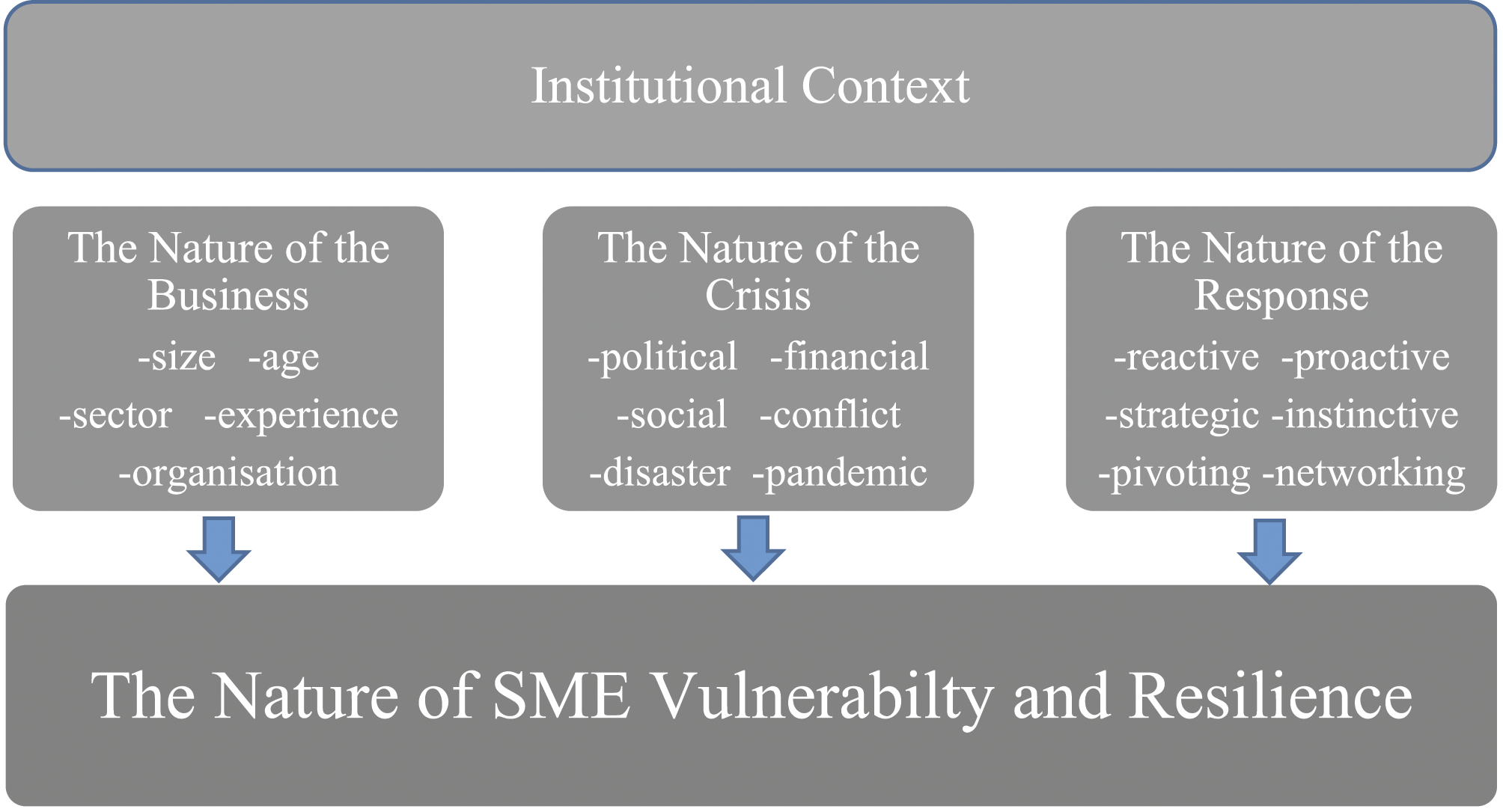
This analytical lens posits that smaller firm vulnerability and/or resilience to exogenous shocks will flow from three key domains set within a given institutional context. First is the nature of the business, including its size, age, management capacities and sector. Broadly, small firms have fewer resources at their disposal and face more intense temporal pressures than larger firms. Moreover, certain sectors may be more vulnerable to certain shocks and the age of the business or experience of management may act as bulwarks. Small businesses may also be organised such that they are more agile under crises; they may be able to manoeuvre towards emerging opportunities or more quickly counter the threats that shocks pose, but this may be tied to their business relationships, support networks and degree to which they foster support within their communities of operation.
Second, the nature of the crisis that is experienced carries different scales and magnitudes of impact. Economic crises in Asia (1998) and globally (2008–2009) saw small firms face severe credit shortages, declining production and loss of sales. This was frequently met with strategies such as alliance and network building, debt reduction and prioritising downscaling and business continuation. While some small firms rebound following economic shocks, most lack the resources to do so. For natural disasters, impacts are differentiated by endogenous losses to the business and supply chains and exogenous damages to the broader economy or negative demand shocks. As disasters create both short- and long-term challenges, vulnerability and resilience to disaster-related shocks includes factors that determine business survival or demise. Shocks related to armed conflict or terrorist activities have similarly debilitating effects, and their impacts vary based on conflict type, duration and intensity. Most businesses suffer, but some also opportunistically engage through instability or in war economies. Temporally, violent shocks ebb and flow, bringing a ‘certain uncertainty’ that influences strategic responses and often necessitates relationships with violent actors to ensure survival.
Third, the nature of the response to a shock and its consequent crisis plays a key role. Response capacity is linked with both the nature of the business and nature of the conflict, yet small business decision-making processes during crisis may be rational and/or instinctual and are predicated upon past behaviour. Responses may drive change and innovation, using mechanisms that correlate with survival through crisis and beyond. Small firms may employ riskier or more innovative actions driven by necessity to enable transitions through crises; engage more deeply with community networks of support or pursue clustering activities with other firms to pool resources and survive. Small businesses may also pivot from a shock-damaged activity in pursuit of a more promising activity or close for a period and re-emerge with a different business or in a different sector when conditions are favourable. Crises may encourage a new equilibrium as opposed to simply a return to a ‘pre-crisis normal’; as bouncing back to pick up as things used to be may not be a realistic outcome for most small businesses.
This analytical lens that prioritises these three domains endeavours to unpack and contrast the vulnerability and resilience of smaller firms to exogenous shocks. It seeks to address a conceptual gap in the literature by organising diverse studies that possess different entry points, methodologies and disciplinary tendencies. To more comprehensively employ this framework, we next discuss its main features in the context of emerging research on the COVID-19 pandemic.
Vulnerability and resilience: Small businesses in the time of COVID-19
The SME-COVID-19 relationship has elicited a wealth of new research, not least because the pandemic and its follow-on effects have triggered shock response in several of the above categories over the previous 18 months. Researchers have started to examine whether the COVID-19 pandemic affects smaller firms in a similar way to other crises, or whether it is unique (Bartik et al., 2020; Cowling et al., 2020; Fairlie, 2020; Kawagatchi et al., 2021; Kurmann et al., 2020).
Much of the emerging research aims to better understand the challenges that smaller firms face and which resilience mechanisms are effective. In a survey of 5800 U.S. SMEs, Bartik et al. (2020) found that COVID-19 exacerbated disparities between sectors. In a survey of 8000 American firms, Humphries et al. (2020) found that half of small firms expected that their business would be harmed for at least 2 years, and few saw any helpful internal mitigation or adaptation measures. Kurmann et al. (2020) found similar results in a Canadian study, with rapid losses but also rapid gains and re-openings as the pandemic slowly came under control in June, albeit plateauing at levels 30% below the February 2020 baseline. Fairlie (2020) found that firms run by vulnerable/marginalised groups, including immigrants, ethnic/racial minorities and women, were more susceptible to business closure and interruption during the pandemic, suggesting a cascading effect of vulnerability with respect to pre-existing ownership positionality. These findings support Ratten’s (2020) concerns of COVID-19 risk with respect to entrepreneurship.
The pandemic’s length also affects smaller firms more intensely as they generally lack sufficient resources to tolerate extended periods of upheaval with many closing once they deplete their operating finances (Cowling et al., 2020). Micro-firms are most vulnerable, representing the smallest percentage of businesses that had any ‘rainy day’ savings (Cowling et al., 2020). Economic subsidies are important for firm survival as the contagion effects of COVID-19 exacerbate other crises and stresses (Kawagatchi et al., 2021). The ILO (2020) laid out the stark consequences of this in Lebanon, where 50% of small firms shut since the pandemic began, and only 9% were operating as normal after 6 months, due to both business reasons and socio-political instability. Further, the OECD (2020) established that how small firms reacted to and were affected by COVID-19 seemed to be similar worldwide. This will undoubtedly be a focal point of new research, particularly given COVID-19’s global spread, and significant societal and financial impact, enabling the emergence of robust comparative analyses of SMEs and exogenous shocks.
Regarding how smaller firms can weather this special type of exogenous shock, preliminary evidence suggests clustering and leveraging local social connections may have more long-term value than external financing. Wenzel et al. (2020) outline contributions for a special issue of Strategic Management Journal that favour a variety of strategic responses to shocks, which they categorise as retrenchment, persevering, innovating and exit. Liguori and Pittz (2020: 108) suggest that while government support may provide a worthwhile stop-gap, ‘the optimal means of risk mitigation is the identification of new customers and new opportunities to pursue growth and infuse some positive momentum back into the business’. Hudecheck et al. (2020: online) take a wider lens, arguing that ‘managers must be prepared to accept that what we are now observing represents a new reality: Diseases and other forms of ecological disasters are very real global threats to operational continuity’. Other studies (Soumodip and Clegg, 2021) explore agility and resilience as a key to not only survival but also to sensemaking of and developing adaptive survival strategies through COVID-19. Montserin et al. (2021) find that in these situations, informal firms, in particular, may carry distinct advantages for adaptive resilience, particularly through previously established social networks required to survive without formality.
While emerging research on innovation and decisive managerial change grounded in risk-taking under crisis correlates positively with success compared to peers (Breier et al., 2021; Kawagatchi et al., 2021; Leppäaho and Ritala et al., 2021; Soluk et al., 2021), change for the sake of change under crisis is not necessarily always positive for the future and is heavily context dependent. Clampit et al. (2021) found in a study of 338 American SMEs that firms employing dynamic capability models recovered more quickly and strongly than their peers, with the greatest benefit, perhaps counter-intuitively, for the smallest firms. Studying 889 innovative start-ups just before and after COVID-19 arrived in the USA and EU, Kuckertz (2021) suggests that habitual entrepreneurs are better positioned to adapt to crisis as opportunity, as the ‘when’ and the ‘who’ of innovation may matter at least as much as the ‘what’, to survive shocks.
However, these approaches are likely less actionable or relevant for the most vulnerable businesses, particularly in the developing world. The smallest micro firms and sole proprietorships, particularly in the Global South, were faced with a situation requiring extraordinary resilience that combined business survival with their own. Even in places where other crises are common, COVID-19 was an unprecedented shock with no margin of error for survival (Viswanathan et al., 2021). Amankwah-Amoah and Wood (2021) show how the most politically connected firms employed patronage networks to succeed through shocks, often by siphoning off government aid intended to be delivered to smaller firms due to their vulnerability. Policy prescriptions offering evidence to shift to remote work platforms and similar may also exacerbate gaps between SMEs and micro-firms.
Further, emerging technologies that some Global North SMEs employ under crisis, such as cloud computing, ‘big data’, and predictive analytics are inaccessible for those in developing countries making them less competitive viz-a-viz foreign competitors with such access (Akpan et al., 2020). Amankwah-Amoah and Wood (2021) reiterate the ‘have/have-not’ gap in terms of business failure and its implications for state-market configurations; they consider COVID-19 to be a ‘novel shock’, a unique exogenous impact that cannot be understood through the lens of previous shock experiences. These structural critiques echo post-disaster economic policy challenges in liberal democracies, typified notably by Naomi Klein (2007) as ‘disaster capitalism’, but also ‘parasitic capitalism’ (Merrifield, 2014), and similar (Ganson and Wennmann, 2016; Solis, 2020). Notably, despite being considered part and parcel of the ‘disaster capitalism’ model that Klein espouses, SMEs and particularly micro-firms are unlikely to collectively emerge from any crisis stronger, and especially not one of COVID-19’s depth and breadth.
We now turn to approaches that appear most promising for SMEs working through the crisis. Ratten (2020) explores the power of ‘gut instinct’ in making meaningful large-scale strategic changes during crisis, supported by Weick and Sutcliffe (2007), positing that those that ‘go with their gut’ can react more adeptly to shocks and may be better positioned to thrive afterwards. What remains unclear is to what extent we can consider emotions and other psychological factors (Harries et al., 2018) as an explanatory device for firm strategy viz-a-viz rational actor models, given that ‘gut instinct’ can be simply a function of the decision-makers experiences, boldness and/or creativity. Beyond financial management and strategic decision-making, a firm’s social and community embeddedness may itself be a form of corporate resilience (Williams and Shepherd, 2021). Katsos and Miklian (2021) suggest that studying firms at the moment of shock may be insufficient, as small businesses who prepare for exogenous crises before they occur, or at least have an idea of what to do, fare better than those that scrambled reactively for a working plan even if they ultimately take the same steps as prepared firms.
Future research opportunities
Given the range of theoretical perspectives and array of empirical data surveyed above, a series of valuable future research paths present themselves. These may benefit from the use of an analytical lens to study impacts, risk and vulnerability to shocks presented in the framework here. For the opportunities outlined below, ours is just one reading of the landscape, and we propose that future scholarship that may be of particular merit can be expressed under three general themes.
First, new research on variations within the category of smaller businesses could help refine scholarship on a wide range of actors often consolidated under one catch-all. This includes more targeted examination of the differences between micro-firms and SMEs and the spectrum of damage/opportunity that appears to correlate with business size during and after exogenous shocks. It also includes a need for a greater focus on sectoral variation. For example, emerging evidence suggests that COVID-19 policy responses must be sector-specific if they are to succeed, particularly where sector variations are greatest (Antonescu, 2020; Gourinchas et al., 2020; Juergensen et al., 2020). It also includes exploring differences between formal and informal firms, especially with respect to sector, size and political access and on examining the impact of sectoral differences during and after shocks. In a way perhaps unique to the modern research era, COVID-19 presents an opportunity to comparatively study how firms experience and respond to the same exogenous shock on a global scale. We note several new studies on smaller firms and COVID-19 in Global South states, including Albania (Mucha, 2020), China (Chen et al., 2020; Hu et al., 2020), India (Sharma et al., 2020), Iran (Salamzadeh and Dana, 2020), Malaysia (Yi, 2020), Russia (Obraztsova and Chepurenko, 2020) and Saudi Arabia (Parveen, 2020), among others. Thus, multi-pronged approaches combining studies that examine issues such as fiscal support, public policy, innovation and resilience-building measures could generate a meta-study in 2022 or beyond that collectively analyses the findings of such work.
Second, research on the internal decision-making and the motivations behind such could help distinguish what types of strategies work best under which types of shocks, what types of crisis the shocks generate, and for which types of firms such strategies work best. Beyond research on how SMEs and micro-firms succeed or fail by taking a rational/emotional actor platform, future work could explore the consequences of firms working through more generalised long-term ‘chronic crisis’ settings, specifically those of urban violence and insecurity. In such settings, local community clustering techniques are often assumed to be highly beneficial, but there is a lack of empirical evidence to demonstrate this. In addition, exploring the role of an owner’s or manager’s agency in firm success or failure under exogenous shocks may help us better decipher which sorts of strategies are most beneficial to survival and allow us to better control for cross-firm variation.
Third, new research could explore variations in the macro environment through the commonality of the COVID-19 pandemic, incorporating different political and social environments. COVID-19 may herald a new research era for systems analysis approaches, as they tend to better conceptualise meanings behind and within complex events that constitute ‘how impacts of one event compound with those of additional events to create different challenges and potential opportunities for resilience and recovery’ (Helgeson et al., 2020:1). This could mean exploring differences in policy based on governance structure, for example, between democratic, hybrid democratic and authoritarian regimes, and countries with weak or strong governance. It can also mean more refined analysis of how different types of shocks, for example, financial, political, violence or natural disasters, produce different sorts of challenges. Last but certainly not least is the need for more fine-grained work on the impact of exogenous shocks on firms between developed and developing countries and also between developing countries themselves and other variations. This should include a particular emphasis on asking questions to tease out differences that may challenge ‘universal’ prescriptions for small business success after shock and through crisis.
Conclusion
This review has outlined some of the key domains in the literature pertaining to smaller firms and exogenous shocks and put forth a perspective on how to synthesise this growing body of interdisciplinary scholarship. The conceptual framework presented aims to provide an accessible entry point for a range of scholars from different disciplines to facilitate future examination, interrogation and development. We have also highlighted several areas of relevance for this emerging literature that may benefit from future research attention, with the potential to contribute to larger discussions surrounding business and society. Here, future studies may identify whether particular constellations of business, shock and response characteristics are particularly likely to support resilience or vulnerability; examine more explicitly the interaction of these with institutional factors or identify alternative framings or domains that we do not present here.
As both a conceptual review and an endeavour to develop a foundation for comparative synthesis of smaller firms and exogenous shocks, we acknowledge the limitations of this study. While we worked in a structured manner to access the most relevant literature for this review, we may have overlooked important works, and research on the effects of the COVID-19 pandemic will no doubt expand rapidly. Further, the majority of our references come from Global North settings and cases. There has been a significant effort in academic scholarship to better incorporate the work of scholars from the Global South, and we endeavoured to seek out such contributions. Despite these efforts, however, the present review still underrepresents important Global South-based studies. Finally, while we have focused on conceptual domains that inductively emerged during our literature review, we acknowledge that this is not the only possible framing and there are other ways to categorise this extensive body of knowledge. We welcome further scholarship to test new analytical and conceptual frames to facilitate multidisciplinary understanding of how small firms are affected by exogenous shocks.
This review reiterates that business size is a recurring characteristic related to the survival prospects during crises and understanding distinctions between SMEs and micro-firms under shock conditions should be centred on how we conceptualise vulnerability and resilience to shocks and the crises that follow. Moreover, as the nature of crises can influence the magnitude of impact for smaller firms, more nuanced understandings of how different types of crises such as economic, political, violence, disasters, pandemics, interact with the degree of formality of businesses, sectoral dynamics, and the political institutional context firms operate within, can offer a more fine-grained understanding of both the impact of shocks and the agency, resilience and vulnerability of smaller businesses. Thus, extending empirical and theoretical understandings of the micro-dynamics of smaller firm vulnerability and resilience under shock conditions, and identifying necessary and sufficient conditions related to survival and failure, can contextualise some of the divergent findings that emerge in this review.
Footnotes
Declaration of conflicting interests
The author(s) declared no potential conflicts of interest with respect to the research, authorship, and/or publication of this article.
Funding
The author(s) disclosed receipt of the following financial support for the research, authorship, and/or publication of this article: This work was supported by the Norges Forskningsråd grant NORGLOBAL.
