




Abstract
This article addresses a fundamental question concerning planning, improvisation and resilience in the context of crisis management and business continuity. We seek to explore when and how small business owner-managers respond to crisis situations and cope with associated challenges to their business operations. This question remains unresolved, despite substantial progress in the crisis management and small business literature, which still produces opposing empirical findings and theoretical arguments. While one view supports strengthening existing planned responses to crises; the other view argues and finds support for improvised responses. Drawing on inductive multiple-case study approach, we extend previous research on crisis management by focusing on its planned, improvised and resilience dimensions. The purpose is to provide empirical insights about owner-managers’ perception and response to crises in a crisis-prone environment and complement it with theoretical insights from normal accident and high reliability theories to have a balanced view of crisis management practices within small businesses. We found that crisis planning, improvisation and resilience that occurs simultaneously in the crisis management process is more valuable and enrich crisis management practices of small businesses. We conclude by proposing specific areas for future research in relation to crises and resilience in crisis-prone environment.
Keywords
Introduction
Interest in crisis management and resilience has been increasing over the last few decades, largely due to the unconventional nature of business disruptions and crises facing organizations. This interest is particularly fuelled by a drive to understand how crisis management influences organizational survival. In this regard, there have been a proliferation of studies conducted across several distinct research streams including risk management, business continuity, organizational change, entrepreneurship, strategic management and organization resilience (for example, Coombs, 2015; Doern, 2016; Elliott et al., 2005; Grabowski and Roberts, 2019; Hale et al., 2005; Hills, 1998; Mafimisebi and Nkwunonwo, 2015; Mafimisebi and Thorne, 2017a; Nyblom et al., 2003; Onwuegbuzie and Mafimisebi, 2021; Pearson and Sommer, 2011; Powley, 2009; Rosenthal, 2003; Smith, 1990).
While most empirical crisis management studies have tended to focus on large organizations, research evidence suggests a consensus on the need for increased considerations of when and how small businesses manage crisis in the discussion (Elliott et al., 2005; Herbane, 2010, 2013; Low et al., 2010; Mafimisebi and Thorne, 2015, 2017b; Mikusova, 2011; Runyan, 2006; Small Business Administration, 2003; Spillan and Hough, 2003; Veil, 2011). Crisis management, which describes the process of counteracting the effects of disruptions and crises, is widely acknowledged as an important business continuity practice (Mafimisebi, 2017; Veil, 2011). Numerous aspects of this field are still largely under-explored, nevertheless, and our understanding of planning, improvisation and resilience concepts in crisis management therefore remain underdeveloped (Mafimisebi, 2017; Sriraj and Khisty, 1999; Vaughan, 2005). There is expectation that small business owner-managers are supposed to emulate managerial practices of crisis management in large organizations in order to improve business performance before, during and after crises.
However, small businesses do not predominantly benefit from crisis management in the same way as large organizations (Herbane, 2013; Somers, 2009), and examples of successful crisis management practices in large organizations are not easily benchmark to small businesses. Therefore, a more detailed understanding of crisis planning, improvisation and coping capacity is needed. Studies have acknowledged that small businesses are more vulnerable at times of crisis (Coombs, 2015; Herbane, 2013; Pearson and Sommer, 2011; Runyan, 2006; Spillan and Hough, 2003) and require greater amount of planning, resources and strategic initiatives to survive crises (Bechky and Okhuysen, 2011; Herbane, 2010; Mafimisebi and Nkwunonwo, 2015). This calls for robust crisis management practices in small businesses due to their significant contributions to gross domestic product (GDP) and national economies in terms of rendering essential innovative services/products, increasing employment opportunities and job creation, poverty reduction and reducing inequality in society (Ogunsade and Obembe, 2016; Teng et al., 2011; Urbano and Aparicio, 2016).
Small businesses are often confronted with unexpected turns of events (e.g. COVID-19 pandemic) and crises which impede on their performance and capacities to grow, create opportunities, generate employment and gain competitive advantage (Bechky and Okhuysen, 2011; Doern, 2016). This further show why crisis management in small businesses should be taken seriously and embedded in their overall strategic plans and goals. Existing studies have documented the managerial practices relating to risk and crisis management which are integral to organizations’ business continuity and resilience despite experiencing disruptions, turbulence and crises (Herbane, 2013; Herbane et al., 2004; Mafimisebi, 2018; Mafimisebi and Nkwunonwo, 2015; Simbo, 1993; Spillan and Hough, 2003; Sriraj and Khisty, 1999). Yet, implementing crisis management is a challenging task, particularly for the small businesses’ owner-managers who have little or limited resources to plan, respond and cope with crises. Moreover, as the impact of crises intensify and affect multiple aspects of small business operations, incentives for crisis management and resilience become most evident (Mafimisebi, 2018). According to Mitroff and Anagnos (2001), crises present leaders and managers with situations that require immediate response which are either planned or improvised.
In light of the variations in crisis management practices among large and small businesses, the purpose of this article is to increase current understanding of the planned, improvised and resilience approach to crisis management in small businesses. In this regard, we seek to address the following research question: In a crisis-prone environment, when and how do small business owner-managers respond to crisis situations and cope with associated challenges to their operations? Whilst we find the concept of planned and improvised or intuitive approach to crisis useful, it is also problematic in the context of small businesses; hence, we complement these dominant views by drawing on the notion of organizational resilience to make sense of owner-managers’ perception and response to crises (Akgun and Keskin, 2014; Ali et al., 2017; Ates and Bititci, 2011; Boin and Van Eeten, 2013; Burnard and Bhamra, 2011; Mafimisebi et al., 2018; Somers, 2009; Sullivan, 2012; Woodman and Hutchings, 2010). Organizational resilience has been defined as an adaptive process and capacity for organizations exposed to crises and underlying vulnerability to anticipate, reduce impact of, cope with, bounce back from the effects of adversity or business disruption without compromising long-term survival (Mafimisebi and Nkwunonwo, 2015). As such, our work makes three unique contributions to the crisis management and small business literatures.
First, we identify a valuable connection between crisis management and resilience, which can prove crucial to managing crises among small businesses. For example, Powley (2009: 1289) showed that when external events such as crises disrupt the normal flow of organizational and relational routines and practices, an organization’s latent capacity to rebound activates to enable positive adaptation and bounce back. In showing the relation between resilience and crisis management, Powley demonstrated that resilience is activated in an unexpected organizational crisis and suggest three social mechanisms (liminal suspension, compassionate witnessing and relational redundancy) through which resilience is activated during crises (Powley, 2009). Our work builds on extant studies and contributes to the debate regarding crisis management and resilience of small businesses by noting that crisis planning, response and coping capacity are inherently integral to business continuity and resilience. This view complement findings from existing studies that identified preparedness, protection, response and recovery as facets of organizational resilience (Akgun and Keskin, 2014; Ali et al., 2017; Boin and Van Eeten, 2013; Boin et al., 2016; Mafimisebi and Nkwunonwo, 2015).
Second, it is recognised from previous studies that most organizations are often ill-prepared for crisis situations and sometimes respond in ways that made these crisis events worse (Kovoor-Misra et al., 2001; Mafimisebi, 2017; Pearson and Clair, 1998; Rosenthal, 2003; Starbuck et al., 1978; Weick and Sutcliffe, 2001). This raises questions about the capability for organizations (including small businesses) to respond, plan and cope with crises. While many studies seek to understand the motivations and perceptions of managers relating to crisis management in large organizations (for example, Carmeli and Schaubroeck, 2008; Comfort, 2007; Linnenluecke, 2017; Mafimisebi and Nkwunonwo, 2015; Mafimisebi and Thorne, 2015; Roux-Dufort, 2016), we contribute to the dearth of empirical evidence with respect to crisis management in the African small business context. Our investigation is based on an inductive multiple-case analysis (Eisenhardt, 1989; Eisenhardt and Galunic, 2000; Eisenhardt and Graebner, 2007; Glaser and Strauss, 1967) of 16 small businesses operating in crisis-prone environment of Nigeria. Our work extends previous crisis management and resilience studies by considering when and how small business owner-managers respond to crisis situations.
Third, our paper extends existing literature in crisis management (Akgun and Keskin, 2014; Ali et al., 2017; Ciravegna and Brenes, 2016; Mafimisebi, 2017) and small business (Doern, 2016; Herbane, 2010; Mikusova, 2013; Ogunsade and Obembe, 2016) by specifically uncovering how small businesses use planned, improvised and resilience approaches to crises with profound implications for their business continuity. In context, our findings invoke the prospect that risk awareness among organization members and crisis planning in organizations influence whether an organization would fail or survive a crisis (Mafimisebi, 2017; Pearson and Sommer, 2011; Perrow, 2011; Roux-Dufort, 2007; Veil, 2011). Furthermore, we demonstrate that heightened risk awareness among owner-managers in small businesses have significant impact on concern for the use of crisis planning, improvisation and resilience approach in managing crises. Clearly, this links to the organizational resilience features that encourage the use of risk and crisis management tools (Doern, 2016; Gunasekaran et al., 2011; Mafimisebi and Nkwunonwo, 2015; Pearson and Sommer, 2011) and aligns with previous contention that the social connections among and between organization members enable an organization’s resilience (Powley, 2009: 1291). Finally, we believe that the insights generated from crisis planning, improvisation and resilience lens extend beyond small businesses and also have crucial lessons for resilience and crisis management practice in large organizations.
In the next section, we start by providing the theoretical background including reviewing relevant literatures on crisis and crisis management, and organizational resilience. Next, we discuss the research methodology including the research approach, strategy, theoretical sampling justification, data collection protocols and the analytical procedures used to develop our findings. Thereafter, we present and discuss the case study evidence. Finally, we summarise and discuss the main findings and the implications for crisis management in small businesses operating in crisis-prone environment, reflect on their implications and possible areas for future research extensions.
Theoretical background
Crisis and crisis management in small businesses
In the past two decades, much of the empirical research in crisis management have focused on large organizations’ response to major crises and disasters, and guided by theories of resilience, high reliability and normal accident (Akgun and Keskin, 2014; Alink et al., 2001; Boin and Lagadec, 2000; Boin and Van Eeten, 2013; Carmeli and Schaubroeck, 2008; Comfort, 2007; Linnenluecke, 2017; Mafimisebi, 2018; Mafimisebi and Nkwunonwo, 2015; Mafimisebi and Thorne, 2017a; Pearson and Sommer, 2011; Veil, 2011). The normal accident theorists believed that accidents or crises are inevitable or normal in some types of organizational systems (Leveson, 2004; Perrow, 1981, 1984; Vaughan, 1996, 2005). Within the normal accident theory, an accident is defined as any unintended and untoward event that disrupts the ongoing or future output of an organization or a system (Mafimisebi, 2017; Vaughan, 1996). Early research on normal accident theory claimed that some complex systems suffered an accident owing to multiple failures which interacted with each other in ways that could neither be anticipated nor comprehended (Perrow, 1984, 1994).
Research suggests that small organizations can be vulnerable to unexpected events or crises owing to complex interactions and tight coupling in the wider business environment. Surprisingly, extant crisis management literature has not discussed how complex interactions and tight coupling can make small businesses vulnerable particularly in crisis-prone environment. Here, complex interactions are defined as interactions that occur in unfamiliar sequences, or unplanned and unexpected sequences, and which are either not visible or not immediately comprehensible (Perrow, 1994). Tight coupling implies when there is minimal time lag between the processes organizations or systems execute. Simply stated, organizations that are complexly interactive and tightly coupled can, under peculiar circumstances, lead to system accidents (Perrow, 1994). Therefore, normal accident theory suggests that one cannot, by definition, prevent system accidents which pose a challenge on the capacity of organization to simultaneously cope with complex interactions and tight coupling (Leveson, 2004; Mafimisebi, 2017).
However, the complementary view from high reliability theorists examined how organizations that operate under complex conditions manage to remain accident-free over a sustained period while simultaneously retaining their capacity to meet highly unpredictable and demanding production goals (Ciravegna and Brenes, 2016; Grabowski and Roberts, 2019; Hales and Chakravorty, 2016; Hudson, 2007; La Porte, 1988, 1994; Mafimisebi, 2017; Roux-Dufort, 2016; Vaughan, 2005). Clearly, the position of high reliability theory is that organizations can maintain and execute error-free operations, which appears to be in direct contrast to normal accident theory. This complementary perspective show that high reliability organizations inhibit a strategic prioritization of safety, careful attention to design and procedures, a limited degree of trial-and-error learning, redundancy, decentralized decision making, continuous training usually via simulation, and strong cultures that encourage vigilance and responsiveness to potential accidents (Shrivastava et al., 2009). In critical term, although organizations may not be immune from crises (normal accident theoretical view), it is possible to prevent or manage organizational crises through effective crisis planning, response and coping capacity (high reliability theoretical view).
In view of the above points, evidence from existing studies indicate that crisis preparation and response can enhance organization performance and survival following a crisis (Boin and Van Eeten, 2013; Chastang, 2000; Ciravegna and Brenes, 2016; Mafimisebi, 2017; Mafimisebi and Thorne, 2017a, 2017b). Yet, most small businesses do not have a crisis management plan, even though a mere presence of such plans is no guarantee that a business will avoid or survive major crises (Ali et al., 2017; Coombs, 2015; Mafimisebi & Thorne, 2015, 2017b; Veil, 2011). However, research shows that organizations with crisis management plan are often better prepared for crisis and usually survive unexpected crises compared to those organizations which are ill-prepared (cf. Mafimisebi, 2017). This perspective suggests that lack of crisis management plan to manage crises affect organizations (including small businesses) survival and business continuity. This emphasizes the value of crisis management plan, response and resilience of organizations before, during and after crises (Mafimisebi, 2017; Mafimisebi and Nkwunonwo, 2015). In this view, there is need for close examination of the practice of crisis management and resilience among small businesses.
Traditionally, research suggests that organizational crises tend to arise from surprise events that threaten high-level goals and provide little time for managers to respond. Related conceptualizations also exist in other recent studies (Coombs, 2015; Elliott et al., 2005; Hale et al., 2005; Hills, 1998; Mafimisebi and Nkwunonwo, 2015; Nyblom et al., 2003; Pearson and Sommer, 2011; Rosenthal, 2003). The extant studies further note that there are two conditions that should be met before a situation can be labelled as crisis. Firstly, the entire system needs to be disturbed in such a way that not only are operations fundamentally disrupted, but managers’ and other employees’ basic assumptions are challenged (Mafimisebi, 2017; Pauchant and Mitroff, 1992). Second is the existence of serious threat to the very survival of the organization (Carmeli and Schaubroeck, 2008; Mafimisebi and Thorne, 2015, 2017b). As supported by several studies, crisis situations pose several potential risks: (a) further escalation of disruption within the business, (b) further deterioration due to related follow-ups by the media and/or the authorities, (c) interference in its regular affairs, (d) damage to the image of both the organization and its owners/managers and (e) damage to its productivity and profitability (Carmeli and Schaubroeck, 2008; Kovoor-Misra et al., 2001; Mafimisebi and Thorne, 2015).
In our context, we view crises as disruptions and catastrophic events that can affect the business continuity or survival of small businesses. Mitroff and Alpaslan (2003) classified crises into seven categories: personnel crises (illness or death, industrial action or staff criminality), physical crises (accidents, loss of utilities or product recalls), external criminal crises (malicious product tampering, vandalism or terrorism), information crises (cybercrime or information theft), natural disasters (earthquake, flood or storm), economic crises (economic recession or loss of a major customer) and reputational crises (Internet defacement or malicious rumours). That is why this paper considers wide range of crises because they present a severe threat to organizational survival or business continuity of organizations (Mafimisebi, 2017; Pearson and Sommer, 2011). This is even more challenging for small businesses due to their relatively small size and inadequate resources to respond and manage crises.
As a business activity, crisis management involves planning and coordination to prepare for, and respond to, threats that may prevent or impede operational activities (Herbane, 2013). Clearly, crisis management involves every activity or decision that business owners and managers take in order to mitigate and handle crisis situations (Hale et al., 2005). Within any organization, this can be described as occurring in three different phases; crisis prevention, crisis response and crisis recovery (Coombs, 2015; Elliott et al., 2005; Hills, 1998; Pearson and Sommer, 2011; Rosenthal, 2003; Smith, 1990). According to Fink (2002), the response and prevention phases of crisis management comprise planning as well as all activities that are put in place to prevent and mitigate the occurrence of crisis events. Similarly, Elliott et al. (2005) suggest that the response phase is very essential to the crisis management process within an organization, as the phase requires crisis managers to be aware of crisis situations, to have requisite information available for effective decision making, and to be able to communicate key decisions relevant to dealing with identified crises. In this research, we acknowledge that crisis management is broad in scope and is variously referred to by different terms such as; ‘business continuity’ and ‘business recovery’, ‘crisis management planning’, ‘disaster or emergency management’ and ‘emergency readiness’ (Mafimisebi, 2017; Nyblom et al., 2003). Therefore, we use the term crisis management to refer to the combination of crisis awareness, planning, identification, prevention, response and all activities that is put in place to prevent the occurrence of crisis and mitigate the impacts on business continuity, productivity and survival.
The importance of crisis management as a key tool for business growth and survival has long been established. However, this has not been given much priority in the context small businesses and we still know little about actual implementation of crisis management practices especially among small business owner-managers (Herbane, 2013; Herbane et al., 2004; Mafimisebi, 2017; Sriraj and Khisty, 1999; Spillan and Hough, 2003). Moreover, the literature suggest that causes of crises vary from man-made causal activities to naturally occurring phenomena such as floods, hurricanes, tsunamis, tornados and earthquakes, all of which disrupt normal business functioning (Brody and Schmittlein, 2012; Spillan and Hough, 2003). Although man-made crises such as acts of terrorism and the consequent general insecurity significantly affect the ability of firms to continue business operations and improve performance over the business lifecycle. Studies showed that natural disasters such as earthquakes pose greater challenges to organization’s crisis management planning, response and coping capacity because they are normally seen as outside human control (Okpaga et al., 2012; Ross, 2014).
However, in highly religious and spiritual societal contexts such as Nigeria, such acts of God may cause business operators to be over-reliant on improvisation and less inclined towards planning for crisis situations. Beyond natural disasters, wide ranging events that affect businesses, such as emerging risks, terrorist attacks, technology-related crises and corporate scandals mean that business owner-managers need to develop robust responses which are flexible and adaptable (Herbane et al., 2004; Mafimisebi, 2017). This is pertinent in the Nigerian business environment, which has become increasingly more susceptible to terrorism threat and in urgent need of developing a clear mechanism for effectively responding to crises. In this regard, organizations with a resilient culture would be better prepared to mitigate risk and develop necessary tools to prevail in the face of uncertainties and turbulence (Burnard and Bhamra, 2011; Mafimisebi and Nkwunonwo, 2015). Following Bechky and Okhuysen (2011), we note that it is possible for firms to anticipate crisis situations and coping mechanisms that can be employed to handle such crises including shifting of roles, reorganization of routines and/or reordering of work processes. In effect, the ability for small businesses to effectively manage crises may depend on the extent to which they can simultaneously combine planning and improvisation to bounce back from effect of crises and maintain their business continuity. Whilst it may be difficult to effectively plan for all kind of crises, Low et al. (2010) nevertheless argue that determining suitable strategies and mechanisms for dealing with interruptions is key to the ability of organizations to deal with crisis situations. Such suitable strategies could range from stakeholders that may contribute to the crisis management planning process to premises and technological considerations (Business Continuity Institute, 2017).
We find from extant literature that small business owner-managers play crucial role in ensuring operational effectiveness and preventing financial loss as well as to preserve expert knowledge and avoid sudden loss of key staff (Perman, 2009). Similarly, Hough and Spillan (2005) noted that staff experience is a major factor for consideration for any organization wishing to develop effective crisis management plan. While research has shown that there is higher concern for crises, there is little focus by small business owner-managers on crisis planning and improvisation in small businesses (Herbane, 2013; Onwuegbuzie and Mafimisebi, 2021; Spillan and Hough, 2003). Herbane (2010) found that small and medium business owner-managers frame risks in two ways – a ‘growth vulnerability paradox’ (where growth and diversification are perceived to reduce risk) and the ‘risk elastic’ (where a growth opportunity is eschewed in order to reduce financial uncertainty). This research also suggests that financial resource limitations, limited time in which to respond and the loss of control are dimensions that define the severity of a crisis for small and medium business owner-managers. In clear context, crisis management is arguably more essential for small businesses given their vulnerability to potential crises and inadequate resources to deal with the consequence of crises. In this regard, our research contributes to the growing literature in crisis management of small businesses by directing attention to crisis planning, improvisation and resilience as essential in ensuring small businesses growth and survival.
Organizational resilience
The organizational resilience literature bears relevance to the crisis management research context (e.g. Akgun and Keskin, 2014; Ali et al., 2017; Ates and Bititci, 2011; Boin and Van Eeten, 2013; Burnard and Bhamra, 2011; Gunasekaran et al., 2011; Mafimisebi, 2018) because the resilience of organizations partly depends on effective crisis management (Mafimisebi and Nkwunonwo, 2015). Mafimisebi and Nkwunonwo (2015), for instance, view organizational resilience as the adaptive process and capacity of an organization exposed to crises and underlying vulnerabilities to anticipate, reduce the impact of, cope with, bounce back and recover from the effects of adversity or business disruption without compromising their long-term survival. They further identified six phases to building organizational resilience: (1) address underlying cause of vulnerability; (2) identify and understand basis for resilience; (3) evaluate and benchmark loss/damage; (4) understand how to build adaptive capacity; (5) address organizational belief and risk culture; and (6) initiate and apply learning and transformation. In other words, contrary to many assumptions, organizational resilience is an iterative process of anticipating disruptions and crises, which may enable adaptation to crises, and create value for the organization.
The term resilience has been discussed in diverse fields including psychology (Barnett and Pratt, 2000), metallurgy (Callister and Rethwisch, 2003), ecology (Walker et al., 2002), management (Hamel and Valikangas, 2003), as well as risk and crisis management (Mafimisebi and Nkwunonwo, 2015). In the context of small businesses, an important aspect of resilience is the need to consider the dysfunctions and imperfections of management (owner-managers), organizational systems, product and process design, and decision making alongside internal and external threats. This is crucial to ensure that small businesses can withstand, adapt and bounce back from the catastrophic failure or damage caused by crises and cope with the resultant change (Mafimisebi and Nkwunonwo, 2015). Antecedents of this view can be found in associated studies that emphasize the capacity of organizations to build resilience against internally and externally derived threats to their activities so that they are able to absorb the pressures of the crisis and recover to their pre-crisis state (Akgun and Keskin, 2014; Ates and Bititci, 2011; Burnard and Bhamra, 2011; Boin and Van Eeten, 2013; Mafimisebi, 2018; Mafimisebi and Nkwunonwo, 2015). In critical context, research showed that resilience is a critical resource for individuals and organizations facing adversity and crises (Mafimisebi and Nkwunonwo, 2015; Powley, 2009).
Moreover, it is found that when external events such as crises disrupt the normal flow of organizational and relational routines and practices, an organization’s latent capacity to rebound activates to enable positive adaptation and bounce back. For example, Powley demonstrated using a shooting crisis case that resilience is activated in an unexpected organizational crisis and suggest three social mechanisms (liminal suspension, compassionate witnessing and relational redundancy) through which resilience is activated during crises (Powley, 2009). In this perspective, two assumptions underpinned Powley’s conceptualization of resilience. Firstly, resilience is conceptualized as a latent capacity in organizations which is built overtime through social interaction and relationships. Secondly, resilience might be detected when organizations encounter setbacks (Powley, 2009). While other studies in crisis management and resilience recognized the value of social interaction and relationships in resilience activation, mechanisms such as crisis management plan, risk culture of organization, stress testing plan, risk awareness and risk governance are instrumental to building organizational resilience (Akgun and Keskin, 2014; Burnard and Bhamra, 2011; Mafimisebi and Nkwunonwo, 2015). This has implications for the business continuity and resilience of small businesses in face of crises (cf. Herbane, 2010; Runyan, 2006; Spillan and Hough, 2003).
Our review of existing studies also indicates that although many large organizations have plans for crisis management and primarily recognize the importance of business continuity, the case is less so with small businesses. The perception of crisis management is very different among small businesses where little or no attention is paid to crisis and continuity planning. Reasons for this limited awareness ranges from a false sense of immunity from crises issues erroneously believed to be applicable only to large organizations, to a lack of adequate consideration for what constitute potential crises (Spillan and Hough, 2003). In effect, this partly contribute to limited crisis management capabilities of small businesses. Arguably, crisis management and business continuity capabilities play essential role in the development of resilience (Burnard and Bhamra, 2011; Mafimisebi, 2017, 2018; Mafimisebi and Nkwunonwo, 2015). In sum, the concepts of crisis management and resilience are fundamentally complementary. They both challenge the idea of business continuity but in rather different ways. Building on these theoretical frameworks, we uncover how small business owner-managers, in the Nigerian context, use planned, improvised and resilience approaches to crisis situations with profound implications for their business continuity and organizational resilience.
Crises in crisis-prone environment
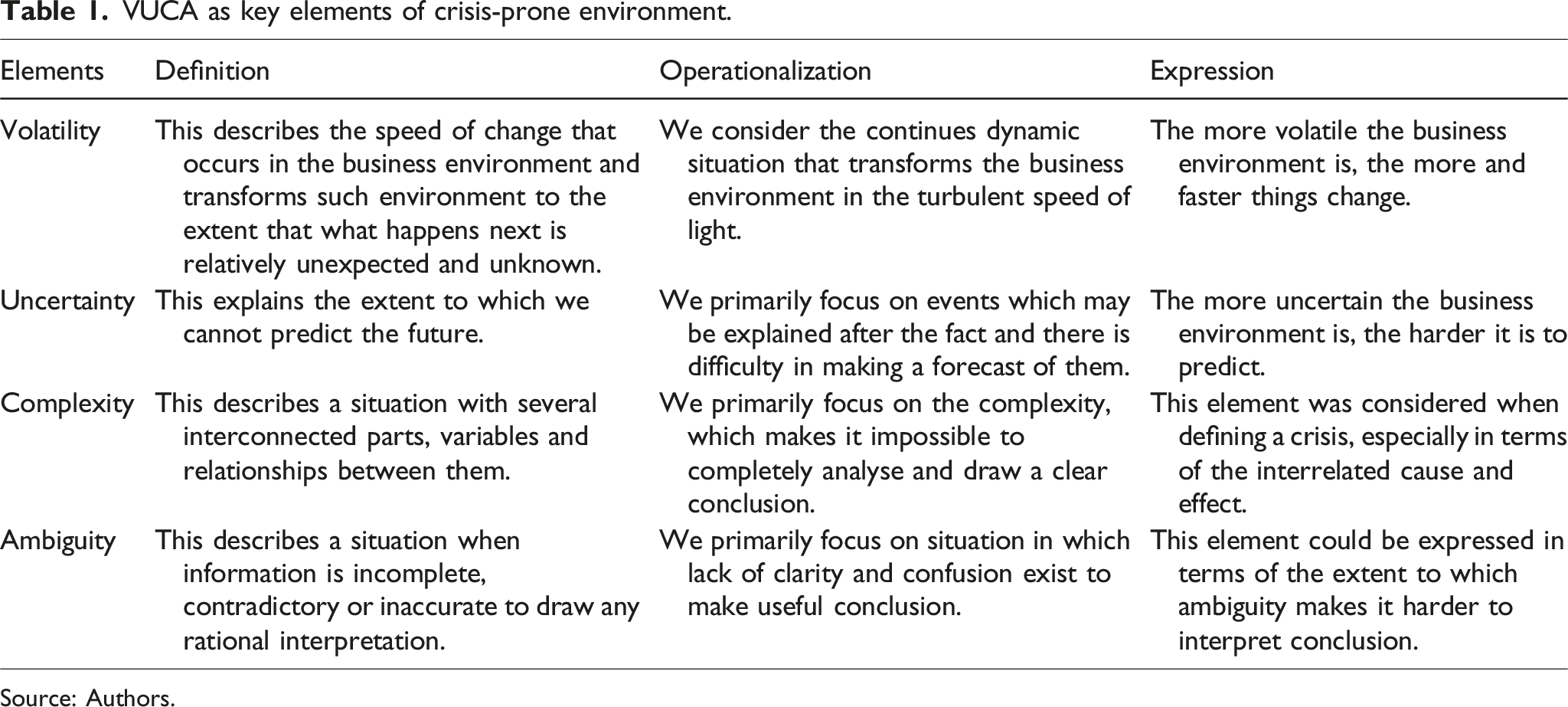
Crisis-prone environment typically describes regions that are frequently fraught with volatile, uncertain, complex and ambiguous (VUCA) situations which make businesses vulnerable to interruption, discontinuity and extinction. Small businesses operating in such crisis-prone environment encounter major challenges that require them to adopt a novel crisis management mindset and a growing concern on the managerial capabilities to manage crises (cf. Mafimisebi, 2017; Mafimisebi and Nkwunonwo, 2015). This has partly led to increased attention on crisis planning in crisis management research, which has largely ignored small businesses, with a lack of research on other approaches to crisis management (Ali et al., 2017; Herbane, 2010; Mafimisebi and Nkwunonwo, 2015). Two of such approaches of crisis management are improvisation and resilience (Linnenluecke, 2017; Powley, 2009; Walker et al., 2002; Weick and Sutcliffe, 2001).
In our view, crisis planning, improvisation and resilience that occurs simultaneously in the crisis management process is more valuable and may enrich crisis management practices of small businesses. Different views and related concepts have emerged in the context of crisis management and organizational resilience. As previously acknowledged, some scholars have argued that organizations with a crisis management plan are more able to manage crises than those without it. At the same time, the perception of the value of crisis planning differs depending on the nature of organizations (large vs small). Another category of scholars have therefore referred to improvisation, responding to crises spontaneously by leveraging on extant resources and knowledge, as a more useful tool to manage crises facing small businesses (cf. Kovoor-Misra et al., 2001; Mafimisebi, 2017; Onwuegbuzie and Mafimisebi, 2021). As such, we find the context of Nigerian small and medium scale businesses of particular interest to explore these approaches to crisis management for two main reasons.
First, small businesses represent over 90% of all businesses, 70% of industrial employment and 50% of industrial output in the nation (Okpara, 2009; Olutunla and Obamuyi, 2008). This provides unique opportunity to engage with representative samples of small businesses in the nation. Second, despite the economic relevance of small businesses, they are highly susceptible to frequent crises. According to the National Emergency Management Agency of Nigeria, small business operators had encountered disruptions and crises events such as kidnapping, banditry, frequent large-scale flooding shutting down of offices and business premises and damaging economy activities (Mamadou et al., 2012). In addition, small business activities were also affected by other external crises such as the terrorism from the Boko Haram and Islamic State of West Africa responsible for several terrorist attacks in several parts of Northern Nigeria. There are also issues of militancy and vandalism in the Niger Delta region of Nigeria causing significant business interruptions in Nigeria, to mentioned but a few (cf. Mafimisebi and Nkwunonwo, 2015; Mafimisebi and Thorne, 2015, 2017a). Collectively, these crises events pose fundamental threats to small business activities and expose most of them to various risks, thereby increasing their vulnerabilities and impact business continuity.
The high probability of crises in this environment makes our research context fascinating and offers opportunity to extend crisis management and small business research. Beyond terrorism, vandalism and militancy, other issues such as herders-famers clashes, climate change and extreme weather conditions such as floods and windstorms are equally identified by the National Emergency Management Agency of Nigeria as factors posing significant threats to economic growth and business survival (Mafimisebi, 2017; Mamadou et al., 2012). Furthermore, the Nigerian business environment is characterised with several other challenges including issues of multiple taxation, hostile entrepreneurial ecosystems, inconsistent government regulatory policies and inadequate support for small businesses as well as natural disasters. Invariably, due to the diverse range of predictable and emergent factors that give rise to crisis situations in Nigeria, small business operators are often ambivalent about how best to effectively respond to crises. This poses a serious concern for policymakers, entrepreneurs and researchers in emerging economies where small businesses and other informal enterprises make significant contributions to the economy (Ogunsade and Obembe, 2016; Okeowo, 2019).
VUCA as key elements of crisis-prone environment.
Source: Authors.
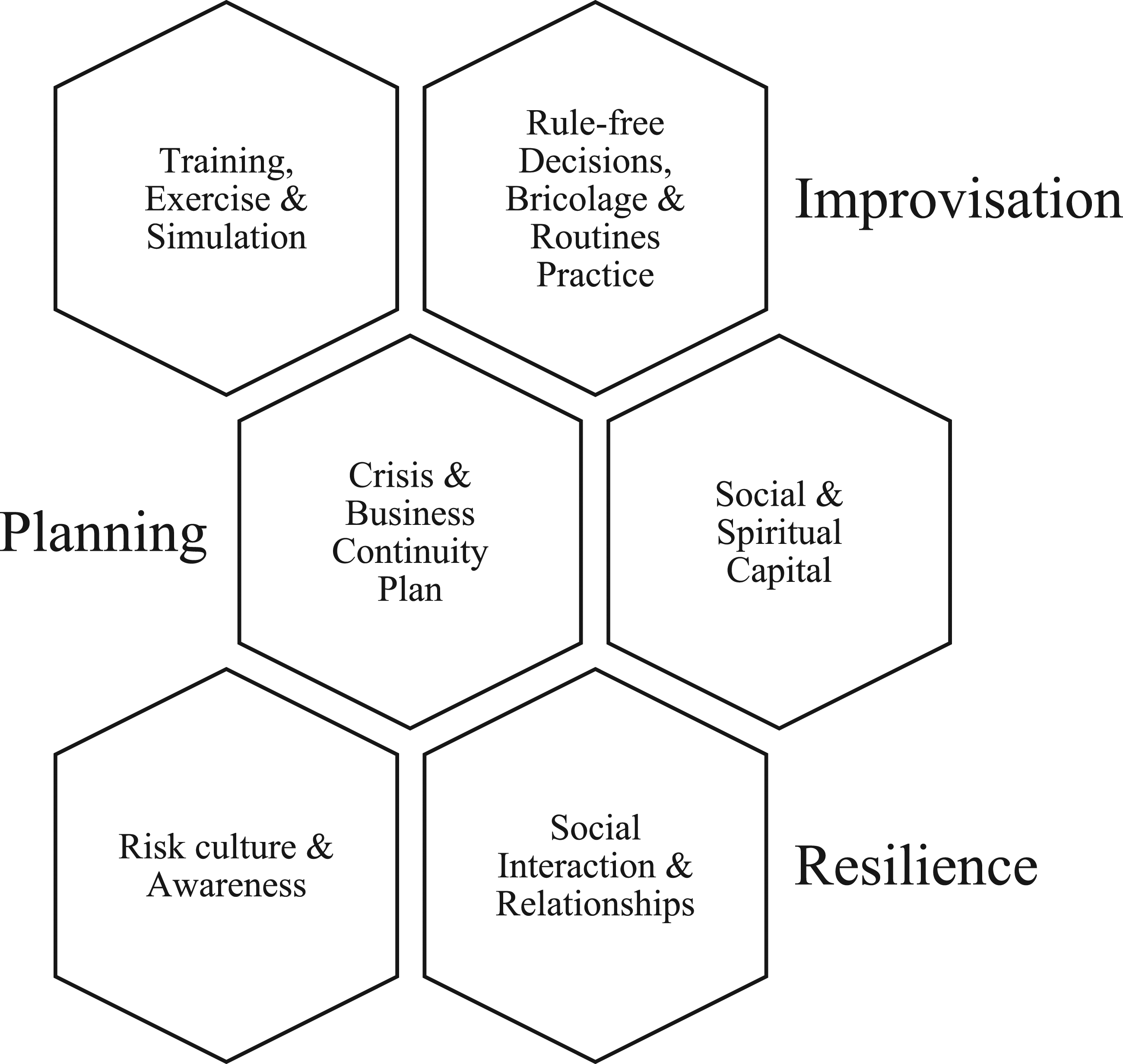
Theoretical framework explaining planning, improvisation and resilience interactions.
Research design
We draw on case study methodology (Saunders et al., 2016; Yin, 2003), an approach consistent with testing crisis management theory as shown in previous research (e.g. Boin, 2008; Chastang, 2000; Mafimisebi, 2017; Mafimisebi and Nkwunonwo, 2015; Powley, 2009), in order to thoroughly examine the phenomenon of our theoretical interest in its real-life context (small businesses owner-managers’ perception and response to crises in crisis-prone environment). This case study approach allowed us to explore when and how small business owner-managers respond to crisis situations as well as to understand their perception of crisis management. As such, we are able to address the identified research gaps and pursue a replication logic within the context of case study generalization boundaries (Eisenhardt, 1989; Eisenhardt and Graebner, 2007; Yin, 2003). Our investigation is based on an inductive multiple-case analysis (Eisenhardt, 1989; Eisenhardt and Galunic, 2000; Eisenhardt and Graebner, 2007; Glaser and Strauss, 1967) of 16 small businesses operating in crisis-prone environment of Nigeria.
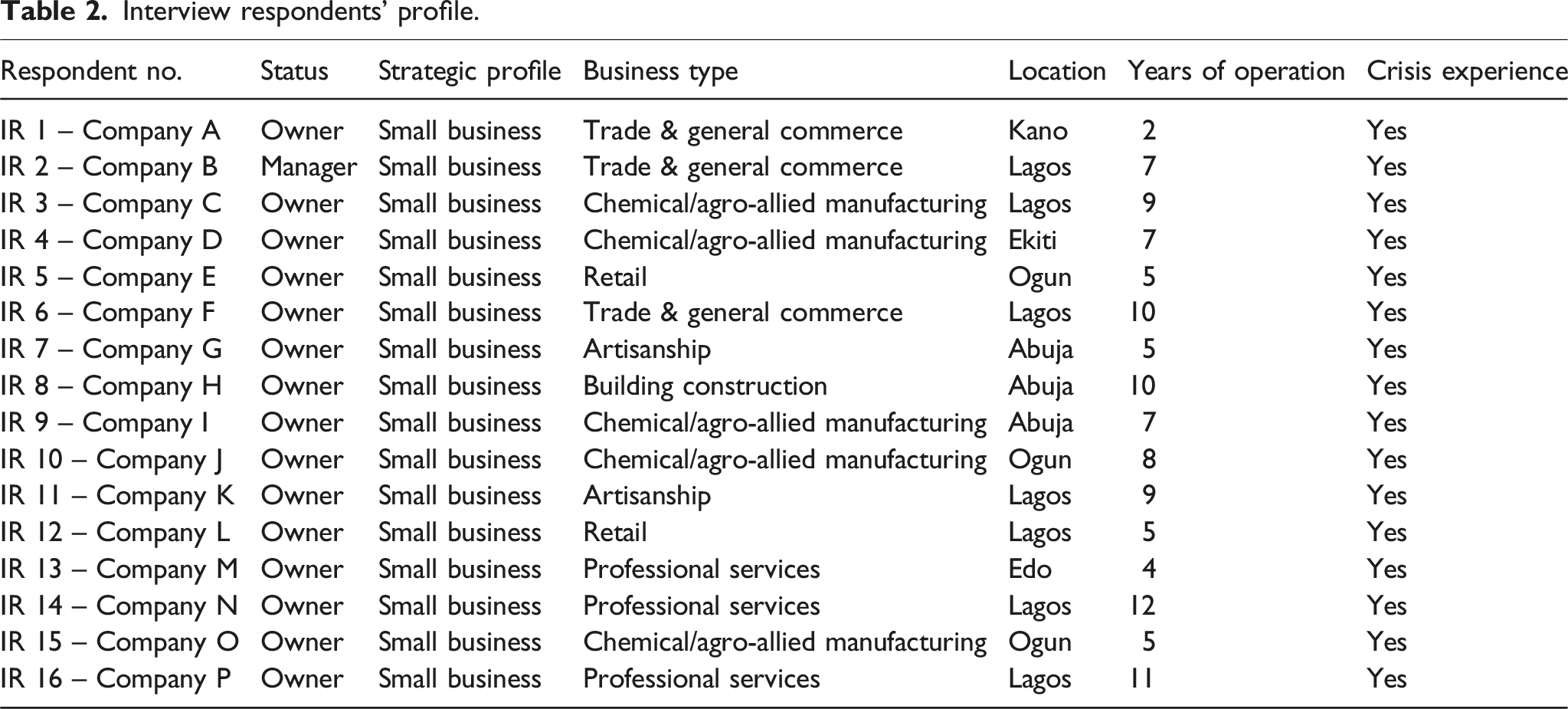
Interview respondents’ profile.
However, small businesses in our study perceived them to constitute crisis because it can destroy their entire business operations, impact their performance and survival. In fact, research suggests that perception of crisis differs among stakeholders. That is, what is considered to be a crisis in one organization could be a disaster in another organization (Mafimisebi & Thorne, 2017b). In our study context, we define small businesses as organization employing less than 20 employees whose annual turnover is less than N25 million (NGR). This definition is consistent with both the Central Bank of Nigeria (CBN) and the National Directorate of Employment conceptualization of small businesses in Nigeria. Also, we are particularly selective of the small businesses included in our study owing to our interest in crisis planning, response and coping capacity for crisis situations. Last but not least, we combined snowballing technique and personal networks when purposively selecting our respondents. We overcome ethical concerns by ensuring that all participating businesses and their owner-managers are fully brief about the purpose of the study and emphasising its societal benefits. We also guaranteed the privacy of information shared ensure confidentiality and anonymity of the participants’ personal and business information. Our approach to ethical considerations gave the participants the needed confidence to make an informed decision to freely participate in the study without any coercion or advanced gifts (cf. Saunders et al., 2016).
Data collection
We used multiple data sources in order to ensure research validity through data triangulation. These sources include semi-structured interviews (as our primary data) with owner-managers and/or co-owners who could offer retrospective views and rich accounts on the phenomenon of our theoretical interest (Gioia et al., 2012). The secondary data were obtained from media documentation and articles, observations and company documents. In terms of primary data, a total of 16 interviews were conducted with small business owner-managers. The interview respondents were drawn from 16 small businesses in across six Nigerian states and spanned six industrial sectors: artisanship, construction, manufacturing (chemical and agro-allied), professional services, retail, trade and general commerce. The interviews were semi-structured in nature and conducted over a period of 4 weeks. We used a combination of face-to-face interviews and web-based interviews (via two Skype interviews) with the small business owner-managers. Purposive sampling was used for respondent selection, drawing on network of contacts within the research context. Respondents were predominantly business owners directly involved in the management of the business, had experience of crisis management and run their business for between 2 and 12 years. Table 2 provides a profile of the interview respondents.
Interviews were recorded electronically and complemented with note taking. The transcription process followed previously developed protocol. Each interview lasted for a period between 45 and 60 min and were respondent-led but were equally guided by theory in order to avoid the potential pitfall of a tangential departure from the interview schedule (Collis and Hussey, 2014; Saunders et al., 2016). The interview schedule consisted of seven broad areas, five of which were research subject-specific; the business environment, understanding of crises and crisis planning, crisis prevention, crisis response and crisis recovery (see Appendix). The schedule served as a guide, as each interview developed with respondent comments and further probing of specific responses, thus creating some uniqueness with each interview (King, 2012). Amongst others, we asked questions concerning personal crisis experiences of respondents; plans for managing crises; and plans in place to handle unexpected or abnormal situations. We also explored planned emergency responses in place to deal with abnormal and unexpected situations such as disease outbreak and fire disasters. The cases of small businesses allowed us to gain a good understanding of various perspectives of crisis management and to clarify potential concerns. In order to ensure data validity, we probed and sort additional clarifications on respondent comments where applicable (cf. Taylor and Bogdan, 1998). We organize our findings around three main themes derived from the empirical data juxtaposed with theoretical constructs in the crisis management and resilience literature (Figure 2). Aggregate data structure and coding process.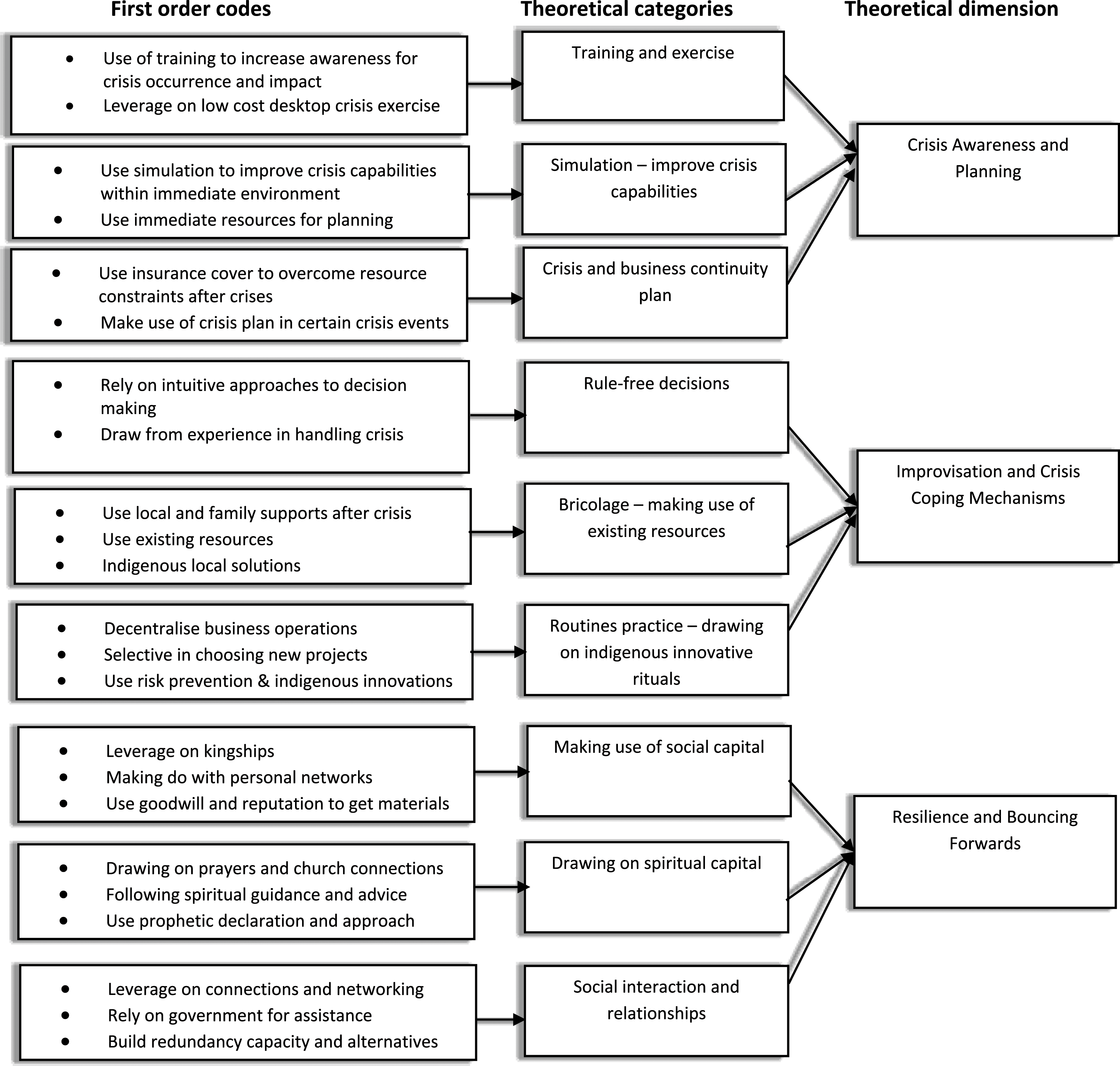
Data analysis
We explore the theoretical perspectives of crisis planning, improvisation and resilience in our data analysis. Accordingly, the perception and response of owner-managers of small businesses are examined using the lenses of crisis management. The data analysis related to an inductive qualitative multi-case study with a grounded theory approach (Corbin and Strauss, 1990; Locke, 2001), where researchers tried to extract, identify and develop themes that capture the crisis phenomenon in small businesses (cf. Onwuegbuzie and Mafimisebi, 2021). In particular, our findings are extracted following recommendations in previous studies (cf. Gioia et al., 2012; Locke, 2001; Saunders et al., 2016) in which we attempted using software (NVivo) to categorize and reduce the data but eventually settled for manual deduction due to the peculiar nature of raw dataset. Our interview dataset contains language/slangs which make it difficult to clearly detect categories and/or themes using software. We therefore opted for manual coding of the dataset using the recommendations of Braun and Clarke (2006). The analysis of the interviews involved a rigorous procedure of data transcriptions, coding, reduction and organization of categories into emerging themes. The data were manually coded drawing on a combination of research-led and theory-driven codes, in reducing, organizing and analyzing statements of respondents (King, 2012). The purpose was to identify themes from within the embedded cases and comparing these findings across cases (Eisenhardt and Graebner, 2007). Table 2 presents an overview of the selected cases. The data analysis process began with a systematic review of the transcripts for the purpose of identifying recurrent themes and generating codes (cf. Braun and Clarke, 2006). In the quest for research validity, the transcription and data coding process were reviewed independently by two researchers. The grounded theory approach was replicated in our construction of categories of findings by developing categories of information (open coding), interrelating these categories (selective coding) and constructing a story that connects the categories (axial coding), upon which the final findings are based (Corbin and Strauss, 1990; Creswell, 2003; Dougherty, 2002).
The coding process and construction of categories was iterative in nature, involving multiple readings of the transcripts and identifying important patterns and ideas that relate to the context of the investigation, and establishes common meaning across multiple observations (Creswell, 2003). This process also involves a systematic break down of raw data and information into different categories; and provides us the opportunity to review and reflect on the data preventing researchers’ personal biases (Creswell, 2003). During subsequent iterations, the initial codes of each single company case together with cross-case analysis were further explored for patterns and meanings leading to identification of new categories and themes (Figure 2). The generated code categories from the cases were reviewed together by the researchers to ensure that the aggregated findings are consistent across the coding process using the research objectives and theoretical lens (Braun and Clarke, 2006; Creswell, 2003).
Evaluation of findings
This article addresses one fundamental question concerning planning, improvisation and resilience in the context of crisis management and business continuity. We seek to explore when and how do small business owner-managers respond to crisis situations and cope with associated challenges to their business operations. In this section, we present our empirical findings using concepts or the new constructs from our cases and compared the empirical data with some theoretical constructs in the crisis management and small business literature. Like previous studies, we employ a combination of illustrative quotes and examples describing the data from which we drew our inferences (cf. Onwuegbuzie & Mafimisebi (2021)). Our analysis of the data suggests that crisis planning, improvisation and resilience are essential in achieving business continuity and/or survival in crisis-prone environment. The findings indicate that crisis planning, improvisation and resilience that occurs simultaneously in the crisis management process is more valuable and enrich crisis management practices of small businesses (see also Figure 2). In line with extant crisis management and resilience studies, the findings also suggest that small businesses that lack crisis planning and resilience are more vulnerable to crises due to inadequate crisis preparedness and poor risk culture (Coombs, 2015; Doern, 2016; Hale et al., 2005; Mafimisebi and Nkwunonwo, 2015; Pearson and Sommer, 2011). Indeed, our findings indicate that when faced with disruptive events such as crises, small businesses are less likely to be adaptive in situation where crisis management is not considered as strategic tool to counter the effects of crises and interruptions.
The data from Figure 1 reveals that while some small businesses (N = 5) were prepared for crisis events, most of them (N = 11) relied on improvisation and resilience to deal with unexpected disruptive events in crisis-prone environments. Also, we found that there is absence of a developed robust crisis response and recovery strategy among those small businesses (N = 11) which rely on improvisation approach to managing and coping with crises. The overall findings suggest a mix of crisis planning, improvisation and resilience approach to crisis management in small businesses. We find that those small businesses (N = 10) which view crises as events that constitute immediate threats to their daily business routines and continuity tend to combine crisis planning, improvisation and resilience. This is less so, however, among those small businesses (N = 6) which appear to dismiss the impact of crises on their operations. Among this group, there is also little evidence to indicate that much thought is given to longer term strategic planning for managing crises. In agreement with previous research, the findings showed that small businesses tend to be more aware of crisis situations where there is a high prospect of such crises occurring within their immediate business environments and threaten their survival (Hills, 1998; Mafimisebi, 2017; Mafimisebi and Thorne, 2015; Pearson and Clair, 1998; Pearson and Sommer, 2011). These small businesses used combination of crisis training and exercise, simulation, bricolage, social and spiritual capital to increase their crisis capabilities during and after crises (Figure 2), while still maintaining the continuity of their businesses and serving customers.
Crisis awareness and planning
The data analysis uncovered insights on when and how small business owners responded to crises. The small businesses (N = 5) who had largely overcome disruptive crisis events used crisis awareness and planning in maintaining their business continuity and survival. For instance, a small business owner (Company A in Figure 3) explained how crisis awareness and planning as well as crisis simulation helped the business in managing crisis situations (Figure 3): ‘We are quite aware of the volatility of our business environment, but here apart from different contingency plans that is in place, we also leverage on low-cost desktop crisis exercise to meet eventualities’. Crisis awareness and planning coding scheme.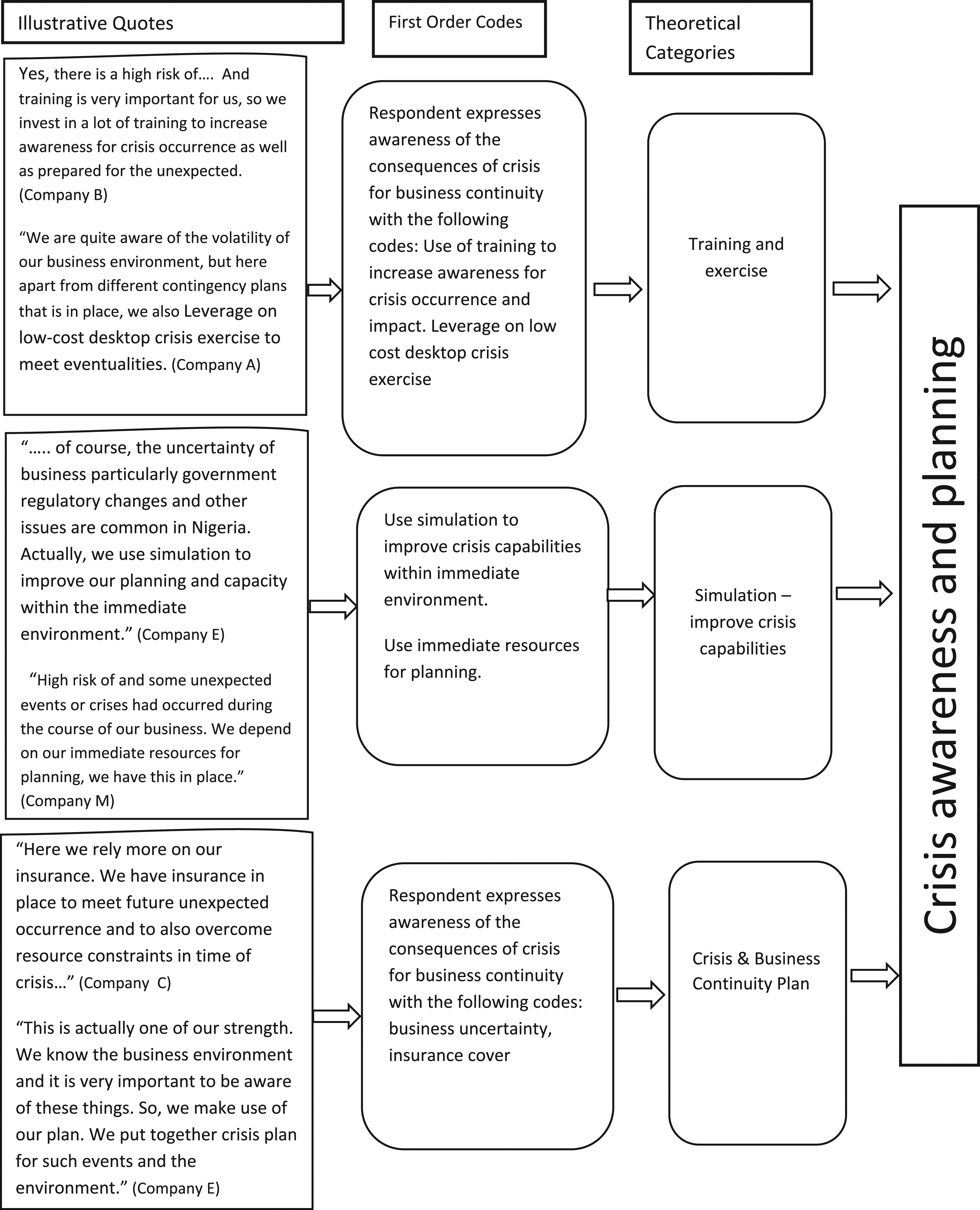
This way of thinking about crisis management indicates the presence of crisis planning and improvisation that are integral to ensuring business continuity and survival. We also see evidence of crisis awareness and planning revealed in other case organizations. For example, one of the small business owners (Company B in Figure 3) explained that: ‘Yes, there is a high risk of business failure …. and training is very important for us. So, we invest in a lot of training to increase awareness and preparation for crisis occurrence as well as prepared for the unexpected’.
Clearly, a significant number of the small businesses (N = 11) demonstrated implicit awareness of the consequences of crisis for business continuity but somehow stuck to the idea of crisis as unavoidable (normal accident theory view) and therefore they did not have a specific plan in place. In particular, we find that these groups appear not to have given much consideration to long-term strategic crisis management. However, we also realised that while some of these small businesses seem ill-prepared for crises, there is strong crisis awareness and immediate reactions to minimize the consequences of crisis. The analysis of case organisations shows that majority of these small businesses (N = 11) leverage on existing resources, indigenous local solutions, selective in choosing new projects, risk avoidance and indigenous innovation when responding to crises. One notable recognition is that some of these small businesses (N = 7) use rule-free decisions, bricolage and routines practices, recombining existing resources and drawing on indigenous innovative rituals when responding and managing crisis situations. Due to a variety of limitations confronting small businesses, we find that it is much richer for them to leverage on combination of planned, improvised and resilience approaches when responding and managing crisis (Herbane, 2010; Linnenluecke, 2017; Mafimisebi, 2017; Mafimisebi and Nkwunonwo, 2015; Pearson and Sommer, 2011; Powley, 2009).
Although the topic of crisis awareness and planning has been addressed in previous crisis management and small business literature (Bechky and Okhuysen, 2011; Herbane, 2013; Mafimisebi, 2017; Somers, 2009; Spillan and Hough, 2003), we observed limitation regarding the extent of preparation and resources needed for small businesses to overcome crisis situations. Some small businesses (N = 5) perceive crisis planning as vital for successful crisis management, which in this case could be seen as planned approach (Figure 3 Company B, A, E, M and C). In the context of crisis impact on business continuity, there is also a strong link to fears of business discontinuity and proactive crisis management, which a few small businesses (N = 2) try to address by adopting low cost desktop crisis exercise and simulation to improved crisis planning and capacity (Figure 3 Company E and M). Most of the small businesses (N = 10) in crisis-prone environment underline immediate resources and indigenous innovation as their main strength (For example, see Figure 3 Company C, E and M), which is in line with existing literature that regards them as critical ingredients for scaling entrepreneurship and ensuring survival of local businesses (Onwuegbuzie and Mafimisebi, 2021).
Moreover, crisis awareness and planning are perceived as essential for business continuity (Figure 3, Company B, A and E) but the small size of these businesses sometimes pose threats to the sustainability of such approach. For example, we observed that there is sometimes dependence on a single individual who possesses the working knowledge to sustain the business as a going concern. The death of such key individual poses significant threat to the business continuity of such organisation. When asked about the mechanisms that had been put in place to deal with risks which may lead to losses, we observed that a few of the small businesses acknowledged that their businesses did not have specific crisis management plan in place. The overall analysis of findings confirm that most small businesses (N = 11) do not have a crisis management plan; notwithstanding the empirical evidence that crisis-prepared organizations survive unexpected crises compared to those organizations which are ill-prepared for crises (Coombs, 2015; Mafimisebi, 2017; Mafimisebi and Thorne, 2015; Mitroff and Alpaslan, 2003; Veil, 2011). Our findings suggest that conventional planned approach to crisis management is not particularly suitable to some of the small businesses. Interestingly, some of the small businesses (N = 10) claim that they do leverage on existing materials, insurance, back-up equipment, good maintenance practices, and having access to alternative facilities and premises from where technical processes can be implemented in the event of crises. As stated in the quotes below: ‘Yes, we have a comprehensive insurance cover, for the building and some specific assets and staffs are also covered by the insurance and that is done based on the level of importance of that asset to the company’. (IR 14) ‘We never thought about insuring our business, because like I said earlier even though Lagos could be flooded during the raining time, our location is not a flood prone area and hopefully it won’t be’. (IR 2) ‘In Nigeria, for small businesses there are some compulsory insurance which definitely you need to have else you will not have a licence to operate but I do not know if you are talking of specific insurance because this is like general insurance for cases of fire and things like that’. (IR 8) ‘Yes, we used to, but am not sure if it is still in force…. the premium you pay is a fraction of what your business is worth, but this insurance does not cover everything it just covers some specific areas like if you have something like fire outbreak destroying your premises and equipment’s’. (IR 5)
Based on the respondents’ comments, some small businesses (N = 5) draw on immediate resources and existing plans such as insurance to help reduce the effect of crises (Figure 3, Company E, H and N) especially in cases where such insurance policies are compulsory. In this case, the rationale for dependence on insurance policy coverage is apparently due to its regulatory requirement as a basis for undertaking certain categories business in Nigeria. These insurance policies are seen as worthwhile investments given the proportion of the premium payment to the estimated business value. At the same time, however, while the policies may help in hedging against unwanted and unpredictable crises, there is also a perception that such policies may not necessarily provide full and complete coverage for losses that may arise from all forms of disasters. However, some of the small businesses (N = 5) demonstrated awareness of the consequences of crisis for business continuity by having some sort of succession plan and social capital, but there was little evidence to suggest some of the insurance policies were still in-force. This might explain why, for some small businesses, it is not always good to entirely depend on planned approach after crises. It is sometimes better to combine existing plans with various improvisation and resilience strategies to bounce back from crises. This could also imply the need for rule-free decisions, bricolage and routines practice to mitigate the consequences of crisis (Figure 2). Moreover, based on the divergent perception of crisis awareness and planning, we call for complete utilization of crisis planning, improvisation and resilience by making use of training, exercise, simulation, crisis plan, social capital and strengthen risk culture of small businesses (Figure 2).
Improvisation and crisis coping mechanisms
We also explored the response and coping mechanism for dealing with unexpected crisis situations such as diseases outbreak, terrorism and fire disasters. Our findings show that a significant number of the case organisations (i.e. small businesses) (N = 11) adopted rule-free decisions, bricolage and routines practices by drawing on indigenous innovative rituals. There is high level of dependence on individual cognitive awareness, government, prayers, God and divine interventions rather than a robust plan for such situation (Figure 4). Figure 4 shows the improvisation and crisis coping mechanisms coding scheme. We found that where there is absence of a developed robust crisis response and recovery strategy, small businesses make do with existing resources and draw from indigenous solutions to deal with the unexpected and managing crisis situations. For example, when asked about mechanisms adopted in coping and responses to a crisis which may affect functions of their business ventures, most of the small businesses (11 of 16) have different perspectives on their crisis response and recovery strategy. However, we find that some small businesses (N = 7) underlined experience, intuition, existing resources, indigenous local solutions and decentralise business operations as part of their coping mechanisms (Figure 2). These tools were perceived as instrumental to their ability to deal with uncertainties and crises. Improvisation and crisis coping mechanisms coding scheme.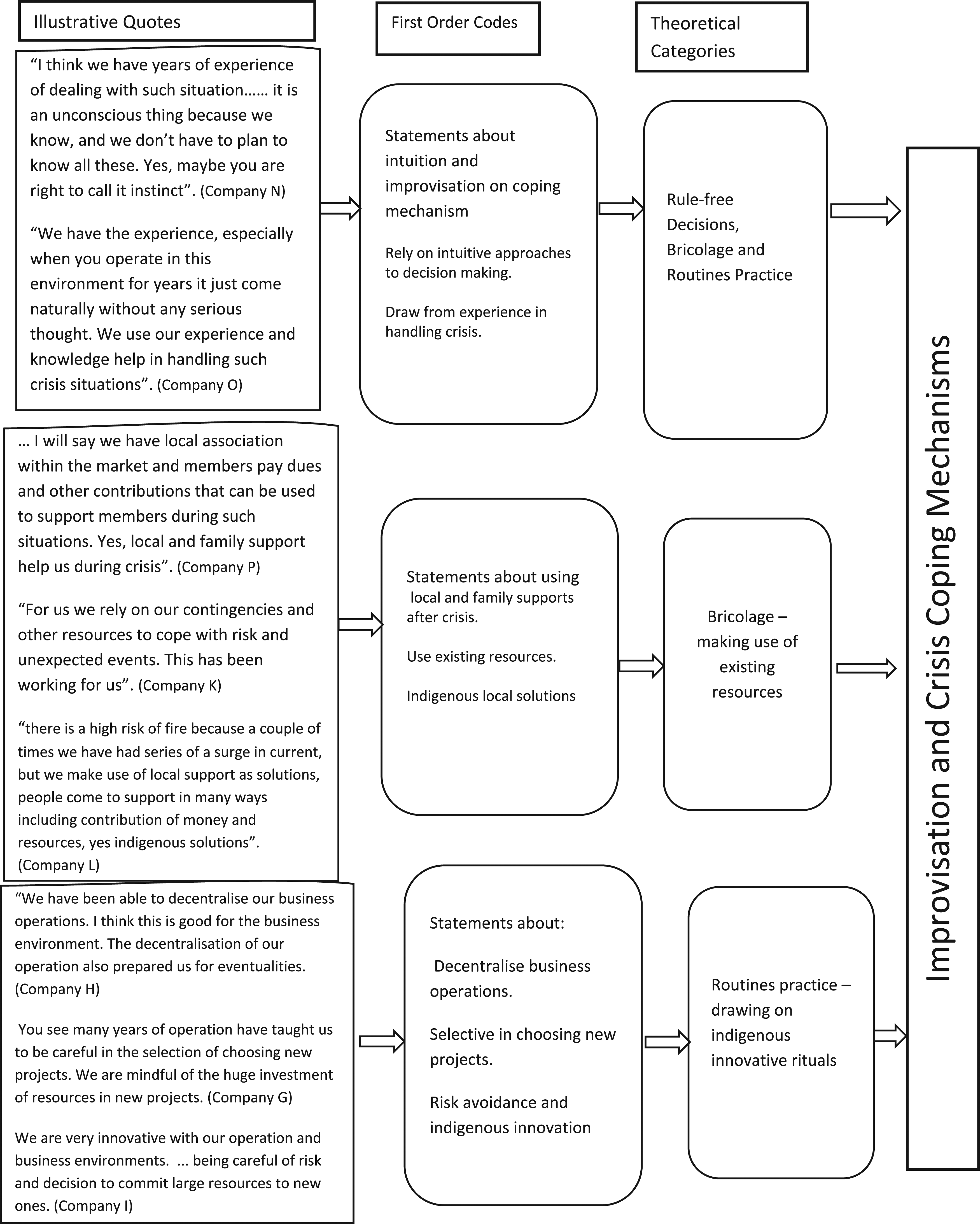
Furthermore, being small (and in some cases, family) businesses, majority of the respondents (N = 14) acknowledged that they draw from local business experience, succession plans, selective in choosing new projects, products and markets to ensure business continuity. Our empirical findings also suggest that small businesses (N = 15) are willing to seek help from government emergency funds and support as the following quotes reveal: ‘The government promised; it is only promise we have now. They promise to take care of those affected and set up committee to find out the remote and immediate cause of the fire outbreak. Government also promised to equip the fire services with necessary equipment’. (IR 5) ‘We are still in shock of what led to this disaster. It was painful, because the government collects huge revenue from the market and they could not provide the needed service and fire equipment. But we are open to support from them’. (IR 6)
The findings suggest that some small businesses (N = 12) rely on mixed of instruments and tools such as government support, collaboration, communal supports, indigenous cooperation, faith and divine intervention (spiritual capital) as part of their coping mechanisms after crises. Their views and responses reveal the prevailing religious and cultural values within this context. Highly religious societal contexts such as Nigeria tend to incline on divine interventions and miracles as measures of crisis prevention. Due to their liabilities of smallness, our findings revealed that most small businesses, who could not afford large expenses on crisis planning and preparedness, largely depend on taking spontaneous action either as a novel approach or response tool after a crisis. This practice of creating something new or reinventing business in the moment of crisis is well captured by a number of the small businesses (N = 13). Our empirical evidence from interviews with Company N and O (Figure 4) illustrate this practice of improvisation very well. ‘I think we have years of experience of dealing with such situation…it is an unconscious thing because we know, and we don’t have to plan to know all these. Yes, maybe you are right to call it instinct’. (Company N). ‘We have the experience, especially when you operate in this environment for years it just come naturally without any serious thought. We use our experience and knowledge help in handling such crisis situations’. (Company O).
From the adoption of ‘acting in the moment’ and rule-free approach to handling of crises, it is evident that small businesses adopted improvisation approach to crisis management (Mafimisebi, 2017; Vaughan, 2005; Weick and Sutcliffe, 2001; Woodman and Hutchings, 2010). The improvisation approach as coping mechanism is rooted in the increasing need to remain flexible and leverage on resources at-hand in the face of crises. In crisis-prone environment where these small businesses operate, we are not necessarily talking about relying on improvisation alone in which small businesses do not plan for crisis; if small businesses are able to plan, it might be better for them to also combine improvisation and bricolage to manage crises. The mixture of these approaches can therefore potentially provide extra and robust crisis coping capacities and mechanisms for small businesses (cf. Barnett and Pratt, 2000; Bechky and Okhuysen, 2011; Boin and Van Eeten, 2013; Chastang, 2000). This is nicely exemplified by Company P, K and L, who collectively acknowledged that local association, collaboration, family support and contribution of funds from cooperative society are instrumental to their recovery from crises (Figure 4). Additionally, for small businesses who rely on crisis contingencies plan and resources, the balancing approach of improvisation and planning would further augment their crisis management capabilities (Figure 4, Company K and L).
The efficient utilization of improvisation and local indigenous solutions appear to contribute strongly to crisis management capability of small businesses. Small businesses appear to be drawing from lessons from previous crises, immediate resources and local support; due to their size and financial resources, some have decentralised their business operations and chose to be very selective in their offerings (Onwuegbuzie and Mafimisebi, 2021; Teng et al., 2011). For some small businesses (N = 7) (Figure 4 Company N, O, P, K, H, G and I), the decentralisation of various parts of their business operations provides an effective way to reduce their vulnerabilities to crises, which can enhance their business continuity and survival. In addition we observed among the category of small businesses who used risk avoidance and indigenous innovation during crisis, applied both bricolage and improvisation in their operations in crisis-prone environment. In the case of a small business artisanship, improvisation and crisis coping mechanisms are observed in the way at-hand resources are mobilised to overcome impact of crises. This small business does not only rely on intuitive decision making but also use routines practice of indigenous innovative rituals and local communal supports to reduce crisis vulnerability.
We found that small businesses (N = 5) were able to reuse existing materials to make new products; at times, vacate a current ‘trouble’ market and re-enter another market by completely serving a new segment of customers to ensure their business survive crisis impact. For example, a small business in our sample discussed that ‘we are very innovative with our operation and business environments ...being careful of risk and decision to commit large resources to new ones’ (Company I). Improvisation is evidenced in the way this organisation utilises existing materials and reinventing old resources to make something new. Further, we see evidence of improvisation and crisis coping capacities in the way the sampled small businesses in the way they utilise quick-fix and intuitive decision makings are adopted after crisis. Collectively, we observed that these small businesses used combination of rule-free decisions, bricolage – making use of existing resources, and routines practice – drawing on indigenous innovative rituals to cope with crisis (Mafimisebi, 2017; Onwuegbuzie and Mafimisebi, 2021; Weick and Sutcliffe, 2001; Woodman and Hutchings, 2010).
Resilience and bouncing forward mechanism
In terms of resilience and bouncing forward mechanism, we focused our research interest on the sources of resilience that small businesses in crisis prone environment used to cope and overcome crisis situations. Following Perrow (2011), Powley (2009) and Mafimisebi (2017) and others who build on the notion of resilience, we consider sources of resilience in small businesses as including social capital, spiritual capital, making do with kingships and personal connections as well as social interaction and relationships that foster resilience in moment of crises (Figure 5). In our context, we observed that small businesses sometimes use resources from kingships, make do with personal networks, goodwill and reputation to get materials after crises (Figure 2). This is in line with resilience activation after crisis (Powley, 2009) and has significant implications for dealing with crisis situations among small businesses. We investigated when resilience is activated in crisis prone environment. Despite the fact that some small businesses in our research context do not have crisis management plan, they value social interaction and relationships as part of their crisis response tools. Resilience and bouncing forward mechanism coding scheme.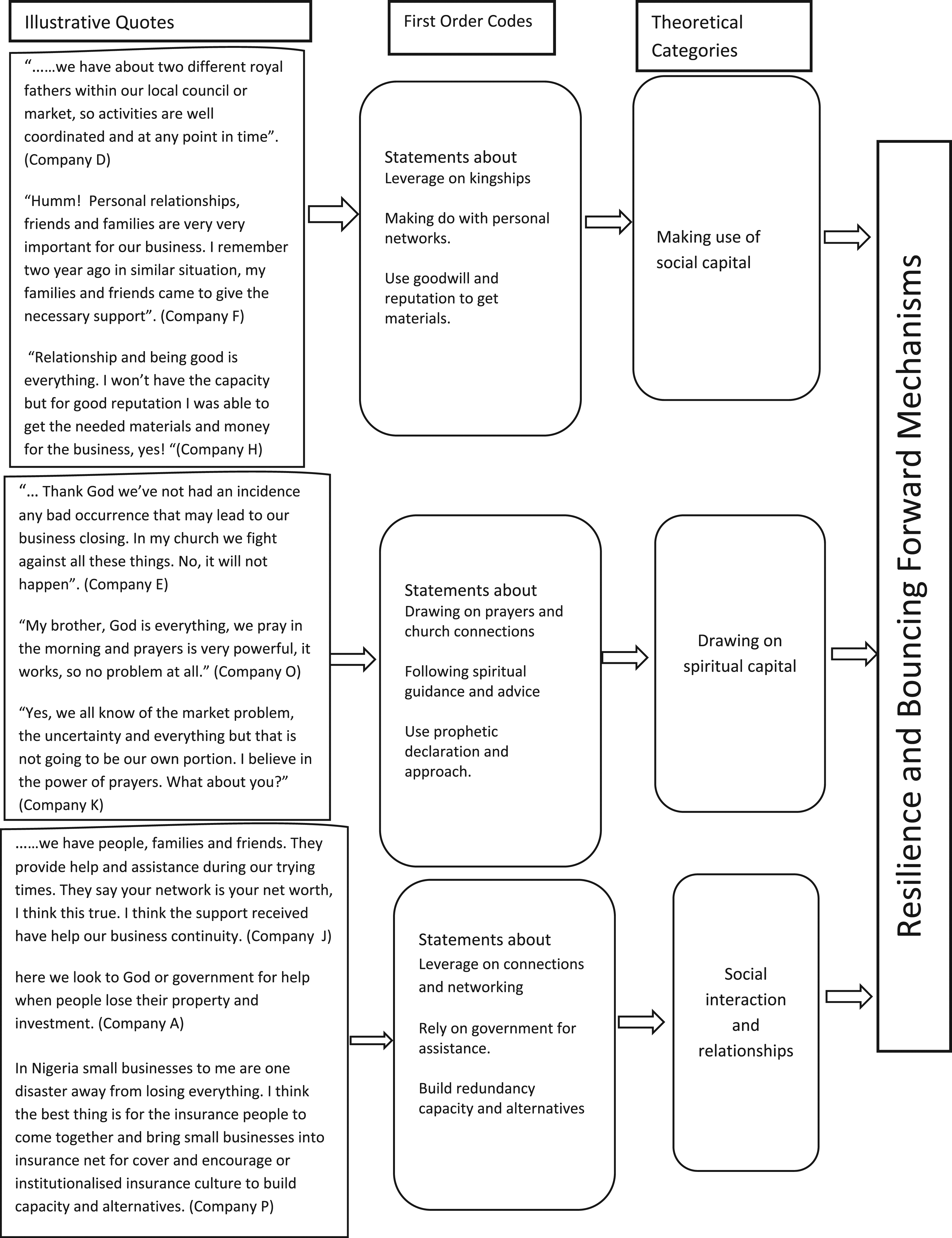
We found that prayers and spiritual connection, guidance and prophetic declaration are perceived as useful source of comfort and resilience in the moment of crises (Figure 5). For some small businesses (Figure 5 Company D, F, E, K, P and A), the decentralisation of operation, risk avoidance, selective in new projects and offerings, and contingencies support from families and friends also provide a novel way to augment their crisis management capabilities, which can lead to resilience (Mafimisebi, 2017; Mafimisebi and Nkwunonwo, 2015; Walker et al., 2002; Woodman and Hutchings, 2010; Somers, 2009). This is usually done to reduce their vulnerabilities and crisis effects (cf. Mafimisebi and Thorne, 2015). It is however important to note that a few numbers of small businesses (N = 5) indicated having contingent strategies in place also help them deal with potential crisis events and resilience remain a critical component of their crisis management strategies. In this regard, the small businesses invoke these contingencies in the event of crises, thus have an assurance of continuity of their business’s operations. As stated below: ‘…we have about four different mixers and at any point in time we do not need more than two for the production so I will say we have built in redundancy capacity for response there. So, if I have a mixer that is not functioning all I need to do is switch over to a functioning one’. (IR 15) ‘Our tools, they are very important, we have some high-power servers and equipment we use for our work, socialized equipment we use. We can’t afford to lose any of them’. (IR 3) ‘power supply is a major problem in Nigeria so I think everybody has an alternative here and for us it is to have electric generators that when there is no supply from the Power Holding company, we switch over to it’. (IR 13) ‘…the attractor is heavy and we use it for the grinding of our paste and all [that] we have just one and we try to rely on good maintenance practice to keep it running but assuming we have downtime that hasn’t happened we can go to an alternative company just to grind our paste. There are companies that just grind and you pay for the grinding. But for the mixers which we use most of the time we have built in redundancy by having more than we need at any point in time’. (IR 2)
We observed that there seems to be over-reliant on improvisation approach to crisis management among some of the small businesses (N = 11) in our research context. However, we also found that significant number of the small businesses (N = 5) also leverage on planned and resilience approaches to crisis management. More so, we observed that those small businesses who relied on improvisation approach are less inclined towards planning as a measure of crisis prevention and management. Although we found that statements from the respondents revealed some insights into their fears of business discontinuity after crisis events: ‘I remember when we had fire disaster late last year, everyone was crying Oh God why did you allow this to happen…. The fire started midnight and lasted till about 6.30 in the morning. The fire men came very late and through individual efforts and the fire fighters, the fire was eventually put out. We lost everything in the building before the fire was put out. In advance countries, victims of fire disaster like this look to insurance companies for claims, here we look to God or government for help when people lose their property and investment. In Nigeria small businesses to me are one disaster away from poverty and losing everything I think the best thing is for the insurance people to come together and bring small businesses into insurance net for cover and encourage or institutionalised insurance culture in our society’. (IR 1) ‘…there is a high risk of fire because a couple of times we have had series of spark or having your fuse blowing because there is a surge in current. Thank God we’ve not had an incidence’. (IR 9)
The data suggests that lack of crisis planning, poor risk culture and governance among the small businesses undermined their resilience and crisis coping capacity. This matches with previous notable studies (Akgun and Keskin, 2014; Burnard and Bhamra, 2011; Carmeli and Schaubroeck, 2008; Coombs, 2015; Mafimisebi, 2017; Mafimisebi and Nkwunonwo, 2015) which showed that crisis management plan, robust risk culture, stress testing plan, risk awareness and risk governance are essential towards building resilience of organizations. We observed that there is a sense that small businesses are one disaster away from business discontinuity if they do not embrace strategic crisis management and resilience. Further evaluation of the comments made by the owner-managers provides some insights into their crisis management orientation, the skills and capacity for crisis response management, and how prepared they are for dealing with unexpected crisis situations. In a sense, from the above representative comments, we observed an inclination for the owner-managers to consider possible crises that could affect their businesses as being predominantly related to organizational structures and processes; that is, the facilities available to them for undertaking their business processes, fluctuations in energy supply and disruptions in business environment, which is an endemic challenge with doing business in Nigeria. This view re-echoes the fundamental idea of normal accident theory which asserted that some organizations are vulnerable to crises owing to complex interactions and tight coupling in the wider business environment (Perrow, 1994; Leveson, 2004; Mafimisebi, 2017; Shrivastava et al., 2009).
The findings further reveal that owner-managers who leverage on spiritual capital also expressed a distinct sense of crisis as avoidable. This could be linked to high reliability view and the need to acquire crisis management capabilities that help small businesses operate in crisis prone environment. In doing so, we find that small businesses strive to acquire both tangible and intangible resources including social capital, spiritual capital, connections, government emergency support, redundancy and indigenous innovation to overcome crisis. In this way, crisis planning, improvisation and resilience are not only addressed but could also be explained by high reliability notion (Mafimisebi, 2017; Perrow, 1994). This combination of approach in which small businesses combine crisis planning, improvisation and resilience serves as a way to create high reliability organisation in which crisis vulnerability is reduced, strengthen business resilience and achieve sustained business continuity. Clearly, in a crisis prone environment where businesses operate under VUCA conditions (Table 1), the impact of crisis on small businesses are lessen by the simultaneous practice of planned, improvisation and resilience approach to crisis management (Figure 5 Company D, H, J, and P).
Based on the representative comments from the small businesses (Figures 3–5), although the general expectation would be for owner-managers of small businesses to be well prepared for crisis events that are characterised by high impact and likelihood of occurrence, they also need to be proactive in terms of resources at-hand, realistic about cost of crisis planning, explore novel tools such as indigenous innovation, local community support, government emergency support, social capital and redundancy when it comes to dealing with unexpected crisis situations. Cooperation and other forms of indigenous local arrangement with trade union and partners are also common ways to reduce crisis vulnerability for small businesses. This comprehensive approach to crisis management among small businesses is essential because they do not always have sufficient resources to deal with crises. The analysis of the research findings suggests that where the respondents view a low probability of crisis occurring or where there is ambiguity in relation to potential crises, then planning is of little consequence. For instance, we find that whilst the risk of flooding and acts of terrorism were generally acknowledged as posing risks to the general business environment in Nigeria; some respondents considered these issues as wicked problems and committing personal resources to deal with their impacts is seen as less effective in their specific operational environments and as such they did not have any plans in place for dealing with such eventualities. Overall, strong interdependencies and cooperation among small businesses possibly strengthen their crisis management capabilities.
Discussion and implications
Theoretical contributions
This study contributes to the field of crisis management and small business research by examining when and how do small business owner-managers respond to crisis situations and cope with associated challenges to their operations. While much attention has been given to large organizations within the broader framework of crisis management (Mafimisebi, 2017; Pearson and Sommer, 2011; Perrow, 2011; Roux-Dufort, 2007; Veil, 2011), our paper extends existing literature in crisis management and small business by providing new insights into crisis management practices of small businesses in African context; and we also extend the literature by showing how small businesses use planned, improvised and resilience approaches to crisis situations with profound implications for their business continuity and organizational resilience. We found that planned, improvised and resilience approach to crisis that occurs simultaneously in the crisis management process is more valuable and enrich crisis management practice of small businesses. In doing so, our work contributes to the growing literature that have studied crisis management in organizational context (Akgun and Keskin, 2014; Ali et al., 2017; Ciravegna and Brenes, 2016; Mafimisebi, 2017), resilience of organizations (Akgun and Keskin, 2014; Ali et al., 2017; Boin and Van Eeten, 2013; Mafimisebi and Nkwunonwo, 2015) and small businesses operating in crisis prone environment (Doern, 2016; Herbane, 2010; Mikusova, 2013; Ogunsade and Obembe, 2016) by suggesting that crisis planning, improvisation and resilience help small businesses overcome impact of crises and enrich their crisis management capabilities in crisis prone environment.
We also suggest that small businesses that lack crisis planning and resilience are more vulnerable to crises due to inadequate crisis preparedness and poor risk culture (Coombs, 2015; Doern, 2016; Hale et al., 2005; Mafimisebi and Nkwunonwo, 2015; Pearson and Sommer, 2011). If harnessed and used properly, small businesses in crisis prone environment will not only benefits from the combination of crisis training and exercise, simulation, bricolage, social and spiritual capital, but also owner-managers will increase their crisis capabilities during and after crises. This will ensure that small businesses are able to recover from crises, continue their business operation and remain resilient in the face of disruptions. Likewise, we extend existing literature in crisis management and small business by examining when and how do small business owner-managers respond to crisis situations. We complement the two dominant views of crisis inevitability and prevention proposed by both normal accident and high reliability theorists by emphasizing that crisis management practice that simultaneously combines planned, improvised and resilience strengthen operations of small businesses and ensure their business continuity and survival in crisis prone environment (Akgun and Keskin, 2014; Ali et al., 2017; Ates and Bititci, 2011; Boin and Van Eeten, 2013; Burnard and Bhamra, 2011; Mafimisebi et al., 2018; Perrow, 2011; Somers, 2009; Sullivan, 2012; Woodman and Hutchings, 2010).
Furthermore, while many studies seek to understand the motivation and perception of managers relating to crisis management in large organizations (Carmeli and Schaubroeck, 2008; Comfort, 2007; Linnenluecke, 2017; Mafimisebi and Nkwunonwo, 2015; Mafimisebi and Thorne, 2015; Roux-Dufort, 2016), this study extends extant crisis management research and contribute to the dearth of empirical evidence with respect to crisis management as practice in small business context. In this regard, our work builds on extant studies and contributes to the debate regarding crisis management of small businesses by noting that crisis planning, response and coping capacity are inherently integral to business continuity and resilience. This view complement findings from existing studies that identified preparedness, protection, response and recovery as facets of organizational resilience (Akgun and Keskin, 2014; Ali et al., 2017; Boin and Van Eeten, 2013; Mafimisebi and Nkwunonwo, 2015). Clearly, our contributions link to the organizational resilience literature that encourage the use of risk and crisis management tools (Doern, 2016; Gunasekaran et al., 2011; Mafimisebi and Nkwunonwo, 2015; Pearson and Sommer, 2011) and aligns with previous contention that the social connections among and between organization members enable organizational resilience (Powley, 2009: 1291). Indeed, crisis management and its implementation tools are complex (Herbane, 2013; Mafimisebi, 2017; Mafimisebi and Thorne, 2017b; Runyan, 2006; Spillan and Hough, 2003; Veil, 2011), and the notion that crises are inevitable or preventable in organization is too simplistic. Our analysis demonstrated that small business owner-managers interpretation of crises slightly deviates from experts’ conceptualization of crises (Boin & Lagadec, 2000; Comfort, 2007; Mafimisebi, 2017; Mafimisebi and Thorne, 2015, 2017a; Pearson and Clair, 1998; Pearson and Sommer, 2011). This comes to explain the tensions that cut across ‘crisis as process’ and ‘crisis as event’ dichotomies that have existed in crisis management literature for several decades (Herbane et al., 2004; Kovoor-Misra et al., 2001; Mafimisebi, 2017; Mitroff and Alpaslan, 2003), and in which small businesses perceived crisis as effect. In context, it is the effect of crisis that constitutes crises for small businesses. This echo view from prevailing crisis management studies which have established that perceptions of crisis vary across stakeholders and organizations (Mafimisebi and Thorne, 2017a; Mafimisebi, 2017, 2018).
Taken together, although the expectation is for small businesses with previous crisis experience to show more concern towards crisis management planning (Mafimisebi, 2017; Mafimisebi and Nkwunonwo, 2015; Spillan and Hough, 2003), this study agrees with Herbane (2013) who finds that experience of crisis may not directly reflect in attitudes towards crisis management planning. A plausible explanation is the view that it takes a crisis of the magnitude and severity of near catastrophe to significantly influence a heightened concern for crisis management planning and business resilience (Ali et al., 2017; Burnard and Bhamra, 2011; Chastang, 2000; Mafimisebi, 2017; Mafimisebi and Nkwunonwo, 2015). This can also be explained since small businesses do not necessarily have ample resources to commit to crisis planning but instead leverage on combination of improvisation and resilience approach to crisis management. Despite the fact that the crisis planning phase of crisis management is essential to successful crisis management, making important decision about potential crises that can affect the continued existence of businesses is complex and requires combination of approaches (planned, improvised and resilience) (Alink et al., 2001; Carmeli and Schaubroeck, 2008; Elliott et al., 2005; Mafimisebi, 2017). This combination of crisis management approaches is needed to ensure that small businesses remain resilient in crisis-prone environments. Therefore, we believe that strengthening small businesses capacity to simultaneously combine planned, improvised and resilience approaches to crisis management is critical to improving their business performance that, in turn, have significant implications on survival of small businesses (Boin & Lagadec, 2000; Comfort, 2007; Carmeli and Schaubroeck, 2008; Mafimisebi and Ogbonna, 2016; Mafimisebi and Thorne, 2017a; Onwuegbuzie and Mafimisebi, 2021; Pearson and Clair, 1998; Pearson and Sommer, 2011; Veil, 2011).
Managerial implications
This research raises a number of significant managerial implications for small businesses. First, the fact that crises have capacities to disrupt business growth and survival of organizations suggest the need for prompt decision-making in times of crises (Alink et al., 2001; Boin and Lagadec, 2000; Comfort, 2007; Carmeli and Schaubroeck, 2008; Pearson and Sommer, 2011; Veil, 2011). However, crisis decision making must precede the crisis events because successful crisis management requires a combination of planning, improvisation and resilience. Practically, we believe that our findings may serve as guidelines for small businesses operating in crisis prone environment. Some of the important elements of crisis management that small businesses could utilize when responding to crises are crisis training, exercise and simulation, business continuity plan, social and spiritual capital, bricolage and improvisation. Apart from strengthening business resilience, these elements of crisis management are instrumental to survival of small businesses in crisis prone environment. The implementation of crisis management tools impact on how owner-managers are able to respond and bounce back from unexpected crisis situations (Ali et al., 2017; Ates and Bititci, 2011; Doern, 2016; Mafimisebi, 2017; Mafimisebi and Nkwunonwo, 2015). This is also in line with the view that crisis awareness, planning and resilience, coupled with educational training, plays a significant role in generating the kind of concern among businesses that may lead small businesses to plan for potential threats and remain resilient in turbulent environment (Akgun and Keskin, 2014; Gunasekaran et al., 2011; Mafimisebi, 2017; Somers, 2009; Spillan and Crandall, 2002; Spillan and Hough, 2003; Weick and Sutcliffe, 2001). These raises a number of practical issues for small businesses.
First, awareness of sources of crises represents a critical first step for small business owner-managers in being able to successfully plan for unexpected crisis events (Boin and Lagadec, 2000; Carmeli and Schaubroeck, 2008; Mafimisebi and Nkwunonwo, 2015; Mafimisebi et al., 2018; Mitroff and Alpaslan, 2003; Pearson and Sommer, 2011). Second, the capacity for crisis prevention is not only predicated on mere awareness of uncertainties and crises but more significantly on deeper level of understanding on how such uncertainties and crises arising from both the internal and external business environments may be planned for. We also emphasize the view that an increased awareness of the importance of crisis management planning among owner-managers does little for successful crisis management. Third, the combination of crisis planning, improvisation and resilience approaches is more beneficial for small businesses. Indeed, Mikusova (2013) has argued that many small businesses with clear ideas of what constitutes crisis management planning in effect go on to prepare and plan for potential threats. Therefore, it is essential for small businesses in general to seek to learn about crisis management techniques and develop crisis prevention strategies. The implication of this is that the small businesses, in crisis prone environments, are better off by understanding the types of crises they face as well as identifying potential threats that may impact on their business continuity and resilience. This will help them to be better equipped to manage such threats and enhance business resilience in the face of multiple disruptions and crises.
Finally, based on our findings, we posit that small businesses wishing to be adequately prepared to deal with unexpected crises and remain resilient will benefit significantly from an audit of crisis management and business continuity activities. As most small business owner-managers are less likely to have plans for crises, they should draw on bricolage, improvisation and resilience in crisis prone environments. An important and practical implication for the business owner-managers is that in order to effectively respond, prevent and deal with crisis events, and be assured of business survival, they would be well served to proactively assess and identify crises experienced by other businesses rather than wait for first-hand experience of similar crises. This would enable them to benchmark their strengths and weaknesses and identify resources and capabilities they would require in order to respond to crises in the future. In sum, we demonstrate that although small businesses may not be immune from crises (normal accident theoretical view), it is possible to prevent or manage organizational crises through effective crisis planning, improvisation and resilience (high reliability theoretical view). Last but not least is the extent to which owner-managers are able to ambidextrously utilize resources at-hand with external supports from partners, government agencies and suppliers. The level of cooperation, collaboration and engagement among stakeholders including local communities, suppliers, customers, government agencies and ministries matters in times of crisis. The small business owner-managers should have increase understanding of the causes of crises and drivers of cooperation and collaboration to help deal with various challenges in crisis management process.
Limitations and directions for future research
While this study offers significant insights on when and how small business owner-managers respond to and cope with crisis situations, we acknowledge that there are limitations to the generalisability of our findings that offer unique opportunities for future research. Our findings are limited to small business owner-managers in the Nigerian context. The possibility thus exists that the findings and implications based on the Nigerian institutional context may differ in another crisis-prone environment context. As such, we propose that future research should undertake a more detailed study of how small businesses respond to and plan for crises allowing for contextual variations. We acknowledged that institutional environment in which businesses operate shape their risk and crisis management approach. It is essential, therefore, to integrate VUCA as key elements of crisis-prone environment and investigate risk/crisis management practice within such contexts. Our results can be generalized in business environment which shows attributes of VUCA (Table 1). It will be interesting to see future investigations regarding the extent to which crisis management practice shape organizational survival under VUCA conditions. There are also a wide range of exciting directions for future research to pursue. We propose the pursuit of future research along two broad directions; extension of the conceptualization of crisis and links to organizational resilience; and how crisis management can be made actionable for small businesses which have not experience crises. These aspects remain insufficiently studied and less understood in extant risk and crisis management research.
Likewise, it is unclear from prevailing risk and crisis management studies whether businesses pursue resilience as a strategic asset or as a reaction to avoiding and managing potential crises. This is a further area that future research can examine in order to understand the motivation for organizational resilience especially in the context of small businesses. There is also scope for future research, for example, to study the drivers of small business resilience using datasets of micro, small and medium enterprises and chart the way forward for enterprise development policy in turbulent and crisis prone environments. In addition, future research can examine the configurations of factors needed in building organizational resilience. There is need to investigate what factors are sufficient to enhance business continuity of small businesses. Research also needs to examine factors that are necessary and sufficient to enhance organizational resilience. Finally, our research was conducted using multiple case studies of small businesses in a single country, but potential remains for multi-countries research exploring crisis management of small businesses across different sectors in Africa and beyond.
Conclusions
We examine when and how do small business owner-managers respond to crisis situations and cope with associated challenges because it helps us make understand novel ways to achieve business continuity and resilience in crisis-prone environment. In this study, drawing insights from extant crisis management and small business literature, we presented the challenges faced by small business owner-managers in crisis prone environment and offered insights on crisis coping mechanisms. Accordingly, we uncovered that small business are less adaptive to unexpected crisis events that may be considered as having a low probability of occurring or that may be considered as ambiguous in nature due to crisis ill-preparedness (Bechky and Okhuysen, 2011; Elliott et al., 2005; Mafimisebi, 2017; Mafimisebi and Thorne, 2017a, 2017b; Pearson and Clair, 1998; Pearson and Sommer, 2011; Runyan, 2006). On the other hand, we noted that where there is a high probability of a crisis occurring or where the consequence of a crisis event is understood and of significance, small business owner-managers are more likely to be proactive and leverage on improvisation and resilience. We draw on normal accident and high reliability theories because they support strengthening existing planned and improvised responses to crises.
However, as an extension to the current crisis management and small business literature (Akgun and Keskin, 2014; Alink et al., 2001; Boin and Lagadec, 2000; Comfort, 2007; Carmeli and Schaubroeck, 2008; Mafimisebi and Ogbonna, 2016; Mafimisebi, 2017; Pearson and Sommer, 2011; Somers, 2009; Veil, 2011; Weick and Sutcliffe, 2001), we focused on underexplored aspect of crisis management, that is, planned, improvised and resilience approaches to crises among small businesses. Specifically, small businesses that simultaneously combine crisis planning, improvisation and resilience are more likely to survive crises and strengthen their business continuity. Overall, we conclude that while crisis management and resilience is imperative for small businesses, these concepts are still less understood among small business owner-managers. The main reason for this was attributed to variations in the conceptualization of what constitute crisis by small business owner-managers. In consequence, our findings raise two crucial implications for small business resilience and survival. Firstly, small business owner-managers are less likely to plan for crises when there is reliance on improvised approach as well as belief that their businesses are not vulnerable to crises. Secondly, small businesses which have been found to improve business resilience and survive crises are likely to combine planned, improvised and resilience approaches to crisis management. This is an important lesson for manager-owners of small businesses because it can help in enhancing their crisis management capabilities and ultimately enrich effectiveness of their business operations and resilience.
Footnotes
Declaration of conflicting interests
The author(s) declared no potential conflicts of interest with respect to the research, authorship, and/or publication of this article.
Funding
The author(s) received no financial support for the research, authorship, and/or publication of this article.