



Abstract
This study looked at the impact of the Coronavirus Disease 2019 (COVID-19) pandemic on the revenues of small businesses operating in industrial sectors and at the extent to which these businesses changed or adjusted their business activity, or changed the extent to which they utilized open innovation tools and implement innovation promotion processes. The findings show that, despite COVID-19’s far-reaching impact in all areas of life, the revenues of most small businesses in industrial sector were not adversely affected by the pandemic, and most of them did not change or adjust their business activities or the extent to which they employed open innovation tools and engage in innovation promotion processes. The findings also indicate that small businesses, most of whose revenues derive from subcontracting work to other businesses business to business (B2B) and from long-term agreements, are likely to cope better during periods of economic difficulty and under conditions of economic uncertainty. The findings also show that businesses that are active in the international markets have succeeded in adapting that activity to the changing demands and various trade restrictions. This study’s theoretical contribution lies in its focus on small businesses in the industrial sector and its examination of how the subcontracting strategy and international operations help such businesses contend with problems and conditions of economic uncertainty. On the practical plane, the findings suggest that policymakers should foster programmes that assist small businesses with these work strategies, which can help them survive, enhance their stability and thereby also promote the economy’s ability to withstand crisis situations
Introduction
In December 2019, the global health crisis caused by the Coronavirus Disease 2019 (COVID-19) pandemic began in China (Akpan et al., 2020a; CDC, 2020; Huang et al., 2020; Ting et al., 2020), catching the world unawares and unprepared and causing significant havoc to business activities, with serious adverse effects on small businesses (Akpan et al., 2020b; Humphries et al., 2020).
Small businesses are likely to be severely affected, as they tend to be more concentrated in sectors that have been directly affected by the COVID-19 response measures (e.g., retail and services) and are typically more credit constrained than larger businesses (Cao & Leung, 2020; Kumar & Francisco, 2005). Importantly, small businesses comprise the majority of companies in the economy and are responsible for a substantial share of employment (Humphries et al., 2020).
Previous studies by Harel et al. (2019b, 2020a, 2020b) that focused on promoting innovation in small businesses in industry sectors, showed that small businesses that utilized open innovation tools (Harel et al., 2019b) and implemented processes for sharing and utilizing knowledge (‘sharing processes’; Harel et al., 2020a) and processes for developing an innovation culture that encourages innovation (‘cultural processes’; Harel et al., 2020b), were more successful in promoting innovation. Earlier studies on small businesses have also indicated the impact and direct link between innovation and business performance and growth (Baregheh et al., 2009; DTI, 2003; Smith, 2005; Taques et al., 2020).
In light of COVID-19’s far-reaching impact on all areas of life, and especially on the economy and the business sector, the aim of the present study was to investigate the pandemic’s effect on the scope of operations and the revenues of small businesses in industrial sectors, and the extent to which adjustments or changes were made to business activities in order to cope with the new challenges of this period.
In order to try to assess the COVID-19’s impact and future consequences for these businesses, the study looks at whether, and to what extent, there were changes in the use of open innovation tools or implementation of sharing and cultural processes that could potentially foster innovation, with a corresponding impact on business performance.
The decision to study this group of businesses from among all small businesses stemmed from the fact that this was a distinct group, in most cases consisting of businesses that operated in traditional industrial fields and invested relatively small sums in R&D activity. These businesses are not engaged in high-tech and advanced technology spheres, which in a conservative assessment can be said to have had no material and immediate impact on their business operations. On the other hand, these businesses do not belong to the group of businesses engaged in the fields of retail, tourism and entertainment, which serve end consumers in face-to-face interactions, and have been directly and severely impacted by the consequences of COVID-19.
The study is structured as follows: first, we present a short literature review, including information and data on the COVID-19 epidemic, then provide background to innovation in small businesses and insights regarding open innovation tools utilized by small businesses, sharing processes and cultural processes. The next section presents the theoretical framework, followed by the research methodology we employed, including an explanation on the sample selection and data collection. The following section discusses the findings and conclusions. We conclude with the theoretical contribution made by the research and its practical implementation and a recommendation for future research.
Literature Review
Coronavirus Disease 2019
COVID-19, which was declared a global pandemic by the World Health Organization (WHO, 2019), has now infected more than 45 million persons and caused more than 1 million deaths as of the end of October 2020 (ECDC, 2020). The frantic effort to curtail the human-to-human transmission of COVID-19 led to a lockdown of communities and business closures (Akpan et al., 2020a).
In the wake of this global health crisis and to avoid shutdown of economic activities, the use of some technologies that were not considered essential by small businesses became crucial to avoid a complete shutdown of the global economy (Ting et al., 2020). Many businesses of all sizes have since implemented technologies such as Zoom virtual meetings and other methods (Ting et al., 2020; Webster, 2020). These technologies became one of the survival strategies during the lockdown of communities by different levels of the government meant to contain the spread of the COVID-19 pandemic and enable the management of operations and projects remotely (Vaccaro et al., 2020), or conduct business meetings without physical contact among employees (Puddister & Small, 2020; Vaccaro et al., 2020).
Businesses in certain sectors that were defined by the authorities as essential for continuing economic conduct were allowed to continue their activities under restrictions like maintaining distance between employees. Yet, it is unimaginable how things would have gone had the technologies currently in use by businesses during this global health pandemic not been as pervasive (Akpan et al., 2020b).
On the other hand, the epidemic and the resulting lockdown have accelerated and magnified the impact technology can have on some organizations’ business models. Many small businesses have also been able to utilize new techniques to adapt and improvise their business models (Puddister & Small, 2020; Vaccaro et al., 2020). Notable examples include personal training, tutoring and client consulting, using virtual video platforms like Zoom (Puddister & Small, 2020) and restaurants that have turned to take away and delivery options backed by online meal ordering (Pantelidis, 2010).
Addressing Innovation in Small Businesses
According to the OECD, innovation is defined as the introduction of a new or significantly improved product or the implementation of a new process, marketing method or organizational method in business practices, workplace organization or external relations (OECD, 2005).
According to the European Union (EU) Commission, small businesses are defined as businesses that employ up to 50 employees (European Commission, 2003) and are often characterized by limited regional activity and relatively small market share (Yew Wong & Aspinwall, 2004). Small businesses often operate in niche and highly specific markets and are able to provide something different from standardized products and services offered by large companies. In industry sectors particularly, many small businesses act as specialist suppliers of parts, components and subassemblies (Yew Wong & Aspinwall, 2004), and many large companies are using small businesses as subcontractors to incorporate specialized skills and to perform tasks that are not part of their core business (Tudorneau et al., 2018).
Small businesses are perceived as an important growth driver in the economy (Henrekson & Johansson, 2010; OECD, 2009), and in the ever-changing economic environment, their advantages are expressed in flexibility, rapid response, adaptability to market changes and quick decision-making (Bommer & Jalajas, 2004; Tzadik, 2007; Vossen, 1998). Harel et al. (2019a) point out that despite the difficulties small businesses face in promoting innovation, a substantial part of small businesses in industry sectors are actively engaged in various types of innovations, although many of these innovations are relatively minor.
Open Innovation
The changes that have taken place in recent decades worldwide have led to changes in the innovation concept, from a closed model based on internal resources to an open innovation (‘OI’) model characterized by going beyond the business borders.
OI can be expressed in the acquisition of technology or knowledge, the use of networking, cooperation with external entities for product design, etc. The OI model enables businesses to employ both internal and external pathways and, concurrently, to acquire knowledge from external sources. Using the OI model enables small businesses to become part of the innovation landscape (Bigliardi & Galati, 2018; Chesbrough, 2003) because only a small number of them have sufficient ability to manage the entire innovation process independently, and they need to collaborate with other entities (Mitra, 2019).
Harel et al. (2019b) differentiated between OI tools aimed at acquiring knowledge in a unidirectional manner from external open sources of information, like Internet searches for professional information or attending professional conferences, and OI tools aimed at obtaining knowledge by interacting with other factors in the business ecosystem.
Lee et al. 2010, Radziwon and Bogers (2018) and Van de Vrande et al. (2009) also argue that small businesses need to find ways to benefit from economies of scale and therefore must develop external relationships in order to find the resources they lack for innovation.
Processes for Sharing and Utilizing Knowledge in the Business
Knowledge is one of the main sources for innovation and creation of a competitive edge for any business (Caloghirou et al., 2004; Weijs-Perrée et al., 2019). However, exposing a business to new external knowledge is not sufficient for innovation (Jansen et al., 2005). In order to use the new knowledge effectively, a business must develop appropriate structured processes that will make it possible to integrate it into the existing knowledge (Björk et al., 2010).
These structured processes are composed of regular and consistently practised patterns of individual and business behaviours that institutionalize and organize knowledge through activity and conduct in the business (Knight & Cavusgil, 2004).
Processes for Creating an Organizational Culture that Encourages Innovation
Previous studies have shown that organizational culture is an important resource for promoting innovation and contributes greatly to business performance and growth (Ali & Park, 2016; Do et al., 2018; Hoyte, 2019). Organizational culture is defined as a framework of shared values and beliefs for employees at all levels of the organization that are reflected in its characteristics, and organizational culture that encourages innovation includes behaviour that demonstrates an appreciation of creativity, risk-taking, freedom, teamwork, communication, trust and respect (Dobni, 2008; Miron et al., 2004). Developing such organizational culture is an integral part of the innovation process (Dasgupta & Gupta, 2009; Terziovski, 2010).
Each organization has elements of leadership, skills, infrastructure, values, culture and processes (Popli & Rizvi, 2016), and the challenge is to adapt these components to an innovation framework that is compatible with the organization and its objectives (Skarzynski & Gibson, 2013). The creation of a suitable organizational culture that encourages communication and knowledge sharing will make it available for use by the entire organization (Woodfield & Husted, 2017).
Theoretical Framework
Many small businesses operate in the retail and service sectors and serve the end consumer through face-to-face interactions. These sectors were the most adversely affected by the COVID-19 pandemic, due to the restrictions and closures imposed by the authorities (Cao & Leung, 2020).
As noted, small businesses often operate in niche and highly specific markets and are able to provide something different from standardized products and services offered by large companies. In the industry sectors particularly, many of them act as specialist suppliers of parts, components and subassemblies and work as subcontractors to large industrial companies (Yew Wong & Aspinwall, 2004), which for the most part continued to operate during the COVID-19 period, in view of their status as essential industrial enterprises to the economy.
Hence, the following hypotheses:
Earlier studies noted the contribution of operating in international markets to business innovation (Autio et al., 2000; Chetty & Campbell-Hunt, 2005; Madsen & Servais, 2004; Rialp et al., 2005; Zahra et al., 2000).
The wider the range of foreign markets and cultures in which a business is active, the greater the firm’s exposure to knowledge sources and to new and varied ideas that allow it to develop the capabilities and faster learning processes necessary for innovation and for the advancement of business opportunities. Thus, businesses that operate in the international market show greater flexibility that makes them better able to cope with change than businesses active solely in the local market (Autio et al. 2000; Zahra et al., 2000). Also, the pandemic began at different times in different countries, with differing levels of impact around the world.
Hence, the following hypotheses:
Methodology
Sample
The sample included small businesses in the industry sectors in Israel that employ between 10 and 50 employees.
The study included 50 business managers out of a group of 202 business managers that participated in the earlier study by Harel et al. (2019a). The businesses in the present study were selected based on innovation scores, on measures of OI tool utilization and on the existence of sharing and cultural processes within the business as found in the prior study. Given that most of the questions in the present study focused on changes in business activity in the context of OI tool use and sharing/cultural processes, it was necessary to choose businesses that utilized OI tools at moderate or higher levels and in which sharing/cultural processes were present to a moderate or higher degree. For example, there was no point in investigating changes in a business’ scope of collaboration with external entities, if it had engaged in no such collaborations prior to the COVID-19 pandemic.
The business selection for the previous study was based on data from the Israeli Industry and Craft Association that included all small businesses in these sectors, which by law were incorporated into this organization. The study author contacted these 50 small business managers, all of whom agreed to a telephone interview, resulting in a response rate of 100%.
The interviews were conducted by telephone (call was initiated by the study author to the business managers to their personal mobile phone). In light of the acquaintance from the earlier study, none of the managers refused to participate in the interview for the current study. No incentive was offered to the study participants.
During the interview, which lasted for about 10–15 min, the study author filled in the answers in the questionnaire form, which was prepared by him in advance.
The interviews were not digitally recorded, but the study author recorded the responses in handwriting as stated during the interview.
Data Collection
All interviews without exception were conducted by the study author only (in the present study, there is only one author).
Data collection was conducted using a structured questionnaire that was divided into two parts, allowing business managers to expand and explain their answers to each question:
The structured questionnaire that was used during the interviews was prepared in advance by the study author himself, so that he was aware of the purpose, propositions and research objectives before the interview phase. This also ensured consistency in all of the interviews.
The first part dealt with the changes in revenue and the extent to which changes or adjustments were made in the business activity during the pandemic period. The second part dealt with the extent to which there was a change in the business’ usage of open innovation tools (activities for identifying and obtaining knowledge from external open sources of information—‘knowledge-acquisition activities’ and collaboration on innovation with external entities—‘external collaboration’), the extent to which there was a change in the sharing processes that were taking place in the business and cultural processes that were implemented in the business during the COVID-19 period as compared to the same period last year.
The changes were examined according to the items included in the indices used by the researchers in their previous studies (Harel et al., 2019b, 2020a, 2020b).
The knowledge-acquisition activity index based on a validated index used by Caloghirou et al. (2004) consists of six items: searching patent databases; searching the Internet for professional information; entering competitors’ sites; analysis of competing products; participating in exhibitions and professional conferences; and collecting data from the professional press. Each manager was asked to estimate the extent to which there was a change in the business’ usage of knowledge-acquisition activity during the COVID-19 period according to these items on a 5-point Likert scale (from 1 to 5).
The external collaboration index is based on Marques and Ferreira (2009) and includes the number of collaborations to promote innovation with external entities such as suppliers, customers, other businesses, consultants, etc.
The sharing processes include five practices: holding weekly meetings for sharing information, transferring information to employees, reporting on external information after participating in conferences or meeting with customers, processes for implementing innovations in the business and taking responsibility for promoting innovation issues as formal part of the job of an employee other than the manager. Managers were asked to estimate the extent to which there was a change in these processes in the COVID-19 period on a 5-point Likert scale (from 1 to 5).
The cultural processes include 10 practices based on validated indices used by Terziovski (2010) and Skarzynski and Gibson (2013): encouraging employees to engage in informal meetings, monitor their own performance, share knowledge, teamwork, experiment with new ways of doing things, creativity in employee remuneration (Terziovski, 2010), discussing innovation in meetings with employees, encouraging employees to propose new ideas, implementing employees’ new ideas and including creativity and innovation capabilities as part of the hiring process of new employees (Skarzynski & Gibson, 2013). Managers were asked to assess the extent to which there was a change in these processes in the COVID-19 period on a 5-point Likert scale (from 1 to 5).
The characteristics of the businesses and the business managers were picked up from the previous study so that they could be presented according to the number of businesses in the current study.
The characteristics of the business are as follows: industry sector, size (based on the number of employees), age, level of sales for export (export to total sales ratio), proportion of sales from subcontracting work to total sales and sales by business’ customer type (B2B or B2C). The characteristics of the business managers are as follows: managerial experience, number of businesses the manager has managed and being the owner of the business.
The study author performed all coding and analysis of the data, as well as the statistical tests.
Analysis
The findings are presented in two parts. The first part comprises descriptive statistics and presents the characteristics of the businesses, the characteristics of the business managers and the businesses’ distributions according to the following: change in revenue and the extent to which changes or adjustments were made in the business activity during the COVID-19 period, the extent to which there was a change in the business’ usage of open innovation tools (knowledge-acquisition activities and external collaboration) and the extent to which there was a change in the sharing processes that were taking place in the business and cultural processes that were implemented in the business during the COVID-19 period as compared to the same period last year.
Quotes from the business managers are also included to provide explanations and support for the answers they gave in the structured questionnaire.
The second part is the main analysis. In the first stage, t-tests for independent samples were conducted to determine whether there were any differences between the businesses whose revenues increased or remained unchanged during the pandemic and those whose revenues declined, as well as to investigate the differences between the businesses where changes or adjustments were made to business activity during the pandemic and businesses where no such changes or adjustments were made. Differences between the business groups were examined with regard to the following research variables: business characteristics, business manager characteristics, the extent to which there were changes in business activity aimed at identifying and acquiring external knowledge, the extent of collaboration with external entities (Harel et al., 2019b), the extent to which sharing processes were taking place in the business (Harel et al., 2020a) and the extent to which there was a change in the cultural processes implemented within the business (Harel et al., 2020b) during the pandemic.
In the second stage, Pearson correlation coefficients were used to determine the extent to which a relationship exists between change in revenue and the extent to which changes or adjustments were made to business activity during the COVID-19 period, and the other research variables noted earlier.
Descriptive Statistic
Business Characteristics
The distribution by sectors (according to Israel’s Central Bureau of Statistics classification) of businesses in the sample is presented in Table 1.
Distribution of Businesses by Sector.
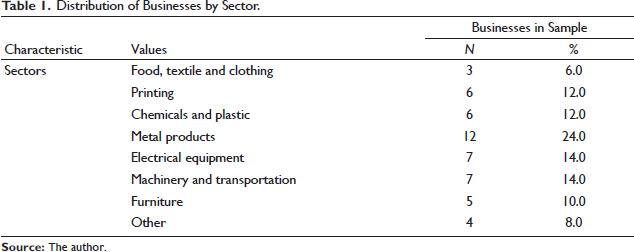
Table 1 shows that one quarter of the businesses are in the metal industry, another quarter in the chemical and plastics industries, and another quarter in the field of mechanical equipment and transportation.
In addition, 40% of the businesses in the sample have between 10 and 19 employees, while 26% have between 20 and 29 employees and 34% have between 30 and 50 employees. The average number of employees is M = 26.4 (SD = 13.9), and the average age of businesses in the sample is M = 29.3 (SD = 13.7). A total of 40% of the businesses export their products, and 50% of them work as subcontractors, while, for 90% of the businesses, most of their sales are to other businesses (B2B).
Characteristics of the Business Managers
The average number of years of management experience was M = 26.7 (SD = 10.4). More than 70% of the business managers had managed only one or two businesses, indicating that despite many years of experience, their management experience was not diverse. This finding can be explained by the fact that in 88% of the businesses in the sample, the manager of the business was also its owner.
Business Activity, Utilization of Open Innovation Tools and Implementation of Sharing and Cultural Processes During the Coronavirus Pandemic
The distribution of businesses according to the change in revenue during the COVID-19 period as compared to the same period last year is presented in Table 2.
Distribution of Businesses According to the Change in Revenue.
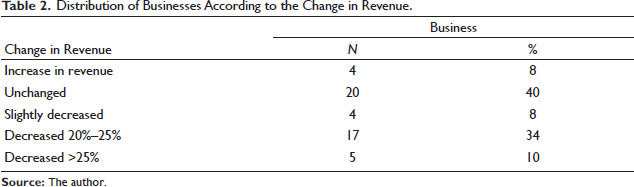
Table 2 shows that the revenues of half of the businesses did not decline as compared with the same period last year, and that 8% of the businesses actually showed a revenue increase for this period. Only 10% of the businesses suffered more than a 25% revenue drop as compared with the same period last year, while only one business—the apparel sector—completely ceased operations during the pandemic.
Following are quotes from the managers of businesses whose revenues increased during this period: C, manager of a business that produces electrical switches for communication networks, 100% of whose revenues come from subcontracting work and over half from export sales, said: ‘The communication equipment sector is growing, and during the coronavirus period it has actually grown faster. So, the company has recently enjoyed growth in activity’. According to Z, the manager of a business that manufactures plastic products, 95% of whose revenues are from subcontracting for customers in the defence industry and 25% from export sales: ‘Everything to do with defense just increased during this period, and so demand for our products grew’. According to M, the manager of a company that produces and markets manual irrigation system equipment, 25% of whose revenues come from subcontracting work and over half from export sales: ‘There’s been increased demand for irrigation products, along with growth in sales, especially to existing customers. The growth is due to the increased free time of private individuals who aren’t working, who apparently are devoting more time to their home gardens’. According to R, manager of a business that manufactures outdoor furniture, 100% of whose revenues come from subcontracting work for customers in the local market: ‘The coronavirus situation is good for the company, since there’s more work in the field of Perspex dividers’.
The distribution of businesses according to the extent to which changes or adjustments were made in the business activity during the COVID-19 period is presented in Table 3.
Distribution of Businesses According to the Extent to Which Changes and Adjustments Were Made in the Business Activity
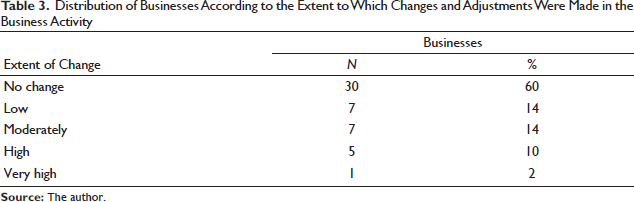
Table 3 shows that 60% of the businesses made no changes or adjustments to their activity (e.g., changes in the products or services they provide) during the pandemic, 30% made changes to a relatively low degree and just 10% of the businesses made changes to a high degree.
To follow are quotes from business managers who made no changes or adjustments in business activity during the pandemic. B, the manager of a firm that produces optical components for the defence industry, all of whose revenues come from subcontracting for customers in the local market, said: ‘There was no change in our existing business activity, as the company has a half-year order pipeline. There’s a risk that the problem will arise in the coming months, in fulfilling the order pipeline for the next period, since the customers’ purchasing departments are working at smaller volumes right now. Another impact is the cessation of new initiatives that we started on, as new equipment can’t be purchased and installed’. According to T, manager of a business that manufactures metal cable conductors for the electric power industry: ‘There was no change in our business activity or in the demand for our products, and we’re working as usual’. According to D, manager of a metalworking firm, 100% of whose revenues come from subcontracting work: ‘Our business activity volume declined due to a drop in orders, mainly from abroad, and so we stopped our night shift to cut expenses. Beyond that, we’ve made no changes or adjustments to our activity’. T, manager of a firm that manufactures elevator control products, 85% of whose revenues are from exports, said: ‘We’ve made no changes or adjustments as we’ve managed, despite everything, to maintain our activity level. The world is getting flatter and we can meet with customers via Zoom much more easily. This brought us closer to customers abroad and that’s a big change since I used to have to fly all the time in order to close deals’.
The distributions of businesses according to the extent to which there was a change in the business’ activities for identifying and obtaining knowledge from external open sources of information (‘knowledge-acquisition activities’) and to the extent to which there was a change in the business’ collaboration on innovation with external entities (‘external collaboration’) are presented in Table 4.
Distributions of Businesses According to the Extent to Which There was a Change in the Business’ Knowledge-acquisition Activities and External Collaboration.
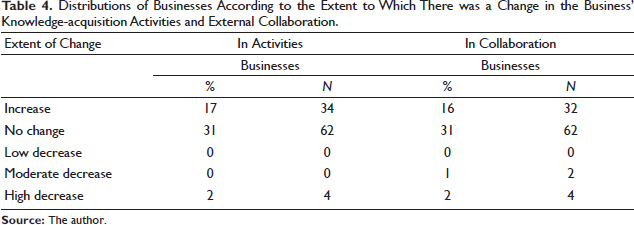
Table 4 shows that over 60% of the businesses made no changes during the pandemic in their activities to acquire knowledge from external entities, while a third of the businesses increased their activities in this sphere. Additionally, a quarter of the businesses anticipated that they would continue increasing their efforts to identify and acquire knowledge from external entities in the future, even once the pandemic ended and things returned to normal.
Following are quotes from managers who increased their businesses’ activities to identify and acquire knowledge. A, the manager of a paramedical equipment company that experienced no change in sales volume, said: ‘We succeeded in maintaining our revenue level because we developed a new product related to the process of filling syringes for coronavirus inoculation, which grew out of our relationship with our main customer, a large German firm. We heightened our efforts to acquire external knowledge for purposes of developing the new product and intensified our collaboration with the customer and with external consultants in order to advance the project’. According to O, manager of a company that manufactures printing products: ‘We’re trying to enter new fields such as printing on children’s toys, and to move in the direction of products rather than services, and so we need to acquire more external knowledge that isn’t in our possession’. According to P, manager of a business that produces car air conditioner components: ‘I was forced to make big changes due to operating in the field of passenger vehicles which took a harsh immediate hit. We entered new fields, such as coronavirus disinfection equipment, ambulance adaptation for transporting coronavirus patients, and the like. In light of our entry into new areas of activity, we had to seek new knowledge about things we weren’t familiar with’.
Table 4 also shows that, during the pandemic, over 60% of the businesses made no changes in the scope of their collaboration with external entities for purposes of innovation promotion, while a third of the businesses actually increased their collaboration levels. Moreover, 30% of the businesses anticipated that they would continue increasing their levels of external collaboration in the future, even once things returned to normal after the pandemic.
According to A, manager of a printing press: ‘Due to the drop-in activity, we entered into collaboration with another printing press firm that specializes in large format and doesn’t have digital activity, so we’re complementing each other’s areas of operation. We intend to continue growing this collaboration in the future, as the market is moving in the direction of creating large entities and moving to digital’. According to S, manager of a firm that produces duster cloths: ‘We were forced to make changes and adjustments to our products. We started collaborating with an external entity on a new product for covering children’s strollers for coronavirus protection, and on the production of special cloths and protective masks against corona’. Other business managers, including managers in the printing and metalworking fields, reported heightened collaboration with comparable businesses in the sector, not necessarily to promote innovation, but in order to effect savings and economies of scale by sharing production resources.
The distributions of businesses according to the extent to which there was a change in the sharing processes that were taking place in the business and to the extent to which there was a change in the cultural processes that were implemented in the business are presented in Table 5.
Distributions of Businesses According to the Extent to Which There Was a Change in the Sharing and Cultural Processes in the Business.
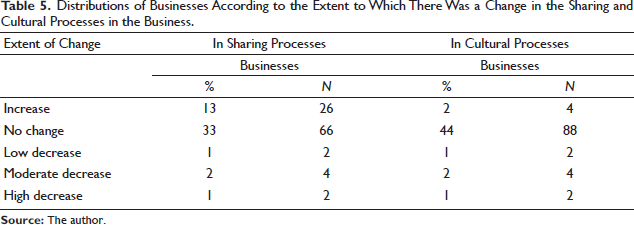
Table 5 shows that, in two-thirds of the businesses, there was no change in the extent to which sharing processes took place during the pandemic, while over a quarter of the businesses engaged more extensively in sharing processes. Additionally, 14% of the businesses anticipated that they will continue expanding their sharing processes even after the pandemic ends and things return to normal.
For most of the businesses that engaged more extensively in sharing processes, this was due to social distancing requirements and to the switch to online meetings, as well as to rapidly changing official guidelines and restrictions. According to the manager of a plastics business: ‘The shift to digital and to cloud computing brought an increase in the use of information-transfer and documentation processes, including online meetings via Zoom for information transfer, where everything is documented and recorded’. Another example can be seen in businesses that were forced to make changes in their activity and undertook new operations. As noted by J, the manager of a plastics firm: ‘We increased our information transfer to employees, because we had to transmit information to them for the development of the new activity, including knowledge we acquired from external consultants that also manifested in changes in the business’s computer and control systems’. According to Z, manager of a business that manufactures components for diamond processing machines: ‘I was forced to move employees to other jobs, due both to employee absences because of the restrictions and the desire to reduce expenses at this time, and so we had to expand the information transfer processes, including in the control processes’.
Table 5 also shows that 90% of the businesses showed no change in the implementation of cultural processes during the pandemic, and that two businesses actually expanded their cultural processes during this time. A total of 98% of the businesses anticipated no change in the assimilation of cultural processes within the business even after normal life resumes in the post-COVID-19 period.
Main Analysis
Following are the results of the tests to determine the differences between the groups of businesses—t-tests.
Revenues
Independent sample t-test results of the change in revenue and income from subcontracting work are presented in Table 6.
Independent Samples Test: Change in Revenue and Income from Subcontracting Work.
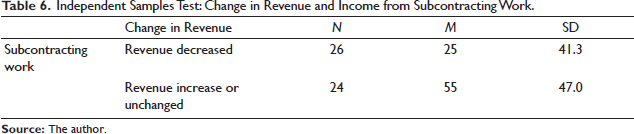
In the examination of the differences in rate of revenue from subcontracting work between the group of businesses whose revenues increased or stayed the same and the group of businesses whose revenues declined, it was found that the average rate of revenue from subcontracting work in the group whose income rose/stayed the same (M = 55.0, SD = 47.0) was significantly higher than the average rate in the group whose revenues dropped (M = 25.0, SD = 41.3) (t(48) = −2.40, p < 0.05).
Changes or Adjustments to Business Activity
Independent sample t-test results of the extent to which changes or adjustments were made in the business activity and income from subcontracting work are presented in Table 7.
Independent Samples Test: The Extent to Which Changes and Adjustments Were Made in the Business Activity and Income from Subcontracting Work.
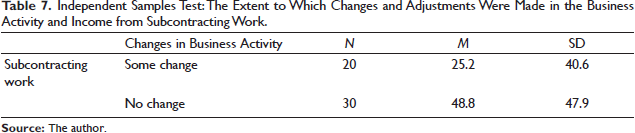
In the examination of the differences in rate of revenue from subcontracting work between the group of businesses where changes or adjustments were made to business activity during the pandemic and the group of businesses where no changes were made, it was found that the average rate of revenue from subcontracting work in the group where changes or adjustments were made (M = 25.2, SD = 40.6) was significantly lower than the average rate in the group of businesses where no changes or adjustments were made (M = 48.8, SD = 47.9) (t(48) = −1.81, p < 0.05).
Independent sample t-test results of the extent to which changes or adjustments were made in the business activity and export sales are presented in Table 8.
Independent Samples Test: The Extent to Which Changes and Adjustments Were Made in the Business Activity and Export sales.

Examining of the differences in revenue rate from export sales between the group of businesses where changes or adjustments were made to business activity during the pandemic, and the group of businesses where no changes were made, revealed that the average rate of revenue from export sales in the group where changes or adjustments were made (M = 31.8, SD = 41.4) was significantly higher than the average rate in the group of businesses where no changes were made (M = 12.6, SD = 25.9) (t(48) = 2.0, p<0.05).
Correlations Between the Research Variables
The correlation between the change in revenue and income from subcontracting work is presented in Table 9.
The Correlation Between the Change in Revenue and Income from Subcontracting Work.

*p < 0.01.
Table 9 shows positive correlations between the change in revenue and income from subcontracting work, that is, in businesses where income from subcontracting work is relatively high, their revenue during the COVID-19 period increased or remained unchanged.
No correlation was found between the change in revenue and export sales.
The correlations between the extent to which changes or adjustments were made in business activity and income from subcontracting work and export sales is presented in Table 10.
The Correlations Between the Extent to Which Changes and Adjustments Were Made in the Business Activity and Income from Subcontracting Work and Export Sales.

*p < 0.01 and **p < 0.001.
Table 10 shows positive correlations between the extent to which changes or adjustments were made in the business activity and export sales, and negative correlation between extent to which changes or adjustments were made in the business activity and income from subcontracting work, that is, in businesses where the revenue rate from export sales is relatively high, the extent to which changes or adjustments were made in the business activity during the COVID-19 period was higher, and in businesses where income from subcontracting work is relatively high, the extent to which changes or adjustments were made in the business activity during the COVID-19 period was lower.
Discussion
The present study empirically investigated the COVID-19 pandemic’s impact on the scope of operations and revenues of small businesses in industrial sectors as compared to the same period the previous year. It also looked at the extent to which businesses made adjustments or changes to their business activity in order to cope with the new challenges posed by the pandemic. We also looked at the relationship between a business’ rate of revenue from subcontracting work/export sales and its change in revenue/the extent of business activity changes or adjustments that the business had to make during the COVID-19 period.
Moreover, in order to assess the impact and future implications of COVID-19 for these businesses, the study asked whether, and to what extent, there were changes in the utilization of open innovation tools and in the implementation of sharing and cultural processes that could potentially promote innovation within the business and, accordingly, business performance.
Revenue, Changes or Adjustments to Business Activity, and Changes in the Utilization of Open Innovation Tools and Sharing/Cultural Processes During the COVID-19 Pandemic
The study findings showed that the revenues of over half of the businesses were not harmed during the pandemic as compared to the same period the year before, and even 8% of the businesses actually saw a revenue increase during the pandemic. These findings support research hypothesis H1, according to which the revenues of most of small businesses in the industry sectors did not decrease during the COVID-19 period.
The explanations given by the business managers for these findings focused on the sectors in which the businesses operate, for example communications, defence, medical equipment, plastic components for special uses—sectors that were not adversely affected by the pandemic. The managers also note their businesses’ ability to utilize new communication technologies like Zoom, which has enabled them to continue their business activity while staying in touch with employees and customers online.
Thus, the managers supported the study findings of Ting et al. (2020) and Webster (2020), regarding the adoption and utilization of new technologies during the pandemic, as well as the study findings of Vaccaro et al. (2020) and of Puddister and Small (2020), who argued that these technologies became one of the survival strategies during the pandemic, that enabled the management to operate remotely and conduct business meetings without physical contact.
The study findings showed that 60% of the businesses made no changes or adjustments to their business activity during the pandemic, thereby supporting research hypothesis H2. The business managers explained that they worked on the basis of a lengthy order pipeline, most of it subcontracting work for big customers, meaning that the demand for their products did not change during the period in question. Also, those businesses whose revenues declined during the pandemic made efforts to reduce expenses, whether by cancelling night shifts, laying off workers or other means; however, as noted, no changes or adjustments (e.g., altering the product mix or the means of service provision) were made to the business activity itself.
The findings also indicated that over 60% of the businesses made no changes during the pandemic in their activities to acquire knowledge from external entities or in the scope of collaboration with external entities. Moreover, a third of the businesses actually increased their activity in these spheres. The business managers explained the increased activity in terms of efforts to expand the product line or to enter new areas of activity—efforts that entailed the acquisition of new knowledge. Also, changes and adjustments to products, or the desire to reduce expenses and achieve economies of scale, led to increased collaboration with external entities, generally with a main customer or with other businesses in the same sector.
The findings also indicated that, for two-thirds of the companies, there was no change in the extent to which sharing processes took place within the business during the pandemic, while, for over a quarter of the businesses, such processes occurred to an even greater degree. In 90% of the firms, there was no change in the extent to which cultural processes were implemented during the COVID-19 period.
According to the managers of businesses who displayed greater engagement in sharing processes, this was due mainly to social distancing limitations and to the shift to online meetings, as well as to rapidly changing official guidelines and restrictions. And as the manager of a plastics business aptly noted: ‘The shift to digital and to online Zoom meetings led to increased utilization of knowledge transfer processes and to increased documentation’.
These findings confirm research hypotheses H3a and H3b—that most small businesses in the industry sector have not reduced their use of the open innovation tools and the extent to which sharing and cultural processes were taking place and implemented in the business during the COVID-19 pandemic period.
These findings are very encouraging in terms of the future, as most of the businesses maintained, and some even increased, their utilization of OI tools, and also continued engaging in sharing and cultural processes for innovation promotion purposes. One may therefore anticipate that the innovation level of most small businesses in the industrial sectors will not be adversely affected in the future, and may even rise, given the increased efforts of a large proportion of these firms to identify and utilize external knowledge, and the increased innovation-oriented collaboration with external entities (Harel et al., 2019b).
Impact on Revenues
The study findings showed that the rate of revenues from subcontracting work for those businesses whose revenues increased or remained unchanged during the pandemic was higher than that of businesses whose revenues declined, pointing to a significant relationship between the change in revenue levels during the pandemic and revenues from subcontracting work, such that businesses whose rate of revenue from subcontracting work was relatively high showed increased or unchanged revenues.
These findings support research hypotheses H4a and H4b, regarding the relationship between change in revenue and rate of revenue from subcontracting work.
Findings from previous studies support these findings of the current study. Nwokocha et al. (2019) found that the subcontracting relationship between large-scale industries and small businesses is inclined to production and product-related cooperation, where the contractors are concerned with meeting fluctuation in demand and shortening long delivery times. According to Nwokocha et al. (2020), production subcontracting strategy is instrumental in the survival of small businesses in the industrial sector, given the ability to guarantee reductions in operating costs and risk, and resources’ accessibility.
We can thus see that small businesses in the industrial sectors that work as subcontractors and, in particular, that have long-term contracts with big customers, are likely to cope better during periods of economic distress and under conditions of economic uncertainty. Businesses whose sales are based primarily on other businesses (B2B) and that do not serve private end customers (B2C) through face-to-face interaction, cope better during periods of restrictions and unexpected situations, such as a global pandemic.
No significant relationship was found between change in revenue during the pandemic and export sales. These findings do not support research hypotheses H6a and H6b. The findings contradict the expectation that businesses active in international markets and exposed to new knowledge and ideas that allow them to develop the ability to learn quickly and the flexibility to deal with change (Autio et al., 2000; Zahra et al., 2000) will be less adversely affected by extreme situations of economic distress, uncertainty and restrictions.
Changes or Adjustments to Business Activity
According to the study findings, the rate of revenue from subcontracting work for businesses that made changes or adjustments to their business activity is lower than the rate for businesses that made no such changes or adjustments. This points to a significant relationship between the extent of the changes/adjustments made to business activity and the rate of revenue from subcontracting work. In businesses where income from subcontracting work was relatively high, the extent to which changes or adjustments were made in the business activity during the COVID-19 period was lower.
These findings support research hypotheses H5a and H5b.
The study findings also demonstrated that export sales of businesses that made changes or adjustments to their business activity were higher than businesses that made no such changes, indicating a significant relationship between the extent of the changes/adjustments made to business activities and export sales. In businesses where export sales was relatively high, the extent to which changes or adjustments were made in the business activities during the COVID-19 period was higher.
These findings support research hypotheses H7a and H7b, showing that businesses active in the international market were exposed to knowledge and ideas that contributed to innovation and promoted business opportunities, thereby developing the capabilities and flexibility necessary to cope with change, to a higher degree than businesses active solely in the local market. Businesses active in the international market whose revenue rate from export sales was relatively high managed to make changes and adjustments to a higher degree, and to adapt their business activities to developments on the ground and to the changing requirements of customers around the world. They also succeeded in adjusting to the myriad trade restrictions imposed by different countries at different times and in varying degrees.
And as the manager of a firm that manufactured and marketed musical toys put it: ‘We’re exporters and we had to make changes and adjustments in order to cope with the restrictions that were placed on international trade, in terms of moving some of our activity online, in terms of price and product mix adjustments, and in terms of marketing adjustments, including the nature of our meetings with customers’.
The findings of earlier studies by Zahra et al. (2000), Autio et al. (2000) and Laursen and Salter (2014) support the present study’s findings concerning the relationship between business activity in international markets and development of the learning skills and flexibility necessary to cope with changes in the market.
Conclusion and Implications
The aim of the study was to empirically examine the COVID-19 pandemic’s impact on the revenues of small businesses in the industrial sectors and the extent to which these companies made changes in business activity, the utilization of open innovation tools and the implementation of various managerial processes. The study also looked at the relationship between revenue from subcontracting work/export sales and changes in revenue/the extent of changes or adjustments in business activity during the pandemic.
The findings showed that, despite the far-reaching impact of COVID-19 in all areas of life, and especially on the economy and the business sector, the revenues of most small businesses in the industrial sectors were not harmed during the pandemic, and most of these businesses made no changes or adjustments to their activity, or in the extent to which they utilized OI tools or implemented sharing and cultural processes.
The findings pointed to a relationship between change in revenue/extent of change or adjustments in business activity during the pandemic and revenue from subcontracting work. Those businesses whose rate of revenue from subcontracting work was relatively high did not suffer a decline in revenue and were not obliged to make many changes to their activities during this period. As mentioned, large businesses in certain industrial sectors that were defined by the authorities as essential for continuing economic conduct were allowed to continue their activities under some restrictions. Small businesses that served as subcontractors to those businesses were also allowed to continue their work. In addition, these small businesses continued to conduct their business activities without physical contact with their customers, even during the lockdown periods.
From this, we may conclude that small businesses in the industrial sectors that served as subcontractors and, in particular, had long-term contracts with big customers, were likely to cope better during periods of economic distress and uncertainty. Businesses whose sales were based primarily on other businesses (B2B) and did not serve private end customers (B2C) through face-to-face interaction coped better with restrictions and unanticipated situations.
The findings also pointed to a relationship between revenue from export sales and the extent of the changes or adjustments made to business activities during the pandemic. The findings showed that businesses active in the international market, whose rate of revenue from export sales was relatively higher, succeeded to a greater extent in making changes to their business activity and adjusting that activity to the changes underway and to the varying requirements of customers around the world, in accordance with the trade restrictions instituted by different countries.
The present study’s theoretical contribution consists in its focus on small businesses in the industrial sectors, with an emphasis on the work strategy of subcontracting and international activity as a factor that enables businesses to cope with difficulties and conditions of extreme economic uncertainty.
The study findings also make a practical contribution by suggesting that, given the significant contributions of production subcontracting and international activity to small businesses in the industry sectors, these strategies deserve development and policy support.
Such support will help these businesses survive and become stable, while fostering their ability to thrive in the future, thereby also promoting the economy’s resilience in crisis situations and enabling it to flourish.
Limitation of the Study and Future Research
The findings were based on data provided by business managers during the interviews and were based only on one manager per business.
Future research could expand the circle of research participants in each business, so as to cross-reference the responses.
Future study should also include larger sample of businesses as well as small businesses in other industries, such as commercial, service and financial companies and small businesses in the periphery. This would make it possible to determine whether differences exist between the various sectors, and whether geography has an impact.
In addition, it would be interesting to compare the effects and consequences of the COVID-19 pandemic to other economic crises and recession events that have occurred in the past.
Footnotes

Acknowledgement
The author is grateful to the anonymous referees of the journal for their extremely useful suggestions to improve the quality of the article. Usual disclaimers apply.
Declaration of Conflicting Interests
The author declared no potential conflicts of interest with respect to the research, authorship and/or publication of this article.
Funding
The author received no financial support for the research, authorship and/or publication of this article.