




Abstract
We peer inside the notion that small firm employment relations are a matter of mutual adjustment to conceptualise a key relation subject to negotiation as space–time–energy rhythms. Businesses must offer their goods and services in line with the rhythms of their marketplace and they do so by developing their own rhythms in the form of organisational roles and routines. Staff are only available to fulfil roles if they can synchronise work rhythms with those of their bodies, the people they care for, family members and care services. Mutual adjustment relies on synchronising organisational and market rhythms with non-business rhythms. This demands ‘rhythm intelligence’, practised by managers, workers and teams and, ideally, embedded as an organisational capability. Through empirical exploration of a typical point of negotiation – return from maternity leave – we propose a framework of practices and conditions that constitute rhythm intelligence and outline implications for managers and research.
Introduction
Understanding people management in small- and medium-sized enterprises (SMEs) is crucial to productivity, business growth and job creation and essential to designing employment regulations and good work (Taylor, 2017). Yet, there is relatively little research on employment relations in SMEs (Stumbitz et al., 2018) although related policies and practices are critical for productivity (Taylor, 2017). In this article, we take the established notion that small firm employment relations are a matter of mutual adjustment (Edwards and Ram, 2006) and suggest that it is time to peer inside this relationship to conceptually elaborate the structures subject to negotiation in the informally negotiated order of SMEs. It is also necessary to analyse the forms of management that support a fair and productive organisation of labour. Empirically, we focus on return from maternity leave as a common negotiation event.
We propose that space–time–energy rhythms are a key relation subject to mutual adjustment in workplaces, including during return from maternity leave. Our conceptualisation draws primarily from Toyoki et al. (2016) who define rhythms as recurring patterns of behaviour across time and space. For them, rhythms are not individual practices, but social patterns of action that are shaped by, and reproduce, or sometimes change, norms, governance regimes and distribution of resources. In other words, rhythms are constituted by, and produce, social structures. Building on Lefebvrian’s thinking, Toyoki et al. (2006) perceive rhythms as mechanisms through which a wider social order is normalised as ordinary and common sense and through which roles, and associated power to command resources and shape cultural schemas, are legitimised and enacted. 1
Societies are formed by multiple rhythms that inter-relate and conflict, mediate or support one another. According to Lefebvre (2004), they form a ‘polyrhythmic assemblage’ – a set of inter-relating rhythms that can be more or less stable. When rhythms synchronise well, there is eurhythmia. Eurhythmia tends to induce a sense of normalcy, so that rhythms themselves are hardly observed and the social structures they reproduce are hidden. Lefebvre explained that eurhythmia is always a fragile and political accomplishment such that when rhythms are in a high state of tension, there is arrhythmia. The polyrhythmic assemblage and the social structures it reproduces are threatened. In these circumstances, we are likely to become more aware of rhythm relations and the politics they support.
An easily relatable example concerns UK parents of school-age children. The rhythmic norm of separating work and home is enabled by the school system. However, conflict arises because ‘normal’ work rhythms are full-time and annual leave is a minimum of 28 days, while schools operate part-time and have long holidays. The resulting arrhythmia is not appropriately managed by the government providing wrap-around care; a patriarchal governance regime has chosen not to invest in resolving this arrhythmia. Instead, a social norm of women prioritising mothering by working part-time and close to home, and/ or using their wages to buy childcare services, stabilises the polyrhythm. This assemblage, in turn, reproduces gendered social structures in terms of men leading institutions that shape the governance regime, earning higher wages and having household power as breadwinners.
Masculine management tends to idealise linear rhythms amenable to rational planning (Acker, 1990). Such planning is blind to biological, emotional and care rhythms that tend to be cyclical, can change or breakdown and are not easily self-regulated. As these rhythms are a part of reality, all managers and employees are forced to manage periods of arrhythmia, when rhythms conflict. While small firm owner-managers do not have the power to change social rhythms such as school hours or market norms, they do have some power to adjust the rhythms of their own businesses. They regularly face the challenge of adapting organisational routines – the regular space–time–energy rhythms that produce business capabilities and structure roles and teams – to synchronise with the wider sets of time–space–energy rhythms that shape markets and labour (Glucksmann, 1995). It is in this process of creating a workable polyrhythm, with only a tolerable level of arrhythmia between business processes, labour and market rhythms that – we suggest – businesses create a productive labour process, competitiveness and fair working practices.
Toyoki et al. (2016) argue that actors tend not to innovate rhythms; they act through routine agency, performing practices that comply with norms, governance regimes and resource distributions handed on from the past. Through mass practice, routine rhythms are reproduced at a social level. However, Toyoki et al. (2016) do not support Bourdieu’s (1990a, 1990b) idea that social practices are so deeply ingrained that they form fixed habitus or fields. Instead, eurhythmia is destabilised by changes in the natural world, including in the human body, via tensions between rhythms and errors that occur through only approximate practical repetition of routine rhythms.
To innovate in light of conflict or change, Toyoki et al. (2006) tell us, organisations and staff must be prepared to relinquish routine rhythms; they then use practical-evaluative agency to improvise new practical rhythms in an attempt to cope with changed circumstances in the here and now. Or, more consciously and reflexively, they must enter imaginary space to use projective agency to design projective rhythms that synchronise within an imagined future. 2 Organisations cannot simply respond to an employee’s request to change their working practices without considering consequences for the market, suppliers or other employees. Nor are they free to plan for an imagined future that is highly unlikely; they have constrained power to shape social routines but, still, some power to coordinate routines locally into a polyrhythmic assemblage that is a workable labour process.
Following Lefebvre (2004), Toyoki et al. (2006: 104) stated that actors may have ‘more or less conscious knowledge of the various temporal and spatial forces that are in play in any given situation’. We suggest that humans have cognitive capacity to sense rhythms and that socio-cultural context can variably raise awareness of particular rhythms and establish them as individual, colleague or manager concerns. People, as creative agents, can also respond in a range of ways to the social structures that shape the rhythms in their contexts, including behaving otherwise to expectation, although not necessarily without consequences. 3 Of course, individual managers may not perceive rhythms; indeed, a prevailing neo-liberal and masculine management culture may encourage them to bracket labour rhythms outside of business operations as beyond their legitimate concerns (Acker, 1990). We suggest that conceptualising labour management using a rhythmic understanding is a route to challenging such ideas and to empowering small firm stakeholders to negotiate rhythms more consciously using rhythm intelligence. This may enable them to be fair employers and to be more innovative regarding productive labour processes.
In this article, we offer four contributions. First, to conceptualise mutual adjustment as a process often concerned with organising polyrhythms and so, involving practical and projective rhythm agency and adjustment. Second, to propose that SME managers, workers and teams require rhythm intelligence to develop and renew workable eurhythmic and fair polyrhythms; we articulate the commitment and capabilities on which rhythm intelligence depends. Third, to explicate the value of rhythmanalysis to peer inside mutual adjustment in SMEs by applying it in empirical analysis of a common negotiation event: return from maternity leave. Fourth, to conceptualise the practices and pathways that form rhythmic intelligent maternity management in SMEs, offering this as a contribution to the workplace maternity literature, as well as to entrepreneurship research.
We begin by establishing the need to peer inside mutual adjustment and proposing time-space-energy rhythms as a key form of social relation subject to negotiation. We then propose a form of rhythmanalysis, and our own concept of rhythm intelligence, as a powerful framework to support conceptual development. Following this, we conceptualise return to work from maternity leave as a rhythm negotiation. After outlining our qualitative study, we summarise the practices and conditions that create rhythm intelligent management in a discussion section. Finally, we conclude with a summary, implications for practice and research directions.
Peering inside mutual adjustment
Employment relations in small firms are often characterised as a mutual adjustment (Edwards and Ram, 2006), an accommodation between employers and employees formed through bargaining over pay, conditions, performance and benefit. Give, take, coercion, resistance, co-option and resigned resentment (Ram et al., 2007) occur through silent and inter-subjective moves (Wapshott and Mallett, 2013), and form an informally negotiated order (Holliday, 1995; Ram, 1994; Ram et al., 2007). Smaller employers tend to prefer informal management due to their desire to manage autonomously and flexibly. They promote reciprocity and interdependence through intimate everyday working and, in some cases, a feeling (or reality) of ‘family-ness’ (Ram and Edwards, 2003, Ram et al., 2001, 2007). In rhythmanalytic terms, SMEs are typically characterised by limited resources, governance regimes that demand role flexibility to suit organisational needs and management autonomy and cultural schemas of mutual obligation.
Of course, mutual adjustment may not lead to equal or fair adjustment. Employers command resources and role privilege so can withhold progression, benefits or even a job, and workers in small firms tend to have weak collective organising to redress this imbalance. However, employers can feel beholden to staff with particularly valuable and scarce skills or knowledge (Ram, 1999a, Wapshott and Mallett, 2013), and some small firm cultures are paternalistic, engendering worker engagement in return for a degree of protection from a pure market exchange logic. Employees can also withhold labour subtly, refusing to work flexibly across roles or peaks in demand, or productively (Ram, 1999b). In rhythmanalytic terms, they take some control over the resources, governance regimes and cultural schemas on which business rhythms are founded.
Worker interests might also be asserted through employment and equality law, a key part of governance regimes. However, in the United Kingdom, the threat of enforcement of employment regulations in SMEs is low. Owner-managers typically have only a partial understanding of regulation, learned on a need-to-know basis, and are resentful of time invested in regulatory discovery, unaware of its potential productive benefits. These conditions cause only vulnerable compliance or confident ignorance (Kitching, 2016). In rhythmanalytic terms, regulatory governance regimes have only a partial impact on cultural schemas, resource distribution and role relations; their power to shape rhythms is partially unrealised due to mediating forces.
As businesses grow, they tend to acquire professionalised human resource management and some medium-sized firms manage more formally (Micheli and Cagno, 2010). However, the path to formality is not linear or complete (Marlow et al., 2010); while line managers may be variably governed by human resource policies, they also exercise discretion and medium-sized firms commonly offer highly personalised working arrangements (Atkinson and Sandiford, 2016). It is noteworthy that only a quarter of professional managers understand that UK workers with more than six months service have the right to request a change in hours, time or location of work (Chartered Management Institute, 2019). Knowledge among SME managers is likely to be much lower, and so negotiations may still depend more on how a request reflects a manager’s or firm’s cultural schema and resources, including management skill, than on the regulatory aspect of governance regimes.
Wapshott and Mallett (2012: 75) argue that it is vital that research becomes more ‘sensitive to the spatial implications of work’. We suggest that the literature on mutual adjustment is ripe for conceptual elaboration and propose a rhythmanalytic framework that helps us to peer inside and see time–space–energy relations. In the following section, we apply rhythmanalysis to a common but neglected point of negotiation and adjustment: return from maternity leave (Lewis et al., 2014; Stumbitz et al., 2018). We then propose rhythm intelligence as a capability that drives mutual adjustment and good maternity management.
Applying rhythmanalysis to conceptualise return to work from maternity leave
Henri Lefebvre (2004: 15) proposed that ‘Everywhere where there is an interaction between a place, a time and an expenditure of energy, there is rhythm’ (emphasis in original). Lefebvre himself died before fully realising his rhythmanalysis project; consequently, rhythmanalytic research has morphed through the incorporation of other conceptual frameworks. Toyoki et al. (2006: 107) have conceptualised how society emerges not only across, but also through time–space revealing how, in social practice, ‘there will be a thick mingling of (spatial-temporal) social structures, traces of repetition of the past, practical engagements with the present, and vigorous attempts to imagine the future’ (Toyoki et al., 2006: 107). In this way, they conceive of actors ‘in a continuous cycle of reproduction with resources, cultural schemas and governance regimes’, these social structures being ‘at least partially experienced and interpreted by their spatio-temporal virtues’ (Toyoki et al., 2006: 104–105).
A rhythm is not an object, but the patterning of sequences of behaviour occurring across time and space (Toyoki et al., 2006: 108). For example, business or working hours and school or nursery schedules are approximately repeated patterns, and so routine rhythms. Lefebvre conceived of rhythms as disciplinary conditions where power and oppression are hidden by their normalising and naturalising effects (Reid-Musson, 2017). Through this lens, businesses, families, childcare and gendered roles are taken for granted social structures (systems of cultural schemas, resources and governance regimes) stabilised by their approximate eurhythmia (synchronicity) in a delicate polyrhythmic assemblage. Moreover, Lefebvre (2004: 8) said, ‘[e]verywhere there is rhythm, there is measure, which is to say law, calculated and expected obligation, a project’. People are compelled to take on different projects according to their roles which tend to prescribe some time–space–energy rhythms.
Within this article, we focus on the rhythms shaping new mothers, as they seek to return to work and so take on the discipline and project of reconciling care and paid work roles. In so doing, we build on the existing literature on workplace maternity management. Following Stumbitz et al. (2018), we consider three phases: pregnancy, maternity leave and return to work.
Pregnancy
Contemporary workplaces are characterised by masculine cultures that valorise masculine forms of embodiment. Ideal workers are relentlessly strong and healthy and the advent of digital technology has meant that professional workers, in particular, are expected to be ever-available for work (Bailyn, 2011, Lewis et al., 2017). Pregnant workers are ‘space invaders’ in these contexts, displaying unprofessional bodies that hint at prioritising family life and that threaten emotional and physical leakage that would breach masculine norms (see Gatrell, 2007, 2011b). In response, women typically perform maternal body work that conceals pregnancy symptoms, hiding the fecund body and its symptoms for as long as possible and then downplaying its effects (Gatrell, 2011a). To combat presumptions that pregnancy means permanently reduced commitment and capability (Gatrell, 2007), pregnant women tend to supra-perform (Gatrell, 2011b). This performance involves ignoring and disguising the symptoms of the pregnant body and tolerating discrimination in an act of maternal stoicism (Gatrell et al., 2014; Van Amsterdam, 2015).
In rhythmanalytic terms, pregnancy is an embodied process where the female body enters a novel rhythm of conception, gestation and childbirth. The masculine workplace is disrupted by the demands for care and rest that the fecund body may make and alarmed by the impending further disruption likely to be wrought by a dependent infant and breastfeeding woman. Women are conscious that organisations may respond by dismissing or side-lining them. In rhythmanalytic terms, women sense rhythm conflict and patriarchal norms and governance regimes. Fearful of loss of workplace role and wage resources, they tend to use practical-evaluative agency to display maternal bodywork and stoicism. This does not challenge extant social structures, or use projective agency to design a different future, and so largely reproduces masculine workplaces with the minor exception that mothers usually sustain their role in the organisation.
Maternity leave
Most countries provide some women with maternity leave rights (Addati et al., 2014) although it must be remembered that on a global scale, many have no right to maternity leave and do not receive maternity pay, often coping by caring and working simultaneously (Lewis et al., 2014). Maternity regulations enable the production of a new generation of healthy workers and consumers, ease the supply of female and male labour and so reduce pressure on wages, and enhance consumer markets by creating dual-earning families (Stumbitz et al., 2018). SME managers, and their competitors, do not necessarily see these wider conditions, however; employers are often unable to see that employment rights are part of the conditions that make markets function (Kitching et al., 2015). Consequently, small employers commonly perceive of maternity leave as an inconvenience (Equality and Human Rights Commission, 2016). There is some evidence that managers with more recent experience have less negative views (Carter et al., 2009; Edwards et al., 2004), suggesting that hostility relates to a masculine heuristic and that, in practice, maternity regulations provide some useful guidance. Nevertheless, it is widely assumed that small employers cannot afford to contribute to maternity leave payments (Addati et al., 2014) and some employers resist a process they see as insufficiently mutual, via discrimination (Equality and Human Rights Commission, 2016).
In the UK the key state intervention is to support employed new mothers by giving women a right to up to 12 months of maternity leave and up to nine months of Statutory Maternity Pay. Aside from 10 ‘Keeping in Touch’ days, women are not allowed to work during maternity leave. In contrast, paternity leave lasts for only two weeks, with fewer than a third of fathers taking it whilst the take-up of Shared Parental Leave is rare (Webber, 2018). Thus, infant care is squarely positioned as the work of mothers under UK law and culture.
In rhythmanalytic terms, maternity leave regulates women to step aside from workplace rhythms to focus energy on the time-spaces and effort of childbirth and infant care. Its institution as a right, rather than a norm, reflects market failure in terms of businesses self-regulating to respect new mothers as part of their cultural schema and points to the mediating role of the state as governor of polyrhythms under managed capitalism. Yet, maternity leave is also a rhythm that reproduces masculine organisations in two ways: first by cleaning up a time of complex inter-dependencies, it actively produces the workplace as a logical place of production, separate from the ‘messy’ and feminine rhythms of reproduction, and second by creating a role and a discipline for women to lead childcare and homemaking.
Return to work
As the notion of the ideal worker, whose embodiment is relentlessly available, is still the hyper-masculine hero (Acker, 1990), returning to work as the mother and, socially, the primary carer, of an infant relies on continued maternal body work and stoicism. Maternal body work on the return to work means disguising the demands of infant care, and either ceasing or disguising the work of breastfeeding. Maternal stoicism, at this stage, is the labour of ignoring cognitive or emotional symptoms, such as exhaustion or identity conflict, and tolerating being side-lined or discriminated against when the demands of the child or breastfeeding leak through into the workplace or in response to stereotypes about the reduced commitment and capability of new mothers (Gatrell, 2011b). Women commonly accept being side-lined or low pay as an inevitable outcome of requesting flexible or part-time working (Baughman et al., 2003). Workplace adjustments on return to work may depend on having extra credits with an employer. As maternity progresses, credits are spent but women’s maternal body work and stoicism does not accrue new credits. A credit balance sheet becomes depleted (Dex and Scheibl, 2001), and so their power progressively wanes during the maternity process (Buzzanell and Liu, 2007). Women in their first maternity experience may notice this dynamic and respond tactically by building up their credits before having a second child (Gatrell, 2013). Some women cope with lack of employer adaption by silently excluding themselves from the workplace (Gatrell, 2013).
In rhythmanalytic terms, gendered cultural norms charge mothers with the project of taking lead responsibility for family care and making this as linear as possible to synchronise with the norms of masculine business practice (Blum and Nast, 1996). The state and employers in most countries provide limited childcare services or encouragement to fathers to care, positioning mothers within a chronic social arrhythmia. The expectation of juggling care and paid work mean that new mothers face rival and excessive demands on their labour resource. Even when women manage to co-ordinate work and care, family rhythms tend to interrupt, such as when a child is sick. Periodic acute arrhythmias then arise as projects compete for the mother’s energy at the same time, but in different roles and spaces.
Post-feminist culture idealises women who successfully juggle motherhood and work as the epitome of feminine accomplishment (Lewis et al., 2017). The suffering and career trade-offs arising from their excess of projects and roles are silenced by this norm and mothers face an individualised over-load of work: a highly individualised arrhythmia. Rhythms can be so naturalised they are only noticed or questioned when they conflict and threaten to break (Reid-Musson, 2017). Yet, the post-feminist mother is socialised not to admit such failures or to perceive her ‘personal’ struggle as a fault of society or indication of social injustice. On return to work from maternity leave, women are not empowered to challenge established rhythms but primed to negotiate an accommodation that will demand ongoing maternal stoicism and maternal body work.
A rhythmanalysis of managing return to work part-time
We focus on women who respond to social arrhythmia by requesting to work part-time following maternity leave. These are provocative requests for employers to accommodate interests that masculinist culture tells them are outside of business concerns. The very term part-time signals deviance from a full-time norm and shapes widespread employer presumptions that new mothers lack commitment and capability (Gatrell, 2007; Haynes, 2008a, 2008b). We propose that fair and productive maternity management means giving up the ideal worker norm and actively managing the real assemblage of bodily, social and organisational rhythms in which SMEs and new mothers are situated. Lefebvre encouraged us to analyse significant moments when orthodoxies are challenged and to think about how new rhythms weaving into everyday life may transform society (Verduijn, 2015). We use rhythmanalysis to conceptualise return to work from maternity leave as just such a disjuncture that can either harden masculine power over workplaces or shape more gender equal organisations.
Thus far, the small business management literature has largely ignored the challenge of managing maternity despite SMEs being the context in which millions of women internationally strive to reconcile their gendered family lives with paid work (Rouse and Sappleton, 2009; Stumbitz et al., 2018). We do know that small firms lack useful support to manage maternity fairly and productively (Rouse and Sappleton, 2009) and have a high incidence of maternity discrimination (Equality and Human Rights Commission, 2016). New knowledge about what characterises fair and productive maternity management is, therefore, urgently required. To contribute to this debate, we draw upon a small empirical study to conceptualise maternity management as a form of rhythm negotiation and to propose that fair and productive maternity management demands an individual and business capability we call ‘rhythm intelligence’. Small firm managers do not have full control of social rhythms, but they do have some command of internal norms, governance regimes and resources. They also have the capacity for practical-evaluative or projective agency to design labour processes. We propose that business regulation and support can shape both their contexts and their practices to foster rhythm intelligent maternity management.
As return to work from maternity leave is part of a temporal series, in which each interaction creates the conditions for future actions, we explore the propensity for path dependency in rhythm intelligent management, starting from pregnancy. Our empirical work is not intended to identify typical SME maternity management but to show the power of our framework to explicate some of the types of practices and conditions on which rhythm intelligent maternity management depends. Our wider aims are to demonstrate the value of rhythmanalysis as a means of peering inside mutual adjustment and explain people management in SMEs, and to point to a broad research agenda.
Methodology
Maternity management was selected as the focus of our rhythmanalysis of mutual adjustment due to a paucity of research globally and urgent social need for conceptual development to support this agenda (Stumbitz et al., 2018). We adopted a qualitative research design to enable biographic interviewing. At that stage, our interest was in return to work from maternity leave and our aim was simply to engage with the lived experience of our participants. We were aware that, to obtain rich data, it was necessary to understand return to work in its temporal context. So, we structured interviews to generate a biographic account of the relationship between employee and manager pre-pregnancy and during pregnancy, before talking about maternity leave and return to work. We were also aware that negotiations would be influenced by the future plans and goals for both employee and manager and so we also enquired about this. In short, while not explicitly attempting to make space-time-energy rhythms a subject of discussion at this point, qualitative interviews enabled us to capture the way in which past, present and future collide in the context of maternal return to work negotiations.
Semi-structured, biographic interviews have been used successfully in exploring the complexities of spatio-temporal lived experience (Tietze and Musson, 2005). Lee (2017: 257–258) suggests using semi-structured post hoc interviews when researching ‘where co-presence is impossible or difficult to sustain . . . making it impossible to conduct traditional ethnographic fieldwork’. We also acknowledge the possibilities for more immersive approaches (Edensor and Holloway, 2008). However, we note challenges when endeavouring to ‘situate oneself simultaneously inside and outside’ polyrhythms (Lefebvre, 2004: 27). For instance, Warnes (2018: 142) argues that, at times, ‘rhythmanalysis researchers need to observe from a point of distance’. In small firms, conducting rhythmanalysis ethnographically is likely to be intrusive and most viable when influencing the organisation is a stated aim, as in action research. This would be an interesting approach to developing rhythm intelligent organisations in the future.
In this exploratory study, where we focus on developing the concept of rhythm intelligence, biographic interviewing proved effective enough to apply our rhythmanalysis technique and demonstrate its value. In fact, rhythmanalysis only became our focus as we began to analyse the data. The original team spoke with a colleague who has employed rhythmanalysis elsewhere (Rowe, 2015) and saw potential in furthering a rhythmanalytical approach to peer inside mutual adjustment. Our research aim then shifted to the development of rhythmanalysis as a conceptual tool for thinking about people management in SMEs as well as making theoretical claims about the processes occurring in workplace maternity management. We considered the quality of our data in relation to this new aim and assessed that it was adequate for our exploratory analysis.
Clearly, we cannot make quantitative estimations of the prevalence of particular forms of maternity management. This is not our aim. Rather we seek to demonstrate the benefits of our rhythmanalytic approach to analysing small firm employment relations and to identify how forms of maternity management relate to prevailing social conditions in terms of the norms, governance regimes and resource distributions that support them and that they (re)produce.
Interview panel
It was crucial to understand employer and employee perspectives and so we sought interviews with managers and staff who had been involved in requests to return part-time following maternity leave. Adopting conventional definitions (European Commission, 2016; OECD, 2005), we limited recruitment of our interview panel to firms that are small- (under 50 staff) or medium-sized (50–249 staff). As flexible working and so, cultural norms vary by sector, we sought to explore a range of business contexts and occupations and so recruited firms from different industries including those with some of the highest (professional services) and lowest (construction and manufacturing) rates of flexible working (Department for Business Innovation and Skills, 2012). To support this comparison, we restricted recruitment to a single regional setting, in the North West of England.
Recruitment was multi-faceted. A shortlist of 20 firms was compiled using the FAME database that collates publicly available information about public and private limited firms in the UK. A standard letter inviting manager or employee participants was emailed to named individuals in each firm, either directors or HR managers. Firms that did not respond were then contacted by telephone; this method resulted in two employees and one manager agreeing to participate. The relatively low response reflects the low priority or sense of inconvenience in the so-called proper management that maternity management can engender and nervousness about talking about a contentious employment process.
Messages seeking employee participants were posted on websites frequently visited by mothers with young children, for instance, Mumsnet. This method yielded two employee participants, again reflecting ambivalence to discuss difficult social processes that are often hidden from sight and debate. The remaining five respondents were recruited through the networks of one of the authors, reflecting the importance of trust in addressing difficult employment events. As our study does not aim to be statistically generalisable, we did not seek a representative panel. However, in our later proposals regarding future research, we do acknowledge how the specific nature of our interview panel limits of our capacity to explain workplace maternity negotiations and outline priorities for future study.
Interviews
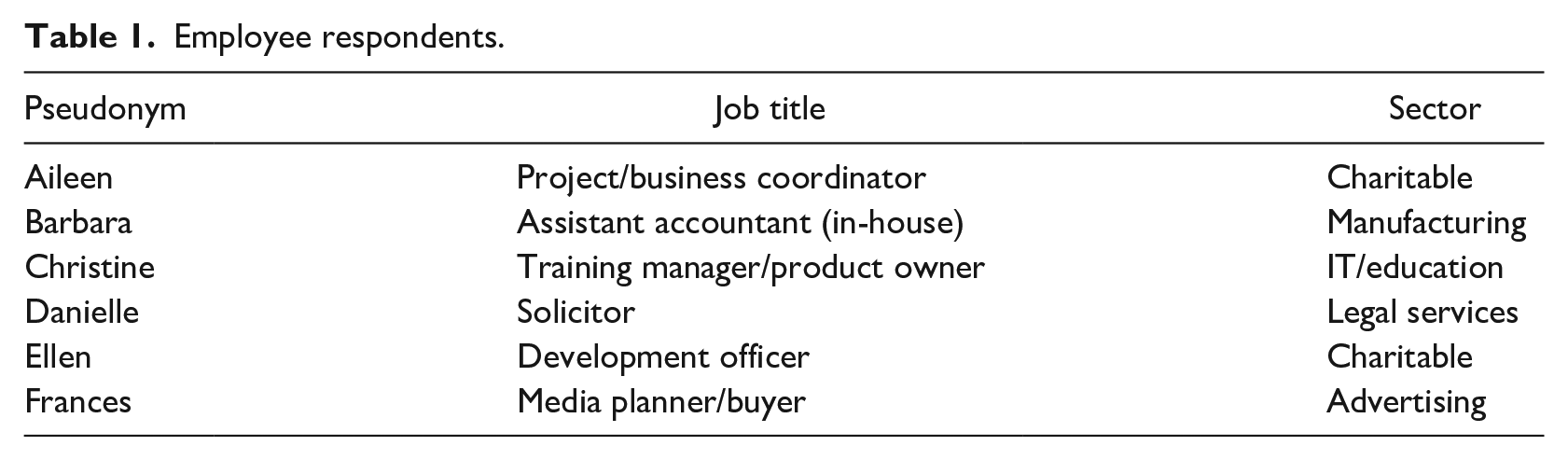
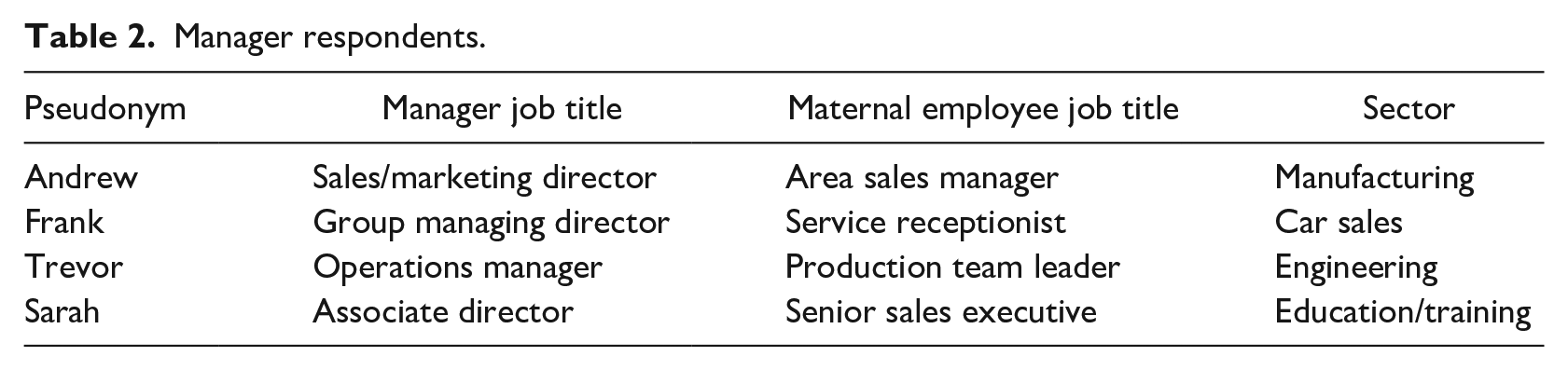
Semi-structured interviews were undertaken with six employee and four manager participants (see Tables 1 and 2 for details of their job titles and sectors). The interview schedules took the employees through a series of questions that produced rich data about the nature of their work pre- and post-maternity leave and the process of making a request to return to work part-time. Managers were asked to recall their most recent experience of managing an employee who requested part-time work and to focus discussion on this example. Interviews lasted 45–90 minutes were recorded and transcribed.
Employee respondents.
Manager respondents.
Data analysis
The authors adopted a data analysis technique based on Nadin and Cassell’s (2004) matrix analysis, which itself derives from the work of Miles and Huberman (1994). Matrices are a means of summarising data and analysis without over-simplification. They can be used to present data in a descriptive or explanatory way (Miles and Huberman, 1994). Typically, matrices are organised so that each theme has a row and each period of time a column. Summarising and analysing data for each respondent in such a matrix enables systematic analysis by theme and understanding of how phenomena within themes arise from relations to other themes and, so, wider contexts. In other words, they support within-case analysis across-themes and across-comparison by theme, over time.
Our first matrix employed codes that were essentially descriptive, for example, outlining participant comments on the relationship with their manager before, during and after maternity leave, and this enabled description of what had happened in each case (Nadin and Cassell, 2004: 272). These codes were in rows and each phase of the maternity process was a column. The second stage involved creating new matrices that collated interview data around rhythmanalysis-related themes. These matrices were explanatory in nature. This technique helped us to analyse interviews systematically and to use rigorous comparison with extract further insight into the varying conditions of action and behaviours that engender individual outcomes. This stage was crucial to thinking about the pathways of rhythm negotiation from which particular return to work experiences emerged. Cross-case analysis enabled us to deepen understanding of each case by increasing sensitivity to how each case relates to its particular context. It also supported us to use similarities between cases to point to how they emerge from social structural conditions that the wider research base suggests are common. Thus, while we did not seek statistical generalisability, we are able to make some claims about factors that are likely to have a regular effect on workplace maternity management in SMEs.
Ultimately, data analysis devices, such as templates, do not produce research findings. Our research team used them to explore ever more deeply what was occurring in each case. Template analysis enabled us to be rigorous in the sense of subjecting all of the cases to analysis in relation to key themes and to use cross-comparison to draw out our understanding of the context and action that shaped each case. Ultimately, some analysis occurred as we wrote about the cases and developed a narrative to explain them. The rhythmanalytic framework encouraged us to link empirical reports to our knowledge of wider social conditions.
We present our conceptualisation of rhythm adjustment and rhythm intelligent management practice during maternity leave and explicate this at crucial points through case examples. Where we seek to illustrate pathways effects, we have consciously chosen to re-visit particular cases across the maternity process. The trade-off is that we do not quote from all respondents directly. However, our rigorous across-case analysis and higher level conceptualisation means that the rhythmanalysis framework we propose does explain all cases. In the discussion that follows our analysis of maternity management, we draw out the practices and conditions of rhythm intelligent management and, so, make a more generalisable contribution to understanding employment relations and mutual adjustment.
Peering inside return to work from maternity leave: mutual rhythm adjustment via rhythm intelligence?
We propose there are five key sets of rhythms at work in the polyrhythmic assemblage subject to negotiation during workplace maternity management: the woman’s role, the organisation, more specifically, the team in which the woman’s role is embedded, the woman’s embodiment, her physical body, bodily experience and conduct and social interpretation of her body, her baby’s embodiment and infant care services, such as family, public or commercial. We asked about the negotiation between the new mother and her manager, a conversation centred on her role within the organisation; thus, we focus on the first three rhythms while retaining a broader view of polyrhythmic relations.
Pregnancy: establishing a rhythm intelligent pathway of fair and productive adjustment?
Rhythm intelligent management emerged from both manager willingness and capability to practise rhythm intelligence. Manager willingness depended on a values-based commitment to empower or protect the pregnant worker and to achieve fair and productive synchronicity between worker and role. Ideally, this arose from a gender-aware or feminist valuing of women’s sexed and gendered reproductive work and their enduring work capability and commitment. Ideally, this would rely on having political sensitivity to workplace norms as socially constructed, politically laden and mutable – viewing pregnant and maternal embodiment and the incursion of governance regimes shaping reproductive roles as legitimate disrupters. A more paternalistic protection of women’s ‘essential’ work as producers and carers for children also motivated a degree of rhythm intelligence by provoking sympathy for the range of domains a woman must juggle. However, paternalists also presume that mothers have essentially reduced work commitment or capability (Gatrell, 2013); their rhythm intelligence may be mediated by a narrowly masculinist and short-term business case heuristic (Hahn et al., 2014). We found that a manager’s personal experience – and, so, sex, life course and generation – was influential here. Aileen’s manager had recently become a father and this seemed to motivate him to accommodate her request for flexible working through a form of paternalistic sympathy. Sarah was able to empathise with, and legitimise, her pregnant employee from a more feminist perspective. She knew what it meant to have new mothering responsibilities, but she had also sustained her career and was keen to support this employee to do the same: obviously I’m a woman and I’d had my daughter by that time, so I knew what it was like, and how you feel, you feel different, so I could empathise with the situation and I was really keen to keep her engaged and motivated.
Here, we see examples of managers with firsthand experience of having to cope with the frequently competing rhythmic demands of pregnancy, childcare and paid work. The father experienced this from a masculine position and his response was more paternalistic. Sarah sensed the importance of protecting a woman’s engagement during the strain of juggling pregnancy, infant care and work, perhaps sensing the cultural pressure to prioritise mothering to the detriment of career pathways. Her ongoing support for the pregnant employee that she was responsible for also suggests belief in her work capability and potential for career development.
Capable rhythm intelligent management depends on four practices. First, being aware of polyrhythms, including those outside the manager’s immediate domains of interest, and second, sensing or predicting arrhythmia. Under normative pro-masculine and neo-liberal structures and role relations, the key domains associated with the management role are the organisation and team. As expected, we found that workplaces tended to be founded on the routine rhythm of separating work and home. Ideal worker norms were challenged when women’s fecund bodies and reproductive labour were brought into the workplace. The degree of challenge depended on the woman’s pregnant embodiment. It is useful, then, to compare the experiences of two employees reporting arrhythmia due to physical demands that made sustaining routine work difficult.
Barbara worked in a formal and structured office environment where progression depended on the traditionally masculine behaviours of hard work and dedication to the organisation or, in other words, bracketing of distracting rhythms from home, leisure or body. She wanted to progress in her career and had internalised the rules of the game: I was committed and I did want to further my career, and you know, was dedicated and working hard.
However, Barbara had a complicated pregnancy and had to attend additional medical appointments. This meant she was contravening the workplace culture of sustaining an ordered and intense rhythm. Her symptoms meant that, as the pregnancy progressed, it was difficult to sustain a high workload. However, her employer did not anticipate the need to adjust rhythms or respond to signs she was struggling: … I didn’t feel that the pressure . . . or my workload was relieved, even though I was obviously, you know, poorly and things. So that was quite difficult . . . It was still the fact that, you know, I still had the same pressures and that was quite difficult when you’re tired and really sometimes I just felt like I wanted to go home and go to bed and it was quite difficult when I had to do a full day’s work . . .
In fact, Barbara did not request a change to her working hours. The typical small firm management technique of silent inter-subjective negotiation (Wapshott and Mallett, 2013) was ineffective in prompting employer adjustment when a worker, socialised into the primacy of masculine work practices, feared being ignored or sanctioned. She silently acquiesced to suffering arrhythmia via maternal body work and maternal stoicism (Gatrell, 2013). In analysing the silences in Barbara’s account, it seems likely that both manager and worker presumed accommodation to the pregnant body was an illegitimate organisational concern. Failure of employer adjustment was disguised by the woman’s edited disclosure of arrhythmia. Her manager may not have sensed arrhythmia at all, or they may have more consciously disregarded it as an illegitimate concern. Barbara’s embodiment meant she was aware of the arrhythmia but she did not seem to reflect or act on the possibility of challenging workplace norms by raising her need for adaption. Thus, we can see rhythms reproduced through repression of rhythmic awareness and sensing – or challenging – of arrhythmia.
Conversely, Ellen’s manager anticipated that bodily change during pregnancy may require adaption to organisational rhythms. She moved into projective agency, that is, imagining and designing the future, by undertaking a risk assessment. This is a resource recommended under health and safety guidance that is effectively a scaffold, a supportive structure of questions that enables diagnosis or foreseeing of arrhythmia between body, role and team and for entering a projective space to design future time–space–energy patterns. It is likely that Ellen’s manager was enabled in this by a governance regime that legitimated and prompted the risk assessment process. It resulted in a reduction to Ellen’s work-related travel, which was a great help to her during the pregnancy.
The third practice of capable rhythm intelligence management is ambidextrous use of practical and projective agency to develop a workably eurhythmic polyrhythm. This is either in the short-term, as practically improvised responses to changing and unforeseen circumstances, or via projective design of new routines to suit expected future circumstances (Toyoki et al., 2006). In workplace maternity management, the five domains of rhythms at work are challenged by change in two of them: the woman and the baby’s embodiment. The mediating influence on others is likely to be complex and difficult to predict. Of course managers or women may also have partial awareness of polyrhythms and have only limited control of each rhythm due to the other actors, or physiological processes, at work. Thus, while projective design is important, managers and workers must accept that the polyrhythmic assemblage that emerges may not be the one they intended; they must accept this partial control, remaining open to sensing arrhythmia and willing to ambidextrously move from projective design to practical adjustment.
Ideally, managers draw on the fourth practice of capable rhythm intelligence – co-creation – to adjust. A pregnant worker may be invited or nurtured by their manager to co-practise rhythm intelligence: appreciating polyrhythmic assemblages, sensing arrhythmia and using practical and projective agency and collaboration to co-design a mutual adjustment with them. Below, Ellen suggests she was uncertain about achieving synchronicity after childbirth, saying ‘if I came back’, but her manager seemed confident they could navigate the future by employing, together, iterative rounds of planning and practical adaption to emerging circumstances: … . . we talked about what we were going to do and how we would look at maternity cover and things like that and . . . how would we plan for that, you know, to make sure that the person who would take my job, for that time, would know and wouldn’t leave it in a situation where I would struggle if I came back, if that makes sense.
Ellen’s inclusion in the management of her role, even during her leave, seemed to calm her fears about likely arrhythmia and reassure her that communication and adjustment were open and ongoing. She was confident her employer would adjust to enable her to cope with her baby and career, even though future circumstances were hard to predict.
Some managers seemed to over-rely on autonomous projective agency during pregnancy, heedlessly bringing the future into the present by producing a new routine rhythm without the woman’s co-creation and effectively excluding her from part of her role before she went on leave. Under UK law, excluding a pregnant worker from development opportunities may be discriminatory. Some women seemed to sense a loss of role and status and resisted this adjustment. Barbara, for example, voiced frustration at not being allowed to participate in new projects that would continue after childbirth. If projective design is underwritten by a paternalistic stereotype that new mothers are less capable or committed (Gatrell, 2013), it is unsurprising that it will create anxiety that adjustments create excluding routines. In contrast, manager Sarah co-created maternity cover and transition arrangements. Through shared projective agency with her employee, she achieved an engaged and productive employment relationship: … we just got on because I asked her how could we adapt the role, what was her idea, and because she felt that she’d had more of an input, it just helped the relationship and then she . . . yes, so I think it was positive.
Heedless projective adjustment also resulted in pregnant women feeling under pressure to finalise their maternity leave plans and return to work date prematurely during pregnancy. Frances said, I did feel like I had to try and tell her [her manager] what I wanted to do in advance and make my mind up . . . I get from her point of view she needed to know whether to get someone for six months cover or a year’s cover, but there were times when I think she was trying to ask me things that she possibly shouldn’t have done until later on, purely out of a need to juggle her staff.
Frances’ manager wanted to project a return to work date during pregnancy to employ replacement staff for the correct period. This reflects her responsibility to manage a polyrhythmic assemblage. Her projective agency was narrowly executed in that she only imagined changing role occupancy, via maternity cover, as a means of coping and, even then, foresaw this as either a six- or 12-month contract. More flexible options were not imagined; for example, advertising a role as six months in the first instance and managing any later need for cover as a practical adjustment to that contract, or making a team adjustment to roles. Limiting projective design to thinking about role occupancy meant that, on return to work, Frances’ request to work part-time was managed by reducing her hours of work, but not her role. Adjustment often relies on a team consenting to change polyrhythms and so there is a logic for involving team members outside the manager-worker dyad in co-creation. This depends on managers and pregnant workers sensing the arrhythmia that may arise for colleagues as the pregnant woman’s body and roles change. It means raising the human capital of rhythm intelligence in teams and providing a coordinating function to facilitate co-creation of a new, mutually adjusted polyrhythmic assemblage to which all parties consent.
In governance regimes that structure time–space and labour as impersonal, individualised and abstract (Toyoki et al., 2006), or where time–space–energy rhythms are already intensely exploited, relations between staff and managers, and between colleagues, may be too frayed by class relations or too normatively masculine to expect a feminist or even a paternalistic commitment to rhythm intelligent collegial adaption. We identified a case where individual workloads were coterminous with serving a spatial terrain and the rigidity of this approach, combined with masculinist business heuristics (Hahn et al., 2014), shaped a pathway low in rhythm intelligence. It ended with a woman being refused part-time work and a business losing a skilled worker. When Andrew’s area sales manager was unable to sustain extensive driving late into pregnancy, he adjusted but with autonomous and exclusively practical-evaluative agency. He divided her territory (an abstract and individualised concept of space and of the time–space–energy rhythms of labour) between the other Area Sales Managers, seemingly without consulting them or his pregnant worker. She responded defensively, refusing to hand over some tasks, while her colleagues suffered work intensification. When this member of staff, described by Andrew as high-performing and with scarce skills, requested part-time working on return to work, he accepted this change but treated it, in his words, like a ‘phased return to work’, with the aim of her returning to full-time work relatively quickly. His response to pregnancy was low in co-creation and projective agency and this set the business on a pathway of unsustainable rhythms, low rhythm intelligence and to the unproductive outcome of suffering disruption during pregnancy and maternity, yet still losing a valued staff member.
Overall, we found that the establishment of fair and productive rhythm intelligent pathways during pregnancy varied according to the willingness and capability of individual managers. Negotiation with team members was rarely mentioned and pregnant workers were more often involved in absorbing arrhythmia via maternal stoicism and body work than being a partner in practical and projective adjustment. While wider organisational employment relations were influential, we identified very little evidence of rhythm intelligence being embedded in routine management or team behaviour; rhythm intelligence was therefore not established as an organisational capability but depended on individual manager capability and norms.
Maternity leave: separating rhythms and preparing for a new polyrhythmic assemblage
Willingness to practise rhythm intelligent management of maternity leave means being willing to occupy more than one time–space, planning maternity leave during pregnancy and return to work during maternity leave. It also involves willingness to forego established routine rhythms and instead employ projective agency co-creatively with pregnant workers and teams, to iteratively plan and negotiate consent for new polyrhythmic assemblages. In the UK, women usually plan to start maternity leave in the few weeks prior to an expected delivery date but if a woman is unwell in late pregnancy or labour is premature, she, or her employer, can trigger maternity leave. Managing the reordering of rhythms requires practical as well as projective agency, then, to respond to the pregnant body.
Despite its virtual inevitability, businesses often fail to plan for maternity leave (Stumbitz et al., 2018). However, we did observe examples of effective planning. Barbara’s manager identified a member of staff to cover her role and planned a four-week handover in late pregnancy. While she had not responded with empathy and practical-evaluative agency to Barbara’s pregnancy complications, she did adopt projective agency to plan a linear progression from pregnancy, probably because maternity leave is a clearly regulated rhythm. In fact, Barbara’s baby arrived five weeks premature, reducing her handover to one day. Barbara was now on maternity leave, separated from the work domain and excluded from co-creation. This removed her chance to influence how roles were altered and to negotiate a return to work part-time. Her manager favoured clean time–space separations of reproductive and productive labour, with roles undisturbed except for role occupation. Barbara’s request to return part-time made during maternity leave was initially rejected, leaving her isolated and worrying about future arrhythmia and dispute.
In most cases, interaction during maternity leave was scarce and short, staccato disruptions that did not unsettle, or innovate, the primary pattern of dividing work and home, worker and employer and that often stabilised role design by only changing role occupancy. This created little chance for mutually reflexive time–space to learn about one another’s rhythm domains, foresee potential arrhythmia and projectively design a new polyrhythm with teams, including role design for part-time working. Babies were brought to work in the tradition of showing them off – a routine that blurs spatial-temporal boundaries for a short period. By displaying the woman as rooted in reproductive labour, it may call out a paternalistic protection of her essential family focus rather than a feminist commitment to her productive capacities and complex polyrhythms. This polite and occasional engagement concealed a pathway of poor communication and unspoken mutual suspicion about legitimate interests and future rhythms, given impending return to work negotiations.
Returning to work: designing and legitimising part-time work?
Gendering processes, including maternity regulations, mean that women in the United Kingdom are still positioned as primary carers for infants and coordinators of formal and informal care (Ridgeway and Correll, 2004). 4 Infant care is expensive (OECD, 2017) and its costs only partially offset by government assistance; scarcity and flexibility of provision is also a problem (OECD, 2017) and most carers will not look after sick babies. When arrhythmias arise, women commonly have little choice but to provide care labour. Requesting part-time work can be perceived as falling short of the masculinist ideal worker, but it is actually a means of navigating gendered structural conflict and social arrhythmia in the total social organisation of labour.
Most of our respondents sought part-time work using the right to request flexible working that became law in April 2003. Requests raised manager awareness of worker reproductive rhythms, as far as these were disclosed, but did not compel them to adjust. Neither did it provide managers or teams with commitment or capability for rhythm intelligence. We found that requests to work part-time are culturally legitimated during the latter part of maternity leave. This is, in part, because the governance regime of maternity regulations obliges women to give the notice of eight weeks of their intention to return to work. As women are not obliged to make a return to work commitment, and can change any early plans, some managers postpone communication until a woman notifies their intention to return to work. When a woman simultaneously signals her return and makes a request to return part-time, managers have limited time to projectively and co-creatively plan a new organisation of roles across a team. Managers and colleagues who presumed that normal conditions are established working practices, had by now coped with arrhythmia multiple times as they improvised their way through pregnancy and maternity. The balance sheet of credits on which adjustment relies (Dex and Scheibl, 2001), under paternalistic commitment to rhythm intelligence, is almost empty. The combination of lowered commitment, limited time frame and a pathway of management via low rhythm intelligence tend to prompt improvised, practical, partial or resentful adjustment or refusal.
Conversely, where rhythm intelligent management was practised during pregnancy, there were more successful examples of earlier requests for part-time working, made during pregnancy or following childbirth. There seemed to be a path dependency from high rhythm intelligent management of pregnancy and maternity leave to earlier requests and productive negotiation of part-time working.
Barbara’s experience is an example of partial and resentful accommodation; her manager resisted role adjustment during pregnancy and on return to work. Barbara’s wider polyrhythmic assemblage of family and childcare meant she had little choice but to respond with brave assertions of her need to work part-time. Ultimately, her manager agreed to a different part-time pattern to Barbara’s initial suggestion, indicating mutual adjustment. However, Barbara’s colleagues resisted, complaining about how busy they were; her manager’s failure to raise their commitment and capability for rhythm intelligence, and to adjust their roles co-creatively, led to micro-aggressions that delegitimised part-time work. Empathising with her colleagues arrhythmia, Barbara took her non-working days on quiet dates in the team’s monthly cycle, a highly productive adjustment that can disguise a privatised difficulty in adjusting care services. Barbara was still judged as in deficit, in relation to the ideal worker norm, due to her part-time work, despite playing a lead role in rhythm intelligent mutual adjustment.
Similarly, Danielle encountered a lack of support from the partners of her employing business, that is, from its governance regime, to her request to return part-time. She responded through edited disclosure of the arrhythmia between work and care responsibilities, requesting adjustments her managers might tolerate but that under-stated the change needed to achieve a workable eurhythmia. Such edited disclosure may be a common part of silent subjective negotiation (Wapshott and Mallett, 2013), especially in smaller firms. It may also be part of the way that pro-masculine capitalism’s routine rhythm of prioritising productive work and exploiting women’s care work is accepted as inevitable (Toyoki et al., 2006) and a woman’s problem to manage, via maternal stoicism and body work (Gatrell, 2011a, 2011b, 2013, Gatreell et al., 2014), under post-feminism (Lewis and Simpson, 2016). When Danielle’s enduring arrhythmia was inevitably revealed, her managers saw no need to practically adjust; instead, her commitment and capability – and so her rightful place at work – was questioned.
For some managers, inadequate adjustment arises from heedless agreement to part-time work without re-design of roles. Time–space is then changed but not the energy involved in delivering a full-time workload. For example, Frances’ employer reluctantly agreed to give her Wednesdays off, but without changing her workload. Frances sought to have all work completed on Tuesdays and returned to two days of workload on a Thursday. Again, she compensated for lack of organisational rhythmic intelligence through self-exploitation, yet still failed to win the symbolic capital of ideal worker. Frances reluctantly agreed to return full-time after seven months because these working arrangements were unsustainable.
Of course, if the cultural schema and role arrangements in an organisation legitimate fractional working as a routine rhythm, there is organisational capability to support a return to work part-time. For example, Trevor, an Operations Manager, responded to women’s frequent requests for part-time work by re-designing his labour process around morning and afternoon shifts. A woman returning from maternity leave simply requested particular shift arrangement, without having to ask for organisational re-design. This innovation was built on a strong commitment to being rhythm intelligent, awareness of rhythms and arrhythmia and a desire to create a system level change so that requests for part-time working could be dealt with as practical adjustments rather than requiring projective design. Trevor said, I think really we’ve got a duty as a business to try and allow people . . . to take shorter hours. If we can fit people in then . . . I would prefer not to lose their skill, just for the sake of not allowing them to go part time. I’d rather have 10 part timers that were quite happy to be here . . . rather than five people who have got no knowledge of being here because we’ve had to take them in new.
When businesses change during maternity leave, managers need to manage a woman’s place in a new workplace rhythm as well as dealing with her request to work part-time. Such a polyrhythmic challenge arose when Christine returned to her hi-tech employer. Innovations meant her role had changed significantly and her manager responded by creating a different, part-time position, that suited her original skills set, rather than re-training her. This was a promotion and so came with the message that her skills and part-time work were highly valued. Crucially, it followed Christine using Keeping In Touch days and, so, having a strong line of communication with managers from maternity leave; this was pivotal in supporting them to mutually adjust to dynamic circumstances.
One firm refused a request to work part-time as unmanageable and/or illegitimate. As noted earlier, Andrew responded to pregnancy and maternity leave with only practical improvisation and ultimately this resulted in the loss of a highly valued staff member. He made small practical adjustments in the early weeks of return to work before insisting on resumption of routine full-time work. Andrew’s only reflection was that he could have allowed part-time working for slightly longer; he was unwilling or unable to recognise arrhythmia as a legitimate challenge that required role and team re-design from pregnancy onwards: The issue I have is, it’s a full-time position. She’s a valued member of the sale team that had been very successful over a number of years, that we didn’t want to lose . . . But unfortunately that puts me in the position of, you either lose a valued member of staff or you take it on the chin for another two or three months in the hope that that makes them a happy member of staff . . . (Andrew, manager)
Overall, more productive and synchronous returns from maternity leave emerged from a pathway of high rhythm intelligence. Most commonly, rhythm intelligence was low or sporadic. Here, women employed awareness of business rhythms and edited disclosure to request an adjustment that was feasible, rather than fully synchronous, absorbing the ongoing cost of hidden arrhythmia themselves. Even when acquiescing to self-exploitation, they were treated as ‘unideal workers’ for defying the orthodoxy of full-time work. Most managers lacked political awareness or political empathy for the women’s positioning within conflicting social reproductive/productive relations. Ironically, losing a member of staff, or persisting with arrhythmia, could be unproductive, but these managers lacked insight into how a rhythm intelligent pathway could produce a more productive outcome. Co-creation with teams was scarce and this absence led to unsustainable adjustments. Again, there was little evidence of rhythm intelligence being systematically raised, or routinised, as a business capability. Part-time work weaved itself into working life sporadically, but signs of underlying power structures or cultural schemas that supported working motherhood were scarce, therefore.
Discussion: the cumulative pathway of practices that create rhythm intelligent management
We found that rhythm intelligent management depends on commitment and capability and it has pathway effects. It depends on manager and team values and skills and is shaped by organisational and wider socio-cultural contexts. Embedding it is likely to depend on developing organisational capability, via regulation and business support.
Committed rhythm intelligent maternity management depends on a values-based recognition of the organisational legitimacy of rhythms outside the work domain, either as a feminist political commitment or a more paternalistic empathy towards worker embodiment and family life. These values mediate masculinist business case heuristics (Hahn et al., 2014) and ideal worker norm (Acker, 1990) that tend to bracket wellbeing and family as beyond legitimate manager concerns.
Capable rhythm intelligent maternity management relies, first, on actors (managers, workers, teams) being aware of the multiple domains that shape the organisation’s and worker’s contexts of action. Second, on sensing actual or potential arrhythmia within this polyrhythmic assemblage. Third, on employing practical and projective agency to create practical improvisations or projective designs that foster synchronicity. Fourth, on managers facilitating co-creative use of rhythm intelligence within teams and co-ordination of mutual adjustments.
Rhythm intelligent management is not a one-off activity. Rather, it demands continuous awareness of changing circumstances, vigilance to arrhythmia and iterative co-creative adjustment. As the relations and outcomes of each phase of working life shape the conditions of action of the next stage, rhythm intelligence has pathway effects and, indeed, research could usefully take pathways as its unit of analysis. It seems that a pathway of mutually trusting, early and continuous communication tends to produce the conditions of action under which mutual adjustment is later negotiated. However, where rhythms outside the organisation are not legitimised as a business concern, pathways of low rhythm intelligent management emerge.
Of course, the practice of rhythm intelligence is not binary. We found that partial practices and solutions were common, in part because partial compromise was enshrined in the right to request flexible working regulation. This signalled that employers should adjust, but only as far as they could imagine that adjustment is productive. In response, women commonly used rhythm intelligence to read what partial adjustment seemed feasible, edited disclosure to reveal only part of the arrhythmia they experienced and acquiescence to suffer considerable arrhythmia. This partial mutual adjustment left open the risk of losing a staff member, despite going through the maternity process with them: an unproductive outcome. It seems that regulation will need to be more assertive in requiring rhythm intelligent management if it is to shape fair and productive workplaces.
For one manager, a process recommended under UK Health and Safety law – risk assessment for pregnant workers – underpinned adjustment by legitimating pregnant embodiment as a business concern, monitoring for arrhythmia and setting an expectation of organisational adjustment. This shows the potential of mediating artefacts in the hands of a willing and capable manager and a firm sophisticated enough to blend more formal processes with the informal management that is typical in small firms. In most cases, the quality of workplace pregnancy management depended on individual manager willingness and capability to be rhythm intelligent, however. This reflects the high degree of manager discretion in informally managed small workplaces and the need for regulation and business support to establish rhythm intelligence among line managers and as an organisational capability. Referring back to Toyoki et al.’s (2016) assertion that rhythms constitute social structures and yet, in effect, disguise them as common sense, we can see that regulation is necessary to raise manager and organisational commitment to rhythm intelligent management and that business support is required to use the mediating artefact of regulation to raise capability in rhythm intelligent management.
Conclusion
Our first contribution has been to argue that rhythmanalysis provides powerful conceptual tools to peer inside mutual adjustment and expose the deeper social relations (patterns of resource ownership, governance and norms) that are reproduced, normalised or transformed by rhythm negotiation. Second, we have proposed the concept of rhythm intelligence and argued that its practice depends on willingness and capability and has pathway effects.
Our third contribution has been to explicate the value of rhythmanalysis to peer inside mutual adjustment in SMEs by applying it in empirical analysis of a common negotiation event: return from maternity leave. This, in turn, produces our fourth contribution: a depiction of the practices and pathways that form rhythm intelligent maternity management. This empirical work does not generalise as to what behaviour is typical in SMEs, but it does provide insight into various forms of commitment and capability that create or undermine rhythm intelligent maternity management.
This framework could be usefully deployed to explore the practices that shape good maternity management in large and public or third sector businesses. Rhythmanalysis tends to use a fairly abstract and technical language that could deter practitioner adoption and so, an important direction for practice is to translate its ideas into language and rules of thumb that can be mobilised by managers, workers and teams. We found that managers or colleagues may be more willing to employ rhythm intelligence when they have personal experience of workplace maternity, or have observed a partner’s experience. Relating to such experience, or taking managers close to experience via storytelling, may be useful in raising paternalistic empathy. Ideally, interventions will raise gender–political consciousness. This may call for activist, and not just engaged, interventions and action research (Rouse and Woolnough, 2018).
We know that small firms raise employment relations capability when they engage with professional advisors, but are likely to need face-to-face interventions to use mediating artefacts such as a risk assessment tool or the Equality and Human Rights Commission’s ‘Working Forward Pledge’. Interventions such as the Group Coaching offered by the charity Working Families are interesting. We suggest that comparative research of different regulatory and business support environments and action research could considerably enhance understanding of how context and interventions combine to shape more rhythm intelligent management in particular types of firms and managers.
Of course, SME maternity management relates to gender processes in the local socio-cultural context as well as organisational culture (Metcalfe and Woodhams, 2012; Tatli and Özbilgin, 2012). As women and businesses are positioned differently within local relations, contextual accounts should adopt an intersectional and positional analysis (Martinez Dy et al., 2014). Most of the women we interviewed had skilled work and long-term tenure and employers were consequently more concerned to retain their skills than is the case for younger, less skilled or experienced staff. All of our respondents were also white British and so the intersecting discrimination that comes from being a black or minoritised ethnic woman experiencing workplace maternity (Equality and Human Rights Commission, 2016) was not observed. These are important research gaps. We also note that women have variable power to negotiate within rhythm intelligent co-creation and that some may be able to strategically develop power by positioning themselves as core to the organisation or holding scarce skills or networks prior to pregnancy (Gatrell, 2013). Such chances will, of course, depend on the woman’s position in social structural relations and presume that pregnancies are planned. While it may be useful to train women in developing their power, solutions must ultimately rest in changing social structural conditions, including regulation and business support.
Echoing Stumbitz et al. (2018), we call for international comparative research on rhythm intelligent management of workplace maternity and point, in particular, to the need for scholarship in the global south where women and babies are most vulnerable. The COVID-19 crisis poses a particularly interesting context, as the routine rhythms of markets, businesses and care have been so radically disrupted. This both raises concern about how workplace maternity will be managed, under conditions of social structural crisis, and hope that new norms are being formed as organisational interdependency with worker bodies, family lives and care services are laid bare and new ways of doing business emerge. Meanwhile, we proffer rhythmanalysis and the concept of rhythm intelligence as powerful tools to peer inside mutual adjustment in SMEs, regardless of the form of employment negotiation at hand. We also suggest that rhythm intelligence is a concept that could deepen our understanding of good management beyond the world of small firms, including in relation to maternity management.
Footnotes
Funding
The author(s) received no financial support for the research, authorship and/or publication of this article.
