




Abstract
This article explores early twentieth-century visual and textual representations of fortune telling in Blackpool, England. It does so to investigate the Romani presence at, and centrality to, this seaside resort in order to query the shared and contested space(s) emergent during the development of what was at the time an inherently modern and innovative touristic place. Starting the discussion with a well-known 1930s Mass Observation image of a palmist’s booth, the article then explores earlier photographs and postcards from the turn of the century depicting fortune-telling tents on Blackpool’s South Shore sandhills. Here three interlinked strands of enquiry are addressed. Firstly, the shared histories and development of Romani fortune tellers and their families and the rise of the touristic offer of Blackpool; secondly, the dichotomy of the marketing and representation of fortune telling as an integral part of this touristic offer and the precarity and criminalization of the fortune tellers’ lives and activities; and thirdly, the often overlooked ways in which fortune tellers utilized visual representations themselves as a way of creating and self-marketing a space of authenticity and place-based belonging. To do this the article draws upon contemporaneous ethnographic reports, professional and family photographs, newspaper reports and magazine articles.
In 1937, the photographer Humphrey Spender captured two images of a palmist’s booth – that of Madame Curl – in the seaside resort of Blackpool, on the north-west coast of England. In these we see the front entrance of the booth, with the palmist’s name in large letters over the entrance. On the outside walls are various adverts and photographs, and, stood in front of the booth, is a woman in a fur collared coat – presumably the palmist herself. The images were part of a Mass Observation study. This so-called ‘Anthropology at Home’ sought to document the working classes of England’s industrial north. 1 The Blackpool component to which the images belonged explored how those working classes holidayed in their masses in the town at the time. An established leisure activity while there had been to visit one of the famous fortune-telling – or palmist’s – tents and booths. 2 Indeed, these Romani fortune tellers had been central to the iconography and embodied practices of a holiday in Blackpool for several decades, just as their wider families had been an integral part of the development of the resort itself.
To explore this, the article draws upon contemporaneous ethnographic reports, professional and family photographs, newspaper reports such as those advertising fortune tellers or covering court cases, and magazine articles. It commences with an exploration of the Spender image alongside some relevant mass observation notes on fortune-telling booths written at the same time, all set within the wider context of tourism in Blackpool in the late nineteenth to early twentieth century. The article then introduces a counterpart to the Spender images and covert observer’s documentation: a family photograph of Madame Curl herself, Flossie Townsend, and her niece, both Blackpool fortune tellers originally from the Romani encampment that had been established on Blackpool’s South Shore sandhills in the late 1800s until 1910. The discussion proceeds to explore visual and textual representations of these early palmist’s tents, and with it the history of Romani historical presence in the resort and associated journey from the sandhills to the booths we find depicted in the Mass Observation documents. The article argues that the Romani families that settled on the South Shore embodied and at the same time challenged the liminality and modernity of this turn of the century resort that built its own replica of the Eiffel Tower, set out to rival Coney Island with its Pleasure Beach funfair, and amazed late nineteenth-century visitors with its famous electric street illuminations.
Beside the Seaside: Belonging, Non-Belonging, and the Spaces Between
The English seaside resort was at this time – and arguably remains – both ordered and disordered. As a leisure and entertainment space, it represented an area for mixing and relaxing. However, as Darren Webb discusses, it was physically and conceptually spatially bounded along socio-economic lines, with middle-class and working-class zones (the North and South Piers). Even leisure time for the working classes was ordered and set to the same schedule that mirrored that of the factories and other industries. 3 Moreover, it is important to note that from the beginning the seaside resort was at once a site of both inclusion and exclusion, not only in relation to class but especially in relation to different ethnicities or minorities. This is especially relevant to this article in terms of its framing of fortune tellers as active agents in self-promotion. Romani and Travellers were, and remain, heavily discriminated against and are routinely stereotyped. Here, as Daniel Burdsey comments in his exploration of race and place at the seaside, whilst there is a sense of ‘coastal liquidity’ which signifies possibility and multiple meanings, there is also a strong sense of othering and commodification. 4 In relation to the presence of fortune tellers at the seaside, this results in their presence often being used to celebrate tradition and suggesting agency whilst also leading to stereotyping and cultural commodification. Present or recent seaside activities are not covered in this paper; however, the Blackpool of the period discussed here very much stereotyped, appropriated and marginalized the Romani presence. Whilst the purpose and framework of this article will not be to explore the extensive existing literature and critical discussions of the representation of British Romani at the time, or indeed the literature on ‘gypsy representations’, these are of course essential to understanding the historical (and indeed contemporary) context of British Romani experiences. The representation of Romani people in late eighteenth- and early nineteenth-century Britain was in part informed by notions of romanticism and nostalgia, typified by the Gypsy Lore Society and associated narratives of there being a ‘pure Romany’. 5 Discussed critically and extensively by several authors, the Society from its onset viewed Romani culture and people through a colonial lens, seeking to study and record its Romani subjects. 6 These subjects occupied an inherently romantic space, seen as apart from and endangered by the modern industrial world, as opposed to people living and working within it. The other side to this was defined by the lived reality of prejudice, and with it the criminalization of activities that were part of Romani life and livelihoods, for example, via prosecutions for ‘pretending to tell fortunes’ under the Vagrancy Act, which will be further discussed below.
Whilst acknowledging and proceeding from this critical stance, the article focuses on and addresses a perceived tendency in critical discourse to overlook the contributions of everyday lives and the value of shared everyday practices when exploring (in this case) historical Romani practices. There is often a lack of engagement with what might be termed an everyday agency that exists within the specific context (social, cultural and also economic, enforced or chosen) of individual or community circumstance and specificity. This in turn has a direct impact on how we acknowledge and value diverse and often complex contributions to narratives and histories of place (and place-making). As such, the article explores the role and importance of self-promotion and advertising used by the fortune tellers themselves to make a living, and with it, a place- and practice-based heritage.
Resident next to the burgeoning Pleasure Beach on the South Shore sandhills during the holiday season so as to catch the trade brought by the many visitors, by the late 1890s and turn of the twentieth century the Romani fortune tellers were actively and boldly advertising their services by displaying large signs for palmistry and using the photographs and illustrations of the like made for visitor postcards in front of their tents. These same images were then used outside (and inside) the bricks and mortar booths in the 1930s; used not just to advertise services, they were also employed to define and claim a lineage of authenticity and place-based continuity. As Jodie Matthews argues, Romani contributions or presence is often seen as being outside of the narrative of Britishness. 7 This is important to address, as is the recognition that Romani families were key in (co-)developing what were to become iconic seaside resorts. Therefore, the article concentrates on literature and examples relating to Blackpool and the history of and activities around the South Shore, specifically the visitor economy there, and subsequent spatial shifts leading up to the mass observation documentation of the town. By doing so it discusses Romani centrality to the growth and founding myths of place, alongside recognizing their marginalization from it. This will be discussed in relation to the South Shore evictions, undertaken to regulate and make way for further land development. The case is also made here that while fortune tellers had always occupied a complex, liminal space between criminality and performance, in Blackpool they were to become central to the early marketing and embodied experiences of a visit to the resort. Here they were a central part of the new leisure time and the modernity offered, as much as they were also seen to be peripheral and problematic in terms of the town’s motto of progress.
Blackpool: A ‘Synonym for Progress’
Although people had been visiting Blackpool to take in the sea air and bathe since the 1700s, it was in the early nineteenth century that it became a popular destination for the more affluent. The first pier was built in 1863, by which time a wider range of visitors were arriving. 8 By the latter part of the century, the resort had developed to become a working-class destination, with additional piers (and thereby distinct socio-economic class zones) opening. This coincided with a general growth in holidaying at the seaside during the Victorian age, and, as John Walton discusses, with a rapid urbanization in towns and cities. 9
Blackpool sought to be more than place of entertainment, it sought to be a place of innovation. Already in an 1897 guidebook, overseen by the town council, potential visitors are told: ‘Blackpool is also a synonym for “Progress” – the town’s Corporate Motto’. 10 In addition to the Piers, a Winter Garden for indoor concerts was built in 1878, ensuring entertainment despite any poor weather conditions, with other parts such as the Opera House and the Olympia exhibition hall (where we will later find Madame Curl’s booth) added to it over the next decades. An early version of the Blackpool Illuminations, a yearly light display, was started in 1879, as an experiment in electric street lighting; the tram, one of the first electric trams in the world, opened shortly after in 1885. The famous Blackpool Tower opened in 1894. At 158 metres tall, inspired by the Eiffel Tower, complete with a tower ballroom, and a circus at the top, it became the iconic symbol of the resort. The main pull though remained the sea air – its function as ‘the lungs’ of the smog-filled industrial north, at that point still a centre for heavy industries such as mining and steel working – and the entertainment that went along with it, the Pleasure Beach. This had its beginnings around 1880 on a stretch of the sand on the South Shore. 11 As set out above, it was occupied by a British Romani encampment, established there to benefit from the many holidaymakers. The tents offering palmistry and operating the fair were joined by various individually held stalls, booths and a switchback railway. 12 In the late 1890s a stretch of unused land nearby was bought by William Bean and John Outhwaite. Their aim was to develop a UK version of New York’s Coney Island – which they did – and large swing rides, flying machines and other rides were gradually erected. It was unrivalled globally in size and scope. 13
Fortune Telling, Blackpool and Mass Observation
At the same time that Blackpool was growing, fortune telling was highly popular, both as a hobby, with magazines publishing how-to guides for parlour games and the like, and as the practice of going to have one’s fortune told. Well-known fortune tellers such as Gipsy Lee (Urania Boswell) and Corlinda Lee professed to have told the fortunes of royalty, and almost every fair and large race meeting in the country had a fortune-telling presence catering to the masses. Associated with, though not exclusive to, Romani people, the stereotype of the exotic ‘gypsy fortune teller’ became embedded and much appropriated within Western popular culture.
No matter how much it captured the popular imagination, fortune telling was also a highly precarious and criminalized activity – first made an offence under Witchcraft acts, and then, in 1714, added to the Vagrancy Act’s list of suspicious street trades. 14 This, and subsequent additions to the Vagrancy Act relating to fortune telling in 1824, as ‘pretending or professing to tell fortunes’ in order to deceive, were undoubtedly aimed at Romani and Travellers. 15 Fortune telling was often disproportionality penalized and, as Alana Piper discusses, it was almost overwhelmingly women who were affected, as it was mostly a female industry (in terms of both practitioners and customers). 16 As the article will discuss shortly in relation to Blackpool’s palmistry tents and their occupants, whilst there where several prosecutions leading to heavy fines and prison sentences, the police often ignored the highly visible practice. Indeed, as Owen Davies discusses, around the time of the First World War fortune telling was a competitive business, attested to by the many advertisements in the national and regional press. 17 It could also be a difficult crime to prove, as practitioners would advertise their services as character reading, or charge for a different service or product and offer fortunes for free.
When the Mass Observation team came to Blackpool in the 1930s, the resort was welcoming over 10 million visitors a year, and many of these were interested in some form of fortune telling, even if it was mechanized. In her article exploring the team’s activities in Blackpool, Jennie Taylor comments that: Every summer, crowds of working-class holiday makers exchanged pennies for prophecies in the clairvoyant and palmistry booths along Blackpool’s beachfront. With notebooks in hand, observers immersed themselves in the mysteries of occult marvels and tried to make sense of their popular appeal.
18
Mass Observation was initially largely coordinated and undertaken by the middle-class Oxbridge graduates Tom Harrisson, Charles Madge and Humphrey Jennings. 19 The sociologist Harrisson focused on the northern industrial town of Bolton, which was named ‘Worktown’ for the study. The aim was to record working-class voices and activities, up until this point seen from the outside (the outside is here defined as educated, southern and middle class) as something of a foreign land. 20 Observations were initially covert, with overheard conversations, photographs and descriptions of everyday life recorded by the external observers. The Blackpool the team visited in 1937 was where the working classes of ‘Worktown’ and similar Northern industrial towns and cities went to spend their newfound leisure time. This was something that had previously been confined to a day out, for example to an annual horse fair, town fair or a race meeting. These were similarly sites and events which also offered visitors experiences such as funfairs, gambling, and fortune telling within a liminal space. 21 The Wakes Week – or, as Harrisson referred to it ‘the Fifty-Second Week’ – was the product of industrialization, a sanctioned holiday in the form of one week a year when a whole town’s factories, mines and mills closed, and the workers and families went off en masse to places like Blackpool. 22
The team was aware that fortune telling formed part of the town’s iconography; indeed, Harrisson commences his Picture Post article on Blackpool by referring to the Romani encampment, telling the reader that the Romani people there: Started a big business in fortune telling and astrology, for which Blackpool has ever since been famous. To-day, their scattered camp among the sand dunes has been turned into the vast gleaming architecture of Joseph Emberton’s Pleasure Beach, with its Great Dipper, its Grand National, Casino, Ice Rink, Fun House, Indian Theatre, Great Wheel, Hall of Mirrors, Water Caves, and Noah’s Ark …
23
They found, as they knew they would, that fortune tellers were very much still a part of Blackpool. Harrisson continues: ‘The spirit of the gypsy carries on, however, and to-day in Blackpool there are more gypsy fortune-tellers than anywhere else in the world’. He also equates the development of this with another area that interested him, the fortune-telling machines which were a mechanical form of palmistry and popular at seaside resorts. These generated a card which told the future – in effect, a modern commodification of fortune telling. 24
A substantial component of the observer team’s work in Blackpool was devoted to collating information on fortune telling, and on religious and occult practices. This included visiting palmist’s booths and recording conversations and photographing those booths alongside the fortune telling and gambling machines (penny slots and other games) and other entertainment. As part of this, the Mass Observation photographer, Humphrey Spender, who had taken many now famous photographs for the Worktown study, also visually documented people, and their practices in Blackpool. 25 Amongst the images he took were two of a palmist’s booth at Olympia Pleasure Palace, in the indoor Winter Gardens. We can tell that the booth is that of Madame Curl, as this name is displayed above the entrance at the front and back. In the image used in The Geographical Magazine (April 1938) to accompany Harrisson’s article, the fortune teller standing outside has spotted Spender, and so partially covers her face (see Figure 1). Spender was famously a covert observer who would keep his camera hidden in his coat, and his failure to be invisible to this subject results in what Curzon has described as revealing a Cartier-Bresson’s ‘decisive moment’. 26
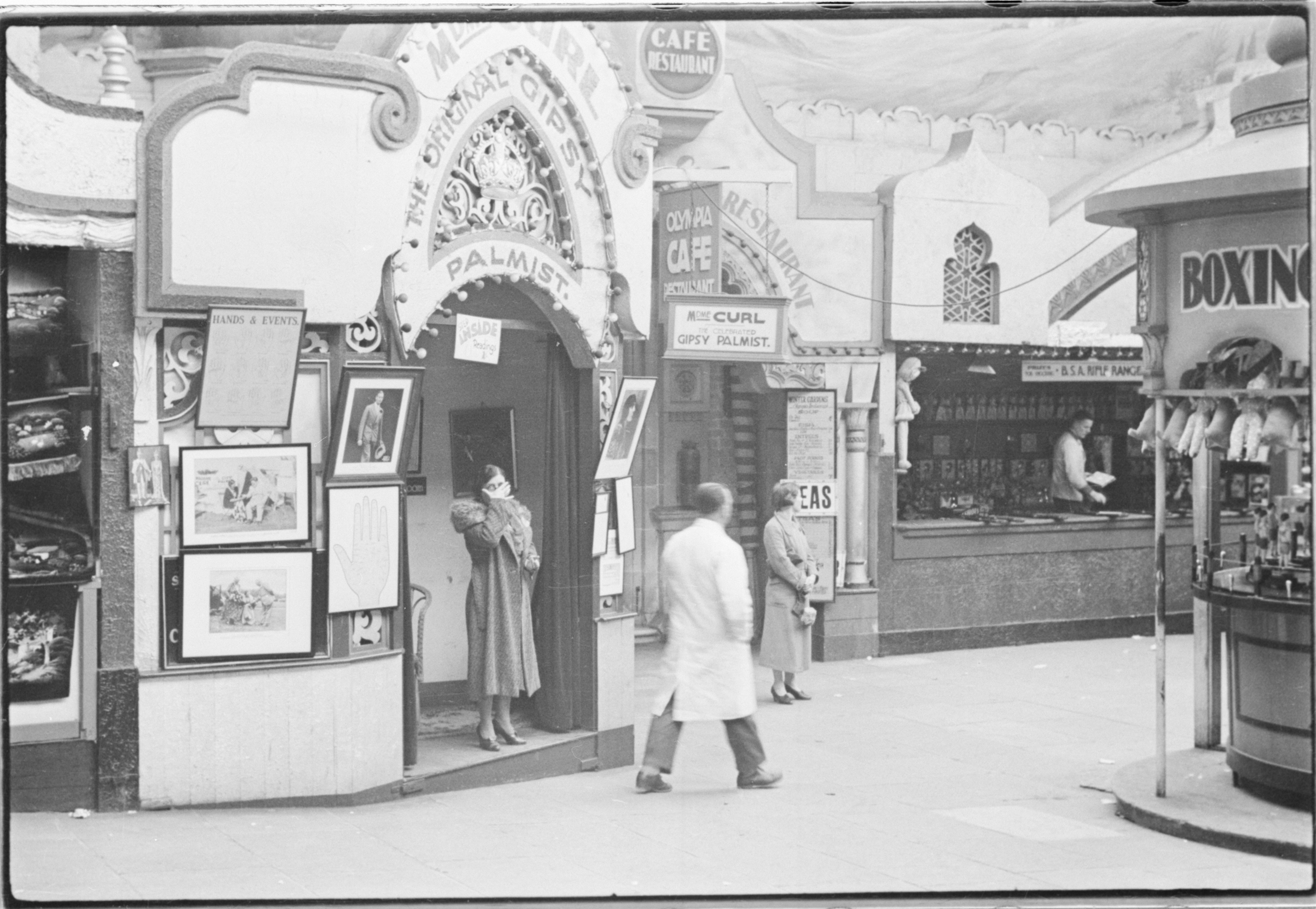
Humphrey Spender, Gypsy Palmist, Blackpool (Olympia Pleasure Palace), 1937.
Observers from the team had also visited this same booth, alongside several others. They recorded details of the interiors, exteriors and the thematic content of the fortunes that were told by different fortune tellers, even comparing value for money between the different tents and booths. For example, a visit to Madame Curl was deemed by one observer to be ‘not worth 2/6 compared with Gipsy Smith’s 1/6’. 27 Observer Zita Baker gives us a detail of the layout of the booth; for example, we are told that Madame Curl’s has a text on the wall saying ‘You’re not as down as you look’, on the table there is ‘a packet of Players cigarettes, a saucer with lumps of sugar in it, a bowl for money, a large vase of real chrysanthemums, and some blue knitting’, and there is also a description of Madame Curl herself as wearing a large string of pearls. 28 Both observers describe the adverts outside of the booth, and these are also clearly visible in Spender’s photograph. Here we can see that alongside illustrations pertaining to palmistry there are photographs of a palmist giving advice outside a tent on the sandhills. One observer’s notes tell us that they stood outside the booth looking at the photographs in window, which included Mayors of Blackpool having their palm read by Madame Curl. We are also told that Gipsy Smith has a sign outside the tent reading ‘One of the oldest families in South Shore’. 29 Observer Zita Baker also notes the photographs and claims outside of Madame Curl’s: ‘One photograph, clearly pre-war time, shows the title ROYAL GYPSEY splashed over her booth. This is no longer the case …’. Her notes also contain a copy of Madame Curl’s business card. The card advises us that she is resident in the Winter Gardens, with Blackpool in large font, alongside the statement ‘Patronised at all Leading British & Continental Exhibitions’.
‘Mrs. Flossie Curl, a Prepossessing Young Woman, Attired in a Smart Tailor-Made Costume’ 30
Although the authors of the mass observation notes do not know it, or in any case they do not record having known it, the Madame Curl depicted and discussed by them is Florence Curl, or Flossie. 31 The lady covering her face in the foreground of the Spender image is not Flossie Curl though; it is her niece, Esther Townsend. Esther, like her aunt and her mother Catherine, was also an established Blackpool fortune teller. 32 We find Flossie and Esther seated together in a family photograph, undated but most likely taken in the 1920s–1930s (see Figure 2). This second family album image has both ladies smiling and looking straight into the camera, a personal and direct counterpart to the surreptitious mass observation image, the covert participant observation displayed in the notes, and Harrison’s offhand and impersonal caption to the photograph in the magazine. 33 The booth does not look the same as the one in the Spender image and the photo was most likely taken in front of other premises. However, just as in the Spender image, we can see that on the outside walls of the booth are photographs from an earlier time, showing the family telling fortunes from tents on the South Shore sandhills, probably around the turn of the century. Their presence on, and connection with, Blackpool, and their lifelong activities as fortune tellers, is traceable through newspaper coverage, and their history on the sands through photographs and postcards.
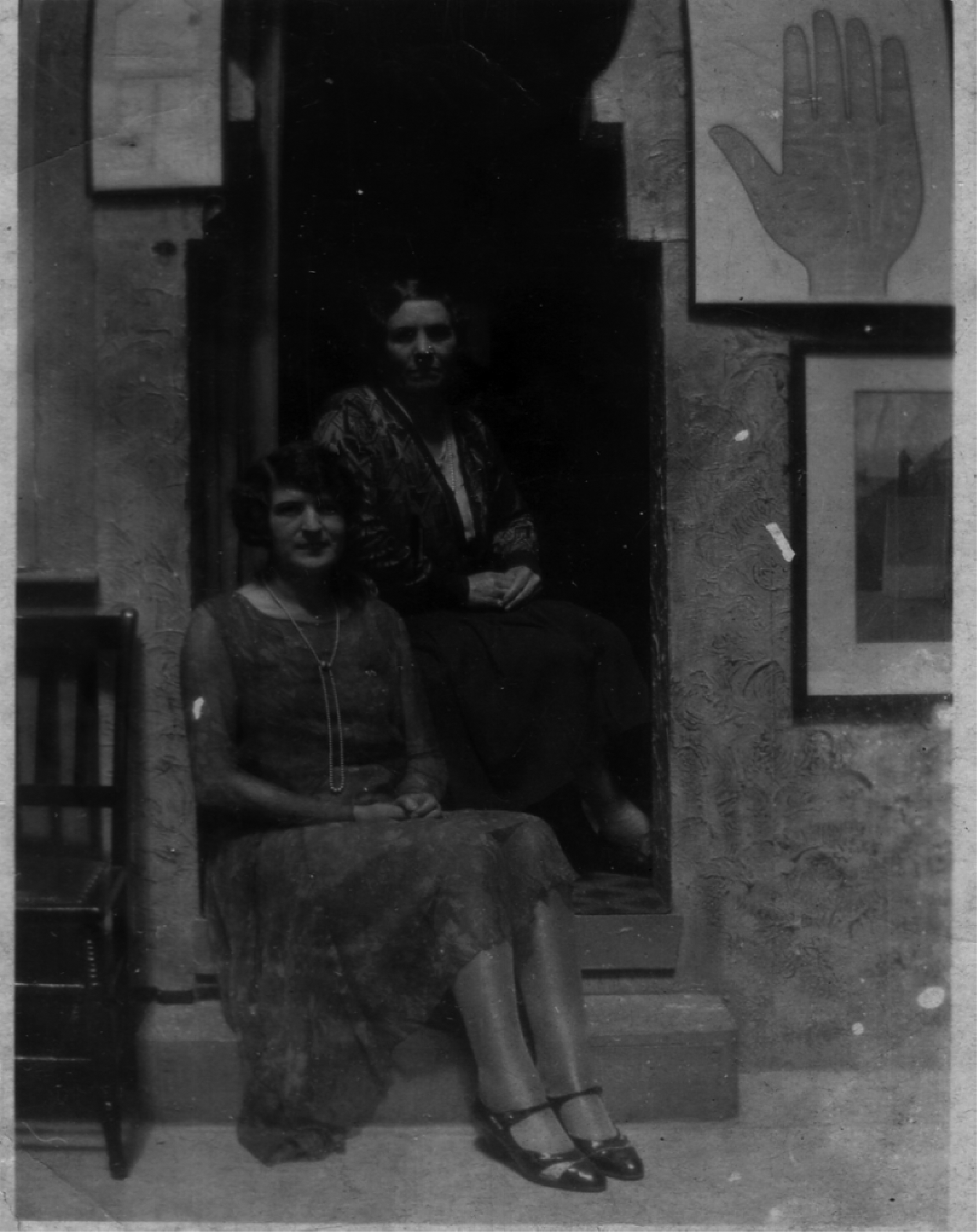
Esther Townsend (front) and Flossie Curl, family photograph.
Esther Townsend was born and died in Blackpool. The 1901 census records her, and her family, as resident in the ‘Gipsy Encampment’ on the South Shore sandhills. 34 Here Esther is recorded as being three years old and living with her sister Mamie, her father Lawrence and her mother Catherine Townsend, nee Guatelli. Catherine Townsend was herself a fortune teller, evidenced via photographs and illustrations from the early encampment. Later, in the 1939 census, Catherine was still living with Lawrence at an address in Blackpool and had her profession recorded as ‘Palmist’. 35 By 1911, Esther had moved away from the sandhills but was still in Blackpool, dwelling in a van, with the address given as van, Pollards Yard, Blackpool. At that point Esther’s grandmother, Richenda, also a fortune teller, was living with her. 36 Esther married one of the Boswell family, Adolphus, in 1914. According to his military records, she was still resident in Blackpool, on St Anne’s Road, in 1918. 37 We know, of course, from the Spender image and the family photograph, that Esther was working as a fortune teller in Blackpool in the 1930s. We also know that she remarried, to a non-Romani man, as she was resident with him in Blackpool during the 1939 census, around the time of Spender’s image. 38
Flossie Curl, nee Townsend, was not registered as residing in the tents on the South Shore in the 1901 census; 39 however, we know that her and her husband Charles Curl’s daughter, Phyliss, was registered as born in Blackpool in 1907 with the parents recorded as living on the South Shore, and their occupation described as ‘gipsy’, 40 and again in 1911, Flossie and Charles Townsend and their two daughters were resident in Blackpool. 41
Flossie’s name was a regular sight in print throughout her life. Like many fortune tellers at the time, she was arrested on several occasions, usually as part of police sting operations. On one occasion in 1916 she was sentenced to three months imprisonment, after being caught offering to tell fortunes to two women who had been sent in by the police to catch her out. At this time she was resident in London while Charles served in the army during the First World War. When the warrant for her arrest was issued, she fled back to Blackpool. She was eventually apprehended, with one paper claiming that when she was told the charge she replied: ‘Quite right, I do tell fortunes, I have been in the profession since a child’. 42 We are also told that Flossie requested legal representation. From the various reports we find that she, and her family, were well used to engaging legal representation, not only to defend them against the charges but on several occasions to bring claims against other people. In another report, Flossie is arrested in Blackpool but attests that ‘She did not practice palmistry, and only gave advice on business and health’. 43 Flossie also appears to have been a formidable figure: in 1908 she sued her neighbours, the Youngs, who were resident in neighbouring tents on the sandhills, for defamation, and she won. Covering the story, one newspaper described her as ‘Mrs Flossie Curl, a prepossessing young woman attired in a smart tailor-made costume’. 44 This newspaper makes clear that the people appearing in court did not conform to the ‘gypsy’ stereotype: ‘For some reason or other these people, who were fairly well-to-do, preferred to live in the gipsy encampment, where the defendants also resided, and were well known’. It is worth noting, that this description of the South Shore Romani occurs in several different newspaper stories. It seems that the residents of the sandhills were well dressed and well spoken, and that often this did not tally with the external prejudiced expectations of them. There were also numerous adverts for Flossie’s palmistry service across local and national newspapers, ranging from The Times through to the regional press. The content of these is much like that in her business card; the adverts almost always reference Blackpool in some way, usually describing Flossie as ‘From the Olympia, Winter Gardens, Blackpool’. 45 Flossie obviously visited many different places – from exhibitions to horse fairs – as well as appearing in her booth in the Winter Gardens.
Flossie told fortunes in Blackpool all of her life. She reached the age of 100 and was buried in the town’s cemetery in 1980. Her departure was worthy of note in national entertainment publications. In Stage and Television Today her obituary read: Blackpool gypsy Madame Curl has died, only a fortnight after her 100th birthday. She was born in a tent on the side of the Blackpool Pleasure Beach in January 1880.
Up to two years ago Madame was practising palmistry professionally – she worked the Olympia and the piers. She was on very good terms with many of the entertainers who consulted her during their resident summer seasons in the resort. Her daughters Dorothy and Jean both became fortune-tellers.
She was a sweet lady, writes our correspondent James Hartley, himself a friend of many of the Romanies who live in the area. 46
‘There was no Cloaking. The Gipsies Were One of the Attractions of Blackpool’ 47
That the above ‘Madame Curl’ obituary references the Pleasure Beach is significant. It is more than a reference to her life; it is a reference to the life and history of Blackpool itself. Sidney Moorhouse, a journalist who had also described Romani presence and fortune-telling practices at local horse fairs, tells us in his 1950s guide to Blackpool that: The gypsies were, in reality, the founders of the Pleasure Beach on Blackpool’s South Shore, for although it was some fifteen years after their camp had been closed down that Roger Pye commenced the building operations of what was to develop into the greatest amusement park of its kind in the country, we know that Morgiana’s
48
contemporaries relied just as much on the roundabouts, coconut shies, and other various ingredients of the old English fair for their livelihood as they did on their skill at reading palms.
49
The most well-known resident on the sandhills was undoubtedly Sarah Boswell. Sarah was known as ‘Gipsy Sarah’ and her name was for many years synonymous with the South Shore. 50 She was married to Ned Boswell, held to be the first of the Romani to settle on the North Shore of Blackpool in the 1830s, before being moved on to reside on the sandhills of the South Shore and thus linked to the start of the Pleasure Beach. Sarah told fortunes as long as she lived, which was just short of a century. Her fortune-telling presence in Blackpool was carried on by her daughters and granddaughters, usually advertising themselves as ‘Gipsy Sarah’s Eldest Clever Granddaughter’ or using similar claims of authenticity. According to the 1901 English census, Sarah was residing in a tent on the ‘Gipsy Encampment, Sandhills’. She was recorded as being head of the family and ninety-six years old, and described as ‘living on her own means’. 51 Next to her are the Heron family, who were recorded as being horse dealers and hawkers. We also find in the 1901 census six further tents housing the Smiths, the Townsend families and the Youngs, the heads of which are recorded as being horse dealers or cab proprietors (stable keepers). 52
It is through postcards and photographs taken from around 1900–1906 that we can see how prominent the palmistry tents (and the names of the fortune tellers) are, and how the encampment was central to the growing Pleasure Beach. Here it is evident that the tents are busy with visitors, and that they are situated next to key areas such as the early fairground rides, or the miniature railway, which was opened in 1905 and transported visitors to a station called ‘Gipsyville’. Figure 3 shows a montage of three postcards from this time. The top left part of the image shows Madame Curl’s tent on the far left, the tent of Madame Townsend is in the foreground; the top right image shows the busy ‘Gipsyville’ station with the tent of ‘Gipsy Sarah’s Eldest Clever Granddaughter’ next to it; the bottom image depicts the tent of ‘Gipsy Sarah’s Daughter in Law’ complete with a queue of customers and sightseers.
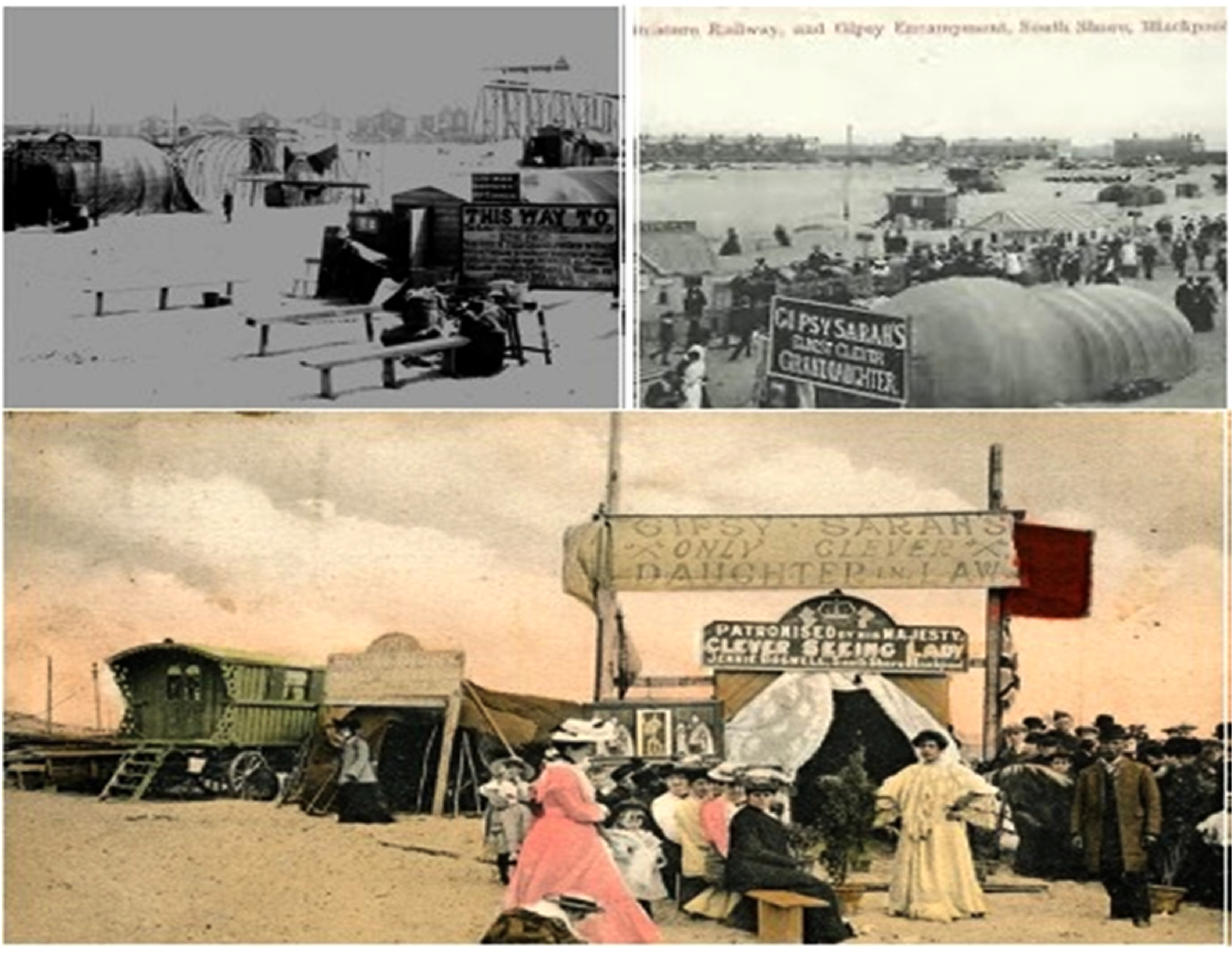
Montage of Postcards, South Shore Encampment.
These postcard images of the tents demonstrate the very bold use of advertising. We can see the large, prominent boards displaying the occupant’s names – for example in the bottom part of the image we find Jennie Boswell describing herself as ‘Gipsy Sarah’s Only Clever Daughter-in-Law; Patronised by Her Majesty. Clever Seeing Lady’. As one newspaper article tells us: ‘most of the tents to-day have in front of them a conspicuous board or sign advertising (generally in home-made spelling) the particular predestinating virtues of the lady who peeps into the future. Some claim to have appeared before Royalty’. 53 Most display photographs or illustrations outside of their tents. Again, these are often of royalty or other dignitaries – it was usual for fortune tellers to claim they had read the palm of a King or a politician. There were also images showing the fortune teller sat outside of the tent, reading a customer’s palm. The same or similar pictures and claims would, three decades later, be displayed outside the fortune tellers’ booths and reported on by the Mass Observation team.
Popular visitor guidebooks, seaside annuals, and newspaper articles reinforced how to use a distinct holiday time, still a new concept to the working classes. Photographs, illustrations, newspapers, magazines and travel publications created, or reinforced a certain understanding not only of the seaside space but also how to consume or enact one’s time within that space. As Medcalf points out, the seaside became an embodied visitor experience that was very much constructed. Exploring railway photographic advertising, he points out that hotels, councils, railway companies all contributed to how this construction was formed. 54 Moreover, once there, visitors would document these experiences with photographs (produced by one of the many itinerant beach photographers) or they could buy other visual mementos, such as postcards, once again reinforcing and sharing the expected on-site practices. In terms of creating a visual understanding of the Blackpool experience, the postcards of the encampment and the close ups of individual fortune tellers and tents on the sandhills formed part of a shared understanding of seaside leisure practices. By utilizing these or similar photographs and illustrations outside of their tents, and later outside of the booths, the occupants are signalling to visitors that to visit them was to be part of a seaside experience, or performance. To some extent this constituted an empowered – or at least lucrative – self-representation, albeit via the (re-)usage of the external stereotype.
There are several early newspaper and magazine accounts of visits to the South Shore fortune-telling tents. They do invariably describe the fortune tellers along the lines of the ‘dark hair, flashing eyes’ stereotype. Some do, at least in part, also question established tropes and make clear that the Blackpool families are well established on the South Shore and very much sought out by visitors as part of the Blackpool leisure experience. For example, an 1894 account, written for a Socialist paper, describes the Romani met at Blackpool as challenging initial preconceptions: ‘the Rommany ladies and gentlemen made a very favourable impression on me. They seem very modest, civil people …’. 55 The article is also clear about their status as visitor attraction: ‘Among these tents were wandering a considerable number of sight-seers, who stood and stared into the Rommany abodes’. An old lady, 84 years of age, is quoted as saying: ‘There are some ladies over there that want their fortunes told. They always come like that, walking about and looking shamefaced and bashful’. 56
An earlier account, a vignette of sorts, can be found in Ben Brierley’s journal. This was a publication written in the regional dialect (Brierley was a Lancashire poet). Blackpool, given its position on the north-west coast of Lancashire, drew visitors predominantly, albeit not exclusively, from that area and so this account is in many ways invaluable. It describes a scene, an embodied holiday practice, as well as the fortune teller and tent. Written in 1888, the sense that Blackpool is a thriving mass holiday destination is already apparent and vividly described. There were Punch and Judy puppet shows, minstrels, waxworks of the famous and notorious and Booath piers wer crammed, an’ ther streamer sailins to different places fro’ each. Aw never saw sich a thingi’ mi life, th’ streets wer as throng at seven o’clock I’th’ mornin’ as Market Street, Manchester, is at one o’clock of a Setterday
57
[i.e. it was as busy on the Piers as it was on a Saturday in the main shopping street in the city of Manchester].
Later in the article he goes on to describe how the police often use a decoy to catch out the fortune tellers: Then a decoy is sent into a gipsies’ tent to get her fortin towd, whol a landau is in hidin’ wi’ an escort o’ police to hurry th’ ‘teller: off at once befooar th’ magistrates … Neaw these gipsies han bin patronised an’ tolerated for fifteen years, an’ afore they pitch a stick on th’ sond they’ve got to pay a rental of a gud mony peaunds for th’few months they stop theer. They dunnot goo sneakin’ abeawt back durs importunnin silly servant lasses to ha’ther fortuins towd, but confine ther business to ther tents. [Here telling us that the police send a decoy into the tent to catch the fortune tellers out, resulting in them being charged and fined, which he sees as wrong because they already pay a good amount of money to pitch their tents.]
In addition to his journal, Brierley also created other work referencing Blackpool, including popular visitors’ guides called ‘Ben Brierley Sea-side Annual’, which contained within them descriptions of seaside activities. These types of publications from the 1870s and 80s, Margaret Beetham argues, cemented an ‘iconic status as the place for the working-class seaside holiday. These publications both represented and created that definition of Blackpool’. 58
Through the article in Brierley’s journal, alongside the details we have of Flossie Curl and others being arrested, we can see how the representation of fortune telling as a touristic attraction (or as a romantic or exotic stereotype) contrasted with the same reality of it being a criminal activity. Most of the fortune tellers on the South Shore mentioned here, and several of their female relatives, were arrested, fined or imprisoned, sometimes to serve hard labour, several times in their lives. As discussed in the introductory section, pretending to tell fortunes was often heavily penalized, and the force of the law predominately targeted women (it was, in effect, a female working-class economy, with fortune telling representing the main income for some women 59 ). Trials were reported on in the press, often involving what Brierley in the above quote termed the ‘silly servant lasses’ – working-class women who have their fortune told. However, the Blackpool fortune tellers were, to all intents and purposes, an established attraction. Again, as the article in Brierley’s journal informed the reader, these ‘gipsies’ have to pay rent, and there is nothing covert in their practice. This is where the fortune-telling prosecutions find a further dimension and a difference from those that we see taking place in other locations covered in the general press.
It is clear from newspaper accounts that the residents of the South Shore encampment paid rents and taxes; it is also suggested that they earn a substantial amount of money from fortune telling. There is something of an obvious paradox here in terms of the fame and visibility of the palmistry business in the tents, and the police (and council/corporation) crackdown on the practice. Sometimes this is reported in comedic manner, for example, with the arresting police officer being asked to recount the fortune he was given in court and attest to its veracity.
60
Alongside this and across many of the reports of these Blackpool fortune-telling trials the argument is constantly made by the defendant’s legal representation that there are large signs for palmistry on the tents – as it was an accepted practice, why was it being penalized? For example: Eva Franklin, 27 Clare-street, Blackpool, a gipsy, who said she had been at Blackpool for 40 years during which time gipsies had been on the sandhills. She was one of the first there. There were signs in front of the tents, and the public knew that fortune telling was practiced. There was no cloaking. The gipsies were one of the attractions of Blackpool.
61
This trial (reported in the paper with the claim ‘Chief Constable says Palmists make £10 a Day’) involved Flossie Curl’s mother, Richenda Townsend, alongside members of the Smith and the Young families. The newspaper reports that: ‘The old lady Townsend said that she had to do something for a living and what had she to do but sell fortunes? She also said she paid £2 a week for the rent of her tent’. We are also told that, when asked if the defendants can have time to pay the fines, the Chief Constable objects, saying ‘they are making £10 a day’, a large amount of money for that time.
62
We also see a link being made here with what was to be the eviction of the families from the South Shore in 1910, something which will be elaborated on in the next section. The defence draws a connection between the arrests for fortune telling and the desire of the Corporation to move the tenants off the South Shore to make way for development: ‘If the Corporation wanted to clear the fairground of the gipsies he suggested that the owners should be proceeded against. What had been done was not the way to clear them’.
‘Our Tents Were the First Things on the Show Ground’ 63
The price of pitches on the South Shore Pleasure Beach site was high. By 1908, the cost of a stall on the sands was £870. The authorities were, by this time, clamping down on any unregulated activities. Whilst we are told there were ‘Italian ice cream vendors, salesmen, ventriloquists, and other amusements present in large numbers all anxious to secure stands’, there were clear conditions: ‘No rock selling was to be allowed … Other practices, such as palmistry, chiropody, photography, fortune telling, were also forbidden’. 64
The move to evict the residents from the Romani encampment had also started in 1908. In April that year a letter to the editor appeared in the Lancashire Daily Post asking for public attention to be drawn to the fact that Blackpool Corporation were proposing the eviction ‘without reason, from their ancient homes, on the South Shore sand dunes’. Moreover, the letter informs the editor that the residents have lived there ‘without reproach and carried out all the duties of citizenship. They have paid rent, rates, taxes, and all legal demands’.
65
Whilst issues of sanitation or criminality were referenced, it is clear that the dwellings (and practices) there stood in the way of the sale and development of the lucrative land near to the Pleasure Beach. This was a time of major land development for the town’s Council, and references to the prohibited practice of palmistry were used to reinforce the need to clear away the fortune-telling tents: Councillor Bancroft pointed out that the Council some time ago passed a resolution prohibiting any person from professing palmistry or phrenology, and he did not know why the Council should wink at the gipsies, who invited anyone and everyone to have their fortunes told. If the police could not stop them the Council should sweep them altogether from the sands.
66
By 4 December 1908, the Lancashire Evening Post reports that the decision had been made that they should leave the south shore and that ‘bye-laws to this effect are being drafted’. 67
The removal of the South Shore encampment was reported on widely by the Press, and not without some empathy, or at least some acknowledgement of the length of time the encampment had been part of Blackpool. Reports also acknowledged the town Council’s continuing drive towards ‘progress’: Times have changed at Blackpool as elsewhere, and instead of the jolting promenade bus the smooth and swift-moving electric car carries its thousands not to a colony of caravans and rush-covered huts, but to a conglomerate collection of merry-go-rounds and all that goes to make up a Lancashire ‘Coney Island’.
68
The Leeds Mercury of 8 March 1909 refers to ‘a harsh decision it seemed and so described at the time – to insist on their vacation from the land’, and, as many other reports do, refers to ‘Gipsy Sarah’ when discussing the history of the encampment. These reports mentioning Sarah build upon a pre-existing nostalgia and, in effect, something of a founding myth of the Pleasure Beach with an old lady in a ‘smoke blackened tent’ on the sands who had been there from the very start.
69
On her death in 1903, readers of a Scottish newspaper were told that: Thousands of the English-speaking race throughout the world wherever Blackpool is known will hear of the death of Gipsy Sarah almost with a shock of surprise and regret … She was so old that she could almost look back on a time when Blackpool, now the most famous seaside resort in the world, did not exist. … To-day, Blackpool is-well, Blackpool, but to the end Sarah Boswell was the same Gipsy Sarah who came to Blackpool at the beginning.
70
The nostalgia for the time of ‘Gipsy Sarah’ remained evident years later. Right up to the time the Mass Observation team was in Blackpool, the Lancashire Evening Post was reminding its readers of a time when ‘Gipsy Sarah ruled with an iron hand’. 71 Her son, Alma Boswell, had been granted permission to remain on the sandhills, but this too was soon challenged. He was ordered to vacate the site in 1910, despite the court being informed that he had abided by all the requirements: ‘It was stated that Boswell was a perfectly satisfactory tenant, but the Corporation declined to pass certain plans for erection on the fair ground until the owners had got rid of the gipsies, and they were consequently compelled to take action’. 72
Many of the former sandhills residents remained in Blackpool, or its surroundings. Of course, we know from census records, newspaper reports and photographs that several of the Townsends, such as Flossie Curl, and Catherine and Esther Townsend, did stay in Blackpool, moving into the bricks and mortar of lodging rooms and then houses, but maintaining the fortune-telling tradition. They represent a valuable link in terms of both presence, visibility and heritage between the tents on the sandhills and the booths of Olympia and the Piers, right up to the present-day fortune tellers of Blackpool.
Fortune telling in Blackpool was a space that could hold, or at least temporarily promise to hold, different socio-economic classes, expectations and exchanges. It took place in an open, rented space – not the liminal space of criminality that the door-to-door fortune tellers had to navigate in order to earn a living, and equally not the accepted performance spaces of Blackpool’s theatres and tower. It was an accessible, personal moment containing within it the promise of the future as well as a link to the past, and it was part of the present established holiday landscape. Here fortune telling was an embodied practice, a constructed and thoroughly modern leisure pastime visually and textually marketed through postcards, illustrations, visitor guides and annuals, newspapers, and, crucially, also by the fortune tellers themselves. More than this, though, it was – and remains – a family heritage. This brings us back to Spender’s image of Madame Curl’s booth, and beyond it, to the family photo of Flossie and Esther who, alongside their mothers and several former South Shore neighbours, defined the early spaces and practices of the visitor experience and with it a life in the resort. They created and promoted a space of authenticity and fame and a lineage quite specifically tied to place. The photographs outside Madame Curl’s booth meant something both to her and to the visitors who came, just as in another tent or booth a granddaughter’s claim to be descended in some way from the famous ‘Gipsy Sarah’ meant, in effect, to be a descendant of, and active agent in, the growth of Blackpool itself.
Footnotes
Acknowledgements
The author wishes to thank Sharon Heppell for her time and correspondences, and for the use of images from her archives.
Funding
The research for this publication is framed in the project BESTROM, financially supported by the HERA Joint Research Programme ([http://www.heranet.info)]www.heranet.info) which is co-funded by AoF, NCN, AHRC, AEI and the European Commission through Horizon 2020.