



Abstract
What is to be gained by studying visual observation in Mass Observation's COVID-19 collections? What can we see of the pandemic through diarists’ images and words? Visual methods were part of the plural research strategies of social research organisation Mass Observation (MO) in its first phase, when it was established in 1937, but remained marginal in relation to textual research methods. This continues with the post-1981 revival of the Mass Observation Project (MOP), with its emphasis on life writing. With wider shifts in technology and accessibility, however, even when they are not solicited, photographs now accompany MOP correspondents’ submissions. In MO’s substantial COVID-19 collections, images appear in or as diary entries across a range of forms, including hand-drawn illustrations, correspondent-generated photographs, creative photomontages, and screengrabs of memes. In addition, diarists offer textual reflections on COVID-19's image cultures, such as the role of photographs in pandemic news media, as well as considering how the pandemic is intersecting with the visual in more abstract ways, from themes of surveillance and ‘Staying Alert’ in public health messaging to internal pictorial imaginaries produced as a result of isolation and contemplation. Positioning these materials in relation to wider patterns in pandemic visual culture, including public photographic collecting projects that make explicit reference to MO as their inspiration, this article considers the contribution of the visual submissions and image-rich writing in MO's COVID-19 collections to the depiction of a virus commonly characterised as invisible.
What is to be gained by studying visual observation in Mass Observation's COVID-19 collections? What can we see of the pandemic through diarists’ images and words? Visual methods were part of the plural research strategies of social research organisation Mass Observation (MO) in its first phase, when it was established in 1937, but remained marginal in relation to textual research methods. This continues with the post-1981 revival of the Mass Observation Project (MOP), with its emphasis on life writing. With wider shifts in technology and accessibility, however, even when they are not solicited, photographs now accompany MOP correspondents’ submissions. In MO's substantial COVID-19 collections, images appear in or as diary entries across a range of forms, including hand-drawn illustrations, correspondent-generated photographs, creative photomontages, and screengrabs of memes. In addition, diarists offer textual reflections on COVID-19's image cultures, such as the role of photographs in pandemic news media, as well as considering how the pandemic is intersecting with the visual in more abstract ways, from themes of surveillance and ‘Staying Alert’ in public health messaging to internal pictorial imaginaries produced as a result of isolation and contemplation. Positioning these materials in relation to wider patterns in pandemic visual culture, including public photographic collecting projects that make explicit reference to MO as their inspiration, this article considers the contribution of the visual submissions and image-rich writing in MO's COVID-19 collections to the depiction of a virus commonly characterised as invisible.
Visualising the less-than-visible: Covid visual culture
Since early 2020, the global COVID-19 pandemic and its associated government-mandated lockdowns and public health messages have had a distinctive visual character. The photographic documentation of unfamiliar sights, from newly empty streets in usually bustling city centres to social distancing signage and personal protective equipment in daily use across populations, has established a set of familiar media motifs that together consolidate into a recognisable pandemic visual culture (Callender et al., 2020; Delicado and Rowland, 2021; Forbes and Chao, 2020; Pollen and Lowe, 2021; Sonnevend, 2020). Alongside public news messaging, artists and visual culture scholars alike have worked to depict and communicate personal and collective experiences under lockdown conditions through photographic means (see, for example, ‘Diary of a Pandemic’, [Magnum Photographers, 2020], and issue 36(2) of the International Visual Sociology Association’s journal, Visual Studies, dedicated to pandemic visual essays).
While the body of visual culture relating to the pandemic's social effects is now extensive, a key challenge to all visualisations is the apparent invisibility of COVID-19, a point acknowledged by political leaders and visual analysts alike. Donald Trump, in March 2020, while president of the United States, characterised the virus as an ‘invisible enemy’ (Shafer, 2020). Boris Johnson, when UK prime minister, repeatedly used similar metaphorical terms, describing coronavirus as ‘an unexpected and invisible mugger’ (Shariatmadari, 2020). Sociologist Julia Sonnevend, in her early exploration of the visual communication of COVID-19, argued that the pandemic constituted a representational crisis. ‘There are millions of photographs published about this event every day, yet we cannot see the key actor: the virus’, she observed (Sonnevend, 2020: 451). Like all viral forms, SARS-CoV-2 is invisible to the naked eye, yet in the context of a global health emergency characterised by fear and doubt, its invisibility produces cultural problems, not least in news media dependent on imagery for illustration, evidence, and audience engagement.
Stylised renderings of the spiked spherical virus have been widely used as illustrations in news reporting since early 2020, alongside abundant infographics, data graphs, and maps. Paul Kahn, analyst of information design, has called COVID-19 ‘the pandemic that launched a thousand visualisations’ in recognition of their proliferation, variously charting case numbers and spread, variants, and vaccinations. These data visuals have, in turn, informed public health messages; UK and US governmental calls in 2020 to ‘flatten the curve’, for example, were based on deflating a bump in case numbers visualised on a generalised graph plotted on axes representing infection rates against time (Kahn, 2021; Sonnevend, 2020).
If the key actor cannot be seen, in Sonnevend's dramaturgical metaphor, then Covid's heroes and villains – the frontline health workers and pioneering scientists versus the rule breakers and public health deniers – and theatrical stage settings take its place. The stages where COVID-19 is photographically performed include empty cities and physically distanced public spaces as well as domestic worlds newly transformed into home-work and home-school environments (Sonnevend, 2020: 452). Photographs of masked health professionals and citizens have come to operate as dominant visual motifs of the pandemic, often standing in for the other images of COVID-19's effects that take place offstage: graphic depictions of ill health and the bodies of the dead. Dominant motifs have been described by Sonnevend as COVID-19's ‘identifiable iconic repertoires’. These are similar to what photography curators Duncan Forbes and Marcela Chao characterise as the pandemic's ‘standard news tropes’, and to what communication analysts Ana Delicado and Jussara Rowland – in their discussion of 600 news photographs in Spanish and Portuguese COVID-19 stories in 2020 – confirm as international stereotypes, repeated again and again.
Although Sonnevend (2020: 460–1) astutely observes that these visual templates are ‘symbolic condensations’ that ‘summarise more than they depict’, photographs of Covid's cultural figures and effects nonetheless provide valuable public surfaces for imagining a crisis that is hard to comprehend as well as to see. Graphic medicine specialists Callender et al. have argued for images’ powerful service to public health, observing that they inform, provide meaning, and illustrate the outbreak narrative in ways that help us process, reflect on, and understand our experiences. The dynamic nature of our engagement with these images allows us to generate collective knowledge about the pandemic in a cultural space where images are created, contested, embraced, and at times transformed into icons. (Callender et al., 2020: 1061)
This claim has particular potency when applied to photographs taken outside news media, where a wider engagement with the experience of Covid and the challenge of its visualisation opens out the photographic conversation to include more personal reflections. Using cameras to communicate public responses to COVID-19 has not been confined to professionals alone.
Crowdsourcing a public pandemic view
As the pandemic took hold in the UK in spring 2020, participatory or crowdsourced public photography projects began to emerge in force as a means to create connections between communities, to record a historical moment characterised as unprecedented, to capture its strange new cultural forms, and to externalise the complex emotions that the new conditions precipitated (Pollen and Lowe, 2021). In the context of widespread camera ownership, and in recognition of the potential for digital networked images to bridge the isolation caused by 2020 ‘Stay at Home’ regulations, COVID-19 public photography projects offered easy-to-access routes for collective record making and reflection, with historical precedents – not always acknowledged – in mass-participation projects from pre-Covid times (for a survey of preceding practices, see Pollen, 2015).
Large-scale pre-COVID-19 crowdsourced public media projects, such as the feature film Life in a Day (Macdonald, 2011) and the book A Day in the Life of the World (Angles et al., 2012), had used tens of thousands of moving image and photography submissions to create high-profile international exhibitions, books, and films collaged together to show global shared experiences of everyday life in temporal cross section. While some 2020 COVID-19 photographic collecting projects occurred on a local level – see, for example, in the UK, Sunderland Museum's ‘Collecting COVID-19’ and Cardiff Museum's ‘Cardiff in Lockdown’ (Museum of Cardiff, n.d.; Sunderland Museum & Winter Gardens, n.d.) – the most ambitious also aimed to speak nationally and internationally about shared experiences; these emphasised collective experiences and aimed for mass results. Many pre-COVID-19 participatory media projects, including Macdonald's Life in a Day in both its 2011 version and its 2020 reiteration, were framed in relation to MO (Ackerman, 2020). This continued into COVID-19 photographic collecting projects.
‘MassIsolation’ was a notable example. As a social media mass-participation photography project launched in March 2020, a few days before the UK lockdowns were formally instituted, ‘MassIsolation’ was envisaged as a means of creating engagement and building global communities in times of enforced disconnection. The project was launched as an Instagram account and a hashtag by the Derby-based photography festival Format, with an invitation stating, ‘Share your experience of this global pandemic and send us your photographs, drawings, memes, tips and ideas. Become part of this important visual archive at a most extraordinary moment in our history.’ The organisers noted that their ‘important international initiative’ was ‘inspired by the 1937 Mass Observation project’ (‘@MassIsolationFORMAT’, 2020). To date, over 40,000 Instagram posts from over 90 countries have carried #MassIsolation hashtags, and its expanding project partners included photographic galleries from Ireland, Finland, and Australia. Its participants included, according to Format, ‘photographers, professionals, amateurs, [and] members of the public’ and photographic submissions ranged in mode from candid documentary records to elaborately constructed artistic productions.
A month later, Historic England, the state-funded body tasked with caring for the national historical environment, launched ‘Picturing Lockdown’ as an open public photographic engagement project to take place over a week from late April, alongside a parallel set of paid commissions by professional photographers (Historic England, 2020). The public call to depict lockdown daily life prompted nearly 3000 submissions across England, showing the home haircuts and home baking, the rainbows in windows, and the weekly ‘Clapping for Carers’ ritual that characterised the culture of the first English lockdown in its early weeks (Pollen and Lowe, 2021). Framing the project in very similar terms to ‘MassIsolation’, Claudia Kenyatta of Historic England described its crowdsourcing photography ambition as an attempt to ‘record history’ at an extraordinary time and to ‘create a unique time capsule for the future’. The Guardian newspaper described it as the first time that the public had been called to populate Historic England's archive since 1939, ‘when the social research organisation Mass Observation collected accounts of everyday life during wartime’ (Bakare, 2020).
The role of the visual in Mass Observation
While independent COVID-19 participatory photography projects were frequently linked to MO to provide context and legitimation for their purpose and method, these statements were based on two misapprehensions: firstly, that MO was a historical project that no longer actively collects, and secondly, that MO was principally a photographic endeavour. The social research project, while still alive and well, has in fact had an ambivalent relationship to photography since its inception in 1937 by ornithologist Tom Harrisson, poet Charles Madge, and film-maker Humphrey Jennings as an autoethnographic experiment to record everyday life in Britain through a mixed methodology that aimed, first and foremost, at the accumulation of social facts. Nick Hubble begins his book-length interpretation of MO by acknowledging its hybrid nature, its diversity of forms, and its enigmatic position: ‘Definitions’ of the organisation, he argues, ‘shift bewilderingly according to perspective’ (2006: 1). Hubble quotes Dorothy Sheridan, former archive director and one of MO's pre-eminent interlocutors, who, with David Bloome and Brian Street, summarises that MO has variously been characterised as a documentary or photographic project, a social survey, an adventure at the expense of the working class, a people's history, and a precursor to oral history (Sheridan, Street, and Bloome, 2000: 27). Its plurality and complexity are what attracts researchers to it as a rich and unparalleled body of qualitative data – the first phase of MO (from 1937 to the 1960s) has been described by sociologist Mike Savage as ‘the most studied, and arguably the most important, social research institution of the mid-twentieth century’ (2010: 57) – but these aspects also constitute its methodological slipperiness as a resource across its earlier and later manifestations (Pollen, 2013).
As visual scholars such as Russell Roberts (2013) and Lucy D. Curzon (2016) have discussed, while MO incorporated visual research methods into its founding approaches to studying everyday life – employing painters and photographers at the outset – there were naïve conceptions about photographic objectivity and uncertainties about the use and integration of visual methods with other observational practices. Despite the core premise of observation in the organisation's title, the visual aspect was philosophically underdeveloped and practically underused during MO's first phase. I have argued elsewhere that photographs form an absent presence across the long history of MO, where they move in and out of view as material, subject matter, and metaphor (Pollen, in press). From the earliest days of the organisation, when Observers were referred to as ‘subjective cameras’ by Madge and Harrisson (1938: 66), and when Humphrey Spender was commissioned to photograph street life in Bolton in 1937–8, resulting in a body of around 900 photographs that remained largely unseen until the 1970s, through to unrealised attempts to develop a mass photographic observational practice under Harrisson's direction in the 1940s and 1970s, photographic ideas figured in MO's conceptual structure even if they were not fully realised as social research methods or integrated into published outcomes.
Although photographs were not used consistently and written accounts were foregrounded, first-phase MO writing had a particular aesthetic informed by surrealism, modernism, and montage (Highmore, 2002; Jardine, 2018). It was also infused with the visual. MO's search for a poetic ‘image’ that combined intellect, emotion, and sensation was informed by contemporaneous imagist conceptualisations (Curzon, 2016; Hubble, 2006). Both Madge and Jennings reflected on written images as central to their concerns, in and beyond MO in the 1930s (Jennings, 1982; Madge, 1982). They stated in 1938 that MO's social investigation was ‘to get written down the unwritten laws and to make the invisible forces visible’ (Madge and Harrisson, 1938: 8).
In the revived Mass Observation Project – the name for the endeavours first orchestrated by anthropologist David Pocock and then archive assistant Dorothy Sheridan in 1981 and continuing today – writing remains central. Images of all kinds, including photographs, are not prioritised, as the project is conceived of as life writing first and foremost (Sheridan, Street, and Bloome, 2000). The central practices of MOP comprise thrice-yearly Directives, or open-ended questionnaires, on a wide range of topics across the personal and political. Self-selected volunteer writers – currently numbering around 600, from across the four nations, and across all genders, classes, and age groups – respond as they wish to these prompts, in shorter or longer subjective written accounts. In addition, photographs and drawings are spontaneously submitted and occasionally solicited (see, for example, two 2012 MO Directives on photographic themes).
Beyond MOP, photographs appear substantially in several of MO's Related Collections, which now comprise more than 50 separately donated bodies of material with thematic or methodological parallels to MO's core interests; these include tens of thousands of photographic prints across several independent collections (Pollen, 2015). Beyond archival images, MOP writing, as Sheridan (1993) has argued, is multidimensional. Submissions contain handwriting and typescript, and textual elements can range across voices, modes, and styles. MO Directives encourage observation, reflection, recollection, opinion, fantasy, and fact (Harrison and McGhee, 2003; Shaw, 1996). The rich observational and imaginative descriptions that result are often infused with written images, even when visual material is not present. I argue that, as a result, MO constitutes a particular ‘way of seeing’ (Berger, 1972), even if the image is in the text. MO writing thus operates as an expanded form of ekphrasis, to adapt the ancient Greek term for poetry that describes art, as writing that evokes pictures in the mind's eye (Mitchell, 1994; Pollen, in press).
Thinking visually with MO's COVID-19 collections
While the COVID-19 photographic collecting projects cited above claimed to be reviving and adapting defunct MO methods for pandemic times, MO was simultaneously launching its own collecting calls in early 2020; submissions included photographs and other visual material. With an existing national panel of writers – ‘correspondents’, as MO terms them – and with established collecting policies, archival processes, and trained staff, MO was in a priority position to attract public submissions in a period when crowdsourced collecting projects achieved new force. ‘Perhaps more than any moment in the last fifty years’, historian Clare Langhamer observed in 2020, ‘the present crisis has driven a commitment to, and plethora of, everyday record-keeping and creative record-making that transcends national borders’.
Langhamer made this point in a July 2020 Institute of Historical Research lecture that gathered pandemic ‘First Responses and Early Perspectives’. She noted that the public history-making phenomenon was ‘perhaps surprising given the difficulties of organizing such practices during lockdown, but’, she argued, ‘collection practices have been fuelled by a sense of living through one of the folds in history, and facilitated by the shift to online living’ (Vinen, Langhamer, and Siena, 2020: 797). MO was not only well positioned practically to step up to the challenge of recording history as it occurred; it also drew on what it did best. As cultural geographers Nick Clarke and Clive Barnett argued, in the context of their British Academy-funded COVID-19 research project: ‘MO has a long history of collecting data at times of national crisis. Its collections during and after the Second World War are central to many studies of Britain during that period. MO's time has come again as the UK responds to the COVID-19 pandemic’ (Clarke and Barnett, 2020: 4).
MO first wrote to its panellists on 17 March 2020, in response to the World Health Organization's categorisation of COVID-19 as a global pandemic, and in anticipation of major changes to UK everyday life. The British government had already advised that non-essential contact should be avoided, and the archive had already closed, with staff working from home. They asked their addressees, ‘Please record your experiences, thoughts and opinions as the coronavirus unfolds. It is an unprecedented time and as with previous events in Mass Observation's history, we would like you to capture this in your writing’ (Pattrick and Scantlebury, 2020). Once lockdown commenced, MO was inundated with enquiries, leading to a spike in applications to join, according to Kirsty Pattrick, MO projects officer (Bealing, 2020). COVID-19 diaries were consequently submitted to MO from across the world, including by those not formally established as MO panel members but who sought an appropriate home for their reflections.
A formal COVID-19-themed MO Directive followed in April 2020, as part of the scheduled thrice-yearly sets of questions for volunteer panellists. On 12 May 2020, MO's annual open day diary call was repeated, and received over 5000 entries; fewer than 300 had been submitted the previous year. Inspired by the 1937 monthly day diaries instituted by first-phase MO, culminating in one of the first MO publications, May the Twelfth: Mass-Observation Day-Surveys (Jennings and Madge, 1937), day diary submissions, written on 12 May by anyone willing, had been revived by MO in 2010 as an annual collecting exercise. 2020 gave them further purpose and expanded their reach. Further COVID-19-themed Directives for MO panellists resulted in summer and autumn 2020. By summer 2021, more than 8500 COVID-19-related MO submissions had been received across these various categories (Mass Observation, 2021).
In summer 2020, MO made the first tranches of their COVID-19 collections available for researchers. These did not constitute the full body of material submitted but represented only those that had been appropriately anonymised and that been accompanied by the necessary release form. My research sample from this material includes all 44 diaries that were available; these were submitted by ‘non-Mass Observers’ and prefixed by the numbers CV19 (MO provides reference numbers for correspondents to protect their anonymity; correspondents may additionally choose to identify themselves by gender, age, occupation, and location).
The constitution of the nearly 4000 correspondents who have written for MO since its revival in 1981 has been comprehensively surveyed, most recently by Rose Lindsey in an ESRC-funded project that has resulted in a database of correspondents, enabling analysis of their demographic characteristics (‘Mass Observation Project (MOP) Database’, n.d.). This shows that women dominate contributors at 68%. While correspondents live across all four nations, the largest group is clustered in London and the South East (34%). Ages range from 16 to 94, but the average age for a writer to join is 50. Of those who provide employment details as part of their biographical information, most have ‘professional, associate professional and administrative occupations’ (ibid.). Until very recently, data on ethnic and sexual identity was not consistently collected by MO, but this has been instituted as a biographical data category since 2021. A 2021–2 MO project, funded by the Wellcome Trust and entitled ‘Mass Observing COVID-19’, is analysing the demographic data of contributors to COVID-19 calls; my early view of part-complete databases suggests that MO's gender and age patterns may be reproduced, even though the reach of the submissions was international.
The CV19 diaries varied significantly in form and length and could be handwritten or typed. The longest submission extended to 262 pages, while others comprised merely a single short statement. The writing included original poems, a collective submission assembled on behalf of an all-female community choir, and diaries by children under 10 and by adults over 90 years of age. Some submissions were wholly visual, such as a slideshow comprising 300 photographs, or a 26-page hand-drawn COVID-19 alphabet ranging from ‘Aircraft Grounded’ to ‘Zoom’. Some were wholly written, but 15 of the 44 diarists (a third) included some form of visual material, such as photographs the writers had taken or cut and pasted from news media and memes, alongside line drawings, government signage, and clip art.
I also reviewed all the 438 available day diaries from 12 May 2020 (prefixed MT2020); as this was an open call, these could be authored by current Mass Observers and those outside the national panel. These, again, included submissions by adults and children, handwritten and typed, including some illustrated with photographs and other imagery. From the available body of 438, I constructed a purposive sample of 75 for more detailed scrutiny. My selection represents around 17% of the total and includes not only those that submitted visual material but also those that mentioned photography, drawing, or painting; those that reflected on visual culture and looking; and those that deployed particularly visual descriptions in their writing. My enquiry and sample selection were driven by several key questions: If COVID-19 is invisible, how is it visualised in the experiences of those submitting COVID-19 diaries to MO? How do MO diarists depict the pandemic in images? How do they transpose its image into words? In relation to the foregoing contexts, concepts, and comparative examples, what might be distinctive about picturing the pandemic in Mass Observation diaries?
COVID-19 photographic patterns: Mass Observation's daily bread
Many photographic subjects in MO's COVID-19 collections, as sampled above, correspond to the visual themes on display in other crowdsourced COVID-19 collecting efforts (Pollen and Lowe, 2021). In the case of the 12 May 2020 MO diaries, these were produced mostly in the UK and only a week after Historic England's ‘Picturing Lockdown’ project (29 April–5 May 2020), so their visual overlap with this collection is unsurprising. ‘Picturing Lockdown’ took place in a period when leaving the house for an hour a day was all that was permitted under UK law for all except those deemed to be essential workers (see Figures 1–5). On 10 May 2020, the British government changed the official message from ‘Stay at Home’ to ‘Stay Alert’, meaning that limited outdoor movement became possible. MO diarists writing in these periods submitted photographs taken on their permitted daily manoeuvres. These include scenes from nature – landscapes and skyscapes – as well as, for those in rural locations, animals such as ducks and sheep, but also barricaded playgrounds and public health signage in urban locations (see Figures 6 and 7).
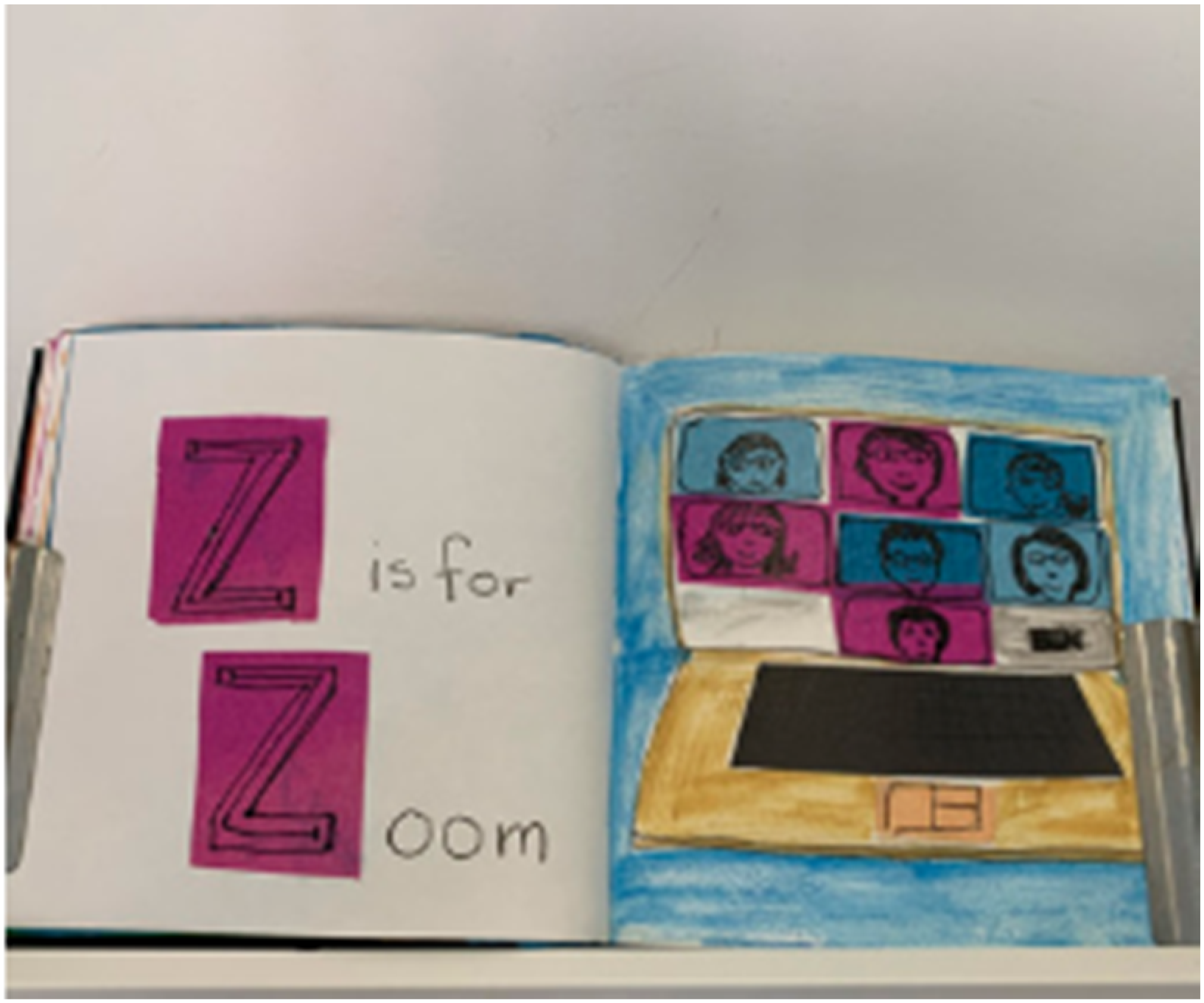
© Sue Veck, ‘Z is for Zoom’ (detail of a page from a scrapbook created during the COVID-19 lockdown), 24 April 2020, ‘Picturing Lockdown’ Collection, Historic England Archive, HEC01/036/01/074.
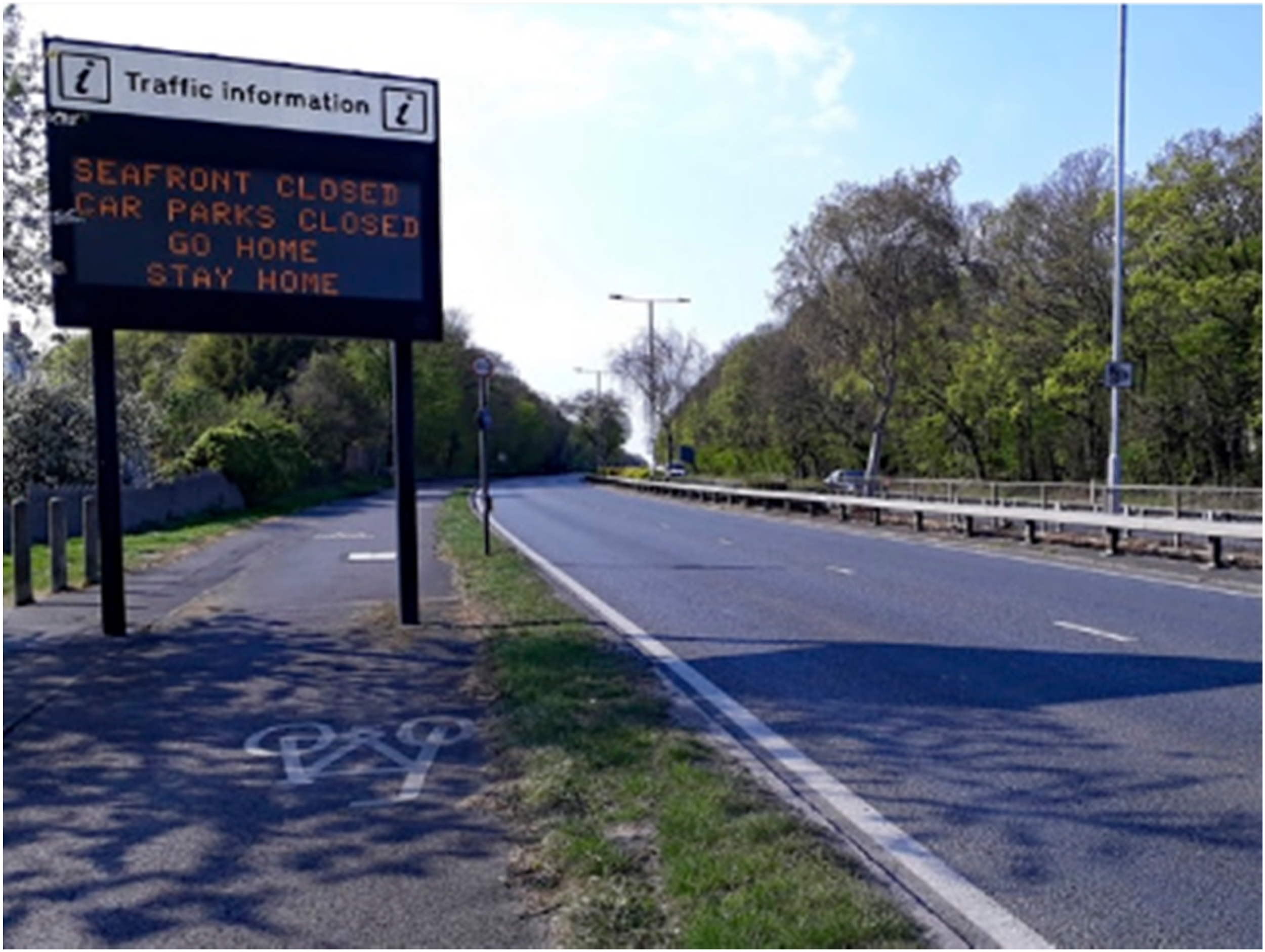
© Terry Withers, ‘Sunny Southend Closed for Business’ (electronic road sign advising visitors to stay at home during the COVID-19 lockdown), 11 April 2020, ‘Picturing Lockdown’ Collection, Historic England Archive, HEC01/036/01/097.
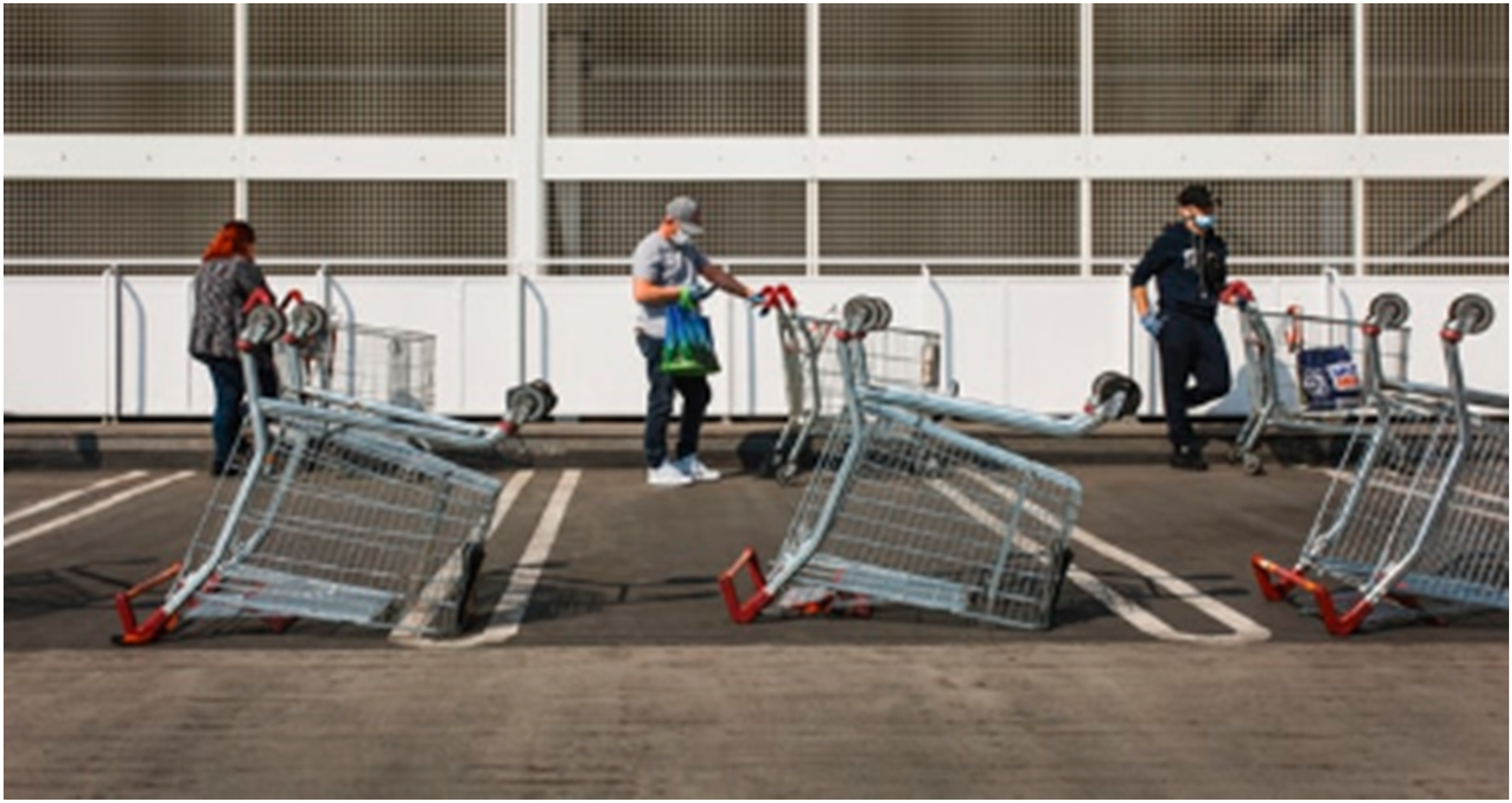
© Michaela Strivens, ‘Upside Down World’ (people wearing protective face masks and maintaining social distancing, queueing with their empty shopping trolleys in a supermarket car park during the COVID-19 pandemic), 9 April 2020, ‘Picturing Lockdown’ Collection, Historic England Archive, HEC01/036/01/046.
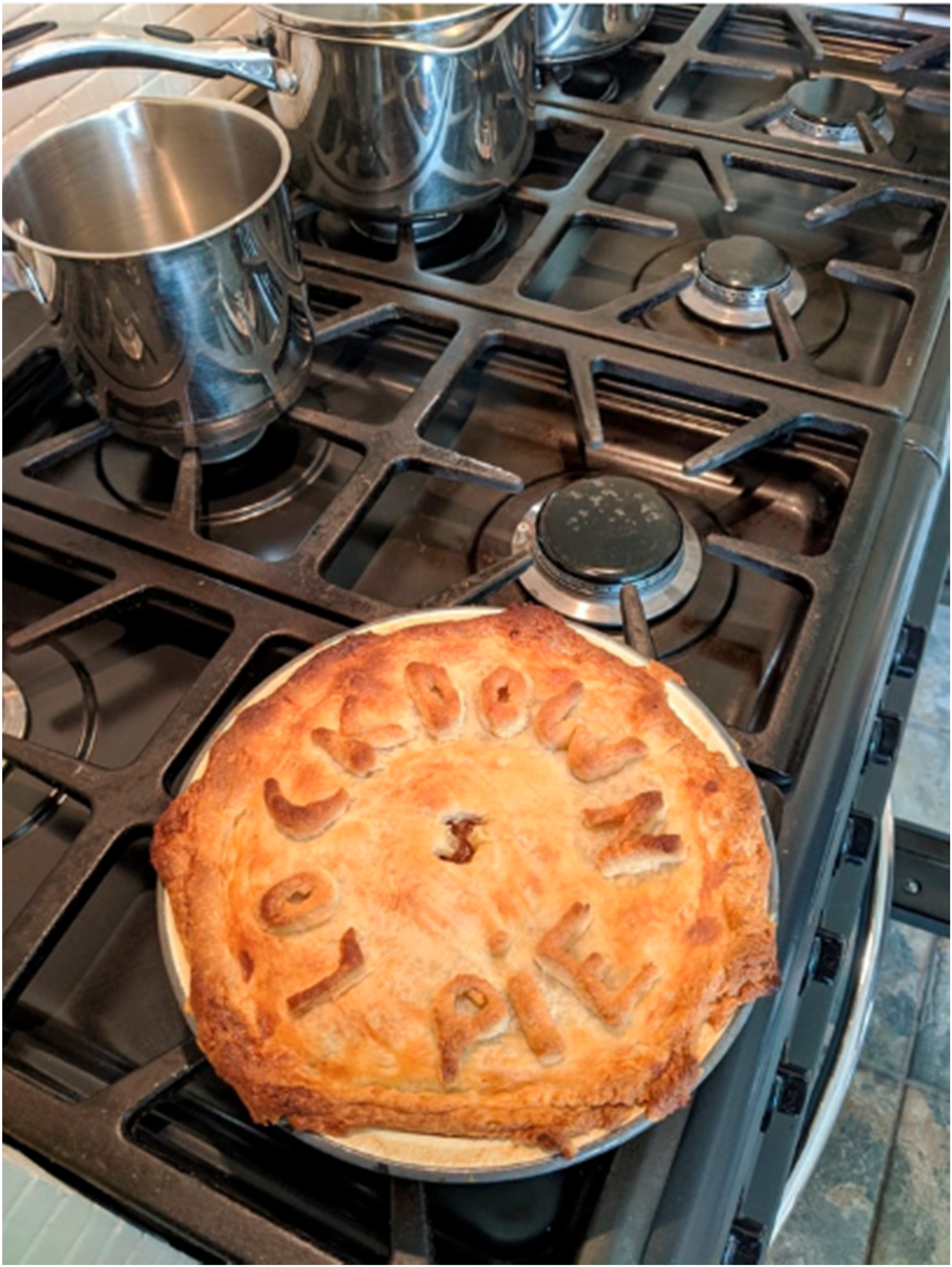
© Jill Ingle, ‘Lockdown Pie’ (homemade pie made during the lockdown caused by the COVID-19 pandemic), 9 April 2020, ‘Picturing Lockdown’ Collection, Historic England Archive, HEC01/036/01/047.
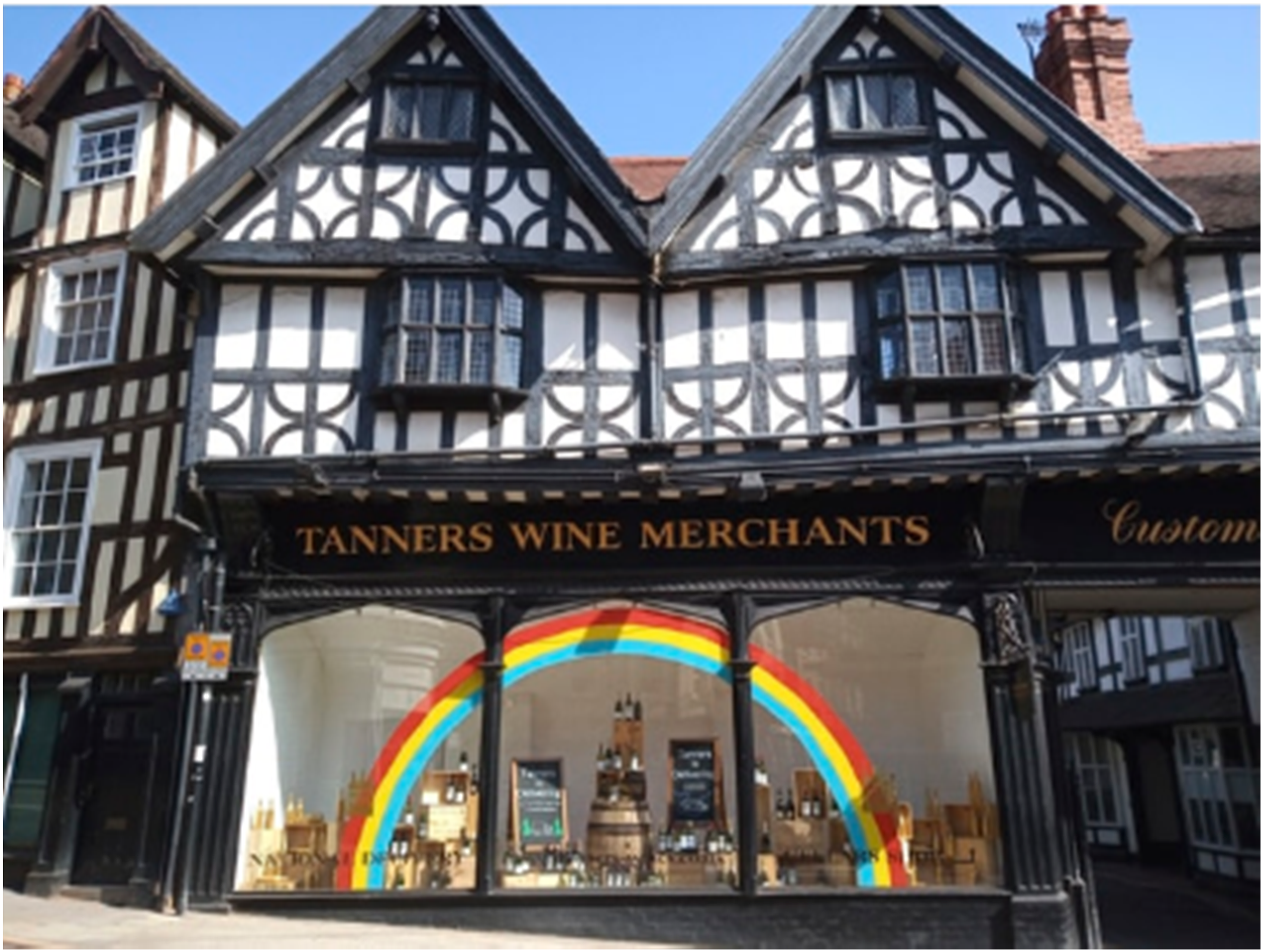
© Philip Shaw, ‘Wyle Cop, Shrewsbury at Rush Hour’ (rainbow displayed in the windows of Tanners Wine Merchants on a deserted Wyle Cop during the COVID-19 lockdown), 29 April 2020, ‘Picturing Lockdown’ Collection, Historic England Archive, HEC01/036/01/052.
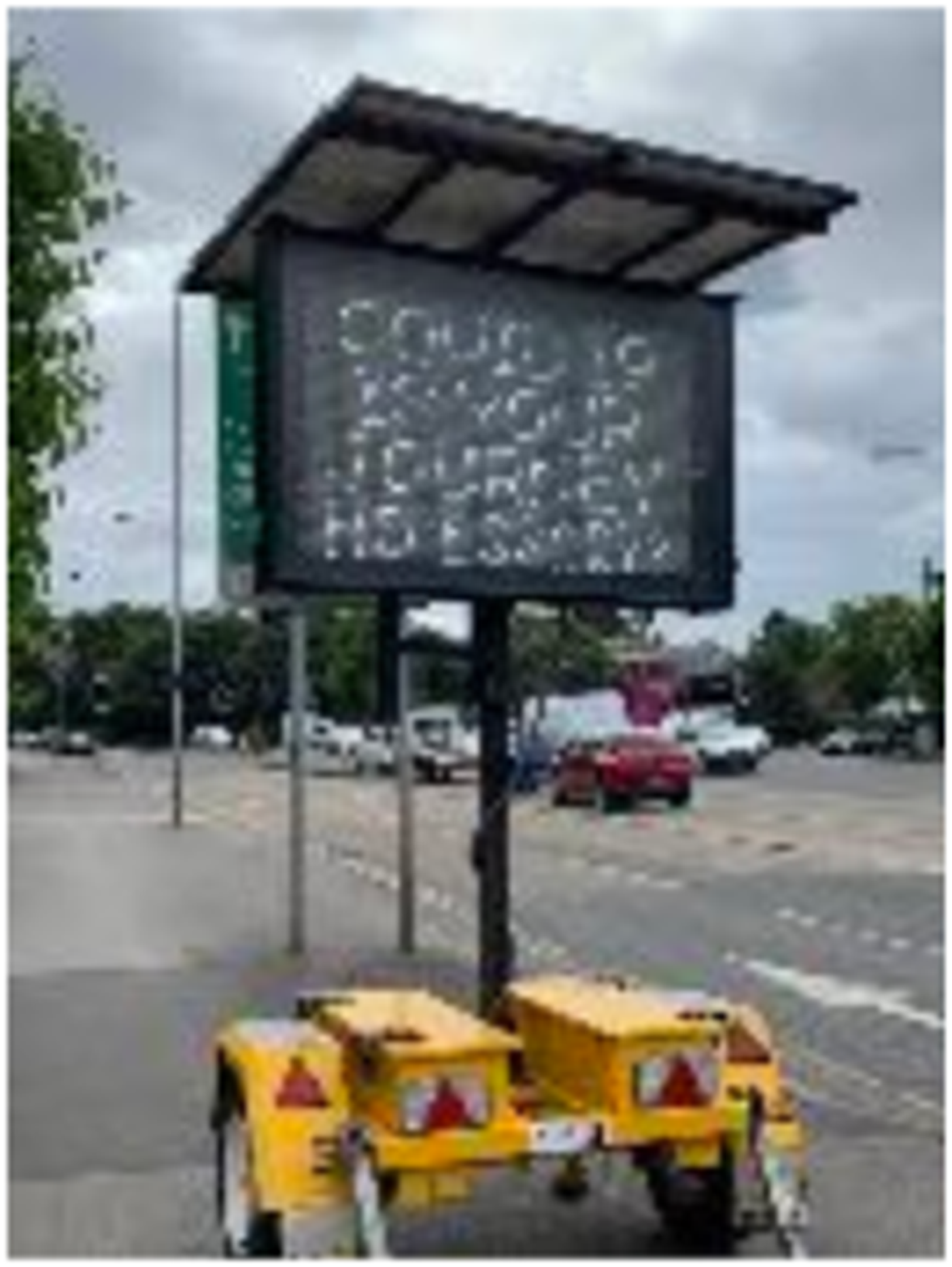
MT2020-470, Untitled photograph (public signage: ‘COVID-19: Is Your Journey Necessary?’), 12 May 2020. Courtesy of the Mass Observation Archive.
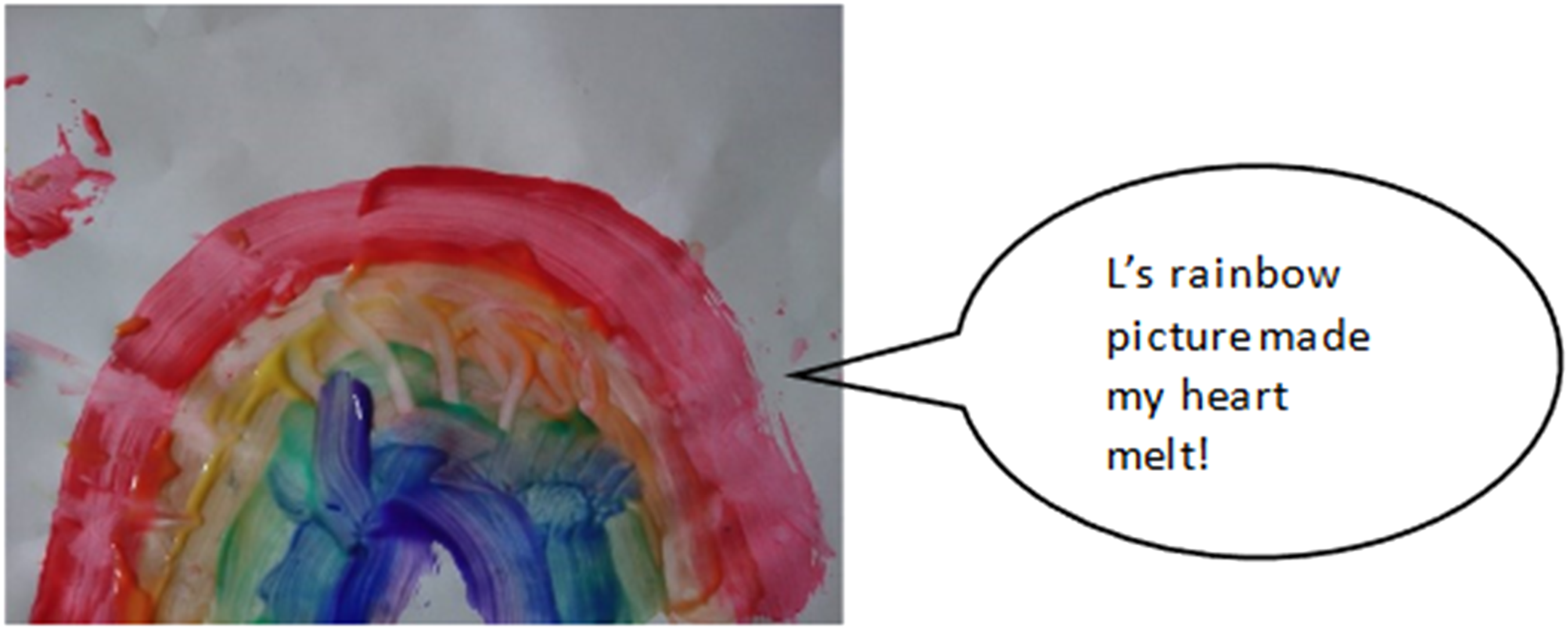
CV19-46, ‘L's rainbow picture made my heart melt!’ (annotated photograph), 9 April 2020, included as part of a 21-page photographically illustrated typewritten diary. Courtesy of the Mass Observation Archive.
As was the case with ‘Picturing Lockdown’, although not all photographs depict COVID-19-specific subject matter, all images produced and submitted to MO are necessarily COVID-19-themed by their context; they are about Covid even if they are not photographs of it (Pollen and Lowe, 2021). By way of example, MO diarists with gardens and pets frequently describe them as important sources of solace in isolation. Photographs of plants, such as flowers and vegetables, as well as cats, dogs, and rabbits, and garden wildlife, from foxes to caterpillars, thus figure in their MO diaries (see Figures 8 and 9). Taken out of COVID-19 context, these could be photographic subjects taken at any time, in any year. Similarly, art and craft projects are described as saving the sanity of some diarists, many of whom thus include photographs of their creative endeavours; these may not necessarily be COVID-19-focused in their appearance. In a public COVID-19 collecting project, however, the pandemic purpose of these photographs is extended; some diarists express their hope that sharing scenes of solace and creativity will spread optimism and positivity. As MT2020-381, a 70-year-old retired teacher, notes of a day diary compiled with photographic illustrations taken by her husband, ‘This is my photographic hug to you all.’
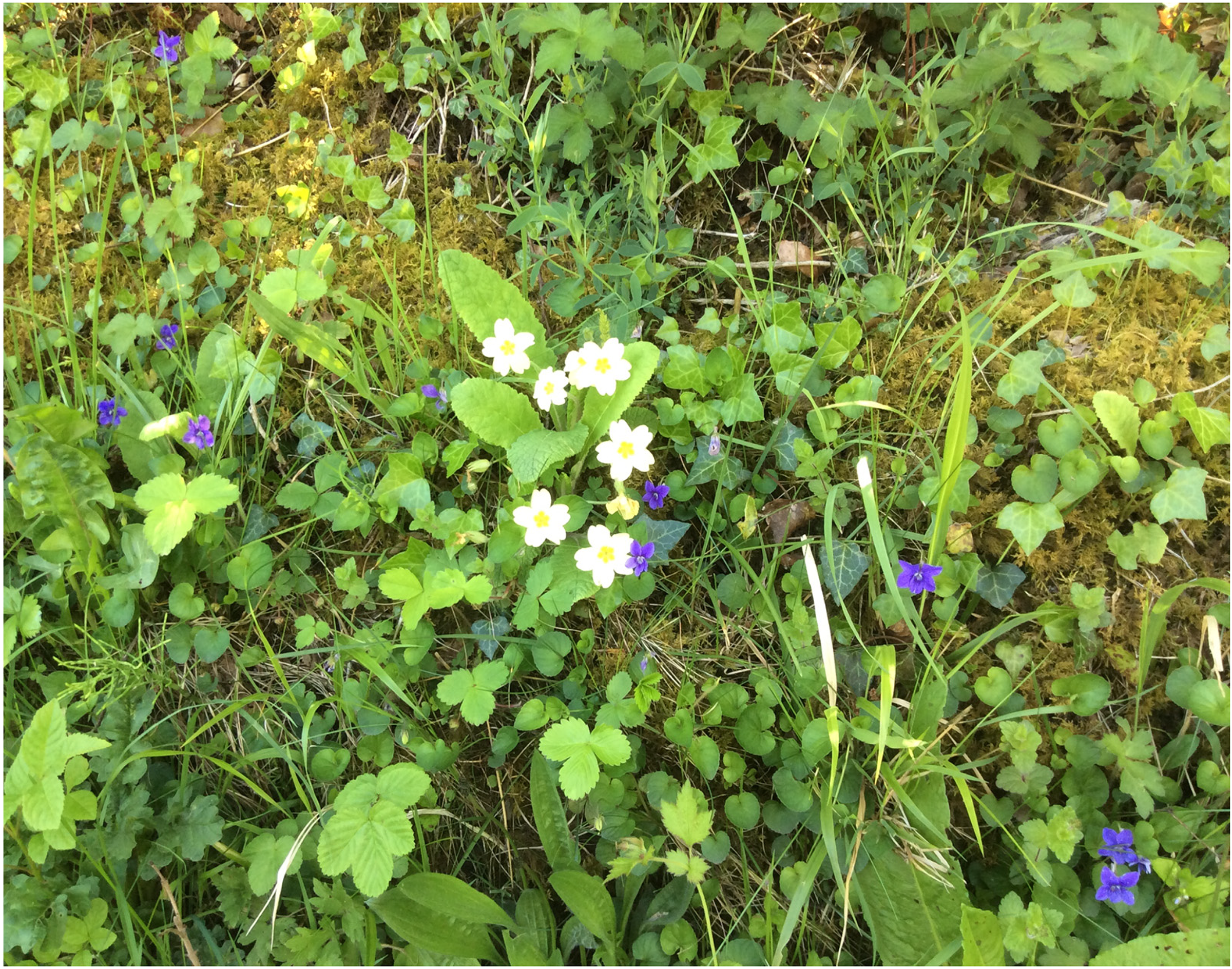
MT2020-498, Untitled photograph (spring flowers described as making lockdown bearable), 12 May 2020. Courtesy of the Mass Observation Archive.
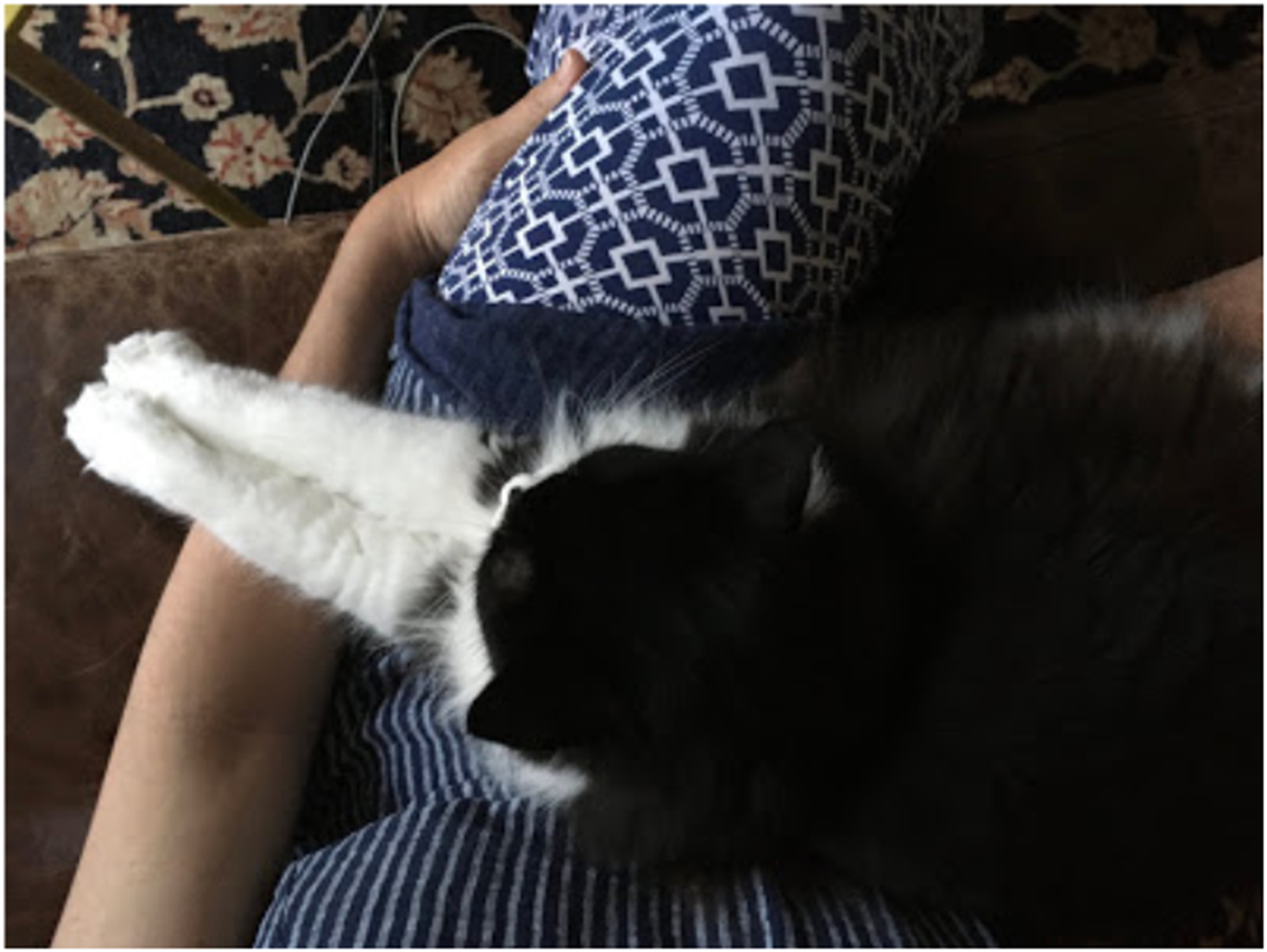
MT2020-31, ‘Schnookums’ (photograph of pet cat), 12 May 2020. Courtesy of the Mass Observation Archive.
Inevitably, not all visual submissions are so positively framed. CV19-15, in her ‘Coronavirus Alphabet Diary’ draws some playful and uplifting entries, but there are also scenes drawn from direct experience and those transposed from news media imagery, from empty supermarket shelves to COVID-19 patients on ventilators (see Figures 10 and 11). CV19-20, another accomplished artist, submitted mixed-media illustrations to capture imaginatively the dehumanising experience of social distancing, and builds a powerful collage of worrying headlines and news photographs of masked figures overpainted with a black and white title, ‘Dem Panic 2020’ (see Figure 12). CV19-18 paints an apocalyptic scene of a queue of line-drawn figures with shopping trolleys spaced evenly into infinity in a lunar landscape under a looming curdled red sky (see Figure 13).
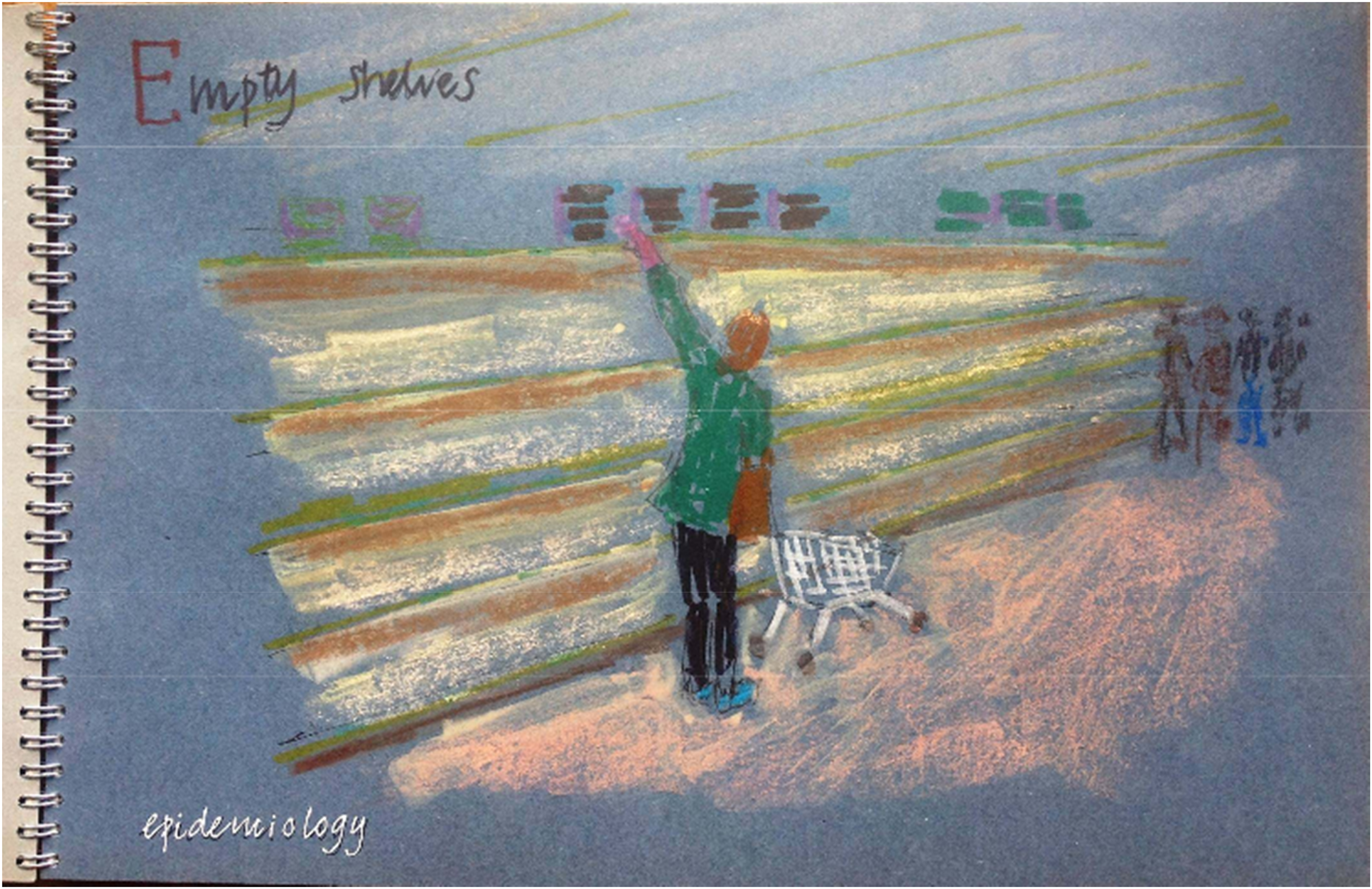
CV19-15, ‘Empty Shelves’ (letter E from Coronavirus Alphabet Diary), 8 May 2020. Courtesy of the Mass Observation Archive.
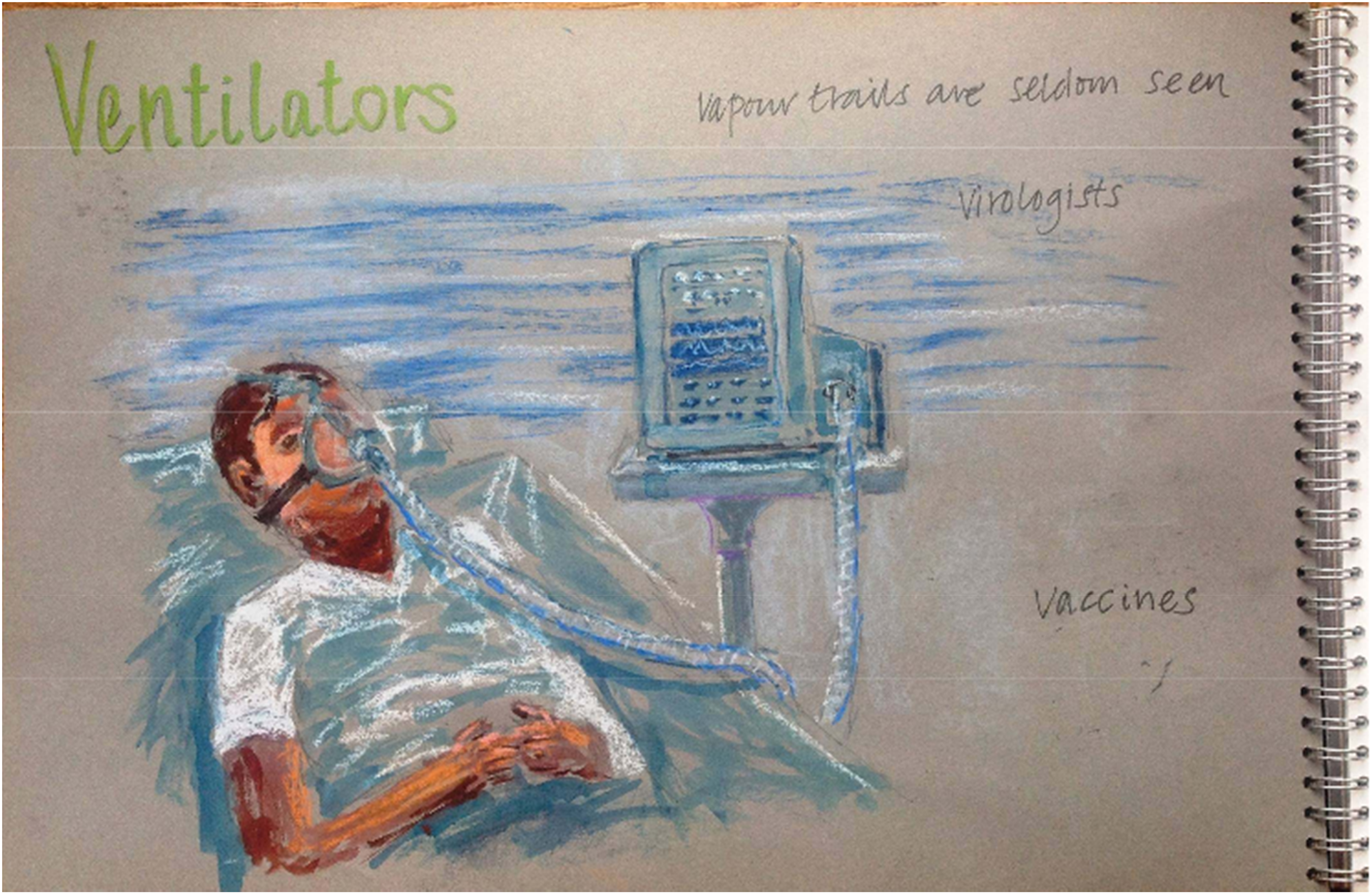
CV19-15, ‘Ventilators’ (letter V from Coronavirus Alphabet Diary), 8 May 2020. Courtesy of the Mass Observation Archive.
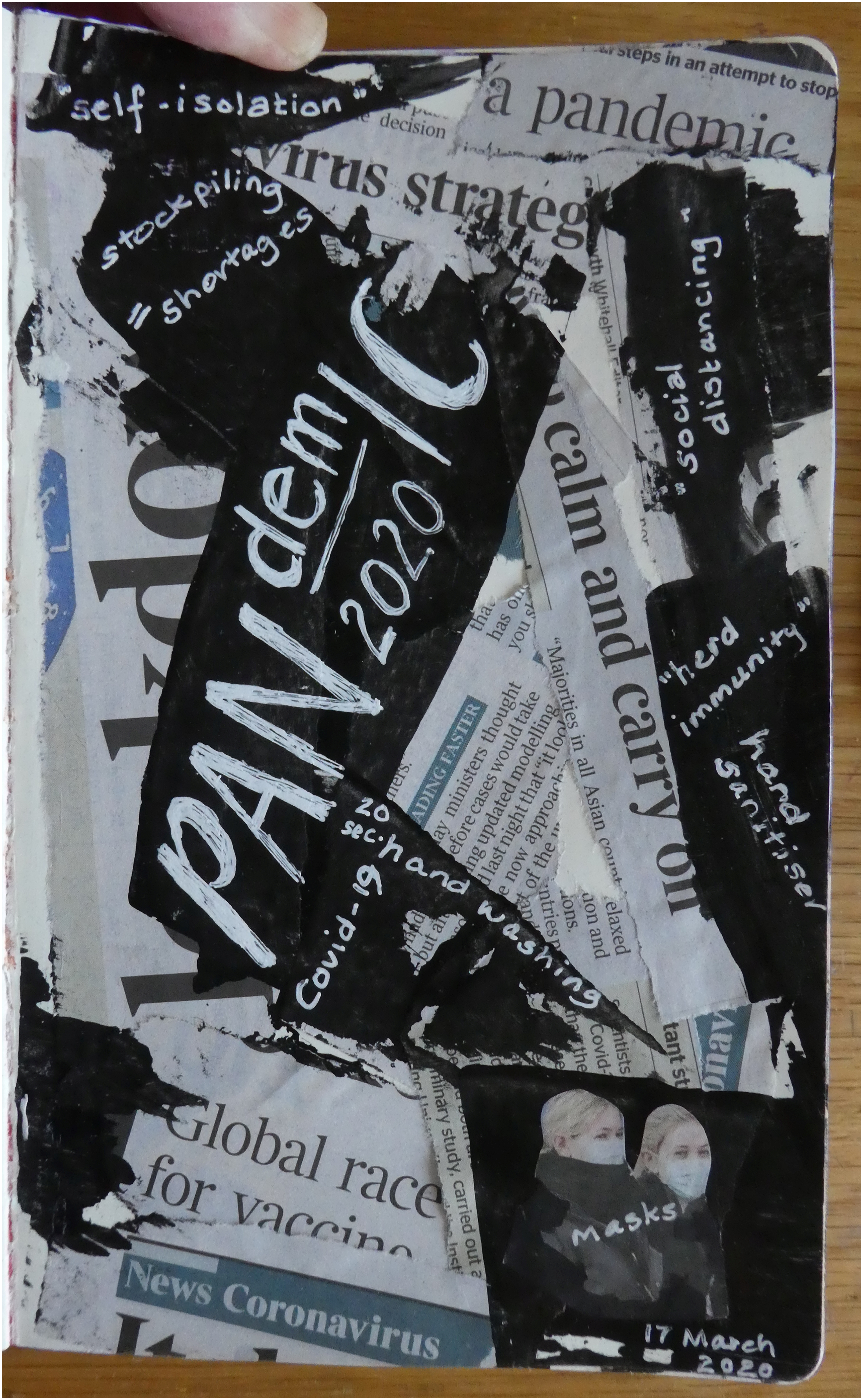
CV19-20, Untitled (‘Dem Panic 2020’), 17 March 2020, mixed-media collage. Courtesy of the Mass Observation Archive.
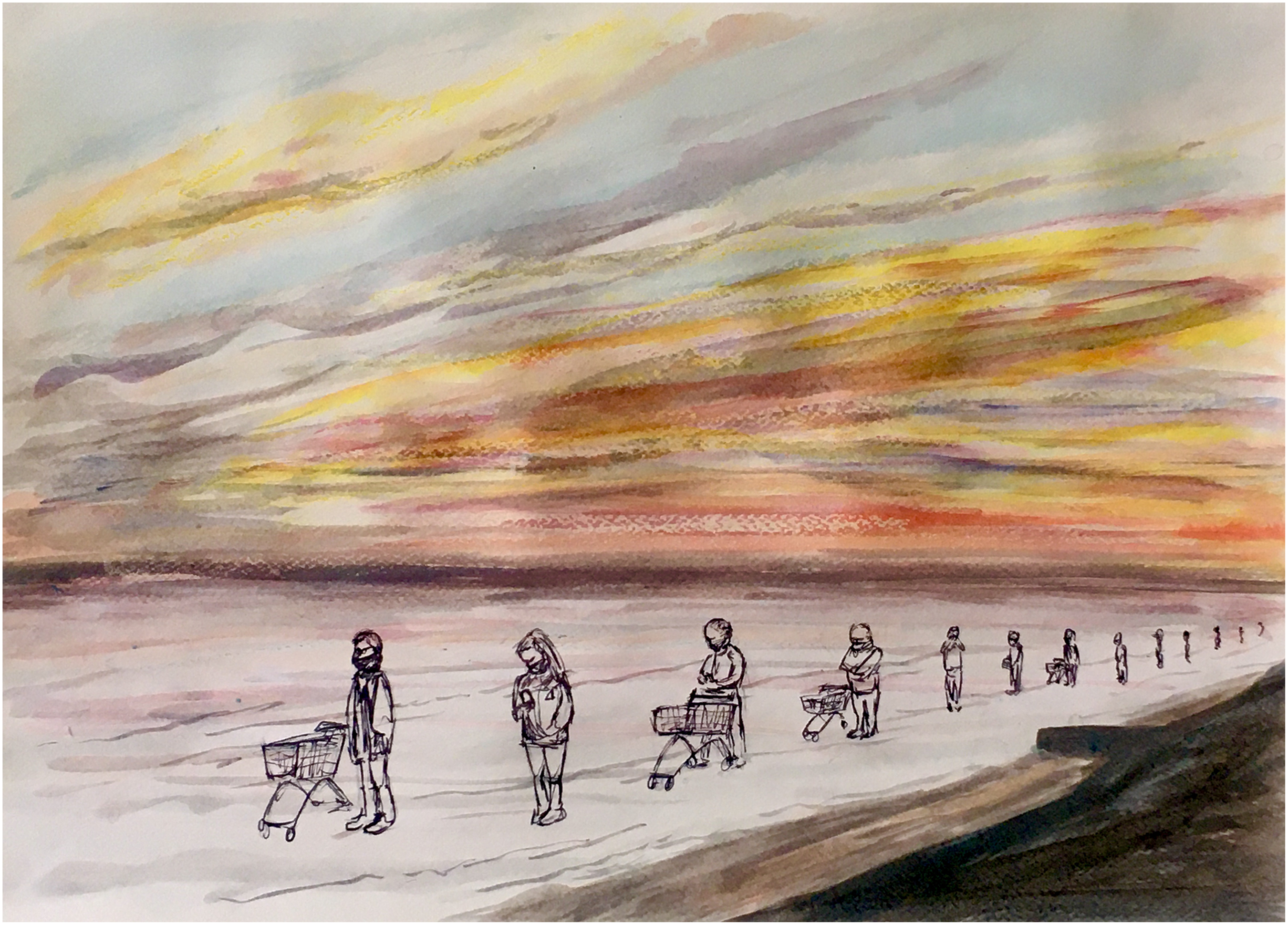
CV19-18, Untitled (socially distanced supermarket queue), mixed media, 26 May 2020. Courtesy of the Mass Observation Archive.
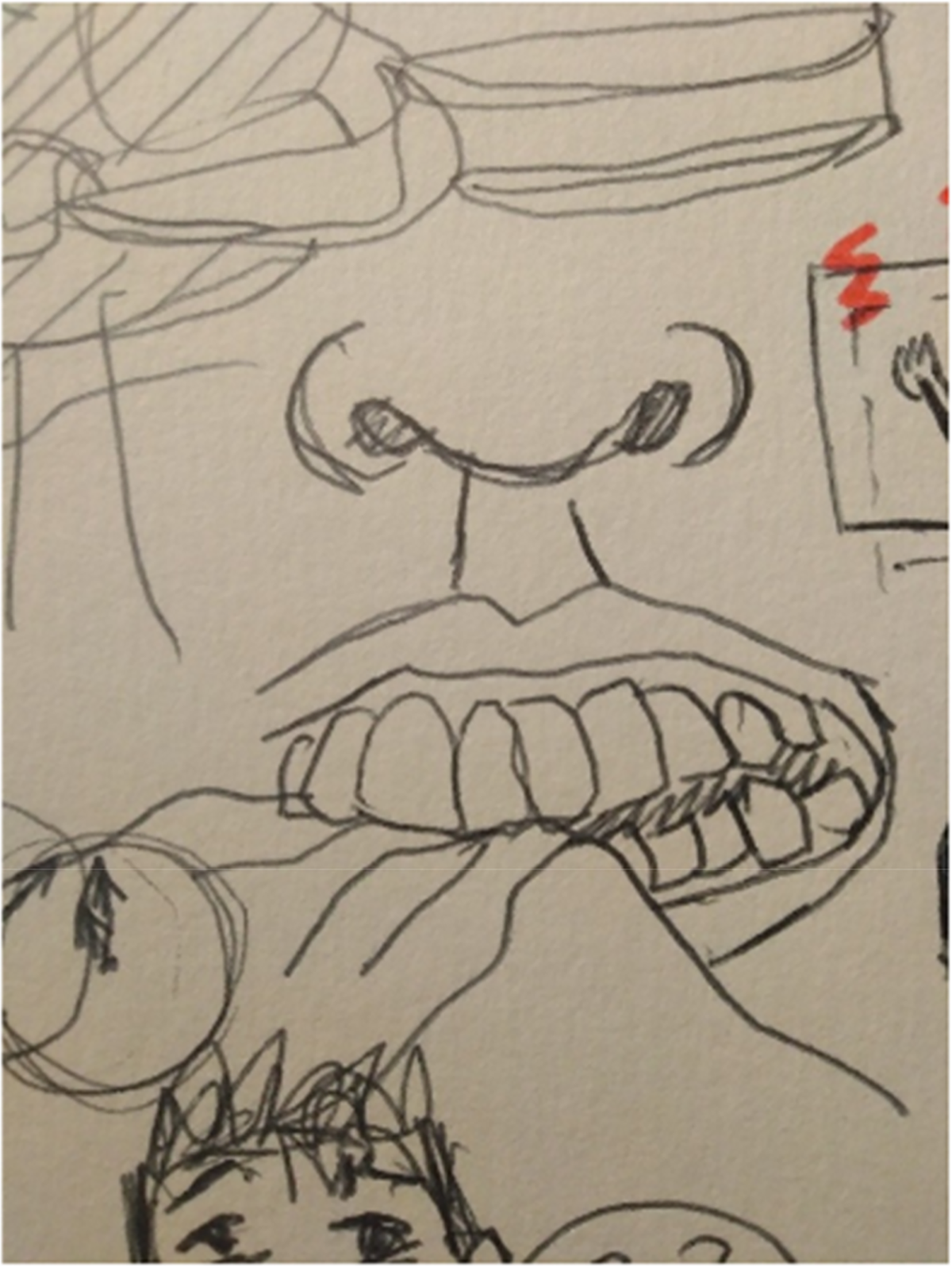
Some use their illustrations to externalise their complicated feelings. For example, MT2020-511, a 20-year-old autistic man from Ardrossan, Scotland, expresses his difficulty in coping with change. He says, ‘I have been making a lot of art about the situation to help me process it’, also submitting drawings of multiple clocks telling different times and a grimacing face showing gritted teeth (see Figures 14 and 15). Written diaries record feelings of anxiety, uncertainty, and sadness; the imagery elaborates on and works through these moods beyond their written labels. The visual material is not merely illustration – the showing to writing's telling – but it can operate in numerous and overlapping ways: to articulate anxieties for which words cannot be found, to fix and order the bewilderment of change into coherent categories and visual systems, and to give of gifts, perhaps as a kind of public greeting card. The images are processes and tools as well as outcomes and records.
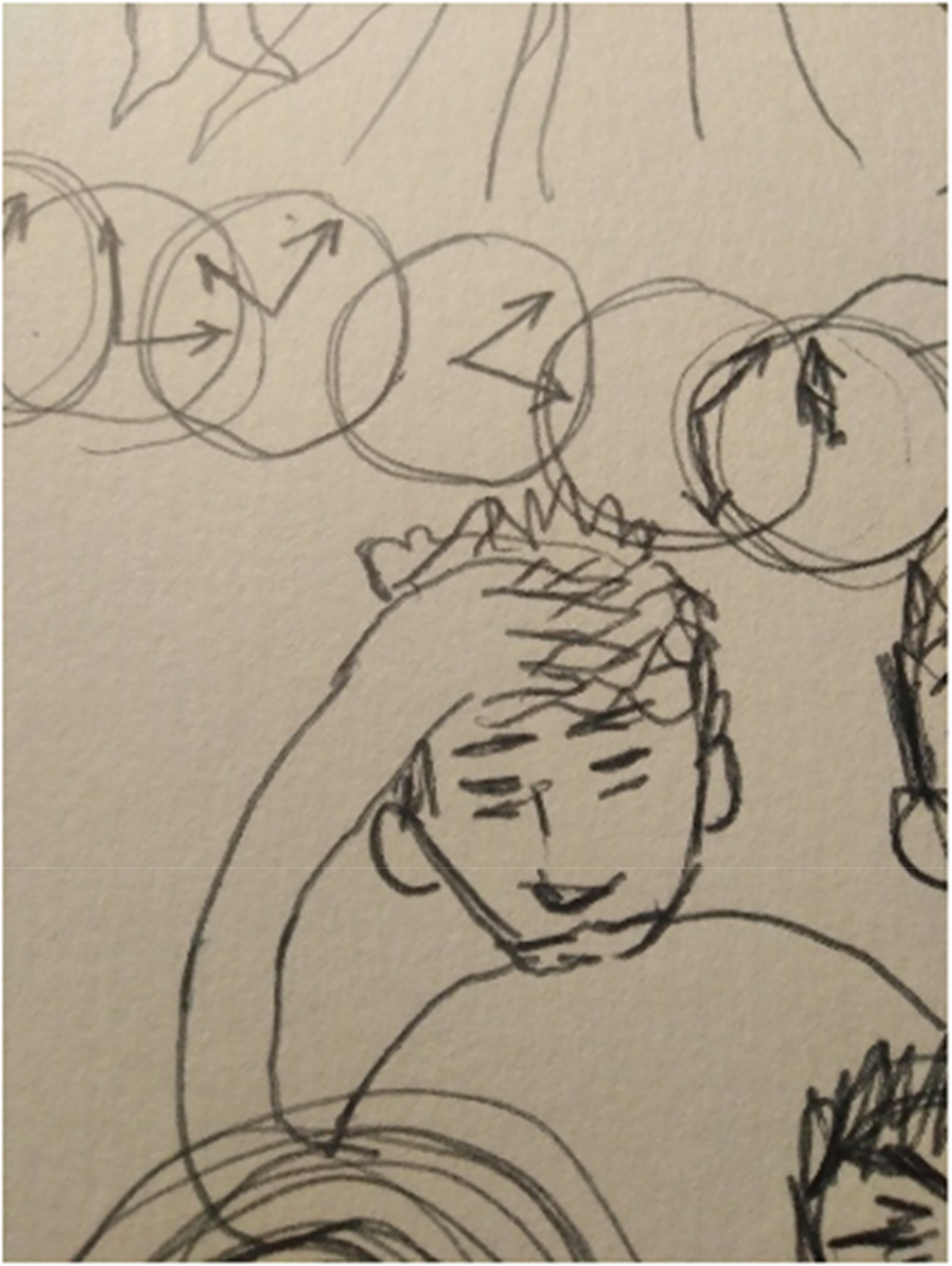
MT2020-511, Untitled (anxiety drawings), 12 May 2020. Courtesy of the Mass Observation Archive.
Photographs provided with MO COVID-19 diaries include those that capture daily lockdown life experiences, such as meals eaten (see Figure 16). There are also images that resulted from various COVID-19-specific home conditions, such as CV19-43's handwritten sign attached to a door marked ‘Dishoom Living Room’, as a joke about creative ways to make eating dinner feel special when restaurant dining is not possible (see Figure 17). Food is a popular topic for discussion across COVID-19 diaries more broadly. Although the 2021–2 Wellcome Trust-funded analysis is still underway, across the full 8500 submissions to MO's COVID-19 collections, where keywording has been undertaken, food has been tagged as a topic for discussion in around a third of entries. Food is not only a marker of time over the course of a day diary but was a prominent focus in a pandemic characterised by international shortages of familiar grocery products, including flour and yeast.
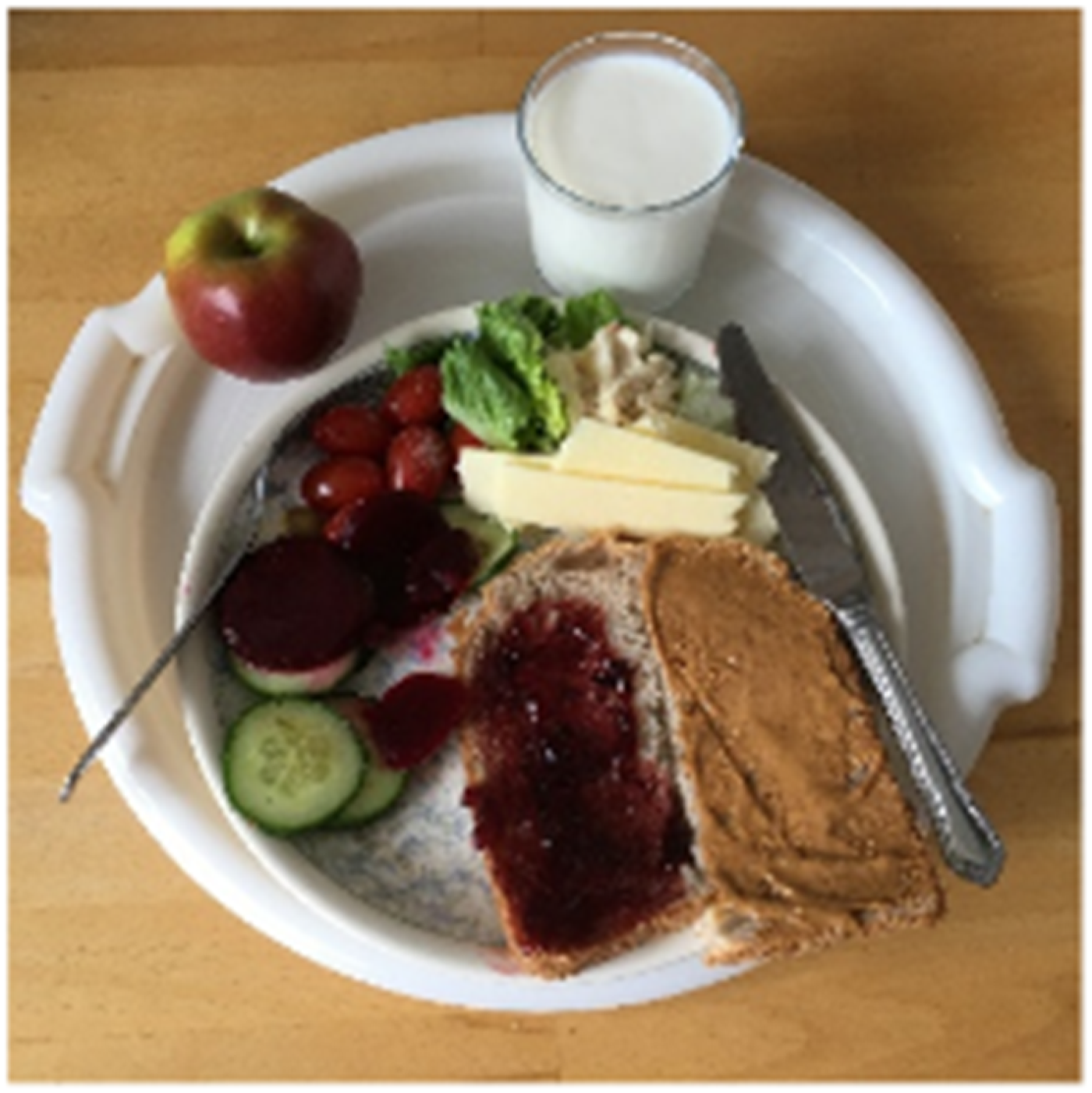
MT2020-430, Untitled (photograph of lunch), 12 May 2020. Courtesy of the Mass Observation Archive.
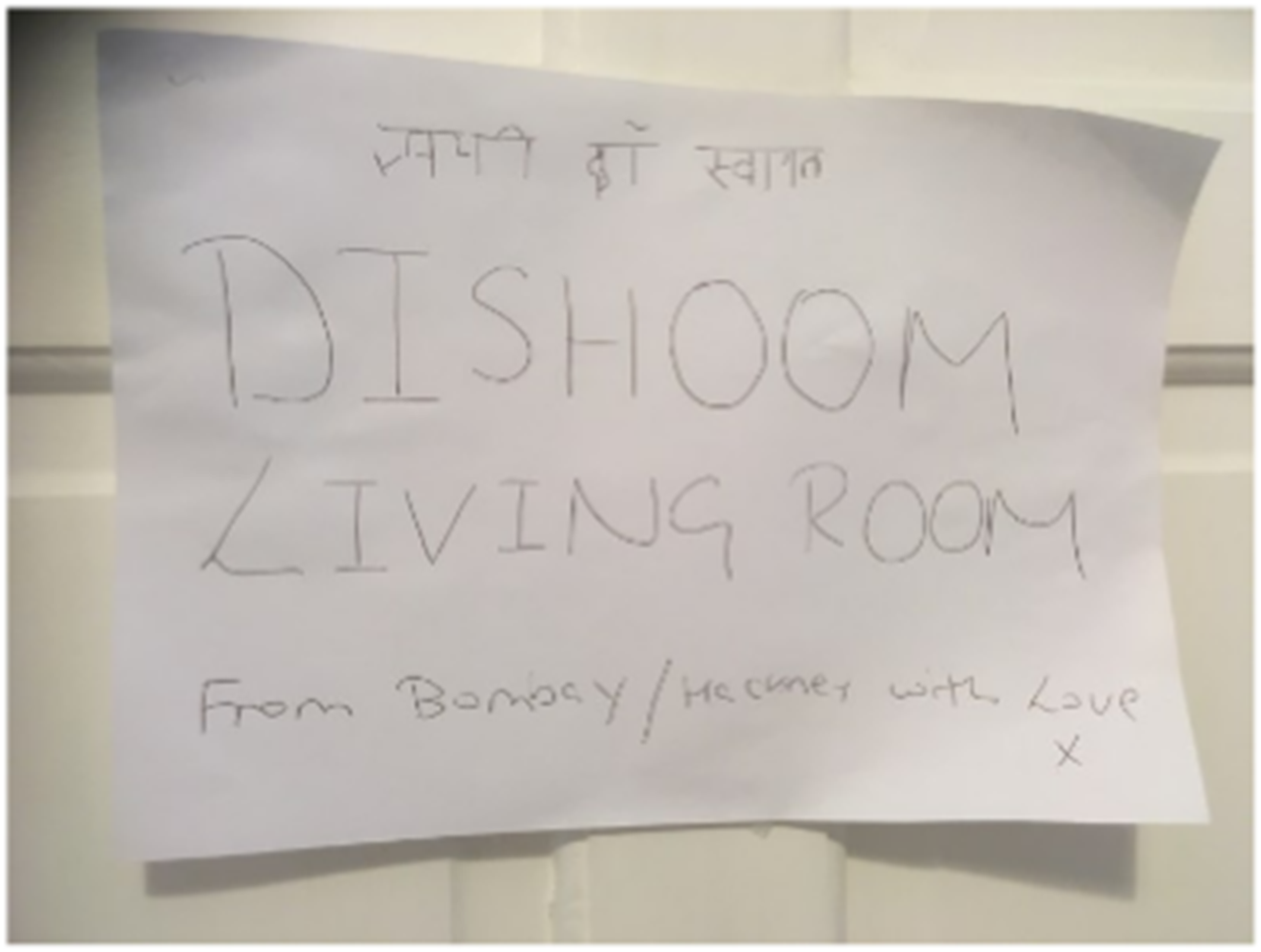
CV19-43, Untitled (‘Dishoom Living Room’), 20 June 2020, one of four photographs accompanying an 84-page typewritten diary. Courtesy of the Mass Observation Archive.
MO diarists, like many other commentators during the pandemic, reflect on bread and baking in both their photographs and their writing (Figure 18). MT2020-287 notes, in a poem written on a COVID-19 food theme, ‘Now a nation of bakers, there is no flour to make my bread. / I worry about food while more people are dead.’ MT2020-399 reflects, ‘I am cooking and eating too much. Everybody is baking.… Eating and drinking are the new obsessions.’ MT2020-437 is similarly critical: ‘Flour. Flour. Flour. The whole country has gone mad for it. Nothing better to do than be at home baking bread? Lucky them.’ Photographs of freshly baked goods feature in the visual submissions and in the written discussions, embodied by CV19-42: ‘The tea cakes have cooked a treat and are delicious. How do I know? I cut one open direct from the oven and slathered it with butter and shared it with George. I posted a picture on my Instagram page. I’m getting quite a lot of followers.’
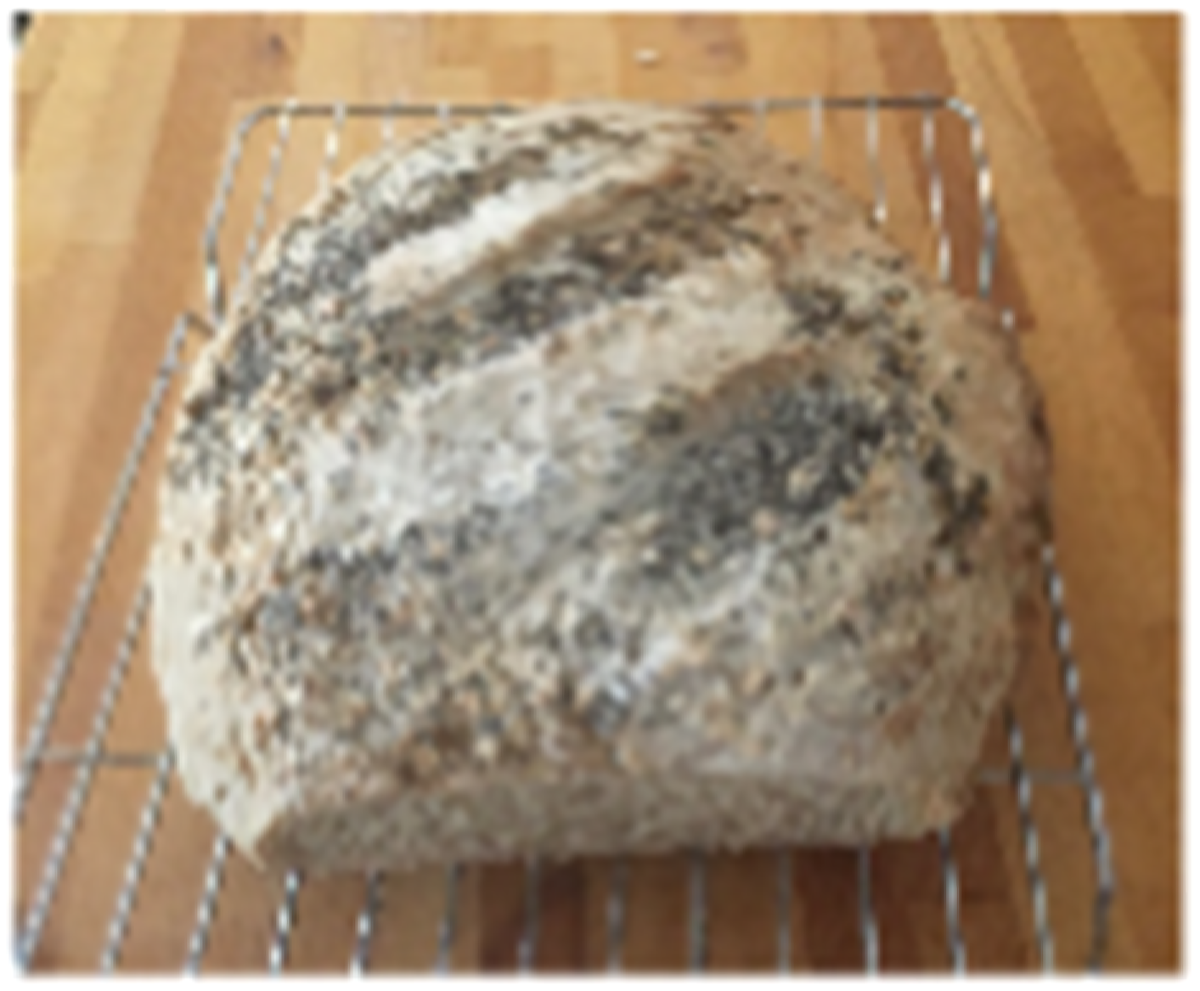
CV19-51, Untitled (bread photograph), 19 March 2020, from ‘The Corona Shut Down Diaries’ (a 36-page typescript submission, with multiple photographs on most pages). Courtesy of the Mass Observation Archive.
Both the baking of bread and the photographing of it for social media have manifested as more widely observed COVID-19 phenomena, beyond MO's COVID-19 diaries. This has been the case especially in relation to sourdough, a form of bread that can be leavened by fermentation rather than yeast, and which had already achieved cult status pre-COVID-19. Why sourdough should have become so popular in the pandemic was the subject of several 2020 news articles in broadsheet media in the UK and North America that were the first to note and to reflect on this trend, even if they were not the most substantial in their analyses. Journalist Tony Tassell (2020), writing in the Financial Times, identified sourdough as a word of the year, and summarised: ‘In hipster cafés from Brooklyn in New York to Hackney in London and Brunswick in Melbourne, it is the ubiquitous bread of choice.’ Flour and yeast shortages and health fads for fermented foods were some of the reasons that home baking became prevalent; early commentators also speculated that it represented a home comfort in times of anxiety for those with time on their hands, and it was a domestic practice that provided focus and control (Delap, 2020; Gammon, 2020).
Tassell (2020) quantified loosely that internet search interest in baking bread had ‘tripled as the western world went into lockdown’, and he counted four million #sourdough photographic posts on Instagram. Wider contexts for this trend include the phenomenon of social media food photography. Food photographs have been popularly perceived to represent the epitome of banal photography in the 21st century, where they typify the narcissistic and oversharing affordances of social media to its detractors. Scholars of Instagram pictorial practices (Manovich, 2016) and of ‘digital food culture’ (Lupton, 2020) have both accounted for the novelty and popularity of food photographs on social media platforms in recent years, but also for their efficacy in communicating the self and for consolidating communities, even as they perform commodity aesthetics. Photographic historian Kim Beil, who maps visual trends through media archaeological methods (2020a), was quick to observe that ‘quarantine bread pictures’ had come to display their own performance norms (see Figure 19). ‘At first, a few people were doing it. The slightly overhead angle showed off the scoring on the sourdough; the background was a plain wooden breadboard. Maybe they included a slice artfully balanced against the loaf with a humble brag hashtag about the quality of the crumb.’ A few weeks after, she noted playfully, ‘every other picture in your feed features a delicious loaf of golden sourdough on a plain wooden breadboard, a slice propped up at the side’ (Beil, 2020b).
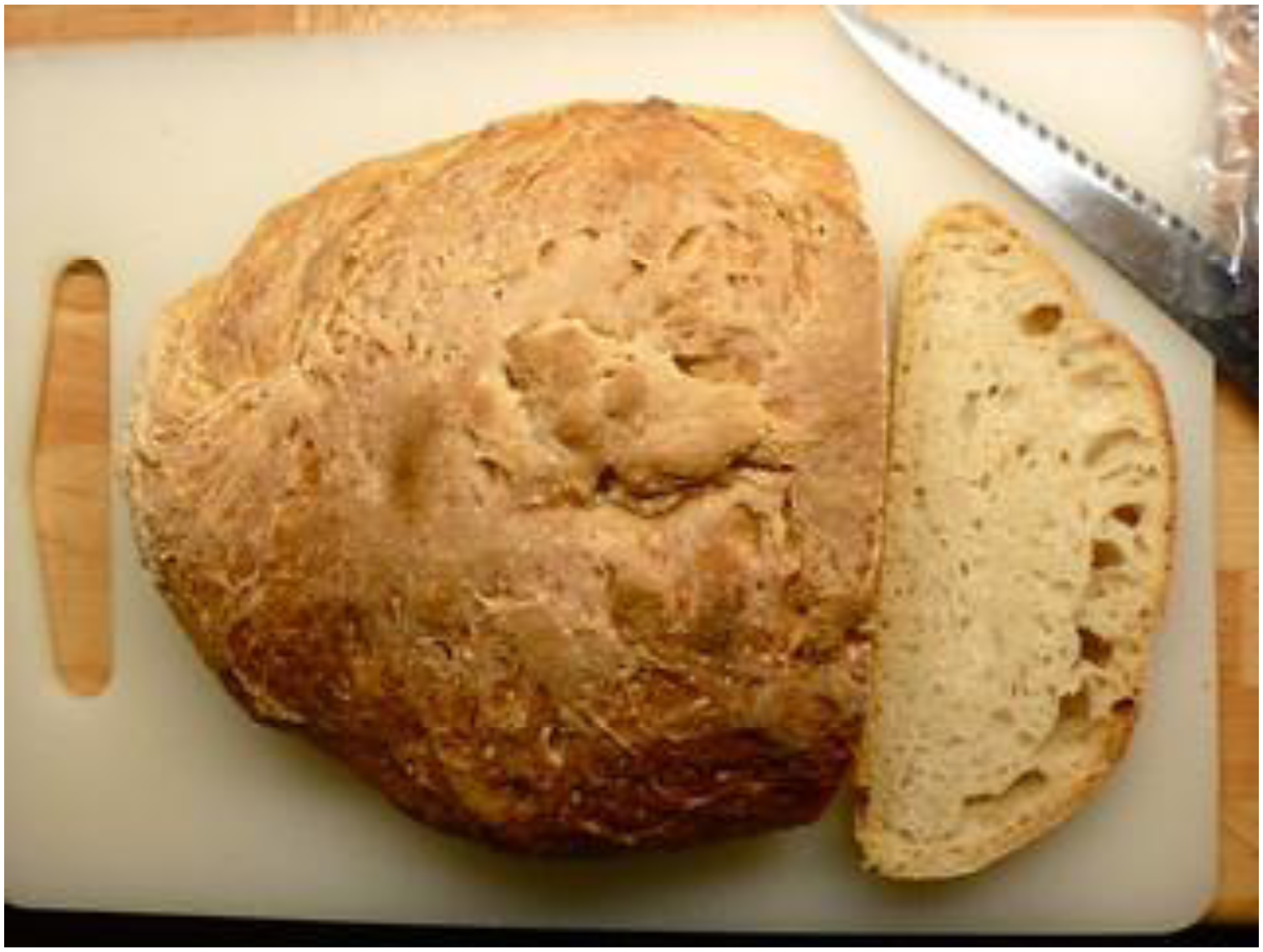
Peter Lindberg, Sourdough, Flickr. CC-NY. https://www.flickr.com/photos/plindberg/2856066920/in/photolist-5mo6c7-uQ3Xa-7ctLGg-dtgbQP-8cdD5N-7w8Q9g-5uHBXt-dtg5eG-9cgG2Q-dh1vST-8yhAdL-rtkCJB-nzaf3C-bzi44W-beESdX-5bdNzW-bQP2ez-8yhwub-6u2Sm3-8yhypo-4oZm6E-bf6r8V-6QtArZ-bf6ysx-4RJurb-bujtVV-beERPn-cK36Pb-bujupV-7CtfEN-7PkkD3-8UaY2c-beERnR-91wC1Q-8J4jRd-2g5xNr-bXhWjY-9FMbE8-BNNxcF-eBkjst-pkLMpr-7FCkmE-8J1hAR-obRxVL-bXhTHE-njeM8Y-eiMKV8-bdEeri-e3UddE-jdPGe3 An example of a social media sourdough photograph posted online during spring 2020.
MO diary photographs of home-baked bread, taken and submitted under COVID-19 conditions, share visual similarities with wider social media photographs of bread and baking, and it could be tempting to dismiss their inclusion as a privileged performance of affluent foodies. MO contributors, however – at least among the regular panel of writers, who have been analysed comprehensively – are not always easy to read against wealth and class signifiers, as Savage (2013) observes. He tackles the misapprehension that MO contributors are ‘an unrepresentative middle-class clique’; he shows how MO writers express ‘considerable ambiguity’ in how they define themselves, noting that they tend to ‘emphasise their hybrid class identities’ while reflexively critiquing the utility of the categories.
Although sourdough has served as shorthand for middle-class food fashion (see also avocado), the preparation and consumption of particular foods are not straightforward indexes of comfort and luxury, as Pen Vogler (2020) has recently explored in relation to food and class in Britain. Eating products associated with health lifestyles and/or international travel, such as granola and hummus – both of which feature in MO COVID-19 diaries – may be a popular middle-class indicator, but this assumes a lot about financial circumstances and choices while ignoring wider patterns of cultural exchange. The interpretations are not straightforward. Home-grown produce, such as vegetables, may signify thrift, but it also presupposes time and access to private outdoor space, which may signal a comfortable lifestyle and/or home ownership. In the context of home baking, some diarists were, like the wider population, furloughed from work; their time at home was enforced. While MO writers discuss food deprivation, it is true that they are more likely to be food bank contributors than recipients.
Full occupational analysis of the authors of the 8500 MO COVID-19 contributions is still ongoing, but in my sample diarists included key workers in schools and the NHS as well as those unemployed and unable to work due to disability; the pictures of their lockdown experience are thus mixed, and their pandemic fortunes, as with the rest of the population, were unevenly shaped by circumstances of gender and generation, sexuality and ethnicity, and social class. MO data – perhaps because of the organisation's name, and the scale of its holdings – has often led to erroneous expectations that the material somehow represents a cross section of the population from which one might draw nationally generalisable conclusions (Pollen, 2013). As MO researcher James Thomas (2002: 37) rightly points out, ‘Because its panel comes closer to approximating a quantitative survey than most qualitative option sources, it has been criticised more for not reaching a statistical purity that it does not seek to achieve. If the sample was smaller, it is doubtful whether the criticisms would be so persistent.’ Diarists in MO's COVID-19 collections may follow the wider demographic patterns of MO contributors more broadly, but their experiences are not homogeneous.
A photograph of food submitted as part of a reflective diary to a social research organisation, then, may be one and the same as a photograph uploaded to social media, or it may merely look superficially similar; there are key differences between the two destinations. Photographic messaging is notoriously slippery; as many eminent photography scholars have observed, intention can be hard to capture and meaning can be mobile (Berger and Mohr, 1982). Even photographs that look similar can be produced for quite different purposes and achieve quite different effects. Victor Burgin's application to photography of the rhetorical form of anatanaclasis – meaning ‘repetition with different significations’ – can work well for thinking about the individual differences in mass photographic practices, especially in relation to visual patterns or what are sometimes dismissed as clichés (Burgin, 1982; Pollen, 2018). Many image instances do not automatically equate to one singular message.
It is also worth contextualising MO COVID-19 diaries in relation to wider MO practices to see a bigger picture. For example, photographic day diaries were submitted by MO correspondents as a task in autumn 2012's Directive, ‘Photography and You’. The randomly selected days that MO correspondents photographed were more self-consciously ‘ordinary’ than those scrutinised under pandemic conditions, but correspondents similarly submitted photographs of their meals alongside other domestic subjects. In the same Directive, correspondents were asked questions about photographic culture and experience, including their attitudes to photographs on social media. Even though they photographed and shared the most ordinary aspects of their domestic lives for MO, many criticise similar practices taking place online in their responses to the 2012 Directive. M4780, for example, a 28-year-old administrator, complains that some people's social media photographs are ‘really boring’, and as an exemplar, she cites a photograph of a sandwich. R4539, a 40-year-old teacher, says she enjoys looking at photographs of people she knows on Facebook but adds, ‘It annoys me, though, when people post photos of their lunch or a cake they’ve baked, as one of my friends did recently.’ B4290, a 43-year-old civil servant, shares her strong views on people, especially younger people, taking photographs of dinners, describing it as ‘bad form’ and an ‘intrusion’.
For some, this is a criticism of the triviality they perceive in social media more generally. R3422, a 65-year-old man, formerly a bank manager, says, ‘As an intelligent adult I have no use for Facebook and its like.’ R4526, a 52-year-old science teacher, asks, ‘Are people so insecure or desperate for attention that they need to put even the most banal aspects of their existence online?’ He then answers his own question: ‘All too obviously Yes!’ Those respondents to the ‘Photography and You’ Directive who dismiss sharing what S3779, a 50-year-old bereavement counsellor, describes as ‘very intimate information / photos about themselves on the internet’ mostly do not seem to notice that they are sharing the same intimate details and everyday life photographs with MO. T4715, a 40-year-old speech therapist, reflects on this point explicitly, however. She realises that she is contradicting herself when she criticises the ‘obsession … these days’ of ‘finding out everything’ about people, even those who are ‘ordinary’, after having said earlier in the same submission that she enjoys looking at social documentary photographs that show ‘normal people carrying out everyday activities’. When she complains about ‘endless photographs’ circulating online that ‘some people’, she says, seem happy ‘to share with complete strangers’, she puts this into context with the importance she ascribes to her own privacy and data protection, and she considers why contributing to MO and other research projects is different. A principal reason is MO's provision of anonymity, but another is its wider social purpose; this explains why she submitted 12 densely typed pages packed with intimate details of her personal life.
In this area, T4715 shares characteristics with others who have considered the value of contributing to MO, as captured in an autumn 2004 Directive, ‘Being Part of Research’. Correspondents reflected on MO's anonymity and how it offered protection and engendered trust. They valued being part of an organisation with historical longevity, and writing for an archive that held their submissions in posterity and combined them, with others, into large-scale overviews (Pollen, 2014). This gave consequence and meaning to what might otherwise be individually mundane. These MO qualities carried forward to what were widely agreed to be the ‘extraordinary times’ of a global pandemic, when ‘ordinary’ took on a new contrasting power. As a result, photographs of food in MO COVID-19 diaries become historical documents performed for posterity in a project whose bread and butter is the documentation of everyday life; they move, in contributors’ eyes, from narcissism to public good. As visual anthropologist Elizabeth Edwards has observed, in relation to photographs and the construction of historical meaning, ‘However banal and inconsequential the subject matter, the photograph frames the fleeting instant: it heightens, projects, performs and pushes into significance and analytical possibility.’ She argues that photographs, even if of the minor details of everyday life, ‘vastly expand the range of traces that might both constitute and inform a sequence of events’; that is, they become the building blocks that constitute the making of history (Edwards, 2022: 59).
Writing visually: Pandemic imaginaries
In addition to the images submitted as, or with, MO COVID-19 diaries, there is a strong strand of visually inflected ekphrastic texts in the written submissions. I argue, building on the work of MO scholars such as Hurdley (2014), Shaw (1996), and Swales (1990), that image-rich and imaginative quality is a characteristic of MO seeing and poetic writing (Pollen, in press). This dimension has further force under pandemic conditions, where everyday life is rendered newly strange and scrutinised afresh. Isolated positions create new perspectives both on the outside world and in the mind's eye. As will be discussed, these conditions produce vivid dreams and heightened senses, leading to fresh perceptions even when there is nothing particularly arresting to observe. My approach offers a visual culture framework that, following Nicholas Mirzoeff (2015: 11), views visual culture as ‘not simply the total amount of what has been made to be seen, such as paintings or films. A visual culture is the relation between what is visible and the names we give to what is seen. It also involves what is invisible or kept out of sight.’
MO diarists reflect on the challenges of COVID-19's invisibility. MT2020-61, a 39-year-old man from Glasgow, opines, ‘In this foul year of our Lord, 2020, I find myself confined to the house due to the invisible menace of Coronavirus.’ An English literature lecturer, MT2020-490, also reflects on the ramifications of COVID-19's obscurity. She says, ‘Some of my friends think the whole thing is a conspiracy to control us, and it is strange staying inside when everything looks so normal out there.’ The 12 May diaries are particularly interesting on this point; two days before, as noted above, the British government had changed the message from ‘Stay at Home’ to ‘Stay Alert’. The nebulousness of this instruction, and its relation to wartime slogans and practices, is considered by correspondents, especially among those who observe that vigilance was already characterising pandemic life. MT2020-89, a teacher in a Cambridge secondary school that had closed due to COVID-19, writes: Over the last few days I have been thinking about my grandparents all of whom were alive in the second world war. My grandfather was a fire watcher in London and in the evenings I have been thinking about how he kept watched over the city whilst others slept. I think about how quiet the roads must have been during the war and how dark the nights. In lockdown, the roads have been so quiet again and the government are telling us all to stay alert – perhaps we are all watchers looking for the danger signs.
MT2020-21, who characterises herself as a retired 67-year-old married woman, living in a village on the borders of Hertfordshire and Essex, sees more sinister effects to the new practices of watching, seeing them as more as tactics for social surveillance and suspicion. She complains: Tesco has instituted a one-way system around the shop, informally policed by members of the public, who in another time and place would have been ARP wardens or would have shopped their neighbours to the secret police! I came back from one such shop, sat down and wrote a list of all the things I’d forgotten because I was so stressed walking around the store I couldn’t sufficiently focus.
Many writers, isolated from the outside world, look instead at its visual representation in news and social media and shape their impressions of the pandemic in its reflection. For some, the way that the pandemic is being reduced to superficial images in a kind of political branding is a repeated source of frustration. MT2020-153, a 52-year-old postdoctoral student from Widnes, rages: Throughout this pandemic we have been urged to rediscover a wartime spirit. The number of deaths now approach those that were experienced during the Blitz of 1940–41. We have a Prime Minister who professes that Winston Churchill is his hero and enthusiastically calls for national solidarity. This call for national solidarity is hollow. His posturing as a new Churchill is a cheap, plastic veneer. When the Prime Minister calls to the nation he is only calling to those who think as he does. It is the worst kind of nostalgia. It is bread and circuses using the imagery of Spitfires, Lancasters, and Dunkirk wrapped in red, white, and blue bunting.
MT2020-139, a 15-year-old diarist, is also scathing about the efficacy of some visual endeavours – such as the Royal Mail gesture in May 2020 to signal appreciation for frontline workers by painting some of their postboxes blue, with the slogan ‘Thank You NHS’ – saying, ‘Great, that really helps.’
The press image is a particular point of discussion for diarists, often engendering sympathy but also anxiety. CV19-42, for example, makes several observations of public images in her extended diary: ‘Facebook was flooded with pictures of the elderly (men and women)’, she notes; these figures typically ‘stood with a basket in the middle of the store, glancing down at their shopping list, with all the shelves around them empty, with a bewildered look on their faces. Sobering and sad.’ On another occasion, she notes: ‘On Facebook, Brighton beach was absolutely packed with people – none of them taking heed of the government's warning about social distancing. Ditto’, she gripes, ‘the queues in the Asda car park’. Later in the pandemic, in response to changing conditions relating to the return to work, she bitterly observes: ‘Saw pictures of the tube on BBC Breakfast this morning and commuters were packed in like sardines again. Not many had face “coverings” as we’re supposed to call them now.’ But she is also moved by the power of photographs to act as substitutes for absent others. She records: Wonderful story on BBC News earlier about an old gentleman in a care home who always goes to sleep with a picture of his wife in a frame by his bedside. A care assistant got his wife's photograph printed onto the cushion and presented it to him! His reaction brought tears to my eyes. He was so overwhelmed. What a lovely thing to do.
This public image reflects a private practice that several diarists describe as their own photographs take on new force and meaning in isolated conditions. MT2020-492, writing from Pistoia, Italy, reflects, ‘I felt quite upset looking at photos of my niece E in my study since I have no idea when I’ll be able to see her again. She lives in Chester and I suspect I won’t be able to travel safely for a long time. I had a little cry.’
As a result of seeing the world mostly through media images on screens, MO diarists report that they have gained more attuned senses, providing them with a powerful new sensual engagement with the parts of the world that they can access. This offers some compensation for other restrictions, and may even be the product of narrowed experience as the wider world grows quieter and their private domains become smaller. CV19-40 asks, in an entry dated 13 April 2020 (emphasis in original), ‘How to keep one's heart from sinking on a daily basis? This Spring will be remembered as the year we noticed our environment’, she concludes. MT2020-423 reflects that after seven weeks at home, she does not feel much like painting, which is usually her main retirement pastime. She says, ‘Instead I have been watching.… My gaze has been more intense[,] my focus longer.… As I have been looking at nature and animals I have moved into a very slow and quieter gear.… I have had time to look and we have all had time to think.’ This may be a rather fortunate position – and there are MO contributors who describe their lockdown experience as a spiritual retreat or an artistic residency – as it suggests that only those with spare time had the chance to look.
Interestingly, a particularly rich body of MO visual writing comes from CV19-19, a busy ambulance driver who draws powerful written scenes from his frantic work as tiny vignette sketches. For example: I was travelling back home in my car which is plastered with NHS logos and badges. A white Audi went past me, then suddenly slowed down. Then the driver put on hazard lights to say ‘thank you’ to me and raised the fist out of the window to salute. I waved back, and the Audi sped off into the sunset like in the old movies.
This contribution is amusingly resonant with MO's original outline, in the New Statesman on 30 January 1937, of what founder members hoped to capture in examining unexamined practices, including ‘the shouts and gestures of motorists’ (Harrison, 2014). In relation to visual thinking, however, this diarist's final phrase also recalls other observations across MO COVID-19 diaries, where contributors notably draw photographic, painterly, or filmic parallels in their observations of lockdown life, which becomes more like a two-dimensional representation or a fantasy rendered as a dissociative image. As CV19-42 puts it, ‘It's like being in a film or having a dream and expecting to wake up but then realising that it's real and it's happening now.’
Dreams and fantasies were an original focus for MO's first-phase investigations in the 1930s as they sought to record collective mental ‘images’, and dreams have proved remarkably enduring as a research topic, including in more recent MOP Directives that have solicited dream accounts (Miller, 2001; Vinen, Langhamer, and Siena, 2020). MO COVID-19 diarists volunteer spontaneous reflections on both night visions and daydreams, sometimes in wider recognition of discussions in the media, where shifts in dreaming were identified as a shared pandemic experience. CV19-40 observes, ‘Apparently we are living rich, vivid, sensory lives in our dreams like never before. And remembering them. Lockdown Dreams. There are surprisingly few nightmares, but many typical anxiety dreams (no food on the supermarket shelves!) and much waking up with anxiety.’ From her own perspective, she says, I’m enjoying my dream life, even those spiked with anxiety, because they give me something to think about. Last night I dreamed I was sitting next to a man … who smoked cigarettes. I wasn’t able to move away. I felt sick and carried this over into wakefulness where it stayed with me – an unpleasant feeling of illness.
MT2020-399 communicates something similar, reflecting on both her own experience and its place in a wider cultural frame: My husband and I have fallen into a habit of both waking up at 4 am and telling each other about our dreams. Everyone is having the most vivid dreams now, usually what we call ‘garden variety anxiety’ but sometimes the most bizarre images, like roller coasters being the new mode of transportation. I dream a lot about being lost in cities or plane crashes – husband dreams of snakes.
While the above examples draw on involuntary images produced during sleep, there are accounts of semi-conscious visual fantasies too, provided in the form of daydreams. MT2020-383 asks: I wonder if anyone else's head is doing what mine is doing. Replaying snatches of our good times all over the world. Usually tiny inconsequential times, sitting outside at a fish restaurant in Italy watching the sea. Taking photos of himself with a huge bottle of wine. The ginger cat who followed us all over Plovdiv[,] Bulgaria. That was this time last year. Will it ever happen again[?]
MT2020-396, a 34-year-old writer living with his girlfriend in Hackney, reports missing simple pleasures closer to home. He confides his prosaic, but sensual, fantasies: ‘Sometimes I imagine the act of being in a bookshop, leafing through pages, buying a book …’
There are many examples, such as those above, that could be extracted from MO diaries to demonstrate the visual imagination at play and poetic description in practice. These qualities can characterise MO writing outside pandemic conditions, where submissions may be individually rich, detailed, and imaginative in content, but the heightened intensities of lockdown have produced not only an abundance of new contributions from those seeking to capture and preserve a moment in history, and an expansion of the number of Mass Observers, but also affective and sensually attuned writing, as the following two extended excerpts show. The first is from MT2020-269, a 16-year-old boy in Warwick, whose GCSEs have been cancelled and who is left with his own contemplations, and whose moods seem to range from the romantic to the bitter: From my bedroom window, I look out across the little world that I can see. The birds dancing, the trees swaying, a gentle landscape painting itself along the surface of the river. The road has gone silent for a few moments; in its place springs a concert of chirps and whistles, floating along a soft breeze towards my window. I’m drawn to a row of yellow flowers over in the distant park, whose brilliance is dazzling in the sunlight. Next to them, I notice the silhouette of an old man, sitting alone on a park bench, quietly representing the last trace of humanity in my view of the world. Gazing over to the boat club, I imagine dozens of people out on the courts knocking balls back and forth, spectators laughing from the sides as they sip their drinks, coaches giving lessons to lively children, elderly folk gathered on the bowls green, rowers flitting up and down the river. Every person smiling, having a good time, forgetting about any of their problems in the outside world. Then the ghosts are gone, and the courts sit empty and disused under a smug blue sky.
The second, equally finely written although strikingly different in tone, is from MT2020-57, a middle-aged woman from Newhaven, Sussex, who writes of the narrowed range of her aspirations as a result of lockdown: ‘I thrilled to the idea of visiting a new supermarket in a different town; Peacehaven Sainsbury's’; such a small-town shopping location ‘has never been so rich with exotic promise’. In her diary, she paints an evocative scene, full of colour and texture, populated with fully realised characters in minute detail: On the way there, I needed a wee and, knowing that usual options (cafes, pubs, petrol stations etc) were all closed, I had to be creative in a very built-up ribbon suburbia. A closed car sales lot provided adequate cover, and again on the way back, albeit in broad daylight. I hope the locals coped with any glimpses of my middle-aged arse, white and shining between the polished-chrome of auto deals. Returning home, the sun was also ablaze and people exchanged smiles, greetings or just a raised eyebrow: a builder nearly finishing a wall, a chap renewing his fence (I remarked how smart it looked and he seemed proud) and a little girl sitting on her scooter who piped a cheerful ‘Hello’ while waiting patiently for her mum to finish on her phone.
Both diarists describe scenes, real and imagined, layered with reflections on the act of description, from the plaintive to the humorous. MT2020-269 sets up what he can see, what he wants to see, and what he cannot see. MT2020-57 watches herself being looked at, and develops, through creative writing, an evocative image of figures in a landscape, almost in freeze-frame.
When Charles Madge, one of MO's founders, outlined the purpose of MO in 1937 for the readers of New Verse magazine, he argued that asking Observers to record detailed statements about their everyday social worlds would produce a democratic form of poetry that was not, as was usual, ‘restricted to a handful of esoteric performers’. He argued, using a visual art simile, ‘In taking up the role of Observer, each person becomes like Courbet at his easel.’ These acts of record would become acts of insight: ‘What has become unnoticed through familiarity is raised into consciousness again’ (Madge, 1937: 3). In 1938, Madge and Harrisson used another visual metaphor, describing Mass Observers as ‘the cameras with which we are trying to photograph contemporary life.… They tell us not what society is like, but what it looks like to them’ (1938: 66). These visual practices – of observation, description, and interpretation – resulted in written texts rather than in paintings or photographs, constituting a form of ekphrasis, that is, what W. J. T. Mitchell calls ‘the verbal representation of visual representation’. Original MO strategies, to make visible the invisible and make the everyday strange, can be found in MO COVID-19 writings, which embody the ekphrastic ideal, where ‘the image/text division is overcome, and a sutured, synthetic form, a verbal icon or imagetext, arises in its place’ (Mitchell, 1994).
The warp and weft: Individuals and masses, images and texts
Within a few days of the pandemic being classified as such in early 2020, illustrations of the virus and data visualisations of scientific information began to emerge; within a few weeks, pandemic photographic themes were consolidated in news media; within a few months, the first analyses of pandemic visual tropes took shape. Those who became Mass Observers through creating and submitting visual and textual diaries to MO were enmeshed in these practices and in their interpretations; as they lived through the pandemic, they imagined its possibilities and limits, and they produced reflections on its significance.
Where there are photographs included in MO diaries, they echo the pandemic's wider visual repertoires, but they also shaped these tropes while they were still in formation. MO's open-ended Directives and lack of prescriptive structure enabled greater reflection on the meaning and purpose of photographs than was possible in parallel photographic collecting projects. ‘MassIsolation’, for example, collected narratives mostly at the level of hashtags, and the 50-word inscriptions accompanying ‘Picturing Lockdown’ submissions necessarily cut short nuance. Each project welcomed textual reflections with their submissions but, while they could be rich and affecting, these were only secondary. The wider meanings that MO images carry – such as depictions of bread – can be positioned in relation to other COVID-19 collections and wider photographic practices, but they are best understood in the context of the project that solicited them and to which they were submitted. They are contributions to a public history project designed to symbolically condense pandemic experience, whatever their subject and however they look. The call attracted those who had the urge to record, and who recognised MO as a meaningful location; their numbers were large, but their perspectives were particular. As with the larger MO project, despite their massing, they are not a generalisable mass.
The unruly scales and textures of MO submissions, and their ability to incorporate word and image, fact and feeling, in a range of tones and styles, forms and lengths, challenge researchers looking for neat data manageable by singular methods, but the richness and messiness of MO contributions offer their own rewards, as MO material mimics the unruliness of everyday life (Hurdley, 2014; Pollen, 2013; Vinen, Langhamer, and Siena, 2020). In the context of MO's COVID-19 collections, diaries offer reflective forms that capture, day by day, the real-time processing of the questions that all who experienced the pandemic's uncertainties were grappling with: What is this time we are living through? How can we capture it? How can we make sense of it? MO correspondents are not merely the producers of research data for others to make sense of; as carefully named ‘correspondents’, they are also its researchers, interpreters, and analysts (Pollen, 2014; Sheridan, Street, and Bloome, 2000).
In relation to Covid's visual culture, MO diarists reflect, in parallel with other visual culture scholars, on the in/visibility of the virus and the visual rhetoric of government public health messaging; they express concern about what news and social media show and what they do not; they are alternatively enraged and moved by what they can see and what they can’t. Through their own experience, they consider the narrowing of their horizons and the raising of their attention; they visualise what they have lost and imagine what may yet be. They capture what is new and strange, mapping the minutiae of their days. They write and photograph, reflect and communicate, perform and submit these considerations for public appraisal. They do so with the available tools and skills at their disposal, under confined circumstances, to show as well as say, to interpret as well as demonstrate, to emphasise and embellish their written accounts, and to offer alternative forms of visual articulation.
The open-ended invitation of MO does not narrowly specify the forms through which experience must be recorded and submitted, enabling the visual and the verbal to coexist and intertwine. MO writing has been summarised as a genre of its own. Sheridan notes that it draws on ‘the family letter, the school essay, the newspaper report, the personal diary, the testimony and the confessional’ (2002: 77). Twenty years on, we might update this list to add new media models such as the photographically illustrated blog post and the status updates of Facebook and Instagram. Across the MO samples, written and visual forms do not compete but cohere; they are the warp and weft, whether integrated into a single multidimensional submission or in image-infused writing.
The extraordinary and the ordinary: Still looking at the pandemic
As I write this article, in bed with a bout of COVID-19, two years on from the first time I heard the news of the virus, it still feels early to make full sense of a pandemic that is far from over. What it is in 2022, however, is not what it was in 2020. The furloughed are mostly back in work; governmental restrictions are mostly relaxed; vaccines have been produced and disseminated; new variants have emerged; successive waves of infection are still in progress. Clarity and certainty are still far from provided. The extraordinary times have not concluded but they are, perhaps, more ordinary now. MO diaries charted the pandemic's events – or lack of them – as they occurred. As Langhamer noted in her first pass of the 12 May material, ‘The sense of living through History is palpable but also elusive’ (Vinen, Langhamer, and Siena, 2020). She quoted MT2020-144, a 26-year-old Londoner, who had observed, ‘It's odd, you always feel like you’d feel the difference when something historical is happening around you, but instead normal life goes on.’ The 93-year-old diarist CV19-1 makes a similar point. Once she has successfully fulfilled the task of getting food in her cupboards, she says, ‘I think I’m going to go mad with boredom.’ She clarifies, ‘That's not a statement of intent. We're living in a very exciting moment of history, when we humans could step back from our insane domination of the planet.’ Yet, she notes, ‘there’s nothing to do!’
As CV19-40 prepared her MO diary for the benefit of future historians, she positioned her experience of the COVID-19 pandemic in dialogue with her reading of historic plague diaries and related literature. These helped her reconcile conflicting feelings. Discussing her encounter with Samuel Pepys' euphoric experience of the bubonic plague in the 1660s, where he stated, ‘I have never lived so merrily … as I have done this plague time’, she quotes his biographer, Claire Tomalin, who wrote in Samuel Pepys: The Unequalled Self, ‘The parallel is obvious with men and women at war or under bombardment who have found themselves living on an adrenalin high that gives extra intensity to every experience’ (Tomalin, 2002: 169). CV19-40 identifies with these feelings, yet she also quotes from Albert Camus’ 1947 novel The Plague. Camus observed that even the most difficult of conditions inevitably becomes routine and misfortune monotonous. On the poverty of his material, Camus concluded, ‘There is nothing less spectacular than a pestilence’ (2013[1947]: 138).
These contrasting but coexisting conditions, as seen in historic plague literature and as reflected on by an MO COVID-19 diarist in 2020, show the complexities of capturing the look and feel of a pandemic in words and images, where everything is simultaneously more pressing and more mundane, where historic organisations and their contributors are energised by the urgency to observe and record, even when there is very little to see. MO diarists, as a consequence, described both what they saw before them and what they saw in their mind's eyes. In writing full of luminous details, they communicated hopes and fears, preoccupations and fantasies. With new conditions shaping their contemplations – whether they were blessed or burdened with more or less time to think – they looked harder at the ordinary in recognition of a collective extraordinary. They stayed alert, per government instruction, in sometimes numbing circumstances. There may not have been much cultural variety in spring/summer 2020, as many usual distractions were locked down, but this infused the routine with a new iconic status. Media visualisations took on new force and became objects for comment. Interior worlds were illuminated and animated. The daily fabric of life, usually visible only as background, came to the fore. There may not have been much to see, but a powerful desire to see it and to say it runs through MO’s COVID-19 collections, whose expanded scale of submissions is testament to a public need to draw a collective portrait of 2020. Mass Observers drew it freehand, snapped it with their phones, and visualised it in words.
Footnotes
The author wishes to thank Nick Clarke, editor of this Special Section of History of the Human Sciences, and Jessica Scantlebury, of the Mass Observation Archive, for their assistance with the development of this article.
Declaration of conflicting interests
The author declared no potential conflicts of interest with respect to the research, authorship, and/or publication of this article.
Funding
The author received no financial support for the research, authorship, and/or publication of this article.
