



Abstract
During the long nineteenth century, public and semi-public venues of urban recreation were spaces where people actively shaped local social order by reinforcing, challenging, and changing patterns of social in- and exclusion in terms of class, gender, ethnicity, and other axes of social difference. Over the last decades, historians have been able to demonstrate how these tactics and patterns of social in- and exclusion functioned by focusing on different types of urban recreation. This article argues that during the long nineteenth century, the cyclical rhythm of the seasons—and their regularly shifting contexts of space, environment, weather, temperature, light, and so on—played a crucial role in the ways in which people interacted in urban recreations. Urban society actually functioned differently and was, in important ways, defined by the rhythm of the seasons. The article focuses on indoor sites of winter recreation such as theaters, concert halls, cultural associations, and balls; on sites of summer recreation such as parks, zoos, and other open air recreations; and on the annual urban fairs in between in Amsterdam and The Hague.
Introduction
The soirées and balls of The Hague’s beau monde had been more cheerful and luxurious last season, a journalist noticed in May 1872 in his biweekly news feuilleton about the residential capital. The exhibition of modern art had been quite successful, and the tricentenary commemoration of the Capture of Brielle (a key moment in Dutch history) rather dull but decent. But now it was time for change: The budding greenery in the Hague Woods puts an end to such festivities. The beau monde hurries to get everything ready for a summer stay in a country house or bath hotel; the middling-sort of public or the so-called respectable bourgeoisie—saturated with literary readings, concerts and operas—prepares itself for the enjoyment that the woods and the bath house will provide; and the general public saves up money to be able to enjoy the fair.
1
Statements like these abound in nineteenth-century Dutch newspapers, all indicating a strong sense and appreciation of the seasonal cycle in urban leisure activities. At the end of the long summer season, The Hague’s correspondent usually longed for change again: “For the light-hearted, the residence [The Hague] will again make every effort to make the winter bearable. Concert, and dance halls will be opened, the covers of the benches will be taken off . . . and the great contest of local celebrities, dilletants, maestri etc. will again commence.” 2 Did these chronicles simply reflect a recurrent sense of boredom? Or did their cheerful anticipation of the new season point to something else?
Studying major historical processes such as the rise of the middle class, the making of the working class, or female emancipation, historians are very much accustomed—and indeed trained—to project concepts on past societies that suggest linear trends of social change, evolving and manifesting themselves in the course of several decades. With respect to traditional socioeconomic indicators of societal inequality and stratification—such as income levels, distribution of wealth, occupational structure, and intergenerational mobility—the key notion that social structures, inequality, and stratification tend to develop and change relatively slowly and progressively in linear sequences of time appears hardly disputable.
If we turn to the field of leisure, however, and to urban leisure in particular, this linear conception of social change seems more difficult to maintain as the only or even dominant way of studying social structure and social change in the past. Over the last decades, historians have demonstrated that during the nineteenth century, public and semi-public venues of recreation were pivotal spaces in urban societies, where a wide range of people actively shaped local social order—and indeed, society—by reinforcing, challenging, and changing patterns of social in- and exclusion, both in terms of class, gender, ethnicity and other intersecting axes of social difference and inequality. Historians have studied specific types of urban recreation, such as theaters, cultural associations, parks, and shopping streets, to chart how tactics and patterns of social in- and exclusion functioned and together forged long-term developments in urban social structure. 3 In this context, the seasonal dimension of urban leisure has evidently been noticed, but it has hardly been elaborated as a key factor to enhance our understanding of nineteenth-century social structure and social change. 4
This essay will argue that during the long nineteenth century, the cyclical rhythm of the seasons—and their cyclical shifting contexts of weather, temperature, light, environment, space and place—played a crucial role in the ways in which people interacted in urban recreations. I aim to demonstrate that due to the cyclical shifts in the main sites of urban leisure culture and in the social interaction on these sites, much of the social order of cities as forged on these sites of leisure culture did not merely change in a linear way across the decades of the century, but also—and perhaps even more fundamentally—in a cyclical way, each season again. The argument is based on leisure culture in two expanding Dutch cities: Amsterdam, the largest Dutch city and formal capital of the Netherlands (140,000 inhabitants in 1815; 417,000 in 1890); and the Dutch residential capital The Hague (42,000 inhabitants in 1815; 157,000 in 1890). Drawing on earlier research of myself and colleagues, and expanded with additional qualitative and quantitative data, the essay will mainly focus on the construction of class at sites of winter recreation such as theaters, cultural associations, and balls; on sites of summer recreation such as parks, zoos, the seaside; and on the annual urban fairs in between. 5
The Annual Fair
Each September, when the first leaves dropped from the trees, the days shortened and the average temperature fell, Amsterdam was in the spell of the annual fair. Originally for three weeks (since 1847 for two weeks), the city’s main squares and streets accommodated many hundreds of tantalizing market stalls, a stunning variety of spectacles in permanent theaters, in temporary tents and on public streets, and splendidly embellished cafés and terraces—many of these also outside the city walls. 6 Organizing the annual fair just between the summer and winter season had some apparent advantages. In this time of the year, the average weather conditions made it possible to exploit a maximum number of indoor and outdoor locations, while the mid-evening sunset—shifting from 19:30 to 18:30—facilitated attractions with natural and artificial oil and gas lights, enriched by the enchanting pleasures of twilight. This advantage of the in-between season was confirmed by The Hague’s somewhat shorter annual fair, organized in the opposite transition period between the winter and summer season. For originally twelve days (since 1856 ten days) in May, residents celebrated on the city’s main squares, in its spacious aristocratic residential quarters, and in various cafés, gardens, and woods around the city. 7
In no other period of the year did the seasonal conditions enable and stimulate both cities and urban societies to be so much dominated by leisure and pleasure. Public entertainments and large crowds of amusing, singing, and dancing people were visible, audible, and smellable everywhere in urban squares, streets, quarters, public gardens and outside of the city gates. The fairs counted on massive, fully immersed public participation. An analysis of tax registers in the 1820s and 1830s reveal that more than half of the yearly estimated and/or realized revenue in Amsterdam’s public entertainments was made during the annual fair—mainly from circus and theater performances, but also from concerts, balls, fireworks, vauxhalls, wax figures, extraordinary humans and animals, and optical and mechanical spectacles. 8 Despite increasing contestation by religious, political, medical, and other authorities, the fairs continued to appeal to massive and increasing crowds of people. 9 With exception of the leisure industry, economic productivity in both cities noticeably slowed down during the fairs, hyperbolically painted by a commentator as a two week’s “general strike.” 10 As another publicist meekly confessed, the change of meteorological seasons and the associated urban fair triggered a change in emotional and bodily state: “I can’t help getting into a kind of festive mood every year around the fair, when the mercury of my activity drops considerably and I feel a spirit of blissful laziness rising within me.” 11 Only the volatile weather conditions typical for the in-between season could prove to be a spoiler. In 1873, The Hague’s fair galvanized substantially fewer people due to an icy north wind. 12
The active participation of people of all social classes made the fairs in Amsterdam and The Hague a truly extraordinary annual phenomenon (See Figure 1). For most working-class and lower-middle-class people, the fairs represented the year’s most joyous time. Many of them saved money all year long or even pawned some of their possessions to enjoy these weeks most intensely. 13 Nineteenth-century diaries testify that in Amsterdam many Dutch upper-class families continued to visit the fairs, too. 14 In 1856, The Hague’s Board of Mayor and Aldermen confirmed that the fair was still very much appreciated by “aristocrats and minor people.” 15 Well into the 1860s, members of the royal family visited The Hague’s urban fair, particularly on the “elegant” Thursday afternoon, accompanied by a large entourage. 16 In the 1880s, a prominent nobleman in The Hague continued to applaud the “opportunity of contact between high-ranking people and the inferiors” that the annual urban fair facilitated: “the fraternization between the different classes, and fraternization in the most favorable circumstances; by celebrating together.” 17
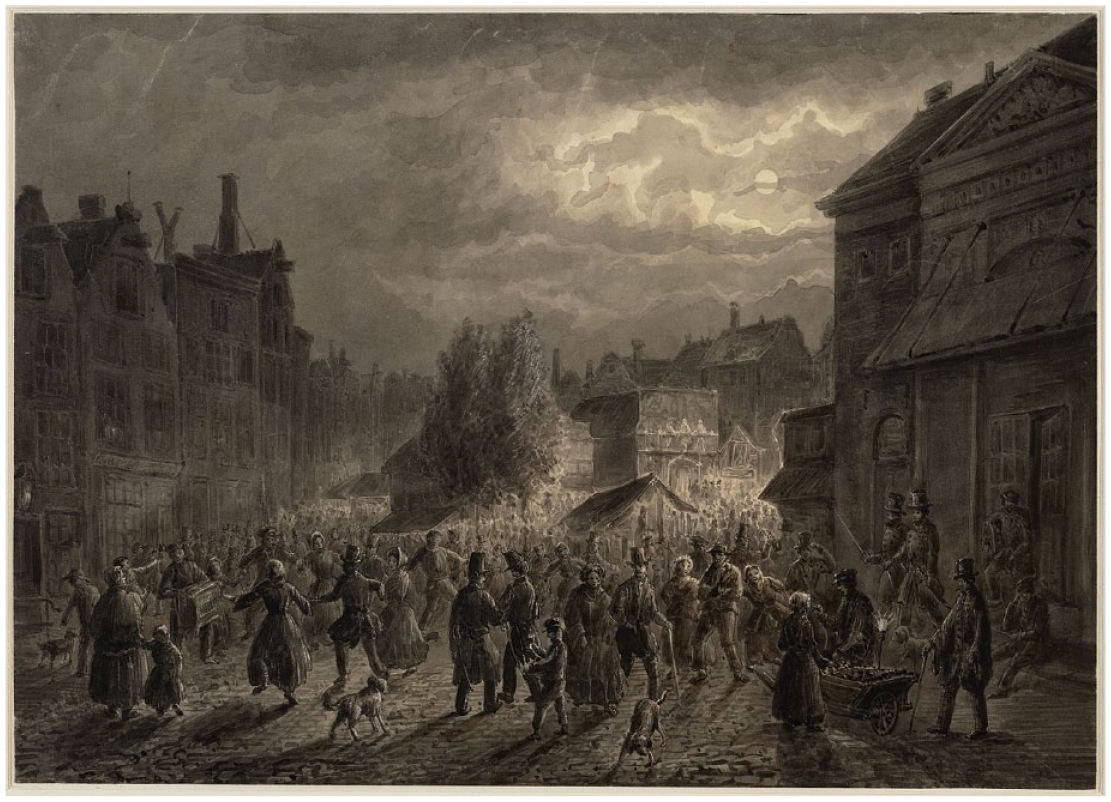
Fair on the Amsterdam Botermarkt, ca. 1850. City Archive Amsterdam.
It would stretch too far to suggest that intense social contact between the classes during the annual fair in Amsterdam and The Hague temporarily dissolved, symbolically overturned, or even questioned or contested class inequalities and stratification. Most indoor entertainments attracted a relatively wide but still fairly delineated variety of income groups, depending on price levels, locations, and social status of their spectacles. Various permanent and temporary theaters even enabled visitors to distinguish themselves from other categories of people by seating themselves on different ranks. 18 The visits of members of the royal family or municipal authorities confirmed rather than temporarily lifted the existing political and social power structures. The gleeful social mingling of the local upper classes on the streets with the rest of the population—particularly on Saturday evenings—had, for some, mainly a strategic purpose. The nobleman mentioned above celebrated how social interaction between the classes during The Hague’s fair encouraged “mutual esteem, in the face of much inequality.” Yet, he added, “Has one ever thought how a little more ease of intercourse, and a little more leniency of forms would impede the success of the social democrats?” 19 The congenial atmosphere between the classes, another contemporary reassured, was largely a nocturnal and thus a temporary affair. 20
None of this changes the fact that the annual urban fairs offered a few extraordinary weeks in which people of various classes united in a collective experience of pleasure, curiosity, and relaxation. Symbolically heralded by school boys ringing the bells of the city hall (in The Hague) or by boys drumming and singing at the Amsterdam Exchange, during the urban fair many people interacted with each other differently and more intense than during other seasons. 21 According to the middle-class newspaper Haagsche Courant “all classes” were represented: “All yelled and jubilated; from the highest to the lowest ranks.” 22 In these particular weeks in the annual seasonal cycle, most urbanites clearly felt much more free and actively encouraged than in other seasons to connect to people of various classes and to cherish the notion of a harmonious society of mutual belonging as well as solidarity—solidified by the substantial fair alms that local elite and well-to-do middle-class families donated to domestic, municipal, and commercial servants at least one period a year, to enjoy urban pleasures. 23 When in the final quarter of the century local governments decided to abolish the fairs, the massive street protests and petitioning campaigns—in The Hague signed by 20 percent of the city’s adult population, representing “all walks of life”—confirm that across most of the nineteenth century these festivals of pleasure, their unique atmosphere and peculiar social dynamics, offered an outstanding period in the seasonal cycle of urban leisure that deeply impacted individual lives and local society as a whole. 24
The Winter Season
As the trees lost almost all their leaves, chilly wind and rainstorms swept across the country, the air became colder and colder, and evenings fell in by late afternoon (until 16:30 by December), many inhabitants of Amsterdam and The Hague each year again prepared for the start of their winter recreations: a fairly standard repertoire of leisure activities cultivated almost exclusively in indoor locations within the city’s built-up area, such as theaters, concert halls, clubs and associations, libraries, restaurants, cafés, and private homes. The annual return of the winter recreations was usually eagerly anticipated: “What we cannot continue to enjoy in free nature, will again be compensated by what has already been and will be offered to us in various indoor locations.” 25 The urban poor and working classes hardly joined any of these amusements and spent most of their limited leisure time at home, in pubs, or on public streets. Compared with the summer season or the urban fair, the winter season particularly stimulated the upper and middle classes to cultivate a strong desire for social fragmentation and distinction and organized themselves in smaller, more exclusive social circles. This certainly might have been promoted by the more physically close and thus more cautious social interaction that indoor spaces of leisure impelled. Yet, we might even speculate that low temperatures, rain, early darkness, and artificial light probably made most people’s bodies and mind more tense, and often less prepared for open minded and spontaneous forms of social interaction across the classes. 26
In both cities, visiting the theater was one of the most important and—relatively speaking—socially more inclusive forms of urban leisure during the winter season (See Figure 2). Theater lovers in The Hague could see French Opera and Dutch drama in the Royal Theatre and, since 1874, German operas at the larger Building for Arts and Sciences. In Amsterdam, theater goers had many more options, including the Municipal Theater, the German Theater, the French Theater (closed in 1852), about five smaller theaters, and, since the 1840s various Salons de Variétés, and since the 1880s two new monumental theaters. 27 Although The Hague’s Royal Theater offered performances all year round until 1853, and although some Amsterdam theaters incidentally opened during the summer season (mainly for traveling acting groups), the most and best visited performances were staged during the winter season. According to ticket sale registers, the Amsterdam Municipal Theater and the Royal Theater in The Hague were usually best attended in January and February, sometimes in November or March—particularly when it was not too cold and heavy rainfall and snow did not sway citizens to stay at home. 28
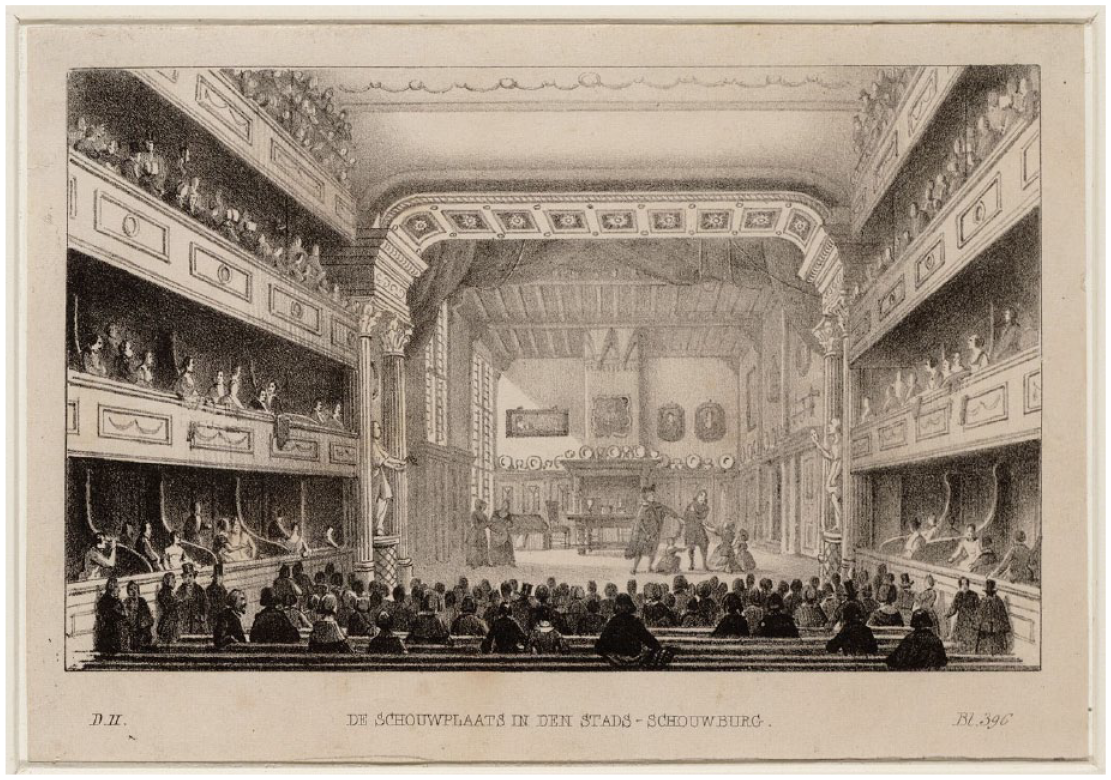
The Municipal Theater in Amsterdam, J.J.A Hilverdink, ca. 1845. City Archive Amsterdam.
The wide variety of theatrical genres—from spectacular grand operas, ballet, pathetic dramas and melodramas, to light-hearted comedies, operetta’s and vaudevilles—united various upper- and middle-class men and women in joint experiences of pleasure, amazement, compassion and fear. Yet, particularly in Amsterdam, the theatrical landscape also encouraged citizens to limit cross-class social interaction and organize themselves in more exclusive circles. Subscription registers and contemporary reports suggest that the French Theater was a particularly select meeting place for the city’s upper classes. The German Theater appealed to both upper-class and middle-class patrons, but particularly created an indoor sphere in which relatively well-to-do German immigrants and (Ashkenazi) Jews could forge their mutual bonds and identies. 29 While some (mainly young male) members of the elite took a pleasure in temporarily immersing themselves in the (lower) middle-class audiences of the popular Salons de Varietés, other small theaters were gathering places for middling sorts of people. 30
With ticket prices ranging from about three guilders to thirty cents, the Amsterdam Municipal Theater and The Hague’s Royal Theater welcomed a relatively wide variety of visitors compared with many other winter recreations, even though skilled working-class people (earning about one guilder a day) could frequent them only occasionally. 31 Each evening, the spectacle united various classes in a shared range of emotions and societal opinions, yet the theater auditorium with four to seven separate ranks simultaneously staged an embodied representation of the city’s social structure in which visitors were divided and divided themselves in various distinct ranks. At The Hague’s French opera, the aristocratic subscribers of the most expensive boxes even painstakingly expressed their own internal hierarchy, with the royal family seated closest to the stage, followed by a box with diplomats, local nobility, non-noble aristocrats, and, finally, rich rentiers. 32 Both theaters further catered to urbanites’ preferences for social distinction by offering separate entries/exits, supported by elaborate police regulations to separate the traffic lines of carriages by class. 33
Attending the activities of cultural associations was as popular and important as theater going for many upper- and middle-class citizens in Amsterdam and The Hague. During the nineteenth century, both cities boasted an impressive, and strikingly expanding, number of associations devoted to all sorts of cultural activities—from organizing concerts, playing instrumental music, choir singing, creating and performing literature, theater, visual arts, science to playing chess. Meeting either in their own premises or in rooms and venues rented in cafés or public buildings in the city center, most of these societies organized their activities only during the winter season, often once a week or every two weeks, and usually starting in October or November and ending in March or Early April. For many, the winter season really took off when these associational activities started. In The Hague, some even felt that the season only commenced with the first concerts of the concert society Diligentia in early December: “Many a person who attends opera or comedy before that date feels more or less embarrassed that he so violates tradition.” 34 Meanwhile, several prominent gentlemen’s clubs ran winter series of musical soirées, literary and theater performances, and balls.
In accordance with Thomas Nipperdey’s classic article “Vereine als Soziale Struktur” and the subsequent tradition in historical research on associations, recent research shows that in Amsterdam and The Hague cultural associations and gentlemen’s clubs played a crucial role in forging urban social order. 35 All these cultural associations, and many more, actively promoted the key ideals such as trust in education, self-improvement, and cultural patronage that helped the heterogeneous upper and middle classes to see themselves as a homogeneous and hegemonic class, and to self-confidently stimulate working-class initiatives to similarly establish these kinds of cultural associations. Yet, all these cultural associations clearly also enabled members to express their desire to socially distinguish themselves and cultivate exclusivity in well-delineated social networks. In almost all cultural associations, membership was based on very strict ballot procedures, consisting of an internal sponsor, a probationary period, a majority of votes, and even the possibility to black-ball candidates by simply paying a sum of money.
Over the last decades, historians like me have indulged in time-consuming analysis of membership lists to get a deeper and more complex understanding of nineteenth-century urban social structure as constructed in clubs and associations. 36 Apart from demonstrating which segments of the upper and middle classes joined, distinguished, and solidified itself in which particular club and association, analysis of double membership helped to understand how exactly members of separate associations positioned themselves and their social circles into a wider cultural and social network. In Amsterdam and The Hague, quite a few cultural associations—including prominent societies devoted to visual arts and literature—brought together and helped to socially integrate members of various occupations and income levels who did not meet and excluded each other in exclusive gentlemen’s clubs. 37 The perspective of seasonality, however, should make us realize that all the tables, graphs, and network visualizations we usually create on the basis of these membership lists actually do not represent the city’s social structure and networks in a certain year or decade, but rather the urban social order that members cultivated and embodied particularly during the winter seasons. Although they usually did not end their membership during the summer, only during the winter season the social interaction and frequent ballot procedures, the sometimes heated debates on candidates as well as on the ballot rules themselves characterized their social life.
In her classic The Best Circles: Society Etiquette and the Season (1973), Leonora Davidoff explained how during the “London Season” in the winter months a regular calendar of social events offered upper- and middle-class people “a highly effective way of linking family life with public life and allocating a ‘place’ and ‘position’ to people in society.” 38 In Amsterdam and The Hague, the winter calendar of private and public balls—almost exclusively organized in January, February, and March—fulfilled the same roles. Next to theater and concert-going, attending balls played a crucial role in constructing—and often reproducing—social structure by transforming social relations based on sociability (convivium) into more solidified social structure based on marriage and family bonds (connubium). The private balls in splendid residences of the Amsterdam and The Hague aristocracy, the magnificent balls at the Royal Court, the balls of extremely exclusive Casino societies, the regular balls (and even children’s balls) in gentlemen’s clubs and cultural associations, and even commercial balls in brilliant or modest venues in the inner cities: all helped to cement urban social order. 39 Impatiently anticipated for months by mothers, fathers, marriageable sons, and daughters, these seasonal series of balls offered an annual stage for reproducing (or slightly changing) social structures.
Both in Amsterdam and The Hague, the working classes and the urban poor hardly joined any of these amusements. During the winter, the reduced length of working days offered working people relatively more leisure time, but also lower salaries and—due to increased expenses on heating and clothing—lower effective purchasing power to spend on amusements. 40 In these months, both unemployment and the percentage of the households depending on poor relief were higher, at times even reaching 25 percent. 41 (Primarily male) workers often sought relief, warmth, and company in the numerous small pubs near their homes. Although in the coldest winter months the upper and middle classes—out of humanitarian motives and to maintain social order—were more concerned to alleviate the harsh living conditions of the poor, the opportunities to share and interact in leisure time and spaces were largely limited to a few outdoor spaces. For instance, on Saturday and Sunday evenings, various classes encountered each other on the city’s main shopping streets, enjoying the bright atmosphere of the city center. 42
When temperatures further decreased and canals and ponds started freezing, however, the winter season offered the extraordinary opportunity for all classes to establish an embodied sense of social harmony in the shared pleasure of ice skating. Since the seventeenth century, both Dutch winter landscape paintings and literary “ice-pieces” reflected and shaped the returning notion—and ritual—that skating in a liminal period of frost and a liminal space (not water, not land) momentarily softened, dissolved, or even overturned existing social differences and hierarchies of class, gender and age. In nineteenth-century Amsterdam and The Hague, the huge crowds gathering on frozen canals and ponds in and around the city, and the traditional custom of skating together in rows strongly cemented and embodied social relations between men and women of various classes who did not socialize in other areas of urban life. According to a contemporary, the ice-fairs on the river Amstel were cultivated as “a sort of Carnival, where all is joined: sledges and carriages, pubs and waffle stands, tightrope walkers and music . . . as if one were engaged in celebrating a public feast to which the whole city was invited.” Only by the 1880s, the rise of exclusive ice skating clubs dramatically changed the scene: since then, the incidental periods of frozen water and urban skating—with elites haughtily distinguishing themselves from the urban crowd—rather expressed the deplorable loss of social harmony. 43
The Summer Season
As the trees started to blossom again, temperatures rose, the sun got higher in the sky, and the days lengthened (up to 21:00 in June), each year the inhabitants of Amsterdam and The Hague impatiently waited for seasonal conditions that would allow them to again enjoy open air recreations—not only inside, but also, and largely, outside the city. Whether walking and touring around the city, assembling in taverns with terraces and playgrounds, attending open air concerts, strolling in parks, visiting the zoo, or going to the seaside, the spacious character of all their summer recreations usually allowed for more distance and movement between people compared with the indoor winter recreations. It facilitated and indeed encouraged more inclusive social interaction without forcing people to make their contacts with people of other social formations too close and intense. Much of summer recreation was cultivated in spaces and places that were freely or relatively freely accessible for working classes, too. It might not stretch too far to suggest that during the summer season the usually warm, agreeable weather facilitated and promoted easier social interaction between people of various classes, allowing their bodies to relax, unbend, and open themselves in a more jolly atmosphere to other people than usually was the case in the cold winter season. 44 Evidently, the social mingling of classes did not prevent distinctive behavior and social tensions in summer. But compared with the winter season, the constant drive for social in- and exclusion seemed to be less on top of the public’s mind, and a greater heterogeneity of people and some blurring of social boundaries was often cheerfully accepted or even appreciated and sought out.
Each year, the arrival of spring encouraged the local aristocracy to harness their horses and board their carriages. “The haute volée is gradually starting to think about the summer program,” a commentator noted in 1866: “it is blasée from all those concerts, operas and soirées. With the beautiful spring weather, she makes lovely rides around the outskirts of the city.” 45 From May and June, many aristocratic families even left Amsterdam and The Hague for a few weeks or months; either to stay in their country estates or in rented manors in the surrounding countryside and in the land provinces of Utrecht, Gelderland or Overijssel; bath hotels in Dutch seaside resorts such as Scheveningen or Zandvoort; or increasingly to travel abroad. 46 Especially during July and August, much of the Amsterdam upper classes were simply not present in the city—also prompted by the abhorrent stench of the canals, resulting from the impact of the increasingly warm water on the decomposition of feces and other waste. Here again, the seasonal cycle strongly impacted the city’s social structure. With the city’s elite out of town, during these summer months the city’s upper middle classes set much more of the social tone.
The spacious green areas in and around Amsterdam and The Hague encouraged a wide variety of people to amuse themselves by taking a walk or a carriage ride or watching and enjoying the jolly atmosphere of people of all walks of life amusing themselves in heterogeneous company. The Amsterdam Plantage, an extensive green area within the city walls dating from the seventeenth century, was very popular for its lively Sunday promenades, particularly in spring, when the city’s upper classes were still in town and enriched the scene without excluding the pleasures of other classes. These Sunday promenades, cherished for their gleeful atmosphere, functioned as a performance of embodied social hierarchy. However, just as in the newly established Vondelpark (1865) or the promenades in The Hague’s Woods, the spatial boundaries between classes at the Amsterdam Plantage were much less clear cut and more permeable than in (most) theater auditoriums and strictly delineated cultural associations during the winter season. In the heart of the summer season, when a substantial part of the elite was out of town, the broad middle classes enriched their recreational walks in a wide variety of taverns with summer gardens and playgrounds just outside the city gates or in the surrounding area. Particularly on Sundays but also on Wednesday evenings, many taverns boosted the lively atmosphere with cheerful music, dancing, enchanting illumination, and even spectacular fireworks or occasional balloon ascents. Although both cities lacked extensive pleasure gardens or Vauxhalls modeled to British or French examples, the rich variety of taverns were some compensation for this lack and firmly established the idea that broad middle classes temporarily dominated local leisure industry—and society. 47
Since the 1820s, one of the key attractions in The Hague’s summer season were the biweekly open air concerts in The Hague’s Woods, organized in the annex of the city’s largest gentlemen’s club De Witte in an idyllic spot surrounded by century-old oaks and a meandering pond (See Figure 3). Between May and September, every Sunday afternoon and Wednesday evening, hundreds of people of all classes flocked together to listen to the Royal Military Wind Orchestra perform comprehensive arrangements of operas, symphonies, and military marches. The social order as constructed in these popular concerts was more inclusive and less stratified than in most winter recreations. Yet, firm spatial and social boundaries were established here as well: the 1,000 to eventually 2,000 club members—mainly court and governance officials, civil servants, military officers, academic professionals, and persons of independent means—sharply distinguished themselves and their families from the rest of the population with a low fence. In the 1850s, some rich shopkeepers and artisans, who were categorically refused as members, tried to distinguish themselves from the mass of listeners by seating themselves on hired chairs outside the fence, until the club successfully lobbied at the Ministry of Internal Affairs to simply forbid renting these chairs. Sitting comfortably at hundreds of De Witte’s elegant tables, the social formation of The Hague’s respectable classes continued to manifest itself as the heart and pinnacle of local society in summer spaces. 48
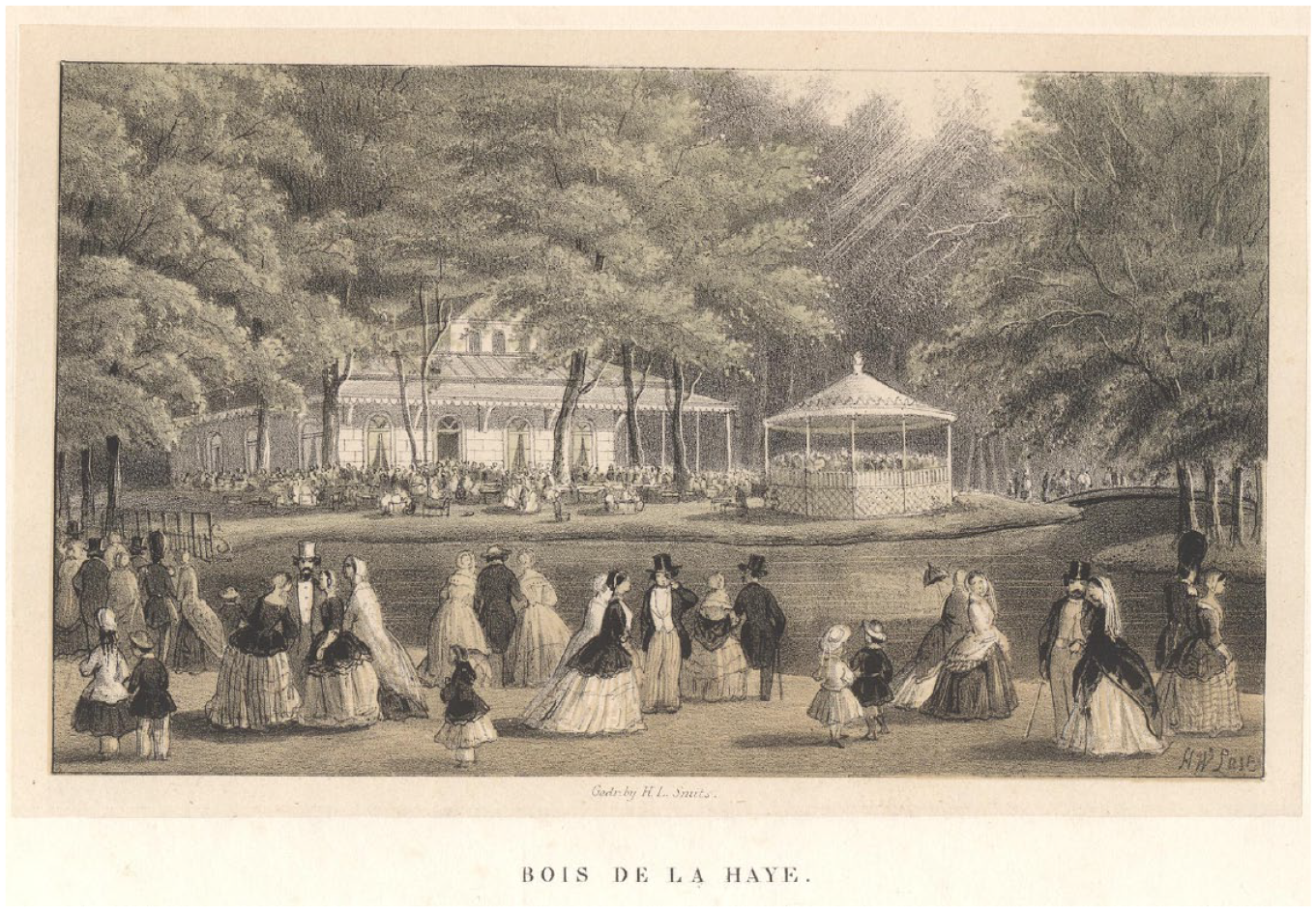
Open Air Concert in the Hague Woods, H.W. Last, ca. 1860. City Archive The Hague.
A second main attraction in The Hague was the seaside at Scheveningen, a few miles from the city center. Since at least the seventeenth century, the walk to Scheveningen had been a popular outing: to watch the sea, take in the fresh air, and enjoy the view of fishing activities. The arrival of the first, rather unpretentious, bathhouse in 1818, and the subsequent establishment of the luxurious municipal bathhouse in 1828, aimed to attract international and national aristocracy. Bathing opportunities spurred Scheveningen’s ascent as a major seaside resort. Especially following an 1850s expansion, on bright Sundays The Hague’s well-to-do locals demanded the right to seat themselves next to local and international aristocracy at the bathhouse terrace. Shopkeepers and artisans looked to enjoy the frequent open air concerts as a privileged pleasure they felt—as ratepayers—entitled to. In the 1870s, various commentators praised the even greater heterogeneity of the Sunday audiences on the expanded terrace: “The terrace . . . now welcomes all without distinction. Anyone whose wallet permits to sit down there leaves it for no other reason, so that especially on Sundays the terrace displays the image of the greatest communism.”
49
The great social diversity and jolly atmosphere of the people walking along the beach was celebrated: A busy pêle-mêle fits here well and promotes general gaiety. . . . The whole crowd consists of calm walkers, who don’t quarrel while promenading and enjoy an unconstrained traffic. Decent sans gêne belongs at a seaside resort. Stiffness and constraint are there what yellow fever is to a city in South Africa: everyone avoids and shuns that place.
50
What was hardly conceivable during the winter season—a wide variety of classes enjoying the same amusements in a harmonious way without constantly marking and defending their mutual social boundaries—was widely cherished at Scheveningen as a pleasant, even attractive characteristic of the summer season’s urban social order.
51
In the 1880s, when the local municipality decided to sell the bathhouse to private entrepreneurs who planned to fence the new Kurhaus terrace with an iron barrier and raise a seasonal entrance fee, a massive media and petitioning campaign against this decision highlighted this positive appraisal of social inclusion during the summer season. The subsequent initiative of the Kurhaus management to hire the Berliner Philharmoniker for a series of formal concerts in the Kurzaal was explicitly deplored as infusing the summer season with winter recreations—including stiff clothing and silent listening behavior that was so characteristic for the obsession with social distinction during the winter season: “There we sat, my friend Sam and I,” a journalist complained in 1886: in a hermetically sealed hall, as if it were the middle of winter in the Diligentia concert, listening to Mannstadt’s orchestra! . . . Even though the music was so dragging and the unity of the orchestra so admirable, my friend Sam remained in the highest degree indignant about this wrong world, that intrusion on the warm season, that winter concerts in the summer, that Tantalus fate of seeing the sea and not being able to breathe it in.
52
Although Amsterdam could not boast proximity to the seaside (the distance to the closest seaside resort Zandvoort was forty kilometers), since 1838 it had another major summer attraction: the zoological and botanical garden of Natura Artis Magistra in the Plantage, the first in continental Europe modeled after the example of London Zoo (1828). Initiated by a publisher, a commission merchant, and a watchmaker, Artis was established as a cultural association with the same formal ballot procedure as the cultural associations active during the winter season. However, this association was strikingly more inclusive than all the clubs active in the winter combined. By 1839, Artis already had five hundred members, including high-ranking aristocrats as well as well-to-do shopkeepers and artisans. In contrast to some prominent elite associations it also included Jews. Expanding to about 1,000 members in 1841 (including women welcomed on their own as donatrices), 2,500 in 1852, 3,500 in 1857, and 5,000 in 1880, Artis evolved into a spectacular vehicle and stage for social integration of the city’s upper and broad middle classes. Expanding its territory, collections, and the number of monumental buildings for animals and visitors, during the summer season Artis assembled and connected a wide variety of Amsterdam families. These families walked freely in shared space, cultivating a shared pleasure of watching animals, learning about nature, celebrating Dutch colonial possessions, and, after 1849, enjoying together the frequent music performances of military bands. After 1852, during the weeks of the urban fair between the summer and winter season, Artis also opened its premises to skilled workers and poor for a low entrance fee. 53
In The Hague, notorious for its obsessive cultivation of class differences, during the summer season the Zoological and Botanical Garden also challenged, eased, and redefined the city’s social order in much of the same way as Artis in Amsterdam. 54 The Hague’s Zoo was established in 1863 as a new type of cultural association with membership based on a formal ballot procedure or on the purchase of shares. Due to this new institutional format the Hague’s zoo—growing from 1,000 members in 1864 to about 2,700 in 1884—created a new social common ground where the city’s respectable classes no longer were able to exclude the well-do-do shopkeepers and artisans. In one of the first brochures to create broad public support for the zoo’s establishment, the main founder, a medical doctor, explicitly pointed to its open, extensive, and “neutral” terrain just outside the city, where families of various ranks could easily maintain distinctions while passing each other on the meandering lanes. Referring to the performances in The Hague’s Woods and terrace of the Municipal Bathhouse in Scheveningen, the physician suggested that the wide acceptance of and even pleasure in the relatively heterogeneous social company in open air summer recreations outside the city would justify to institutionalize in a formal association a major step in the democratization of the city’s social order. For all citizens—and particularly the city’s upper and middle classes—it was perfectly clear that this new, spectacularly inclusive social network created and cultivated in The Hague’s zoo would only function during and due to the summer season.
Conclusion
During the nineteenth century, citizens of Amsterdam and The Hague were used to distinguish and appreciate the four meteorological seasons. Yet, when it came to urban leisure culture, they mostly distinguished just two: the summer and the winter season, offering them quite distinct forms of leisure in distinct places in distinct spaces, with the annual urban fair in between. Although the seasonal dimension of urban leisure may appear obvious, the cases of Amsterdam and The Hague stimulate us to more fundamentally acknowledge its impact on urban social order and social change. In nineteenth-century Amsterdam and The Hague, the turn of each season did not merely bring a regular change in the key places and forms of leisure. It also brought regular change in the ways in which men and women of various classes positioned themselves in society, in how they transgressed, blurred, or defended social boundaries, and in how they appreciated how others did this. The seasonal cycle greatly affected how urbanites collectively constructed social hierarchy, structure, stratification, and inequality: not only with respect to class, but—a key aspect not treated in this short essay—also with respect to (its intersections with) gender and age. 55
Obviously, it would be reductive to suggest a sharp binary between summer and winter recreations and to argue that urban societies functioned completely different in the three seasonal periods discussed in this piece. Additional research on the places of leisure discussed in this article has shown that the landscape of leisure, the ways in which people interacted in it, and the changing social patterns of the nineteenth-century were much too complex to fit in such a simplistic scheme. However, I hope this essay has made it plausible that established ideas about, for instance, the role of associations in shaping nineteenth-century social structure and the tables we publish to represent those social structures, are difficult to maintain without a seasonal qualification. The perspective of seasonality can help us to understand nineteenth-century urban social structures as much more flexible and dynamic. And we might even assume that many urban inhabitants liked their societies to function this way. Their enthusiasm about the arrival of a new season did not simply imply that they felt a bit bored and longed for the regular alternation in forms and places of leisure. It also suggests they very much looked forward to regularly change their social company, their way of social interaction, their self, and, at least slightly, their society.
Footnotes
Acknowledgements
My warm thanks to Dorothee Brantz, Avi Sharma, and Kara Murphy Schlichting for their encouragement and helpful feedback.
Author’s Note
Earlier versions of this article were presented at the Lecture Series on Urban Seasonalities, Centre for Metropolitan Studies, Berlin, January 25, 2022, and the session “The Times are Changing: Cities, Seasons and Urban Life Around the World,” European Association for Urban History Conference, Antwerp, August 31, 2022.
Declaration of Conflicting Interests
The author(s) declared no potential conflicts of interest with respect to the research, authorship, and/or publication of this article.
Funding
The author(s) received no financial support for the research, authorship, and/or publication of this article.