



Abstract
Background
Emerging research has suggested that a significant proportion of children and young people in looked after care present with communication needs including Developmental Language Disorder (DLD) and other forms of neurodivergence. It is not known how these young people perceive and experience their communication skills and needs.
Aims
The aim of this study was to understand how neurodivergent young people with communication support needs who are leaving care perceive their own communication, and how their communication fits within their lived experiences.
Method
Twenty-three neurodivergent young people aged between 17 and 24 years leaving care engaged in semi-structured interviews about their communication skills and life experiences. Adaptations to the interviews were made to facilitate accessibility. The interview data were transcribed and analysed using Reflexive Thematic Analysis.
Results
A central concept in the interviews was being understood. Analysis resulted in four main themes: (1) mutual understanding as a pre-requisite for connection with others; (2) the risk of being misunderstood and misjudged; (3) misunderstandings of neurodivergence and the consequences for support; and (4) Understanding their own differences and disability as a route to potential self-advocacy.
Conclusions
Neurodivergent young people leaving care were able to discuss and advocate for their communication experiences. The themes identified related to their broader experiences of communication and the value of trusted communication with others. Communication is highly important to these very vulnerable young people. Speech and Language Therapy services and other professionals need to provide more timely and targeted support for young people within the care system to ensure their communication needs are identified and supported and to enable further self-advocacy.
Keywords
Introduction
DLD and neurodiversity
Developmental language disorder (DLD) is a lifelong form of neurodiversity which affects phonology, vocabulary, syntax, semantics and/or pragmatics, not due to another cause such as hearing impairment or learning disability (Bishop et al., 2016). DLD has been used as a diagnostic term since Bishop et al.'s (2016) seminal CATALISE study, replacing other names such as Specific Language Impairment. The prevalence rate of DLD is typically around 6–7% (Calder et al., 2022; Norbury et al., 2016), although DLD may be higher in vulnerable populations such as those in the youth justice system (Chow et al., 2022). Children in the out-of-home care system face long-term disadvantages in terms of health and education (Cameron et al., 2018). Early research indicates an increased risk of undetected and unsupported DLD in care experienced young people (Clegg et al., 2021). Small-scale studies suggest barriers to diagnoses and clinical services, for example McCool and Stevens (2011) reported that none of the 19 children in the care system with severe and pervasive language disorder in their study had ever been referred to speech and language therapy and Snow et al. (2020) found the majority of their Australian cohort (n = 26) of adolescents in out-of-home care had language and literacy difficulties, yet only one had a previous relevant diagnosis.
This is perhaps unsurprising given that DLD is less well known and understood than other types of neurodivergence such as Autism (McGregor, 2020). Neurodiversity is used in this paper to refer to variation in ways of perceiving, experiencing and interacting in the world, encompassing neurodevelopmental differences such as autism, attention deficit hyperactivity disorder (ADHD), dyslexia, DLD, dyscalculia, and developmental coordination disorder (Hamilton and Petty, 2023). A neurodiversity approach considers contributions of both individual and society factors to disability (Dwyer, 2022). DLD may need to be approached differently when viewed through a neurodiversity informed perspective. So far, this includes keeping the term ‘disorder’ so that the extent of difficulties faced by people with DLD can be better understood and the momentum in raising awareness of DLD is not lost through another name change. A neurodiversity affirming approach to DLD can, however, be taken when considering interventions which target making an accepting and inclusive environment and working on areas of language identified by the individual to work towards their own goals (Hobson et al., 2024).
Listening to the views of neurodivergent children and young people
All children and young people – regardless of communication differences and needs – have the right to express their views and for their views to be given due weight (Lundy, 2007). This includes neurodivergent children and young people who may need additional support to fully realise their fundamental right to be heard and to have their views taken seriously (Gallagher et al., 2018). Some research has investigated the lived experiences of children and young people with communication needs such as DLD (Clegg et al., 2012; Roulstone and McLeod, 2011). For example, Blaskova and Gibson (2021) interviewed four 4–12 year olds with DLD, who spoke about the importance of friendships to their quality of life, a need to be socially accepted, and the impact of DLD when being singled out by adults for extra support. Similarly, Ekström et al. (2023) interviewed twenty-three 13–19 year olds with DLD in Sweden and reported themes of feelings of inadequacy and comparisons with others, feelings of being misjudged and misunderstood, the importance of feeling safe and comfortable and the significance of the social and communicative context. There is growing recognition that more needs to be done to include children and young people with communication needs in qualitative research by collaborating with young people, focusing on the skills and knowledge needed to achieve accessibility, and ensuring adequate time is available to achieve involvement (Walsh et al., 2024).
Care leavers
The young people who participated in this study were ‘care leavers’ – a term used to describe young people in the process of leaving Local Authority care as they transitioned to independent living upon reaching young adulthood. Care leavers with DLD and other types of neurodivergence are a potentially very vulnerable group, as both their care experience and diagnosis are associated with increased risk of poor psychosocial outcomes over time. DLD is associated with an increased risk of mental health difficulties and poorer life chances in childhood (Botting et al., 2016; Norbury et al., 2016) and adulthood (Clegg et al., 2005; Johnson et al., 2010). Experience of out-of-family care is also associated with higher rates of mental health difficulties, poorer socio-economic outcomes, increased risk of homelessness and increased risk of criminal convictions in care leaver (Viner and Taylor, 2005). Care leavers report facing ongoing instability, stigma and poor institutional support within education systems (Ellis and Johnston, 2024).
Leaving care should be an extended process with aftercare services (Keshri, 2023) and should be more like a staircase leading to independent living as opposed to a ‘care cliff’ where support suddenly stops at 18 years (Palmer et al., 2022). In the city where this current study was carried out, children and young people aged 16–25 years leaving care received financial support and a personal advisor to assist with access to services related to housing and health, and with decision making around education and employment. A pathway plan is completed following an assessment of the young person's skills and details areas where support is needed for the young person to achieve their goals (Sheffield City Council, n.d). The experiences of young people leaving care has been explored in research (Bengtsson et al., 2020; Butterworth et al., 2017; Ellis and Leahy Laughlin, 2021; Kelly et al., 2021; Keshri, 2023; Palmer et al., 2022). The themes in these studies related to the process of transitioning out of care. These studies discuss the importance of a smooth transition between services, as well as the importance of relationships and not feeling unfairly judged by others. However, very little research has explored the views of neurodivergent young adults leaving the care system or considered communication in this context.
Study Aim: The aim of this study was to explore the perspectives of neurodivergent young people with communication support needs who are leaving care with regards to their own communication, and how their communication fits with their lived experiences.
Method
Background
This study involved a group of people leaving the care system as they reached young adulthood. Interviews reported here were conducted as part of a wider research project, where a cohort of 44 young adults had their language abilities and needs assessed (Clegg et al., 2021). Ninety percent of the care leavers’ language abilities were below average and over 60% met criteria for DLD in combination with literacy difficulties, neuro-developmental disorders and social, emotional and mental health difficulties (SEMH). When the DLD criteria of scoring 1.5 standard deviations below a language assessment mean was applied (from Calder et al., 2022 and Norbury et al., 2016) 76% of young people met the criteria for DLD (Clegg et al., 2021). Fourteen young people reported having neurodivergent diagnoses: Attention Deficit Hyperactivity Disorder (ADHD) (n = 8), Autism (n = 5), learning difficulties (n = 4), dyslexia (n = 4) and dyspraxia (n = 1), and 29/44 had a mental health diagnosis. However, none of the young people had a previous diagnosis of DLD or known previous contact with a speech and language therapist. Although self-reported background and diagnostic information may not always be accurate, it is likely that DLD is particularly undiagnosed in this population. The reasons for underdiagnosis are poorly understood but likely to be complex and related to factors such as the impact of early life experiences involving inconsistent care-givers and barriers to accessing assessments. We invited all participants in the wider study (Clegg et al., 2021) to be interviewed to tell us more about their experiences.
Design
The study was approved by the School of Allied Health Professions, Nursing and Midwifery's Ethics Committee at the University of Sheffield. This qualitative study is based on the analysis of 23 interviews with neurodivergent young people within the care system with previously undiagnosed communication needs, as they transitioned to independent living as a young adult. This research combines a realist theory of reality (ontology) that there is a truth and reality to be researched, with a relativist theory of knowledge (epistemology) that this truth and reality is socially located. Therefore, the study is designed on the premise that new knowledge is accessible through considering the participants’ experiences, as shaped by their culture and language. Running parallel, the researcher's own cultural and social position plays an important part in interpreting this truth (Braun and Clarke, 2021).
Participants
The 44 participants from Clegg et al.'s (2021) study were approached to consider participating in this interview study. Twenty-three young people between the ages of 17 and 26 completed the interviews. All 23 participants were in the process of leaving ‘looked after care’. All young people who took part in the interviews had a profile of language assessment scores that indicated Language Disorder, either associated with Autism (n = 2) or DLD (n = 21). Co-occurring neurodivergent diagnoses included mental health disorders (n = 19), ADHD (n = 5), and dyslexia (n = 2). Five participants were bilingual and four were born outside of the UK. There were 13 girls/young women, 9 boys/young men and one trans participant who used they/them pronouns.
Information about the study was sent via the personal assistants in the team, who then discussed the study with the young people. If they were then interested in being interviewed, they could then contact the research team directly or ask their personal assistants to do so on their behalf. The participants could opt for a face-to-face or online interview and could opt out at any time (pre-data anonymisation). The participants were given a £20 voucher of their choice for completing the interviews as a token of thanks.
Researcher positionality: The research team members were all women, mothers, and speech and language therapists with a background of working with children and young people with DLD (with over 60 years combined experience). They were outsiders to the participant group in that they had never been in care and had not been marginalised in relation to protected characteristics such as disability status or race. English was the first language of three members of the team and a second language for the person who conducted the interviews. The participants were informed about the researchers’ occupations, motivations, and the research aims of the study.
Interviews
Interviews were used because they are useful to explore lived experiences and in giving voice to silenced lives whose accounts have not previously been sought or heard (Hall and Sikes, 2018; McLaughlin and Tierney, 1993). The semi-structured interviews aimed to directly engage with the participant's perspectives by eliciting detailed accounts with subjective meaning (Trainor and Bundon, 2021). Due to the logistics of working with the personal assistants, we were unable to include multiple interviews over time. We were also unable to go back to participants for member checking of transcripts or our analysis, due to the timing of our collaboration with the care service and the timeline for analysis (which had interruptions due to two of the research teams’ maternity leaves).
The interview questions were piloted with two young people aged 16 years and 17 years who were not in the leaving care service. As a result of the piloting, some questions were rephrased to improve their clarity.
The interview schedule was flexible and included the following broad prompts:
Tell me about yourself. What is your life like now? How do you imagine your future? What do you think about your communication – your talking, listening, reading and writing? What do you think about how staff in the service communicate with you? Is communication ever difficult? (is talking/understanding/listening/reading/writing ever difficult) if so, in what way? What would improve communication for you? What would improve communication in the service? What can others do to support you in communicating?
The questions involved asking about the young person's life, their communication and their experiences in the service. The interviews allowed for flexibility in how these were presented. Additional questions were asked to allow for opportunities to elaborate on and clarify responses. Visual support materials were used as needed to support the interviews, with a brief written version of each question and a supporting image presented for each question. Additional strategies to support accessibility involved: giving additional time for responding, repeating back key words for checking, additional time for expansion of ideas, and the use of gesture.
The interviews took place in the young people's homes or in the University clinic (n = 21) or via video call (n = 2) between May and October 2022. All opted to tell their stories in one session. The majority of the participants (n = 21) requested their personal advisor to sit in the interviews. The interviews were recorded as MP3 files. In total, there were 11 h, 2 min and 16 s of interview time. The mean time of the interviews was 28 min 48 s with a range from 14 min to 66 min.
Analysis
Reflexive Thematic Analysis is a method used for interpreting a qualitative dataset and was chosen because the analytic focus was the lived experiences of care leavers (Braun and Clarke, 2021). Braun and Clarke's (2006) approach has previously been used to investigate the lived experiences of young people with DLD and young people leaving care (e.g., Kelly et al., 2021; Keshri, 2023).
Transcription
The interviews were transcribed using the software Otter. They were then checked alongside the recordings, edited and anonymised. Two researchers independently reviewed the data with the aim of becoming immersed in the data.
Coding
Each transcript was given equal attention in the coding process (Braun and Clarke, 2006) and data relevant to the lived experiences of the care leavers were tagged with a short phrase, including some of the surrounding data for context. This was done using NVivo software.
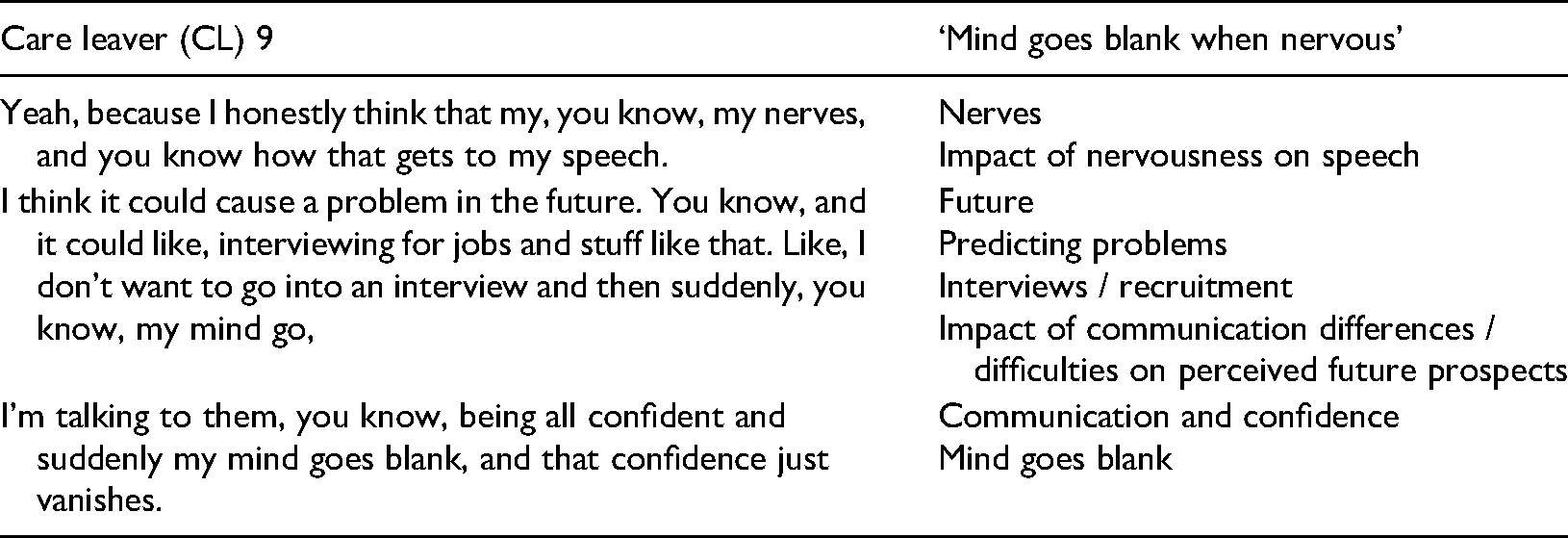
The first stage was open coding so that transcripts were linked to concepts and ideas. The codes were a mix of semantic and latent coding. An example of semantic coding, where the codes capture explicit meaning at the surface level (Braun and Clarke, 2021) is outlined in the table below, along with example open coding:
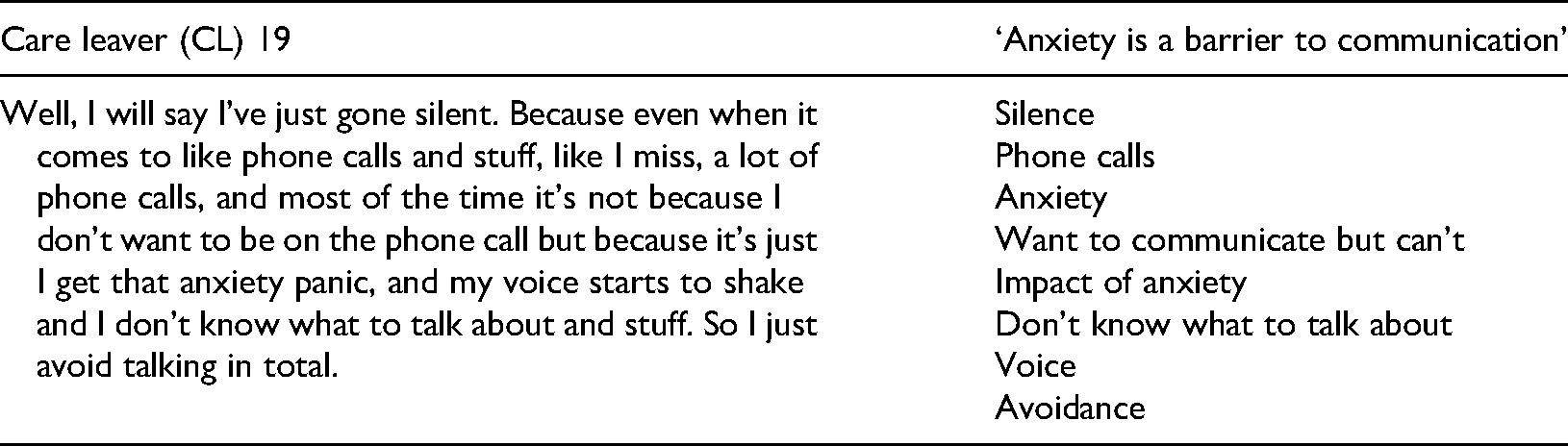
An example of latent coding, which captures the implicit meaning such as ideas, concepts and assumptions (Braun and Clarke, 2021) is outlined in the table below, along with example open coding:
From familiarisation of the data through transcribing and open coding, the first list of themes was generated (8 themes). Theme definitions were written to check that they were organised around a central organising concept – being understood. The process of reflexive thematic analysis is not linear, and the researchers moved between codes, early themes, transcripts and later development of themes (Braun and Clarke, 2021). Themes were edited as we moved through analysis, for example:
− ‘Close relationships, including with personal advisors are valued’ was then renamed the ‘Value of relationships with care staff (personal advisors)’. This was then part of the wider theme: ‘Mutual understanding as a prerequisite for connection with others’. − ‘Fear of being judged / Judgements from others’ was renamed as ‘The risk of being misunderstood and misjudged’. − ‘It's my brain, not me’/'SEMH as a cause for communication difficulties’/‘Understanding own differences and disability’ were grouped and reconceptualised as part of ‘Misunderstandings of Neurodivergence and the consequences for support’. − Themes around the need for earlier diagnosis and support and being in care impacting on access to education were later thought to be linked to the need for young people to ‘understand their own neurodivergence and disabilities as a route to potential self-advocacy’.
A theme of online communication featured in most transcripts but was thought to link to meeting other people who understood their interests and so was included under ‘mutual understanding being needed for connection’. For the purposes of this paper, we are focusing on themes related to communication and lived experiences. Many participants spoke about their broader life stories and the challenges they have overcome in working towards independence in adulthood. We wanted to give this aspect of the data the depth of analysis it needs within a further journal article (Spencer et al., in preparation).
The analysis considered the importance of themes throughout the dataset. However, we do not report on the number of participants who gave each view as themes relate to what is salient in relation to our research aim, not necessarily what is the most common. This would also not be appropriate as the data are situational within each interview (Braun and Clarke, 2021). Given our status as speech and language therapists, we noted some absences in the data (DLD and strategies to support communication differences) while acknowledging that other absences would be less striking to us during analysis due to our positionality.
Results
A central concept that ran through all interviews was understanding and being understood. Analysis resulted in four main themes: (a) mutual understanding as a pre-requisite for connection with others; (b) the risk of being misunderstood and misjudged; (c) misunderstandings of neurodivergence and the consequences for support; and (d) understanding their own differences and disability as a route to potential self-advocacy. Being understood (including being understood in relation to neurodivergence) was framed as essential for connection. Young people discussed their paths in life, their challenging personal circumstances, the resilience and skills that they had developed. They wanted to be known and understood for what they had achieved despite the wider challenges they had faced. Young people discussed how time and time again they were judged for being care leavers – being perceived as failures – and how their neurodivergence was missed or misjudged as overall lack of ability. Self-awareness and knowledge of their own communication and neurodivergence was viewed as an important step towards self-advocacy.
Mutual understanding as a pre-requisite for connection with others
Communication was framed as an interaction with familiar and unfamiliar others, rather than as a set of skills or behaviours that an individual had to a lesser or greater extent. Connection was key. Mutual understanding as a starting point for connection and support was a central theme, for example CL1 said ‘Someone that I like and someone that I've got quite a connection with – then I can have it – it is easier to talk to them about how I feel’. Many young people discussed this in relation to how their personal advisors were valued because they took time to understand them (though note that the personal advisors were present for the interviews which may have influenced this). Their discussions about the importance of these relationships included the provision of practical support such as making their appointments and managing extensive paperwork. However, many of the young people also discussed how being understood by their personal advisor led to their feeling safe and supported. This connection is dependent on being seen as more than ‘a box to be ticked’ (CL20). Some young people also talked about being understood by their partners, friends, siblings and parents. Often the young people referred to online friendships developed or nurtured via technology such as WhatsApp and in relation to gaming (e.g., Genshin Impact, FIFA, Grand Theft Auto, Formula One). Both online and in person, communication was central to feeling understood and supported by others, for example when CL9 said that ‘the only time I find communicating easier is if I'm talking to people I'm familiar with’. CL17 discussed the importance of ‘being known’: I think it is just about getting to know me. So like, obviously, I say, like ‘uhum’ a lot, but like, I'll say in different tones, and stuff like that. So I feel like if you know me, you'll know like, especially if I'm not in a talkative mood. My body language will really show what I'm trying to say I guess. So it's just really about knowing me and getting to know me as best you can. (CL17)
The risk of being misjudged and misunderstood
Many interviews included an account of the fear of judgement from others. This is either because people have pre-existing prejudices about young people within the care system or because unfamiliar people don’t understand them and therefore will make inaccurate judgements about their abilities. Some young people described a fear of being judged negatively regarding their communication skills, whether this is due to what they say or their comprehension skills. This leads to a reluctance to ask for help in school or college for fear of getting in trouble, being made fun of, or misjudged: ‘I just didn’t want to ask the teacher because they might think that I’m thick’ (CL12). CL4 describes this in terms of managing the risk of being misjudged as not engaged, and therefore withdrawing in case she ‘gets something wrong’: People can be very judgmental, and like: ‘She's not listening. She's not paid attention. She's been busy doing other things’. … [when asked for advice for professionals] Don’t just be like: ‘Are you daft, or something?’. Actually understand how hard it is for their point, because they may understand it, whereas you don't. In the past there have been social workers that have been just quick to judge. And I feel like if they take the time to understand the child, they could just see it from their point. (CL4)
With links to Theme 1, CL4 discusses a need to be understood and for professionals to take time to withhold judgement until they understand the child's perspective. Familiarity and trust were linked to not fearing judgement and this leading to more open communication: When I'm with people that I know that they're not gonna judge and they're not gonna laugh, and you can just say, what's going through your head. And what you want to say that they won’t judge you for it, like with your friends or my foster carers aren’t. Any of them I can just say and they won't necessarily laugh at it. (CL4)
Many young people discussed their unease at talking to people who were unfamiliar and how this impacted on their communication. Successful communication was free from fear of being ridiculed: Sometimes I fear, you know, they might make fun of me. [Interviewer: Right. Has that happened before?] Well, to be fair, I don't really talk to many people that I'm unfamiliar with so no. But it's like, it's just like an internal fear. Like, I'll think um you know, someone's, you know, going to make fun of me if I just, I've just completely forgot what I'm about to say, You know what I mean?… I think it could cause a problem in the future. You know, and it could like, interviewing for jobs and stuff like that. Like, I don't want to go into an interview and then suddenly, you know, my mind go, I'm talking to them, you know, being all confident and suddenly my mind goes blank, and that confidence just vanishes. (CL9)
CL9 links this to consequences in the future for recruitment but other young people also linked fear around their communication skills being misjudged as impacting on current employment (for example when speaking over the tannoy, talking on the phone, reading quickly in front of others, and answering questions).
The fear of being misjudged poorly was often linked to their own worries about misunderstanding (language comprehension) or saying the wrong thing. However, CL5 also talked about the impact of finding it hard to engage in ‘normal conversation’: I've always been (like) since I were young and shit (like) it's always just been deep (like) people are just trying to be (like) – have small talk with me. I'm just (like) just bully right through it and not on purpose – I'm just like a bull in a China shop… I just want to bounce my head off of sumit coz I just, I get it, I understand what it is. It's to do with anxiety it's to do with comfortability has to do with: ‘Is this person a fucking psycho or not?’… That's why a lot of people don't want to talk to me is because like, ‘Yo, how are you?’ And I'm just like dragons and ancient Bible stuff. And they're just like, ‘Yeah, I'm going because you sound crazy’ And I'm just like, ‘Yeah, I get that’. (CL5)
CL5 talked about the impact of being unable to engage in ‘small talk’ and being misjudged as ‘crazy’ or ‘a fucking psycho’ when they go straight to big topics (‘dragons and ancient Bible stuff’). CL5 (who has a diagnosis of anxiety) understands why people are reluctant to talk to them due to this, as they are being misjudged as a potential threat. This is a source of frustration (‘I just want to bounce my head off … [something]’) and has been so since childhood.
Misunderstandings of neurodivergence and the consequences for support
Young people mentioned their frustration with not having timely and quality diagnosis or support for their mental health, dyslexia, Autism and attention deficit hyperactivity disorder (ADHD). No young person mentioned DLD. These needs were diagnosed too late or not at all and all involve communication. Furthermore, those who did have a diagnosis were not given appropriate support in school or college: Even when I got funding for extra support in school – for like my reading to help me read – where did that money go? I don’t know to this day because I didn’t get any of the extra help. (CL19)
CL17 discussed her experiences of being very late to be diagnosed with mental health difficulties: I think with young people, if they feel they have problems, or they feel there's something deeper, that's holding them back. That needs to be looked into more. Definitely feel that restrictions are hard. It's more difficult to have a female diagnosed with a mental illness than it is a male… I want that to push further, like, help us a bit more. Not be 21 when you get properly diagnosed because that's all crazy, sets your life up (do you know what I mean?). So I think it's just more being there. Definitely, if you can be: be there.
Note that C17 mentions that young people will feel that they have ‘problems’ – this self-awareness was evident in our interviews. CL14 discussed her own concerns about dyslexia and her ongoing frustration at not being assessed for dyslexia: I remember in Year 11, I asked like, am I dyslexic? Can I have a test? Coz I'm still in these classes. I have one-to-ones still. And, just like, ‘No, you're not dyslexic, we would know if you was’ and I was like, ‘Well, why am I here then?’ Like, I'm doing like Year 3 spellings in like Year 11. I still kind of would like to have one [an assessment] to be fair, just to know because some, like, at work we have to do reading small barcodes and like the words are really small or like on the computer we have to do lots of training and sometimes I really struggle to even read it. I'm just there like, ‘Can someone like help me please?’ (CL14)
Some young people discussed years of ‘wondering’ about their own communication differences and whether these were due to being shy, awkward, pride (CL14 said: ‘I thought it were all a pride thing, but it's not: it's my barriers’), ‘just scatty’ (a colloquial term for absent mindedness or disorganisation), or being ‘thick’ (a colloquial term for low intelligence).
Understanding their own differences and disability as a route to potential self-advocacy
Young people talked about being neurodivergent with insight, most often in relation to mental health and attention. When asked as part of our interview schedule, young people were also often able to describe their own communication skills, differences, and needs, for example CL4 talked about reluctance to ask for clarification and fear or asking the wrong question: I'm not a brilliant speaker. I didn't wanna ask because everyone knew what they were doing and I just felt (like) a bit awkward. I don't know, I just feel awkward in case I say something that's not there. Ask the wrong question or something. (CL4)
CL14 reflected on their ability to understand question forms in school, and the frustration of knowing the curricular content but being confused by the language of the classroom: That's another thing I really struggle with. You know – sometimes with questions. I know – like you know like – the wording of it. I would not understand it at all, especially in Sixth Form. The wording of the questions would always throw me. I'd know the answer, but I wouldn't know what the question's even asking me- to even get to that point. (CL14)
Young people were able to describe their ‘struggles’ in detail and with many examples of the impact educationally, socially and in the workplace as well as in specific situations like visiting the dentist: Yeah, yeah, it's [memory and communication needs] got me into trouble with missing appointments. Like this one time I'm supposed to have dentist. I thought it was another day. Turns out it was that day. Then when I went to, when I remembered it, I literally – literally – swore at myself. I tried ringing them up. They said I'm no longer allowed to go back to that dentist. (CL3)
Young people talked about the challenges of access to services that led to a diagnosis (e.g., as Autistic, with ADHD, with anxiety), with some mentioning the extra impact of the pandemic. Diagnosis – when it came – led to an understanding of their neurodiversity which changed their ‘mindset’ (e.g., CL5 said ‘before I thought the whole world was against me’). Young people were able to reflect on how this explained the functional difficulties that they had long experienced, for example, CL4 reported: ‘It's part of my disability that I've got something that's wrong with my brain that I can't remember a lot of things’.
Young people often viewed their brains as being something to accommodate or be aware of. For example, CL5 described their brain in terms of a load of exposed wires: Yeah, my thought process is not a thought process it's just like (pause) imagine if like you just punch them lights off and it were just loads of exposed wires. Put that in like a small little glass bowl and all like chemicals and smoke and that and the lightning. (CL5)
There were some notable absences of themes in the data: No young person described their difficulties in relation to DLD. No young person discussed what they had in place or needed to further include them socially, educationally or in employment; how they could be supported to build on their strengths; nor how people could adapt the communication or literacy environment to minimise the challenges they faced. They were able to give advice for professionals, most often to ‘just listen’ to young people, avoid misjudgement, and to take time to get to know them and their unique strengths and differences. Many asked for better and more timely access to specialist assessment and support services. However, when asked ‘what would improve communication for you’ and ‘what can others do to support you in communicating’, answers were general and therefore we noted in this theme that their insight opened up the potential for self-advocacy but this could be an area for further research and targeted support.
Discussion
The overall aim of the current study was to explore the perspectives of neurodivergent young people with communication support needs who are leaving care regarding their own communication abilities, and how their communication fits with their lived experiences. Twenty-three care-leavers took part in interviews: some with known neurodivergent diagnoses, and all with low language assessment scores indicating Language Disorder, as reported in Clegg et al. (2021). Twenty-one met a profile of DLD in earlier research, though none had previously been diagnosed with DLD, and two had a profile of language disorder associated with Autism. Co-occurring neurodivergent diagnoses included mental health disorders (n = 19), ADHD (n = 5), and dyslexia (n = 2). Reflexive Thematic Analysis resulted in four main themes: (a) mutual understanding as a pre-requisite for connection with others; (b) the risk of being misunderstood and misjudged; (c) misunderstandings of neurodivergence and the consequences for support; and (d) understanding their own differences and disability as a route to potential self-advocacy.
Throughout the dataset, young people talked about their communication skills not in isolation, but about their interactions with others (Doyle, 2020; Whelpley et al., 2023). Many young people felt they could communicate well with their personal assistants whom they trusted and did not feel judged by. This contrasted with communication with unfamiliar people, as discussed in the theme ‘the risk of being misunderstood and misjudged’. Barriers to communication were discussed particularly in relation to education, for example young people talked about being misjudged as having low learning potential or as being less likely to succeed because they were living in out of home care, discussed their reluctance to ask questions in class or being unable to understand questions in class despite knowing the curricular content being discussed. Successful interaction and communication went beyond their own skills and involved the patience, familiarity, understanding and abilities of others: lending itself to a neurodiversity affirming approach. There are clear implications for professionals such as specialist teachers and speech and language therapists. They must ensure that care leavers have access to timely and appropriate assessments, that consider young people's own perspective as assessment of functional language and literacy skills. Professionals have a responsibility to raise awareness of how neurodivergence – including DLD – presents to avoid young people being overlooked or mislabelled. Finally, professionals must share their expertise on supporting neurodivergent young people to increase their communicative, social and educational participation.
Although young people discuss neurodivergence in relation to mental health and literacy, there is no mention of speech and language therapy or DLD. This may be because DLD is less studied (McGregor, 2020) and understood by the public (de Lemos et al., 2022). Many young people did discuss functional communication differences and challenges such as finding small talk impossible, word finding difficulties, and comprehension difficulties. There was therefore a potential disconnect between the impact of their communication differences and needs on all aspects of their lives and the utility of diagnostic labels. Validation of the challenges they have, for example, via a diagnosis of DLD, may lead to the removal of self-reproach (Doyle, 2020). Instead, diagnosis – if done well – may lead to the empowerment which comes from understanding their own language profile and increasing access to the support and adaptations needed (Hobson et al., 2024). This kind of empowerment was evident in how they talked about other neurodivergent diagnoses (such as ADHD, Autism, anxiety disorder). Interestingly, the language used by the young people to describe their needs and experiences differed to the terminology often used by education, health and social services. Although terminology such as neurodivergence, DLD and communication differences and difficulties is used in this manuscript to communicate the experiences of these young people to researchers and professionals, the young people themselves do not use this terminology. This is of relevance to a wider debate about what diagnostic labels mean to the children and young people they are applied to (Hobson et al., 2024). Listening to young people about how they experience communication as an individual and with others is instrumental in understanding what communication means to them. This may even offer opportunities to develop a shared language with young people that enables them to describe their communication experiences and needs so others can fully understand them.
The value of connection with their personal assistants and other familiar communication partners matches the views of the young people in Brown et al. (2019), Kelly et al. (2021), Palmer et al. (2022) and Snow's (2008) interviews. These all found a need for professionals to show they cared and for staff and carers to go beyond their job role to develop family-like relationships and to be an advocate for the young people. Like the care leavers in the current study, Snow (2008) explains the significance of this bond due to previous insecure and fleeting relationships. Guest (2012) discusses this close relationship and feeling of belonging as a protective factor in their interviews of older adult care leavers. Joined up, transparent, and easy to navigate services are needed to reduce the burden of self-advocacy (Hamilton and Petty, 2023).
The feeling of judgement from the young people in this study echoes Brown et al.'s (2019) theme around discipline and boundaries regarding care leavers and Ekström's (2023) theme of feelings of being misjudged and misunderstood regarding teenagers with DLD. Groups in both studies believe they will be unfairly judged as stupid or being disciplined if they asked for help. This feeling is likely exacerbated for the young people in this current study who both have communication needs and face the stigma of having been in care.
Study evaluation and future research
The study adds to previous research on the views of care leavers and of people with DLD, gaining insight into the lived experiences of this vulnerable group of young people who belong to both groups. Around half of potential participants agreed to be interviewed, a relatively high uptake. The use of vouchers as an incentive may have helped with this, along with support from personal assistants and flexibility in how the interviews were carried out, with phone and video calls being offered. The young people requested their personal assistants to be present in most interviews, which increased inclusion but may have influenced the topics discussed.
This study also adds to a growing body of research demonstrating that it is possible to carry out meaningful interviews with young people with communication differences when facilitated and supported through visuals and adapting use of language (e.g., Ekström et al., 2023; Janik Blaskova et al., 2021; Spencer et al., 2010). More research is needed in this area and might address some of the limitations of our research design. For example, future research could build in time for multiple data collection sessions over time, more use of creative methods to invite more detailed refection, explanations and storytelling, and more exploration of variation of experiences based on factors such as timing of any diagnoses, and intersecting points of marginalisation (e.g., bilingual status, racialisation, gender). Returning to participants with transcriptions and analysis of their interviews for member checking was not possible due to the logistical constraints of this study but should be part of future research to ensure the integrity and validity of the perspectives reported in research.
The neurodivergent care leavers in this study put an emphasis on understanding and being understood. Our analysis resulted in four main themes: (a) mutual understanding as a pre-requisite for connection with others; (b) the risk of being misunderstood and misjudged; (c) misunderstandings of neurodivergence and the consequences for support; and (d) understanding their own differences and disability as a route to potential self-advocacy. Being understood (including being understood in relation to neurodivergence) was framed as essential for successful social connection and wellbeing. Our data suggests a need for earlier identification of forms of neurodivergence, including DLD, in this vulnerable population. Given the stigma facing young people leaving care, there is a heightened risk that they are misjudged or unsupported and that language disorders are missed. The young people in our study described their attempts at self-advocacy within an under-funded and under-resourced system. While personal assistants were very much appreciated, there needs to be better funding of professional support for neurodivergent care leavers with a focus on facilitating inclusion and shared understanding.
Footnotes
Acknowledgements
We thank all our participants for their generosity in sharing their stories with us as well as the professionals involved in the research collaboration.
Declaration of conflicting interests
The authors declared no potential conflicts of interest with respect to the research, authorship, and/or publication of this article.
Funding
The authors received no financial support for the research, authorship, and/or publication of this article.
