



Abstract
Purpose
Developmental language disorder (DLD) has known consequences on academic performance, and adaptations to teaching methods and material are often required to counteract negative outcomes. This study used first-hand reports from students with DLD and their caregivers to explore how individual and school-related factors influence academic achievement and provision of educational support.
Method
We collected questionnaires from 246 Swedish adolescents with DLD and their caregivers. Binary logistic regression was used to model academic achievement and educational support as a function of individual (e.g. caregiver concern, heredity) and school-related (e.g. current difficulties in schoolwork, perceived complexity) predictors.
Results
The odds of receiving passing grades are lower for participants with disorders affecting receptive, rather than expressive, language abilities, and passing grades can be successfully predicted using the participants’ own rating of the complexity of school-tasks. The odds of being provided educational support increase dramatically when DLD coincides with other conditions.
Conclusions
The results indicate that the academic achievements of Swedish students with DLD depend on the subtype of language disorder and that the students’ own reports of school-task complexity hold valuable information to understand the educational needs. This information could be used for more unbiased decision-making, where the support to students with DLD is not conditioned on the presence of additional disorders.
Introduction
The risks of developmental language disorder (DLD) for educational progress are well documented (e.g. Conti-Ramsden et al., 2009; Dockrell et al., 2007; Durkin et al., 2015). At group level, students with DLD have repeatedly been found to perform lower than peers with typical language development throughout the school years and across the curriculum (Ziegenfusz et al., 2022). Language abilities (expressive and receptive) are fundamental for learning and necessary for displaying competences in all subject areas. Consequently, impaired language functioning is likely to negatively affect academic achievements (Adlof and Hogan, 2018; Dubois et al., 2020).
With a prevalence of approximately 7.5% (Norbury et al., 2016; Tomblin et al., 1997), DLD is one of the most commonly occurring disorders among children and problems often persist throughout their schooling and beyond. Approximately 80% of children who in their preschool years have impairments affecting language comprehension, vocabulary and grammar, exhibit similar difficulties during the school years (Stothard et al., 1998). Among school-age children with DLD, vocabulary, language comprehension, and literacy are particularly affected language components (Botting et al., 2001; Johnson et al., 1999). Impairments of language comprehension and the use of more complex phonology and grammar (Ebbels, 2014; Graf Estes et al., 2007), as well as time-consuming, inefficient and effortful word use and word understanding (Kan and Windsor, 2010; Parsons et al., 2005), are likely to have functional impact on tasks with high demands on language and communication, typical of schoolwork. Even children whose language problems have normalized at the time of school enrollment have an increased risk of impaired reading and writing (Dockrell et al., 2011; Glogowska et al., 2006; Law et al., 2009; Snowling et al., 2006) which may further limit their educational progress (Serry et al., 2008; Snow, 2016).
As a group, students with DLD are underserved and at risk of not receiving adequate services (Law et al., 2013; McGregor, 2020; Skeat et al., 2010). At school entry, only a minority of those who fulfill the diagnostic criteria is identified and given access to appropriate services (Norbury et al., 2016; Tomblin et al., 1997). DLD can be difficult to detect without formal language assessment, and children with insufficient language skills may instead be misperceived as shy, inattentive, or uninterested (Ekström et al., 2023; Graham and Tancredi, 2019; Hobson and Lee, 2022). However, children with DLD can also exhibit externalizing and disruptive behaviors which may hide the underlying problems with language. Such camouflaging (Hobson and Lee, 2022) could partly explain the common difficulties to detect and correctly interpret the symptoms of DLD, which prevent many children with clinically relevant language disorder from receiving a diagnosis during their school years (Norbury et al., 2016; Tomblin et al., 1997).
Inequities in service provision
Despite difficulties with school-work, educational support for students with DLD has been reported to decrease when children enter secondary school (Griffiths et al., 2024; Hollands et al., 2009). Inequities in service provision have been linked to gender (boys are more likely than girls to receive services (Lindsay and Strand, 2016; Morgan et al., 2017) and behavioral profile (students with poor self-regulation, often easily recognizable in the classroom, are more likely to receive services than students with better self-regulation (Morgan et al., 2017). In addition, socioeconomic status (SES) can influence service provision. Children with more highly educated mothers, a frequent proxy for SES, more often receive services than students whose mothers have lower educational levels (Wittke and Spaulding, 2018). The specific subtype of language disorder and any comorbidity with other conditions can also determine who receives services. As an example, children with DLD and concurrent speech sound disorders are more than twice as likely to receive services as children with DLD without speech sound disorders (Skeat et al., 2010; Zhang and Tomblin, 2000). This increased likelihood does not reflect an increase in severity or functional impact. In fact, among a set of verbal and nonverbal predictors of later academic and professional achievements, productive phonology was the least important (Elbro et al., 2011). The existence of problems with productive phonology is, however, apparent also to untrained listeners, which may lead to earlier detection and intervention (Zhang and Tomblin, 2000).
Access to services and support are not only affected by individual factors. In Sweden (Sandgren et al., 2023), the US (Morgan et al., 2017), and Australia (Shelton et al., 2021), respectively, geographic location has been shown to affect equity in the services provided. Furthermore, in Sweden, the age of the child with DLD can also affect service provision and remains a major cause of inequity. Whereas the language needs of children in their preschool years are the responsibility of the speech-language pathology (SLP) services within the healthcare system, the management of any remaining difficulties with speech or language at school entry are transferred to student health teams within the schools (Sandgren et al., 2023). Importantly, however, Swedish schools are not legally obligated to have SLPs employed. Therefore, many schools lack staff with relevant competence to provide adequate support to students with DLD (Sandgren et al., 2023; SOU, 2016).
The current study
Most of the accumulated knowledge of the academic performance of students with DLD, and of what affects service provision, is the result of research conducted on English-speaking participants. In this study, we investigate factors contributing to the academic achievements of Swedish students with DLD and the educational support they are provided, thereby widening the knowledge base to include a country with a school system, curriculum and service provision that may differ from that of other countries, increasing the generalizability of the findings.
Aim
Swedish school legislature (Statutes, 2010) states that schools must provide all students with educational needs the necessary support to reach their full potential. However, the support offered does not always align with the needs, as reported by students and caregivers. The aim of the study is to model the academic achievements and educational support of students as a function of individual and school-related factors. The specific research questions we set out to answer were:
What factors predict passing grades in core subject areas for students with DLD? What factors predict the provision of educational support for students with DLD?
Method
Survey development
A two-section survey was created to capture the perspectives of students with DLD and their caregivers, respectively. The first section included questions to caregivers on relevant background information. The questions were based on current knowledge of “red flags” for language development (Bishop et al., 2016; Calder et al., 2023) and included forced-choice questions on current or previous concern for the child's language development, heredity for language or literacy related disorders, age at language disorder diagnosis, comorbid conditions, and current difficulties with schoolwork, as perceived by the caregiver. Caregivers were also asked for details on any current educational decisions regarding their child, including type of schooling (mainstream or language unit) and ongoing provision of special education services or curricular adjustments. Caregivers also listed other known modifications of the teaching methods or material made by the classroom teacher, for example, visual support, repeated instructions, help to get started on assignments, assistive technology, and extra tutoring. Lastly, caregivers were asked to state their educational level (reported elsewhere).
In the second section of the survey, the adolescents with DLD were asked thematically related questions. For example, they rated the perceived level of complexity of tasks frequently encountered in school, for example, reading, writing, speaking, listening, and focusing. The adolescents were also asked for any adjustments made by the teacher to facilitate their learning, to evaluate whether the measures taken were felt to be helpful, and if they thought other types of support were warranted. Importantly, they were also asked for their most recent grades across all school subjects. Lastly, the survey tapped into psychosocial aspects related to attending school.
Depending on the topic of the question, forced-choice questions (e.g. ordinal rating of complexity) or multiple-choice questions (e.g. listing comorbid conditions) were used, for some items with an “Other” option available to specify the response (see Appendix for the full survey). This study presents no analysis of free text responses.
The survey was piloted on five adolescents and eight caregivers who, after completing the survey, were asked for input on its form and content. The feedback resulted in some minor changes to the wording of single items.
Recruitment of participants
Data were collected from individuals born between 1st January 2002 and 31st December 2007, who had received a diagnosis of language disorder (ICD-10 codes F80xx) no earlier than 1st January 2005 at the Speech-Language Pathology clinic in one Swedish healthcare region. As specified in the ethics approval, medical record data, including the names, contact details, and relevant ICD codes of the participants, were accessed and compiled by a third party, employed by the healthcare provider, who acted independently from the authors. The third party was instructed to distribute the surveys and, three weeks later, survey reminders, and to add serial numbers necessary to be able to track any differences in response rates between respondents with different subtypes of language disorder. Participants with multiple language disorder diagnoses were categorized according to their most severe disorder, in terms of prognosis and expected impact on schoolwork (see, e.g. Johnson et al., 1999; Schoon et al., 2010). Following this logic, receptive language disorders (F802) were considered more severe than expressive disorders (F801), which, in turn, outweighed problems with productive phonology (F800), which outweighed unspecified disorders (F809). As an example, a participant presenting with expressive disorders affecting grammar (F801A) and lexicon (F801C) as well as a general receptive disorder (F802B) would be assigned to the receptive disorder category.
Survey distribution
All surveys were sent by post to the participants’ registered home addresses. Participants responded on paper, by sending back the completed survey through prepaid post (n = 222), or electronically, by using a QR code on the invitation (n = 24). The online survey was administered via Survey and Report and was available between 7th September and 31st December 2020. Survey responses included no identifiable information and were therefore received and further processed by the authors.
In total, 1466 individuals matching the inclusion criteria were identified, 1272 of which were retained after excluding individuals with oral motor problems (F808) and no concurrent diagnosis of language disorder. Thirty-six surveys were returned to the sender due to incorrect addresses. Survey responses were collected from 246 participants, a response rate of approximately 20%. One hundred and one adolescents (41.1%) were female and 138 (56.1%) were male (missing data, n = 7, 2.8%). While the exact age of the participants was not available for analysis, all school years in the target age range were represented (Year 7 (13 years), n = 31; Year 8 (14 years), n = 39; Year 9 (15 years), n = 55; Year 1 high-school (16 years), n = 50; Year 2 high-school (17 years), n = 37; Year 3 high-school (18 years), n = 21 (missing data, n = 13, 5.3%).
Ethical considerations
All respondents were informed of the purpose of the study and how the data were to be analyzed, reported, and protected from unauthorized access. By accepting to respond to the survey, the participants consented to participate. The participants responded anonymously. Ethical approval for the study was granted by the Swedish Ethical Review Authority, approval number 2020/02505.
Analysis
To answer the first research question, binary logistic regression was used to model academic achievement (pass, fail) in core subjects (Swedish, English, mathematics) as a function of individual and school-related predictors. Individual predictors included caregiver reported measures: concern, heredity, timepoint for diagnosis, and comorbid conditions. School-related predictors included reports from caregiver on current difficulties with schoolwork and provision of educational support from school, and child-reported rating of the perceived difficulty of frequently occurring school-tasks (reading, writing, arithmetic, oral presentation, listening, focusing). Finally, information on DLD subtype, retrieved from the healthcare provider, was dummy coded and included as predictors, using F800 Phonology as the reference category. For the second research question, provision of educational support was used as dependent variable and academic achievement included among the predictors. As there were no specific hypotheses about the relative importance of the predictors, all predictors were entered simultaneously into the models. All variables are presented in Table 1.
Variables in logistic regression models.
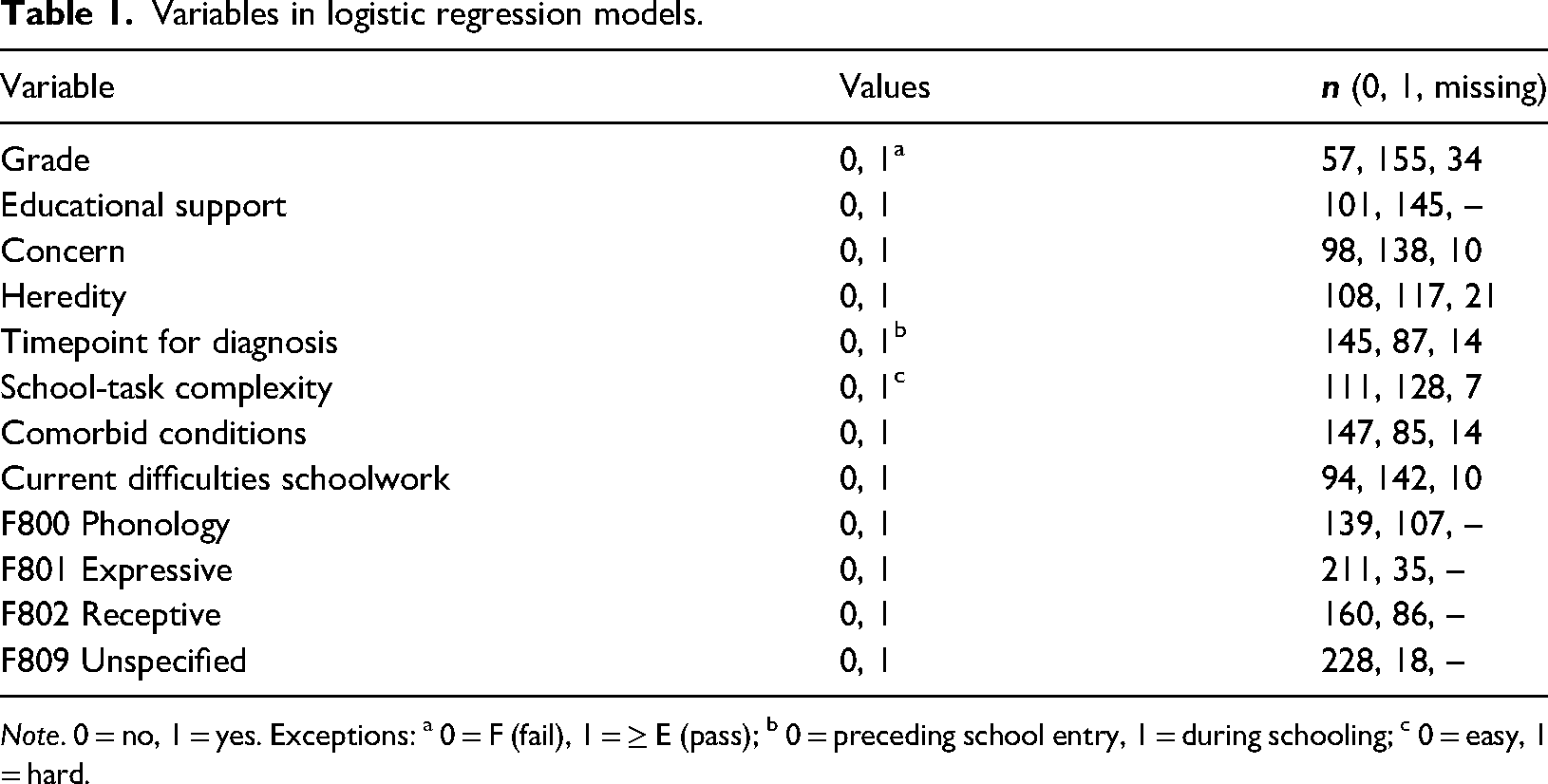
Variables in logistic regression models.
Note. 0 = no, 1 = yes. Exceptions: a 0 = F (fail), 1 = ≥ E (pass); b 0 = preceding school entry, 1 = during schooling; c 0 = easy, 1 = hard.
Variables with ordinal data were converted to binary variables to decrease the risk of multicollinearity and improve readability. For example, for Grade, the value 0 was given to cases who failed in any of the core subjects, and 1 to cases with passing grade in all core subjects, as required to apply for high school. Similarly, for Educational support, the value 0 was given to cases receiving no educational support (total n = 101; F800, n = 71; F801, n = 14; F802, n = 13; F809, n = 3), and 1 to cases receiving support after an informal decision from the teacher and/or a formal decision from the principal (total n = 145; F800, n = 36; F801, n = 21; F802, n = 73; F809, n = 15).
Goodness of fit, that is, whether the combination of predictors have the capacity to predict the outcome (passing grades and provision of educational support, respectively), was evaluated by comparing the full models, including all predictors, to constant-only models using log-likelihood tests and classification accuracy. The contribution of individual predictors was evaluated with the Wald test and odds ratios. Preliminary analyses ensured all assumptions, including independence of observations, multicollinearity and ratio of cases to predictors, were met. All statistical analyses were performed using SPSS.
Predicting passing grades
Complete data for the dependent variable (Grade) and all predictor variables were available from 169 participants. The full model, including ten predictors (Concern, Heredity, Timepoint for diagnosis, Comorbid conditions, Current difficulties in schoolwork, School-task complexity, Educational support, and dummy coded variables for DLD subtypes) significantly outperformed the constant-only model, χ2 (10, N = 169) = 71.73, p < 0.001, indicating that the model successfully distinguished between participants who received passing grades and participants who did not. The model classified 81.1% of cases correctly, as compared to 72.8% for the constant-only model. Cox and Snell R2 (0.35) and Nagelkerke R2 (0.50) were used to approximate the strength of the relationship between the dependent variable and the predictors. Two predictors, School-task complexity, χ2 (1, N = 169) = 15.72, p < 0.001, and F802 Receptive, χ2 (1, N = 169) = 4.69, p = 0.030, contributed significantly to the model. Table 2 shows regression coefficients, Wald statistics, odds ratios, and confidence intervals for each predictor. The odds ratio for School-task complexity indicates that participants reporting high demands from school-tasks are 0.044 times less likely to receive passing grades than participants reporting low demands. Inverted for readability (1/0.044), participants reporting high demands from schoolwork are 23 times more likely to fail academically (95% CI = 4.83–111.11). Similarly, the odds of achieving passing grades for participants with problems affecting receptive language are 69.5% lower (=(0.305–1)*100) than for participants in the reference category, F800 Phonology.
Logistic regression predicting passing grades.
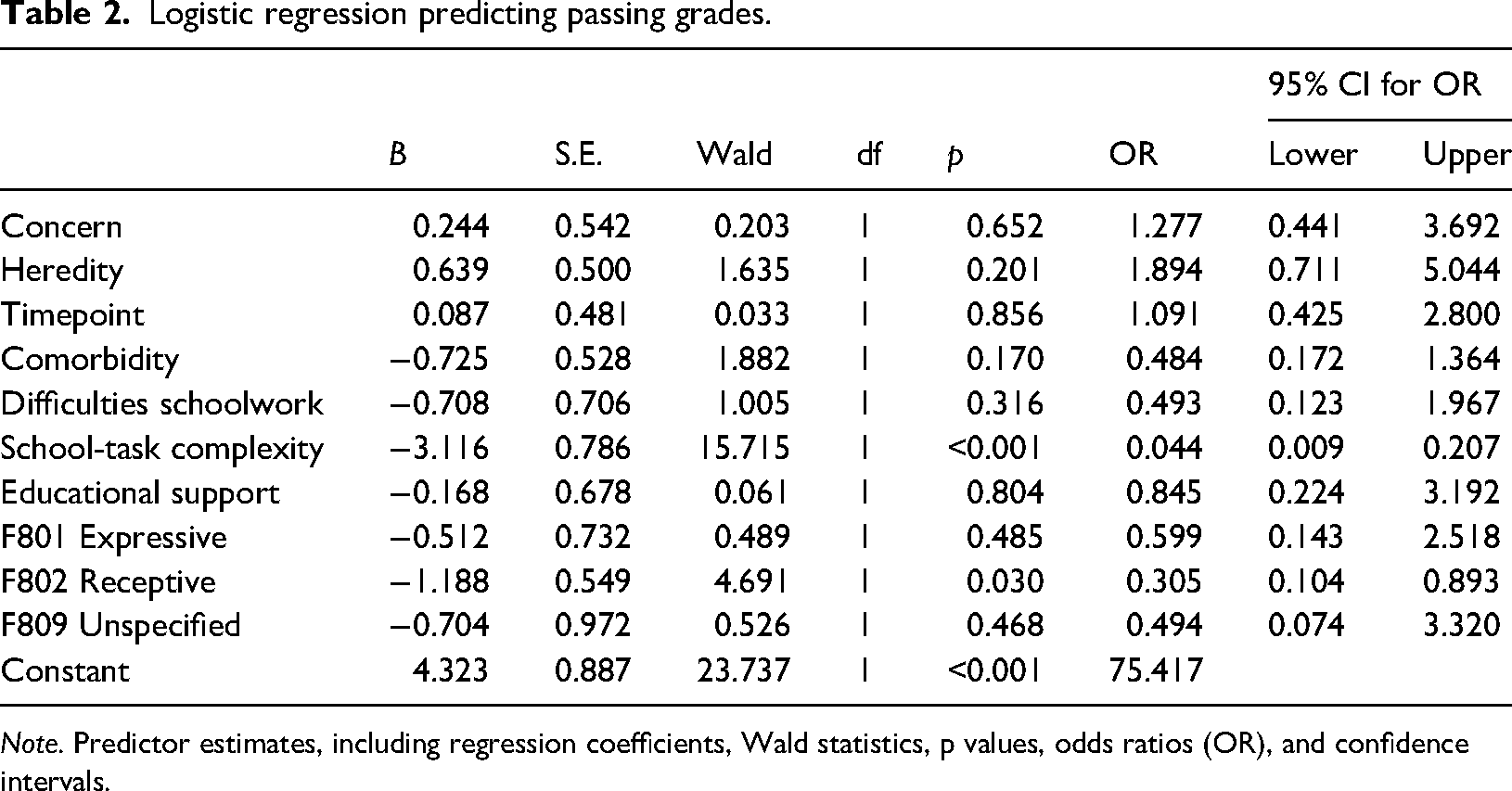
Logistic regression predicting passing grades.
Note. Predictor estimates, including regression coefficients, Wald statistics, p values, odds ratios (OR), and confidence intervals.
The full model, predicting the dependent variable (Educational support) from ten predictors (Concern, Heredity, Timepoint for diagnosis, Comorbid conditions, Current difficulties in schoolwork, School-task complexity, Grade, and dummy coded variables for DLD subtypes) failed to converge, showing irregularities in the parameter estimates for F809 Unspecified. A re-run model, with DLD subtypes removed, was statistically significant, χ2 (7, N = 169) = 103.03, p < 0.001, and could successfully distinguish between participants receiving and not receiving educational support. The model classified 83.4% of participants correctly, as compared to 59.2% for the constant-only model. Cox and Snell R2 (0.46) and Nagelkerke R2 (0.62) were used to approximate the strength of the relationship between the dependent variable and the predictors. Only one predictor, Comorbidity, χ2 (1, N = 169) = 12.56, p < 0.001, made a statistically significant contribution to the model. Table 3 shows regression coefficients, Wald statistics, odds ratios, and confidence intervals for the predictors. The odds ratio for Comorbidity indicates that participants with additional disorders are 44 times more likely to receive educational support than participants with DLD as their only condition.
Logistic regression predicting educational support.
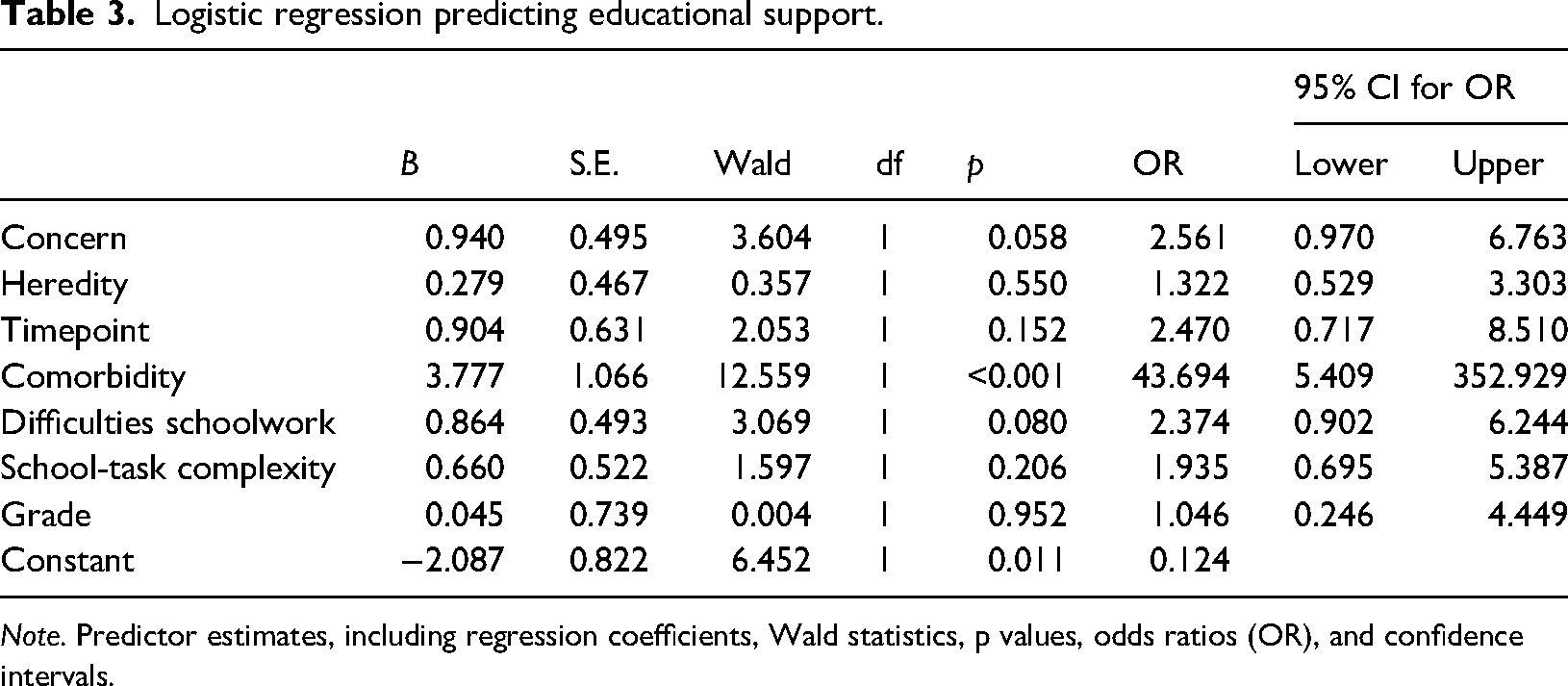
Logistic regression predicting educational support.
Note. Predictor estimates, including regression coefficients, Wald statistics, p values, odds ratios (OR), and confidence intervals.
The results indicate that information on DLD subtype, and reports from the participants on the perceived complexity of frequently occurring school-tasks, can be used to determine the academic performance of students with DLD. Furthermore, provision of educational support to students with DLD is predicted by the presence of additional disorders, that is, whether DLD presents in combination with other conditions. Implications of these findings are discussed below.
Predictors of academic performance
Problems affecting receptive language impact more severely on academic performance than do expressive disorders. The finding is corroborated by previous research and should not be surprising. In a recent example, albeit concerning younger children, Bruinsma et al. (2024) found children with mixed receptive-expressive language disorder to face challenges in almost all communicative situations, whereas children with only expressive disorder faced similar challenges only in specific situations. Many expressive language disorders, affecting, for example, phonology and grammar, can be expected to improve more rapidly and even normalize completely before school entry (Law et al., 2004), whereas receptive symptoms that are present when formal instructions begin, more likely lead to long-term consequences (Snowling et al., 2016). In this study, all participants were students in middle school or upper secondary education and answered questions regarding their current situation. Thus, the survey was directed at participants who were at a point in their schooling where expressive symptoms can be expected to be less prominent. Instead, receptive symptoms will likely pose the greatest challenges to schoolwork.
Importantly, the perceived level of difficulty of frequent school-tasks proved to be a significant predictor of academic performance. This can be interpreted as evidence that the participants can reliably assess their own abilities and disabilities. As previously suggested (Lyons and Roulstone, 2018), the personal reports of students with DLD will often hold information that can be used to better understand the impact of the disorder on everyday life, which will be of help when planning for relevant educational support and intervention. Listening directly to those affected enables an innovative process where ideas for support and intervention can be developed and improved (Hersh et al., 2022). In addition, more systematically considering the perspectives of individuals with DLD helps the SLP profession meet the requirements of the UN Convention on the Rights of the Child (e.g. Lyons et al., 2022), which states that the child should be involved in decisions concerning them, and person-centered care, which is an ambition in the healthcare systems of many countries, including Sweden (Ekman et al., 2011). Consequently, assessment and interview instruments which can be used to elicit responses on, for example, which school-tasks are considered easy and hard, should be developed and validated for use in different languages.
Predictors of educational support
Only one predictor, comorbidity, contributed significantly to determining which participants received educational support. Admittedly, DLD shares some of its symptoms with other conditions, but given the collective knowledge of the impact of DLD on academic performance, it is discouraging that the odds of receiving support increase dramatically only when other conditions are present. The finding is, however, supported by previous research. Dockrell et al. (2019) found that provision of educational support in UK schools is driven by diagnostic categories, as opposed to an assessment of the child's language, literacy, cognitive, and behavioral needs, and that children with autism spectrum disorder are more likely to receive support in school than children with DLD. Similarly, in a population-based sample, Griffiths et al. (2024) found that a diagnosis of a neurodevelopmental (e.g. autism) or sensory impairment was the strongest predictor of special educational support being provided to children with teacher-reported language difficulties. Indeed, such findings could indicate that other disorders are more visible than DLD in the classroom and in schoolwork, and more detrimental to academic performance. Alternatively, school personnel may be better trained to detect other conditions. Since 2021, the preservice training of teachers in Sweden includes mandatory coursework on neurodevelopmental conditions, mainly autism spectrum disorder and attention-deficit/hyperactivity disorder, but with no specific focus on DLD (Statutes, 2020). This may contribute to support more often being provided when DLD coincides with other neurodevelopmental conditions.
Unfortunately, having language difficulties confirmed by a formal assessment is no guarantee that adequate support will be provided in school, or that the amount of support will be enough to change the student's level of functioning. Internationally, preservice teachers have been found to receive very little training in spoken and written language structure (Glasby et al., 2022; Moats, 2009) and similar results have been reported also from Sweden (Alatalo, 2011; Tärning et al., 2024). Consequently, teachers may lack the necessary qualifications to provide students with high-quality language teaching and to adapt their instructions, for example, by recasting to highlight critical linguistic components, to support students with problems understanding or using language. Previous work has also found teachers to overestimate their own skills (Krimm, 2022). Thus, it is not certain that all teachers will recognize their limited capacity to provide support to students with language needs.
Conclusions
From this study it can be concluded that while neither parent-reported difficulty with schoolwork nor insufficient grades are significantly associated with the provision of educational support to students with DLD, having additional diagnoses of neurodevelopmental conditions is. The results indicate that the risk for academic failure is greatest among students with receptive language disorder which, despite its severe impact on academic performance, may remain undetected, or at least, left without necessary support. Additional work is needed to direct the attention of teaching personnel toward the critical symptoms of DLD and create awareness of the lasting nature of the condition. For example, the preservice training of teachers should include mandatory coursework on the key symptoms of DLD, including known ways for adolescents to camouflage or mask language problems, and interventions that can be delivered in the classroom as part of regular teaching activities. Such measures could help enable a more accurate identification and interpretation of language disorder among adolescents.
Limitations
In this study, all survey respondents have received a diagnosis of DLD. Students with confirmed diagnoses are more likely to having received support than students whose difficulties are left without formal assessment. In addition, a formal diagnosis, which defines and explains the condition, can serve as a confirmation and an empowering validation of the difficulties. This may set the participants apart from peers with undiagnosed problems with language.
Parental concern and heredity were non-significant predictors. This may indicate that school decisions on academic support should rely more heavily on the actual performance of the students than on parental reports. The classification accuracy of this approach should be further evaluated. In addition, only difficulties were included as predictors. There may also be protective factors at play, which deserve to be more fully examined in future studies.
This study was conducted in Sweden, with a school system that may differ in some respects from that of other countries. For example, many Swedish SLPs are employed in the healthcare sector (Sandgren et al., 2023), which may make it hard for them to work as closely together with schools and teachers as would be required to gain insights into the teaching methods used in classrooms, and offer expertise on ways to adjust the teaching for students with DLD.
Supplemental Material
sj-docx-1-clt-10.1177_02656590251339377 - Supplemental material for Predictors of academic achievement and educational support for adolescents with developmental language disorder (DLD)
Supplemental material, sj-docx-1-clt-10.1177_02656590251339377 for Predictors of academic achievement and educational support for adolescents with developmental language disorder (DLD) by Olof Sandgren, Birgitta Sahlén, Christina Samuelsson and Anna Ekström in Child Language Teaching and Therapy
Footnotes
Acknowledgements
The authors wish to thank all respondents for their time and valuable contribution.
Consent to participate
All respondents were informed of the purpose of the study and how the data were to be analyzed and protected from unauthorized access. By accepting to respond to the survey, the participants consented to participate.
Consent to publish
All respondents were informed of, and consented to, how the data were to be reported.
Data availability statement
Data available from the first author upon request.
Declaration of conflicting interests
The authors declared no potential conflicts of interest with respect to the research, authorship, and/or publication of this article.
Ethical considerations
Ethical approval for the study was granted by the Swedish Ethical Review Authority, approval number 2020/02505.
Funding
The authors disclosed receipt of the following financial support for the research, authorship, and/or publication of this article: This work was supported by the Vetenskapsrådet (grant number 2019-03455).

Supplemental material
Supplemental material for this article is available online.
References
Supplementary Material
Please find the following supplemental material available below.
For Open Access articles published under a Creative Commons License, all supplemental material carries the same license as the article it is associated with.
For non-Open Access articles published, all supplemental material carries a non-exclusive license, and permission requests for re-use of supplemental material or any part of supplemental material shall be sent directly to the copyright owner as specified in the copyright notice associated with the article.
