




Abstract
Individuals with developmental language disorder (DLD) often struggle with reading, both with reading comprehension and decoding. Although decoding difficulties are common in the population with DLD, studies investigating phonics-based interventions for these individuals are sparse. This study investigated the effect of a phonics-based computer game, GraphoLearn (GL). To our knowledge, this is the first randomized controlled trial investigating the impact of a phonics-based intervention method in children with DLD. Sixty-seven children enrolled in Grades 0–4 were randomized into three groups: one intervention group playing GL, one active control group playing a math game, and one control group that received teaching as usual. The duration of the intervention was 5 weeks. Decoding ability was measured at baseline, post-intervention, and at follow-up 10–12 weeks after the intervention. The effect of the intervention was analysed using mixed linear models. The analysis showed no significant differences between the groups in terms of improvement. Instead, all groups improved their decoding scores from baseline to follow-up. For children with DLD enrolled in Grades 0–4, it seems like playing the GL game does not improve decoding ability to a greater extent than teaching as usual. However, all groups did improve their decoding scores during study participation, indicating a potential to improve reading ability in a relatively short time despite having a diagnosis of DLD.
Introduction
The ability to read is a fundamental skill and a prerequisite for learning and participation in society. Typically, around the second school grade, Swedish children reach a level of reading ability that allows them to switch from the process of learning to read to using reading as a means of learning (Herrlin and Lundberg, 2014). However, for individuals with developmental language disorders (DLD), reading is often a significant and lifelong challenge, both in terms of reading comprehension and decoding (Botting, 2020; Kalnak and Sahlén, 2022). DLD is characterised by difficulties affecting receptive and/or expressive aspects of language form, content, and use (Conti-Ramsden and Durkin, 2017), with an estimated prevalence of about 7.5% (Norbury et al., 2016). According to the theoretical framework the Simple View of Reading (SVR, Gough and Tunmer, 1986), reading comprehension is the product of two components, namely decoding (i.e., the ability to read isolated words or non-words as quickly and accurately as possible) and language comprehension (i.e., the ability to comprehend spoken language). Reading Impairment (RI) encompasses difficulties with accurate and efficient decoding and/or poor reading comprehension (Vellutino et al., 2008). The prevalence of RI in the general population has been estimated to be somewhere around 5–10%, varying with the definition of RI (Hulme and Snowling, 2011; Snowling and Hulme, 2013). The co-occurrence of DLD and RI ranges between 17% and 51%, depending on the criteria (Moll, 2022), and is associated with long-term negative consequences for academic achievements (Conti-Ramsden et al., 2009).
Previous studies have documented difficulties with both decoding and reading comprehension in populations with DLD. For example, Kalnak and Sahlén (2022) found that 82% of school-aged children with DLD attending language units exhibited significantly poor decoding skills. Similarly, Botting (2020) reported that young adults with DLD experienced greater challenges in reading various types of texts compared to a control group. These findings indicate that reading ability is compromised in individuals with DLD, and this impairment could stem from both language difficulties typically associated with DLD or co-occurring decoding difficulties, as predicted by the SVR. Taken together, these previous results underscore the importance of investigating the impact of reading interventions in this population.
Phonics-based reading interventions
Phonics-based reading interventions employ a systematic teaching of the correspondence between graphemes and phonemes (i.e., letters and sounds), and this method has been extensively researched in both transparent and opaque orthographies. Swedish is considered to have a more transparent orthography than English, but is less transparent than, for example, Finnish or Italian, meaning that the grapheme–phoneme correspondence patterns are fairly consistent (Aro and Wimmer, 2003). Phonics interventions have been proven effective for Swedish children who struggle with reading (Levlin and Nakeva von Mentzer, 2020) and for Swedish children with intellectual disabilities (Nakeva von Mentzer et al., 2021). Further, phonics-based interventions have been successfully implemented on children with, or at risk for, RI (Galuschka et al., 2014; van Rijthoven et al., 2021). In addition to the expected improvement in decoding skills, phonics interventions have also been shown to have a positive effect on reading comprehension in beginning readers (Connelly et al., 2001). This is in line with the SVR, as it describes decoding as being an important component of reading comprehension (Gough and Tunmer, 1986).
Studies investigating reading interventions in general, and reading interventions focusing on phonics in particular, for children with DLD are sparse. Intervention studies for this group often focus on strengthening language aspects to improve reading-related skills, or employ a combined intervention program, where the phonics method is just a part of a more comprehensive approach that also includes aspects of reading comprehension (Chen and Lin, 2022; Peñaherrera et al., 2025; Taylor et al., 2021). For example, a study by Taylor et al. (2021) performed a retrospective cohort comparison between an intervention called InitiaLit and a ‘business as usual (BAU)’ intervention after 18 months. The InitiaLit intervention was highly structured, and teachers received materials, scripted lessons, and formal training. The InitiaLit intervention focused on the essential components of literacy development, with a strong focus on developing accurate word recognition in the beginning, and after a while, the focus expanded to also include reading fluency and comprehension. The BAU intervention was designed by school-based speech-language pathologists, and it also included systematic phonics instruction, alongside teaching of high-frequency words. The BAU intervention was not scripted, and progress monitoring was the responsibility of individual teachers. Hence, the two conditions mainly differed concerning the level of program structure, use of scripting, and assessment schedule. The study showed that the children in the InitiaLit condition scored significantly higher on non-word reading measures after the intervention compared to the BAU condition, but there were no significant differences in word reading measures (Taylor et al., 2021). These results could be interpreted as phonics being an effective method regardless of the level of program structure and use of scripting for the development of word reading, but for the development of non-word reading the intervention method needs to employ more structure and scripting to be successful.
Computer-based phonics interventions
Phonics interventions have traditionally been delivered by a teacher in a classroom or one-to-one, but it has become increasingly popular to use computer- or tablet-based games as a means of delivering phonics interventions, in Sweden as well as in other countries. GraphoLearn (GL, formerly known as GraphoGame) is a computer-based game that provides phonics instruction (Lyytinen et al., 2007). In the development of GL, one of the pronounced goals of using a computer-based approach was the possibility for everyone in need of phonics training to gain access to it, regardless of the availability of trained remediation personnel (Lyytinen et al., 2007). GL has been found to increase decoding ability in, for example, Finnish children at risk of reading difficulties (Saine et al., 2011) and English children identified as poor readers (Kyle et al., 2013).
Studies testing computer- or tablet-based phonics interventions for children with DLD remain sparse. However, a recent study explored the progress in GL and reading-related skills in Spanish-speaking children with DLD and their typically developing peers in kindergarten or first grade (Martínez et al., 2023). The participants were divided into three groups: DLD with both receptive and expressive difficulties, DLD with only expressive difficulties, and a control group with typical development. All participants completed pre- and post-intervention in-game tests of letter recognition, nonsense word recognition (i.e., listening to a nonsense word and choosing the correct written word out of five options), and phonological awareness. In addition, the participants were assessed on a word decoding task at follow-up, more than 1 year later. All three groups improved on all in-game tests, but the DLD group with both receptive and expressive difficulties made less progress compared to the other two groups (Martínez et al., 2023). In addition, Carson (2020) investigated the effect of three Reading Doctor apps compared to a usual preschool program for 4-year-old children with DLD on measures of phonological awareness and letter-sound knowledge. The study found significant differences between the intervention and control groups on phoneme blending, phoneme segmentation, letter-sound recognition, and the number of correct phoneme–grapheme conversions. The study concluded that a tablet-based intervention could support reading readiness in children with DLD (Carson, 2020).
In summary, it seems like phonics interventions, both manual and computerized, could be beneficial for children with DLD. However, there are no previous reading intervention studies focusing on Swedish-speaking children with DLD.
Present study
This study aimed to investigate the effect of a phonics-based computer game, GraphoLearn (GL), on the development of decoding ability in children with DLD, using a single-blinded randomized controlled trial design. The study compared the performance of three groups: one intervention group that played GL, two control groups where one group played a math game, and one group undertook teaching as usual (TAU). The primary research question addressed in this study was whether GL is an effective intervention tool for enhancing decoding skills among Swedish children diagnosed with DLD. We hypothesized that the implementation of GL would lead to significant improvements in decoding abilities from baseline to post-intervention assessments.
Materials and methods
Ethical approval
This study received ethical approval from the Swedish Ethics Review Authority (2020-02655). First, written informed consent was obtained from the parents, and thereafter, oral informed consent was obtained from each participant before the assessments. The trial was also registered at https://clinicaltrials.gov/ with registration number XX.
Participants
We performed power calculations based on two sample sizes, and the final sample size fell between these two scenarios. First, a design of 30 + 30 + 30 yielded a power of 0.99 to detect a moderate effect size of 0.3, and a power of 0.71 to detect a small effect size of 0.1. Further, a design of 20 + 20 + 20 yielded power to detect both large and moderate effects, but less power to detect small effects (0.51 power). The same intervention showed moderate effect sizes for children with intellectual disabilities (Nakeva von Mentzer et al., 2021).
The participants with DLD were recruited from nine school language units in Sweden, where, in total, 209 children with DLD were enrolled. These schools have small classes for a maximum of 8–10 children with DLD. A total of 83 children fit the inclusion criteria, and 67 children consented to the study, yielding a response rate of 80.7% (Figure 1). The participants (n = 67) had a mean age of 8.10 years (Mage in months 102.90, SD 15), the female-to-male ratio was 24:43 (64.20% males), and they were recruited from Grade 0 to 4. In Sweden, Grade 0 is the first formal school year that children attend from the year they turn 6 years old. The study inclusion criteria were a clinical diagnosis of DLD, which excludes a diagnosis of intellectual disability and autism spectrum disorder; normal hearing and normal vision (with correction); and Swedish being the only or dominant language of the child. All participants had an F80.2B ICD-10 diagnosis, that is, general language impairments affecting both receptive and expressive aspects of language functions. According to parental reports, 10 participants also had attention deficit hyperactivity disorder (ADHD), two participants had dyslexia, and one participant had childhood apraxia of speech. In addition, children for whom the schools suspected an intellectual disability or autism spectrum disorder, or children who were under investigation for any of these conditions, were excluded (Figure 1). The study criteria were confirmed for each child by the parents and the school.
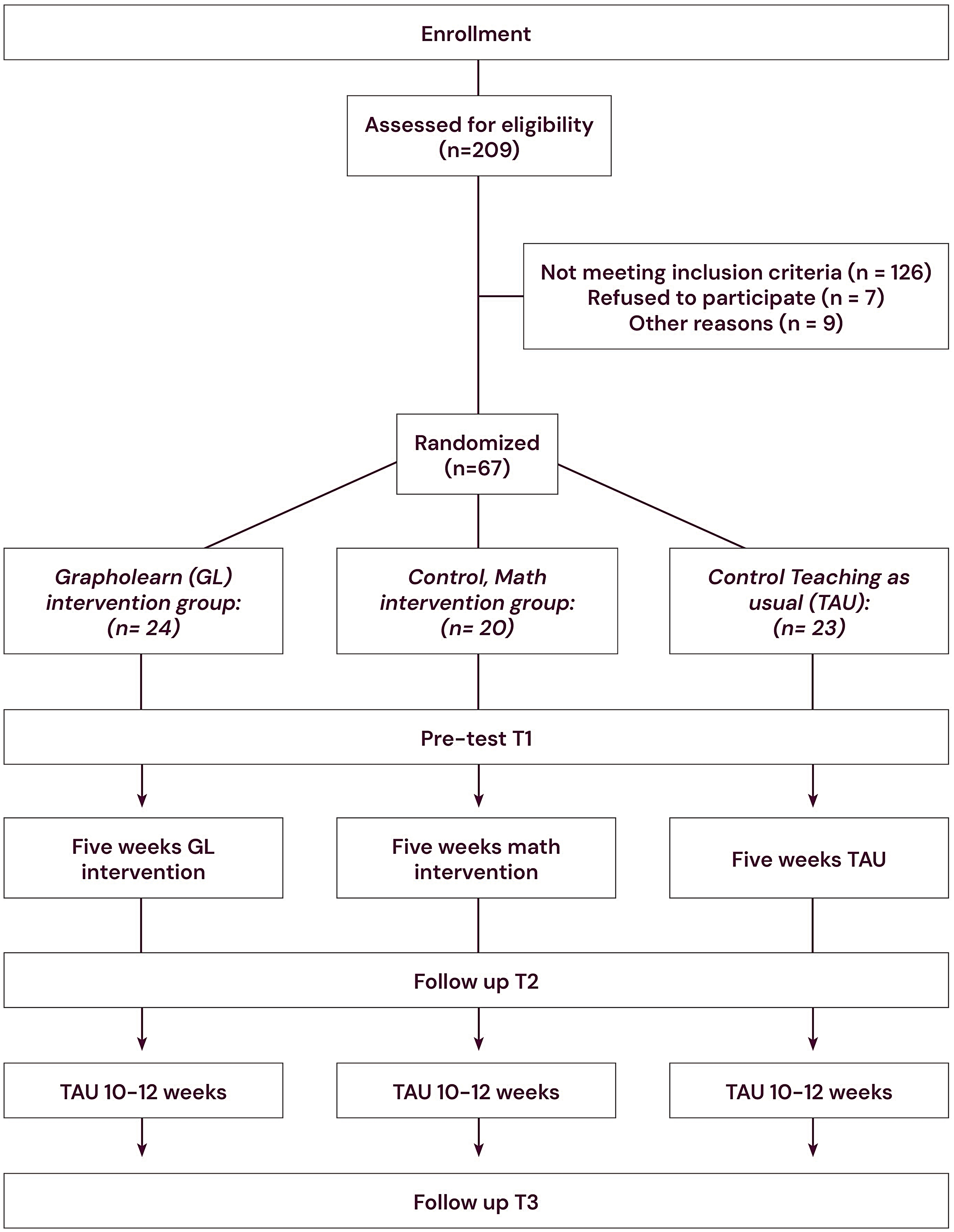
Flowchart showing the study design.
Parents were interviewed over the phone by an experienced clinical speech-language pathologist to establish whether the child had any other diagnosis in addition to DLD, and the parents were asked about their child's reading ability. Moreover, the interview included questions regarding family aggregation of language-related conditions, such as RI and DLD or other neurodevelopmental conditions, in biological parents and siblings.
The mothers’ and fathers’ highest level of education was used as a proxy of socio-economic status. The following categories were used: 9 years of elementary school was labelled as low level, finished high school (3–4 years) was labelled as medium level, and at least 3 years of university studies was labelled as a high level of education.
The GraphoLearn (GL) game
The GL game is a computer-based reading intervention, originally from Finland (Lyytinen et al., 2007, 2009), translated from Finnish Swedish into standard Swedish (Nakeva von Mentzer, 2014). The game is based on the phonics method (Kyle et al., 2013; Torgerson et al., 2019), meaning that it starts with smaller units (phoneme–grapheme correspondence) and progresses into decoding and blending/spelling words. The GL game has an adaptive feature, in the sense that the level of complexity is tailored to each child's performance. The child needs to reach a performance level of approximately 80% correct before advancing to the next level. The Swedish version of the GL game has 56 levels, and these levels are divided into three themes based on the phonological and orthographical complexity of the words. First, GL introduces isolated upper-case and lower-case letters and their corresponding speech sounds. Second, GL advances to the three themes, where Theme 1 includes one-syllable words with a consonant-vowel (CV) structure, Theme 2 includes VC, CVC, VCC, and CVCC structures, and Theme 3 includes eight-letter words. In Theme 3, the words contain initial consonant clusters and larger grapho-phonemic units, for example /ŋ/. In addition, the GL game also contains a set of blending/spelling tasks.
The GL game collects data on intervention fidelity by automatically registering dates, time of the day, the total amount of time per session and in total, and the highest GL level reached at the end of the intervention period.
Design and procedure
Randomization and intervention
When entering the study, the children with DLD were randomized, based on school-grade and sex, into three subgroups (strata), the GL-intervention group or one out of two control groups: one active control group playing a math computer game (Math group), and one passive control group undertaking teaching as usual (TAU group, see Figure 1). Participants were then randomized within each stratum to ensure equal representation (block size randomization) in all intervention groups. Only the last author and the child's teacher or the school-based speech-language pathologist had access to the group assignment for each participant. The test administrators were blinded to the participants’ group assignment.
The study adopted a longitudinal design ranging over 16 weeks (see Figure 1). Data was collected during 18 months, from September 2021 to February 2023. After the first baseline assessment (T1), an intervention period of 5 weeks was initiated. The intervention group was instructed to play a minimum of 20 sessions of the GL game, for a minimum of 20 min and a maximum of 30 min per session, using headphones. Further, the teacher was instructed to be available in the room. Missing days were allowed to be compensated by extra daily practice sessions within the 5 weeks. Our design was inspired by a Swedish study on poor decoders in second grade, where a 6-week-long phonics intervention significantly improved pseudoword decoding compared to regular classroom instruction (Levlin and Nakeva von Mentzer, 2020).
The Math group played a math computer game, and the schools were allowed to choose which math computer game the children would play. The Math group followed the same procedure as the GL group, namely 20 sessions during the same period. One common math game chosen by the schools was the app Vektor, in which the child moves between islands in a fantasy world. Each island has three math challenges (arithmetic, working memory, and problem-solving), and the difficulty is adjusted based on the child's performance. The TAU group undertook teaching as usual, that is, classroom-based teaching in small groups that followed the structure of the Swedish national curriculum. In Sweden, all schools follow a national curriculum where systematic training of grapheme–phoneme correspondence is required for Grades 1–3 (Skolverket, 2022). Hence, it is reasonable to assume that participants in the TAU group either received phonics instruction to some extent during the study, or had received systematic phonics instruction prior to the study.
In each school, a special needs teacher or a speech-language pathologist was responsible for implementing the intervention. They were instructed to write log notes in a protocol after each GL session, covering their observation of the child's ability to work independently and if any problems occurred. The research team was available to the schools during the whole intervention period, in case any support was needed. The intervention fidelity was closely monitored by the research team using in-game data from the GL server to ensure that the participants were playing GL according to the study design, and feedback was given to the school when needed. For the Math group, the intervention fidelity was based on the same protocol as for the GL group, with schools noting the date and duration (in minutes) of each session. The participants in the GL group responded to a question about how much they liked playing the GL game. The answer was measured with a five-point Likert scale.
Assessments
Tests of speech, language, and cognitive abilities were administered to the participants pre-intervention (T1), and tests of decoding ability were administered at three time points: baseline (T1), directly after 5 weeks of intervention (T2), and 10–12 weeks after the intervention period (T3). All tests were individually administered to the participants in their schools. The following measures were included: the Swedish version of The Clinical Evaluation of Language Fundamentals (CELF-IV, Semel et al., 2003). The core language index score (CLS) was reported. Raven's 2 Progressive Matrices Clinical Edition (Raven et al., 2018) was used to measure non-verbal IQ. Standard scores were reported. The Nonword Repetition test (Kalnak et al., 2014; Sahlén et al., 1999) was used as a measure of phonological short-term memory. Binary scoring was used (correct/incorrect repetition) and standardized scores were reported based on new Swedish reference data collected as a part of this project (see more information below and in the Supplements).
Three measures of reading were used. The primary outcome was measured using the GL decoding task, developed for a previous study (Nakeva von Mentzer et al., 2021). This task consists of three lists of words: one list of GL words (i.e., words that have occurred in the GL game), one list of real words unrelated to the GL game, and one list of nonsense words. The instruction was to read all the words, and no time limit was used. These three types of word lists correlated highly (r > .90) and were combined into a composite variable (GL decoding) that was used in the analysis. In addition, two secondary outcomes were measured. Letter knowledge was assessed with the Letter naming task (Frylmark, 1995). The participants were shown a chart with six rows of four lower-case letters (24 items, font size 48), and then asked to name the letters from left to right. Raw scores, but also standardized scores based on new Swedish reference data (Supplements), were reported. Word decoding and nonsense word decoding were measured with the Swedish version of the Test of Word Reading Efficiency, TOWRE (Lyxell et al., 2009). TOWRE consists of two subtests that assess word decoding and nonsense word decoding. Each subtest consists of two lists and, in total, 208 words and 126 nonsense words. The instruction was to read out loud as many words/nonsense words as possible for 45 s per list. There is a high correlation between the subtests (r > .90), and scores on the subtests were added together to a total score that was used in the analysis. Raw scores, but also standardized scores based on new Swedish reference data (see below for details), were reported.
Reference data
Swedish reference data from 220 children in Grades 0–3 were collected for the following tasks: TOWRE, the Nonword Repetition Test, and the Letter naming task. This data was collected because previous reference data for these tests was either collected a long time ago or was based on too small samples. The participants for the reference data were recruited from three mainstream schools, two representing urban areas and one representing rural areas. Inclusion criteria were attendance in Grades 0–3, Swedish being the only or best language of the child, no developmental diagnoses, and normal hearing and vision (corrected vision was accepted). A total of 220 children, 116 females (53%), and 104 males (47%) were assessed (see Tables S1 and S2 in the Supplements). All children were assessed by experienced speech-language pathologists, and the tests were administered in the schools to one child at a time, with a duration of about 15 to 20 min. All data were collected during 7 weeks from the end of October 2022, except for one child who participated in January 2023. No statistical differences were observed between the urban and rural areas for any of the tests. No sex differences were found for any of the tests per school grade. TOWRE word decoding and TOWRE nonsense word decoding were highly correlated in all school grades (Grade 0: r = .97, Grade 1: r = .93, Grade 2: r = .88, Grade 3: r = .83) and were therefore collapsed into a composite score: TOWRE total. For all three tests (TOWRE, the Nonword Repetition Test, and the Letter naming task), the performance increased with every grade level, except for the Nonword Repetition Test, where the difference between participants in Grade 0 and 1 was not statistically significant.
Data analysis
Data were managed using REDCap electronic data capture tools hosted at Karolinska Institutet. First, data was extracted and sorted in IBM SPSS Statistics (Version 28), and thereafter analysed in R Version 4.3.1 and R Studio Version 2023.12.1 (R Core Team, 2017). A Kruskal-Wallis test was used to test for group differences in T1 performance, and differences in T1 TOWRE and Letter naming in relation to demographic variables. For demographic variables with only two levels, a Mann-Whitney U test was used. Non-parametric tests were chosen because the majority of variables were not normally distributed. To analyse the effect of the intervention on the primary and secondary outcomes, data were analysed using Mixed Linear Models (MLM). This choice was based on the fact that MLM provides a simple and straightforward interpretation, can handle missing data, and has superior statistical power compared to mixed ANOVAs and OLS regressions (Hilbert et al., 2019). In R, MLM was used by applying the lmer() function in the lme4 package (Bates et al., 2015). Models were compared using Likelihood Ratio Tests (LRT) by applying the anova() function in R. MLM assumptions of linearity, homoscedasticity, and normality were checked. One primary outcome and two secondary outcomes were analysed. The primary outcome was a change in performance on the GL-decoding task. The secondary outcomes were changes in performance on the Letter naming task and on TOWRE. The model of interest was the interaction between Time (i.e., progress from the pre-test to the follow-up test), and Study group (i.e., the intervention condition). This model was compared to a random-intercept-only (i.e., null) model.
Results
Demographic and descriptive data
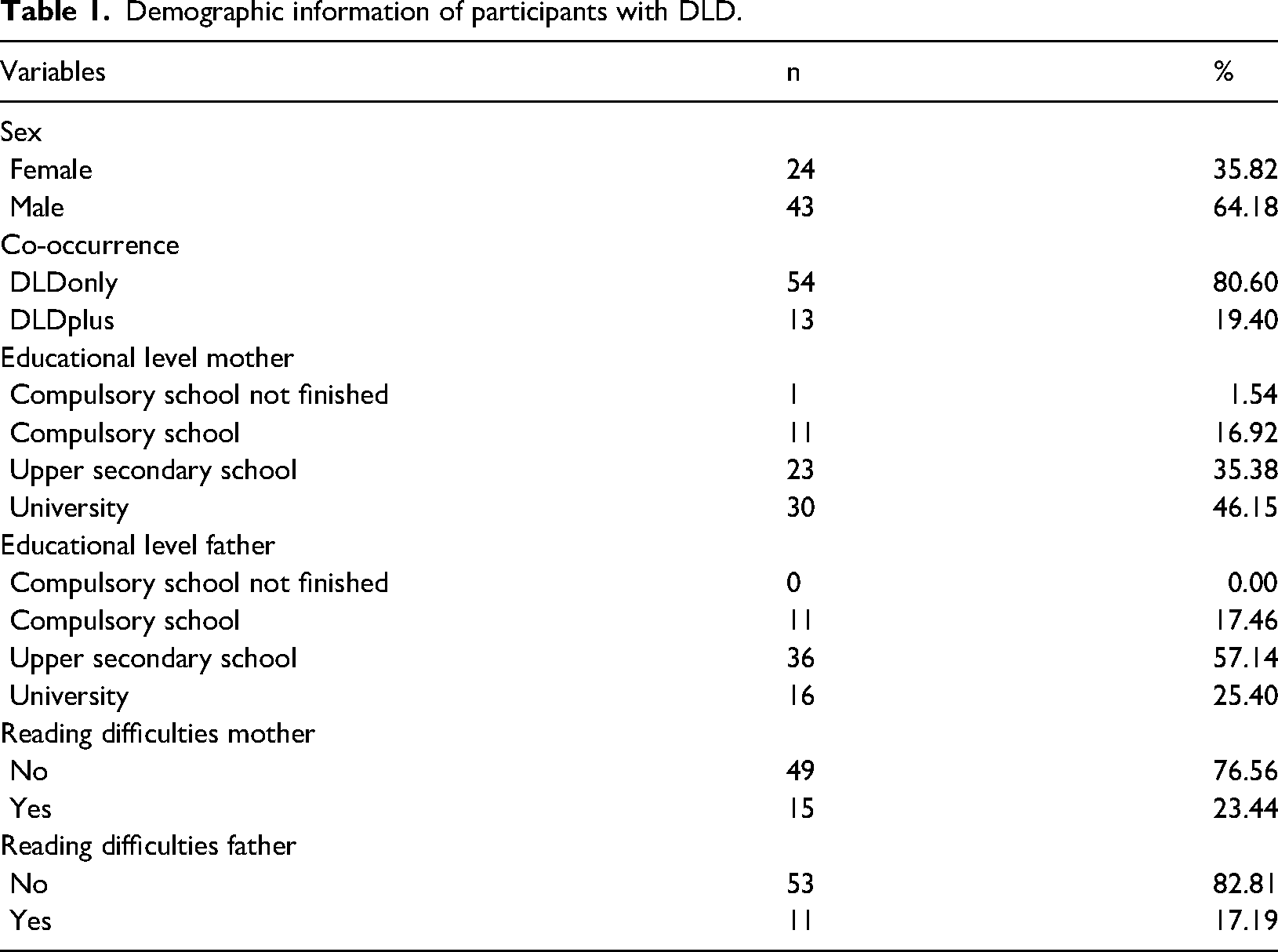
The interviews with the parents showed that out of the 67 participants, 10 children also had ADHD or ADD (14.9%), one had a diagnosis of childhood apraxia of speech (1.5%), and two had dyslexia (2.9%). The remaining 54 children had DLD only (80.6%). Moreover, the parents reported poor reading ability for 45 of the children (67.2%), that is, reading proficiency was not considered comparable to peers of the same age without DLD.
Table 1 presents the educational level of parents, both separately and together. About 7% of the participating children belong to families where both parents have a low level of education, about 38% have at least one parent (mostly both) with a medium level of education, and 55% have at least one parent (mostly both) with a high level of education.
Demographic information of participants with DLD.
There were no differences between the three groups at T1 on age, general language ability, non-verbal IQ, non-word repetition, or any of the reading measures. Descriptive statistics, including p values from the Kruskal-Wallis test, are reported in Table 2. There were no differences in performance on T1 TOWRE or the Letter naming task in relation to participants’ sex, educational level of the mother and father, reported reading difficulties in the mother and father, and whether the participant had DLD only or DLD plus another diagnosis. Because having an additional diagnosis could potentially hinder development in decoding, we also compared the participants with DLD only and the participants with DLD plus an additional diagnosis at T3. No differences in performance were found. When comparing the performance of the participants with DLD with the new Swedish reference data, it was found that at T1, 63% of the sample performed below one standard deviation from the mean on TOWRE. At T3, the corresponding figure was 49% (see Figure S1 in the Supplements). About 14% of the participants moved from poor decoding performance to within-average decoding performance.
Descriptive statistics of participant characteristics and task performances of participants with DLD.
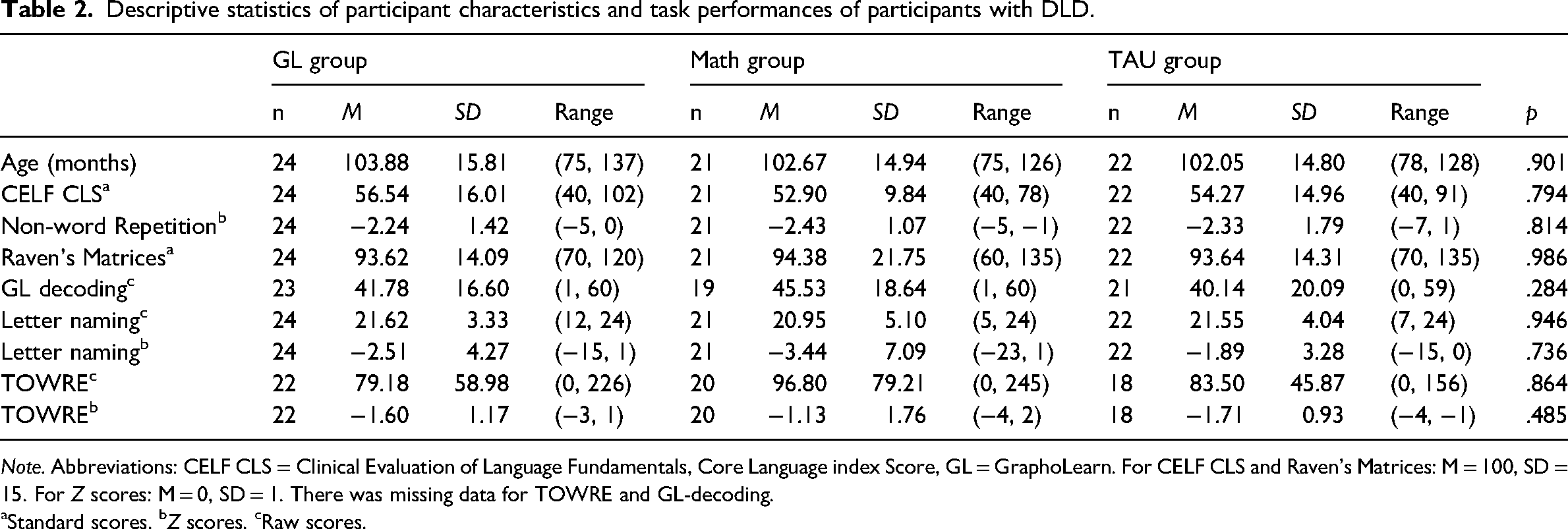
Note. Abbreviations: CELF CLS = Clinical Evaluation of Language Fundamentals, Core Language index Score, GL = GraphoLearn. For CELF CLS and Raven's Matrices: M = 100, SD = 15. For Z scores: M = 0, SD = 1. There was missing data for TOWRE and GL-decoding.
Standard scores. bZ scores. cRaw scores.
The GL group spent on average 321.29 min (range 74–456 min) playing the GL game, during an average of 20.29 sessions (range 7–28 sessions). The Math group spent on average 313 min (range 50–415 min) playing the math game, during an average of 18.45 sessions (range 3–20 sessions). The reason that some participants had fewer than 20 GL sessions was that they completed the entire GL game in fewer than 20 sessions.
Effect of intervention on primary outcomes
The entry-level for the GL group on the GL decoding task was M = 41.78 (SD = 16.60), and the level post-intervention was M = 46.33 (SD = 14.42). There was no significant interaction between Time and Study group for the GL decoding outcome, indicating that being enrolled in the GL group did not improve performance on the primary outcome, the GL decoding task, compared to being enrolled in any of the control groups. In line with this, the effect size (d = 0.29, 90% CI [−0.19, 0.77]) for the GL group was small. However, there was a significant increase in performance for the whole sample at Time 3 (Figure 2). The LRT showed a significantly better fit compared to the null model,
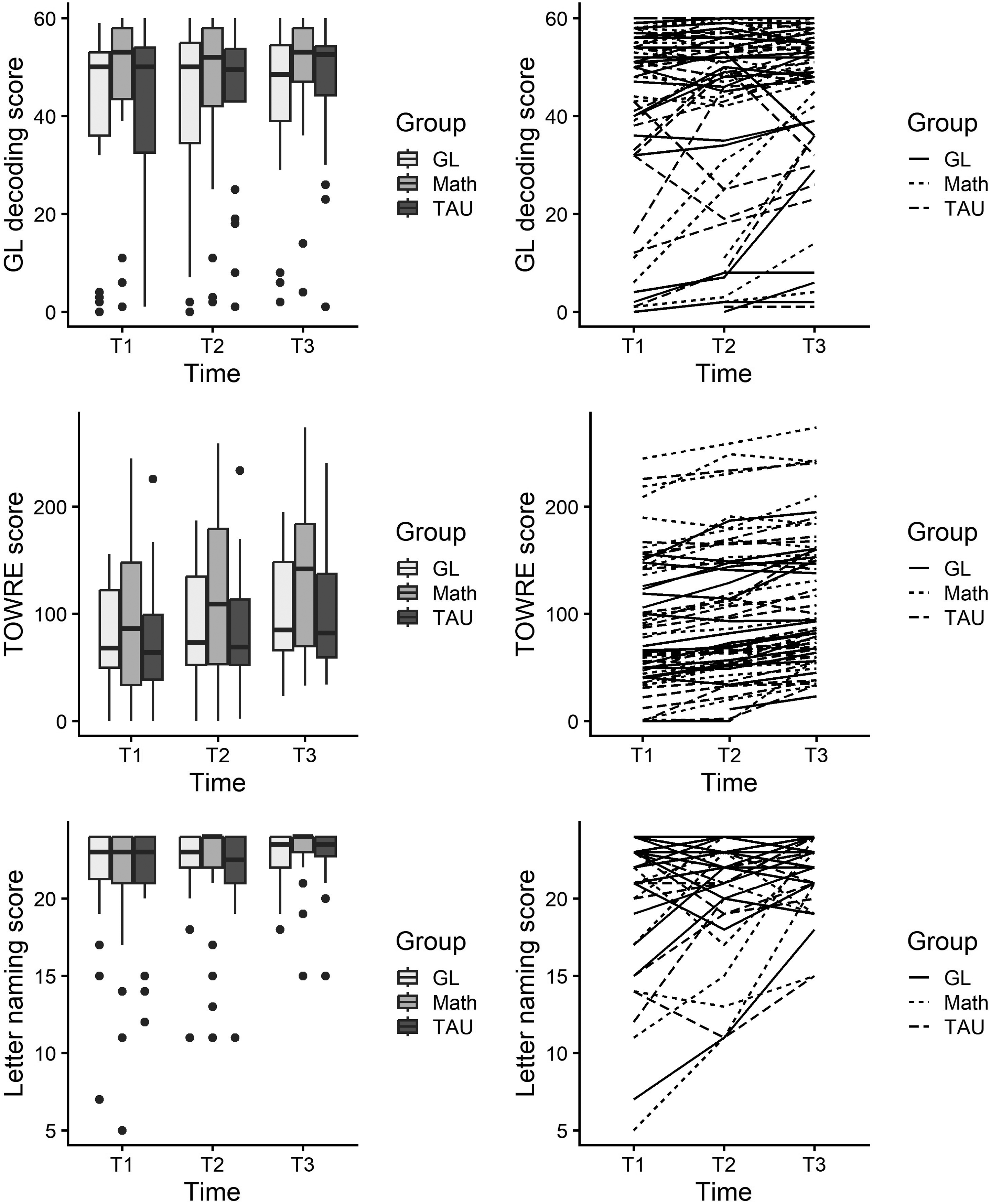
Change in performance on GL decoding, TOWRE, and letter naming on group level and for each participant. Colours represent the three intervention groups.
Effect of intervention on secondary outcomes
The entry-level for the GL group on TOWRE was M = 79.18 (SD = 58.98), and the level post-intervention was M = 100.68 (SD = 57.45). The corresponding figures for the Letter naming task were M = 21.62 (SD = 3.33) and M = 22.79 (SD = 2.02). There was no significant interaction between Time and Study group for the secondary outcomes, indicating that being enrolled in the GL group did not improve performance on TOWRE and the Letter naming task compared to being enrolled in any of the control groups. The effect sizes for the GL group on TOWRE (d = 0.37, 90% CI [−0.13, 0.87]) and Letter naming (d = 0.42, 90% CI [−0.06, 0.90]) were small to moderate. However, there was a significant increase in performance for the whole sample at both Time 2 and Time 3 on TOWRE, but only at Time 3 on letter naming (Figure 2). The LRT showed a significantly better fit compared to the null model for TOWRE,
Feasibility of the intervention
Twenty-three out of 24 participants in the GL group answered the question about how much they liked playing the GL game. The result was a median of 4 (min–max 1–5). Only one child responded with 1 (very bad), and the same child played only 18 sessions and did not make that much progress in the game.
The teachers’ log notes showed that among the 24 children who played the GL game, 10 played independently and seven needed help to focus at one or two times. Three children were reported to need help to focus at four or more times, and two children needed help to slow down more than four times. Two children were reported to need help to understand how to play the game at three or more times. Among the children who needed help to focus, three children were reported to be less motivated towards the end of the intervention period. These children were good readers from the start and found the game too easy and, therefore, boring.
Discussion
This study aimed to investigate the effect of the phonics-based computer game GL on the development of decoding ability in children with DLD, using a randomized controlled trial design. The study compared the performance between three groups: one intervention group playing GL, and two control groups. The hypothesis was that the GL group would perform better on measures of word and nonsense word decoding at Time 2 and Time 3 compared to the control groups. The results showed a significant increase in decoding performance for all groups on GL words, letter naming, and TOWRE at Time 3, but no significant interaction effects between Time and Study group. Hence, participants improved their decoding scores across groups, indicating that the lack of intervention effect was not attributable to a lack of improvement in decoding scores. Rather, it was because all groups progressed comparably. Possible explanations for the lack of effect of the intervention are discussed below, together with implications for future research.
Phonics interventions, both manualised and computer-based versions, have been proven successful for children with DLD in previous research (Carson, 2020; Martínez et al., 2023; Taylor et al., 2021), but only one previous study has, to our knowledge, used GL in a DLD population (Martínez et al., 2023). However, the aforementioned study did not include a control group that did not receive the GL intervention, meaning that there is no way of knowing if a TAU condition would have shown equal benefits. Similarly, in the study by Taylor et al. (2021), where they compared the manualised intervention InitiaLit to TAU, there was no effect of InitiaLit on word reading compared to the control group. Because TAU often contains aspects of phonics, it could be that using a more systematic intervention approach (manualised or computer-based) does not add anything compared to TAU for children with DLD.
The Swedish version of the GL game has 56 levels, and participants must pass each level to proceed. Out of the 24 participants who played GL, 20 reached the highest level, and six of these participants required fewer than the scheduled 20 sessions to get to the highest level (between seven and 18 sessions). This could indicate that these participants had a reasonably adequate level of decoding ability when they entered the intervention, explaining the lack of effect. However, at pre-intervention testing, only two of these six participants scored above −1.0 SD on TOWRE; the other four participants scored on average −3.04 SD. Hence, reaching the highest level in the GL game does not correspond with advancement from, for example, −3 SD to the norm average for the individual child. The expectations of and the norms for decoding ability are higher than the most difficult level in GL. This means that even though the children with DLD and poor decoding ability have learnt to decode the words and non-words that they have practised in the GL game, the gap to norms remains unaffected. This lack of transfer could be caused by many factors, for example, that it takes longer than 5 weeks of intensive computerized intervention to get an effect of GL in children with DLD.
Given that the participants enrolled in the current study were aged between 6 and 12 years, the GL approach might not have been challenging enough, and maybe not suitable for older children. However, age was not correlated to how the GL game was evaluated by the participants. Phonics interventions are meant to support decoding development during the early stages, and once a child has understood the alphabetic principle, more focus should be directed towards developing decoding fluency rather than practising the correspondence between graphemes and phonemes. For comparison, in the study by Carson (2020), in which significant effects on measures of phonological awareness and letter-sound knowledge were reported, the children enrolled in the study were in Grade 0.
According to a review of meta-analyses and systematic reviews targeting reading intervention studies, the most effective interventions for improving children's decoding skills encompass one-to-one teaching by certified teachers using a standardized method (Al Otaiba et al., 2023). The GL intervention design in the present study, although being a computerized intervention, corresponds rather well with these recommendations. Despite this, most of the participants in the present study did not increase their TOWRE decoding scores to within the norm average (at or above −1.0 SD) during the intervention period. About 63% of the whole sample scored below −1.0 SD on TOWRE at T1, and about 49% still performed below −1.0 SD at T3. The individual participants who improved on TOWRE were distributed across the three groups. This result can be compared to a study by Levlin and Nakeva von Mentzer (2020), in which 8-year-old struggling readers were provided with a one-to-one phonics intervention with a teacher using the same time frame from T1 to T3 as in the present study. In the study by Levlin and Nakeva von Mentzer (2020), about 65% of the participants performed at or below the 15th percentile (i.e., about −1.0 SD) on a decoding task at T1, but only 12% remained at that performance level at T3. Hence, the majority of the participants in their study reached an average level of decoding, while in the present study, the opposite pattern was found. Catching up to an average decoding performance within the 5-week time frame is not a realistic goal for all individuals, and it might even be specifically difficult for individuals with DLD because of the high co-occurrence with RI.
In a previous study, decoding ability in a sample of 61 Swedish children with DLD recruited from school language units was described (Kalnak and Sahlén, 2022). The study emphasized literacy development in children with DLD and that the co-occurrence of decoding difficulties should be formally assessed and, when appropriate, acknowledged with a diagnosis of dyslexia. Compared to the participants in the study by Kalnak and Sahlén (2022), the participants in the present study showed a lower prevalence of poor decoding ability (63% vs. 82% based on TOWRE). In addition, a smaller proportion had parents with self-reported reading difficulties. All this implies that the participants in the current study are better readers, with less burden of family aggregation, compared to the sample in Kalnak and Sahlén (2022).
Parental reports indicated that 2.9% of participants were diagnosed with dyslexia and 14.9% with ADHD. These rates are lower than expected compared to earlier reports of co-occurrence, where rates as high as 43% co-occurrence between DLD and dyslexia (Snowling et al., 2019), and up to 59% between DLD and ADHD (Redmond and Ash, 2014) have been found. Because additional diagnoses could potentially affect decoding development, we compared the participants with only DLD and the participants with additional diagnoses at T1 and T3 and did not find any differences. Hence, the co-occurrence with dyslexia and ADHD did not affect the outcome of the intervention. However, another important aspect is that the low incidence of co-occurrence in our sample could indicate a failure to identify co-occurring conditions in the population with DLD. In an attempt to fill a critical gap in the understanding of the co-occurrence between DLD, dyslexia, and ADHD, Hancock et al. (2025) introduced the Reading, ADHD, and Language (RE.A.L) Comorbidity Model. The study highlighted the risk for children with DLD and co-occurring symptoms of dyslexia and ADHD to be delayed or denied early identification. The study provided evidence of the disassociation of word-reading difficulties and ADHD symptoms in children with DLD when accounting for cognitive-linguistic indices associated with each diagnosis. Further, the study emphasised the importance of interpreting word-reading difficulties in children with DLD and ADHD symptoms as an early indicator of dyslexia risk, not due to attentional or behavioural difficulties (Hancock et al., 2025). While this is an important step for our understanding of co-occurring conditions, further research is needed to understand the educational needs of these students, specifically in terms of reading instruction.
Limitations
In Sweden, it is common for schools to use computer- or app-based phonics interventions in regular reading instruction. Therefore, there is a possibility that computer- or app-based games have been a part of the TAU condition. Controlling for the use of computer- or app-based phonics games in the TAU group would have been ideal, but it would have been ethically questionable to ask the schools to refrain from using such tools during 16 weeks of study participation.
Furthermore, in light of the results and the discussion above, it might have been beneficial to apply an exclusion criterion based on the level of decoding ability when entering the study. The majority of participants in the intervention group made it to the final level in the GL game, and some of them needed fewer than 20 intervention sessions to do that. In addition, 37% of the sample scored above −1.0 SD at T1. It might be that the GL game would have been more beneficial to children with poorer decoding ability at the start of the intervention.
The current study had a reasonable sample size for investigating the differences between the three groups. However, part of the benefit of using MLM is that it is possible to include context variables such as the effect of being enrolled in a specific school or a specific classroom. Unfortunately, our sample size was too small to conduct these analyses.
Conclusions
This is, to our knowledge, the first RCT study investigating the effects of a phonics-based intervention method in children with DLD. For children with DLD enrolled in Grades 0–4 in school language units in Sweden, using the GL game did not improve decoding ability more than TAU did. However, the sample of participants as a whole improved their decoding scores from T1 to T3, indicating potential to improve reading ability in a relatively short time despite having a diagnosis of DLD.
Supplemental Material
sj-docx-1-clt-10.1177_02656590251411097 - Supplemental material for Evaluating a phonics-based reading intervention for children with developmental language disorder – A single-blinded randomized controlled trial
Supplemental material, sj-docx-1-clt-10.1177_02656590251411097 for Evaluating a phonics-based reading intervention for children with developmental language disorder – A single-blinded randomized controlled trial by Karin Nilsson, Marika Habbe, Kristiina Tammimies and Nelli Kalnak in Child Language Teaching and Therapy
Footnotes
Acknowledgements
We are grateful to the participants and the schools for participating in this study. Thank you to the speech-language pathologists Anita Laurin Nordlund and Isabella Rosvall for making the data collection possible.
Consent to participate
First, written informed consent was obtained from the parents, and thereafter, oral informed consent was obtained from each participant before the assessments.
Consent for publication
The written informed consent includes the consent for publication.
Data availability statement
The ethical approval of this study did not include sharing the data publicly, but we provide all the relevant information about data in the manuscript, and raw data will be available from the corresponding author/Karolinska Institutet after needed approvals.
Declaration of conflicting interests
The authors declared no potential conflicts of interest with respect to the research, authorship, and/or publication of this article.
Ethical considerations

Funding
This work was supported by grants from Sunnerdahls Handikappfond, Promobilia, HKH Kronprinsessan Lovisas förening för barnasjukvård, and Sällskapet Barnavård. In addition, the National Agency for Special Needs Education and Schools (SPSM) funded the salary for Marika Habbe during the study.
Supplemental material
Supplemental material for this article is available online.
References
Supplementary Material
Please find the following supplemental material available below.
For Open Access articles published under a Creative Commons License, all supplemental material carries the same license as the article it is associated with.
For non-Open Access articles published, all supplemental material carries a non-exclusive license, and permission requests for re-use of supplemental material or any part of supplemental material shall be sent directly to the copyright owner as specified in the copyright notice associated with the article.
