




Abstract
Children with developmental language disorder (DLD) are known to present difficulties in storytelling, both in macrostructure (i.e., narrative scheme) and in microstructure (i.e., language complexity). Studies also show that children with DLD can improve their narrative macrostructural performance through specific intervention. While most intervention studies explore the impact of intervention on one type of narrative task in an individual setting, we explore the impact of intervention on two types of narrative tasks (story retelling and story generation) in a group setting. Children receive intervention on a story retelling task, and we examine whether they can generalize the narrative skills they have learned to a story generation task. Fifteen French-speaking children with DLD (aged 7;5 to 10;2) were trained into two groups of seven to eight children, during four to six sessions of 45 min each. Children had (1) to make the correspondence between an icon and a macrostructural element, (2) to learn macrostructure elements within a story, and (3) to practice the retelling of this story. In order to assess improvement between pre- and posttest, children were assessed via four baselines: two story retelling tasks (with only one story that was trained), one story generation, and a control measure (rapid automatized naming test). Children significantly improved on the three stories, in terms of the number of macrostructural elements learned. No improvement was observed on the control measure nor on the microstructural score. Our results confirmed that intervention focusing on macrostructure leads to improvement in this specific domain and that children with DLD can generalize learning acquired during a retelling task to a story generation one, a finding which has clinical applications for group intervention on narratives in speech–language therapy.
Children with developmental language disorder (DLD) struggle in telling stories. Therefore, it is recommended that they receive specific intervention to train their narrative skills (Fey et al., 2004). Several recent reviews (Favot et al., 2020; Nicolopoulou and Trapp, 2018; Pico et al., 2021; Pinto et al., 2018; Spencer and Petersen, 2020) have highlighted the active ingredients of efficient narrative training in children with DLD, for example, associating a visual icon to each trained story grammar element or giving children many opportunities to generate stories during each training session. However, there is little evidence of the efficacy of such training when delivered to children with DLD in a group setting, which is precisely the design we choose in this study. We also address whether children trained on one narrative task (i.e., story retelling) are able to generalize their learning to another narrative task (i.e., story generation).
I Introduction
A narrative is a monologue in which the narrator conveys a story to listeners (Petersen, 2011); it consists of a macrostructure that corresponds to the story grammar elements (Van Dijk, 1983), and a microstructure that corresponds to the complexity of the language used during the storytelling (Justice et al., 2006). Telling a story can involve recounting a present, past, or future event, whether real or fictional (Pesco and Crago, 1996). There are several narrative tasks, such as story generation (Preece, 1987) or retelling (i.e., telling a story based on a narrative initially heard; Kalmbach, 1986). These narrative activities can be considered along a continuum of difficulty (Spencer and Petersen, 2020), with visual support facilitating story production as compared to a story generated without any visual support (Gillam and Ukrainetz, 2006), and retelling being easier than story generation (Gillam and Johnston, 1992; Kraljevic et al., 2020; Spencer and Petersen, 2020). As producing narratives relies on multiple language domains including the lexicon and morphosyntax (Pearce et al., 2010), it is considered an ecological task (Cleave et al., 2015), which provides a global assessment of children's expressive language skills (Gagarina et al., 2015; Pankratz et al., 2007).
Narration is one of the (oral) language domains affected by DLD, which is a severe and persistent language impairment (Bishop et al., 2016, 2017; Leonard, 2014). In children with DLD, both macrostructure and microstructure are impaired, which constitutes one of the clinical markers of DLD (Bishop et al., 2017). Specifically, as compared to typically developing children of the same age, children with DLD produce shorter stories (Colozzo et al., 2011), containing fewer story grammar elements (Ukrainetz and Gillam, 2009) and incomplete episodes (Duinmeijer et al., 2012). As for microstructure, stories of children with DLD consist of shorter sentences (Scott and Windsor, 2000), fewer complex sentences (Bishop and Donlan, 2005), and more syntactic errors (Winters et al., 2022). It is worth noting that microstructure is generally more affected than macrostructure in this population (Colozzo et al., 2011), which can be explained by the persistent and severe difficulties in complex syntax that have been identified in children with DLD (Delage and Frauenfelder, 2020; Pearce et al., 2010; Tuller et al., 2011).
Targeted language therapy is recommended to improve narrative skills in children with DLD (Fey et al., 2004): they need specific modeling, prompting and encouragement to construct narratives with an adapted macrostructure (Petersen, 2011) and to use correct complex syntactic forms during the narrative (Spencer and Petersen, 2020). Multiple systematic reviews have highlighted the active ingredients of effective narrative skill training in children with DLD (Favot et al., 2020; Nicolopoulou and Trapp, 2018; Pico et al., 2021; Pinto et al., 2018; Spencer and Petersen, 2020), including (1) the type of narrative activity to target, (2) the order in which to address macro- and microstructural elements, (3) multiple opportunities of giving children stories to produce within a session, and (4) the type of corrective feedback to provide during their story telling.
First, in their review, Spencer and Petersen (2020) mention that training children to retell stories is a preferred initial task for training narrative skills because it is simpler than other narrative activities, such as story generation for example (p. 1084). Indeed, story retelling involves providing a model, on which children can rely to tell (or retell) their own story (Kraljevic et al., 2020). Second, the authors of systematic reviews (Favot et al., 2020; Nicolopoulou and Trapp, 2018; Pico et al., 2021; Pinto et al., 2018; Spencer and Petersen, 2020) point out the necessity of addressing macrostructure initially, with the first step being to teach the child each story grammar element, associated with a visual representation (an icon or a pictogram). Then, the child can practice producing each element of the narrative scheme within a story. After addressing macrostructural elements, Petersen (2011) argues that it is necessary to explicitly target microstructure elements (e.g., causal or temporal connectors) during a narrative intervention to allow gains in microstructure. According to this author, the absence of specific microstructural elements’ training could explain why Green and Klecan-Aker (2012) or Miller et al. (2018) did not find any improvement in microstructure after a narrative training targeting story grammar elements only. However, a recent study has highlighted contradictory results. Delgado-Cruz et al. (2022) trained story grammar elements in 5-year-old Spanish-speaking children with DLD, in order to improve children's microstructural skills. During 55 twenty-minute sessions, children were encouraged to retell multiple stories, examiners prompting and supporting the production of story grammar elements. Results showed improvements in microstructure, with a greater number of nominal ellipsis, pronominal and lexical anaphora or connectors (e.g., causal connectors) in posttest, as compared to pretest. One could wonder if these results (i.e., the absence of gains in microstructure following training in macrostructure) could be due to the participants’ ages, 6 to 10 years old in Green and Klecan-Aker (2012) and Miller et al. (2018) vs. 5 to 6 years old in Delgado-Cruz et al. (2022), or to the number of sessions delivered during the training, about 30 sessions in Green and Klecan-Aker (2012) and Miller et al. (2018)vs. 55 sessions in Delgado-Cruz et al. (2022).
A third active ingredient highlighted by systematic reviews is the importance of giving the child many opportunities to tell stories, with several different narratives, not only throughout the training but also within each session. In order for children to learn how to master narrative scheme elements, Spencer and Petersen (2020) recommend that clinicians target “more than two stories” (p. 1085) during a narrative training, with all the stories targeted having the same (number and type of) story grammar elements. In this way, the authors claim that children will be able to produce these elements in novel story contexts. In addition, Nicolopoulou and Trapp (2018) reported that each training session should give children ample occasions 1 to produce stories using the targeted story grammar elements. As an illustration, we can consider the study of Petersen et al. (2010), in which the authors trained macro- and microstructural elements in three six to eight-year-old English-speaking children with unspecified language impairment. During each session, children were given 10 opportunities to retell or generate a story, alone or with the help of the examiner, with 14 stories trained in total during this narrative intervention. As a result, the three participants improved their narrative skills, producing more narrative scheme elements and more microstructural elements (e.g., causal relations or temporal subordinate clauses) after the intervention. As discussed by the authors, these promising improvements could be linked to the number of opportunities children received to produce stories, which therefore constitutes an important active ingredient of narrative training, alongside clinicians’ corrective feedback.
As a fourth active ingredient, it is recommended that the clinician provide immediate corrective feedback (Archer and Hughes, 2010) during the child's narrative production, without emphasizing the error made by the child (Watkins, 2005) while positively accentuating the correctly produced elements (Cleave et al., 2015). Such corrective feedback should provide specific information on what the child should have said (Watkins, 2005). For example, Spencer and Petersen (2018) trained oral story retelling skills in seven typically developing first graders, over six sessions. During each story telling occasion, as soon as a macrostructural element was not produced, the examiners helped the child by providing a prompt such as “Wait. How does [the character] feel about his problem?” (p. 575). If this question did not allow the child to correct her/his production, a more direct prompt was provided, such as “Say it like this. He felt sad because his knee hurt” (p. 575).
In summary, as underlined by the recent systematic reviews mentioned above, narrative interventions should first target story retelling and story grammar elements, before targeting other narrative activities and/or story components. It is thus suggested that clinicians should address easier goals first, before addressing more difficult ones. Moreover, intervention designs should allow children to produce a story multiple times during each session, making sure that clinicians can provide appropriate corrective feedback during all children's productions. Narrative training following these principles has been proposed in different settings (i.e., in individual or in group settings; Favot et al., 2020).
In children with DLD, language therapy, including narrative intervention, can be carried out individually or in group (Mullen and Schooling, 2010). Focusing on 6–11 years old children with DLD, Boyle et al. (2009) compared the language outcomes of a 15-week intervention delivered in a group vs. in a 1:1 setting. The intervention targeted multiple language domains, including vocabulary, morphosyntax, and narrative. The authors found no differences between the two settings, suggesting that 1:1 and group therapies could be similarly effective, with a group setting resulting in a lower average cost per child, as compared to an individual setting. Focusing on training targeting narrative skills exclusively, positive treatment effects have been observed for both 1:1 settings (see for instance Petersen et al., 2024; Risueño et al., 2024; Spencer and Petersen, 2018) and group settings (Favot et al., 2020; Fey et al., 2010; Janssen et al., 2020). For example, Janssen et al. (2020) explored the effectiveness of a narrative intervention delivered to six Dutch-speaking children with DLD in a group setting (children were trained in groups of six). The narrative intervention targeted macro- and microstructural skills within story retelling and story generation tasks, by teaching children how to produce story grammar elements (by using visual aids) and how to use specific verbs, nouns, and conjunctions. After 10 sessions (the length of which is not mentioned in the paper), the participants (aged 8–10 years old) demonstrated better macro- and microstructural skills in story retelling and story generation. Nevertheless, as noted by Favot et al. (2020), the effectiveness of narrative training delivered in a group to children with DLD has been very little demonstrated and needs to be further explored. It is precisely the aim of our study.
Children with DLD have narrative difficulties (in both macro- and microstructure), which requires specific training. The active ingredients of this training have been underlined in several systematic reviews, as detailed before. However, while the literature has highlighted the effectiveness of intervention targeting narrative skills in multiple languages, including Arabic (Ibrahim et al., 2025), Chinese (Xue et al., 2025), Dutch (Janssen et al., 2020), English (see the systematic review of Petersen, 2011 for instance), or Spanish (Delgado-Cruz et al., 2022; Spencer et al., 2024), no study exists to date in French. Given that some clinical markers of DLD exist in French but not in other languages (Delage et al., 2024), conducting a study with French-speaking participants is of utmost importance.
Furthermore, we know of only one study (Petersen et al., 2010) that has measured the generalization effect between the targeted narrative task (retelling based on pictures) and another narrative task (story generation based on a movie), but it is important to note that it included a small sample size (three children with neurologically based language impairments, aged 6–8). Moreover, a small number of studies have focused on whether narrative training is specific. We have been able to identify only a few (Delgado-Cruz et al., 2022; Fey et al., 2010; Janssen et al., 2020; Petersen et al., 2022) that have included a control measure (or control group) in their research design: having a control measure is important to ensure that improvement is due to training and not simply due to maturational effects. In addition, whether training macrostructural elements only during narrative intervention allows improvement in microstructure does not reach a consensus. The lack of evidence on both the specific and generalization effects of narrative training constitutes an important limitation of the existing literature that we aim to address in the current study.
Finally, following Favot et al.'s (2020) systematic review, narrative interventions can be delivered in different types of settings, including in-group settings. It should be noted that group intervention is predominantly proposed by school-based speech and language therapists (SLTs) to children with DLD (Brandel and Frome Loeb, 2011). Therefore, as noted by Favot et al. (2020), “building efficacy for group interventions is vital” (p. 529). However, we were able to find only one study addressing the efficiency of a narrative training targeting macro- and microstructural elements, focusing on a group of six children with DLD (Janssen et al., 2020). Yet, this setting is known to be less expensive than a 1:1 setting (Boyle et al., 2009). Moreover, a group setting is especially appropriate for narrative training as “storytelling is used for purposeful communication with one or more listeners. This intentional, communicative purpose should not be lost during the intervention process” (Spencer and Petersen, 2020: 1086).
With these points in mind, we hypothesize that group intervention targeting macrostructure in a story retelling activity can lead to an improvement in macrostructural skills (between pre- and posttests) in 7- to 10-year-old French-speaking children with DLD. More precisely, we expect to observe a direct learning effect (improvement in macrostructure on a trained story), as well as a generalization effect to an untrained story (improvement in macrostructure on an untrained story) and a generalization effect to another narrative task (improvement in macrostructure on a story generation task). We also expect no effect on our control measure, which should point to the specific effectiveness of our training. As an exploratory analysis, we will investigate whether our training focusing on macrostructural elements can also lead to improvements in microstructure.
II Method
1 Participants
We included 15 children with DLD, aged 7;5 to 10;2. The children were those whose parents gave their consent for their children to participate in this study. Approval for the research was obtained from the Ethics Committee of the University of Geneva. Thirteen of the children were monolingual and two were multilingual, with the first language being Spanish and German for the first child (age of French acquisition being 4 years) and English for the second (age of French acquisition being 3 years). All the children were part of a clinical institution that specializes in children with DLD. To be admitted into this clinical institution, the children had to demonstrate an important functional impact of their language disorder on daily life and a need for language intervention and to have received a diagnosis of DLD by a SLT and a neuropediatrician. Prior to their admission, the children had been tested by clinicians with standardized language tests applying the usual inclusionary and exclusionary criteria to diagnose DLD, namely having scores at least 2 SDs below the norm in multiple language domains, both in reception and in production (American Psychiatric Association, 2013). Moreover, clinicians made sure that children did not present any known differentiation condition (as defined by the CATALISE group, Bishop et al., 2017), such as brain injury, aphasia, cerebral palsy, sensorineural hearing loss, or autism. In this institution, children attended a language therapy session, once a week, during three hours. These language therapy sessions were usually delivered by an SLT and an educational psychologist and targeted oral and written language in group sessions. The children were grouped according to their individual objectives for remediation. In addition to attending this institution, the children attended regular school services and received individual speech therapy sessions with an independent SLT, one to two sessions a week. Due to the children's impaired language skills, professionals working with these children (e.g., SLTs, educational psychologists, etc.) attested to the children's need to be included in a narrative training.
Morphosyntactic proficiency, as well as nonverbal reasoning (NVR) skills, were assessed to obtain information on the children's linguistic and cognitive profiles. To this end, before the beginning of the study, children were required to perform a sentence repetition (SR) task, as deficits in SR constitute a clinical marker of DLD (Ward et al., 2024), and the Raven matrices (Raven et al., 1998), which is typically used to assess nonverbal intelligence (Wood et al., 2021). The SR task (French version of the Clinical Evaluation of Language Fundamentals-Fifth Edition (CELF-5); Wiig et al., 2019) was made up of 26 sentences that children had to repeat. They could get up to 3 points, depending on the number of morphosyntactic and lexical errors made during the repetition (3 points when no error was made, 2 points when 1 error was made, 1 point when 2 or 3 errors were made and 0 points when 4 or more errors were made). A stopping criterion was reached when children received four times 0 points in a row. A standard score (between 1 and 19) was then derived depending on the child's age; a standard score below 7 is considered as pathological. All participants received such a pathological score, indicative of their morphosyntactic impairment, which was expected due to their DLD. Turning to NVR skills, assessed with Raven matrices (Raven et al., 1998), children were required to correctly select the missing part of matrices. Z scores were calculated according to the standardization protocol in the manual. Descriptive data on the participants are displayed in Table 1.
Descriptive data on participants.
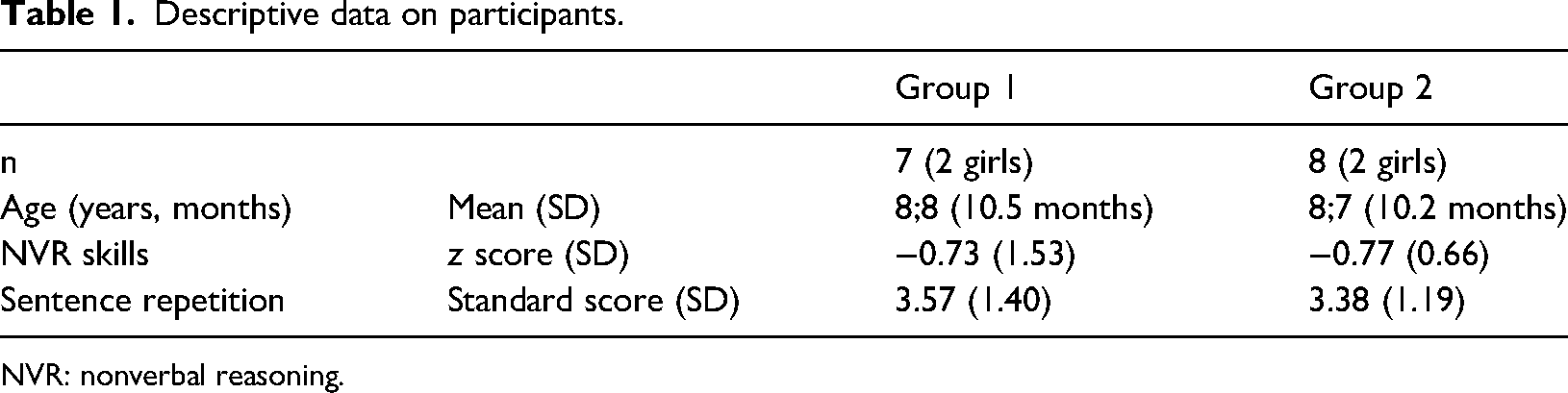
NVR: nonverbal reasoning.
In the institution frequented by our participants, speech and language therapy sessions are always provided in a group setting. In order to resemble the design of Janssen et al. (2020) which trained children in groups of six, while ensuring active participation of all children during training sessions, participants were randomly divided into two groups, with seven or eight children per group. We made sure that the two groups did not differ by age, NVR nor by language proficiency (all ps of pairwise comparisons > .73).
2 Procedure
The pretests, posttests, and training sessions were run by five examiners (two certified SLTs, two educational psychologists, and one educational psychologist trainee) who were trained by Olivia Hadjadj and Estelle Ardanouy in the use of the material. We made sure that the two persons conducting the pre- and posttests were not involved in the training sessions, these latter being carried out by the same three examiners within the same group (one SLT, one educational psychologist, and one educational psychologist trainee). The assessments took place in a quiet room, at the center in which the children received their speech and language therapy or psychology sessions. All audio stimuli (instructions, stories) were prerecorded and integrated into a computer-based presentation in order to avoid any bias between experimenters. Children's productions were recorded with the dedicated device of each examiner's phone. All productions were scored by Olivia Hadjadj at the end of the study, based on these recordings. In this way, we ensured that examiners were blinded to each child's narrative proficiency, at all times of the study.
The pre- and posttests were conducted in identical steps, lasting around 5 min each. Individually, we asked children to complete three narrative tasks, in the following order: (1) a story generation based on pictures (measure of generalization effect to another narrative task, “The toboggan story”), (2) a story retelling, which was later trained (measure of direct effect of training, “Haroun at the swimming pool”), and (3) a story retelling, which was not practiced during the training (measure of generalization effect to an untrained story, “Leo and his bike”). Children were asked to tell the story as best as they could. The story pictures were taken from the material Story Champs (Petersen and Spencer, 2016) and translated into French. To do so, Olivia Hadjadj (a French native speaker) used the English scripts provided with the manual of Story Champs (Petersen and Spencer, 2016) and translated these scripts into French. Then, the French versions were modified so that these three stories (as well as those used during the training) were matched in terms of number of macrostructural (n = 13) and microstructural elements (n = 15). As for the control measure, children finally performed a rapid automatized naming task (RAN, used in Cohen et al., 2018), in which they had to name rapidly an array of four pictures (a hand, a car, a house, and a dog). RAN was used as a control measure since, to date, no study has shown an effect of narrative training on serial or phonological processing, which is what is precisely measured by RAN tasks (Furnes and Samuelsson, 2011; Georgiou et al., 2013). Moreover, both serial and phonological processing are impacted by age (Anthony and Francis, 2005; Kolinsky et al., 2020). As a result, we chose RAN to control for maturation.
3 Scoring
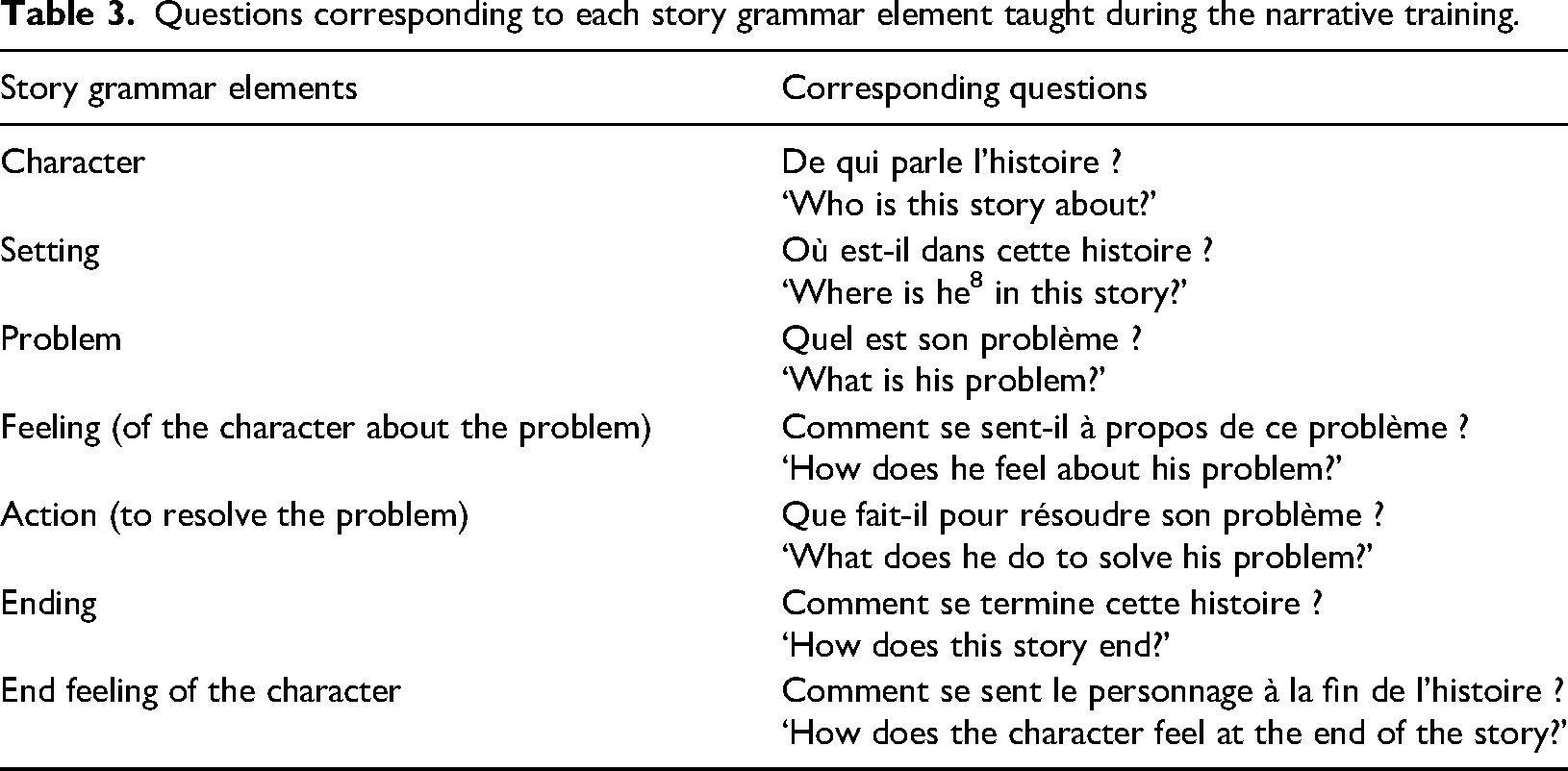
The macro- and microstructural elements of each story produced in the pre- and posttests were rated twice by Olivia Hadjadj 2 . Table 2 displays the macrostructure elements (based on the Index of Narrative Complexity; Petersen et al., 2008), and the microstructure ones (based on the Narrative Language Measures; Petersen and Spencer, 2012) that were assessed in the pre- and posttests. The tools chosen to assess the quality of the stories are the ones usually used to evaluate narrative skills in children with DLD (Andreou and Lemoni, 2020). Composite scores were derived by adding each item within each category (macro- or microstructure elements), resulting in a macrostructure composite score (/13) and a microstructure one (/15).
Scoring of macro- and microstructure.
As for the RAN (control measure), we calculated a score considering the number of items correctly produced and the time needed to complete the task (similarly to Araújo et al., 2015), according to the following formula: number of correctly produced items/naming time for all items, in seconds.
4 Training
One week after the pretest, training sessions began with one 45-min session per week. The training was designed to provide multiple opportunities (n = 3) for children to retell a specific story, and to learn seven elements of macrostructure. Each session followed the same structure: (1) teaching story grammar elements outside the story context (children were trained by the examiners to associate a question to each story grammar element, as shown in Table 3), (2) modeling of the story (children listened to the story, previously recorded by Olivia Hadjadj), (3) teaching story grammar elements within the story context (children were trained by an SLT, an educational psychologist and an educational psychologist trainee) to answer the questions corresponding to each story grammar element of a specific story), (4) retelling of the story by the children (children retold the story, with less and less visual support), and (5) modeling of the story (as in Step 2).
Questions corresponding to each story grammar element taught during the narrative training.
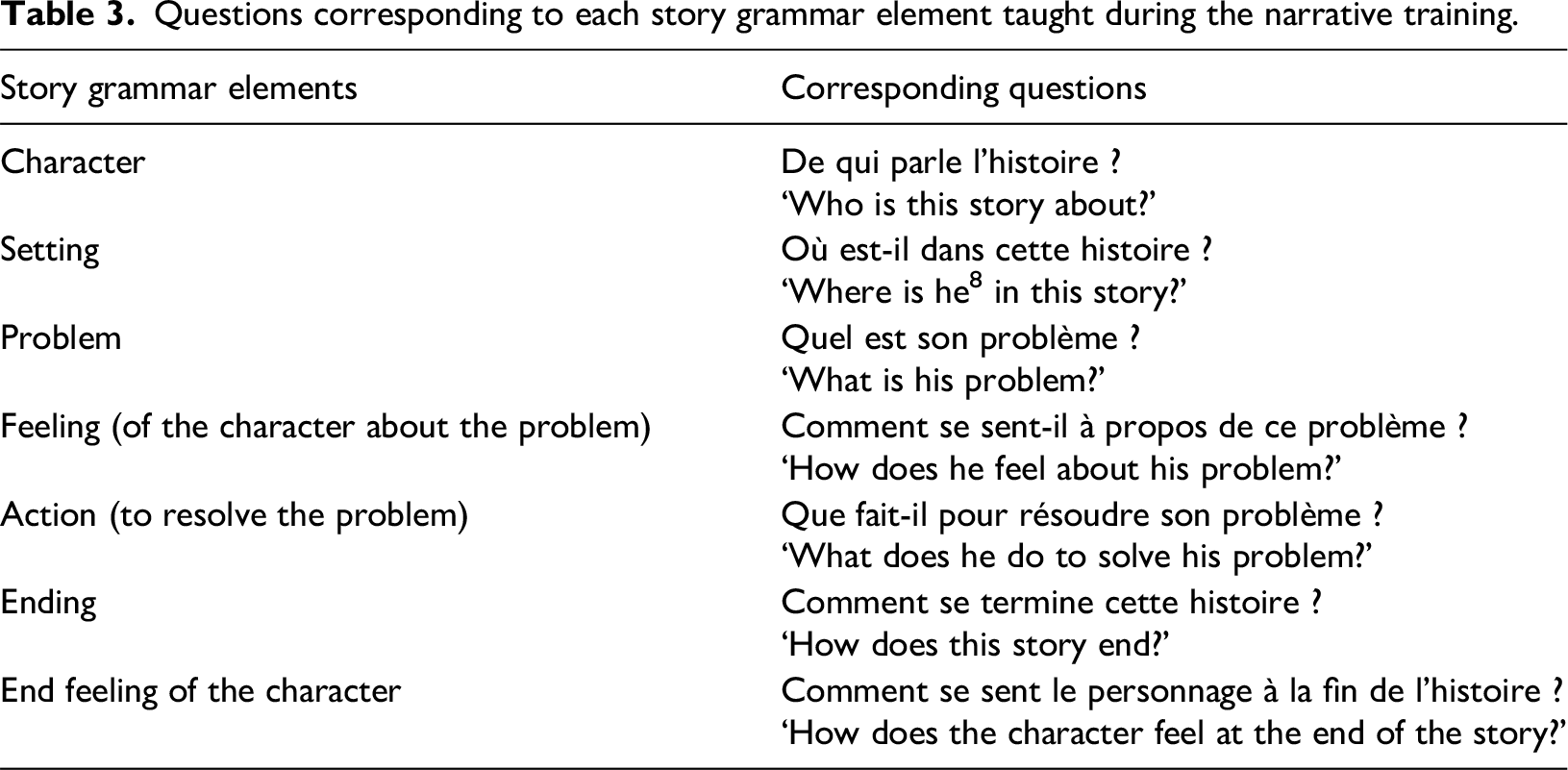
First, we presented seven story grammar elements, each one being represented by an icon 3 : character, setting, problem, feeling (of the character about the problem), action (to resolve the problem), ending, and end feeling of the character. For each story grammar element, a corresponding icon was presented to the child. Then, for each element, we also presented the corresponding question, as detailed in Table 3.
Second, the trained story was modeled, while pictures and icons representing the story grammar elements were shown to the children. Third, children were asked the questions associated with each icon, in order for them to learn the story grammar elements, this time in the context of a story. For instance, the icon for “setting” was shown under the first picture of the story, and the child was asked: “where is he in this story?” After each answer, the expected response was always provided 4 (e.g., “He is at the swimming pool”). The three examiners in charge of the training ensured that all children participated equally in the activity. Fourth, the children retold the trained story, within the group. At this stage, an icon representing each story grammar element was distributed to the children: each child had to tell the part of the story corresponding to the icon s/he received. The three examiners delivered immediate corrective feedback if necessary. Then, the children retold the story in pairs: one child (Child A) told the story to another child (Child B) using the story's pictures and the story grammar icons. Child B completed Child A's productions if necessary. In case of an odd number of participants, children were required to retell the stories in small groups of three, with Child A telling the story to Children B and C, these later completing Child A's production if necessary. The three examiners listened to the productions of each pair, providing immediate corrective feedback. In order to ensure an active participation of all children, one of the examiners was responsible at each session for counting the number of times each child took part in order to balance the children's numbers of productions. Following this activity, the story grammar icons were distributed to the children again, so they could retell the story within the group setting. This time, however, the story's pictures were no longer shown to the children. Finally, the story was modeled (through a previous recording made by Olivia Hadjadj) to the children, without any visual aids.
Three stories were practiced during the 6-week training, with each session focusing on one story exclusively. The story “Haroun at the swimming pool” was trained twice, whereas the other stories were practiced at least once. We planned to work each story twice, which was not possible for all participants, due to children's absence (sickness, school trip, etc.). As a result, if a child did not practice “Haroun at the swimming pool” twice, we planned an extra session for this child (delivered in a group of four children), so that all participants practiced this specific story the same number of times. Therefore, the number of sessions varied between participants from four to six. Furthermore, the number of participants per group varied between four and seven, depending on children's absences. The number of sessions delivered to each participant as well as the number of participants per group depending on the session is summarized in Table 4.
Summary of the sessions’ schedule for each participant.
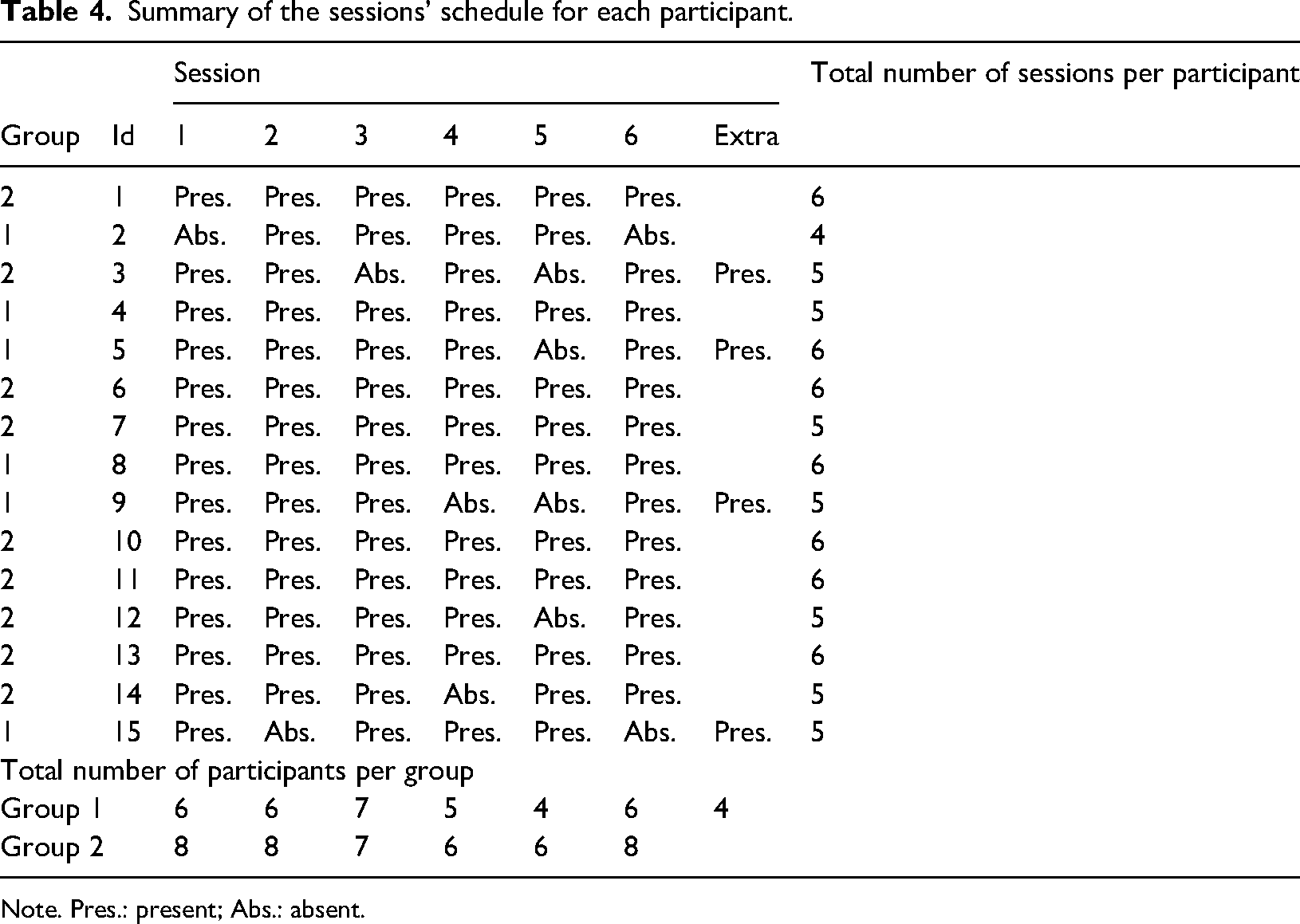
Note. Pres.: present; Abs.: absent.
III Results
In order to check the effectiveness of our training within the entire sample, we compared the change in the macro- and microstructure scores (pre- vs. posttest) of three stories (a trained story retelling, an untrained story retelling, and a story generation) and of the control measure (RAN), by using paired t tests. Analyses were performed using R statistical software (R Core Team, 2024).
1 Effect of time
The measures were normally distributed at each time (pre- and posttest), as assessed by Shapiro-Wilk's test (p > .07). We reported effect sizes by providing Cohen's d 6 . Results, displayed in Table 5, indicate an improvement of all stories in macrostructure, with a large effect size, and an absence of difference between the pre- and the posttest for our control measure. Microstructure scores did not improve between pre- and posttest. Figure 1 illustrates the gains in macrostructure in all stories and the absence of gain in the control measure.
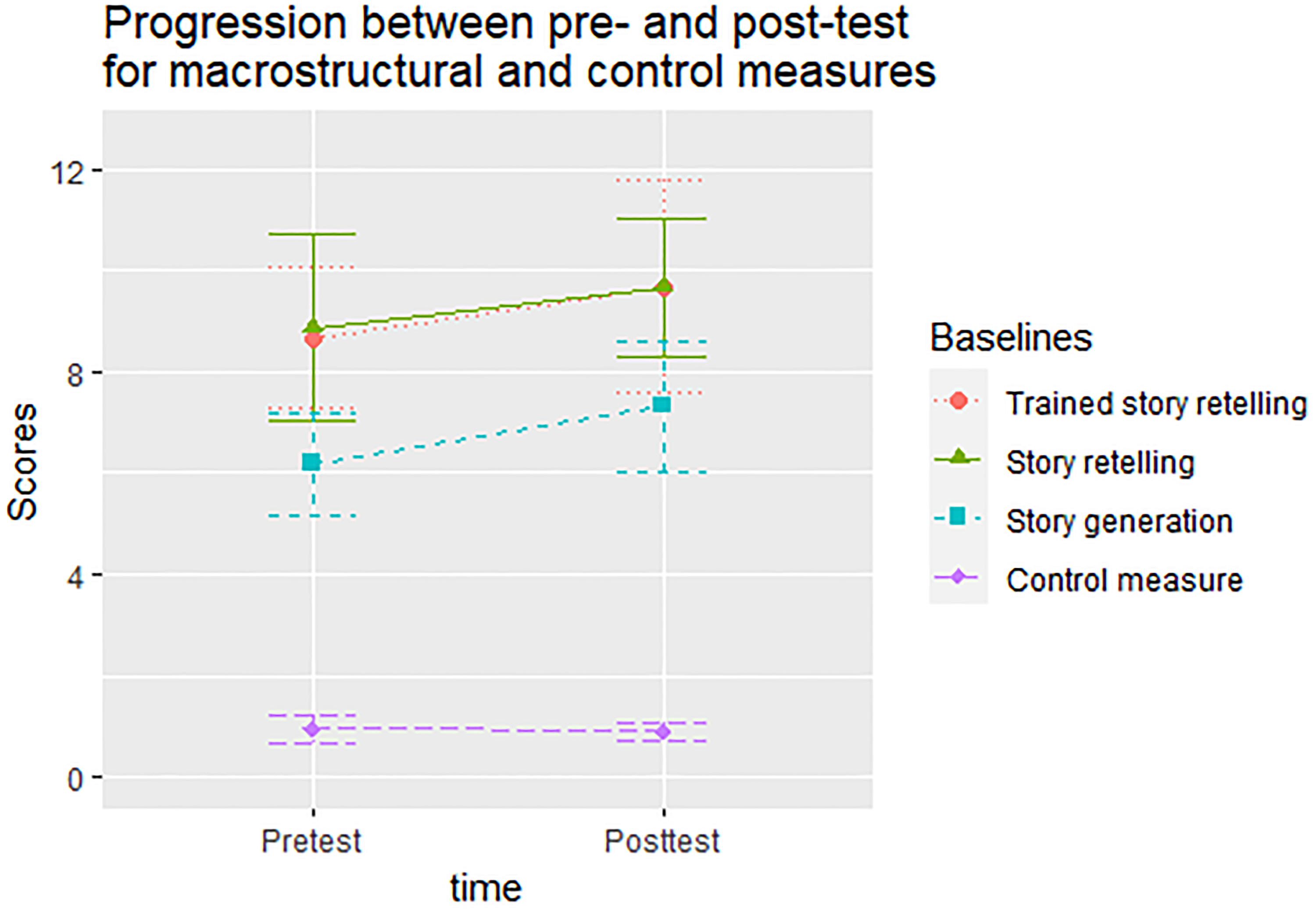
Progression between pre- and posttest for macrostructural and control measures.
Raw scores and pre- vs. posttests comparisons for all measures.
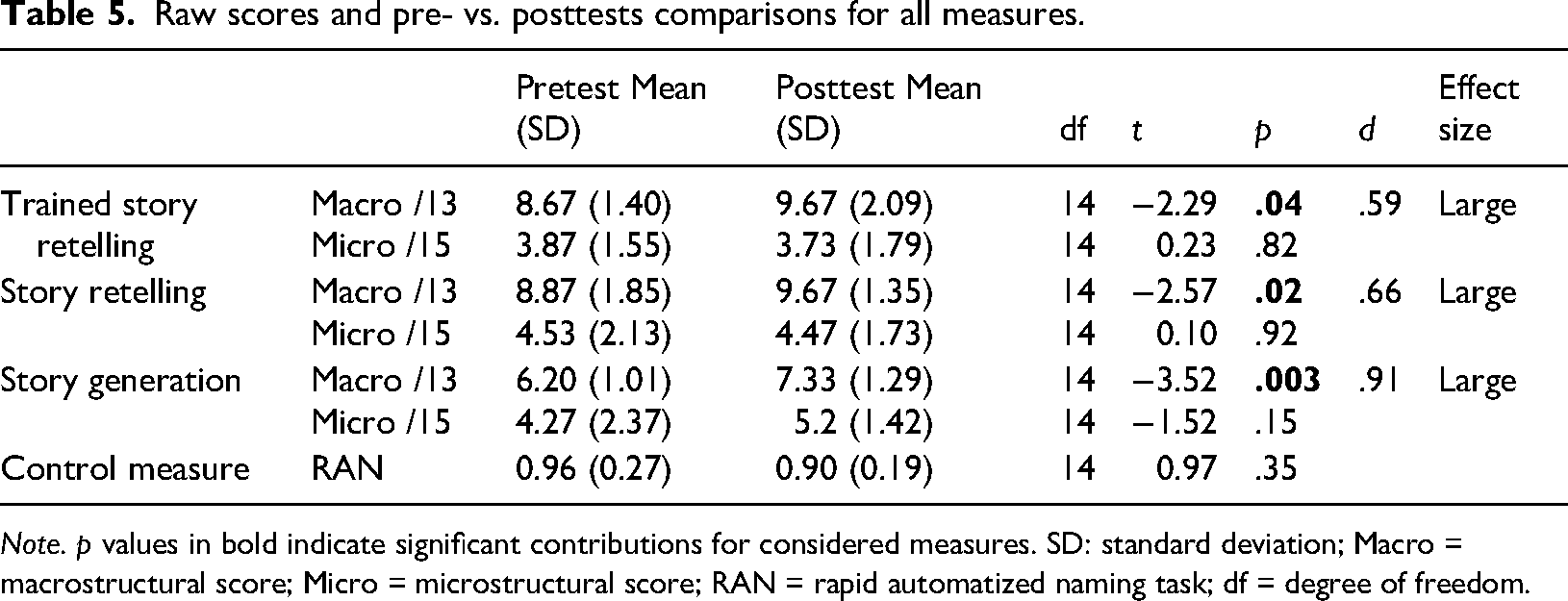
Note. p values in bold indicate significant contributions for considered measures. SD: standard deviation; Macro = macrostructural score; Micro = microstructural score; RAN = rapid automatized naming task; df = degree of freedom.
2 Effect of age, language, NVR skills, and number of sessions
As a further analysis, we checked whereas age, morphosyntactic proficiency (i.e., SR and the microstructure score obtained in pretest when merging all three stories), NVR skills or the total number of sessions provided to the child had an effect on the gains in macrostructure between pre- and posttest, when merging all three stories together. Therefore, we computed a multiple linear regression model to predict the gains in macrostructure (i.e., obtained by subtracting the score in pretest from the score in posttest). As detailed in Table 6, we found an effect of the pretest score in microstructure on the macrostructural gains: the higher the microstructural score in pretest, the higher the gains in macrostructure. However, the other variables (age, SR, NVR, and the number of sessions) did not have any impact on the gains made in macrostructure between the pre- and the posttest of our training.
Regression analyses of gains in macrostructure using age, sentence repetition standardized score, microstructural level in pretest, NVR z score, and number of sessions as independent variables.
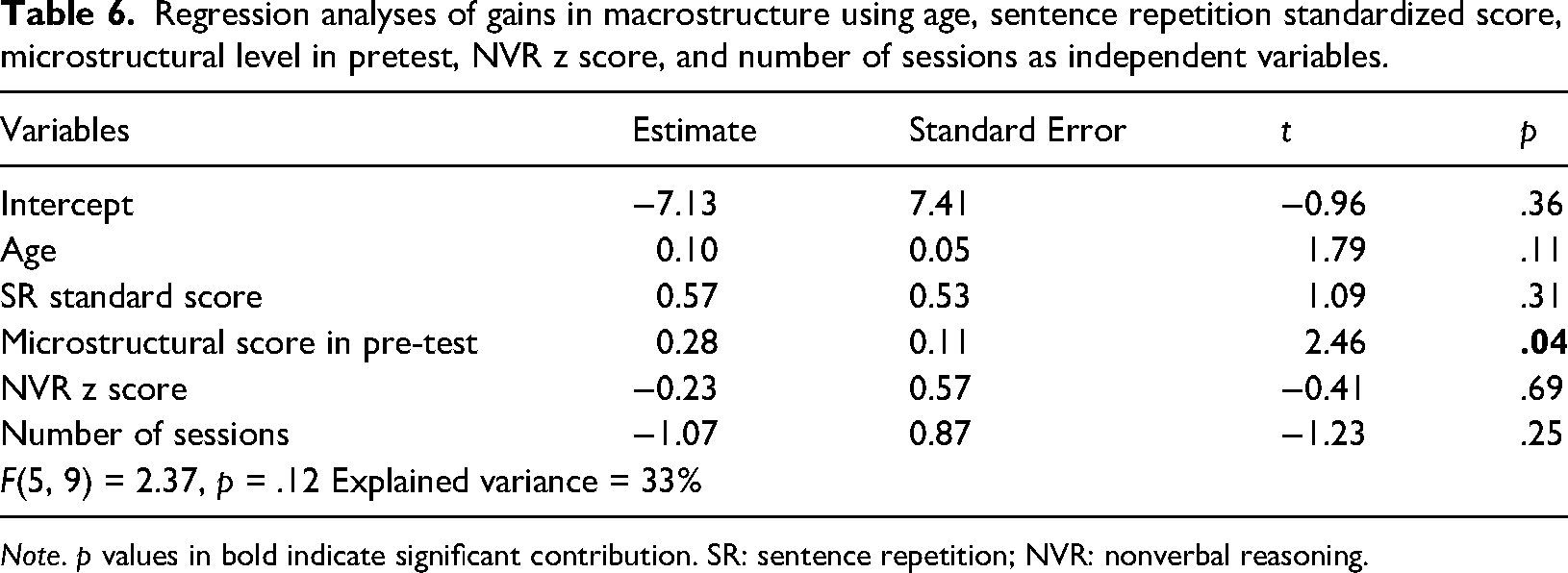
Note. p values in bold indicate significant contribution. SR: sentence repetition; NVR: nonverbal reasoning.
IV Discussion
The aim of our study was to investigate the effect of group training of macrostructural elements in a story retelling task, among 15 French-speaking children with DLD, aged 7 to 10. The intervention consisted in teaching children the correspondence between icons and macrostructural elements, which were then trained within a story retelling activity, following the principles of Spencer and Petersen (2020). Precisely, we aimed to determine if there were generalization effects between narrative tasks, namely, from the trained story retelling to another (untrained) story retelling and from the story retelling to a story generation. Our main findings revealed significant improvement in the number of macrostructural elements for the trained story (= direct effect) and untrained ones (= generalization effect). No such progress was found for microstructural scores (language complexity used during the storytelling) nor for the control measure, attesting to the specificity of the effects observed in macrostructure.
1 Direct learning effect
We predicted a direct and specific effect of intervention for the trained story retelling on narrative skills, with a significant improvement in macrostructure. Global results showed such an improvement, with a large effect size and an absence of progress for the control measure (to recall, RAN). We thus demonstrated the efficacy of intervention delivered in a group setting, a finding which has been little reported on in children with DLD. In fact, we have found only one study with this design in this specific population in the literature (Janssen et al., 2020). 7 These results echo those of previous studies in English, which have targeted macrostructure with children in a 1:1 setting (Favot et al., 2018; Gillam et al., 2018; Miller et al., 2018; Risueño et al., 2024). Our results are also consistent with previous studies which report that group training can be effective in children with DLD (Boyle et al., 2007, 2009; Green and Klecan-Aker, 2012). We, thus, show that narrative training delivered in French, and in a group setting, could lead to direct learning effects in macrostructure in children with DLD. Another original feature of our study was the addition of a control measure in order to check the specificity of the effects of training (i.e., to make sure that the positive effect we found could not be attributed to the normal maturation of children). Such a design (with a control measure or a control group) has rarely been used in previous training studies targeting macrostructure (see for instance Delgado-Cruz et al., 2022 or Petersen et al., 2022).
2 Generalization effect
Progress on the trained story retelling could be uniquely due to a “simple” memorization of the story, which children had heard several times during the intervention. Therefore, it was relevant to check whether participants could also demonstrate progress on narrative activities that were not trained/heard during the intervention. Our results showed clear generalization effects, with significant improvement for the (untrained) story retelling and for the story generation, with large effect sizes, in macrostructure. Such a distinction (between trained and untrained tasks) is quite rare in the literature, as we have found only one study which included generalization measures (Petersen et al., 2010), and this study contained an extremely small sample of children (n = 3). Other studies have generally measured the children's progress on the specific narrative activity that was trained (e.g., Favot et al., 2018; Fey et al., 2010). Our experimental paradigm, comparing pre- and posttest scores on trained and untrained stories and comparing narrative tasks with a control measure, is in line with the evidence-based practice approach (Byiers et al., 2012) and is more informative, as we could distinguish between direct and generalization effects. It seems, then, that the children benefited from the training in such a way that they were able to produce more story grammar elements for stories they had not heard during the training. Therefore, they could be considered as having succeeded in extracting and generalizing the narrative scheme. This result is even more compelling in that they improve on story generation, which is considered a more complex narrative task than retelling (Gillam and Johnston, 1992; Kraljevic et al., 2020; Spencer and Petersen, 2020). In addition, this measure of generalization was specifically the one for which the effect size was the largest (d = .91 vs. d = .59 for the trained story retelling and d = .66 for the untrained story retelling). We could imagine that story generation was especially challenging for the participants and that the particular aspects of this task (in which children had to create their story with no previous modeling) disadvantaged them in the pretest, leaving more room for improvement in the posttest as compared to the two story retellings. This was confirmed by the lower pretest scores for story generation (M = 6.2 for macrostructure) as compared to the two story retellings (8.7 and 8.9).
3 Absence of improvement in microstructure
Turning to microstructural scores, our results did not point to any improvement between the pre- and the posttest. This finding is similar to that of Green and Klecan-Aker (2012) or Miller et al. (2018), who focused on the training of narrative scheme elements and who did not find any gains in macrostructure following this training. It could be due, as suggested by Petersen (2011), to the fact that we only targeted macrostructural elements during our training. Indeed, we did not target any microstructural elements, which could be the reason why this specific measure, reflecting the language complexity used to tell stories, did not improve. We had hypothesized that the absence of transfer effects between macro- and microstructural gains could be due to the number of sessions provided during the narrative training. Indeed, Green and Klecan-Aker (2012) as well as Miller et al. (2018) conducted narrative trainings during about 30 sessions, while Delgado-Cruz et al. (2022), who found an improvement in microstructural scores across their training which only focused on macrostructure, proposed a 55-session training. In our study, the training was shorter (only four to six sessions). Moreover, microstructural scores were quite low in our sample at both testing times (M ≈ 3.8 out of a maximum score of 15). These low scores are most likely related to the well-known syntactic impairment children with DLD have (Delage and Frauenfelder, 2020; Pearce et al., 2010; Tuller et al., 2011), which is highlighted in our sample by the very low standard scores obtained in SR (see Table 1). In sum, the reduced length of our training and the low morphosyntactic proficiency of our participants could be the reasons why we did not find any improvement in microstructure. It seems reasonable to posit that a greater number of training sessions are necessary to allow gains in microstructure since this measure involves morphosyntactic proficiency (such as the use of temporal or causal connectors), which is of particular difficulty for children with DLD (Bishop et al., 2017; Bishop and Donlan, 2005; Delage et al., 2024; Delage and Frauenfelder, 2020; Nicolopoulou and Trapp, 2018; Pearce et al., 2010). In a future study, we would like to investigate whether a minimum number of sessions targeting macrostructure is necessary to enable gains in microstructure as well.
4 Effect of the microstructural score in pretest on gains in macrostructure
As further analyses, we found an effect of the microstructural pretest score on the gains in macrostructure, when merging all three stories together. To recall, higher scores in microstructure (in pretest) predicted higher gains in macrostructure (between the pre- and the posttest). However, the standard score in SR did not show such an effect on children's progression. This result suggests that the severity of language impairment could have an impact on the progression made during the narrative training. More precisely, it could indicate that children's morphosyntactic proficiency in discourse context, as compared to morphosyntactic proficiency in isolated sentences context, is a good predictor of children's success during narrative training. In addition, we did not find any effect of age on macrostructural gains (to recall, our participants were aged 7–10), suggesting that younger and older children improved similarly on macrostructure. Such results are of all importance as the recent meta-analysis of Ebert and Lee (2024) did not identify any predictor of narrative intervention success.
Another finding reported in our additional analysis was the absence of an impact of the number of sessions provided on the gains in macrostructure. To recall, children participated in four to six sessions, due to potential absences during the 6-week training. It is probable that we did not find any effect of the number of sessions as the difference between the lowest and the highest number of sessions delivered was small. One could posit that a wider range of number of sessions could have led to significant effects on the gains made during the training.
5 Limitations
A first limitation comes from our experimental design. Even if we had a control measure, we did not have a control group, such as in Fey et al. (2010) or in Delgado-Cruz et al. (2022), which would allow us to improve the experimental level of our study. Moreover, the absence of inclusion of children participating in a 1:1 narrative training setting could be considered as a second limitation. In a future study, we could incorporate both settings into our study in order to compare the effectiveness of training delivered in a 1:1 vs. in a group setting. The inclusion of both settings would allow us to expand upon the conclusions of Boyle et al. (2009), who pointed to an equivalent effectiveness of both settings, with a group setting being less expensive than an individual one. A third limitation is that we did not include any maintenance measure in our study design. By adding a delayed posttest to the design of our study, we could have investigated whether our training would allow long-term progress in macrostructure. Finally, adding a spontaneous language sample measure would have allowed us to explore whether the positive effects of our narrative training also had a positive impact on children's everyday communication skills.
6 Clinical applications
The fact that our narrative training resulted in a generalization effect should encourage the use of this kind of intervention in clinical settings, as SLTs all hope that children can generalize a trained target and, in that way, improve their everyday communication skills. Practicing different stories multiple times (to recall, “Haroun at the swimming pool” was practiced twice by all children, and two other stories were practiced at least once during our training) led to the extraction of narrative scheme elements. Children were then able to apply these macrostructural elements in a new story (i.e., that was not practiced during the training) and in a new narrative activity. Our results also suggest that even a short training can lead to significant improvements in macrostructure. This is not surprising as several authors have reported significant gains in macrostructure as a result of very short teaching phases delivered within narrative dynamic assessment tasks (e.g., Hadjadj et al., 2024; Peña et al., 2014; Petersen, Konishi-Therkildsen et al., 2024). By providing four to six training sessions to our participants with DLD, children were able to improve their macrostructural skills. As we have discussed above, it is possible that a longer training could have allowed gains in microstructure as well. Our study should encourage SLTs to propose narrative training to their caseload with DLD, adapting the length of such training depending on children's linguistic profiles. Finally, our results support the use of group intervention, which is considered to be as effective as individual therapy (Boyle et al., 2007, 2009) while also having a cost advantage.
V Conclusion
The present research supports the existing literature on the efficacy of narrative skills’ training in children with DLD. Our results showed that a group intervention in French, targeting story grammar elements, led to better performance on the production of macrostructural elements, both in trained and untrained narrative activities, thus, demonstrating a generalization effect. Even if our study presents with some limitations, we hope that the present work will open the door for more frequent use of group therapy targeting macrostructure in clinical settings.
Footnotes
Acknowledgements
We wish to thank Charlotte Darras, Valeria D’Emma, Samantha Forgnone, and Ingrid Meynent for the testing of children and Margaret Kehoe for the editing assistance.
Author contributions
Conceptualization: Olivia Hadjadj; Methodology: Olivia Hadjadj; Validation: Olivia Hadjadj and Hélène Delage; Formal analysis: Olivia Hadjadj; Writing–original draft, Olivia Hadjadj and Hélène Delage; Writing–review and editing: Olivia Hadjadj, Estelle Ardanouy, and Hélène Delage; Visualization: Olivia Hadjadj; Supervision, Hélène Delage. All authors have read and agreed to the published version of the article.
Consent for publication
Informed consent for publication was provided by the participants’ legally authorized representative.
Consent to participate
All participants’ legally authorized representative provided written informed consent prior to enrolment in the study.
Data availability statement
The data presented in this study are available on request from the corresponding author. The data are not publicly available due to ethical reasons.
Declaration of Conflicting Interests
The authors declared no potential conflicts of interest with respect to the research, authorship, and/or publication of this article.
Ethical considerations
This study was approved by the University Commission for Ethical Research in Geneva (CUREG; Protocol Code CUREG 2022-11-132), approved on 15 May 2023. This research was conducted ethically in accordance with the World Medical Association Declaration of Helsinki.
Funding
The authors received no financial support for the research, authorship, and/or publication of this article.
