




Abstract
It has been hypothesised that executive function deficits, specifically inhibition difficulties, may play a central role in Developmental Language Disorder (DLD). The presented study compared the response inhibition abilities of typically developing preschool children, with monolingual and bilingual preschool children who had already been classed as being at risk of developing DLD. A non-word repetition test and two inhibition tasks were used along with a prospective memory task. The results indicated that children at risk of DLD performed significantly worse than typically developing children on all tasks. The findings suggest that children at risk of DLD are impaired in response inhibition. Educational and therapeutic implications are discussed.
Developmental Language Disorder (DLD) is a condition in which children have difficulties acquiring language with no obvious explanatory reason, i.e., there is no hearing or neurological problem. The heterogeneity of children diagnosed with DLD is well researched and such children typically have difficulty with expressive and/or receptive language. The precise mechanisms behind its causation is unknown and recent research indicates both verbal and nonverbal skills are implicated (Conti-Ramsden et al., 2012). An increasing body of research suggests that the development of inhibition and language are interdependent (Kohnert, 2008; Spaulding, 2010) and compared to typically developing children, many children with DLD have difficulty with inhibition (Larson et al., 2020). Given the importance of the early identification of children with DLD, understanding the early development of inhibition in children at risk of DLD is needed. Furthermore, bilingual children are known to have some executive function advantages which can mask DLD at preschool age (Aguilar-Mediavilla et al., 2014). It is therefore of particular interest to understand inhibition development in bilingual children and monolingual children at risk of DLD.
Response inhibition is the active suppression of a dominant or entrained response (Pauls and Archibald, 2016) and it develops rapidly in the pre-school years (Marton et al., 2012). Several studies using the Shape School task, requiring the child to name certain colourful characters and not others, found that gains in response inhibition in typically developing three to four-year-old children correlated with good levels of language at school entry (Clark et al., 2013; Espy, 1997; Espy et al., 1999). Research has shown that a child who has problems with inhibition, is also likely to have problems with receptive and/or expressive language (Russell et al., 1999). Recently, Larson et al. (2020) found predictive relationships between inhibition and aspects of language (morphology) and suggested that targeting inhibition skills in children with DLD is likely to improve morphological comprehension. However, these studies have not included bilingual children and there are few studies examining response inhibition in preschool children with DLD.
Studies of older school-age children with DLD have demonstrated inconsistent findings on response inhibition depending on the task and response modality tested (Henry et al., 2012). In Henry et al., ten and eleven-year-old children with DLD performed similarly to their peers on a verbal response inhibition task (to copy the production of the word ‘doll’ initially and then to inhibit this response and produce the word ‘car’ when they heard ‘doll'). However, on the equivalent nonverbal task (first copied a fist action with their hand before inhibiting this to perform a different action), performance was significantly impaired in comparison to their typically developing peers. Given that response inhibition develops rapidly between the ages of two and four years (Dowsett and Livesey, 2000; Gerardi-Coulton, 2000; Reed et al., 1984) the nonverbal finding is surprising and Henry et al. (2012) note the implications for diagnosis but also suggests that performance on the verbal task may reflect compensatory strategies employed by the age of eleven years. Research has shown that more complex interference inhibition (the ability to resist irrelevant/distractor information) develops slowly from the age of seven to twelve years (Esposito et al., 2013; Larson et al., 2020; Marton et al., 2014). There is also evidence that interference inhibition tasks have increased processing demands and the performance of seven to 12-year-old children with DLD on these tasks, is suggested to demonstrate inefficient inhibition or processing capacity limitations (Bjorklund and Harnishfeger, 1990; Spaulding, 2010). However, at preschool age response inhibition is developing rapidly and there have been very few studies investigating this in pre-school children with DLD. Spaulding (2008, 2010) examined both resistance to distracter interference and response inhibition in four to five-year-old children with DLD. The Stop/Go response inhibition task required the children to press a dinosaur button when they heard two target words and on hearing ‘stop’ they were required to withhold their response. The children with DLD had significantly more difficulty inhibiting the intentional prepotent response compared to their peers and this was not explained by differences in nonverbal cognition. In contrast, Dodwell and Bavin (2008) found six-year-old children with SLI (Specific Language Impairment) performed similarly to typically developing controls on an inhibition task requiring the child to press a button when an animal appeared on screen and not to press the button when the target animal appeared on screen. However, in comparison to Spaulding (2010), this task was less complex.
Studies investigating response inhibition in bilingual children largely focus on typically developing children and there are consistent findings suggesting bilingual children demonstrate an advantage over monolingual children in more complex interference inhibition tasks in seven to twelve-year-old children (Borragan et al., 2018,. However, in response inhibition tasks findings are less consistent. Bilingual preschool children are suggested to show no advantage over their monolingual peers on response inhibition using Stroop tasks (Carlson and Meltzoff, 2008; Esposito et al., 2013). However, Barac et al. (2016) examined electrophysical differences in bilingual and monolingual five-year-olds and found better performance in bilinguals on a Go/ No-Go response inhibition task. The authors suggest that bilingual children out-performed monolingual peers as their inhibitory control is advanced. It is unclear whether findings of monolingual children with DLD on response inhibition tasks can be generalised to bilingual children with DLD. Bilingual children manage two languages suppressing the interfering language, and therefore it is likely that they are comparatively advanced in early inhibition development.
Children with DLD are known to have more general deficits (i.e. difficulties following directions) and researchers have proposed that deficits in working memory may be implicated (Thomas et al., 2019). However, these organisational deficits are consistent with deficits in prospective memory which is associated with inhibition (Mahy and Moses, 2011). Prospective memory (PM), the ability to remember to carry out an intended action at a future time, plays an essential role in everyday functioning (Kvavilashvili et al., 2001). The development of PM in children increases rapidly between the ages of three and six years and that cue saliency is a key factor in PM success at this age (Mahy et al., 2014). Given that performance on PM tasks is linked to and predicted by inhibition (Kvavilashvili et al., 2001; Mahy et al., 2014), it is suggested that children with DLD who have deficits in inhibition will also be less likely to remember to perform future actions. Understanding the PM abilities in children at risk of DLD is necessary to inform therapy and support beyond the linguistic domain.
The present study examined response inhibition deficits and PM in three to four-year-old children. Given the limited research on bilingual children with DLD and the research on the association between language and inhibition, performance on inhibition (verbal and nonverbal) and PM was compared between typically developing children and both monolingual and bilingual children at risk of DLD. The children had no formal diagnosis of DLD but were deemed to be at risk of developing a language disorder, having been placed in a specialist language unit. The inhibition tasks were the most suitable for use within the target age range and the nonword repetition task was administered as a measure of phonological memory which is known to be impaired in DLD (Delcenserie et al., 2021). It was therefore predicted that children at risk of a language disorder would perform worse on the nonword repetition task compared to typically developing given that this is a known marker of DLD. On the basis of the literature, it was further predicted that (1) children at risk of DLD would perform worse than typically developing children in the same age range on verbal and nonverbal inhibition tasks and perform less well on the PM task, and (2) that the performance of bilingual children at-risk of DLD would be better than that of monolingual at-risk children across all tasks.
I Method
Participants
Ninety children aged thirty-six to forty-eight months participated (See Table 1) which included thirty typically developing (all monolingual) and sixty children (thirty monolingual and thirty bilingual) classified as at risk of language disorder. The required sample size was calculated using the average effect size found by Pauls and Archibald (2016) on tasks of inhibition in typically developing children and those with DLD/SLI (g = −.56). Using this moderate effect size and assuming α = .05 and 1 – β = .80, a power calculation conducted in in G*Power (Faul et al., 2007) indicated that a similar effect size would be detected using a total sample of 126 participants (see discussion for further details).
Age and gender profile of the participant classifications. .

Age and gender profile of the participant classifications. .
Children were classified as being at risk as they had all either been referred to a specialist language unit (referrals made when a child’s language has fallen behind expected levels) or were undergoing assessment due to concerns about their language. As no children in the language units had yet received a formal diagnosis of DLD, it was not possible to differentiate those children from others who may have gone on to have other language disorders. Participants were recruited from two main settings; a playgroup for typically developing three to four-year-olds and a nursery of monolingual and bilingual three to four-year-olds receiving language support from qualified Speech and Language Therapists (SLTs) in accordance with UK standards. The recruitment strategy was to approach the management for permission to approach the parents of every child in the three to four age range. The language unit and playgroup were both located in the Southeast of the UK with an average socioeconomic status (SES) profile, but differed in the number of bilingual children; the language unit had high numbers of bilingual children where the playgroup had none. The purpose of using these institutions was to compare children from similar SES backgrounds, whilst enabling access to sufficient numbers of bilingual children for meaningful data to be obtained.
Monolingual participants were defined as those children who had English as their sole language and had been cared for in homes where only English was spoken. Bilingual participants were defined as those children who had been exposed to two (or more) languages (including English) in the course of their upbringing, either simultaneously or sequentially. Due to data protection concerns raised by the language unit and the playgroup, parental interviews were held with the first author by telephone to establish the languages which the children had had exposure to. The range included: Polish, Hebrew, Urdu, German, Romanian, Bengali, Hindi, Irish Gaelic, Spanish and Punjabi. It was not possible to obtain reliable information regarding the length or type of exposure which the children had had to the additional languages alongside English. There were more male than female participants in the group of children identified as being at risk of DLD which reflects the fact that at this age there are typically more boys than girls identified as being at risk (Eriksson et al., 2012).
The study consisted of four tasks which were administered to all children including a nonword repetition task, two inhibition tasks (nonverbal inhibition, verbal inhibition), and a PM task. The tests were carried out in a single session (approximately fifteen minutes) and the sequence was randomised to prevent order effects. The tests were carried out in a quiet area of a classroom in the playgroup and language unit by the first author and a research assistant. The testing took place between January and June 2018. Ethical approval for the study was granted from the Ethical Committee for Health and Human Sciences at the University of Hertfordshire. Parental consent was obtained for each participant and a suitable debrief given.
Nonword Repetition Test: The nonword repetition test used in the study was developed by Chiat and Polisenska (2016) for use with two to four-year-olds, administered to all children as a measure of phonological memory. It is cross-linguistic as it has taken word length, word likeness, prosody and articulatory complexity into account, drawing on a number of languages and considered suitable for use with both the monolingual and bilingual participants in the current study. It comprised four practise items and sixteen test items with each set of four words containing an equal number of nonwords controlled for syllable length (two, three, four and five syllables) and prosody. Before the test, the child was introduced to a glove puppet and was asked to copy some words the puppet was going to say. It was also explained that the puppet would say some “silly puppet words” which the child should copy too. In accordance with the scoring system employed by Chiat and Polisenska (2016), responses were scored as correct if they contained all the phonemic components in the correct order with no additional phonemes. The number of correct items was recorded for each participant, with a maximum of sixteen.
Nonverbal Inhibition Test: This test is designed to be used with three to seven-year-old children (Luria, 1966). The child was instructed first to copy the actions of the researcher (tapping a dowel once or twice), and then required to inhibit the copy action and perform the alternative action (tap once when the researcher taps twice, tap twice when the researcher taps once). The task requires the participant to hold two things in mind at the same time and inhibit the natural response to imitate what the researcher does. Following a short pre-test consisting of two inhibition condition trials, the inhibition test itself consisted of sixteen trials. Following the method of Diamond and Taylor (1996), if the child was correct on the inhibition pre-test, these two trials counted as the first two trials of testing. Only one dowel was used which was passed between the researcher and the child in order that neither the child nor the researcher would begin tapping before the other one had finished. The researcher also avoided influencing the child’s response by reaching to take the dowel too early or letting the child hold it for too long. The percentage of correct responses was recorded for each child.
Verbal Inhibition Test: This test was based on the Shape School inhibition task developed by Espy (1997) and considered suitable for use with children aged three to five. Children are presented with a three by five matrix of fifteen colourful characters. It was explained to each child that this is Mr Circle’s class and the names of the characters are their colours (e.g. Mr Blue, Mr Red, etc). The child was first asked to name all the characters as quickly as possible without omitting any or making any mistakes (control condition). The trial was timed, and the number of correct and incorrect answers counted. It was then explained to the child that the pupils who were ready for lunch are happy and have smiling faces and the ones who are not ready have sad faces. The child was asked to name only the characters who have happy faces. The trial was again timed and the number of correct and incorrect answers counted. The dependent variable was the efficiency score, calculated as the number of correct responses minus the number of incorrect divided by the time to completion.
Prospective Memory Test: This test was based on the methods used in published studies with children of similar ages (Slusarczyk and Niedzwienska, 2013). The child was asked to remember to give the researcher a wooden block at the end of each of the individual inhibition tests. Completion of each test was clearly signalled by a cue to the child in which the researcher stated “The test is finished now. What do you have to do?” The child was given the instructions at the beginning of the session and that if they remembered to give the wooden block each time, they could take a packet of sweets from the basket which was positioned on a table near the door as they left. In order to ensure that a child did not fail the test due to simply forgetting the instructions which would involve retrospective memory, a standard prompt question was used if the child did not give the researcher the block, “Was there anything you had to do when you had finished each little test?” No other prompts such as eye movements or facial expressions were used. The number of correctly carried out PM tasks was scored out of a maximum of four. The child was also told that they could collect a reward at the end (a treat in a plastic tub near the door of the room).
Statistical analysis
The main comparisons of interest across all of the tasks was the performance of the typically developed children against those children deemed at risk of DLD, and the performance of the monolingual at risk against the bilingual at risk children. For the nonverbal inhibition, verbal inhibition and the PM tasks the results were analysed using a one-way ANOVA with the follow up comparisons conducted using independent samples t-tests (corrected for multiple comparisons). Where the variances between groups was found to violate the assumption of homogeneity (nonverbal inhibition test, verbal inhibition test) the ANOVAs reported are based on the Welch’s statistic. Performance on the nonword repetition task was examined using a 3 × 4 mixed ANOVA to examine the effect of syllable length between groups (using independent samples t-tests to assess follow-up comparisons). Given that children with DLD demonstrate impairments with nonword repetition, this task was initially analysed to confirm that the sample used here (those deemed ‘at risk’) also share this characterisation.
II Results
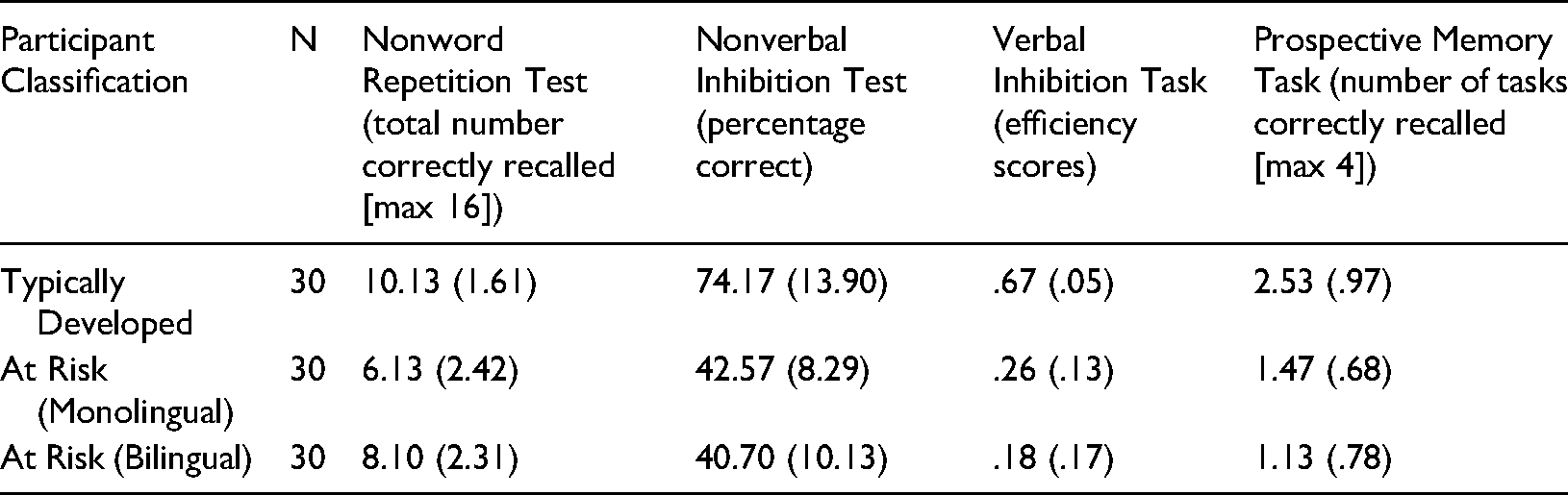
The results in Table 2 show the total number of correctly recalled words on the nonword repetition task, the percentage of correct responses on the nonverbal inhibition test, the efficiency scores on the verbal inhibition task, and the number of correct tasks performed on the PM task. At first glance, the results show that typically developing children scored higher on all four tasks compared to the children at risk of developing DLD.
Mean scores (standard deviations) for the nonword repetition test, nonverbal inhibition test, verbal inhibition task and the prospective memory task. .
The number of correctly recalled words on the nonword repetition test was initially examined to confirm that the children at risk of DLD performed worse than the typically developing children. A 3 × 4 mixed ANOVA using group status as a between-subjects factor and syllable length as a within-subject factor (see Figure 1) found significant main effects for both factors (Group Status: F(2, 87) = 25.61, p < .001, Cohen’s f = .74; Syllable Length: F(2.68, 232.86) = 531.20, p < .001, Cohen’s f = 2.45) as well as a significant interaction (F(5.35, 232.86) = 13.89, p < .001, Cohen’s f = .54). Analysis of the simple effects on the interaction found significant differences between the groups on 2, 3 and 4-syllable words, but not for 5-syllable words (all children performed at close to floor). The simple effects were broken down using independent samples t-tests (one-tailed) comparing performance between the groups for 2, 3 and 4-syllable words (significance determined using the Bonferroni correction, α = .005). On 2-syllable words, typically developing children outperformed both the at risk monolingual (t(32.46) = 5.70, p < .001, Cohen’s d = 1.47) and bilingual children (t(33.97) = 3.10, p = .002, Cohen’s d = .80), and while the latter outperformed the monolingual children this was not significantly so after adjusting for multiple comparisons (t(58) = −2.44, p = .009). On 3-syllable words, the comparisons between all groups was significantly different (p < .005) with the at risk monolingual children performing worst, and the typically developing children performing best On the 4-syllable words the typically developing children performed better than both the at risk monolingual (t(48.02) = 4.63, p < .001, Cohen’s d = .1.20) and the at risk bilingual children (t(47.58) = 2.76, p = .004, Cohen’s d = .71), but the at risk children did not differ from each other after adjusting for multiple comparisons (t(58) = −2.56, p = .007). Overall, the results show that the children deemed at risk of DLD were impaired on their nonword repetition performance in comparison to the typically developing children.
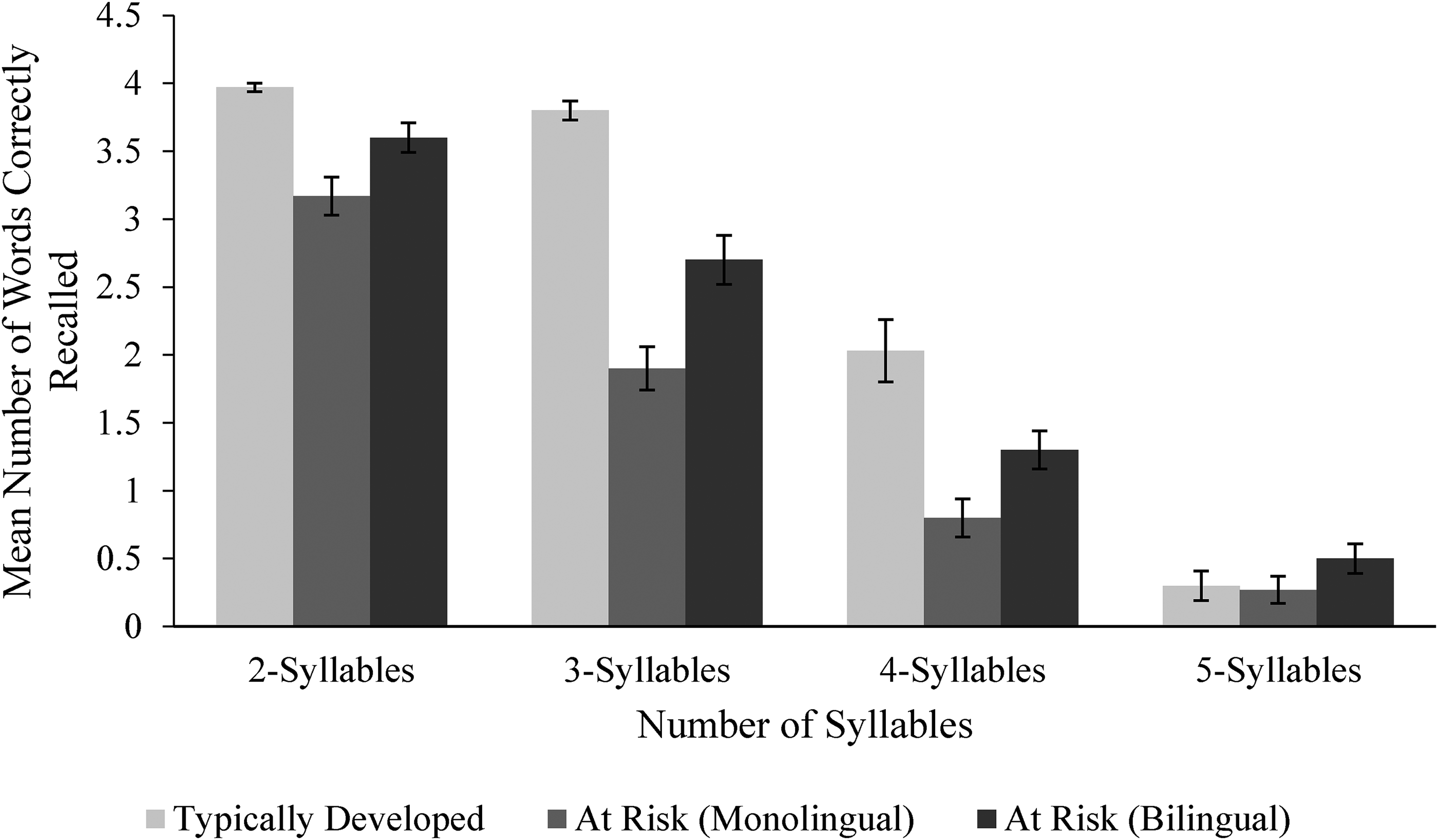
Mean number (standard error) of words correctly recalled per number of syllables on the nonword repetition test (Maximum 4 words per syllable).
The remaining analysis addresses the two predictions outlined in the introduction comparing performance between the typically developing and at risk children, and between the monolingual and bilingual at risk children across the nonverbal inhibition, verbal inhibition and the PM tasks. The omnibus tests (one-way ANOVAs) for all three tasks were significant (Nonverbal Inhibition: F(2, 55.88) = 66.48, p < .001, Cohen’s f = 1.49; Verbal Inhibition: F(2, 46.32) = 218.21, p < .001, Cohen’s f = 2.97; PM: F(2, 87) = 23.90, p < .001, Cohen’s f = .71). The effects were further broken down using independent samples t-tests (one-tailed) for each measure with significance determined using the Bonferroni adjustment (α = .016).
The first prediction was that children at risk of DLD would perform worse than typically developing children in the same age range on nonverbal and verbal inhibition tasks and on the PM task. In line with the first prediction, both the monolingual and bilingual children at risk of DLD got significantly fewer responses correct on the nonverbal inhibition task (TD vs MAR: t(47.31) = 10.69, p < .001, Cohen’s d = 2.76; TD vs BAR: t(53.02) = 10.66, p < .001, Cohen’s d = 2.75), were less efficient on the verbal inhibition task (TD vs MAR: t(37.85) = 16.35, p < .001, Cohen’s d = 4.22; TD vs BAR: t(33.89) = 14.85, p < .001, Cohen’s d = 3.83), and were less likely to perform the PM task (TD vs MAR: t(58) = 4.92, p < .001, Cohen’s d = 1.27; TD vs BAR: t(58) = 6.16, p < .001, Cohen’s d = 1.59) in comparison to the typically developing children. This therefore demonstrates that typically developing children have an advantage over children at risk of DLD on both inhibition and their memory to carry out future tasks.
The second prediction was that that the performance of bilingual children at risk of DLD would be better than that of monolingual children across all three tasks. This was not shown to be the case; no significant differences were found between the at risk monolingual and bilingual children on the nonverbal inhibition task (t(58) = .78, p = .44), the PM task (t(58) = 1.77, p = .041) or the verbal inhibition task (t(58) = 2.02, p = .024) after adjusting for multiple comparisons. Therefore, bilingual children at risk of DLD showed no advantage for inhibition or PM compared to monolingual speakers.
III Discussion
This study set out to examine whether children at risk of DLD would perform worse than typically developing children in the same age range on inhibition tasks and a PM task. The results of the typically developing group support previous findings of preschool children on nonverbal and verbal inhibition tests (Diamond and Taylor, 1996; Espy et al., 2001) and the development of PM research (Mahy and Moses, 2011). In the atypical groups, performance on the nonword repetition test supported the at risk nature of the monolingual and bilingual groups, as nonword repetition is a known marker of language disorder (Conti-Ramsden et al., 2001). As predicted, the children at risk of DLD performed significantly worse on inhibition tasks and PM compared to their peers. No overall differences were found between the two groups at risk of DLD suggesting that bilingualism offers advantage for inhibition and PM tasks.
The results of the nonword repetition test confirm results from other quasi-universal nonword repetition tests as a robust indicator of DLD (Boerma et al., 2015; Dos Santos and Ferré, 2016). In line with previous literature, performance decreased with syllable length and children at risk of DLD, performed significantly worse than typically developing children. The bilingual children did not show a consistent advantage over monolingual children on this task and the findings support previous research suggesting either processing capacity limitations or inefficient inhibition (Adams and Gathercole, 2000; Bjorklund and Harnishfeger, 1990; Marton et al., 2007).
As expected, the monolingual and bilingual children performed significantly lower than their peers on both the verbal and nonverbal inhibition tasks. These results suggest that response inhibition is delayed in children at risk of DLD. Previous research (Marton et al., 2007; Spaulding, 2008, 2010) has reported deficits in the performance of children with DLD on response inhibition tasks compared to typically developing peers, but there is some inconsistency (Dodwell and Bavin, 2008). The complexity of the task may explain this inconsistency in research findings (Dodwell and Bavin, 2008; Spaulding, 2010). In the study by Dodwell and Bavin (2008) where no differences were found between SLI and typically developing children, the child was told to press a key if the target (dinosaur) appeared but not if another animal appeared. Spaulding (2010) argues that task demands are reduced if a target or non-target can be ignored rather than entering working memory. Response inhibition typically supresses irrelevant information that is already encoded in memory. In the current study task demands were in line with those of Spaulding (2010) and Marton et al. (2012) where an intentional prepotent response was required. In addition, both the typically developing and the language impaired groups performed similarly in the control conditions (in the verbal inhibition test, this was simply naming the characters and in the non-verbal inhibition test, this was simply copying the experimenter), indicating that it was the cognitive demands of the inhibition which posed difficulty for the language impaired children. The finding that nonverbal inhibition is also delayed supports recent research suggesting nonverbal abilities may be delayed in DLD and developmental trajectories vary (Conti-Ramsden et al., 2012). The nonverbal task required a motor response and findings support those of Henry et al. (2012) in older children with SLI and a recent meta-analysis (Gallinat and Spaulding, 2014) suggests that the characterisation of DLD as having adequate nonverbal abilities is mistaken. These findings suggest that a nonverbal measure for early identification or screening might usefully include response inhibition in preschool children. These results also support the findings of others focussing on causality (Larson et al., 2020), that response inhibition support in therapy would be advantageous for children with DLD (and indeed children at risk of DLD).
The results of the PM test were in line with predictions and the typically developing children performed better than the at risk children. In line with previous PM research, it is necessary to rule out retrospective memory as an explanation for failing to carry out the PM intention. Prompts were given when the PM action was not spontaneous. If they then remembered after the prompt, they had remembered the instructions but failed the PM task. The results showed the children at risk of DLD were delayed in PM. They may have been capable of forming a PM intention but the cue did not reactivate the encoded instruction sufficiently to produce the PM action. The pragmatic dual process theory of future thinking (Kvavilashvili and Rummel, 2020) suggests periodic reactivation during the intervening task strengthens the intention and increases the likelihood of PM success. The performance of the at risk groups supports this view as the prospect of a prize on the way out of the room did not improve their PM performance despite the evidence that strong cues and reward motivation improve PM success in children (Guarjardo and Best, 2000). The current findings suggest that for these children, the ability to monitor or rehearse the PM intention is still developing and therefore therapeutic support (i.e. providing salient cues) has the potential to improve their ability to follow instructions (and organisation) in everyday life (Cejudo et al., 2019).
There were no differences, contrary to our prediction, between the monolingual group and the bilingual group on the inhibition and PM tasks. There is some debate in regard to whether the inhibition abilities of bilingual children confer an advantage in response inhibition, but it is generally agreed the advantages are evident in speech production and entail suppression of interfering information (i.e. competing words in a given context) (Borragan et al., 2018; Giovannoli et al., 2020; Kroll et al., 2008). Our findings support those of Barac et al. (2016) who argues that the advantage seen in bilingual children is related to the complexity of task demands. Barac et al. (2016) varied the task demands of response inhibition go/no go tasks and found 5-year-old bilingual and monolingual children differed only on the more demanding tasks. The advantage shown by bilingual children on the complex tasks, was suggested to be a result of advanced development of executive control in typically developing bilingual children compared to monolingual children. The proficiency and duration of bilingual experience is also implicated in a bilingual advantage on PM tasks. A recent study by López-Rojas et al. (2022) in adults suggests an increased capacity to regulate processing across PM task demands was relative to proficiency and duration of bilingual experience. The study examined PM in early bilingual, late bilingual and monolingual adults and only those who learned another language early in life were found to engage in different more successful monitoring strategies compared to those who learned language later in life and monolinguals. In the current study, the tasks were not linguistically demanding nor were the inhibition tasks complex. In addition, the at risk bilingual and monolingual children may have had insufficient language development to have yet developed any advantage. A limitation of this study was that bilingual proficiency and exposure is not known and there could be variations in the competence in each language within the bilingual group (Borragan et al., 2018).
These results support the view that inhibition interventions in children with DLD are likely to positively support language development (Larson et al., 2020) and inhibition might usefully be employed when identifying children at risk of DLD. The nature of the task is an important consideration and in this study the tasks were naturalistic (rather than computer tasks), the verbal inhibition task in particular was designed for use with preschool children. Studies examining executive function interventions consistently show inhibition skills are needed in both comprehension and production (Gandolfi and Viterbori, 2020). The inhibition of contextually inappropriate meanings of words when comprehending and/or the holding back of competing alternatives to the correct response when producing language, are key aspects of development. Increasing evidence shows that improving inhibition skills, if provided in a timely and appropriate way, can lead to gains in abilities. For example, Ebert and Kohnert (2009) found gains in sentence formulation and grammar in two monolingual, school-aged children with DLD, while Ebert et al. (2012) also found similar progress was made in the case of two bilingual children with DLD. Ebert et al. (2014) compared cognitive, language orientated treatment and deferred treatment in fifty-nine bilingual children with DLD and found that enhanced inhibition skills produced gains in language, coupled with improved processing speeds and sustained attention. Further support comes from Vugs et al. (2016) who found improvements in verbal fluency following inhibition training in eight to twelve-year-olds with DLD. The key aspect of inhibition is that it confers the ability to suppress alternatives to a correct response (as in the case of regular and irregular verbs) and the educational and therapeutic interventions based on this, should therefore work in tandem to produce beneficial outcomes for children.
The results of this study should be seen in the light of their contribution to the understanding of monolingual and bilingual children at risk of DLD. The participants were mainly undergoing assessment for DLD and so it was not possible to draw a definitive conclusion as to their long-term diagnosis. Nevertheless, the deficits highlighted in the at risk group as a whole and the differences which monolingual and bilingual children at risk of DLD show in inhibition performance may form an interesting basis for further research in this area. However, the authors acknowledge that the sample recruited did not meet the required target as per the sample size calculations. These calculations were conducted based on the overall, moderate, effect size found in the meta-analysis by Pauls and Archibald (2016) who also noted significant heterogeneity in the effect sizes of previous research. Such variation predominantly results from sample and methodological differences, and in line with other studies demonstrating large effects (Dodwell and Bavin, 2008; Henry et al., 2012; Marton, 2008; Spaulding, 2008, 2010) the current study showed large effects across all of the analyses. Future studies might usefully examine whether such large effects are the hallmark of DLD, and whether a combination of nonword repetition scores and inhibition scores may be useful markers for children at risk.
In conclusion, this study investigated inhibition in both monolingual and bilingual preschool children at risk of developing DLD. Results indicate that there is a clear inhibition deficit in these children compared to their typically developing peers. Further research is needed to deepen our understanding of how monolingual and bilingual children may differ in this regard and to provide educational interventions and therapy which are more tailored to each child’s needs.
Footnotes
Declaration of conflicting interests
The author(s) declared no potential conflicts of interest with respect to the research, authorship, and/or publication of this article.
Funding
The author(s) received no financial support for the research, authorship, and/or publication of this article.
