



Abstract
Purpose
Children with developmental language disorder (DLD) have persistent language difficulties in complex syntax. To date, few studies have examined the effectiveness of syntactic training focusing on complex grammar, with no existing studies having been done in French. In English, the SHAPE CODING (SC) system, which combines shapes and colors to identify the nature and function of words and sentence types, has been shown to be effective with children and adolescents with DLD. Our study assesses the effectiveness of a French adaptation of the SC methodology on the mastery of three syntactically complex structures: object relatives, accusative clitics and passives.
Method
We developed a training protocol, inspired by the SC principles, comprised of 13 sessions of 30 minutes, and compared the ability of 18 children with DLD aged 7 to 11 to produce the target structures before and after syntactic training. Three lists of 12 trained sentences were directly trained whereas three untrained (matched) lists were used as a measure of generalization. An untrained structure was used as a control measure.
Results
Comparison of scores, as measured by dedicated baselines, shows that training results in improved performance for all target structures, whereas no progression is observed on control items (verbal inflexions), which are not trained. More specifically, results show an improvement on sentences directly trained during the protocol, but also on new sentences that contain the same target structures, reflecting the generalization of the production of these structures.
Conclusion
Findings confirm the effectiveness of an explicit approach in grammar interventions and they provide new perspectives on language therapy dedicated to children with DLD. The implications of the results are also discussed at the individual level.
Keywords
Introduction
Children with developmental language disorder (DLD) have significant language difficulties without presenting any differentiating factors, such as intellectual disability (Bishop et al., 2017). Previous research has identified severe and persistent syntactic deficits in this population for complex sentences involving syntactic movement and/or embedding (e.g. Delage and Frauenfelder, 2020; Hamann and Tuller, 2014), with cognitive-based theories explaining these deficits in terms of processing limitations (e.g. Gillam and Hoffman, 2003; Leonard, 2014). These approaches focus on cognitive impairment, for example, limited information processing capacity (Gillam and Hoffman, 2003), slower speed of processing (Miller et al., 2001; Schwartz, 2009) or working memory deficits (Delage and Frauenfelder, 2020; Montgomery et al., 2018). A more recent and broad-spectrum hypothesis is that of the procedural deficit hypothesis (PDH), which highlights deficits in learning and in activating skills involving sequences in DLD, linked to impairments in procedural memory and weak implicit learning (Lum et al., 2014; Ullman and Pierpont, 2005). This hypothesis notably explains the presence of syntactic deficits in DLD and had inspired specific types of syntactic training in DLD. It has indeed been found that explicit approaches, teaching grammar in an overt way, generated the greatest effects in English-speaking children and adolescents with DLD (Ebbels, 2014). The most documented metalinguistic approach is that of SHAPE CODING (SC; Ebbels, 2007), which uses visual cues to represent syntactic structures. Surprisingly, no study evaluating this system has included French-speaking participants, even though French contains clinical markers of DLD that do not exist in English, such as accusative clitics. The aim of this pilot study is thus to evaluate the effectiveness of a targeted and individualized syntactic training, using a French adaptation of the SC system.
Complex syntax production of French-speaking children with DLD
It is well known that syntactic deficits are a common feature of DLD and many authors have reviewed such deficits in French-speaking children (Jakubowicz and Tuller, 2008; Parisse and Maillart, 2004; Zesiger and Mayor, 2020). It has also been shown that these syntactic deficits persist, with French speakers showing impairment with complex verb forms (Jakubowicz and Tuller, 2008; Pizzioli and Schelstraete, 2008), a persistent low MLU and a lower rate of embedding (Tuller et al., 2012), as well as difficulties with accusative clitics (Tuller et al., 2011). As for comprehension, children typically have difficulties in the same areas impaired in production, such as accusative clitics in French (Guasti et al., 2018). It has been shown that what is problematic for children with DLD is the degree of grammatical complexity of the utterance being processed, but not its length (Pizzioli and Schelstraete, 2008).
Precisely on this notion of complexity, syntactic difficulties attested in French-speaking school-aged children with DLD particularly affect complex structures, including passives (Stanford and Delage, 2021), object relatives (Delage and Frauenfelder, 2020; Hadjadj et al., 2022), as well as accusative clitics (Delage and Durrleman, 2018; Stanford et al., 2019; Stanford and Delage, 2020; Tuller et al., 2011). Delage and Frauenfelder (2020) observe that these deficits all involve syntactic movement yielding non-canonical word order, that is, with the object preceding the verb in an otherwise SVO (Subject-Verb-Object) language, making these structures syntactically complex following the Derivational Complexity Metric (Jakubowicz, 2005, 2011; Jakubowicz and Strik, 2008). This is true for accusative clitics
1
(e.g. il
Amongst the various explanatory hypotheses for syntactic disorders in DLD which have been proposed, we can mention the PDH (Lum et al., 2014; Lum and Conti-Ramsden, 2013; Ullman and Pierpont, 2005). The PDH asserts that most individuals with DLD show abnormal development of brain structures affecting the procedural learning system and, particularly, processes responsible for the detection and extraction of abstract structural regularities in linguistic input, leading to impairment in syntactic skills (Ullman and Pierpont, 2005). 2 As predicted by the PDH, children with DLD have core deficits in procedural (implicit) memory as well as difficulties in working memory (Lum et al., 2012; Lum and Conti-Ramsden, 2013), both systems supporting the use and learning of grammar (Delage and Frauenfelder, 2019, 2020). More specifically, Ullman and Pierpont (2005) propose that the distinctive profile observed in DLD of impaired grammar alongside relatively spared vocabulary is the result of a general deficit in (implicit) procedural learning mechanisms since lexical acquisition is supported by the declarative memory system and is thus expected to remain largely intact, whereas the acquisition of rule-governed aspects of language (such as syntax) relies on the procedural memory system. As such, learning using declarative memory, which is somewhat explicit, may play a compensatory role for grammar (Lum et al., 2012). This type of learning can be achieved through explicit grammar training which is aligned with the PDH since implicit learning mechanisms are impaired but explicit learning mechanisms are spared. It is important to note that explicit interventions are hypothesized to be effective regardless of the underlying causal mechanism likely to impact complex syntactic deficits in DLD, as has been shown for weak linguistic representations (particularly for sentences requiring syntactic movement; e.g. Marinis and van der Lely, 2007), verbal working memory (e.g. Delage and Frauenfelder, 2020) or controlled attention (e.g. Montgomery et al., 2009).
Syntactic training in children with DLD: implicit vs. explicit training
As for therapeutic approaches, the narrative review of Ebbels (2014) contrasts two main methods: (a) implicit approaches focused on child-directed input, with repetitions, reformulations, and modeling of the target structures; (b) explicit approaches specifically teaching grammar in an overt way, most often through visual cues. A recent survey of speech-language therapists in the United States revealed that among the therapeutic options offered to school-aged children with DLD, implicit approaches are favored over explicit approaches (Finestack and Satterlund, 2018). However, in the few studies that have directly compared the two intervention types, Finestack and Fey (2009) showed better grammatical learning in 6- to 8-year-olds with DLD when the rule is made explicit (compared to an implicit approach), as well as better generalization to untrained utterances and better maintenance at delayed posttests. In 2018, Finestack compared a purely implicit approach to a mixed approach 3 in DLD children aged 5 to 8, with the mixed approach proving more effective. Furthermore, implicit approaches are primarily effective with preschoolers with mainly expressive difficulties (see Tyler et al., 2002, 2003), while explicit ones are more beneficial to older children or adolescents with mixed difficulties, that is, with deficits in both production and reception (Balthazar et al., 2020; Ebbels, 2014; Levy and Friedmann, 2009). Note however that implicit approaches have also been proposed to older children. Thus, in the study by Van Horne et al. (2017), the children trained to produce past-tense verbs (with the -ed form) were aged between 4 and 10 and received training in the form of repetition, modeling 4 and focused stimulation (the targets worked on being embedded in a story context). Wada et al. (2020) also showed that reformulations of relative clauses increased the production of these forms in children with DLD aged 6 to 10.
Explicit approaches, which allow children to visualize grammatical elements and structures, are the focus of the current study. In their review, Balthazar et al. (2020) identified three systems that have proven valuable in this field: the SC which is the most used approach (9/12 studies), the Meta-Taal approach and the Complex Sentence Intervention approach. The common point of these systems is to highlight the different sentential components using shapes and colors. With SC (Ebbels, 2007), clinicians use a color for each syntactic category (e.g. noun, verb, adjective), a shape for each phrase type (e.g. nominal or verbal phrase), and lines and arrows to highlight inflectional markers, based on a written sentence. This is currently the most documented explicit approach in the literature, with benefits provided not only on the expressive side (Calder et al., 2018, 2020, 2021; Ebbels et al., 2007; Kulkarni et al., 2014), but also on the receptive side in Ebbels et al.'s work (2014) and Ebbels and van der Lely's study (2001). For instance, in the study of Ebbels and van der Lely, which is the only study to focus on complex syntax, adolescents with severe DLD have been successfully trained on comprehension and production of both passives and ‘wh’ questions. The SC system was used and allowed visualization of syntactic movement for these structures. More precisely, “the shapes can be embedded inside each other and moved leaving behind traces; black arrows show the chain between a moved constituent and its trace” (p. 345).
The current study
Our literature review underscores the presence of deficits in complex syntax in children with DLD, with impairment being persistent and related to grammatical complexity, and particularly by a disruption of the canonical word order SVO (Delage and Frauenfelder, 2020; Pizzioli and Schelstraete, 2011; Tuller et al., 2012). Increasingly, studies are linking these deficits to more general limitations, such as the PDH which postulates that grammatical deficits may be largely explained by procedural memory/learning impairments (Ullman and Pierpont, 2005). As for training studies on complex syntax, recent work has shown the effectiveness of explicit syntactic training in English-speaking children and adolescents with DLD, focusing on wh-questions, passives, and relatives 5 (see Balthazar et al., 2020, for a review). The success of such explicit approaches could be linked to deficits in procedural (implicit) learning which have been repeatedly found in individuals with DLD (see Lum et al., 2014, for a meta-analysis). As suggested by Balthazar et al., more thorough research is needed in the field of explicit approaches, including work on languages other than English.
The aim of our pilot study is to test an explicit, experimentally controlled, training of French complex structures, characterized by a non-canonical word order, in a group of child participants. According to the PDH and studies showing better effectiveness of explicit approaches in school-aged children, the idea is that explicit intervention should be effective as it could help children with DLD overcome difficulties in implicit learning (supported by the procedural memory system), making participants more aware of the mechanisms/rules underlying grammar. More precisely, we expect that participants will progress on the trained targets, that is, on sentences that will be directly trained and include either object relatives, accusative clitics or passives, but we also assume that there will be generalization to the non-trained items which contain the same structures. Conversely, we expect no progression for control items, which will allow us to prove the specific effect of our training. We chose to use an adaptation of the SC system since it is the most documented in the literature and the most adapted to highlight what we targeted, namely the representation of a syntactic movement in our targeted structures, as in Ebbels and van de Lely (2001).
Methods
Participants
Eighteen children (12 boys and 6 girls
6
) with DLD, aged 7 to 11 (M = 8;6; SD = 1;1), participated in this training study. These participants were recruited according to the following criteria:
their age must be above 6 years old which correspond to the youngest participants in the studies identified in the review of Balthazar et al. (2020),
7
and no more than 12 years in order to minimize the variability of the profiles of participants with DLD; they must have been diagnosed with DLD by a qualified speech-language therapist; DLD had to be the only diagnosed disorder, with no known differentiating condition (such as deafness or intellectual disability, as defined by the CATALISE group, Bishop et al., 2017); they were required to be French-speaking monolinguals or simultaneous bilinguals (N = 4),
8
so that possible errors could not be attributed to L2 acquisition; their syntactic scores must be below average at the beginning of the training. Finally, they should not have presented ceiling performance (with scores superior to 20/24 for at least two of the three structures evaluated) in our pretests. Five participants with DLD, amongst the oldest (aged 8;8 to 12;4), initially recruited, were excluded for this reason.
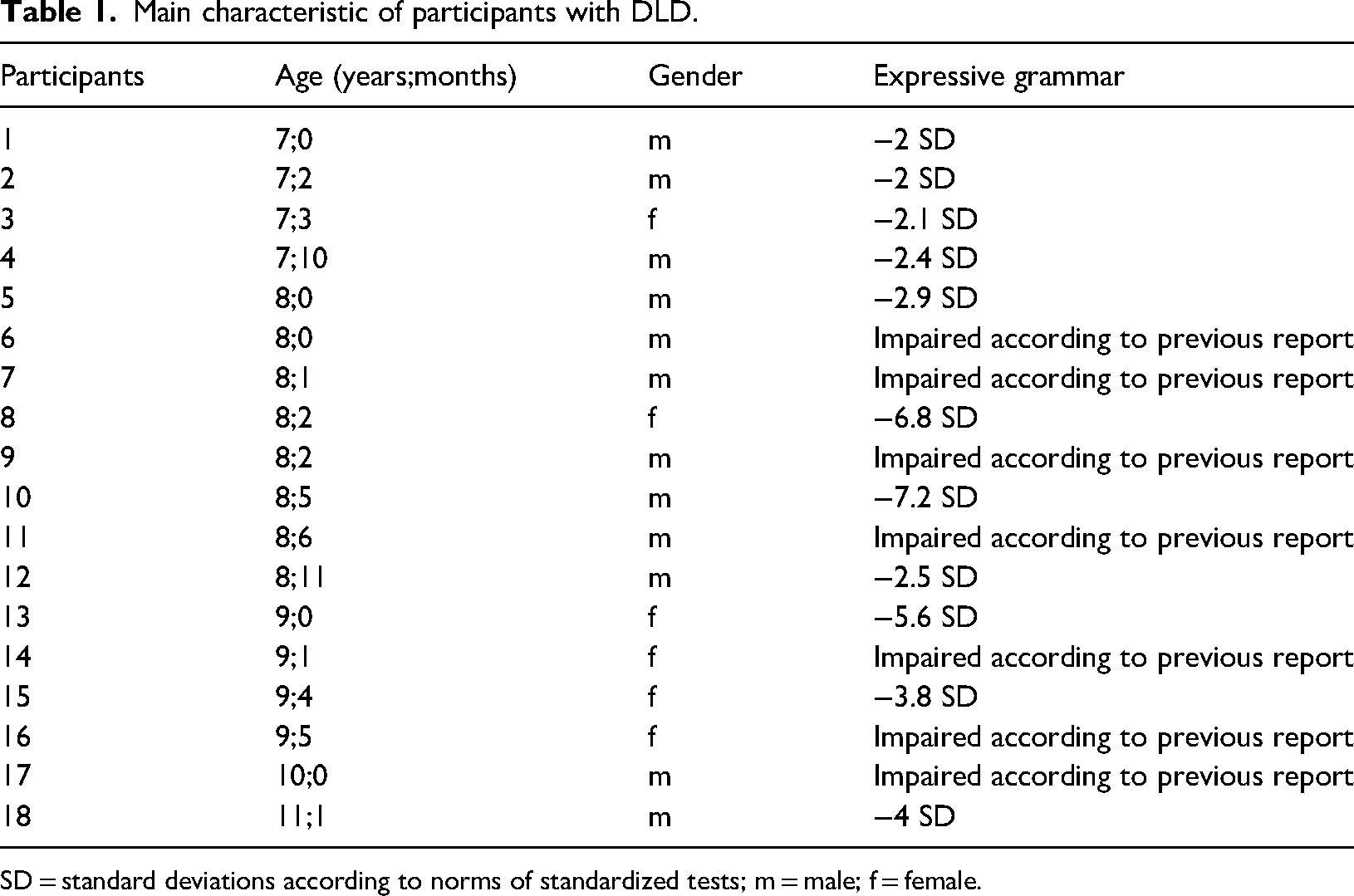
Seven participants were recruited from reference centers for language disorders and thus, we were able to ascertain from their reports that they did present a clear diagnosis of DLD including syntactic impairment. According to these reports, they all displayed low scores (below the 10th percentile) on common standardized tests of expressive grammar (e.g. the ELO, Khomsi, 2001). For the other 11 participants, we evaluated their expressive syntax with a French standardized language test (BILO-3C, Khomsi et al., 2007) to be sure that they demonstrated clear syntactic impairment, with scores of at least 2 standard deviation (SD) below age-specific norms. 9 Note that we did not find any difference between results at pretest of these eleven participants, compared to those of the seven participants recruited in specialized centers, for all measures of pretests (p > .2), nor for age (p = .3). Table 1 summarizes the main characteristics of the 18 children with DLD who were ultimately included in the study.
Main characteristic of participants with DLD.
Main characteristic of participants with DLD.
SD = standard deviations according to norms of standardized tests; m = male; f = female.
The children were administered the baseline as a pretest, 1 or 2 weeks before the beginning of the intervention, and as a posttest, 1 week after the end of the training. This baseline consisted of seven lists, each with 12 sentences: two lists included relative objects (lists A and A’), two others included 3rd person accusative clitics (lists B and B’) and the last two lists consisted of passives (lists C and C’). Finally, a unique list served as a control list and focused on verbal inflexions in the future or past tense (list D), since it is well known that verb morphology is another source of difficulty in children with DLD (see Jakubowicz, 2003). 10 At pretest and posttest, children had to correctly repeat sentences with object relatives (lists A, A’) and future/past inflexions (list D). As for accusative clitics (lists B, B’) and passives (lists C, C’), they had to complete a sentence given by the examiner, as in Figure 1 for clitics and in Figure 2 for passives. 11 There were no examples items before the pre- and posttest.

Elicited production of accusative clitics. Experimenter: Le grand-père tire le cheval. Que fait le grand-père avec le cheval ? Le grand-père… Expected answer:
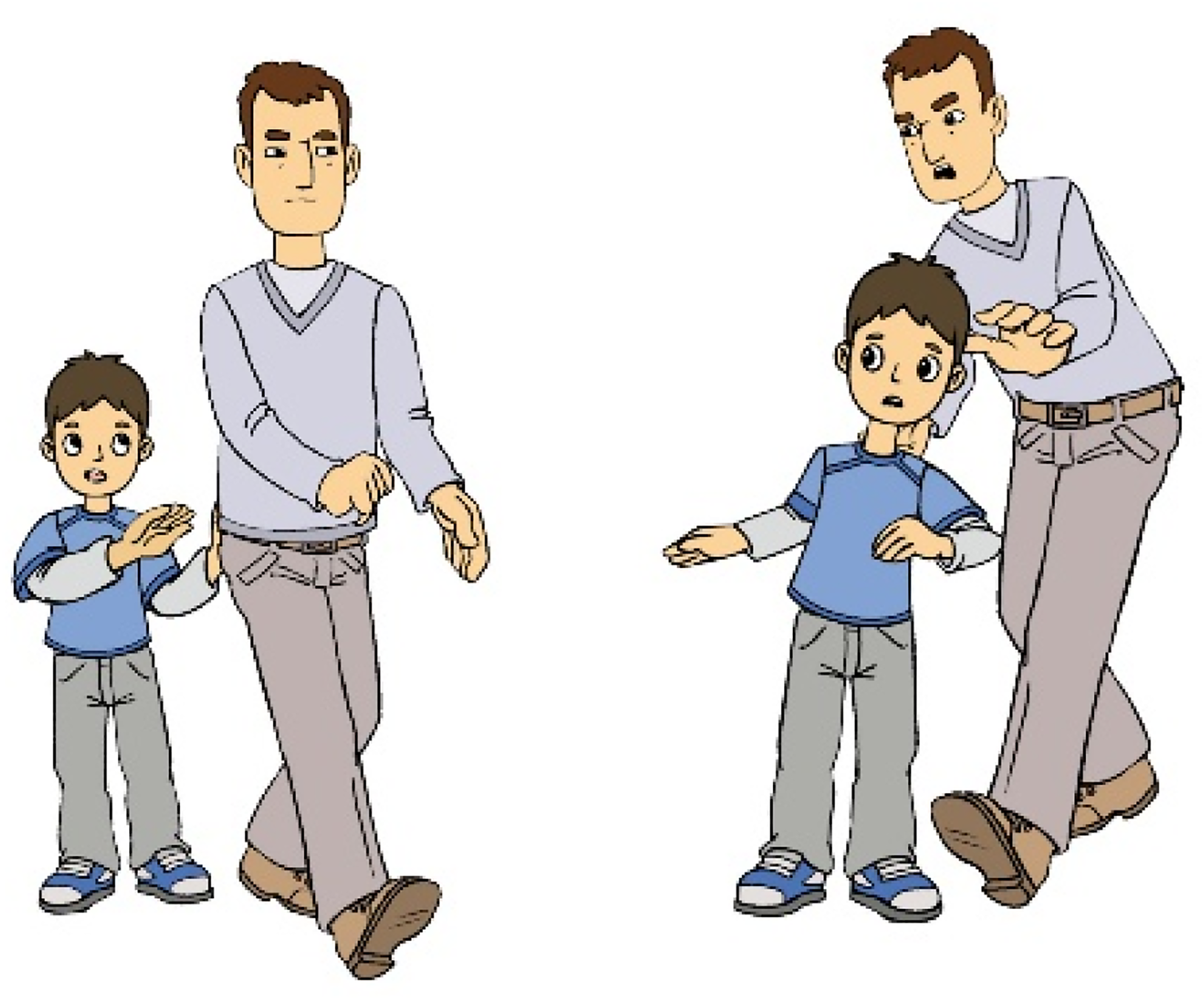
Elicited production of passives. Experimenter: Ici, le garçon pousse le monsieur. Et là, le garçon… Expected answer:
Lists A/A’, B/B’ and C/C’ were matched in frequency (on nouns, p = 0.7 for relatives, p = 0.6 for clitics, p = 0.1, for passives, and on verbs, p = 0.3 for relatives, p = 0.4 for clitics, p = 0.7 for passives) using Lexique database (New et al., 2004), as well as in length, p = 0.7 for relatives, p = 0.2 for clitics, p = 0.2 for passives (in terms of numbers of syllables). For relatives and clitics, the lists were also matched in the number of reversible and non-reversible sentences, with half reversible and half non-reversible. For passives, all sentences were reversible. In addition, for accusative clitics, each list contained the same number of masculine (le ‘him’, N = 5), feminine (la ‘her’, N = 5) and plural forms (les ‘them’, N = 2). Finally, the control list (list D) included six verbs in future and six in past tense. For each type, three inflections were singular and three plural. Table 2 summarizes the baseline approach, as well as our expectations depending on the list. Lists A, B and C were directly trained, as detailed later, while lists A’, B’ and C’ were used to evaluate the effects of generalization.
Organization of the baseline and expected effect.
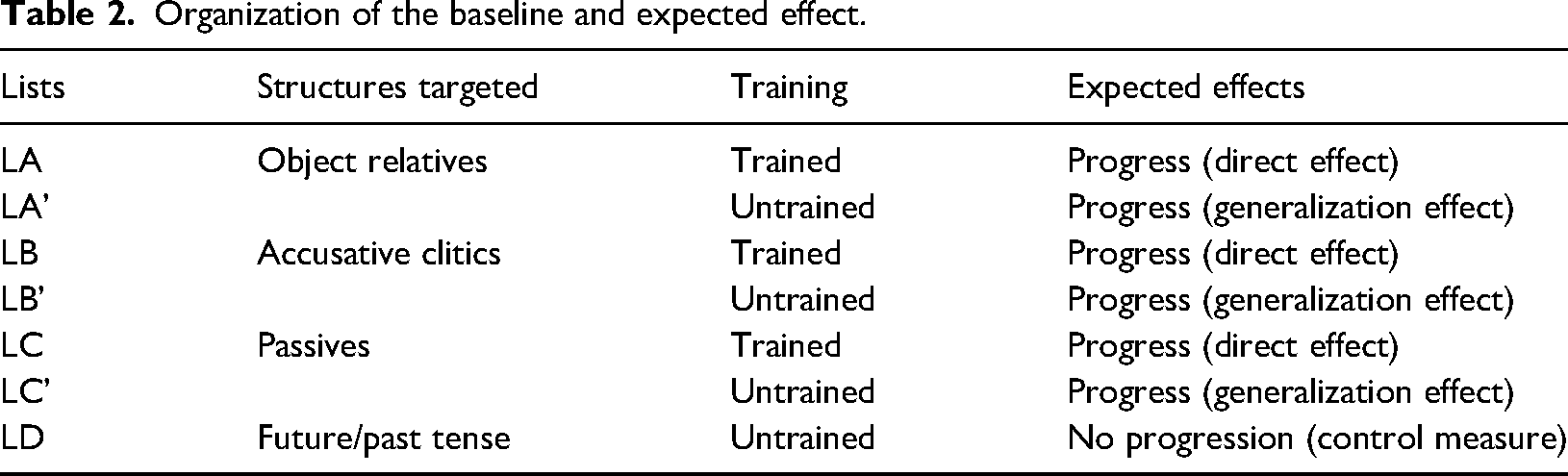
The lists were presented in the order of their appearance in Table 2 with, for each structure, one trained item alternated with one untrained item. One to two sessions were required for this pretest phase, depending on the participant's attentional capacities. As for coding, we considered a correct answer when the target structure was produced, without accounting for possible lexical substitution errors. For example, for relative clauses, the presence of the antecedent, the pronoun and the verb was required, whatever the lexical items used. Phonological or articulatory modifications were not penalized either. Accusative clitics were considered correct when they were produced with the correct gender. As an example, if the target structure was an object relative such as L’homme porte la fille que touche le chat (‘The man carries the girl that the cat touches’), the child's production Le monsieur porte le garçon que touche le chien (‘the gentleman carries the boy the dog touches’) was considered as correct. 12
All the participants were trained on object relatives and accusative clitics, but only 8 were also trained on passives, a structure which we added later to the protocol. For these latter participants, the training took place over 13 sessions, with one 30-minute session per week, as in Calder et al. (2020). 13 For the children not trained on passives, the training was shorter and consisted of 10 sessions with the same dosage as before. The training was conducted in France (Paris and Tours) by three master students in speech-language therapy who followed exactly the same protocol and activities (and had previously been trained by the first author to follow the script), at the participant's home (N = 6) or in the clinic were children received their language therapy. This study was declared at “La Commission Nationale de l’Informatique et des Libertés (CNIL)” in France. Parents provided written informed consent for their child's participation and children were informed of their right to withdraw from the study at any time.
Training
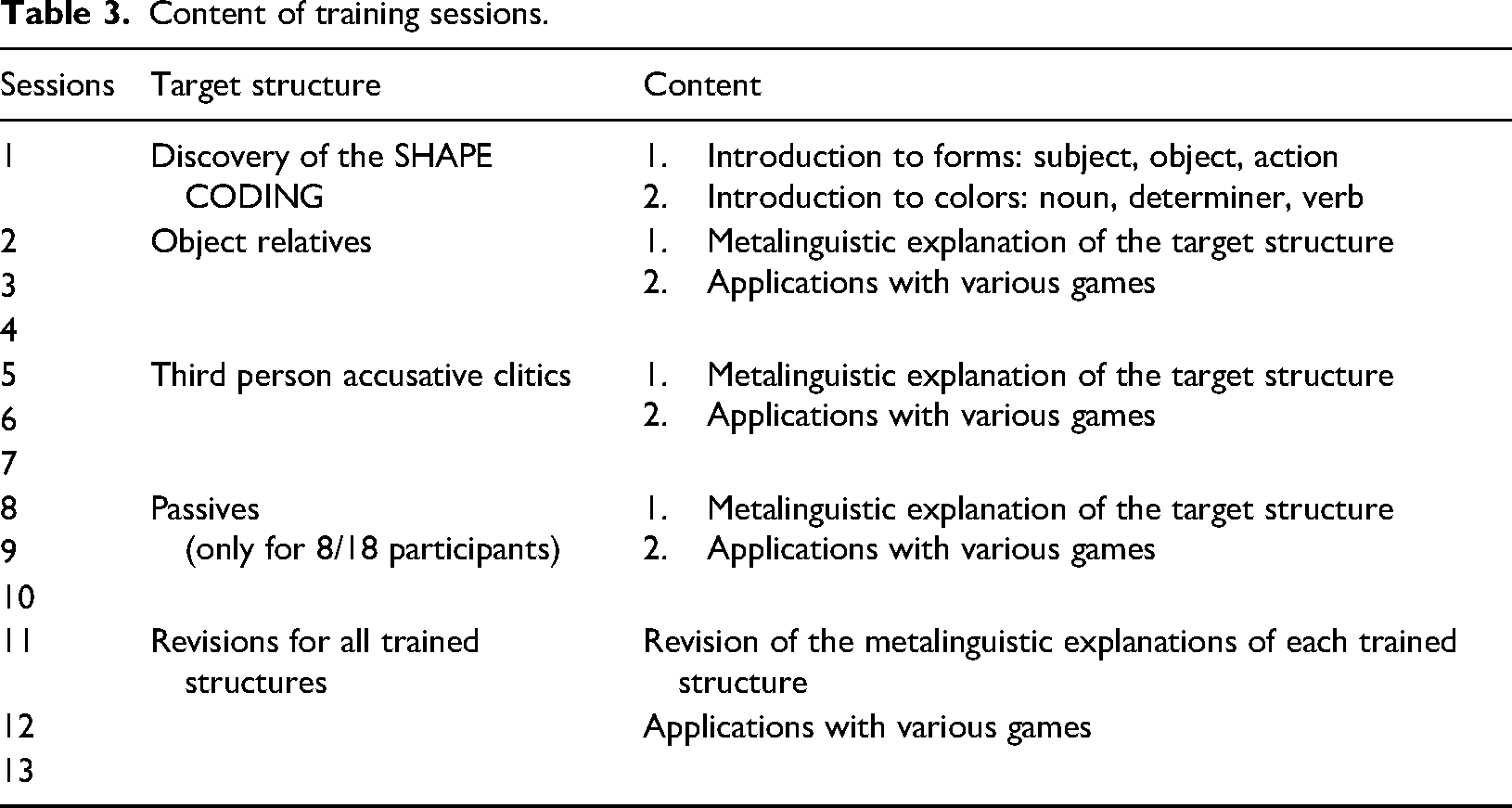
The first session was dedicated to the discovery of the SC system as recommended by Ebbels (2007): it consists in establishing the link between the shape and the question word by using laminated ‘Who/What’ and ‘What doing’ shapes (oval and hexagon) and asking the children to give the experimenter a name to go in the ‘Who’ shape and an action to go in the ‘What doing’ shape. Then, three sessions were conducted on object relatives, followed by three sessions on accusative clitics and three others on passives (for the 8 participants trained on this structure). After that, three sessions were conducted in order to review all the structures that have been trained. In each training session, the target structure was introduced with a metalinguistic explanation using the various symbols of the SC. For example, for accusative clitics, we started by explaining to the child that we can talk about a topic without repeating it if we have already talked about it before. For example, we asked a question like Que fait le monsieur avec la pomme (‘What is the man doing with the apple?’). We started by positioning the visual supports (Qui? ‘Who’; Fait quelle action? ‘does what action’; Quoi? ‘what’, see figure 3) in a canonical SVO order to describe the given situation. Then we explained to the child that we did not want to repeat what is contained in Quoi (’what’) form. To do this, we showed the child the movement to be made, that is, moving the Quoi (’what’) form to the pre-verbal position, and then we turned this form over to write the corresponding accusative clitic (la ‘it’). We also explained to the child how to choose the appropriate pronoun (le ‘him’, la ‘her’, les ‘them’) by addressing the variations of clitic forms according to their gender and number.
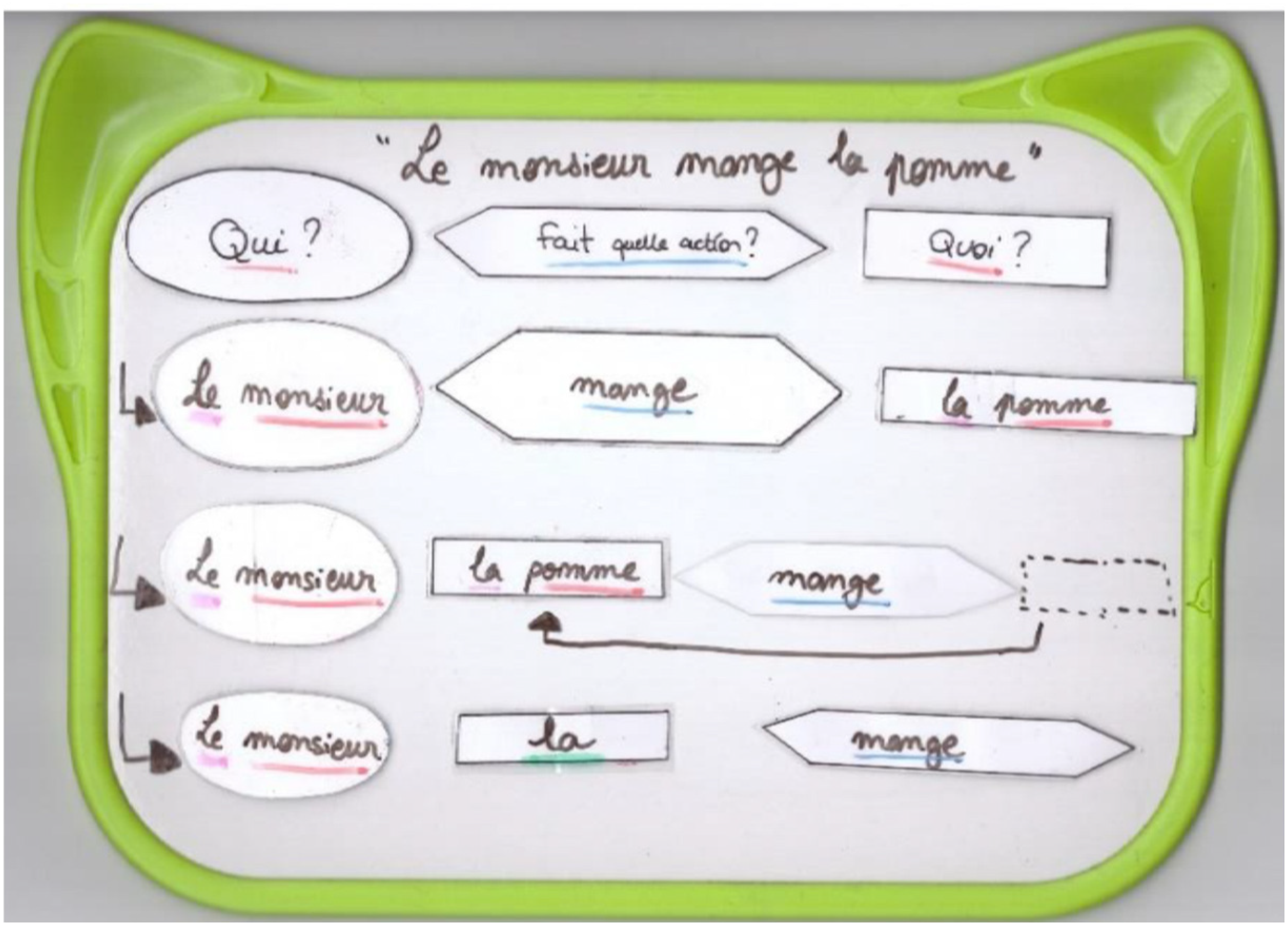
Visual support for metalinguistic explanation of accusative clitics from the sentence Le monsieur mange la pomme (‘the man is eating the apple’) to the sentence with the clitic in a preverbal position: Le monsieur
Three such sessions were then scheduled for the training of each structure, in which the participants discovered the coding of the target structures and then applied this system to new sentences. This coding was also inserted into games (e.g. pair games, memory games, goose game, card games) to maintain motivation and interest. Our approach thus incorporated implicit techniques, including elicited imitation and recasting if the child failed to produce the target structure, but always with the support of coding. These different activities targeted only the sentences of the trained lists. As for material, we used cards including targeted written sentences and cards illustrating the actions described by these sentences (see Figures 4 and 5). 14 Table 3 shows the sequence and content of each session
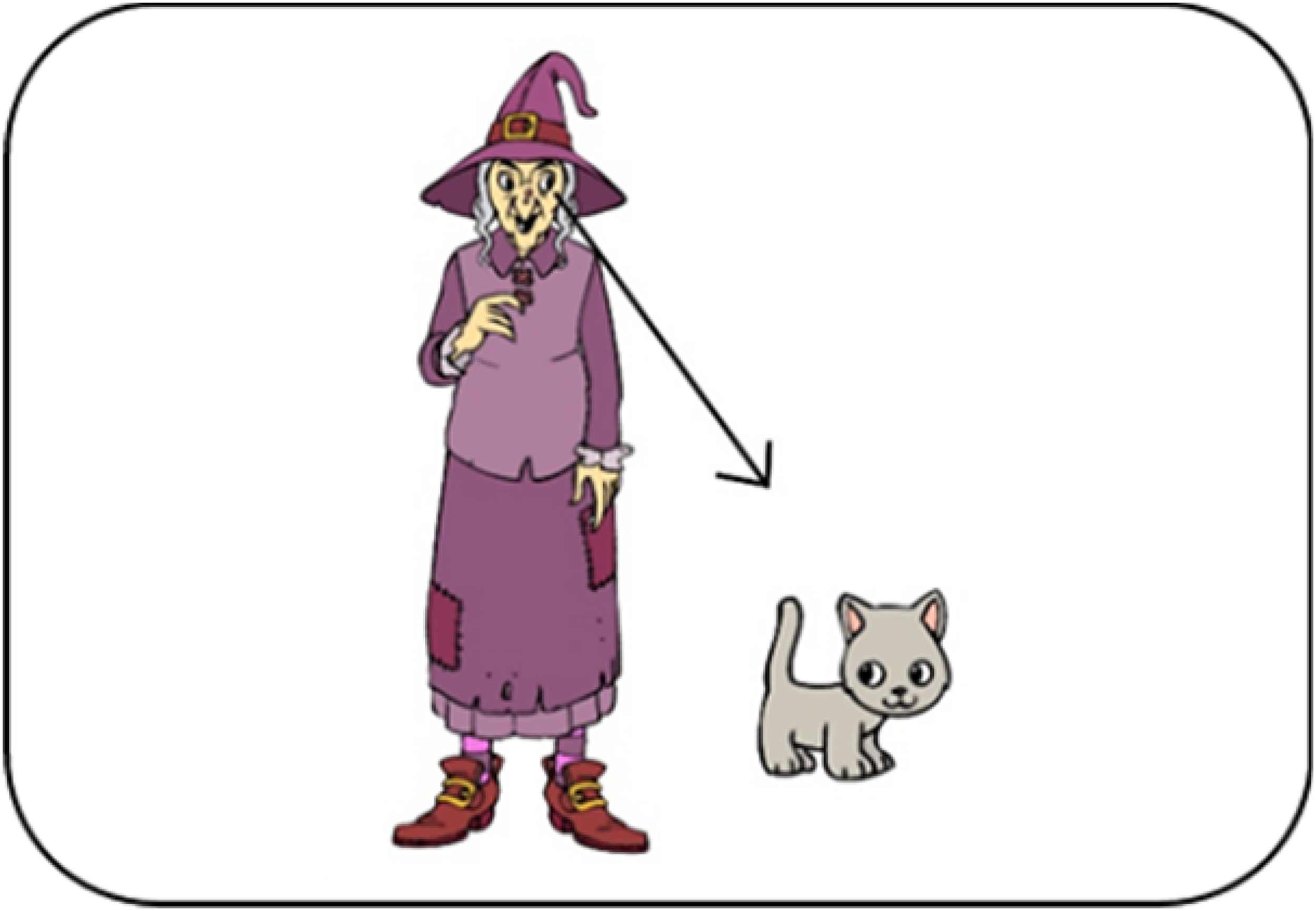
Picture for accusative clitics corresponding to the trained sentence La sorcière

Picture for passives corresponding to the trained sentence Le monsieur
Content of training sessions.
Descriptive results are displayed in Table 4 for trained items and in Table 5 for untrained items (including the control list targeting verbal inflexions). We first conducted Wilcoxon tests to compare children's performance, as a group, between pre- and posttest, for trained as well as untrained items. Then, we examined results at an individual level, by using McNemar tests, to see how many children have significantly improved their performance for each structure. Finally, we investigated the extent to which the gains achieved depend on other (linguistic and clinical) factors.
Direct effects: progress on items directly trained (LA, LB, LC): mean scores (standard deviations).

Direct effects: progress on items directly trained (LA, LB, LC): mean scores (standard deviations).
Maximal scores = 12.
Indirect effects: progress on items not directly trained (LA’, LB’, LC’); specificity effects: progress on control items (LD): mean scores (standard deviations).
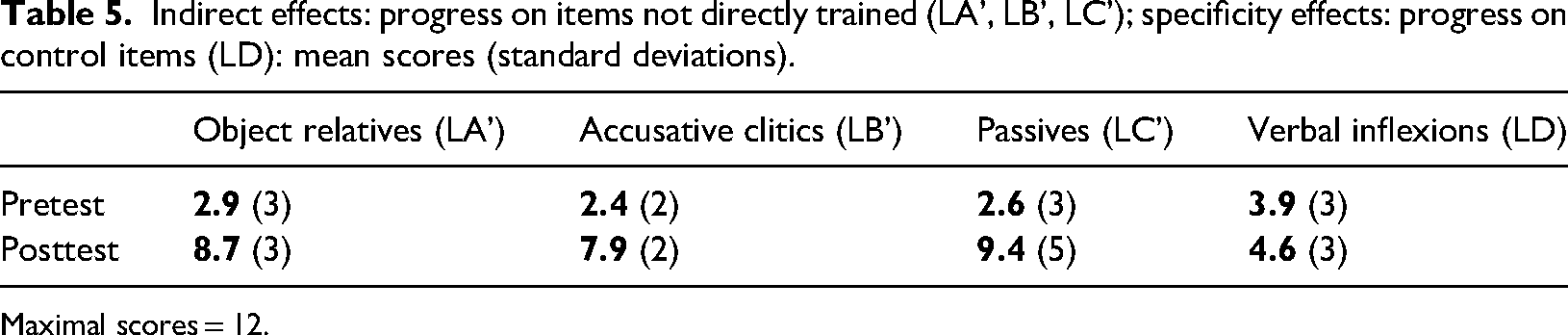
Maximal scores = 12.
Due to our sample size (N = 8 for passives; N = 18 for other structures) and the absence of a normal distribution of our data (with floor effect for pretest and ceiling effect for posttest), we used Wilcoxon signed-rank post hoc tests to test for differences between pretest and posttest. Effect size was calculated by dividing the square Z score by the number of participants (Tomczak and Tomczak, 2014). 15 As expected, children, as a group, improved significantly their performance for trained items, whether for object relatives (Z = 3.88, p < .001, r = .84), accusative clitics (Z = 4.01, p < .001, r = .89) and passives (Z = 2.27, p = .02, r = .51). The same results were found for the untrained structures: object relatives (Z = 3.39, p < .001, r = .64), accusative clitics (Z = 4.01, p < .001, r = .89) and passives (Z = 2.27, p = .02, r = .51), revealing the presence of indirect/transfer effects. All these differences were reported with large effect sizes. In contrast, there was no difference between pre- and posttest, for the control list (Z = 1.21, p = .23). As for the difference between trained and untrained lists at posttest, it appears that relatives which had been trained (LA) were better produced that untrained relatives (LA’), Z = 2.13, p = .03, r = .25. It was also the case for accusative clitics, Z = 2.36, p = .02, r = .31, but not for passives, Z = 0.7, p = .4. It is important to note that there was no such difference between trained and untrained items at pretest (all p > .4).
We also tested whether these improvements were significant for each child, thus at an individual level. We then performed mid-p value McNemar tests, an approach which has recently becoming more popular and recommended to assess the effect of an intervention on a single case study for interventions with a pre- and posttest (Caronni and Sciumè, 2017; Pembury Smith and Ruxton, 2020), for each participant. Table 4 reports the data for each child and the McNemar test results. It appears that children globally improved their performance (with no decrease for all trained structures) and that this progression is significant for 10/18 participants for trained object relatives, a proportion that rises to 11/18 for untrained object relatives (and 2 additional participants with trend); this higher proportion can be explained by the fact that some participants (13, 15 and 16) already obtained high scores in pretest (≥ 9/12) for items belonging to the LA list. The proportion of children making progress for accusative clitics is slightly higher with 15/18 children for trained structures (LB: 14 with significant progression, 1 with trend) and 13/18 for untrained structures (LB’: 10 with significant progression, 3 with trend). As for passives, only one child (participant 10), of a total of eight, did not make any progress and another (participant 3) only progressed for the trained items (LC). Finally, no child made significant progress on the control list (LD).
Since all children did not progress to the same degree, we investigated the extent to which the gains achieved were dependent on other factors. Using Spearman's rank correlation coefficient, we did not find any correlation between measures of gains (measuring the difference between post-test and pre-test scores) and age (all p > .1), nor with standardized scores for the eleven participants for which we had exact scores (all p > .2). As for the influence of gender, we did not find a difference, regarding measures of gains, between boy and girls (all p > .3). By contrast, we found significant (negative) correlations between pretest scores for relatives and gains calculated for this structure, whether for trained (rs = -0.58, p = .01) and untrained sentences (rs = −0.53, p = .02), which means that the lower the pre-test scores, the higher the gain. Finally, we did not find any difference between gains observed for trained and untrained lists (all p < .1), even if the latter are slightly lower than the former, as shown in the last line in Table 6.
Individual pre- and post-test scores from baseline and McNemar test results, as well as mean gains (posttest–pretest scores).
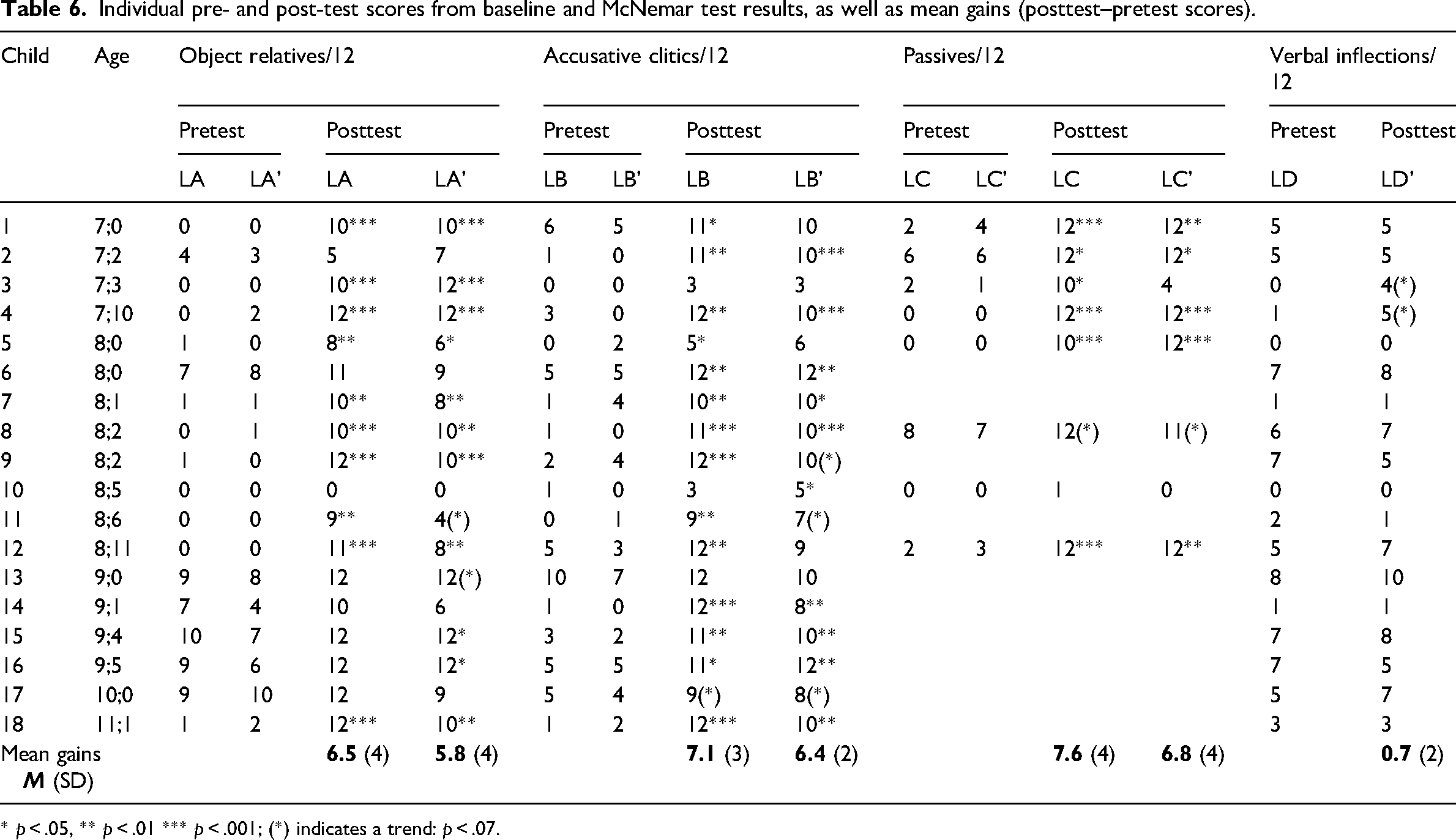
* p < .05, ** p < .01 *** p < .001; (*) indicates a trend: p < .07.
The aim of our study was to investigate the effect of an explicit approach to improve complex syntax of French-speaking children with DLD aged 7 to 11 years, both at the group and individual levels. The intervention used a metalinguistic approach adapted from the SC system (Ebbels, 2007), targeting complex structures in French, namely object relatives, accusative clitics and passives. Our main findings revealed significant improvement at the group level of trained (= direct effect) and untrained items (= transfer effect), for all structures. At the individual level, improvement was not systematic across all children and structures, although significant differences were observed in most of the cases. The absence of any progression on the control list attests to the specificity of the observed effects.
Directs effects
We predicted a direct and specific effect of training on the targets that had been directly trained. Global results showed such improvement for all the structures tested, with large effect sizes. These results echoed those of previous studies which targeted complex syntax using explicit approaches, in English (Balthazar and Scott, 2018, on adverbial, completive, and relative clauses; Ebbels and van der Lely, 2001, on passives) and Dutch (Zwitserlood et al., 2015, on relatives). Moreover, we trained structures which are particular to romance languages, such as accusative clitics. Numerous studies have demonstrated the deficits that French-speaking individuals with DLD encounter with this structure, considered a clinical marker of language impairment (Delage and Durrleman, 2018; Paradis et al., 2003; Stanford and Delage, 2020; Tuller et al., 2011) but our study is, to the best of our knowledge, the only one to investigate the effect of a direct training of this structure. 16 These observations contrast with the number of studies describing particular difficulties in inflectional morphology in English-speaking children with DLD (e.g. Calder et al., 2022; Rice and Wexler, 1996) and the training studies focusing on this aspect, notably with an explicit approach similar to that used in the current study (Calder et al., 2018, 2020, 2021; Kulkarni et al., 2014).
At an individual level, we have observed that some children did not significantly improve for trained sentences. For most of them, the explanation seems simple: they already had high scores at pretest, and thus the margin of progress was too small to be significant in posttest. One child (participant 10), however, stands out from the group with a lack of significant progression for all trained sentences. The syntactic deficits of this child were most likely too severe to achieve progress on the targeted complex structures; he indeed displayed the lowest score in the standardized tasks of expressive syntax (−7.2 SD). Moreover, even if he showed interest in the code system, he had a lot of difficulty concentrating during the training sessions, and his speech therapist does mention strong attention weaknesses.
Generalization effects
As progress on trained items could be due to a “simple” memorization of the sentences, it was necessary to check if participants were able, at posttest, to better produce or repeat sentences that were not seen during the training. Group results showed that this was the case, with large effect sizes for each structure. Since there was no such progression on control items, these results prove a generalization effect which was specific to the training and cannot be attributable to the normal maturation of children. Such a distinction (between trained and untrained items) was absent in the previous training studies targeting complex syntax (Balthazar and Scott, 2018; Zwitserlood et al., 2015) which evaluated the participant's progression on items that were different from those used in training. Our experimental paradigm, comparing pre- and posttest scores on trained and untrained items (with a control structure) in line with the Evidence-Based Practice approach (Byiers et al., 2012), seems to us more informative, so that we could distinguish between direct and transfer effects. Note however that scores obtained at posttest were better for trained lists (versus untrained lists) for relatives and accusative clitics whereas there was no such difference at pretest. This stronger progression for trained items is easily explained by a stronger learning effect for sentences that were repeated many times.
General statement and clinical applications
To sum, our study contributes to the literature since it is the first conducted in French, and that it targeted complex syntactic structures, notably accusative clitics which are common structures in romance languages, but which do not exist in the Germanic languages that have been considered in previous studies using the SC system. We have also added a measure of generalization which was absent in the literature. The fact that our training resulted in a generalization effect should encourage the use of this method in clinics, as clinicians all hope that what they work on in sessions will become generalized and improve their patients’ everyday communication skills.
Limitations
With a total sample of 18 participants, our study included more participants than some previous studies using explicit syntactic training (e.g. 14 participants in Ebbels et al., 2014; 12 in Zwitserlood et al., 2015; 9 in Calder et al., 2020), but we acknowledge that our sample is still limited, especially for passives (N = 8); our results would thus need to be replicated on a larger sample to validate the effects found in the current study. As pointed by an anonymous reviewer, an additional limitation comes from the fact that we were unsure of how DLD was diagnosed by clinicians, the accuracy of the diagnosis, or heterogeneity of diagnostic procedures. This variability may contribute to the individual variation in intervention response. Also, even if we had a control measure, we did not have a control group, which is done in Calder et al. (2021) for example and that could allow us to improve the experimental standard of our study. Then, the absence of significant progress of some participants may be due to the fact that their pretest scores were already high; on the other hand, other children did not progress, presumably because the structures are too complex for their current skills. It would therefore be interesting to adapt the training to the exact level of each individual, by training only the impaired structures of a particular participant, which would avoid such ceiling or floor effects. This would provide an adaptive form of training (an aspect which is absent from previous studies on grammar training), adjusted to the current capacities of participants, which is particularly relevant because DLD is a heterogeneous disorder (Bishop et al., 2017). The protocol could also be improved by having the pre- and post-tests performed by another experimenter. Indeed, in our study, the evaluator is also the rehabilitator, which may constitute an expectation bias. Another limitation comes from the fact that we did not have delayed posttest to assess the maintenance of the progression, as in Calder et al. (2021), nor another measure (such as a spontaneous language or narrative analysis) that would inform us about a possible transfer of learning to a more ecological context. Finally, future studies should compare implicit and explicit grammar training to quantify the added value of the latter. Such comparisons are very rare in the literature on DLD and have only focused on the learning of pseudo-morphemes (Finestack, 2018; Finestack and Fey, 2009). Yet, a comparison of implicit and explicit approaches would allow for further exploration of the PDH (Lum et al., 2014; Ullman and Pierpont, 2005). Indeed, if children with DLD have difficulties in implicit learning, which typically-developing children would not have since they acquire the grammar of their L1 without explicit instruction, they should benefit more from explicit teaching.
Conclusion
The present research supports the existing literature about the efficiency of an explicit approach to complex grammar in children with DLD. Even if our study needs to be replicated with a more rigorous protocol (contrasting implicit and explicit training), our results showed that our French adaptation from the SHAPE CODING system led to better performance on complex structures, both trained and untrained. We hope that the present work will open the door for future syntactic training studies aimed at French-speaking children with DLD, as well as a more frequent use of explicit approaches in clinical settings.
Footnotes
Acknowledgments
The authors wish to thank Anaïs Muzica for her contribution to the creation of the training and the testing of participants, Samuel Bruder for his permission to use his software Artiskit, and children for their participation.
Declaration of conflicting interests
The authors declared no potential conflicts of interest with respect to the research, authorship, and/or publication of this article.
Funding
The authors received no financial support for the research, authorship, and/or publication of this article.
