




Abstract
Stories constitute a significant part of the Indian preschool curriculum due to their various benefits in preschool child development. However, the teachers’ practice of stories and their perception regarding the influence of stories on preschool child development are vital determining factors in the benefit preschoolers receive from stories. The global concern for providing quality education for preschool children necessitates the exploration of teachers’ practices and perceptions; however, such studies in the Indian context, where education is shaped by its multicultural and linguistic diversities, are limited. The present study provides an original contribution to exploring the Indian preschool teachers’ practice of stories and perception of the influence of stories on preschool child development using a developed questionnaire, Teachers’ Practice and Perception of Stories (TPPS). Ninety-six preschool teachers from English medium schools in Mangalore, India, participated in the study. The findings indicated that irrespective of teachers’ demographic variables, they played an active role in telling stories to children and positively believed that stories facilitate speech and language, cognition, literacy, and socio-pragmatic development in preschoolers. The findings broadly apply stories for preschool child development in clinical and school settings.
Introduction
The preschool period is an open stage of learning and exploration of new experiences (Gnjatović, 2014) and is critical for education and overall child development. Education during preschool is vital as it lays the foundation and prepares them for formal schooling and lifelong learning (Morni, 2002). Stories form an inevitable part of the preschool curriculum (National Council of Educational Research and Training, 2019) due to their benefits in facilitating development (Gnjatović, 2015; Tin et al., 2013) and educating young children (Lucarevschi, 2016). However, implementing stories as a teaching strategy depends on the ‘Teacher’ (Gnjatović, 2014).
The teacher leads the children's learning experience during preschool education by supporting and stimulating them to reach their highest developmental potential (Gnjatović, 2015). The curriculum offers guidelines for teachers, allowing them flexibility in selecting teaching strategies and tools to meet the child's needs (Gnjatović, 2014). Research proves that teachers’ perceptions and beliefs can influence the teaching strategies and materials they adopt (Lee and Bathmaker, 2007) and how they implement them while teaching the child (Seng, 2017). While stories are integral to the preschool curriculum, understanding teachers’ practices and perceptions is essential, as they directly impact the benefits children derive from stories (Scheiner and Gorsetman, 2009). Furthermore, examining teachers’ perceptions of using stories as an educational tool can yield valuable insights into the benefits experienced by preschoolers. However, there is a noticeable scarcity of studies investigating teachers’ practices and perceptions regarding stories in preschool education.
Among the few studies, Tin et al. (2013) investigated the practice and perception of stories of preschool teachers in Myanmar using a mixed method and reported that teachers in Myanmar support the use of stories as they are important to children's lives. Gnjatović (2014) explored how Swedish preschool teachers perceive the role of stories and their methods of story practice using a qualitative approach. They reported that the teachers mostly perceived story as an educational and regulative tool and discussed different methods of story practice in Sweden. Another qualitative research by Gnjatović in 2015 on Swedish preschool teachers’ perception of stories reported that teachers were aware of the story benefits and used them for language development, self-regulation, motor skills, and creative development. Khurana and Rao (2011) examined how teachers utilize books, including storybooks, for emergent literacy in preschoolers via questionnaires. Alatalo and Westlund (2021) investigated Swedish preschool teachers’ perceptions of using read-aloud sessions for language and literacy development through focus group discussions. These studies discussed different methods of story practice and perception and gave recommendations for improving the countries’ curricula and preschool programs. Considering the global concerns for providing quality education for children aged three to six years, research across different countries has become valuable and indispensable in preschool education (Joshi and Taylor, 2005).
India is a country with diverse religious, social, and cultural backgrounds (Katoch and Johansson, 2021) that shape India's educational system (Mathur, 2018). From its inception, early childhood care and education have been considered primely important (Katoch and Johansson, 2021; Kaul and Bhattacharjea, 2019). The National Educational Policy (NEP, 2020) recognizes this as the foundation stage of learning and aims that every child from three to six years has access to free, safe, high-quality, developmentally appropriate care and education by 2025 (Rao et al., 2021). However, research reveals that a significant number of young children face obstacles in reaching their developmental potential due to issues related to the structure and quality of preschool services (Chopra, 2016; Katoch and Johansson, 2021; Rao, Ranganathan et al., 2021). Such challenges can have adverse effects on the child's outcomes (Chopra, 2016), underscoring the importance of conducting research within Indian preschools (Katoch and Johansson, 2021; Rao, Ranganathan et al., 2021).
The tradition of storytelling by the elders in the family to the children is prominent in Indian communities (Buvaneswari and Padakannaya, 2017), and likewise, stories form an essential part of the preschool curriculum in India (National Council of Educational Research and Training, 2019). Preschool education in India is multifaceted, operated by various organizations (Joshi and Taylor, 2005), and shaped by multicultural and linguistic factors (Mathur, 2018), which can influence educational quality (Joshi and Taylor, 2005). Despite stories being part of the curriculum, their efficacy hinges on teachers’ practices and perceptions (Gnjatović, 2014), making it crucial to investigate this aspect in a diverse, multilingual country like India. To date, there has been a noticeable absence of research examining how Indian preschool teachers employ storytelling and their perceptions of its impact on preschool child development. This gap in the literature is corroborated by the findings of Kalra and Baveja (2013), who noted limited studies on teacher perceptions in India. Consequently, the current study aims to provide insight into the Indian preschool teacher's practice and perception of the influence of stories on preschool child development. The specific objectives were to develop a questionnaire focusing on teachers’ practice and perception of stories, to explore the teacher's practice of stories, perception of the influence of stories on preschool child development, the relationship between the practice and perception of stories on preschool child development, and the teacher's practice and perception concerning demographic variables using the developed questionnaire.
Materials and methods
The study adopted a cross-sectional design following STROBE guidelines, initiated after obtaining the Institutional Ethical Clearance (IEC KMC MLR 02-2020/62). The study was carried out in Mangalore, India, which is heterogeneous with an ethnically and culturally diverse population.
Participants
The participants comprised 96 teachers teaching preschool children between the ages of 3.6 to 5.5 years, recruited using non-random convenient sampling from English medium schools in Mangalore. The permission to conduct the study was obtained from the Block Education Officer, Mangalore. Following this, informed written consent was obtained from school authorities and teachers before inclusion in the study. The teachers who agreed to participate were provided with hard copies of the Teachers Practice and Perception of Stories (TPPS) questionnaire, and the researcher ensured that there was no missing data during the data collection. The participants’ age ranged from 23 to 64 years (Mean = 40.16 years, SD = 8.89), with an equal age-wise distribution of young-aged (48 teachers) and middle-aged adults (48 teachers). All the teachers were females, and their teaching experience ranged from one to thirty-four years, with a mean of 10.59 years (SD = 7.53 years) of experience. Of the teachers, 94% taught at unaided schools (privately operated educational institutions that do not receive government funding) and 6% at government schools. The teaching hours in a day ranged from one to eight hours (Mean: 4.41, SD: 1.48), and the class size ranged from 7 to 49 students. The highest educational level ranged from Secondary School Certificate (SSC) to post-graduation. Among the teachers, 6% had a Secondary School Certificate (SSC), 27% had a Higher Secondary School Certificate (HSC), 55% had a graduate degree, and 12% had post-graduate degrees. Half of the teachers (50%) had attended special training for preschool teaching. Teachers trained in special education and with less than twelve months of teaching experience were excluded from the study.
Questionnaire construction and content validation
This study used a quantitative design to explore Indian preschool teachers’ practices and perceptions of the influence of stories on preschool child development. A novel questionnaire, Teachers Practice and Perception of Stories (TPPS) was developed, as the research evidence did not comprehensively document how stories contribute to the development of speech, language, cognitive, literacy, and socio-pragmatic skills (Alkaaf, 2017; Seng, 2017; Tin et al., 2013). The novel closed-ended self-administered TPPS questionnaire was constructed in five steps. The first step was item generation from literature reviews, clinical observations, and focus group discussions. For the focus group discussions, five speech-language pathologists with more than five years of experience in child language development were recruited using the purposive sampling (Nyumba et al., 2018). The discussion initiated with an overview of the study objectives, domains, and items that need to be explored in the questionnaire. The process helped to identify 98 critical aspects, of which 27 were practice items and 71 were perception items. In the second step, the investigators carried out item selection from the 98-item pool by removing duplicates, overlaps, and non-representative items while modifying and retaining 87 relevant items (19 practice items and 68 perception items).
The third step was to word, sequence, and construct response formats and scoring for the selected items. The questionnaire was formulated in clear and comprehensible English, mindful of participants’ varying levels of understanding, education, and cultural backgrounds, following guidelines to avoid ambiguous or double-barreled questions (Peter et al., 2019). The readability of the questionnaire was checked using the Flesch Reading Ease Score (Farr et al., 1951), which assesses the number of words in sentences and the number of syllables in words that facilitate the ease of reading (Edwards, 2010). The questionnaire obtained a score of 62, indicating that it required only eigth-grade education to understand, making reading reasonably easy for most adults. The worded items were then sequenced logically with a mixture of positively and negatively directed items to minimize response bias (Peter et al., 2019; Rattray and Jones, 2007). All the items were constructed as closed-ended questions or statements with corresponding response options. The demographic details were sequenced at the end of the questionnaire to avoid monotony (Rattray and Jones, 2007).
The fourth step was content validation, which ensured that the questionnaire represented adequate and relevant items (Peter et al., 2019). The developed questionnaire was content validated by three speech-language pathologists and three preschool teachers, both having experience of more than five years with preschool children. The experts were asked to rank the items in the questionnaire on a five-point Likert scale concerning the relevance of items and appropriateness of the instruction, language, response format, scoring, and provision for additional suggestions across each item. The items that obtained a Content Validity Index of greater than 0.78 (Almanasreh et al., 2018) were retained in the questionnaire and were then pilot-tested as the final step in the questionnaire construction. The pilot testing was conducted on 20 preschool teachers (10 young adults and 10 middle-aged adults), and the findings indicated that the questionnaire was understandable to teachers, served the purpose of exploring practice and perception, and took around 10–15 min for completion, which confirmed the questionnaire's face validity and feasibility. As a result of the construction process, the questionnaire underwent revisions and deletions, ultimately yielding a final version comprising 63 items, named the Teachers Practice and Perception of Stories (TPPS) questionnaire.
The final TPPS questionnaire contained four sections, Section 1: Practice of stories (seven items) focused on the frequency of story usage, kinds of stories, the language and methods used for narrating stories, activities carried out during and after story narration, child's responses to the story narration, and purpose of the story narration, all rated on a four-point Likert scale, obtaining a maximum score of 184. Section 2: Perceptions of the influence of stories on preschool child development (52 items) focused on the frequency of story exposure among preschoolers and 50 statements on the teacher's perception of presenting stories to preschoolers (10), the role of stories in speech and language (10), cognitive (10), literacy (10), and socio-pragmatic development (10), all rated on a four-point Likert scale with an additional don’t know option (Chyung et al., 2017) obtaining a maximum score of 200. Section 3: Recommendations by teachers (four items) targeted teachers’ recommendations on using the story for preschool child development, teaching, child assessments, and intervention, all designed in a yes/no question format. Section 4: Demographic details of the teachers included details such as age/gender, highest educational level, preschool training, years of teaching experience, type of school, teaching hours in a day, and class size. The internal consistency reliability of the TPPS questionnaire was assessed using the Cronbach's alpha, yielding a score of 0.90 for practice and 0.93 for perception of stories. These scores demonstrate strong and acceptable internal consistency reliability, meeting the requirements for the developed tool (Peter et al., 2019).
Data analysis
The data was analyzed statistically using the SPSS v.25 software. The frequency and percentage of responses were calculated to understand the teachers’ practice and perception of the influence of stories on preschool child development. The relationship between practice and perception was checked using the Pearson correlation coefficient, and the influence of demographic variables on teachers’ practice and perception was analyzed using Independent t-tests and one-way ANOVA.
Results
Teachers report on the practice of stories
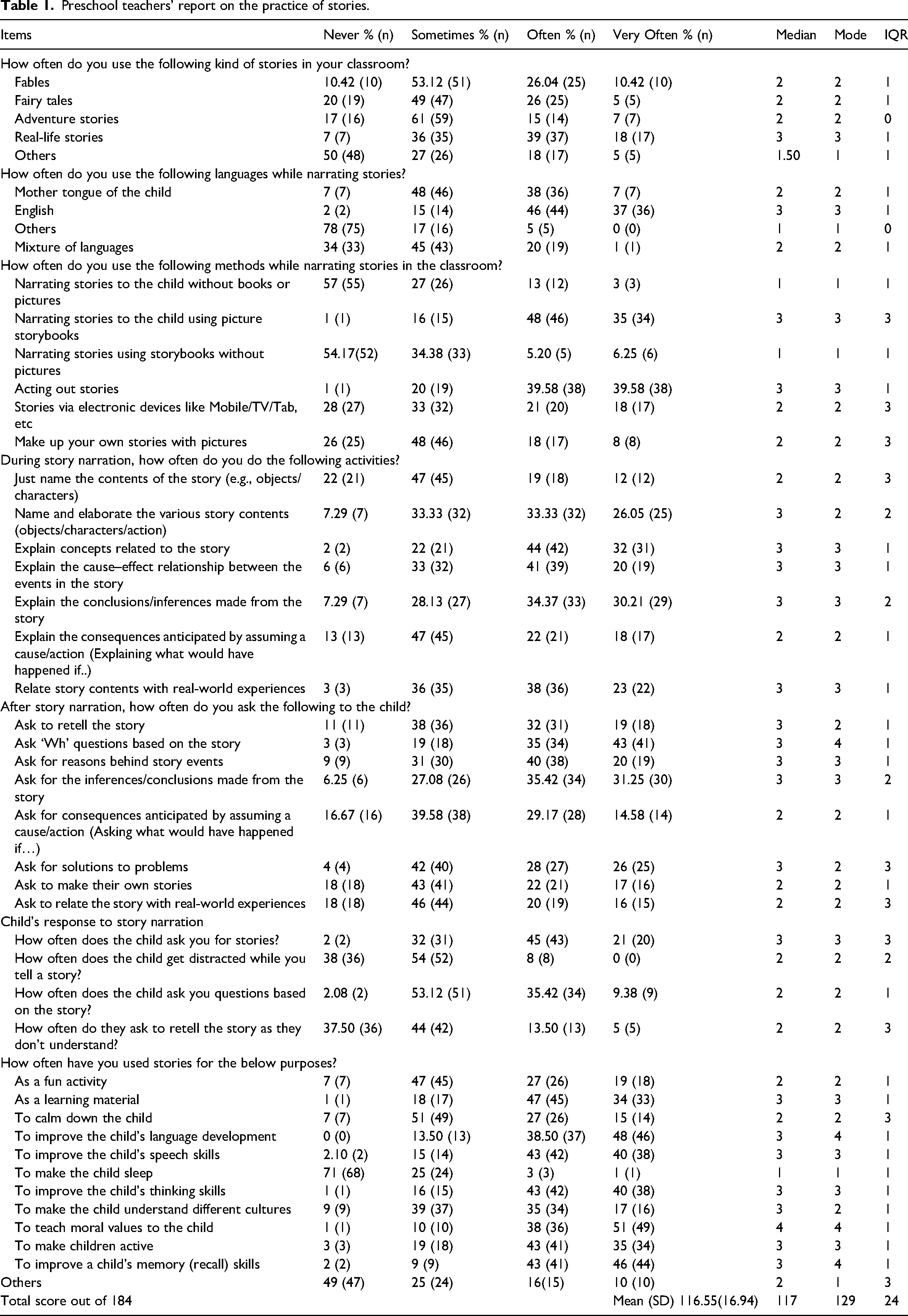
As indicated in Table 1, it was observed that the teachers predominantly narrated real-life stories (57%) in English (84%), with the help of picture storybooks (83%) (Teachers have also employed a combination of languages, incorporating English with the child's mother tongue during story narration [Kannada: 57%, Tulu: 29%, Tamil: 3%, Malayalam: 5%, Hindi: 3%]). During the story narration, most teachers explained concepts (76%) and elucidated conclusion/inferences made from the story events (64%). Following the story narration, teachers predominantly posed ‘Wh’ questions (78%) and sought inferences or conclusions from the story (66%). In the child's responses to stories, teachers reported that preschoolers often ask for stories (66%). The primary focus for most teachers when using stories was to impart moral values (89%) and enhance memory (89%) rather than solely using stories as a source of entertainment or for calming the child.
Preschool teachers’ report on the practice of stories.
Teachers’ perception of the influence of stories on preschool child development
Teachers’ perceptions regarding the age at which stories should be introduced showed that 16% suggested less than one year, 18% recommended one to two years, 34% advised two to three years, 23% endorsed three to four years, and 9% proposed greater than four years. As for the frequency of story exposure, 45% of teachers advocated for daily exposure, 33% suggested one to two times per week, and 22% recommended three to five times per week.
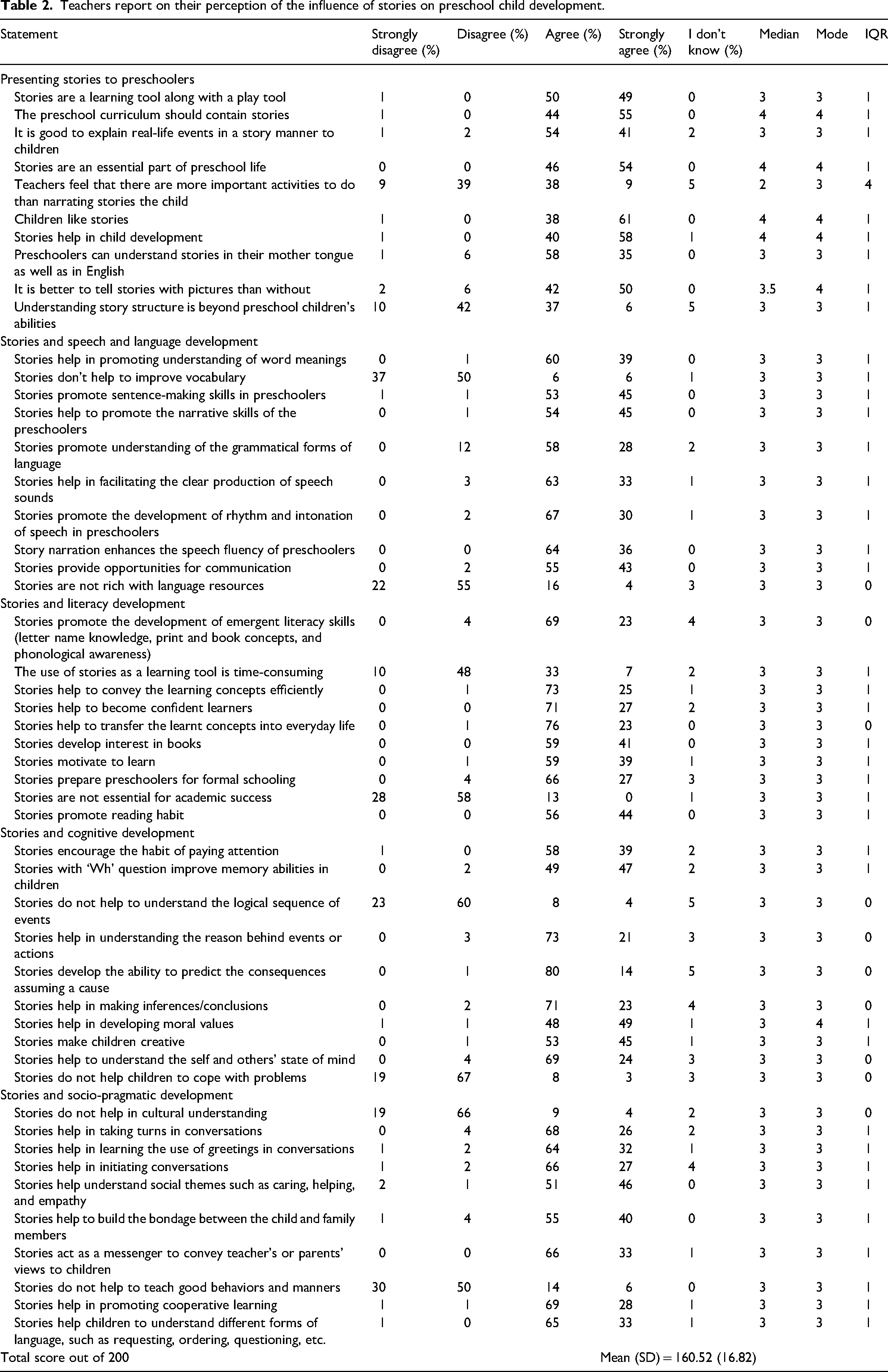
Teachers’ perceptions regarding the impact of stories on preschool child development (Table 2) indicated that majority have a positive belief in the benefits of stories across various developmental domains, ranging from 77–99%. There were slight differences (1–18%) between agreement and disagreement percentages in three statements for three statements related to factors such as other activity demands beyond storytelling, the increased demand for understanding story structures by preschoolers, and the time commitment involved in storytelling. Concerning the teachers’ recommendations, results showed that majority of the teachers recommended stories for teaching (100%), preschool child development (99%), assessments (89%), and treatments (88%).
Teachers report on their perception of the influence of stories on preschool child development.
Relationship between teachers’ practice of stories and perception of the influence of stories on preschool child development
A Pearson correlation coefficient was computed to assess the linear relationship between preschool teachers’ reports on the practice of stories and their perception of the influence of stories on preschool child development. The findings showed a moderate positive correlation between practice and perception, which was statistically significant (r = 0.36, n = 96, p < 0.001).
Teachers’ practice and perception concerning demographic variables
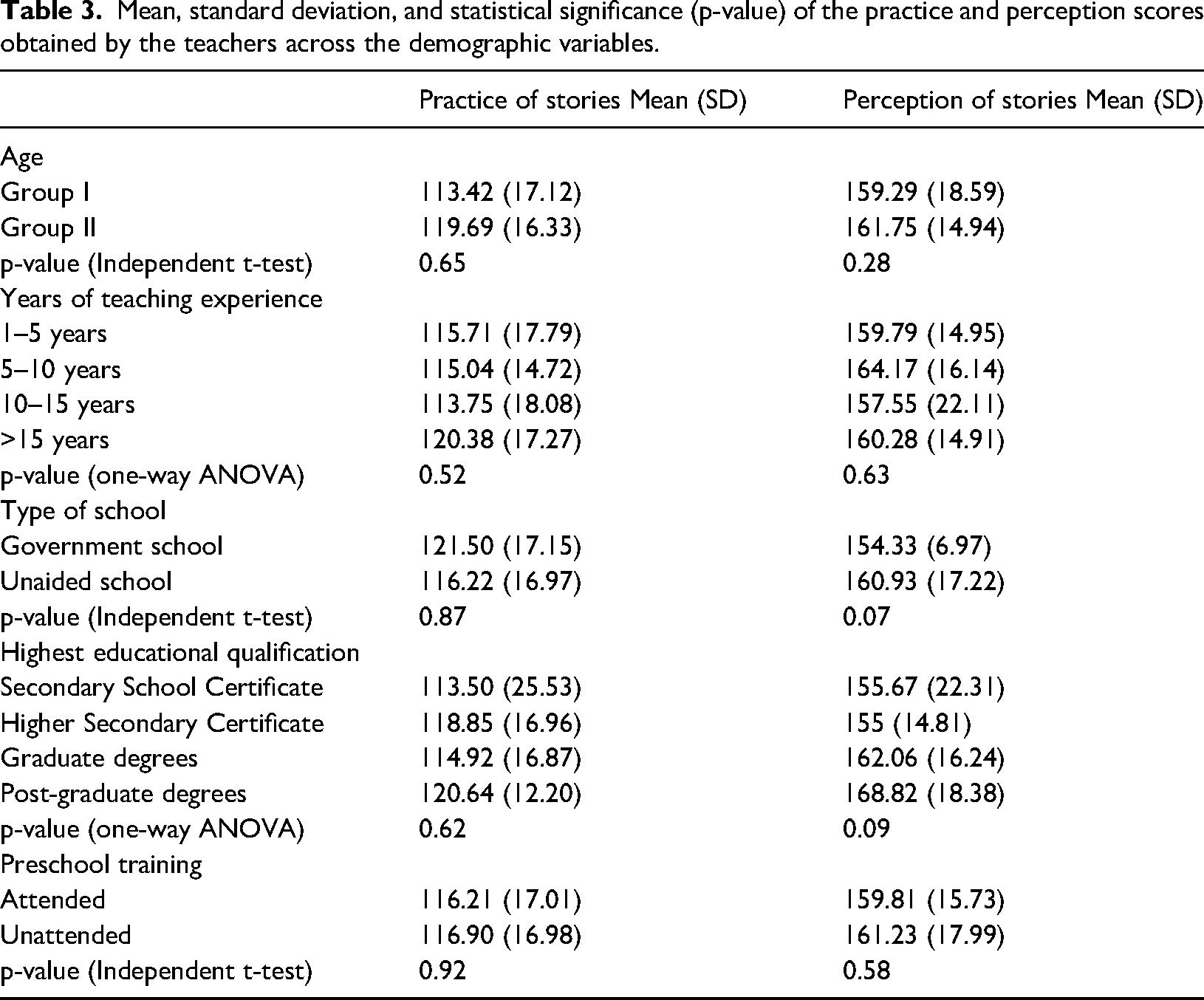
The practice and perception scores did not differ concerning demographic variables such as age, years of teaching experience, type of school, highest educational qualification, and preschool training (Table 3).
Mean, standard deviation, and statistical significance (p-value) of the practice and perception scores obtained by the teachers across the demographic variables.
Discussion
Teachers report on the practice of stories
The findings revealed that the majority of the Indian teachers preferred to narrate real-life stories in English, either with the help of picture storybooks or acting out stories. The real-life stories describe events in human real-life contexts, such as ‘A Day at Grandparents House’(Prasanna et al., 2021). The use of real-life stories contrasted with teachers’ practice in Myanmar, where they frequently used adventure stories and fables, believing these could capture the children's attention (Tin et al., 2013). These variations in teacher perceptions may be attributed to differences in educational curricula and cultural norms across countries (Rao et al., 2021). The increased use of real-life stories by Indian teachers may promote better learning opportunities in children as they are more relatable to real-life scenarios (Larsen et al., 2018). The prevalence of English language use in story narration can be attributed to the teachers’ employment in English medium schools, where there is an emphasis on using the English language in the curriculum.
The method of story narration preferred by the teachers was narrating stories to the child using picture storybooks, probably due to the benefit of dual-modality (Clark and Paivio, 1991) that can increase interest and attention allocation in learning (Gnjatović, 2014). Literature indicates that teachers believe in acting out stories and using pictures during the story narration, which is an effective strategy in teaching (Alkaaf, 2017). The least preferred method of story narration was to make up a story on their own for teaching preschoolers, which is in contrast with the findings of Tin et al. (2013), who found that around 70% of the teachers preferred to make up their own story with the help of pictures in Myanmar. This disparity suggests the flexibility and adaptability of Myanmar teachers in story creation, possibly influenced by the limited availability of storybooks in curricula or schools, which necessitates their reliance on creating their own stories (Tin et al., 2013). Similarly, the less dependency on making their own stories by teachers in the current study could be because of the availability of storybooks for teaching in Indian schools (Khurana and Rao, 2011).
The teachers actively engaged in activities during and after the story narration. They explained the concepts, highlighted cause–effect relationship, asked ‘Wh’ questions, drew inferences/conclusions, and reasoned story events to the preschoolers. Their active participation suggests that they adopt a comprehended style of narrator, prioritizing the explanation of concepts and drawing inferences from the story. This approach contrasts with describer style of the narrator, where the focus is primarily on labeling and describing pictures within the story (Haden et al., 1996; Scheiner and Gorsetman, 2009). However, it was also noted that they never or sometimes used prediction activities and asked children to make their own stories, contrasting with the findings of Tin et al. (2013). This might be because most teachers tend to prioritize using stories for teaching different concepts than using them as a cognitively stimulating tool.
According to the teachers’ reported purposes for story narration, it is clear that stories are primarily utilized as educational tools to impart moral values and enhance memory, speech, language, and thinking skills. They are less commonly used for entertainment or as a means to soothe or calm the child, indicating that they consider stories as an educational material than a material for enjoyment, consistent with Tin et al. (2013) and Gnjatović (2014).
The teachers’ observations of children's responses to stories suggest that the children enjoy listening to stories, often requesting more stories, and remaining less distracted. This may be attributed to the engaging and entertaining nature of stories, which can infuse an element of fun into the learning process (Borges and Vivacqua, 2010; Gnjatović, 2015; Setyarini et al., 2018; Tin et al., 2013). However, it was also noted that preschoolers are less engaged in asking questions and requesting to retell a story. One of the possible reasons could be that they have understood the story, as the majority of stories use real-life scenarios that are easy to relate to and may reduce the initiative to ask questions.
Teachers’ perception of the influence of stories on preschool child development
Similar to the practice of stories, teachers perceived stories as an educational tool essential in the preschool curriculum and that preschoolers like stories, as suggested in previous literature (Gnjatović, 2014; Tin et al., 2013). Regarding the frequency of story exposure, most teachers perceived that the story needs to be exposed to children from the age of two to three years daily, as compared to other age groups, which is in line with the reported story reading practice by Indian parents at home (Pandith et al., 2022). Teachers believed that presenting real-life events in a storytelling format benefits children. Additionally, they endorsed using pictures when narrating stories, whether in the mother tongue or English, which aligned with their reported practices in story narration.
The findings regarding the role of stories in preschool child development indicated that teachers believed that a story facilitates development across speech and language, cognition, literacy, and socio-pragmatic skills. Teachers firmly believed that stories are essential to preschool life, enhancing speech fluency, developing an interest in books, and promoting reading habits. Consistent with the research evidence, they confirmed that stories facilitated speech and language development by improving vocabulary acquisition, understanding word meanings and grammatical forms of language, promoting sentence-making skills, narrative skills, precise production of speech sounds, rhythm, intonation, and fluency of speech in agreement with earlier reports (Cremin et al., 2018; Lucarevschi, 2016; McGrath Speaker et al., 2004; Rahiem, 2021; Seng, 2017; Tin et al., 2013). The teachers believed that stories were rich with language resources (Seng, 2017) and provided communication opportunities (Sundin et al., 2018; Tin et al., 2013). The findings on the role of stories in literacy development indicated that teachers opined that stories are an essential element for academic achievement with considerable benefits in literacy skill development, in line with Zhou and Yadav’s (2017) observation. Teachers perceived that stories contribute to literacy development in children by promoting emergent literacy skills, interest in books, reading habits, confidence to learn, transfer of the learned concepts in everyday life, motivation to learn, efficient convey of learned concepts, and formal schooling preparation as evidenced in previous research (Gnjatović, 2014; Nicolopoulou et al., 2015; Seng, 2017; Yazıcı and Bolay, 2017). The cognitive benefits of the stories they perceived indicated that teachers confirm the literature evidence on the role of stories in cognitive development in children. They perceived that stories aid in paying attention, improving memory abilities, problem-solving abilities, moral values, creativity, reasoning and theory of mind, and understanding the logical sequence of events (Duinmeijer et al., 2012; Gnjatović, 2014; Seng, 2017; Tin et al., 2013).
Dyson and Genishi (1994) explained the socio-cultural benefits of stories, suggesting that children will be directed to each other and learn from each other through stories. The findings indicated that teachers also agree with the existing literature suggesting that stories aid in socio-pragmatic development of the child by helping in taking turns, learning the use of greetings, initiating conversations, understanding cultures, social themes (caring, helping, and empathy) to build the bond between the child and family members, to teach good behaviors and manners, promote cooperative learning, understand different forms of language (requesting, ordering, questioning), and aid in conveying the teachers’ message (Alkaaf, 2017; Seng, 2017; Tin et al., 2013).
Although most teachers opined positively about the contribution of the story to development, the slight disparity between the agreement and disagreement on statements related to other activity loads than narrating stories, increased story-structure understanding demand on preschoolers, and time consumption of storytelling revealed that nearly half of them found some practical limitations of using stories in teaching owing to workload and time constraints. Time constraints have also been reported as a concern by the teachers in story narration, story-based question activities, and general preschool education in literature (Alkaaf, 2017; Katoch and Johansson, 2021; Seng, 2017). Hence, it indicated that specific practical issues limited teachers’ effective use of stories, which needs to be addressed while implementing preschool programs. However, the findings indicated that knowing the benefits of stories in children, most teachers recommended using stories for teaching, preschool child development, assessments, and intervention in preschoolers.
Relationship between teachers’ practice of stories and perception of the influence of stories on preschool child development
The moderate correlation between the reported practice and perception of stories indicated teachers’ perception's critical role in influencing their practice of stories among preschoolers. The findings are consistent with the existing literature that teachers’ perceptions influence teaching practices (Hammett et al., 2012; Kalra and Baveja, 2013). However, contrary findings also exist, evidencing a mismatch between belief or perception and practice (Rentzou and Sakellariou, 2011). Literature reports that though teachers know the benefits of stories, they require professional training in narrative skills to efficiently use stories for child benefit (Seng, 2017). The lack of such capabilities might cause a mismatch between perception and practice (Seng, 2017), which could explain the reason for obtaining a moderate but not strong correlation in the current study. It was also observed that despite the teacher's positive perception of using stories to improve prediction ability (94%) and socio-pragmatic skill development (85%) in children, their practice regarding the same was found to be less frequent (40 and 52% respectively). This might indicate that teachers require training to effectively use stories as a cognitively stimulating and socio-pragmatic tool.
Teachers’ practice and perception concerning demographic variables
Exploring whether teachers’ practice and perception differ with respect to demographic variables indicated that teachers perceive stories as an essential part of preschool training, contributing to preschool child development irrespective of demographic variables such as age, years of teaching experience, type of school, and highest educational qualification and preschool training. These findings indicate that teachers equivocally support the use of stories and believe in the positive contribution of stories to preschool child development. These observations are supported by previous literature that witnessed no influence of the level of education (Hegde and Cassidy, 2009; Scheiner and Gorsetman, 2009), years of experience (Scheiner and Gorsetman, 2009), and training (Joshi and Taylor, 2005) on teaching practices. The findings of this study are in contrast with studies that evidenced the influence of factors such as level of education (Hammett et al., 2012), years of experience (Kalra and Baveja, 2013; Torres, 2017), and training (Wilcox-Herzog and Ward, 2004) on teachers’ beliefs and practices. The contrary findings could be because of the wide acceptance of the efficiency of stories in teaching and preschool child development by the teachers, irrespective of demographic factors.
In conclusion, this study provided insight into the Indian preschool teacher's practice and perception of stories on preschool child development. Irrespective of teachers’ demographic variables, they played an active role in telling stories to children and positively believed that stories facilitate speech and language, cognition, literacy, and socio-pragmatic development in preschoolers. The findings also implicate that Indian teachers require professional training, motivation, and encouragement to utilize stories as a cognitively stimulating and socio-pragmatic tool. In addition, the study offers a unique lens to understand how stories are integrated into educational practices and how teachers perceive its role in preschool child development in regions where multiple languages and diverse cultural backgrounds intersect. Stories are accepted and utilized as an effective tool for preschool child development by teachers despite cultural and linguistic variations. The novel questionnaire formulated in the present study can also be utilized as a self-feedback form for the teachers to introspect and self-reflect on their practices and perceptions. The findings of the current study relied on self-reported practices rather than direct classroom observations and were limited to closed-ended questions. Future research endeavors could benefit from incorporating classroom observations to gain a more accurate understanding of story narration practices. Additionally, utilizing open-ended questions may provide more in-depth insights. It is worth noting that securing teachers’ participation in questionnaire completion was challenging in the present study due to their busy schedules. Comparing teachers’ practice and perception with child outcomes and exploring the challenges faced while practicing story-related activities in preschool could also be explored in future research.
Footnotes
Acknowledgment
We acknowledge all the participants of the study.
Declaration of conflicting interests
The authors declared no potential conflicts of interest with respect to the research, authorship, and/or publication of this article.
Funding
The authors received no financial support for the research, authorship, and/or publication of this article.
