




Abstract
Internationally, professional bodies are increasingly recognizing a role for speech-language therapists (SLTs) in identifying and supporting students who struggle with literacy. Although some guidelines have been developed to support this work, little is understood about the overlapping, but distinctive knowledge bases claimed by SLTs and teachers with respect to reading instruction and provision of additional support to struggling readers. In this article, we report on a qualitative exploration of the experiences and perspectives of 25 professionals in Australia who are dually qualified as teachers and SLTs. The aim of this study was to understand the views from both professional perspectives about pre-service training and barriers and facilitators pertaining to literacy instruction and intervention. Paradigm differences in conceptualizing reading instruction and support, bi-directional knowledge of scope of practice, and employment barriers and enablers emerged as themes and are discussed with reference to implications for pre-service training and interprofessional practice in school settings.
I Introduction
When children master reading, spelling and writing skills in line with expected targets in the first three years of school, they are well-positioned for ongoing academic and social wellbeing at school (Catts et al., 2002; Spira et al., 2005) and beyond (Smart et al., 2017). However, this is an advantage that is conferred unevenly within and between early years classrooms. Estimates vary, but around 30% of children will experience reading difficulties (Hempenstall, 2013) and a significant proportion of these have an underlying language disorder, whether diagnosed or not (Snowling et al., 2016). Consequently, the role for speech-language therapists 1 (SLTs) in conventional literacy development (reading, spelling and writing) and remediation has expanded considerably in recent years.
Many speech-language therapy professional bodies globally have affirmed the role of SLTs working in the literacy domain, given the intimate relationship between acquiring oral language and learning to become literate (ASHA, 2001; New Zealand Speech-Language Therapists’ Association, 2012; Speech-Language and Audiology Canada, 2016; SPA, 2016). However, SLTs are not typically trained in curriculum design and delivery or classroom management. Conversely, teachers possess curriculum and classroom management knowledge and expertise, but have been shown to possess variable knowledge and expertise regarding oral language development, together with low knowledge of the language constructs that underpin the transition to literacy (Binks-Cantrell et al., 2012; Stark et al., 2016; Washburn et al., 2016, 2011; Wilson et al., 2015). These disciplinary demarcations sit alongside historic tensions in how children should be taught to read (Castles et al., 2018) and differing epistemological foundations between education and speech-language therapy as professions (Snow, 2016). Speech-language therapy is an allied health profession, and as such, draws on theory and practice strongly informed by empirically derived scientific evidence in a medical tradition. Historically this has been in a positivist paradigm, but in recent years, rigorous qualitative research has also been promoted in the profession (Hegde and Salvatore, 2020). By contrast, as noted by Moats (2010, p. 12), ‘Unfortunately, lack of rigor and respect for evidence in reading education are reinforced by the passivity of education leaders who feel that any idea that can muster a vigorous advocate is legitimate and deserves to be aired.’
The role of the speech-language therapist (SLT) in supporting the teaching of literacy across Response-To-Intervention (RTI) tiers has become a more prominent focus with respect to scope of practice in recent years (ASHA, 2010; SPA, 2016). Embraced by SLTs but yet to be widely adopted by schools in Australia (SPA, 2016), RTI is a comprehensive, three-tiered model that supports close monitoring and an early intervention approach to students’ learning difficulties and problem behaviours using evidence-based approaches (Fox et al., 2010). Its critical features include robust Tier 1 instruction, universal screening, ongoing progress monitoring, evidence-based interventions and supports, data-informed decision-making, and fidelity of program or support implementation (Fox et al., 2010). A successful RTI program is dependent upon best-practice at Tier 1 (whole class instruction), in order to prevent excessive numbers of students unnecessarily requiring Tier 2 and 3 supports (Richards et al., 2007).
The adoption of RTI has occurred alongside important developments in the education-SLT interface in recent years. Firstly, there has been a move away from the pull-out model (Beck and Dennis, 1997; SPA, 2016) in favour of SLTs providing consultations to school staff and/or working directly in classrooms, rather than working one-to-one outside the classroom (SPA, 2016). Secondly, the content of initial teacher education (ITE) in the domain of reading instruction and intervention over the last four decades has left many teachers without the requisite knowledge and skills to teach all students to learn to read and to provide additional supports to those who struggle (Buckingham and Meeks, 2019; Meeks and Kemp, 2017; Meeks and Stephenson, 2020; Meeks et al., 2020; Kurtz et al., 2020). Limitations in ITE with respect to preparing preservice teachers about reading instruction are generally attributed to the hold of whole language and balanced literacy ideologies and pedagogies in education faculties in English-speaking nations since the 1980s (Seidenberg, 2017). Wider-scale adoption of the RTI framework within education is therefore likely to depend on the phasing out of such approaches, which are typically not aligned with robust Tier 1 instruction and evidence-based interventions in Tiers 2 and 3.
In New Zealand, Wilson et al. (2015) demonstrated that pre-service teachers were unable to correctly identify half of the relevant reading-related linguistic concepts. In Australia, Stark et al. (2016) reported similar findings, demonstrating that teachers’ explicit and implicit knowledge of basic linguistic constructs was limited and highly variable. Teachers were most likely to rate their ability to teach skills including spelling, phonics, comprehension and vocabulary as either ‘moderate’ or ‘very good’ despite most participants demonstrating limited knowledge of concepts such as sound segmentation and morphological awareness.
The linguistics knowledge of SLTs has also been investigated in relation to early reading constructs. Spencer et al. (2008) found that SLTs significantly outperformed educators (teachers) on a range of sound identification and segmentation tasks and Carroll et al. (2012) demonstrated SLTs consistently performed at or close to ceiling on phonological awareness tasks. Spencer et al. also found that SLTs consistently performed better than educators on all phonemic awareness tasks, however, their performance was variable and not all SLTs demonstrated the expected level of proficiency, which was ceiling. Given the limited focus on developing knowledge of phonemic awareness, phonics and reading instruction more broadly during teacher training (Meeks and Stephenson, 2020), growing SLT expertise in language and literacy assessment, diagnosis and intervention makes an increasingly compelling case for their inclusion in supporting instruction and intervention in schools.
Tensions in the teacher-SLT working relationship were reported in the United States late last century (Beck and Dennis, 1997). Key challenges identified by SLTs concerned barriers such as: having limited access to students in their classrooms; curricula that failed to reflect the importance of language and literacy programming, and poor fidelity in teachers’ implementation of oral language and literacy instruction in the classroom (Ehren and Ehren, 2001; Fallon and Katz, 2011; Tambyraja et al., 2014). Challenges noted by teachers in working with SLTs included that SLTs are seen as aligned with a medical model, strongly grounded in empirical sciences and in particular, cognitive psychology, while teachers identify with an educational framework that for many years, has been aligned with social constructivism associated with Piagetian and/or Vygotskian theories (Carter and Wheldall, 2008; Foorman, 1995). Teachers have also described a lack of support from SLTs when attempting to implement oral language and literacy goals in the classroom and have reported that SLTs can be reluctant to relinquish ‘expert status’ (Achilles et al., 1991; Beck and Dennis, 1997; Creaghead, 1992; Russell and Kaderavek, 1993).
Given these tensions, practitioners who are dual-qualified as SLTs and teachers may provide unique insights regarding these paradigm differences, due to their experience in both roles. We therefore sought to explore the opinions and experiences of these professionals regarding (1) their preservice preparation to work on reading with students in the school context, and (2) how being dual-qualified practitioners influences their practice in the education setting.
II Method
1 Recruitment
The La Trobe University Human Research Ethics Committee approved this study. Participants were recruited via social media using an Expression of Interest (EOI) flyer and snowball sampling as defined by Noy (2008). Snowball sampling involved asking participants to send the flyer to colleagues within their networks who they deemed to be suitable for inclusion in this study. To be eligible, potential participants had to be dual-qualified to work as a teacher and/or an SLT and had to have experience working in the education sector in Australia, either as a teacher, an SLT, or both. There were no restrictions on the order of completion of qualifications or the time worked (or not) in either discipline.
2 Participants
Twenty-five participants (all female) were recruited from seven of Australia’s eight states and territories. Participant characteristics are outlined in Tables 1 and 2. Those who initially qualified in teaching worked as teachers for a mean of 9.6 years (range = 0–27; SD = 6.8) compared to those who initially qualified in SLT, with a mean of 7.8 years (range = 0–33; SD = 8.3). Two participants moved from one degree to the next without working in their first field. In contrast, four participants re-trained between two and three decades into working in their first profession. The median number of tertiary qualifications for the sample was 2.8 (range = 2–6). In addition to teacher and SLT training, two participants had completed a PhD, and one was partway through PhD studies. Nine participants held qualifications from graduate certificate level through to masters level, beyond teaching and SLT qualifications.
Participant qualifications, years of work and professional identity.
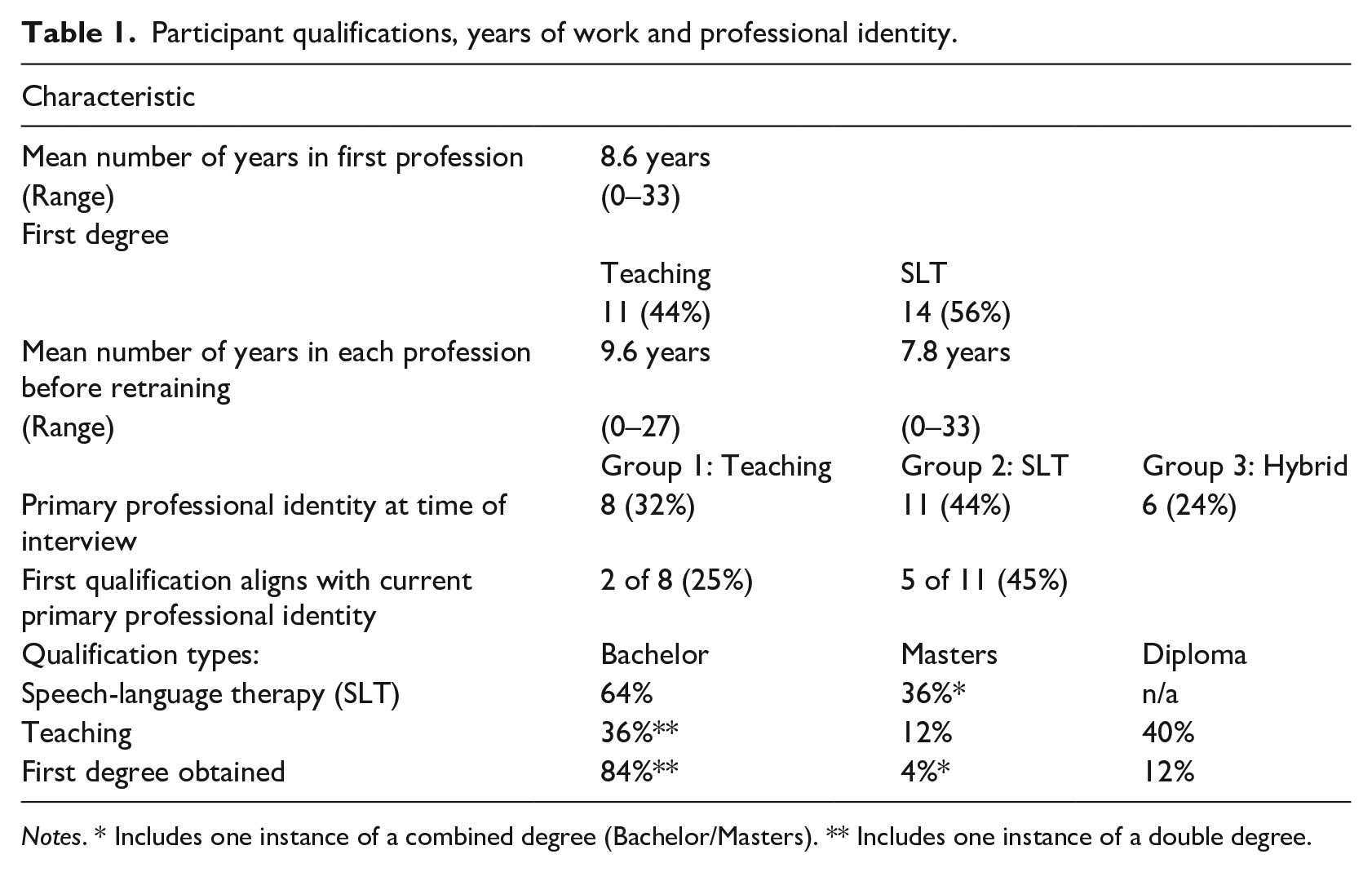
Notes. * Includes one instance of a combined degree (Bachelor/Masters). ** Includes one instance of a double degree.
Participant training sequence, current role and professional identity.
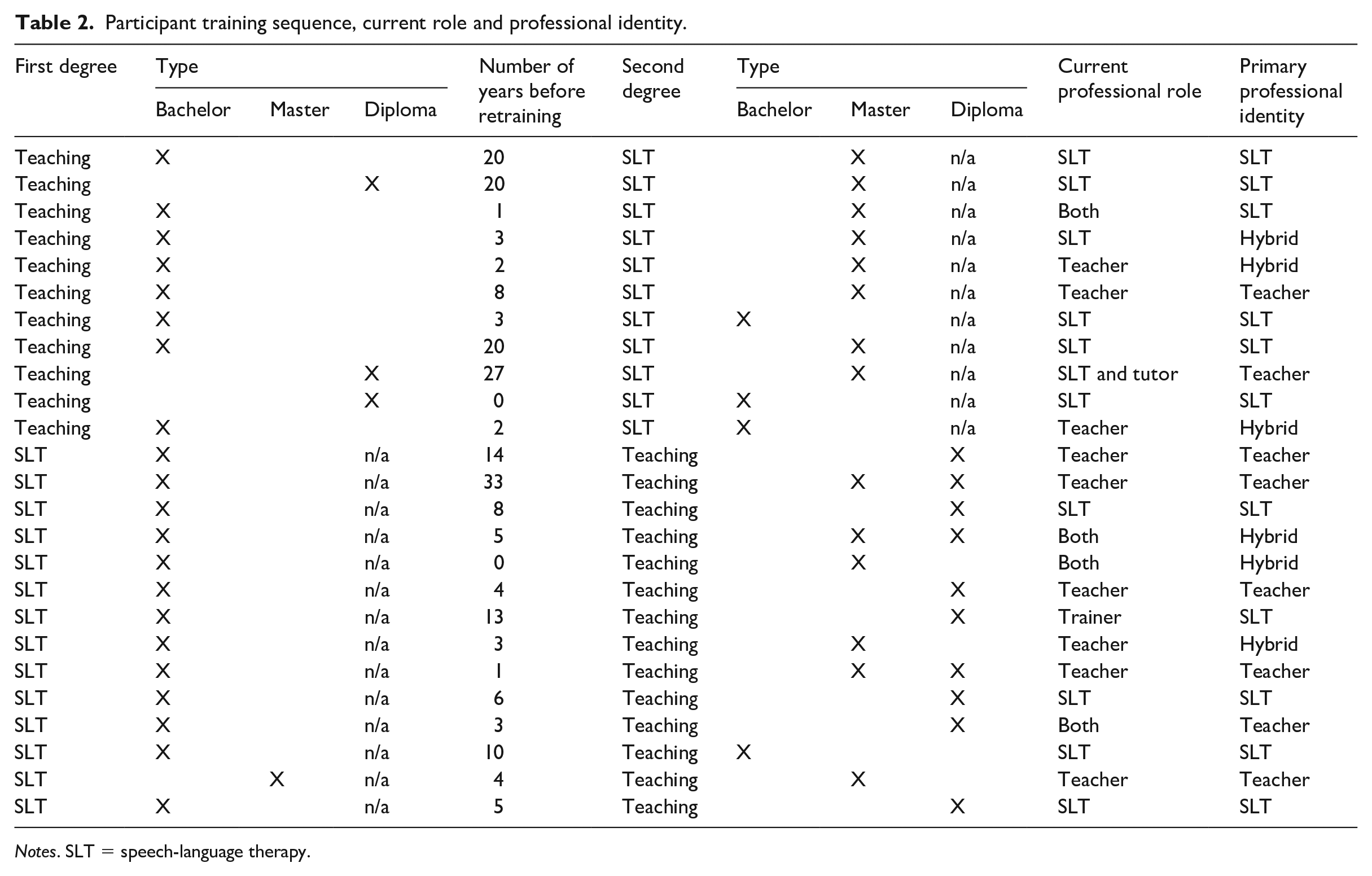
Notes. SLT = speech-language therapy.
3 Methodological framework
This study adopted an interpretative phenomenological analysis (IPA) as the theoretical framework. IPA is ‘concerned with the detailed examination of personal lived experience, the meaning of the experience to participants, and how participants make sense of that experience’ (Smith, 2011: 9), with the view to capturing cognitive and affective reactions to experiences in as much detail as possible. An IPA approach is intended to provide more in-depth analysis than an inductive approach, which often focuses only on finding themes relevant to the research objective rather than describing the impacts of the studied phenomenon on participants lives (Alase, 2017).
4 Interviews
Data was collected via individual semi-structured interviews conducted by the first author. An interview guide was developed by the study team, following a review of the literature and consultation with identified education and SLT experts. The final version contained 22 probes. Participants were interviewed individually by the first author via virtual live (online) technologies (n = 10), telephone (n = 14), or in person (n = 1). While participants were interviewed individually, they were subsequently assigned to one of three naturally occurring groups according to their current self-described professional identity (teacher, SLT or hybrid respectively) as reported in Table 1.
The mean interview length was 52 minutes (range 30–75; SD = 11). Interviews were audio-recorded for later transcription and analysis. Participants had the opportunity to read and amend their transcripts prior to analysis. Eight participants took up the opportunity to review their transcripts, and three made changes with respect to wording and sentence structure.
5 Ensuring rigour
Several steps were taken to minimize bias in the collection and analysis of data. We consulted with experienced teachers, SLTs, dual-qualified practitioners and academics in both disciplines to refine the interview probes to ensure that we could capture rich content pertinent to our exploratory study. This guide was used with all participants to ensure as much consistency as possible in the context of semi-structured interviews. The interviewer adhered to Patton’s (2002) concept of empathic neutrality to maintain a balance of impartiality along with a deep connection and interest in participants’ comments.
The first author, who has qualifications in speech-language therapy, adolescent counselling, youth mental health (psychiatry), and public health, conducted the interviews and led the analysis of data. She acknowledges that her training and/or professional experience in these domains likely creates certain perspectives and biases, as does her experience of working in schools and in educating pre-service and practicing SLTs and teachers about language and literacy. This risk of bias was managed through regular consultation with the second and third authors, consultation with independent experts as detailed above, and additional steps during analysis as detailed below.
Given this study is the first of its kind, we had no clear a priori sense of what would be reported but expected a range of views and experiences to emerge. We responded to the data by analysing it in a methodical manner, in line with established recommendations for qualitative analysis (Braun and Clarke, 2006).
6 Analysis
Prior to commencing the analysis, the first author cross-checked transcription accuracy while listening to the audio recordings, then a research assistant, who was independent of the study, read all transcripts to check that questions were asked and answered in a consistently neutral manner. Transcripts were then analysed thematically following the six steps in qualitative analysis, as outlined by Braun and Clarke (2006). These six steps were data familiarization (reading, re-reading, immersion), coding (generating labels for important data features and sorting content accordingly), initial theme generation (examination of codes to identify broader ideas, meaning and patterns), theme consolidation and review (cross-checking themes with data, refining and combining themes including subtheme development), naming themes in ways which reflect their scope and focus, and finally, writing up the themes. Hard copy transcripts as well as NVivo 11 were used. Coding was guided by the general and explicit content of the data (inductive and semantic coding) as well as the reality apparent in the data (realist coding), consistent with definitions and guidance provided by Braun and Clarke (2006) and Silverman (2016). Sections of text were highlighted on the hardcopy transcripts as well as in the NVivo 11 program, and initial codes were then applied. Codes were then sorted to identify potential themes in the data, and themes continued to be refined until the result was two main themes with various subthemes or categories.
The second and third authors cross-checked the coding protocol (as detailed above), verified themes, and provided feedback about accuracy and coherence for approximately 20% of the total sample. After the draft manuscript was written, the first author completed a further audit of quotes used to ensure an even representation with respect to number of times a participant was quoted, current role, primary professional identity, years of experience, and the sequence in which qualifications were obtained.
III Results
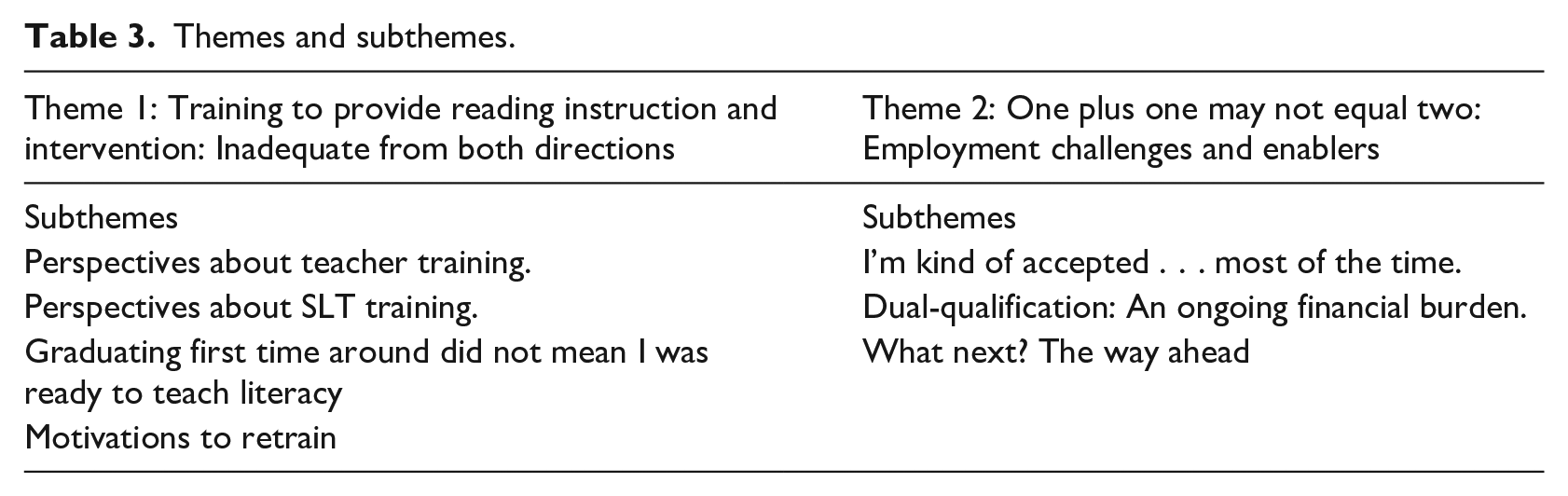
Consistent with qualitative research recommendations (Glaser and Strauss, 2017) using generated interview data, our sample size was large enough to gain deep insights regarding our research questions, and for thematic saturation or informational redundancy (Braun and Clarke, 2019) to be reached. Two key themes and related subthemes were identified following analysis of perspectives from our 25 dual-qualified participants. The key themes were pre-service inadequacies in both qualifications, and employment challenges and enablers; for further details, see Table 3.
Themes and subthemes.
Theme 1: Pre-service inadequacies for both qualifications
a Perspectives about teacher training
Participants were unanimous in their view that preservice teaching content on reading development, assessment, instruction and intervention was inadequate, limited and, for some participants, virtually absent. They noted that content they did receive was unhelpful, vague or non-evidence-based, and that little or no time was devoted to teaching preservice educators how to actually teach students to read. For participants who had studied teaching first, these insights often arose as a result of subsequently completing their degree in SLT. They overwhelmingly reported that as new graduate teachers, they felt ill-equipped and underprepared to assess and teach reading at the classroom level and to support students experiencing difficulties learning to read. To demonstrate, P17 (Group 3), stated: ‘The information in my teaching degree gave me absolutely nothing . . . there were no specifics on how to teach reading, what reading would look like in a classroom setting, how you’d intervene . . .’ while P5 (Group 1) made the comment that her preservice teacher training was ‘. . . grossly inadequate’. P19 (Group 2) said: ‘If you say ten is perfectly prepared and zero is terrible, I would say close to zero. Between zero and one.’ P3 (Group 3) said she found the ‘. . . hands-on experience was key . . .’ rather than the theoretical content as it ‘. . . taught me a lot about the different resources and how to implement them in the classroom’. Some participants mentioned that the training they received about how to teach reading was ‘. . . very whole language . . .’ (P5, Group 1) and did not allow for preservice teachers to explore the ‘reading wars’ to the extent that she recalls the messaging ‘Oh no, we don’t do phonics, we don’t do sounds . . . phonics programs and decodable texts are dreadful, boring.’ Her comments align with P6 (Group 2) who noted that she was not taught about the ‘Big 5’ components (phonemic awareness, phonics, vocabulary, fluency, and comprehension) for comprehensive reading instruction as documented by the National Reading Panel (2000), and that overall, ‘. . . it would’ve helped to know a lot more about . . . what is evidence-based literacy instruction.’ Narrowness of the preservice teacher training was also reflected on by P5 (Group 1) who noted ‘I couldn’t write what I wanted to write in essays because I knew it was totally against the pedagogy of the university.’ In contrast to what many participants viewed as restricted coursework about teaching students to read, P18 (Group 1), who had trained as an SLT first, did in fact describe a scenario reflecting a more open stance about the science of reading from her lecturer who ‘. . . found out that I [P18] was a speech therapist and I actually ended up giving a lecture on phonological awareness . . .’ Despite the apparent openness of her lecturer, it deepened P18’s lack of confidence in the skill-base of those delivering her training.
b Perspectives about SLT training
With respect to SLT preparation to work in the literacy domain, participants’ responses were more diverse although still reflecting a somewhat limited and restricted view about the quality of the content they received about working with students on literacy (reading. The focus of course content was described by many as referring mainly to early or pre-reading skills and did not extend beyond this point. This is exemplified by P8 (Group 1) who said ‘It taught me all the precursors to effective reading instruction . . .’ while P1 (Group 2) noted ‘. . . it kind of felt a little bit . . . underdone . . .’ Participants reported that course content about literacy assessment and intervention had historically not been part of an SLT degree, but in the past five to ten years, more SLT courses have begun incorporating such content. Nevertheless, there was a clear sense that their SLT degree could not and did not prepare them to work in school systems or to practice within the frame of school curricula. P6 (Group 2) described this clearly: ‘I really think [we needed] exposure to the classroom environment . . . perhaps some time participating and being part of a classroom and shadowing a teacher.’ In contrast to ITE, whereby participants all had experience in early years classrooms, many noted that literacy-focused and/or school-based clinical placements during their SLT training were not guaranteed.
Regardless of the sequence of attaining their qualifications as an SLT and teacher along with their current employment status, participants were united in relying heavily upon their SLT training to inform their assessment and teaching of core literacy skills. P1 (Group 2), who qualified first as a teacher, noted that her ‘. . . practice of teaching reading now [as an SLT] is very much explicit and follows . . . in terms of decoding, phonics, what the National Reading Panel suggested all those years ago . . .’ Participants explained this reliance on their SLT training resulted from having a firm knowledge base in phonetics, phonology, phonemic and phonological awareness, semantics and syntax (and phonics for those who had studied literacy within their SLT training). Additionally, training about language development and expected language milestones was also perceived as instrumental to their teaching practice in the literacy domain. P1 (Group 2) said ‘I very much changed my tune . . . my practice of teaching reading is now very much explicit . . . [knowing] they [language and literacy] go in tandem but they’re taught separately . . . [knowing] that is not my teacher training, that’s my speech therapy study’ and P2 (Group 2) said ‘I have a better understanding of the . . . skills that kids are missing.’ P5 (Group 1) reported, ‘I see myself as a teacher using the knowledge of language gained from my speech therapy. I haven’t gained that knowledge from teaching, from teacher training.’ She went on to say, ‘I think I still think like a speech therapist, and I work as a teacher. And there is a difference.’ Participants also reported that learning how to apply various therapeutic principles in SLT preparation (such as task analysis, explicit teaching, modelling and stepped scaffolding) was useful to them as teachers. For example, P4 (Group 1) stated that she was able to ‘. . . differentiate (that’s a teaching word) but you step-up, step-down, being able to give a child structure and feedback’.
c Graduating first time around did not mean I was ready to teach literacy
Many participants reported a need to undertake additional literacy professional development upon graduation, especially those who had studied teaching first. To demonstrate, P5 (Group 1) noted that ‘. . . Professional development has been a far stronger influence than my actual training’ and P10 (Group 3) added that professional development ‘. . . has influenced my knowledge and skill enormously’. This additional professional development was often at personal expense but was described as key to developing participants’ perceived confidence and skills to work in the literacy domain. Several who studied teaching first also indicated that completing their SLT degree felt like an extended form of professional development. Nevertheless, caution about the quality of professional development was emphasized by P5 (Group 1) who stated ‘There’s some fairly dodgy professional development that’s going on that a lot of teachers go off to and come back all very excited about these concepts that aren’t particularly evidence-based.’ Those who had studied SLT first felt their knowledge of language and literacy was an adequate foundation for the teaching of reading, and that their teaching degrees prepared them for understanding how to work in classrooms and how to use a curriculum.
d Motivations to retrain
In each group, several participants described a benefit to their competencies from having undertaken the second qualification. SLTs who then qualified as teachers tended to be motivated by the capacity to be more fully immersed in their education settings. For example, P5 (Group 1), wanted to be ‘. . . part of the system of the school more’ while P7 (Group 2) was ‘. . . looking to understand a teacher perspective to see how speech therapy-teacher collaboration could be more effective’. It is P19 (Group 2)’s comment that exemplifies the drive to enhance her SLT practice by gaining knowledge about the authentic experience of being a teacher. She said: ‘I thought it would be helpful, from a speech therapy point of view, to better understand the curriculum and the expectations around learning of language and literacy in a primary school, so that I could be better at programming as a speech therapist.’
Teachers who retrained as SLTs, were more likely to view the second degree as a new career path. The comments by teachers who became SLTs typically seemed to reflect frustration and low self-efficacy for teaching reading combined with an aspiration for professional knowledge perceived as missing from their teacher training. Some were keen to move into a more specialized role outside of the classroom. High school teacher P8 (Group 3) noted that she ‘. . . was increasingly frustrated with the levels of low literacy that were coming through in those teens. I contemplated what I could do to skill myself up to better equip myself to work with them. That’s how I ended up in speech therapy ’ and newly graduated primary school teachers P14 and P7 (both Group 2) respectively reflected that they ‘. . . really struggled as a new grad in teaching, feeling really ill-equipped to deal with kids who were struggling in literacy. I felt I didn’t have the tools to help them so that propelled me to leave teaching . . . to fill those gaps and that that there is more that I can be doing.’ (P14) and ‘I never felt like I was doing a good enough job as a teacher because I think I could always see a better way of doing it but as a new graduate I just didn’t have the skillset’ (P7). That said, P5 (Group 1), who was initially an SLT, also expressed her frustration with her original role as a visiting clinician as her motivation for training as a teacher. She was: ‘. . . working in that model of being the therapist who visits one day a week, sees children for half an hour, tries to catch the teacher to have a chat about what you’re doing, and possibly not even seeing the parents. I did get a little frustrated . . .’
Eleven participants felt the sequence of attaining both degrees mattered to their perceived competence to teach reading. The remaining 14 participants were neutral. The 11 participants; five who were initially trained as teachers, all agreed that SLT training should come first. This view was held in light of their experiences of inadequate training in their teaching degree and because SLT training included the essential knowledge foundations. P2 (Group 2) said, ‘[if you do] speech therapy first, you might go in with a much more informed idea for your teaching qualifications’ while P9 (Group 1) said, ‘I think when you are first taught how to teach a child to read and spell, and the more you practice it, that can become . . . entrenched and it can be difficult to shift your mindset and change. I would think that if you learned . . . speech therapy . . . first, it would set you up for more effective teaching of reading and spelling.’ Primary teachers were most likely to hold this perspective. Three participants believed the sequence did not matter as both skillsets ‘come together in the end’, and it is more about work experience and workplace, than qualification sequence.
Theme 2: One plus one may not equal two: Employment challenges and enablers
a ‘I’m kind of accepted . . . most of the time’
Individual professional relationships and the culture within a school were described as the major determinants of how well participants felt accepted, particularly when working as an SLT. Many participants described the benefit of being dual-qualified to facilitate trust and rapport with their singly-qualified colleagues. P1 (Group 2) felt she was viewed as having credibility and value for the insights she could offer as a dual-qualified teacher-SLT. She said: ‘. . . when I’m giving advice to teachers about how to accommodate these kids, it comes from that knowledge-base that regular speech therapists don’t have; how classrooms work and differentiation . . . teachers really like that and schools . . . appreciate that far more than they would a speech therapist coming in and telling them what they should be doing.’ P2 (Group 2) described a greater sense of validity in her work being dual-qualified in situations where teachers may feel that the SLT is coming from a purely clinical perspective. Her capacity to let teachers know that she too was ‘a teacher for 20 years’ provided her with the opportunity for teachers to identify and trust her more than a regular SLT. Conversely, P10 and P17, both from Group 3, noted a greater reliance on the individual school circumstances; particularly at the level of leadership. P17 summarized this phenomenon in her statement: ‘I really think it depends on the climate of the school and the leadership and the openness of staff. You need that for it to be successful.’
Another complication referred to by some participants was the ethical dilemma faced when working at a school whose theoretical framework for reading instruction and intervention clashed with their own knowledge about the importance of adhering to evidence-based practices: P6 (Group 2) said, ‘I find it particularly challenging when I am recommending particular programs that are evidence-based or resources and they’re not received positively or they can be quite openly quashed in their professional conversation.’ P22 (Group 2) said, ‘You feel like you’re having to argue all the time for your case.’
b Dual-qualification: An ongoing financial burden
Most participants did not receive increased financial remuneration as a dual qualified practitioner. In fact, the reverse occurred for some participants as P16 (Group 1) described: ‘Monetarily, I’ve dropped significantly’ as she went ‘. . . from an experienced teacher salary to a graduate speech therapist salary.’ P6 (Group 2) expanded on this phenomenon by noting that when she commenced her first job as dual-qualified: ‘Experience isn’t considered for salary purposes. You’re not regarded as having any additional knowledge or skills. You’re still regarded as entry-level . . .’ This was despite the fact the as a dual-qualified teacher-SLT, she arguably brings ‘a lot of skills . . . over and above what they’d expect of a new graduate in speech therapy or teaching’. At a personal level, participants reported that returning to an entry-level salary was challenging, given that many had several years’ work in one profession before re-training. Many also noted that maintaining two professional registrations added to the cost burden of dual qualifications.
Current employment rules within Australian education systems require professionals to be employed as a teacher or an SLT, but do not specifically accommodate both. Two participants reported working in positions which were hybrid roles, but employers had offered them remuneration in the field in which they had the least years of experience, in order to minimize the cost of their salary. P2 (Group 2) actually felt overlooked for a job as a newly qualified SLT at a school because ‘as a qualified teacher they’d have had to pay me at my teaching rate, not at the new grad speechie rate . . . and because I was at the top of the teaching tree . . .’ For a few participants, it was only through pursuing leadership positions in literacy or school governance that they felt they were appropriately remunerated for their dual skillset.
c What next? The way ahead
There was wide support for a greater shared understanding between teachers and SLTs which would be ‘. . . helpful to productive work in schools in an ongoing way.’ (P7, Group 2) and as P2 (Group 2) noted ‘I think it would be really good if we each knew what the other knew.’ However, looking ahead, participants offered practical suggestions to bridge the theoretical divide so that SLTs and teachers are ‘coming from the same evidence-base we would then not be fighting . . .’ (P2, Group 2) with proposals including a shared single subject or even multiple shared subjects at university. In fact, P3 (Group 2) suggested ‘There should be a degree that is both.’
IV Discussion
This study is the first of its kind to provide the unique perspective of professionals who have trained and/or worked across both teaching and SLT practice in school-aged literacy. Overwhelmingly, participants regarded teaching degrees in Australia as inadequate preparation for effectively teaching reading. Participants were highly critical in their descriptions of a limited or non-existent focus on evidence-based reading instruction in their teaching degrees. While SLT degrees were described as variable with regard to the amount of preparation for SLTs to work effectively in schools, all participants reported they received critical foundational knowledge in linguistic concepts and principles of evidence-based practice, even if their course did not adequately cover literacy or working in schools. All participants reported that they relied upon their SLT training for linguistic concepts in teaching reading and spelling, regardless of the sequence in which they trained. Those who had trained more recently in SLT reported adequate preparation in the area of literacy and more school-based opportunities for clinical placements, however these are not necessarily guaranteed at pre-service level. It appeared in some cases that an SLT degree prepared or even over-prepared participants for the language and literacy components of a teaching degree, with one participant being asked to deliver course content to her peers in place of her lecturer.
Despite the relatively even split in the sequence in which initial qualifications were obtained, more participants identified as SLTs than they did as teachers or as ‘hybrids’ (a sense of being both equally). This did not necessarily mean they were working in roles that matched their chosen professional identity. Participants reported wrestling with professional identity, often feeling neither like a ‘proper’ SLT nor teacher amongst their peers. An added challenge was working in schools knowing what constitutes best-practice according to current evidence, but not being able to provide it, due to the prevailing culture or approach of the school. Some held to their original professional identity despite retraining, some changed their professional identity once they had re-trained, and others harmonized the two professional identities, labelling themselves as hybrids.
Participants’ unique dual-qualified skillset does not yet appear to be systematically valued and utilized by schools, perhaps because dual qualifications are acquired in an ad hoc manner, rather than through formal dual-degree channels. In terms of workforce capacity-building, school leaders will need support to fully leverage what these dual-qualified professionals have to offer, and to recognize their knowledge and skills with fair and appropriate positions and remuneration.
We are not aware of any previous study that has investigated the experiences of dual-qualified SLT-teachers. However, themes identified do lend some support to previous research in a number of ways. Participants reported a heavy reliance upon knowledge obtained in their SLT degree regardless of the sequence in which they had trained. These reports support the presence of a knowledge gap between SLTs and teachers, described by Spencer et al. (2008), Carroll et al. (2012), Wilson et al. (2015), and Stark et al. (2016). All participants reported that the content of their teaching degrees was inadequate preparation for literacy teaching, which is consistent with findings by Meeks and Kemp (2017), Buckingham and Meeks (2019), Kurtz et al. (2020), Meeks and Stephenson (2020) and Meeks et al. (2020) about the shortfalls in initial teacher education. Arguably, more needs to be done to better prepare teachers for the teaching of literacy, which in turn can close the knowledge gap between teachers and SLTs, likely allowing for more effective instruction, intervention and collaboration in school settings.
1 Limitations
Given the size of the dual-qualified workforce in Australia is unknown, it is impossible to say how reflective this sample is. We were able to document the views and experiences of a portion of dual qualified teachers and SLTs in their specific contexts. We sought to overcome the potential limits of this by providing a detailed description of our participants, so that readers can determine the degree of transferability of our findings to their own context.
2 Future directions
Changes to preservice education in both professions could ensure that teachers and SLTs are better and more equitably prepared to work in the domains of language and literacy in schools, and that they know how to effectively work together. Developing shared course content at undergraduate or postgraduate levels, either as stand-alone subjects or in combined degrees will be an important step in this process. Postgraduate pathways open to teachers and SLTs to enable them to develop genuinely shared content knowledge and expertise in language, literacy and learning, and curriculum should also be explored.
A larger-scale international study should be considered, as this study included only Australian practitioners. It would be of value to understand how many professionals are dual-qualified as teachers and SLT nationally and internationally. Understanding the views of principals and literacy leaders regarding working with and employing dual-qualified professionals would augment our understanding of key barriers and facilitators concerning development of this workforce segment going forward. It will be helpful in future studies if experiences of dual-qualified practitioners are explored in relation to supporting students who are struggling with reading.
V Conclusions
Professionals who are dual-qualified as teachers and SLTs are a small, and largely invisible subgroup in the education workforce in Australia. In this study, they provided a unique opportunity to understand the experiences of working in one role but having qualifications in both. Participants’ perceived concerns about shortfalls in pre-service training in both professions (more so in teacher pre-service training as this pertains to the important topic of reading instruction) are significant. Our findings describe the challenges and barriers to working effectively in schools, the benefits and burdens of ‘wearing both hats’, and proposed ways forward. Participants also reported challenges in finding roles in which they are appropriately remunerated, and valued by others given their unique skill sets, as they navigate sometimes complex terrain, being pulled in the different directions imposed by expectations of each profession. Moving forward, students in both professions should be adequately prepared to work in school settings. They should also be taught about the complementary nature of teacher and SLT roles and skillsets in order to maximize collaborative and effective instruction and intervention in school settings.
Footnotes
Acknowledgements
We acknowledge the time and the commitment given by our participants to share their insights and experiences as dual-qualified practitioners.
Declaration of conflicting interests
The author(s) declared no potential conflicts of interest with respect to the research, authorship, and/or publication of this article.
Funding
The author(s) received no financial support for the research, authorship, and/or publication of this article.
