




Abstract
In this study, our purpose was to establish a shared definition of collaboration for use by speech-language pathologists (SLPs) and educators during literacy instruction for school-age students. To help build our definition, we conducted a principle-based concept analysis of peer reviewed publications in the context of school-based SLP-educator literacy instruction. Using a systematic search strategy and article selection process, we identified 13 articles for analysis to inform our definition. Our analysis identified several characteristics of SLP and educator collaboration for literacy instruction. However, authors were quite varied in how they defined, described, and used the term collaboration. Joint planning and delivery of literacy instruction and attributing actions to a specific professional were the only consistently reported characteristics. The only regularly reported precondition for collaboration to occur was having discipline-specific knowledge to contribute. Outcomes primarily focused on student benefits. The most prominent feature differentiating collaboration from bordering concepts was that collaboration involves the joint actions of two or more professionals working together. Given this variability, our analysis indicates that collaboration is an emerging concept in the education and speech-language pathology literature. We offer a definition of collaboration that reflects a shared disciplinary understanding of the concept by making all the characteristics of collaboration explicit. Our definition will support application of collaboration by SLPs and educators for literacy instruction in their unique settings. Our definition will support researchers’ systematic investigation of collaboration to strengthen the knowledge base that informs practice and serve to advance concept maturity.
Literacy and academic achievement among students with diverse language abilities is supported through evidence-based literacy instruction (Botting, 2020; Moats, 2020). Such instruction is informed by the Reading Rope framework, which highlights that skilled reading emerges from the development and use of strong language comprehension and word recognition skills (Moats, 2020; Scarborough, 2001). To support literacy achievement, all components of the Reading Rope must be considered for integration into a comprehensive instructional program (Moats, 2020; Scarborough, 2001). For this reason, the delivery of evidence-based literacy instruction obliges school-based speech-language pathologists (SLPs) and educators to combine their expertise and collaborate to address the literacy needs of all students (American Speech-Language-Hearing Association (ASHA, 2010); Ontario College of Teachers (OCT, 2025); Speech-Language & Audiology Canada (SAC, 2021)). Collaboration is identified as an element of best practice for both SLPs (ASHA, 2010; SAC, 2021) and educators (OCT, 2025). Yet, within and across the disciplines of speech-language pathology and education, the concept of collaboration is labeled (Mathers et al., 2024), defined (Evans et al., 2025; Jeremy et al., 2024), and operationalized differently (Evans et al., 2025). Further, authors have indicated that the literature tends to report on collaborative processes, practices, or investigate barriers and facilitators to professionals working together rather than investigating whether enacting collaboration achieves its intended outcomes (Jeremy et al., 2024; Mathers et al., 2024).
Rationale
Consistency in how a concept is understood and used enables its systematic investigation and application, thereby bridging the gap between research and practice (Morse et al., 1996). To advance research and practice in the fields of speech-language pathology and education, we propose that a shared definition of collaboration is needed that enables its consistent use and systematic investigation (Evans et al., 2025; Mathers et al., 2024; Morse et al., 1996). Therefore, in this study, we analyzed the concept of collaboration in the context of school-based SLP-educator collaboration for literacy instruction in general education classrooms. We aimed to identify the concept's structural features and develop a shared definition of collaboration.
Research question
How does the literature in speech-language pathology and education conceptualize and define the concept of collaboration for school-based SLPs and educators in the context of literacy instruction in general education?
Method
We conducted a principle-based concept analysis (Morse et al., 1996; Penrod and Hupcey, 2005) to evaluate the concept of collaboration within the context of SLPs and educators delivering literacy instruction in general education classrooms. The purpose of a principle-based concept analysis is to determine the existing state and level of maturity of a concept, within a specified context, and develop a comprehensive definition that integrates the features and disciplinary understanding of the concept grounded within the literature (Morse et al., 1996; Penrod and Hupcey, 2005). Our research team was comprised of two school-based SLPs (BP and AS), and one researcher with expertise in the field of education (TG), and two researchers with expertise in the field of speech-language pathology (LT and WC).
Database search and source selection
We applied the Joanna Briggs Institute's methodology for scoping reviews (Peters et al., 2020). The first author designed the search strategy in consultation with a university research librarian, following the Population (educators and school-based SLPs), Concept (collaboration and literacy instruction), and Context (kindergarten 1 to Grade 12 general education) framework (Peters et al., 2020) (Supplemental Material 1). The first author executed the search on 23 July 2024, in Education Resources Information Center, PsychInfo, and Web of Science. No date limitations were applied. Retrieved references were imported into Covidence review software (Veritas Health Innovation, 2025) and de-duplicated. Potential sources were examined against eligibility criteria (Supplemental Material 2) by two independent reviewers (BP and AS) in two stages, title and abstract screening and full text review. To be included, data sources had to be published in a peer-reviewed journal in English, situated in general education settings, discuss literacy instruction (i.e. for the whole class, small group, and/or individual student) involving both school-based SLPs and educators, and provide a definition or description of the concept of collaboration. The reference lists of included sources were hand-searched for additional titles following the same process to determine eligibility. The kappa statistic (k) and percent agreement were applied as measures of interrater reliability with a minimum kappa of 0.61 set as the criterion (O’Connor and Joffe, 2020). Discrepancies were resolved through consensus.
Data charting and analysis
Data relevant to the characteristics of included sources were charted using Covidence (Veritas Health Innovation, 2025). This included author names, publication year, country in which the study was situated, study aim, study design, service delivery model, grade(s), focus of literacy instruction, and educators collaborating with SLPs (Supplementary Material 3). Characteristics were charted independently by the first and second authors and verified through consensus. The first author deductively synthesized the focus of literacy instruction according to Scarborough’s (2001) Reading Rope.
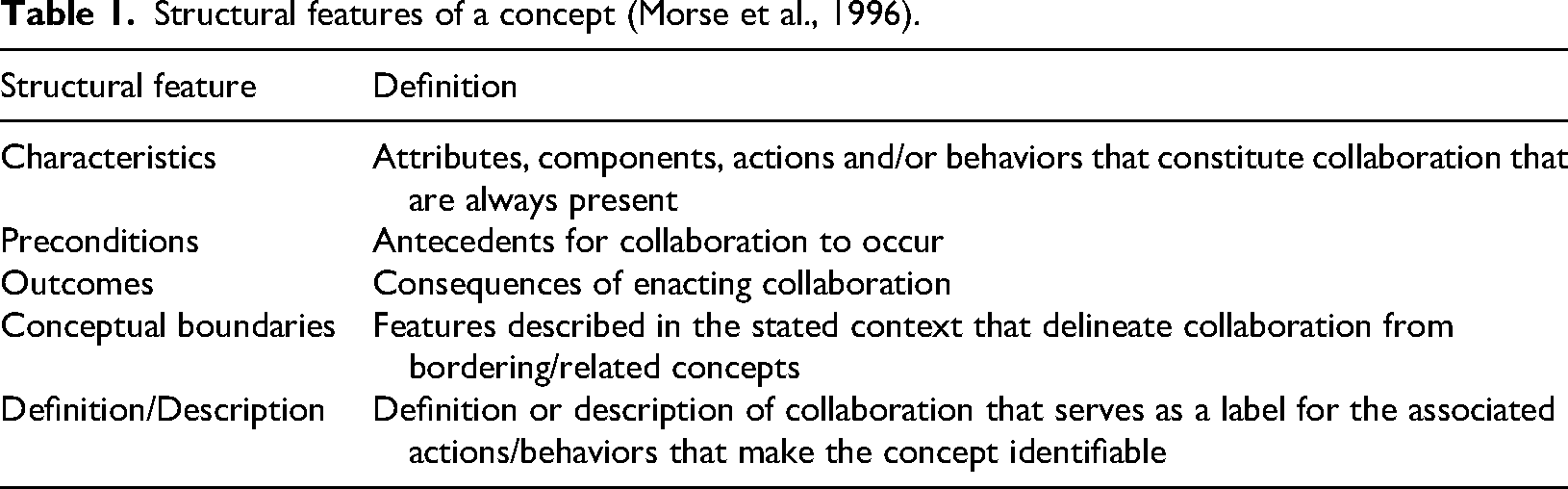
Data relevant to the concept of collaboration were charted and analyzed using NVivo software Version 15.1.2 (Lumivero, 2025). The first author developed a codebook using the five structural features of a concept (Morse et al., 1996; Table 1). Initially, the first author applied the codebook deductively to identify the structural features of the concept. Then, the first author inductively generated sub-codes relevant to each of the five structural features of the concept. Once developed, first and second authors independently trialed the codebook on three source articles. Following the trial, coders established consensus for code and sub-code definitions. The codebook was updated as additional sub-codes were inductively identified. The finalized codebook (Supplemental Material 4) was applied to all data sources through iterative review by the first author.
Structural features of a concept (Morse et al., 1996).
The first author examined and synthesized the coded data according to the four principles of concept analysis to evaluate concept maturity. The principles of concept analysis (Penrod and Hupcey, 2005) were applied as follows:
Based on a review of the structural features of collaboration identified across all source articles, and guided by the four principles for analysis, the first author constructed an initial draft of the definition of collaboration using language relevant to the context of school-based SLP-educator delivery of literacy instruction in general education settings. Following a review with research team members, the definition of collaboration was finalized.
Throughout the research process, the first author maintained an audit trail of decision-making for coding and data analysis and engaged in peer debriefing with researchers with expertise in education (TG) and speech-language pathology (LT and WC) (Krefting, 1991).
Results
Source selection
The systematic database search yielded 3034 potential sources. Following deduplication, title/abstract screening, and full-text review, 13 articles were identified for inclusion (Figure 1). Interrater reliability for screening at the title and abstract stage was k = 0.76 and 96% agreement; for full text review, interrater reliability was k = 0.81 and 93% agreement. Citations for source articles are in the reference list and numbered with a superscript notation.
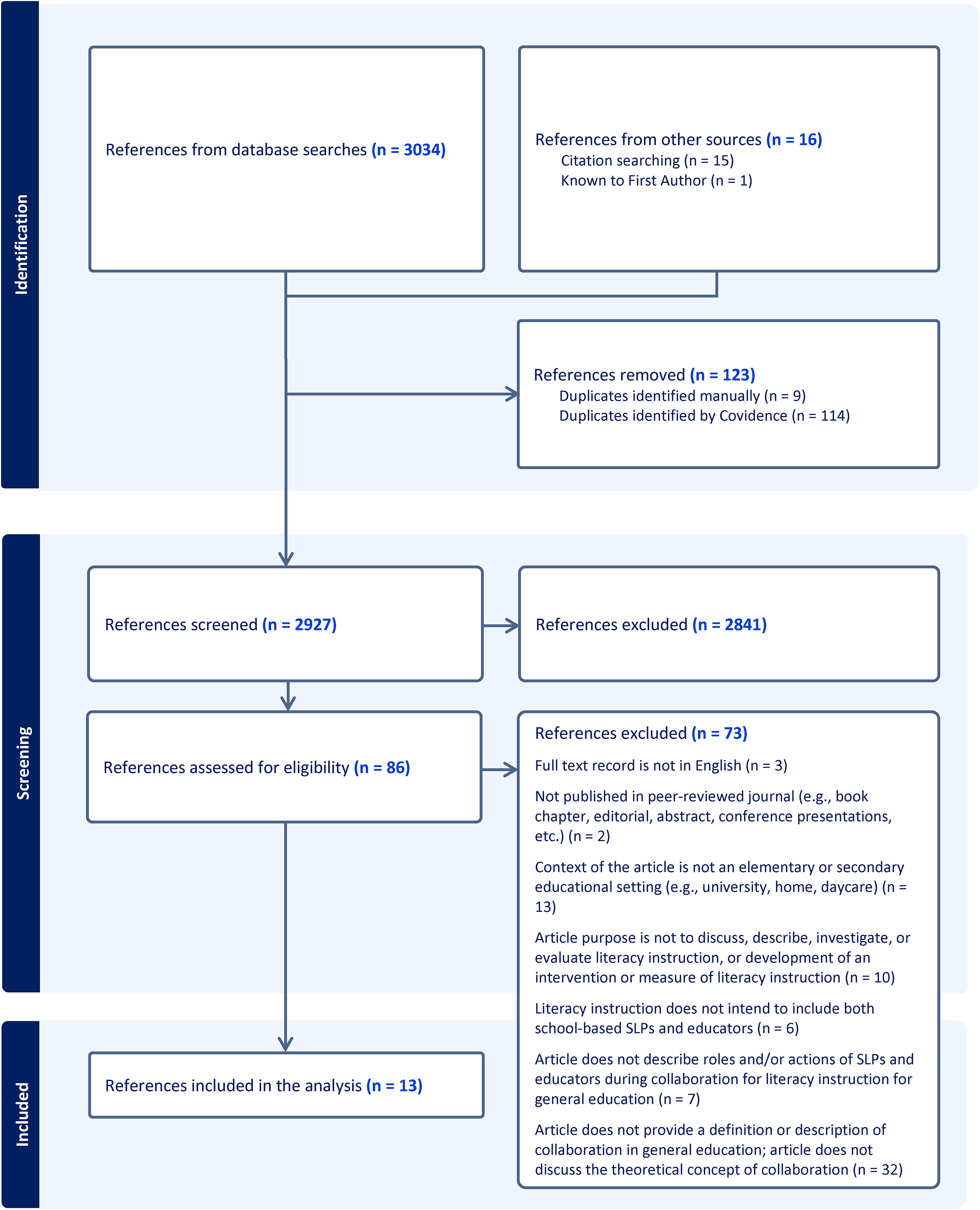
Search and selection of information sources.
Description of data sources
Included articles were published between 1997 and 2023, with seven (54%) of 13 published since 2017. Twelve (92%) data sources were situated in the United States, and one (8%) in Australia. Only one included source was an empirical article, a qualitative study employing focus groups and content analysis. Supplemental Material 5 reports the study design, model of service delivery, instructional format, and grades of instruction represented in the 13 source articles.
Supplemental Material 6 presents the aspects of literacy addressed in source articles. With respect to the language comprehension strand of Scarborough’s (2001) Reading Rope, vocabulary skills (n = 11; 85%) and language structures (n = 7; 54%) were most often addressed. In the word recognition strand, instruction most often focused on decoding (n = 11; 85%) and phonological awareness (n = 8, 62%).
All source articles (N = 13; 100%) reported that both school-based SLPs and classroom teachers were engaged in the literacy instruction. Eight (62%) articles reported that one or more additional personnel were involved in instruction in addition to the classroom teacher and SLP. Supplemental Material 7 lists the specific education professionals involved in literacy instruction for each source article.
Principle-based concept analysis
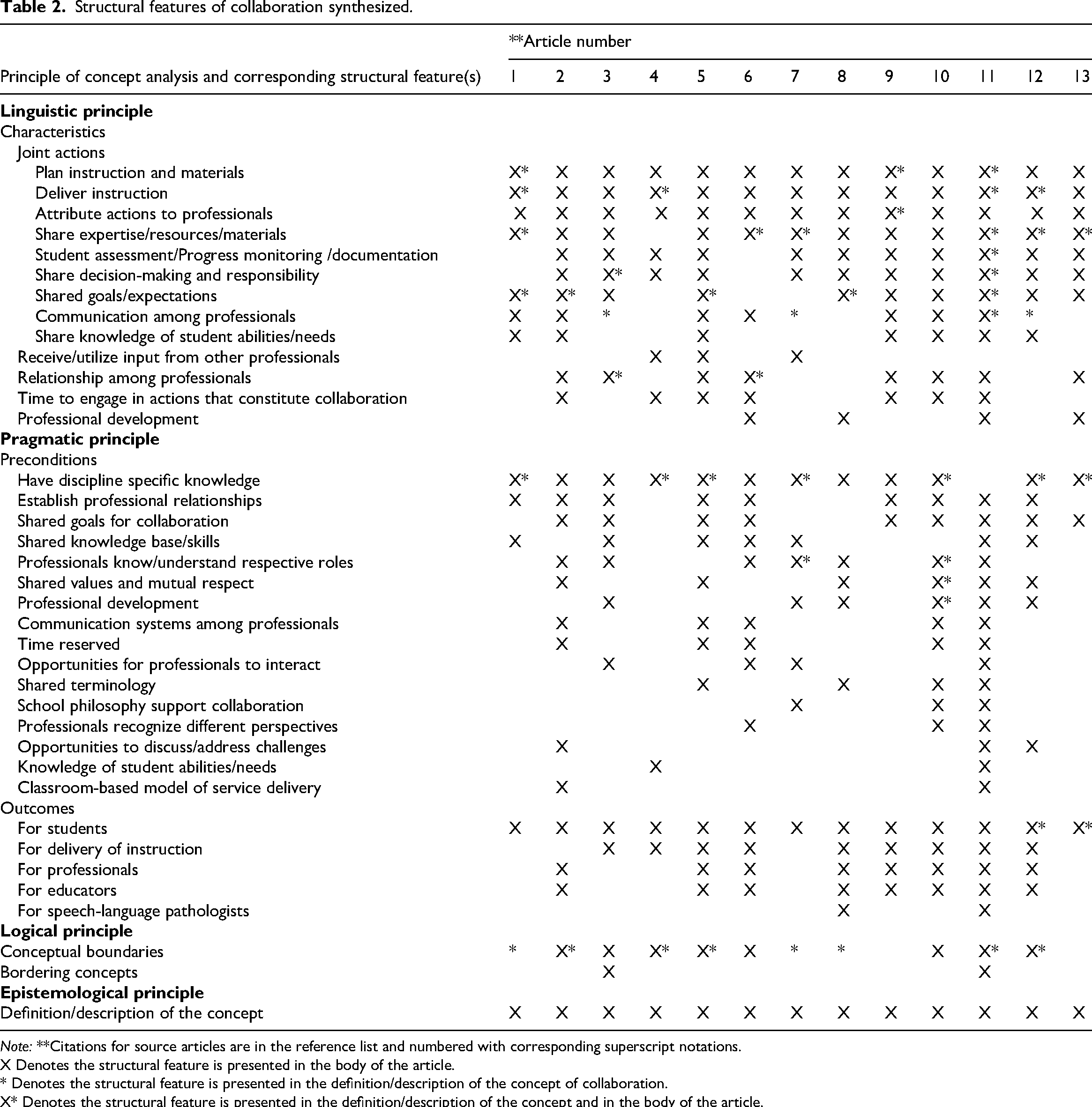
A definition for each structural feature of the concept of collaboration is presented in Table 1. The structural features were synthesized and are presented in Table 2. Application of the four principles for analysis is described below. Our proposed definition is presented following the results and interpretation of the analysis.
Structural features of collaboration synthesized.
Note: **Citations for source articles are in the reference list and numbered with corresponding superscript notations.
X Denotes the structural feature is presented in the body of the article.
* Denotes the structural feature is presented in the definition/description of the concept of collaboration.
X* Denotes the structural feature is presented in the definition/description of the concept and in the body of the article.
Linguistic principle: characteristics
Four characteristics of collaboration were identified in the source literature (Table 2).
Joint actions by the SLP and educator
All 13 sources described joint actions performed by the SLPs and educators. We identified 10 joint actions (see Table 2), three of which were reported in all articles: (a) planning instruction and materials, (b) negotiating and/or attributing actions to a specific professional, and (c) delivering instruction. A fourth joint action, sharing expertise/resources/materials, was described in 12 of 13 sources (92%). Additional joint actions were observed less frequently across data sources.
Regarding the joint action of attributing actions to a specific professional, all 13 articles discussed actions attributed to the SLP; and 11 (85%) sources discussed actions attributed to the educator. Actions attributed to SLPs included: (a) delivering individual intervention (n = 8; 62%), (b) sharing expertise (n = 7; 54%), (c) monitoring progress (n = 6; 46%), (d) conducting assessment (n = 6; 46%), (e) providing professional development to educators (n = 5; 38%), and (f) helping families implement interventions at home (n = 1; 8%). Actions attributed to educators included: (a) delivering instruction (n = 9; 69%), (b) assessing and monitoring progress (n = 2; 15%), (c) developing instructional materials (n = 1; 8%), (d) sharing expertise (n = 1; 8%), and (e) providing professional development to SLPs (n = 1; 8%).
Our analysis also revealed six joint actions that were consistently presented in the source literature as only occurring jointly by SLPs and educators: (a) planning instruction and materials (n = 13; 100%), (b) sharing decision-making and responsibility (n = 11; 85%), (c) communicating among professionals (n = 10; 77%), (d) sharing instructional goals (n = 10; 77%), (e) sharing knowledge of student abilities and needs (n = 7; 54%), and (f) receiving and using input from other professionals (n = 3; 23%).
Relationship among professionals
A relationship among professionals was observed in eight (62%) sources (Table 2). We identified four traits describing the relationship among SLPs and educators in the context of delivering literacy instruction: (a) the relationship is based on trust, mutual respect, and support (n = 6; 46%), (b) the relationship is non-hierarchical (n = 4; 31%), (c) engagement occurs based on student needs (n = 4; 31%), and (d) all individuals willing to work together are included (n = 3; 23%).
Time
Seven sources described time allocated to SLP and educator collaboration for literacy instruction (54%) (Table 2). Authors discussed time as a characteristic of the concept that is or should be dedicated to engaging in joint actions that constitute collaboration.
Professional development
Professional development that contributed to the delivery of literacy instruction was described in four (31%) articles (Table 2), with all four describing the SLP as delivering training to educators. There was no instance of the educator delivering training to the SLP. One article (see Meaux et al., 2020) recommended resources the SLP could independently seek out for information regarding instruction and how to train educators to implement that instruction.
Applying the linguistic principle
According to the linguistic principle, our findings demonstrated inconsistent use and meaning of the concept of collaboration across the source literature. In our context of kindergarten to Grade 12 general education, only three characteristics of SLP and educator collaboration were consistently present, specifically, jointly planning instruction and materials, negotiating/attributing specific actions to specific professionals, and delivering literacy instruction. The joint action of sharing expertise, resources, and/or instructional materials was also present in most sources. The additional three characteristics of a relationship among professionals, time, and professional development were represented inconsistently across source articles.
Pragmatic principle: preconditions and outcomes
Preconditions
Although all 13 articles described one or more preconditions for collaboration to occur, no single precondition was common across all data sources (Table 2). Most articles (n = 12; 92%) described professionals having discipline-specific knowledge that contributed to the delivery of literacy instruction as a precondition. Nine sources (69%) discussed establishing a professional relationship for engaging in actions that constitute collaboration. Having shared goals and expectations for collaboration was observed in nine (69%) sources. Additional preconditions were reported less frequently across data sources (Table 2).
Outcomes
Most source articles were descriptive in nature; therefore, outcomes anticipated from enacting collaboration are the opinions of the authors. Nine (69%) sources reported outcomes relevant to instruction (Table 2). The most commonly reported anticipated outcome was efficient planning and effective literacy instruction (n = 9; 100%). Additional anticipated outcomes included: (a) development of appropriate education plans (n = 4; 44%), (b) application of evidence-based strategies and best practice (n = 3; 33%), and (c) increased service coordination (n = 2; 22%).
All 13 sources discussed outcomes anticipated for students when SLP and educator collaboration for literacy instruction is enacted (Table 2). The most common anticipated student outcome discussed in data sources was achievement of literacy and language goals (n = 10; 77%), followed by student access to high quality instruction and special education services to meet identified needs (n = 9; 69%). Additional anticipated outcomes included integration of students with communication disorders into the classroom (n = 8; 62%), academic achievement (n = 8; 62%), and family involvement in students’ education (n = 1; 8%).
For professionals, anticipated outcomes were described in eight (62%) data sources (Table 2). A positive relationship among professionals characterized by mutual trust and respect was presented as an anticipated outcome in four (50%) of these sources. Additional anticipated outcomes included: (a) improved communication among professionals (n = 3; 38%), (b) blending of expertise (n = 3; 38%), (c) developing an appreciation of the roles, responsibilities, skills and expertise of the other discipline (n = 2; 25%), and (d) professional development (n = 2; 25%). One (13%) article also indicated satisfaction among team members and strengthened team outcomes resulting from collaboration.
Eight (62%) data sources discussed anticipated outcomes specific to teachers. Most commonly, authors discussed how collaboration may lead to building educator capacity for literacy/language instruction (n = 5; 63%). Additional educator outcomes included: (a) enabling teachers to scaffold for diverse groups of students (n = 2; 25%), (b) developing educator morale, self-efficacy, and confidence for the delivery of literacy/language instruction (n = 2; 25%), and (c) supporting teachers’ understanding of the impact of communication impairments on learning (n = 1; 13%). Two articles (14%) suggested anticipated outcomes for SLPs. Both articles discussed how SLPs may gain an understanding of classroom expectations, dynamics, and challenges. One source described the outcome of SLPs gaining an understanding of curriculum.
Applying the pragmatic principle
Although several preconditions for collaboration were observed in the source literature, there was no agreement across all data sources on any one antecedent for collaboration to occur within our stated context. As the source literature was largely non-empirical, the outcomes discussed are those anticipated from enacting collaboration rather than outcomes derived from empirical investigation.
Logical principle: delineation of conceptual boundaries and bordering concepts
Eleven (85%) source articles discussed conceptual boundaries that delineated collaboration from bordering concepts. The most frequently observed feature was that collaboration involves joint actions of the SLP, educator and/or additional educators and/or other professionals working together (n = 6; 55%). Additional features that distinguished collaboration from bordering concepts included: (a) crossing traditional disciplinary boundaries (n = 4; 36%), (b) shared decision-making, responsibility, and ownership of jointly established instructional goals (n = 2; 18%), and (c) sharing information to target mutually identified learning objectives (n = 1; 9%).
Bordering Concepts
Two bordering concepts were defined in the source literature: (a) community of practice (Paul et al., 2006), and (b) collaborative consultation (Elksnin, 1997). Paul et al. (2006) described several features of a community of practice, including that professionals engage in equal participation, support and learning, have a shared knowledge base and skill set, jointly establish goals and share resources, share accountability and responsibility, and deliver classroom-based services. No other source articles discussed the concept of a community of practice.
Elksnin (1997) defined the concept of collaborative consultation as a co-equal partnership between professionals with diverse areas of expertise and a process for identifying solutions to shared problems. Elksnin (1997) positioned this concept along a continuum of related constructs like co-activity, cooperation, and coordination with collaboration “at the highest level” (p. 415). The term “consultation” and other derivatives (e.g. consult, consulting, consultants) were observed in seven (54%) additional source articles, usually without an explicit definition or description of the term as a concept. One article, Roth and Troia (2006), described consultation as a “model of collaboration” and used the phrase “collaborative consultation” with the authors appearing to use “collaborative” as an adjective modifying “consultation.”
Applying the logical principle
The source literature provided a rudimentary description of conceptual boundaries, with no consensus on features that delineate collaboration from bordering concepts. Sources did not provide explicit discussion on how a given conceptual boundary is important for understanding and distinguishing the concept of collaboration from bordering concepts in the context of SLPs and educators delivering literacy instruction in general education classrooms.
Features describing the two bordering concepts, collaborative consultation (see Elksnin, 1997), and a community of practice (see Paul et al., 2006), overlapped with those identified in the source literature for collaboration. This overlap made it difficult to differentiate collaboration from these concepts suggesting they are competing to describe the same phenomenon.
Epistemological principle: definition/description
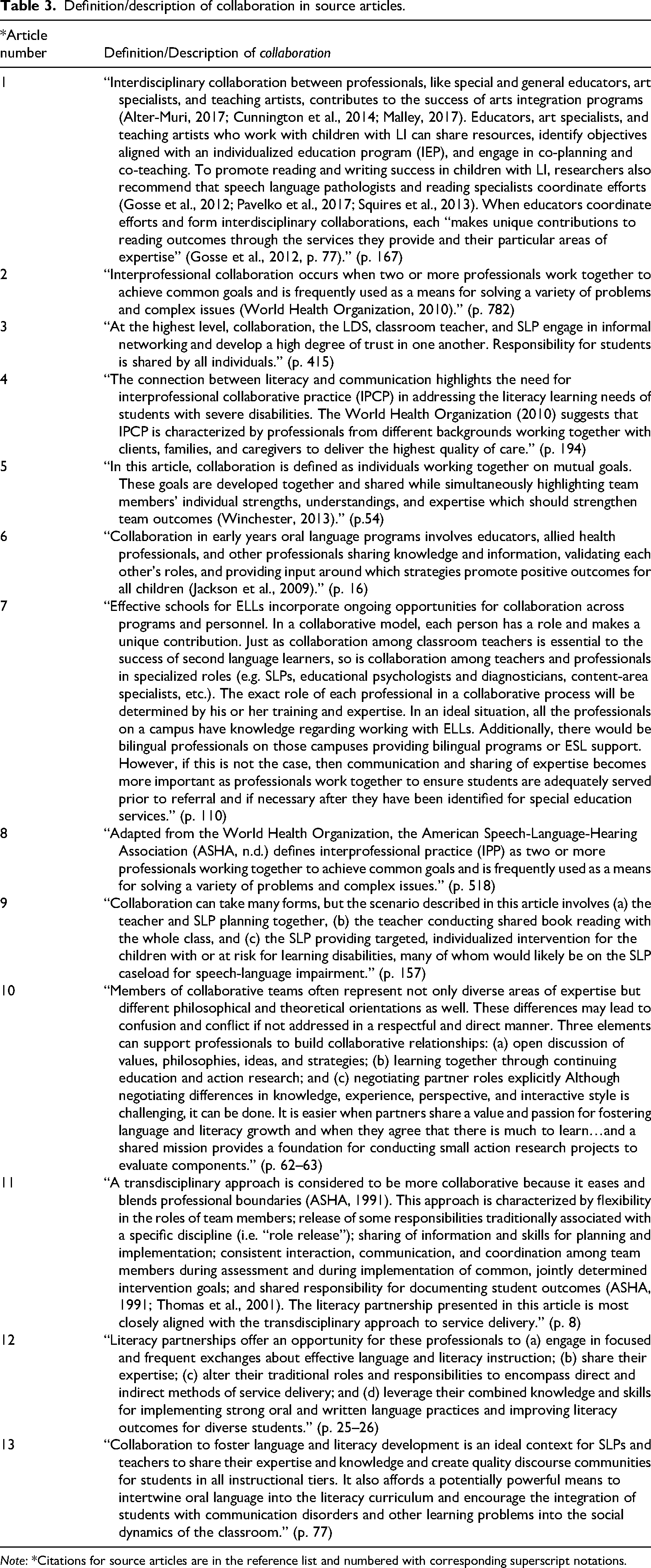
Table 3 summarizes the definition/description of the concept of collaboration as stated in each source article. The label used to represent the concept of collaboration varied across and within data sources. The term “collaboration” was stated as the label for the concept in eight (62%) data sources. Several derivatives of the term “collaboration” were also used. For example, Erickson (2017) used the label “interprofessional collaborative practice” (IPCP), citing the World Health Organization (WHO, 2010). Meaux et al. (2020) used the term “Interprofessional Practice” also drawing from the WHO (2010) definition. Linan-Thompson and Ortiz (2009) used several terms, including “collaboration,” “collaborative model,” and “collaborative process” within the same section of text describing the concept. Both Paul et al. (2006) and Roth and Troia (2006) used the term “literacy partnership.”
Definition/description of collaboration in source articles.
Note: *Citations for source articles are in the reference list and numbered with corresponding superscript notations.
Although all source articles included at least one structural feature in the definition/description of collaboration (see Table 2), no single feature appeared consistently across all definitions/descriptions. Structural features observed in the definition/description of collaboration included characteristics (n = 12; 92%), conceptual boundaries (n = 8; 62%), and preconditions (n = 7; 54%) (Table 2).
Applying the epistemological principle
While each article offered a definition or description of collaboration, sources varied in the specific structural features used to explicate the concept. The inconsistent use of terms to label the concept of collaboration posed a challenge in establishing text intended to define and describe the concept in the source literature. Our analysis demonstrated that the included literature does not offer consistent language for defining the concept of collaboration in our stated context.
Evaluation of concept maturity
Only three characteristics were common to all 13 sources: jointly planning instruction and materials; negotiating/attributing actions to a specific professional; and delivering instruction. There was no consensus regarding preconditions, outcomes, or conceptual boundaries. Poorly delineated conceptual boundaries made it challenging to understand how school-based SLP and educator collaboration for literacy instruction could be operationalized, leaving intended outcomes unclear. Only two sources provided similar definitions, both derived from the World Health Organization (WHO) definition for IPCP (WHO, 2010). Therefore, based on our principle-based concept analysis, grounded in the source literature retrieved from the fields of speech-language pathology and education, the concept of collaboration in our stated context is in an emerging state.
Discussion
We identified 13 source articles from literature in the fields of education and speech-language pathology published over a 26-year period, that discussed collaboration in the context of school-based SLPs and educators delivering literacy instruction in general education classrooms. This context was integral to determining structural features of the concept of collaboration, our interpretation of the concept, our understanding of how structural features could be operationalized, and our evaluation of concept maturity (Morse et al., 1996; Penrod and Hupcey, 2005). Both fields view collaboration as essential and recognize that combining their expertise can strengthen literacy instruction. Our analysis demonstrated that in the context of SLP-educator collaboration for literacy instruction in general education settings, there is a lack of consistency in how the concept is defined and how the structural features of collaboration are presented in the source literature. Our principle-based concept analysis revealed that in our stated context, the concept of collaboration has not yet reached conceptual maturity.
Structural features of the concept of collaboration
Our analysis made explicit the characteristics, preconditions, outcomes, and conceptual boundaries of the concept of collaboration as reported across all data sources, in our stated context. We found three actions were consistently observed as characteristics of collaboration, specifically, jointly planning instruction, negotiating or jointly determining who would take specific actions, and jointly delivering instruction. Recent research in school-based contexts has also reported that collaboration included components such as a relationship among professionals, communication among professionals, and sharing information about student abilities and needs (Armstrong et al., 2023). Our analysis showed these characteristics were not always described in the source literature as components of collaboration across all included articles. Per the linguistic principle, a consistent description of characteristics that constitute collaboration is required to distinguish collaboration from related concepts, and to apply the concept within the stated context (Morse et al., 1996; Penrod and Hupcey, 2005).
As with recent research, the precondition that professionals have discipline-specific knowledge to contribute to instruction was usually present (Jeremy et al., 2024). Discipline-specific knowledge is the expertise that professionals share with one another, that may lead to the anticipated outcomes discussed in the source literature, such as building educator capacity for the delivery of language and literacy instruction (Collins and Wolter, 2019), and the SLP acquiring knowledge of the curriculum (Paul et al., 2006). In turn, these outcomes could contribute to building a shared knowledge base and skills for language and literacy instruction.
In addition to having discipline-specific knowledge, professional development also was observed as a precondition and characteristic of collaboration, however without consistency across source articles. Professional development almost always was presented as an action attributed to the SLP for the purpose of building the educator's knowledge base and skills (Armstrong et al., 2023). There was no discussion of educators providing formal or informal professional development to build the knowledge base and skills of the SLP. While authors presented the opinion that collaboration gave SLPs an enhanced understanding of the curriculum (Paul et al., 2006) and of classroom dynamics and expectations (Meaux et al., 2020), there was no explicit description of how these anticipated outcomes were to be achieved. In addition, none of the sources discussed building professional capacity for collaborative practice, an area identified as a need in recent research (Evans et al., 2025). Our analysis showed gaps in the source literature for professional development provided by educators to develop the knowledge and skills of SLPs for classroom-based instruction, and for developing skills of both educators and SLPs for collaborative practice.
With only one empirical article included in the study, outcomes of SLP-educator collaboration in our analysis represent anticipated outcomes as described by authors of source articles. Outcomes should connect the concept to the context, and the evidence must show change in students’ literacy skills that is measurable for collaboration to be considered effective (Jeremy et al., 2024). Although a prior systematic review (Archibald, 2017) indicated school-based SLP-educator collaboration results in benefits for students, our observation of a limited number of articles employing qualitative or quantitative research designs that includes both a definition of SLP and educator collaboration and a focus on student outcomes suggests further investigation is required (Jeremy et al., 2024). Based on the pragmatic principle, our observations highlight the need for consensus on the prerequisites for collaboration to occur, and the expected outcomes of collaboration, if the concept is to be useful in our given context (Penrod and Hupcey, 2005).
A mature concept is described by characteristics that are always present and can be clearly differentiated from bordering concepts (Morse et al., 1996). Our analysis found a gap in the source literature regarding the description of characteristics that serve as conceptual boundaries for the concept of collaboration in our stated context. Based on the logical principle, a clear understanding of what constitutes a concept and differentiates it from bordering concepts, including preconditions and outcomes, is essential for application by practitioners in a given context (Morse et al., 1996).
Researchers may be investigating collaboration in our stated context using empirical designs; however, the definition/description and use of the concept are inconsistently reported in this body of literature (Evans et al., 2025; Mathers et al., 2024). Our findings indicate that the non-empirical education and speech-language pathology literature provides more detailed definitions/descriptions of collaboration within our stated context. Consistent with other recent research, we found that although authors included some common features of collaboration in the definition (Jeremy et al., 2024), they used various terms to label and/or refer to the concept (Mathers et al., 2024), making it challenging to recognize the concept in the literature. Finally, considering the epistemological principle, the definitions/descriptions provided in the source literature did not consistently reference structural features that distinguish and illustrate the importance of the concept of collaboration in our stated context. This added to the challenge of identifying the concept in source articles (Morse et al., 1996; Penrod and Hupcey, 2005).
A shared definition of collaboration for literacy instruction
Effective collaborative practice requires the concept of collaboration be jointly understood by educators and SLPs (Jeremy et al., 2024). The results of our analysis, which synthesized and analyzed the reported structural features of collaboration, revealed the concept of collaboration in our stated context to be emerging, affirming the need for a shared definition. To achieve a common understanding of the concept and enable application in the context of school-based SLPs and educators delivering literacy instruction in general education settings, we offer the following definition of collaboration:
Limitations
Our decision to restrict inclusion to peer-reviewed, English-language articles in general education settings may have excluded relevant non-peer reviewed or non-English sources that could have informed our analysis and definition of collaboration. Although we searched three databases selected for their coverage of education and speech-language pathology literature, expanding the search to additional databases may have identified more empirical studies. These additional studies might have offered further insights into tested outcomes of school-based SLP and educator collaboration for literacy instruction and impacted our evaluation of concept maturity. Terms for labelling/referring to the concept of collaboration varied across the source literature (Mathers et al., 2024). As we intended to include sources that purposefully reported on the concept of collaboration, it is possible that our search terms resulted in the exclusion of articles that may have contributed to our findings.
Implications
Our study advances the concept of collaboration for literacy instruction delivered by educators and SLPs in general education settings by offering a shared definition that can guide practice and research. Educators and SLPs have the disciplinary expertise for the delivery of literacy instruction and are expected to collaborate as part of best practice (ASHA, 2010; OCT, 2025; SAC, 2021). By making explicit the structural features of collaboration, we have made known the constructs that professionals can advocate for and implement in their own general education settings to meet practice expectations.
Given that empirical research was largely excluded from our analysis because authors did not describe actions that constituted collaboration and/or did not define the concept, we suggest that researchers state the definition of collaboration and the context for the inquiry to enable consistency across investigations and disciplines, and support application of findings to practice (Morse et al., 1996). Researchers investigating collaboration also need to specify the focus of their inquiry, whether it is student achievement (e.g. whole class, small group, or individuals) or the process of collaboration itself and ensure the use of appropriate measures to assess success (Jeremy et al., 2024). If outcomes are measured, findings could serve to demonstrate the efficiency and effectiveness of school-based SLP and educator collaboration for literacy instruction.
Conclusion
“A scientific concept is not a static entity – it is dynamic, with the state of the science representing the most current state of scientific understanding” (Penrod and Hupcey, 2005: 414). The concept of collaboration in the context of SLPs and educators delivering literacy instruction in general education classrooms is currently in an emergent state in the literature. Our proposed definition provides a common language and shared understanding of the concept that will enable school-based SLPs and educators to apply collaboration for literacy instruction and achieve the mutual goal of every student reading. By making explicit the structural features that constitute collaboration, including the preconditions for collaboration to occur, our definition of collaboration can support researchers’ efforts to systematically investigate outcomes of SLP and educator collaboration for literacy instruction. In turn, future research could strengthen the evidence base that informs professional practice across the disciplines of speech-language pathology and education and advance concept maturity.
Supplemental Material
sj-docx-1-clt-10.1177_02656590261433347 - Supplemental material for Speech-language pathologist and educator collaboration in literacy instruction: Establishing a shared definition through principle-based concept analysis
Supplemental material, sj-docx-1-clt-10.1177_02656590261433347 for Speech-language pathologist and educator collaboration in literacy instruction: Establishing a shared definition through principle-based concept analysis by Basiliki Passaretti, Allison Sexton, Tiffany Gallagher, Lyn S Turkstra and Wenonah Campbell in Child Language Teaching and Therapy
Supplemental Material
sj-docx-2-clt-10.1177_02656590261433347 - Supplemental material for Speech-language pathologist and educator collaboration in literacy instruction: Establishing a shared definition through principle-based concept analysis
Supplemental material, sj-docx-2-clt-10.1177_02656590261433347 for Speech-language pathologist and educator collaboration in literacy instruction: Establishing a shared definition through principle-based concept analysis by Basiliki Passaretti, Allison Sexton, Tiffany Gallagher, Lyn S Turkstra and Wenonah Campbell in Child Language Teaching and Therapy
Supplemental Material
sj-docx-3-clt-10.1177_02656590261433347 - Supplemental material for Speech-language pathologist and educator collaboration in literacy instruction: Establishing a shared definition through principle-based concept analysis
Supplemental material, sj-docx-3-clt-10.1177_02656590261433347 for Speech-language pathologist and educator collaboration in literacy instruction: Establishing a shared definition through principle-based concept analysis by Basiliki Passaretti, Allison Sexton, Tiffany Gallagher, Lyn S Turkstra and Wenonah Campbell in Child Language Teaching and Therapy
Supplemental Material
sj-docx-4-clt-10.1177_02656590261433347 - Supplemental material for Speech-language pathologist and educator collaboration in literacy instruction: Establishing a shared definition through principle-based concept analysis
Supplemental material, sj-docx-4-clt-10.1177_02656590261433347 for Speech-language pathologist and educator collaboration in literacy instruction: Establishing a shared definition through principle-based concept analysis by Basiliki Passaretti, Allison Sexton, Tiffany Gallagher, Lyn S Turkstra and Wenonah Campbell in Child Language Teaching and Therapy
Supplemental Material
sj-docx-5-clt-10.1177_02656590261433347 - Supplemental material for Speech-language pathologist and educator collaboration in literacy instruction: Establishing a shared definition through principle-based concept analysis
Supplemental material, sj-docx-5-clt-10.1177_02656590261433347 for Speech-language pathologist and educator collaboration in literacy instruction: Establishing a shared definition through principle-based concept analysis by Basiliki Passaretti, Allison Sexton, Tiffany Gallagher, Lyn S Turkstra and Wenonah Campbell in Child Language Teaching and Therapy
Supplemental Material
sj-docx-6-clt-10.1177_02656590261433347 - Supplemental material for Speech-language pathologist and educator collaboration in literacy instruction: Establishing a shared definition through principle-based concept analysis
Supplemental material, sj-docx-6-clt-10.1177_02656590261433347 for Speech-language pathologist and educator collaboration in literacy instruction: Establishing a shared definition through principle-based concept analysis by Basiliki Passaretti, Allison Sexton, Tiffany Gallagher, Lyn S Turkstra and Wenonah Campbell in Child Language Teaching and Therapy
Supplemental Material
sj-docx-7-clt-10.1177_02656590261433347 - Supplemental material for Speech-language pathologist and educator collaboration in literacy instruction: Establishing a shared definition through principle-based concept analysis
Supplemental material, sj-docx-7-clt-10.1177_02656590261433347 for Speech-language pathologist and educator collaboration in literacy instruction: Establishing a shared definition through principle-based concept analysis by Basiliki Passaretti, Allison Sexton, Tiffany Gallagher, Lyn S Turkstra and Wenonah Campbell in Child Language Teaching and Therapy
Footnotes
Acknowledgements
The authors wish to thank the McMaster University Health Sciences library staff for assistance provided in developing the search strategy.

Funding
The authors disclosed receipt of the following financial support for the research, authorship, and/or publication of this article: This work was supported by the John and Margaret Lillie Chair in Childhood Disability Research. .
Declaration of conflicting interests
The authors declared no potential conflicts of interest with respect to the research, authorship, and/or publication of this article.
Data availability statement
Inquiries regarding availability of the data analyzed during this study may be directed to the corresponding author.
Supplemental material
Supplemental material for this article is available online.
Notes
References
Supplementary Material
Please find the following supplemental material available below.
For Open Access articles published under a Creative Commons License, all supplemental material carries the same license as the article it is associated with.
For non-Open Access articles published, all supplemental material carries a non-exclusive license, and permission requests for re-use of supplemental material or any part of supplemental material shall be sent directly to the copyright owner as specified in the copyright notice associated with the article.
