




Abstract
In order to inform English foreign language (EFL) diagnostic assessment of literacy, this study examined the extent to which 175 first-language Hebrew-speaking EFL young learners from fifth to tenth grade exhibited differences in single-letter grapheme recognition, sub-word, and word reading, and rapid automatized naming (RAN) of letters and numbers. In addition, this cross-sectional quasi-experimental quantitative study examined correlations between the aforementioned literacy components and oral reading speed, spelling, vocabulary, syntax, and morphological awareness. There were no differences between the grades for single-letter grapheme recognition, and participants demonstrated incomplete automatic recognition for this task. Sub-word recognition improved across grades. However, the results highlighted a lack of mastery. Sub-word recognition correlated with word reading and spelling throughout. RAN speeded measures and oral reading speed correlated with sub-word, word recognition, and spelling in the older grades illustrating the presence of accuracy and speed components. Correlations across grades between literacy components and vocabulary, syntax, and morphological awareness provided support for theories explaining how knowledge of multiple layers of words contributes to literacy acquisition. These results comprising EFL diagnostic assessment can inform reading and spelling teaching and learning.
Diagnostic language assessment is a developing area in foreign language learning and refers to testing individual functioning in the respective language components to provide specific, fine-grained intervention directives (Cheng, 2019; Lee, 2015). Diagnostic language assessment may be considered part of formative assessment for learning because it provides teachers with information regarding language components that should be taught and informs learners as to where they are vis-à-vis the learning goals (Stiggins, 2002). Diagnostic assessment enables teachers to acknowledge individual differences in the context of classroom learner diversity and, as such, it comprises part of the language teaching toolbox. When placed on a timeline, diagnostic language assessment examines past language achievement and, based on the individual’s performance, provides intervention recommendations as to how to facilitate future language acquisition (Lee, 2015). A professional diagnostic language assessment should enable teachers to design individualized language learning teaching plans that will empower learners by promoting strengths while developing weaker linguistic abilities, thus facilitating learning (Grabe, 2009).
The role of the English Foreign Language (EFL) classroom teacher is critical in facilitating EFL literacy acquisition. Young learners are considered learners who have not yet entered higher education (Nikolov & Timpe-Laughlin, 2021). Nikolov and Timpe-Laughlin (2021) pointed to the vulnerability of young learners who may perceive the assessment experience as highlighting their weaknesses or inability to acquire a foreign language, thus causing anxiety. Professional EFL teachers may reduce EFL assessment anxiety by framing the purpose of diagnostic assessment to inform the teacher and learner as to which language components should be taught. In addition, teachers may provide young learners with expected learning outcomes, thus making them partners in the teaching-learning process so that they can understand what might be expected in the EFL literacy acquisition process (Grabe, 2009). This kind of diagnostic assessment is, thus, learning-orientated and a part of good classroom practice, as it should assist the young learner in reducing anxiety, increase self-esteem and may increase motivation (Nikolov & Timpe-Laughlin, 2021) to engage in EFL literacy learning.
Assessing language components accounting for EFL literacy outcomes
Individual differences that explain EFL literacy outcomes include underlying linguistic abilities that may be measured in the learner’s first language (L1) and that differentiate between stronger and struggling language learners. These linguistic abilities are strongly connected to the acquisition of oral and literary language in both first and additional languages (August & Shanahan, 2006; Cho & Chiu, 2015; Gholomain & Geva, 1999; Kahn-Horwitz et al., 2005; Kahn-Horwitz & Saba, 2018; Russak & Kahn-Horwitz, 2015). Grigorenko (2002) elaborated on linguistic and cognitive components that may explain individual differences between foreign language learners. These include difficulties with speech perception, speech production, visual, verbal, short- and long-term memory, as well as phonological processing difficulties, including speed of lexical access.
Phonological awareness, one of the primary linguistic components facilitating word reading and spelling acquisition, was part of the L1 acquisition process and transferred to EFL (Kahn-Horwitz et al., 2005, 2012a; Russak & Kahn-Horwitz, 2015). A longitudinal study of students in upper elementary school examined predictors of English word reading accuracy. Results showed that a combined English spelling score consisting of orthographic and morphological knowledge as well as English spelling measured 5 years earlier explained more variance than L1-Hebrew measures (Kahn-Horwitz et al., 2012b). This provided a rationale for combining EFL diagnostic language assessment with L1 linguistic assessment. L1 and EFL diagnostic assessments should provide in-depth information regarding the individual’s EFL literacy ability. EFL teachers and learners can then utilize the EFL assessment outcomes regarding the EFL learner’s recognition of the fine-grained components of EFL word reading and spelling achieved until the diagnostic testing point to initiate effective learning.
When conducting an EFL reading and writing-related diagnostic assessment, the EFL teacher should be able to examine automatic recognition of the grain sizes that comprise English orthography. Peeling the layers of English orthography, at the text or sentence level, word, sub-word (including digraphs, trigraphs, quadrigraphs, and rimes), or single-letter level, should enable the teacher to tease apart EFL language components that individual language learners may be struggling to acquire. This granular EFL literacy analysis would then provide the building blocks of EFL teaching and learning.
Word reading and spelling are the foundations of foreign language literacy development, and yet there is a scarcity of word reading and spelling assessment and development research in foreign language literacy contexts (Kahn-Horwitz, 2020; Nikolov & Timpe-Laughlin, 2021; Russak, 2020). General language assessments, including screening tests, do not provide the detailed information that fine-grained tests provide (Cheng, 2019). The depth of written English requires acquiring more than grapheme–phoneme and phoneme–grapheme correspondence of single letters to successfully read and spell written language (Frost, 2005; Miller, 2019; Spencer, 2006). Knowledge of larger grain sub-word units such as digraphs, for example, <ph> representing the phoneme /f/, trigraphs <igh> representing the phoneme /aɪ/, quadrigraphs <augh> representing the phoneme /ɔ:/, rimes such as <all> in the words ball, tall, and small, as well as conventions such as the letter /c/ appearing before <e>, <i>, <y> representing the phoneme /s/ (Moats, 2010; Shankweiler & Fowler, 2004), can be expected to jumpstart statistical learning acquired through multiple exposures (Seidenberg et al., 2020; Treiman & Kessler, 2014). This process facilitates accurate reading and spelling acquisition.
EFL readers need to synchronize the various word components to automatically recognize a word. This automatic lexical access must be fast enough to facilitate comprehension at the word, sentence, and text levels without a loss of information in the process (Kail & Hall, 1994). Naming speed in L1-English speakers increases with age (Kail & Hall) and processing speed differentiates strong versus struggling foreign language learners (Kormos, 2017). Phonemic awareness and rapid automatized naming (RAN) are the phonological processing skills at the core of word reading and spelling development. RAN has not consistently been found to contribute to EFL reading and spelling at different stages and this may be a function of the characteristics of English orthography (Share, 2021). Lexical access measured in L1-Spanish was found to contribute to English word reading and reading comprehension for young elementary school-aged English language learners (Nakamoto et al., 2007) and to English word reading but not English spelling for L1-Korean fifth-grade EFL students when measured by rapidly naming numbers and letters in Korean (Cho & Chiu, 2015). Russak (2020) found that English letter RAN did not explain English spelling for fifth-grade L1-Hebrew and L1-Arabic learners. However, for older L1-Hebrew-speaking ninth-grade EFL students, both Hebrew and English RAN of letters accounted for EFL word reading and reading comprehension (Kahn-Horwitz et al., 2012b). Kormos (2017) labeled speed-related skills as universal factors that impact foreign language literacy acquisition by connecting speed of naming with decoding and reading comprehension. Share (2021) pointed out that slow but accurate English reading usually characterizes compensated adult struggling readers, but young struggling readers of English are characterized by poor reading accuracy.
EFL meaning-related components connected to EFL literacy components
Vocabulary, syntax, and morphology are meaning-based components of foreign language learning. During the first encounter with an EFL word, the foreign language reader is expected to decode the orthographic form, possibly followed by the pronunciation of the word. The orthographic form is linked to the word meaning(s), and morphological as well as syntactic components add additional layers to the knowledge of the word. Perfetti and Hart (2002) discussed the multiple layers of a word as contributing to the depth of word knowledge. Research has shown that exposure to the orthographic components of words contributes to vocabulary acquisition in an L1 literacy context (Ehri & Rosenthal, 2007) as well as in the process of foreign language literacy acquisition (Krepel et al., 2021; Nation, 2001). Orthography, syntax, and morphological knowledge of words contribute to reading comprehension, whereas the addition of the phonological component contributes to listening comprehension (Cheng & Matthews, 2018). The integration of the various language components within a word constitutes in-depth knowledge of the word and this indicates an advanced stage of knowledge characterizing skilled EFL learners. This contrasts with the pre-basic or basic knowledge that characterizes young EFL learners who may demonstrate vague knowledge of a word that might include partial orthographic, phonological, and vocabulary knowledge and may completely lack morphological and syntactic knowledge (Cheng & Matthews, 2018).
Aligning Common European Framework of Reference for Languages can-do statements with EFL literacy diagnostic assessment
The Common European Framework of Reference for Languages (CEFR) (Council of Europe, 2001) was constructed primarily for adult language learners to provide an international framework for comparing language development (Byrnes, 2007; English with Cambridge, 2011). At each level (basic, independent, proficient), can-do statements have been compiled to assess language development (Council of Europe, 2001; Little, 2007). Policymakers in various countries have produced detailed can-do statements that may facilitate assessment, teaching, and learning (Bérešová, 2017; Ecostar, 2017).
Extensive work has been conducted developing CEFR can-do statements at the more advanced levels of foreign language acquisition (Eckes et al., 2005; Ecostar, 2017; Runnels, 2013). The CEFR can-do statements have been adapted for use with young learners (pre-A1 and A1 levels) (Nikolov, 2016; Rixon, 2016; State of Israel Ministry of Education, Pedagogical Secretariat, Language Department English Language Education, 2020). Nikolov and Timpe-Laughlin (2021) reviewed assessment research conducted with students between the ages of 3 and 14. Of the early research conducted two decades ago, Nikolov and Timpe-Laughlin found that foreign language reading assessment of young learners did not assess the components of word reading and spelling. The steps on the way to acquiring larger goals such as reading comprehension have yet to be included in young learner CEFR can-do statements. Including a foreign language learner’s phonological and orthographic component knowledge, naming speed, word reading, spelling, and vocabulary recognition would provide an informed diagnostic picture of early literacy acquisition. These EFL language components form the basis of accurate and fluent reading and writing.
Can-do statements could be adapted for EFL literacy acquisition. Young learners acquiring English reading and writing need to automatically recognize single-letter graphemes, sub-word orthographic units, and morphemes. Can-do statements for young EFL learners might include phonological, orthographic, and morphological components to bridge between letter-name and letter-sound knowledge and reading comprehension, as well as written composition. This might provide EFL teachers with an understanding as to what individual learners in their classrooms might be lacking to reach fluent word reading and spelling, the building blocks of reading comprehension and writing.
The current study
Acquiring EFL is necessary for international communication and higher education. In the late 90s/early 2000s, At around the turn of the century 10% to 20% of Israeli students were estimated as having difficulty acquiring their first language, Hebrew or Arabic, because of learning disabilities (Finkelstein, 1999; Kohanai, 2002). More recently, Al-Yagon and Margalit (2016) claimed that it is not possible to estimate the percentage of students with learning disabilities in Israel as there is currently no across-the-board diagnostic testing that takes place in schools. In addition to students who have been diagnosed with learning disabilities, many students struggle to acquire EFL. Their difficulties could be associated with overcrowded language classrooms (Guvendir, 2015; Toro et al., 2019), affective factors (Chen & Chang, 2004; Nikolov & Timpe-Laughlin, 2021; Solodkova et al., 2018), socioeconomic background (Kahn-Horwitz et al., 2006; Olshtain et al., 1990), a lack of professional instruction (Detal, 2019), as well as teachers lacking the necessary content knowledge to facilitate teaching and learning (Goldfus, 2012; Kahn-Horwitz, 2015, 2016; Roffman, 2012; Saban & Kahn-Horwitz, 2022; Vaisman & Kahn-Horwitz, 2020).
There are expected to be washback effects to institutionalizing EFL diagnostic testing (Lee, 2015). These washback effects might include a heightened awareness of the various linguistic components that comprise foreign language learning, specifically regarding English literacy acquisition. Language teaching professionals and their students would benefit from diagnostic assessment, followed by teaching at the sub-word level of phonemes, graphemes, syllables, onsets, rimes, and inflectional morphemes as well as affixes where appropriate.
Teachers need to have the necessary content knowledge of English phonology, orthography, and morphology to teach these respective linguistic components (Moats, 2014). In both L1 English-speaking countries (Joshi et al., 2009; Washburn et al., 2016) and Israel, where English is taught as a foreign language, both pre-service and in-service teachers have demonstrated differential knowledge of these language components (Goldfus, 2012; Kahn-Horwitz, 2015, 2016; Roffman, 2012; Saban & Kahn-Horwitz, 2022; Vaisman & Kahn-Horwitz, 2020). Pre-service and in-service teachers in Israel improved their content knowledge following participation in courses that taught phonology, orthography, and morphology as the building blocks of English reading and spelling and reported feeling empowered to teach these sub-lexical units (Kahn-Horwitz, 2015).
In this context, there is a lack of research regarding the fine-grained components comprising EFL word reading and spelling. Accurate and fast EFL word reading and spelling are crucial to reading comprehension and written composition. However, it may be insufficient to include fine-grained components of EFL word reading and spelling for a literacy diagnostic assessment Including additional meaning-related layers of word knowledge presents a fuller picture as, knowledge of multiple components of a word enrich lexical quality and anchor the words in memory (Perfetti & Hart, 2002). Thus, the current study examined correlations between EFL meaning-related components (vocabulary, syntax, and morphology) and EFL literacy components. Based on theories describing the multiple language components contributing to word knowledge (Ehri & Rosenthal, 2007; Krepel et al., 2021; Nation, 2001), we hypothesized that we would find correlations between EFL meaning-related components and EFL literacy components. If these expected correlations were found, this EFL literacy diagnostic assessment could aid teachers in testing hypotheses based on observations of students who struggle to acquire EFL literacy (Harding et al., 2015), thus informing both language teachers and learners as to which components need to be strengthened in the EFL literacy acquisition process.
The current anchor EFL literacy diagnostic assessment included grapheme–phoneme recognition of single letters, sub-word identification (digraphs, trigraphs, quadrigraphs, and rimes), RAN of English letters, RAN numbers (in English), word reading, words read per minute (oral reading speed), and spelling. Meaning-related correlating measures assessing young learners’ EFL vocabulary knowledge (recognition, contextual, and decontextualized vocabulary), and syntactic and morphological sensitivity were included to examine the possibility of providing a multilayered EFL word-level diagnostic assessment measure.
The following research questions were examined:
To what extent do young EFL learners between Grades 5 and 10 succeed in single-letter grapheme recognition, sub-word recognition (digraphs, trigraphs, quadrigraphs, rimes), RAN of English letters, RAN numbers (in English), and word reading?
To what extent are the EFL literacy-related anchor components (single-letter grapheme recognition, sub-word identification, word reading, spelling, RAN letters and RAN numbers, oral reading speed) correlated with one another and with the connected meaning-related components (vocabulary, syntactic sensitivity, and morphological knowledge)?
Method
This research was a cross-sectional exploratory study that investigated grade differences on various EFL literacy diagnostic assessment measurements to answer the first research question examining the extent to which EFL learners between Grades 5 and 10 succeed in single-letter grapheme recognition, sub-word recognition, RAN of English letters and numbers, and word reading. The independent variable was grade-level performance of young EFL learners in Grades 5 to 10. Dependent variables were students’ performance in the tasks assessing their English single-letter grapheme recognition, sub-word recognition of digraphs, trigraphs, quadrigraphs, and rimes, RAN letters, RAN numbers, and word reading. The second part of this cross-sectional exploratory study answered the second research question and examined intercorrelations between EFL literacy-related anchor components and meaning-related components at the respective grades examined.
Participants
EFL young learners toward the second half of the fifth, sixth, seventh, eighth, ninth, and tenth grade participated in this research. The learners were from medium to high socioeconomic backgrounds. This information was indicated by their schools being in areas that have a rating of 5 or above on a scale devised by the Central Bureau of Statistics, State of Israel (2021). This scale ranges from 1 to 10, with 1 representing the lowest SE status. The index is calculated based on demographic factors (for example, percentage of families with four or more children), schooling and education (for example, percentage of the population awarded with higher education degrees), employment and benefits (for example, percentage of individuals earning a wage or income), and standard of living (for example, average number of days spent abroad).
Two elementary and two upper elementary schools in northern Israel were selected using non-probabilistic convenience sampling. The participants began their EFL studies with two weekly hours in third grade. They received four weekly hours of English instruction from fourth grade onward. Headteachers and EFL teachers were approached and agreed to cooperate. Subsequently, 15 students were randomly sampled from each of the two schools in each grade group. Students who had lived in an English-speaking country, students who came from bi- or trilingual backgrounds and spoke English at home, students whose parents did not sign permission forms, students who chose not to participate, and students who were diagnosed with specific language learning disabilities were not included as participants in the study. Of the remaining eligible students, a total of 175 students—approximately 30 students in Grades 5, 6, 7, 8, 9, and 10—participated in the research. They had begun studying listening and spoken components of EFL in third grade and started EFL literacy acquisition from fourth grade.
Measures
The following EFL literacy diagnostic assessment measures were implemented by 130 EFL in-service teachers over a 6-year period. These teachers were studying diagnostic assessment and intervention for students with learning difficulties at two colleges of education in the North of Israel. These practice exercises were a part of the assignments required to complete their studies. The teachers provided feedback regarding assessment efficacy resulting in changes at the item level (e.g., removing cognates from the word reading measure to prevent the words from being read as their Hebrew equivalent, resulting in the incorrect pronunciation of the vowel phonemes <balloon>, <virus>).
Items from the word reading and the three vocabulary knowledge tests were selected from existing EFL textbooks used for teaching and learning in the respective grade levels. The English Curriculum 2020 published by the Ministry of Education (Ministry of Education, Inspectorate for English Language Education, 2019) in Israel provides a comparison of CEFR-level words and approximate grades in which the CEFR-level words are taught (p. 20). The CEFR-level words included in each test are included below (see “Meaning-Related Diagnostic Measures” section).
In addition, RAN of letters and numbers as well as vocabulary knowledge measures were implemented in research with upper elementary EFL students in a longitudinal study (Kahn-Horwitz et al., 2012b). This study found a Pearson’s two-tailed very high positive correlation of above .90 between the three vocabulary assessment tools, a low positive correlation between speeded letter naming in Hebrew and English (r = .48), and a moderate positive correlation between speeded letter and number naming in English (r = .55). In addition, the three EFL vocabulary measures were the most significant predictors of reading comprehension at the end of ninth grade (see Kahn-Horwitz et al., 2012b).
Anchor literacy diagnostic measures
Recognition of EFL single-letter graphemes
The researcher presented the single-letter graphemes in jumbled order. Each participant pronounced the sound of the letter being presented. For letters with more than one corresponding sound (e.g., the long vs. short sounds of the respective vowels, the hard <c> corresponding to the phoneme /k/ vs. the soft <c> corresponding to the phoneme /s/ in conditions where <c> appears before <e>, <i>, <y>), participants were asked whether they were familiar with an additional sound that the letter made. The maximum score for this test was 36.
EFL sub-word reading
This measure consists of 62 cards with consonant and vowel digraphs (e.g., <sh>, <ee>), trigraphs (e.g., <igh>), quadrigraphs (e.g., <eigh>), and rimes (e.g., <-all>, <-ost>). Participants pronounced the corresponding phoneme/s or rimes of each orthographic pattern printed in black with enlarged fonts per white card. The maximum score for this measure was 79.
Word reading
This measure consisted of 100 words comprised of one, two, three, four, and five syllables. Consonant blends included CCVC, CVCC, and CCCVCC structures. Syllable types included closed, open, vowel R, consonant le, vowel team, and split digraph syllables (Moats, 2010). Inflections and derivations appeared in just over 10% of the words. Words included Anglo Saxon, Latin, Greek, and French etymology. The words were categorized according to the CEFR as follows: 50% of words were A1 (pre-basic user words), 20% of words were A2 (basic user words), 16% of words were B1, 9% were B2 (independent user words), and 1% of words were C1 (proficient user words) (full six-level English Vocabulary Profile; Cambridge University Press, 2018). Participants read word after word aloud and received one point for each word read accurately. The words were printed with enlarged fonts on six A4-sized pages. The maximum score for this measure was 100.
Spelling
The researcher dictated three sentences to each participant. Different sentences were dictated to different grade groups. The sentences contained vocabulary reflecting the level of English vocabulary in the respective textbooks. Fifth- and sixth-grade students spelled different sets of three sentences, as the fifth-grade students were beginner spellers. Participants in Grades 7 and 8 spelled the same three sentences, and Grades 9 and 10 spelled the same three sentences. The researcher read each sentence as a coherent whole and then dictated phrases. Where requested, the researcher repeated words. Repeated pronunciation of the phrases and words facilitated individual differences in working memory capacity. Participants wrote the words of the sentences on a page. Participants scored one point per accurately spelled word. Fifth graders spelled a total of 20 words, of which 19 were one-syllable words and one was a two-syllable word (see the appendix 1 for the sentences that were dictated and spelled at each grade). Sixth graders spelled a total of 20 words, of which 15 were one-syllable words and five were two-syllable words. Seventh and eighth graders spelled a total of 27 words, of which 21 were one-syllable words, four were two-syllable words, and two were three-syllable words. Ninth and tenth graders spelled a total of 25 words, of which 15 were one-syllable words, five were two-syllable words, two were three-syllable words, and three were four-syllable words.
RAN English letters (speed and accuracy)
This measure examines lexical access through automatic letter naming (Kail & Hall, 1994). Participants named five English letters (a, p, s, d, o). Following this, participants named these five English letters appearing in different sequences as quickly (and as accurately) as possible. Speed of naming (in seconds) and the number of naming errors were noted (maximum number of errors = 50).
RAN numbers in English (speed and accuracy)
This measure examines lexical access through automatic digit naming in English (Denckla & Cutting, 1999). Participants named the following numbers (1 2 3 4 5 6 7 8 9). Following this, participants named the nine digits presented in different sequences as quickly (and as accurately) as possible. Speed of digit naming and number of naming errors were noted (maximum number of errors = 50).
Oral reading speed (words in a minute)
Participants were tested for text oral reading speed using texts that reflected language form and content appropriate to what was being taught at each stage. Fifth and sixth graders read a text with 45 words, seventh graders read a text containing 77 words, eighth graders read a text of 84 words, ninth graders read a text with 114 words, and tenth graders read a text with 132 words. To calculate words per minute, the number of words in the passage was multiplied by 60 and the resulting number was divided by participant reading time (converted to seconds).
Meaning-related diagnostic measures
Vocabulary recognition
Twenty words from EFL textbooks across the ages reflecting varied age-appropriate content were read to each participant. Participants read and listened to each word. Participants circled the correct Hebrew translation for each English word out of five possibilities. One possibility was the correct answer, for example, responsible—אחראי ʌxʁʌ’i; another possibility had the initial Hebrew phoneme being phonologically similar to the English target word, for example, responsible—רישום ʁiʃum; yet another possibility was the same part of speech as the target word, for example, responsible—strong חזק xʌzʌk; and another possibility morphologically resembled the Hebrew correct answer, for example, responsible—מחסנאי mʌxsʌnʌ’i. Finally, one possibility had the English translation’s initial phoneme being phonologically like the English target word, for example, responsible—relax נרגע niʁgʌ. According to the six CEFR levels where A1 includes basic-level frequent words and C2 is comprised of proficient native-level words, the fifth- and sixth-grade words comprised 18 A1-level words and two A2-level words. The seventh- and eighth-grade words comprised 17 A1-level words and three A2-level words. The ninth- and tenth-grade words comprised one A1-level word, six A2-level words, nine B1-level words, three B2-level words, and one C1-level word.
Vocabulary contextualized words
A second 20 vocabulary items were presented to participants. The vocabulary words were taken from frequently used EFL textbooks used in the respective grades. According to the six CEFR levels where A1 includes basic-level frequent words and C2 includes proficient native-level words, the fifth and sixth-grade words included 18 A1-level words and two A2-level words. The seventh- and eighth-grade words included 12 A1-level words, five A2-level words, two B1-level words, and one unlisted word. The ninth- and tenth-grade words included three A1-level words, four A2-level words, nine B1-level words, and four B2-level words. The researcher read each target word, a contextual sentence, and finally the target word again (e.g., danger—Fire can be a
Vocabulary decontextualized words
Finally, a third set of 20 words from frequently used EFL textbooks used in Grades 5 to 10 were presented to participants. According to the six CEFR levels, the fifth- and sixth-grade words included 16 A1-level words and four A2-level words. The seventh- and eighth-grade words included 12 A1-level words, six A2-level words, one B1-level word, and one unlisted word. The ninth- and tenth-grade words included one A1-level word, eight A2-level words, seven B1-level words, and four B2-level words. The researcher read target words in English and participants viewed the words. Participants provided Hebrew translations.
Syntactic sensitivity
This measure consisted of 15 sentences of between 3 and 10 words that were read to participants. Participants read the sentences while listening to them. Words of each sentence were presented in jumbled order (e.g., Lili shop the to go will). Instead of writing the words as a grammatically correct sentence, participants numbered the words according to the appropriate sequence (e.g., Lili will go to the shop). In the example, “Lili” was 1, “will” was 2, “go” was 3, “to” was 4, “the” was 5, and “shop” was 6. Tenses included present simple and present progressive, past simple, past progressive, and future. Question forms were included. Fifth and sixth graders were not expected to complete more than the first 8 sentences as sentences 9 to 15 included tenses that they had not yet studied. The maximum possible score for this measure was 15.
Morphological sensitivity
This measure required that participants choose the correct word inflection or derivation from three options. One example was provided before the researcher read the 14 sentences to each participant. The participants viewed the sentences while hearing them being read (e.g., Money doesn’t always bring (happy, happiness, happily)). Participants circled the correct option. This measure was only presented to eighth, ninth, and tenth graders as derivative morphemes are only taught from eighth grade. The maximum possible score for this measure was 14.
Procedure
The primary researcher together with a research assistant (an EFL remedial teacher with a graduate degree in education) collected the data from the four schools. Students were only tested after returning parental consent forms. The researchers met each student for 50 minutes to an hour in a quiet room in each of the respective schools. Instructions were provided in the Hebrew language.
Data analysis
Descriptive statistics were calculated for each measure in each of the five grade groups (see Tables 1 and 2). Preliminary Levene’s tests of homogeneity of variance and normality tests were conducted across grades. Based on the median, the homogeneity tests showed no differences in variance across grades except for the RAN tests. Normality assumptions were violated. Thus, we applied a generalized linear model (GLM) with robust standard errors (McCullagh & Nelder, 1989). Gamma and binary distributions were used for (a) a-symmetric distribution and (b) proportion outcome. The robust standard error calculation overcame the homogeneity of variance problem in the case of the RAN measures. For marginal mean ranking, we used post hoc pairwise comparison for multiple groups adjusted to a Bonferroni correction for multiple comparisons (see Table 1). Latin letters were used to indicate ranking, where “a” was used for the lowest marginal mean and so on. Correlations between the EFL anchor literacy-related measures and themselves as well as the vocabulary, syntax, and morphology meaning-related measures were calculated separately for each of the six grades (see Tables 3–8).
EFL anchor and connected literacy components: means, standard deviations (in brackets).
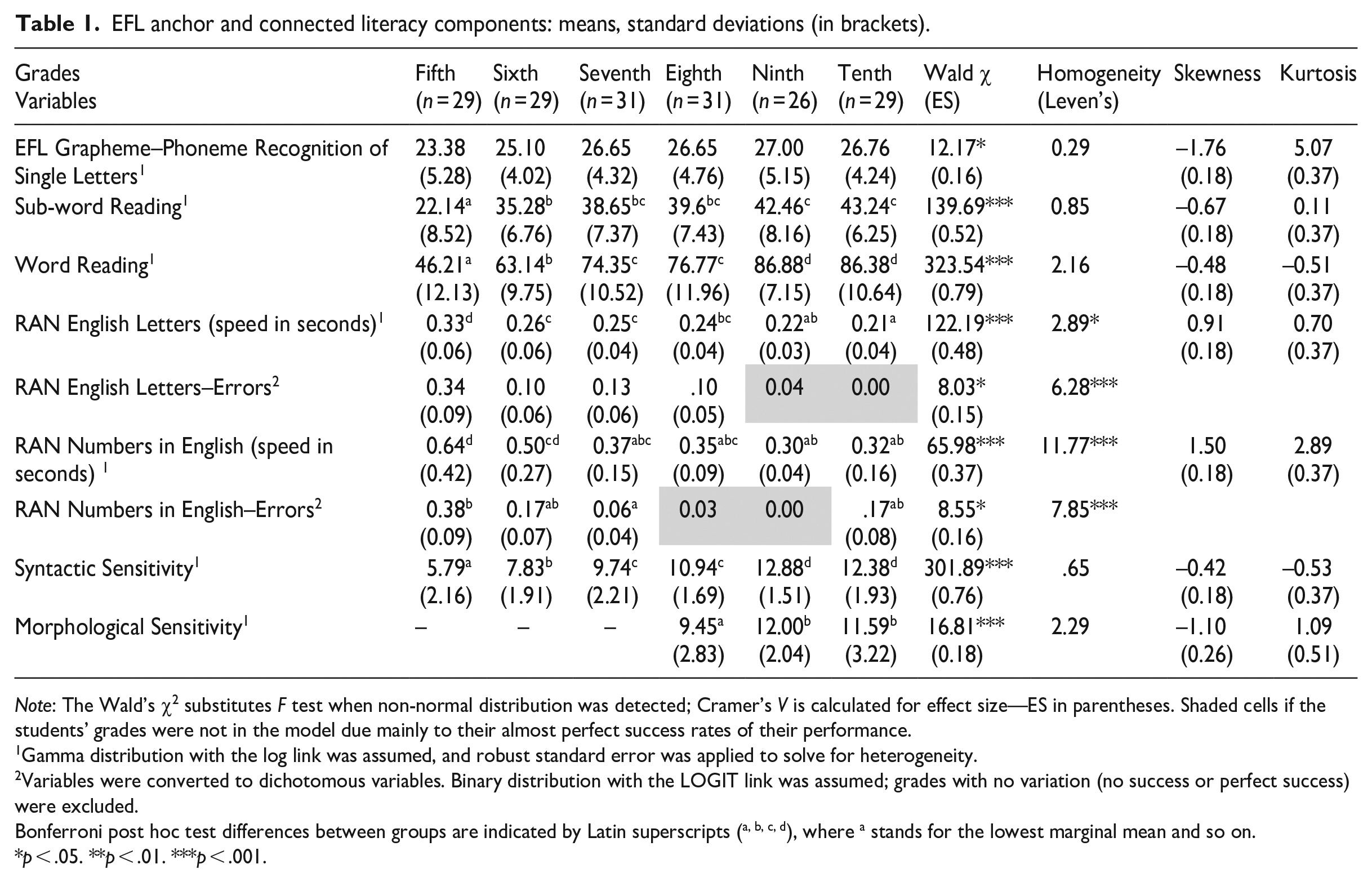
Note: The Wald’s χ2 substitutes F test when non-normal distribution was detected; Cramer’s V is calculated for effect size—ES in parentheses. Shaded cells if the students’ grades were not in the model due mainly to their almost perfect success rates of their performance.
1Gamma distribution with the log link was assumed, and robust standard error was applied to solve for heterogeneity.
Variables were converted to dichotomous variables. Binary distribution with the LOGIT link was assumed; grades with no variation (no success or perfect success) were excluded.
Bonferroni post hoc test differences between groups are indicated by Latin superscripts (a, b, c, d), where a stands for the lowest marginal mean and so on.
p < .05. **p < .01. ***p < .001.
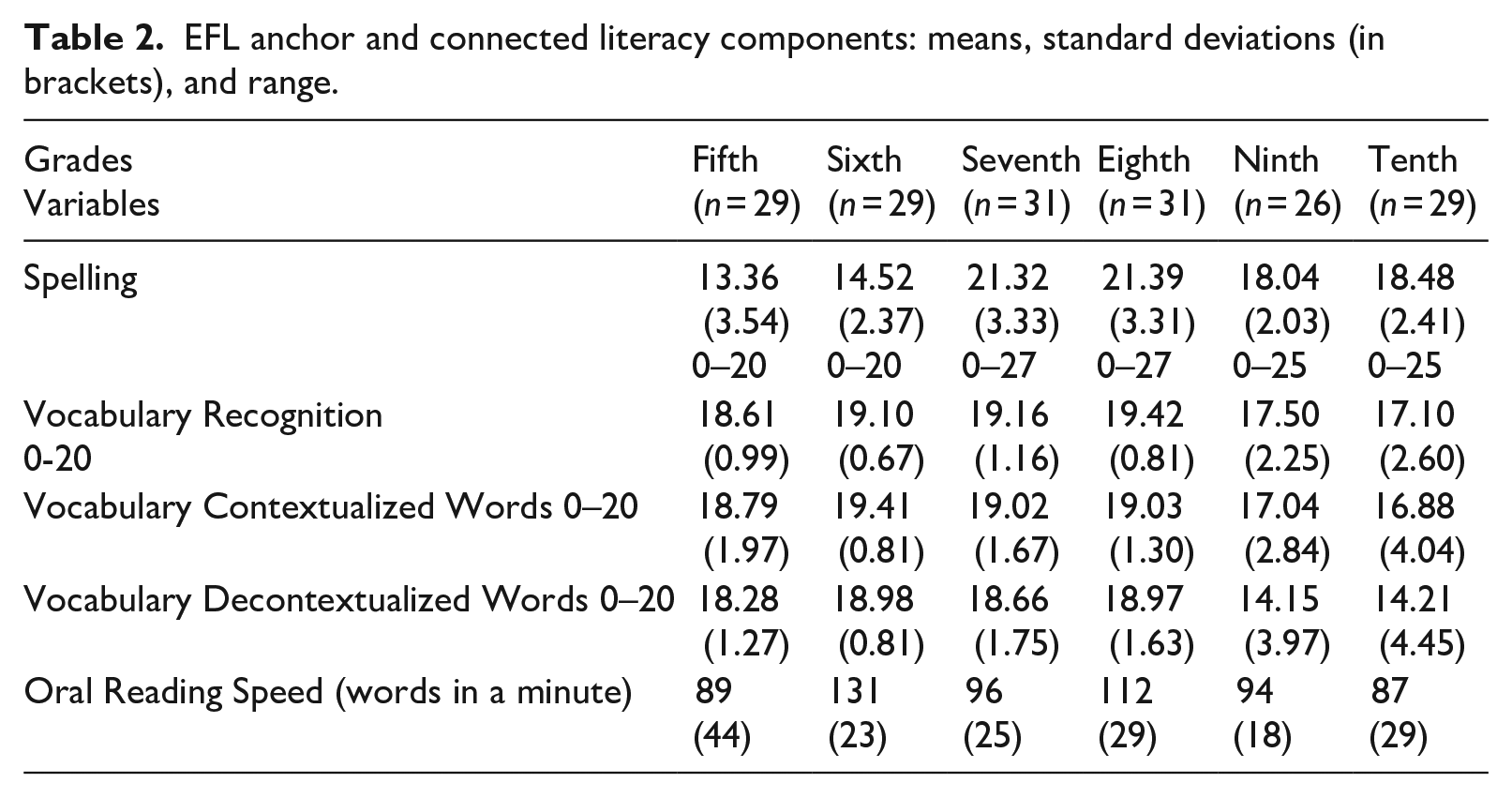
EFL anchor and connected literacy components: means, standard deviations (in brackets), and range.
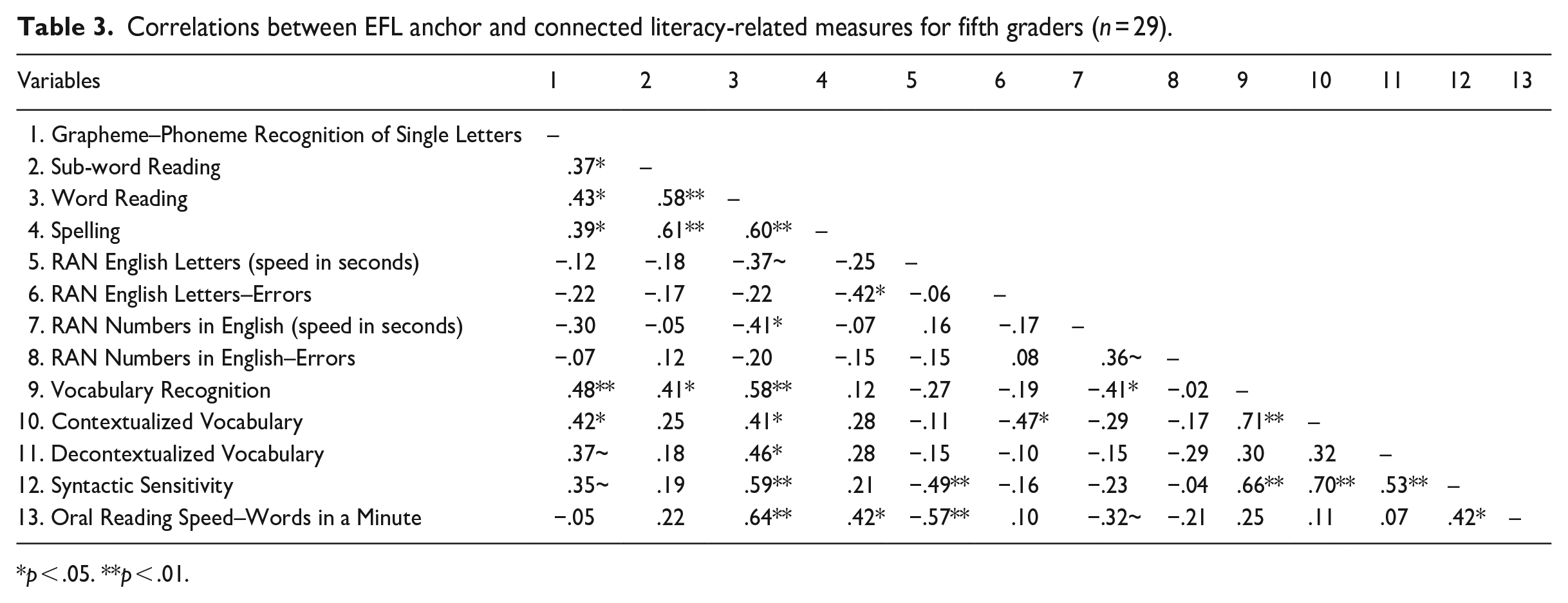
Correlations between EFL anchor and connected literacy-related measures for fifth graders (n = 29).
p < .05. **p < .01.
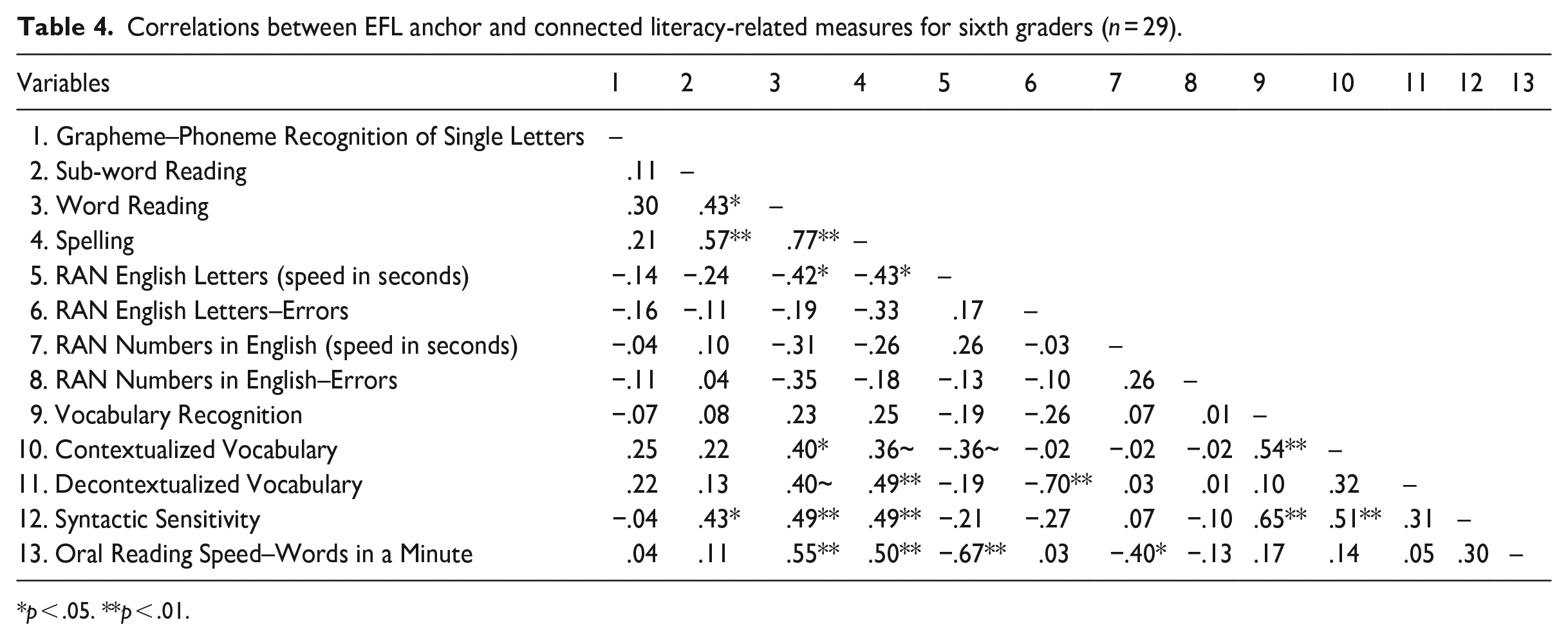
Correlations between EFL anchor and connected literacy-related measures for sixth graders (n = 29).
p < .05. **p < .01.
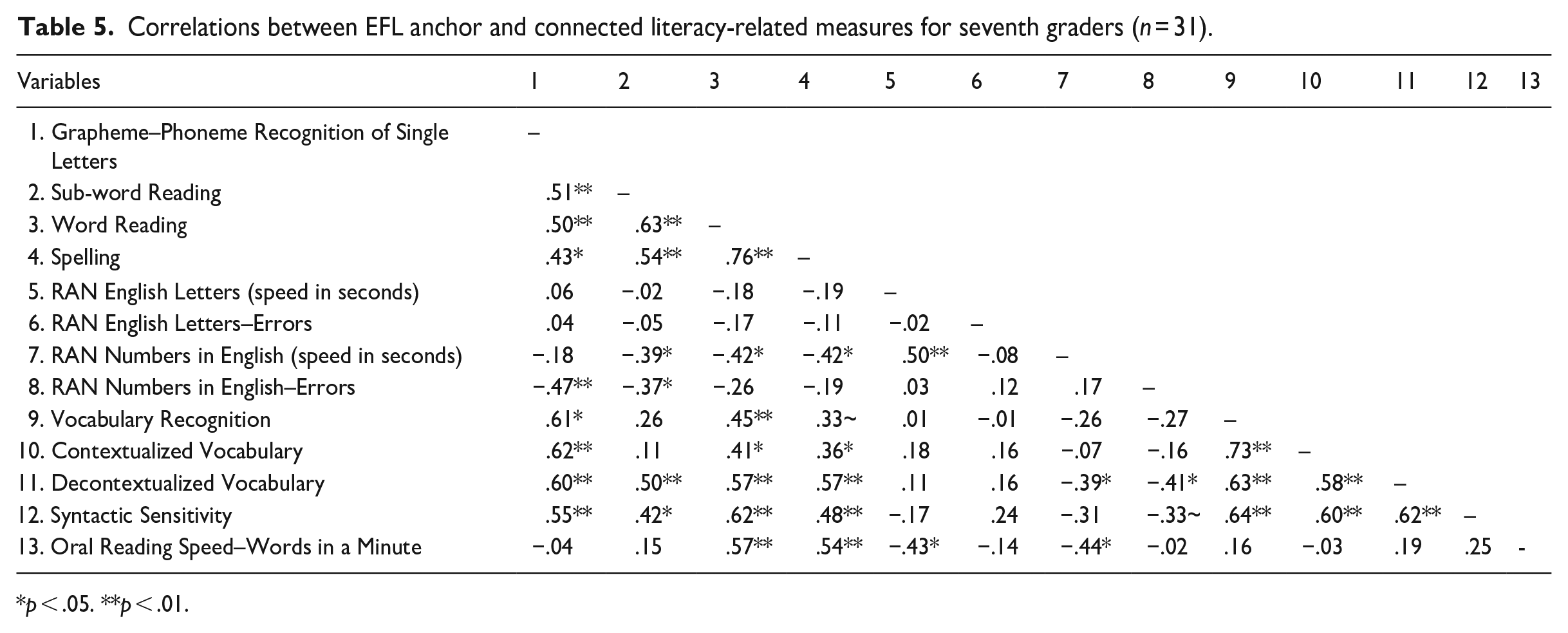
Correlations between EFL anchor and connected literacy-related measures for seventh graders (n = 31).
p < .05. **p < .01.
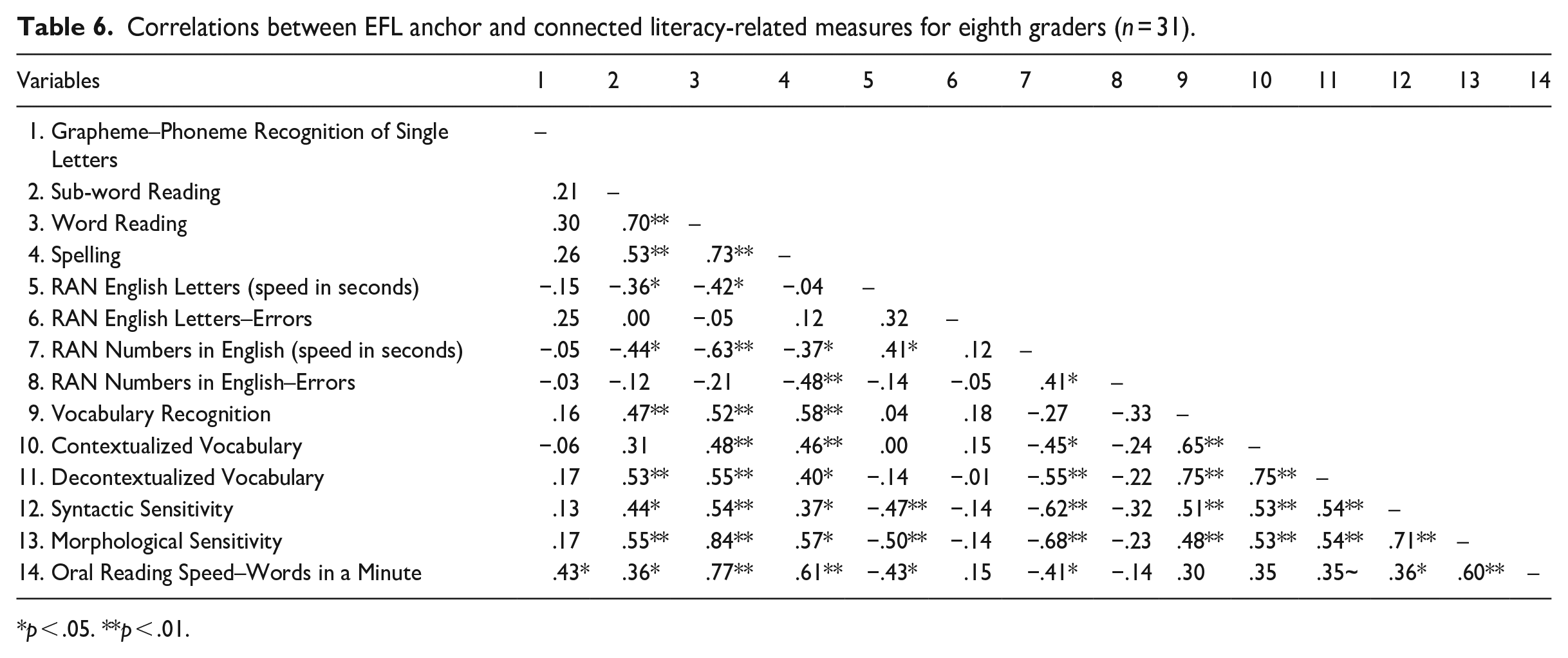
Correlations between EFL anchor and connected literacy-related measures for eighth graders (n = 31).
p < .05. **p < .01.
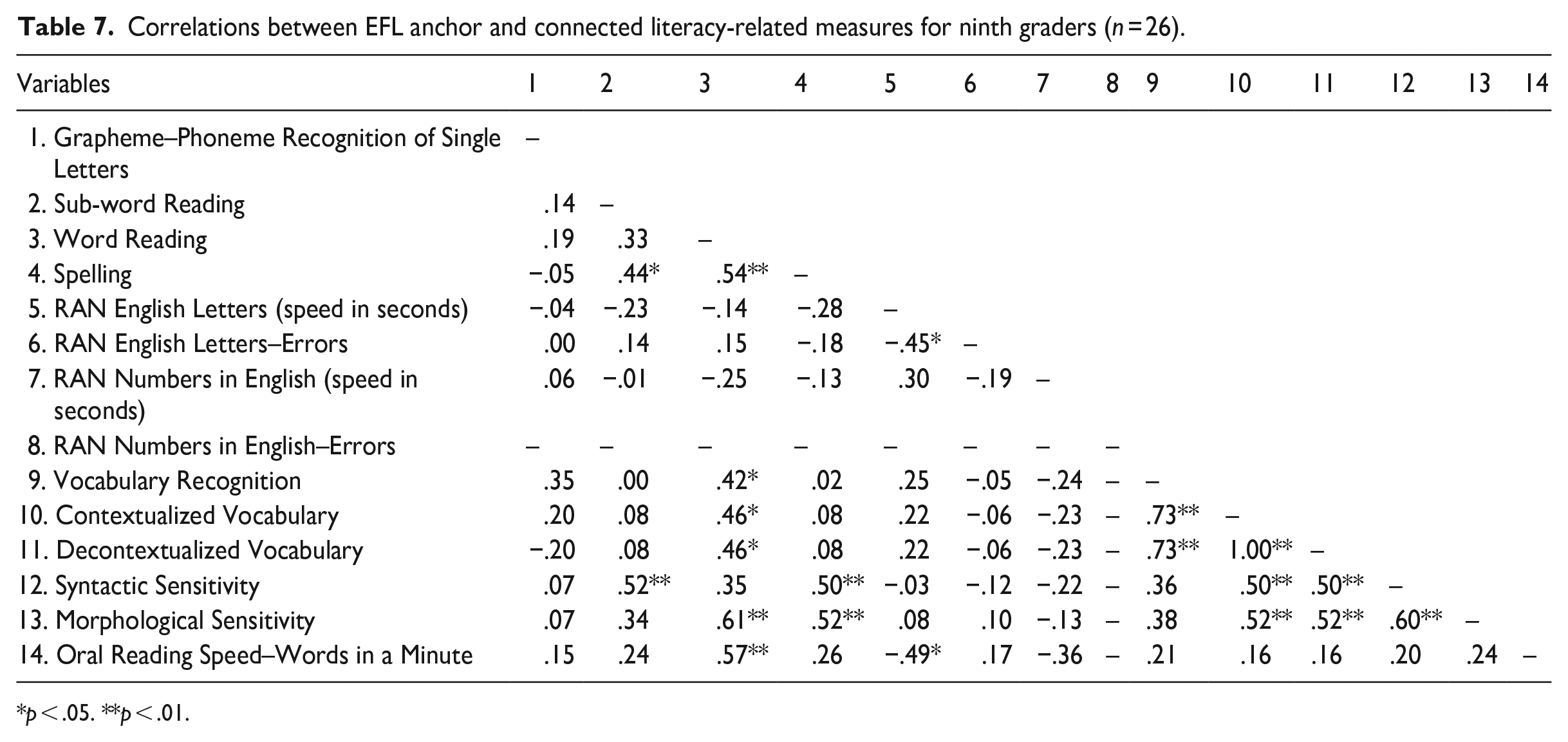
Correlations between EFL anchor and connected literacy-related measures for ninth graders (n = 26).
p < .05. **p < .01.
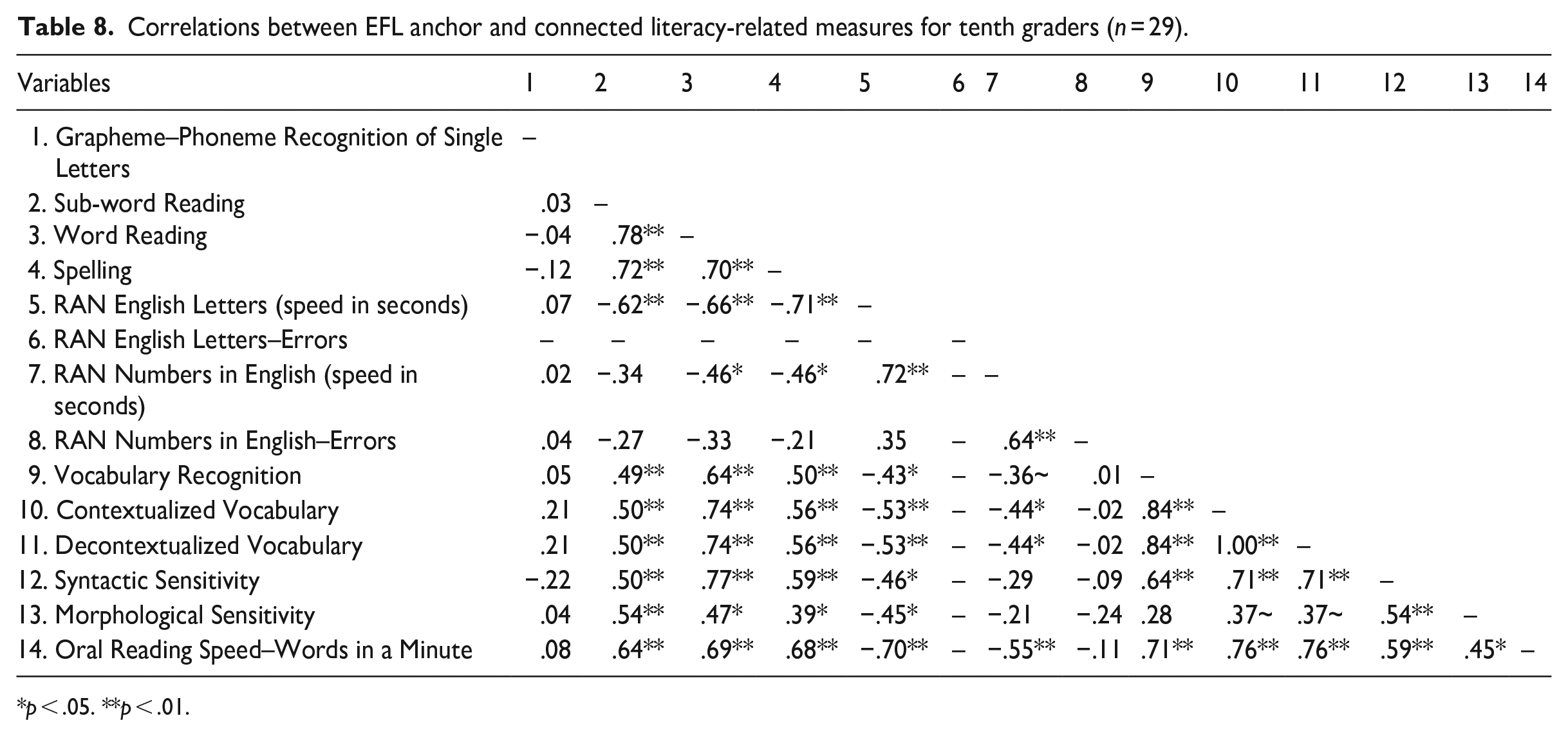
Correlations between EFL anchor and connected literacy-related measures for tenth graders (n = 29).
p < .05. **p < .01.
Results
The first research question examined the performance of EFL students from fifth to tenth grade in the various granular literacy components and meaning-related components. Table 1 shows no differences between the respective grades regarding single-letter grapheme recognition. Recognizing single-letter graphemes comprises the initial stage of reading acquisition and participants in all grades recognized at least one phoneme for each of the letters in the alphabet. Differences in sub-word reading across grades showed a large effect size with fifth graders recognizing significantly fewer digraphs, trigraphs, quadrigraphs, and rimes than students in higher grades. Ninth and tenth graders recognized significantly more sub-word units than sixth graders. EFL young learners across grades demonstrated partial sub-word reading, and it is noteworthy that out of a maximum of 62 sub-word units, the tenth-grade group recognized about 70%.
Word reading mean scores climbed steadily from fifth (below 50% correct) to sixth grade (63%), followed by a mean score improvement for seventh and eighth graders (mean score of about 75%), and finally an additional mean score improvement for ninth and tenth graders (mean score of about 86%). English letter RAN was fastest for tenth-grade EFL students and slowest for fifth graders. The fifth-grade students made significantly more errors for RAN letters than students in the other grades. English number RAN was slower than the English letter RAN. Fifth-grade EFL students were slower at number RAN than sixth-grade students. Sixth-grade students were slower than the seventh, eighth, ninth, and tenth graders. The fifth graders had more errors than students in the other grades for RAN numbers.
Spelling was the only literacy component not compared across grades because different items were tested at each grade (see Table 2 for descriptive statistics for the spelling variable). Dictated sentences were different across grades to represent the length, complexity, and frequency of words that EFL learners spell across the grades. The measures reflected these differences.
For the meaning-related literacy measures, accuracy at ordering words sequentially (syntax) gradually improved from fifth grade to tenth grade. The fifth graders yielded the lowest scores, followed by the sixth graders. The seventh and eighth graders were weaker than the ninth and tenth graders, who received the highest scores on this measure despite the finding that the ninth and tenth graders did not reach ceiling levels. For the morphemic sensitivity task administered to eighth-, ninth-, and tenth-grade students only, the eighth graders were significantly weaker than the ninth and tenth graders. Different vocabulary and oral reading speed items were tested at different grades to represent the types of words that EFL learners acquire and the texts that EFL learners read across the grades (see Table 2 for descriptive statistics for these variables). The measures reflected these differences.
The second research question examined the extent to which EFL literacy components (single-letter grapheme recognition, sub-word reading, word reading, RAN of letters and numbers, oral reading speed, and spelling) correlated with one another and with the meaning-related components (vocabulary, syntax, and morphological knowledge; See scatter plots of correlations in the supplemental file.). Single-letter grapheme recognition scores correlated with word reading for initial grades, whereas sub-word reading significantly correlated with word reading and spelling for most of the grades examined.
In the initial stage of EFL acquisition measured in fifth grade, there were some significant correlations between anchor literacy variables and meaning-related variables. Single-letter grapheme recognition correlated moderately with vocabulary recognition (.48, p < .01) and had a low positive correlation with contextualized vocabulary (.42, p < .05). Sub-word reading had a low positive correlation with vocabulary recognition (.41, p < .05). Finally, word reading had low positive and moderate positive correlations with the three vocabulary measures (vocabulary recognition, contextualized vocabulary, and decontextualized vocabulary) as well as the syntactic sensitivity measure (.58, p < .01; .41, p < .05; .46, p < .05; .59, p < .01, respectively). For the fifth graders, there were strong and consistent correlations between anchor literacy components and themselves and between meaning-related components and themselves. That is, single-letter grapheme recognition had low positive correlations with sub-word and word reading, as well as spelling. Sub-word reading had a moderate positive correlation with word reading and spelling. Reading and spelling had a moderate positive correlation. For the meaning-related components, syntactic sensitivity had moderate positive correlations with the three vocabulary measures (see Table 3). For the fifth-grade EFL students, the anchor literacy components, single-letter grapheme recognition, sub-word reading, word reading, and spelling, mostly did not correlate with the RAN measures. Literacy-related measures increased their correlations with RAN measures in the older grades.
By tenth grade, single-letter grapheme recognition did not correlate with any of the other variables, but both anchor literacy measures and meaning-related measures were intercorrelated. That is, sub-word reading, word reading, and spelling correlated with the three vocabulary tasks, syntactic sensitivity, and morphological awareness with low to high positive correlations ranging from .49 to .77. For the tenth-grade EFL students, RAN of letters had moderate to high positive correlations with sub-word, word reading, and spelling (–.62, –.66, and –.71, p < .01 respectively) than RAN of numbers that showed low positive correlations with word reading and spelling (see Table 8). The oral reading speed measure had a moderate positive correlation with the anchor literacy measures (sub-word and word reading, and spelling), a high positive correlation with the vocabulary meaning-related measures (vocabulary recognition, and contextualized and decontextualized vocabulary), and a moderate positive and low positive correlation with syntactic sensitivity and morphological sensitivity respectively. The oral reading speed measure had high negative and moderate negative correlations with the other speed of processing measures RAN letters and numbers (–.70 and –.55, p < .01). Thus, by tenth grade, anchor literacy measures, meaning-related measures, and speed of processing measures all intercorrelated.
In summary, participants across grades recognized about one phoneme per single-letter grapheme. Neither single-letter grapheme recognition nor sub-word reading was mastered by tenth grade. Similarly, the tenth graders did not demonstrate ceiling levels in word reading accuracy. Aside from single-letter grapheme recognition that appeared to be stable knowledge across grades, sub-word and word reading accuracy and RAN speed improved across grades. In the older grades, EFL students were more accurate and fluent in the literacy-related anchor measures. Single-letter grapheme recognition was correlated with word reading in the initial grades, possibly indicating the role played by single-letter grapheme–phoneme recognition in the initial acquisition of EFL reading. Subsequently, sub-word reading correlated with both word reading and spelling. Word reading and spelling were strongly correlated in all grades. For fifth graders, accuracy and speed measures did not correlate. By tenth grade, these accuracy and speed measures correlated. Finally, there were fewer correlations between the literacy-related anchor and meaning-related measures within the initial grades. By tenth grade, the literacy-related anchor measures and meaning-related measures correlated.
Discussion
This study aimed to examine the various literacy and meaning-related components that comprise diagnostic EFL literacy assessment to facilitate EFL literacy teaching and learning (Stiggins, 2002). Specifically, to inform EFL literacy diagnostic assessment, this study examined the extent to which learners from grades 5 to 10 exhibit achievements in the various grain size literacy components: single-letter grapheme recognition, sub-word identification (digraphs, trigraphs, quadrigraphs, and rimes), English letter and number RAN, and word reading. The second question examined the correlations between the EFL literacy components (single-letter grapheme recognition, sub-word and word reading, spelling, RAN letters and RAN numbers, oral reading speed) and themselves, and between the connected meaning-related components (vocabulary, syntactic sensitivity, and morphological knowledge). Finding significant correlations would provide a rationale for combining the teaching of anchor literacy and meaning-related components of words, thus anchoring these English words in memory.
There were no significant differences between the grades on recognition of single-letter graphemes. However, descriptive analyses found none of the grades reached ceiling for this measure. It appeared that approximately one phoneme was produced for each single-letter grapheme. This suggested that the participants likely did not have automatic access to the respective single-letter vowel grapheme–phoneme correspondences. This would subsequently impact the participants’ word reading and spelling (Frost, 2005; Moats, 2010; Shankweiler & Fowler, 2004; Spencer, 2006).
Word reading strongly correlated with spelling at each grade. Word reading and spelling are considered two sides of the same coin (Russak & Kahn-Horwitz, 2015; Treiman & Kessler, 2014). Spelling diagnostic assessment is less labor-intensive than the one-on-one requirement of listening to each child read word after word in a word reading task. An EFL diagnostic spelling measure may provide useful insights regarding the young learner’s orthographic and morphological knowledge. In addition, the EFL spelling task strongly correlated with both literacy and meaning-related measures across most of the grades. This suggests that a spelling assessment may be an efficient formative (Stiggins, 2002) and diagnostic (Cheng, 2019) assessment measure, in that it can be administered in group format as a means of providing a mirror of single-letter grapheme recognition, sub-word, and morphological knowledge.
The RAN measures showed inconsistent correlations with the anchor literacy components. Inconsistent correlations between RAN and EFL literacy measures were found in previous EFL literacy research among fifth-grade L1 Hebrew and Arabic learners versus L1 Hebrew ninth-grade EFL learners (Kahn-Horwitz et al., 2012b; Russak, 2020). These speeded measures may indicate a separate assessment component and could be candidates for EFL fluency diagnostic assessment for older learners (Share, 2021). These same speeded measures seemed to be less consistently correlated with word and sub-word reading and spelling measures for younger learners, who need to become accurate in reading and spelling English before improving their fluency (Share, 2021).
The meaning-related components, vocabulary recognition, contextualized and decontextualized vocabulary as well as syntax and morphology knowledge (for eighth to tenth graders) correlated with word reading across most grades. These meaning-related components correlated with spelling in some of the higher grades. These correlations support theories of orthographic mapping (Ehri & Rosenthal, 2007) and lexical quality (Perfetti & Hart, 2002), whereby layers of word knowledge, including semantic, syntactic, morphemic, orthographic, or phonological, contribute to in-depth EFL word knowledge (Krepel et al., 2021; Nation, 2001). Furthermore, these correlations justify including grain size literacy and meaning-related components in EFL literacy diagnostic assessment for young learners.
The fifth-grade students demonstrated a different profile from other participants. They were the youngest participants and had studied English for two weekly hours in third grade and four weekly hours in fourth and fifth grade. Their single-letter grapheme recognition scores correlated with other accuracy measures. The number of words they read per correlated with word reading, spelling, RAN of letters, and syntactic sensitivity. This was the only group for whom single-letter grapheme recognition correlated with other variables. This may indicate that single-letter grapheme recognition may be an effective diagnostic assessment measure for fifth graders. This supports findings by Russak and Kahn-Horwitz (2015) that found spelling consonant clusters and initial h to discriminate between good and struggling L1-Hebrew EFL spellers.
The EFL literacy components can be divided into accuracy and speed of processing measures. Accuracy literacy measures included sub-word and word reading, as well as spelling. Sub-word reading included recognition of digraphs, trigraphs, quadrigraphs, and rimes. The current findings indicated that across all grades, sub-word reading correlated with spelling and mostly with word reading. This highlights the complexity of English orthography and may suggest that beyond recognizing single-letter graphemes, teaching and facilitating the learning of digraphs, trigraphs, quadrigraphs, and rimes should be integrated into EFL word reading and spelling instruction (Frost, 2005; Moats, 2010; Shankweiler & Fowler, 2004). Students who are lacking sub-word knowledge should be explicitly taught these graphemes and rimes as part of EFL literacy instruction across grades (Kahn-Horwitz, 2020). This instruction will assist in jumpstarting the statistical learning that is likely to take place as students are exposed to frequent EFL vocabulary (Seidenberg et al., 2020). The finding that after 8 years of EFL acquisition, tenth graders recognized about 70% of the sub-word units and reached a mean of 86% for word reading, and 74% for spelling accuracy might call for further research, with the aim of finding optimal teaching and learning strategies for sub-word units in the EFL literacy curriculum. An additional recommendation is to examine the extent to which these teaching and learning strategies could improve word reading, spelling, and vocabulary knowledge, all a part of the lexical quality (Perfetti & Hart, 2002) that EFL learners may be accruing in their language acquisition.
Conclusions
EFL teachers are often limited as to how to proceed with struggling students in their classes. The measures presented in the current study may be used together with or independently of L1 assessment. They may be implemented as part of classroom formative assessment regardless of whether the students in question have been diagnosed as having a learning disability. The results of this study could contribute to the EFL teaching toolbox, enabling EFL teachers to diagnose the various literacy components at the heart of EFL reading and spelling. Results could inform the building of an appropriate EFL intervention program by the teacher, including setting learning outcome goals for students, thereby assisting students in becoming EFL literate. This, in turn, could positively influence students’ literacy, cognition, self-esteem, and motivation.
Supplemental Material
sj-docx-1-ltj-10.1177_02655322231162838 – Supplemental material for English foreign language reading and spelling diagnostic assessments informing teaching and learning of young learners
Supplemental material, sj-docx-1-ltj-10.1177_02655322231162838 for English foreign language reading and spelling diagnostic assessments informing teaching and learning of young learners by Janina Kahn-Horwitz and Zahava Goldstein in Language Testing
Footnotes
Appendix 1
Declaration of conflicting interests
The authors declared no potential conflicts of interest with respect to the research, authorship, and/or publication of this article.
Funding
The authors disclosed receipt of the following financial support for the research, authorship, and/or publication of this article: This research was funded by a joint grant from Oranim College and an Israeli Ministry of Education Pedagogical Initiative.

Supplemental material
Supplemental material for this article is available online. An OASIS (accessible) summary of this article authored by Kahn-Horwitz and Goldstein (2023) is available at https://oasis-database.org/concern/summaries/kd17ct62b?locale=en In addition, a video abstract is available at https://youtu.be/tRtFMmEju90 at https://www.youtube.com/watch?v=tzKTEEcRQow&t=7s.
References
Supplementary Material
Please find the following supplemental material available below.
For Open Access articles published under a Creative Commons License, all supplemental material carries the same license as the article it is associated with.
For non-Open Access articles published, all supplemental material carries a non-exclusive license, and permission requests for re-use of supplemental material or any part of supplemental material shall be sent directly to the copyright owner as specified in the copyright notice associated with the article.
