




Abstract
The use of profile photos is central to most dating apps, yet some apps deliberately delay the display of photos. This study examines user experiences on pictureless dating apps, with a focus on Heymandi. Semi-structured interviews were conducted with 23 Gen Z (i.e., 18–25 years old) users in Hong Kong to address three research questions: (1) what affordances motivate users to adopt pictureless dating apps, (2) how users self-present in a text-only environment, and (3) how relationships develop on this kind of apps. Findings highlight three key affordances: anonymity, which enables users to avoid stigmatization and prioritize personality over appearance; immediacy, which facilitates instant matching and real-time conversations; and specificity, which encourages users to initiate and respond to targeted discussions. Users employed three self-presentation strategies—self-promoting, effortless, and interest-based—to create appealing text-only profiles. Relationship development followed a three-phase process: matching, switching between social media platforms (e.g., transitioning from Heymandi to Telegram and/or Instagram), and, for most users, photo exchanges via other platforms prior to in-person meetings. While pictureless apps aim to reduce emphasis on physical appearance, photo exchanges reintroduced appearance-based considerations. This study sheds light on emerging dating platforms, revealing how they both challenge and reinforce traditional appearance-driven dating norms.
Physical attractiveness has long been considered a primary determinant of liking in a romantic context (Walster et al., 1966). This belief remains relevant in online dating, as recent research reveals that the physical attractiveness of profile photos is often given more importance than detailed written descriptions (Coduto & Fox, 2024). This is why photo-oriented dating platforms like Tinder dominate the global online dating market.
Such emphasis on photos in online dating, however, is criticized as superficial (Ward, 2017). The Future of Dating Report by Tinder (2023) also suggests that Gen Z tends to prioritize values and personality over physical appearance. Therefore, there is a recent growing interest in dating apps that deliberately postpone the display of profile photos. For instance, Lovetastic, a dating app headquartered in Switzerland, positions itself as an app where “other users like you without a photo at first impression” (Lovetastic, nd). Users complete a text-only profile and view others’ text-only profiles. Similarly, Heymandi, a dating app with offices in Hong Kong and Canada, also challenges the dominance of photos in dating app culture (Heymandi, 2023; Figure 1). Every time users log onto the app, they create a new one-line description (known as a “title” among Heymandi users) using text and emojis only (e.g., “94 tall and thin, music lover” or “28 160 I am serious”1). Additionally, users can choose up to three hashtags to describe themselves. After they log on, they see a list of titles created by other users, accompanied by any hashtags. If they are interested in a title, they can send a chat invitation to the title creator. Meanwhile, users, who have created a title when logging on, can accept or decline invitations initiated by other users. If the invitation is accepted within 15 seconds, an anonymous chatroom will be created between two users. Only after the two parties have talked for an extended period will the app allow them to share photos with each other, through a feature known as “FairSwap.” A step-by-step usage guide for Heymandi (Screen captures on October 22, 2024)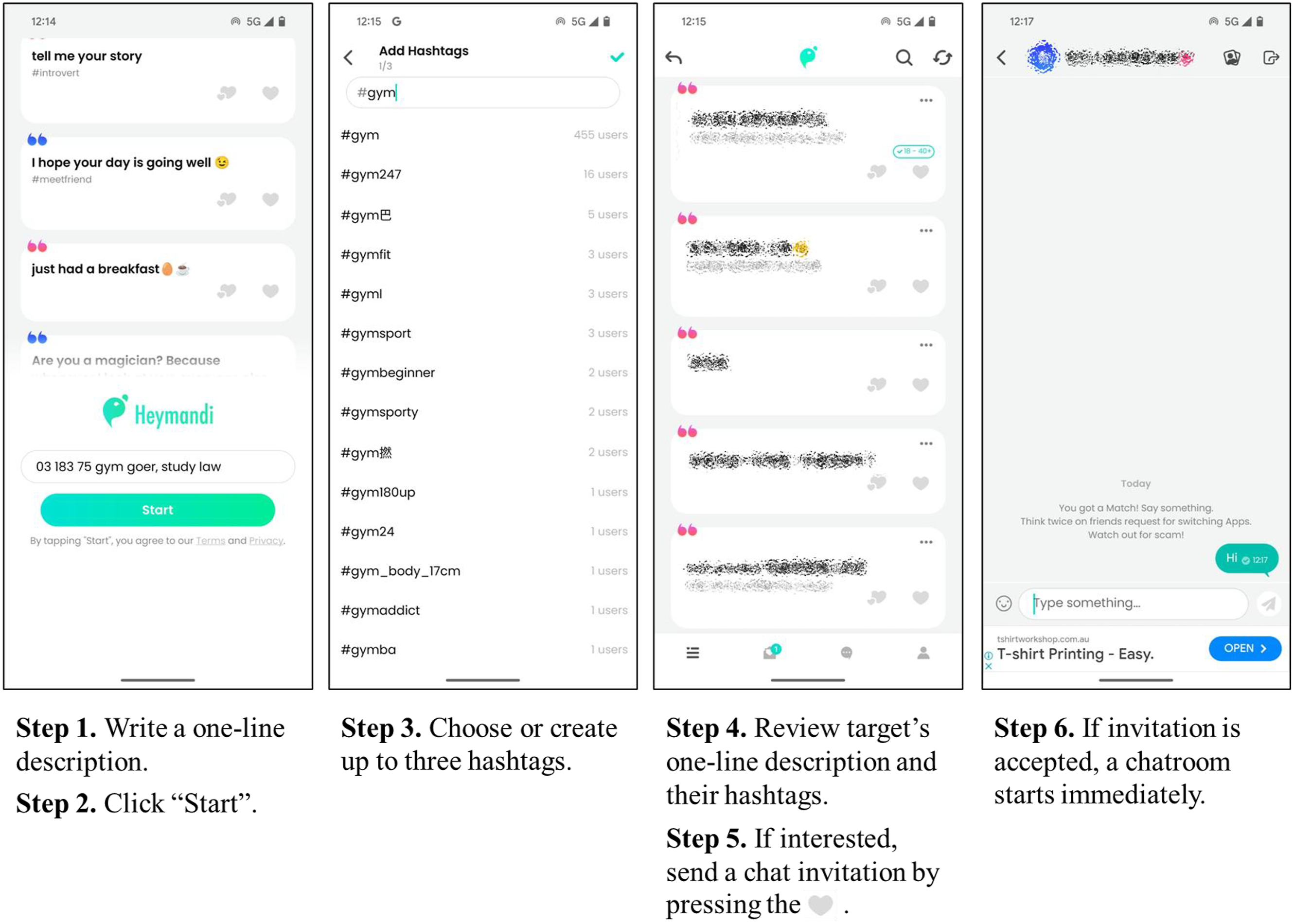
As most dating apps today foreground daters’ photos, many studies have explored how online daters present themselves using profile photos (e.g., Miller, 2019; Ward, 2017). Apps like Lovetastic and Heymandi offer a pictureless dating app environment where photos are not displayed or shared until users have started talking with each other. Therefore, this study aims to explore how dating app users present themselves and develop romantic interests in such pictureless dating app environments. Through in-depth interviews with young Heymandi users in Hong Kong, we examine (1) the reasons why people opt for a pictureless dating app; (2) the ways in which people self-present with limited cues (i.e., text and emojis only); and (3) the trajectory of relationship development originating from a pictureless dating app. The findings of this study contribute to a better understanding of the importance of profile photos in online dating and people’s reactions to this newly emerging online dating environment.
Literature review
Affordance of pictureless dating apps
Among studies exploring why people use dating apps, many employed uses and gratifications (U&G) theory (Katz et al., 1973). The theory presumes that users are active and conscious in their media choice and use media to satisfy their needs. Most of these studies have demonstrated that, across cultures, seeking relationships—romantic, sexual, and purely social—was a significant motivation for using dating apps (Solis & Wong, 2019; Sumter et al., 2017; Timmermans & De Caluwé, 2017; Van de Wiele &Tong, 2014).
While these studies focused on the reasons people use dating apps, they place less emphasis on the affordances of dating apps that motivate people to use them. Indeed, U&G researchers Sundar and Limperos (2013) introduced “U&G 2.0,” which emphasizes technology as a direct source of gratifications. They suggested that not only do new technologies bring about new forms of gratifications, but they also refine existing, more general gratifications.
Affordance refers to the properties that emerge through the interaction between a user and an object, highlighting the possibilities for action (Faraj & Azad, 2012). From a communication studies perspective, Evans et al. (2017) outlined three threshold criteria of affordance: first, affordance is not a feature itself but is derived from an object’s features; second, it is not an outcome of use but can lead to multiple outcomes; and third, affordance is better described in terms of magnitude rather than as a binary presence or absence.
Many dating app scholars have identified various affordances unique to these platforms. For example, Ranzini and Lutz (2017) applied Schrock’s (2015) typology of mobile media affordances—portability, availability, locatability, and multimediality—to the context of dating apps. Chan (2017) proposed five affordances that distinguish dating apps from traditional dating websites. These affordances can be summarized as follows. First, dating apps afford mobility, as users can use their mobile phones at their convenience, regardless of time and location (Chan, 2017). This aligns with Schrock’s (2015) concept of portability. Second, contrary to dating websites connecting people across broader geographical regions, dating apps afford proximity by making use of geolocation information to connect users who are physically nearby (Chan, 2017). Tanner (2024) suggests that this is similar to Schrock’s (2015) concept of locatability, which allows users to discover someone in their vicinity. Third, dating apps affords immediacy through real-time, quick, and easy message exchanges, thereby expediting relationship development (Chan, 2017). This is similar to Schrock’s (2015) concept of availability; Ranzini and Lutz (2017) refer to this as synchronicity. 2 Fourth, some dating apps afford authenticity by implementing registration through users’ social media accounts (Chan, 2017). The lack of authenticity, on the other hand, can be associated with anonymity, where users are permitted to conceal their identity (Evans et al., 2017). Fifth, many dating apps afford visual dominance, enabling users to foreground their photos and downplay textual descriptions (Chan, 2017). Finally, Ranzini and Lutz (2017) note that by allowing users to link their social media profiles to their dating apps (to enhance authenticity), dating apps also afford multimediality, enabling users to create more sophisticated self-presentation through various modes of communication.
Based on the searching-matching-interacting (SMI) framework (Adelman & Ahuvia, 1991), Coduto and Fox (2024) discussed relevant affordances critical to dating app use. During the searching stage, visibility, 3 searchability, and locatability enable dating app users to look for their ideal partners who are physically nearby. During matching, conversation control, synchronicity, and editability offer users safety mechanisms to vet their potential partners. Finally, bandwidth, identifiability, and accessibility continue to allow users to reduce uncertainty about their partners during the interacting stage.
In sum, various affordances elucidate why dating apps are popular in general, but little is known about why people use pictureless dating apps. Therefore, we ask the following research question: RQ1: What affordances of pictureless dating apps motivate users to use them for seeking relationships?
Self-Presentation via Texts and Emojis Only
On most dating platforms, users are introduced to profiles of their targets—typically consisting of photos, along with personal information and geolocation. Among these elements, photos are the most important in attracting attention (Whitty & Carr, 2006). Initiation in online dating heavily relies on self-presentation and assessment of targets’ profiles, with an emphasis on positive first impressions (Ellison et al., 2006; Ward, 2017). Multiple studies have found that displaying one’s photos on a profile is advantageous to those who meet common beauty standards. For instance, Schoendienst and Dang-Xuan (2011) analyzed 167,276 message exchanges among users of an Australian online dating platform. Their analysis showed that messages from physically attractive senders were more likely to receive a response than messages from less attractive senders; this relationship was stronger among male receivers than female receivers. Besides, daters with short-term intentions prioritize qualities such as physical attractiveness and sex appeal (Buss & Schmitt, 1993). Tinder is a prime example of dating apps that put photos first.
Nonetheless, on pictureless dating apps, users cannot use photos to create first impressions. Users must adapt to the absence of photos and learn how to create engaging profiles using limited cues (see social information processing theory; Walther, 1992). This is akin to the “personal ads” published in newspapers or magazines where people created a text-only profile, hoping their ideal partners would write them back (Cameron et al., 1977; Phua & Kaufman, 2003).
Research on broader digital cultures demonstrates that people are eager to express themselves using text alone. For example, Reddit features various subreddits for discussion, where users express their extroversion through pro-social words (Bergstrom & Poor, 2023). Experimental research has shown that in text-only online environments, individuals can build impressions by disclosing personal information (e.g., hobbies, personal histories) and extracting information from their conversation partners (Coduto, 2025). Moreover, text-based online communication can incorporate the use of emojis, which have been found effective for enhancing communication, especially when discussing positive topics with close family and friends (Cavalheiro et al., 2022). Overall, this line of research suggests that people can create a positive impression even if only text is available.
Pictureless dating apps offer a space akin to old-fashioned “personal ads” in newspapers and magazines, where no photos are allowed in one’s profile. Therefore, we ask: RQ2: How do users self-present themselves on pictureless dating apps?
Relationship development on pictureless dating apps
In a typical online dating scenario, initial impressions are formed through browsing targets’ profiles with photos. Users start simple message exchanges with targets whose appearance they find acceptable. This is the stage where people seek information, discover similarities, and reduce uncertainty. As the relationship develops, communication shifts to more immersive media like private messaging or phone calls with a higher contact frequency (Eichenberg et al., 2017). This transition is associated with greater self-disclosure, which results in increased intimacy, enhanced relationship satisfaction, and improved communication quality (Boyle & O’Sullivan, 2016; Ledbetter, 2021).
Researchers argue that cue-reduced online environments, such as online dating sites, are particularly conducive to the development of intimacy through hyperpersonal communication (Walther, 1996; Walther & Whitty, 2021). In these settings, online dating users can selectively present their most favorable selves. The asynchronous nature of online communication enables users to carefully craft their messages, which are then received by others who are likely to idealize the message senders due to the absence of visual cues. This combination of strategic self-presentation, deliberate messaging, and idealized perceptions fosters favorable feedback. Empirical research supports this notion, demonstrating that dyads communicating through text-only channels reported greater social attraction to their partners compared to dyads interacting via videoconference (Antheunis et al., 2020).
The first in-person date is a pivotal turning point in online dating since it determines the developmental trajectory of the relationship (Ramirez et al., 2014). This transition from exclusively online communication with limited modalities to face-to-face interaction is traditionally known as modality switching. In-person meetings provide additional cues that can strengthen or weaken the impressions, ultimately assessing the potential for a romantic connection. Delaying in-person meetings may lead to poorer outcomes because people tend to overinterpret the social cues available in online communication, creating unrealistic expectations (Ramirez et al., 2014). After the first date, both individuals decide whether they would like to proceed; if either party expresses disinterest, the relationship usually ends.
More recently, researchers studying dating apps have shown that the straightforward transition from text-only to face-to-face communication is rare in online dating (Coduto & Fox, 2024). In their in-depth interviews with 37 dating app users, Coduto and Fox (2024) found that users typically utilized three to five different channels, such as Instagram or Snapchat, to gather more information about their romantic interests before exchanging phone numbers and meeting in person. They describe this layering and switching between platforms as modality weaving, a phenomenon in which “relational partners … engage in weaving multiple modalities throughout their relational communication” (McEwan, 2021, p. 1). With the growing number of online platforms offering diverse modes of communication, Parks (2017) argue that “it is not clear how well previous modality-switching research describes today’s overall online environment, in which communicators frequently switch among several different modes and media platforms” (p. 508).
Heymandi sets itself apart from other dating apps by letting users match with their targets solely based on textual descriptions, potentially leading to a different path of relationship development. This approach may encourage users to transition across multiple platforms to gather more information about their romantic interests before progressing to in-person meetings. Therefore, we propose our third research question: RQ3: How do relationships develop from pictureless dating apps?
Method
Research design overview
The exploratory nature of this study warrants a qualitative approach. We conducted in-depth, semi-structured interviews with 23 Heymandi users in Hong Kong from September 2023 to February 2024. Our interviews consisted of three parts. In the first part, we inquired how our respondents came across this dating app, gauging their perception of the app before and after they started using it. In the second part, we asked about our respondents’ usage patterns of the app and the way they created their titles. In the third part, we asked how our respondents validated their targets’ qualities and proceeded with relationship development in a pictureless dating app environment. Our study was approved by the research ethics board of the first author’s institution (SBRE-23-0494).
Respondent recruitment and demographics
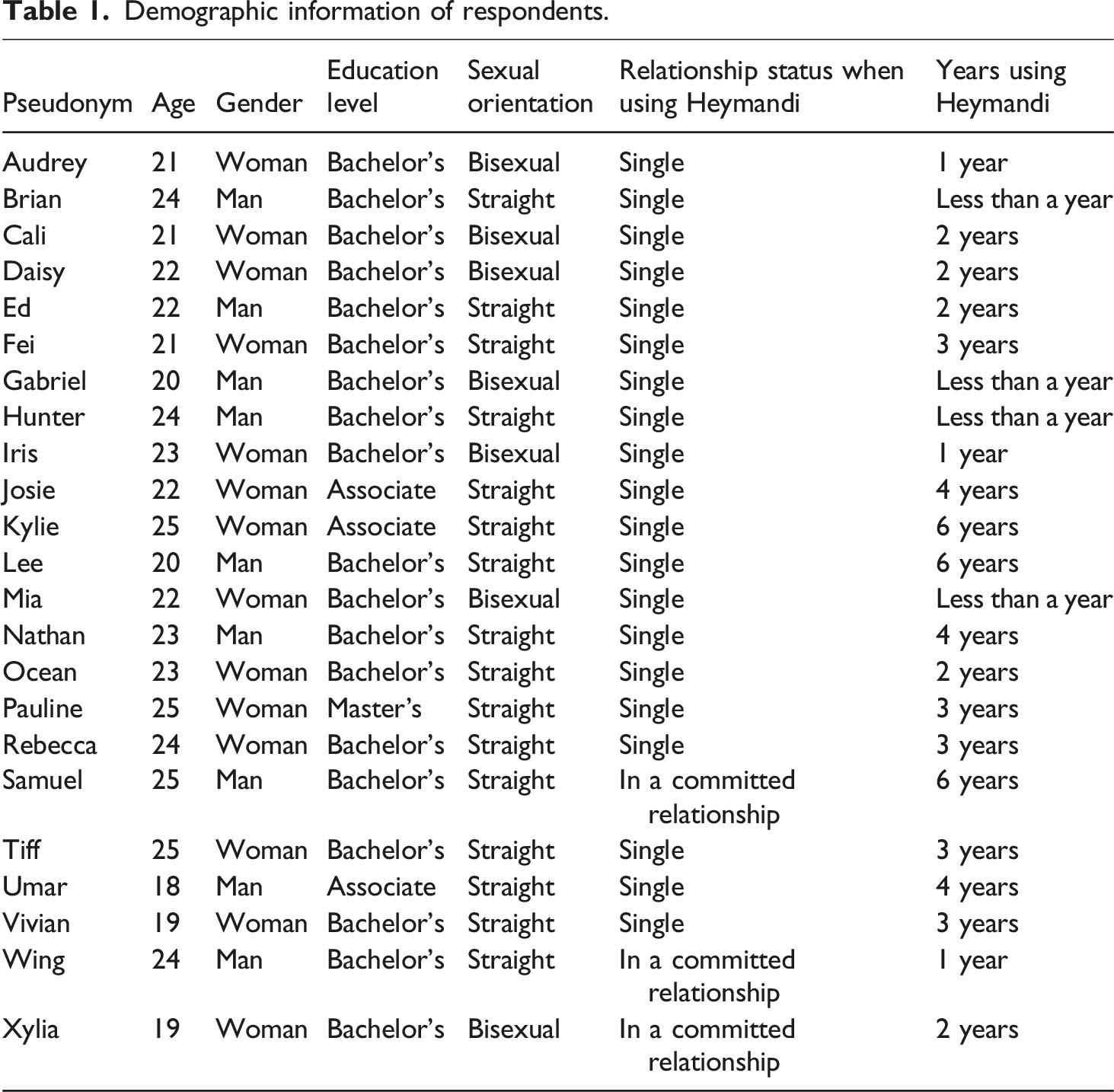
The criteria for participating in this study included (1) being 18–25 years old (i.e., Gen Z), (2) living in Hong Kong, (3) speaking Cantonese, (4) having logged into Heymandi at least once a week in the last month (weekly logins were required to ensure consistent use, as logging in monthly or less could make it difficult for respondents to recall their experiences), and (5) having gone on an offline date with at least one match from the app. We limited our recruitment to Gen Z as many of them (23%) had reported using a dating app within the past three months (Singh, 2025). We created recruitment messages and posted them on the romance sections of Dcard, a popular Hong Kong forum akin to Reddit, and shared them via our personal social media networks. It was ensured that no people whom the researchers personally know were included in the study.
Demographic information of respondents.
Researchers’ description
The interviews were conducted by the first author, who identified as a straight woman. She was a user of Heymandi for four years; her familiarity with the app helped develop trust and rapport with our respondents. The second author, who identified as a gay man and the first author’s research supervisor, had never used Heymandi and therefore could maintain a critical distance from the phenomenon.
Data collection and analysis
Face-to-face or phone interviews were conducted with respondents, depending on their preference, by the first author. The interviews lasted from 21 minutes to 1 hour (with a mean of 41 minutes). Prior to the interviews, the first author explained the nature and purpose of this study to our respondents, who gave their informed consent to participate in this study. With the permission of our respondents, the research interviews were audio-recorded. The interviews were conducted in Cantonese.
The first author transcribed the audio-recorded interviews. She familiarized herself with the data by reading and rereading the transcripts. A two-cycle coding process (Miles et al., 2014) was employed. First, the first author reviewed the data in relation to the three research questions and coded relevant paragraphs of the transcripts using descriptive coding. For instance, a respondent said, “I don’t want people whom I know in reality, or friends, to know that I’m using dating apps after breaking up”; she coded this as “reluctance to be identified.” Likewise, she coded “I prefer to learn about my targets on a deeper level, focusing on their characters rather than superficial appearance” as “preference for characters over appearance.” Second, after the first-cycle coding process was completed, the first author grouped, organized, and rearranged similar codes across respondents to identify emerging patterns and themes through constant comparison (Glaser & Strauss, 1967). For instance, the above codes “reluctance to be identified” and “preference for characters over appearance” both point toward the consequence of being anonymous on Heymandi, so they were grouped under the theme “anonymity.” The second author also participated in this constant comparison stage to offer analytical clarity. Finally, both authors organized these themes to address the three research questions.
For RQ1, we consolidated the second-cycle codes into three meaningful affordances that motivated our respondents to use the app for relationships. We compared the affordances that emerged from our data with those identified by prior dating app studies (Chan, 2017; Ranzini & Lutz, 2017; Tanner, 2024). Two of our findings aligned with the existing literature, namely “anonymity” and “immediacy,” while we introduced a new label, “specificity,” for an affordance not covered in previous research. For the latter, we applied the three threshold criteria developed by Evans et al. (2017) to confirm that it constitutes an affordance, rather than a feature or an outcome. For RQ2, we consolidated the second-cycle codes into three strategies: the self-promoting strategy, the effortless strategy, and the interest-based strategy. Finally, for RQ3, we identified three phases in relationship development on Heymandi, with the last phase involving two different pathways.
By the 19th interview, data saturation was reached as coherent themes began to recur. Four more interviews were conducted to further confirm this saturation.
In the results section, the first author translated the respondents’ quotations from Cantonese into English. Pseudonyms are used to represent our respondents.
Findings
Affordance of Heymandi (RQ1)
Our analysis shows that three key affordances of Heymandi have motivated our respondents to use the app: anonymity, immediacy, and specificity.
Anonymity
Anonymity is “the degree to which a communicator perceives the message source is unknown and unspecified” (Scott, 1998, p. 387). It is considered a common affordance of social and digital media (Evans et al., 2017). As discussed earlier, this can be regarded as a lack of authenticity, which is one of the key affordances of dating apps (Chan, 2017; Ranzini & Lutz, 2017; Tanner, 2024). Rather than being a feature, anonymity arises from the absence of identity verification or photo requirements. Its degree varies across platforms. For example, Grindr allows users to remain discreet by not uploading any identifiable photos, whereas Facebook Dating requires users to upload at least one photo with a visible face. Anonymity can also lead to multiple outcomes, as described below. Our respondents found this affordance useful.
Online daters may face stigmatization as having low mate value or attractiveness (Whitty & Carr, 2006). Some of our respondents shared this stigma, feeling guilty and ashamed about using online dating. Particularly, our female respondents expressed concerns about being seen as desperate if spotted using dating apps. Josie (22, woman) explained, “Some people take screenshots and circulate girls’ [dating] profiles online. I got to keep my personal information safe.” For respondents like Josie, maintaining privacy was essential. By keeping their online dating activities separate from real-life connections, they felt more comfortable searching for new relationships. After a recent breakup, Cali (21, woman) wanted to meet new people for rebound relationships but said, “I don’t want people I know in reality, or friends, to know that I’m using dating apps after breaking up.”
The anonymity of Heymandi helped users avoid being recognized by not only friends and colleagues but also lovers. Samuel (25, man) and Xylia (19, woman), both in committed relationships with their respective partners, admitted that Heymandi allowed them to conceal their online activities from their current partners.
Furthermore, Heymandi’s anonymity was found to be a strong motivator for people who prioritize personality over appearance. In contrast to swipe-based dating apps, Heymandi’s exclusion of profile photos encourages users to evaluate targets holistically. Daisy (22, woman) elaborated: The reason why I don’t use Tinder is that I feel Tinder users over-emphasize physical appearance. I prefer to learn about my targets on a deeper level, focusing on their character rather than superficial looks. If we are a good fit, I would love to pursue the relationship, even if they may not be handsome.
Finally, Ed (22, man) pointed out that his lack of confidence in his own appearance made him appreciate the opportunity to connect without posting photos. “Personally, I don’t enjoy taking photos. Many apps require uploading photos, but I’m not fond of it. I prefer a simpler approach, like getting to know people via chats.” He usually came up with interesting titles to catch attention from potential targets.
In short, the anonymity of Heymandi enables our respondents to avoid stigmatization, focus more on targets’ characters and personalities, and deemphasize appearance in the competitive dating scene.
Immediacy
Immediacy has been identified in prior research as a key affordance of dating apps (Chan, 2017; Tanner, 2024). It refers to the potential for users to receive instant responses to their messages from someone who is available (or online) at the moment message was sent. According to Evans et al.’s (2017) three-part criteria, immediacy qualifies as an affordance. First, in the context of Heymandi, immediacy is primarily enabled by its 15-second acceptance mechanism. When a chat invitation is sent, the other end—who must be online—has only 15 seconds to decide whether to accept. If no action is taken, the invitation is declined automatically. In other dating apps, such as Grindr, immediacy is brought by the green dot feature on a user’s profile, indicating that the person is currently online or has been active in the last 10 minutes. Second, immediacy is not an outcome in itself but facilitates real-time conversations, which can lead to different relational outcomes as reported below. Finally, immediacy varies across dating apps. For instance, Tinder offers less immediacy than Heymandi, as matched users on Tinder cannot always start a mutual conversation immediately due to one party potentially being offline when the match occurs. Thus, immediacy meets the criteria for being considered an affordance.
Umar (18, man) explained succinctly why he liked the app: “I want to chat and find someone to call with right now, and Heymandi shows online users only, which saves me time.” On other dating apps, users must wait for their targets to log on to reply, but on Heymandi, conversations happen immediately. Nathan (23, man) said, “Heymandi is efficient [for matching] because it’s in real-time. Unlike other dating apps where matched targets may be inactive or slow to respond, it keeps you occupied by offering instant conversations.”
When people know that their conversation partner is ready on the other side, they feel less anxious. Kylie (25, woman) stressed the significance of immediacy in creating a safe space for receiving prompt emotional support: Heymandi is my go-to for sharing my thoughts. Even after my friends have listened to me vent, I might still feel sad but hesitate to burden them further, so I turn to other targets on the app until I feel better.
Many of our respondents shared similar thoughts as Kylie, pointing out that they would go to the app knowing that “there are always listeners available” (Gabriel, 20, man).
Specificity
We labelled the third affordance of Heymandi as “specificity.” This affordance refers to the app’s encouragement for users to specify who they are, why they are on the app, and what they want. This affordance stems from the app’s mandatory requirement for all users to write a title when they log on. This title is where users first self-represent on the app. In other apps, like Tinder, specificity can be derived from the “Looking for” feature, which allows users to indicate whether they are seeking long-term partners, casual relationships, or other types of connections. Specificity varies across dating apps. For instance, Chan’s (2020) study of Momo, a Chinese dating app, found that both the app and its user community discourage having a specific relational goal, instead favoring organic relationship development. In contrast, users on apps like Tinder and Grindr readily state their relational goals. Finally, specificity also enables multiple outcomes, as explored below. Therefore, specificity aligns with the threshold criteria outlined by Evans et al. (2017).
With specificity, users can initiate discussions with a specific topic, preference, or intention. Brian (24, man) explained: Thanks to the titles, you can ask more relevant questions. [Users’] titles usually make it clear what they intend to talk about. For example, if [my target] is a teacher, I might ask if she is busy with work or about her daily responsibilities.
Several respondents found it useful to directly state their relationship goals in their titles, fostering efficient connections with like-minded others. Whether seeking a casual fling, a serious commitment, or something in between, declaring intentions upfront can avoid miscommunication and save time. Brian (24, man) continued: On Tinder or Bumble, I hesitated to disclose my relationship intent on my profiles because I was afraid of being judged. Since I don’t have to upload my personal photos on Heymandi, I don’t feel awkward about stating my intent. I made it obvious in my title that I was looking for casual relationships at the time, and I actively sent invitations to titles suggesting “casual” or “friends with benefits.” This helps me filter out people who weren’t interested in anything casual.
In a similar vein, respondents more interested in serious relationships also added hashtags to specify what they did not want. Some jargons have been created and used as hashtags by the Heymandi user community. For example, our respondents used #走人哋 (“no others”; meaning “no people who are in a relationship”) and #走甜 (“no sugar”; meaning “no sexual chats”) to indicate to their targets that they had no interest in casual or sexual relationships.
Self-presentation on Heymandi (RQ2)
Heymandi’s one-line title is the foremost self-presentation element on the app. Users can also add up to three optional hashtags visible to their targets. Because there is no photo, whether one will receive a chat invitation depends entirely on the appeal of the title and hashtags. As such, we consider the title and hashtags as impression construction tools through which users actively curate a desired impression (Leary & Kowalski, 1990). Our analysis reveals three main self-presentation strategies in the titles and hashtags of Heymandi: self-promoting, effortless, and interest-based.
Self-promoting strategy
We define a self-promoting strategy as using titles and hashtags that emphasize qualities appealing to the targets. Our respondents noted that a majority of Heymandi users used self-promoting titles like “180 cm, have a car and a house, gym rat” to indicate their physical attributes, financial status, and interests. This practice comes from the “relationshopping” culture where online daters emphasize positive qualities in their profiles to make themselves more attractive (Heino et al., 2010).
One way our respondents knew what qualities were marketable was by observing what people wrote on their titles. Our respondents noted that straight women would explicitly state that they were “finding guys with 185 cm height” on their titles, while straight men would put “no fat girls” on theirs. Consequently, our respondents learned what their targets desired and aligned their attributes with what was in demand. Audrey (21, woman) explained this urge to employ a self-promoting strategy: The way people think these days is all about whether you have a car, where you live, and whether or not you play sports. You have to sell yourself in a few words by listing these criteria. It’s like presenting yourself as a commodity for others to select.
Practically, both women and men tended to highlight their physicality in the titles. Fei (21, woman) said, “I’ve noticed that other female users mention their looks in titles, so I’ve learned from them and list my age, academic background, and body shape in mine.” “Male users on Heymandi are particularly curious about physical attributes. I then share my height and weight upfront to spare annoyance,” explained Ocean (23, woman). Lee (20, man) said, “If I don’t mention my height, university, and gym routine, hardly anyone would click on my title.”
In short, our respondents understood that even in the absence of a profile photo, self-promotion was still essential. They observed that self-promoting titles received the most invitations, especially for male users. This implies that self-promotion is not only commonly used but also desired by Heymandi users.
Effortless strategy
We borrow the idea of “effortless” from Haywood (2018), where he used the phrase “effortless achievement” to refer to the way young men on Tinder claimed that they only spent little time creating their profiles. Haywood compared these young men’s mentality to British highschoolers who considered working too hard at school as “uncool” (Jackson & Dempster, 2009). Here, we define an effortless strategy as a title that appears to indicate disinterest in any meaningful connection with targets.
Our respondents who were motivated by the immediacy of Heymandi tended to adopt this effortless strategy most. They would just put their year of birth, a random combination of emojis, or even as simple as “…” on their titles. Vivian (19, woman) explained: “I just want to goof around with no particular intention in mind. I sometimes use titles like ‘04 [her birth year].’” Similarly, Daisy (22, woman) said, “I generally put my birth year or ‘00s,’ followed by ‘let’s talk’ in the title.” As one can see, titles like this do not convey any qualities of the creators nor indicate any desired relationship goals.
One benefit of adopting an effortless strategy is the ability to play cool. Many of our respondents said that dating apps like Tinder create an inorganic environment where people on these apps know they are there for dating. Cali (21, woman), who used “ ” in her title, said: “[On Heymandi] Some users might carry on the conversation based on my title or just put something random, while making new friends can feel quite formal on Tinder.”
Interest-based strategy
The title and hashtags feature of Heymandi allow users to use words to express their interests, attracting like-minded targets. Listing interests in the titles was highly preferred by some of our respondents because this could foster more efficient connections. For example, Ed (22, man) told us, “I mention my cat in my title to match with other pet owners.” Tiff (25, woman) shared, “I would ask if anyone else has watched a specific movie or their MBTI in the title to initiate conversation more spontaneously.”
This kind of interest-based strategy is also beneficial to the receiving end. Brian (24, man), a sports enthusiast majoring in physical education at university, desired a partner with a similar educational background and shared his passion for sports. He valued having shared interests so that he and his future partner could have more opportunities for joint activities. He elaborated: I often bring up my bachelor’s degree and love for the gym in my title. The girls I matched with often put “24Y” as their age, along with their height and a dumbbell emoji to show they’re into fitness. Some even use hashtags like #90s, #sporty, #unigraduate, or #mgrad for master’s degrees. These hashtags helped me find people with whom I could relate easily.
Through titles and hashtags, respondents tried establishing common ground over various topics, ranging from educational background and hobbies to desired relationships. Respondents seeking casual relationships often made their relationship intent clear in their titles, explicitly mentioning “finding fwb” (i.e., friends with benefits) or “BDSM.” Iris (23, woman) said, “I’d rather use explicit titles to screen out [targets] and have straightforward conversations that lead to sex.” They argued that straightforwardness helped save time and encouraged more open “sexting,” expediting the process of meeting in person.
Overall, our respondents employed and observed the use of three common self-presentation strategies via texts or emojis only: self-promoting, effortless, and interest-based. Since titles and hashtags can be updated each time users log into the app, they can adopt the strategy they find most appropriate for the occasion.
Relationship development on Heymandi (RQ3)
In this research question, we explore how Heymandi users develop relationships from the app. Our data suggests a three-phase development process: the first phase involves matching, the second phase entails switching between social media platforms, and the third phase follows a diverging pathway based on whether photos are exchanged.
Phase 1: matching
There are two scenarios in which matching happens on Heymandi. In the first scenario, our respondents scrolled through various targets’ titles. When they were interested in a specific target’s title and hashtags, they would send a chat invitation to the target. The target, upon reviewing our respondents’ titles and hashtags, decided to accept or decline the invitation. In general, our respondents selected the most fitting title and sent an invitation to the title creator. If their invitation was not accepted, they moved on to another title. Iris (23, woman) preferred sending invitations to title creators who put “SP” (i.e., sex partners) or “FWB” (i.e., friends with benefits) on their titles, as these were her primary relationship goals.
In the second scenario, our respondents received chat invitations from others. They would review others’ titles and hashtags and decide if they would accept the invitations. Our female respondents particularly assessed if these titles or hashtags contained any sexual references. Fei (21, woman) complained, “I’ve encountered a lot of creepy guys on Heymandi trying to sext, and this sexual harassment always makes me uneasy. I won’t accept titles that are explicitly sexual or seek PTGF [part-time girlfriend].” In line with the broader dating app culture, where women are more vulnerable to sexual harassment than men (Chan, 2021), our male respondents were less concerned with sexually explicit titles and focused more on interest-based ones.
Phase 2: switching between social media platforms
All of our respondents told us that they would switch from Heymandi to other social media platforms, such as Telegram, Instagram, or both.
Almost all respondents switched their communication channels to Telegram after matching on Heymandi. Telegram’s features—message deletion, self-destructing messages, and self-selected usernames—allowed our respondents to keep all conversations within the platform while staying anonymous. For those who primarily sought casual sex on Heymandi, they switched to Telegram to avoid their sex partners from intruding into their personal lives. Samuel (25, man) said, “I don’t feel comfortable sharing my Instagram with someone I’ve just met online, especially considering that I already have a girlfriend.” Those looking for more serious relationships also switched to Telegram because the app supported photo sharing, which we will discuss later.
A few respondents opted for Instagram to foster greater self-disclosure and gain a better understanding of their matches. Lee (20, man) explained, “On Telegram, chats can be deleted at any time, giving the impression that people are only interested in casual sex; but it feels like we’re genuinely making friends on Instagram.”
Sometimes, platform switching could take multiple steps. Ed (22, man) would first chat on Telegram and then switch to Instagram: [Instagram] reveals more of [the targets’] daily lives through posts and stories. It helps me gauge their authenticity. I can start a conversation through replying to their stories. However, on Telegram, all you see are usernames with minimal information, making it somewhat challenging to generate topics through text alone at times. So, I will still swap to Instagram if the conversation [on Telegram] goes well.
The timeframe for leaving from Heymandi varied among our respondents, ranging from immediately after matching on Heymandi to within one to two weeks of texting on the app. What we found was that respondents who placed greater importance on their targets’ physical appearance tended to switch to Telegram or Instagram sooner for photo exchanges, a phase that we now turn to.
Phase 3, pathway 1: photo exchanging and meeting face-to-face
Despite the absence of profile photos on Heymandi, most of our respondents developed an alternative to assess their targets’ physical appearances: exchanging photos outside the app. While Heymandi has the “FairSwap” feature where two parties can share photos after an extended period of message exchanging, this feature was rarely used because it took too long to activate. To share photos, our respondents switched to Telegram, using the self-destruct timer, which automatically deletes photos after viewing. In some cases, our respondents exchanged Instagram handles or shared photos using a hyperlink.
What photos are shared must be strategic. Rebecca (24, woman) recalled, “I would send them my ugliest photo, like selfies without makeup or just taken after working out, to lower their expectations.” While our respondents agreed that the first impression matters, they were also extremely concerned about being accused of lying if the photo they shared had been excessively edited.
Contrary to the intent of pictureless dating apps, our respondents considered photo exchanges the most important phase in relationship development, as physical attractiveness largely determines their intent to pursue a relationship or not. Audrey (21, woman) explained, “If the intention is obviously for fun [casual sex], then exchanging photos is a must.” Some also viewed photo exchanges as a protective measure against disappointment. For instance, Gabriel (20, man) explained: What if you have been talking for a few months and then realize they are not attractive? You wouldn’t want to date them either. Exchanging photos is necessary as doing so helps prevent disappointment and save time for both sides.
When both sides were content with each other’s physical appearance, they were more likely to engage in deeper conversation and eventually meet face-to-face. Our respondents had developed romantic relationships, casual sex, or long-lasting friendships with people they met via this pathway.
Phase 3, pathway 2: meeting face-to-face without photo exchanges
Although the general practice observed from our interviews was that people exchanged photos before meeting in person, a few of our respondents had gone on dates without prior photo exchanges. The reasons for this differed, including the spontaneous nature of the date or a lesser emphasis on physical appearance. For instance, Audrey (21, woman) suggested a meet-up with her target after a few text exchanges, as she was desperately looking for an immediate companion and did not have time for photo exchanges: “Since I was only looking for a dining companion, with no romantic or sexual intentions in mind, I’m not concerned about his looks or feel the need to swap photos. I just want to go out!” Cali (21, woman) recalled, “I was feeling bored. I decided to go out that evening, and coincidentally, [my target] happened to be nearby. I asked him to come along even though we hadn’t exchanged photos yet.”
Some people may enjoy the thrill of meeting a target of unknown appearance, hoping that the target’s appearance looks better than expected. Cali described it as “winning a jackpot.”
Another major reason for meeting face-to-face without exchanging photos was a lower priority on physical appearance. Two of our respondents believed that compatibility and personality played greater roles in shaping romantic relationships than superficial looks. They also engaged in longer online conversations (up to 2 months) before meeting face-to-face. Daisy (22, woman) explained, “I didn’t bother exchanging photos because I believed appearance didn’t matter if we got along. Even if we weren’t compatible romantically, we were okay with being friends.”
Nonetheless, not everyone going on dates without prior photo exchanges was satisfied with their practice. Some turned strongly against this practice after bad dating experiences. Fei (21, woman), for instance, met a target who claimed to be decent and tall in his title, but he did not meet such a description in person. Nathan (23, man) also shared: I once went on a date with someone whose title described herself as “chubby and cute,” but she was overweight in reality. Not exchanging photos [prior to the date] can lead to greater disappointment, as you are left to imagine the person.
Nathan’s comment may suggest fatphobia, but it highlights the potential discrepancy between text-only descriptions and real-life appearances.
In summary, most of our respondents took their relationships away from Heymandi and switched to other communication platforms such as Telegram and Instagram, which allowed them to share photos with their targets. Many decided if a physical date would take place only after photos were exchanged. Those who went on a date without prior photo exchanges expressed regret.
Discussion
The rise of pictureless dating apps such as Heymandi and Lovetastic suggests that contemporary daters —particularly those from Gen Z—are seeking an alternative to conventional photo-oriented apps. This could also be a result of dating app burnout, where prolonged use of dating apps lead to emotional exhaustion and inefficacy (Sharabi et al., 2024). This study offers a preliminary understanding of why young people opt for this newer type of dating apps and their experiences on these apps. At the same time, it offers counterexamples to the narrative that Gen Z prioritizes inner qualities over physical attractiveness. Most of our young respondents still viewed appearances as a key factor in their romantic decisions.
Analyzing dating apps through affordances
Our first research question explored which affordances of pictureless dating apps motivate people to use them. Interviews with Heymandi users revealed that anonymity, immediacy, and specificity were the key appealing affordances.
Earlier studies highlighted that authenticity is a dominant affordance of many dating apps that provide identity verification (Chan, 2017; Tanner, 2024). Our findings revealed that Heymandi users preferred low authenticity, or high anonymity. While literature has long linked anonymity with engaging in sexual pursuits online (Cooper, 1998)—a trend we also observed—our respondents who valued anonymity included those seeking serious relationships. Particularly among our female respondents, anonymity was preferred to avoid the shaming and stigma associated with online dating. A similar observation was noted by Chan (2021), where a female respondent was compelled to delete the dating app in front of her date to “prove her innocence” (p. 43). These observations highlight a pervasive gender-based expectation across cultures that celebrates women’s passivity, viewing those who actively seek relationships as inappropriate (Jamieson, 2013). For respondents with committed long-term partners like Samuel and Xylia, anonymity enables them to seek relationships outside their primary relationships. It allows them to conceal their identities and salient aspects (e.g., having a partner). This finding suggests that, in addition to personality traits, some platform affordances can facilitate infidelity (Timmermans et al., 2018).
The immediacy of Heymandi stems from its 15-second invitation acceptance mechanism, addressing a common frustration among dating app users: waiting for a response (Chan & Chui, 2024). This affordance enables users to have instant conversations and receive immediate emotional support, as exemplified by Kylie’s experience. While this outcome is largely positive, it is also plausible that immediacy could lead to harmful interactions, such as unsolicited verbal sexual messages (Gewirtz-Meydan et al., 2024). Early on, we noted that Tinder offers lower immediacy, as the matched user may not be online for immediate communication when the match occurs. Bumble provides even lower immediacy by requiring users to match first and placing the responsibility on women to initiate conversations, giving them two opportunities to filter out unwanted interactions (Pruchniewska, 2020). In contrast, Grindr’s green dot indicator and the recently introduced “Right Now” tab enable users to see who is currently online, affording high immediacy. Therefore, we demonstrated how immediacy fulfilled the threshold criteria of affordance (Evans et al., 2017).
The third affordance we identified, specificity, represents a new affordance that has not been discussed in previous dating app literature. In our results, we demonstrated how specificity successfully met the affordance criteria (Evans et al., 2017). Specificity is enabled by Heymandi’s one-line title feature, which encourages users to specify their attributes and goals. Specificity allows for multiple outcomes: users can indicate a specific topic they want to discuss or clearly state their relationship goals. Furthermore, while most dating apps exhibit high specificity by allowing users to craft detailed written profiles, Momo demonstrates lower specificity, as its users prioritize organic relationship development over clearly defined goals.
In the affordance literature, information control refers to communicators’ ability to decide what content to express or conceal during a communicative episode (Feasters, 2010). It is operationalized as the extent to which a communication channel allows communicators to control how much information they disclose, both verbally and non-verbally, as well as to avoid topics they do not wish to discuss (Fox & McEwan, 2017).4 This aspect of information control is conceptually similar to specificity, as both refer to people’s ability to specify what they want from the interaction. However, specificity also affords the receiving end of the interaction the ability to know what questions to ask the creators of the communication (see Brian’s experience), an aspect that extends beyond what information control encompasses.
In short, anonymity, immediacy, and specificity have been identified as affordances. Because they can emerge on other dating apps through different designs, future researchers can apply these affordances in future dating app studies. Besides, when identifying and naming affordances for different dating apps, we recommend that researchers exercise caution in creating new labels. If similar affordances have already been discussed in the literature, it is advisable to adopt existing terms. New labels should only be created when genuinely new affordances are identified. This approach maintains analytical flexibility while ensuring that the number of affordances remains manageable for research and analysis.
A typology of text-only self-presentation
Our second research question focused on the practice of self-presentation. In traditional online dating, a profile photo is crucial for impression construction (Ellison et al., 2006; Ward, 2017). Users often carefully curate and professionally edit their photos to create a desirable impression (Toma & Hancock, 2010). Pictureless dating apps like Heymandi require users to rely solely on words and emojis. Most of our respondents preferred a self-promoting strategy, highlighting physical attributes. This kind of simple self-promotional textual self-presentation can be sufficient to create a positive impression on the recipient. According to the hyperpersonal communication model (Walther, 1996), receivers in computer-mediated communication tend to idealize message senders. On pictureless dating apps like Heymandi, users may idealize others as they are compelled to form judgments based on limited information. For instance, if a male user describes himself as being 180 cm tall, other users might envision him as attractive and athletic. This could explain why Nathan felt disappointed when he met a date who had described herself as “chubby and cute” on Heymandi. Not only did Nathan perceive her as overweight, but it is also likely that he had formed an unrealistic impression of her based on their textual self-presentation.
An interest-based strategy allows Heymandi users to manually search for targets with common interests. However, recent literature suggests that shared values and belief systems are more influential in achieving relationship success than shared hobbies or interests (Sharabi, 2024). Therefore, those seeking serious relationships on pictureless dating apps might benefit from highlighting their beliefs or values in their textual descriptions.
Third, users employing an effortless strategy use minimal words and emojis in their titles. While this type of self-presentation may suggest disinterest, users actually wish to chat with others. This aligns with Coduto and Fox’s (2024) observation on other dating apps, where a participant included little information in her bio, yet expected potential partners to create detailed bios and take the initiative in messaging her. As Haywood (2018) argued, for his male respondents, appearing “effortless” on Tinder served as an ego-protective device, allowing those who were not popular to attribute their lack of success to their profiles rather than themselves. In our interviews, we did not explore these deeper layers of anxiety and protective mechanisms; this remains an interesting area for future research.
The results above demonstrate that text-only self-presentation can take various forms. Future research could explore how different types of text-only self-presentation perform on dating apps. Which approach generates the greatest attraction in the target? Furthermore, does the effectiveness of these tactics depend on users’ psychological traits or situational factors?
Modality switching or modality weaving
Our third research question explored how relationships are developed from Heymandi. Once logged onto the app, our respondents reviewed different titles and hashtags, sent invitations to their targets and waited to be accepted, and then exchanged messages. A notable aspect of the development process was that most users switched to apps like Telegram or/and Instagram for more convenient communication and photo sharing.
Our empirical observations align more closely with the concept of modality weaving rather than traditional modality switching (McEwan, 2021), though elements of both are evident.
While McEwan (2021) highlights that studies on modality switching have primarily focused on the transition from computer-mediated communication to face-to-face interaction, modality switching can also occur between one mediated channel and another, as long as the channels involved offer different constellations of modes. From this perspective, the transition from text-based communication on Heymandi to richer interactions on Telegram or Instagram could be interpreted as an instance of modality switching.
However, as Coduto and Fox (2024, p. 5) point out, quoting McEwan (2021), “rather than a single modality switch, dyads in modern developing relationships are more likely to engage in modality weaving, selecting different channels to seek out more information and meet evolving needs.” Our respondents’ switching across platforms—from Heymandi to Telegram, from Heymandi to Instagram, or from Heymandi to Telegram and then Instagram—demonstrates the intentional exploitation of features offered by these platforms. This behavior reflects modality weaving, as respondents used different social media platforms to gather information, negotiate relational boundaries, and adapt communication strategies based on their specific goals. For instance, Telegram was preferred by those like Samuel, who sought casual relationships, due to features such as message deletion, self-destructing messages, and username anonymity. In contrast, Instagram facilitated greater self-disclosure and relational exploration, allowing users like Ed to assess their matches’ authenticity by viewing posts and stories. Ed’s decision to first communicate on Telegram and then transition to Instagram exemplifies how users strategically layer communication channels to achieve relational goals. This nuanced, multi-step process is a hallmark of modality weaving.
Therefore, our findings align with recent dating app research (Coduto & Fox, 2024), which emphasizes the increasingly complex and layered use of communication channels in relational development through contemporary dating apps. Future research could explore the factors that influence users’ decisions to switch between platforms or layer modalities, including personal characteristics, relational goals (e.g., casual versus serious relationships), and platform-specific features.
Importance of appearance and design implications
Our findings from the third research question also corroborate research on traditional, photo-oriented dating platforms (Toma & Hancock, 2010): physical appearance is still crucial. Many respondents only proceeded to face-to-face meetings after exchanging photos; some regretted going on dates without having done so. Contrary to the Tinder's (2023) report, which found that Gen Z places less value on the appearances of potential partners, our young respondents still cared about physical traits. As emerging adults, our respondents may be particularly concerned with feedback on their appearance from others, including romantic interests (Arnett, 2006). They are also at an age where they frequently receive messages about physical appearance from family, peers, and media (Gillen & Lefkowitz, 2009). These factors may explain why our respondents continued to prioritize physical appearance even on a pictureless dating app.
Therefore, the popularity of pictureless dating apps may come from the allure of temporary mystery. In this context, the anonymity these apps provide creates a short-term thrill. However, as our findings show, physical appearance often reemerges as a critical factor, regardless of the users’ intent. Whether users were seeking casual sex, like Audrey, or long-term relationships, like Gabriel, exchanging photos remained an essential part of the process. Heymandi’s “FairSwap” feature—designed to allow photo sharing after extended interaction—is an attempt to delay the emphasis on appearance. Yet, our findings suggest that many young users may lack the patience to wait for this feature to unlock. Instead, they often bypass the app’s design by transitioning to other platforms for quicker photo exchanges.
This highlights the need for dating app designers to balance the temporary thrill of anonymity with the reality of user preferences for visual cues. App developers could reduce the interaction threshold required to unlock photo sharing. For example, users might unlock this feature after exchanging a specific number of messages or completing a guided interaction. Alternatively, developers could implement features allowing users to reveal parts of their profile pictures (e.g., blurred or pixelated images that gradually become clearer). App companies could launch campaigns to educate users about the platform’s goals, such as focusing on personality and meaningful connections. This could help set expectations and encourage users to engage with these pictureless features.
Limitations
This study has several limitations that should be considered. First, our research focused exclusively on young, pictureless dating app users in Hong Kong. It would be beneficial for future research to also explore whether older individuals in the city or people from different cultural backgrounds place a similar emphasis on physical appearance. Second, our respondent pool was limited to cisgender heterosexual and bisexual individuals. However, because all of our bisexual-identifying respondents had not dated same-sex partners, we did not compare their experiences with those of heterosexual users, as they may not represent the broader bisexual experience. Furthermore, given that gay and lesbian adults represent a major demographic of online dating users (Anderson et al., 2020), our study does not provide a comprehensive view of the experiences within pictureless dating apps. Finally, although our findings revealed that certain experiences were unique to female respondents, the qualitative nature of this study prevented us from making a comparative analysis across genders. Future research could employ a survey methodology with a larger sample size to facilitate a more detailed comparison of experiences across different user subgroups.
Footnotes
Declaration of conflicting interests
The author(s) declared no potential conflicts of interest with respect to the research, authorship, and/or publication of this article.
Funding
The author(s) received no financial support for the research, authorship, and/or publication of this article.
Open research statement
As part of IARR's encouragement of open research practices, the author has provided the following information: This research was not pre-registered. The data used in the research cannot be publicly shared but are available upon request. The data can be obtained at:
