




Abstract
An increasing number of people are engaging with artificial intelligence–based conversation agents such as social chatbots. The aim of this study was to investigate individual characteristics and well-being factors associated with the use of social chatbots as a form of friendship. We collected cross-national surveys from adults in Finland (N = 1,095), France (N = 1,014), Germany (N = 900), Ireland (N = 588), Italy (N = 1,099), and Poland (N = 967) in autumn 2023. Measures included social chatbot usage, general positive attitudes toward new technologies, frequency of face-to-face social contact, psychological distress, loneliness, self-esteem, and sociodemographic factors. We analyzed the data using logistic and linear regression analyses. The results showed that of the participants, 12.24% (Finland), 14.69% (France), 9.67% (Germany), 8.67% (Ireland), 17.93% (Italy), and 12.72% (Poland) were social chatbot users. Users of social chatbots were younger than nonusers in all country samples. In the regression models, social chatbot usage was positively associated with psychological distress across the six countries, with loneliness in France, Germany, Italy, and Poland, and with higher self-esteem in France. The results indicate that social chatbot usage is most consistently linked with younger age and psychological distress, suggesting that these tools may serve as an additional social resource for younger individuals. However, the usage does not necessarily contribute to improved well-being in the way social chatbot tools are intended to. Although social chatbot use was associated with higher self-esteem in France, their use may highlight more negative than positive outcomes overall.
Introduction
Humans have a fundamental need to form and sustain meaningful relationships with others (Baumeister & Leary, 1995; Ryan & Deci, 2017). In the digital age, meaningful social relationships are also sought through technological means (Guzman & Lewis, 2020; Nowland et al., 2018). There has been a long-term trend that human social interaction is increasingly mediated by technology. Moreover, people can interact directly with technology, making technology a communicator and extending communication beyond human-human activity (Guzman & Lewis, 2020). An increasing number of people are engaging with artificial intelligence (AI)-based conversation agents such as social chatbots. Still, only a limited number of empirical studies have focused on the usage of such social bots, and the individual characteristics and well-being factors associated with the use.
Chatbots are defined as automated programs that interact with humans through text or chat interfaces (Przegalinska et al., 2019). Utilizing natural language processing and machine learning, these tools strive to replicate human interaction (Shumanov & Johnson, 2021). Many scholars have argued that chatbots still fall short of delivering the depth and emotional engagement found in human–human interactions (Hancock et al., 2020; Zhou et al., 2023). Some people, however, perceive chatbots as more approachable than humans and prefer disclosing their personal issues to these programs (Brandtzaeg et al., 2021, 2022; Väänänen et al., 2020). Comparing interaction with chatbots to human interaction and identifying their similarities and differences has long been a central point of Human-Machine Communication (HMC) research (Guzman & Lewis, 2020; Spence, 2019). However, this focus can narrow the scope for future research and set boundaries when studying human-chatbot interaction.
Scholars have proposed that human-human interaction shouldn’t automatically be seen as the ideal state for communication since not all human-human interactions are deep and emotionally engaging (Spence, 2019). Still a quest for more human-like qualities in chatbots—such as empathy, sympathy, and anthropomorphic traits like self-disclosure, reciprocity, and emotional expression—reflects a growing user expectation (Chaves & Gerosa, 2021; Kim & Hur, 2023; Pelau et al., 2021; Zhou et al., 2023). Although these features can enhance user satisfaction with chatbots, authenticity of chatbot interactions is limited by the lack of nonverbal cues and the absence of voice and tone characteristic to text-based communication (Zhou et al., 2023). However, more research is needed, as it is still somewhat unclear who the users of social chatbots are and what potential shared characteristics they have.
In this study, we investigate social chatbot usage from an individual and well-being perspective. Given that the primary purpose of social chatbots is social and emotional engagement, prior research has not sufficiently examined the characteristics of the users or how these characteristics relate to usage. Individual differences play a crucial role in technology adoption and engagement, and assessing social chatbot usage in relation to well-being factors can provide initial evidence on whether such usage provides psychosocial benefits or if it primarily reflects underlying social and emotional vulnerabilities. We utilize cross-national surveys to examine the associations relevant to this phenomenon. Although many previous studies have focused on user experiences with a single chatbot application (e.g., Brandtzaeg et al., 2022; Croes & Antheunis, 2021), our research provides a broader approach to the topic considering the use of various applications and using data from six European countries. This large-scale, cross-national approach is novel in the field and offers a unique and more nuanced understanding of the common characteristics shared by social chatbot users. At the same time, this study contributes to broader discussions on human-technology interaction and digital well-being, especially pertaining to challenges like loneliness, distress, and self-esteem.
Social chatbot use as a form of friendship
Friendships are essential to human psychological and mental well-being and significantly shape our life journey (Erikson, 1968; Levinger, 1980). The concept of friendships has evolved in the advent of digital technology such as social media. Technology has altered the friendship landscape in two distinct ways in particular: It has redefined what friend means and expanded the possibilities of who one can be friends with (Brandtzaeg et al., 2022). The previous definitions of friendship, including closeness, assistance, and reciprocity, do not always apply to friends on Facebook or other social media platforms (Brandtzaeg et al., 2022) or to social chatbots (Croes & Antheunis, 2021). Thus, the definition and meaning of friendships seem to continue evolving in the case of social chatbots as well.
The Computers Are Social Actors (CASA) paradigm posits that humans tend to apply similar social attributes and heuristics to computers as to humans (Nass et al., 1995). Furthermore, it has been proposed that not only are human-human associated social scripts implemented into interactions, but human-media scripts are also applied to social interactions with technologies (Gambino et al., 2020). Media Are Social Actors (MASA) paradigm builds upon and expands the CASA paradigm, particularly from the perspective of social cues and signals, as well as individual differences and contextual factors—elements that are influential in evoking social responses and medium-as-social-actor presence (Lombard & Xu, 2021). Early HMC research focused more on how people instinctively responded to machines as if they were social beings (Media Equation paradigm), like thanking a voice assistant or getting frustrated with a chatbot. Today’s AI interactions demand more attention to the Media Evocation paradigm, where users consciously reflect on and question the blurred boundaries between humans and machines (van der Goot & Etzrodt, 2023).
Regarding AI-powered entities like generative AI and chatbots, this can mean perceiving such tools as social actors and communicators which you can exchange direct messages with (Guzman & Lweis, 2020). This allows chatbots to serve as subjects in interactions, thus facilitating an exploration of the emotional and relational dynamics between users and chatbots (Kim & Hur, 2023). Consequently, by engaging with chatbots, users might experience a range of emotional responses, from feelings of intimacy to empathy, fostering a sense of parasocial friendship and potentially leading them to view the chatbot as a friend rather than a tool (Ki et al., 2020).
Although friendships with social chatbots and people involve some common features, they also differ significantly. Rawlins (1992, p. 271) described a human friend as someone to talk to, rely on, and trust for help. Additionally, a friend provides support, care, and companionship, offering enjoyment in shared activities. Although one can converse and share thoughts and feelings with social chatbots, these applications lack the ability to provide concrete physical help and genuine care. Indeed, in a study by Croes and Antheunis (2021), participants did not view the social chatbot Mitsuku as a friend after repeated interactions, citing a decline in interaction quality, empathy, and communicative competence. The decrease was linked to the necessity for deepening interpersonal communication over time and the unmet high initial expectations of the chatbot. Interactions grew predictable and shallow over time, indicating that similar social norms govern both human–chatbot and human–human interactions. In the study by Brandtzaeg et al. (2022), the social chatbot Replika was described as unable to empathize with human experiences or share its own. Consequently, conversations failed to reach the desired depth because Replika did not remember past discussions and events, unlike real friends. On the other hand, Replika’s availability was seen as positive and different from that of real friendships (Brandtzaeg et al., 2022).
Both Mitsuku and Replika can be categorized as social chatbots, noted for their ability to engage in supportive and compassionate conversations with users, exhibiting human-like behaviors suitable for roles such as friends or romantic partners (Brandtzaeg et al., 2022; Croes & Antheunis, 2021; Zhou et al., 2023). AI technologies thus differ in their roles as communicators, from acting as interpersonal interlocutors to merely generating content (Guzman & Lewis, 2020). The concept of a human–AI social relationship, or friendship, introduces a new form of intimate connection that may redefine traditional human relationship roles and meanings. This type of friendship with chatbots often mirrors a customized reality shaped by the user’s needs and interests (Brandtzaeg et al., 2022). In Brandtzaeg et al.’s (2022) study, Replika was noted as beneficial for practicing interaction and social skills, positioned also as “better than nothing” in terms of friendship. However, this has also led to discussions on the concept of second-class friendship and the development of unrealistic expectations within this tailored reality (Brandtzaeg et al., 2022).
Research has indicated that individuals lacking or being fearful of social interactions with real people are more likely to form connections with social chatbots and use them compulsively (Ali et al., 2023). Some individuals begin to rely on these mechanical companions to enhance their sense of belonging and meet their connectedness needs. Although interactions with social chatbots may provide immediate relief from distress, they can gradually lead to emotional and psychological dependence by inducing withdrawal symptoms, loss of control over usage, and preoccupation with usage, thus negatively impacting one’s mood and social life (Ali et al., 2023; Islam et al., 2019). These notions are supported by Xie et al. (2023), who showed that factors such as loneliness, trust, and the personification of chatbots can drive consumer engagement, foster relationship development, and potentially lead to psychological dependence on chatbots. Concurrently, chatbots are being developed to engage in more in-depth conversations to provide social interaction and support for users facing mental health issues and other health-related concerns (Haque & Rubya, 2023).
Previous research has also suggested that younger age is somewhat related to higher interest in chatbot usage (Brandtzaeg et al., 2021; Rajaobelina & Ricard, 2021). However, more research is needed on other potential individual factors that could explain the usage of chatbots as social companions, or friends. In addition to age and gender, we investigate whether general attitudes toward new technologies and the amount of face-to-face social contact one has are related to chatbot friend usage.
Social chatbots and well-being
Digital technology can have profound implications for the well-being of individuals. Given their convenient and accessible nature, chatbots are increasingly utilized across various health care sectors to facilitate seeking guidance, receiving assistance, and enhancing access to care (Boucher et al., 2021; Vaidyam et al., 2019). The integration of chatbots has also broadened the possibilities for individuals in various stages and circumstances of life to engage in interactions they may otherwise feel reluctant to initiate with other people. However, to date, only limited evidence is available about the individual and well-being characteristics of those who interact with chatbots and consider them as social assets. Essentially, social chatbots are AI-powered systems designed to act as social agents, capable of providing empathetic responses and engaging in discussions. This social and empathetic aspect can encourage people to disclose personal information and form social connections or other types of companionship with a chatbot (Skjuve et al., 2021, 2022).
The role of well-being indicators in social relationships and friendships is well established. For instance, friendship quality, support from friends, and fulfillment of psychological needs by friends are positively associated with attributes that contribute to individuals’ physical and mental well-being, such as experiencing positive emotions and vitality (Pezirkianidis et al., 2023). As discussed earlier, in today’s digital landscape, friendships have expanded into virtual realms. Liu et al. (2016) found in their meta-analysis that social networking site (SNS) usage provides social capital primarily through facilitating communication and interaction among individuals who are already friends offline, rather than fostering new online relationships. This underscores the role of SNSs as platforms for reinforcing existing social ties. To that end, chatbot technologies introduce a new dimension to virtual interaction and friendships. Some individuals, particularly those experiencing loneliness or social isolation, may turn to social chatbots for companionship and reflection.
Loneliness refers to the subjective negative experience of having deficiencies in social relationships, in their quality or quantity (Peplau & Perlman, 1982), and it has been linked with chatbot usage and friendship in previous studies. Brandtzaeg and colleagues (2022) found that friendship provided by a chatbot was viewed as a means of alleviating loneliness, along with fostering self-improvement, and offering therapeutic effects. Engaging with an empathetic chatbot has also been shown to alleviate the negative effect of social exclusion (De Gennaro et al., 2020). Gasteiger et al. (2021) conducted a systematic literature review on studies among older adults and found that physical social robots can help combat loneliness, but the evidence was still insufficient for computer agents. Limited evidence has suggested that chatbots may be effective in addressing mental health (Abd-Alrazaq et al., 2020), with psychological distress being one of its common indicators referring to low mental well-being that manifests through various symptoms (e.g., fatigue, depression; Drapeau et al., 2012).
Even though friendly chatbot apps are designed with positive intentions, their effects on well-being can also be negative, sometimes surpassing their benefits. According to a comprehensive study by Marriott and Pitardi (2023), users’ feelings of loneliness and concerns about judgment, along with the perceived sentience of AI and the sense of well-being derived from interactions, contributed to heightened addiction to chatbot use. This addiction was characterized by increased time loss, negative emotions resulting from use, and withdrawal symptoms when not engaging with the chatbot. Self-esteem, a person’s evaluation of self (Pyszczynski et al., 2004), has been linked with the use of SNSs both positively and negatively, depending on the type of use (Krause et al., 2021; Saiphoo et al., 2020). Relationships on SNSs and social chatbots share similarities, both being digital social tools, and results from SNS use can offer initial insight into how virtual relationships may influence one’s self-esteem. However, social chatbots differ fundamentally by not being someone real the user could know or engage with offline. Also, a chatbot is built to be nonjudgmental and social interactions with it are controllable by the user. These features may be appealing to individuals with varying levels of self-esteem, but evidence of self-esteem and social chatbot usage is limited.
This study
In this study, we investigated the associations of individual characteristics and well-being factors with social chatbot usage. Building on previous empirical evidence on chatbot usage and well-being (Abd-Alrazaq et al., 2020; Brandtzaeg et al., 2022; De Gennaro et al., 2020; Marriott & Pitardi, 2023), we set two research questions: (a) What individual characteristics are associated with social chatbot usage in Europe; and (b) how is social chatbot usage associated with psychological distress, loneliness, and global self-esteem? The goal of this study is to gain insight into individual characteristics, specifically focusing on sociodemographic variables (i.e., age, gender, income), social connection variables (e.g., number of social contacts, work and family situation), attitudes, and well-being factors that are associated with social chatbot usage.
We employ a cross-national study design to conduct analyses in each country, aiming to explore the associations in each country. We utilize data from Finland, France, Germany, Ireland, Italy, and Poland. These countries were chosen based on theoretical considerations as they all fall under the European Union legislation while covering diverse regions in terms of socioeconomic and cultural dimensions as well as technology use and development (Eurostat, 2023a; World Values Survey Association, 2023). Finland is a technologically advanced Nordic country with a strong role in the development of mobile and digital technologies. Ireland is an English-speaking country with a presence of major technology companies. France and Germany represent major middle-European countries, which are more conservative toward the use of new technologies. Italy represents a South European country and Poland East Europe. These differences are reflected in various individual-level markers of digitalization, with Finland and Ireland reporting rates above the EU average for individuals with at least basic digital skills (79.2% and 70.5%, respectively). In France, this figure stands at 62%. On the other hand, Germany (48.9%), Italy (45.6%), and Poland (42.9%) all report rates below the EU average for individuals with basic digital skills. Relatedly, the popularity of various internet-connected devices for purposes such as entertainment and health tracking also varies between the countries and is overall the highest in Ireland and Finland (Eurostat, 2023a). The selection of these countries is thus supported in the coverage of different geographic regions and cultural regimes (Inglehart & Welzel, 2005), as well as digital competencies, allowing for a comprehensive understanding of social chatbot usage across varying societal and technological areas. To our knowledge, this is the first study to investigate social chatbot use using such large-scale, cross-national datasets.
Material and methods
Participants and procedure
Participants took part in the longitudinal Self & Technology study covering data collections in Finland, France, Germany, Ireland, Italy, and Poland. The survey includes questions about respondents’ sociodemographic information, perceptions, and usage of new technologies, social relationships, and well-being. The survey is targeted at adult respondents aged 18 to 75. The research group designed the survey and the study. The data provider company Norstat recruited the respondents from their online panels. The surveys were filled out online and were available in the most commonly spoken official languages of each county.
The first measuring point of the longitudinal survey was in October–November 2022 and the second measuring point in October–November 2023. The sample sizes at the first measurement point were as follows: Finland (N = 1,541), France (N = 1,561), Germany (N = 1,529), Ireland (N = 1,112), Italy (N = 1,530), and Poland (N = 1,533). Of all the individuals initially invited to the survey in each country, the response rates were as follows: 40% (Finland), 13.5% (France), 16.5% (Germany), 18% (Ireland), 23% (Italy), and 27.3% (Poland).
This study is part of a larger research project with multiple measurement points. In this study, we utilized data from the second measurement point collected in October–November 2023 in Finland (N = 1,095), France (N = 1,014), Germany (N = 900), Ireland (N = 588), Italy (N = 1,099), and Poland (N = 967). This was because data for social chatbot usage were only available at the second measurement point. Of the participants who answered the first survey, 71% (Finland), 65% (France), 58.9% (Germany), 52.8% (Ireland), 71.8% (Italy), and 63.1% (Poland) answered the follow-up survey. Compared to the age and gender distributions reported by Eurostat, the samples exhibited only minor deviations, indicating a high parallel with the broader population demographics (Eurostat, 2023b).
The median response time in minutes for the second survey was 18.5 (Finland), 16.3 (France), 17 (Germany), 18 (Ireland), 15.6 (Italy), and 20.1 (Poland). Data quality checks included response speed, attention, and patterned responses (e.g., straight lining).
Ethical considerations
Participants were informed about the aims of the study, the voluntary nature of participation, and the option to withdraw at any point. The privacy notice of the study was publicly available to participants. Before the data collection, ethical permission for the research was granted by the Academic Ethics Committee of the Tampere region in Finland.
Measures
Social chatbot usage. In this paper, we use the term social chatbot to align with current terminology, while noting that our survey specifically referred to “chatbot friends”. Specifically, social chatbot use was measured with the question “How often do you use a chatbot friend (e.g., Replica, My AI)?” Answer options ranged from 0 to 4 (0 = I do not use, 1 = less than weekly, 2 = weekly, 3 = daily, 4 = many times a day). We created a dummy variable to indicate nonusers and social chatbot users (0 = no social chatbot use, 1 = social chatbot use). This categorization allowed us to focus on foundational questions about who engages with a social chatbot at all.
Loneliness was measured with the short version, 3-item scale, adapted from the University of California Loneliness Scale (R-UCLA-3; Hughes et al., 2004). The three questions were “How often do you feel” (a) “that you lack companionship?”, (b) “left out?”, and (c) “isolated from others?”, and answer options were 0 (almost never), 1 (sometimes), or 2 (often). The three items were summed up to a scale with possible values from 0 to 6. McDonald’s omega (ω) coefficients were 0.84 (Finland), 0.86 (France), 0.83 (Germany), 0.87 (Ireland), 0.86 (Italy), and 0.85 (Poland), indicating good internal consistency of the scale across the samples.
Psychological distress was measured using the 5-item Mental Health Inventory (MHI-5; Berwick et al., 1991). This is a widely used short scale assessing overall mental health status. The scale includes items on anxiety, depression, positive affect, and emotional control but it is typically used as a unidimensional measure of these mental-health dimensions (e.g., Kelly et al., 2008; Rumpf et al., 2001) and has been found to effectively and reliably measure general mental health and well-being in surveys (Cuijpers et al., 2009; Elovainio et al., 2020). The five questions were as follows: “How much of the time, during the last month, have you” (a) “been a very nervous person?”, (b) “felt so down in the dumps that nothing could cheer you up?”, (c) “felt calm and peaceful?”, (d) “felt downhearted and blue?”, and (e) “been a happy person?” Responses were given on a scale from 0 (none of the time) to 5 (all of the time). For the analyses, two positive affect items were reverse coded, and all items were summed up to a scale with possible values ranging from 5 to 30. McDonald’s ω coefficients were 0.87 (Finland), 0.84 (France), 0.87 (Germany), 0.85 (Ireland), 0.86 (Italy), and 0.82 (Poland).
Self-esteem was measured with a single statement “I have high self-esteem” (Robins et al., 2001), to which participants answered on a scale from 1 to 7 (1 = does not describe at all, 7 = describes me completely).
Frequency of face-to-face social contact was assessed with a question adapted from the European Social Survey (2020): “How often do you meet socially face-to-face with friends, relatives, or work colleagues?” Answer choices ranged from 0 to 6 (0 = never, 1 = less than once a month, 2 = once a month, 3 = several times a month, 4 = once a week, 5 = several times a week, 6 = every day).
General positive attitude toward new technologies was measured with a single statement, “I have a generally positive attitude toward new technologies,” with answer options ranging from 1 to 7 (1 = strongly disagree, 7 = strongly agree).
Sociodemographic background variables included age in years, gender (female/male or other), working status (working/not working), monthly gross income (below 1,000€; 1,000–1,999€; 2,000–2,999€; 3,000–3,999€; 4,000–4,999€; 5,000–5,999€; 6,000–6,999€; and over 7,000€), relationship status (not married or in a registered relationship/married or in a registered relationship), and parental status (not a parent/a parent).
Statistical analyses
Descriptive statistics of all study variables in six countries.
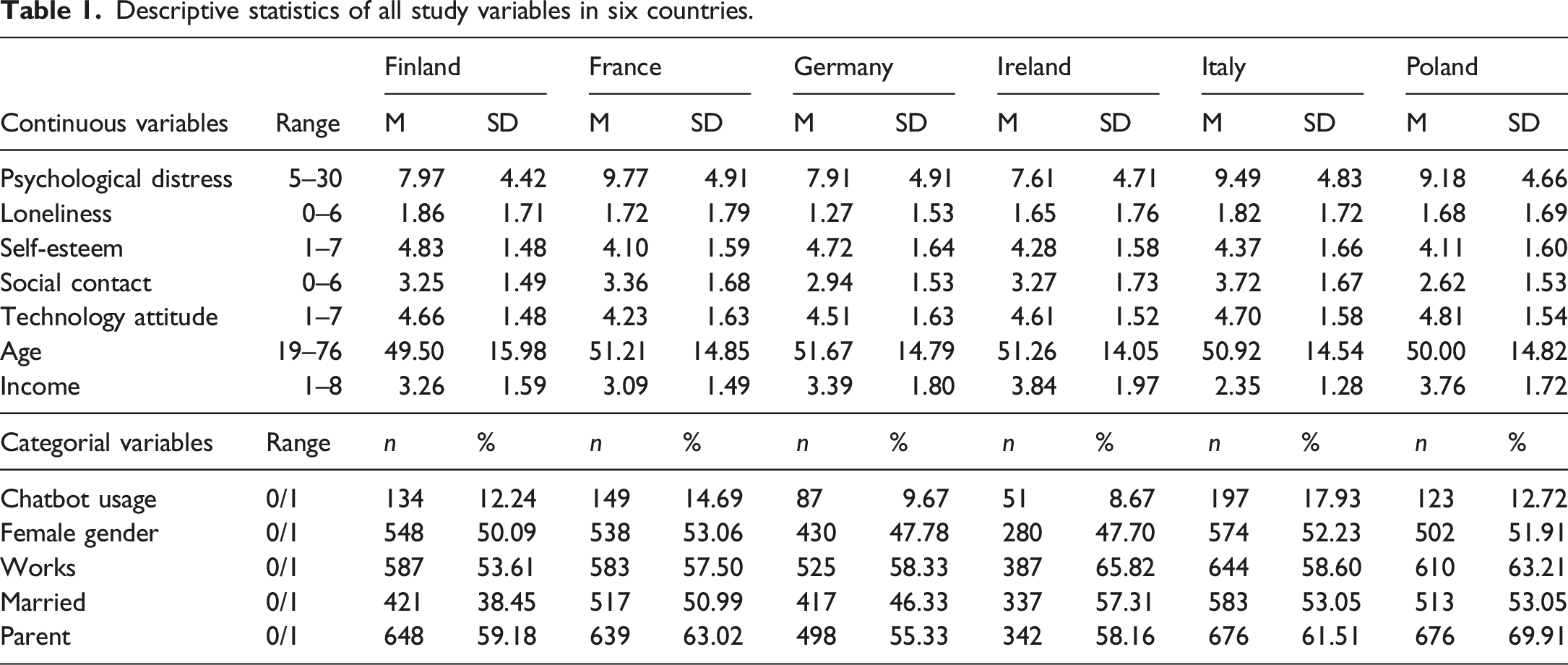
Based on the assessments of the regression model assumptions, we did not detect multicollinearity, but, based on Breusch–Pagan tests, residuals were heteroscedastic. Potential outliers were detected using Cook’s distance measure and values greater than 4/N. Outliers were also detected using dfbeta postestimation command and excess values of 2/√(n). As a solution to heteroskedasticity and asymmetric data, we incorporated robust regression for the analysis using robreg command and mm-estimator (Jann, 2022; Verardi & Croux, 2009).
Results
Individual characteristics associated with social chatbot usage
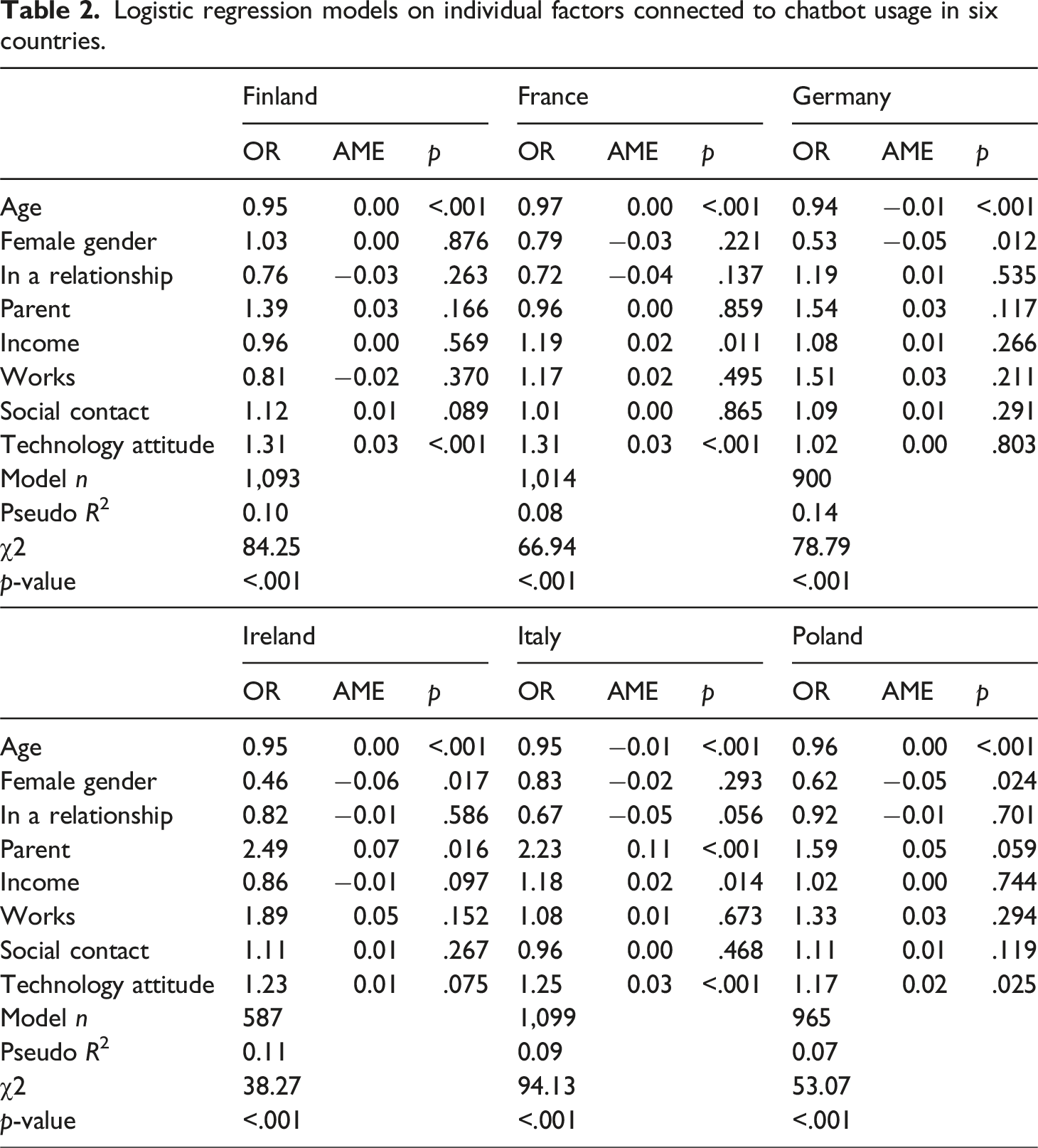
Logistic regression models on individual factors connected to chatbot usage in six countries.
Well-being factors associated with social chatbot usage
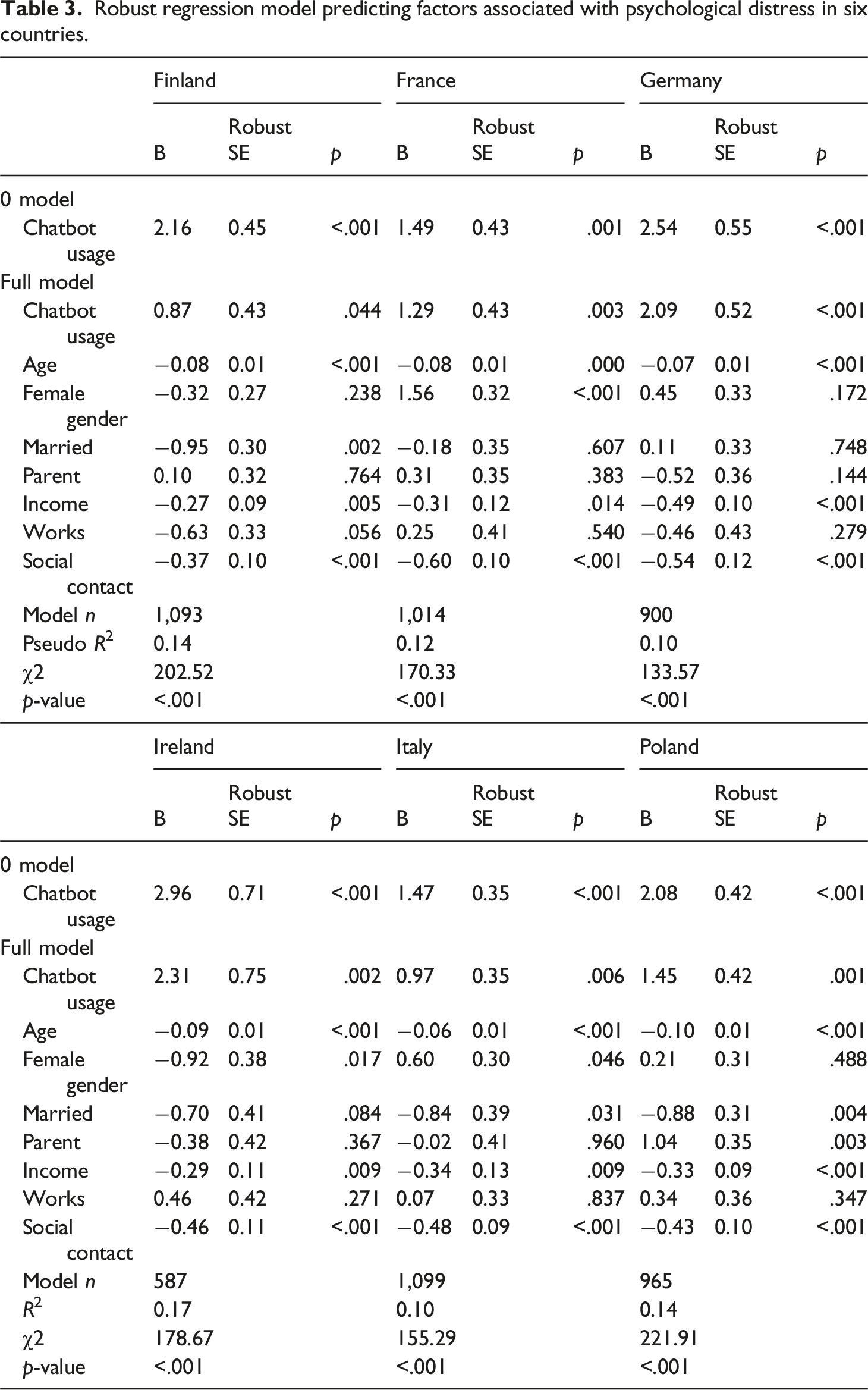
Robust regression model predicting factors associated with psychological distress in six countries.
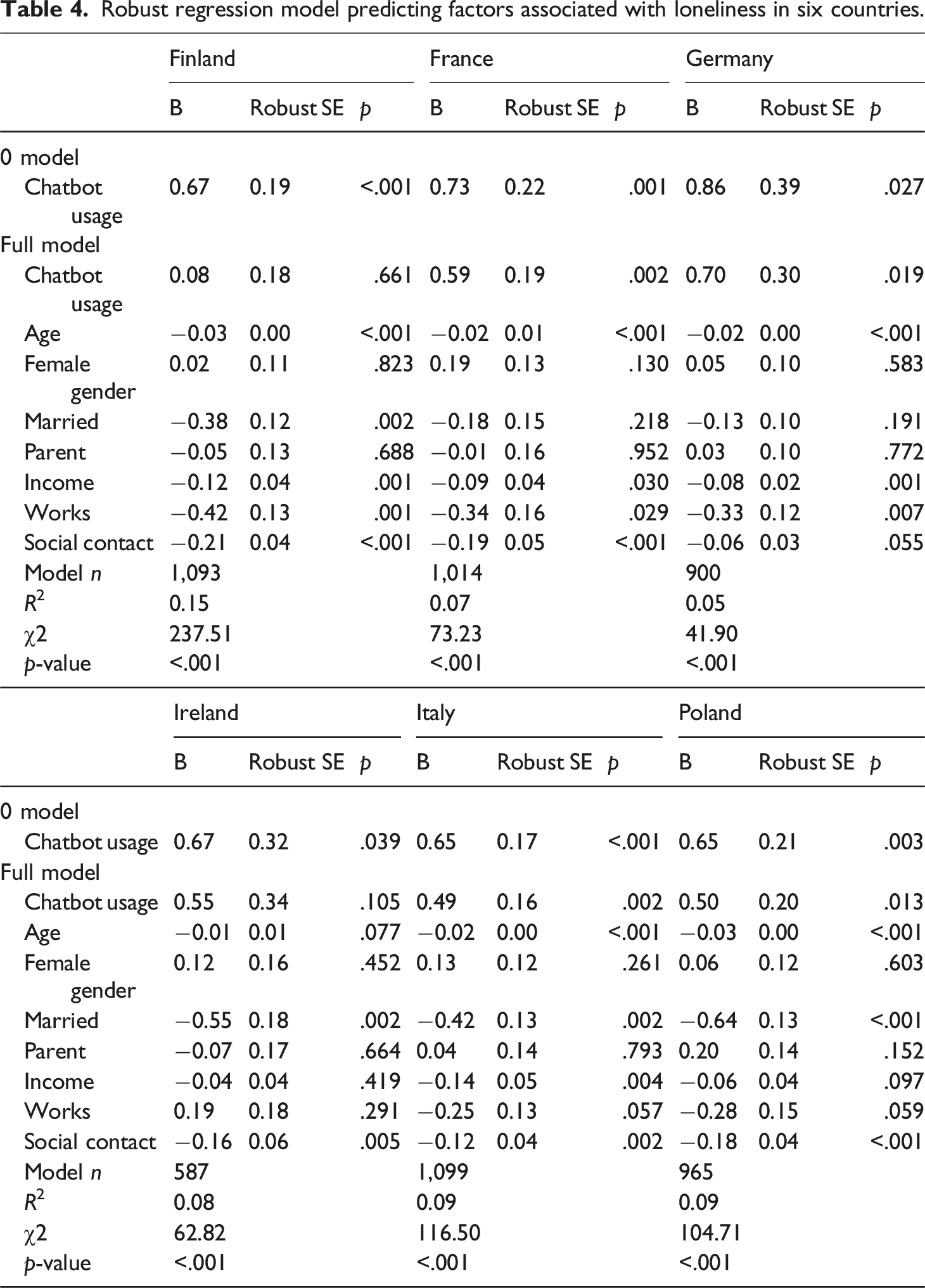
Robust regression model predicting factors associated with loneliness in six countries.
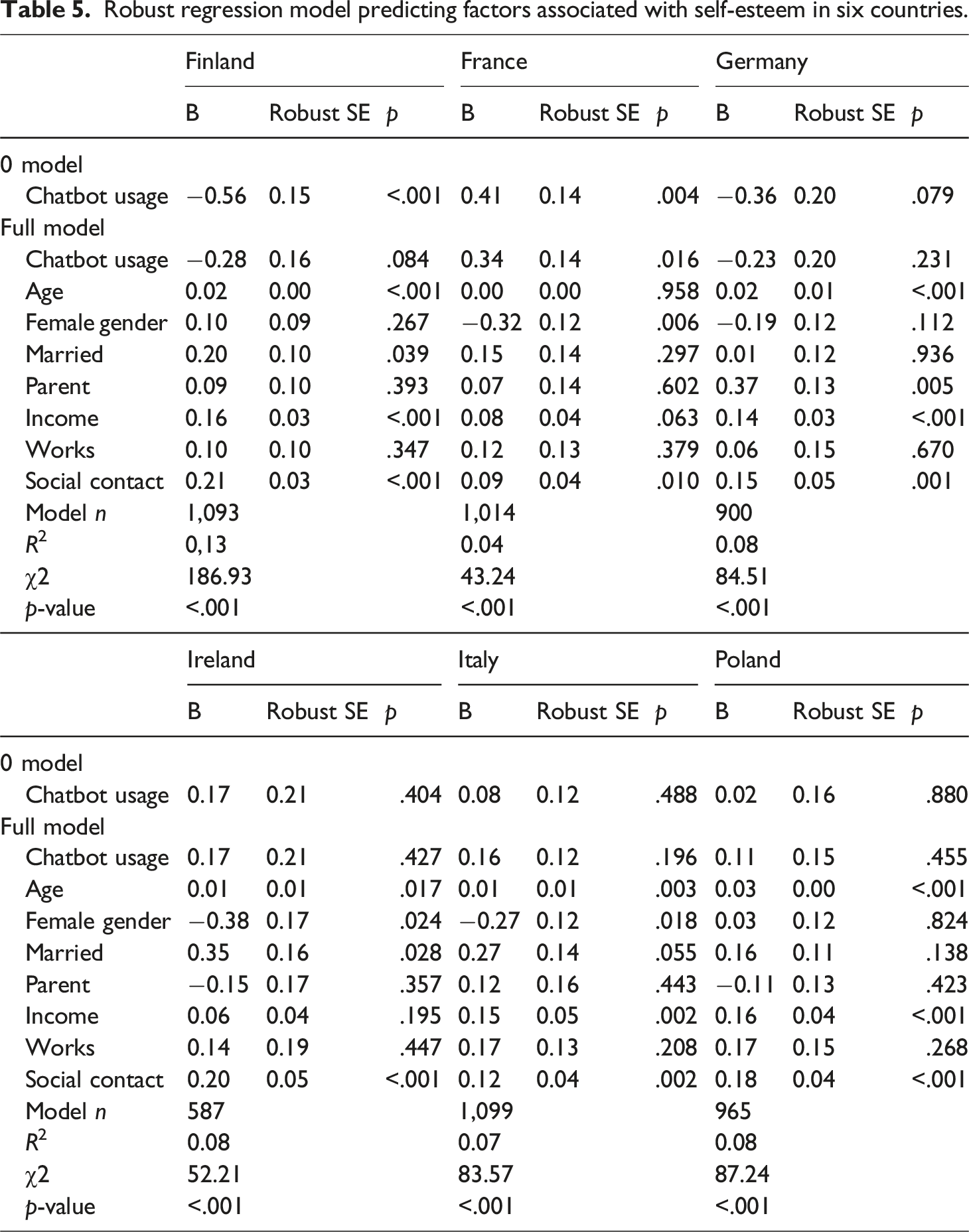
Robust regression model predicting factors associated with self-esteem in six countries.
Discussion
This study investigated individual and well-being factors associated with social chatbot usage, utilizing survey data from Finland, France, Germany, Ireland, Italy, and Poland. The results showed that social chatbot users tended to be younger in age compared to nonusers. Younger age and psychological distress were the most consistent factors associated with social chatbot usage in the examined countries. A significant positive link between loneliness and social chatbot usage was found in France, Germany, Italy, and Poland, and the positive link between self-esteem and social chatbot usage was significant in France. Altogether, the results suggest that age and psychological distress are relevant universal factors in the social chatbot usage phenomenon.
Our study makes an important contribution to the knowledge of individual characteristics and well-being factors associated with social chatbot usage, a viewpoint that has not been systematically researched previously. Social chatbot usage was found to be associated with younger age in all studied countries, echoing the findings of a previous study on user segments regarding interest in chatbots (Rajaobelina & Ricard, 2021). In addition, some country-specific associations were identified, such as social chatbot usage being associated with male gender in Germany, Ireland, and Poland, as well as being a parent in Ireland and Italy. Chatbot usage was connected to higher income in France and Italy, as well as a stronger general positive attitude toward new technologies in Finland, France, Italy, and Poland. Interestingly, the frequency of social face-to-face contact was not significantly associated with social chatbot usage in any of the countries. These results generally suggest that, other than age, sociodemographic factors may play some role in social chatbot usage, but it appears to be rather small. Instead of an objective amount of human social contact, social chatbot usage is more closely connected to a subjective feeling of loneliness and indicators of mental health and well-being.
We found that social chatbot usage was associated with psychological distress, loneliness, and self-esteem. Of these, the most consistent relationship was observed between social chatbot usage and psychological distress. Whereas previous studies have investigated chatbots’ abilities to improve mental health (Abd-Alrazaq et al., 2020; Boucher et al., 2021), we found that social chatbot usage is connected to higher psychological distress. This is an important and alarming finding that suggests social chatbots may have a negative influence on users’ mental health. Alternatively, because our findings were based on cross-sectional data, it may also be that psychologically stressed people are more likely to use social chatbots. In fact, some chatbots are particularly targeted to users facing mental health issues and other health-related concerns (Haque & Rubya, 2023; Vaidyam et al., 2019).
Furthermore, we found a positive association between social chatbot usage and loneliness in France, Germany, Italy, and Poland. This is a noteworthy finding suggesting that social chatbot usage is related to higher, not lower, loneliness. Previous studies have noted that social chatbots can still fall short of delivering the depth and emotional engagement found in human–human interactions (Hancock et al., 2020; Zhou et al., 2023). Regarding technological features, one previous study noted that the lack of nonverbal cues and the absence of voice and tone can limit the authenticity of chatbot interactions (Zhou et al., 2023). Thus, it could be inferred that a social chatbot cannot qualitatively correspond to peoples’ needs and expectations toward social connectedness or friendships and thus relates to higher loneliness (Peplau & Perlman, 1982). However, because the data from previous studies and our own were derived from a single timepoint, the opposite scenario could also be true, indicating that lonely people use social chatbots more than nonlonely individuals to alleviate the feeling. Research has documented that individuals who lack social interactions with others, or are fearful of them, are more likely to form connections with social chatbots (Ali et al., 2023). Although interactions with social chatbots may provide immediate relief to some, they can gradually lead to negative consequences to a person’s social life more widely (Ali et al., 2023; Islam et al., 2019). Social chatbots may provide personalized friendships tailored to a user’s needs but also provoke unrealistic expectations toward relationships (Brandtzaeg et al., 2022), which could violate aspects of learning social skills required in the offline world, for instance.
At first glance, a somewhat surprising result from our analyses was that social chatbot usage was positively associated with self-esteem in France. Previously, a meta-analysis on using SNSs and self-esteem showed a weak negative relationship between SNS use and self-esteem (Saiphoo et al., 2020). A systematic review by Krause et al. (2021) suggested that, on one hand, using SNSs tends to be associated with decreases in self-esteem, particularly if the use involves comparing oneself with others. However, on the other hand, getting positive feedback from others or reflecting on oneself through the platform is mainly linked with benefits to a user’s self-esteem (Krause et al., 2021). An important difference between SNS and social chatbots may be that social chatbot applications are not public social platforms involving other people but, instead, are tailored to an individual’s personal use. Although social chatbots may still be limited in empathizing with users and providing them with emotional support, they may provide users with supportive and compassionate conversations (Brandtzaeg et al., 2022; Croes & Antheunis, 2021; Zhou et al., 2023), potentially nurturing users’ self-esteem as well.
This study highlights the significant theoretical and practical implications of social chatbot usage, primarily that its use is associated with higher levels of psychological distress and a younger demographic. From the perspective of the MASA paradigm (Lombard & Xu, 2021), which extends the CASA paradigm (Gambino et al., 2020), age and distress may be understood as individual and well-being factors that can significantly shape social responses to chatbots. Social chatbot technologies strive to mimic real-world interactions, potentially fulfilling the fundamental human need to belong (Baumeister & Leary, 1995). However, scholars such as Spence (2019) have argued that human-to-human interaction shouldn’t be considered the default ideal for communication, noting that not all such interactions are deeply engaging or emotionally fulfilling. While individuals might expect high-quality relationships from social chatbots, these technologies, in Granovetter’s (1983) terms, may primarily offer weak ties rather than strong ones. As suggested by Hollan and Stornetta (1992), the true strength of virtual technologies may lie in providing capabilities that are beyond those of face-to-face interactions and other human interactions. Nevertheless, the increasing adoption of social chatbots raises critical questions about the evolving social roles of machines and the increasingly ambiguous boundary between humans and machines, issues that warrant further attention in future research (van der Goot & Etzrodt, 2023).
The inclusion of six European countries representing the continent’s main regions enabled us to analyze these associations in different contexts. Despite all being part of the EU, these countries exhibit significant digital, cultural and societal variations, providing a valuable perspective on what the shared characteristics of social chatbot users are. Thus, relationships between variables that appear consistently across all or most samples represent particularly strong findings, demonstrating the generalizability of our results. This is especially notable given that the studied countries differ in citizens’ digital skills, social network participation, adoption rate of digital technologies, and other relevant contextual factors. However, we also observed significant differences between the studied countries, which underlines the importance of context for understanding the way individuals use digital tools, and any practical interventions need to be tailored to the population in question. Investigating the exact mechanisms behind the country-level differences lies beyond the scope of the current study, focused on the results’ replicability and generalizability, and would require a deepened examination of each of the national contexts separately. This is another worthwhile direction for future research, particularly using qualitative and mixed research methods.
Limitations
The first obvious limitation is the cross-sectional design of our study as it only allows us to discuss associations between the variables rather than inferring causalities between them. This limitation highlights the need for future research employing longitudinal and experimental designs to clarify the directionality of the associations observed. Another limitation is the use of single-item measures in some of the key variables, such as social chatbot usage and self-esteem. Although we used validated measures, such as the single-item self-esteem scale (Robins et al., 2001), future studies could consider employing longer scales when feasible (e.g., the Rosenberg Self-Esteem Scale, Rosenberg, 1979). Additionally, using more comprehensive measures of social chatbot use could be beneficial, particularly for exploring users’ motivations for interacting with chatbots. In this study, social chatbot use was used as a binary measure, which was purposeful as an essential first step in assessing characteristics of users, but future research should continue exploring wider variations in usage patterns. Future studies could also analyze whether user motivation moderates the relationship between self-esteem and social chatbot usage. Future studies could also examine the expectations related to technology-driven relationships, for example, from the perspective of strong and weak ties (Granovetter, 1983). They could also explore the specific strengths that certain technologies may offer, compared to, for example, physical interaction or interaction with people (Hollan & Stornetta, 1992). In statistical analyses, it may be beneficial to more thoroughly consider the increasing prevalence of social chatbot usage and the resulting diversifications of user experiences and effects, as this could help explain some of the statistically non-significant relationships.
The response rates in the initial survey were not optimal; therefore, respondent bias cannot be completely ruled out. Whereas online panels, such as those used in this study, offer the opportunity to draw representative datasets based on sociodemographic characteristics, there may be some bias regarding who chooses to participate in such panels (Lehdonvirta et al., 2021). Additionally, the survey’s topic may have attracted individuals already interested in new technologies, potentially resulting in biases in results, especially concerning technology use and attitudes towards it. For that reason, it is crucial to conduct future research using various methods of recruiting participants, including those not relying solely on digital tools and platforms.
Despite these limitations noted, we believe our study, based on its cross-national design and large datasets, provides robust evidence on individual and well-being factors that are associated with social chatbot usage in six European countries.
Conclusion
Social chatbots have become an increasingly recognized phenomenon in online social relationships, but knowledge of the individual characteristics and well-being indicators associated with their use is only beginning to emerge. In this study, we found that younger age and higher psychological distress were consistently associated with social chatbot usage across six European countries. Other associations were also found, but their significance fluctuated across countries indicating possible cultural differences. Future research is needed to make more robust conclusions on social chatbot usage and their potential in supporting human health and well-being. Moreover, the possibility that these technologies are of particular interest to those who are already in a vulnerable position warrants investigation.
Footnotes
Declaration of conflicting interests
The authors declared no potential conflicts of interest with respect to the research, authorship, and/or publication of this article.
Funding
The authors disclosed receipt of the following financial support for the research, authorship, and/or publication of this article: This research received funding from the Tampere University (internal project funding 2022–2024, PI: Atte Oksanen) and the Kone Foundation (UrbanAI-project 2021–2024, Grant 202011325; PI: Atte Oksanen).
Open research statement
As part of IARR’s encouragement of open research practices, the authors have provided the following information: This research was not pre-registered. The data used in the research cannot be publicly shared but are available upon request. The data can be requested from senior author and principal investigator of the paper, Prof. Atte Oksanen at
Ethical considerations
The ethics committee of the Tampere region in Finland declared in a 2022 statement that the protocol for this research did not present any ethical issues (Statement 115/2022).

Data Availability Statement
The data used in this study are available from the principal investigator Prof. Atte Oksanen, upon reasonable request.
Appendix
Pearson correlation coefficients of the study variables in six countries. Note. ***p < .001, **p < .01, *p < .05.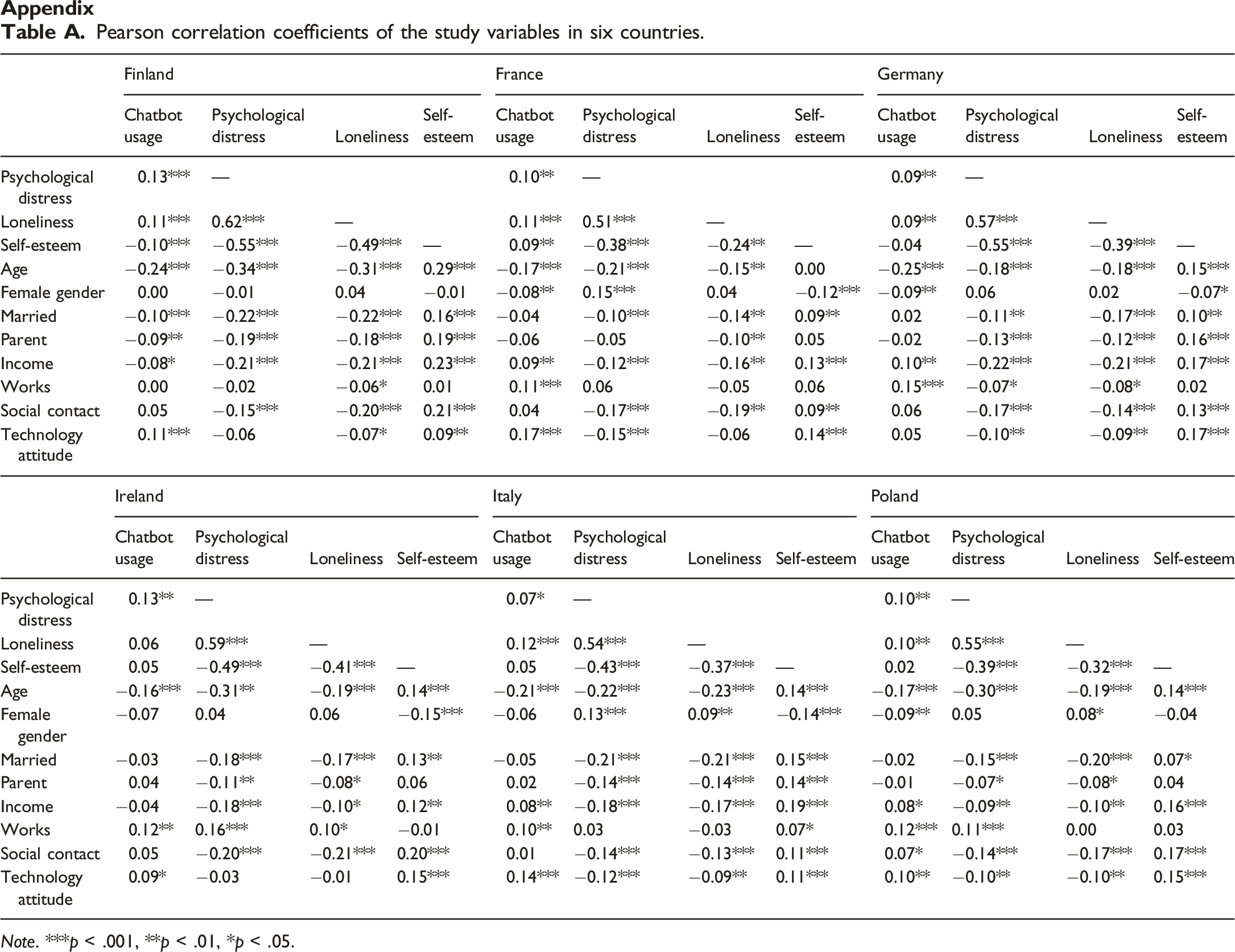
Finland
France
Germany
Chatbot usage
Psychological distress
Loneliness
Self-esteem
Chatbot usage
Psychological distress
Loneliness
Self-esteem
Chatbot usage
Psychological distress
Loneliness
Self-esteem
Psychological distress
0.13***
—
0.10**
—
0.09**
—
Loneliness
0.11***
0.62***
—
0.11***
0.51***
—
0.09**
0.57***
—
Self-esteem
−0.10***
−0.55***
−0.49***
—
0.09**
−0.38***
−0.24**
—
−0.04
−0.55***
−0.39***
—
Age
−0.24***
−0.34***
−0.31***
0.29***
−0.17***
−0.21***
−0.15**
0.00
−0.25***
−0.18***
−0.18***
0.15***
Female gender
0.00
−0.01
0.04
−0.01
−0.08**
0.15***
0.04
−0.12***
−0.09**
0.06
0.02
−0.07*
Married
−0.10***
−0.22***
−0.22***
0.16***
−0.04
−0.10***
−0.14**
0.09**
0.02
−0.11**
−0.17***
0.10**
Parent
−0.09**
−0.19***
−0.18***
0.19***
−0.06
−0.05
−0.10**
0.05
−0.02
−0.13***
−0.12***
0.16***
Income
−0.08*
−0.21***
−0.21***
0.23***
0.09**
−0.12***
−0.16**
0.13***
0.10**
−0.22***
−0.21***
0.17***
Works
0.00
−0.02
−0.06*
0.01
0.11***
0.06
−0.05
0.06
0.15***
−0.07*
−0.08*
0.02
Social contact
0.05
−0.15***
−0.20***
0.21***
0.04
−0.17***
−0.19**
0.09**
0.06
−0.17***
−0.14***
0.13***
Technology attitude
0.11***
−0.06
−0.07*
0.09**
0.17***
−0.15***
−0.06
0.14***
0.05
−0.10**
−0.09**
0.17***
Ireland
Italy
Poland
Chatbot usage
Psychological distress
Loneliness
Self-esteem
Chatbot usage
Psychological distress
Loneliness
Self-esteem
Chatbot usage
Psychological distress
Loneliness
Self-esteem
Psychological distress
0.13**
—
0.07*
—
0.10**
—
Loneliness
0.06
0.59***
—
0.12***
0.54***
—
0.10**
0.55***
—
Self-esteem
0.05
−0.49***
−0.41***
—
0.05
−0.43***
−0.37***
—
0.02
−0.39***
−0.32***
—
Age
−0.16***
−0.31**
−0.19***
0.14***
−0.21***
−0.22***
−0.23***
0.14***
−0.17***
−0.30***
−0.19***
0.14***
Female gender
−0.07
0.04
0.06
−0.15***
−0.06
0.13***
0.09**
−0.14***
−0.09**
0.05
0.08*
−0.04
Married
−0.03
−0.18***
−0.17***
0.13**
−0.05
−0.21***
−0.21***
0.15***
−0.02
−0.15***
−0.20***
0.07*
Parent
0.04
−0.11**
−0.08*
0.06
0.02
−0.14***
−0.14***
0.14***
−0.01
−0.07*
−0.08*
0.04
Income
−0.04
−0.18***
−0.10*
0.12**
0.08**
−0.18***
−0.17***
0.19***
0.08*
−0.09**
−0.10**
0.16***
Works
0.12**
0.16***
0.10*
−0.01
0.10**
0.03
−0.03
0.07*
0.12***
0.11***
0.00
0.03
Social contact
0.05
−0.20***
−0.21***
0.20***
0.01
−0.14***
−0.13***
0.11***
0.07*
−0.14***
−0.17***
0.17***
Technology attitude
0.09*
−0.03
−0.01
0.15***
0.14***
−0.12***
−0.09**
0.11***
0.10**
−0.10**
−0.10**
0.15***