




Abstract
Relationship theorists posit that children’s daily interactions with others are the foundation of their overall relationship quality (Hinde, 1979); however, few studies have tested this proposition. Warm sibling relationships have a positive impact on social-emotional adjustment, making it important to consider how the features of daily sibling interactions may be linked to positive sibling bonds. This study investigated the connection between global aspects of sibling relationship quality (i.e., warmth, conflict) and the focal child’s reports of their daily interactions with their sibling; the latter did not participate. Thirty-three early adolescents (Mage = 11.5 years; 14 girls, 19 boys) completed 14 daily diaries regarding positive (e.g., helping) and negative (e.g., fighting) sibling interactions. Participants completed the Sibling Relationship Questionnaire (Furman & Buhrmester, 1985) to assess global levels of warmth and conflict. Results provide new insight into the dynamics of daily sibling interactions. For example, being happy with a sibling was most closely associated with global warmth and frequent daily helping was most strongly associated with lower global conflict. On days in which children reported more negative sibling interactions, they also reported fewer positive interactions. When participants reported behaving positively toward their sibling on any given day, they also reported their sibling reciprocated positive behaviors. Global warmth and conflict did not moderate these associations. Our findings help support the theoretical notion that daily interactions are linked, but not interchangeable, with relationship quality. Future research is warranted to further elucidate the forms and dynamics of daily interactions between siblings.
Introduction
Sibships are a key relationship in a child’s life, yet there is limited research compared to studies of parent-child and peer relationships (Howe et al., 2022). Siblings, especially those in early adolescence (10–13 years old), spend considerable time together and have intimate, frequently intense interactions, thus potentially having a significant impact on one another’s development. For example, warmer and less conflictual sibling relationships are linked to fewer internalizing and externalizing behaviors (Buist et al., 2013; Dirks et al., 2015; Gamble et al., 2011). Relationship theorists posit that there is a bidirectional relationship between daily interactions and global relationship quality (Dunn, 1983; Hinde, 1979). Most sibling research focuses on the global aspects of relationship quality (e.g., Furman & Buhrmester, 1985; Smorti & Ponti, 2018); however, examining the features of daily sibling interactions as well as global relationship quality may provide insight into relevant behaviors and processes that constitute relationship quality (Hochgraf et al., 2022). Nevertheless, there is limited research on the interactions between siblings at the daily level that characterize a positive sibling relationship and how these daily interactions are linked to global relationship quality. Siblings engage in both positive (e.g., helping) and negative (e.g., fighting) interactions on a daily basis. Due to the variability and intensity of sibling interactions, documenting the sometimes ambivalent nature of the relationship may provide a deeper understanding of sibling dynamics (Dunn, 1983). During these exchanges, children also have opportunities to reciprocate their sibling’s behaviors (Abramovitch et al., 1986), and affective reciprocity is linked to variations in relationship quality (Kibblewhite, 2006). Examining the extent to which different forms of daily interactions are related to global relationship quality will provide a test of the theoretical proposition that relationships are built on daily interactions and will also provide insight into which types of interactions are most strongly linked to global warmth and conflict.
Based on one focal preadolescent child’s reports of daily dyadic sibling interactions and relationship qualities, our objectives were threefold. First, we assessed the features of daily interactions most closely linked with youths’ perceptions of global relationship qualities (i.e., warmth, conflict). Second, we assessed the association in reports of daily positive (e.g., helping) and negative affective interactions (e.g., fighting) and how global qualities of warmth and conflict might be potential moderators of the daily link between these positive and negative exchanges. Finally, we investigated children’s reports of daily reciprocity in their positive sibling interactions and whether the focal child’s perceived reciprocity was moderated by global warmth and conflict.
Sibling relationship quality and the patterning of daily positive and negative interactions
The sibling relationship is distinct from other key relationships such as with parents or peers. It is characterized by intense positive, negative, and sometimes ambivalent affect (e.g., Killoren et al., 2017; McGuire et al., 1996); is frequently lifelong; and consists of both reciprocal (e.g., peer-like) and complementary (e.g., parent-child like) interactions (Dunn, 1983; Hinde, 1979). This long-term relationship is important for overall adjustment (e.g., Padilla-Walker et al., 2010; Stocker et al., 2002) and a significant context for studying children’s development (McHale et al., 2012). Theorists posit that children develop within the context of close, personal relationships that are fostered and maintained over time via repeated interactions (Carpendale & Lewis, 2015; Dunn, 1983; Furman, 1984; Hartup, 1989). Yet, the premise that relationship qualities are developed and maintained through everyday interactions has rarely been tested. Studying associations between siblings’ everyday interactions and overall relationship quality can provide new insight into this crucial relationship.
Reciprocity is also a characteristic feature of siblings’ daily exchanges. In observational studies of siblings in early childhood, when one child engaged in a positive (e.g., prosocial) or negative (e.g., agonistic) behavior, their sibling was likely to reciprocate the behavior (Abramovitch et al., 1986; Howe et al., 1997). Furthermore, warmer sibling relationships included more positive emotional reciprocity whereas siblings in conflictual relationships displayed more negative emotional reciprocity (Kibblewhite, 2006). Thus, from early childhood to adolescence, when children reciprocate each other’s behaviors, this is associated with global relationship quality; however, detailing the daily patterning of sibling exchanges can complement scholarship on individual interactions. By patterning, we are referring to the daily covariance of different aspects of sibling exchanges. This is not meant to imply a specific ordering or sequence of interactions but rather refers to how distinct aspects of interactions are interconnected on a daily level.
Specifically, little is known about how positive daily exchanges are intertwined with negative ones. Positivity (e.g., warmth) and negativity (e.g., conflict) are two distinct aspects of the sibling relationship (Dunn, 1983; Furman & Buhrmester, 1985). Examining intersections between positive and negative exchanges is important in charting sibling relationship quality; indeed, the presence of relational ambivalence, characterized by high levels of both positivity and negativity (Buist & Vermande, 2014; Killoren et al., 2017; McGuire et al., 1996), within sibling relationships is posited to be developmentally significant (see Campione‐Barr & Killoren, 2019). It may be that some sibling relationships are characterized by this relational ambivalence (e.g., Buist & Vermande, 2014; Killoren et al., 2017). Nevertheless, while some studies have examined the juxtaposition of global positive and negative relationship qualities, this does not directly illuminate how affectively positive and negative exchanges are interrelated across days within the relationship.
Positive sibling interactions
Warm relationships are related to several positive forms of sibling interaction. Early adolescent siblings disclose personal thoughts and feelings more often in warmer relationships (Martinez & Howe, 2013), which may in turn be associated with trusting their sibling (Persram et al., 2022). Siblings with warmer relationships also engage in more prosocial behaviors such as sharing, helping, and showing concern for one another, both concurrently and prospectively (Pike & Oliver, 2017; Smorti & Ponti, 2018). Companionship, or spending free time together, is also a key part of the sibling relationship and may be a sign of a warmer, more positive relationship (McHale et al., 2013). Nevertheless, while research has charted how relationship quality may be linked to certain types of behaviors overall, less is known about which interactions at the daily level are most strongly linked to global relationship qualities when compared to others (e.g., helping vs. companionship).
Negative sibling interactions
While overall levels of conflict are associated with later internalizing (e.g., depression) and externalizing (e.g., aggression) problems in adolescence (Dirks et al., 2015; Stocker et al., 2002), when paired with high levels of overall warmth, conflict also provides opportunities to learn about conflict resolution, negotiation, and compromising (Howe et al., 2022). In fact, Campione‐Barr & Killoren (2019) and Kramer (2010) argue that when siblings rarely engage in conflict, they have fewer opportunities to develop these important skills that may not be learned in positive interactions. Furthermore, warmth can mitigate against the negative effects of conflict; siblings in relationships characterized by high levels of both warmth and conflict (i.e., ambivalent relationships) report more positivity and fewer depressive symptoms compared to children in high conflict and low warmth relationships (Killoren et al., 2017; McGuire et al., 1996). While warmer or more conflictual interactions have been examined simultaneously (e.g., Abramovitch et al., 1986; Howe et al., 1997), there is limited examination of the daily juxtaposition of these behaviors. Namely, how positive and negative interactions are patterned at the daily level (e.g., on days when siblings engage in more positive exchanges, do they also engage in more negative exchanges?), and how this patterning is linked to global relationship qualities. In this study, we use the term negative interactions to refer to the frequency of negative affective exchanges, as assessed via the focal child’s reports of fighting and being mad and/or sad with a sibling; as noted above, this conceptualization does not imply that these interactions are necessarily destructive or that they do not present key learning opportunities.
Daily diaries: Measuring daily fluctuations in sibling interactions
Daily diaries – in which participants complete assessments every day – provide a window into everyday behaviors and experiences, mitigating retrospective bias because of the requirement for immediate reporting of interactions (e.g., minutes or hours compared to weeks or months; Iida et al., 2023). Early research using daily diaries to examine sibling relationships typically employed between-person analyses, aggregating daily reports into summary measurements (e.g., Howe et al., 2000; Tucker & Winzeler, 2007). One of the key advantages of daily data is the ability to examine within-person associations, and more recent research has documented daily associations between siblings’ interactions and their mood and well-being (Hochgraf et al., 2022; van der Kaap-Deeder et al., 2017). Such work highlights that there is meaningful variability in everyday experiences with siblings, and that examining everyday interactions may provide new insight into this critical relationship.
The current study
The current study investigated associations between the global relationship qualities of warmth and conflict and daily sibling interactions as reported by one focal sibling in each family. We employed a dataset consisting of daily diaries reported by 40 early adolescents (Howe et al., 2000; Howe et al., 2011; Karos et al., 2007). Early adolescence is a unique developmental period in that children are increasingly engaging with peers and activities outside the home but still spend most of their out-of-school time at home (Dunifon et al., 2017). Younger siblings in early adolescence peak in the perceived help and support received from their older sibling (Branje et al., 2004); whereas older siblings tend to report higher rates of conflict than their younger counterparts (Kim et al., 2006). Early adolescence is also characterized by a change in shared activities (e.g., hanging out together, watching tv) and the overall view of sibling relationship quality (Cole & Kerns, 2001). The quality of the relationship in this developmental period also plays an important role in the development of prosociality as well as internalizing and externalizing behaviors (Padilla-Walker et al., 2010). Thus, while early adolescence represents a period of significant change in the relationship, siblings are still a key facet in day-to-day life and influential in children’s development. Assessing daily exchanges during this period as well as the overall relationship quality can help illuminate key interactions that are linked to more positive relationships to potentially support warmer interactions between the siblings.
Although these data were previously analyzed using between-person techniques, the current study used a multilevel framework to analyze both between- and within-person associations. First, in terms of between-person variability, we assessed the features of daily interactions most closely linked with global warmth and conflict by directly comparing the strength, rather than direction, of associations using the Meng et al. (1992) procedure. By examining the strength, we are able to determine what types of interactions are most closely linked with global relationship quality, rather than just studying the direction (e.g., positive association between global warmth and prosocial behaviors), and thereby further finetune our understanding of what comprises a positive sibling relationship. Daily interactions are theoretically the foundation of relationship quality (e.g., Hinde, 1979), yet this proposition has received limited examination. Thus, we investigated how children’s reports of global warmth and conflict were associated with their reports of daily positive (i.e., disclosing personal information, teaching, helping, comforting, positive emotionality, and companionship) and negative (i.e., negative emotionality, fighting) interactions. Since warmth and conflict are two distinct dimensions of sibling relationships (McGuire et al., 1996; McHale et al., 2007), we expected that global warmth would be more strongly linked with positive daily interactions than to daily negative interactions, whereas global conflict would be more strongly linked with negative daily interactions than positive interactions. Conversely, existing literature did not provide a clear basis for hypotheses regarding associations between more specific types of daily interactions and relationship qualities (e.g., is companionship or helping more strongly associated with global warmth?) and we thus examined these links in an exploratory way.
Second, with respect to within-person variability, we examined how global warmth and conflict moderated the daily associations between positive and negative sibling interactions. Although studies have considered global relational patterns of ambivalence (Buist & Vermande, 2014; Killoren et al., 2017), research examining between-person differences cannot illuminate within-person patterns in how reports of positive and negative interactions are interrelated (i.e., how they covary on any given day). For example, is a warmer relationship associated with greater covariance of positive and negative interactions across days? This question was exploratory given limited prior research.
Finally, we assessed how global warmth and conflict were related to perceived positive reciprocity, particularly to daily diary reports of positive interactions (i.e., disclosure, teaching, helping, comforting). Specifically, if the focal child reported acting more positively towards their sibling on a given day, did they also perceive their sibling acting more positively towards them? We hypothesized that a warmer sibling relationship would be associated with greater perceptions of positive daily reciprocity (Howe et al., 1997; Kibblewhite, 2006). Only positive behaviors were analyzed for the third research question because the dataset lacked items relating to perceived reciprocated negative behaviors.
Method
Participants
Structural variables and relationship quality descriptives.
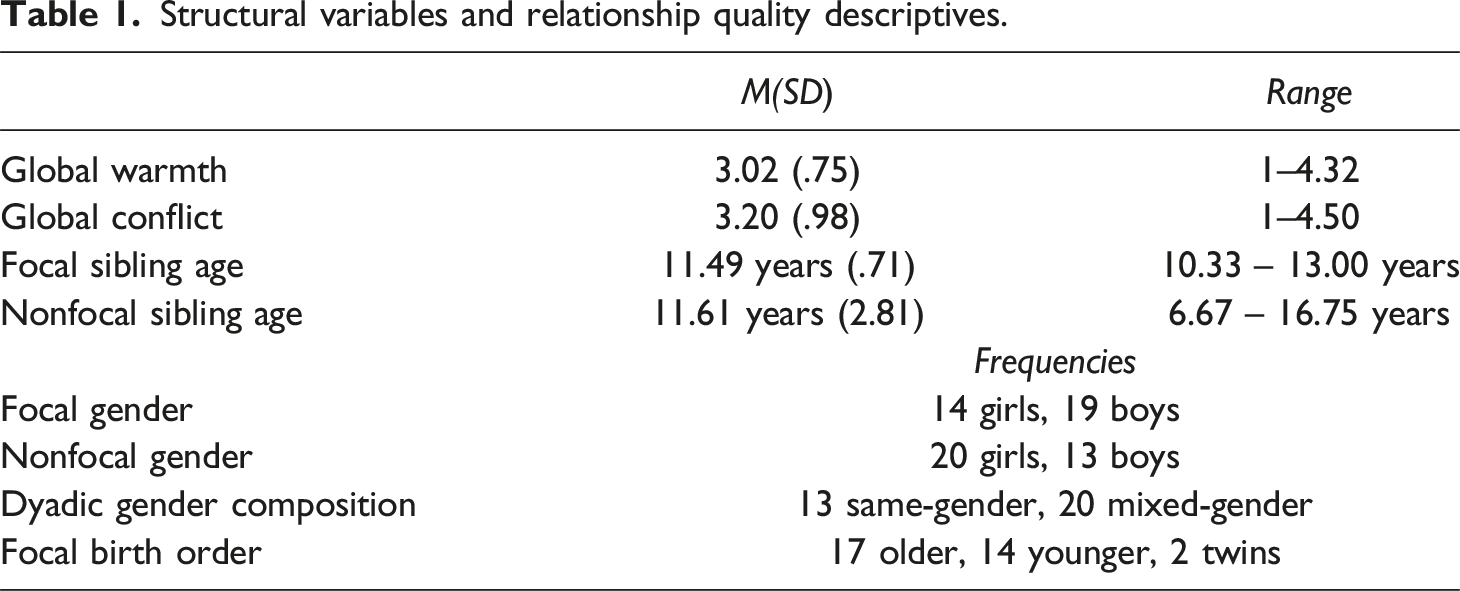
The participants lived in Eastern Canada on the outskirts of a metropolitan city in a small bilingual community (population = 23,000). Based on census data, the community from which the sample was drawn was predominantly lower to middle SES (Statistics Canada, 1991). Approximately 98% of residents were born in the province. Most community residents had at least a high school diploma (or equivalent). Participants were recruited at the only English elementary school in the community; although English was the primary language of instruction, all children also learned French in school. While the participants were linguistic minorities in their community, according to census data (Statistics Canada, 1991), most English-speaking families reported being bilingual and were thus not isolated from the linguistic majority community. The study received ethical approval from Concordia University; participation was obtained via both written parental consent and child verbal assent. Children were eligible to participate if they spoke English, were in fifth or sixth grade, and had a sibling; over 90% of eligible children participated. All children who participated lived in the same household as their sibling.
Procedure
The participants first completed the Sibling Relationship Questionnaire as a group in their classroom. The children then received a packet of daily diaries for 14 days, in which all were completed over the same two-week period. Children were compensated for completing either only Week 1 ($5) or $15 for both weeks. Five children only returned one week of diaries but were included in analyses. Among the 33 participants, 88.1% of diaries were completed (407/462).
Measures
Sibling Relationship Questionnaire
The Sibling Relationship Questionnaire (SRQ; Furman & Buhrmester, 1985) is a self-report measure of global sibling relationship quality that focal siblings answered about the relationship between themselves and their nonfocal sibling. The measure includes four subscales (i.e., warmth, conflict, rivalry, power/status); however, the current analysis focused only on warmth (22 items, Cronbach’s alpha = .93; e.g., “How much do you and your sibling play around and have fun with each other?”) and conflict (6 items, alpha = .90; e.g., “How much are you and your sibling mean to each other?”). Participants answered on a 5-point Likert scale ranging from 1 (hardly at all) to 5 (extremely much).
Daily diaries
For 14 days, focal children used a checklist (yes/no) to report on their daily interactions with the nonfocal sibling by completing the diary each day at bedtime. The checklist included 20 questions about their daily interactions (e.g., “Did you help your [brother/sister] today?”; “Did your [brother/sister] comfort you today?”), with wording adjusted to reflect the nonfocal sibling’s gender. A score of zero (no) or 1 (yes) was assigned for each question. Questions were designed to capture eight aspects of daily interactions (i.e., disclosure, teaching, helping, comforting, positive emotionality, companionship, negative emotionality, fighting). An overall positive behavior score was calculated by averaging scores for disclosure, teaching, helping, comforting, positive emotionality, and companionship; an overall negative behavior score was computed by averaging scores for negative emotionality and fighting. For four types of interactions (i.e., disclosure, teaching, helping, comforting), the focal child reported on their own and their sibling’s behavior separately, allowing us to examine self-reported perceptions of daily reciprocity (i.e., reciprocal dimensions) (see Appendix A for items and scoring).
To examine overall rates of different types of interactions, each daily diary variable was averaged across 14 days. Average scores were also computed for positive and negative daily interactions. Scores for the four variables participants reported for themselves (focal child) and for their nonfocal sibling were also averaged separately. Three reciprocal behaviors (i.e., teaching, helping, comforting) were based on one item for each sibling per day. The reports for disclosure were adjusted as described in the Appendix. Overall scores for teaching, helping, comforting, and disclosing were computed by averaging the focal and nonfocal children’s scores for each variable.
Plan of analysis
An alpha level of p < .05 was used for all statistical tests. Preliminary analyses examined overall frequencies of different types of interactions and associations with structural variables (i.e., age, gender, birth order, age gap). Participants reporting on a twin (n = 2) were omitted from birth order and age gap analyses. We then examined the frequency of reports using repeated-measures ANOVAs. Specifically, affective valence of interactions (positive vs. negative) was included as a repeated-measures independent variable (IV) with frequency of interactions entered as the dependent variable (DV). This was followed by ANOVAs that compared (1) the specific daily positive (e.g., companionship vs. disclosure) and (2) negative interactions (i.e., fighting vs. negative emotionality) as IVs with frequency of interactions as the DV. We also compared focal children’s overall reports of their own and their and siblings’ behaviors for the reciprocal dimensions (e.g., focal help vs. nonfocal sibling help).
To address the first research question concerning associations between global relationship qualities and daily variables, we computed correlations between global ratings of warmth and conflict and the means for each of the daily diary variables, followed by the Meng et al. (1992) procedure to analyze differences in the magnitude of associations. Specifically, the Meng et al. (1992) procedure was used to statistically compare the magnitude of the correlations between the study variables, rather than whether they are each different from zero. We used a nested approach to compare the magnitude of associations (1) between overall positive versus negative interactions, then (2) among different positive subcategories (e.g., helping vs. comforting) and negative subcategories (i.e., fighting vs. negative emotionality), then (3) between focal versus nonfocal behavior for specific types of positive interactions (e.g., focal helping vs. nonfocal helping).
The second and third research questions focused on daily variability in positive and negative interactions; thus, multilevel modeling was used to partition within- and between-person variance. We used Mplus 8.8 (Muthén & Muthén, 2022) to construct two-level models using the MLR estimator. In each case, we first ran an unconditional model to explore how much variability in the DV was within- versus between-person. To answer the second research question, we constructed models in which the DV was the participant’s daily report of overall positive interactions. As there is limited research on the positive aspects of sibling relationships when compared to negative, we were particularly interested in examining what might predict positive interactions, rather than negative. In the first model, daily reports of overall negative interactions, which was within-person centered, were included as a within-participants predictor. We estimated a random effect for the intercept and the slope. In the event of a significant random effect, we then ran a second model in which global warmth and global conflict were included as between-person predictors of the intercept/slope. The average overall daily negative interactions were also included in the second model as a between-participants covariate.
We took a similar approach to addressing the third research question, which focused on daily reciprocity of positive interactions. Here, focal children’s report of their siblings’ positive behaviors was the DV. In the first model, focal children’s daily reports of their own positive behavior towards their sibling were centered within-person and entered as a within-person predictor. We estimated random effects for the intercept and slope. We then ran a second model in which global warmth and global conflict were included as between-person predictors of the intercept and/or slope, given that the previous model documented significant between-person variability in these effects. Average overall focal daily positive interactions were included as a between-participants covariate. In each model, all between-person predictors were grand mean-centered. Day of testing was originally included as a control variable in each model; however, day was not a significant predictor and did not alter any of the patterns reported below and thus, was removed from the models for parsimony.
Results
Descriptive statistics and preliminary analyses
Descriptive statistics and correlations of daily diary variables with SRQ warmth and conflict.
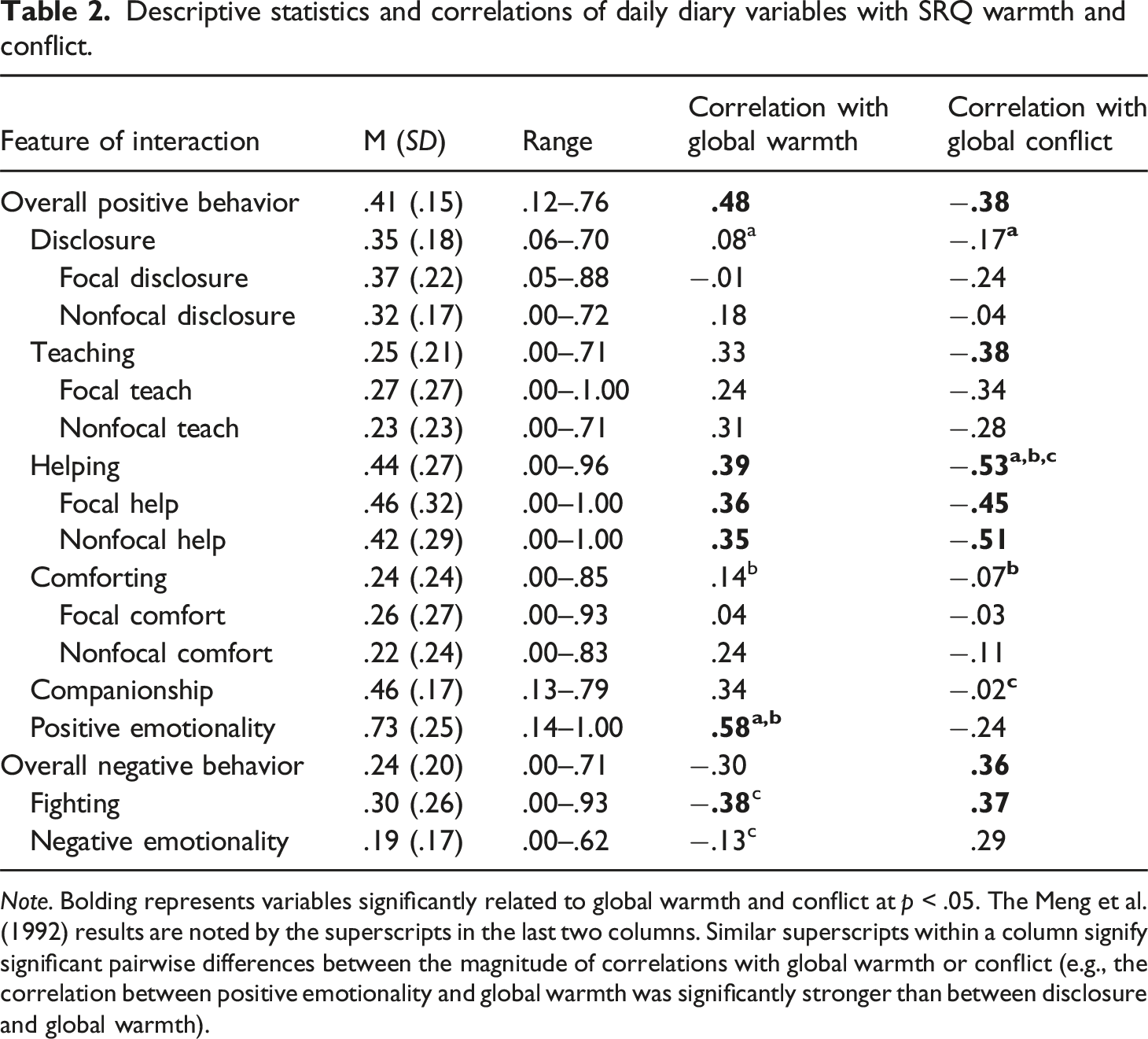
Note. Bolding represents variables significantly related to global warmth and conflict at p < .05. The Meng et al. (1992) results are noted by the superscripts in the last two columns. Similar superscripts within a column signify significant pairwise differences between the magnitude of correlations with global warmth or conflict (e.g., the correlation between positive emotionality and global warmth was significantly stronger than between disclosure and global warmth).
Overall frequencies of different types of daily interactions
Repeated measures ANOVAs compared the mean levels of different aspects of interactions (see second column of Table 2). Based on diary reports, overall positive interactions were reported significantly more often than overall negative interactions, F(1, 32) = 16.86, p < .001, ηp2 = .35. There were significant differences among types of positive interactions, F(5, 160) = 32.18, p < .001, ηp2 = .50. Specifically, post-hoc pairwise comparisons with a Bonferroni correction (to preserve an overall alpha level of p < .05) revealed that positive emotionality was reported significantly more often than disclosure, teaching, helping, comforting, and companionship. Furthermore, helping and companionship were reported more frequently than both comforting and teaching. For negative interactions, fighting was reported more often than negative emotionality, F(1, 32) = 13.35, p < .001, ηp2 = .29. There were no significant mean differences between reports of focal and nonfocal sibling behaviors for the reciprocal dimensions.
Structural variables, relationship quality, and sibling interactions
Pearson correlations and t tests assessed associations between the variables and (a) the focal child’s age, (b) nonfocal sibling birth order, (c) each child’s gender, and (d) sibling age gap. There were no significant associations with ratings of global warmth or conflict 1 . Focal child age was not significantly related to any of the daily diary variables. Birth order was significantly related with companionship, t(29) = 3.59, p < .001, d = 0.14; and focal child teaching, t(20.97) = 2.27, p = .03, d = 0.26. Specifically, focal children with a younger sibling reported more companionship and teaching (M = .53, SE = .03; M = .35, SE = .08, respectively) than did focal children with an older sibling (M = .35, SE = .04; M = .15, SE = .03 respectively).
Focal child gender was not significantly associated with any variable, but nonfocal sibling gender was significantly related to companionship, t(31) = −2.51, p = .02, d = 0.16. Focal children reported less companionship with nonfocal sisters (M = .40, SE = .03) than with nonfocal brothers (M = .54, SE = .05). There were no significant associations with the reciprocal interactions (e.g., focal help vs. nonfocal sibling help).
Age gap was expressed as an absolute value to avoid confounding age gap with birth order. Age gap was inversely related with overall negative interactions (r = −.36, p = .045), fighting (r = −.37, p = .04), overall comforting (r = −.36, p = .045), and comforting by nonfocal siblings (r = −.41, p = .02). Children reported more overall negativity, more fighting, overall comforting, and comforting by their sibling when the age gap was smaller.
Are global relationship qualities related to between-person differences in daily sibling interactions?
To address the first research question, we examined the strength of associations between global warmth and conflict as measured on the SRQ and the types of sibling interactions reported on the daily diary. We first computed bivariate correlations with global warmth and conflict (see Table 2 columns 4 and 5). Global warmth was significantly, positively related with overall positive interactions, overall helping, the focal child’s helping of and being helped by their sibling, positive emotionality, and inversely related with fighting. Global conflict was negatively related to overall positive interactions, overall teaching, overall helping, helping of one another, and positively related with overall negative behavior and fighting.
Next, the Meng et al. (1992) procedure was applied using Diedenhofen and Musch (2015) software to analyze the differences in the magnitude of the associations. The analyses used the absolute values of the correlations; that is, negative values (e.g., −.40) were transformed into positive values (e.g., .40), because we were interested in the strength and not the direction of the correlations. Contrary to our hypothesis, associations between global warmth and overall positive and negative daily interactions were not significantly different. Nevertheless, analyses indicated differences in specific aspects of interaction within the overall positive and negative categories (see Table 2 column 4). Regarding types of positive interactions, the association between global warmth and positive emotionality was significantly stronger than that between global warmth and (a) disclosure (z = 2.24, p = .03), and (b) comforting (z = 1.99, p = .05). In terms of negative interactions, the association between (a) global warmth and daily reports of fighting was significantly stronger than (b) global warmth and negative emotionality (z = 2.03, p = .04).
Contrary to our hypothesis, associations between global conflict and overall positive and negative daily interactions also did not differ significantly. Furthermore, the difference in the magnitude of associations between (a) global conflict and fighting and (b) global conflict and negative emotionality was not significant. However, differences between the magnitude of associations with daily helping and other positive daily variables were detected (see Table 2 column 5). Specifically, the inverse association between global conflict and helping was significantly stronger than associations between global conflict and daily interactions of (a) disclosure (z = 2.19, p = .03), (b) comforting (z = 2.72, p = .01), and (c) companionship (z = 2.78, p = .01). No significant differences were observed in the magnitude of any associations with focal versus nonfocal behaviors (i.e., focal vs. nonfocal disclosure, teaching, helping, or comforting).
Does relationship quality moderate daily associations between positive and negative features of interaction?
Daily associations between positive and negative sibling interactions.
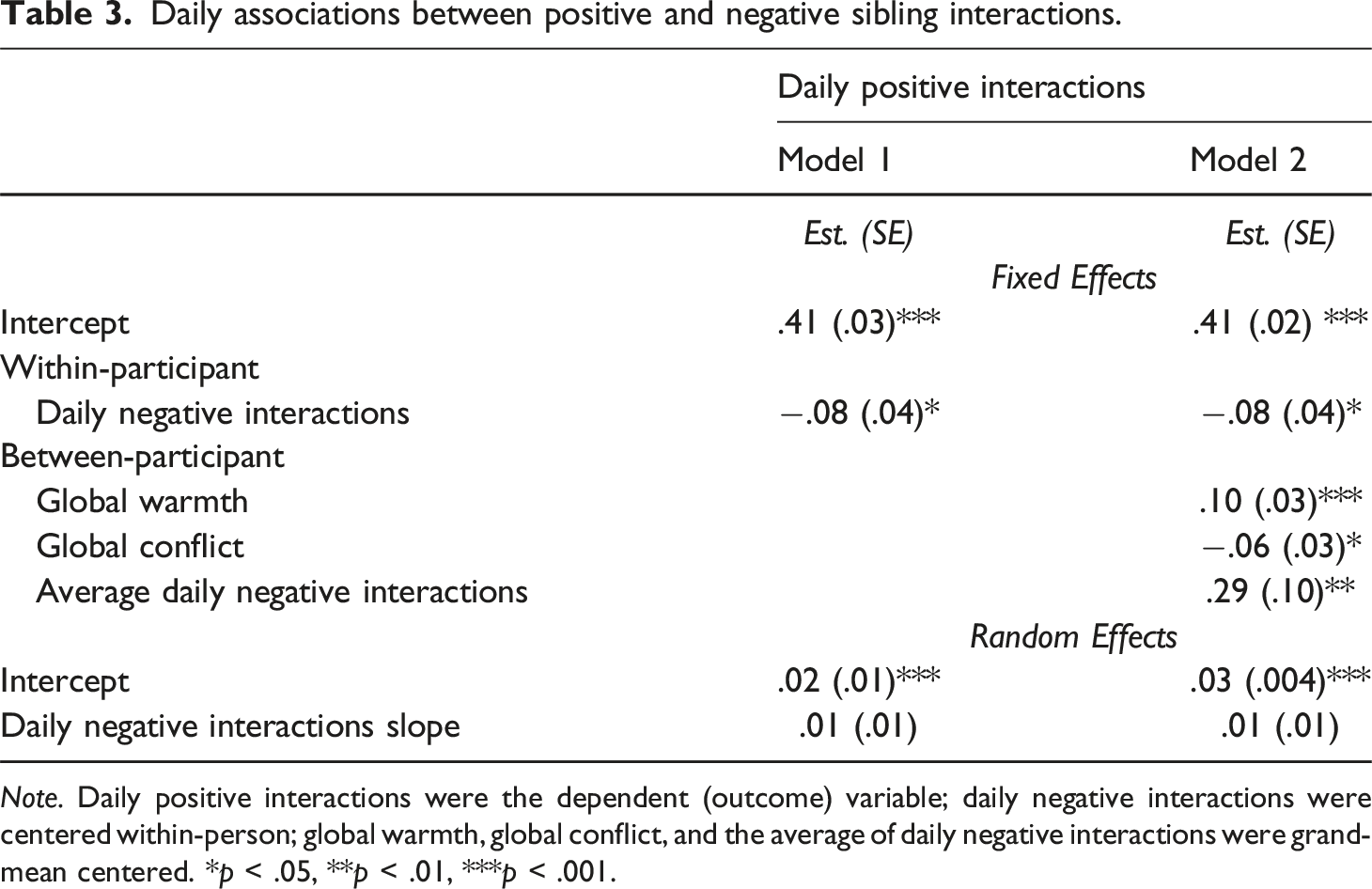
Note. Daily positive interactions were the dependent (outcome) variable; daily negative interactions were centered within-person; global warmth, global conflict, and the average of daily negative interactions were grand-mean centered. *p < .05, **p < .01, ***p < .001.
Given the lack of temporal precedence between positive and negative daily interactions, we also ran additional analyses that reversed the IV and DV (i.e., daily positive interactions as the IV and daily negative interactions as the DV). The pattern of results did not change (see Supplement Table S1).
Is relationship quality related to reciprocity of siblings’ daily interactions?
Daily associations between the perceived reciprocal positive behaviors of focal and nonfocal sibling.
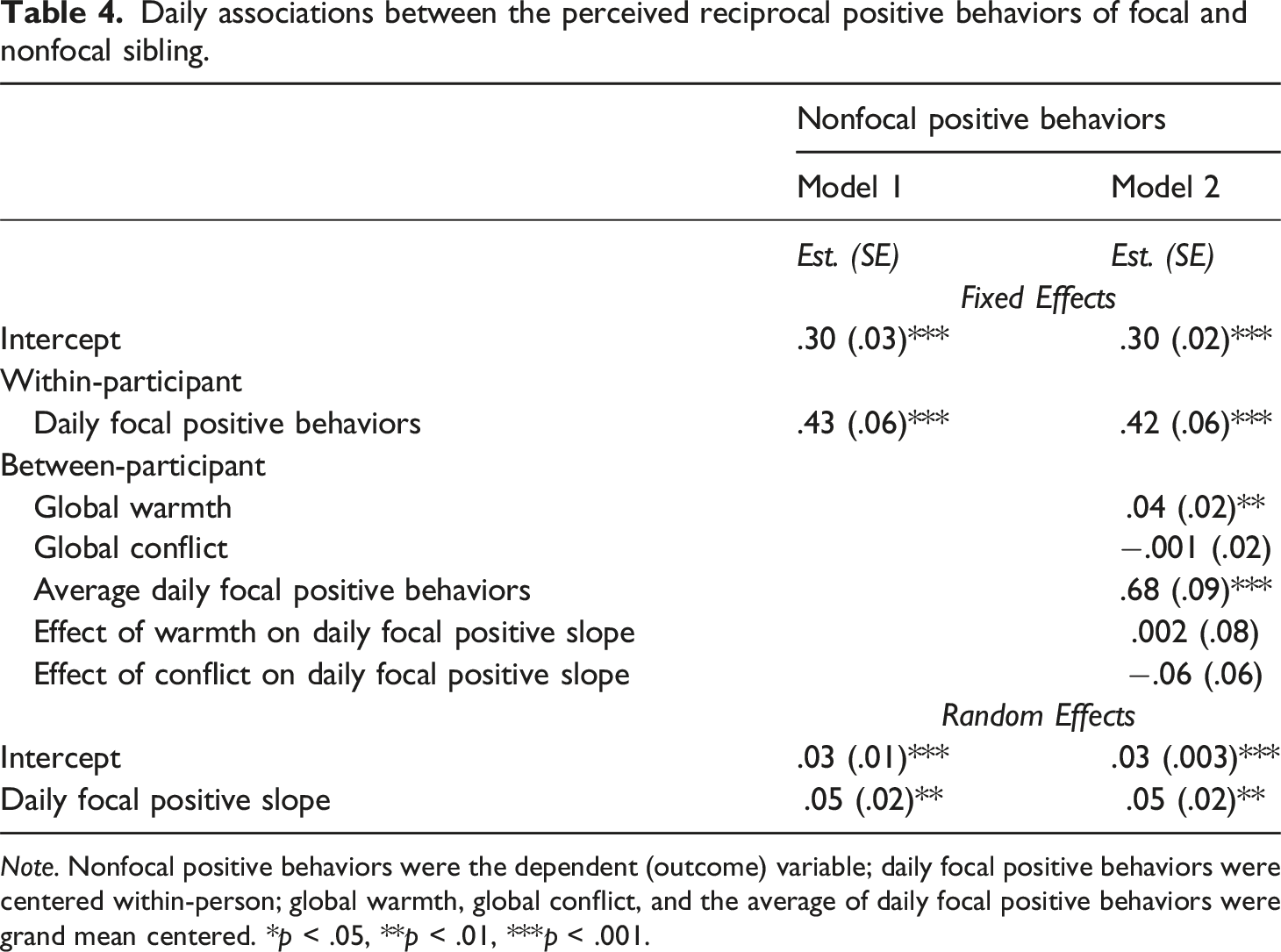
Note. Nonfocal positive behaviors were the dependent (outcome) variable; daily focal positive behaviors were centered within-person; global warmth, global conflict, and the average of daily focal positive behaviors were grand mean centered. *p < .05, **p < .01, ***p < .001.
Similar to research question 2, the model was rerun with the outcome and predictor reversed (i.e., focal sibling’s daily positive behavior as the DV, nonfocal sibling’s behavior as the IV). The pattern of results was analogous to the findings here, with the exception of global warmth no longer having a significant association with the outcome (see Supplement Table S2).
Exploratory cross-lagged associations
Although this study focused on concurrent daily associations, we also considered next day cross-lagged associations for the second and third research questions. Results did not reveal any significant within-person effects. That is, for our second research question, positive interactions did not significantly predict next day negative interactions (B = −.01 SE = .16, p = .96), or vice versa (B = .06, SE = .04, p = .07). For our third research questions, focal positive behaviors did not significantly predict next day nonfocal behaviors (B = .07, SE = .07, p = .30), or vice versa (B = .01, SE = .06, p = .83).
Discussion
Although significant life events may be more memorable, everyday interactions are posited to be the foundation of overall relationship quality (Hinde, 1979). Relationships are developed and maintained via daily, repeated interactions (Hartup, 1989), which are prevalent in sibling relationships. We examined patterns of daily positive and negative sibling exchanges and associations with overall relationship warmth and conflict in an archival sample of 33 early adolescents from a small, bilingual Canadian community. Particular types of daily exchanges had varied associations with global sibling relationship qualities and daily interactions differed in both affective valence and reciprocation.
Features of siblings’ daily interactions and associations with relationship qualities
Participants reported more positive than negative sibling interactions. For example, participants more frequently reported being happy with or spending free time with their sibling than they did fighting or being mad. Although it is important to note that more items on the diary focused on positive interactions compared to negative ones, findings were based on averaged scores across days, suggesting that this did not account for these overall differences. Indeed, similar results were found by Flook (2011) in which adolescents reported more daily positive events with peers and family than negative events. Siblings engage in many different activities pertaining to companionship (e.g., playing games, watching tv) and our results are in line with Furman and Buhrmester (1985), who reported that 11- to 13-year-olds described companionship as a prominent feature of their sibling relationships. Scholars often characterize sibling relationships as fraught and conflictual, and indeed, sibling aggression is more prevalent than peer aggression (e.g., Dirks et al., 2019). Nevertheless, in our sample, although participants engaged in conflictual interactions and experienced negative emotionality, they reported many positive interactions and overall enjoyed spending time together.
For our first research question, we expected that global warmth would have a stronger association with positive daily interactions than with negative daily interactions and that global conflict would be more strongly linked with daily negative than daily positive interactions. These hypotheses were not supported; the strength of associations with warmth and conflict were fairly similar (e.g., relating to both positive and negative interactions to a similar degree). Nevertheless, we found that there were variations in reports of how specific types of daily interactions were related to overall relationship qualities of warmth and conflict. The overall daily experience of being happy with a sibling was most closely associated with global warmth compared to other daily interactions. That is, children in a warmer relationship reported more positive emotionality with their sibling, when compared to overall rates of other positive interactions. It is interesting to note there was not a significant association between global warmth and daily negative emotionality. Thus, although this finding implies that children in warmer relationships may still be mad or sad when with their sibling, more frequent daily reports of being happy were linked to warmer relationships. Perhaps, encouraging shared activities that promote happiness may be a key means to building and maintaining positive sibling relationships (see Kramer, 2010).
Lower levels of warmth were also more strongly associated with daily fighting than with negative emotionality (e.g., being mad at a sibling). Children who have warmer relationships may be less prone to frequent fighting while still experiencing and expressing negative emotions in exchanges with their sibling; conversely, the associations between these two daily variables and global conflict were not significantly different. In turn, greater global conflict was particularly associated with less daily helping, which contrasts with earlier work that found no association between global conflict and prosocial behaviors (e.g., Cole & Kerns, 2001; Lam et al., 2021). Children in more conflictual relationships may be less trusting of each other and thus may not perceive that their sibling can or will act prosocially with them. Previous work has demonstrated that conflict was negatively associated with trust in adolescent siblings (Gamble et al., 2011). Although our design does not support causal inferences, there might be a cyclical relationship between interactions and relationship quality. The lack of prosocial behaviors, for example, might contribute to negative relationship quality, which then could further impede positive interactions, as argued by Hinde (1979). Such a speculation requires future testing.
When taken together, the results of these analyses underline not only the links between daily sibling interactions and overall relationship qualities, supporting Hinde’s argument, but also that global positive and negative relationship qualities are not two sides of the same coin. Furthermore, directly comparing the magnitude of correlations provides a more nuanced perspective on the types of interactions that are most closely aligned with warmer and less conflictual relationships in early adolescence.
Daily associations between positive and negative sibling exchanges
A unique contribution of this study was using multilevel modeling to assess the daily associations between positive and negative interactions with a sibling. Daily interactions are arguably the foundational aspect of relationships (Dunn, 1983; Hinde, 1979). This proposition requires an examination of how relationships are characterized globally as well as how they vary both between and within families. Previous literature has focused on between-person differences; however, capturing within-person variability provides new insight into how sibling interactions fluctuate from day to day.
On days when children reported behaving more negatively with their sibling (e.g., fighting), they also reported fewer positive interactions (e.g., helping). We did not find significant variability in this association across participants; therefore, we did not test whether global warmth or conflict moderated this link. However, global warmth and conflict predicted daily positive interactions, as did the average of the daily negative interactions. Specifically, when children reported higher levels of warmth, they also reported more positive daily interactions. Global conflict and daily positive behaviors were negatively associated. These patterns suggest that global perceptions of relationship quality are meaningfully linked with everyday experiences. Surprisingly, children who reported higher levels of daily negative interactions, on average, also reported more daily positive interactions. This finding may have arisen for methodological reasons. For example, it may be due to response biases (e.g., some participants may be more likely to endorse both positive and negative daily diary items).
Our findings complement past research examining associations between global perceptions of positive and negative features in both middle childhood and early adolescence (e.g., Killoren et al., 2017; McGuire et al., 1996), by considering the daily co-variation of positive and negative interactions. Although greater average negative interactions across the diary were associated with more daily positive interactions, at the daily level, we instead found that more negative interactions were linked with fewer positive ones. These results imply that certain interactions may be more prevalent on certain days, rather than a pattern wherein more positive and negative interactions tend to co-occur (e.g., because of more time spent together). The design of the current study does not allow us to draw inferences about the sequencing of positive and negative interactions within sibling exchanges within any given day. Using a more intensive method, such as event based sequential analyses (e.g., Iida et al., 2023) might reveal varied ways in which positive and negative exchanges are interrelated and may mutually influence each other.
When considering cross-lagged associations across days, our findings did not reveal significant associations. Thus, it may be that siblings’ deviations from their own “baseline” on any given day do not predict similar variations on the following day. In this sense, the next day may be considered a “restart” in how the siblings may feel about and interact with one another. Similarly, Hochgraf et al. (2022) did not find a link to the next day between mood and sibling warmth and negativity. Nevertheless, future research is warranted to further examine these temporal connections.
Perceived reciprocity of positive behaviors in daily sibling interactions
Past research suggests that siblings tend to reciprocate behaviors; for example, when one child acts prosocially, the other child is likely to behave in a similar manner (Abramovitch et al., 1986; Howe et al., 1997). Although we were only able to examine positive reciprocity, our findings are in line with past work, such that children’s overall reports of their own positive behaviors towards their sibling were linked with their reports of their sibling’s positive behaviors towards themselves.
More importantly, our study extended previous work by also assessing within-person variation. Specifically, on days when children reported engaging in more positive behaviors (e.g., helping), they also reported that their sibling directed positive behaviors towards them. Note that this finding is based on perceived (rather than actual) reciprocity in that only the focal child reported on their own and their sibling’s behavior. Although global warmth and conflict did not moderate this association, relationship quality was linked to reports of the sibling’s behaviors. Specifically, children in a warmer relationship reported that their sibling engaged in more positive behaviors towards them. Perhaps, in a warmer relationship, the child may have a more positive view of their sibling and may be inclined to identify when their sibling acts positively towards them. Additionally, children may reciprocate positive behaviors in general (Leimgruber, 2018), regardless of relationship quality.
As noted earlier, we also found that the average of children’s own daily reports of positive behavior was associated with sibling reciprocity, such that children who engaged in more positive behaviors perceived greater reciprocity from their sibling. Thus, in the analyses for both our second and third research questions, global relational qualities were associated with daily behavior, even after accounting for the average of daily interactions, a pattern that has both theoretical and practical implications. Theoretically, these results are consistent with Hinde et al.’s (2001) argument that that relationship quality reflects more than the sum of the constituent interactions. Rather, relationship quality reflects past experiences and future expectations (Hinde, 1979), and although everyday interactions will play a key role in shaping relationship quality, they are not interchangeable. Practically, these findings suggest that assessments that aggregate daily interactions are not equivalent to global measures of relationship quality, and both should be considered in future research.
Sibling interactions and structural features of relationships
Although links with sibling structural variables were not our primary focus, and our small sample limits statistical power, some associations are worth noting. Focal children who were older siblings reported more companionship (e.g., spending free time together) and teaching than did those who were younger siblings, in line with previous research (Buhrmester & Furman, 1987). Additionally, focal children who were the younger sibling had adolescent siblings and these older nonfocal siblings may be spending more time outside of the home with peers. Further, focal children with a brother reported more companionship than did those with sisters, inconsistent with previous work suggesting that sister-sister dyads have the warmest sibling relationships, followed by mixed-gender and brother-brother pairs (Buist & Vermande, 2014; Cole & Kerns, 2001). Some items that encompassed companionship in this study (e.g., playing sports) may be more common ways for boys to connect compared to girls. Lastly, children closer in age to their siblings reported more overall comforting and being comforted by a sibling, as well as more fighting. Siblings closer in age may spend more time together and have more shared interests more than those with a larger age gap (Dunifon et al., 2017; Volling, 2003), thus they may be more attuned to one another’s feelings allowing for more opportunities for comfort, support, and fighting. Overall, gender, birth order, and age findings are mixed and additional work is required.
Limitations and future directions
In interpreting our findings, we note several limitations. First, the small sample size limits our power. Additionally, individual data on sociodemographic factors such as race/ethnicity, ability status, and family socioeconomic status were not collected, thus it would be important not to generalize our findings. Future studies should employ larger samples and consider variations across family backgrounds and cultures, as well as different family structures (e.g., foster children, single-parent households). Additionally, the data used were collected in 1992, thus there are potential differences in how siblings may have interacted in this study in comparison to modern families. For example, with the advent of social media and more technology-based activities, siblings may be less likely to spend time together in shared activities (although see Reich et al., 2013, for a more nuanced perspective on how technology innovations may alter rather than diminish sibling exchanges). Also, due to the COVID-19 pandemic, cohort effects may come into play in that sibling relationships may have been altered because of the marked increase of siblings’ close proximity due to the closure of schools and fewer opportunities to interact with peers outside of the family (Campione-Barr et al., 2024). Furthermore, only the focal child was asked about their daily sibling interactions; future work should include both siblings’ perspectives on the same day. Doing so would provide an indication of similarities or differences in the siblings’ perspectives regarding their daily interactions (see Hochgraf et al., 2022), including perceptions of reciprocity. Behaviors reported by one sibling may be colored by their own perception of the relationship or their mood on a given day. Additionally, we only assessed perceived reciprocity of positive behaviors; future studies should include items pertaining to reciprocated negative behaviors. Diaries also explored also fewer types of negative interactions than positive ones; future work should include a similar number of positive and negative interactions. Another worthwhile direction would be to conduct a qualitative analysis of everyday sibling interactions based on the daily diary questions. For example, rather than simply asking for yes or no answers, children could describe their interactions (e.g., how did your sibling help you, why did you not help your sibling). This approach would elicit more detailed information on what siblings do (or not) together, as well as why and in what context. Finally, given the correlational findings, we are unable to disentangle the direction of associations. Cross-lagged associations were conducted; however, results were not significant. Thus, more research, specifically assessing how behaviors may be sequenced over time within and across days, should be done to parse through the potential direction of associations.
Conclusion
By documenting daily interactions between siblings, our findings add support to the theoretical premise that global relationship qualities and daily interactions are linked, but not interchangeable (e.g., Hinde, 1979). Ultimately, this line of work may provide guidance for parents and practitioners who wish to promote warmer and less conflictual sibling relationships. Intervention research indicates sibling relationships can be improved when specific interactions and behaviors are pinpointed (e.g., Kennedy & Kramer, 2008). Identifying which interactions are most prevalent between siblings is a first step in considering how and when to intervene. For example, there may be discrepancies in what parents expect and observe in their children’s relationships, and a lack of warmth may sometimes be overlooked between siblings because negative interactions are more prominent (Kramer & Baron, 1995). A lack of sibling warmth, however, has been associated with negative outcomes (e.g., Dirks et al., 2015) and decreasing conflict does not automatically increase warmth (Kramer, 2010). It is important for parents to attend to positive interactions as well as negative ones and to acknowledge and reinforce the former interactions. In the present study, positive emotionality was most closely associated with a warmer relationship, whereas helping was most closely linked to a less conflictual relationship; daily fighting was also particularly associated with less global warmth. While causation cannot be inferred, fostering happiness and prosociality between children may be fruitful areas to promote more positive sibling relationships, combined with efforts to reduce the frequency and increase the constructiveness of conflict resolution in daily interactions.
In sum, the current study demonstrates the value of daily diaries to chart variations and fluctuations in sibling relationships. Given prospective associations between warmer sibling relationships and positive development (e.g., social competence, prosocial behaviors; Buist & Vermande, 2014; Padilla-Walker et al., 2010), understanding the daily interactions that are most characteristic of warmer and less conflictual relationships may be fruitful in promoting healthy relationships, and ultimately, long-term well-being. Thus, the importance of focusing on how to promote happier, warmer sibling relationships will not be beneficial just in the short-term, but also as the children grow and develop.
Supplemental Material
Supplemental Material - Associations between sibling relationship quality and daily interactions in early adolescence
Supplemental Material for Associations between sibling relationship quality and daily interactions in early adolescence by Christine E. Kinsley, Holly Recchia, Nina Howe and Melanie Dirks in Journal of Social and Personal Relationships.
Footnotes
Acknowledgements
We would like to thank Erika Infantino for her help with data entry.
Declaration of conflicting interests
The author(s) declared no potential conflicts of interest with respect to the research, authorship, and/or publication of this article.
Funding
The author(s) disclosed receipt of the following financial support for the research, authorship, and/or publication of this article: This study was funded by a grant from the Social Sciences Research Council of Canada to Nina Howe and also supported by the Concordia University Research Chair in Early Childhood Development and Education.
Open research statement
As part of IARR’s encouragement of open research practices, the authors have provided the following information: This research was not pre-registered. The data used in the research cannot be publicly shared but are available upon request. The data can be obtained by emailing: holly.recchia@concordia.ca. The materials used in the research cannot be publicly shared but are available upon request. The materials can be obtained by emailing: holly.recchia@concordia.ca.

Supplemental Material
Supplemental material for this article is available online.
Note
Appendix
References
Supplementary Material
Please find the following supplemental material available below.
For Open Access articles published under a Creative Commons License, all supplemental material carries the same license as the article it is associated with.
For non-Open Access articles published, all supplemental material carries a non-exclusive license, and permission requests for re-use of supplemental material or any part of supplemental material shall be sent directly to the copyright owner as specified in the copyright notice associated with the article.
