




Abstract
While we know a great deal about the—typically negative—effects of conspiracy beliefs, surprisingly we know little about the interpersonal effects of such beliefs on relationships with non-believers. QAnon-specific research is now leading the way in this regard, with a handful of surveys and interviews beginning to chart how conspiracy beliefs influence relationships with friends, colleagues, and loved ones. This paper advances that progress via a novel (to the field) methodological approach applied to a vast and unique dataset. Using large language model embeddings, and machine learning algorithms, this study categorized—and examined—over 75 thousand unique references to “family” on the public, anonymous reddit forum r/QAnonCasualties, a subreddit dedicated to specifically discussing QAnon’s effects on relationships. The model reveals a range of family discussions, from emotional tolls, and various negative effects, to potential strategies to salvage the family, and the desire to seek refuge in a support network. The results within also shed light not only on what users discuss most frequently, but also what conversations are most popular (i.e. produce upvotes)—navigating pandemic related issues (e.g. COVID-19, masks, vaccinations), holiday gatherings, and problematic social media behavior represent some of the most well-received discussions. Pleas to better understand the effects of conspiracy beliefs on families were also highly prominent, and popular, on the subreddit. Ultimately the goal of this paper is just that, to partially advance our general understanding of conspiracy belief effects on relationships, though with a more narrow focus on specific relationships (i.e. families).
Introduction
“QAnon is kidnapping our loved ones and replaces them with a bitter hollow shell of what they once were.” “QAnon ruined my life, completely... I'm not sure what to do, I'm not sure what to think. I'm scared, but I know I'm not getting anyone in my family back.” “I lost my entire family to this insanity. I haven't heard anything from my family since I gave them the choice. Either me or this cult.” “Has anyone had friends or family that have turned away from QAnon? I am desperate for any tips or help. I love my family, but I cant keep this up.” “Lost my family too. They're full on Q and I'm [LGBTQ+]. Build yourself a family of people who love you for you and you'll never go wrong. It is so painful... We're here for you. You can do this.” — anonymous posts on r/QAnonCasualties
In March of 2020, only a quarter of Americans had heard about QAnon (Pew Research Center, 2020). By September, that number had reached nearly a half (Mitchell et al., 2020). Within 18 months, two thirds of Americans had heard of the conspiracy movement, and among those, 1 in 5 reported knowing a QAnon supporter personally (Economist/YouGov, 2022).
QAnon’s stunning domestic—and international—spread therefore, understandably commands a great deal of public attention (e.g. see Uscinski, 2022). QAnon’s origin as an ‘elastic super-conspiracy myth’ (to borrow from Zeeuw & Gekker, 2023) is exhaustively documented elsewhere, though its core belief structure remains most pertinent: namely, there exists an international, Satanic, cabal of pedophiles who conspire to harm and commit any number of heinous crimes; a select group with “Q” level security clearance—and their supporters—are looking to disrupt and publicly reveal the conspiracy in the hopes of destroying the conspirators, and ultimately saving the world.
We care about these views primarily because research connects such conspiracy beliefs to a host of negative effects on individuals, and on societies (Jolley et al., 2022). Research on the effects of QAnon-specific beliefs is no different, for example, suggesting these beliefs pose a danger—among some believers—of provoking interpersonal violence (Jensen & Kane, 2024). The FBI echoes this concern, suggesting some QAnon adherents may represent a domestic, violent extremist threat (e.g. CNN 2021; Winter, 2019), which further justifies the need for research on these beliefs and their effects.
As the anonymous quotes above suggest, though, QAnon beliefs also clearly exert substantial influence on interpersonal relationships (i.e. with non-believers). Curiously, however, only a handful of studies (Toribio-Flórez et al., 2023) explore these interpersonal effects of conspiracy beliefs—including QAnon’s interpersonal effects (e.g. Mastroni & Mooney, 2024). As the quotes to come emphasize, there exists substantial demand for QAnon-specific studies of this kind.
The current paper looks to address that demand. To accomplish this task, this study investigates how family members of QAnon believers discuss their relationships on the public, anonymous reddit forum r/QAnonCasualties. The subreddit’s description itself speaks to this specific concern: “Have a friend or loved one taken in by QAnon? Look here for support, resources and a place to vent. Learn how to steer them back to reality and heal yourself.”
The project uses state-of-the-art topic modeling (i.e. BERTopic; see Phillips & Scarf, 2024) to categorize and examine all “family” mentions on r/QAnonCasualties. In turn, the purpose is to better understand the self-reported interpersonal effects of conspiracy beliefs—specifically on families—using this unique, large dataset. The results show a wide array of contexts in which family is discussed on the forum, most notably in reference to the family-level emotional toll of these beliefs; the varying effects of such beliefs on families; potential strategies to salvage their family; and the support network(s) they seek as a result of QAnon’s effects. Before more deeply exploring these results, however, I now turn to the literature that theoretically informs the study to come.
Literature
Why we study conspiracy beliefs
Conspiracies theories typically involve a secret—but powerful—group seeking to enact (and cover up) “invariably nefarious” social or political change (Keeley, 1999). As is well established in the literature, whether a certain conspiracy theory is actually true or false is not of much interest: rather, it is an individual’s disposition towards conspiracy beliefs (i.e. holding one or more conspiracy theories) and the observed—often detrimental—effects of such beliefs that commands our primary focus.
We know, for example, a wide array of psychological motivations explain conspiracy beliefs. Most notably, research suggests believers seek to empirically maintain their unstable worldview (i.e. epistemic); control threatening situations (i.e. existential); and strengthen their own—and their identified group’s—self-worth (i.e. social; see Douglas et al., 2019). We also know that conspiracy beliefs tend to strengthen in several rather interesting ways. For example, conspiracy beliefs offer a natural “defense mechanism” where contradictory evidence is perceived as further proof of a conspiracy and cover up (Boudry & Braeckman, 2012). In the face of limited or missing evidence, conspiracy theorists will also often use other (multiple) conspiracy theories for justifying these beliefs—QAnon’s ‘Great Awakening’ map offers a compelling visual example of such a phenomenon (i.e. see Zuckerman, 2019).
Explaining motivations for these self-reinforcing beliefs has obvious value. That value, however, grows substantially after considering the potential ramifications of conspiracy beliefs. For example, a great deal of literature directly links conspiracy beliefs with problematic behaviors, such as limiting the effectiveness of public health responses, to harming political participation, and damaging intergroup relations (e.g. see Jolley et al., 2022 for one such summary). Though it should be acknowledged that Uscinski et al. (2022) take issue with how (uncritically) widespread the field applies causal explanations, conspiracy beliefs have nevertheless been linked with lowering institutional trust (Imhoff & Lamberty, 2018), fostering prejudice (e.g. antisemitism see Bilewicz et al., 2013), criminal behavior (Jolley et al., 2019), political violence (Jolley & Paterson, 2020), and radicalization and violent extremism (e.g. see Douglas et al.’s discussion (2019)—to name just a few examples. This is to say nothing of the explosion of pandemic-related conspiracy theory literature that directly connects conspiracy beliefs and problematic reactions to the public health response during COVID-19 (e.g. see Dacombe, 2021; Kużelewska & Tomaszuk, 2022; Pummerer et al., 2022).
The potential for conspiracy theories to have consequential public and individual-level effects makes exploring conspiracy beliefs all the more important. Most of the literature does just that, by investigating wider societal consequences, or potential individual-level effects of believing in conspiracy theories. Toribio-Flórez et al. (2023) describe this either/or as the field’s macro or micro level focus, a dichotomy that almost completely overlooks the interpersonal effects that an individual’s conspiracy beliefs may have on immediate family, friends, and colleagues.
Interpersonal relationships and communication
Despite this gap in interpersonal-specific conspiracy belief research, there exists a host of more general interpersonal relationship work relevant to the current study. Take shared reality theory as a primary example—the basic social need for people to share common beliefs, feelings, and understandings of the world around us (Higgins et al., 2021). This concept (Echterhoff et al., 2009) not only further explains the psychological motivations to share conspiracy beliefs with others (i.e. strengthen personal relationships by developing mutual concerns about the world), but also how communicating these views can alienate believers from non-believers—including family members. Namely, fundamental disagreements (e.g. over conspiracy theories) may constitute a threat that at best could disrupt a potential shared reality—dividing in and out-groups, and at worst foster distrust, fear, and even conflict (Higgins, 2019).
Interpersonal communication involving such disagreements therefore represents a delicate scenario that can “epistemically” threaten relationships (Rossignac-Milon & Tory Higgins, 2018). It may come as little surprise then that people deploy various conflict management strategies in communicating disagreements within relationships (e.g. see Blake & Mouton, 1964). Communicators clearly understand this threat; while a number of mitigating strategies and personal motivations exist, generally people seek to maintain their relationships by aggressively extinguishing disagreement via assertive persuasion, avoiding the conflict altogether, or compromising (e.g. see how romantic relationships navigate “serial” arguments: Bevan et al., 2007).
Political disagreement in relationships is of particular interest, given we tend to discuss politics most often with friends and family, yet historically political communication research has overlooked this interpersonal context (e.g. see Eveland et al., 2011). Emerging research into interpersonal political disagreements mirrors these initial strategies (Hopmann et al., 2020). We see these same strategies deployed online as well: those who value interpersonal connections look to protect their relationships by avoiding posting political content (Pennington & Winfrey, 2021), yet others seem driven, perhaps relentlessly, to share political views to influence their networks. Romantic partnerships offer further complexity for political disagreement, particularly where avoidance is impossible; as Emily Van Duyn (2024) shows, such “cross-cutting” relationships force negotiation over (political) news consumption, at times leading to direct conflict.
All of this outlines important conditions where political communication can not only negatively influence interpersonal relationships, but also reveals that individuals intentionally seek to mitigate such detrimental effects. Given their inherent political nature, conspiracy beliefs likely operate as a proxy for similar constraints on interpersonal relationships. There is certainly some reason to suggest that conspiracy beliefs might harm social relationships (Van Prooijen et al., 2022). As Toribio-Flórez et al. theorize (2023), our existing evidence hints that such beliefs might distance, alienate and even “erode” interpersonal relationships, particularly when conspiracy beliefs promote non-normative behaviors. Yet only a handful of emerging studies have sought to remedy this research gap, showing—in one most recent example—decreased relationship satisfaction (Toribio-Flórez et al., 2024).
QAnon interpersonal effects
Exploring QAnon interpersonal effects represents the forefront of this conspiracy beliefs and interpersonal relationship research nexus. To my knowledge, there are currently four (peer-reviewed) published studies that explore how interpersonal relationships are affected by QAnon beliefs. Waltman’s (2023) work on QAnon family effects offers a good starting point. That particularly study conducted a qualitative analysis of (media) interviews by journalists, with parents, spouses, friends, and loved ones of QAnon believers. Ultimately Waltman identified four major themes emerging from these interviews, revealing that QAnon believers: (1) introduce a toxicity into their relationships that provoke feelings of humiliation, hurt, and rejection in others; (2) redefine QAnon as their real family or community; (3) ‘assault’ and attack others to convert them to the cause; (4) and ‘harm’ others (e.g. their children) in various physical and non-physical ways. Waltman’s research provides some initial insights into the family effects of QAnon, of course, but it also reveals how little the area is studied—given its reliance on journalistic accounts and media reports.
The remaining three QAnon-specific studies collect primary data to explore this phenomenon. St-Amant et al. (2023) surveyed 473 family and friends of QAnon believers, showing immediate family—particularly those of younger age—report negative mental health impacts as a result of these relationships. Participants in the survey also reveal the types of support they sought to remedy such effects. As a result, St-Amant et al. (2023) strengthen our understanding slightly, by developing primary evidence about the relationship effects of QAnon beliefs. Though, it should be noted they focus primarily on deradicalization efforts and preventing and countering violent extremism programs (CVE) as solutions.
Radicalization and political polarization also command the focus of Moskalenko et al.’s (2023) survey of 288 people with QAnon “loved-ones” (though the sample appears to extend to neighbors and colleagues as well). Respondents in that survey reported anger and sadness, lowered happiness, and greater self-reported psychological distress (e.g. anxiety and “PTSD”). Given these detrimental effects, Moskalenko et al. (2023) call for policymakers to address the downstream public and mental health issues arising from QAnon beliefs.
Mastroni and Mooney’s (2024) opt for a thematic analysis of their in-depth interviews with 15 QAnon-affiliated loved ones. Like Waltman (2023), they too identify four themes among respondents. That is, participants in their study described QAnon as a (1) “malignant” force that ideologically radicalized others, prompting shock in respondents in how personal these “angry”, “paranoid”, and “hate-filled” beliefs had transformed their loved ones. The interviews also revealed increased (2) physical and emotional distance between QAnon believers and their loved ones. Mastroni and Mooney (2024) also coin (3) “Qonflict” as another damaging effect whereby loved ones observed extreme defensiveness among QAnon adherents and felt various levels of disrespect in their interactions. Finally, the study exposes the real-world efforts of loved ones trying to (4) repair their relationships, and those that have given up altogether—something certainly discussed in the other QAnon studies, but not specifically explored.
Collectively, this research to date offers our first empirical, theoretical, and practical insights into QAnon’s interpersonal effects. Empirically, the above generally identifies a handful of overlapping themes and self-reported effects. Theoretically, this prior work has developed our understanding of the phenomenon, by—for example—exploring the broader effects of conspiracy theories beyond the believers themselves. Practically, the four papers also offer specific remedies along radicalization, CVE, and health policy lines. There is, unquestionably, room for growth though.
Methodological diversity is perhaps the most immediate need: so far, all of this prior research has either surveyed or interviewed a handful of participants—though such contributions certainly offer rich qualitative analysis. Interestingly, two of these QAnon-specific studies recruited directly from the r/QAnonCasualties subreddit (i.e. Mastroni & Mooney, 2024; St-Amant et al., 2023), and so there likely exists more insights to be gleaned from this (larger) sample. The current paper looks to capitalize on that opportunity for growth, using this same promising sample. In turn, I offer the following three research questions, informed by our existing knowledge, and what the field stands to gain from its unique approach.
The previous literature suggests at most eight broad themes that categorize how loved ones view the effects of relationships with QAnon believers. Much of these observed themes overlap: Mastroni and Mooney (2024) specifically cite aggressive proselytizing as one such example (e.g. overlapping with Waltman’s (2023) aggressive conversion theme). Given this overlap, the existing literature suggests loved ones, rather narrowly, conceptualize and characterize their relationship with QAnon-believers. The fact that much of this existing sample comes from r/QAnonCasualties makes
Existing research—particularly thematic analyses—also tends to highlight frequency of discussion as a meaningful metric. For example, Mastroni and Mooney (2024) specifically investigate “frequent” discussion of decreased communication; or take Waltman’s (2023) point that infrequent themes were discarded from analysis. Frequency is certainly a valuable metric to assess, because it potentially reveals what commands the attention of QAnon family members. Researchers spotting frequent, similar discussions in these samples therefore, understandably, use quantity and repetition to identify important themes.
On the other hand, reddit social media metrics, like up and down voting, show which discussions QAnon family members actually value most. Assessing r/QAnonCasualties discussion frequency, alongside upvotes therefore provide more comprehensive insight into what family members of QAnon believers consider important.
As the prior discussion reveals, theory suggests conspiracy beliefs likely influence interpersonal relationships, but to date only a handful of studies have been conducted on the matter. The answers to
I now turn to describing the methods of the current study.
Methods
To answer these research questions this paper draws data from the pushshift reddit archive—effectively the most complete publicly available, academic repository of the platform’s data. The r/QAnonCasualties pushshift data—of nearly a million posts—runs from July 4, 2019 until December 32, 2023. All posts (∼6 thousand) and comments (∼53 thousand) using the (case-insensitive) keyword “family” were extracted for this study. In turn, the search produced over 75 thousand unique sentences referencing family on the subreddit.
To better understand how family is discussed on r/QAnonCasualties, this study utilizes a refined version of Grootendorst’s BERTopic pipeline (2022)—effectively our most advanced topic modeling method to date. This method combines bidirectional sentence transformers with dimensional reduction and soft clustering to automatically categorize enormous collections of text. In essence, the method uses a large language model (e.g. like Chat GPT) and machine learning algorithms to place unique sentences into similar topics. For those interested in technical details, a more extensive discussion can be found elsewhere (e.g. see Phillips & Scarf, 2024; Phillips et al., 2024). All code used in this study, and the Online Supplement, is found in an Open Science Framework repository (please see Data Availability statement).
A final word on the ethics of this research is needed here before proceeding. All material used in this study was pulled from an anonymous, publicly available message board (i.e. reddit). Reddit’s Terms and Services, and indeed their Privacy Policy explicitly state that users “consent to the collection and use” of their data, and “[b]y using the Services, you are directing us to share this information publicly and freely.” Legally, no permission is therefore needed for this research. However, as Williams et al. (2017) suggest, online research must be careful not to solely rely on legality as justification (i.e. be guided by “a more nuanced and reflexive ethical approach that puts user expectations, safety, and privacy rights center stage.”) This perspective sits at the heart of this research.
Based on even the most superficial risk assessment, this topic of research is clearly sensitive, and likely contains traumatic details that constitute previous and likely ongoing harm. Regardless of the added layer of anonymity, this requires additional remedies from the researcher.
At the data collection stage, for example, user identification data (i.e. usernames) was not extracted from the archive along with content. Meaning, user data remained unknown to the researcher. Next, statistically representative data (i.e. posts) produced by the topic model—was carefully scrubbed for potential identifying data. Finally, where necessary, material reproduced (i.e. quotes) in this study may be slightly and strategically altered. For example, altering quotes may be necessary to prevent others (i.e. outside the study) from reverse-searching the archive for direct quotes to identify posters—even if these posters are indeed anonymous. There are likely also instances where quoted material graphically recounts deeply personal traumas, or presents triggering offensive and/or violent content, and so alterations may be necessary in these instances as well, either for the purposes of respecting personhood (i.e. Favaretto et al., 2020), or for protecting the reader from triggering material (e.g. see Phillips & Campion, 2024). While there is a public need to better understand the effects of conspiracy theories on family relationships (i.e. a ‘greater social good’ demands reproducing quoted content—see Jones et al., 2024), the project must carefully balance that benefit with the prospect of inflicting harm, either to participants, researchers, or to readers. In turn, the current study offers insights into how families are affected by QAnon, but does so with great ethical care. For further information on the project’s ethics, please see the Ethics Approval statement.
Results
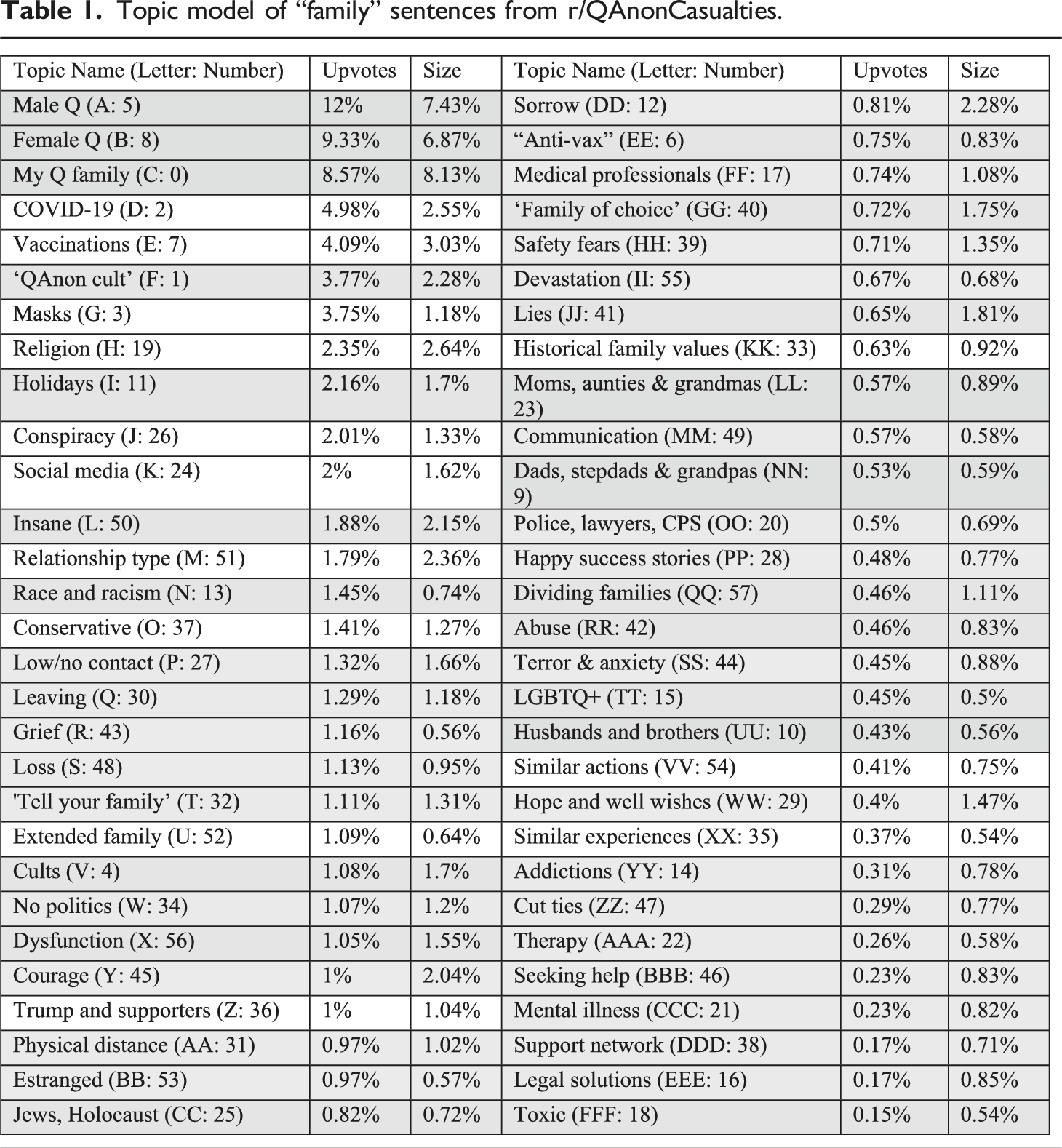
Topic model of “family” sentences from r/QAnonCasualties.
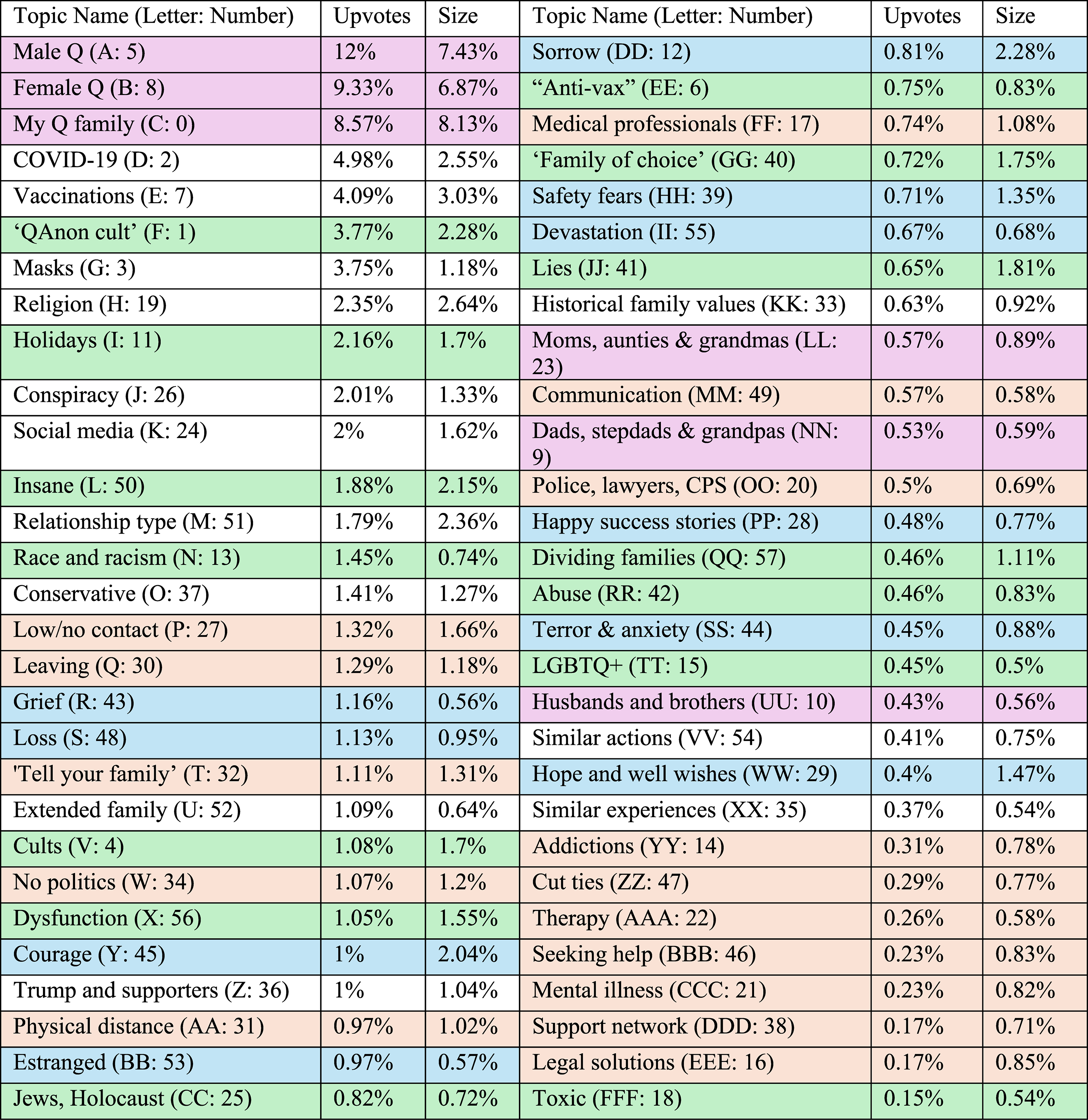
Emotional outcries (highlighted blue) are clearly present as well. Take, for example, feelings of grief (R), loss (S), devastation (II), and sorrow (DD): “I mourn every day, and grieve for the loss and destruction of a once-happy family life...” (Grief: R) “It is like a death. You are grieving the loss of a family. Ppl talk abt closure or moving on. Grief isn't like that. Grief is your feelings telling you Every day you miss them.” (Grief: R) “I have lost friends and family....broke my heart...over and over.... BUT, i need to draw that line, to protect ME...And i come HERE, to give what i can in the way of Love and Support!!! Hugs and Love Babe!! We are Family Now!!!” (Loss: S) “He is very intelligent and wasn't easily led as a child. I am devastated. I have lost my family. I am grieving the living.” (Loss: S) “I'm sorry you and your family has to go through this. Q beliefs have torn so many families apart, mine included. My heart goes out to you. I hope you and your daughter find peace and healing.” (Sorrow: DD)
As the above suggests, terror and anxiety (SS), and fears of safety (HH) are also rife throughout: “This is so sad. You must protect your family. Q people are known to be unstable and you son could be hurt, kidnapped or murdered.” (Safety fears: HH) “This has me so worried about my family. I feel like I have to constantly gauge the mental health and capacity for violence in them... It's just so scary because you never really know what someone is capable of...” (Terror and anxiety: SS) “I just get scared because I'm so terrified of my family finding out. If they saw this post, I'm not even sure what would happen to me.” (Terror and anxiety: SS) “Your in-laws are gone, probably not ever coming back from the rabbit hole they willing fell into. So YOU and you husband and hopefully any family that hasn't Qed out, can have great memories! It's awful that there are so many families dealing with this. But you have YOUR family to protect. Pray for them. But don't expect a change of heart or mindset. I wish you all the happiness in the world!” (Safety fears: HH) “I have family members who are obsessed with QAnon. They eat, sleep and drink this lengthy list of lies. I want to de-program my brother who is the one who is spreading these lies to the rest of my family. ... My brother has sold all of his stock and has guns placed at his front door. I'm so worried about my whole family.” (Terror and anxiety: SS)
This is not to say positive emotional expressions are absent on the board (e.g. Courage (Y); Hope and well wishes: WW), but typically such conversations involve optimism about family life without the Q believer, though some success stories are certainly present (PP): “I am so happy for you and your family! Your son gets a relationship with his grandpa, and gets to hear encouraging words at a stressful time. Nothing but joy and hope, maybe, I get that some day. That's for sharing!” (Happy success stories: PP) “Congratulations on breaking free!! Thank you for sharing your success story. Your family must be so happy to have you back. It is what most of us hope for with our own Qs.” (Happy success stories: PP) “Honestly seems like if you don't join her cult she doesn't want to be with you! Not to be harsh, but she seems far gone and more in love with her cult! I really wish you the best of luck with your family!” (Hope and well wishes: WW)
Indeed, the framing of losing family members to a cult (F & V) is clearly prominent in the data. “it is best to be critical, especially since we've seen how many QAnon cult members have tried to frame, slander, falsely accuse, and doxx members and mods of this subreddit. These people are dangerous; they are mentally unhinged and they are out for blood. I have several members of the QAnon cult in my family. The amount of xenophobia, homophobia, sexism, and fascist beliefs they have is disgusting. These people fantasize about participating in a civil war where they get to kill anyone with leftist beliefs and minorities. It's fucking terrifying.” (QAnon cult: F) “no amount of reasoning once they are “in” seems to work. The cult is the new family.” (cults: V) “The problem with cults, the cult has to come before the family.” (cults: V)
In this way, the distribution of topics also reflects the real-world effects of QAnon beliefs on these family relationships (highlighted green). From dividing families (QQ) into their ‘family of choice’ (GG) due to these conspiracy beliefs, to introducing toxicity (FFF), lies (JJ), racism (N), bigotry (TT), and antisemitism (CC) into the family dynamic, there exists many real-world effects discussed on the subreddit: “Protect your child. Your family is no more...” (Dividing families: QQ) “Are you me? This is exactly why I cut off my family finally. I'm so, so sorry this is happening to you. It's not ok. Healthy families do not do this. Healthy people do not do this.” (Dividing families: QQ) “Despite what people say, blood is not thicker than water. If there are toxic people in your life- family or not- then it is best to cut them out. It sounds harsh but I think it will be the best solution for you.” (Toxic: FFF) “Several of both families have fallen prey to Q, mostly through the Save the Children talking point. They weren't racist before, but now, they're super racist to Latinos who just came over, or all Asians and blacks” (Race and racism: N) “I have Jewish family too! It's so disturbing when my father repeats conspiracy theories that, if true, would mean his sister and nephews were some kind of demons without seeming to notice. He loves his sister. It's wacky. We're all slow fading.” (Jews, Holocaust: CC) “I lost her. I couldnt handle it anymore when she called anyone in the LGBTQA + community pedophiles. We have gay family members. I couldnt sit there watching her attacking people of different genders and races anymore without consequences of her actions. Cutting her off was hard but I'm happier.” (LGBTQ+: TT)
This last message shows these discussions sometimes invoke a myriad of potential solutions to the family crisis (highlighted orange), including strategies to maintain these relationships. For example, some of these conversations offer the promise of reconciliation, urging consultation with medical professionals (FF); therapy/counselling (AAA); advice about handling mental illness (CCC); and potential similarities with addiction (YY). Like the literature on interpersonal disagreement, strategies of avoidance, compromise, and direct confrontation are discussed extensively in these topics and throughout the rest of the data: “Don't let peoples personal politics impact your family. Family is way more important than politics. All of this talk about cutting out family members from their lives is ridiculous. And I'm talking to both sides. Just refuse to engage in the conversation.” (No politics: W) “I can only speak to my mistakes and what Ive experienced. For me and my wife, I've learned that we just can't talk about politics anymore... I still love my family even if their beliefs are repulsive to me. The relationships are worth keeping.” (No politics: W) “My partner let me listen to the telegram groups he was listening to so I could get an idea how far in he was, and what his beliefs were. It didn't work for us as a couple in the end- but I had a pretty good idea on what he was doing once I had a bit of access to that world.” (Husbands and brothers: UU) “Not even the most basic logic on how it isnt real worked on her. I tried to appeal to her emotions, to her convictions, her love of family, her heritage, her religion. I went through it like a checklist, and I was met with an unmovable object of willpower at every turn. It devolved into a yelling match, and within moments we were yelling over each other and noone was listening.” (Relationship type: M)
Yet, others on the subreddit frame these relationships as irreconcilable, urging use of the legal system (EEE) and recommendations that families reduce contact (P), cut ties (ZZ) or leave (Q) their relationship with QAnon believers: “It was hard for me to cut ties with my family but I had to. There was nothing I could do or say to make it better. I really wish there was something I could do.” (Cut ties: ZZ) “I cut all ties with all family. It wasn't easy. I didn't do it until I came to the painful realization that they could possibly be willing to hurt me. Fuck them, blood or not. I'll never forgive them.” (Cut ties: ZZ) “Good. I have had to go no contact with my family. Draw your boundary, keep it. And when tempted to talk to them, write them a letter instead, and then burn it. I thought it was baloney but it actually helps the impulse.” (Low/no contact: P)
Table 1 also shows two other important metrics, the popularity of each topic (i.e. as a percentage of all upvotes) and the topic’s relative size. In other words, the table outlines how much attention particular topics receive (i.e. its size) and how users respond to each topic (i.e. with an upvote). As the top of Table 1 shows (ordered by upvote popularity), individual references to male (A), female (B), and family (C) QAnon members command the most attention and popularity, but these generic references give way to more specific (insightful) conversations. For example, topics like vaccinations (E), COVID-19 (D) and masks (G) dominate a great deal of this discussion. In fact, these topics outperformed their cluster size, suggesting posters were not only concerned about these issues, but so were users (i.e. audiences) on the subreddit. How to navigate family gatherings—particularly during the pandemic—was also another important topic to users: “We usually spend Thanksgiving and Christmas with my family but not this year. They have fallen for Q... She couldn't leave well enough alone and it ended in her attacking me... My kids know that we aren't speaking but not the reasons why... They don't understand why we can't spend Thanksgiving together and I don't know what to say. I don't know how to explain that it's not happening this year.” (Holidays: I) “As hard as that is to say, it's not easy to do, but that is what I did, and once 2 year's went by and our family didn't have Christmas and Thanksgiving with my mother, she started to realize. It's not a guarantee, but you have to do what is right for yourself your sanity, and your family.” (Holidays: I)
Discussion and conclusion
In order to strengthen our collective understanding on the effects of QAnon beliefs on family relationships, this study explored 75 thousand unique sentences from r/QAnonCasualties containing the (case-insensitive) keyword “family”. Using state-of-the-art topic modeling, these sentences were organized into 58 categories and used as a basis for answering the current paper’s three research questions. I now turn to addressing those questions.
With 58 topics, the model initially suggests that family is discussed on the subreddit in a wide array of contexts. Nevertheless, in my estimation, four broad themes emerged across the models. Namely, r/QAnonCasualties’ “family” content (1) identified the type of relationship with Q believers (e.g. mothers (LL), fathers (NN), husbands and brothers (UU)); (2) and the deep emotional toll of the belief on family relationships (e.g. grief (R), loss (S), isolation (BB), sorrow (DD), devastation (II), safety fears (HH) and terror and anxiety (SS)). Though far fewer in occurrence, happy success stories (PP), offers of hope and well wishes (WW) and celebrating displays of courage (Y) were also notable. (3) The topic model also revealed over a dozen potential self-reported effects of QAnon beliefs on the family. The most immediate effects focused on the consequences of family members joining a ‘cult’ (F, V), ultimately either dividing (QQ, I) families and injecting severe dysfunction (X), lies (JJ) and toxicity (FFF) into their relationships. Users also recounted disturbing changes in their Q family interactions, seeing racism (N), antisemitism (CC), and bigotry towards the LGBTQ + community (TT) prominently displayed within the family context. Some of these latter examples explicitly discuss how marginalized family members were directly targeted by QAnon believers. (4) Finally, a notable grouping of conversations focused on potential solutions to the family crisis. From trying various communication strategies (MM) with both Q family members and the wider—non-believing—family (T), to seeking therapy (AAA), and treatment from medical professionals (FF). Much of these strategies focused on concluding the relationship in some form, by going low/no contact (P), increasing physical distance (AA), seeking legal solutions (EEE) or even contacting law enforcement and Child Protective Services (OO).
Outside the generic references to male, female or Q family members, pandemic related discussions clearly commanded the primary attention (both in size and popularity) of the community. These discussions, involving COVID-19 (D), vaccinations (E), and masks (G) saw a greater percentage of upvotes than the size (i.e. frequency) of those topics, suggesting these conversations were particularly valued by the subreddit. Strategies to navigate family holiday gatherings (I) was another clearly important topic among these users, as was the potential religious (H) connection with some believers, dealing with family behavior on social media (K), and requests to better understand the effects of conspiracy beliefs on families (J).
That expressed desire among r/QAnonCasualties to know more about the effects of conspiracy beliefs on families is all the more compelling, given research on these specific interpersonal effects is so limited. We have clear reason to believe that relationships are likely harmed by conspiracy beliefs (e.g. van Prooijen et al., 2022), with a handful of potential theoretical consequences like alienation and erosion due to non-normative behaviors (Toribio-Flórez et al., 2023), and empirical evidence that such beliefs decrease relationships satisfaction (Toribio-Flórez et al., 2024). QAnon-specific interpersonal research leads the way in this area, showing a handful of effects like feelings of humiliation (Waltman, 2023), negative mental health impacts (St-Amant et al., 2023), psychological distress (Moskalenko et al., 2023) and ‘Qonflict’ (Mastroni & Mooney, 2024), though much of these emerging initial results overlap to some degree as Mastroni and Mooney suggest (2024).
This study adds to that body of research. While this data also shows areas of overlap (i.e. as reflected in four generic themes discussed above), the current study’s results nevertheless reveal a rather diverse range of specific family-related concerns even within the broadly similar topics. Take emotions as one example: these conversations involving the emotional impacts of conspiracy beliefs on family are wide ranging, an initial finding that helps broaden our empirical evidence on the effects of such beliefs.
Positive emotional responses within the community (e.g. from encouragement, to celebrating success stories) also command fleeting attention in existing research (e.g. Mastroni & Mooney, 2024 offer one such discussion). Celebrating the prospect of reconnecting families is certainly a notable finding, but so too is documenting the numerous potential strategies and solutions to the family crisis discussed on the subreddit. This is why studying the effects of conspiracy beliefs on families has primary value, because these individuals are clearly looking for answers to address their family’s trauma.
Limitations and future research
As the data indicates, there are a host of self-described effects of conspiracy theories on family relationships worthy of future research. With that said, the nature of the forum (i.e. self-described relationship casualties of QAnon beliefs), and the resulting limitations from this sample certainly requires some acknowledgement. By design, the study did not collect or account for demographic data, nor did it seek to gather data from individuals that may have expressly seen their relationship gain from such beliefs. In turn, issues of sample bias and causality are clearly present. Future research should therefore be wary of these concerns when interpreting this study’s results. Nevertheless, while the subreddit does indeed fixate on the self-described negative effects of QAnon conspiracy beliefs on family relationships, the data offers quite a bit for future research, both in theory and practice.
From a theoretical perspective, the current paper reveals more empirical evidence—in a new context—on the effects involving interpersonal disagreement, and the strategies both believers and non-believers apply to maintain their relationships. For example, posts are rife with questions about navigating family members relentlessly expressing QAnon beliefs. Not only do these examples highlight the clear interpersonal threat both believers and non-believers recognize over disagreement, but also the various strategies both parties deploy in response. From aggressive debate (and confrontation), to compromise, avoidance, and cutting ties altogether, families look to these strategies to resolve this interpersonal dilemma, though this time in a new context.
If nothing else, the subreddit expresses real demand for future research to expand into the interpersonal effects of conspiracy theories (i.e. more generally). We should also be mindful, though, not to repeat the problematic macro versus micro dichotomous focus of current conspiracy belief research: there are many different types of relationships, and looking more closely at how conspiracy beliefs—for example—affect marriages, parental relationships, or even friendships differently may further expose some valuable insights. The above also demonstrates that methodological diversity pays dividends as well, and so those looking to investigate the interpersonal effects of conspiracy beliefs need not only draw from surveys and interviews.
From a practical perspective, a reviewer asks “can these findings be useful to family therapists who may have clients affected by this issue?” Given my limited expertise in this area, my hope is that this journal’s audience can see potential in using this study’s data to answer such a question going forward. The Online Supplement offers considerable detail for further analysis along these lines. Yet, while the QAnon movement unquestionably has some unique characteristics, the reality is that conspiracy theories have existed long before, and will exist long after QAnon. Meaning, the most promising avenue for future work may rest on the applicability of this research into the more general interpersonal effects of conspiracy beliefs. Theory and practice therefore stand to gain, at least in my estimation. The hope is that the current study has helped partially advance our knowledge while inspiring others to contribute to this important area of research.
Footnotes
Declaration of conflicting interests
The author declared no potential conflicts of interest with respect to the research, authorship, and/or publication of this article.
Funding
The author received no financial support for the research, authorship, and/or publication of this article.
Open research statement

Ethical statement
Data availability statement
The Python and R code used in this study, and the Online Supplement, are available in an Open Science Framework repository at the following URL: https://doi.org/10.17605/osf.io/xj3uz