




Abstract
This study investigates how the quality of family relationships and children’s residence arrangements are associated with stepparent-child relationship quality. Prior literature has studied these factors separately, with the role of family relationships often studied only among stepfamilies with co-resident children. Little is known about how the relevance of family relationships varies depending on where children reside. The opportunity structure (e.g., contact frequency) within which various family relationships influence each other can differ across residence arrangements. This study, therefore, investigates the roles of multiple family relationships across children’s various residence arrangements - including the more contemporary arrangement of shared residence. Multiple regression analyses with moderation techniques were conducted using the New Families in the Netherlands (NFN) survey, large-scale data collected in 2020 among divorced and separated parents with a minor or (young) adult focal child (N = 1829). We found for each family dyad (between the biological parent and the focal child, between the biological parent and the stepparent, and between the stepparent and the other biological parent of the focal child) that a high relationship quality was associated with higher stepparent-child relationship quality. Their importance, however, varied across residence arrangements. Poor relationship quality of the biological parent-child dyad and the stepparent-other biological parent dyad was associated with a poor stepparent-child relationship, especially when the focal child was nonresident. Whereas, there was a positive association between the stepcouple relationship and stepparent-child relationship quality primarily for children living full-time with the stepfamily. Altogether, the relationship quality of various family dyads spills over to the stepparent-child dyad - though the extent of this spillover differs depending on the opportunity structure determined by children’s residence.
Introduction
The relationship between stepparents and children has often been considered difficult. As a dyad formed following the repartnering of (one of) the biological parents, the stepparent-child relationship might be involuntary (Ganong & Coleman, 2017). As a result, some stepfamilies might lack the motivation to form strong stepparent-child bonds (Ganong & Coleman, 2017). Despite the fragility of this dyad, building positive stepparent-child relationships has many benefits for children, such as improving their psychological well-being (Jensen, 2022).
Stepparent-child bonds develop within the context of various ongoing family relationships and are practiced through different residential arrangements (Ganong & Coleman, 2017). Two separate strands of literature have studied these bonds, either investigating the set of family relationships surrounding the stepparent-child relationship or the structural factors regarding children’s residence (Raley & Sweeney, 2020). The first strand has examined how ties between stepfamily members are interdependent and has shown that the quality of multiple family relationships is crucial to the stepparent-child relationship quality (King, 2006). This literature has often focused only on stepfamilies with co-resident children and investigated the relationship dynamics within the stepfamily household. These studies have shown that the relationship quality between the biological parent and children and between the biological parent and the stepparent (from here on referred to as the stepcouple) is highly relevant to the stepparent-child relationship quality (Jensen & Howard, 2015; King & Lindstrom, 2016). Only few studies have broadened their focus beyond the stepfamily household and considered the children’s other biological parent. These studies have shown that how well the stepparent gets along with the other biological parent also matters for the stepparent-child relationship quality (Hornstra et al., 2020; 2022). The second strand of literature has reported children’s co-residence with the stepfamily as critical to strong stepparent-child bonds (Ganong & Coleman, 2017; Kalmijn et al., 2019).
The present study focuses on the stepparent-child relationship quality among stepfamilies with minor-aged and (young) adult children. We investigate how the stepparent-child relationship quality is associated with children’s residence arrangements and with the quality of family relationships, namely, the (focal) biological parent-child relationship, the relationship between the partners in the stepcouple, and the relationship of the stepparent with the other biological parent. For residence arrangements, we include full-time resident children (i.e., residing only with the stepfamily), part-time resident children (i.e., shared residence with the stepfamily), those living with the other biological parent, and (adult) children living independently. Our study aims to bring the mostly separate research on relational and residential factors together. There is often a strong positive correlation between the quality of family relationships and co-residence (e.g., Kalmijn et al., 2019), making it difficult to disentangle their roles from each other. Data limitations have mostly prevented prior research from investigating the relative importance of the two. By examining them simultaneously, we can investigate the distinct roles of each family dyad and co-residence. As a result, we can shed light on whether co-residence is important in its own right, or whether the importance of co-residence for positive stepparent-child relationships is explained by the fact that co-resident dyads often have more positive family relationships. Also, the relevance of family relationships for stepparent-child relationship quality can vary across children’s residence arrangements depending on the opportunity structure (e.g., contact frequency) a particular residence arrangement offers. Hence, we can investigate how the relevance of family dyads varies depending on where children reside. We thus answer the question: Does co-residence amplify or curtail the importance of family relationships for the stepparent-child bonds?
We further contribute to prior knowledge by displaying the increasing diversity in the residence arrangements of children. As a result of more parents opting for shared residence after divorce, it has become more common for children to live approximately half of the time in the household of each biological parent (Bernardi & Mortelmans, 2021). This creates a distinct stepfamily form where multiple (step)parental figures can be (almost) equally active in the lives of children, making family relationships in multiple households more intertwined (Thomson & Turunen, 2021). Furthermore, research in the last decades has shown that nonresident biological parents are becoming more active in their children’s lives (Westphal et al., 2014), along with nonresident stepparents becoming more present parental figures. Little is known about the dynamics of stepparent-child relationships in such stepfamilies (Raley & Sweeney, 2020; Sweeney, 2010). By studying the interdependency of family relationships across different residence arrangements, our study aims to fill this knowledge gap – helping to inform family practitioners and policymakers regarding the relationship dynamics in more contemporary stepfamily forms. Lastly, we move away from the often dichotomous contrast of co-resident versus nonresident children to reflect the heterogeneity in living arrangements. We distinguish stepfamilies with full-time resident children from those with part-time resident children under co-residence. For nonresident children, we separate children living with the other biological parent from (adult) children living independently. This distinction is relevant since the constraints of nonresidence (e.g., limited contact) are more inherent for the former group.
We use data from the survey “New Families in the Netherlands” (NFN) held among Dutch divorced or separated parents with minor or (young) adult children (Poortman et al., 2021). This recent dataset is unique in that it covers various forms of stepmother and stepfather families with different residence arrangements for their children, including shared residence. NFN offers detailed information on the bonds across multiple members of a stepparent family, also reaching beyond the stepfamily unit – that is, with the other biological parent of focal children.
Theory and hypotheses
Dyadic family relationships
We argue for the interdependency between dyads with reference to Family Systems Theory (Broderick, 1993), proposing that a family system consists of various subsystems, each one influencing another (Cox & Paley, 2003). Due to this interdependency, positive or negative relationship characteristics of one subsystem affect the functioning of another – which is called “spillover effects” (Petren et al., 2018). As subsystems in a stepfamily, we expect the relationship quality of each dyad we look into – namely, the biological parent-child dyad, the stepcouple dyad, and the stepparent-other biological parent dyad (see Dyads A, B, and C in Figure 1) – to spill over to the stepparent-child dyad (Dyad D). We focus on these dyads since they are the main ones within a focal stepfamily unit (i.e., between the stepparent, the biological parent, and the children) and reflect the parenting dynamics with the other biological parent. We leave out the ex-couple dyad from the scope of this study since the dynamics of this dyad could highly overlap with the relationship between the (focal) stepparent and the other biological parent and be less directly related to the stepparent-child relationship quality (Hornstra et al., 2022). Relationship dyads. Notes: A = Biological parent-child dyad; B = Stepcouple dyad; C = Stepparent-other biological parent dyad; D = Stepparent-child dyad. The dyads shown with the dashed lines are not included in the present study.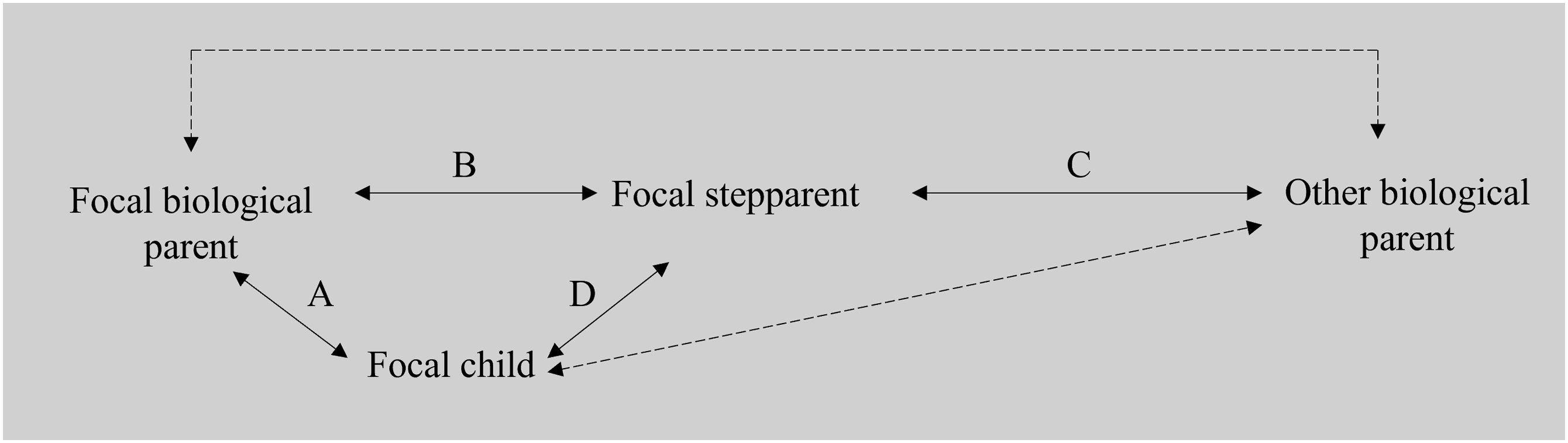
When they have a positive relationship with their children (Dyad A) or with their partner (Dyad B), biological parents are more likely to foster a positive relationship between their children and this partner (i.e., stepparent) (Dyad D). Literature refers to such efforts as “kin-keeping” (Van Houdt et al., 2020). Biological parents can, for instance, act as the mediator between the stepparent and children (Weaver & Coleman, 2010). Moreover, a happy relationship between the partners in the stepcouple (Dyad B) could motivate stepparents to be more responsive to their stepchildren (King, 2007). Children might also be more willing to invest in their relationship with their stepparent when they see the stepparent bringing happiness to their biological parent (Braithwaite et al., 2018). Children’s motivation could be even stronger when they have a strong bond with their biological parents, encouraging them to be close to their stepparent as well. Lastly, children’s relationship with their biological parent and their stepparent could be a “package deal” (Hornstra et al., 2022, p. 5) since positive bonds and frequent interactions with the biological parent often mean more engagement, and potentially closer bonds, with the stepparent as well. Focusing mostly on stepfamilies with co-resident children, prior research found that the biological parent-child relationship quality and the stepcouple relationship quality were positively associated with the stepparent-child relationship quality (Jensen & Howard, 2015; King & Lindstrom, 2016).
Relationship dynamics with the other biological parent of the (focal) child might also matter for the stepparent-child relationship quality. A positive relationship between the stepparent and the other biological parent of the (focal) child (hereafter, the other parent; Dyad C) might facilitate a higher relationship quality between the stepparent and the child. The other parent could, for instance, talk about the stepparent positively and respect the role of the stepparent in the child’s lives (Marsiglio & Hinojosa, 2007). When the relationship between the other parent and the stepparent is poor, the child might refrain from bonding with the stepparent following the loyalty conflict they may feel toward their other parent (Ganong et al., 2011). Focusing on stepfamilies with adult children, prior research found a positive association between the two dyads (Hornstra et al., 2020; 2022). We expect a higher relationship quality of the biological parent-child dyad (H1-Dyad A), of the stepcouple dyad (H2-Dyad B), and of the stepparent-the other parent dyad (H3-Dyad C) to associate with higher stepparent-child relationship quality (Dyad D).
Children’s residence
Residence patterns depend on children’s residence and the type of relationship between the biological parent and the stepparent (i.e., marriage or cohabitation versus living apart together (LAT)). Here, we only focus on children’s residence while assuming the type of relationship as constant across stepfamilies. Co-residence offers the opportunity to spend more time together, which is crucial to building strong and amicable stepparent-child bonds (King, 2006). Co-residence can also increase conflict between stepparents and children (Arránz Becker et al., 2013). Still, most prior research (see below) suggests that opportunities for bonding dominate those for negative interferences, resulting in an overall higher relationship quality between co-resident children and stepparents. When children reside solely with a stepfamily, they are full-time resident in the stepfamily household and have the most interaction opportunities with the stepparent. In the case of shared residence, children live approximately half of the time with each biological parent, meaning they are part-time resident in the stepfamily household. Note that selection into (full-time or part-time) co-residence can also play a role since children are more likely to reside with a stepfamily when dyadic relationships within the stepfamily are positive (e.g., Steinbach, 2019).
Nonresidence with the stepfamily implies formal and informal restrictions to stepparent-child bonds (Hawkins et al., 2006). Formal restrictions may be legal custody arrangements and visitation rights, and informal ones can be related to the family functioning involving the co-resident parent and the rest of the household members. Even when children become adults, and formal restrictions are no longer at play, established interaction patterns may continue if living arrangements do not change. Whereas, when (adult)children move out to live independently, they can actively shape family relationships, and have more autonomy in deciding how often to see the stepfamily. This implies that the restrictions of nonresidence are more applicable when nonresidence is due to children with the other parent compared to children living independently. Previous literature has predominantly confirmed the importance of residing together for stepparent-child closeness (King, 2006; 2007; Van Houdt, 2023). Whereas, Arránz Becker et al. (2013) found co-resident (adult) children to have less close relationships with their stepparents than nonresident children. We expect full-time resident children to have the highest stepparent-child relationship quality (Dyad D), followed by part-time resident children, children living independently, and those living with the other parent, respectively (H4).
Interactions of biological parent-child and stepcouple dyads with residence
Children’s co-residence can amplify the mechanisms connecting the biological parent-child dyad and the stepcouple dyad to the stepparent-child dyad, increasing the relevance of these dyads. Alternatively, co-residence can enable stepparents and children to build bonds with each other more directly, decreasing the relevance of these dyads. Because no prior research, to our knowledge, has investigated the moderating role of co-residence, we refrain from prioritizing one of these alternatives. Instead, we offer opposing hypotheses arguing for co-residence as “an amplifier” or “a damper”.
As argued before, biological parents might be motivated to facilitate close bonds between stepparents and children when they have strong bonds with their children (Dyad A) or with their partner (i.e., stepparent) (Dyad B). Co-residence functions as an amplifier if it amplifies biological parents’ already strong motivations further by an increase in opportunities for kin-keeping. These parents could create more occasions for the stepparent and children to engage in one-on-one activities, facilitating stronger stepparent-child bonds (Ganong & Coleman, 2017). Furthermore, children could perceive the relationship with their biological parent and stepparent more like a package deal when they live together. This would imply that children with strong bonds to their biological parents put more effort into the relationship with their stepparents, especially when co-resident. These amplifying effects could be most present when children are full-time resident with the stepfamily, followed by part-time resident, whereas less so when children are nonresident. Biological parents with nonresident children could, for instance, prioritize investing in their own relationships with the children instead during the more limited time they see their children (Degreeff & Burnett, 2009). This could be notably the case when children live with the other parent compared to living independently. We expect that the positive association of the biological parent-child dyad (Dyad A) and of the stepcouple dyad (Dyad B) with the stepparent-child dyad (Dyad D) is the strongest for full-time resident children, followed by part-time resident children, children living independently, and children living with the other parent, respectively (H5A).
Alternatively, co-residence may function as a damper. When children live with the stepfamily, there are greater possibilities for more direct interactions and engagement between stepparents and children. As a result, children and stepparents can form bonds with each other with less dependence on the biological parent-child dyad or the stepcouple dyad. For nonresident children, the possibilities for one-on-one interactions with their stepparents are more limited, especially when they live with the other parent. This could make mechanisms related to the biological parent-child and the stepcouple dyads more relevant. For instance, children might perceive their relationships with their biological parent and their stepparent more as a package deal when nonresident because they would be less likely to spend alone time with their stepparent without the presence of the biological parent. We, alternatively, expect that the positive association of the biological parent-child dyad (Dyad A) and of the stepcouple dyad (Dyad B) with the stepparent-child dyad (Dyad D) is the weakest for full-time resident children, followed by part-time resident children, children living independently, and children living with the other parent, respectively (H5B).
Interaction of stepparent-other parent dyad with residence
When children live with their other biological parent, they are more exposed to this other parent’s opinions of the stepparent. Furthermore, as the co-residential parent, the other parent usually has more influence on which parental figures are more active in their child’s lives (Ganong et al., 2015). Therefore, how well the stepparent gets along with the other parent of the (focal) children could be crucial for stepparent-child bonds, especially when these children live primarily with the other parent, followed by part-time. Independently-living children might be less exposed to the other parent’s opinions of the stepparent. In addition, they likely have more agency in shaping their relationship with the stepparent, making the other parent’s views less influential. When children are full-time resident with the stepparent, the bond between the stepparent and children could develop with the lowest influence from the other parent. We expect the positive association between the relationship quality of the stepparent-other parent dyad (Dyad C) and the stepparent-child dyad to (Dyad D) to be the strongest for children living with the other parent, followed by part-time resident children, children living independently, and full-time resident children, respectively (H6). To our knowledge, no prior research has investigated this moderation.
Methods and data
Data and sample
The data came from the New Families in the Netherlands (NFN) survey (Poortman et al., 2014; 2018; 2021; Poortman & Van Gaalen, 2019a; 2019b). Since only Wave 3 (2020) included questions on relationship quality, we conducted the analyses with this wave and added some (background) information from Wave 1 (2012/2013) and Wave 2 (2015/2016). In collaboration with Statistics Netherlands (CBS), the sample for Wave 1 was drawn randomly among different-sex parents who dissolved their marriage or cohabitation in 2010. Both former partners received an invitation to participate in an online survey, resulting in 4481 respondents, which equals a response rate of 39% among persons and 58% among former households approached. If respondents gave permission to be re-contacted in Wave 1, they were invited to Wave 2. In addition, to compensate for the panel attrition, a refreshment sample was added, with respondents drawn from the same population as the original sample. The total sample of Wave 2 amounted to 3464 respondents, combining the original (n = 2544) and refreshment sample (n = 920). For Wave 3, respondents who participated in Wave 1 or Wave 2 were reapproached. The response rates of Wave 3, very similar to Wave 2, were 68% at the person level and 72% at the former household level, yielding a sample size of 3056 respondents. For around one-fifth of former households, both ex-partners participated in Wave 3. Note that the response rates of all three waves were comparable to other family panel surveys in the Netherlands (Poortman et al., 2021).
In Wave 3, respondents reported about a focal child selected in a former wave based on age: if at least one of their children was 10 or older at the time of Wave 1, they reported about the youngest child of 10 or older. If all their children were younger than 10, the focal child was the oldest one. The cut-off age was 13 for the refreshment sample for comparability with the original sample. All three waves of NFN shared the common response patterns: those with the highest income and Dutch people were overrepresented, whereas men, former cohabiters, younger people, those with a low income, and on welfare were underrepresented. Note that those with non-western backgrounds were also underrepresented, but no specific information on ethnic identities was available. Higher socioeconomic status was the strongest predictor for re-participation in Wave 2 and Wave 3. Also, women, older people, and re-partnered respondents were more likely to participate in Wave 3.
We excluded some cases in line with the aim of our study. First, we excluded those who were not re-partnered (n = 1012) or, following the aim of our study and their limited sample size, those who were in a same-sex relationship (n = 47). Second, respondents with children who had “other” residence than one of the parental homes or living independently were excluded (n = 74). Third, especially from children’s perspective, LAT stepparents who had no parental engagement might not be perceived as a parental figure with whom they form bonds. We, therefore, excluded LAT stepparents who scored zero on all the items measuring parental involvement with the focal child (n = 34) 1 . Respondents with missing values on any of the filter variables mentioned so far were also excluded (n = 35). In the end, the number of missing values on all variables in the analyses amounted to only around 1% (n = 25), which were handled using listwise deletion, resulting in 1829 respondents from 1635 former households.
Dependent variable
Stepparent-child relationship quality
Respondents (i.e., focal biological parent) were asked how they would describe the relationship between their partner (i.e., stepparent) and the focal child on a scale from 1 (very bad) to 10 (perfect) (see also e.g., Nomaguchi, 2012). This variable was the dependent variable and treated as an interval one.
Independent variables
Biological parent-child & Stepcouple relationship quality
For the biological parent-child relationship quality, respondents were asked how they would describe their own relationship with the focal child on a scale from 1 (very bad) to 10 (perfect). For the stepcouple relationship quality, respondents reported how they would describe their relationship with their partner (i.e., stepparent), again on a scale from 1 (very bad) to 10 (perfect). Both of these interval variables were highly left-skewed, with few respondents reporting a (very) bad relationship quality. To better distinguish the problematic relationships from more positive ones (also see: King, 2006, 2009), we transformed these variables into three dummy variables. This approach also helps us detect any (possible) nonlinearity. We determined the cut-off points for these dummy variables based on the 33rd (the original score of 8) and 67th (score of 9) percentile values (for similar cut-off points: Drapeau et al., 2009) which were the same for both interval variables. For the biological parent-child and the stepcouple relationship quality, the resulting dummy variables (1 = Yes) were lower relationship quality (original scores of 7 and lower), higher relationship quality (original score of 8), and very high relationship quality (original scores of 9 and 10).
Stepparent-other parent relationship quality
Respondents reported, overall, how they would describe the relationship between their partner (i.e., stepparent) and their ex-partner (i.e., the other parent of the focal child) on a scale from 1 (very bad) to 10 (perfect). This variable had a bi-modal distribution, with the majority reporting either a (very) low or a relatively higher score. Accordingly, the 33rd and 67th percentile values corresponded to the scores of 4 and 7, respectively. To better reflect the bi-modal structure, we created three dummy variables following these percentiles (1 = Yes): low relationship quality (original scores of 3 or lower), medium relationship quality (scores of 4, 5,6), high relationship quality (scores of 7 or higher). Note that we also had information on the relationship quality between the two biological parents of the focal child (i.e., the ex-couple), which was strongly correlated with the stepparent-other parent relationship quality (r = 0.76, p < .001). We, therefore, refrained from including both dyads and opted for the stepparent-other parent dyad as this dyad might have stronger implications for the stepparent-child relationship quality. Still, in additional analyses, we checked and confirmed that our findings were consistent also when the ex-couple dyad was added into the analyses (not shown here).
Moderator
Residence of children
Respondents reported with whom the focal child lives most of the time. The answering categories were “with me”, “about equally with both parents”, “with ex-partner”, and “child living alone”. Accordingly, we created four dummy variables: full-time resident children, part-time resident children, children living with the other parent, children living independently (1 = Yes).
Control variables
Mean, range, and SD of the variables in the analyses.
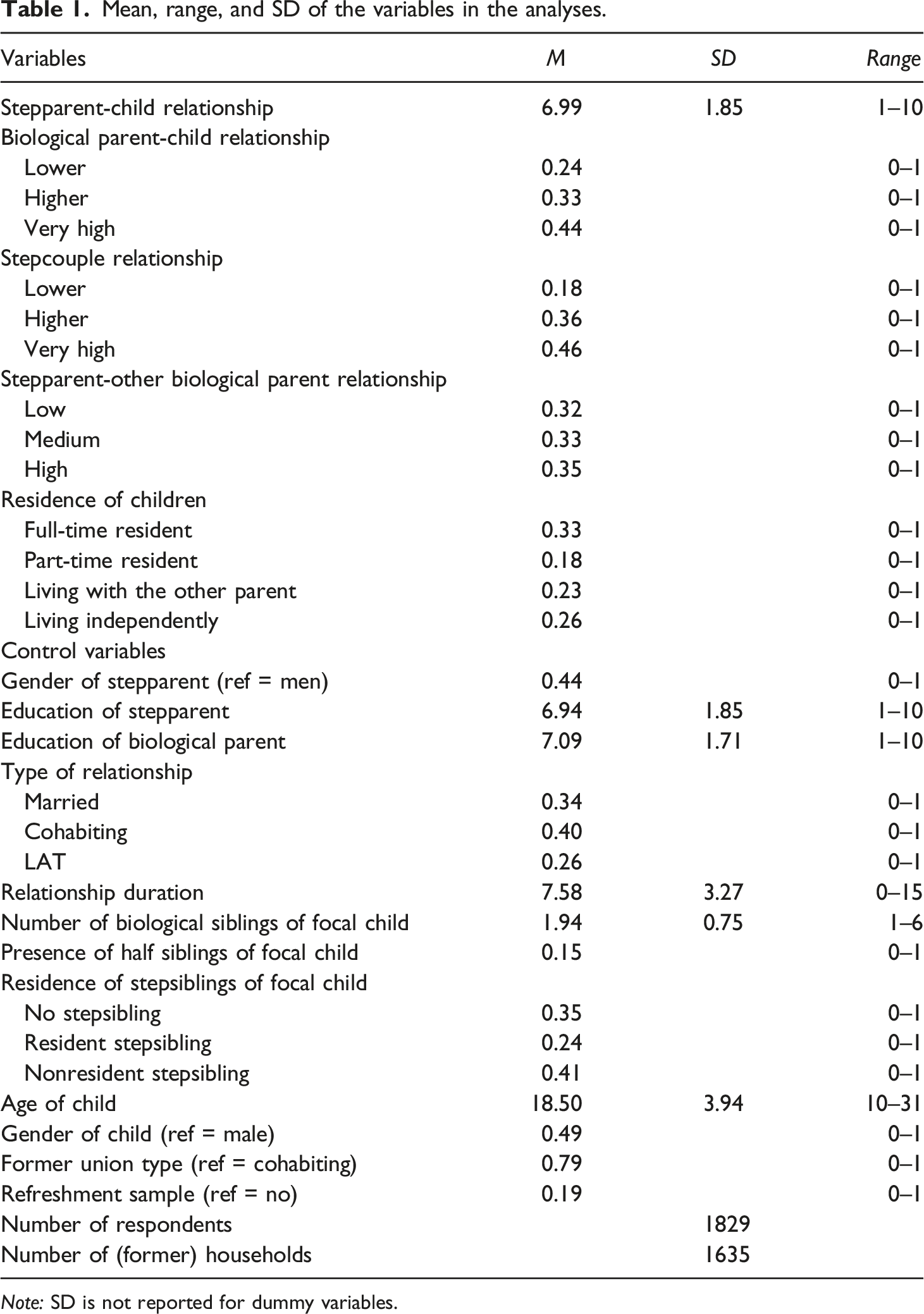
Note: SD is not reported for dummy variables.
Analytical strategy
We performed multiple linear regression while accounting for the clustering at the former household level (i.e., when both ex-partners participated) by clustering the standard errors at this level (with the option “vce(cluster)” in Stata). We estimated six models. Model 1 includes the main effects of the relationship dyads. Model 2 includes the main effects of children’s residence, whereas Model 3 tests the main effects of relationship dyads and residence together. For these models, we calculated effect sizes (Cohen’s d) (see the formula: Wilson, 2016, p.11). The subsequent models separately tested whether the effect of each relationship dyad differed depending on residence. Model 4 includes the interaction term between residence and the biological parent-child relationship quality. Models 5 and 6 test the residence interaction with the stepcouple relationship quality and with the stepparent-other parent relationship quality, respectively. Note that each model included the same set of control variables. For all interaction models, we conducted Wald tests to see if the models improved.
Results
OLS regression analyses for the main effects of variables predicting stepparent-child relationship quality: Unstandardized coefficients and SEs.
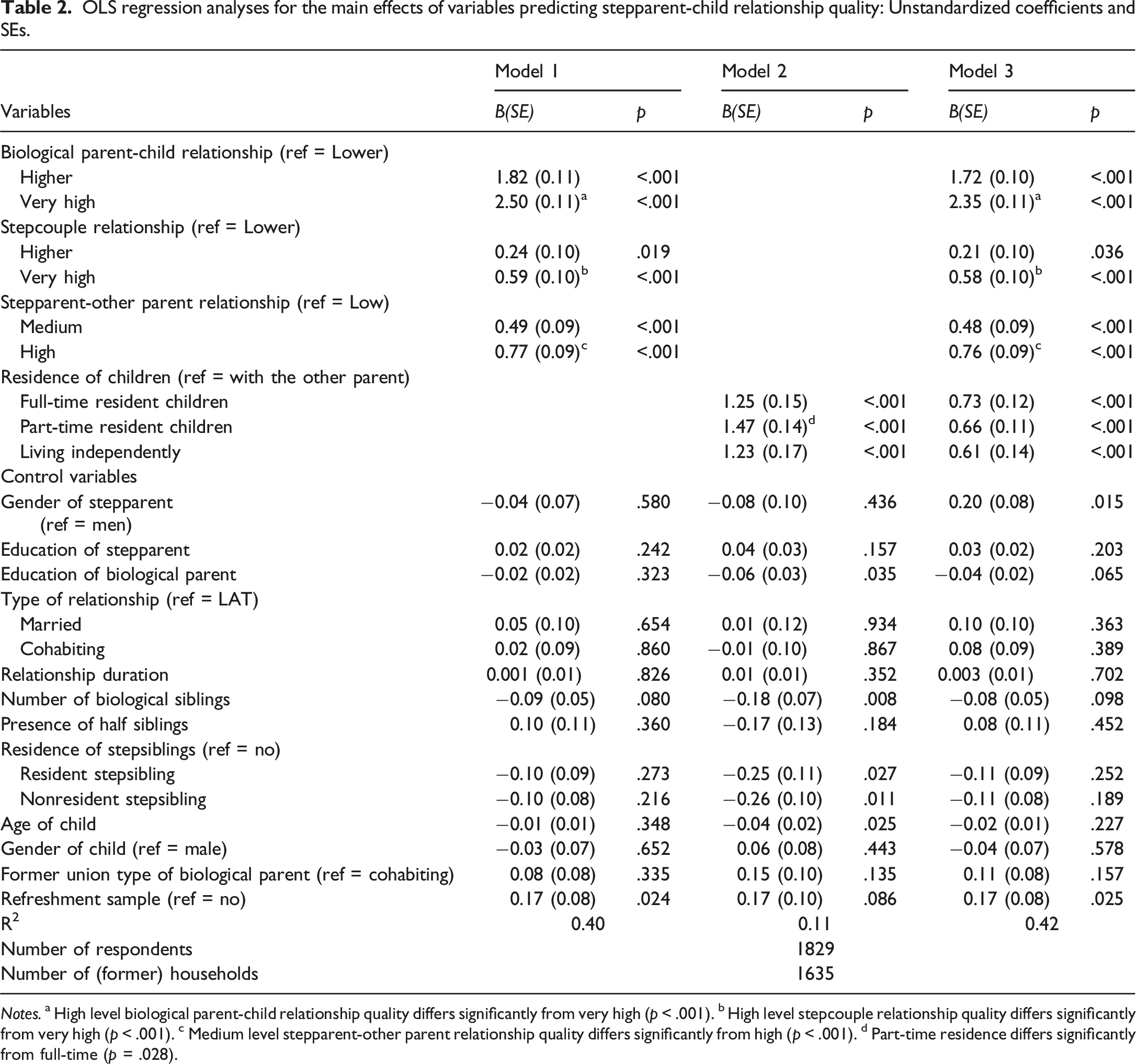
Notes. a High level biological parent-child relationship quality differs significantly from very high (p < .001). b High level stepcouple relationship quality differs significantly from very high (p < .001). c Medium level stepparent-other parent relationship quality differs significantly from high (p < .001). d Part-time residence differs significantly from full-time (p = .028).
Compared to the lower level, the stepparent-child relationship quality was more positive when the stepcouple relationship quality was at the higher or the very high level – equivalent to (very) small effect sizes of 0.13 and 0.32, respectively. The difference between the very high versus higher stepcouple relationship quality was also statistically significant (b = 0.36, p < .001, d = 0.20, not in Table 2). These results confirmed H2.
In line with H3, Model 1 shows children had a more positive relationship with their stepparent when this stepparent had a medium or high relationship quality with the other parent, compared to a low one. These differences were equivalent to small and modest effect sizes of 0.27 and 0.43, respectively. The difference between the high versus medium level of stepparent-other parent relationship quality was statistically significant (b = 0.28, p < .001, d = 0.15, not in Table 2). Model 1, overall, demonstrates the strongest association to be between the biological parent-child dyad and the stepparent-child dyad.
Model 2 includes the main effect of residence only. Compared to children living with the other parent, part-time resident children had the highest stepparent-child relationship quality, followed by full-time resident children and those living independently. The effect sizes were mostly medium (e.g., for full-time resident children: 0.72). Changing the reference category, we found the difference between full-time and part-time residence as significant (b = 0.22, p = .028, d = 0.12, not in Table 2). Additional analyses showed no other statistically significant differences. These results partly confirmed H4 by showing children living with the other parent to have the lowest stepparent-child relationship quality. Contrary to H4, part-time resident children scored higher than full-time resident children but similar to independently-living children.
Model 3 tests the effects of relationships dyads and residence together and shows the importance of considering them simultaneously. When the quality of various family relationships was accounted for, the effect sizes for residence arrangements were substantially smaller (in Model 3) than when it was not (Model 2). The smaller effect sizes were particularly observed for part-time resident children (0.87 in Model 2 vs. 0.36 in Model 3). Accordingly, unlike Model 2, Model 3 shows no statistically significant difference between part-time versus full-time resident children (b = 0.07, p = .432). These differences demonstrate the correlational nature between co-residence and family relationships - that is, children could be more likely to reside with stepfamilies where dyadic relationships are more positive, with this being especially the case for part-time residence. Note that, in additional analyses (not shown here), we confirmed the differences in the effects sizes of residence arrangements between the two models (with Wald tests). Regarding control variables, stepmothers (versus stepfathers) and those from the refreshment sample reported higher stepparent-child relationship quality (be it only in Model 3).
Model 4 (Table 1, Supplemental materials) includes an interaction term between the biological parent-child dyad and residence, and Figure 2(a) plots adjusted predictions calculated in Stata. Wald tests showed that this interaction improved the model (F (6) = 10.77, p < .001). Results partially supported H5B, arguing co-residence as a damper for the association between the biological parent-child dyad and the stepparent-child dyad. Stepparent-child relationship quality scored better at the higher level than the lower level of biological parent-child relationship quality. This was especially the case for children living with the other parent or living independently, with a comparable effect between the two (b = −0.60, p = .051 in Table 1, Supplemental materials). The extent of difference in the stepparent-child relationship quality was smaller for full-time and part-time resident children. This means that when the biological parent-child relationship was of lower quality, the stepparent-child relationship was more likely to be poor if the child was nonresident rather than co-resident with the stepfamily (Figure 2(a)). The difference in the stepparent-child relationship quality between the higher versus the very high level of biological parent-child relationship quality was comparable across residence arrangements. Overall, these results show the positive association between the biological parent-child dyad and the stepparent-child dyad as stronger for nonresident children than co-resident children - though only at the lower end of the biological parent-child relationship quality score. Interactions between dyadic relationship quality and residence arrangements.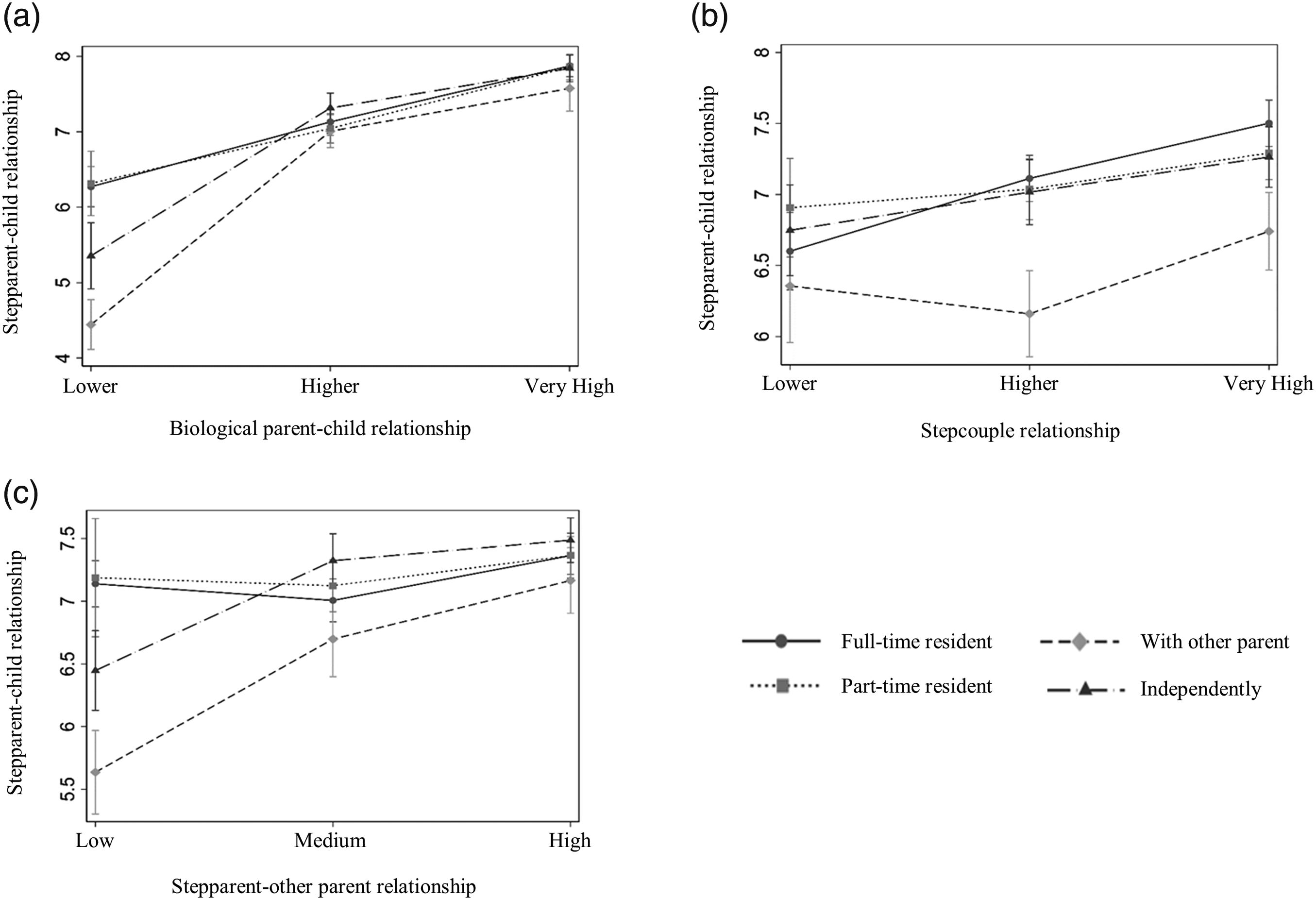
Model 5 and Figure 2(b) present the interaction between stepcouple relationship quality and residence. The effect of this dyad varied little across residence arrangements and Wald tests showed no strong evidence indicating this interaction improved the model (F (6) = 1.50, p = .173). All residence arrangements except for living with the other parent seemed to indicate a positive association with the stepcouple relationship quality (Figure 2(b)), but the stepparent-child relationship quality scored better at the higher level than the lower level of stepcouple relationship quality only for full-time resident children. Moreover, the difference between residence arrangements was only statistically significant when contrasting children living with the other parent to full-time resident children (b = 0.71, p = .016 in Table 1, Supplemental materials). Consequently, the stepcouple having a higher relationship quality was associated with higher stepparent-child relationship quality only for full-time resident children, and only when compared with children living with the other parent. The difference in the stepparent-child relationship quality at the higher versus the very high level of stepcouple relationship quality was comparable across residence arrangements. These results provided limited support for H5A, arguing for co-residence as an amplifier – though this was observed mainly when higher level of stepcouple relationship quality was compared with the lower one.
The interaction between the stepparent-other parent dyad and residence is presented in Model 6 and Figure 2(c). Adding this interaction improved the model (F (6) = 7.94, p < .001). The stepparent-child relationship quality scored better at the medium compared with the low quality of the stepparent-other parent dyad only for children who live independently or with the other parent. The effects were comparable between the two (b = −0.19, p = .521, in Table 1, Supplemental materials). As shown in Figure 2(c), this implies that when the stepparent and the other parent had a poor relationship, it was particularly nonresident children who had a poorer relationship with their stepparent. The difference in the stepparent-child relationship quality at the high versus medium level of stepparent-other parent relationship quality was comparable across residence arrangements. These results partly confirmed H6 by showing that the positive association between the two dyads was stronger for nonresident children than co-resident children. However, this stronger association for nonresident children was observed only at the lower end of the stepparent-other parent relationship quality score.
Additional analyses
Most prior research has focused only on stepfather families, hence there is only limited knowledge regarding stepmother families. The interdependency of family relationships can differ for stepmother families, for instance, due to women taking on more kin-keeping roles than men (Van Houdt et al., 2020). We, therefore, investigated stepmother and stepfather families separately as an additional analysis (Table 2A & Table 2B, Supplemental materials), and tested the equality of coefficients between the two types of stepfamilies with Wald tests (using seemingly unrelated estimation, the command “suest” in Stata, reported in column “Diff. p” in Table 2B, Supplemental materials). Contrary to prior research on (adult) children-stepparent closeness (Hornstra et al., 2022), some differences were observed. For instance, we found a stronger effect for a higher-level biological parent-child relationship quality (compared to lower) and for a medium level stepparent-other parent relationship quality (compared to low) for stepmother than stepfather families. Still, our main findings were comparable between the two stepfamily types.
Prior research has proposed co-residence as causing more conflicts between stepparents and adolescents, potentially lowering the overall relationship quality between the two for this age group (Arránz Becker et al., 2013). Thus, we ran our analyses separately for minor children (i.e., aged below 18) and adult children (i.e., aged 18 or above) (results in Table 3A and Table 3B, Supplemental materials), and tested the equality of coefficients between the two groups with Wald tests (using command “suest” in Stata, reported in column “Diff. p” in Table 3B, Supplemental materials). Due to the low number of minor children living independently (n = 4), we left out (minor or adult) children who resided independently (n = 483). Some differences were observed, such as a stronger effect for adult children of higher-level biological parent-child relationship quality (compared to lower) and a medium-level stepparent-other parent relationship quality (compared to low). Still, our main conclusions were applicable to both age groups.
Discussion
Positive bonds between stepparents and children have multiple benefits for children’s outcomes. Though prior research has shown the quality of family relationships and children’s residence as important correlates of the stepparent-child relationship quality, these two factors have mostly been studied separately. The present study included multiple family relationship dyads and residence arrangements, bringing the two strands of literature together. We first addressed the distinct roles of co-residence and the quality of dyadic family relationships for the stepparent-child relationship quality. Second, we examined how the relevance of dyadic family relationships varies depending on the residence arrangements for children.
Our first conclusion is that children’s residence arrangements and the quality of dyadic family relationships have crucial and distinct roles for the quality of stepparent-child bonds. Our findings on residence arrangements showed that children living with their stepfamily on a part-time or a full-time basis and those living independently had a higher relationship quality with their stepparents than children living with the other parent. This finding has implications for stepfamilies with co-resident children in general and those with part-time resident children in particular. The literature on part-time resident children has suggested that families with generally more positive family ties are more likely to opt for shared residence arrangements (Steinbach, 2019), which could encourage better stepparent-child relationships. However, even after we accounted for the quality of dyadic family ties, part-time resident children still had relationships with their stepparents that were similar to full-time resident children and better than children living with the other parent. This means that beyond the factors related to the generally positive atmosphere often found in stepfamilies with part-time resident children, part-time residence offers an opportunity structure that is comparable with full-time residence and is distinctly relevant for stepparent-child relationship quality.
Our findings on residence arrangements further imply that the constraints of nonresidence (e.g., limited contact) have negative implications for stepparent-child ties only when children live with the other parent but not when they live independently. By showing the difference between the two forms of nonresidence, we emphasize the relevance of focusing beyond the dichotomous comparisons that prior research has made between co-resident and nonresident children (e.g., Arránz Becker et al., 2013). We show that investigating the variation within the group of nonresident children can help us better understand the heterogeneity within stepparent-child dynamics.
Our second conclusion is that children’s relationship with their biological parents is most critical to their bonds with stepparents. Our results show that stepparent-child relationship quality was better especially when children had better relationships with their biological parent. The stepcouple dyad and the stepparent-other parent dyad were also important for bonds with the stepparent, though to a lower extent. When stepparents had positive relationship dynamics with their partner (i.e., focal biological parent) or with the other biological parent of the child, the stepparent-child relationship quality was also more positive. The particular importance of the biological parent-child dyad could be due to biological parents with close ties to their children facilitating closer bonds between their partner and their children. It could also be due to children considering the stepparent as part of a package deal (Hornstra et al., 2022) - that is, as a part of their family unit together with their biological parent - depending on their relationship dynamics with their biological parent. These findings confirmed the literature on Family Systems, demonstrating the spillover effects across family dyads (e.g., Jensen & Howard, 2015), in our case, from family relationship dyads to the stepparent-child dyad. We extend this prior research by adding the role of the stepparent’s relationship quality with the other parent and simultaneously showing the relevance of multiple dyads among diverse types of contemporary stepfamilies.
We thirdly conclude that residence arrangements shape the extent to which stepparent-child relationship quality depends on the quality of the family dyads especially when these family dyads have lower relationship quality. We found that when children had a low-quality relationship with their (focal) biological parent or when the stepparent did not get along well with the other parent, it was especially nonresident children who also had low relationship quality with their stepparent. This finding implies that nonresident children with distant bonds to their biological parent are more likely to consider their stepparent as part of a package deal, meaning having lower-quality relationships also with their stepparent. These children might also be less likely to invest in their relationships with their stepparents. It further implies that if there is a negative relationship between the stepparent and the other parent, the other parent might consider the stepparent less of a parental figure for their children, particularly harming the stepparent-child relationships if children are nonresident. Overall, we confirm prior research by showing that the stepparent-child relationship quality is not independent of the biological parent-child and the stepparent-other parent relationship quality. We contribute to this literature by showing that this interdependency is especially the case when children are nonresident and when the relationship dynamics of the biological parent-child dyad and the stepparent-other parent dyad are poor.
Lastly, we found a higher relationship quality in the stepcouple dyad spilled over to the stepparent-child relationship quality especially for full-time resident children compared to children living with other parent. This could be due to children living with the other parent having limited exposure to the positive stepcouple dynamics. Whereas, children living with the stepfamily full-time observe such dynamics highly frequently. Hence, these children could feel more encouraged to foster better relationships with their stepparents when the stepcouple relationship is positive.
Despite important contributions to previous research, our study had some limitations. First, due to the cross-sectional nature of the data, we cannot rule out the possibility of reversed causality. As suggested by the term interdependency of relationships, Family Systems Theory argues that dyads often have bi-directional associations. For instance, stepparents with good relationship quality with their stepchildren might be more likely to have a high-quality relationship with their partner (Jensen & Ganong, 2020). To address this, appropriate longitudinal data need to become available. Second, the dataset we used, as is often the case with most sample-based surveys, is not free from sample selectivity (e.g., on socioeconomic status), which might have affected some of our substantive conclusions. In order to reduce the consequences of this rather inevitable limitation as much as possible, we controlled for crucial socio-demographic characteristics of stepfamilies and gladly observed that many of our findings were consistent with the prior literature. Third, our data did not include all dyadic relationships (e.g., children’s relationship with the other (biological) parent) and relied on the reports of one focal biological parent, which might have introduced some bias to our dyadic measures. Though a close observer of these relationships, a parent might not be fully aware of or overestimate - following social desirability bias - the relationship quality between two other family members. In addition, even when they are part of the measured dyad, having reports from only one side of the dyad might not give the most accurate picture. To this end, future research could collect data from the perspective of multiple parental figures and children, which could also facilitate the inclusion of all dyadic relationships. Fourth, positive and negative feelings might coexist in family relationships resulting in ambivalence (Van Houdt, 2023). Though we aimed to give an overall description of relationship quality by using a global measure – hence, considering both positive and negative aspects – it is possible that this one-item global measure might not have fully captured the complexity of such relationships. Future research could use more extensive and detailed measures to investigate this complexity more comprehensively. Furthermore, family relationship dynamics might vary depending on the developmental stage of the children. Though we found our findings to be comparable between minor and (young) adult children, future research could investigate this variation with narrower age groups (e.g., middle-to-late childhood) – which we could not do due to sample-size limitations. Lastly, the data did not include disability information, which could be examined by future research.
All in all, despite these limitations, our study shows that both the quality of family relationships (i.e., biological parent-child dyad, stepcouple dyad, and stepparent-other parent dyad) and children’s residence arrangements are important predictors of the stepparent-child relationship quality. We show that when the quality of these family dyads is lower, the opportunity structure determined by children’s residence arrangements becomes particularly relevant, influencing to what extent these dyads associate with the stepparent-child dyad. Whereas, when these family dyads have (very) high relationship quality, the family structure becomes less relevant as the positive relationship dynamics within the family dyads spill over to the stepparent-child relationship quality to the same extent regardless of children’s residence. Our findings bring nuances to prior research by showing that the interdependency of relationships is affected by both the opportunity structure and the level of relationship quality within the family dyads.
Supplemental Material
Supplemental Material - Interdependency of relationships in stepfamilies – Variation across residence arrangements
Supplemental Material for Interdependency of relationships in stepfamilies – Variation across residence arrangements by Ece Arat, Marieke Voorpostel, and Laura Bernardi in Journal of Social and Personal Relationships
Footnotes
Declaration of conflicting interests
The author(s) declared no potential conflicts of interest with respect to the research, authorship, and/or publication of this article.
Funding
The author(s) disclosed receipt of the following financial support for the research, authorship, and/or publication of this article: The NFN data were collected by Utrecht University in collaboration with Statistics Netherlands (CBS) and were funded by grant 480-10-015 from the Medium Investments Fund of the Dutch Research Council (NWO), Utrecht University, and (in case of wave 3) by grant VI.C.181.024 of the Innovational Research Incentives Vici Scheme of NWO. It also benefited from the Swiss National Centre of Competence in Research “LIVES—Overcoming vulnerability: Life course perspectives” (SNSF grant 51NF40-160590). This research was approved by the Ethics Committee of the Faculty of Social and Behavioural Sciences, Utrecht University (FETC20-089).
Open research statement
As part of IARR’s encouragement of open research practices, the authors have provided the following information: This research was not pre-registered. The data used in the research are available. The data can be obtained by emailing:

Supplemental Material
Supplemental material for this article is available online.
Note
References
Supplementary Material
Please find the following supplemental material available below.
For Open Access articles published under a Creative Commons License, all supplemental material carries the same license as the article it is associated with.
For non-Open Access articles published, all supplemental material carries a non-exclusive license, and permission requests for re-use of supplemental material or any part of supplemental material shall be sent directly to the copyright owner as specified in the copyright notice associated with the article.
