




Abstract
Emotion regulation has traditionally been conceptualized as an intrapersonal phenomenon with a focus on individuals’ personal experiences (e.g., feelings) and behaviors. However, a relational perspective on emotions underscores that emotion regulation occurs predominantly in the context of social interactions. Close relationships play an important role in emotion regulation in social interactions, particularly during emerging adulthood when individuals spend more time outside the family home. However, few studies have examined predictors of the use of different emotion regulation strategies in everyday life. Using Ecological Momentary Assessment, we first examined concurrent associations between social contexts (closeness to interaction partner and pleasantness of interaction) and use of emotion regulation strategies (cognitive reappraisal and expressive suppression). Second, we used lagged models to explore potential bidirectional associations between aspects of the social context and emotion regulation strategy use. We collected EMA data four times per day for two weeks, resulting in 3,158 momentary assessments. Better quality of social interactions was associated with both less suppression and less reappraisal at the same moment, but not at subsequent moments. Interestingly, we found that reappraisal at one moment predicted more pleasant interactions and closeness at the next moment. Our findings underscore the importance of understanding both social contexts and emotion regulation on momentary levels. This study holds implications for understanding social context and emotion regulation in the everyday lives of emerging adults.
Keywords
Introduction
Emotion regulation entails the ability to adapt emotion regulation strategies to manage one’s goals as a function of situational demands (Campos et al., 2011; Wilms et al., 2020). The way individuals regulate their emotions is variable across time and situations (English et al., 2017; Kobylinska & Kusev, 2019), and has commonly been used as a predictor to understand how this variability predicts outcomes, such as psychopathology (Eckland et al., 2022). However, less research has examined what predicts within-person variations in the use of emotion regulation strategies over time (see English et al., 2017; Wilms et al., 2020 for exceptions). Global self-reports are useful in providing information about general emotion regulation strategy selection and use, but more dynamic measures (i.e., methodologies that capture how emotion regulation strategies and elements of the social context change over time) are needed to capture factors that predict emotion regulation strategy use (see Koval et al., 2023).
One important factor that may be associated with emotion regulation strategy use is the social context in which emotion regulation is taking place (Kobylinska & Kusev, 2019; Krämer et al., 2023). More specifically, aspects of one’s social context such as how close they are to their interaction partner and how pleasant these interactions are perceived to be may play a role in one’s current emotion regulation strategy deployment. These aspects assess the functionality of relationship in a particular moment, but in a way that poses fewer assumptions (e.g., interactions that are longer or with family members might be perceived to be more impactful than shorter or interactions with strangers). Put another way, it is critical to assess the social context in a way that allows for natural variation from moment-to-moment even if the structure of the interaction (e.g., the interaction partner) has not changed. Indeed, prior work has found that the dimensions of pleasantness and/or closeness measured in everyday life are differentially related to momentary levels of positive (happiness, interest) and negative emotions (sadness, tiredness, pain) (Bernstein et al., 2018) and loneliness (Hussain et al., 2021) in expected directions. These associations between aspects of the social context and emotional experiences suggest that there could be relations between social context and emotion regulation strategies used to manage these emotions as well. Furthermore, according to the emotion regulation process model, aspects of the social context may predict emotion regulation strategy use in subsequent interpersonal interactions due to situation selection (i.e., prior experiences in a social interaction may inform one’s emotion regulation choice in a way that helps shape the characteristics of future interactions; Gross, 2015).
The current study used ecological momentary assessment (Lionetti et al., 2018) to examine how (1) emerging adults’ emotion regulation strategies (cognitive reappraisal, expressive suppression) concurrently varied as a function of pleasantness of social interactions and closeness to their interaction partner in daily life, and (2) explore whether there were bidirectional relationships from one moment to the next in the associations between aspects of the social context and emotion regulation strategy use. Given the consistent associations between emotion regulation strategies and psychopathology (e.g., Aldao et al., 2010), it is important to identify aspects of individuals’ social environments that are associated with use of various emotion regulation strategies.
Emotion regulation as an interpersonal and dynamic process
Emotion regulation has traditionally been conceptualized as an intrapersonal (i.e., occurring within the individual) phenomenon, but in recent years has increasingly been theorized and studied as a relational and interpersonal phenomenon (Battaglini et al., 2023; Campos et al., 2011; Zaki & Williams, 2013). According to a relational perspective, the social context is the primary setting in which emotion regulation takes place, as individuals are continuously modifying and managing their goals in relation to the goals of others during social interactions (Campos et al., 2011). Indeed, individuals regularly adapt their emotion regulation strategy use to fit the demands of the social context (Aldao, 2013; Paul et al., 2023).
In addition to taking a more interpersonal and relational approach, recent scholarship has emphasized the dynamic nature of emotion regulation (see Koval et al., 2023). According to an emotion regulation flexibility framework (Aldao et al., 2015; McKone & Silk, 2022), there is considerable within-person variability in emotion regulation strategy use that is not captured by global self-reports. This variability is important because individuals choose emotion regulation strategies depending on how effective they are deemed to be in a specific social context (Blanke et al., 2019; Wilms et al., 2020). In some situations, individuals may think it is important to hide their emotions (i.e., engage in expressive suppression) to avoid negative social consequences, such as an argument, whereas in other contexts cognitive reappraisal may be determined to be more appropriate, such as when the situation is perceived to be out of one’s control. However, what aspects of the social context are associated with emotion regulation strategy use both in the same moment and across time are poorly understood. Understanding factors that predict emotion regulation strategy use in daily life is important due to the long-term mental health outcomes associated with emotion regulation strategy selection (Vally & Ahmed, 2020) and flexibility in deployment of these strategies (Kalokerinos & Koval, in press).
Expressive suppression and cognitive reappraisal are two of the most common and most often studied emotion regulation strategies with implications for psychological adjustment and wellbeing (Vally & Ahmed, 2020). The goal of expressive suppression is to change the outward expression of emotional responses, whereas cognitive reappraisal involves changing the meaning of emotional experiences (Gross, 2015). Recent studies have found that cognitive reappraisal has been linked with cortical thinning in the right temporal and parietal cortices, regions of the brain involved in executive functions (Ferschmann et al., 2021) and mindfulness (i.e., the tendency to observe, act with awareness, not judge, and not react; Zhou et al., 2023), suggesting that reappraisal is linked with other cognitive functioning. Conversely, expressive suppression has been linked with lower life satisfaction in a meta-analysis (Wu et al., 2024), though there are important contextual factors that predict the adaptiveness of these respective emotion regulation strategies (Aldao, 2013; Judah et al., 2022). These two emotion regulation strategies are apt for the present study given (1) they are commonly used in everyday life, and (2) they are shaped by the social context in which they occur (Marroquin & Nolen-Hoeksema, 2015; Winterheld, 2016). Using Gross’s emotion regulation process model as a framework (Gross, 2015), recent research on these emotion regulation strategies has used daily self-report methods to capture within-person contingencies between expressive suppression and cognitive reappraisal and how the selection of these strategies influences affect. What is less understood is how aspects of the social context and emotion regulation strategies are linked within and across time.
The role of social context in shaping emotion regulation strategies
Drawing upon the social influence hypothesis (Winterheld, 2016), aspects of the social context can directly influence an individual’s emotion regulation repertoire and use. In the current study, we focus on two aspects of the social context that prior literature points toward being particularly important for emotion regulation: pleasantness of the social interaction and closeness of the relationship partner.
Pleasantness and emotion regulation
The degree of pleasantness or hostility within a interaction is has been shown to be particularly important for understanding how one understands and appreciates their social context (Baumeister & Leary, 1995). For example, negative experiences within a social interaction could intensify an individual’s negative emotions and thwart later motivation or attempts at amelioration (Bakhtiar et al., 2018; Mänty et al., 2020). Indeed, in studies using ecological momentary assessment to capture emotion regulation in everyday life, the quality of the interaction predicted momentary sadness and anxiety levels (Hussain et al., 2021), and measures of momentary distress (Bernstein et al., 2018). However, fewer studies have examined more positive feelings about a social interaction and its associations with emotion regulation strategies in daily life.
Closeness and emotion regulation
Closeness is another social factor that has implications for individuals’ emotion regulation strategy use and involves the extent to which a person perceives themselves as aligned or overlapping the other (Aron et al., 1992). Specifically, previous studies have shown that perceived closeness of the social partner influences how much expressive suppression individuals use. Individuals who reported less closeness with their partners showed an increase in their use of expressive suppression (Winterheld, 2016), suggesting that perceived closeness precedes the use of emotion regulation strategies (or in this case, expressive suppression specifically). In the same study, securely attached individuals used greater reappraisal than insecurely attached individuals, especially when they are closer to their partner (Winterheld, 2016). This suggests that perceived closeness to the social partner and emotion regulation strategies are linked (thought the direction of these associations is unclear). Conversely, frequent emotional and topical disclosure were related to greater intimacy in relationships (Lippert & Prager, 2001; Maier et al., 2013). Importantly, these studies suggest that the relationship between closeness and emotional processes can be bi-directional, such that having difficulties regulating emotions may have a negative impact on the closeness between individuals and their partners (Tani et al., 2015). In other work on emotional experiences in everyday life, how close one perceived themselves to their interaction partner in the moment predicted sadness and anxiety when their levels of collectivism (i.e., a cultural value of interdependence, social obligations toward, and maintaining positive social relationships and time spent with others; Triandis, 1995) were taken into account (Hussain et al., 2021).
Taken together, emerging evidence demonstrates that closeness and pleasantness could be closely linked with an individual’s emotion regulation and adjustment.
Dynamics of emotion regulation in daily life
Although emotion regulation is a situational reaction to varying social contexts (Kobylinska & Kusev, 2019), emotion regulation has often been studied in a static way. Retrospective self-reports are commonly used to measure emotion regulation, which (implicitly) assume emotion regulation is a relatively stable trait across contexts (e.g., Marroquin & Nolen-Hoeksema, 2015; Winterheld, 2016). While some laboratory-based experimental work has examined state changes in emotion regulation strategies simply upon request (Riem & Karreman, 2019) or through orchestrated social stimuli (DeWall et al., 2011), these studies are limited in their ecological validity (Campos et al., 2011). Only a few studies examined the impact of social contexts on emotion regulation as a state outside of the laboratory context (e.g., McRae et al., 2011; Sahi et al., 2023; Srivastava et al., 2009). Studies using methods that capture emotion regulation in everyday life, such as EMA, have been increasing in popularity in recent years (Battaglini et al., 2023; Benson et al., 2019; Paul et al., 2023). As suggested by Colombo and colleagues (2020), EMA can capture emotion regulation dynamics during the flow of daily experiences in real-life settings by utilizing repeated measurement. Given our main interest is to examine how social context is associated with emotion regulation strategies in real-life settings, EMA can serve as a useful tool to investigate the use of expressive suppression and cognitive reappraisal when individuals are engaging in social interactions in real time. Such an approach can reduce recall bias and offers high ecological validity because the variables are measured in the participants’ living environment repeatedly (van Roekel et al., 2019). Furthermore, the intensive longitudinal design of EMA studies allows for the opportunity to examine not only concurrent relationships among variables, but also lagged relationships (i.e., how aspects of the social context may influence emotion regulation strategies over time).
EMA studies have found that emotion regulation strategies vary as a function of the social context. For example, a recent study found that individuals are more likely to report using reappraisal to regulate their emotions when alone, while suppression is more likely to occur concurrently in the presence of close others (Paul et al., 2023). Studies with college students have found that there was an increase in suppression use when students left their social environment and started to explore the new social environment in college (Srivastava et al., 2009). Another study examined changes in expressive suppression and cognitive reappraisal at the Burning Man Festival which captured a relatively short-term and drastic impact of social context (McRae et al., 2011). Participants reported decreased use of suppression and increased use of reappraisal during the festival. A more recent study found that specific aspects of the social context (desiring to be alone vs. to be with others) was associated with emotional well-being (Krämer et al., 2023), which could possibly be mediated by emotion regulatory processes. Regarding emotion regulation strategy selection specifically, Wilms et al. (2020) examined how contextual factors including control, expected reoccurrence, and emotional intensity of the situation were associated with emotion regulation strategy selections, finding considerable variability at the within-person level as a function of these situational factors. English et al. (2017) more explicitly examined how aspects of the social context were associated with emotion regulation strategy selection, finding that individuals engaged in greater expressive suppression when other people, particularly non-close social partners, were present. However, the role of interpersonal factors in predicting emotion regulation strategy use over time has not been directly tested. This is important because longitudinal research has found long-term improvements in mental health outcomes when individuals use more cognitive reappraisal when alone and decrease their use of reappraisal during social interactions that involve close others (Paul et al., 2023).
Though context-specific, there also be may be carryover effects from one situation to another with regard to links between aspects of the social context and emotion regulation strategy use. In support of this concept, studies have found that emotional experiences and emotion regulation strategies mutually influence one another over time. For example, a recent study found that the use of cognitive reappraisal reduced negative affect over time, whereas expressive suppression increases negative affect (Wang et al., 2024). An EMA study with adolescents found that although there were no concurrent associations between cognitive reappraisal and positive affect, greater cognitive reappraisal predicted higher levels of positive affect over time (Silva et al., 2018). However, no studies to our knowledge have examined the how aspects of the social context and emotion regulation strategy may be linked over time in daily life. This is important because deployment of emotion regulation strategies shapes our mental health and the quality of our social interactions (Hu et al., 2014; Zaki & Williams, 2013). Intense negative emotions are known to impede effective emotion regulation (Shafir et al., 2016). For example, an extremely unpleasant interaction with a close family member regulated by expressive suppression may have lasting effects that carries into the next moment when another emotion regulation strategy is more desirable. Indeed, one study showed that the flexibility of using or nullifying expressive suppression to be a predictor of long-term psychological adjustment (Bonanno & Keltner, 2004). Identifying how aspects of the social context and emotion regulation strategy are mutually related from one moment to another may help us understand how these processes are linked over time.
Emerging adulthood and emotion regulation
Emerging adulthood (i.e., ages 18–25) is a developmental period characterized by identity exploration and changing social contexts (Arnett, 2000). Transitioning to college marks a challenge to stay connected with hometown relationships while developing new friendships at college (Gentzler et al., 2011). Therefore, it is particularly important to examine emotion regulation patterns during this period characterized by both great changes in social contexts and potentially significant needs for effective emotional adaptation (Christie & Dinham, 2016). Increased use of expressive suppression over cognitive reappraisal has been linked to negative mental health outcomes among college students (Campbell-Sills et al., 2006; Joormann & Gotlib, 2010). For example, among college students, depressed and depression-vulnerable students were found to use more expressive suppression than non-depressed students (Rude & McCarthy, 2003). Reduced use of cognitive reappraisal and increased use of expressive suppression were also related to less cognitive inhibition of negative affect, which is a risk factor for depression (Joormann & Gotlib, 2010). Moreover, a systemic review supported the connection between overutilization of expressive suppression and underutilization of cognitive reappraisal in depression and anxiety disorders (Dryman & Heimberg, 2018). Taken together, prior research showed that examining how contextual factors are related to emotion regulation strategies among emerging adults may provide crucial insights about students’ wellbeing.
The present study
The current study aimed to address how aspects of the social context are linked with emotion regulation strategy use. Specifically, we examined whether aspects of the social context (pleasantness of a social interaction and closeness with the interactive partner) at one moment are associated with expressive suppression and cognitive appraisal at the same moment. We also explored whether aspects of the social context at one moment predict the level of expressive suppression and cognitive appraisal at the next measurement occasion (i.e., lagged effects over multiple hours), as well as the reverse (i.e., do emotion regulation strategies at one moment predict pleasantness and closeness at the next moment). Given the lack of research on lagged associations among aspects of social context and emotion regulation strategy use in daily life, we did not have specific hypotheses about the direction of these associations.
Method
Participants
Participants were 71 undergraduate students who participated in a larger study of their social context, thoughts, and feelings at a Hispanic-serving university in Central California. Participants were eligible if they were at least 18 years old at the time of participation and were English-speaking. Of this initial sample, 60 participants had EMA data (the other 11 only chose to complete the baseline questionnaire). The final sample was primarily female (48 female, 10 male, 1 non-binary, 1 no answer), aged from 18- to 28-year-old (M = 20.4, SD = 1.96). Most (70.0%) of participants identified their ethnicity as Hispanic/Latinx and their race as White (53.3% White, 15.0% Asian, 11.7% multiracial, and 5.0% Native American; 15.0% declined to answer). The data were collected between November 2019 and March 2020.
Procedure
For the baseline session, participants came to a university research lab and provided informed consent. They subsequently completed an online survey via Qualtrics in which they provided demographic information. At the end of the baseline session, participants were instructed on how to respond to the EMA prompts measuring pleasantness, closeness, suppression, and reappraisal. Participants first downloaded the RealLifeExp app (LifeData Corp., Marion, IN) on their smartphone to complete the EMA questionnaires. Those who did not have a smartphone were given an iPod (Apple, Cupertino, CA) with the app pre-installed to complete the study. Participants completed four EMA surveys each day for two weeks with prompts delivered using a signal-contingent design. Push notifications alerted participants when it was time to complete the EMAs randomly at the following times: between 9–11:30am, 12–2:30pm, 3–5:30pm and 6–8:30pm. Participants had 60 minutes to complete the EMA once the prompt was delivered. Subjects received course credit for participating in the 60-min baseline session.
Starting from the baseline assessment and ending with EMA, the duration of the study lasted 15 days (the day of baseline measurement and EMA training, followed by 14 days of EMA). There was a maximum of 56 EMA items to be completed (4 assessments per day). In total, participants completed 3,158 assessments out of 3,360 prompts for a 94.0% compliance rate (M = 52.63, SD = 6.93, range 16–56). They were then compensated with a $25 Amazon gift card after engaging in two weeks of EMA. Students received an additional $10 Amazon gift card as a bonus if they completed at least 85% or more of the questionnaires throughout the week, over which 88.9% (n = 56) received this bonus.
Measures
Social interactions
Whether participants had a social interaction since the previous prompt was measured with the question, “Did you have a social interaction since the last prompt? If you had more than one social interaction since the last prompt, please answer the following questions based on your most recent interaction.” The item was coded as 0 (no) or 1 (yes).
If the participant answered “yes,” they were directed to the items that asked about the pleasantness and closeness of the interaction and their use of emotion regulation strategies. The pleasantness of the interaction was assessed with the question, “How pleasant was the interaction?” The item was rated on a slider scale with the endpoints being 0 (very hostile) to 6 (very pleasant). Participants’ perceived closeness was an adapted version of the Inclusion of Other in Self scale (Aron et al., 1992). Participants were shown an image of seven pairs of circles, with each pair labeled as either self or other (referring to the most recent interaction partner). The pairs of circles increasingly overlapped. Participants were instructed to select which pair, ranging from 1 (completely distant/separate) to 7 (very close), “best indicates how close you are with that person?”
Emotion regulation
Give our interests are expressive suppression and cognitive reappraisal, we extracted two questions based on prior work measuring emotion regulation strategies with EMA (Visser et al., 2018). We measured emotion regulation (i.e., suppression and reappraisal) by using similar questions with wording “In this particular interaction, how much were you trying to hide the emotions you were feeling?” (suppression) and “In this particular interaction, how much were you actively trying to reframe or think about the situation differently?” (reappraisal). The items were rated on a slider scale of 0 (not at all) to 6 (extremely).
Analytic plan
Multi-level models were used to account for the nested nature of data; we utilized two-level models with observations nested within participants. The first set of analyses tested if qualities of the social context at one measurement occasion (i.e., pleasantness of an interaction and closeness with the social partner) concurrently predicted emotion regulation strategies at the same occasion (i.e., suppression and reappraisal). Models test both a person-level assessment of pleasantness and closeness (i.e., the average of all responses for each participant), as well as a within-person pleasantness and closeness score centered around that person’s mean (i.e., the participant’s average pleasantness or closeness score that was subtracted from each of that participant’s momentary assessments of pleasantness or closeness). This allowed us to test how a higher pleasantness and closeness score than is typical for that person predicted emotion regulation in those moments. Models controlled for temporal factors, including what day of the study it was for the participant (ranging from 1 to 14), whether it was a weekend (0 = non-weekend day, 1 = weekend day), and time of day measured in hours. A random intercept was included to account for the possibility that participants had different levels of initial suppression and reappraisal. A random slope was included for the within-person pleasantness and closeness score to account for the possibility that the effect of the social context on emotion regulation is different for each participant. As a measure of effect size, we calculated a Pseudo R2 by first estimating a predicted value for each moment based on the model parameters, and then correlating this predicted value with the observed score (Singer & Willett, 2003).
We then conducted a follow-up model using the same parameters as both but in which both between-person and within-person pleasantness and closeness were entered simultaneously, as well as interaction effects between pleasantness and closeness at both the between-person and within-person levels. To simply the model, we removed the within-person random slope effects for pleasantness and closeness so as to avoid overfitting the model.
For the second set of analyses, lagged models were conducted to explore the potential carryover effects of pleasantness and closeness on emotion regulation. This allowed us to see if emotion regulation at time t could be predicted by within-person pleasantness or closeness at time t-1. Temporal factors were controlled, including what day of the study it was for the participant (ranging from 1 to 14), weekend days (0 = non-weekend day, 1 = weekend day), and time of day. Following the recommendations of Bolger and Laurenceau (2013), we also controlled for within-person social context (pleasantness or closeness) at time t, and emotion regulation (suppression or reappraisal) on time t-1, along with the between-person pleasantness or closeness. A random intercept was included to account for the possibility that participants have different levels of initial suppression and reappraisal. We were not able to include random intercepts of pleasant or closeness due to data convergence issues and did not account for autoregression as we were interested in predicting the relationships between variables over time.
Finally, a set of reverse models were tested with within-person emotion regulation as predictors and pleasantness/closeness as the outcome, following the same modeling steps reported above.
Results
Descriptive statistics and bivarite correlations of pleasantness, closeness, suppression, and reappraisal.
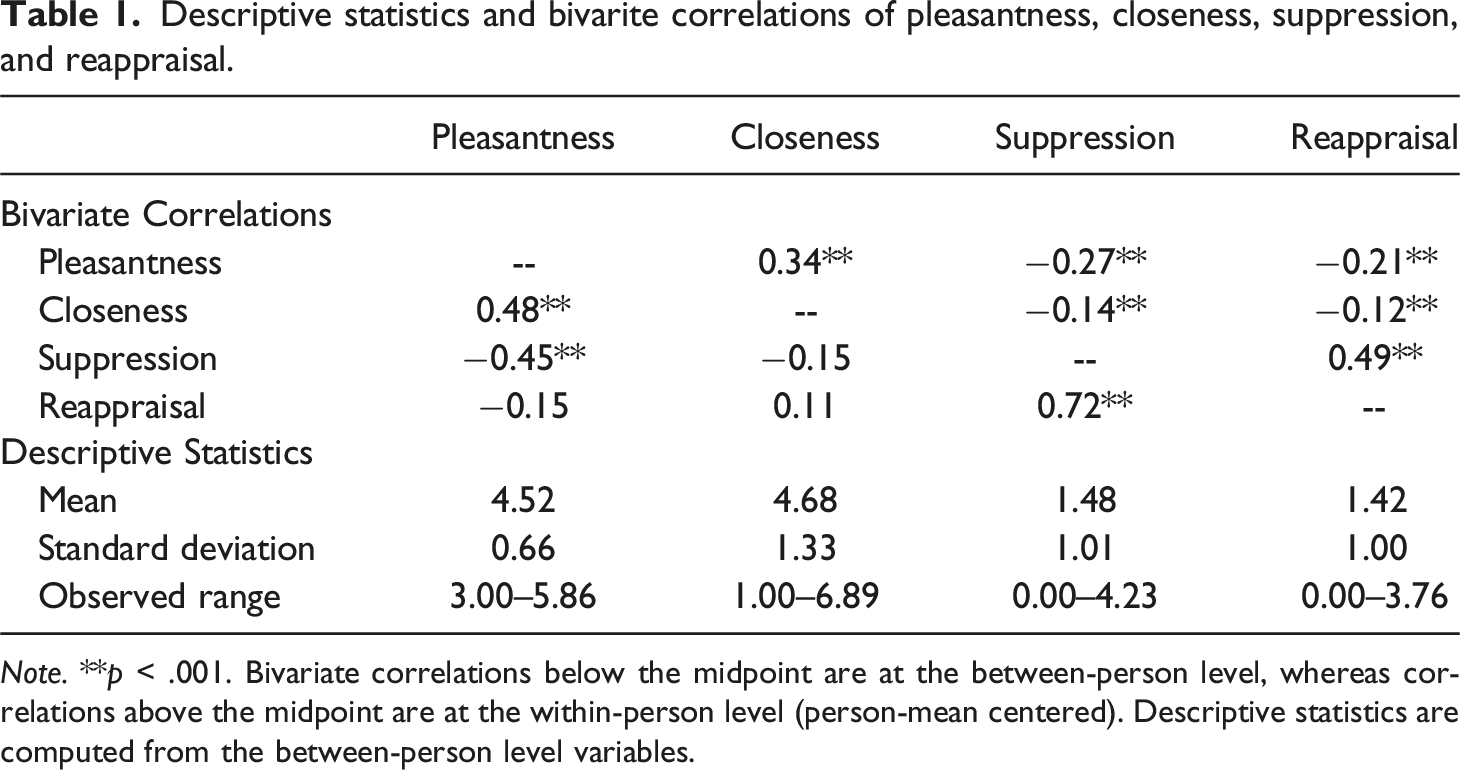
Note. **p < .001. Bivariate correlations below the midpoint are at the between-person level, whereas correlations above the midpoint are at the within-person level (person-mean centered). Descriptive statistics are computed from the between-person level variables.
Concurrent associations between social context and emotion regulation
Unstandardized beta coefficients (standard errors) of social context predicting emotion regulation.
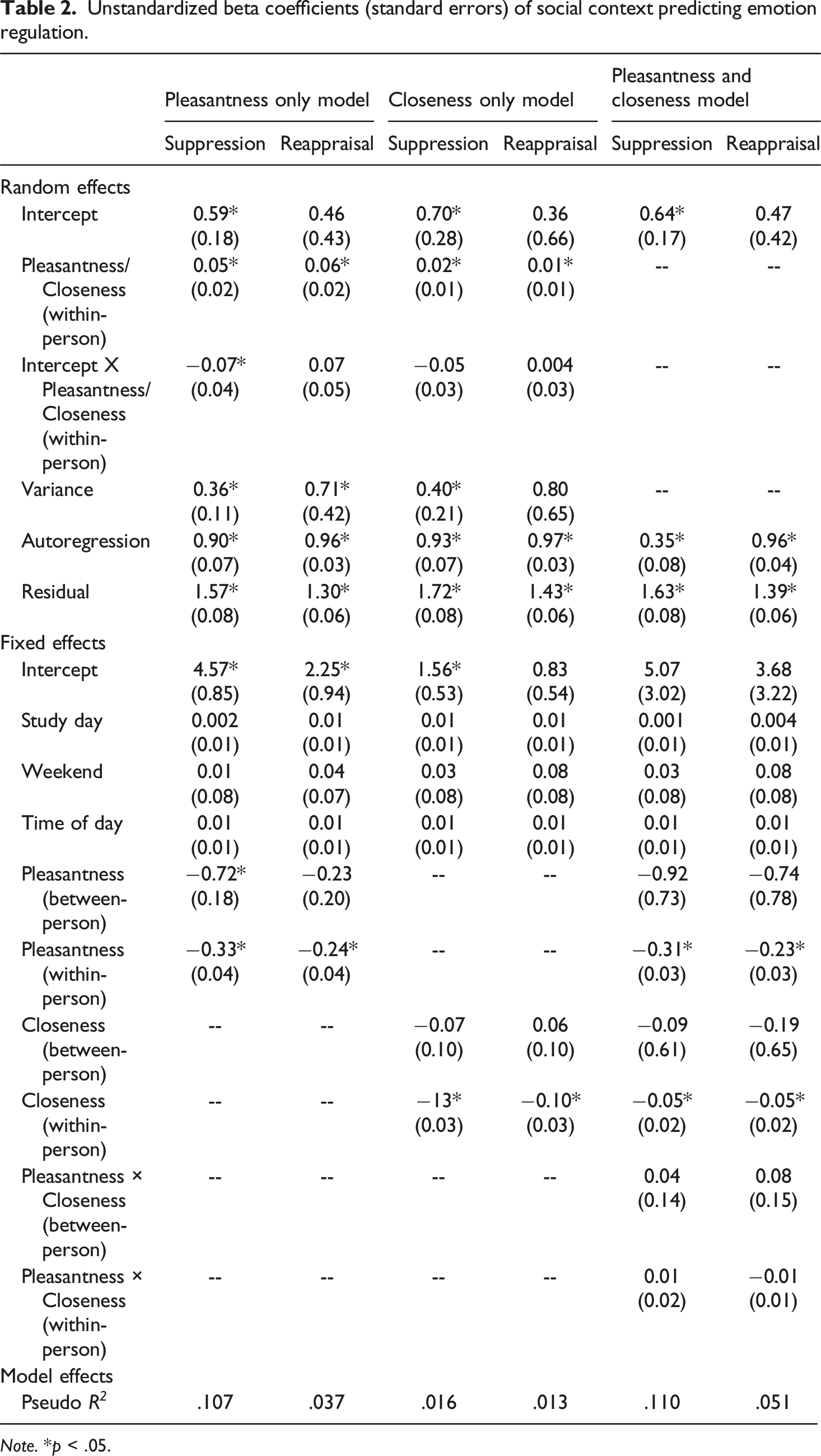
Note. *p < .05.
A similar pattern emerged for closeness at the within-person, but not between-person level. As reported in Table 2, at the between-person level, those participants who experienced more close interactions did not report differences in general levels of suppression (p = .51) nor reappraisal (p = .55) compared to those with lower average levels of close interactions. In contrast, at the within-person level, moments in which a participant had higher levels of closeness were characterized by lower levels of suppression (p < .001) and reappraisal (p < .001) in those moments for that participant compared to moments with lower levels of closeness.
Finally, we conducted follow-up analyses in which the same models were run, but in which pleasantness and closeness were entered simultaneously, as well as interaction terms between pleasantness and closeness at both the between-person and within-person levels. As reported in Table 2, neither the between-person nor within-person were significant predictors of suppression (ps = .80 & .61, respectively) or reappraisals (ps = .74 & .70, respectively).
Social context predicting later emotion regulation
Unstandardized Beta Coefficients (Standard Errors) of Time t-1 Social Context Predicting Time t Emotion Regulation.
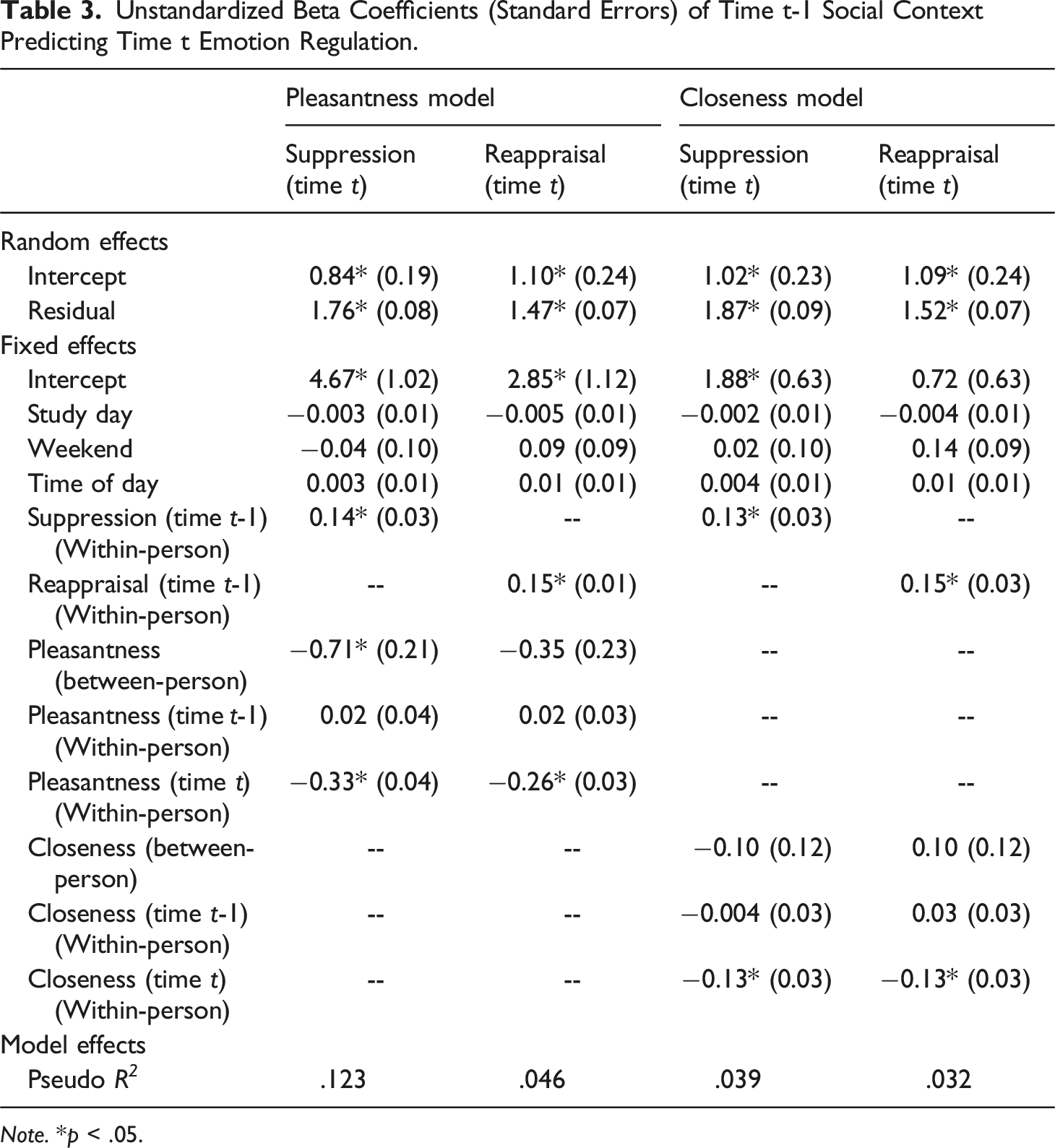
Note. *p < .05.
Emotion regulation predicting later aspects of social context
Unstandardized Beta Coefficients (Standard Errors) of Time t-1 Emotion Regulation Predicting Time t Social Context.
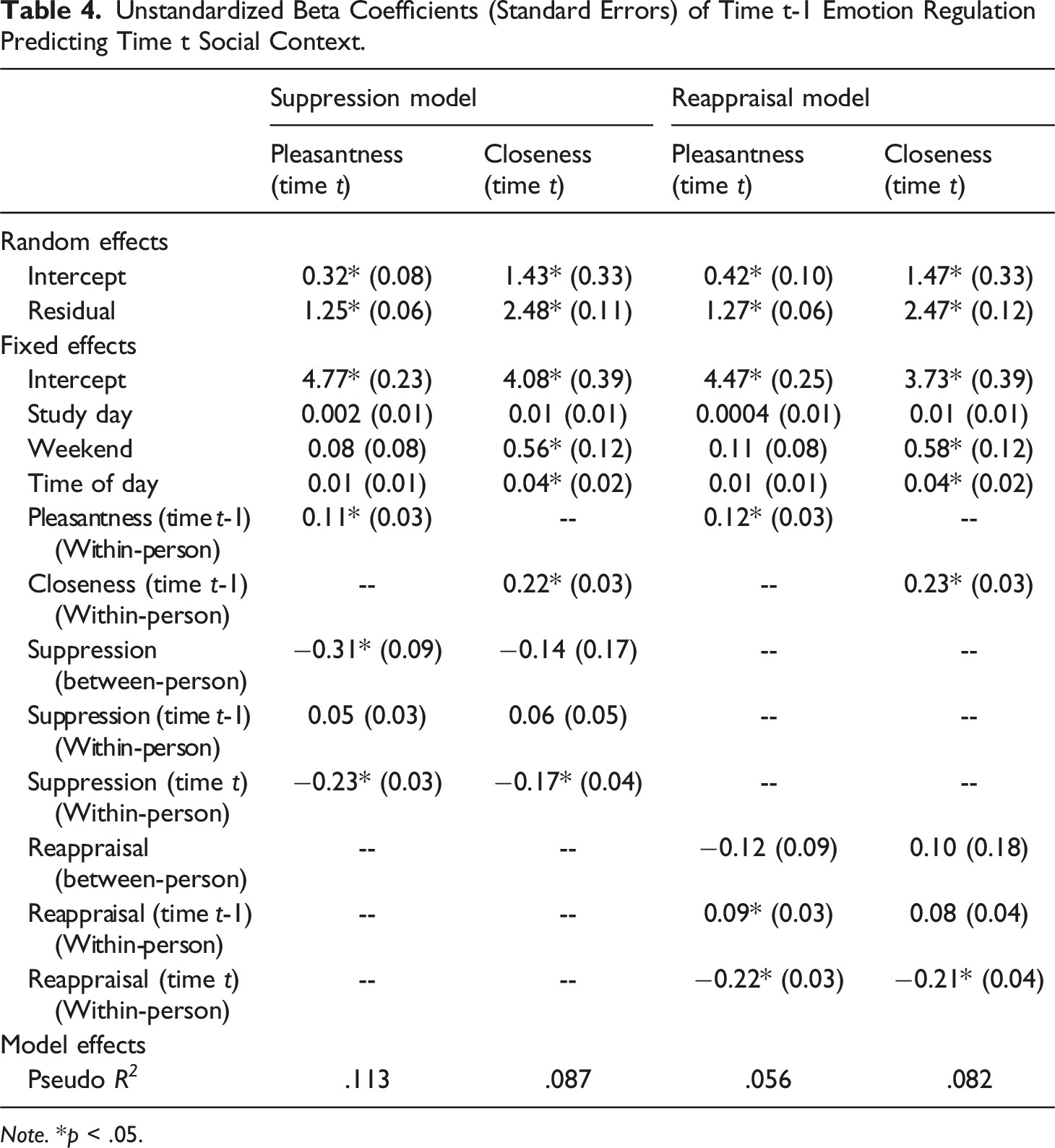
Note. *p < .05.
Discussion
The purpose of this study was to examine if aspects of one’s social context (i.e., pleasantness, closeness) in the moment predicted emotion regulation strategy use (i.e., expressive suppression, cognitive appraisal) both in the moment and whether emotion regulation strategies and aspects of the social context were mutually related across time. This study is the first to our knowledge to directly test within-person variations in the use of emotion regulation strategies over time and how these are linked with aspects of individuals’ social environment. This work is important because a deeper understanding of links between aspects of the social context and emotion regulation will facilitate the development of more targeted interventions with individuals struggling with effective and context-appropriate emotion regulation.
Concurrent associations between social context and emotion regulation
Consistent with our hypothesis, results showed that experiencing more pleasantness was associated with lower use of expressive suppression in the same moment. This finding suggests that individuals may experience more positive emotion during more pleasant interactions (Bernstein et al., 2018), resulting in less likelihood of needing to regulate these pleasant feelings. Indeed, people are less likely to suppress emotions when the valence of experienced emotion and of the situation in which the emotion occurs match (Kalokerinos et al., 2017). Participants also reported decreased use of expressive suppression when they were interacting with a closer partner. In line with previous studies, it is possible that individuals were more willing to openly express their emotions when they were interacting with a more trusted and helpful intimate partner (Reis & Shaver, 1988).
Somewhat surprisingly, interactions in which individuals experienced more closeness with the interaction partner predicted less cognitive reappraisal. Prior literature has suggested competing hypotheses regarding whether more or less reappraisal would be expected to occur in these situations. On the one hand, our results are somewhat contrary to previous research that found that when participants interacted with a closer partner to whom they were securely attached, they reported greater use of reappraisal (Winterheld, 2016). Though secure attachment is conceptually distinct from closeness per se, it is plausible that when participants interact with a close partner, they do not have to downregulate any positive emotions they experience (Kalokerinos et al., 2015). Thus, they reappraise less in an interaction with high closeness. Consistent with Social Baseline Theory (Beckes & Coan, 2011), when interactions are characterized as high pleasantness or closeness, participants may feel more accepted and expressive so that they do not have to suppress or reappraise their emotions to modify their emotional experience. Future work is needed to understand what seemingly positive social environments may still lead to reappraisal, and might rely on the extent to which the domain is novel and/or reflect changing dynamics within social relationships.
Lagged associations between social context and emotion regulation
When exploring whether aspects of the social context were linked with emotion regulation strategy use over time (i.e., the lagged model), we first tested whether time t emotion regulation was predicted by time t-1 social context. Results showed that moment-to-moment emotion regulation (i.e., suppression, reappraisal) was associated with moment-to-moment social contexts (pleasantness, closeness). However, pleasantness and closeness at one time did not predict suppression and reappraisal at the subsequent time point. This is likely because individuals’ social situations are constantly fluctuating with different contextual demands (Campos et al., 2011), suggesting that individuals are constantly required to update their emotion regulations strategies based on these demands. For example, at one moment an individual might be suppressing their emotions in response to a difficult interaction with a co-worker, whereas at the next moment they may be openly disclosing their feelings about the interaction with a close friend – two interactions with quite different emotion regulatory demands. An important direction for future research would be to examine parameters of the context that influence emotion regulation strategies (e.g., type of relationship, presence of different types of interaction partners). Furthermore, situation selection (Gross, 2015) likely influences emotion regulation strategy use by guiding the people with whom we choose to interact.
We also tested the reverse lagged model, in which time t social context was predicted by time t-1 emotion regulation. The reverse lagged model revealed cognitive reappraisal at one moment was found to be associated with less pleasantness and closeness at the same moment, but predicted more pleasantness at the following moment. This is consistent with a study that found that cognitive reappraisal consumed cognitive capacity (Lee & Xue, 2018). As individuals engage in reappraisal, it may become challenging to maintain a stable and close interaction with their partners at the same time. Therefore, it is possible that participants may prefer to be alone when they were reappraising a negative event. However, they may open up and perceive social interactions with more pleasantness after their negative thoughts were resolved. Though are data cannot speak directly to carryover effects as there may be other contextual variables that explain these associations, our lagged models suggest that emotion regulation strategies at one moment predicted perceived pleasantness and closeness of social interactions at the next moment, but not the other way around. This is similar to the findings of previous studies that reported reappraisal as the emotion regulation strategy most associated with positive affect and positive relationship outcomes (Moskowitz et al., 2019; Rusu et al., 2018). For example, reappraisal was found to be related to positive dyadic coping in couples, which in turn increased both partners’ relationship satisfaction. Building on previous research, our study found that reappraisal is not only associated to positive outcomes, but also has a positive carry over effect on social interactions. Future research could employ micro-level moment-to-moment methodologies and experimental studies to shed more light on causal associations among aspects of the social context and emotion regulation strategy use.
Limitations and future directions
The current study is an important first step in understanding the impact of social contexts in emotion regulation among emerging adults in everyday life. However, some limitations warrant mentioning. Despite the racial/ethnic diversity of the relatively small sample, most of the participants were young adult females, and thus precluded the ability to test for gender differences in the present study. This also may limit the generalizability of the findings to males and other gender identities as well as middle-aged or older adults. Women tend to report using more emotion regulation strategies with higher flexibility comparing to men (Goubet & Chrysikou, 2019) and adults typically become better at regulating their emotions as they age (see Meier et al., 2024). Future studies could include more males as well as older adults to examine gender and age-related differences in social context and emotion regulation.
Although we were able to examine two different aspects of the social context in the quality of the interaction and how close a person felt with their interaction partner, future studies could incorporate more variables to capture complexities of social contexts with different aspects. For example, our study did not capture the social interactions’ content, length, gestures etc. Interactions that are shorter in nature, for example, may allow individuals to adopt different regulation strategies than they might typically or prefer to use if the goal is to escape the interaction versus trying to resolve the content of the interaction. All these features of social interactions may affect how individuals regulate their emotions and are important areas of future investigation.
Finally, descriptive statistics revealed that both expressive suppression and cognitive reappraisal had a low mean score but relatively high standard deviation. This suggests that even though participants reported low frequency of regulating their emotions, those emotion regulation events were with high variability and intensity for some individuals. Future studies could test more within-person variations in predictors of emotion regulation strategy use over time.
Conclusions and implications
This study holds implications for understanding social context and emotion regulation in the everyday lives of emerging adults and college students in particular. Extending on previous research, we used the EMA approach to investigate participants’ responses close in time to when they just had interactions and regulated their emotions. Quality of social interactions was found to be related to emotion regulation strategies at the same moment, but did not predict emotion regulation at the next moment. Interestingly, we found that the emotion regulation strategy of reappraisal predicted more pleasantness and closeness in social interactions at the next moment. Our findings underscore the importance of understanding both social contexts and emotion regulation on momentary levels. It will be critical to further uncover the factors that maintain this reciprocal relationship, as elements of the social context and emotion regulation strategies are closely related to well-being (Paul et al., 2023). Overall, college campuses should consider promoting positive social interactions (e.g., pleasantness and closeness relationships) as an important resource for improving student wellbeing. Student life officers and healthcare practitioners should be aware of the impact of social contexts in order to promote well-being among emerging adults.
Footnotes
Acknowledgements
The authors wish to thank the research assistants who assisted with data collection and the individuals that participated in the study.
Funding
This research was supported by an Academic Senate Faculty Research Grant awarded to Matthew Zawadzki from the University of California, Merced.
Open research statement
As part of IARR’s encouragement of open research practices, the authors have provided the following information: This research was not pre-registered. The data used in the research cannot be publicly shared but are available upon request. The data can be obtained by emailing:
