




Abstract
In their care of children and young people, foster carers report experiencing social isolation and a lack of support. This study examines the social network experiences of Australian foster carers who are members of Mockingbird Family. While well established in the United States and United Kingdom, Mockingbird Family was introduced to Australia offering a new approach to address the unique challenges of foster caring for vulnerable children and young people. The model geographically networks 6–10 foster care households in a ‘constellation’ with a central ‘hub home provider’ tasked with providing information, support, and respite care. This study employed a cross-sectional explanatory sequential mixed methods approach to investigate social connections and supports in the first four Australian Mockingbird Family constellations. A social network tool was used to survey participants (n = 27) and two focus groups (n = 20) to gather their experiences. Analysis found the highest mean social network connections with people from within their own Mockingbird Family constellations. Three measures of centrality were used indegree, betweenness and closeness, to report the connections and role of members within each constellation. Comparing constellations at different stages of maturity, the hub home provider was consistently ranked with high betweenness centrality as the bridge. In the longer-running constellations, the hub home provider was ranked with high indegree centrality or the primary source of advice or expert support. This indicated micro-network evolution that may potentially result in reduced reliance on statutory and other formal system supports over time. Changes to micro-dynamics in social support within constellations were explained qualitatively through three themes: leadership and expertise, information diffusion and communication, and trust and familiarity. Mockingbird Family was found to provide social connections and support networks amongst foster carers, indicating the model’s capacity to strengthen supports to carers thereby strengthening the immediate environment of children and young people in care.
Introduction
Foster care, a form of out-of-home care, aims to provide stable, safe, and permanent home-based care for children and young people who are unable to live safely with their birth family (Gouveia et al., 2021; Tilbury & Osmond, 2006). Studies on foster carers’ vicarious trauma in Australia showed that caring for abused or traumatised children and young people was proven to be stressful and isolating (Harding et al., 2018, 2020a, 2020b; Riggs, 2021). Foster carers repeatedly identified a lack of support in studies examining the experiences of foster caring (Gleeson et al., 2016; Kiraly et al., 2015; McLaren et al., 2024; Octoman & McLean, 2014) or the support that was offered was limited in helpfulness (Barrett et al., 2021). Social support can buffer the negative impact of parenting stress on the well-being of foster carers and enhance their satisfaction (Cooley et al., 2019; Dominick et al., 2015; Sharda, 2022). Two types of social support can be identified - formal support received from government organisations or service providers, and informal support from extended family members, neighbours, friends, and other carers (Mallette et al., 2020). Support from adult children, extended family, and friends of foster carers, as well as tailored formal training, have been found to promote carers’ resilience in continuing their role (Butler & McGinnis, 2021). Peer or social support from other carers is emphasized as an essential element for providing knowledge, emotional and practical help from experienced carers (Brown et al., 2019; Lynes & Sitoe, 2019; York & Jones, 2017) as were support systems independent of foster care and the child welfare system (Blythe et al., 2014).
Studies have examined the benefits of connectedness for children and young people in kinship versus foster care (Hassall et al., 2021), while we were unable to locate studies examining connectedness between foster carers. Social connectedness is the ‘sense of belonging, and subjective psychological bond that people feel in relation to individuals and groups of others’ (Haslam et al., 2015, p. 1). Higher levels of social connectedness have been linked with higher health and wellbeing outcomes (Haslam et al., 2015; Hodges & Gore, 2019; Holt-Lunstad et al., 2017). The extent that an individual is socially connected takes a multifactorial approach including, the connections with others via the existence of relationships and roles, a sense of connection based on actual or perceived support and positive negative qualities (Holt-Lunstad et al., 2017). Perceived social support is the degree to which an individual feels understood, appreciated, and supported by others in their social network. Underpinning this study are the following two understandings. First, that social networks are an antecedent to social support providing the structure of an interactive process, while social support was the function (Langford et al., 1997) and second, that higher levels of social connectedness increases potential support (Blakeslee, 2015).
Program context
The focus of this study is on social networks associated with the Mockingbird Family, a collective model of foster care that has been translated into practice in United States, United Kingdom, Canada, Australia and the Netherlands (Grossman & McKenna, 2007; McLaren et al., 2023). The Mockingbird Family embodies the idea of collective parenting and community involvement, akin to the concept of a “village”. Known as constellations, groups of 6–10 foster care families resemble a ‘hub and spoke’ (Elrod & Fortenberry, 2017), called ‘hub and satellite’ in Mockingbird (Grossman & McKenna, 2007; McDermid et al., 2016) in which connections to each other enable access to formal and informal social support. In engineering these social networks, the Mockingbird Family constellations aim to strengthen the care environment for the children and young people in care, whilst simultaneously providing support for the foster carers (McDermid et al., 2016; Ott et al., 2020). At the centre of the hub and satellite, is the ‘hub home provider’, an experienced foster carer(s) who play a role like that of a grandparent or extended family member. In Australia, the hub home provider is paid to provide respite care and 24/7 support to their constellation. The families within the constellation come together monthly at the ‘hub home’ to provide peer support and provide an opportunity for the children and young people to socialize in a safe and familiar environment. The Mockingbird Family model builds formal and informal social support through social networks within constellations to create a supportive care environment for children and young people (Patmisari et al., 2024), while also supporting the foster carers. The first Australian constellations were formed during the first year of COVID-19, and their monthly constellation catch-ups went online which provided opportunities for overcoming isolation associated with caring, managing the challenges of home schooling and lockdowns (McLaren et al., 2023).
The Australian government funds non-government organisations, such as Life Without Barriers, to provide the infrastructure including training and support for foster carers. Each constellation has a Liaison Officer, employed by Life Without Barriers, and Case Manager employed by the Department for Child Protection (Patmisari et al, 2023). The Liaison Officer is responsible for managing the constellations and any support needs the hub home provider or foster carers require. The Departmental Case Manager focuses on the wellbeing and safety of the children and young people placed with the family.
Social network analysis (SNA)
In social and health care, SNA has assisted in determining key influencers, collaborative relationships, subgroups within a network, and those who provide both tangible and social support (Dávid, 2013; Fernández-Peña et al., 2022; Liu, 2022). SNA has been utilized in various foster care-related studies, such as integrating mental health services (Nicaise et al., 2014; Yoshioka-Maxwell & Rice, 2017, 2020), analysing network characteristics of homeless young adults with foster care history (Yoshioka-Maxwell & Rice, 2017, 2020), and examining social networks supporting youth who have aged out of child welfare custody (Blakeslee, 2012). United States social work academic Blakeslee (2015) developed a tool for assessing functional support provided by a family-based network for youth, based on Tracy and Whittaker (1990) social network map. While some studies exist, the research on the composition and functioning of comprehensive social networks among foster carers and the social support they receive is limited.
In this study we explore the micro-dynamics of informal and formal support networks in four Australian Mockingbird Family constellations at different stages of maturity. SNA was used to examine the foster care social connections and networks established and what they looked like within the Mockingbird Family at different stages of constellation development (1, 3, 18 and 24 months). Research questions were: 1. What is the structure and composition of social networks among foster carers in the Mockingbird Family? 2. How do the social networks of hub home providers, foster carers and liaison officers in the Mockingbird Family influence their experiences and perceptions of social support?
To help us better understand the structure and composition of the social connections and networks among foster care constellations over time and who, how and when social supports are delivered, we draw upon Imperial et al. (2016) analysis identifying four stages of social network development: activation, collectivity, institutionalization, and stability/decline. Imperial et al. (2016) argued that each stage is characterized by a unique set of challenges, opportunities, and strategies for network development and their potential to become self-sustaining. Other studies using SNA (Velenturf & Jensen, 2016; Vătămănescu et al., 2018) highlighted the importance of proximity and similarity as key concepts that can help explain the development of social networks. Proximity, in this context, refers to the physical or geographical closeness between individuals. Similarity refers to the shared characteristics, interests, or experiences between individuals that can facilitate the formation and maintenance of social ties. These concepts have important implications for understanding the dynamics of social networks in the foster care system.
Methods
Cross-sectional explanatory sequential mixed methods research was applied in this study (Creswell & Plano Clark, 2007). The qualitative method followed the quantitative in a sequential approach to explain, understand or add meaning to the findings from the quantitative study (Creswell & Plano Clark, 2007). A mixed-methods approach is beneficial for investigating research inquiries that pertain to the formal or structural aspects of networks and the significance of interactions or the diversity of social relationships (Froehlich et al., 2020). Quantitative data were collected from four cohorts at different stages of the development program (1 and 3 months in State 1, 18 and 24 months in State 2). These states were selected as, at the time of the study, they were the only States delivering the Mockingbird Family in Australia. The time-points were selected based on convenience and the stage of constellation development at the time of the study.
Focus groups provided the opportunity to interview a range of stakeholders simultaneously such as hub home providers, foster carers and liaison officers. The value of this method lies in the interaction and synergy that emerges amongst participants during the discussion (Acocella, 2012). Synchronous teleconferencing focus group discussions were chosen due to geographical distances and COVID restrictions, and because they involved real-time discussion and a close replication of face-to-face interactions (Keemink et al., 2022).
Data collection
Quantitative
The extent to which individuals utilize their social support can be measured using SNA. SNA is an analytical method used to measure and visualize social connections between individuals, families, or groups by quantifying the degree of utilization of social support networks (Knoke & Yang, 2020; Rice & Yoshioka-Maxwell, 2015). Centrality is an important metric as it indicates which members hold critical positions within the network, displaying greater influence providing support or information networks (Crescenzi et al., 2016; Das et al., 2018; Zhang & Luo, 2017). Freeman (1979) introduced three centrality network metrics to measure networks: degree centrality, is based on the number of nodes a node is connected to; betweenness centrality, identifies nodes that act as bridges between two other connected nodes; and closeness centrality, measures the distance between a node and all other nodes in the network. Our quantitative study adopted Blakeslee’s (2015) instrument with some adjustments to fit the study purpose. The main purpose was to identify the interconnecting ties between all identified individuals who provide any kind of support (including emotional, informational, and concrete support) to foster carers in the Mockingbird Family constellations. The instrument consists of two measurements: the social network map and the social network grid. The network map identified the number of interconnecting ties between individuals based on four categories, that is, people you live with, other family or friends, people in your foster care network, and people from services. The individuals who were identified in the network map were then transferred to the network grid, which details the social roles of each individual and the quality of their relationships. Content validity was carried out to ascertain whether the instrument adapted from Blakeslee’s study was representative of all aspects of the construct. The instruments were informally reviewed for suitability by the research advisory committee, which was constituted by employees from Life Without Barriers and the Department for Child Protection, followed by testing with a small sample of volunteers including young people (n = 5). Feedback included for example, keeping colours consistent across sections to show they were connected.
Qualitative
Qualitative data were collected by conducting two focus group interviews (from both State 1 (n = 7) and State 2 (n = 13)) via Microsoft Teams in May/June 2022. There were 20 participants in total, including hub home providers, foster carers and Life Without Barriers liaison officers, with representatives from all four constellations. The focus of the discussion was to explore their experiences with Mockingbird Family social networks and how they provided support to them. The focus groups were recorded and auto-transcribed. The auto-transcription was checked for accuracy against the recording, with minor changes made.
Recruitment and sample
All available Mockingbird Family constellations (n = 4) at the time of the study (two Mockingbird Family constellations in operation in each State) were invited to be involved. The two States where Mockingbird Family was delivered were selected by Life Without Barriers, based on the suitability of implementing the Mockingbird Family. Life Without Barriers reported that the sample frame included 14 families from State 1 and 17 families from State 2, with a total of 52 foster carers (including couples and single carers). As Life Without Barriers had an existing relationship, they invited all Mockingbird Family hub home providers and foster carers in States 1 and 2 to participate in both the quantitative and qualitative studies. Life Without Barriers recruitment was facilitated by disseminating study information and consent forms, calling for potential participants to opt-in. All four constellations were involved in the study, two from each State. Of the 52 foster carers in the four Australian Mockingbird Family constellations, 27 took part in this study representing a 52% response rate. Consenting participants may have been in either the quantitative or the qualitative components, or both. If both, their contributions were not linked. In addition to the hub home providers and the foster carers, the Life Without Barriers liaison officers were also invited to participate in the focus groups.
Both the program and the evaluation (qualitative and quantitative) data collections were impacted by COVID. There were delays in rolling out constellations in State 1 and in State 2 constellations were unable to meet face-to-face for the first few months. The original plan was for the survey and focus group data collection to be conducted face-to-face in both States by the researchers. For State 1 data collection was conducted face-to-face by the researchers and for State 2 constellations, hard copies were sent, and data collection was undertaken self-guided with support from researchers online upon request. Online data collection support was offered to help facilitate survey completion. This may have impacted participant response rates.
Data analysis
Quantitative
The network map and grid data were processed and then analysed using an online software for SNA called Kumu (https://kumu.io) founded in 2011 by Jeff and Ryan Mohr (Kumu Inc, 2022). Kumu is a sophisticated and adaptable mapping tool that can be utilized in the foster care network system for organizing and visualizing data and information from complex social networks (Patmisari et al., 2023).
Data initially gathered from the social network map and grid was systematically organized into two Excel spreadsheets. In the ‘Elements' spreadsheet, two columns were prepared: ‘Label' (Column A), listing all participants’ names or codes, and ‘Type’ (Column B), detailing their roles within the Mockingbird Family network. In the ‘Connections’ spreadsheet, ‘From’ (Column A) contained the names of participants, while ‘To’ (Column B) enumerated all individuals they are connected to, indicating affiliations or relationships. This pre-processed data was then imported into Kumu, which automatically recognizes ‘Elements’ as nodes and ‘Connections’ as edges, constructing the initial visual framework of the network. Upon import, KUMU generated a visual representation where nodes (elements) were displayed as circles on the map, each one representing an individual actor within the network. Edges (connections), illustrated as lines, were drawn between nodes to signify the presence of a relationship or interaction, such as support given or received, between the actors. With the visual network established, we applied KUMU’s built-in SNA metrics to the map to derive quantitative insights into the network structure. KUMU measured Indegree Centrality to identify actors who received substantial support, by counting incoming connections. Closeness Centrality was calculated to determine those positioned to disseminate information swiftly across the network, based on their proximity to others. Betweenness Centrality was utilized to pinpoint individuals who significantly influence the network’s flow of information and resources by acting as critical bridges in the shortest paths between other actors. This rigorous process ensured that the data not only informed us about the structural properties of the Mockingbird Family network but also about the dynamic interplay of relationships that sustain the support system.
Qualitative
Qualitative data was analyzed using thematic analysis (Braun & Clarke, 2008). Focus group transcripts were coded deductively to identify themes related to the definitions of the three analytical measures of centrality used within the quantitative analysis for example indegree (leadership), betweenness (bridges, diffusing information), and closeness (trust and familiarity) centrality. This allowed for the linking of the experiences of foster families to the role of social networks in providing support. The coding was cross-checked by author 3.
Ethics
This study was approved by the relevant institutional ethics committee (Project No: 4781) on 24 September 2021. All participants provided informed consent prior to participation. Participants were assured of confidentiality and anonymity, and all data was stored securely to protect participant privacy.
Findings
Quantitative findings
Sociodemographic characteristics of participants and Data of the Mockingbird Family Constellations.
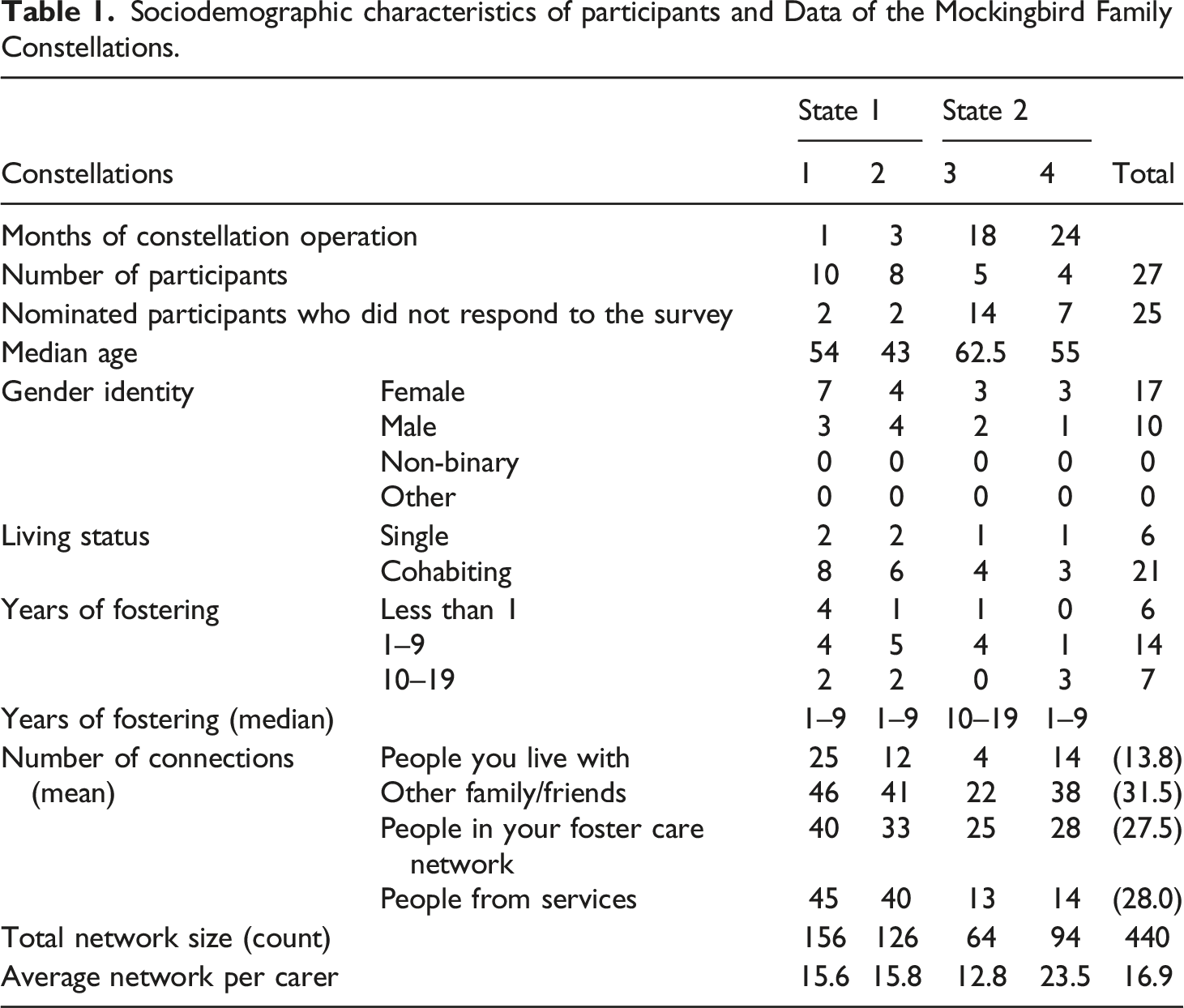
Foster carers were asked: ‘Who was in your support network?’ (Table 1). The lowest mean number of support network connections for all foster carers was with people they live with ( Visualization of social networks in four Mockingbird Family constellations.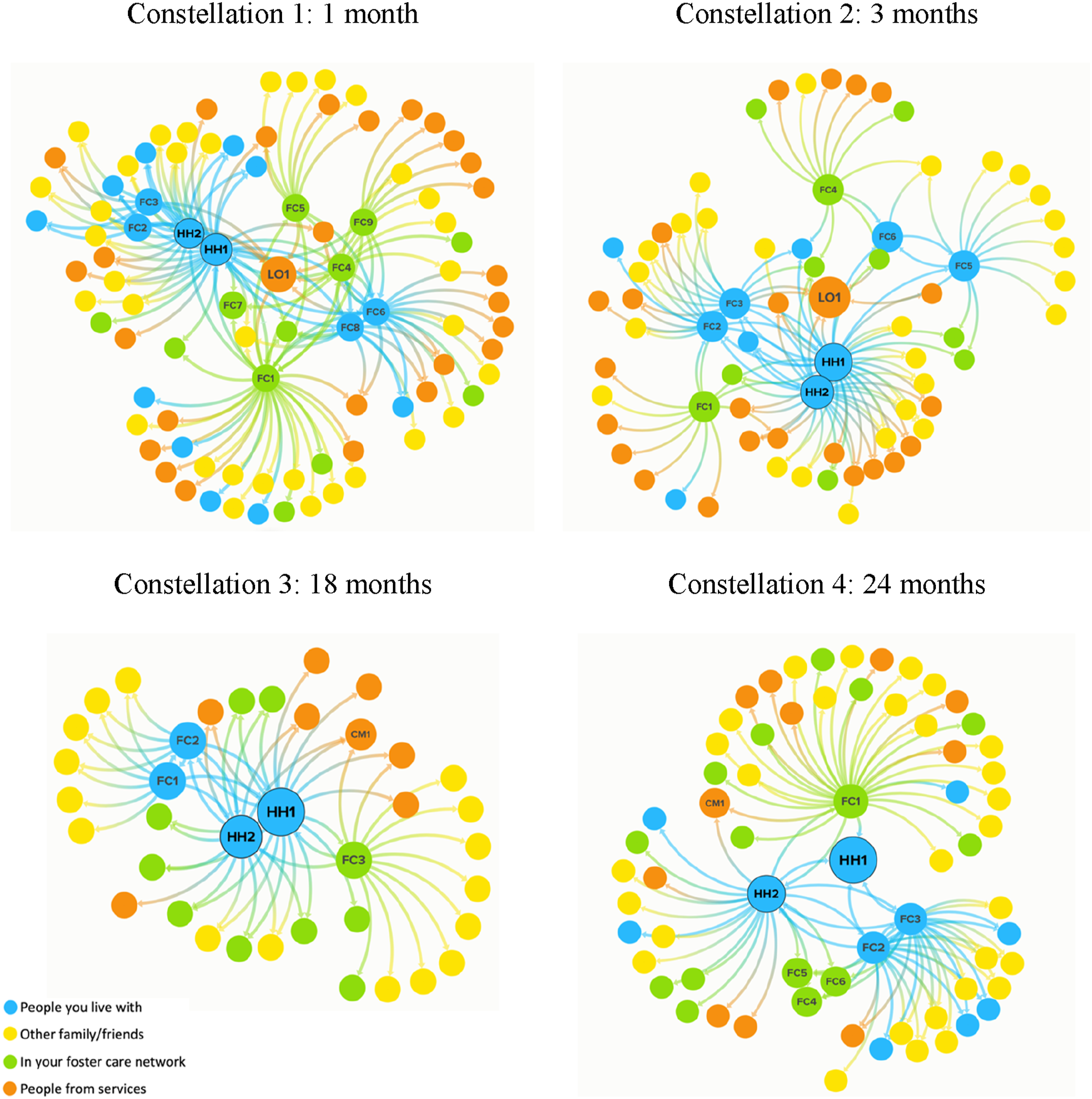
Social network analysis metrics of the Mockingbird Family constellations.
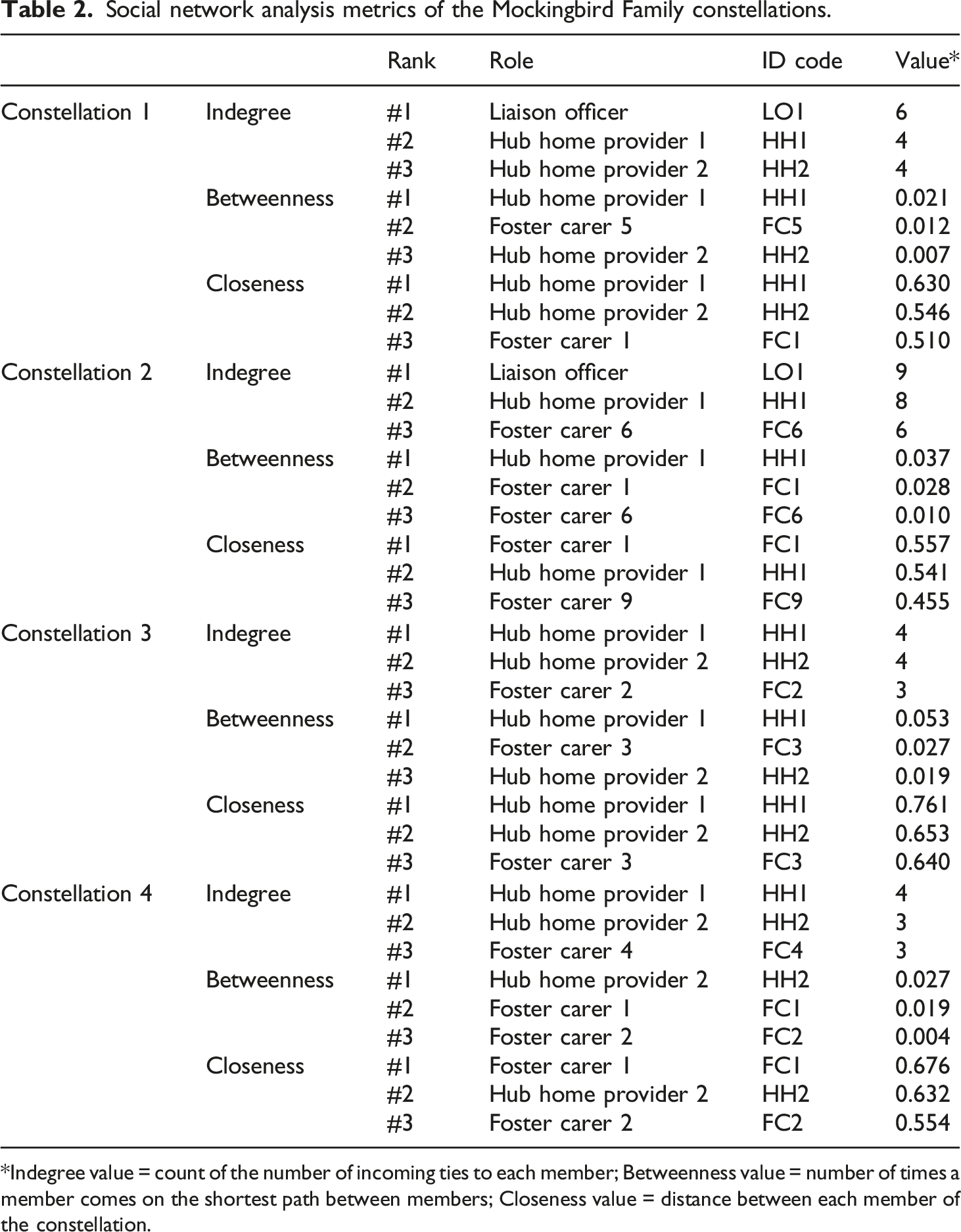
*Indegree value = count of the number of incoming ties to each member; Betweenness value = number of times a member comes on the shortest path between members; Closeness value = distance between each member of the constellation.
Indegree centrality
To begin the analysis of social networks, indegree centrality was used to determine the number of incoming connections for each member of the constellation, measured by a count of the number of incoming ties to each member. This measure helps to identify individuals who are seen by other members of the constellation as a source of advice, expertise, or information. In State 1, in both constellations 1 (Rank#1 LO1:6) and 2 (Rank#1 LO1:9), the Life Without Barriers liaison officer had the highest value of indegree centrality, indicating that they were considered to be the leader of the group. Whereas in State 2, in both constellations 3 (Rank#1 HH1:4) and 4 (Rank#1 HH1:4), the Hub Home Provider had the highest indegree centrality. In State 1, the second highest indegree centrality was found in the hub home provider for both constellations 1 (Rank#2 HH1:4) and 2 (Rank#2 HH1:8), while in State 2, in constellations 3 (Rank#2 HH2:4) and 4 (Rank#2 HH2:3) the second hub home providers (2) had the second highest indegree centrality, indicating that in constellations 3 and 4 the Hub Home Providers have assumed the central leadership or expert role in the constellations. The third position was held by a foster carer in both Constellation 3 (Rank#3 FC2:3) and Constellation 4 (Rank#3 FC4:3).
Betweenness centrality
Betweenness centrality is a measure of the number of times a member lies on the shortest path between two other members in a network, quantifying how many times a member comes in the shortest path between other members. Members with high betweenness centrality act as mediators or bridges and have control over the flow of information within the network. In Constellations 1 (Rank#1 HH1:0.021) and 2 (Rank#1 HH1:0.0370), the hub home provider had the highest value of betweenness centrality, indicating that they had established themselves as having a greater effect on the flow of information and acting as a critical network bridge. Similarly, in Constellations 3 (Rank#1 HH1:0.053) and 4 (Rank#1 HH2:0.027), the hub home providers also had high levels of betweenness centrality. Across all constellations, the second highest betweenness centrality was a foster carer within the constellation.
Closeness centrality
Closeness centrality is a measure that calculates the distance between each member of the constellation and all other members. Members with high closeness centrality can spread information quickly across the network and have a good understanding of what is happening throughout the network. The hub home providers and foster carers both had high closeness centrality values in different constellations. For example, in Constellations 2 (Rank#1 FC1:0.557) and 4 (Rank#1 FC1:0.676), foster carers had the highest closeness centrality value, followed by the hub home provider (Constellation 2 Rank#2 HH1:0.541; Constellation 4 Rank#2 HH2:0.632) and another foster carer (Constellation 2 Rank#3 FC9: 0.455; Constellation 4 Rank#3 FC2:0.554). On the other hand, in Constellations 1 (Rank#1 HH1:0.630) and 3 (Rank#1 HH1:0.761), the hub home provider had the highest closeness centrality value, followed by hub home provider 2 (Constellation 1 Rank#2 HH2:0.546; Constellation 3 Rank#2 HH2:0.632) and a foster carer (Constellation 1 Rank#3 FC1:0.510; Constellation 3 Rank#3 FC2:0.554). This finding suggests that both the hub home providers and foster carers play important roles in disseminating information within and between the Mockingbird Family constellations.
Qualitative findings
With reference to the three measures of centrality (indegree, betweenness, and closeness), we deductively categorized the qualitative findings into three respective themes based on the definitions of these measures of centrality: 1. Leadership and expertise in Mockingbird Family social networks; 2. Information diffusion and communication; and 3. Trust and familiarity within the networks.
Leadership and expertise
Based on our SNA findings, we have identified that the hub home providers and liaison officers have the highest indegree centrality. The hub home is designed to be at the centre of the network, and they are recruited for their extensive experience in fostering roles. A liaison officer has confirmed this: There are specific fidelity requirements around that hub home, having experience, having the ability to provide respite or respite across that constellation, having the attributes and skills to be able to facilitate that community (Liaison Officer 1).
The liaison officers have the highest indegree centrality in Constellation 1 and 2, implying that they are the most influential and have a greater degree of power within these groups. The liaison officer serves as a point of contact between the hub home providers and the broader organization, providing support and resources to ensure that the hub home functions effectively. A liaison officer shared their experience: I'm tapping into [hub home provider]'s skills to boost [their] confidence in mentoring and leading the Constellation 1. [Hub home provider Constellation 2] has completed a university degree and a long history of working in social services, so has the confidence already, and there are also differences in their personalities (Liaison Officer 3).
It is possible that these personality differences may impact the way that the carers operate within their respective constellations and may require different approaches to mentoring and leadership. This could have implications for how the group functions and how interpersonal dynamics play out. Hub home providers in more mature groups, such as Constellation 3 and 4, may already have established collaborative leadership structures. In the system, sometimes there can be a divide between carers, workers, and the department, creating little silos that don't work together. But what I've seen recently is a shift towards a team approach, which is great (Hub home provider 1).
Another hub home provider suggests that hub home providers have more influence in decision-making and see this as a position of leadership or authority. They are sought out by others in the group for advice, guidance, or support, and may have a greater degree of influence in decision-making processes within the group. This can be important for creating a more supportive and effective group dynamic, as experienced by a new carer: Being a first-time foster carer can be overwhelming and challenging, and having someone like her to talk to on a regular basis has been a lifesaver for me (Carer 6).
This highlights the role of the hub home provider in providing support and guidance to other carers in the constellation, which can help to alleviate some of the challenges and stress associated with foster care.
Diffusion of information and communication
In this study, the individuals with the highest betweenness centrality are the hub home providers across four constellations. This suggests that the hub home providers play a critical role in maintaining the overall structure and robustness of the network, as they serve as bridges between different parts of the network that might otherwise be disconnected. A Hub Home Provider stated: We've learned about resources and funding opportunities that we didn't even know existed before. We can share information and resources with each other, and that helps us provide even better care for the kids (Hub home carer 2).
The Mockingbird Family carers have access to new resources and funding opportunities they may not have otherwise known about. This highlights the important role played by the hub home provider in facilitating communication and ensuring that everyone is kept informed and up to date. The importance of having multiple channels of communication and information flow within the foster care system was mentioned by a Liaison Officer: It's almost like when a child goes to their mother and doesn't get what they want, so they go to their father. I see that as a benefit in the model because there seems to be an element that bridges some of those gaps in our system (Liaison Officer 3).
This suggests that having hub home providers who act as critical network bridges can help bridge gaps in the system and improve the flow of communication and information between different stakeholders. Hub home providers are seen as trouble-shooters who step in to help with critical situations. For example, one hub home provider helped a child get their driver’s license, another connected a child with a social group for kids with autism, and in a crisis with a child’s behaviour issues: So, our oldest [foster] child just had an increase in his behaviour issues. It ended up turning into a spectacular episode late on a Friday night and we had to call emergency services. [Hub home providers] were able to come very quickly and picked up [child’s name] that night (Carer 4).
Other foster carers within the constellation also play a crucial role, as evidenced by their high betweenness centrality scores. This is highlighted by another Liaison Officer when they stated: Carers now have the option to seek support from the hub home or from each other, which previously they would have gone straight to the case manager (Liaison Officer 2).
The foster carer acts as a secondary bridge between carers, the hub home provider, and other stakeholders.
Trust and familiarity within the network
Our findings indicate that hub home providers have the highest closeness centrality in Constellations 1 and 3, which suggests that they are more accessible and have stronger connections with others in the group. This information can then be used to understand how trust is distributed within the group. In Constellation 1, where there are more placement issues, hub home providers may be seen as the most trusted person to go to for support due to their knowledge and experience in dealing with such issues. I think for the [Constellation 1] to recognize that new carers and other carers do have placement struggles, and everyone has pulled their socks up to help, which is excellent (Liaison Officer 3).
The hub home providers are responsible for coordinating and facilitating respite care arrangements within the group. They describe their positive experience of providing respite care for young children in their foster care constellation: We have young children come over for short stays, and we look forward to spending time with them, taking them out shopping, and doing things that their parents may not have time for, and more [of a] grandma grandpa … role for the kids (Hub home provider 1).
This quote underscores the hub home provider’s role as a central figure in the network, akin to the role of a grandparent in a family, who provides information, support, and respite care to multiple foster care households in their ‘village’ or constellation. This may be due to their ability to establish close relationships with children and connect with other carers, making them a trusted person in the group. One of the carers said: We were struggling to find a respite carer for our youngest one. Then we discovered that [Hub home provider] and her family were able to provide that for us, which was a perfect fit for [child’s name] because she already knew them (Foster Carer 4).
In Constellations 2 and 4, the carers have the highest closeness centrality, meaning they are the most closely connected within their respective groups. In Constellation 2, the carers were already familiar with each other before the group was formed, resulting in a more tightly knit group. I think with the [Constellation 2], it's been about expanding the carers' existing social network to be inclusive of all the members of the constellation, including those who they may not have known before (Liaison Officer 3).
The carers in Constellation 4 have had a longer time to cultivate their relationships and foster a cohesive community, resulting in a more developed and mature network. I have noticed changes in the way carers relate to children, as well as changes in their paradigms. For example, some carers who were previously resistant to the idea of family contact have become more positive about it (Liaison Officer 1).
This implies that through the ongoing exposure to different perspectives and experiences, carers become more open-minded and adaptable, leading to better care for the children under their supervision. Some carers feel isolated and lack social support from their family. They feel that discussing their struggles with family members and friends could lead to judgment or misunderstandings: We don't have a lot of family support. But if you vent to a family member, they may judge you or they may take it personally (Foster Carer 6).
The Mockingbird Family provides a supportive trusted community where carers can connect with others who understand their experiences and provide a sense of support, belonging and connectedness.
Discussion
This mixed methods study has both quantified the social connections and networks of foster carers and subsequently examined qualitatively the perceived social supports experienced by the foster carers. Former research on foster care models indicated that co-parenting networks, whether constituted with single parent carers, couples, or a combination, can enhance placement stability, and the well-being of both the foster parents and the children in their care (Ahn et al., 2017; Richardson et al., 2020). Our study showed that foster carers in MB were most highly connected with ‘people in their foster care network’ equally followed by ‘people from services’ and ‘other family and friends’. Studies indicate that supporting foster carers to build or strengthen their networks of support may lead to greater self-efficacy in managing the demands of fostering and reduce reliance on agency and statutory case workers (Bruine de Bruin et al., 2020; Lee, 2022; Litwin & Shaul, 2019; Sebba & Luke, 2013). In their integrative review of the foster carer’s experiences, Blythe et al. (2014) found that several studies identified that emotional support of foster carers was reliant on the foster carer’s relationship with the child welfare system but that this could also be a source of conflict, rather than emotional support. In its design, the Mockingbird Family provides foster carers with additional support, through linking with other geographically proximal foster carers. In addition, foster carer’s ability to maintain support networks independent from child welfare was an important way to mitigate the stress and strain from foster caregiving (Blythe et al., 2014).
Using centrality measures, the positions of the liaison officer, hub home providers and foster carers within the constellation demonstrate how and to what extent the Mockingbird Family is working to support the sharing of information and provision of support to members within each constellation. Centrality is a crucial aspect in social networks as it refers to the most significant or influential node within the network (Das et al., 2018; Freeman, 1979; Freeman et al., 1979). The Mockingbird Family using a hub and satellite approach has built-in social support networks for foster carers and their children and young people (Life Without Barriers, 2023), this study suggests the increased use of the ‘built-in’ social supports over time.
This study has provided insights into the operation of connectedness and the formal and informal support networks within Mockingbird Family. Critically within the constellations the hub home provider had the highest betweenness centrality across all constellations, demonstrating that they are working as a conduit. Betweenness centrality maps those people who are between many other people, playing a mediator role and having the power to control resources of the network (Kourtellis et al., 2013; Zhang & Luo, 2017). This provides reassurance for the selection of these people into the central role of hub home provider. The hub home providers are selected due to their experience as foster carers and the role requires strong communication skills as they bring the foster carers together on a regular basis and provide supports (emotional, social and informational) to each of the foster carers within their network. The closeness centrality measure provides insights into how support is provided in each constellation of the foster care model. Emotional and social support are also included in the measure, which helps foster carers cope with stress (Butler & McGinnis, 2021; Gilbar et al., 2018; Tracy & Whittaker, 2015).
In examining the structure and composition of the social networks between foster carers over time, and exploring who, how and when supports are best delivered, we found that in Constellations 1 and 2, running for 1 and 3 months, the Life Without Barriers liaison officer had high indegree centrality. In comparison, Constellations 3 and 4 running for 18 and 24 months respectively, the Hub Home Provider had high indegree centrality. This suggests that the liaison officer provides early leadership and advice to the constellations as they form, developing trust and establishing relationships and connections between the foster carers and the hub home provider. As newly implemented constellations, the members of the network are figuring out what the network can do, differentiating the roles of the network members, and focusing on what to do as part of the Mockingbird Family constellation. Imperial et al.’s (2016) four-stage model of network development encompasses activation, collectivity, institutionalization, and stability, decline, or change, provides a framework for understanding the structure and composition of the Mockingbird Family foster care network supports over time. Constellations 1 and 2 were at the activation stage of network development (1 and 3 months). During the activation stage, the formation of the collaborative partnership is described as the ‘turbulent period of network formation’ (Imperial et al., 2016, p. 136). Hence at this early stage of constellation development the foster carers rely on organisational or service support, rather than the hub home providers or other foster carers in their constellation. This is further evidenced by the mean number of connections being higher with services than foster care networks in constellations 1 and 2. An early focus on building relationships between Hub Home Providers and Foster Carers may be required to ensure that solid foundations are built for social connection and network development within the constellation. Keeping communication channels open and directed through the hub home provider may support the building of these networks and strengthen the centrality of the hub home provider role. By comparison, constellations 3 and 4, running for 18 and 24 months respectively, were at the collectivity or institutionalisation stage of network development (Imperial et al., 2016). This is when the focus shifted from what/how to perform, to fine-tuning network processes. The case manager, while present in the constellations, does not have a central role in this stage of network development. It is anticipated that as constellations 1 and 2 mature over time, the liaison officer may lose their high level indegree centrality, replaced by the hub home provider, following the patterns witnessed in constellations 3 and 4. This suggests that the Mockingbird Family has the potential to provide a self-sustaining collective model of support for foster carers.
The themes highlight the importance of the role of hub home providers, and liaison officers initially, as leaders and experts in fostering effective communication and information diffusion in the network. The presence of trust and familiarity within the networks reinforces the idea that social support and shared experiences are essential to the success of foster care placement. Trust and familiarity need to be in place for foster carers to feel comfortable seeking support in the form of respite care for children in their care (Blythe et al., 2014). These findings support the concepts of proximity and similarity in social network development (Velenturf & Jensen, 2016; Vătămănescu et al., 2018). The support needs of foster carers have been an area of unmet need. Foster carers’ support needs include social, emotional, informational, and parenting support. Well-connected and supported foster carers experience less parenting stress (Blythe et al., 2014; Gleeson et al., 2016; Megahead & Deater-Deckard, 2017; Sharda, 2022), providing healthier families and more stable care for children and young people. The Mockingbird Family has enabled the working together as a collective in the provision of foster care whilst building connections and support systems within the constellations.
Limitations
As with all research, this study has limitations. The study’s response rate was low and sample size was relatively small. As a result, and to reduce the potential identifiability of the participants, the Australian city/State that the participants were recruited from was not reported. The study was conducted in two geographical locations, and so the findings may not be generalizable to other areas or cultures. The study focused on foster carers within the Mockingbird Family and did not include the perspectives of the children in their care, birth families, or other stakeholders involved in the foster care system. In the reporting of their social networks, some carers were inconsistent in their attribution to the different categories, for example, reported other foster carers as ‘other family/friends’ rather than ‘in your foster care network’ which may have resulted in under or over reporting in these categories. Additional limitations are that we did not ask for disability status of the foster carers nor their race or ethnic background, sexual orientation, class information and the study relied on self-report measures and may be subject to biases such as social desirability or recall bias.
Conclusion
SNA is one approach to illustrate connections within a network’s development. We employed specialized mapping tools to evaluate and visualize the data we collected on social network connections between foster carers in four Mockingbird Family constellations. We found that this way of making network maps showed connections and patterns of social support that are hard to ‘see’ in raw data. In all networks, the hub home provider was found to have high betweenness centrality, establishing themselves within their constellation as a conduit, providing informational support to the other 6–10 foster care families. The constellations at the early stage of development relied on the organisational Life Without Barriers Liaison Officer as the leader and source of expert informational support. There is the potential that Mockingbird Family may provide self-sustaining support for foster carers as over time the hub home providers take on the ‘expert’ role, shifting from the non-government organisation or statutory body. Establishing that foster carers support needs are being addressed, both children and young people and their carers stand to gain from this model of collective and embedded support within the foster care networks. The ‘built-in’ nature of ‘trusted’ respite care and the availability of both social and parenting support through the hub home provider role offers the foster carers a formal, professionalized support network. The informal social networks being established between the foster carers provide opportunities for informal support from a network of people who are in similar situations and facing similar challenges. The formal and informal network supports provided by the Mockingbird Family create an environment of connected and “collective foster care,” which serves to strengthen the safety and care environment for children and young people as well as support for foster carers while reducing reliance on case managers. Through these social connections and support systems developed within (and outside of) their constellation, foster carers may increase the longevity of care, providing greater permanence and stability for children and young people in their care.
Footnotes
Declaration of conflicting interests
The author(s) declared no potential conflicts of interest with respect to the research, authorship, and/or publication of this article.
Funding
The author(s) disclosed receipt of the following financial support for the research, authorship, and/or publication of this article: Funding from Life Without Barriers, Australia, for subcontract research in accordance with three-way partnership between Flinders University, Life Without Barriers and the Department for Child Protection, South Australia Government. The views expressed in this article are not necessarily those of the South Australian Government.
Open research statement
As part of IARR’s encouragement of open research practices, the authors have provided the following information: This research was not pre-registered. The data used in the research cannot be shared with any person because of the small sample size and vulnerability of the population group. The materials used in the research cannot be publicly shared but are available upon request. The materials can be obtained by emailing the chief investigator via email:
