




Abstract
Social and personal relationships are critical for transition-age youth (TAY) as they transition out of foster care to adulthood. Youth in foster care experience more challenges as they approach adulthood as a result of previous child maltreatment and lack of social support and resources compared to their peers. TAY with stable and supportive relationships exhibit improved emerging adulthood outcomes, including mental health, education, employment, and housing stability. Child welfare professionals play an important role as they facilitate this transition process through interacting with different stakeholders, including TAY, birth parents, foster parents, and service providers. This study explored the perspectives of child welfare workers and other professionals working with older youth and young adults with foster care experience. This qualitative study included 19 participants who had worked with youth in foster care aged 14 years and older and had worked in this field for over one year. Three themes were identified across the interviews: (1) navigating social and personal relationships during the transition out of foster care, (2) things did not go as hoped as TAY reconnected with family of origin, and (3) the roles of supportive relationships on TAY’s mental health. Findings from this study have several implications on cultivating and enhancing supportive relationships of TAY with foster care experience.
Introduction
During FY 2022, over 368,000 children and youth were in foster care, 24% of whom were over 14 years old (US DHHS, 2023). Youth and young people in foster care experience more challenges as they approach adulthood as a result of previous child maltreatment and lack of social support and resources compared to their peers in the general population (Blakeslee & Best, 2019). Former foster youth experience challenges attaining higher education, securing stable employment and housing, and having financial literacy (Greeno et al., 2019; Keller, 2023; Okpych & Courtney, 2019). In addition, individuals with foster care experience are at higher risk of mental health issues and involvement with the criminal justice system (Gypen et al., 2017; Villagrana et al., 2018). Social and personal relationships play significant roles in the lives of older youth and young adults as they navigate both the child welfare system and adulthood at the same time (Garcia Quiroga & Hamilton-Giachritsis, 2017; Magalhães et al., 2021). Transition-age youth (TAY) with foster care experience who have stable and supportive relationships exhibit improved emerging adulthood outcomes, including education, employment, and housing stability.
Child welfare workers and service providers play critical roles in the process of youth transitioning out of foster care. Required by the Fostering Connections to Success and Increasing Adoptions Act of 2008, each youth exiting foster care is entitled to have a transition plan developed 90 days prior to their 18th birthday to ensure that youth transition successfully and experience positive outcomes. Child welfare professionals (i.e., caseworkers, mental health counselors, independent living program coordinators, advocates, attorneys, etc.) are essential stakeholders during this process as they develop the transition plan with youth and other representatives in the youth’s life.
Child welfare professionals are situated in unique positions where they interact with several stakeholders, including transition age youth (TAY), birth parents, foster parents, and service providers. The voices from TAY on their experiences transitioning out of foster care are critical to be included for child welfare policies. However, considering the roles child welfare workers and service providers play during this transition process and number of TAY they serve, the perspectives from professionals are invaluable. This study explored the perspectives of child welfare workers and other professionals on the roles of social and personal relationships as TAY transition out of foster care. The unique lens from professionals broadens current literature on better serving and fostering supportive relationships between TAY and supportive adults in their lives.
Supportive relationships and health outcomes among TAY in foster care
Supportive relationships are essential factors for the health outcomes of TAY as they approach adulthood. The sources of supportive relationships among TAY in care can be formal, such as child welfare workers or service providers, and informal, such as family members, friends, or peers. Research on natural mentorship among TAY supports the protective function of having a mentor on reducing depressive symptoms and stress and improving life satisfaction (Munson & McMillen, 2009; Salazar et al., 2011). Unstable social networks produce adverse effects on psychological health among TAY (Perry, 2006). Young people with stronger support networks experience better emerging adulthood outcomes related to post-secondary education, employment, and housing (Hass et al., 2014; Okpych et al., 2023).
The importance of relational permanence
The concept of relational permanence has gained increasing attention recently (Antle et al., 2009; Samuels, 2008); relational permanence highlights that both independent living skills and enduring relationships are fundamental for young people in foster care to achieve self-sufficiency as they approach adulthood (Okpych et al., 2023). Scholars have argued that relational permanence should be just as important a measure as legal permanence to ensure youth are connected with life-long and supportive adults (Antle et al., 2009; Samuels, 2009). In addition, legal permanent arrangements, such as reunification, adoption, guardianship, do not always last as desired (Ball et al., 2021; Pérez, 2017; Rolock et al., 2018). Existing research has documented the beneficial impacts of relational permanence on the outcomes among TAY (Okpych et al., 2023; Williams-Butler et al., 2018). A recent study using data from 608 young people aged 17 to 21 found that young people with long-lasting relationships were at lower risk of experiencing food insecurity, economic hardships, and homelessness (Okpych et al., 2023). Another recent study comprised of 534 African American older adolescents aged 13–18 years old found that relational permanence was significantly associated with psychological well-being 8 months later (Williams-Butler et al., 2018). While this study included youth outside of the “transition” age, it is one of the few that has examined the relationship between relational permanence and well-being among adolescents as they transition out of care, highlighting the need for more research specific to TAY.
TAY face multiple challenges to maintain relationship permanence as they leave foster care. TAY often do not have adequate and consistent social support as they leave care (Collins, 2020; Cunningham & Diversi, 2013). In one study, former foster youth reported that the transition out of foster care was “abrupt”, and “instant” and they were not prepared for the expectations of being independent (Rogers, 2011). TAY also struggle to obtain emotional and concrete guidance during this transition process (Capous-Desyllas & Mountz, 2019; Goodkind et al., 2011; Mountz et al., 2018). In the midst of transition, even though youth often long to build connections with their biological parents, they understand the reasons why they were involved in foster care and acknowledge the instability of their biological family (Perez & Romo, 2011; Samuels, 2009). In addition, having multiple placements makes it harder for youth to build ties with their foster families or community members. Even though they may be able to build connections to their foster family, the connections became dissolved and severed after they left care (Cunningham & Diversi, 2013).
Social strain experienced by TAY in care
Social and personal relationships can be sources of both social support and social strain (Bertera, 2005; Chen & Feeley, 2014). Individuals can receive positive support from interacting with family, friends, community members, or professionals; at the same time, these interactions can also generate social strain (Pierce & Quiroz, 2019). Older youth and young adults in foster care encounter various social strains as they transition out of foster care. These social strains mainly come from the interactions with family members, child welfare workers, and service providers. TAY may also experience conflicts with their families after they leave care and return to their biological families (Lee & Szinovacz, 2016). In addition, tension and strains TAY may have with child welfare workers and service providers result from the frustration of feeling their voices are unheard, they have unmet needs, and from their desire for autonomy (Goodkind et al., 2011).
The roles of child welfare workers and other professionals
Child welfare workers and service providers are critical stakeholders in improving the outcomes of children and families served in foster care (Campbell et al., 2015; Migliorini et al., 2021). Child welfare workers create transition plans with older youth to address their housing, employment, mentoring services, and education (Child Welfare Information Gateway, 2018). In addition, child welfare practitioners connect or provide TAY with other services, such as mental health services, independent living programs, etc. Previous research on perspectives of child welfare workers and service providers found that not only their professional experience impacted their decision making but their personal bias from previous experiences also impacted their discernment (Campbell et al., 2015). Understanding the impacts of both personal and professional experience of child welfare workers on their decision making contributed to more effective and constructive engagement with fathers involved in foster care (Campbell et al., 2015). In addition, the perspective of child welfare workers can also improve social work practices and enhance the relationships between social workers and children and families (Migliorini et al., 2021).
Theoretical framework
This study is guided by both social convoy theory (Kahn & Antonucci, 1980) and social strain theory (Rook, 1990). Defined by Kahn and Antonucci (1980), social convoy theory describes the complexity of relationship patterns over time, and the structure of social convoy is viewed from a life span perspective. Kahn and Antonucci posited that there is no “single lifelong recipe” for the structures of social convoy at the different stages of life (Kahn & Antonucci, 1980, p. 256). Support from family, peers, and professionals are essential factors for the well-being of older youth and young adults in foster care. Depending on individual and situational factors, the needs for support and the structure of social support among TAY vary. Defined by Rook (1990), social strain theory described the adverse psychological and/or physiological experience derived from social interactions, such as resentment, sadness, and distress. The impact of undesirable interactions can be a source of chronic stress and its long-term effect on well-being can outweigh the positive effects from social interactions (Rook, 1990).
Social convoy and social strain collectively highlight the dynamic and multifaceted nature of social and personal relationships experienced by TAY. Guided by these two theories, this study explored the support and strains experienced by TAY from the perspectives of child welfare professionals. Having a comprehensive understanding of both supportive and straining aspects of social and personal relationships among TAY will inform future practice and research on the development of programs and/or interventions.
To our knowledge, there is a lack of information on the perspectives of child welfare professionals on the process where TAY navigate their social and personal relationships. Given their roles in facilitating the transition process, the overarching research question for this study was: how do child welfare workers and professionals perceive the roles of social and personal relationships that TAY have as they leave foster care? Within the larger research question, we examined the following three specific research questions: (1) what types of relationships do TAY have as they transition out of care?; (2) what experiences do TAY who reconnect with their families of origin have?; and (3) what types of support do TAY receive from social and personal relationships.
Method
Study procedures
This study consisted of semi-structured interviews with child welfare workers and other professionals who have working experience with TAY in care in the United States. A total of 19 interviews were completed from June 2023 to September 2023. Criteria for inclusion in the study were: (1) participants had worked with youth in foster care aged 14 years and older, and (2) participants had worked in this field for over 1 year.
Recruitment
Non-probability sampling strategy, specifically purposive sampling, was employed in this study. The first recruitment strategy was to search online about the agencies and programs that served older youth and young adults in foster care. The first author emailed 50 contact people at 18 agencies and programs with study information, study flyer, and the Institutional Review Board (IRB) approval letter. A total of 10 individuals responded, and 9 completed the interviews. In addition, the researcher attended the [national conference; redacted for review] in August 2023. The conference coordinator distributed study information and study flyer to all conference attendees. Around 485 people were contacted; 12 responded and 10 completed an interview.
Semi-structured interview
All the interviews were conducted over video conference by the first author and were recorded for transcription. The length of interviews ranged from 38 minutes to 100 minutes (M = 62.17 minutes). Participants were provided with a $50 electronic gift card for their participation. The interviews consisted of two parts. In the first part, the researcher asked participants about their educational background, their agencies and services to TAY, and their roles and experience as they work with TAY. The second part of the interview includes the topics of social support and social strain. At the end of the interview, participants were given the opportunity to share anything else that the researcher did not ask. All study procedures were vetted and approved by the lead author’s institution.
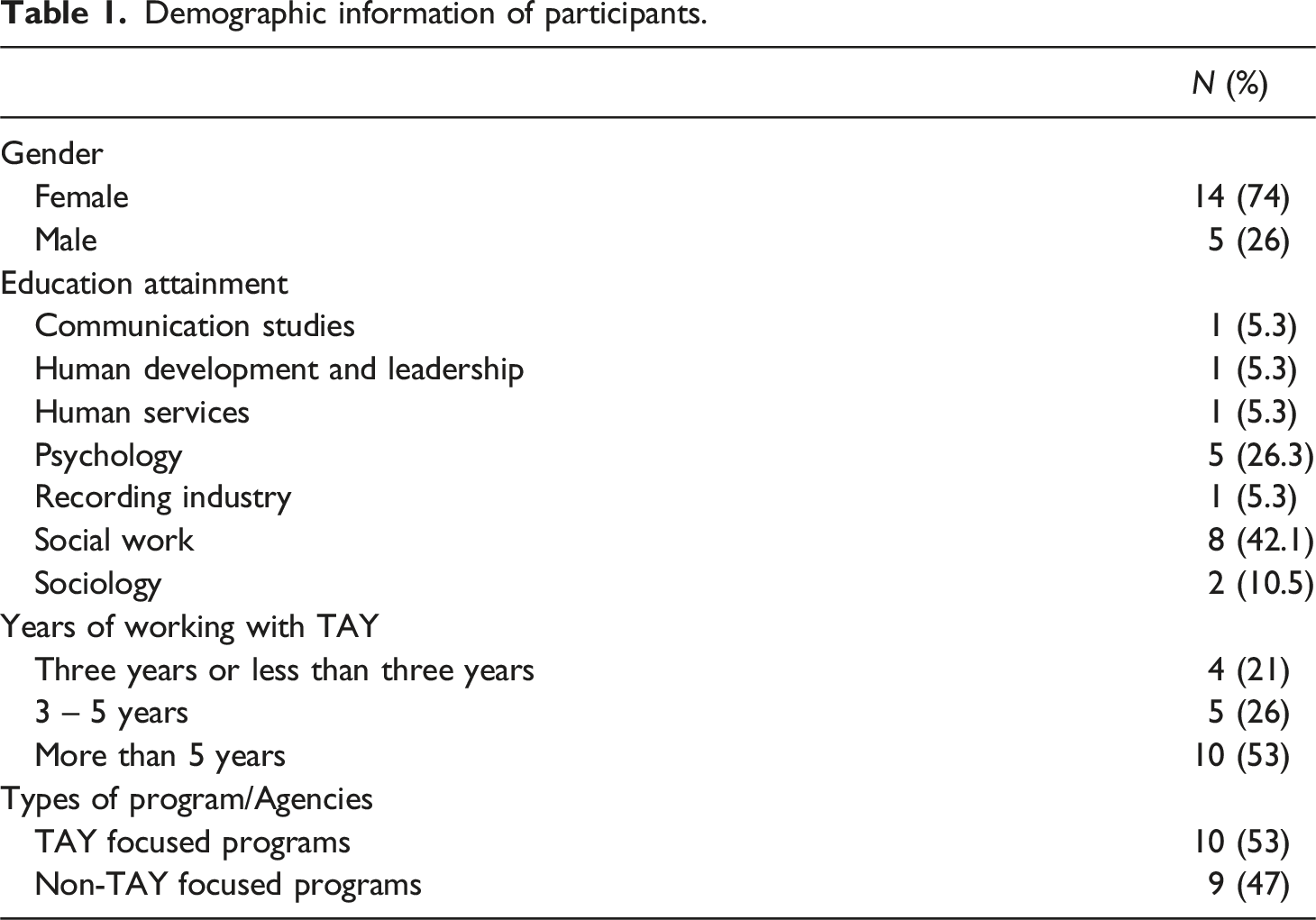
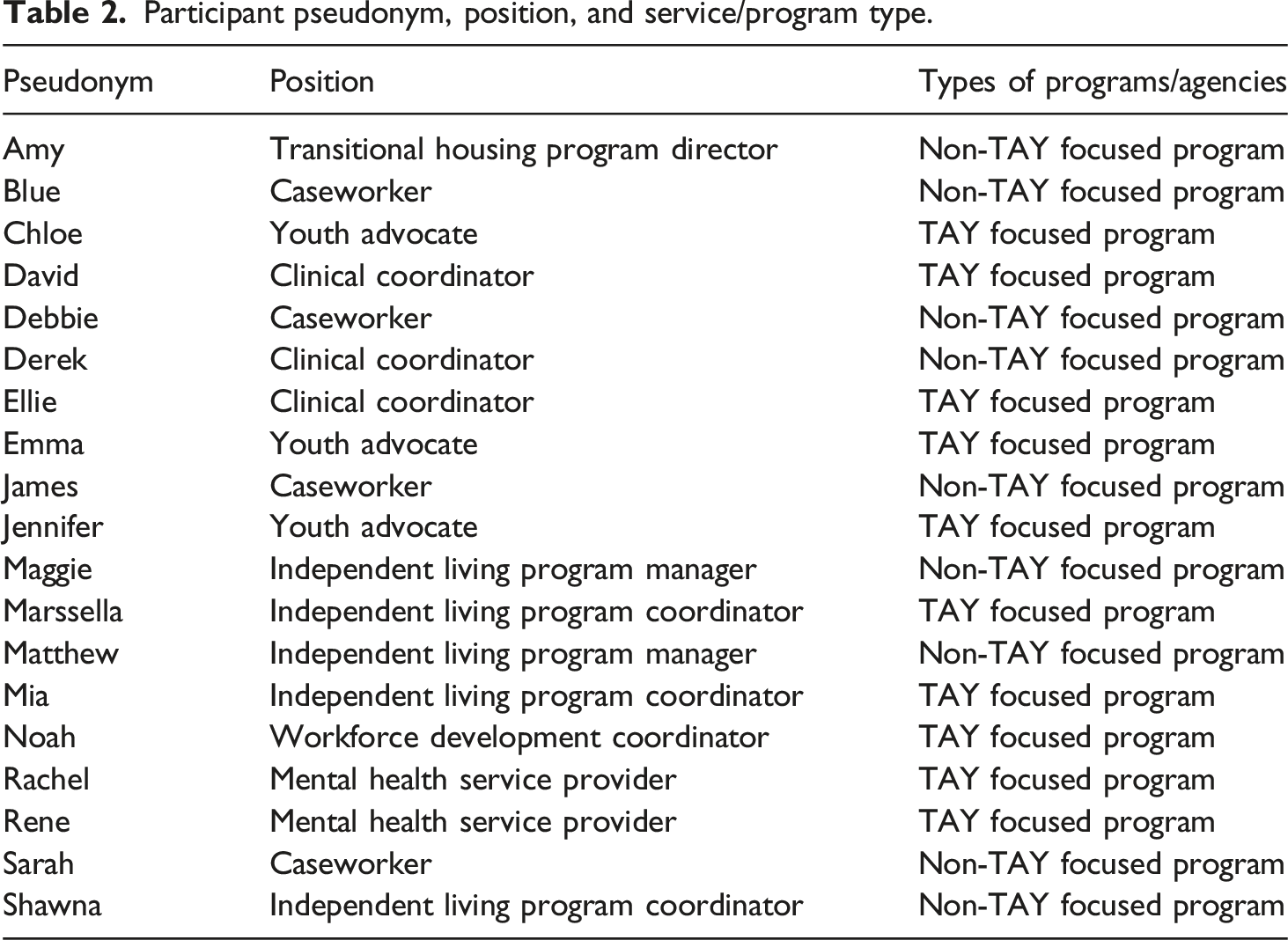
Participants
Demographic information of participants.
Participant pseudonym, position, and service/program type.
Data analysis
Thematic analysis was used to analyze all transcripts by coding line-by-line (Kiger & Varpio, 2020). This analysis followed a structured approach with a priori categories derived from the research questions. Several steps were followed to identify the themes from 19 interviews: (1) reviewing interview notes and being familiar with transcripts, (2) generating initial codes aligned with the priori categories and extracting exemplary quotes, (3) creating a table to classify the initial codes into emergent themes with exemplary quotes, (4) reviewing and defining the themes in alignment with the original research goals/questions (Kiger & Varpio, 2020). Any potentially identifying information, including participants and agency names and locations, are redacted from these quotes. Although the term transition-age youth or TAY is used throughout this paper, many child welfare workers or service providers used an alternative term such as “young people”, “youth” or “kiddo”. Some quotes were edited to preserve confidentiality, and for clarity or brevity. These edits are noted by brackets or “…”.
Rigor
Several steps were taken to ensure the rigor and trustworthiness of the interpretive analysis. The first author shared the table with preliminary themes and codes and exemplar quotes from the first round of coding with a second researcher and received feedback on how to construct themes and codes. As the researcher revised the themes, the researcher used notes and memos to make connections between themes, which increased the trustworthiness of the findings (Nowell et al., 2017). In addition, the first author regularly debriefed with peers who were also conducting qualitative research and actively reflected the impact of personal background and bias on how the researcher interpreted the findings of the study (Johnson et al., 2020). The first author also discussed the themes and codes at the National Independent Living Conference and received guidance and feedback from experts in the field of TAY research.
Positionality statement
Authors in this study do not have lived foster care experience. The first author conducted the interviews and analyzed the data. The first author was born and grew up in China. The first author made meaning of the text through member checking and seeking advice from experts in the field. The second author has extensive practice and research experience in the field of child welfare. Authors acknowledge that personal and cultural backgrounds influenced our interpretations of the data and brought biases into the study.
Results
Three themes were identified across the interviews: (1) navigating social and personal relationships during the transition out of foster care, (2) things did not go as hoped as TAY reconnected with family of origin; and (3) the roles of supportive relationships on TAY’s mental health. These three themes mapped onto the three specific research questions that guided this study. Within the first theme, four sub-themes emerged. Within the third theme, two sub-themes emerged. Each theme and related sub-themes are described in detail below.
Theme 1: navigating social and personal relationships during the transition out of foster care
Child welfare workers and other professionals reflected their experience working with TAY on navigating social and personal relationships during the transition out of foster care. Respondents highlighted the importance of having long-lasting and supportive relationships between TAY and their extended family, foster parents, peers, and professionals during the transition out of foster care. However, respondents also noted the potential strain experienced by these young people as TAY navigated social and personal relationships.
Sub-theme 1.1 the importance of relational permanence
Throughout the interview, participants highlighted the importance of having long lasting and natural support from non-professionals for young people as they left care. Participants reflected that child welfare workers and service providers were not able to stay in a youth’s life consistently. Sarah, who was a child welfare worker, shared that it was critical to have someone “outside of professional capacity that TAY can reach out to on a daily basis” and “someone who is not in a paid position to be in their lives”. Maggie, an independent living program manager, shared: I would say the most important are the natural supports, the ones who aren’t professionals and aren’t going to leave at a certain time. The resource parent I think can be a great long-term support for them for sure, but I think if they can build up peer supports or other natural supports that aren't professionals, I think those are the ones that are going to be the most beneficial long-term.
Foster parents and extended family members could be the sources of long-term supportive relationships for young people. Respondents acknowledged that it was overwhelming for young people to retell their traumatic experience to different people. Extended family members were often connected to young people throughout their cases and processes, and they understood the past trauma young people have experienced. Noah, who worked with young people on workforce development, shared: Although they [TAY] build connections with staff members, they [TAY] know that staff members are going to come and go. Any one of us can get fired, any one of us can resign, we can get a promotion, we can transfer the case, and whenever that happens, that client ends up telling their story over and over to new people that they meet. They [TAY] know that with a family member or extended family member, they don’t have to retell that story and relive that trauma just so that they can get to know them. They [TAY] know that they know their whole story and they can just continue right where they left off and not look back at the past.
Several participants in the study recognized the instability inherent in the relationships with professionals. In contrast, the stability from long-term supportive relationships allows young people to focus on their growth rather than constantly revisiting past traumatic experience. By having consistent and enduring relationships, young people can build resilience and move forward.
Sub-theme 1.2 “You just don’t stop needing family just because you turn 18”
The importance of maintaining connections with family emerged across the interviews. Participants underscored that the emotional support from family members positively impacts the well-being of young people as they approach to adulthood. Chloe, who worked on a youth advisory council, shared that: I think they need to still have connections to bio siblings and extended family members because I’m seeing that makes a huge difference for the youth as they're transitioning and maintaining those relationships if they can maintain healthy boundaries…You just don’t stop needing family just because you turn 18. They still need somewhere to call if they’re having a bad day, or if there’s an emergency, or somewhere to go for holidays, or someone who’s going to call them on their birthday. I think they need that permanent connection as they’re going out on their own. Personal relationship is really the backbone of everything.
As young people navigate the complexities of adult life, having supportive family members provides a crucial source of reassurance. Participants noted that fostering and maintaining connections with sibling and extended family members can empower young people, equipping them with the resilience and support they need to thrive.
Sub-theme 1.3 “Friends become family for our young people”
Peers are important sources of support for older youth and young adults in foster care. Participants reported that young people were more comfortable to ask for help from their peers as they shared similar experiences. Mia, an independent living program coordinator, shared that “a close friend or a partner is what is really important for young people and what I found that a lot of them rely on them.”
Another source of peer support comes from foster care alumni. Sharing lived foster care experience bolstered the connections between current TAY in care and foster care alumni. Blue, who was a child welfare caseworker, shared that he always invited foster care alumni to the [program designed for young adults who left foster care at ages 18 to 21], and he found that older youth in care were more receptive and better engaged with foster care alumni in the conversations. Through talking to foster care alumni, current foster care youth can have a positive perspective of their future. Blue shared his insights on this interaction that “even though you have been in care, there is a light at the end of the tunnel. If you work and desire to do this, you can do this”. Young persons were more motivated and encouraged when they could see foster care alumni who have had success. A lot of times I think that our young people will be a bit more receptive to support if it comes from someone else that's walked in their shoes before. Especially a young person. We’ve talked about figuring out some approach that incorporates mentoring through other young people with lived experience in the foster care system. They don’t have to be the same age. I guess if they were a little bit older, that'd be okay, but someone else with lived experience. I think giving advice and encouraging young people makes a huge difference. Especially when they can see that person has had success. (Mia, an independent living program coordinator)
Mia also shared the passion and strong desire from alumni to help current TAY in care: I come across so many young people who want to improve the child welfare system in our state because they don't want someone else to go through the same things that they went through. I'm always just really impressed by that, their desire to not only look for how they can improve things for themselves, but look into the future for other people, and try to make a difference. We have so many young people who want to be social workers, and lawyers, policymakers, and changers, so they can improve the system that failed them. I think that that's pretty incredible.
Social and personal relationships can be both sources of support and strain (Fingerman et al., 2004). While respondents shared positive experiences with social and personal relationships among TAY, participants also acknowledged the negative experience or strain these relationships can cause. In this study, participants primarily highlighted the challenges from professionals and family of origin.
Sub-theme 1.4 Loss of connections with professionals after 18
Several respondents shared the phenomenon they saw as they worked with TAY that once a young person turned 18, they were expected to become “adults” immediately and then they instantly lost a lot of services and support from professionals within the child welfare structure. Derek, who worked with youth aged 14 to 26 on transitioning out of care, described that young people were losing the connections and support from professionals or non-professionals once they turned 18: A lot of times when our young people turn 18 and they’re “adults” who are transitioning out of the system. A lot of these service providers do step away. The social workers, the guardians ad litem, everyone who is part of the child welfare system structure, they do step aside. That’s why a lot of times those who are 18 and over don’t have those natural supports in place unless they do have family or maybe they do have ongoing case management.
This phenomenon got worse for young people who did not have support from their family members. Participants reflected that when young people did not receive support from their family members, they especially longed for connections with professionals. The instability and availability of the relationships with professionals were identified as the barriers for TAY to build trusting relationships and stay engaged with their services. Marssella, an independent living program coordinator, shared the frustration from young people: They [TAY] started working with the jobs program. And a few months later, I’ll check in with them, “Oh, how’s it going with the jobs program?” And they’re like, “Well, my case manager left, and I never heard anything again. And we did not do anything”.
The turnover of caseworkers led to service disruptions among young people. Marssella pointed out that it is essential for young people to practice these skills and “get into the real nitty gritty”. With the interrupted service experience, young people did not learn anything from the program.
Theme 2: things did not go as hoped as TAY reconnected with family of origin
Some participants reflected that as TAY got older, they started to look for their family of origin. However, reconnection with family of origin did not always go well. Several child welfare workers reported that these young people often ended up finding out that either the parents never wanted them, viewing the youth as a “screw-up” or “their parents were just not capable of taking care of them”. Blue, who was a caseworker, shared that young people experienced “heart pain” and “internal pain” when these negative interactions with parents occurred. David, a clinical coordinator, shared his experience as he worked with TAY and prepare them to become independent: I would say the most common thing, and this is kind of a sad one, is most youth that when they hit 18--if their parents either weren't involved or were involved but didn't really try to get them back—they [TAY] run back to them [birth parents], they go there, and it never ends well. They [TAY] usually end up finding out, you know, the parent never wanted them. They [TAY] find out that the parent was just not capable of taking care of them. They’re not able to give them what they [TAY] want in that relationship.
Resentment towards their family of origin was a recurring theme as participants were asked about social strains TAY experienced. James noted that as TAY grew up, TAY were old enough to talk and started to struggle about what happened to them. James shared that “they [TAY] looked back at their parents or whoever raised them or didn't raise them and resents them and is upset with them because they allow this to happen”. In the situation where TAY made efforts of reconnecting with their family, respondents shared that TAY had expectations of their bio-family and “they [TAY] have this rosy view of what living with their bio-family might be like and or might have been like”.
In addition, respondents shared their concerns about young people who reconnected with their family of origin. Respondents shared that sometimes TAY were taken advantage of by their family of origin as they came back home after 18. Debbie, a child welfare worker, shared her experience working with a young adult who had a developmental disability and was lower functioning: I've had a situation where a young adult went back to a father that did horrible things to her, but she went back, and that relationship picked up where it left off years ago when she was younger unfortunately. She thought that was a great support at the time because she had somewhere to go. She hadn't seen her father in years, but he had terrible intentions for her to come be with him … I think dad just-- he wasn't in the right place. He took advantage of where she was mentally.
This situation demonstrates the complex dynamics that young people encountered as they reconnected with their family of origin. Having guidance and resources is critical as young people navigate their relationships with family members.
Theme 3: the roles of supportive relationships on TAY’s overall mental health
Supportive relationships are essential for TAY to maintain mental well-being in daily life. Respondents noted that the majority of TAY involved in foster care did not always have stable supportive family members in their life to ask for guidance or help. Several participants shared their relationships with TAY. Shawna, an independent living coordinator, shared her experience working with a young man. Shawna shared that even though young person knew what he needed to do, he still wanted to have someone there with him. In addition, Matthew, who was an independent living program manager, shared that the lack of supportive relationship in TAY’s life oftentimes leads to mental health issues: The confidence that comes from knowing that people are there for you to know you're part of a community, that raises all of the outcome levels … They wake up feeling better about their day. I used to say in the apartment-based program, there's nothing worse than waking up and staring at white walls in your apartment with nowhere to go and nobody who cares about you. It's a recipe for depression. It's really a threat, not just to their livelihood but to their life in general. It can be quite dire.
Sub-theme 3.1 Supporting accountability to mental health service use
Several participants raised the idea that how young people need accountability to stay engaged with their mental health services. Respondents expressed that the supportive adults in TAY’s life helped young people manage their appointments and medications and young people could be more accountable for their mental health needs. Several respondents mentioned that for youth who stayed in foster care, either foster parents or social workers helped them with making their appointments and staying consistent in their therapy. A lot of times the foster parents still schedule therapy and requires them [TAY] to do that [therapy] while they're living there. That's probably another reason why they're [TAY] more successful is because they are continuing treatment. Whereas when they move on their own, a lot of times they cut all that out and they stop going. They stop taking meds, they stop going to therapy, all that kind of stuff. (Shawna, independent living program coordinator)
Sub-theme 3.2 Going through crises with a safety net
Supportive relationships served as a safety net by providing guidance and being physically present in TAY’s lives. Having guidance and receiving reassurance when young people navigate challenging situations is critical for their well-being. David, a clinical coordinator, shared his perspective on the role of a safety net that “they [TAY] need to be able to go out on their own, fail, and fall down but not hit rock bottom”. David shared that having someone who can catch them, these young people can get back their strengths and bounce back up. David shared “if you don’t have that safety net, you fall, you hit hard. And some of them [TAY] don’t recover well from that and they end up continuing the spiral.”
Having supportive adults physically present and engaged in TAY’s lives is also critical as they go through mental health crisis. James, a child welfare caseworker, shared the “little silly things, like driving around, following the moon, and walking” one young woman often did with her foster mom helped with her mental health. Mia, a program coordinator, shared her experience on walking with a young person through her mental health crisis. Mia shared that even though this young person knew how to do it, having someone with her helped her feel more comfortable: She [TAY] asks people to walk her through [crisis] a lot, too. She's not the one that I can just send her a number for a mental health provider to call. She wants me on the phone with her to call them with her even though she'll do all the talking. She'll advocate for herself, but she wants a support person there to be there if she stumbles or to debrief even sometimes afterwards.
Discussion
The findings of this study broadened the current literature on the transition out of foster care by focusing on the unique lens of professionals who interacted with different stakeholders in the field. This study identified themes related to child welfare workers and other professionals’ views on the social and personal relationships among TAY as they left foster care and experiences of TAY who reconnected with families of origin. While participants clearly viewed that having supportive relationships are critical as TAY leave care, respondents also brought potential challenges faced by TAY from social and personal relationships during the transition out of foster care.
Previous literature has documented the negative impacts of relationship loss and disruptions on the emotional and relational well-being of youth in foster care, including lack of stability, loss of trust, painful feelings, and disruptive behaviors (Curry, 2020; Strolin-Goltzman et al., 2010). The finding from this study contributes to the existing literature that due to the high turnover, ongoing relationships loss with professionals among child welfare workers and service providers also demolished the service experience and exacerbated the service discontinuity among foster youth. Child welfare practitioners should carefully end the relationships with youth in foster care and collectively process the foreseen emotional disturbance, including sadness, anger, grief, and loss (Curry, 2019; Walsh, 2007).
Participants in this study highlighted the needs of intentionally fostering long-lasting non-professional relationships among TAY in foster care. It is evident that connections with supportive adults in a youth’s life is an important protective factor of positive youth development (Van Dam et al., 2018). Guided by the Fostering Connections to Success and Increasing Adoptions Act, the focus on preparing youth with independent living skills has been shifted toward fostering relationship and connections with supportive adults (Courtney, 2009). A recent scoping review that synthesized social support interventions to strengthen support networks among TAY in foster care (Okland & Oterholm, 2022) concluded that natural mentoring was the one of five key areas of support. Compared to formal support, natural mentoring places an emphasis on reconnecting youth with existing relationships and encourages a youth-initiated approach that acknowledges youth’s autonomy through building a mutual and trust-based relationship. As a result, natural support may nurture long-lasting commitment (Thompson et al., 2016) and existing supportive adults have a better understanding of the cultural values and previous trauma experienced by the target youth (Brady et al., 2019).
The theme of relational permanence is aligned with the call for shifting the focus on independence to interdependence with which child welfare practitioners prepare older youth and young adults leaving the dependence on care (Antle et al., 2009; Courtney, 2009; Goodkind et al., 2011). Geenen and Powers (2007) argued that “services cannot take the place of meaningful relationships” (p. 1098). With the recognition that every adult is interdependent (Fraser & Gordon, 1997), Goodkind and colleagues (2011) highlighted that the focus on independence and self-reliance impeded older youth to build and maintain long-lasting and supportive relationships where they can ask for help. Furthermore, it is important to establish positive, nurturing relationships for TAY. As evidenced by some of the professionals in our sample, some relationships and connections proved to be negative or cause more strife for TAY than support. Thus, the quality of relationships is important to consider and include in case planning.
Participants in the study perceived that TAY desired to reconnect with their birth parents and extended family members, which was consistent with current literature (Perez & Romo, 2011). With the awareness of the potential benefits from family of origin, this study also pointed out the concerns flagged by child welfare workers and other professionals about the challenges young people experienced as they reconnected with their family of origin. Reunification with their birth parents is one of five legal permanence goals child welfare practitioners work with children and birth parents. Key indictors including the willingness and readiness of both children and family towards reunification, concerns led to child welfare involvement, and the participation from both children and family, were included as child welfare practitioners worked on reunification with children and families. As TAY transition out of foster care without achieving reunification, it might be critical for child welfare practitioners to work with both young adults and their family on reestablishing healthy relationships to better support young adults (LaBrenz et al., 2024). While the professionals in this study tended to focus on negative experiences, it is worth noting that this area remains understudied. Furthermore, the quotes that emerged on reconnecting with families of origin emerged largely in response to interview questions related to social strain; therefore, future research could expand these findings by incorporating more neutral questions about how TAY experience reconnections with families and what help TAY successfully navigate these relationships. Furthermore, internalized biases toward family of origin among child welfare workers should be considered as child welfare workers facilitate the reengagement between TAY and family of origin (LaBrenz & Arévalo-Contreras, 2023).
Child welfare workers also shared their concerns about young adults with developmental disabilities being sexually abused again as they reconnected with their family of origin who was the perpetrator. This finding is aligned with recent research suggesting that lower levels of intellectual ability was associated with heightened risk of experiencing sexual victimization among the 334 older adolescents aged 18 to 19 during the transition out of foster care (Carrellas et al., 2021). Young people with developmental disabilities were at higher risk of experiencing sexual victimization and revictimization (Christoffersen, 2020; Wolfe et al., 2018). Although this only emerged in one interview, it highlights a potential area to focus future study and consider the special needs that TAY with developmental disabilities might have as they leave care.
Strengths and limitations
This study had several strengths. With accumulated experiences serving TAY and working with other stakeholders, child welfare practitioners have unique insight into the benefits and challenges of the relationships faced by TAY. Further, there were a diverse range of roles represented in the study. Several steps were taken to ensure methodological rigor and trustworthiness of the data analysis. Researchers engaged in active and ongoing reflection throughout the study process and a second reviewer reviewed preliminary themes and initial codes and provided feedback on how to construct themes and codes. Peer debriefings were conducted to enhance the quality and validity of the findings.
Several limitations in this study need to be considered as we interpret the findings of this study. Potential bias might be present as this study interviewed child welfare workers and other professionals, rather than interviewing TAY themselves. Child welfare workers and other professionals are often perceived as authorities in the lives of TAY due to their roles. However, it is critical to hear the voice of TAY in decisions about their transition out of care, ensuring their agency and perspectives are adequately considered. Participants may selectively report certain findings over others, potentially skewing the overall representation of the data. In addition, participants may come from different cultural backgrounds and family environments, which may potentially impact how participants understand the struggle and strengths of TAY. Last but not least, participants may alter their responses based on the perceived expectations of the interviewer.
Implications for future practice and research
Findings from this study have several implications on cultivating and enhancing supportive relationships of TAY with foster care experience. Child maltreatment, placement instability, and turnover among social workers can lead TAY to become hesitate about seeking help and forming connections with supportive adults in their lives (Augsberger & Swenson, 2015). Child welfare workers should understand the impact of previous experiences on TAY’s social and personal relationships to help them build long-term support networks. In addition, it is crucial for professionals to actively involve TAY, providing opportunities for TAY to take the lead, which empowers TAY to foster the sense of agency and ownership and practice critical life skills.
The findings of this study also underscored the nuanced and complicated aspects of social and personal relationships among TAY. The reconnections with family of origin are mixed and more efforts to incorporate the voices of TAY are needed in the future research. In the future practice, if TAY desire to reconnect with their birth parents, child welfare workers should facilitate and strengthen the connections with their family of origin even though permanence with family of origin is not the primary goal (LaBrenz et al., 2024). The Collaborative Family Engagement model implemented by Court Appointed Special Advocate is designed to facilitate the connections between children in foster care and their supportive relationships (Court Appointed Special Advocates for Children, 2024). Similar models can be adapted and expanded among older youth and young adults who are going to leave care.
Footnotes
Acknowledgement
Authors are grateful to child welfare workers and service providers for agreeing to participate this study. Authors also acknowledge the support from the expertise in the field, including Dr Bethany Lee, Dr Haksoon Ahn, Dr Theda Rose, Dr Kristen Ethier, Dr Lauren Pryce McCarthy, Ardith Allison and Linda-Jeanne M. Mack.
Declaration of Conflicting Interests
The author(s) declared no potential conflicts of interest with respect to the research, authorship, and/or publication of this article.
Funding
The author(s) disclosed receipt of the following financial support for the research, authorship, and/or publication of this article: The first author received funding from the Grand Challenges for Social Work Dissertation Award at the University of Maryland Baltimore.
Open research statement
As part of IARR’s encouragement of open research practices, the authors have provided the following information: This research was not pre-registered. The data used in the research cannot be shared with the concerns of participant privacy and confidentiality. The materials used in the research are available upon request by emailing:
