




Abstract
Individuals who have autism spectrum disorder (ASD) communicate differently than their neurotypical peers. Prior communication research on individuals with ASD has focused on how interventions can adapt the behaviors of those with ASD to be in line with neurotypical communication. This study treated the communication of individuals with ASD as a different, and valid, way of communicating, not something that needs intervening. We examined the face threats individuals with ASD experienced and the facework strategies they used in response. We found that individuals with ASD experienced (a) positive, (b) negative, and (c) hybrid face threats. In response to these face threats, individuals with ASD used (a) preventive, (b) corrective, and (c) future facework. Additionally, communication partners enacted facework on the behalf of individuals with ASD using (a) corrective and (b) future facework strategies. Face theory assumes that face threats (FTAs) and facework strategies are related; using thematic co-occurrence analysis, this study offered empirical evidence that FTAs and facework occur in patterned ways alongside a variety of practical applications.
In the United States (U.S.), one in 44 children has an autism spectrum disorder (ASD; Maenner et al., 2021). Individuals with ASD struggle to navigate social interactions both verbally and non-verbally (Kelly et al., 2018). For example, individuals with ASD might not produce natural gestures (Rodríguez Muñoz, 2013) or a narrative (Palikara, 2018). In other words, those with ASD communicate differently than their neurotypical counterparts, or individuals who do not have ASD (Attwood, 1998). Those with ASD perceive their communication differences and experience rejection or self-segregation (Gillespie-Lynch et al., 2014). Although ASD diagnoses are prevalent, communication research has often focused on solutions to these communicative differences (e.g., see Brunner & Seung, 2009). In contrast, we center the voices of those with ASD to understand how those with ASD communicate; specifically, how individuals with ASD navigate face and facework (Cupach & Metts, 1994).
Face is a performance of one’s identity displayed during interactions with others (Goffman, 1955, 1967). Anything that threatens an individual’s performance and might cause embarrassment is a face-threatening act (FTA; Miller-Ott & Alvarez, 2021). An individual can threaten their own face or the face of others. Considering many individuals treat those with ASD as lacking social skills (see Brunner & Seung, 2009), individuals with ASD might experience unique face threats due to their communication differences. Thus, the first goal of this study is to examine what types of FTAs individuals with ASD report. Additionally, when experiencing or engaging in a FTA, individuals often employ facework. Facework is a set of (in)actions that individuals use in anticipation of (preventive), or response to (corrective), a FTA (Cupach & Metts, 1994). Although individuals often use facework strategies subconsciously, sometimes they might use them strategically. The communicative differences of those with ASD might mean that they navigate face differently. Thus, the second goal is to understand how these individuals navigate FTAs using facework strategies (Cupach & Metts, 1994).
Although FTAs and facework strategies are theoretically linked, scholars who study facework in the interpretive paradigm often identify the themes of the FTAs and facework strategies without looking at the relationships between the two. Romo and colleagues (2023) called for researchers to examine how FTAs and facework strategies might occur in patterned ways. To answer this call and fill this gap in face theory, the third goal of this study is to examine what, if any, patterns exist across FTAs and facework behaviors. To accomplish our three goals, we examined the online communication of people with ASD in the form of posts and comments on the social media Reddit (Hintz & Betts, 2022). Online accounts were particularly apt for this study given the comfortability of people with ASD communicating online (Newton et al., 2009). We will now provide more information about ASD before detailing face theory.
Autism spectrum disorder
ASD encompasses a spectrum of neurodevelopmental disorders (Jensen & Spannagel, 2011). Individuals fall along this spectrum and present ASD differently. Although ASD is a continuum, diagnosticians broadly characterize ASD by differences in communication and social interaction, sensory differences, and repetitive behaviors (Lord et al., 2020). Similarly, although ASD is a spectrum, we cite literature that discusses ASD broadly. For example, during conversations, individuals with ASD often provide irrelevant details, shift the topic at inappropriate times, are unresponsive to partner cues, fail to engage in reciprocal exchange, use unusual intonation, are formal, and are often preoccupied (Paul et al., 2008). Further, individuals with ASD might fail to make eye contact, adjust their facial expressions to what they are saying, maintain a rigid/tense posture, and fail to naturally produce gestures during conversations (Rodríguez Muñoz, 2013). Additionally, individuals with ASD might have a special interest or hobby they focus on and are particularly interested in, like history (Caldwell-Harris & Jordan, 2014). Notably, those with ASD might want to talk about their special interest more than others.
Individuals with ASD also experience unique social interactions. People with ASD know they communicate differently and view their communication as negative, often experiencing anxiety about communicating and the judgement of others (Kelly et al., 2018). When communicating with neurotypical peers, those with ASD might use masking to mimic neurotypical behaviors and hide their neurodivergence (Milner et al., 2019). Masking occurs when those with ASD perform communicative behaviors like their neurotypical counterparts. Regardless, individuals with ASD often experience rejection or self-segregation, and in response, use the internet to communicate with others (Gillespie-Lynch et al., 2014). Considering parents report that their children with ASD experience higher rates of bullying (Rowley et al., 2012), it is unsurprising that individuals with ASD wish for assistance communicating (Kelley et al., 2018). By adulthood, one study found that over 15% of individuals with ASD reported experiencing stigma (Bachmann et al., 2019).
In response to the communicative differences of individuals with ASD, scholars, healthcare practitioners, teachers, and families focus on adjusting the individual’s communication to fit neurotypical norms. For example, Locke and colleagues (2010) argued that adolescents with ASD are lonely and isolated. Therefore, those with ASD needed more social skills interventions that focus on developing friendships (Locke et al., 2010). Additionally, Brunner and Seung (2009) overviewed the variety of communication-based treatments for individuals with ASD. Scholars, practitioners, teachers, and family members tell individuals with ASD that they communicate in problematic ways which might be face threatening and leads us to overview face theory.
Face theory
Face is the performance of one’s identity and includes individual characteristics (e.g., gender, health diagnoses), personal reputation, interpersonal history, culture, and the situation or context (O’Driscoll, 2011). Face is a reciprocal process and relies on the cooperation of communication partners (Goffman, 1959, 1967). Scholars often distinguish between (a) positive and (b) negative face (Brown & Levinson, 1987). Positive face is an individual’s desire for others to like them. Negative face is an individual’s desire to be autonomous (Brown & Levinson, 1987).
All individuals experience threats to their face performance (i.e., FTAs; Cupach & Metts, 1994; Miller-Ott & Alvarez, 2021). FTAs can target an individual’s positive or negative face (Cupach & Metts, 1994; Miller-Ott & Alvarez, 2021). Some FTAs might threaten both an individual’s positive and negative face simultaneously; these are hybrid FTAs. Individuals with ASD experience isolation (Gillespie-Lynch et al., 2014), bullying (Rowley et al., 2012), and are told by practitioners to change their communication behaviors (Brunner & Seung, 2009), thus, they likely experience unique FTAs which we seek to understand by asking: RQ1: What, if any, FTAs do individuals with ASD report experiencing that threaten their positive and/or negative face?
In anticipation of, or in response to a FTA, individuals use facework strategies to maintain face. We detail the multiple types of facework below.
Facework
To maintain face, individuals use facework to ensure that their behaviors uphold their and other’s face (Cupach & Metts, 1994). Individuals might use (a) preventive, (b) corrective (Cupach & Metts, 1994), or (c) future facework (Romo et al., 2023).
Preventive facework
An individual might use preventive facework to save their own, or their communication partner’s, face prior to the FTA (Cupach & Metts, 1994). Preventive facework includes avoiding certain topics, changing topics, or using disclaimers before the FTA occurs. Additionally, individuals might use politeness strategies as preventive facework (Brown & Levinson, 1987; Cupach & Metts, 1994). Politeness is a form of linguistic face-saving (Brown & Levinson, 1987). Strategies range in their face-saving potential. The least face-saving is bald-on-record where a speaker bluntly states their message (Brown & Levinson, 1987). Next, individuals can go on-record using explicit communication to state their message, however, they use communicative action that is meant to repair the face-loss. When an individual uses positive politeness, they focus on saving the addressee’s positive face. In contrast, negative politeness occurs when the speaker focuses on saving the addressee’s negative face. Like FTAs, individuals can direct face-saving actions at both types of face simultaneously with hybrid politeness (Brown & Levinson, 1987). For example, an individual with ASD might be over stimulated by a conversation with several people and say, “I’m going to step outside because I am overstimulated by the conversation. This is something that just happens sometimes, nobody did anything wrong; please, keep talking.” This statement provides face-saving to the hearers’ positive face (nobody did anything wrong) and negative face (please keep talking). When an individual hints at the face-threatening message, they go off-record (Brown & Levinson, 1987). For example, an individual with ASD who is overstimulated might say, “It’s loud in here.” Finally, the most face-saving strategy is when a speaker does not do the FTA at all (Alvarez & Miller-Ott, 2022). For example, when overstimulated, an individual with ASD might remain silent (i.e., not do the FTA). Individuals experiencing emotional abuse from their romantic partner did not engage in FTAs toward their partner as a way to get through the abuse and save their partner’s face (Alvarez & Miller-Ott, 2022). Although scholars conceptualize politeness strategies in terms of the addressee’s face, they also save the speaker’s face. Individuals can also use facework to repair face-loss following a FTA using corrective facework.
Corrective facework
Following a FTA, an individual can use corrective facework to rectify face-loss (Cupach & Metts, 1994). An individual might avoid the FTA by not drawing attention to the FTA. For example, when visually impaired individuals experienced problematic behavior by sighted individuals, they avoided the FTA rather than addressing it (Romo et al., 2023). Individuals might also make a joke (Cupach & Metts, 1994). When correcting face-loss due to their low vision, visually impaired individuals made jokes about their vision (Romo et al., 2023). Similarly, individuals might apologize by admitting blame for the FTA and seeking atonement (Cupach & Metts, 1994). After committing FTAs due to their low vision, visually impaired individuals apologized to their communication partners (Romo et al., 2023). Both those with ASD and visually impaired individuals cannot control their diagnosis. Therefore, individuals with ASD might use similar corrective facework strategies as individuals with vision loss. Additionally, individuals with ASD might also use excuses in which they attempt to minimize their responsibility for the FTA (Buttny, 1985; Cupach & Metts, 1994). When around individuals who were drinking, nondrinkers often made excuses for not drinking by framing it as a personal health choice (Romo et al., 2015). Similarly, individuals can use justifications to accept responsibility for the FTA, yet minimize its impact (Koenig Kellas & Suter, 2012). When reconciling with a prior romantic partner, individuals justified their partner’s behavior when communicating with family members (McBride, 2010). Those with ASD might use similar excuses and justifications to correct face loss. In addition to enacting facework before or after a FTA, individuals can use facework to save face for themselves and others in the future. We detail future facework below.
Future facework
Romo and colleagues (2023) found that individuals employ strategies that are corrective in the moment and preventive for future interactions. Visually impaired individuals used future facework to educate those who performed the FTA and advocate for policies that help others with vision loss (Romo et al., 2023). Romo and colleagues (2023) argue that future facework helps “change oppressive discourses and structures” (p. 167). Individuals with ASD might employ future facework strategies when they encounter a FTA. In response to the FTAs they might experience, those with ASD might enact facework behaviors similarly or differently than their neurotypical counterparts. Thus, we ask our second research question: RQ2: How, if at all, do individuals with ASD enact facework behaviors for themselves?
Other facework
Individuals can enact facework for themselves and others (Cupach & Metts, 1994). Although scholars have never studied other facework during emergent interactions, they have studied it from the perspective of the one engaging in other facework (MicBride et al., 2020) and the receiver of other facework (McBride & Toller, 2011). For example, work spouses co-managed the face of their work wife or husband through preventive and corrective facework (McBride & Toller, 2011). Similarly, after losing a child, bereaved parents perceived that their social networks helped them enact facework by giving parents’ space, autonomy, and serving as an intermediary (McBride & Toller, 2011). Rather than taking a retrospective approach, we use emergent interactions to study other facework during online interactions. Thus, we ask: RQ3: How, if at all, do commenters enact facework behaviors for the individual with ASD?
Theoretically, scholars argue that individuals enact facework in response to or anticipation of FTAs. Yet, prior face research has treated FTAs and facework behaviors as distinct concepts (see Romo et al., 2023). Specifically, scholars often used a thematic analysis to find themes pertaining to the FTAs participants experienced and the facework strategies they used without examining how the two were related. In other words, scholars have not presented empirical evidence to test this theoretical assumption of face theory. Beyond empirically linking FTAs and facework strategies, these two concepts might occur in patterned ways. Although we cannot show causality, such patterns might indicate that individuals use specific facework strategies when they experience or anticipate certain FTAs. Therefore, we offer: RQ4: What, if any, patterns exist across posts made by those with ASD of experienced FTAs and facework strategies?
Method
Data collection
After IRB determined that this data did not classify as Human Subjects Research, we collected posts from Reddit (www.reddit.com; Hintz & Betts, 2022). Not only is Reddit a source of diverse and high-quality data (Hintz & Betts, 2022; Jamnik & Lane, 2017), but it also allowed us to examine the interactions between posters and commenters in an online space in which people with ASD are likely to feel more comfortable sharing about FTAs (Newton et al., 2009). More specifically, Reddit allowed us to examine how commenters enacted additional FTAs, how posters continued to enact facework in the comments, and how commenters enacted other facework. Therefore, by using Reddit, we were able to examine face during interactions and retroactive accounts.
On October 1, 2022, we collected data from Reddit by using an R script and the RedditExtractoR package (Rivera, 2019) which selected all the posts across Reddit that contained the word “autism” (Hintz & Betts, 2022). We then read through all 251 posts and only included posts in the final sample if (a) the poster identified as having ASD and (b) discussed a FTA. We operationalized FTAs using Miller-Ott and Alvarez’s (2021) definition of anything that “challenges a person’s face performance, which might result in embarrassment” (p. 174). For example, we included posts in which the author described being made fun of for having ASD, a threat to positive face, or in which they described losing their autonomy, a threat to negative face. We excluded posts that did not contain a FTA from the dataset. For posts that met the inclusion criteria, we also collected the comments for that post. Fifty-six posts met our inclusion criteria with 391 corresponding comments.
During data collection, we retained the posters’ screen names to identify who the original poster was in the comments section. We then assigned each post a number (e.g., 9), and each comment a number (e.g., 9, 5). When the original poser commented on the post, we identified them with an OP (e.g., OP, 9, 2).
Data analysis
To examine the relationships across research questions, we used thematic co-occurrence analysis (TCA; Scharp, 2021). Scharp (2021) outlines three steps for conducting a TCA. First, we conducted a thematic analysis using Braun and Clarke’s (2021) reflexive thematic analysis by (a) familiarizing ourselves with the data, (b) systematically coding the data in response to our analytical questions, “what FTAs are individuals with ASD describing?” “how, if at all, are people with ASD responding to the FTAs?” and “how, if at all, are commenters responding to the FTAs?”, (c) developing initial themes, (d) reviewing themes, and (e) refining, defining, and naming themes. For RQ2 and RQ3, we conducted an additional layer of analysis where we compared the developed themes to facework (Cupach & Metts, 1994), and politeness strategies (Alvarez & Miller-Ott, 2022; Brown & Levinson, 1987). For example, during the first level of analysis we developed a theme called preemptive explanation. When we compared this theme to the politeness strategies, we identified hybrid politeness. We then held our themes to Owen’s (1984) standards of recurrence (i.e., quantity), repetition (i.e., similar words within descriptions), and forcefulness (i.e., emphasis).
Co-occurrence matrix for RQ4: Co-occurrences between FTAs and facework strategies.
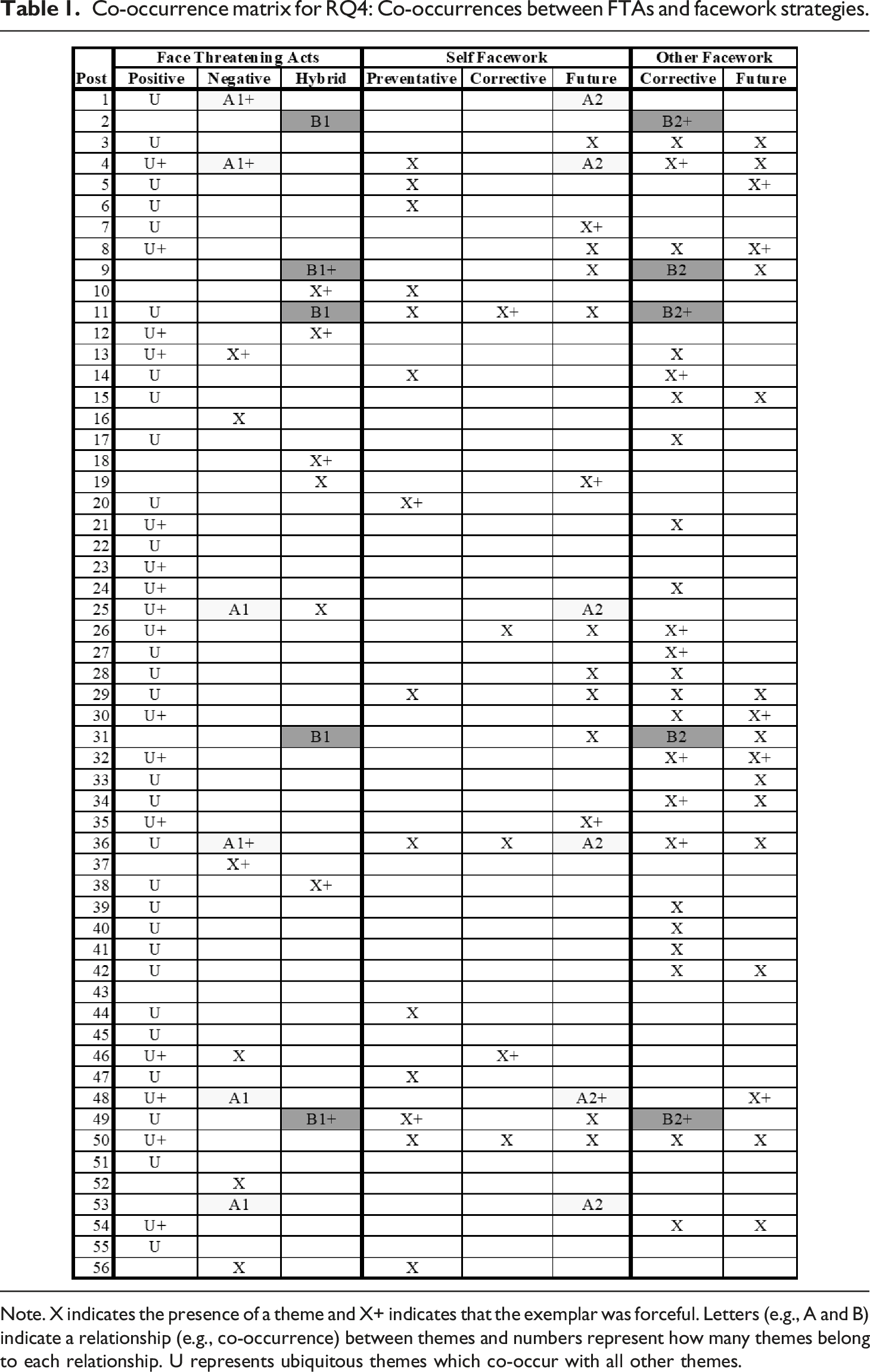
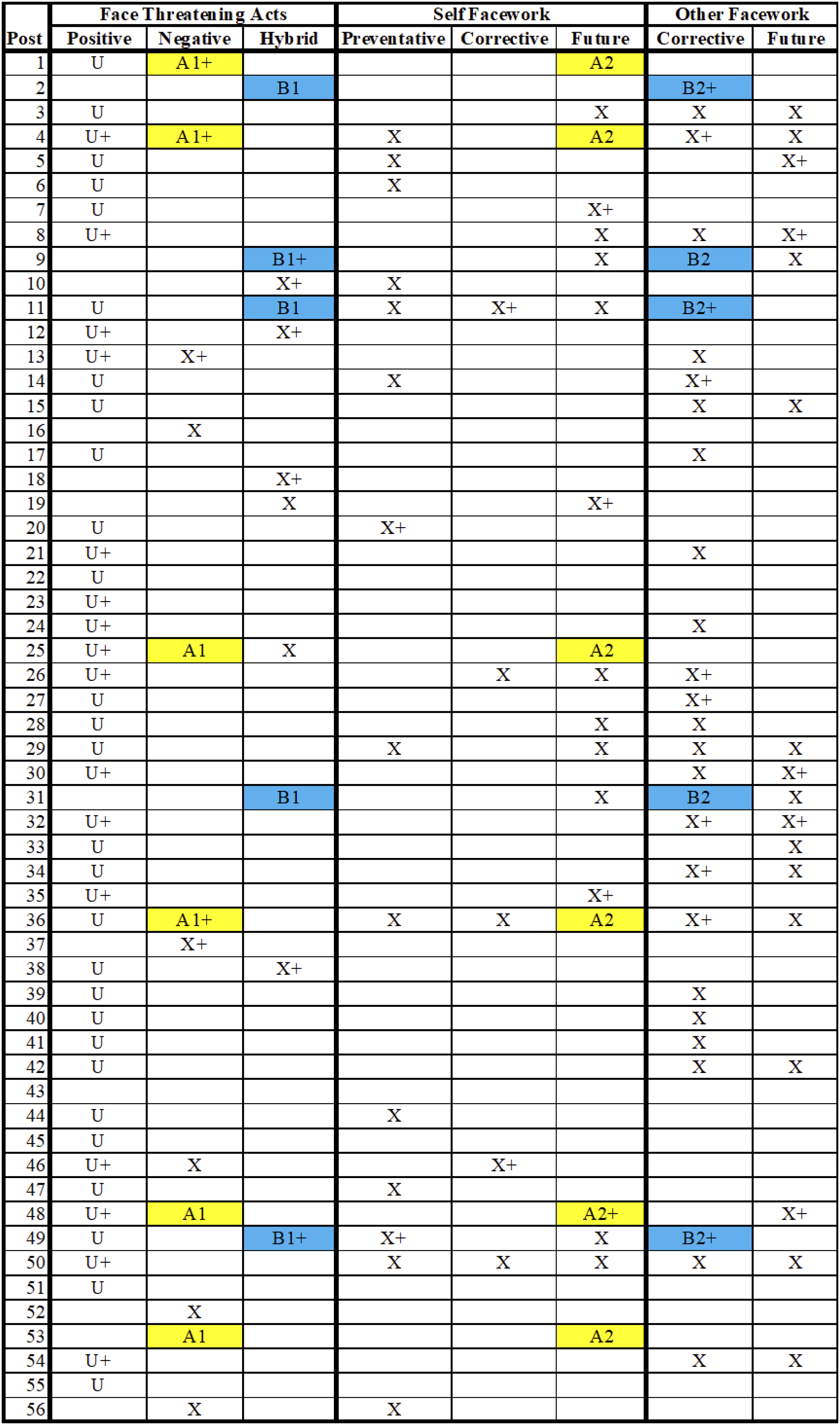
Note. X indicates the presence of a theme and X+ indicates that the exemplar was forceful. Letters (e.g., A and B) indicate a relationship (e.g., co-occurrence) between themes and numbers represent how many themes belong to each relationship. U represents ubiquitous themes which co-occur with all other themes.
Finally, we examined the co-occurrence matrix for relationships across research questions (Scharp, 2021). Co-occurrences are when two or more themes occur in posts together. We identified three relationships (e.g., U, A1/A2, B1/B2). U indicated that the theme was ubiquitous and present in almost all posts. Ubiquitous themes co-occur with all other themes. For example, in this study positive FTAs were ubiquitous and appeared in most of the posts. A and B represent two other unique relationships (i.e., A is a co-occurrence between negative FTAs and self future facework and B is a relationship between hybrid FTAs and other corrective facework) and the number indicates how many themes co-occurred in the relationship. We then examined the relationships using Scharp’s (2021) three continua: (a) sporadic/pervasive, (b) unilateral/bilateral, and (c) balanced/unbalanced. Pervasive relationships appeared in most of the posts; if the relationship did not, it was sporadic. If a theme implied the presence of another (if A1 then A2) then it was unilateral. A relationship was bilateral if the presence of one theme implied the presence of the other and vice versa (if A1 then A2 and if A2 then A1). Balance relied on Owen’s (1984) standards and is the extent to which the themes in the relationship were recurrent, repetitious, and forceful compared to the other themes. Both relationships fell along the continua such that relationships can be more or less sporadic/pervasive, unilateral/bilateral, and balanced/unbalanced.
Verification procedures
We engaged in five verification procedures to develop the credibility of our analysis: (a) referential adequacy, (b) peer debriefing, (c) negative case analysis, (d) the audit trail, and (e) exemplar identification (Kidder, 1981; Lincoln & Guba, 1985). First, we split the data in half and analyzed the first half of the data. We hit saturation in the first half of the data after post 20 (see Corbin & Strauss, 2008). We then analyzed the second half of the data and compared it to the first half. No new themes emerged; therefore, we achieved referential adequacy (Lincoln & Guba, 1985). Second, both authors engaged in peer debriefing during three meetings in which we discussed our findings, argued through differences, came to a consensus, and labeled the themes. Third, to achieve negative case analysis, we refined our analysis until the themes accounted for all the data (Kidder, 1981). Throughout data collection and analysis, both authors kept detailed notes (i.e., an audit trail), which helped with our analysis and selection of evocative exemplars (Lincoln & Guba, 1985).
Findings
Individuals with ASD experienced FTAs and enacted self facework. Commenters helped those with ASD by providing other facework. Additionally, we identified two co-occurrence relationships.
RQ1: Face threatening acts
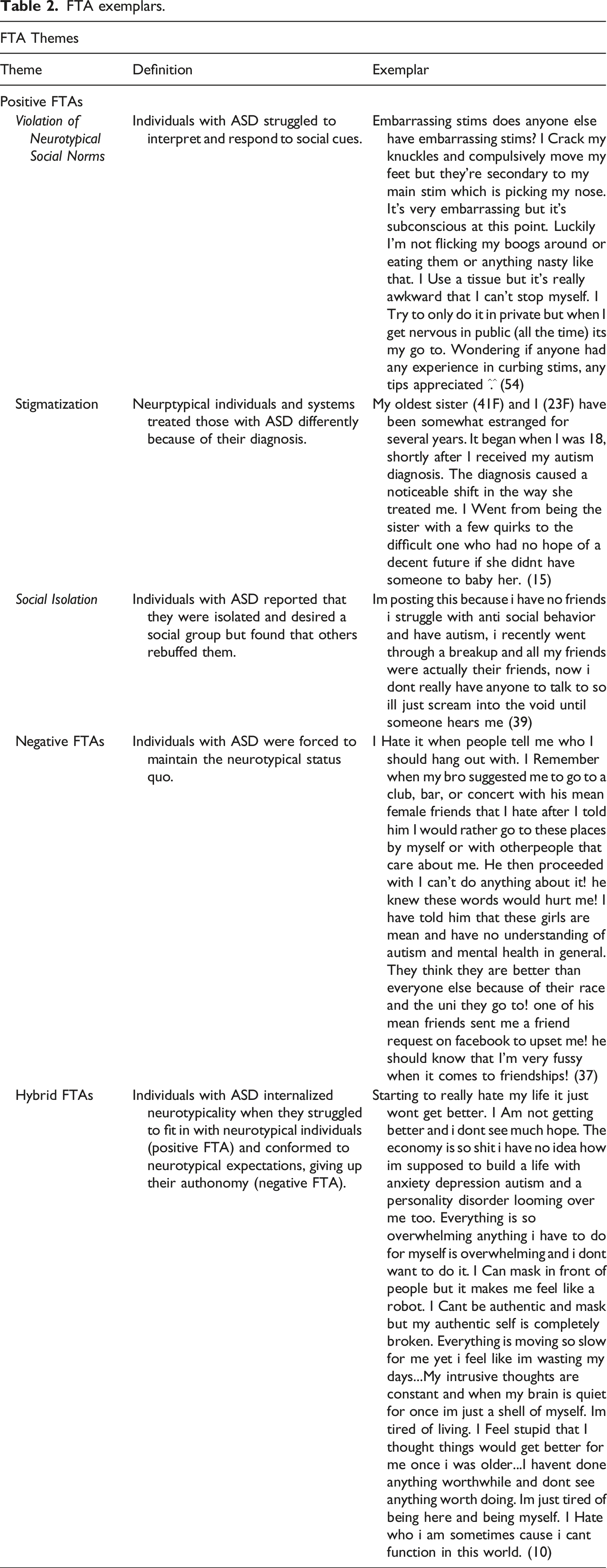
FTA exemplars.
Positive
Posts included three types of positive FTAs: (a) violation of neurotypical social norms, (b) stigmatization, and (c) social isolation. Positive FTAs were ubiquitous (U in Table 1).
Violation of neurotypical social norms
Individuals with ASD reported difficulty conforming to and/or understanding the social cues expected by their neurotypical counterparts, such as how to interpret and respond to social situations. For example, one poster explained: My understanding of sarcasm.... There are also times where someone will say "I'm so pissed today" and I'll be like "well that is unfortunate " and then they will say "I was being sarcastic" or "I was joking". But I didn't even know if they were joking or being sarcastic at first. But honestly my understanding of sarcasm is very random. It is like but if I had to guess it is probably like 40% of the time I actually understand it and 60% I don't understand it. (45)
Stigmatization
Smith (2007) defines stigma as “a simplified, standardized image of the disgrace of certain people that is held in common by a community at large” (p. 464). Individuals with ASD reported that neurotypical individuals and systems treated them differently because of their diagnosis. When experiencing stigmatization, posters explained that family members, friends, educators, and even strangers treated them as less than their neurotypical counterparts. One poster wrote: Family, however, make autism just feel so stigmatic and burdensome. What I mean is they act like me existing in their lives should entitle them to a Victoria Cross or medal of honor. It feels like “Ooh, look at me, a veteran of dealing with my autistic son for 19 years!”…The sad thing for me is I know they have no bad intentions when talking about autism but it makes me feel like shit personally (and I can't bring myself to say anything about it). This leads me to not being able to talk about my problems likely related to autism because I feel like the problem to them instead. (23)
Social Isolation
Those with ASD reported experiencing social isolation. People explained that they were isolated, often desiring a social group; yet found that others rebuffed them. For example, one poster pointed out: Every year I feel lonely and sad on my birthday. I want to celebrate with other people to feel love and belonging but I don't know how to organize it and even if I do I'm scared I'll be the outsider of my own party. My best friend will be with me for sure but I crave for more. Once when I was a kid I organized a party and almost no one came. (21)
Negative
Individuals with ASD reported negative FTAs when neurotypical individuals and systems told them that they could not, or should not, engage in specific behaviors. For example, one poster stated: Before I knew about my autism I thought about the military. Now seeing my brother join the marines I feel destined for more than being a baggage handler. But because of autism and the rules here in uk I am unable to join up. (52)
Neurotypical individuals and systems established that those with ASD did not have the autonomy to communicate in the way that was natural to them, to ask other to meet their needs, or to pursue their dreams, such as certain careers. Posters also reported hybrid FTAs.
Hybrid
Individuals with ASD reported face threats that targeted both their positive and negative face. These hybrid face threats occurred when posters with ASD communicated their internalized neurotypicality. These posters reported feeling ashamed about their diagnosis, a positive face threat, which lead them to trying to conform their behavior to fit within neurotypical standards, a negative face threat. For instance: I think that one part of my reasons for sh [self-harm] was self-hatred, one part was the environment, etc.I hated myself because of my social skills, for example I can say stupid stuff, I don't know what to do in some situations so I imitate others, I stress with people I don't know, (18)
RQ2: Self facework
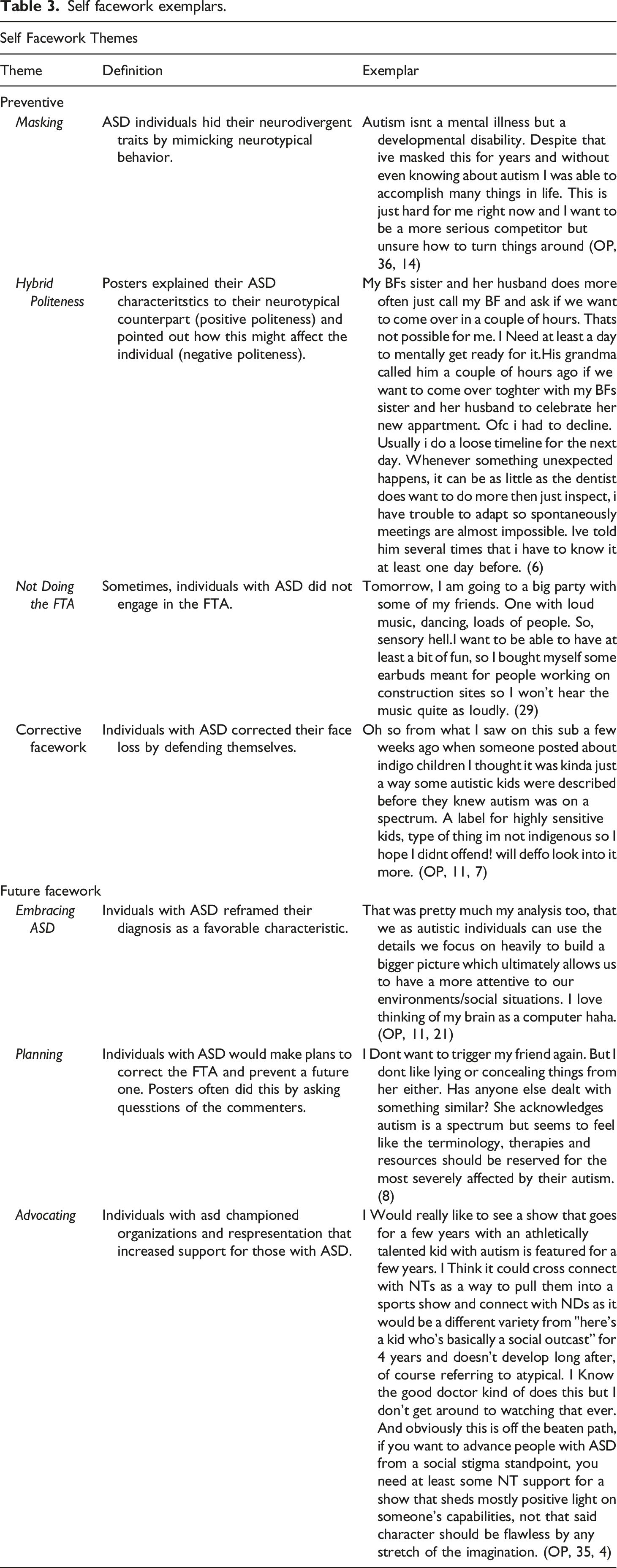
Self facework exemplars.
Preventive facework
When engaging in preventive facework, individuals with ASD (a) strategically masked, (b) employed hybrid politeness, and (c) chose not to do the FTA.
Masking
Posters used masking to prevent face-loss due to their neurodivergence. When masking, individuals with ASD mimicked the behaviors of neurotypical individuals (Milner et al., 2019). One poster explained, “I can mask in front of people but it makes me feel like a robot. I cant be authentic and mask but my authentic self is completely broken” (10). Those with ASD veiled their behaviors to make social interactions with their neurotypical counterparts easier and save their face; however, masking is a process that is both laborious and hides the individual’s identity.
Hybrid Politeness
Individuals with ASD tried to simultaneously prevent positive and negative face-loss to others and themselves by using hybrid politeness. Posters did this by explaining their ASD characteristics to their neurotypical counterpart (positive politeness) and pointing out how this might affect the individual (negative politeness). Hybrid politeness focuses on saving the face of the addressee, which then saves the face of the speaker as well. One poster stated: Every time I meet new person that wants to treat me as a friend or smth [sic] like that one of the first things I tell them is that I am autism and ADHD haver so it is difficult for me to communicate AND THE FACT THAT I MAY GET TIRED OF COMMUNICATING AND DISAPPEAR FOR MULTIPLE DAYS IS NORMAL AND THEY NEED TO ACCEPT IT IF THEY WANT TO BECOME FRIENDS WITH ME. (4)
Not Doing the FTA
Another politeness strategy that posters with ASD used was not doing the FTA. Not doing the FTA is a preventive politeness strategy individuals use when they decide not to engage in the FTA to begin with. For example, one poster reported: I've decided against communicating my feelings to her. I know she doesn't have bad intentions, but she made a jab at my autism the other day and I just acted like it didn't hurt and kept my mouth shut, even though she was blatantly wrong. (47)
Corrective facework
Following a FTA, those with ASD corrected the face-loss they experienced by defending themselves. This occurred in both the original post, and in follow up comments after a commenter threatened the original poster’s face. Following a FTA with their mother-in-law, one poster shared: Ive tried explaining things to her to provide some context& you know, reassure her that I do want to spend time with her and that Im not just a miserable bitch. Ive also tried explaining how the social pressure of these visits combined with stressful life circumstances makes me more likely to shut down, even though I desperately want to do the opposite. (46)
Future facework
Individuals with ASD used future facework to correct face-loss in the moment and prevent future face loss from those individuals. Those with ASD discussed enacting future facework in their offline interactions and relationships by (a) embracing ASD, (b) planning, and (c) advocating.
Embracing ASD
Individuals with ASD saved their face after a FTA, and prevented future face-loss, by reframing ASD as a favorable characteristic. After having a bad day and internalizing neurotypicality, one poster stated, It actually fucking worked though, I'm comfortable, feeling a lot better AND actually found the best bus bus I've been on ever - it's not the newest ugly design but it's not super old, like it's classic with charging ports. it goes through all these beautiful fancy areas, noone on the bus is judgy or scary, it passes by a massive scenic park, and I can see the hills by my house nearly the entire journey. It also just so happens to stop at my favourite part of the city centre. Im not a train autistic guys, but I am a bus autistic (19)
Planning
Furthermore, those with ASD would make plans to correct the FTA they experienced to prevent future face-loss. One way that those with ASD would do this is by asking questions of others about how they might handle similar situations. For example, one poster, a martial arts competitor, wrote: I realize I have a disability and I want to have a conversation with my professor about it. I am very serious about competing but I dont know how to approach this or how to strategize around my disability so I can capitalize on the training as much as possible. What would you do? (36)
Advocating
After experiencing a FTA, individuals with ASD saved their face correctively, and preventively, by championing organizations that increased support for others with ASD. For instance, one poster explained: Is there someone at the university I could go to/email, explain why Autism Speaks is problematic, and ask them to cut all ties with them if they havent already? Do I just go the everyone has skeletons in their closet so why botherroute because Ive probably participated in organizations that support them throughout my childhood just because theyre the go-to autism charity in Hollywood et al.? (7)
Posters with ASD engaged in (a) preventive, (b) corrective, and (c) future facework. Commenters served as communication partners, and enacted other facework on behalf of the individual with ASD.
RO3: Other facework
Other facework exemplars.
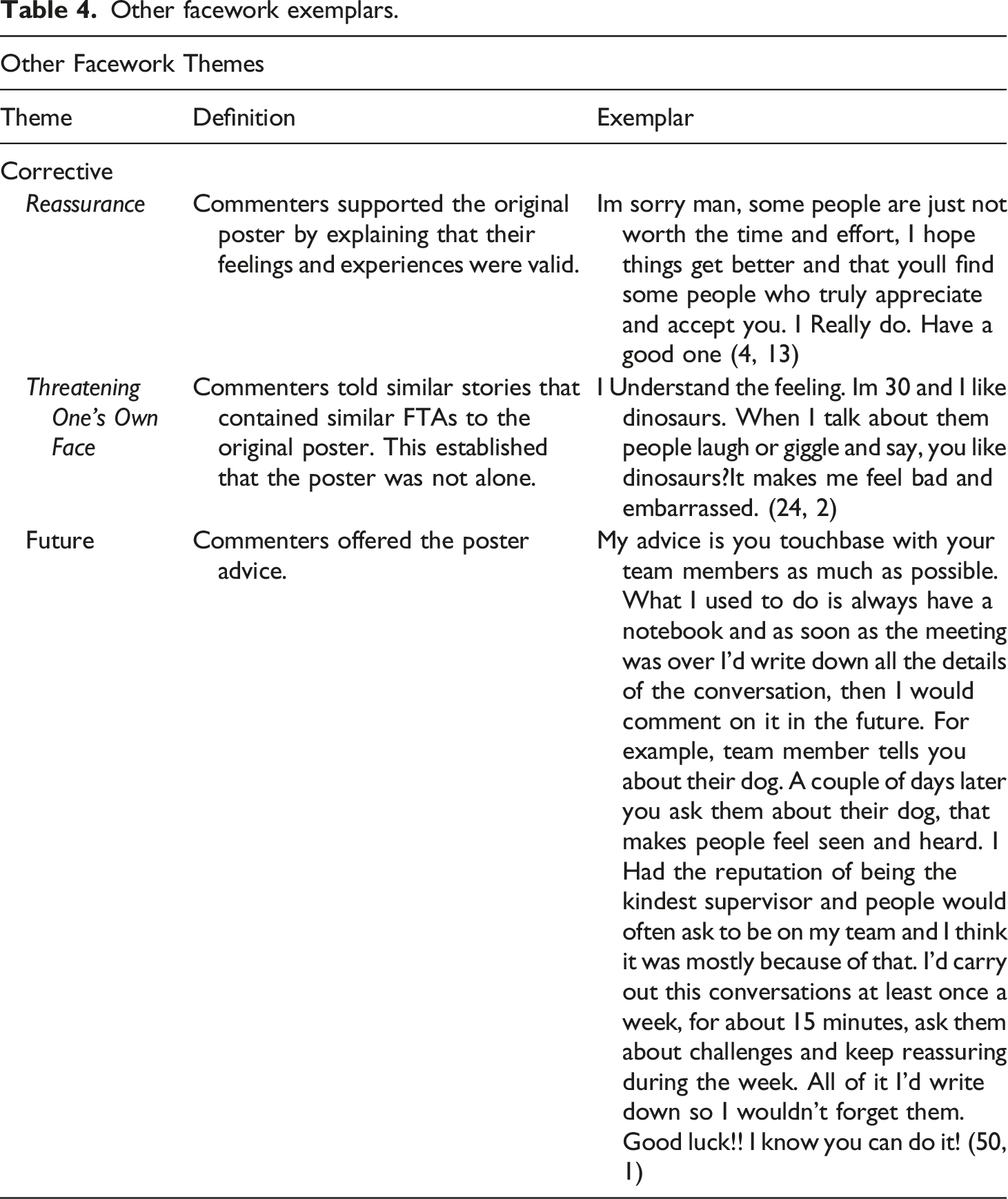
Corrective
In response to the post, commenters helped correct the face-loss of the original poster through (a) reassurance and (b) threatening one’s own face.
Reassurance
In response to the original posters’ expressions of FTAs, commenters supported the poster by explaining that their feelings and experiences were valid. For example, after an individual with ASD described worrying about being a burden to others, one commenter affirmed: Anyway, point is it may take time, but at some point you will find people who will treat you properly and not judge you for your disabilities. I am not going to say it isn't lonely, and I am not going to say it won't take time to open up, especially if you've been mistreated or told you are bad in some way like I have. But you can find people who will like you, and maybe even love you, for who you are despite all your challenges. (27, 1)
Threating One’s Own Face
Commenters often told similar stories, including comparable FTAs, to that of the original poster. In doing so, the commenter established that the poster was not alone, thus helping correct the posters’ face-loss. For example, after a poster described their embarrassing stem, or repetitive behavior, one commenter replied: I move my tongue around a lot, like mouth shut or open, and recently have been popping my mouth. The mouth thing hasn't been an issue and is not super apparent unless you're around me alot, but when I'm super focused I will let my mouth just do its thing. Wearing masks [as a COVID-19 precaution] was great because I could do it under my mask (plus I talk to myself, so the mask hid my mouth movie too). (54, 4).
Future
In addition to providing corrective facework, commenters also engaged in future facework for the poster by offering advice. The advice commenters offered often corrected the posters’ face-loss while providing actions that the poster could take in the future to prevent a FTA. A poster reported a FTA about their friends finding them overbearing (violation of neurotypical norms), and one commenter stated: I think overprotective might be a better word. People like to know that their friends care about them, but they don't necessarily want their friends to take care of them… Sounds like they just want a little more space and freedom, you're not their parent, they don't want to feel obliged to report back to you several times a day. You want them to know that you are there for them if they need you but most of the time they don't need you, and you have to let that be okay. (5, 2)
Commenters provided corrective facework by explaining or reframing the face-threating situation before providing future actions the original poster could take to avoid FTAs. Commenters enacted other facework on behalf of the original posters through (a) corrective and (b) future facework.
RQ4: Co-occurrences between FTAs and enacted facework
Co-occurrence exemplars.
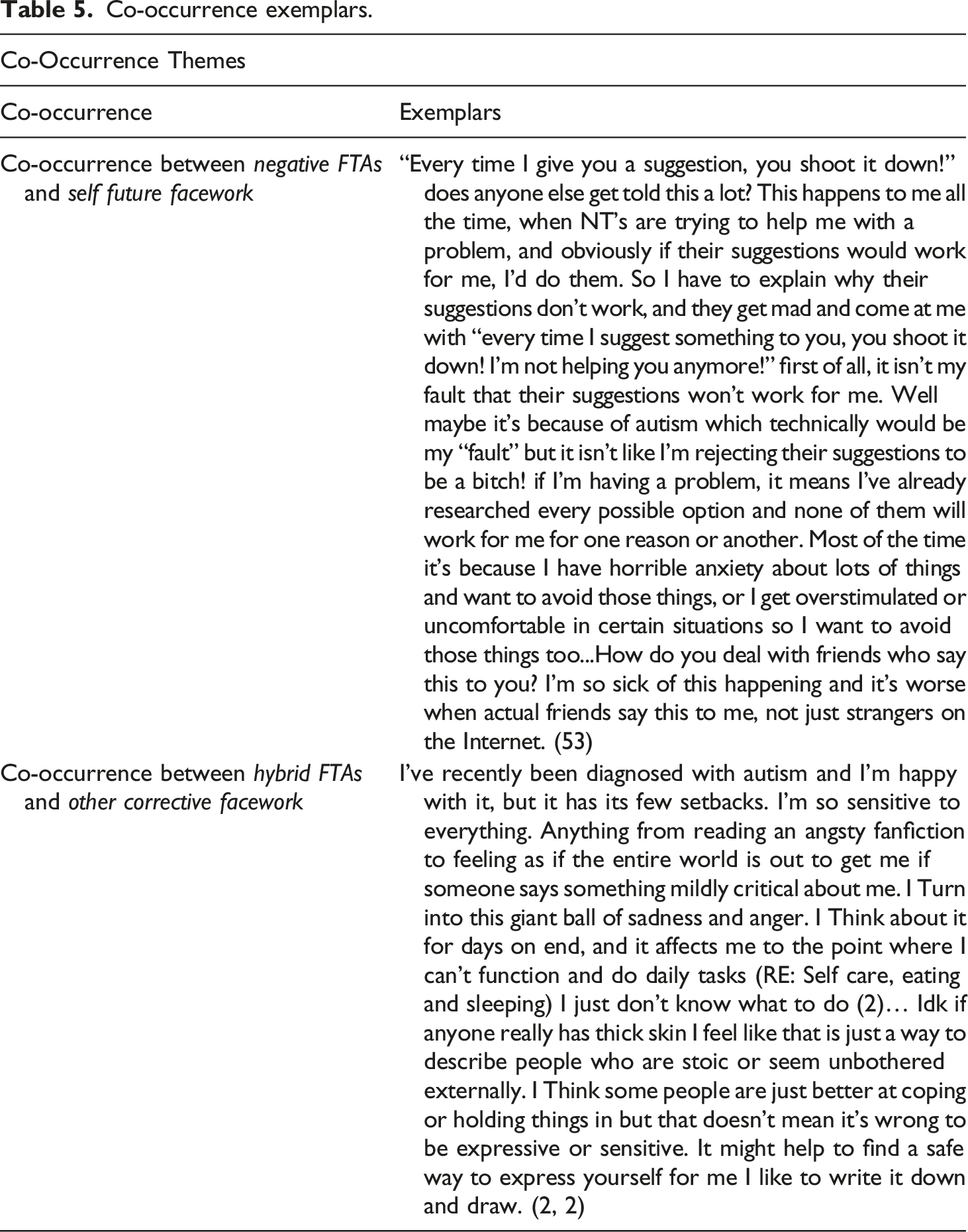
Relationship between negative FTAs and future facework
There was a relationship between the negative FTAs that posters reported and their use of future facework. The relationship was sporadic, meaning that the relationship did not occur in most of the posts. This relationship was unilateral, which means that when a poster experienced a negative FTA, they also reported some form of future facework; however, when individuals used future facework, they did not always report a negative FTA. Additionally, the themes were balanced because they had similar repetition, recurrence, and forcefulness (Owen’s (1984) standards). A poster whose father had an ASD diagnosis, and identified as having ASD but lacked the formal medical diagnosis, stated: On the other hand, what if I decide I want to adopt a child when I'm older? ... Could being diagnosed make that no longer possible? What if I decide I want to immigrate to another country after college? (I am from the US). Could diagnosis prevent that?... I now very proudly identify as autistic and I've done so much work undoing his [father’s] abuse. Getting my autism diagnosed would feel so empowering and I could get accommodations when I start college. I am so scared and worried about being able to do college and I think accommodation would help a lot. (48)
This poster expressed how a formal diagnosis, which could help her in school, might diminish her autonomy in the long run by maintaining the neurotypical status quo. Although she was concerned about an ASD diagnosis, this poster reported that she has come to embrace her ASD and finds it empowering rather than disparaging. When posters experienced negative FTAs, they also used future facework, coalescing into a relationship between the themes.
Relationship between hybrid FTAs and other corrective facework
A second relationship emerged between posters’ reported hybrid FTAs and commenters’ use of other corrective facework. This relationship was sporadic and did not occur in most of the posts. When participants reported a hybrid FTA, commenters often used other corrective facework. Yet, commenters also used other corrective facework on posts that did not report a hybrid FTA. Additionally, the relationship was unbalanced meaning that it did not have similar recurrence, repetition, and forcefulness. One poster expressed a hybrid FTA when they wrote: I'm 32 and was only diagnosed in the last few years… And now I'm reaching a point in my life where I'm really tired of exhausting myself for the benefit of everyone around me. But I also don't know how to stop. I don't know how to figure out who I actually am without this constant nagging narrative of reminders of what everyone else likes/expects/respects. Any time I want to do anything that desires (or requires) the slightest bit of personality, all of this noise and criticism and all of these learned "rules" come in and snuff it out like a candle. Everything I do is in the interest of being the least problematic and least noticeable. And now it's like.... I don't know who I am at all. I'm everyone else, but I'm not me. (49)
In response to this poster’s internalized neurotypicality, one commenter explained: Been struggling with this myself, diagnosed in my 30s as well.. … I was asked, whats underneath the rules.. what do you WANT to do/be like?.. and there was nothing. Nothing underneath the scaffolding of decades of strategies.. and trying to plug in things that I think i *should* like are just more scaffolding around the nothing. (49, 2)
Discussion
Posters with ASD experienced (a) positive, (b) negative, and (c) hybrid FTAs. Like past research, those with ASD reported that their communication differences violated neurotypical norms (Caldwell-Harris & Jordan, 2014; Paul et al., 2008; Rodríguez Muñoz, 2013), that they experienced stigma (Bachmann et al., 2019), and social isolation (Gillespie-Lynch et al., 2014). In response to the FTAs, posters mitigated their face-loss using (a) preventive, (b) corrective, and (c) future facework. Individuals with ASD used the preventive strategies of (a) masking (Milner et al., 2019), (b) hybrid politeness, and (c) not doing the FTA. When using future facework, those with ASD engaged in two new future facework strategies when they (a) embraced their ASD and (b) planned for future interactions. Like those with visual impairments, people with ASD also used advocacy as a future facework strategy (Romo et al., 2023). Additionally, commenters helped posters save face using other corrective and future facework. Commenters used other corrective facework by reassuring the poster and threatening their own face. TCA revealed two relationships among FTAs and enacted facework (see Table 1) (a) between negative FTAs and self future facework and (b) between hybrid FTAs and other corrective facework. These findings provided theoretical implications and practical applications.
Theoretical implications
Our findings hold implications for facework theorizing through (a) online interactions, (b) providing empirical evidence that FTAs and facework are related, and (c) extending future facework. First, by focusing on online communication, we were able to examine facework in actual interactions. This allowed us to provide evidence of other facework. Although all the posts included in the sample required the poster to describe a retrospective FTA, many posters also experienced FTAs in the comments of their posts. Reddit afforded us the opportunity to examine retroactive and emergent FTAs and facework. These emergent facework strategies provided empirical interaction evidence of other facework that commenters used to save-face for the original poster. Although other scholars have discussed other facework, they did so retrospectively (see McBride, 2010). These retrospective interviews allowed scholars to study how participants felt others helped them manage their face (see McBride & Toller, 2011) or how the participants reported they helped others manage their face (see McBride et al., 2020). These emergent interactions provided evidence for Cupach and Mett's (1994) assertation that individuals can enact facework for others. Commenters enacted both corrective and future facework on behalf of the original poster. Correctively, other facework allowed for the facework strategy of threatening one’s own face to emerge. Traditionally, facework scholars discuss strategies that individuals engage in to save their own face and the face of those they interact with (Brown & Levinson, 1987; Goffman, 1959). Yet, during other facework, commenters often shared stories that would threaten their own face, particularly their positive face, to save the face of the original poster. By doing so, the commenter established that the original poster was not alone in experiencing the FTA and lessened the face lost.
Second, this study provides empirical evidence for the theoretical assumption that FTAs and facework are related. Often scholars theoretically frame facework as a response to FTAs (see Cupach & Metts, 1994); however, until recently, there was not an interpretive method that made it possible for researchers to examine how the two are theoretically and practically related. This study answers the call put forth by Romo and colleagues (2023) to examine how FTAs and facework strategies co-occur. Using TCA, we found two co-occurrences between the FTAs that individuals with ASD reported and the facework strategies used to save face (a) negative FTAs co-occurred with self future facework and (b) hybrid FTAs co-occurred with other corrective facework. This study showed that individuals with ASD experience FTAs and use facework strategies in patterned ways.
Finally, this study provided further evidence for, and extends, Romo and colleagues’ (2023) future facework. Specifically, future facework occurs when individuals simultaneously correct their face and prevent future face-loss. Romo and colleagues (2023) identified education and advocacy as future facework strategies. In this study, individuals with ASD enacted future facework by (a) embracing their ASD, (b) planning, and (c) advocating. This study identified two additional strategies individuals might use when enacting future facework. Another extension to future facework is that in addition to individuals enacting future facework for themselves, commenters enacted other future facework on behalf of the original poster. This study furthered our understanding of self and other future facework.
Practical applications
This study provides practical insights for individuals with ASD and other facework. First, rather than viewing ASD as a communication deficit, this study identified common face threats that those with ASD experience from a communication difference perspective. Current therapies for those with ASD focus on improving social interaction and verbal communication (Sharma et al., 2018). These therapies treat the communication of those with ASD as problematic and might have contributed to the hybrid FTAs or internalized neurotypicality. Instead, clinicians should explain the FTAs these individuals might experience and provide recommendations on potential responses. Then, an individual with ASD might be prepared to enact facework. Future facework might be a powerful tool for those with ASD by helping individuals embrace their ASD and provide tangible steps for when FTAs occur. Future facework might even be less exhausting than masking and provide those with ASD an alternative to conforming to neurotypical standards. In doing so, future facework might help those with ASD resist neurotypical norms and expectations. Similarly, practitioners can educate family members on how they might enact other facework to help those with ASD navigate FTAs. Commenters used other facework to help strangers online. Other facework might be effective when it comes from family and friends.
Limitations and future directions
This study must be interpreted considering some limitations. First, although the use of Reddit data provided us many opportunities, it does not come without its limitations. Because Reddit does not require posters to provide demographic information, we do not have these data. This is concerning because white males are more likely to receive an ASD diagnosis than any other demographic (Baio et al., 2018). These data might or might not have represented a more diverse group than the population. Similarly, without demographic information we do not know where on the ASD spectrum posters fell. Additionally, because these posts naturally occurred on Reddit, we were unable to ask follow-up questions or ascertain poster perceptions. Thus, we were unable to analyze the success of these strategies. Likewise, early facework scholars used the context of stranger interactions to study face; however, the theory has become more relational. Because the emergent interactions occurred with strangers, we were only able to capture the relational aspects of facework during retrospective accounts. In the future, scholars should approach the communication of those with ASD as a difference rather than a deficit. Additionally, scholars should examine how those with ASD perceive the FTAs they experience and their facework strategies. Additionally, more research is needed for scholars to understand other facework, especially during face-to-face interactions. Such research should examine how the individual receiving other facework perceive these strategies.
Footnotes
Declaration of conflicting interests
The author(s) declared no potential conflicts of interest with respect to the research, authorship, and/or publication of this article.
Funding
The author(s) received no financial support for the research, authorship, and/or publication of this article.
Open research statment
As part of IARR’s encouragement of open research practices, the authors have provided the following information: This research was not pre-registered. The data used in the research are public available on the Web site reddit. The data used in this study can be obtained by emailing:
