




Abstract
Mother-daughter relationships are characterized by tension between autonomy and connection, generating uncertainties in routine communication. Drawing on the Uncertainty Management Theory, this study explored relational uncertainties in adult mother-daughter communication across life stages within a familistic culture. We conducted six focus groups with 43 Israeli women across three generations: young adult (ages 23–35), midlife (ages 45–62), and elderly (ages 68–82). Thematic co-occurrence analysis identified three uncertainty types (information sharing, well-being, and availability) and their interactions. Women employed strategies aimed at both reducing uncertainties through direct communication and third-party assistance, and maintaining uncertainties through accepting, avoiding, and restraining. Findings extend the uncertainty management framework by illuminating how mother-daughter relationships in a familistic culture shape relational labor and communication dynamics across women’s lifespans.
Keywords
Mother-daughter relationships are unique within the family (Miller-Day, 2004) and remain significant throughout women’s lives (Alford & Miller-Day, 2019; Fingerman et al., 2020b). This study focuses on communication among young adult daughters and midlife mothers as well as midlife daughters and elderly mothers. We use the term “young adult” to refer to a developmental stage marked by achieving adult milestones (e.g., financial independence, autonomous living, committed partnerships). This stage can extend into the 40s depending on cultural context (Beckmeyer & Jamison, 2024; Cepa & Furstenberg, 2021). At the heart of these relationships lies a perpetual tension between autonomy and connection, shaping their interactions and expectations (Jordan, 1991). Across life stages, this tension yields relationships marked by both closeness and irritation (Alford & Miller-Day, 2019; Bojczyk et al., 2011; Fingerman et al., 2020a). Such ambivalence can generate uncertainties in mother-daughter interactions.
Uncertainties in mother-daughter relationships can lead to negative feelings (Knobloch et al., 2007; Lillie et al., 2021) and communication difficulties (Knobloch & Solomon, 2005). The absence or suppression of relational uncertainty may be equally significant yet remains underexplored. Unlike romantic relationships where uncertainties about the future are normative, mother-daughter relationships are rooted in lifelong connection creating different uncertainty dynamics. This is particularly salient in familistic cultures, where family unity is highly valued and women maintain close intergenerational ties (Fogiel-Bijaoui & Rutlinger-Reiner, 2013). Cultural norms may suppress uncertainty expression, though uncertainties may manifest differently in routine communication or remain unspoken.
Given these unique dynamics, there is a gap in understanding how relational uncertainties manifest in routine mother-daughter communication. While previous research has examined either mother-daughter communication patterns or uncertainty management separately, few studies have investigated how uncertainties emerge in everyday mother-daughter communication across different life stages. Communication technologies further complicate these dynamics, introducing new challenges alongside opportunities for connection (Fingerman et al., 2020a) as they blur boundaries and hamper individual autonomy (Hatzir & Segev, 2023).
The Uncertainty Management Theory (UMT) (Brashers, 2001) provides a valuable framework for examining these dynamics. UMT posits that uncertainty is not inherently negative but a complex experience individuals address through communication. People may choose to maintain or even increase uncertainty depending on their goals and context. This perspective suits mother-daughter relationships, where uncertainties about roles, boundaries, and expectations persist throughout life. This study explores how mothers and daughters experience and address uncertainties in routine communication within a familistic context.
Mother-Daughter Relationships Across Life Stages
Mother-daughter communication through all life stages is crucial in shaping identities, roles, and expectations for both women (Alford, 2021; Baxter & Braithwaite, 2009; Bojczyk et al., 2011). Throughout life, mothers and daughters constantly negotiate their need for closeness and intimacy on the one hand, and autonomy and independence on the other (Bojczyk et al., 2011). Young adult daughters attempt to set the boundaries with their midlife mothers as they start their own independent life away from home (Miller-Ott & Kelly, 2019). Midlife daughters and their elderly mothers experience role reversals with daughters assuming caretaking responsibilities, which again involves communication tensions around dependence and autonomy (Fingerman et al., 2020a; Jeon, 2023).
This relationship is further complicated by the feeling of worry. Worry can be experienced by both mothers and daughters, depending on the social environment and life stages (Alford, 2025; Hay et al., 2007; Shrira et al., 2019; Wenzel & Poynter, 2014). Parents worry about diverse aspects of their adult children’s lives, such as health, safety, relationships, and finances, whereas adult children primarily worry about their parents’ health (Hay et al., 2007). This worry becomes part of mothers’ and daughters’ mental and emotional labor. Mothers bear the mental load of enduring family care, involving cognitive labor like planning and organizing as well as emotional labor including responsibility and constant worrying (Dean et al., 2022). Adult daughters similarly engage in “kin work”, often invisible care, including attending to mothers’ needs, maintaining communication, and thinking about the future (Alford, 2021). Research predominantly focused on mothers’ worries, rarely examining young adult daughters’ concerns.
The cultural context is a crucial factor in these dynamics. This study explores Israeli mothers and daughters within a context of “familism” (Fogiel-Bijaoui & Rutlinger-Reiner, 2013). In Israeli culture, the family occupies a central role at both societal and individual levels, with familism shaping everyday practices, attitudes, identity development, and feelings of belonging (Berkovitch & Manor, 2023). As such, Israeli culture is characterized by close emotional and geographical ties between parents and children (Katz, 2009; Lavee & Katz, 2003). Despite ongoing processes of individualization, and westernization, Israeli society has reinforced family connections (Berkovitch & Manor, 2023).
Relational Uncertainty Within Mother-Daughter Communication
Relational uncertainty (RU) represents a fundamental aspect of close relationships. It focuses on close relationships (Knobloch, 2010), the ongoing process of relating and making meaning in intimate social relationships (Baxter & Braithwaite, 2009). RU manifests through three interconnected sources: self, partner, and relationship uncertainties. Self-uncertainty refers to a lack of clarity about one’s thoughts, actions, and level of involvement in the relationship. Partner uncertainty involves lack of information about the partner’s expectations, attitudes, and values regarding the relationship. Relationship uncertainty refers to doubts about the relationship itself including norms for appropriate behavior within the relationship, mutual feelings between partners, and uncertainty about the future (Knobloch & Solomon, 2003; Theiss, 2018). These dimensions of uncertainty are particularly relevant to mother-daughter relationships, where both parties continuously negotiate identities, roles, and boundaries throughout the lifespan (Alford & Miller-Day, 2019; Fingerman et al., 2020b).
To date, no studies have integrated RU in routine mother-daughter communication. However, researchers have focused on uncertainties of parent-child relationships within different contexts, such as divorce (Mikucki-Enyart et al., 2018), adoption (Colaner & Kranstuber, 2010), spousal/parental death (Droser, 2020), transition into emerging adulthood (Scheinfeld & Worley, 2018), and children who are in the estrangement process with their parents (Scharp & McLaren, 2018). A common thread across these studies is the doubts arising during changes in the roles of family members and the need to redefine relational boundaries.
This research focuses on routine mother-daughter communication within a familistic society. Within this context, gendered norms shape mother-daughter relationships distinctively. Women’s identities are strongly tied to motherhood and family caregiving (Kaplan et al., 2020), involving responsibilities such as organizing family gatherings and maintaining intergenerational connections (Berkovitch & Manor, 2019; Birenbaum-Carmeli & Carmeli, 2010). Although women have always took part in workforce in Israel, domestic duties and childcare remain prioritized (Frenkel, 2008), with women balancing these dual responsibilities across their lifespans (Kaplan et al., 2020; Manor, 2021). These gendered norms for relational maintenance may influence how uncertainties manifest and are managed in mother-daughter communication.
The availability of diverse communication channels, from face-to-face interactions to various digital platforms, offers varying degrees of flexibility and control in how mothers and daughters manage their communication (Madianou, 2021), reshaping relational dynamics parallel to broader social structural changes (Alkobi & Khvorostianov, 2024). Additionally, this study follows the assumption that uncertainties appear in interpersonal contexts (Knobloch, 2010). As such, the uncertainty experienced by one person can influence and potentially amplify or mitigate the uncertainty of the other, as well as their communication patterns (Knobloch & Theiss, 2011). Drawing on previous research examining parent-child uncertainties (Droser, 2020), we examine how relational uncertainties manifest in everyday communication from the distinct perspectives of mothers and adult daughters at different life stages.
Therefore, the first research question is:
What types of uncertainties (self, partner, relationship) do women experience in their routine mother-daughter communication practices?
How, if any, do different forms of relational uncertainty interact and co-occur?
Multiple theories address how people manage and respond to uncertainties (Afifi & Afifi, 2009; Theiss, 2018). Unlike earlier theories that focused primarily on uncertainty reduction, uncertainty management theory (UMT) recognizes that uncertainty management is a complex process where individuals may deliberately maintain or increase uncertainty depending on their goals and contexts. Thus, uncertainty is not necessarily good or bad, but an experience that individuals should manage (Brashers, 2001; Hogan & Brashers, 2009). The theory of communicative uncertainty management (TCUM) proposes nine principles that collectively emphasize the social, relational nature of uncertainty management. Additionally, it recognizes information gathering occurs through social interactions, with individuals avoiding, seeking, or being exposed to information (Hogan & Brashers, 2009).
UMT is especially relevant because it acknowledges uncertainty’s contextual nature, aligns with mother-daughter ambivalence (Fingerman et al., 2020a), focuses on communication as the primary management mechanism, and recognizes strategies evolve across life stages (Brashers, 2001). Within the UMT framework, communication strategies can be understood in terms of their approach (active vs. passive) and their impact on relationship quality (constructive vs. destructive) (Brashers, 2001; Hogan & Brashers, 2009). Given that our study focuses on relational uncertainty, examining both information-seeking behaviors and conflict strategies is important. Uncertainties in close relationships often manifest through and are managed via conflict-related communication patterns (Scheinfeld & Worley, 2018; Theiss, 2018).
Uncertainty management aligns with Rusbult and colleagues’ (1998) taxonomy of conflict management strategies, mapped into two dimensions: constructive versus destructive, and active versus passive. Constructive strategies promote relationship quality through engagement to find solutions (active constructive) or acceptance of the situation (passive constructive). In contrast, destructive strategies, associated with lower relationship quality, involve confrontation such as yelling or name-calling (active destructive), or avoiding issues (passive destructive) (Birditt et al., 2009). This integration examines how uncertainty management reflects relational dynamics and goals.
Research demonstrates that conflict management strategies depend on life stage considerations. Adult children, for example, tend to use more passive strategies, mainly acceptance, with their elderly parents. They often spend the time remaining together as is, rather than “working” on solutions or trying to change their elderly parents’ habits (Birditt et al., 2019; Wang et al., 2020). In contrast, parents of adult children apply constructive coping strategies with their offspring, aiming to guide and nurture them (Birditt et al., 2019). Notably, avoidance emerges as a common strategy employed by parents and children when discussing sensitive topics. Avoidance can stem from: the desire to shield oneself from potential judgment or criticism; the aim to safeguard the relationship from conflicts; concerns about the partner’s unresponsiveness to disclose information; the listener’s lack of knowledge to adequately address the issue; or considerations of social appropriateness (Guerrero & Afifi, 1995). Avoidance presents a paradox, while it can sometimes benefit relationships by preventing unnecessary conflict, it can also be harmful by preventing important issues from being addressed (Birditt et al., 2009).
Given the gap in understanding how uncertainty manifests and is managed in routine mother-daughter communication across life-stages and within familistic cultural contexts, the second research question asks:
What communication strategies do mothers and daughters employ to manage their relational uncertainties, and how do these strategies differ across life stages and roles?
Examining the association between relational uncertainties and management strategies reveals the complex nature of mother-daughter communication. Within uncertainty management theory, scholars recognize that managing one uncertainty can generate others and call to investigate systematic patterns between uncertainty types and management strategies (Hogan & Brashers, 2009). For example, Scharp and McLaren (2018) found that estranged adult children deliberately maintained uncertainty about parental love because both possible answers would create equally painful new uncertainties, illustrating how specific uncertainties may reliably link to maintenance rather than reduction strategies. Building on this foundation, Scharp et al. (2021) demonstrate that thematic co-occurrence analysis reveals the nature of relationships between themes, whether they are pervasive or occasional (sporadic), unidirectional or bidirectional (bilateral), and symmetrical or asymmetrical in strength (balanced). In mother-daughter relationships within familistic cultures, where cultural norms may suppress certain uncertainties while amplifying others, understanding these recurring patterns become particularly important. By examining which uncertainties systematically co-occur with which management strategies across life stages and roles, we can illuminate the interconnected ways in which these experiences unfold in routine communication. Given this theoretical imperative, the third research question asks:
What relationships exist between uncertainty types and management strategies used by mothers and daughters?
Method
We employed qualitative methods to explore uncertainties in routine mother-daughter communication (RQ1), their management (RQ2), and relationships between uncertainties and strategies (RQ3). Qualitative methods explore how participants interpret and cope with uncertainty as a subjective phenomenon (Brashers, 2001; Hogan & Brashers, 2009). Our focus on routine communication is required examining how uncertainty emerges and is addressed or suppressed across diverse relationship qualities rather than only in highly uncertain or estranged relationships. Therefore, we recruited participants across varied relationship types. In familistic cultures like Israel, cultural norms may suppress uncertainty expression. Recruiting only those reporting high uncertainty would miss how uncertainty operates when culturally minimized or left unspoken. This approach captured both explicit strategies and implicit patterns of suppression.
Focus groups were particularly suited for uncovering hidden or suppressed uncertainties. Interaction among participants encourages sharing of experiences that might not emerge in individual interviews (Duggleby, 2005; Krueger & Casey, 2000). Participant interaction provides mutual support while allowing examination of individual experiences, social positions, and power dynamics (Belzile & Öberg, 2012; Marková et al., 2007). The interactive nature enabled participants to respond to one another and reflect on experiences they might not have consciously recognized as uncertainties. Dialogue reflects broader cultural and social discourses (Duggleby, 2005; Lunt & Livingstone, 1996) about intergenerational relationships and uncertainty management in familistic contexts.
Participants
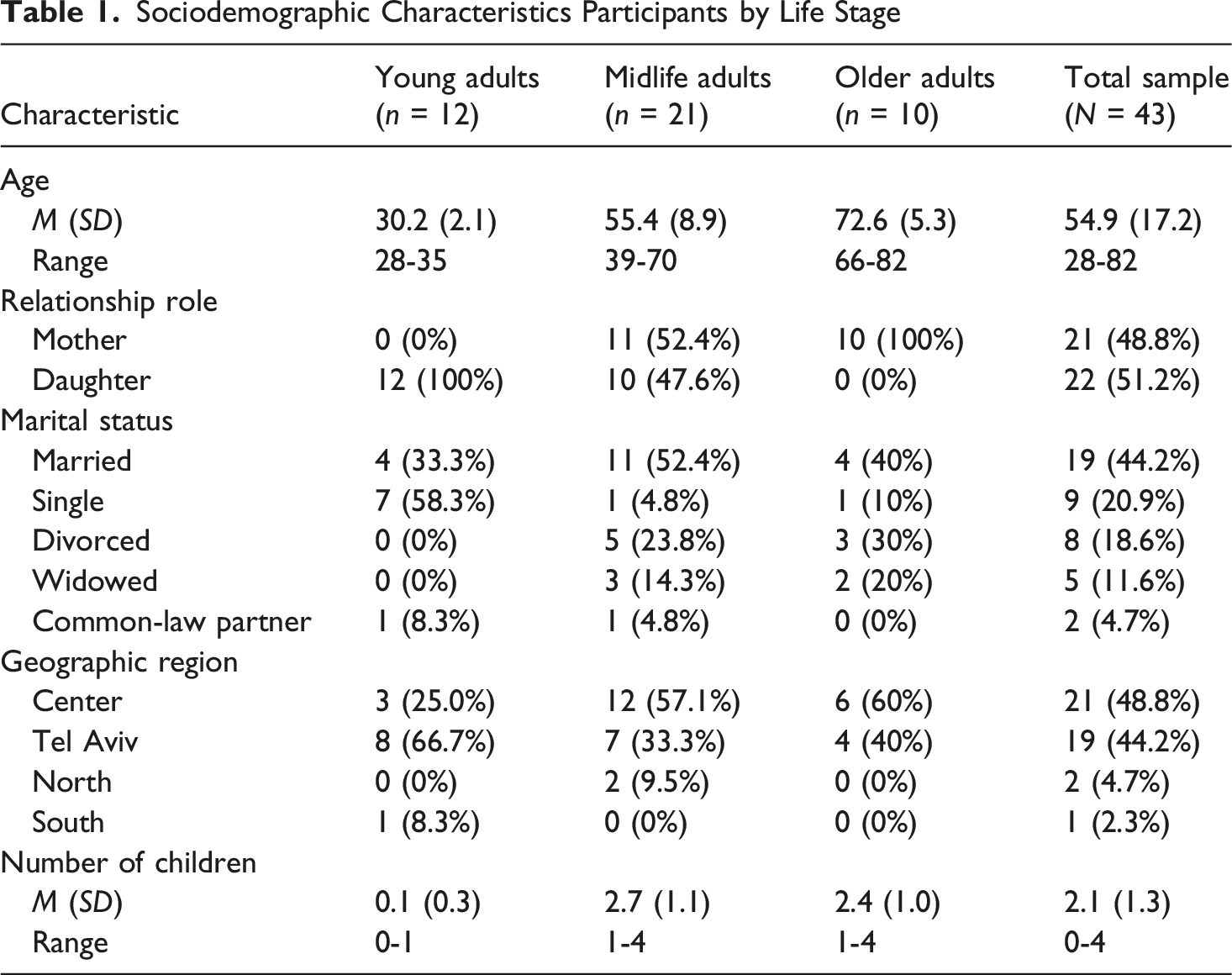
After IRB approval, we recruited participants through convenience and snowball sampling and Facebook postings. We conducted six focus groups with 6-8 participants each (N = 43). In each group, two generations of women took part: young adult daughters with midlife mothers in three groups, and midlife daughters with elderly mothers in three groups. The four life stages recruited were: young adult daughters (aged 28–35; M = 30.58, SD = 2.19), midlife mothers with at least one young adult daughter (aged 52-70; M = 59.54, SD = 5.35), midlife daughters (aged 39-67; M = 50.55, SD = 10.81), and elderly mothers with at least one midlife daughter (aged 66–82; M = 72.95, SD = 5.19).
Sociodemographic Characteristics Participants by Life Stage
Data Collection
Prior to meetings, participants completed a questionnaire collecting demographics and prompting reflection on communication frequency. Although the survey added context, the main study data derived from the focus groups. The first author moderated focus groups with a trained assistant at the university from March to June 2023, lasting 100–120 min. Meetings began with topic introduction, ground rules emphasizing all perspectives were valuable, and consent. Semi-structured interviews followed Krueger (1998) five-part structure: opening (self-introduction), introductory (communication frequency and initiation), transition (situations arising from communication patterns), and key questions (deeper understanding of relational challenges). For key questions, participants were presented with emotion cards displaying sentence stems with negative emotions drawn from Guerrero’s (2013) conflict emotion framework (e.g., “I felt sad when…”, “I was hurt when…”). Each participant selected a card reflecting an emotion she felt during a conflict with her daughter or mother, then shared a related story or experience. This card-based approach facilitated individual reflection before group discussion and helped articulate narratives revealing uncertainties. Throughout these discussions, the moderator actively probed for diverse viewpoints by asking questions such as “Does anyone experience this differently?”
Meetings were audio recorded and then transcribed in Hebrew using Transkriptor. Subsequently, the moderator and assistant moderator made necessary modifications to the transcripts. Each discussion yielded between 34 and 43 transcribed MS Word pages, comprising a total of 236 pages. Pseudonyms were used in place of participants’ real names to protect their privacy.
Data Analysis and Verification
We applied thematic co-occurrence analysis (TCA) (Scharp, 2021), a method used to depict and visualize relationships between and identify ambivalence and complexity. TCA involves three stages: conducting a thematic analysis, creating a co-occurrence matrix, and analyzing patterns of co-occurrence. Thematic analysis (Braun & Clarke, 2021) was applied to the focus group data, following the six phases: (a) familiarizing, (b) coding, (c) generating themes, (d) reviewing themes, (e) refining themes, and (f) reporting.
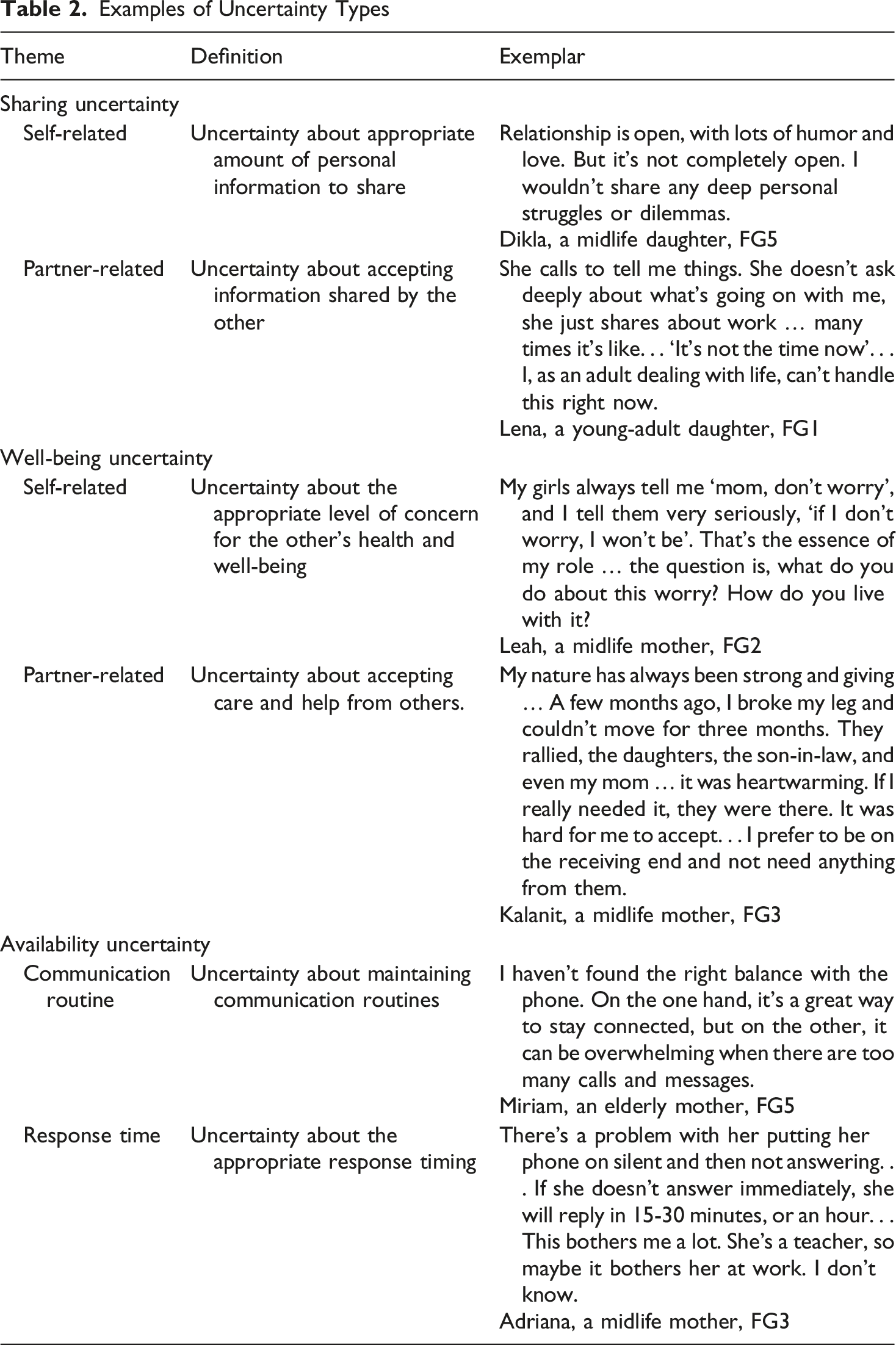
Examples of Uncertainty Types
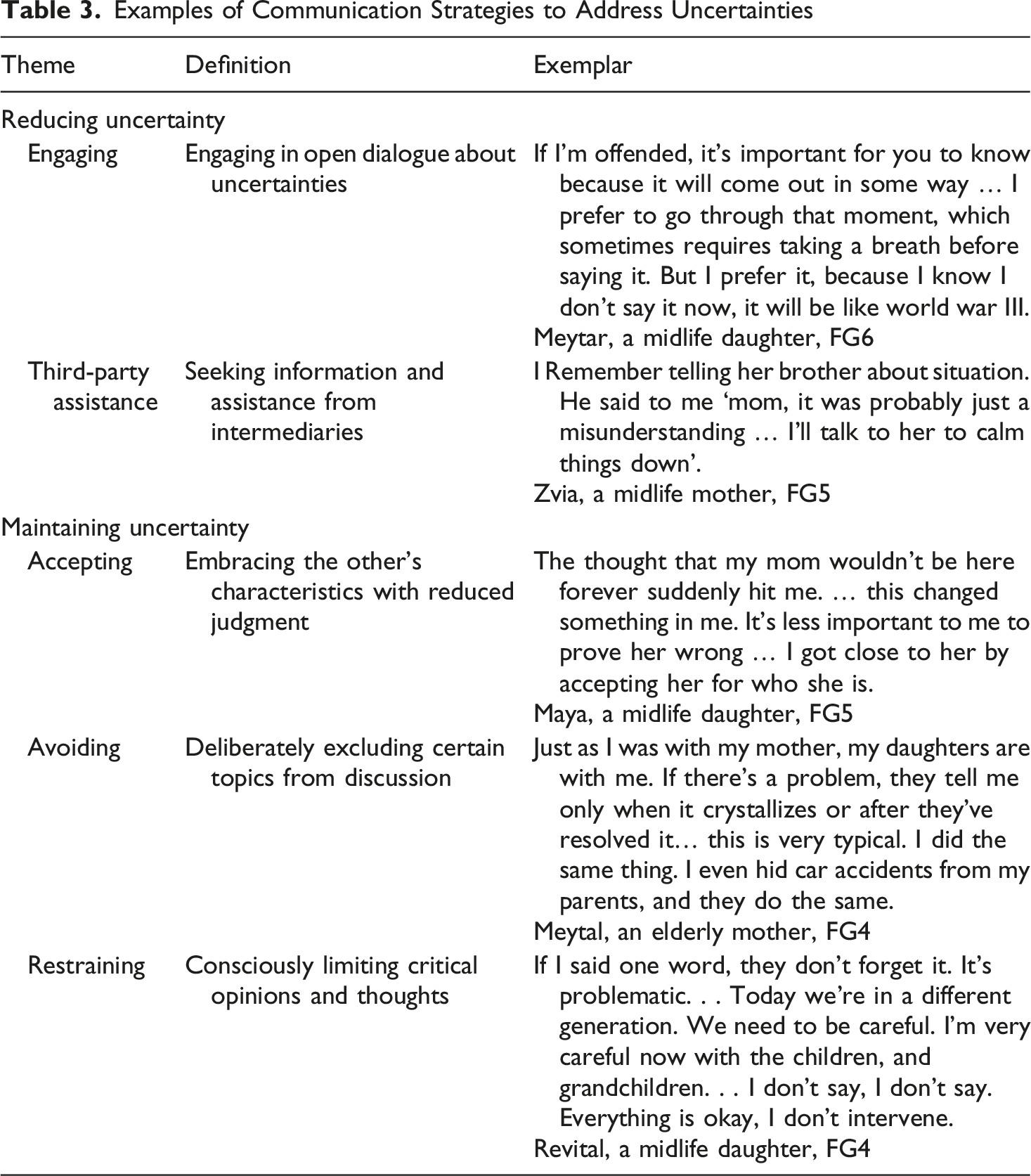
Examples of Communication Strategies to Address Uncertainties
Co-occurrence of Uncertainty Types and Communication Strategies
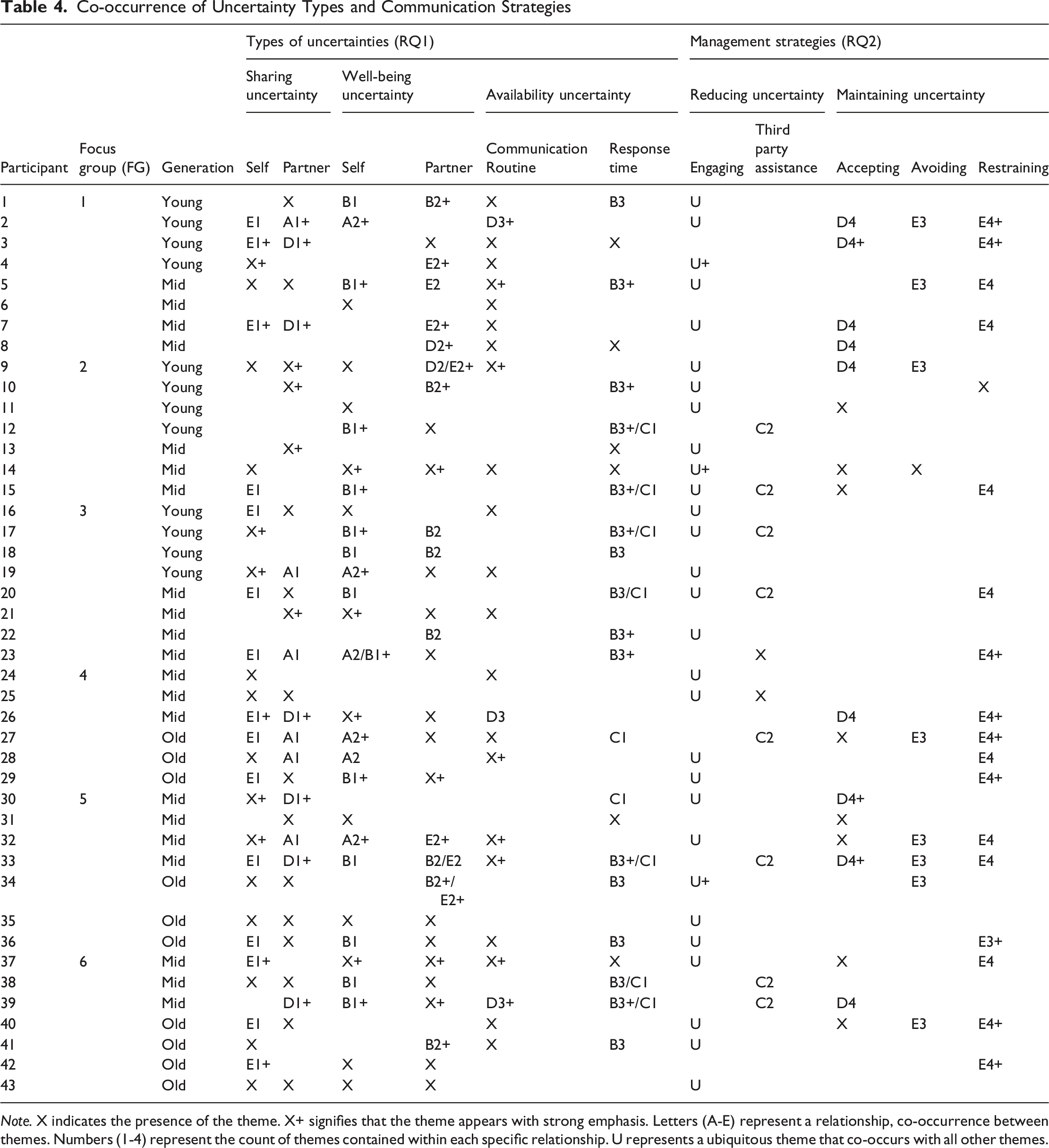
Note. X indicates the presence of the theme. X+ signifies that the theme appears with strong emphasis. Letters (A-E) represent a relationship, co-occurrence between themes. Numbers (1-4) represent the count of themes contained within each specific relationship. U represents a ubiquitous theme that co-occurs with all other themes.
We verified analysis through: (a) peer debriefing, (b) negative case analysis, (c) audit trail, and (d) exemplar identification (Lincoln & Guba, 1985). The first author coded transcripts and developed preliminary themes. Peer debriefing refined interpretations through seven meetings. For example, we debated “well-being uncertainty” versus “health uncertainty” or “worry uncertainty,” with our different perspectives as a young adult daughter and midlife man increasing credibility through reflexivity (Rennie, 2004). Negative case analysis tested our interpretations by actively searching for disconfirming instances. Specifically, examining cases that challenged our categorization revealed “restraining” and “avoiding” as distinct strategies, strengthening dependability. An audit trail documented decisions from recruitment through theme development. Exemplar identification enabled selecting quotes that illustrate themes and provide evidence in the Findings and Tables 2 and 3.
Findings
This study explored relational uncertainties in mother-daughter communication across life stages, examining uncertainty types (RQ1(a)), their interactions (RQ1(b)), management strategies (RQ2), and relationships between uncertainties and strategies (RQ3). We first describe uncertainties and their interactions, then the strategies.
Types of Uncertainties (RQ1)
We identified three types of uncertainties: (a) information sharing (self and partner), (b) well-being (self and partner), and (c) availability (communication routine and response time) (Table 2).
Information Sharing Uncertainty
Self-Related Uncertainties
Most participants were uncertain about how much personal information to share, what topics to discuss, and how to express opinions. All elderly mothers (n = 10), and half of the midlife mothers (n = 6) felt they must express their views about their daughters openly but found it difficult to speak without appearing critical or hurtful. For example, Michaella, a 55-year-old mother (Focus Group, FG1), explained: I'm always worried I'll say something that will end the conversation, or … leave a bad taste … I'm constantly trying to figure out what to say, what not to say. . . (Sigh of relief) Everything's fine, it continues.
Michaella’s dilemma illustrates mothers’ pressure to avoid offending their daughter or terminating the conversation, struggling to offer advice or assist without being perceived as judgmental.
Daughters (7 young adults, and 8 midlife) faced different self-uncertainty, questioning what topics to share to avoid information that might trigger maternal worry, excessive involvement, or unwanted reactions. Maya, a 39-year-old daughter (FG5), tearfully shared her frustration: I get hurt by my mom… there are moments when she immediately comes with a solution… before I even finish… I told her, 'I saw two houses today and I'm not sure which is better. One is in our neighborhood.' The next thing she said was, 'Oh, why this neighborhood? I hate it. No, don't stay here.' Killing the conversation.
Maya’s experience illustrates how unwanted reactions created uncertainty about sharing.
Partner-Related Uncertainties
Twenty-nine participants experienced uncertainty regarding how to respond to information shared. Concerns about information sharing varied. Six mothers (3 elderly, and 3 midlife) regretted daughters’ lack of disclosure. Other mothers worried about excessive sharing: four elderly women wondered whether oversharing indicated insufficient independence, while four found too much information caused overwhelming anxiety (2 elderly, and 2 midlife).
For partner uncertainties, daughters (7 young adults, and 7 midlife) experienced different concerns. They questioned to what extent they should accept their mothers’ advice or listen to their mothers’ difficulties without reciprocal sharing. Both young adult and midlife daughters felt unseen and unsupported by their mothers. Shira, a 29-year-old daughter (FG1), illustrated how this uncertainty begins in young adulthood: She (her mother) asks me about career paths, family matters, holiday preparation … things that she thinks I'm knowledgeable about. In one way, it's very flattering … and I love being an understanding and advising. On the other hand, it makes me feel like. . . if you're consulting with me, then who do I go to? Throwing the ball back is not an option.
These uncertainties about non-reciprocal information sharing created feelings of burden, upset, and guilt as participants struggled to honor both relational expectations and personal boundaries.
Well-Being Uncertainty
Self-Related Uncertainties
Thirty women expressed uncertainty about how to appropriately communicate concern for the other’s well-being as life stages shifted. Mothers across generations (7 midlife, and 7 elderly) struggled to calibrate their expressions of worry, recognizing it as inherent to motherhood, while acknowledging its emotional burden. Daughters (9 young adults, and 7 midlife), experienced uncertainty about their evolving responsibility towards their aging mothers’ well-being. For example, Michal, a 33-year-old daughter, asked the midlife mothers in her group (FG3): I'd like to give more to my mom, but she doesn't want to accept it. “I am the mother” position is more comfortable for her. . . How do you feel, now from the side of someone who might need help and care? It's hard. How ready are you to receive help from your daughters?
Michal’s question revealed her uncertainty about approaching her mother with care offers during this transitional phase, where caring roles begin to shift. Her uncertainty stemmed not from whether to share information but from navigating who provides care to whom, while maintaining boundaries.
Partner-Related Uncertainties
Thirty women felt unclear about how much care to accept. Mothers (8 elderly, and 7 midlife) expressed ambivalence about being cared for, recognizing daughters’ assistance as goodwill while not wanting to bother them. For example, Osi, a 76-year-old mother (FG4) explained: We (Osi and her daughter) were sitting in the living room. She asks me out of nowhere where do I want to be buried? (Participants laugh) I still feel so. . .young. . . I was speechless. How do you react to something like that?. . . I haven't decided yet … I was embarrassed and a little sad. … I totally didn't expect it. But she thought we needed to think about it.
Osi’s response demonstrates uncertainty about how to receive her daughter’s well-intentioned but confronting expression of care.
An exchange in FG2 illustrated daughters’ uncertainty about maternal worry (9 young adult, and 6 midlife). When Leah, a 66-year-old mother, explained she drops topics when receiving laconic answers, Shiloh, a 28-year-old daughter, responded: I'm jealous of that, because when I tell my mom just yes and no, which are usually my answers, she starts going into ‘Why are you answering me like that?’ … When I tell her ‘Enough’ she doesn't stop. Then I either hang up the phone, or like ‘Okay fine’.
Shiloh’s frustration reveals daughters’ uncertainty about whether to tolerate persistent maternal concern or continue resisting, unsure how much intrusive care they should accept even when explicit boundaries are set.
Availability Uncertainty
Communication Routine
Both mothers (5 elderly, and 6 midlife) and daughters (7 young adult, and 6 midlife) described uncertainty regarding communication routines. Disagreements over timing and medium created doubts and difficulties. Lena, a 32-year-old daughter (FG1), explained: Sometimes I send a message just because. I want to show presence … I show myself and I'm truly interested. And then she called me. And then I'm short. And then she gets offended, and then a conflict is created.
Lena sent a text during her workday but didn’t wish to engage in a lengthy phone conversation. However, her mother understood this as an invitation to communicate further. Additionally, women who wanted to reduce the intensity of communicating with their mother or daughter were unsure how to communicate this intention without causing offense, sometimes feeling guilty about setting boundaries.
Response Time
Twenty-four participants across all groups expressed uncertainty about appropriate response times. They faced challenges meeting availability expectations due to work or other obligations. This was particularly pronounced for midlife women facing dual expectations from both generations. Non-response was usually unintentional yet created significant uncertainty, with silence interpreted as potential crisis.
Unavailability was particularly ambiguous when tension already existed between mothers and daughters. In five cases elderly mothers deliberately used non-response to express displeasure and create uncertainty that would prompt their daughters to reach out. Rakefet, a 75-year-old mother (FG6) explained: When I'm offended, I'm passive-aggressive. So, I stopped calling her (daughter) (participants laughed). This is an excellent tool to express myself. . . I don't initiate or answer. I can't keep it up for long. Now I don't call her, I don't answer her … I felt very satisfied. She noticed and said ‘Mom, are you angry? Mom, are you offended?’ Like she understands there's something.
Participants who discussed this pattern recognized that silence could be a communication strategy, prompting the other party to initiate contact. Silence functioned as an ambiguous message regardless of intent, creating uncertainty about whether it signaled anger, crisis, or simply unavailability.
Interaction Between Uncertainties (RQ1b)
TCA analysis revealed interactions between uncertainty types. Two or three themes frequently co-occurred within individuals’ narratives, revealing how one uncertainty triggers or amplifies another. This provides a more complete understanding of uncertainty experiences (Scharp, 2021). Two interactions emerged (Table 4): interaction A between information sharing and well-being, and interaction B between well-being and response time.
Information Sharing and Self-Well-Being
A sporadic interaction occurred where six women expressed partner well-being concern (A2) due to too much or too little sharing (A1). This was unilateral (A1 increased A2, not vice versa) but balanced, with both uncertainties appearing with equal forcefulness. Rakefet, a 66-year-old mother (FG4) illustrated this: Rakefet: Sometimes I prefer not knowing about her conflicts with her partner. It breaks my heart. Moderator: So, you'd rather she didn't share? Rakefet: It never happens. I tell her it makes me feel bad. She says “Fine. I won't tell you”. The next day, she already told me … We talk about everything.
Rakefet illustrates the interaction by reflecting on her conflicting views regarding her daughter’s information sharing. She expresses her desire that her daughter disclose less information to avoid worrying about her problems or well-being.
Well-Being and Response Time
Eight pervasive interactions involved self (B1) and partner (B2) well-being uncertainties and response time (B3). These uncertainties reinforced each other: uncertainty about care provision affected response time expectations, while delayed responses triggered well-being concerns. This interaction was bilateral but unbalanced (B3 more dominant). Gabi, a 35-year-old (FG2) shared: I looked for her, but she didn't respond. It passed the reasonable timeframe … I asked my siblings if they had heard from her, but it seemed like no one had spoken to her for a day. I contacted her neighbor who … entered her house, where she was sleeping. She was embarrassed; he was confused. I felt terribly guilty. Like I didn't let her sleep like a normal person.
Gabi’s escalating worry demonstrates how unintentional non-response triggered anxiety and extreme measures. Women also described efforts to remain accessible to prevent worry (B2), making immediate response obligatory (B3). Conversely, expecting immediate availability could trigger further concerns.
Strategies to Deal With Uncertainties (RQ2, 3)
Analysis revealed two main practices: (a) reducing uncertainties through engaging and third-party assistance, and (b) maintaining uncertainties through accepting, avoiding, and restraining (Table 3). For RQ3, we identified three interactions (C, D, E) between these strategies and uncertainty types (Table 4). Interactions were unilateral, meaning when women discussed a strategy, it addressed particular uncertainties, though each uncertainty could be addressed through multiple strategies. Interactions were also unbalanced, with uncertainties discussed more frequently and forcefully than the strategies used to address them.
Reducing Uncertainties
Engaging
Twenty-nine participants considered direct communication the most desirable approach for all uncertainties. This was ubiquitous across groups (U in Table 4). Participants discussed the benefits of openly communicating fears and uncertainties, including those who wished to speak directly but were unable. Directness was typically associated with synchronous channels, like face-to-face and telephone communication. However, they also stressed WhatsApp’s benefits for communicating more freely - to schedule meetings, share thoughts, and reveal interests. Yardena, a 82-year-old mother (FG5) illustrated: WhatsApp is a gift. It tolerates everything, you can't interrupt each other. . . Before WhatsApp, she could accuse me forever, then I responded, and blah blah blah. It escalated with harsh words. Then suddenly came WhatsApp, offering some ways for reconciliation. . . you can read it, breathe, and respond.
Yardena compared WhatsApp to face-to-face and telephone conversations, arguing that asynchronous communication in WhatsApp offers new opportunities to resolve conflicts. Women can read or listen to each other more attentively when they are ready and thus engage in more open conversations.
Third-Party Assistance
Nine women from all ages sought information or assistance from intermediaries (family, friends, neighbors) for two reasons: emotional support (two women) and when direct contact received no response within expected timeframes (seven women). This created a sporadic interaction between response time uncertainty (C1) and third-party assistance (C2). Romi, a 40-year-old daughter (FG6), described: I was worried. When they (her parents) didn't answer my calls for a day. Both. Moderator: A whole day? Romi: A whole day … They were in the hot springs. Who would have thought? Who would have thought of that? Rakefet: I would have died too Romi: I waited for five hours silently. Then I called my sister.
Romi’s description emphasizes the importance of having an ‘insider’ to assist in reducing response delay uncertainties.
Maintaining Uncertainties
Participants maintained uncertainties through accepting, avoiding, and restraining. Co-occurrence analysis revealed acceptance (D4) managed three uncertainties: partner sharing (D1, most dominant), partner well-being (D2), and communication routine (D3). In contrast, avoiding (E3) and restraining (E4) co-occurred with well-being concerns (E2) and self-sharing (E1).
Accepting
Seventeen participants learned to accept their mother or daughter, believing they could not change the other’s behavior. This was primarily used by daughters (7 midlife, and 4 young adults) who found expecting less served their interest. Reut, a 34-year-old daughter (FG2) explained: I have this feeling, like, I just don't have the mental energy … My mom and I went through some process of learning to accept each other, and some sort of harmony was created. Sometimes even if we don't have strength, we know how to breathe into situations. And it passes.
Reut, like other daughters, learned to accept her mother by being more patient, not getting angry, and seeing positive aspects. Women “forgave” inappropriate sharing. However, acceptance differed by life stage. Young adult daughters like Reut described acceptance as ongoing learning. Midlife daughters had largely reached acceptance, viewing it as settled reality even when difficult. Rachel, a 62-year-old daughter (FG5), illustrated: We sat in a cafe. . . her (her mother’s) childhood was hard without a father, so she has unsolved issues. She started complaining we don't come to her, even though we come every Friday. I got angry and said: ‘But we're busy, we've got grandchildren, we should spend time with our families and work.’ … It got really heated. . . I was angry, but more frustrated because why can't it be different?
When her mother expressed desire to meet more often, Rachel mentioned her obligations (D3) and interpreted this as an attack rather than a request (D1). Yet her awareness of her mother’s difficult childhood enabled Rachel’s acceptance (D4).
Avoiding
Nine participants of all ages deliberately avoided discussing certain topics to prevent potential conflict or discomfort (E3), representing categorical decisions to keep domains off-limits. Participants chose not to initiate discussions rather than deal with them once they began. Dikla, a 41-year-old daughter (FG5) described: We have an app that enables my mom to see my location in real time. She loves it, because she worries. But then she saw me at some junction, and wrote, ‘Are you in traffic?’ No, I'm stopping the traffic (at a demonstration). ‘Oh, you're giving me a real headache’ Yardena: All on WhatsApp? Dikla: Yes. I was terribly hurt … We have disagreements on political issues. The taboo is not to talk about it … We simply do not talk about it, not even in hints.
Dikla learned to avoid political discussions with her mother entirely. Other participants similarly avoided intimate topics and parenting decisions.
Restraining
Eighteen participants (11 elderly, 3 midlife mothers, 1 midlife daughter, and 3 young adult daughters) practiced active restraint (E4) by carefully choosing words during ongoing conversations. Unlike avoidance, restraint meant staying in conversation while controlling what and how much to say. Kalanit, a 62-year-old mother (FG3), explained: There's something I'm learning about motherhood. Every time my daughters come with a problem, mothers tend to immediately solve it or express concern … Mostly on WhatsApp … I need to think how not to sound like I'm advising or revealing my anxiety. Instead, I try to say 'it's okay' and 'I understand.' But sometimes it slips out and she immediately reacts: 'You always act like that,' 'I can't tell you anything,' 'you're always anxious.' Then we stopped communicating.
Kalanit’s experience reflected common reactions mothers received when expressing worry. Many found restraint challenging, requiring careful word selection. Rachel (FG5) described this as “walking on eggshells,” with conversations becoming less natural and hesitant. Despite challenges, participants argued both avoidance and restraint could benefit relationships. They preferred maintaining peace over reducing uncertainties, even when this meant not asking about desired information.
Discussion
We examined relational uncertainties in mother-daughter communication across two generational cohorts: young adult daughters with midlife mothers, and midlife daughters with elderly mothers. We explored uncertainty types in routine communication across life-stage roles (RQ1a) and how uncertainties interact (RQ1b). We also examined what communication strategies mothers and daughters employ to manage uncertainties (RQ2) and relationships between uncertainty types and strategies (RQ3). Our findings extend Uncertainty Management Theory (Brashers, 2001) and relational uncertainty frameworks (Knobloch, 2010; Theiss, 2018), revealing how uncertainties manifest and are managed within mother-daughter relationships in a familistic culture. The current study highlighted the tension in communication routines, and doubts women experienced in almost every interaction.
In response to RQ1, three primary areas of uncertainty were identified: information sharing (what and how much to share with each other), well-being (how to express and accept care and concern), and availability (when and how often to communicate). Notably, our findings did not prominently feature relationship uncertainty as described in RU theory (Knobloch & Solomon, 2003). The absence likely reflects the distinctive nature of the mother-daughter bond. Unlike romantic partnerships that can dissolve, mother-daughter relationships are perceived as permanent, particularly within familistic cultural contexts (Fogiel-Bijaoui & Rutlinger-Reiner, 2013), where family unity and lifelong intergenerational ties are emphasized. Rather than questioning the relationship, uncertainties in mother-daughter bonds evolve around the tension between autonomy and connectedness (Alford & Miller-Day, 2019; Bojczyk et al., 2011), corresponding with self and partner-related dimensions of the RU theory. Women experienced doubts about their own disclosure and care choices, while simultaneously questioning how to respond to the other’s openness and needs.
Information sharing uncertainties centered on disclosure levels and appropriate involvement. Generational differences emerged in how women navigated such uncertainties. Younger daughters actively sought maternal advice while establishing disclosure boundaries. In line with Bojczyk et al. (2011), we found midlife mothers experienced the most complex patterns, questioning appropriate information sharing with elderly mothers and young adult daughters. As relationships became more equal, younger daughters faced a key challenge: navigating not only what to share but also how to respond when mothers disclosed too much about their own struggles. Daughters described feeling uncomfortable and having no room for self-expression, reflecting the transition from a primarily receiving role to a mutual relationship where both parties expose vulnerabilities.
Well-being uncertainties are closely related to information sharing, centered on worry and care. While previous research focused on maternal worry (Hay et al., 2007), our findings show young adult daughters also experience substantial care towards mothers. Both mothers and daughters mentioned the constant need to balance sufficient yet not excessive care to preserve each other’s autonomy. Information sharing and well-being uncertainties reflect the transition from a primarily receiving role to a mutual relationship where both parties expose vulnerabilities. This shift requires renegotiating expectations about disclosure and balancing care responsibilities, representing the “kin work” and emotional labor women carry across their lifespan (Alford, 2021; Dean et al., 2022).
Thematic co-occurrence analysis (Scharp, 2021) revealed not only distinct uncertainty types but also their interactions (RQ1b). Critically, availability is intertwined with well-being concerns. Silence or delayed responses immediately activated worry, creating a preliminary pattern we term a cycle of concern where expectations for availability and worries about well-being mutually reinforce each other. For example, when women worry, they raise availability expectations; when they cannot make contact, worry intensifies, leading to monitoring through third parties. This pattern may be particularly pronounced in familistic contexts where geographic proximity (Katz, 2009; Lavee & Katz, 2003) creates heightened expectations for responsiveness. Whether the cycle emerges primarily in familistic contexts or appears across diverse cultural settings warrants systematic investigation.
RQ2 and RQ3 examined what communication strategies mothers and daughters employ to address uncertainties and how strategies relate to uncertainty types. Drawing on UMT (Brashers, 2001), we identified strategies aimed at both reducing and maintaining uncertainties. Uncertainty reduction was primarily achieved through engaging, talking directly about uncertainties to resolve them. This aligns with constructive coping strategies (Rusbult et al., 1998). By integrating Brashers’ framework with Rusbult’s taxonomy, engagement emerges as an active approach to uncertainty as well as a constructive approach to relationship maintenance. When direct communication proved challenging, women sought assistance from third parties to gather information or bridge relational gaps, demonstrating the relational work required to maintain family connections.
Uncertainty maintenance involves three strategies: accepting, avoiding, and restraining. Acceptance was particularly prevalent among daughters across generations, aligning with research on middle-generation daughters and elderly mothers (Birditt et al., 2019; Wang et al., 2020). However, our findings reveal its developmental process. Young adult daughters began learning to accept aspects of their mothers they could not change. They usually moved from initial anger or frustration to understanding mothers would not change. Midlife daughters showed greater reliance on acceptance, getting used to their role (Alford, 2021,) over years of relationship. Still, acceptance bears a personal cost as daughters continuously work to mitigate negative emotions, reframe situations, and prioritize relationship stability over their own will.
Avoiding and restraining are two approaches to limiting disclosure. In line with previous research (Birditt et al., 2009, 2019), mothers and daughters of all age groups avoided talking on certain topics. Restraint, however, appeared as a new strategy requiring active cognitive and emotional labor, predominantly used by elderly and midlife mothers. Unlike avoidance, restraint involved deliberate efforts: thinking carefully before responding, suppressing immediate reactions, and intentionally crafting messages. This proved particularly challenging for elderly mothers who expressed frustration at continuously restraining their worries yet maintained such maternal relational work to foster daughters’ autonomy and preserve relationship quality. The generational difference reflects shifting relational dynamics wherein midlife women increasingly assume decision-making authority in family systems, prompting elderly mothers to intensify restraint work. Distinguishing restraint from avoidance extends theoretical understanding of uncertainty management, suggesting limiting strategies vary in relational labor demands and reflecting evolving family power dynamics across women’s lifespan.
Our findings reveal how gendered norms and familistic expectations position women as responsible for relational maintenance across generations. Daughters learn this responsibility from mothers who model intensive relational work. The patterns evolve across life stages: young adult daughters move toward acceptance, midlife daughters assume greater decision-making authority, and elderly mothers intensify restraint work. Both daughters and mothers bear costs through suppressing frustrations and adjusting expectations, yet the labor is not purely burdensome as women deeply value their relationships. Evolution reflects the complexity of women’s relational work within familistic contexts, where daughters observe, internalize, and eventually reproduce the patterns in their own maternal relationships.
Limitations and Future Directions
While this study provides valuable insights into mother-daughter communication and uncertainty management, several limitations should be noted. Focus groups, though valuable for capturing shared meaning-making, carry inherent potential for consensus bias where participants may conform to dominant group opinions (Morgan, 1997). Although we employed mitigation strategies including recruiting strangers, establishing supportive ground rules, and actively probing alternative viewpoints, we cannot fully eliminate possible withheld dissenting opinions. Additionally, self-reported data captures only perceptions of communication habits rather than actual daily practices. Future research should incorporate additional methods such as media diaries and content analysis of actual communications.
Participant demographic homogeneity also limits generalizability. With focus groups held at the university, we primarily reached Israeli middle-class, mobile women. Future studies should conduct focus groups in diverse locations to capture wider socioeconomic ranges and explore how geographic location and cultural norms shape uncertainty experiences and management strategies. Cross-cultural comparisons, particularly with more individualistic societies, can extend our findings and reveal whether patterns like the cycle of concern and intensive relational labor are culturally specific or universal. Furthermore, our focus on mother-daughter communication limits understanding of the broader family system. Future research should expand to include male siblings and extended family communication. Finally, the study underscores the needs for further research into how digital communication technologies shape and are shaped by familial worry and care.
Conclusion
We examined complex dynamics of adult mother-daughter communication among Israeli women across generations. The study identified uncertainty types and management strategies mothers and daughters employ to address them. Our findings extend Uncertainty Management Theory and relational uncertainty frameworks in several ways. We identified acceptance as a developmental process and distinguished restraint from avoidance as distinct approaches to limiting communication based on cognitive and emotional effort required. We introduce the preliminary pattern of a “cycle of concern” where availability expectations and well-being uncertainties mutually reinforce each other, warranting further investigation. Emotions such as care and worry play integral roles in communication routines, adding complexity to mother-daughter interactions and potentially exacerbating uncertainties. Our study underscores mutual effort invested by both parties in maintaining and strengthening relationships despite challenges.
Footnotes
Acknowledgements
We would like to thank Bilie Gammer for her help with the moderation of the focus groups. We are also grateful to The Israel Pollak Fellowship Program for Excellence for their support. Finally, we extend our gratitude to all the participants who were willing to participate and share their experiences.

Ethical Considerations
This research was conducted in full compliance with the ethical guidelines set forth by Tel-Aviv University Institutional Review Board (approval number: 0006154-1).
Consent to Participate
The study utilized both written and verbal consent procedures. Prior to the focus groups, all participants provided written informed consent by signing consent forms that detailed the study purpose, procedures, voluntary nature of participation, and data handling protocols. At the beginning of each focus group session, verbal consent was also obtained and recorded after reviewing the key elements of the study. Participants were reminded of their right to withdraw at any time without consequences. All consent procedures were approved by Tel-Aviv University Institutional Review Board (approval number: 0006154-1).
Funding
The authors received no financial support for the research, authorship, and/or publication of this article.
Declaration of Conflicting Interests
The authors declare no personal or professional relationships that could inappropriately influence this research. No competing interests exist that could affect the objectivity of this work. This manuscript has not been published elsewhere and is not under consideration by another journal.
Open Science Statement
As part of IARR’s encouragement of open research practices, the author(s) have provided the following information. The research was not pre-registered. The data used in the research cannot be shared in order to protect the privacy of the participants. The materials used in the research may be obtained upon request to the corresponding author at