




Abstract
Intercultural romantic relationships are increasingly common. While past work has focused on how satisfied intercultural couples are compared to monocultural couples, we focus on factors within intercultural relationships that predict partners’ relationship quality. We propose that diversity ideologies—people’s beliefs about cultural diversity—are one set of factors that influence communication about cultural differences and relationship quality. Across two cross-sectional studies of individuals and one longitudinal study of couples in intercultural relationships (Ntotal = 838), we found that people who endorsed colorblindness—ignored cultural differences—expressed their own culture more but accepted their partner’s culture less in the relationship, in turn experiencing mixed relational outcomes. However, participants who endorsed multiculturalism—acknowledged cultural differences and aimed to preserve cultures as distinct—or polyculturalism—recognized cultural differences and viewed cultures as interconnected—expressed their own culture and accepted their partner’s culture more and in turn experienced higher relationship quality. Our studies provide the first empirical examination of how diversity ideologies shape the way intercultural couples communicate about their cultural differences and subsequently impact their relationship quality.
Keywords
Introduction
Intercultural relationships, ones in which partners are from different cultural backgrounds, are increasingly common (Rico et al., 2018). Partners in intercultural relationships often encounter challenges in managing their cultural differences, including differences in communication styles (Fonseca et al., 2021), language (Tili & Barker, 2015), and religion (Warner Colaner et al., 2023), among other factors. Early research on intercultural couples focused on the problems partners face in communicating about their cultural differences and documented the lower satisfaction they experience, relative to monocultural couples (Hohmann-Marriott & Amato, 2008; Karis & Killian, 2011). However, recent meta-analyses have found no differences in relationship satisfaction for partners in intercultural versus monocultural relationships (e.g., Brooks, 2022). While early studies focused on comparisons between couples in different types of relationships, there has been an increased recognition that intercultural couples are not a monolithic group. As such, it is important to understand the factors that shape variability in relationship quality among those in intercultural relationships.
In this work, we define culture as a system of perspectives (e.g., norms, values, beliefs) that are shared and passed down by members of a social group (Albuja et al., 2022), and define race as a social structure referring to groups of individuals based on their biological characteristics that are perceived to be inherent (Roth et al., 2023). Generally, race has often been used as one indicator of culture (along with ethnicity or nationality) and viewed as a part of culture (Albuja et al., 2022). In the current research, we focus on intercultural couples, which involve people from different cultural backgrounds and include interracial couples. Previous studies have mainly focused on studying interracial couples and, in particular, Black-White pairings (Gaines et al., 2015). This means there is limited knowledge about couples in which partners have different cultural but not racial identities. In this paper, we aim to understand how people from different cultures communicate about their cultural differences in romantic relationships, therefore, we are inclusive to all couples who identify as being intercultural.
We suggest that the quality of intercultural relationships is related to individual differences in people’s beliefs about the fixedness and malleability of cultural differences. We propose that people’s beliefs about cultural diversity in society at large, termed diversity ideologies, may shape how intercultural couples communicate about their cultural differences, and in turn relationship quality. Research has focused on the effects of three diversity ideologies—colorblindness, multiculturalism, and polyculturalism—on improving intergroup relations, each varying in the extent to which they recognize cultural differences in society. In this research, we aim to investigate how people’s endorsement of each ideology is associated with their cultural sharing and relationship quality.
Cultural sharing in intercultural relationships
Relationship science has firmly established the importance of communication in shaping the quality of romantic relationships (Karney & Bradbury, 1997; Woodin, 2011). In intercultural relationships, communication is especially important because there can be more differences to reconcile and misunderstandings are common (Holoien et al., 2015). Intercultural couples face unique challenges in communicating effectively about their cultural differences (Killian, 2013). Such communication requires partners to engage in cultural sharing: positive, supportive communication about partners’ cultures and cultural differences (Killian, 2013; West et al., 2022). In the context of dyadic relationships, cultural sharing involves two key components including expressing one’s culture, traditions, and customs, which we term cultural expression, and accepting a partner’s culture and traditions, which we term cultural acceptance. Cultural sharing can include a variety of behaviors such as partners engaging in experiences involving their cultures (e.g., participating in a partner’s cultural practices) or having supportive discussions about their experiences as members of different cultures. Recent work has found that when partners in interracial relationships share their experiences of discrimination and engage in perspective-taking, they report more self-expansion (i.e., personal growth), and subsequently greater relationship quality (Caselli & Machia, 2022). Cultural sharing is also linked with greater self-expansion and in turn both partners’ relationship quality (West et al., 2022).
Although some couples avoid discussing racial issues or cultural differences in hopes of avoiding conflict, they sometimes miss out on gaining important insights into their relationship (Leslie & Letiecq, 2004). Additionally, partners in intercultural relationships benefit from cultural sharing as a relational maintenance strategy. More specifically, communicating about cultural differences is associated with lower relational distress and predicts higher levels of satisfaction over time (Reiter & Gee, 2008). Yet, it remains unclear who is most likely to engage in cultural sharing.
Diversity ideologies, cultural sharing, and relationship quality
Diversity ideologies refer to beliefs about how to manage cultural diversity among people in heterogeneous societies (Cho et al., 2017; Rosenthal & Levy, 2010). Past literature has identified three diversity ideologies, including colorblindness, multiculturalism, and polyculturalism, upon which ideological interventions have been implemented in educational and organizational settings to reduce prejudice and improve intergroup relations. Each ideology holds different assumptions about the extent to which cultural differences between groups are malleable versus fixed, and how members of different cultural groups should relate to one another (Morris et al., 2015; Rosenthal & Levy, 2010). Individual differences in these ideologies differentially influence intergroup judgments and behaviors (Vorauer et al., 2009). In interracial relationships, people’s ideologies influence discussions about race (Brooks et al., 2021).
In general, colorblindness promotes ignoring cultural differences while emphasizing similarities and views cultural differences as fixed internal attributes. Multiculturalism also views cultural differences as fixed internal attributes but promotes learning about and engaging with other cultures by emphasizing differences between them. In contrast, polyculturalism recognizes cultural differences and focuses on how cultures have historically influenced each other, viewing cultural differences as malleable. Upon facing challenges related to cultural differences, people who view them as fixed will likely deem themselves incompatible with their partner, while those who view differences as malleable will work on overcoming these challenges. Given that people endorse these ideologies at the individual level (Cho et al., 2018; Rosenthal & Levy, 2010), we are interested in examining how individual differences in people’s own diversity ideologies impact their and their partner’s cultural sharing and relationship quality. Here, we link diversity ideologies to broader theories of change in internal attributes (Dweck, 2012) and review studies about ideologies and cultural sharing.
Colorblindness
The colorblindness ideology suggests that everyone should be treated equally regardless of the groups to which they belong by emphasizing commonalities between groups and discouraging discussions of group categories (Rosenthal & Levy, 2010). Colorblindness assumes that prejudice arises when people emphasize irrelevant group categories (e.g., race) and that prejudice can be reduced by ignoring cultural differences (Ryan et al., 2007; Wolsko et al., 2000). Colorblindness is based on essentialism, the belief that members of a group share qualities that are biologically based, fixed, and unchangeable, rendering all members of the group uniform and group membership exclusive (i.e., individuals can only be a member of one group; Roth et al., 2023; Wilton et al., 2019). Essentialism is related to increased stereotyping (Tadmor et al., 2013). Thus, people who endorse colorblindness view cultural differences as fixed and unchangeable and largely ignore discussing these differences.
Although once widely endorsed in institutions to promote the equal treatment of people from different groups, this view may ignore systemic racism faced by racialized individuals (Rosenthal & Levy, 2010; Ryan et al., 2007). Relatedly, individuals who endorse colorblindness view their own culture as the universal standard (Apfelbaum et al., 2008), report being less aware and accepting of thoughts and emotions experienced by people of different cultures (Virgona & Kashima, 2021), display more negative attitudes (Correll et al., 2008) and behave in a less friendly manner (Apfelbaum et al., 2008) towards outgroup members. Overall, colorblindness is largely associated with negative intergroup outcomes. Relatedly, interventions based on colorblindness may not be effective in reducing prejudice since holding a fixed mindset about cultural differences while simultaneously avoiding discussions about them prevents exposure to knowledge that challenges pre-existing beliefs about members of other cultures.
Colorblindness prevents people from integrating information from other cultures (Cho et al., 2018), and may be especially relevant in interracial relationships, in which partners endorsing colorblindness avoid discussions of race (Brooks et al., 2021). Given that people who endorse colorblindness are unlikely to acknowledge cultural differences, racialized individuals in interracial relationships with White partners who endorse colorblindness may feel like their identity is denied by their partner. Indeed, identity denial is associated with greater negative emotions in racialized individuals (Cheryan & Monin, 2005). People with a colorblind ideology may also be less likely to express their own culture in relationships and accept their partner’s cultural traditions. In line with negative relational outcomes related to holding fixed mindsets in relationships (Knee, 1998), we propose that individuals who endorse colorblindness will engage in less cultural sharing and subsequently experience lower relationship quality.
Multiculturalism
The multiculturalism ideology acknowledges cultural differences between groups and aims to preserve cultures as distinct and separate (Cho et al., 2018). Multiculturalism suggests that prejudice results from a lack of knowledge of other groups (Rosenthal & Levy, 2010) and learning about different cultures will improve intergroup contact. Yet, multiculturalism is associated with essentialism and increased stereotyping (Wilton et al., 2019; Wolsko et al., 2000). This means that like colorblindness, multiculturalism is related to fixed beliefs about cultural differences. However, unlike colorblindness, multiculturalism promotes engagement with and learning about other cultures while enforcing strict boundaries between them to preserve cultures as separate entities (Rosenthal & Levy, 2010). Although individuals who endorse multiculturalism have a fixed mindset about culture, their engagement with other cultures is associated with positive intergroup outcomes. Past work has found that multiculturalism promotes perspective-taking and positive behaviors toward outgroup members (Vorauer et al., 2009). In interracial relationships, people who endorse multiculturalism initiate conversations about race to learn about systemic injustices (Brooks et al., 2021).
However, multiculturalism’s simultaneous promotion of learning about different cultures while keeping them separate may create ambivalence in people who endorse multiculturalism when engaging in cultural sharing. More specifically, a person who endorses multiculturalism may want to learn about their partner’s culture but be simultaneously worried about engaging in cultural activities that threaten the purity and uniqueness of a culture over time, and cultural appropriation (i.e., exploiting a minority culture’s products; Lenard & Balint, 2020). Relatedly, individuals who have a high endorsement of multiculturalism are less likely to choose experiences involving different cultures because they are worried about keeping cultures separate (Cho et al., 2017), and less likely to integrate ideas from different cultures during problem-solving (Cho et al., 2018). Based on this, individuals in intercultural relationships with a high (vs. low) endorsement of multiculturalism are likely more accepting of their partner’s culture and traditions but may feel uncomfortable expressing their own culture. Additionally, they may experience positive relational outcomes because of communicating about their cultural differences, but negative relational outcomes because they view their differences as fixed and may not work to reconcile them. Thus, we examine multiculturalism’s link to cultural sharing and relationship quality in an exploratory manner.
Polyculturalism
Polyculturalism, like multiculturalism, recognizes different cultural groups, but instead of emphasizing differences, it highlights how cultures have historically influenced each other and evolved together. Polyculturalism is rooted in changeability and growth and views cultures as interconnected and dynamic while encouraging exchange between them (Morris et al., 2015). This view relates to constructivism, the idea that racial categories are flexible and can change across time or contexts in different societies (Roth et al., 2023). Thus, people who endorse polyculturalism hold malleable beliefs about cultural differences. Although polyculturalism’s emphasis on interconnections between cultures may inadvertently shift the focus to negative historical interactions (e.g., colonization, slavery), empirical work has mostly found evidence for links between polyculturalism and positive intergroup outcomes.
Notably, polyculturalism is linked to a desire for intergroup contact (Rosenthal & Levy, 2012), positive attitudes towards members of different cultures (Bernardo et al., 2013), and openness towards intercultural friendships (Rosenthal & Levy, 2016). People who strongly endorse polyculturalism report being more empathetic toward members of other cultures and experiencing higher-quality interpersonal contact (Virgona & Kashima, 2021). Further, polyculturalism is associated with more acceptance of immigrants and multicultural people and reduces the fear of interacting with outgroup cultures (Rosenthal et al., 2015). Individuals endorsing polyculturalism exhibit more openness towards experiences involving other cultures (Cho et al., 2017) and greater integration of cultures during problem-solving (Cho et al., 2018). It is likely that people who endorse polyculturalism will freely express their culture in intercultural relationships while making room for their partner’s culture. Thus, we expect those who endorse polyculturalism to engage more in cultural sharing and subsequently experience higher relationship quality.
Overview of research
The current research includes three studies to investigate the role of colorblindness, multiculturalism, and polyculturalism in shaping cultural sharing–both expressing one’s own culture as well as accepting a partner’s culture–and in turn, the quality of intercultural relationships (see Figure 1 for a conceptual model). Both Studies 1 and 2 rely on cross-sectional survey data from one partner involved in an intercultural relationship. In Study 1, we (mostly) focused on individuals in established relationships and given that this is the first study of how people’s diversity ideologies shape cultural sharing and relationship quality, we tested our hypotheses in an exploratory manner. In Study 2, we sought to replicate the findings of Study 1 in a confirmatory manner by recruiting a sample of individuals in newer intercultural relationships who are just starting to navigate their cultural differences. In Study 3, we sought to build upon the findings of our first two studies by conducting a preregistered study with both members of intercultural couples whom we followed over a 4–6 month period. Romantic relationships are highly interdependent, and the effects of one partner’s behaviors or beliefs on the other partner’s outcomes are well-documented (e.g., Johnson et al., 2022). In the context of intercultural relationships, research has documented the effects of social disapproval on both partners’ satisfaction (Yampolsky et al., 2021). Thus, it is possible that in addition to affecting their own relationship outcomes, an individual’s endorsement of an ideology may influence their partner’s engagement in cultural sharing and their perceptions of the quality of the relationship. While we preregistered our predictions and analytic plan for Studies 2 and 3, there were some deviations from our plan (see OSM for a detailed description). Conceptual model tested across studies.
Study 1
Method
Participants and procedure
We recruited 326 participants in intercultural relationships through Prolific, a crowdsourcing platform which produces high-quality data with diverse samples (Peer et al., 2017). Participants had to be in intercultural relationships (i.e., indicate that they are in a relationship with someone from a different cultural background) for at least three months 1 and living in Canada, the US, or the UK to participate, which was confirmed both through screeners on Prolific and at the beginning of the study. Participants were compensated with $4.80. We excluded participants who did not complete measures related to key variables in the survey (n = 21), did not meet our eligibility criteria (n = 3), or self-reported being dishonest in their answers (n = 1). The final sample consisted of 301 participants (56.1% women, 39.5% men, 2.7% non-binary, .3% other, Mage = 36.84, SDage = 12.30).
Most participants (76.4%) identified as heterosexual, 11.3% bisexual, 2.7% lesbian, 2.3% gay, 2% pansexual, 2% queer, 1.3% questioning, .7% asexual, and .3% as demisexual. Most participants (71.7%) were living with their partner, 42.9% were married, 33.6% were seriously dating, 11.6% were engaged, 6.6% were in common-law marriages, and 2.7% were casually dating. Participants were together for an average of nine years (SD = 8.35 years) and most (68.4%) identified as White, 7% bicultural or multicultural, 6.3% South Asian, 5.6% East Asian, 5.6% Latin American, 2.7% Black, and 3% a race/ethnicity not listed. Of the White participants, 47.1% were in interracial relationships, whereas 86.3% of People of Color (POC) were in interracial relationships. Participants reported their socioeconomic status compared to other people in their country’s society on a 10-point scale (1 = people who are the worst off, those who have the least money, least education, and worst jobs or no job, 10 = people who are best off, those who have the most money, most education, and best jobs; Adler et al., 2000; M = 5.30, SD = 1.60, range = 2–9).
Measures
Correlations among key variables in studies 1 (N = 301) and 2 (N = 225).
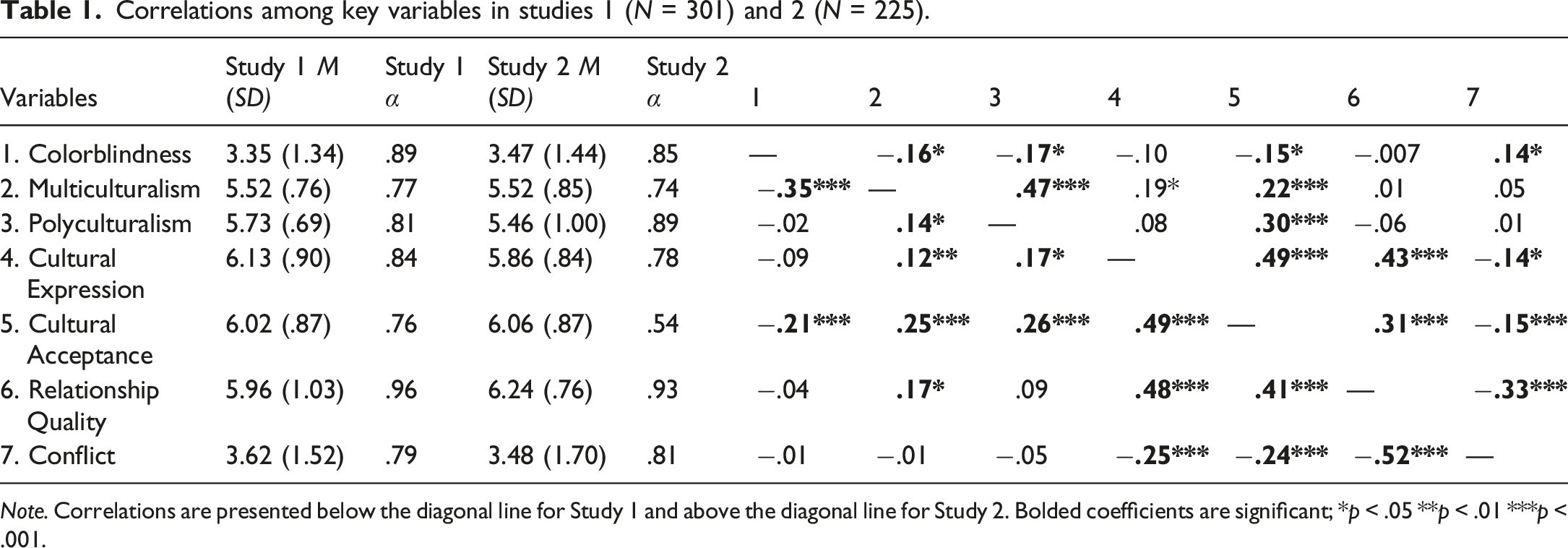
Note. Correlations are presented below the diagonal line for Study 1 and above the diagonal line for Study 2. Bolded coefficients are significant; *p < .05 **p < .01 ***p < .001.
Diversity ideologies
We assessed diversity ideologies using 15 items from the Intergroup Ideologies Measure (Rosenthal & Levy, 2012). This measure consists of three subscales of colorblindness, multiculturalism, and polyculturalism. Sample items include “Racial and ethnic group memberships do not matter very much to who we are” (colorblindness), “All cultures have their distinct traditions and perspectives” (multiculturalism), and “Different cultural groups impact one another, even if members of those groups are not completely aware of the impact” (polyculturalism), measured on a 7-point scale (1 = strongly disagree to 7 = strongly agree).
Cultural sharing
We measured participants’ own cultural sharing using 13 items from the Index of Cultural Inclusion (Killian, 2013). To provide rigorous evidence for the reliability of this measure, we conducted exploratory factor analyses in all three studies and identified two theoretically relevant and distinct factors, which we have labeled cultural expression and cultural acceptance (Table S1). Sample items include “I feel very comfortable talking with my partner about the family and culture that I come from” (cultural expression, five items), and “I value my partner’s cultural beliefs and customs” (cultural acceptance, three items), measured on a 7-point scale (1 = strongly disagree to 7 = strongly agree).
Relationship quality
We used the Perceived Relationship Quality Component Inventory (Fletcher et al., 2000) to assess several positive indicators of relationship quality, including satisfaction, commitment, intimacy, trust, passion, and love. Participants rated 18 items such as “How satisfied are you with your relationship?” on a 7-point scale (1 = not at all to 7 = extremely).
Conflict
We measured conflict as a negative indicator of relationship quality using a standard measure assessing the frequency and intensity of conflict in the relationship (Braiker & Kelley, 1979). Participants rated five items such as “How often do you and your partner argue with each other?” on a 9-point scale (e.g., 1 = not very often to 9 = very often).
Data analytic plan
We conducted analyses using SPSS v.28. We first conducted multiple regression analyses to test the associations between our predictor variables (colorblindness, multiculturalism, polyculturalism), mediators (cultural expression and cultural acceptance), and outcome variables (relationship quality, conflict). We then tested the possible indirect effects of each ideology on indicators of relationship quality via the two components of cultural sharing (entered simultaneously) using PROCESSv.4 (Hayes, 2022). We tested the unique associations of each diversity ideology with the outcomes by entering all three ideologies simultaneously in all models.
Results
Results of regression analyses in studies 1 (N = 301) and 2 (N = 225).
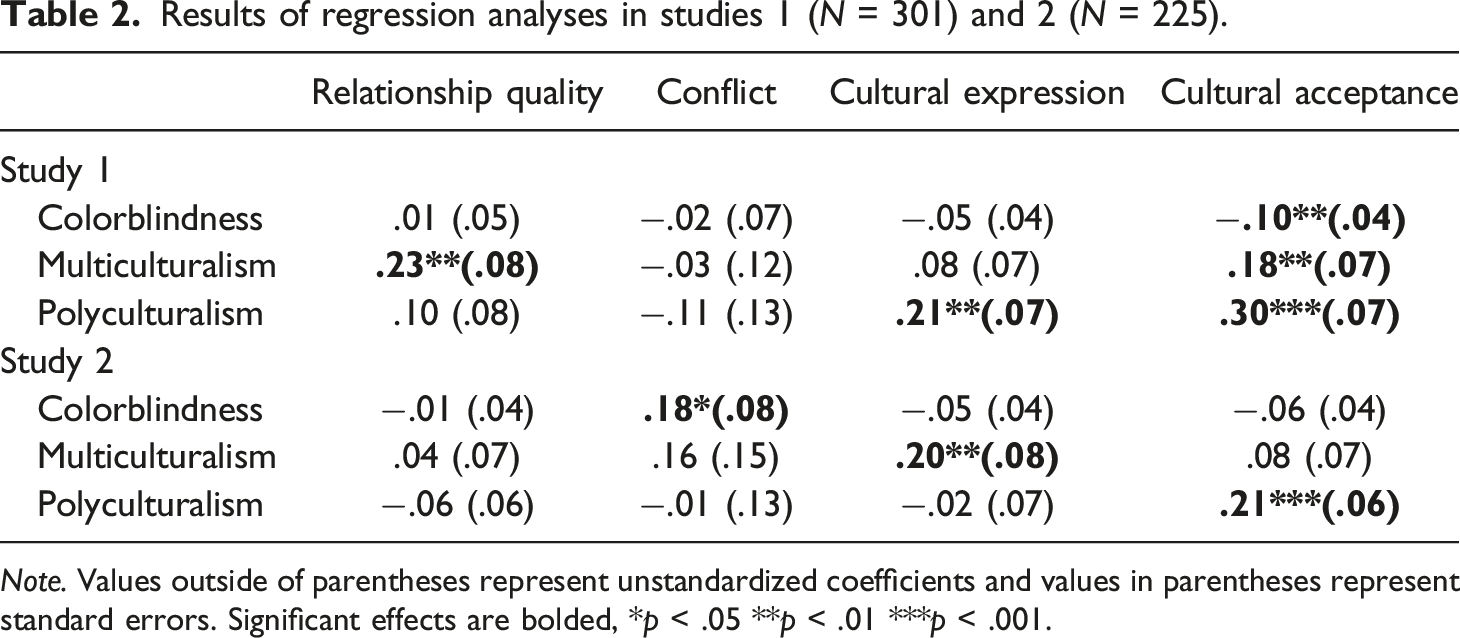
Note. Values outside of parentheses represent unstandardized coefficients and values in parentheses represent standard errors. Significant effects are bolded, *p < .05 **p < .01 ***p < .001.
Indirect effects of diversity ideologies on key outcomes through cultural sharing in studies 1 (N = 301) and 2 (N = 225).
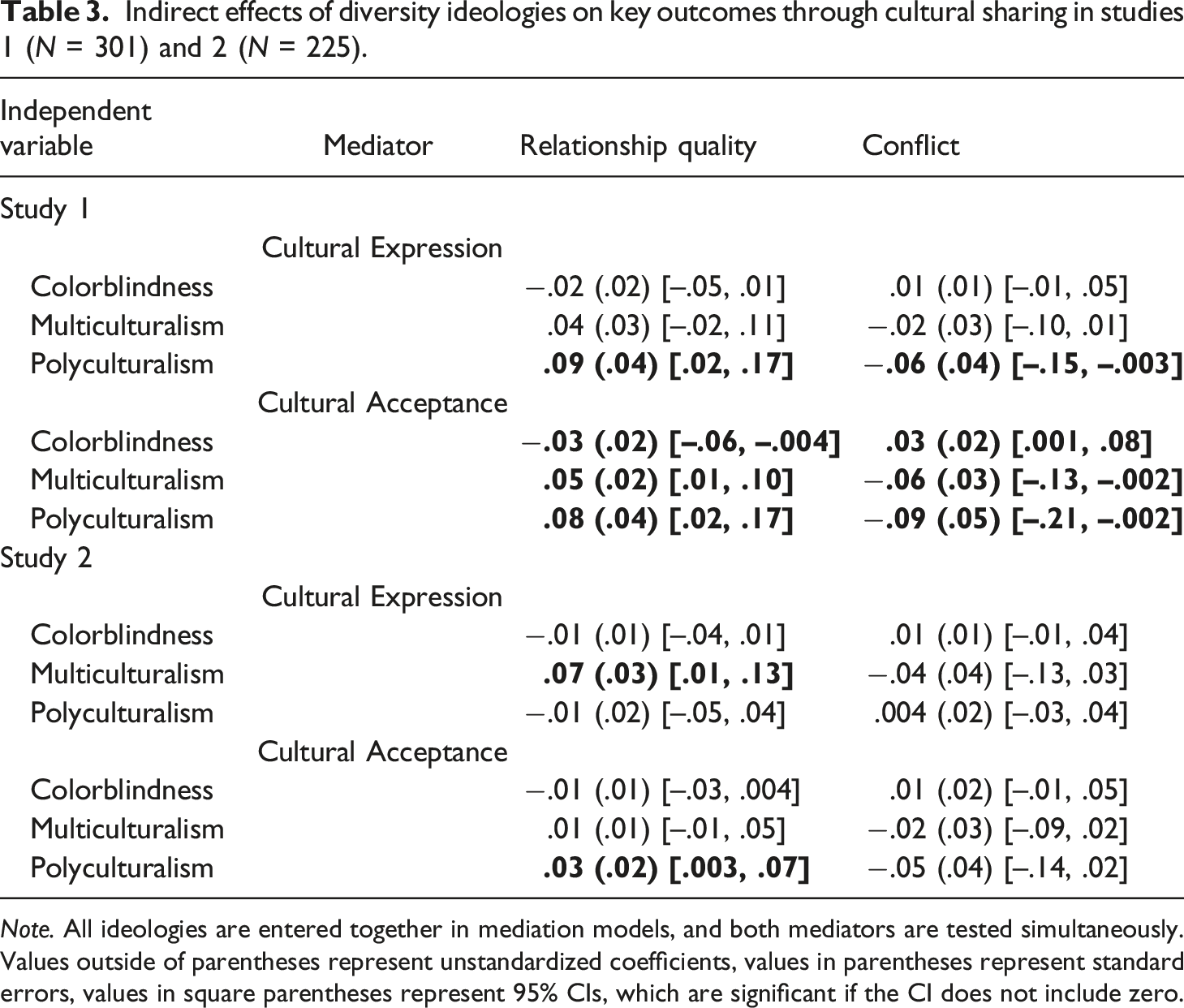
Note. All ideologies are entered together in mediation models, and both mediators are tested simultaneously. Values outside of parentheses represent unstandardized coefficients, values in parentheses represent standard errors, values in square parentheses represent 95% CIs, which are significant if the CI does not include zero.
Study 2
Study 1 provided initial evidence for our proposed model. Given that this sample mostly included people in established intercultural relationships and mostly White participants, we wanted to determine if the effects replicate in a more diverse sample of people in newer relationships who are just starting to navigate their cultural differences. Thus, in Study 2 we recruited a sample of undergraduate students who had been in an intercultural relationship of less than two years and followed them over the course of an academic year with four surveys, each roughly eight weeks apart. We were initially interested in investigating how diversity ideologies change over time and influence the trajectories of cultural sharing and relationship quality (see longitudinal preregistration: https://osf.io/vyh9a/?view_only=b902ddf7c5a449d59460be90570f1ee8). However, we had high attrition over time (43% of participants dropped out by the fourth time point). After conducting attrition analyses, we found that those who did (vs. did not) participate in later surveys significantly differed on our key variables at baseline. As such, it is unclear whether any observed longitudinal patterns would be due to changes in the constructs or differences in sample composition over time. As a result, we only focus on the baseline analyses here (see OSM for more information).
Method
Participants and procedure
We recruited undergraduate psychology students from a large Canadian public university’s participant pool and age-matched participants from Prolific. University participants were compensated with one course credit, and Prolific participants with $3. We excluded participants who did not complete key measures in the survey (n = 18), reported being dishonest in their responses (n = 6), did not provide post-debrief consent (n = 1), or failed any of the four attention checks (n = 1). The final sample consisted of 225 participants (141 from the participant pool, 84 from Prolific; 69.3% women, 28% men, 2.7% other) who were on average 20 years old (SD = 3.00) and had been with their partner for an average of 9.5 months (SD = 5.77). Most participants (64%) identified as heterosexual, 21.8% bisexual, 3.1% asexual, 2.2% pansexual, 1.8% lesbian, 1.8% queer, .9% gay, and .9% other. Most participants (79.6%) were in a committed relationship but not living with their partner, 13.8% were casually dating, 5.8% were living together but not married, and .9% were living together and married. Most participants (28%) identified as White, 14.7% identified as East Asian, 14.7% identified as South Asian, 12% identified as bi/multicultural, 10.7% identified as Black, 9.8% identified as Latin American, 4.9% identified as Middle Eastern, .9% identified as Native American, and 4.3% as a race/ethnicity not listed. Of the White participants, 71.4% were in interracial relationships, whereas 83.3% of the POC were in interracial relationships. Participants reported their socioeconomic status similar to Study 1 and were on average below the mid-point of the scale (M = 4.6, SD = 1.72, range = 1–9).
Measures
Participants completed the same measures as used in Study 1. See Table 1 for reliabilities, descriptive statistics, and correlations among variables.
Results
We conducted all analyses similar to Study 1. Consistent with our preregistered analytic plan, we first conducted regression models with the diversity ideologies entered as simultaneous predictors of both relationship quality and cultural sharing (Table 2). These analyses revealed that colorblindness was associated with more conflict. There were no other direct associations between diversity ideologies and indicators of relationship quality. Colorblindness was not related to indicators of cultural sharing, however, multiculturalism was associated with more cultural expression and polyculturalism with more cultural acceptance. We then tested the indirect effects of diversity ideologies (entered simultaneously) on relationship quality via cultural expression and acceptance (simultaneous mediators). Participants who had a high endorsement of multiculturalism reported more cultural expression and in turn higher relationship quality. In addition, participants who endorsed polyculturalism reported more cultural acceptance and subsequently experienced higher relationship quality (Table 3). Overall, the links between polyculturalism and higher cultural acceptance and relationship quality were replicated from Study 1.
Study 3
In our final study, we wanted to test whether our previous results replicate in another sample, but most novel to this dyadic study, whether there are links between a person’s own ideology and their partner’s cultural sharing and relationship quality (i.e., partner effects), and whether associations persist over time. To test for these effects, we recruited intercultural couples for an initial survey and followed up with them four to six months later. We preregistered our predictions and analytic plan (https://osf.io/vyh9a/?view_only=b902ddf7c5a449d59460be90570f1ee8).
Method
Participants and procedure
In this study, participants had to be in an intercultural relationship for at least six months and both members of the couple had to participate. This was confirmed using Prolific’s demographic information and at the beginning of the study. Each partner completed a separate survey with identical measures. Four to six months later, participants were invited to complete a follow-up survey. Our target minimum sample was 100 couples to have sufficient power for dyadic analyses (Kenny et al., 2006), but we intended to recruit as many eligible couples as possible, resulting in 166 couples. Participants who failed one or more of the four attention checks (n = 10), did not provide post-debrief consent (n = 1), or had an excluded partner (n = 9) were excluded from the analyses.
The final sample consisted of 156 couples (N = 312; 51% women, 46.8% men, 2.2% other). Participants in our sample were on average 36 years old (SD = 9.13), mostly married and living together (93.3%); 3.5% living together but not married, and 2.2% in a committed relationship but not living together. Participants had been with their partners for an average of nine years (SD = 6.25) and mostly identified as White (68.5%); 8.5% as Latin American, 6.9% as East Asian, 4.6% as South Asian, 4.6% as bi/multicultural, 4.3% as Black and 2.6% as a race/ethnicity not listed. Of the White participants, 43% were in interracial relationships, whereas 79% of the POC were in interracial relationships. Participants reported their socioeconomic status similar to previous studies and were on average above the midpoint of the scale (M = 6.32, SD = 1.49, range = 2–10). From this sample, 57% completed the follow-up survey (N = 177; 50.3% women, 48% men, 1.7% other). We found no differences between participants who completed and those who did not complete the follow-up on our key variables.
Measures
Correlations among key variables in study 3 (N = 312).
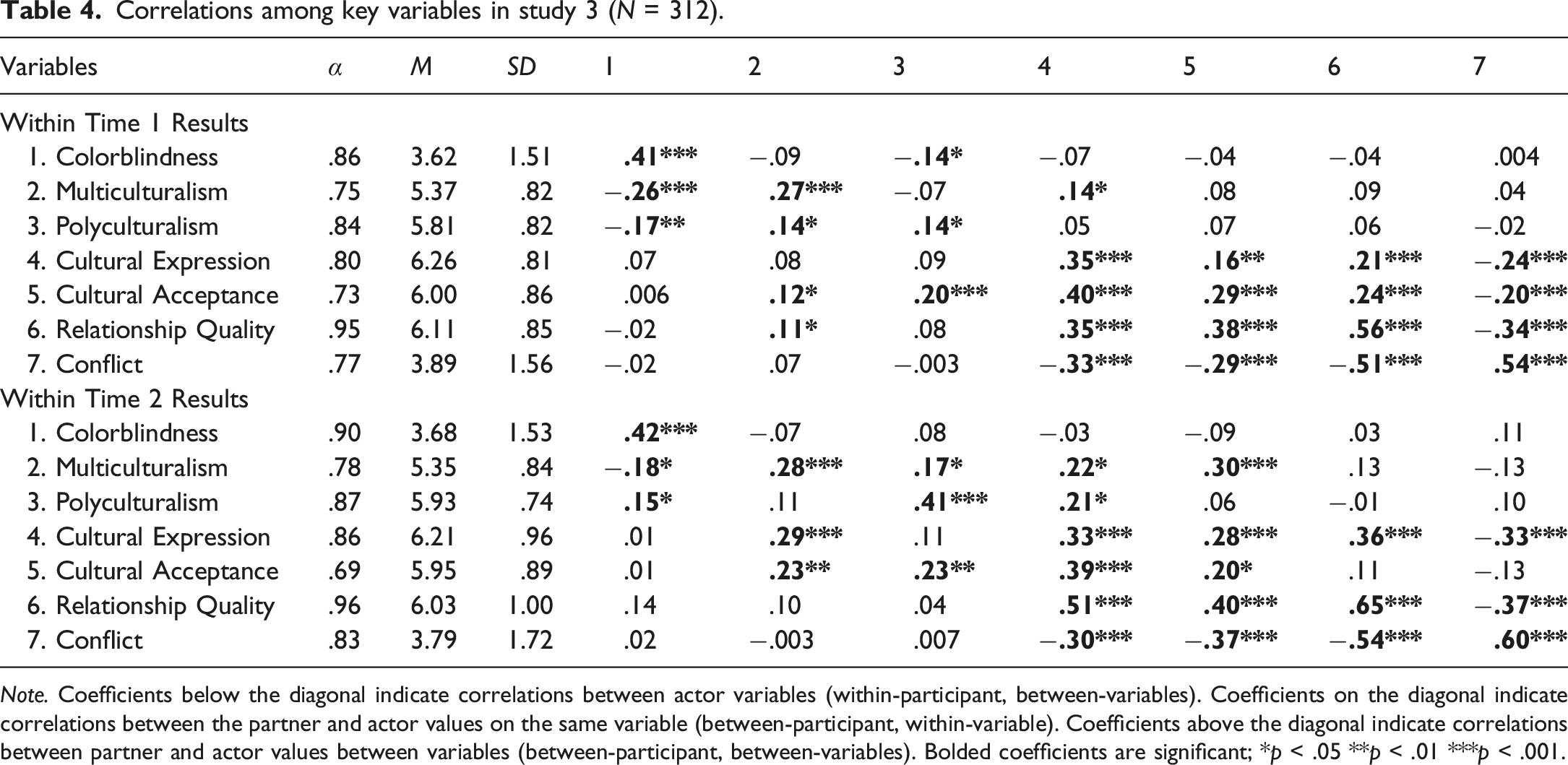
Note. Coefficients below the diagonal indicate correlations between actor variables (within-participant, between-variables). Coefficients on the diagonal indicate correlations between the partner and actor values on the same variable (between-participant, within-variable). Coefficients above the diagonal indicate correlations between partner and actor values between variables (between-participant, between-variables). Bolded coefficients are significant; *p < .05 **p < .01 ***p < .001.
Data analytic plan
We used multilevel modeling with mixed models in SPSS v.28 to account for the interdependence between partners. Our two-level model was guided by the Actor Partner Interdependence Model, with participants nested within dyads and in which both partners’ scores were entered as simultaneous predictors (Kenny et al., 2006). Both actor and partner scores on our predictor variables (colorblindness, multiculturalism, and polyculturalism) and mediators (cultural expression and acceptance) were grand-mean centred. At baseline, we tested the unique associations of each diversity ideology with our outcomes (relationship quality, conflict) by entering all six ideologies and four mediators (as reported by both partners) simultaneously in the models. At follow-up, we examined the impact of diversity ideologies measured at baseline on cultural sharing and relationship quality four to six months later, controlling for their baseline levels, to see whether the effects of the ideologies persist over time.
We used the Monte Carlo Method for Assessing Mediation (Selig & Preacher, 2008) with 20,000 resamples. We examined the indirect effects of diversity ideologies on both partners’ relationship quality via cultural expression and acceptance, entered as simultaneous mediators, and all ideologies entered together. We tested our longitudinal indirect effects, modeling all six ideologies for both partners at baseline predicting actors’ cultural expression and acceptance at follow-up together (controlling for both mediators at baseline) and subsequently predicting both actors’ and partners’ relationship quality and conflict at follow-up (controlling for both at baseline).
Results
Given that this is the first dyadic study to investigate diversity ideologies in couples, in our first set of analyses we explored the extent to which partners shared the same ideologies. We found that partners' scores were positively correlated for all three ideologies: colorblindness (r = .41), multiculturalism (r = .27), and polyculturalism (r = .15), providing the first evidence that, to some extent, partners share some of the same beliefs regarding cultural diversity (Table 4). Then, consistent with our preregistered analytic plan, we report the results of testing our hypotheses in the baseline data and our over time effects.
Baseline associations
Results of dyadic multilevel modeling analyses in study 3 (N = 312).
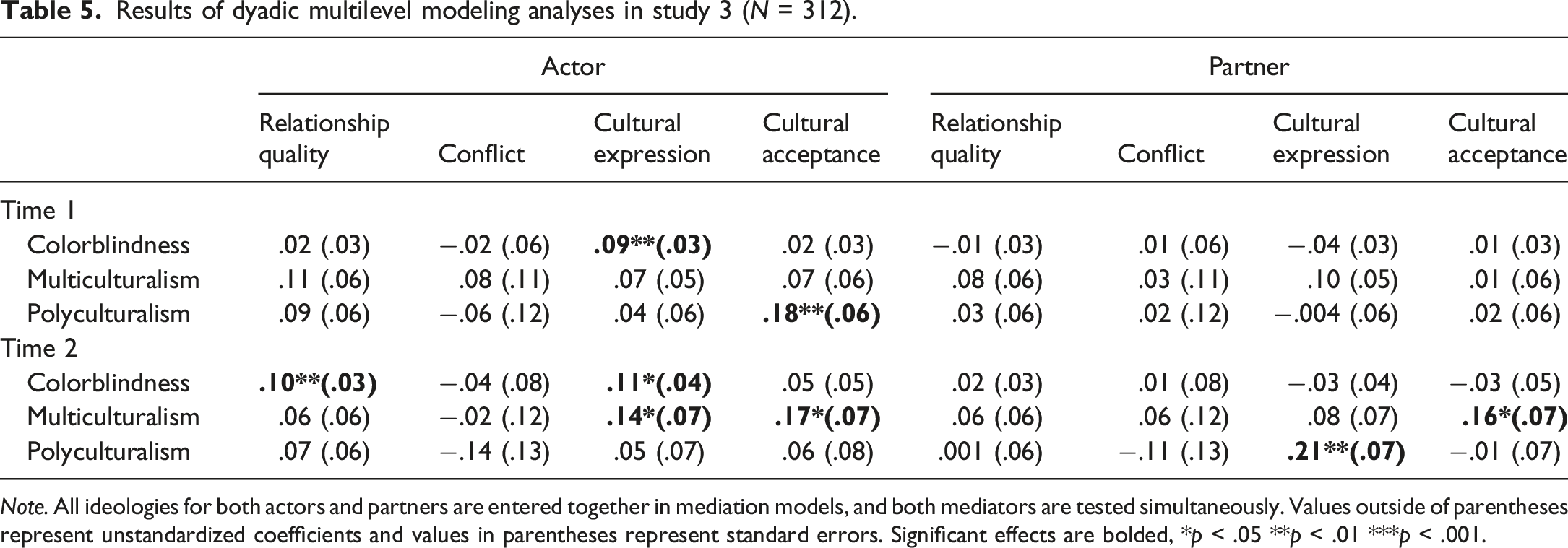
Note. All ideologies for both actors and partners are entered together in mediation models, and both mediators are tested simultaneously. Values outside of parentheses represent unstandardized coefficients and values in parentheses represent standard errors. Significant effects are bolded, *p < .05 **p < .01 ***p < .001.
Indirect effects of diversity ideologies through cultural sharing on both partners’ relationship quality in study 3 (N = 312).
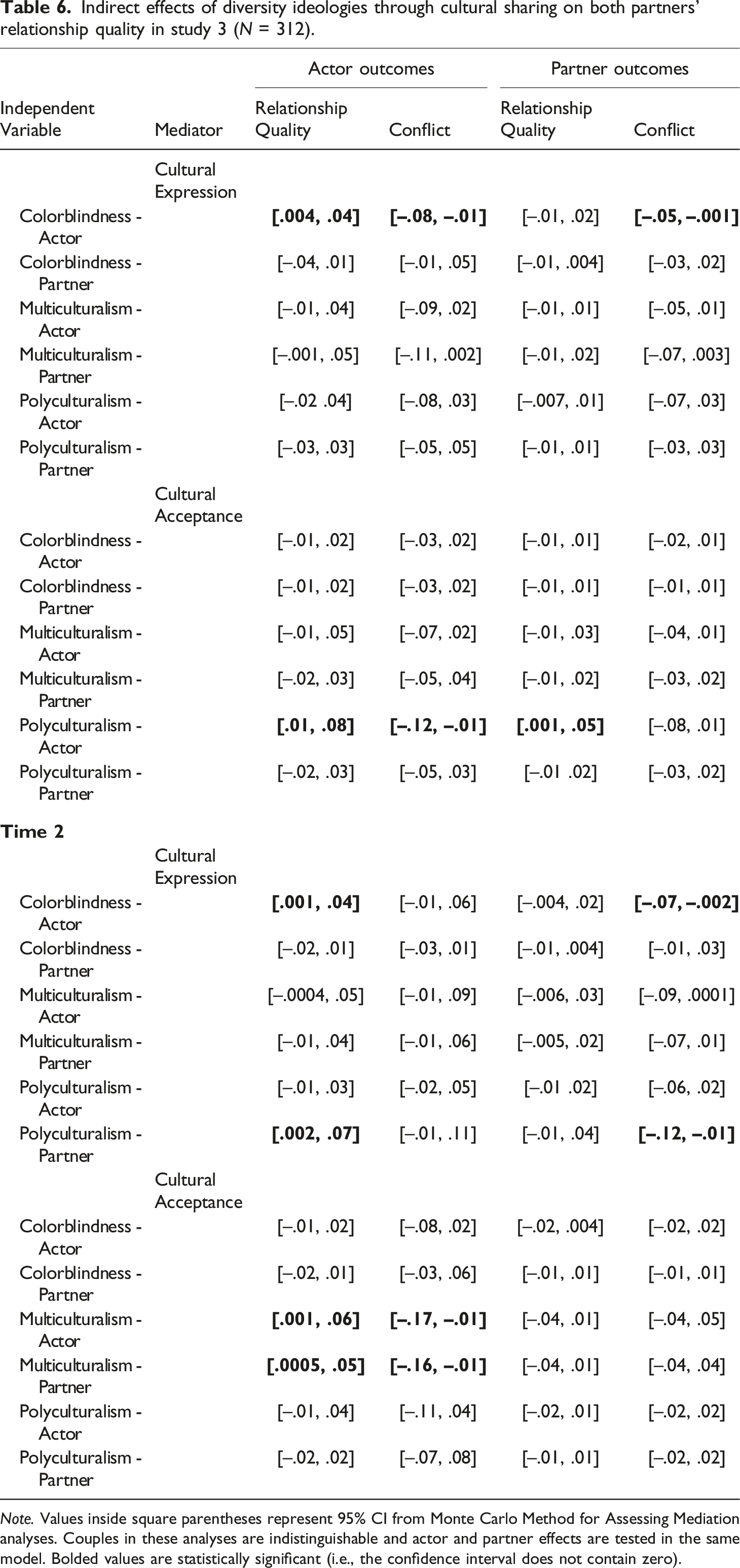
Note. Values inside square parentheses represent 95% CI from Monte Carlo Method for Assessing Mediation analyses. Couples in these analyses are indistinguishable and actor and partner effects are tested in the same model. Bolded values are statistically significant (i.e., the confidence interval does not contain zero).
Over time associations
Starting with the direct effects of ideologies on relationship quality (Table 5), when participants endorsed colorblindness at baseline, they reported higher relationship quality at follow-up controlling for their relationship quality at baseline, but no differences in conflict. There were no significant associations between a person’s endorsement of multiculturalism or polyculturalism and indicators of relationship quality at follow-up. Turning to associations between actors’ ideologies and their reports of cultural sharing, participants who reported higher colorblindness or multiculturalism at baseline, also reported higher cultural expression at follow-up, controlling for their baseline cultural expression. When participants had a high endorsement of multiculturalism at baseline, they reported higher cultural acceptance at follow-up, controlling for their cultural acceptance at baseline. There were no over-time links between actors’ polyculturalism and indicators of cultural sharing.
Turning to partner effects, a person’s own colorblindness at baseline was not associated with their partners’ outcomes over time. When participants endorsed multiculturalism at baseline, their partner reported higher cultural acceptance at follow-up, controlling for their cultural acceptance at baseline. Additionally, when a participant endorsed polyculturalism at baseline, their partner reported higher cultural expression at follow-up, controlling for their cultural expression at baseline. No other links between actors’ baseline ideologies and partners’ outcomes at follow-up were significant.
Turning to our longitudinal indirect effects for the actor (Table 6), we found that when a person had a high endorsement of colorblindness at baseline, they engaged more in cultural expression, and subsequently reported higher relationship quality and their partner reported lower conflict at follow-up. When people endorsed multiculturalism at baseline, they reported more cultural acceptance at follow-up, and subsequently experienced higher relationship quality and less conflict. Next, looking at indirect effects for the partner, when a person endorsed multiculturalism, their partner also engaged more in cultural acceptance at follow-up, and this was associated with the person’s own higher relationship quality and less conflict at follow-up. Relatedly, when a person endorsed polyculturalism at baseline, their partner reported more cultural expression at follow-up, which subsequently predicted their own higher relationship quality and their partner’s lower conflict at follow-up.
Examining race across studies
Across all studies, we also tested the role of race by comparing White with POC subsamples. Although we acknowledge that POC are not a monolithic group, this was our best attempt at examining the influence of race (see West et al., 2022 for a similar approach). We compared whether individuals differed in their endorsement of the ideologies based on their race and found no consistent differences (Table S2). We also examined whether race moderated any of our analyses and found no consistent patterns across studies (Table S3-S5).
Discussion
Across our studies, we found mixed results for colorblindness. In Study 1, participants who endorsed colorblindness were less accepting of their partner’s culture and subsequently experienced lower relationship quality and more conflict. However, in Study 3, participants who endorsed colorblindness expressed their culture more, and in turn experienced higher relationship quality and both partners experienced less conflict. Thus, colorblindness may not prevent individuals from expressing their culture in the relationship, potentially because they view their cultural identity as an aspect of the self, not a cultural group (Schwartz et al., 2008). Indeed, colorblindness involves two dimensions, color evasion (i.e., emphasizing sameness) and power evasion (i.e., emphasizing equal opportunities), which differentially influence discussions of race in interracial relationships (Brooks et al., 2021). Further, half of our participants in Study 3 were in monoracial relationships and cultural sharing was likely not viewed as threatening to partners. Expressing one’s culture may only be threatening when there are greater cultural differences to overcome, in which case colorblindness may prevent partners from sharing their cultures to avoid conflict regarding these differences.
Additionally, we found that multiculturalism was associated with greater acceptance of a partner’s culture (Studies 1 and 3) and more expression of one’s own culture (Study 2), and subsequently with both partners’ better relationship quality. Further, across three studies we found that when participants endorsed polyculturalism, they accepted and included their partners’ cultures and cultural traditions more in the relationship (all studies), and subsequently, both partners experienced higher relationship quality (all studies) and less conflict (Studies 1 and 3). In addition, when people endorsed polyculturalism, they (Study 1) and their partner (Study 3) expressed their culture more, and in turn, both partners experienced higher relationship quality and less conflict.
Across studies, we examined a broad range of people in intercultural relationships, and the dyadic data in Study 3 allowed us to examine whether partners endorse similar diversity ideologies. While our data demonstrate that partners’ endorsement of diversity ideologies are moderately correlated, it is still common for partners to have differences in their ideologies. Additionally, we intentionally recruited participants in intercultural relationships to be more inclusive, since past studies have mainly studied interracial relationships (Gaines et al., 2015). Because of this, most couples in Studies 1 and 3 included at least one White partner. Given that POC have different experiences compared to White people that can influence their beliefs about cultural diversity, and the ideologies may mean different things to people from different groups (Rosenthal & Levy, 2012), we also tested for differences between these two groups. We did not find any consistent patterns across studies, which may be related to a lack of statistical power.
Theoretical implications
This work adds to each ideology’s framework by moving beyond prejudice reduction in broad intergroup settings and showcasing how diversity ideologies influence cultural sharing in romantic relationships. Although both colorblindness and multiculturalism view cultural differences as fixed and are related to essentialism, our findings suggest that they have different implications for cultural sharing and relationship quality. Specifically, viewing cultural differences as fixed is not necessarily detrimental to the relationship as it does not prevent people from expressing their own cultures. This fixed view may keep people from accepting their partner’s culture and has negative influences on their relationship quality if they believe they should not engage with or have discussions about other cultures (colorblindness). However, when this fixed approach is paired with the ability to acknowledge and celebrate cultural differences (multiculturalism), it tends to be associated with higher relationship quality. Overall, we found that people who endorsed polyculturalism and believed cultural differences are malleable consistently engaged in both components of cultural sharing and consequently experienced better relationship outcomes.
It is important to note that people may express and experience these ideologies differently. For example, colorblindness and multiculturalism are associated with essentialism and believing that people can only belong to one cultural group (Roth et al., 2023). This may be problematic for bicultural individuals in intercultural relationships or bicultural children of intercultural couples, as part of their identity may be denied through these essentialist beliefs. Similarly, endorsing polyculturalism and engaging in a partner’s cultural traditions may result in cultural appropriation and be viewed as offensive to members of that culture. Thus, it is essential for partners in intercultural relationships to have discussions about appropriate ways to appreciate and celebrate each other’s heritage. More research is needed to examine the influences of essentialist and constructivist views in intercultural relationships.
Limitations and future directions
Despite the strengths of our multi-method studies on an under-researched population, there are several limitations. First, most participants in Studies 1 and 3 were racially White. Although all our samples were more diverse compared to a median White racial representation of 76.2% in relationship studies from 1996 to 2020 conducted in Western countries (McGorray et al., 2023), and we recruited a more racially diverse sample in Study 2, we remained underpowered to adequately test for moderations by race. Racialized individuals in intercultural relationships can experience intimate racism from their partner (Yampolsky et al., 2023), which may prevent them from cultural sharing. Further, cultural sharing may not threaten monoracial couples with smaller differences to reconcile. Interracial couples might provide a more appropriate sample for a thorough examination of how diversity ideologies (especially colorblindness) influence cultural sharing. Although across studies at least half of our participants reported being in interracial relationships, we were underpowered to investigate moderations by type of relationship. Future studies should actively recruit more diverse samples to explore whether individuals from different racial groups differ in their beliefs.
Second, we did not have information about participants’ levels of acculturation (i.e., adopting beliefs and practices of the dominant culture) or assimilation (i.e., replacing one’s own cultural beliefs and practices with those of the dominant culture; Teske & Nelson, 1974). Racialized partners in Western countries may differ in their endorsement of diversity ideologies based on how much they have adopted the beliefs of the dominant Western culture. Prior experience in navigating multiple cultures (e.g., POC living in a Western country) may also shape one’s endorsement of diversity ideologies or influence how much one is accepting of other cultures. Further, racialized partners who have not completely adopted the dominant Western culture may have particularly negative experiences when paired with a White partner who endorses colorblindness, as the White partner’s disregard for the racialized partner’s culture can invalidate their identity and result in negative emotions (Cheryan & Monin, 2005). Future work should examine the link between acculturation and assimilation and diversity ideologies in intercultural relationships.
Conclusion
Previous work has mostly overlooked how partners in intercultural relationships can successfully navigate their cultural differences, and no studies have explored whether diversity ideologies influence cultural sharing. While previous research has documented the importance of cultural sharing in shaping the quality of intercultural relationships, we further differentiated between cultural expression which represents partners sharing their cultural identity at an individual level, and cultural acceptance which involves engaging with a partner’s culture at an interpersonal level and identified who is most likely to engage in these behaviors. Taken together, these two components showcase the importance of creating space within the relationship for both individuals to express their cultural identities and traditions and feel accepted. Our results highlight how each ideology is associated with relationship quality. Although colorblindness has garnered a negative connotation, we found that endorsing colorblindness does not necessarily preclude sharing one’s own culture. However, our finding that individuals with a colorblind ideology are not as accepting of their partner’s culture identifies a problem for individuals in intercultural relationships who endorse this ideology. Partners in intercultural relationships have historically been viewed as incompatible, but our work illustrates that people who hold views rooted in changeability and engage with other cultures can grow with their partner and move beyond challenges in their relationships.
Importantly, the benefits of cultural sharing extend beyond the relationship. Intergroup contact theory posits that when members of different groups interact with each other, prejudice is reduced (Pettigrew, 1997). However, not all types of contact are equally effective. More intimate forms of contact, such as intergroup friendships and romantic relationships, are more strongly linked to reduced prejudice (Paolini et al., 2021) because they involve repeated contact, self-disclosure, and mutual trust (Marinucci et al., 2021). In other words, cultural sharing is more likely to occur in intimate relationships, which can help in prejudice reduction. Given that intergroup conflict remains an issue worldwide, it is important to promote positive interactions between members of different groups, especially in close relationships, that can contribute to forging a harmonious society. This work can more broadly promote the integration of intercultural couples, a historically marginalized group, in society by understanding how partners can supportively communicate about their cultural differences and improve their relationship quality.
Supplemental Material
Supplemental Material - Through the cultural looking glass: Diversity ideologies and cultural sharing in intercultural romantic relationships
Supplemental Material for Through the cultural looking glass: Diversity ideologies and cultural sharing in intercultural romantic relationships by Hanieh Naeimi, Alexandria L West, Amy Muise, Matthew D Johnson, and Emily A Impett in Journal of Social and Personal Relationships
Footnotes
Author's Note
Findings from this paper have been presented as a poster by the first author at the 2023 Annual Society for Personality and Social Psychology conference and the 2023 Annual York/University of Toronto Social Personality Abnormal Conference.
Declaration of conflicting interests
The author(s) declared no potential conflicts of interest with respect to the research, authorship, and/or publication of this article.
Funding
The author(s) received no financial support for the research, authorship, and/or publication of this article.
Open research statement

Supplemental Material
Supplemental material for this article is available online.
Notes
References
Supplementary Material
Please find the following supplemental material available below.
For Open Access articles published under a Creative Commons License, all supplemental material carries the same license as the article it is associated with.
For non-Open Access articles published, all supplemental material carries a non-exclusive license, and permission requests for re-use of supplemental material or any part of supplemental material shall be sent directly to the copyright owner as specified in the copyright notice associated with the article.
