




Abstract
Research comparing the romantic relationship quality of individuals in intercultural and intracultural relationships has yielded inconsistent findings. The current study examined whether accommodation, the process of responding constructively to relationship problems, would reveal new insight on this topic. Undergraduate students (N = 343) reported on whether they were in an intercultural or intracultural romantic relationship and completed surveys of accommodation, romantic relationship quality, and demographic characteristics. Analyses revealed that individuals in intercultural romantic relationships reported higher romantic relationship commitment and satisfaction than individuals in intracultural romantic relationships. The association of accommodation with romantic relationship commitment was also found to be weaker in the intercultural group than the intracultural group after accounting for age and gender, but not after accounting for ethnicity or relationship length. Overall, results suggest that accommodation may be less relevant for individuals in intercultural romantic relationships, and that ethnicity and relationship length are important factors for understanding the role of accommodation within intercultural romantic relationships. Our findings underscore the importance of examining the possibility of distinct psychological processes in intercultural couples, who comprise an increasingly common form of close relationship.
Keywords
Introduction
People are more likely than ever to form a romantic relationship with someone outside of their own cultural background (Pew, 2019). These relationships, termed intercultural romantic relationships, bridge many forms of cultural difference, including race, ethnicity, religion, country, and socioeconomic status (Shenhav et al., 2017). Studying the ways that intercultural romantic relationships do and do not differ from intracultural romantic relationships, where both partners identify with the same cultural background, is important for uncovering new knowledge about relationship processes generally and in intercultural contexts specifically. One relationship process that is broadly considered to be psychologically important and may be of particular relevance to intercultural romantic couples is accommodation (Rusbult et al., 1991), which involves a constructive reaction that an individual can have to their partner’s breach of good behavior. The goals of the current study were to examine the possibility of differences in (1) self-reported romantic relationship quality and (2) the strength of the association of accommodation with romantic relationship quality between young adults who reported being in an intercultural romantic relationship and those who reported being in an intracultural romantic relationship.
The puzzle presented by intercultural romantic relationships
Romantic relationship quality, comprised of commitment and satisfaction, is an important factor for the well-being and stability of relationships. Partner similarity, or congruency in how two people view the world, is one of the most robust factors relating to romantic relationship quality and other romantic relationship outcomes. The literature on attraction and romantic relationships finds that similarity is positively related to attraction and satisfaction but negatively related to relationship dissolution (Davis, 1981; Morry, 2005). Similarity is theorized to reduce the uncertainty that individuals might otherwise experience when interacting with their partner (Parks & Adelman, 1983). Similarity also facilitates social interactions in ways that may allow couples to enjoy spending time with one another to a greater degree since they share similar desires and interests (Burleson et al., 1994). For these reasons, cultural difference may be among the challenges that intercultural couples have to face and may play a role in the mixed findings in the existing literature on intercultural romantic relationship quality.
One pattern in the literature indicates that romantic relationship outcomes are poorer for intercultural couples 1 : romantic relationship quality in intercultural couples is lower (Hohmann-Marriott & Amato, 2008) and the break-up or divorce rate in nationally representative samples of intercultural couples is higher (Bramlett & Mosher, 2002; Zhang & Van Hook, 2009) when compared to intracultural couples. For example, being in an intercultural relationship has also been found to be predictive of a break-up one year later in a mid-Atlantic U.S. college student sample (Reiter & Gee, 2008) and divorce 10 years later in a nationally representative sample (Bratter & King, 2008). Yet, a second pattern indicates that romantic relationship outcomes are better for intercultural couples. At least two studies have found that interethnic couples reported similar levels of romantic relationship satisfaction when compared to intraethnic couples (Negy & Snyder, 2000; Shibazaki & Brennan, 1998), and romantic relationship satisfaction has also been found to be higher for interracial couples compared to intraracial couples (Troy et al., 2006).
The variation in the literature suggests that managing cultural difference is challenging but it may or may not impact romantic relationship quality for intercultural couples. The reasons for the mixed pattern of findings are likely complex but it is important to understand the nuances in intercultural romantic relationship experiences. One possibility is that some individuals may navigate the cultural differences of their relationships in ways that more readily facilitate higher quality romantic relationships. Accommodation is one such psychological process that is known to be beneficial for relationships and may be distinctly relevant for individuals in intercultural romantic relationships.
Accommodation
Relationship scholars have studied accommodation as a positive process that is important for relationship stability and maintenance (Rusbult et al., 1991). Accommodation is conceptualized as varying along two dimensions – the first dimension addresses the extent to which a response is constructive versus destructive. Responses that are more constructive (e.g., voicing displeasure with a behavior) are high in accommodation while responses that are less constructive – destructive (e.g., walking away in the middle of a discussion) – are low in accommodation. To successfully engage in accommodation, a partner must suppress their natural inclination to respond destructively and instead make a conscious effort to respond in a constructive, highly accommodative way. This ability to respond constructively and inhibit impulses to respond destructively is known as the accommodative dilemma, a term coined by Gaines et al. (1997), which highlights the effort that is required of individuals to respond to relationship problems in ways that help preserve the relationship.
Accommodation and intercultural romantic relationships
The accomodative dilemma points to the complexity of accommodation and that it may be a key process that allows individuals in intercultural romantic relationships to maintain their relationship by navigating their cultural differences in ways that promote romantic relationship quality. Although all couples respond to problems of everyday life, responses that are high in accommodation (the process of responding constructively to relationship problems) may be of particular importance for individuals in intercultural romantic relationships. When an individual is aiming to be culturally sensitive to their partner for the betterment of their relationship, they may use accommodation to manage conflict and to navigate the differences that arise from their cultural dissimilarity. For example, accommodation may be needed to move past disagreements that involve topics that are highly sensitive. Conversely, responses that are destructive (low in accommodation) may be uniquely important for individuals in intercultural romantic relationships to avoid because these individuals may be faced with cultural difference that are frustrating (e.g., customs around the dinner table) and these individuals may also have societal incentives to exit the relationship (e.g., low levels of societal acceptance). However, to our knowledge, accommodation has not been studied in individuals in intercultural romantic relationships in comparison to individuals in intracultural romantic relationships.
The current study
We used an online cross-sectional self-report research design to answer our research questions. This allowed us to facilitate recruitment of a sample of individuals who were in an intercultural romantic relationship that might otherwise be challenging to recruit. Given the mixed literature, we first examined whether romantic relationship commitment and satisfaction were similar or different between the two relationship types (intercultural vs. intracultural relationships). Next, we tested whether accommodation related to romantic relationship commitment and satisfaction differently between the groups. All measures were obtained with reference to the participating partner’s actions and perceptions within their relationship.
Hypotheses
(1) We hypothesized that romantic relationship commitment would be lower among individuals in an intercultural romantic relationship compared to individuals in an intracultural romantic relationship. (2) We hypothesized that romantic relationship satisfaction would be lower among individuals in an intercultural romantic relationship compared to individuals in an intracultural romantic relationship. (3) Due to the challenges that may arise from navigating cultural differences within an intercultural romantic relationship, we hypothesized that engaging in accommodation would be more important for individuals in an intercultural romantic relationship. Specifically, we hypothesized that the association of higher accommodation with higher romantic relationship commitment would be stronger among individuals in an intercultural romantic relationship compared to individuals in an intracultural romantic relationship. (4) Similarly, we hypothesized that the association of higher accommodation with higher romantic relationship satisfaction would be stronger among individuals in an intercultural romantic relationship compared to individuals in an intracultural romantic relationship.
Method
Participants and procedure
Undergraduates at a large research university on the West Coast of the United States participated in a larger study on romantic relationships. Participants (N = 615) enrolled in the online study using the university’s social science human subjects research pool through the SONA system and were compensated for their study participation with extra credit that they could apply to a participating course of their choice. Upon enrolling in the study, participants were automatically directed to an online consent form. The sole inclusion criterion was that the participant be at least 18 years of age. Participants were directed to the online survey if they fit this criterion and consented to be in the study. Relationship and demographic questions were asked at the end of the questionnaire to ensure that self-identification did not influence responses to other study measures. All measures and procedures were approved by the University Institutional Review Board.
Descriptive statistics for key study variables.
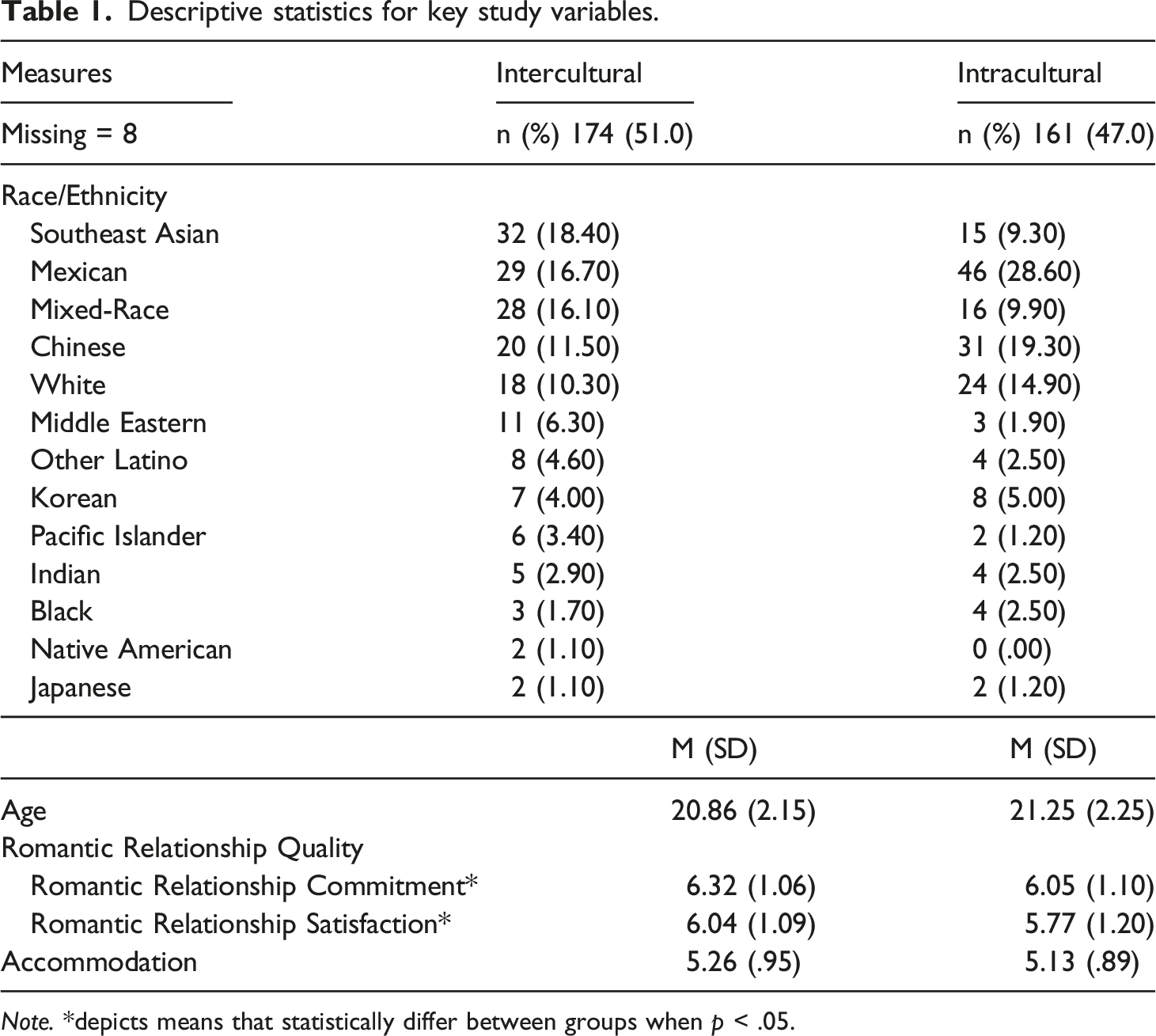
Note. *depicts means that statistically differ between groups when p < .05.
Measures
Relationship accommodation
The Rusbult Accommodation Measure (Rusbult et al., 1991) consists of four subscales that each contain four-items that represent the following responses to relationship problems: voice (e.g., when my partner behaves in an unpleasant manner, I calmly discuss things with him/her), loyalty (e.g., when my partner does something thoughtless, I patiently wait for things to improve), exit (e.g., when my partner says something really mean, I threaten to leave him/her), and neglect (e.g., when my partner is rude to me, I ignore the whole thing). Participants rated their level of agreement on each item using a Likert-scale that ranged from 0 (never do this) to 8 (constantly do this). A variable for a total accommodation score was calculated by reversing the items from the exit and neglect subscales and averaging those items with the voice and loyalty items. Higher scores indicated higher endorsement of total accommodation (α = .76).
Romantic relationship quality
Romantic relationship quality was measured using the commitment (e.g., how committed are you to your relationship) and satisfaction (e.g., how satisfied are you with your relationship) subscales from the Perceived Relationship Quality Components Inventory (Fletcher et al., 2000). These two subscales each contained three items that asked how much of each quality the participant felt matched their opinion of their romantic relationship/partner. Participants rated their level of agreement on each item using a Likert-scale that ranged from 1 (not at all) to 7 (extremely). Item responses pertaining to each subscale were averaged to derive a subscale score (αcommitment = .92; αsatisfaction = .94). Higher scores on each subscale indicated higher endorsement of that subscale.
Relationship type
Self-identification of intercultural romantic relationship status has been found to better capture couples who may perceive cultural differences in their relationship that fall outside of census-based race/ethnic categories (Shenhav et al., 2017). Therefore, participants were presented with the following definition of an intercultural romantic relationship and then asked to self-identify whether they were in such a romantic relationship 1 (Yes) or not 0 (No): By intercultural, we mean a relationship between individuals of different races/cultures/ethnic groups. One example would be a relationship between an individual of Asian background and an individual of Latino background. However, an intercultural relationship may also be between two individuals of Asian background, for example someone who is Chinese and someone who is Korean. Given the above definition, are you currently in an intercultural romantic relationship?
This definition allowed for a broad categorization of culture and thus intercultural romantic relationships. In the current study we referred to participants who reported “yes” to this definition as being in an intercultural romantic relationship because they self-classified their relationship as being with a partner who identifies with a different race, culture, or ethnicity other than their own (e.g., the participant might be Latino, and their partner might be Asian).
Covariates - demographics
Age
Participants were asked how old they were, and they responded using whole number options ranging from 18 to 41 and above.
Gender
Participants were asked “which gender do you identify with?” and were provided with the following response options: men (1), women (2), non-binary or gender non-conforming (3), transgender (4), other (5), prefer not to state (6). If they selected other, they were able to type in a response to clarify. For the purposes of analyses, participants were grouped into larger categories (i.e., men, women, and other gender). Individuals who identified as non-binary or gender nonconforming, transgender, and other were included in the other gender category.
Ethnicity
Participants were asked “What is your ethnicity (indicate more than one if applicable)?” and were provided with the following options: Black, African-American (1), White, Caucasian, European (2), Chinese (3), Japanese (4), Korean (5), Southeast Asian (6), Indian (7), Pacific Islander (8), Mexican (9), Other Latino (10), Native American (11), Middle Eastern (12), Other (13). If they selected Other, they were able to type in a response to clarify. If they indicated more than one ethnicity, they were classified as belonging to a Multi-Ethnic category (14). For the purposes of analyses, participants were grouped into pan-ethnic categories that corresponded as closely as possible to United State Census categories (i.e., Asian, Latino, White, and Other). Individuals who identified as Chinese, Indian, Japanese, Korean, Pacific Islander, and Southeast Asian were included in the Asian category. Individuals who identified as Mexican and Other Latino were included in the Latino category. Individuals who identified as Middle Eastern and White, Caucasian, European were included in the European category. Individuals who identified as Black, African-American, Multi-Ethnic, Native American, and Other were included in the Other Ethnicity category.
Relationship length
Participants reported on the number of months they had been in a romantic relationship with their partner by choosing one of the following options: 1 (1 month), 2 (3–6 months), 3 (Less than 1 year), 4 (1-2 years), 5 (2–5 years), 6 (over 5 years).
Data analytic plan
First, we examined the descriptive statistics and bivariate correlations for demographic and key study variables. Next, hierarchical linear regressions were used to test hypotheses. These analyses were run using the PROCESS Version 3 macro model 1 in SPSS (Hayes, 2018). PROCESS calculated the association between x (predictor) and y (outcome) at each value of the categorical moderator resulting in coefficients that represented the main effects collapsing across the other main effects and an interaction term that related to the dependent variable over and above the main effects and statistical covariates. Accommodation was added as a predictor and romantic relationship commitment and satisfaction were entered as outcome variables resulting in two separate models. Relationship type was entered into each model as a moderator. We then added covariates to the base models in a sequential testing order to determine how robust our models were at predicting romantic relationship quality over and above specific demographic factors of interest. These covariates were age, gender, ethnicity, and relationship length. If the addition of a covariate changed the pattern of results, then that covariate was removed and the next was added. Gender and ethnicity were entered into each model as dummy coded variables with women and Asian as the reference groups as they were the largest groups in their respective variable. All hypotheses were pre-registered on the Open Science Framework (OSF).
Results
Correlation table of key study variables.
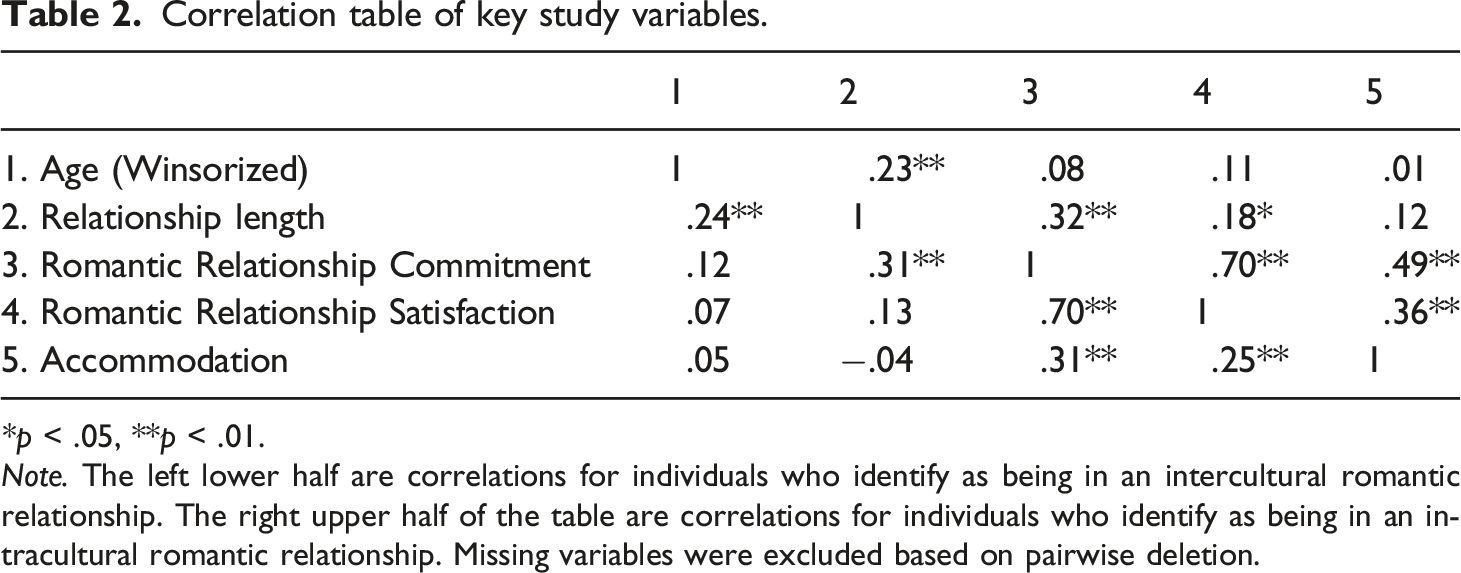
*p < .05, **p < .01.
Note. The left lower half are correlations for individuals who identify as being in an intercultural romantic relationship. The right upper half of the table are correlations for individuals who identify as being in an intracultural romantic relationship. Missing variables were excluded based on pairwise deletion.
Independent-samples t-tests revealed that individuals in an intercultural romantic relationship were not significantly different in winsorized-age [t (333) = −1.63, p = .10], relationship length [t (333) = −1.43, p = .08], or level of accommodation [t (333) = 1.29, p = .10] compared to individuals in an intracultural romantic relationship. However, individuals in an intercultural romantic relationship reported significantly higher romantic relationship commitment [t (332) = 2.34, p = .02] and satisfaction [t (332) = 2.16, p = .02] compared to individuals in an intracultural romantic relationship.
Hypothesis testing
Predicting commitment
Model 1: No covariates
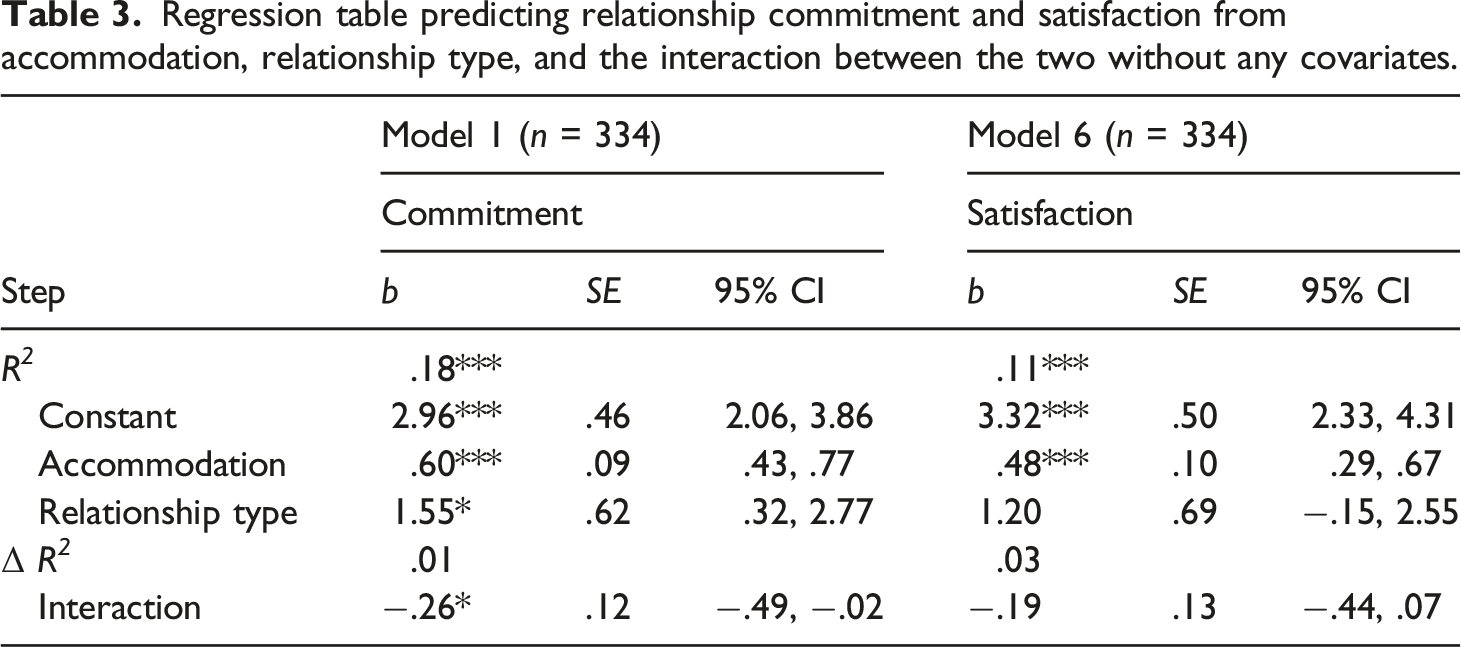
Regression table predicting relationship commitment and satisfaction from accommodation, relationship type, and the interaction between the two without any covariates.
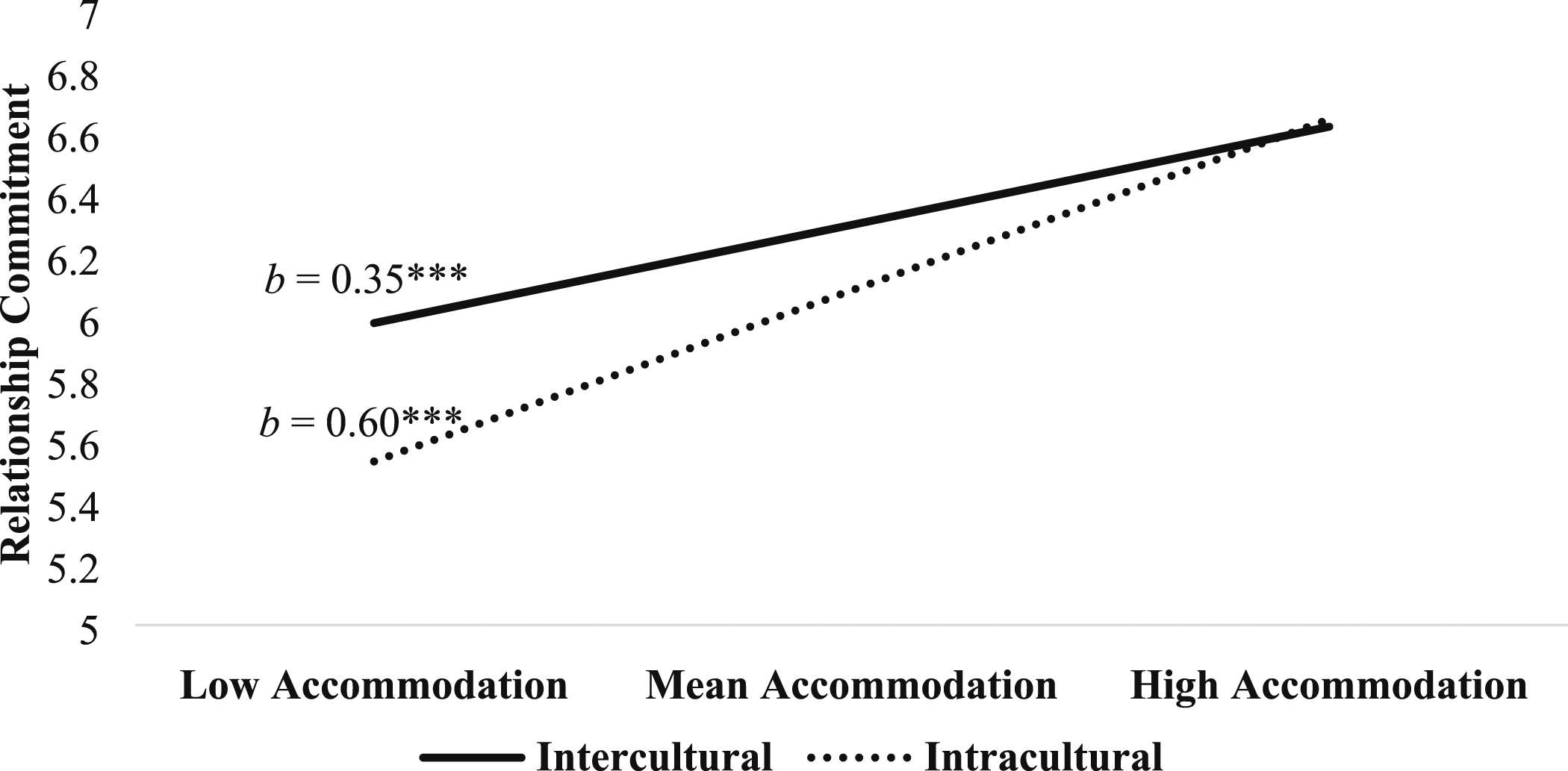
Interaction between accommodation and relationship type predicting relationship commitment (Base Model).
Model 2: Age covariate
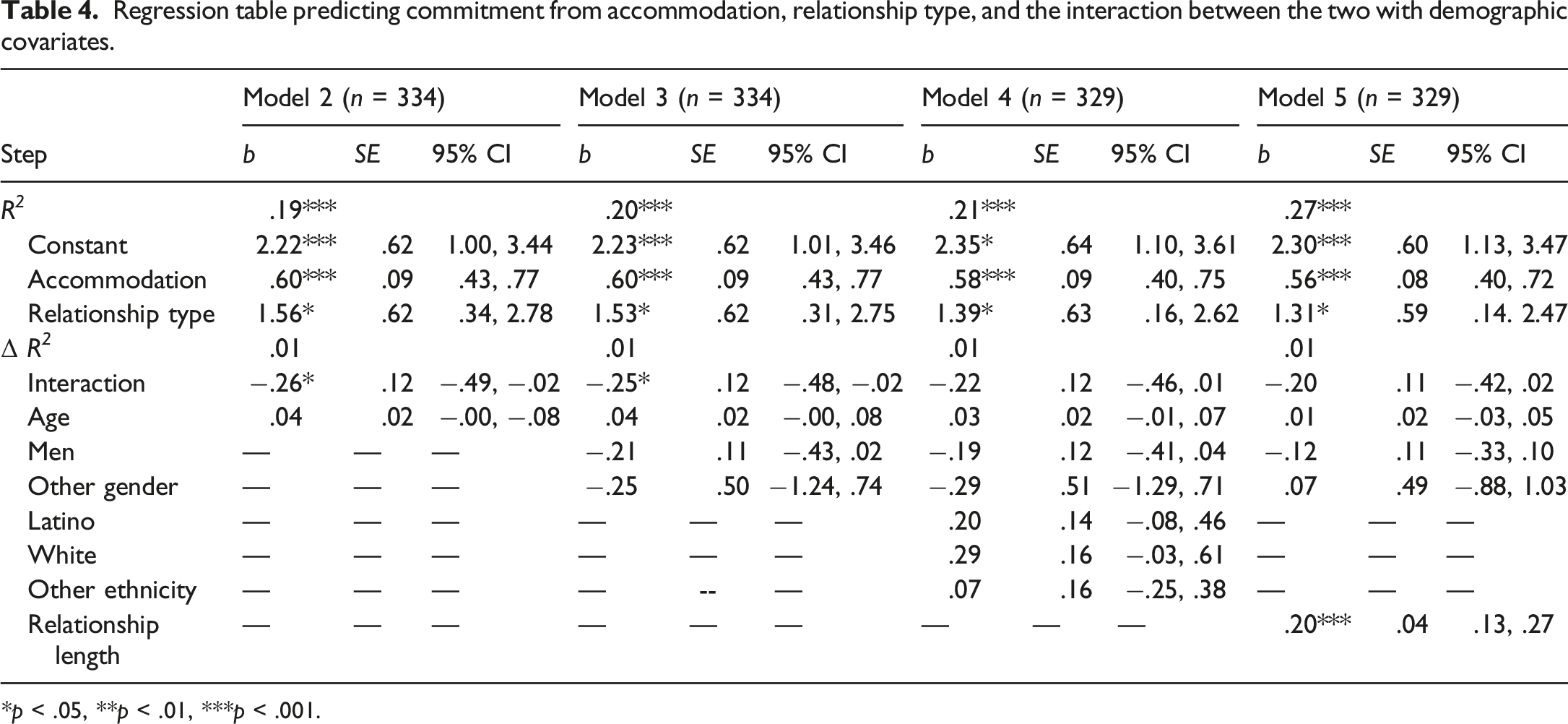
Regression table predicting commitment from accommodation, relationship type, and the interaction between the two with demographic covariates.
*p < .05, **p < .01, ***p < .001.
Model 3: Age and gender covariates
After adjusting for participant winsorized-age and gender, the same association and moderation held (b = −.26, p = .04; see Table 4); the association of accommodation and romantic relationship commitment was weaker for those in an intercultural romantic relationship (b = .34, p < .001) than those in an intracultural romantic relationship (b = .60, p < .001).
Model 4: Age, gender, and ethnicity covariates
After adjusting for participant winsorized-age, gender, and ethnicity, the association of accommodation with romantic relationship commitment was no longer moderated by relationship type (b = −.22, p = .06; see Table 4). Follow up tests revealed that the moderation held when including the dummy coded variable for Asian participants, Latino participants, and Other participants in the model (ps < .05) but not when including the dummy coded variable for European participants in the model (p = .05). To further understand these effects, we explored the moderation analyses among the non-European participants only and then among the European participants only. The interaction was marginally significant among the non-European participants (p = .07) but was largely not significant among the European participants (p = .48).
Model 5: Age, gender, and relationship length covariates
After adjusting for participant winsorized-age, gender, and relationship length, the association of accommodation with romantic relationship commitment was no longer moderated by relationship type (b = −.20, p = .08; see Table 4).
Predicting satisfaction
Model 6: No covariates
The association of accommodation with romantic relationship satisfaction was not moderated by relationship type (b = −.19, p = .15; see Table 3). However, a significant main effect indicated that higher accommodation was associated with higher romantic relationship satisfaction in the overall sample (b = .48, p < .001).
Discussion
The current study is the first to examine the role of accommodation in predicting romantic relationship quality among individuals in an intercultural romantic relationship compared to those in an intracultural romantic relationship. The current study revealed three noteworthy patterns. First, individuals in an intercultural romantic relationship reported higher romantic relationship commitment and satisfaction than those in an intracultural romantic relationship. Second, relationship type moderated the association of accommodation with romantic relationship commitment such that the association was weaker for individuals in an intercultural romantic relationship compared to those in an intracultural romantic relationship. This pattern did not extend to romantic relationship satisfaction. Third, the romantic relationship commitment moderation held after accounting for variation in age and gender but not variation in ethnicity and relationship length. Altogether, these results suggest that understanding intercultural romantic relationship quality may be more complex than existing literature has revealed.
Romantic relationship quality variation between relationship types
We observed that romantic relationship commitment and satisfaction were moderately correlated with accommodation in the intercultural (r ranged from .25** to .31**) and intracultural (r ranged from .36** to .49**) samples. We also observed higher romantic relationship quality in individuals in an intercultural romantic relationship. This latter observation is contrary to most findings in the literature. One possible explanation for this finding is that people willing to expand their dating pool to outgroup members may be more likely to find a compatible partner from that wider dating pool. This would be consistent with the similarity-attraction hypothesis that indicates that perceived similarity is a more important factor for romantic relationship quality than objective similarity (Montoya et al., 2008).
Another explanation is that self-selection processes may be at play for individuals in an intercultural romantic relationship. Individuals in an intercultural romantic relationship may have personalities that are more open to experience and more accepting of difference. This factor may both draw individuals into an intercultural romantic relationship and prove helpful for navigating difference. This reasoning is consistent with studies that have found that the personality factor of openness-to-experience relates to romantic relationship satisfaction and longevity (e.g., Gattis et al., 2004); perhaps this personality factor is more important for or more prevalent among intercultural couples. We should also note that our sample was drawn from a university that is exceptionally diverse and may represent a group that is particularly open to cultural differences. If so, our sample may be self-selecting into intercultural romantic relationships and may be reasonably well prepared to manage the challenges of these romantic relationships. Indeed, it may be that individuals willing to date outgroup members may be those who have previously been exposed to diverse others and thus may have better experiences with new individuals even if they are an out-group member (Page-Gould et al., 2010).
Third, the cultural make-up of the couple may create specific experiences that are related to romantic relationship quality. Zhang and Van Hook (2009) found that couples who were made up of a Black partner and a White partner experienced relationship dissolution more frequently than couples made up of a Hispanic partner and a White partner. It could be that couples with cultural compositions that experience higher societal disapproval or have experienced historical turmoil, as is true for Black and White couples, may have more challenges to overcome. Relationship challenges of this nature may be most prevalent in regions where intercultural couple data are collected from participants who are surrounded by disapproving societies and families. Given that these data were collected from a diverse, liberal region in the United States, it is plausible that the current study included a sample of participants who were not experiencing severe amounts of disapproval related to their intercultural romantic relationship. If this is the case, it could be that the current sample included specific intercultural couples who were more likely to experience better outcomes. This latter possibility is not something the current study could assess but it should be a consideration in future studies on this topic.
Accommodation and relationship type on romantic relationship quality
Interaction
Our findings from the interaction models are consistent with previous literature that finds accommodation to be important for romantic relationship quality. These findings also broaden our understanding of intercultural relationships by suggesting that accommodation is important for intercultural romantic relationship quality but to a weaker degree compared to intracultural romantic relationship quality. It could be that other psychological processes are more important and outweigh the importance of accommodation for intercultural romantic relationships.
This may be similar to findings from low-income couples who report that external stressors (e.g., childcare) are more salient and impactful on their relationship than the internal stressors (e.g., communication) that have received the most attention from relationship scholars (Jackson et al., 2016). Accommodation would be considered an internal factor. Thus, it may be that external factors are more important for individuals in intercultural romantic relationships.
One external stressor that may be salient for individuals in an intercultural romantic relationship is parental or familial approval of the relationship. Approval of one’s romantic relationship is important for all relationships; interdependence theory (Thibaut & Kelley, 1959) argues that interactions with our social world strongly influence our experiences (Rusbult & Van Lange, 2008). Disapproval of one’s romantic relationship can present difficulties for couples, and it may be more common for those in an intercultural relationship. Scholars have found that individuals in intercultural romantic relationships (especially the White partner) perceive parental disapproval of their romantic relationship (Field et al., 2013) and that parental disapproval of intercultural romantic relationships is related to relationship destruction (Bell & Hastings, 2015). If there is disapproval for things that the partners cannot change (e.g., race), it may be more difficult for these couples to navigate and work through. If there is disapproval, or even the perception of disapproval of their relationship, all other factors, even important psychological processes like accommodation, may become less important.
Another explanation could be the nature of the conflicts that intercultural romantic couples experience. If there is conflict in the intercultural relationship that is culturally specific, then accommodation may be important and may be utilized more frequently. Being culturally sensitive and responding in a constructive way to cultural differences may be key in these relationships. On the contrary, if conflict is not culturally specific then perhaps accommodation is less important for individuals in intercultural romantic relationships because, as mentioned above, they may have other barriers to overcome. In the sample that was studied in this research, which was comprised of college students from a community that is fairly diverse and fairly progressive, cultural conflict may be less frequent and accommodation less important for intercultural romantic relationships relative to intracultural romantic relationships.
Interestingly, we tested how robust our model was when accounting for important demographic factors. By doing so, we found that the interaction was not significant when ethnicity (grouped as Asian, Latino, European, and Other) or relationship length were added to the model. This suggests that accommodation may be functioning differently for individuals in an intercultural romantic relationship compared to individuals in an intracultural romantic relationship but only for certain ethnic backgrounds and relationship lengths.
Follow up tests revealed that when including the European dummy coded variable, the moderation effect went away. Including the dummy coded variable allowed us to account for variation between European participants and non-European participants. It seems that the unique nature of accommodation with romantic relationship commitment is only important when allowing European participants and non-European participants to vary. It may be that accommodation is not as different between the relationship types when only European participants are made up of the intercultural group and the intracultural group. It may be that the minoritized or marginalized member of an intercultural romantic relationship is the one who looks most different from intracultural couples. Similar with relationship length, it may be that the association of accommodation with romantic relationship commitment is only different between the groups when relationships are at different stages or when partners have known each other a certain amount of time. It may be that once participants get to know their partner more, the differences between intercultural and intracultural relationships diminish.
Strengths & limitations
The literature on relationship processes is robust but the study of individuals in an intercultural romantic relationship remains rare. A strength of the current work is the examination of people in this kind of romantic relationship. Participants in the current study were allowed to self-identify their relationship type. This approach allowed for the inclusion of individuals that other forms of recruitment of this kind of couple might have missed such as those who perceive their partner to be culturally different, but the source of difference is not captured by U.S. census ethinc/race categories. The definition of an intercultural romantic relationship that participants were provided also included ethnic, racial, and other cultural variation that participants could use in their self-identification. Broad census ethnic/race categories may not be the only aspect that determines cultural variation and the current study aimed to capture the nuances that may arise from different aspects of culture (e.g., generation status, socio-economic status, language spoken at home, religious identity, etcetera). Lastly, the current study of a diverse sample of racial/ethnic groups provides the possibility that our sample was comprised of various intercultural couples.
The current study also has limitations. We collected self-report data that could be further enhanced with the use of behavioral or qualitative measures. The cross-sectional nature of this study also precludes causal interpretations of the findings. It also precludes our ability to determine directionality between the associations; it could be that higher romantic relationship commitment and satisfaction predict higher accommodation. The college student sample also included participants who were only in short-term relationships. Although our sample was ethnically diverse, it was likely not diverse in other characteristics that are important for psychological science. For this reason, the extent to which these findings may or may not be generalizable to gender identities, socioeconomic statuses, relationship statuses, physical and mental abilities, sexual orientations, and relationship lengths not represented in our sample is unclear. The current study was also unable to verify with certainty that participants were in an intercultural romantic relationship because we are unsure of the factors that lead individuals to identify as being in an intercultural romantic relationship. It could have been that they reported a different ethnicity from their partner, but it could have been a number of other factors as well. Therefore, we offer the following as considerations in future studies on this important topic.
Future directions
Future studies can build on the initial steps of the present work by collecting data from both members of the couple to further enrich our understanding of romantic relationship functioning using dyadic analyses and by decomposing the intercultural make-up of couples. In fact, Craig-Henderson and colleagues (2015) offer suggestions on how to classify couples based on their ethnicity and race self-classifications. Dyadic data would also allow researchers to examine the self-report data from each partner to determine which demographic factors are leading participants to self-identify as belonging to an intercultural romantic relationship. Future work should also examine whether results differ based on the demographic make-up of the couple and whether participants with specific cultural backgrounds experience a stronger association between accommodation and romantic relationship quality. For example, our sample may have included couples with specific cultural configurations (e.g., a Latino partner with a White partner, or a Black partner with an Asian partner) that influenced our results. Particular combinations of intercultural couples may be more vulnerable to experiencing outside stressors and societal disapproval. This may be the case, for example, for intercultural couples made up of partners other than cisgender heterosexual individuals. Relationship science will benefit from future studies that examine different types of couples to understand difference more broadly.
In addition, it is known that some intercultural couples may experience disapproval from friends, family, and/or society that contributes to relationship difficulties. For this reason, understanding the role of disapproval or “outside stressors” is likely to expand on our understanding of possible reasons for differences in romantic relationship quality observed between intercultural and intracultural romantic relationships. One possibility that emerged from this study is that accommodation and romantic relationship commitment may be influenced by the length of a relationship. Relationship status (e.g., dating casually, dating seriously, dating exclusively, engaged, married, domestic partnership, etcetera) may also be relevant to the findings on relationship length. One’s relationship status may be associated with romantic relationship commitment. If couples have established higher commitment, accommodation may unfold differently as well. Future longitudinal studies are needed to better understand this intriguing possibility of changes over time in accommodation as well as directionality between accommodation and romantic relationship quality. Lastly, the extent to which differences in rates of transgressions across different levels of relationship distress may be relevant but has yet to be examined in the literature.
Conclusion
Relationship science and society can benefit from better understanding how intercultural couples overcome the barriers they may face to build thriving relationships. To our knowledge, this study is the first to examine the role of accommodation in individuals in an intercultural romantic relationship compared to those in an intracultural romantic relationship. As such, this study contributes to the literature by taking an important first step toward advancing the field’s understanding of the role of relationship processes that shape couple relationship outcomes within a diverse context. Our findings suggest that studying individuals in an intercultural compared to intracultural romantic relationship is a productive direction that may yield a greater understanding of romantic relationship quality and lays the groundwork for future studies that improve the field’s understanding of intercultural romantic relationships.
Footnotes
Authors’ notes
This manuscript has been derived from the first author’s master thesis submission to the University of California Irvine and thus has been published in the university library.
Acknowledgements
The authors wish to thank the participants in this study who contributed their time to assist us in learning more about factors that are related to intercultural and intracultural relationship quality. We would also like to thank Asal Yunusova and Summer N. Millwood for their assistance with data collection and data cleaning and Dr. Jessica L. Borelli, Dr. Karen Rook, and Dr. Oliver Sng for their feedback on this manuscript.
Funding
The author(s) received no financial support for the research, authorship, and/or publication of this article.
Open research statement
As part of IARR’s encouragement of open research practices, the author(s) have provided the following information: The hypotheses of this manuscript were re-registered. The registration was submitted to: Open Science Framework ( ). The data and materials used in the research cannot be publicly shared, but both are available upon request by emailing