




Abstract
Drawing from minority stress theory, research on ostracism, and the communication of exclusion, this study had two goals. First, we aimed to test how perceptions of early relational exclusion relate to current-day minority stress, coping strategies, and social anxiety among young sexual minority men. Second, we aimed to test the reciprocal within-person associations between present-day minority stress, coping strategies, and social anxiety over a three-month period. Based on a three-wave longitudinal dataset of sexual minority men (N = 254), we tested the hypotheses using a random-intercept cross-lagged panel model (RI-CLPM). RI-CLPMs partition variance at the between-person (i.e., mean level differences across participants) and within-person (i.e., intra-individual change from typical levels over time) levels, while also allowing for associations between current and past experiences through the inclusion of a person-level (time-invariant) predictor. Findings indicated that perception of early relational exclusion (at the between-person level) is positively associated with present-day reports of minority stress, maladaptive coping, and social anxiety. Further, in addition to between-person associations among minority stress, maladaptive coping, and social anxiety, model results indicated a within-person longitudinal association between maladaptive coping and social anxiety. As discussed, this study advances theory on minority stress from a relational communication lens, and has implications for practitioners working with sexual minority youth.
Keywords
Introduction
Nearly half of sexual minority youth reported poor mental health during the past year, and close to 70% indicated they felt an overwhelming sense of hopelessness (Centers for Disease Control and Prevention, 2023). Research suggests that this may be due to unique stressors in the day-to-day lives of individuals with minoritized sexual identities—ranging from explicit episodes of violence to subtle acts of interpersonal discrimination (Hoy-Ellis, 2021). Minority stress, or stigma-related stressors, can heighten feelings of self-stigmatization and amplify sensitivity to rejection over time (Meyer, 1995).
One of the consequences of minority stress is experiencing persistent social anxiety (Burns et al., 2012), which is defined as anxiety resulting from the prospect or presence of interpersonal evaluation (Schlenker & Leary, 1982). Decades of research has demonstrated that young sexual minority men are at higher risk of social anxiety symptoms than their heterosexual counterparts (Akibar et al., 2019; Pachankis & Goldfried, 2006). Contemporary theorizing on minority stress and social anxiety often highlights how present-day stressors contribute to poor mental health. Yet, present-day experiences can also be linked to early relational experiences for young sexual minority men (Perales et al., 2020). As Savin-Williams and Diamond (2000) found, “feelings of difference” start well before full recognition of sexual identity. And many young sexual minority men recall explicit and implicit messages of ostracism from their peers (Rivers, 2010). This is true for both gay and bisexual men (Balsam et al., 2005), although significantly less research has been done on experiences of ostracism in childhood among bi+ men (e.g., bisexual, queer, pansexual; Nakamura et al., 2022). These experiences of relational exclusion from peers may continually shape how young sexual minority men make sense of and cope with stressors in their daily life.
Drawing from minority stress theory, research on ostracism, the communication of exclusion, and memorable messages, the present study has two overarching goals. First, we aim to test how perceptions of early relational experiences concerning exclusion relate to current-day minority stress, coping strategies, and social anxiety among young sexual minority men. Second, we aim to test the reciprocal within-person associations between present-day minority stress, coping strategies, and social anxiety over a three-month period. Based on a three-wave longitudinal dataset of sexual minority men, we test hypotheses regarding the influence of past exclusion and reciprocal contemporaneous experiences, using a random-intercept cross-lagged panel model (RI-CLPM). Random-intercept cross-lagged panel models (RI-CLPMs) partition variance at the between-person (i.e., mean level differences across participants) and within-person (i.e., intra-individual change from typical levels over time) levels, while also allowing for associations between current experiences and past experience through the inclusion of a person-level (time-invariant) predictor (Mulder & Hamaker, 2021).
Early relational exclusion
Humans have an incredibly sensitive monitoring system for detecting cues of social exclusion. Feeling excluded can thwart an individual’s need to belong and limit access to vital interpersonal resources (e.g., support, inclusion, affection). Williams and Nida (2022) noted that ostracism could also have detrimental effects on an individual’s need for control, self-esteem, and meaningful existence. Research has also suggested it can impair people’s ability to self-regulate because additional cognitive resources are being used to assimilate (Brewer & Pickett, 1999). The years spanning childhood to early adolescence are an especially sensitive time in people’s lives, because it is during these years that they learn about themselves and group social dynamics (Berndt, 2002). Early adolescence is one of the first opportunities to form and maintain personal relationships with limited facilitation from parental figures. Ostracism deprives adolescents of significant cognitive and social resources necessary for optimal development. Unfortunately, there is consistent evidence that sexual minority youth spend more time alone and are often excluded from key social activities with their peers (e.g., Perales et al., 2020). Research on adverse childhood experiences suggest that this type of exclusion early in life has implications for psychological and relational well-being in adulthood (Hart et al., 2018). In a recent study, Schnarrs et al. (in press) found that negative peer experiences were the most commonly reported identity-based adversity that sexual minority populations faced in childhood.
In-depth interviews with sexual minority men also suggest that sexual identity formation often occurs in early adolescence, yet many recall feeling different long before this identity begins to surface (Flowers & Buston, 2001). These feelings of difference can also be from explicit nonverbal cues and verbal remarks communicated by peers that alert the ostracized that they are different (Kerr et al., 2008). If these episodes of ostracism persist over time, resignation to the exclusion occurs, leading to ongoing feelings of alienation, unworthiness in social interactions, and relational difficulty (Williams, 2009).
Although humans receive a staggering number of messages throughout the course of their daily lives, most of which have a limited “shelf life,” some messages “stick” and continue to influence how individuals understand themselves in relation to others (Knapp et al., 1981). Because the process of being excluded is highly aversive, these painful moments are likely especially memorable to young sexual minority men. Early relational exclusion from peers, then, may operate as an aversive memorable message, which is later reinforced after the formation of sexual identity (e.g., “I have always been different from other boys”). Kerr and Levine (2008) outlined several communication behaviors that help humans detect that they are being excluded. These communication behaviors range from verbal messages, such as differentiating (e.g., “you’re not like us”) and avoiding (e.g., “we don’t want you on the team”) to nonverbal messages, such as ignoring norms governing social interactions (e.g., extended staring) and slandering (e.g., rolling one’s eyes in response to behavior). Receiving these verbal and nonverbal messages in the formative time of adolescence could leave a lasting impression, not just on self-esteem, but also on how the self “ought” to act during future social interactions.
Communication researchers contend that past relational experiences get reified in everyday interactions, such as by shaping how we perceive moments of everyday interaction and its potential for threat and reward (Merolla et al., 2022). Being ostracized due to stigmatized identity indicates an unsafe social environment for sexual minorities (Diamond & Alley, 2022). This alerts ostracized individuals that there are insufficient resources for social connection and inclusion in the future. When belongingness is threatened, individuals become motivated to attend to social cues to achieve relational success in subsequent social interactions. This motivation likely results in high self-monitoring and an overall hypervigilance during social encounters. In other words, early relational exclusion can prompt self-protection motives and ongoing hypervigilance during interactions in manner consistent with heightened social anxiety. In the following three sections, we discuss how early relational exclusion is linked to present-day (a) minority stress, (b) maladaptive coping, and (c) social anxiety.
Early relational exclusion and present-day minority stress
Minority stress theory proposes that increased exposure to stigma-related stressors, combined with limited access to stress-ameliorating resources, accounts for the mental health disparities between sexual minorities and their heterosexual peers (Meyer, 2003). There are two distinct forms of minority stressors: distal and proximal. Distal stressors are objective events or conditions that result in acts of victimization or discrimination. Proximal stressors are rooted in identity and are based on subjective appraisals and individual perceptions. Consider, for instance, concealment behavior. A lack of open behaviors related to stigmatized identity is a proximal stressor that may stem from exposure to distal minority stress (Riggle et al., 2017). Individuals conceal their stigma to protect themselves from scrutiny or harm in social encounters, but this has also been linked to poor mental health outcomes and hypervigilance while communicating with others (see Pachankis et al., 2020). We consider both proximal and distal minority stress in this study.
Ostracism based on sexual identity is exceptionally harmful because it is often enacted in places where social support is provisioned. Many sexual minority youth, for instance, experience early rejection from family members, making the home a site of hostile interactions instead of a place of refuge (Frost & Svensson, 2018). These experiences can result in identity struggles (Taylor & Neppl, 2023), and many young people are forced to leave their home due to this parental rejection (Scharp et al., 2023). Along with familial rejection, sexual minority youth also experience exclusion from peers (Earnshaw et al., 2020). This pain is magnified when victims are not aware of why they are being excluded. Indeed, Sommer et al. (2001) reported that when an individual does not know why a group is rejecting them, the threat to self-esteem and meaningful existence is exacerbated. Past experiences with exclusion can resonate over time, leading to future experiences of minority stress.
Perception of early relational exclusion is positively associated with present-day minority stress for young sexual minority men.
Early relational exclusion and present-day maladaptive coping
Past threats to belonging and peer rejection are likely linked to contemporary deficits in adaptive coping behaviors. Maladaptive coping strategies are harmful reactions to distress, such as rumination, suppression, and avoidance (Aldao et al., 2010). Research supports the notion that present-day responses to stress are rooted in how emotional states were regulated in the past (Compas, 1987). Skinner and Wellborn (1994) also noted that our interpersonal relationships “are seen as critical to whether children’s needs are met and hence to the development of their coping” (p. 91). Because ostracism impairs the ability to self-regulate (Baumeister et al., 2005), early experiences of relational exclusion may shape how individuals react to stress into adulthood. Within the context of sexual minority populations, there is some evidence that a lifetime of ostracism is linked to maladaptive coping behaviors, such as alcohol dependencies, in later life (Morrow, 2001). Limited research, however, has explored if such coping behavior is also present in the day-to-day lives of young sexual minority men that experienced relational exclusion early in life. Thus, we explore if receiving early messages of exclusion is linked to young sexual minority men’s ability to regulate their emotions in day-to-day life.
Perception of early relational exclusion is positively associated with present-day maladaptive coping for young sexual minority men.
Early relational exclusion and present-day social anxiety
Social anxiety is a stress response arising from a fear of interpersonal evaluation in social settings (Schlenker & Leary, 1982). This form of anxiety can manifest as cognitive fear and behavioral avoidance of social encounters (Connor et al., 2001) and is often accompanied by potent cycles of perseverative cognition (i.e., worry and rumination; Bailey et al., 2019). Researchers have traced the heightened level of social anxiety among sexual minority men (compared to their heterosexual counterparts) back to concealment behavior and expectation of rejection in social interactions. Young sexual minority men (ages 18–35) may be at a higher risk for social anxiety (Bostwick et al., 2010) based on findings that adolescents and young adults report elevated symptoms of social anxiety compared to older adults (see Hur et al., 2020). This is likely due to the challenges stemming from the transition to adulthood. Receiving high-quality social support can aid in the transition into adulthood (Leipold et al., 2019). Yet, many young sexual minority men lack a dense interpersonal network to draw upon on in times of distress (McDonald, 2018). This risk may be even more significant for men that identify as bisexual because of bi-erasure within the LGBTQIA+ community (Mahon et al., 2022). Bi+ men are also at an increased risk for anxiety disorders compared to their monosex counterparts (Feinstein & Dyar, 2017). A recent daily diary study, for example, found a link between bi+ minority stress and same-day anxious mood (Feinstein et al., 2022).
Behavioral correlates of social anxiety echo those of social ostracism and relational exclusion. Being ostracized biases how individuals interpret ambiguous social situations (Bar-Sella et al., 2022). This suggests that the process of exclusion causes individuals to perceive ambiguous social cues as threatening. Individuals with social anxiety also have increased cognitive biases resulting in decoding ambiguous social cues as hostile. Zadro et al. (2006) reported that individuals with chronic social anxiety took longer to recover from ostracism than individuals with low social anxiety. Similarly, Oaten et al. (2008) found that ostracism resulted in immediate maladaptive coping behaviors (e.g., excessive eating), regardless of social anxiety level. But this deleterious effect of ostracism only persisted over time for those with social anxiety, suggesting that when ostracized, those with social anxiety have prolonged impairment. We test herein if memories of relational exclusion have similar long-term harmful effects on sexual minority men in the form of increased social anxiety over time.
Perception of early relational exclusion is positively associated with present-day social anxiety for young sexual minority men.
Reciprocal within-person associations
We now transition to the second focus of this study, which is present-day reciprocal relationships between minority stress, social anxiety, and coping. Specifically, we consider how these current-day experiences are linked at the within-person level over a three-month period. The literature on minority stress theory, including important extensions of the theory, such as Hatzenbuehler’s (2009) psychological mediation framework, explain the mechanisms and downstream consequences that stigma-related stressors can have on sexual minority populations. Hatzenbuehler (2009) contended that stigma-related stress depletes individuals of coping resources, which, over time, heightens emotion dysregulation, interpersonal problems, and cognitive processes, contributing to poor mental health outcomes. Through these psychological processes, minority stress results in health risks for sexual minority populations. There has been consistent support for the psychological mediation framework in various sexual minority populations (Lattanner et al., 2022; Schwartz et al., 2016).
Based on this model, we identified maladaptive coping in daily life as one pathway through which stigma-related stressors affect social anxiety for young sexual minority men. According to Hatzenbuehler (2009), stigma communicates a devalued social identity, which, in turn, promotes negative affect. Management of this negative affect may include feelings of self-blame, substance dependency, and disengagement strategies (e.g., avoidance, denial), which could culminate in symptoms of social anxiety. Supporting this explanation, one cross-sectional study found that maladaptive coping of minority stress fully mediated the relationship between stigma and mental distress for sexual minority women (Szymanski et al., 2014).
Few studies have investigated the mediation effects of maladaptive coping between minority stressors and mental health outcomes over time, though. One notable exception is a yearlong longitudinal study conducted by Lattanner et al. (2022) on sexual minority men. They reported that rumination, emotion dysregulation, and low-quality social support at Wave 2 fully mediated the relationship between discrimination at Wave 1 and depression at Wave 3. Such longitudinal effects could potentially emerge in this study. But additional within-person reciprocal associations are also plausible. Although minority stress research has provided critical insight into how stigma negatively impacts sexual minority communities, scholars have recently noted the importance of understanding the temporal sensitivity of these patterns (Livingston, 2017). Much of the research on minority stress utilizes cross-sectional data and tests associations at the between-person level. Yet, the few studies on minority stress that have utilized longitudinal analyses contributed important findings on how daily stressors experienced by LGBTQIA+ communities shape well-being over time. Swim et al. (2009), for instance, reported that daily exposure to minority stress positively predicted levels of anxiety at the end of the day. Mohr and Sarno (2016), moreover, found a significant portion of the variance in internalized stigma stemmed from within-person changes in exposure to identity-salient experiences (i.e., events that cause a heightened awareness of sexual identity) that day.
The present study aims to extend the previous findings linking minority stress and social anxiety for young sexual minority men by assessing within-person associations over a three-month period. This will enable us to test how minority stress, social anxiety, and coping are dynamically linked to one another over time, and how within-person change in one variable manifests in within-person change in another variable 30 days later. To this end, we propose the following hypothesis.
Minority stress, social anxiety, and maladaptive coping are reciprocally associated at the within-person level over a three-month period.
Method
Participants (N = 254) completed a multi-wave survey study over the course of three months. Wave 1 took place in August 2022, Wave 2 in September 2022, and Wave 3 in October 2022. Each wave was completed in approximately 30-day intervals, and participants were asked to recount their experiences over the past seven days. This allowed us to capture a “snapshot” of their day-to-day relational lives. Our selection of one month between waves aligns with theories that suggest maladaptive coping strategies can lead to a cascade of negative consequences (Selby & Joiner, 2009), gradually intensifying social anxiety through reinforcing negative thought patterns and maladaptive behaviors. Thus, we wanted to ensure that the time period was long enough that effects had time to emerge and that any emergent effects would be practically significant (Little, 2013). Extending the interval too long, however, runs the risk of meaningful effects going underestimated or undetected given that longitudinal effects typically lessen in size over time (Timmons & Preacher, 2015). We reasoned that a one-month interval nicely balanced these factors.
Participants were recruited through Prolific Academic. Compensation for Wave 1 was $4.00US, and compensation for the two subsequent waves was $2.67US. Compensation was determined based on an hourly rate of $16.00US and the expected time to complete each questionnaire. Wave 1 asked questions related to demographic and baseline personality traits and about day-to-day experiences. Wave 2 and Wave 3 just asked about the day-to-day experiences. The questionnaire was hosted on Qualtrics, and each participant submitted their responses electronically.
To qualify for the study, participants had to be currently living in the United States, be between the ages of 18–35, and self-identify as a sexual minority man. Participants ranged in age from 18 to 35 at the start of the study (M age = 26.8, SD age = 4.6). With regard to sexual orientation, 50.8% (n = 129) identified as bisexual, 29.9% (n = 76) as gay, 10.2% (n = 26) as pansexual, 5.1% (n = 13) as asexual, 2% (n = 5) as queer, and 2% (n = 5) as fluid/questioning. Participants described their race/ethnicity as White/Caucasian (54%), African American/Black (14%), Laintx (9%), Asian/Pacific Islander (8%), Native American (1%), and bi/multiracial (12%). Participations came from diverse educational backgrounds, with 53% having an associate degree or less, 32% with a bachelor’s degree, and 12% with an advanced degree (i.e., master’s, professional doctorate, or academic doctorate). In terms of relational status, approximately half the sample was single (54.7%).
Perceptions of early relational exclusion
Perceptions of early relational exclusion was assessed with five items from the Ostracism Experience Scale for Adolescents (Gilman et al., 2013). Participants were asked, “Please indicate how often others generally treated you during childhood and adolescence (ages 5–17).” The items focused on the individual’s recollection of how they were treated in social situations by their peers growing up. Specifically, items focused on the verbal and nonverbal cues of social ostracism outlined by Kerr et al. (2008), such as avoiding (e.g., “others ignored me during conversation”), differentiating (e.g., “others picked me to be on their team”), and slandering (e.g., “others spread rumors about me”). Responses were on a 5-point scale anchored at 1 (never) and 5 (always). The positively-valenced items (e.g., “others invite me to go out to eat with them”) were reversed scored and averaged with the negatively-valenced items such that high scores indicate greater early social ostracism in adolescence (McDonald’s ω = .82, M = 2.98, SD = .88).
Minority stress
We used four items to measure minority stress. Although minority stress is a widely-studied topic in public health and clinical psychology, there is not a uniform way to measure it (see Bauerband et al., 2019). To capture the breadth of minority stress experiences, items were derived from existing scales on distal and proximal minority stressors (Herek et al., 2015; Jackson & Mohr, 2016; Pachankis et al., 2008; Williams et al., 1997). The stressors and corresponding items are as follows: interpersonal discrimination (“I was treated with less courtesy or respect than other people because of my sexual orientation this week”), internalized stigma (“my difficulties this week stemmed from my sexual orientation”), concealment behavior (“in certain social situations this week, I concealed my sexual orientation”), and finally, rejection sensitivity (“I was worried others would reject me because of my sexual orientation this week”). Note, the focus was on the past week in the items to provide a clear and consistent period for the respondents. We deemed this easier to than items asking about behavior since the last survey occasion. Responses were on a 5-point scale anchored at 1 (strongly disagree) and 5 (strongly agree) (Wave 1: ω = .81, M = 1.89, SD = .89; Wave 2: ω = .83, M = 1.98, SD = .91; and Wave 3: ω = .84, M = 1.87, SD = .89).
Maladaptive coping
We used six items from Carver’s (1997) Brief COPE instrument to assess weekly maladaptive coping behaviors. The Brief COPE has previously been used in research to understand how sexual minority men react to stress in daily life (e.g., Goldberg-Looney et al., 2016; Rood et al., 2015). The six items tap into several components of maladaptive coping (i.e., self-blame, substance use, venting, denial, self-distraction, and behavioral disengagement). Responses were on a 4-point scale anchored at 1 (I haven’t been doing this at all in the past seven days) and 4 (I’ve been doing this a lot in the past seven days) (Wave 1: ω = 72, M = 1.96, SD = .63; Wave 2: ω = .76, M = 2.02, SD = .66; and Wave 3: ω = .71, M = 1.96, SD = .59).
Social anxiety
Participants’ weekly social anxiety was measured using a modified version of Kashdan and Steger’s (2006) daily social anxiety scale. Derived from existing measures on social anxiety, this measure captures how experiences of social anxiety change over time (as opposed to trait social anxiety). Three of the seven items were used to reduce participant fatigue (e.g., “I was afraid that others did not approve of me,” “When I was talking to someone, I was worried about what they were thinking of me,” “I found it hard to interact with people”). Participants were asked, “thinking about your social interactions this past week, please indicate the degree to which you agree with the following statements,” and responses were on a 5-point scale anchored at 1 (not at all) and 5 (extremely) (Wave 1: ω = 89, M = 2.41, SD = 1.16; Wave 2: ω = .87, M = 2.26, SD = 1.12; and Wave 3: ω = .85, M = 2.39, SD = 1.06).
Model set-up
To test this study’s hypotheses, we ran a RI-CLPM in Mplus 8.8 (Muthén & Muthén, 1998-2017). This model is depicted in Figure 1. We set up the model in the following way. Latent random intercepts were created for each variable being assessed longitudinally to account for between-person stability. This provides a unique average score for each participant on the three variables. Within-person estimates (i.e., person-centered) were created to allow us to assess how each participant deviated from their average score over time. All factors were fixed to 1. Therefore, the variance in the observed variables is represented in two distinct parts: the random intercepts for the between-person estimates and latent deviation scores for the within-person estimates. We then regressed each latent deviation score at the subsequent wave on the latent deviation score calculated at the preceding wave (e.g., W3 social anxiety was regressed on W2 social anxiety). In addition, we added relational exclusion as a time-invariant between-person predictor. A time-invariant predictor changes the covariance structure of the model by accounting for person characteristics, such as age, personality, and education (Mulder & Hamaker, 2021). We conceptualized early relational exclusion as an amalgamation of previous messages of ostracism from peers during adolescence; therefore, this variable conceptually precedes the events of the repeated measures even though it was assessed in Wave 1. This modeling strategy is advantageous because including early relational exclusion as a time-invariant predictor in the RI-CLPM allowed us to test the complete model of our predictions simultaneously. Conceptual model of hypothesized relationships. Note. W indicates within-person effects; subscript indicates time; M indicates minority stress; C indicates maladaptive coping; S indicates social anxiety.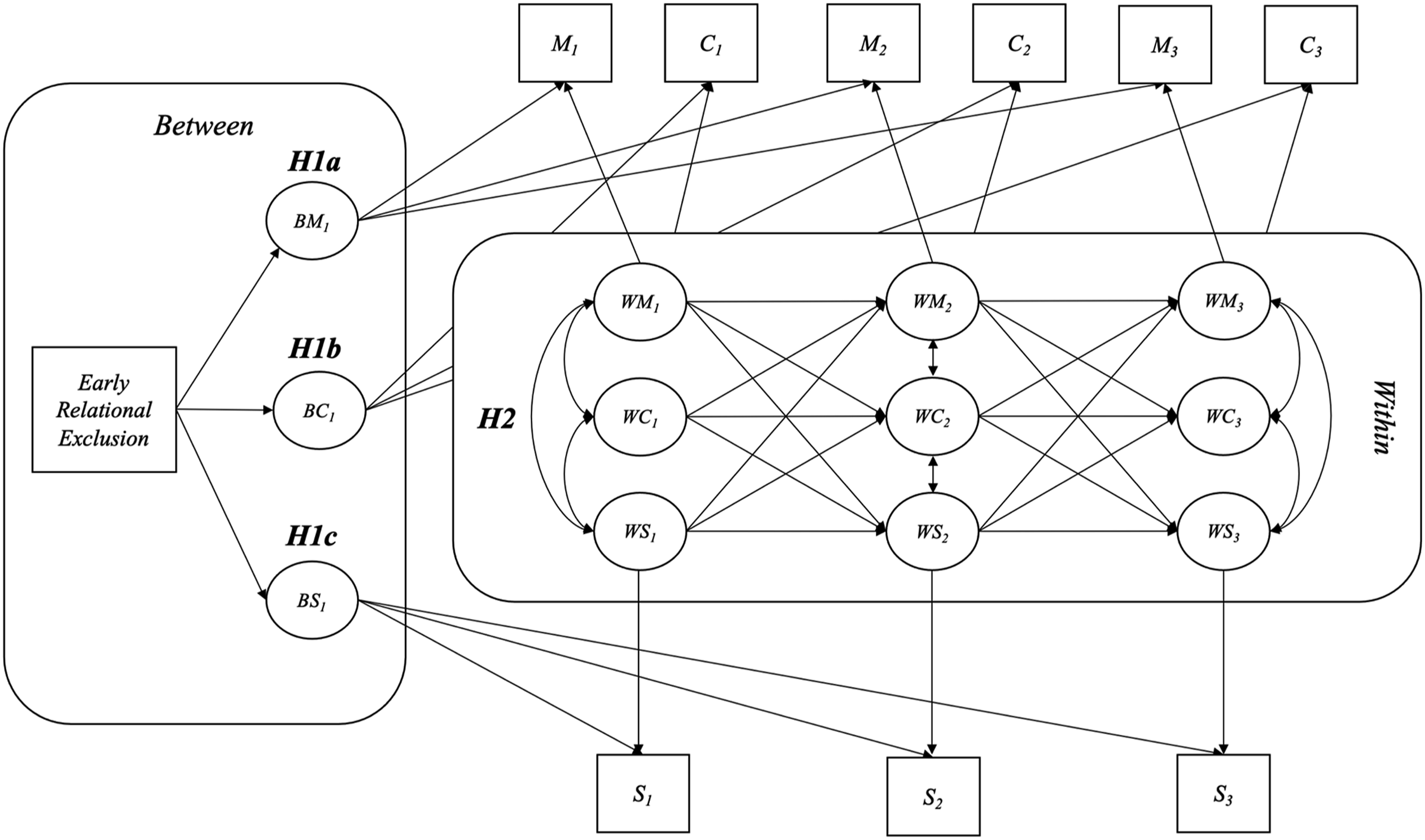
Hamaker et al. (2015) recommend constraining the within-person regression paths if the cross-time lags between waves are equal. This allows the model to gain additional degrees of freedom to estimate the parameters. We compared the fit of models with and without these paths to be equal across waves using a χ2 difference test. Results revealed that the model fit for the constrained model was good and equivalent to the unconstrained model, χ2 = 9.984, df = 9, p = .35, AIC = 3896.46, BIC = 4086.529, CFI = .99, TLI = .99, RMSEA = .02 (90% CI: .00, .07); Δχ2 (9) = 9.77, p = .36. Cross-time constraints were therefore retained. The full model fit the data well, χ2 = 19.758, df = 18, p = .34, AIC = 3888.24, BIC = 4046.529, CFI = .99, TLI = .99, RMSEA = .02 (90% CI: .00, .061).
Results
Descriptive statistics and zero-order correlations.
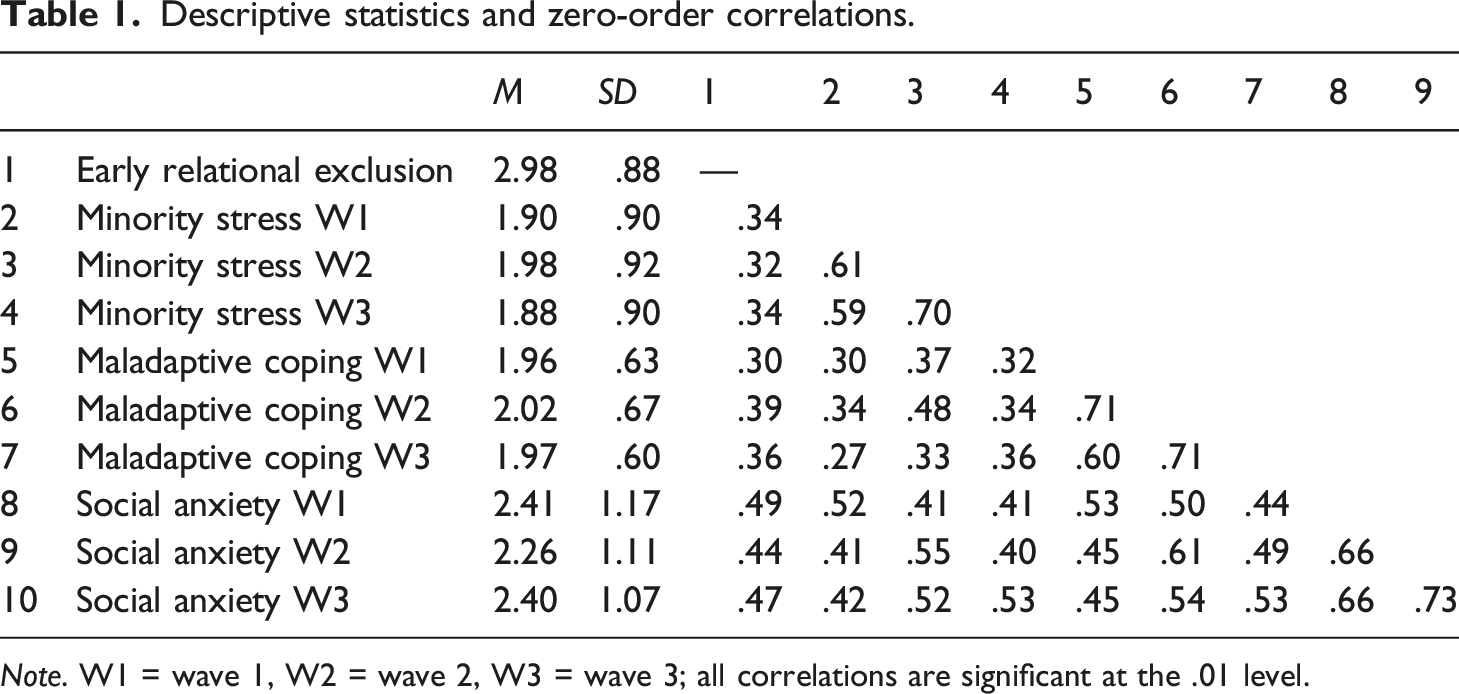
Note. W1 = wave 1, W2 = wave 2, W3 = wave 3; all correlations are significant at the .01 level.
Unstandardized results for time-invariant predictor, autoregressive and cross-lagged effects, and within-wave associations.
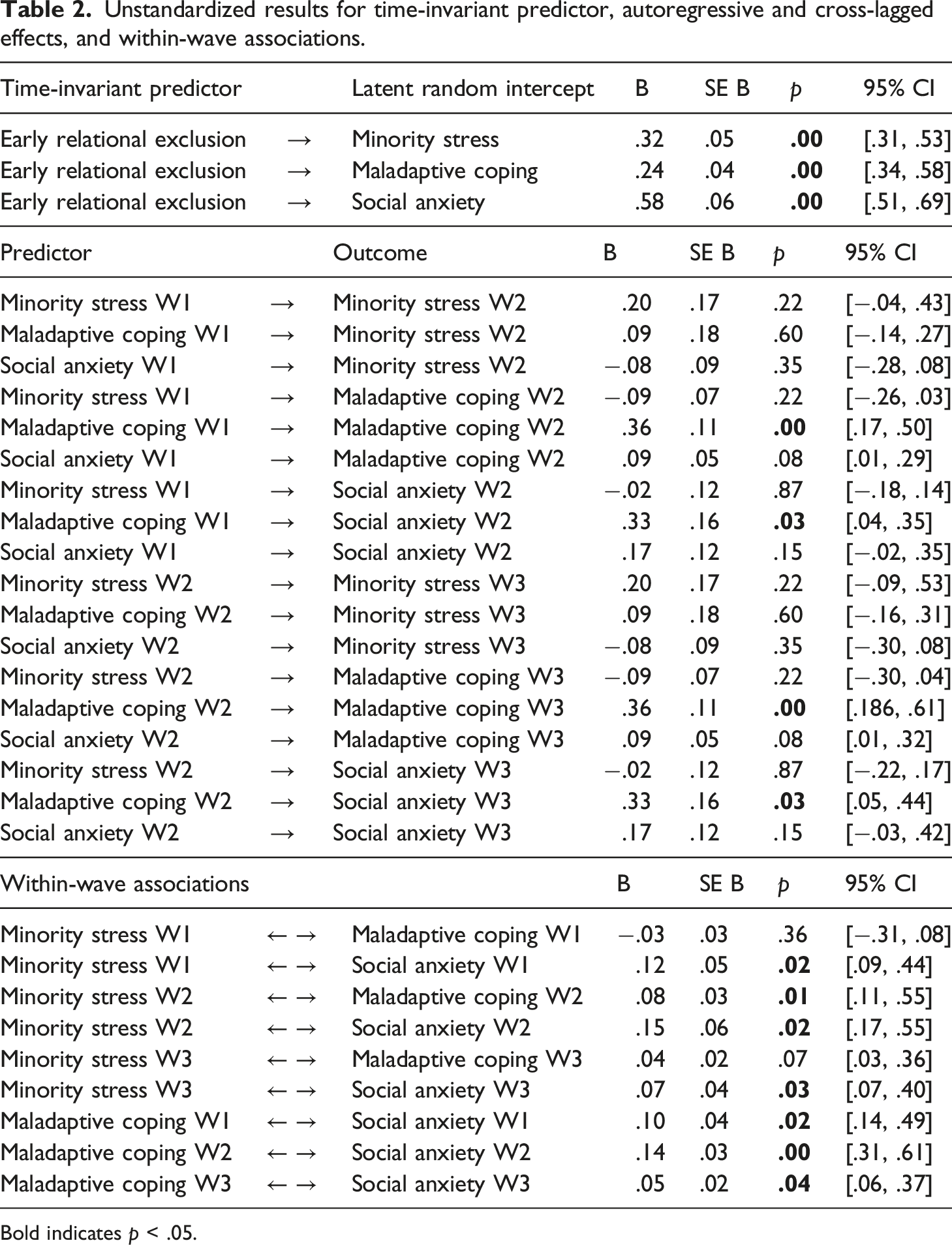
Bold indicates p < .05.
Standardized results for time-invariant predictor, autoregressive and cross-lagged effects, and within-wave associations.
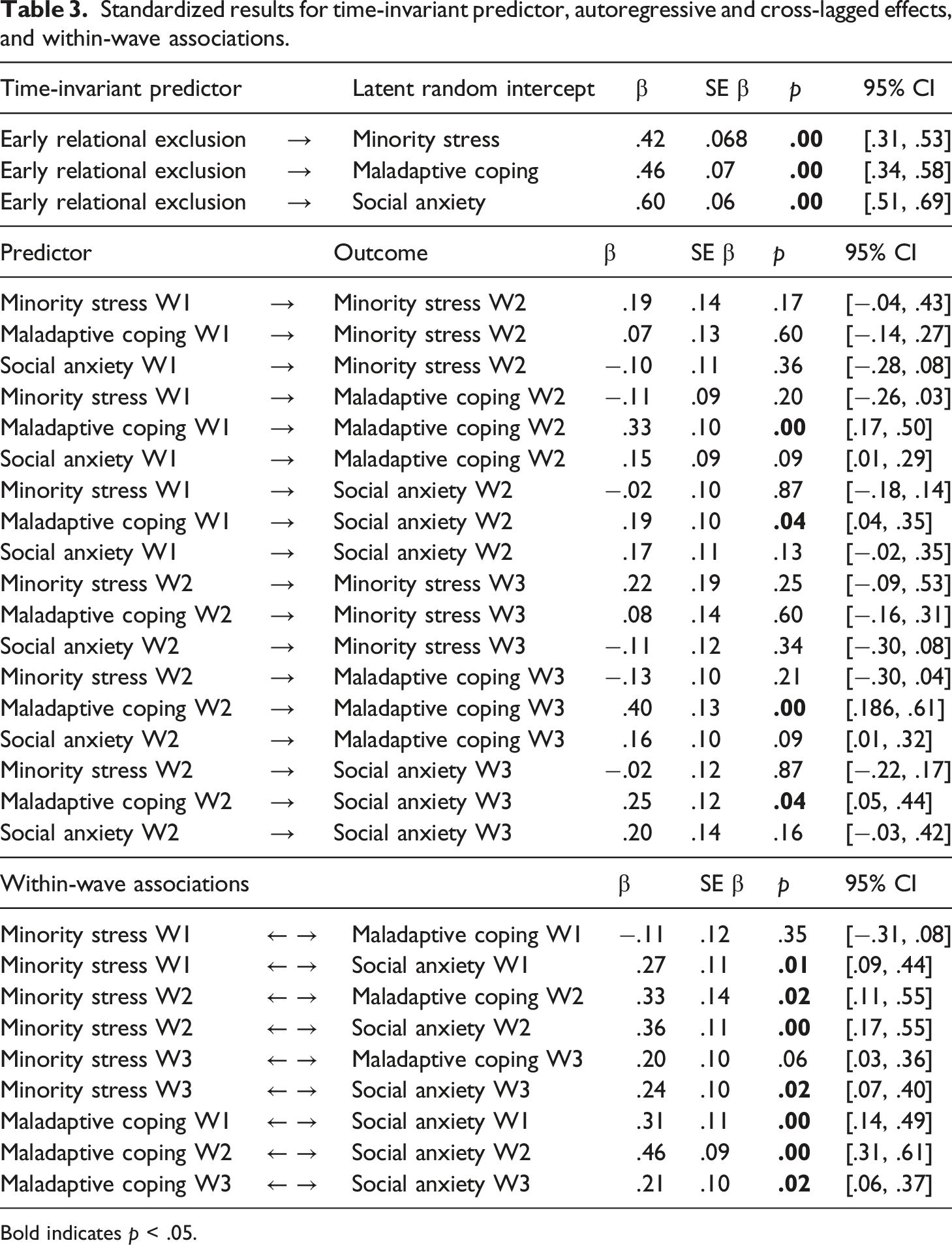
Bold indicates p < .05.
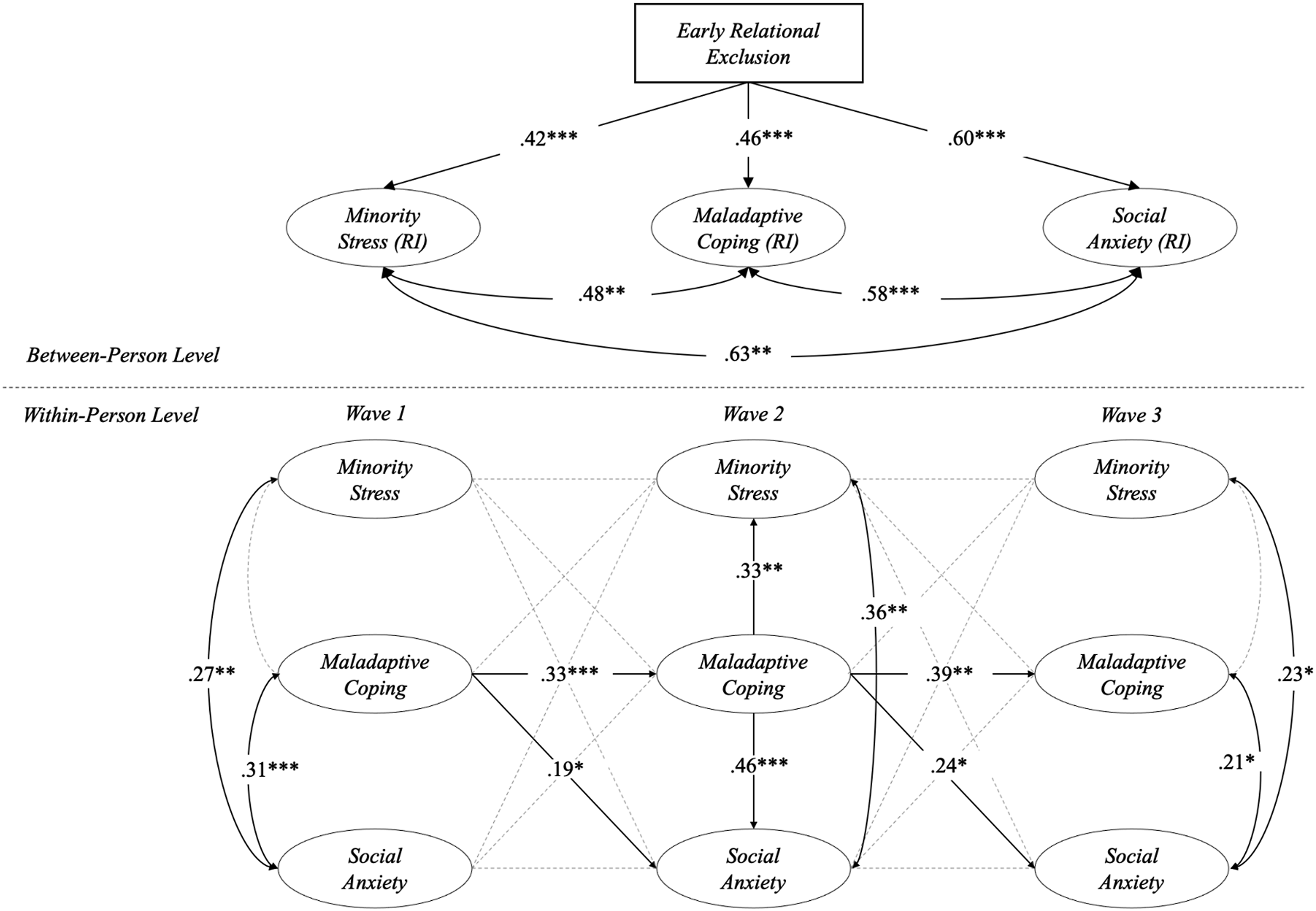
Results for RI-CLPM. Note. *p < .05, **p < .01, ***p < .001. RI indicates random intercept.
Time-invariant predictor and associations between random intercepts (H1)
The first hypothesis, which had two parts, predicted positive associations between early relational exclusion and present-day (a) minority stress, (b) social anxiety, and (c) coping. We tested this prediction by assessing the associations between early relation exclusion (as a time-invariant predictor) and the random intercepts of minority stress, social anxiety, and coping. The random intercepts, as noted earlier, reflect between-person estimates (i.e., average scores across the three waves of data). As shown in Figure 2, early relational exclusion positively associated with the random intercepts of minority stress (β = .42, p < .001), maladaptive coping (β = .46, p < .001), and social anxiety (β = .60, p < .001). This fully supported all three components of H1.
Within-person associations over a three-month period (H2)
The second hypothesis proposed longitudinal relationships between minority stress, social anxiety, and maladaptive coping at the within-person level over the course of a three-month period. Before discussing these results, it is worth reviewing the between-person associations of these variables. Figure 2 shows that these variables were all significantly related at the between-person level, suggesting that individuals who tend to be high, relative to the sample, on one variable also tend to be higher on the other two variables.
Results at the within-person level, which were the focus of H2, demonstrated one statistically significant cross-time effect, and that was between maladaptive coping and social anxiety. Maladaptive coping behaviors consistently predicted social anxiety at the next time point (CopingW1 to Social AnxietyW2: β = .19, p < .05; CopingW2 to Social AnxietyW3: β = .24, p < .05), suggesting that when individuals engage in more maladaptive coping than normal, they report more social anxiety than normal 30 days later. This is indicative of carryover effect. Maladaptive coping was not a significant cross-time predictor of minority stress. Maladaptive coping did, however, evidence significant autoregressive effects (CopingW1 to CopingW2: β = .33, p < .001; CopingW2 to CopingW3: β = .39, p < .001), suggesting negative coping behaviors are relatively stable over time.
Social anxiety did not significantly predict either minority stress or maladaptive coping (see Tables 2 and 3 and Figure 2). Likewise, minority stress did not significantly predict social anxiety nor coping (see Tables 2 and 3 and Figure 2). Therefore, H2 was only partially supported. Specifically, maladaptive coping had reciprocal cross-time effect to subsequent waves and to social anxiety, but we did not find evidence of this effect for minority stress. Finally, it is notable that minority stress, social anxiety, and maladaptive coping were significantly correlated at the within-person level within each wave (see within-wave correlations in Figure 2). This might suggest that cross-time association between these variables might only emerge in closer temporal proximity than 30 days, an issue we revisit in the Discussion.
Discussion
For sexual minority men, relational exclusion begins early and can ricochet into their lives as young adults. Minority stress theory has closely examined contemporaneous accounts of distal and proximal stressors, revealing important findings about the unique experiences of having a stigmatized sexual identity in today’s world. Yet, few studies have connected current feelings of minority stress, social anxiety, and coping to feelings of differences in adolescence. Additionally, this literature has yet to provide a clear picture of how these variables are linked over time at the within-person level. This, however, is critical for theory development, as well as designing interventions to help young sexual minority men who are at risk for social anxiety.
Supporting hypothesis one, early relational exclusion was strongly linked to contemporary experiences of stress, coping, and anxiety for young sexual minority men. This finding is consistent with the literature on “feelings of difference” emerging from social encounters with peers (Simon et al., 2020) and experiences of ostracism playing a prominent role in the lives of sexual minority populations (Hatchel, et al., 2019). Contrary to our prediction, minority stress was not linked to maladaptive coping and social anxiety over time at the within-person level.
Yet, this finding does not necessarily contradict the psychological mediation framework. Data were from three separate seven-day periods over three months. This approach was taken to get a “snapshot” of the relational lives of young sexual minority men (as opposed to month-long retrospectives). The effect of stigma-related stress on coping and social anxiety may be most potent at the trait-level or perhaps when the indicators are measured on a daily basis (e.g., with experience sampling). At the within-person level, minority stress did not have a carry-over effect, but was strongly linked to social anxiety that same week. This may suggest that exposure to minority stress in day-to-day life has a more immediate effect on young sexual minority men’s social anxiety. On the other hand, coping strategies such as self-blame, venting, and behavioral disengagement had a lingering effect on social anxiety, such that when an individual’s maladaptive coping was higher than usual, they reported higher social anxiety than usual at the following wave.
According to the psychological mediation framework, coping behaviors play a prominent role in mental health over time (Hatzenbuehler, 2009). The current study provides longitudinal evidence of a within-person effect described in this framework. Indeed, the framework’s emphasis on the interaction between the individual’s reaction to stress in the environment and subsequent health outcomes for sexual minority populations was demonstrated in the RI-CLPM. Furthermore, early experiences of young sexual minority men have previously focused on how individuals cope with stressors using achievement-related success (i.e., “the best little boy in the world hypothesis”; Pachankis & Hatzenbuehler, 2013). These studies emphasize how early stigma impacts self-worth and subsequent drive for others’ approval through achievement (e.g., academic competence, appearance). Our study provides an additional perspective to this research in that it highlights the relational elements of these early experiences and their subsequent effects on how young sexual minority men feel about current-day social interactions. Additionally, more recent tests of minority stress theory with sexual minority youth have started to untangle exposure to stigma-related stress throughout the day using intensive longitudinal analysis (e.g., Mereish et al., 2021). Therefore, the results of this study provide additional justification for researchers to examine how exposure to minority stress affects moment-to-moment well-being at the individual and relational levels.
Knapp et al. (1981) reported that people could recall specific features of messages that had a lasting impact on them. These memorable messages help individuals make sense of what is appropriate behavior within a particular social environment (Stohl, 1986). We conceptualized early relational exclusion as memorable moments of ostracism from peers, yet we know little about what makes these particular messages have such a long shelf life. Rubinsky and Cooke-Jackson (2017) suggest that memorable messages related to sexuality may serve “socializing functions, especially for a population whose members are marginalized by those aspects of their identity” (p. 1473). Future research should explore how verbal and nonverbal cues work together to generate feelings of relational exclusion and make them especially memorable to young sexual minority men. By examining the specific cues that have a lasting impact on those with a marginalized sexual identity, professionals working with sexual minority youth (e.g., teachers, counselors, school staff) can more readily detect exclusionary behavior and intervene accordingly (National Academies of Sciences, Engineering, and Medicine, 2022).
Notably, this study highlighted the experiences of young sexual minority men. Although this is an overlooked population in the close relationship literature (see Pollitt et al., 2022), these results should not be generalized to sexual minority women or trans and gender-diverse people (Nakamura et al., 2022). Future researchers are encouraged to examine how early relational exclusion uniquely affects other sexual and gender minority populations. Recent evidence suggests that sexual minority women are at higher risk for anxiety-related disorder than their male counterparts (Cohen et al., 2016). Additionally, recent extensions of minority stress theory (e.g., the gender minority stress framework) have reconceptualized how stigma-related stressors operate within an ideology of cisnormativity (Tan et al., 2020; Testa et al., 2015). The present study argued that feelings of difference begin before the formal recognition of sexual identity; trans and gender-diverse youth likely have similar experiences, which subsequently affect current-day social interactions and reactions to stress exposure. Provided the explicit acts of interpersonal violence (Austin et al., 2022) and discriminatory policies that uniquely affect trans and gender-diverse youth (Barbee et al., 2022), this is an important future step for researchers to explore.
It is also critical to consider strategies that help enact resilience. Meyer (2015) specifically outlines a reorientation of minority stress theory that emphasizes individual and community resilience in the face of stigma-related stressors. Fergus and Zimmerman (2005) present an ecological view of resilience that could inform LGBTQIA+ community resilience. Indeed, community resilience could act as a protective factor against adverse health outcomes and help maintain personal well-being in the face of risk (McConnell et al., 2018). In terms of the current study, it would be worthwhile for researchers to understand moments of early relational inclusion, just as much as exclusion. A focus on social encounters when a peer extended a helping hand may buffer the negative effects of memorable messages of exclusion.
The findings of this study have important implications for practitioners working with sexual minority men. In particular, the findings highlight the need to consider both present-day stressors and past relational experiences when working with this population. This research focused on retrospective accounts of early experiences, so it is critical to note that participants may not have fully realized their sexual identity or been “out” when they experienced this relational exclusion. This limits our ability to recommend interventions that directly address sexual identity. Yet, we believe our findings have implications for adults who work with youth in primary and middle-grade educational settings because early relational exclusion centered on peer relations.
Educators should make concerted efforts to avoid class-sanctioned activities with the potential for peers to isolate each other. Physical education instructors, for example, should determine the groups for team sport activities instead of allowing peers to select their teams. Doing so prevents students from being singled out as “the last one.” Educators should also be mindful that exclusionary communication may be modeled from parent behavior learned outside the classroom. One practical classroom intervention is to discourage parents from engaging in exclusionary communication while in the classroom (e.g., parents distributing invitations to a birthday party while in the classroom if not everyone in the class is invited). Early relational exclusion often stems from subtle messages of difference as opposed to explicit derogatory remarks. Actively avoiding opportunities for exclusionary communication is an integral part of building a socially-safe classroom environment for all students.
Overall, this study sheds light on the importance of early relational exclusion in shaping the day-to-day lives of young sexual minority men. By using a multi-wave study and a random-intercept cross-lagged panel model, this study demonstrates the dynamic interplay between stigma-related stressors, maladaptive coping, and social anxiety based on intraindividual differences.
Footnotes
Declaration of conflicting interests
The author(s) declared no potential conflicts of interest with respect to the research, authorship, and/or publication of this article.
Funding
The author(s) received no financial support for the research, authorship, and/or publication of this article.
Open research statement
This research was not pre-registered. The data used in the research cannot be publicly shared but are available upon reasonable request. The materials used in the research can be publicly shared and posted.
