




Abstract
While social pluralism and diversity are central characteristics of functioning democracies, civil society and democratic institutions require citizens to perceive themselves as an integral part of society in order to function. This stems from a general sense of unity and cohesion and a mutual understanding of citizens that institutions and other members of the society are trustworthy. While objective aspects of social embeddedness, that is organizational membership and inter-relational contact, are established predictors of these outcomes, perceived loneliness is rarely investigated. This study investigates whether changes in loneliness reduce levels of perceived connectedness and political and interpersonal trust beliefs. By analyzing 12 waves of panel data from the Netherlands gathered between 2008 and 2020 (n = 41,508 observations from 9954 individuals), the analysis shows that intra-personal variation in loneliness predicts a citizen`s sense of connectedness and interpersonal trust beliefs. Regarding political trust, the relationship was not found with panel fixed effect.
Keywords
Introduction
To function, civil societies and political institutions rely on citizens’ sense of social belonging and on citizens’ mutual understanding that institutions and other members of society are trustworthy. Often discussed in the social cohesion and social capital literature (Chan et al., 2006), trust in political actors and institutions is important for their legitimacy, citizens’ policy compliance, and civic morality (Bargain & Aminjonov, 2020; Letki, 2006). Likewise, inter-relational trust and a sense of interconnectedness with other members of society are considered important sources for civic solidarity, identity, and participation in socio-political processes (Brehm & Rahn, 1997; Marien & Hooghe, 2011; Welch et al., 2005). For instance, studies found that individuals who protested containment policies are characterised by very low levels of institutional trust and a high perceived division in society (Devine et al., 2021; Frei et al., 2021). As trust and perceived connectedness are incremental parts of social cohesion and central for democracies to function (Chan et al., 2006; Vollhardt et al., 2009), scholars warned about the threat of the erosion of these crucial societal resources (Bovens & Wille, 2008; Twenge et al., 2014).
Authors in the tradition of the social capital theory argue that trust and a sense of social cohesion stem from activities in civic organizations, communities, and social interactions as they provide opportunities for cooperation, communal thinking, and reinforcement of shared civic virtues (Coleman, 1988; Putnam, 2000). Correspondingly, empirical studies often investigate the emergence of social cohesion, that is trust and a sense of connectedness, with objective measures of social embeddedness, such as organizational membership, network characteristics, and inter-relational contact (Fukuyama, 2001; Jackson, 2020; Paxton, 2002). However, these operationalizations are often limited to observable aspects of social interactions. Considering the great importance of perception for the perceived social reality and social attitudes (Greifeneder et al., 2017), it is likely that subjective-perceptional aspects of relationships play an important role in the formation of trust beliefs and perceived social cohesion as well (Vollhardt et al., 2009).
This study contributes to overcoming this deficiency by investigating the influence of loneliness on social and political trust beliefs and perceived social connectedness. Loneliness is an emotional response to a perceived deficiency in one’s social network and has been found to influence a multitude of behavioural and health outcomes. However, sociological or political studies concerned with the societal consequences of loneliness are small in numbers.
Figure 1 displays the number of articles registered in the webofscience.org database published between 1960 and 2019 with the term ‘loneliness’ in the title, separated by scientific field. While this can only serve as a rough indicator, the graph illustrates that loneliness played just a minor role in empirical research throughout the 20th century, with particularly few publications in sociology and political science. Out of the whole corpus of 12,402 articles published between 1960 and 2019, only 336 and 54 research articles are categorized as studies from the field of sociology or political studies, respectively. Number of research articles with ‘loneliness’ in the title by year and field.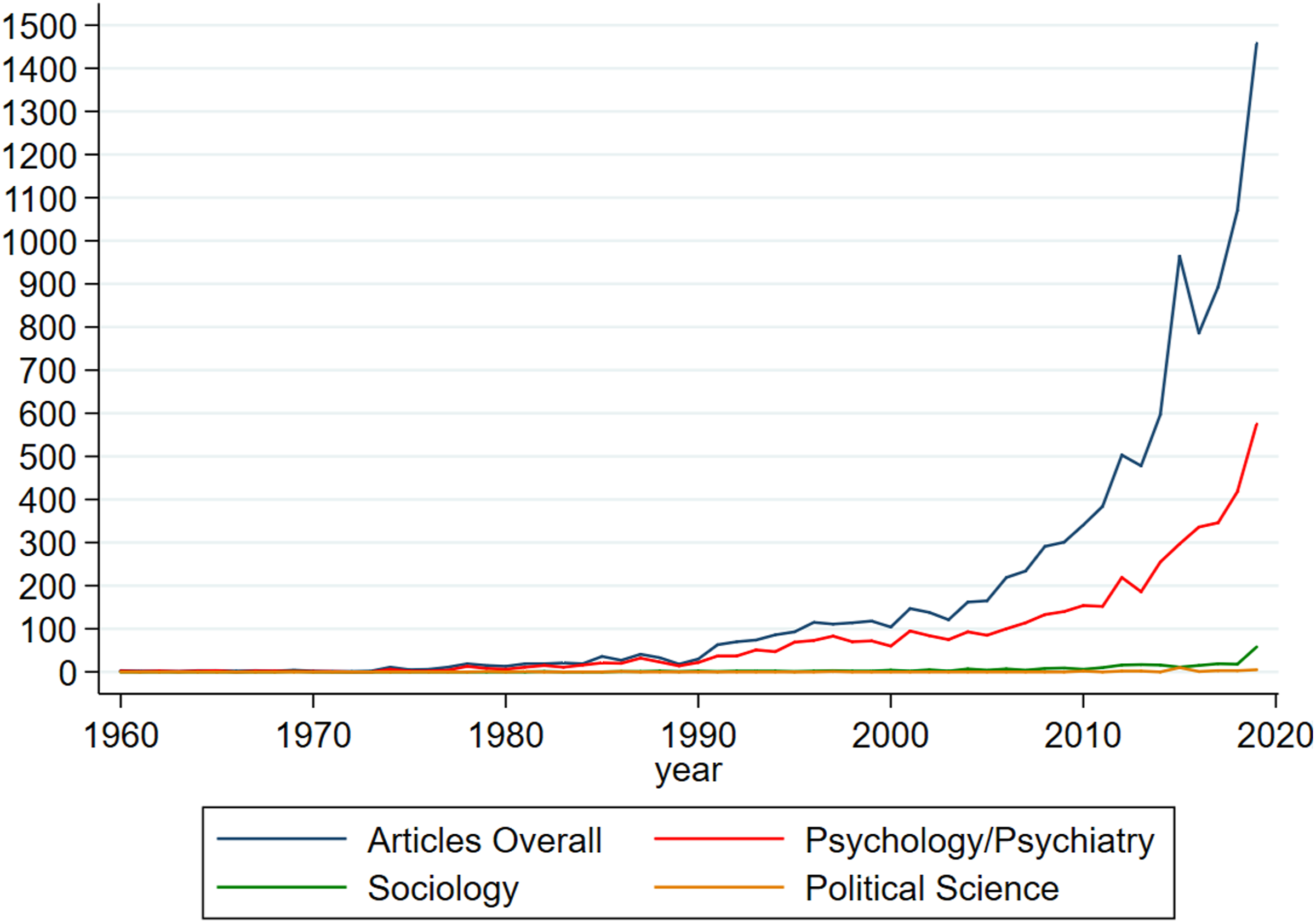
In consequence, it is of little surprise that the question of whether loneliness exerts an influence on social and political trust remains underexplored. Furthermore, the limited number of studies investigating the influence of loneliness on trust and cohesion are mostly based on cross-sectional data (Schobin, 2018; Yang, 2019). One noteworthy study by Rotenberg and colleagues did investigate the relationship between generalized trust and loneliness with a two-wave panel design in several age groups (Rotenberg et al., 2010). This analysis, however, is based on comparably few observations in a fairly short panel, which potentially led to the reported insignificant effects of loneliness on trust.
This article tackles the issue that no study confirmed the relationship with well-powered longitudinal designs so far. By utilizing 12 waves of longitudinal, representative panel data from the Netherlands gathered between 2008 and 2020, the study confirms that within-person variation in loneliness relates to intra-personal variation in the individuals’ perceived connection to others and their social trust beliefs. The relationship between loneliness and political trust, however, can only be found by comparing individuals with different loneliness levels, but not for within-person changes in loneliness over time. Theoretical implications are summarized in the discussion section.
Loneliness, what it is and what it does
Similar to hunger or thirst, loneliness is a universal human experience and, consequentially, the topic of countless philosophical and cultural writings (Svendsen, 2017). Despite its cultural prominence, the notion of loneliness suffers from multiple misconceptions and gets confused with related concepts in public as well as in academia. Therefore, it is important to discuss in more detail what loneliness is, how it relates to objective social relationships and activities, and what is known about its consequences.
As reliable relationships were a central resource for survival throughout history, humans have developed a strong desire to form and maintain reliable social relationships and belong to a larger social group (Baumeister & Leary, 1995; Gere & Macdonald, 2010). Loneliness stems from a perceived discrepancy between one’s desired and actual relationships and can be understood as the emotional expression of a perceived insufficiency in personal social relationships, either in respect of quantitative or qualitative aspects (Franklin & Tranter, 2021; Perlman & Peplau, 1981). The fields of psychology and neuroscience established that loneliness developed as a painful emotional warning signal that motivates humans to re-affiliate with others to maintain a protective relationship network (Cacioppo & Cacioppo, 2018; Qualter et al., 2015), and many scientists concerned with human motivation consider affiliation as one of the most important drivers of human action (Kovač, 2016).
This close conceptual relationship between loneliness and social relationships led to the common misconception that loneliness is a synonym for aloneness. Although conceptually intermingled at times, loneliness and being alone are distinct empirical phenomena and loneliness is more dependent on the quality, rather than quantity, of social relationships and social activities (de Jong Gierveld et al., 2018). For instance, research repeatedly found statistically significant, but modest correlations between social isolation, social activity and loneliness (Coyle & Dugan, 2012; Russell et al., 2012). These findings manifest themselves in an everyday observation: people can feel lonely despite being in company but feel happy with very few contacts. In contrast, social connectedness and social embeddedness are often used interchangeably and refer to the objective social network of individuals (Reilly, 2017). Simply put, aloneness and connectedness are physical states of being, but loneliness is a perception and as such a state of mind.
Due to its motivating function to re-affiliate, loneliness is a useful emotion in the short term. However, being unresolved, chronic loneliness has severe negative consequences. Keeping in mind that loneliness is a warning signal for seemingly insufficient or eroding social relationships, it is of little surprise that chronically lonely individuals tend to experience various negative emotions during social encounters such as anxiousness, insecurity, and risk aversion coupled with a self-preservation mindset (Qualter et al., 2015; Spithoven et al., 2017).
Given that social ties provide security, loneliness is associated with increased stress which results in an elevated threat sensitivity, anxiety and risk avoidance (Cacioppo & Cacioppo, 2018). Mediated through these stress reactions, loneliness is known to cause reduced sleep quality and unhealthy coping behaviours, which results in severe consequences for health and psychological well-being. These outcomes include dementia, depression, cardiovascular diseases, and reduced life expectancy (Hawkley & Cacioppo, 2010; Lim et al., 2020). This led scientists to promote loneliness first and foremost as an issue for public health (Holt-Lunstad et al., 2017).
However, as elaborated in the former section, there is a lack of research concerned with the effect of loneliness on other issues of societal interest. In light of survey results suggesting staggering rates of loneliness in the US and Europe, this might be a crucial shortcoming. For instance, US American surveys found that roughly 35% of adults aged 45 or older report to feel lonely, a trend that likely worsened during the Covid-19 pandemic (National Academies of Sciences Engineering and Medicine, 2020). Likewise, survey data from the adult British population indicate that roughly 14% often or always feels lonely (Jo Cox Commission on Loneliness, 2017). This is mirrored by data gathered in Germany in 2013 and 2017 which indicate that about 10% of the adult population considered themselves frequently lonely (Eyerund & Orth, 2019). Using data from the European Social Survey, social scientists found that loneliness is a substantial issue in almost all European countries with up to 34% of individuals reporting feeling lonely (Yang & Victor, 2011). Global Meta-Analysis and several European studies show the global scale of the issue (Ernst et al., 2022). These findings suggest that a potential influence of loneliness on trust beliefs and connectedness might be of considerable scale.
Loneliness, connectedness and trust beliefs
As reviewed in the preceding section, loneliness is a response to insufficient or eroding social relationships. This is accompanied by feelings of anxiousness, insecurity, and risk aversion (Spithoven et al., 2017). Spithoven and colleagues also conclude that loneliness alters social perception and behaviour as soon as it becomes a chronic state. While situational loneliness motivates individuals to seek out social interactions, repeated failure to overcome their loneliness causes additional fear of negative social interactions and, ultimately, the paradoxical behaviour of social withdrawal (Qualter et al., 2015).
This dynamic likely radiates from the sense of being part of the immediate social community on the perception of belonging in society in general (Pretty et al., 1994). As elaborated before, humans have a strong need for social belonging (Baumeister & Leary, 1995). This does not only refer to individual contacts but also the person’s perception of whether they fit into the broader social setting (for instance, the village or city) and to be an integral part of society (Franklin & Tranter, 2021). Hence, feeling lonely logically relates to increased uncertainty about the own social standing, the reliability of others, and to what degree one has a generalized perceived connection to others. Qualitative studies of loneliness in marginalized groups suggest that a sense of disconnectedness from the greater society and other people is part of experiencing loneliness (Bower et al., 2018; Rokach, 2014). Likewise, studies investigating war veterans highlight the link between loneliness and disconnectedness from society (Stein & Tuval-Mashiach, 2015). However, it is an open question whether these insights can be replicated with survey data of the general population.
Likewise, the prolonged experience of feeling lonely likely fosters distrust against other people. As discussed, lonely individuals tend to grow anxious and insecure in social settings and interpret social encounters more negatively (Spithoven et al., 2017). This likely corresponds with a higher probability to experience negative social situations and, in the long run, becoming more distrusting. Unsurprisingly, observational studies found that loneliness correlated with interpersonal distrust in multiple countries and with various operationalizations (Nyqvist et al., 2016; Qualter et al., 2009; Rotenberg, 1994). However, loneliness and trust beliefs are associated with time-invariant characteristics such as personality traits and correlations potentially due to self-selection (Buecker et al., 2020). Studies that experimentally manipulate situational loneliness support the idea that loneliness fosters anxiety (Cacioppo et al., 2006), but given that experimental manipulation of chronic loneliness is not feasible and cross-sectional data do not observe changes within individuals, it is unclear whether within-person changes in loneliness over longer timespans affects social distrust.
Finally, if loneliness causes distrust and disconnectedness, it potentially exerts an influence on the citizens’ trust towards political actors and institutions as well. If chronically lonely individuals evaluate other people more negatively and become more distrustful in general, the idea that this might lead to generalized distrust against politicians and political organizations as well is not far-fetched. While several studies could not find a link between social and political trust (Uslaner, 2017), more recent studies found an association (Newton & Zmerli, 2011). Likewise, longitudinal evidence from Denmark suggests a bidirectional relationship between social and political trust (Sønderskov & Dinesen, 2016).
All this supports the idea that loneliness potentially influences social as well as political trust. However, lonely individuals show these attitudinal changes out of latent insecurity and fear of further social exclusions. Political actors and institutions are more abstract concepts for most individuals. Whether the social distrust radiates to a general distrust against political actors and their spheres of action (i.e., political institutions) is an open empirical question. There are a couple of multinational cross-sectional studies that find the association between loneliness and political trust using the European Social Survey (Schobin, 2018; Yang, 2019). However, the theoretical relationship between loneliness and political distrust is less clear compared to the other two discussed considered outcomes and suffers from the same issue that empirical findings are mostly based on cross-sectional data.
Taken together, despite a strong argument why loneliness likely causes insecurity and anxiety that, in turn, cause distrust and a reduced sense of connectedness, the empirical evidence is fairly limited. Therefore, this study tests the hypotheses that loneliness is associated with reduced connectedness, and social as well as political trust.
Increases in loneliness are associated with a decrease in perceived connectedness.
Increases in loneliness are associated with a decrease in social trust beliefs.
Increases in loneliness are associated with a decrease in political trust beliefs.
Method and analysis
Data
The data utilized in this study are administered by the CentERdata Institute for Data Collection and Research, funded by the Dutch governmental organization for scientific research. The “Longitudinal Internet Studies for the Social Sciences”, hereafter LISS, is the central panel data project of the “Measurement and Experimentation in the Social Sciences” (MESS) project and is openly available for scientists. The survey is a true probability sample of the registered population in the Netherlands. Although the LISS is mainly organized as an internet survey, the institute is gathering data on people without internet connection. Participants without computer or internet access are provided with devices so that they can participate. Therefore, the survey collection mode does reduce the potential bias of the sample. In the context of this study, this is particularly important because older age groups and low-income households are less likely to have internet access and show higher probabilities to suffer from loneliness (Hawkley et al., 2020; van Deursen & van Dijk, 2019).
Importantly, loneliness as well as perceived societal connectedness and trust beliefs are fairly stable over time (Marien, 2011; Mund et al., 2020). Therefore, long-running panel models are needed to track within-person variations in the central variables of interest. Fielded the first time in 2008, the panel gathers data annually with the most recent wave fielded in October 2020. Furthermore, the LISS continuously included a 6-item version of the de Jong Gierveld loneliness scale since the first observation period. As loneliness is a complex latent construct that is best captured with specific validated scales (Marangoni & Ickes, 1989), the long-running panel is uniquely suitable for the purpose of this study.
This study is based on 12 out of 13 waves gathered between 2008 and 2020. The fifth wave (2012) was not included in the analysis as the variables measuring loneliness varied in their operationalization in this specific wave. The panel itself is unbalanced, with permanent and temporary drop outs (average participation duration is 4.17 years). After excluding underage participants from the analysis (n = 803) and list-wise deletion of missing cases, the final analysis sample contains 41,508 observations from 9954 individuals.
Measures
Dependent variables
Sense of connectedness is measured with a single item indicator. The participants had to answer a question asking them to what extent they feel connected to other people in general. The item is part of the personality core questionnaire and is presented with other questions measuring universal values and attitudes. The rating scale displayed seven figures of overlapping circles to visualize the degree to which the participants feel connected with other people in general. The original item is coded from one to seven, where higher values indicate high connectedness. To increase the comparability of the effect size between the three considered outcome variables, the item was rescaled so it ranges from 0 to 10.
Social trust is measured with the item: “Generally speaking, would you say that most people can be trusted, or that you can’t be too careful in dealing with people?” The participants had to indicate their trust on a scale ranging from 0 to 10, with high values indicating high social trust.
Political trust is measured with a mean score index from five items (Cronbach alpha = 0.94). The participants were asked to indicate their confidence in several political actors and institutions: the government, the parliament, politicians, parties, and democracy overall. Similar to the social trust variable, all items and the resulting mean score range from 0 to 10, high values indicating high political trust.
Independent variable
Loneliness was measured with the shortened 6-item version of the Gierveld loneliness scale (Cronbach alpha = 0.79). The wording and scaling of the items are reported in Appendix Table A1. The Gierveld loneliness scale is a validated and widely used instrument to measure loneliness (de Jong Gierveld & van Tilburg, 2010). The scale is designed so it measures loneliness either unidimensionally or with two dimensions, namely emotional and social loneliness. As both subdimensions are similarly correlated with the outcome variables (compare online Appendix Table OA.1.1 and OA1.2), the reported results are based on the unidimensional version of the scale. Furthermore, given that a loneliness variable generated from factor scores resulted in the same results as a simple sum score (both measures are interrelated with .98), but are less intuitive to interpret, all reported results are based on a simple additive measure that summates the items (resulting in a scale ranging from 6 to 18). The resulting scale was then rescaled to the final loneliness item that ranges from 0 to 12, with high values indicating high loneliness.
Control variables
As elaborated in the theory section, many studies attempt to explain trust and perceived connectedness with measures of objective social inclusion. To ensure that the observed relationship between loneliness and the outcomes are not mere symptoms of limited social contacts, I control for membership in civic organizations as well as interaction frequency with family and friends, both measured on a seven-point scale. Other potential confounders are life events such as divorce (van Tilburg et al., 2015). To account for major life events that trigger loneliness, I include dummies measuring widowhood, divorce, separation from a partner, being married, and whether a person lives with their partner in the same household.
Furthermore, the analysis accounts for several socio-demographic variables. First, the study controls for sex (male vs. female) and level of education (“primary school”, “intermediate secondary education/junior high school”, “higher secondary education”, “intermediate vocational education/junior college”, and “university”). Furthermore, to account for age effects, the models control for the age categories “18–24 years”, “25–34 years”, “35–44 years”, “45–54 years”, “55–64 years”, and “65 years and older”. Also, as loneliness is correlated with poor health, I include a self-reported measure of general health, ranging from one to five, with high values indicating good health. Likewise, financial hardship can increase political and social distrust and is a predictor of social exclusion. To account for this, I include a variable measuring subjective satisfaction with the personal financial situation. The subjective measure was preferred over self-reported income because questions about self-reported income tend to have very high proportions of missing values and are biased due to social desirability (Hariri & Lassen, 2017; Korinek et al., 2006). Moreover, financial satisfaction captures financial hardship better, as it accounts for household size, changing living standards, and other social forces such as social comparisons.
Finally, longitudinal data might show period effects, due to specific events in time. This is often tackled by including arbitrary time dummies, but this can cause biases and introduce issues in respect of effect interpretation (Kropko & Kubinec, 2020). Following recommendations from the literature (Brüderl & Ludwig, 2014), the analysis does not rely on arbitrary time dummies but includes specific, theory-driven period events. It’s worth noting, however, that the results do not change under the model specification with time dummies instead of event dummies.
First, the Netherlands elected their parliament three times during this period. As explained in the description of the dataset, this wave from the 2012 election had to be dropped due to inconsistent measurement of loneliness. Therefore, the analysis considers only two election periods. As election periods are often accompanied by negative media reports and aggressive campaigns, scholars suspect that this affects trust beliefs (Bovens & Wille, 2008). To account for this, the analysis contains a dummy variable indicating whether an observation was gathered during an election year.
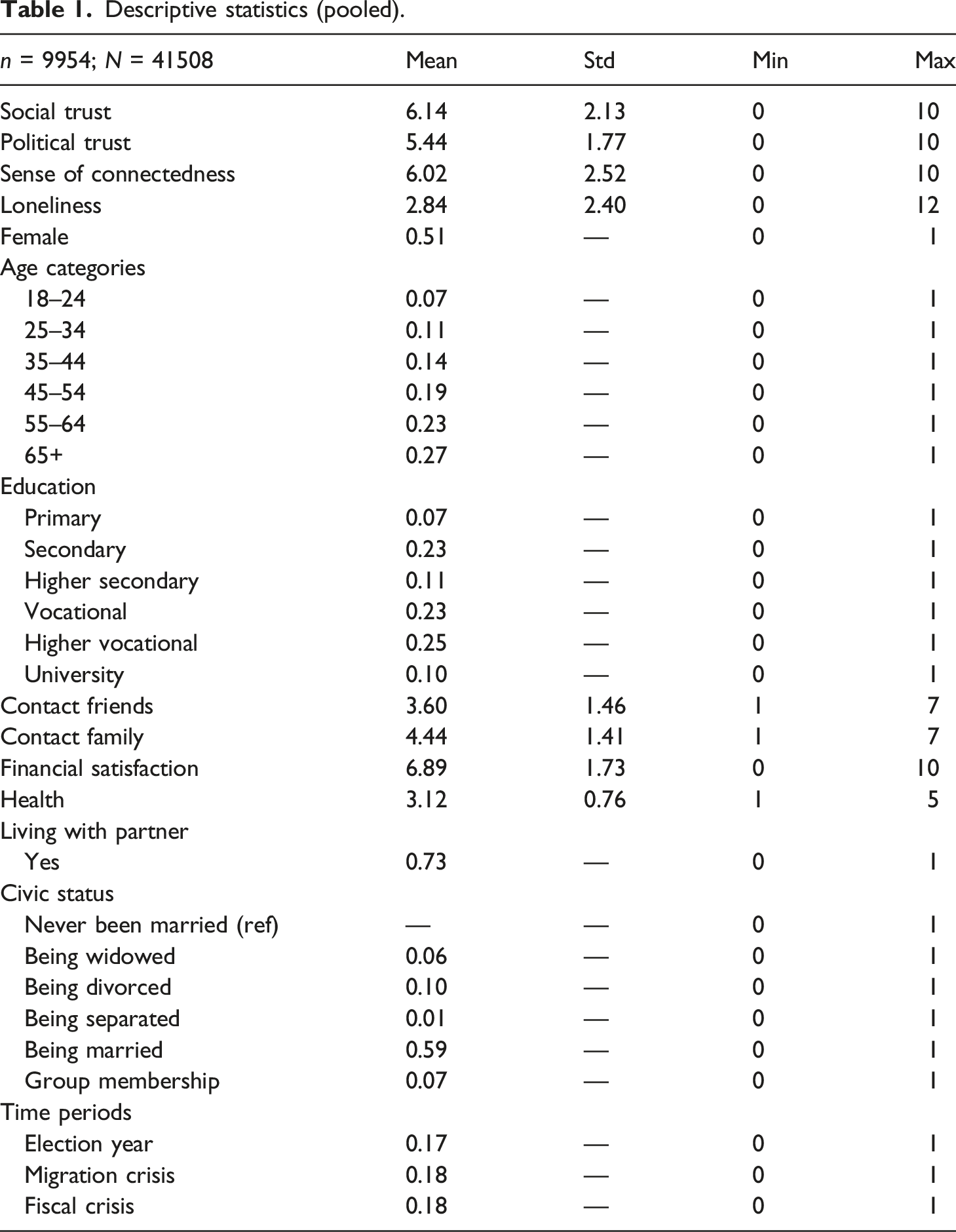
Descriptive statistics (pooled).
Statistical analysis plan
For the analysis, I estimate between-person effects (BE) as well as fixed, within-person variability, effects (FE) panel models (Bell & Jones, 2015; Brüderl & Ludwig, 2014). To investigate the hypotheses, the analyses will mainly focus on FE models, which control for unobserved heterogeneity by design. However, as an additional analytical step BE models are calculated as well. This is done for several reasons: First, comparisons between individuals are better suited to describe differences between sociodemographic groups, while FE models are preferable for causal inference (Brüderl & Ludwig, 2014). As loneliness and trust beliefs are fairly robust over time, BE are especially useful to describe more permanent differences between the most and least lonely parts of the population. Also, given that most previous research is based on cross-sectional data, that is between-person comparisons, the BE models can be seen as replications of these results.
Still, BE models suffer from issues of self-selection and confounding from unobserved individual characteristics (Andreß et al., 2013). As FE models only use within-person variation to estimate coefficients, they are particularly useful to account for these shortcomings. Therefore, to show the dynamic part of the relationship and to ensure that the relationship is not biased by time-invariant confounders, FE models are calculated. Please note that time-invariant variables such as biological sex are omitted in the FE models by design. The FE models are calculated with cluster robust standard errors.
After establishing the relationship using the models described above, the analysis concludes by investigating the possibility of a reverse causal relationship between loneliness and the outcomes. In contrast to experimental designs, observational data struggle inherently with issues related to reverse causality (Leszczensky & Wolbring, 2019). It is plausible that not only loneliness affects trust beliefs and sense of connectedness, but that the individuals’ loneliness is itself influenced by the outcomes. That is, a person growing less trusting is likely becoming lonelier (Rapolienė & Aartsen, 2021); likewise, a person that feels disconnected might become lonelier as well. In order to establish that variation in loneliness actually causes a change in the outcome variables, this potential reciprocal dependency needs to be accounted for. Traditionally, this issue is approached with random intercept cross-lagged panel models. However, these models came under criticism for their strict model assumptions and the, consequentially, often biased estimates (Allison et al., 2017; Mund & Nestler, 2019). Recent advances in statistical inference allow to control for the issue of reverse causality by combining panel fixed effect estimation with cross-lagged panel models (Allison et al., 2017; Leszczensky & Wolbring, 2019). To take this into account, I used the Stata command xtdpdml to compute linear dynamic panel-data models using full information maximum likelihood and robust standard errors (Williams et al., 2018). This approach combines the advantages of fixed-effect estimation (accounts for unobserved heterogeneity) with cross-lagged panel models (solves the issue of reverse dependency between x and y). With that, the estimates control for the effect of the outcome variable on the dependent variable, that is loneliness.
The findings
As elaborated in the preceding section, I estimate between-effects (BE) as well as fixed-effects (FE) panel models to investigate the relationship between loneliness and the outcomes. Figure 2 summarizes the effects of interest out of six regression models. The full regression table can be found in Appendix Tables A2 and A3. Effect of loneliness on social trust, political trust, and sense of connectedness.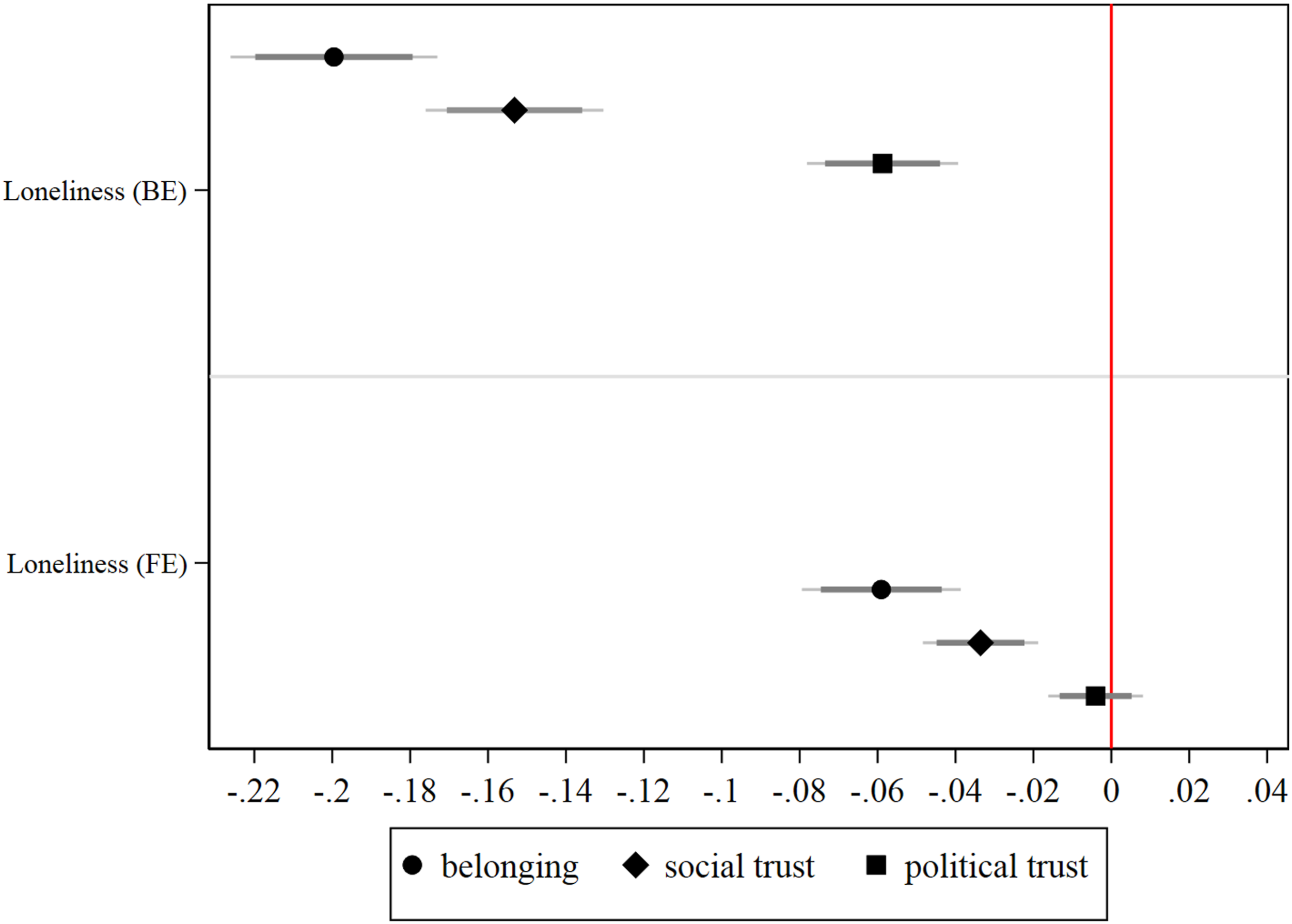
The first three coefficients report the between-effect of loneliness on the sense of connectedness, social trust, and political trust. On average, every additional point of loneliness is associated with a lower perceived connectedness of roughly 0.2 points (p ≤ 0.001). Over the full range of the loneliness scale, this accumulates to a difference of roughly 2.39 points on the 10-point connectedness scale between the most and the least lonely individuals. Likewise, loneliness is negatively associated with social trust (b = −0.153; p ≤ 0.001) as well as political trust (b = −0.059; p ≤ 0.001). Considering the scale of the variables, this accumulates to a difference between the most and the least lonely of 1.824 and 0.708, respectively. This confirms the previously found relationships: lonely individuals are substantially more likely to feel disconnected and to be socially and politically distrusting compared to less lonely individuals.
However, these effects are still confounded by self-selection and time-invariant unobserved confounders. This is especially important in the context of loneliness, as personality characteristics such as extraversion, agreeableness, conscientiousness, neuroticism, and openness are known predictors for loneliness (Buecker et al., 2020). To account for this, the last three coefficients reported in Figure 2 are based on panel fixed effects which are not biased by time-invariant unobserved confounders.
The within-person effects shrink considerably in size compared to the between effect coefficients, but remain statistically significant in two out of three models. With respect to the effect size, every increase in loneliness is, on average, associated with a decrease in perceived connectedness by roughly 0.059 (p ≤ 0.001), accumulating to a difference of −0.708 points on the 10-point connectedness scale between the most and the least lonely. With respect to trust beliefs, every additional point in loneliness is associated with a reduction in social trust of 0.034 (p ≤ 0.001). The effect of loneliness on political trust, however, is no longer statistically significant (p = 0.393).
The results so far suggest that rising loneliness causes reduced social trust and a diminished sense of connectedness. In contrast, the results provide just limited support for the effect of loneliness on political trust. As discussed in the section “Statistical Analysis Plan”, the following part of the analysis is concerned with the possible bias caused by a dependence of loneliness from the outcome variables themselves.
Cross-lagged fixed effect regression using full maximum likelihood.
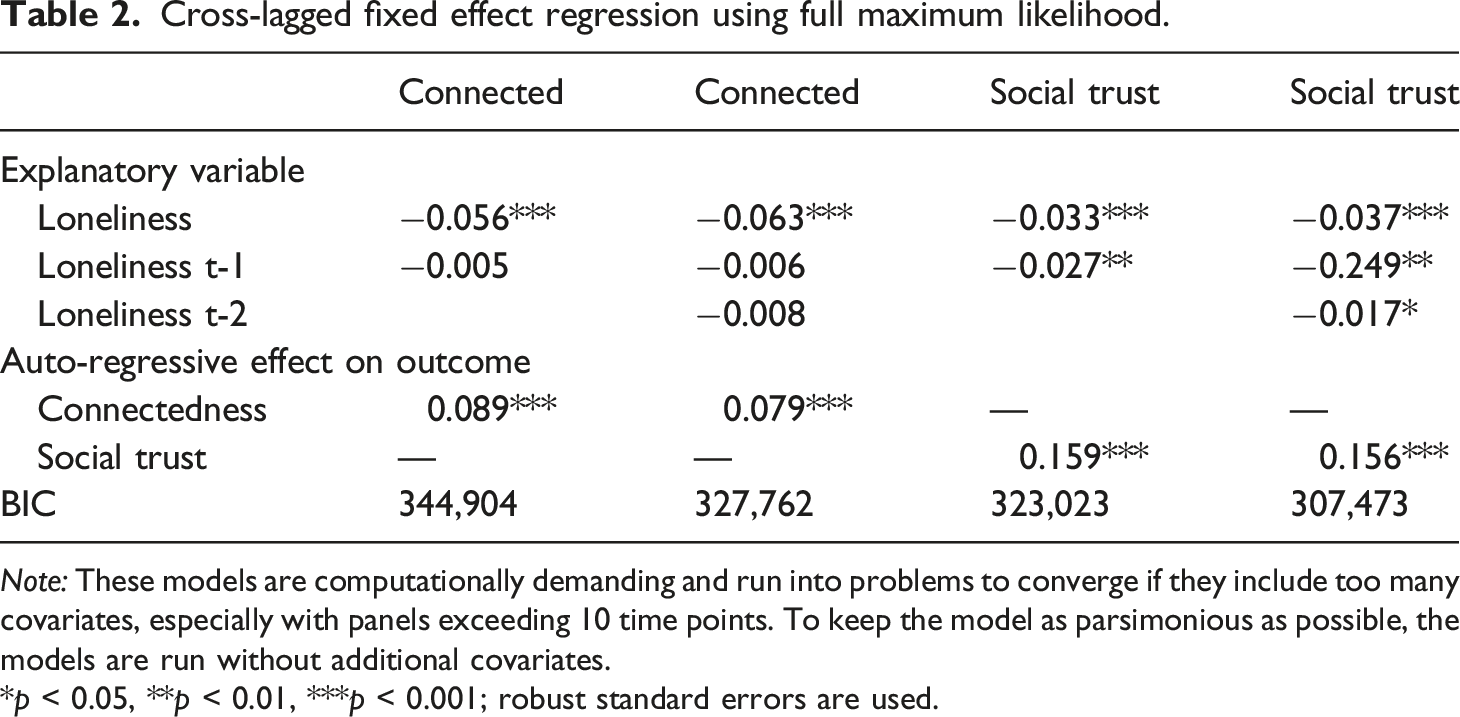
Note: These models are computationally demanding and run into problems to converge if they include too many covariates, especially with panels exceeding 10 time points. To keep the model as parsimonious as possible, the models are run without additional covariates.
*p < 0.05, **p < 0.01, ***p < 0.001; robust standard errors are used.
To conclude, the analysis supports Hypotheses 1 and 2, namely that loneliness erodes perceived connectedness and social trust. In contrast, the analysis finds only limited support for Hypothesis 3. While it is still a possibility that the effect of loneliness on political trust is too small to be detected on a within-person level, the significant BE and insignificant FE models suggest that the relationship between loneliness and political trust potentially stems from self-selection or unobserved confounders.
Robustness tests – alternative model specifications
To get a better understanding of the robustness of the results, I calculated several alternative model specifications. First, the reported results are based on adults only. Including the excluded underage participants does not change the results.
Secondly, the last wave was fielded in October 2020, a time the COVID-19 pandemic likely had a strong exogenous effect on loneliness as well as perceived social solidarity and political trust. However, removing this wave from the analysis does not change the results either.
Third, while panel fixed effects are powerful tools for inference statistics, they can be biased if the exogeneity assumption is not met. Intuitively speaking, if unobserved traits such as maturation or learning effects do influence the effect of loneliness on the outcome of interest, these estimates can be biased (Wooldridge, 2011). The potential issue that the effect of loneliness on beliefs and perceived connectedness might change based on the duration/chronicity of loneliness stands to reason. Fixed effects with individual slopes relax the exogeneity assumption and serve as a remedy of this problem (Brüderl & Ludwig, 2014). Using the STATA program XTFEIS (Ludwig, 2019), repeating the analysis using panel fixed effects with individual slopes leads to the same conclusions. All robustness tests are reported in the online appendix.
Discussion
The central goal of this study is to investigate whether perceived loneliness erodes people’s generalized sense of connectedness and political and social trust beliefs. With that, the study sheds light on the influence of the subjective perception of the personal social relationships on three indicators of perceived social cohesion. In accordance with Hypotheses 1 and 2, the results show that rising loneliness is indeed negatively associated with social trust and perceived cohesion, a relationship that was neglected previously. In respect of political distrust, the results are mixed as the relationship can be found in between-person comparisons, but not in fixed-effects models. Substantially, this means that lonely individuals are, on average, less trusting toward politicians and political institutions, compared to not lonely individuals. However, changes in the loneliness levels did not correlate with changes in political distrust, either because the effect is too small to be detected or because it is not present at all. It is noteworthy that out of the three outcome variables considered in this study, political trust has the lowest variation over time across the observed time period (SD = 0.86). Hence, the relationship between loneliness and political trust may be simply too small to be detected. Still, this finding indicates that the negative influence of loneliness on trust is not generalizable to political actors and institutions.
The results have important implications for existing as well as upcoming empirical research concerned with social capital, social cohesion, and political attitudes formation. The analysis supports the idea that loneliness exerts an influence on political attitudes and behaviour, potentially partially mediated through the three investigated outcomes. For instance, studies have found that loneliness is associated with a reduced sense of duty to vote and lower self-reported voter turnout (Langenkamp, 2021). Assuming lonely individuals feel less connected to other people and therefore not as an incremental part of society, this potentially explains a reduced perceived moral obligation to participate in the democratic process. Likewise, findings that loneliness is associated with a higher probability to sympathize with conservative beliefs, hold more xenophobic attitudes, and an increased probability to vote for populist parties, might directly relate to the enhanced distrust and anxiety of lonely individuals (Floyd, 2017; Langenkamp & Bienstman, 2022).
Furthermore, the sense of generalized connectedness reflects on a more general perceived unity and interdependence with others (Cojuharenco et al., 2016). A lack of feeling connected with friends while feeling lonely is trivial, the question whether lonely individuals feel disconnected from wider society is less so. Importantly, a strong sense of social connectedness is associated with pro-social behaviour and contributing to public goods such as activity in pro-environmental organizations (Cojuharenco et al., 2016) and higher salience of social values and cooperation (Triandis, 2018; Utz, 2004). Hence, loneliness potentially threats these societal resources as well. Upcoming research might investigate whether a potential negative influence of loneliness on these outcomes is mediated through social trust and the sense to connectedness. Likewise, upcoming studies should investigate which moderating factors might lead to variability in the association between loneliness and political attitudes. For instance, the anxiety and distrust triggered by loneliness might radiate more strongly onto attitudes about politicians for individuals with a high political interest as political representatives and topics are more salient for this population. Same might be true for individuals with a high political efficacy.
In the greater theoretical picture, the study speaks to the debate of how (and which) emotions and social relationship characteristics influence social behaviour and cognition. Research established that objective social interaction, social organizations, and network characteristics foster trust beliefs and cohesion. The current paper adds to this literature and suggests that loneliness plays an independent role in predicting indicators of social capital/social cohesion and is a useful additional measurement complementing these more established constructs.
To deepen our understanding of the underlying mechanisms, it will be useful for upcoming studies to take a more nuanced take on loneliness and investigate how different subdimensions of loneliness such as emotional, social, and cultural/collective loneliness relates to the considered outcomes. This will allow identifying which specific unfulfilled social needs cause what kind of social and political attitudes. This will provide not only a deeper theoretical understanding of the mechanisms but also a fruitful basis for specifically designed political interventions.
For instance, publicly funded social places such as parks, car-free city centres, or community centres can reduce loneliness significantly and increase well-being (Astell-Burt et al., 2022; Bell et al., 2014). It is unclear, however, to what extent these interventions reduce different sub-dimensions of loneliness. On a theoretical level, socio-structural interventions such as community centres providing social support are more likely to reduce social loneliness, that is the perceived lack of an adequate social support network. In contrast, emotional loneliness refers to the absence of satisfactory intimate attachment figures less unlikely to be met this way. Exploring which social needs are associated with political outcomes, such as non-voting or radical right-wing support, will allow designing interventions against loneliness with democracy promotion in mind.
However, the results and conclusions of this study have to be interpreted in light of some limitations. First, while the within-person analysis ensures that the effects is not confounded by time-invariant variables, the threat of time-variant confounders remains. To reduce this risk, the analysis took major life events such as changes in family life, unemployment, and changes in financial satisfaction into account. Still, confounding remains an inherent issue of any observational analysis. Secondly, loneliness is a stigmatized and painful emotional state. Therefore, self-reported loneliness might suffer from under-reporting, a potential bias that is difficult to assess. Third, the study relies on single-item measures of trust and connectedness. Similar to the measurement loneliness, these latent constructs should ideally be captured with multi-item scales to improve their reliability. Finally, the survey did not contain information about participants’ race, gender identity, or sexual orientation. Given that effect heterogeneity is possible for these and other demographic groups, upcoming studies should replicate the findings for these demographic strata.
In response to these potential shortcomings, I like to add that research does not happen in a vacuum and results need to be interpreted in the context of the literature. For instance, eye-tracking studies indicate that lonely children have enhanced hypervigilance for social threats and studies using a prisoners dilemma paradigm found that lonely individuals grow less trusting faster if they get crossed in the game (Qualter et al., 2013; Rotenberg, 1994). This supports the conclusion of this study that lonely individuals become distrusting based on experiences faster compared to non-lonely individuals. Likewise, attempts to manipulate state loneliness experimentally suggest that loneliness causes anxiety, anger and fear of negative evaluation (Cacioppo et al., 2006). Other methodological approaches come to similar results Qualitative research of marginalised groups suggests that feeling disconnected from society is part of the loneliness experience (Rokach, 2014; Stein & Tuval-Mashiach, 2015). These and other studies support the idea that loneliness fosters distrust and alienation which make spurious correlation unlikely.
In respect of the threat of social desirability bias, one has to keep in mind that the used loneliness scale measures loneliness indirectly and was developed with that issue in mind. Furthermore, the scale is one of the most broadly validated scales in the field (de Jong Gierveld & van Tilburg, 2010).
Taken together, while all the mentioned limitations of this study have to be taken seriously, this study in conjunction with the empirical context allows us to conclude with some confidence that loneliness causes a reduction in social connectedness and shrinking social trust beliefs. With that, loneliness likely has serious implications for political attitude formation and behaviour.
Supplemental Material
Supplemental Material - The influence of loneliness on perceived connectedness and trust beliefs – longitudinal evidence from the Netherlands
Supplemental Material for The influence of loneliness on perceived connectedness and trust beliefs – longitudinal evidence from the Netherlands by Alexander Langenkamp in Journal of Social and Personal Relationships
Supplemental Material
Supplemental Material - The influence of loneliness on perceived connectedness and trust beliefs – longitudinal evidence from the Netherlands
Supplemental Material for The influence of loneliness on perceived connectedness and trust beliefs – longitudinal evidence from the Netherlands by Alexander Langenkamp in Journal of Social and Personal Relationships
Footnotes
Funding
The author(s) received no financial support for the research, authorship, and/or publication of this article.
Open research statement
As part of IARR’s encouragement of open research practices, the author have provided the following information: This research not pre-registered. The data used in the research are available. The data can be obtained at: https://www.lissdata.nl/research/liss-core-study . The materials used in the research are available. The materials can be obtained via: 
Supplemental Material
Supplemental material for this article is available online.
Appendix
De Jong Gierveld loneliness scale – wording of the items. Original coding categories 1 = yes; 2 = more or less; 3 = no. All items were recoded so that high values indicate high loneliness.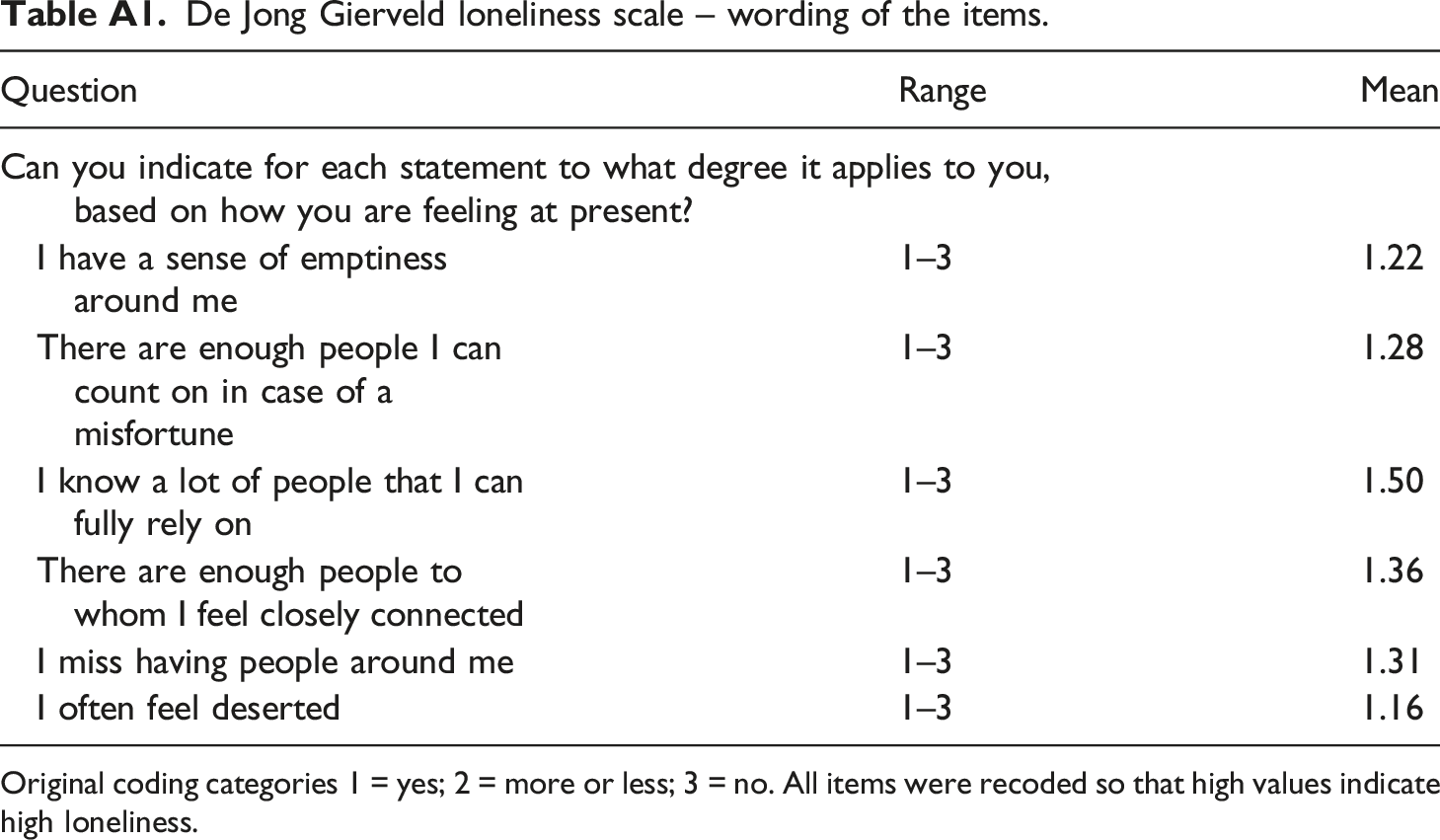
Question
Range
Mean
Can you indicate for each statement to what degree it applies to you, based on how you are feeling at present?
I have a sense of emptiness around me
1–3
1.22
There are enough people I can count on in case of a misfortune
1–3
1.28
I know a lot of people that I can fully rely on
1–3
1.50
There are enough people to whom I feel closely connected
1–3
1.36
I miss having people around me
1–3
1.31
I often feel deserted
1–3
1.16
Between effect regression models. *p < 0.05, **p < 0.01, ***p < 0.001; within brackets = standard error.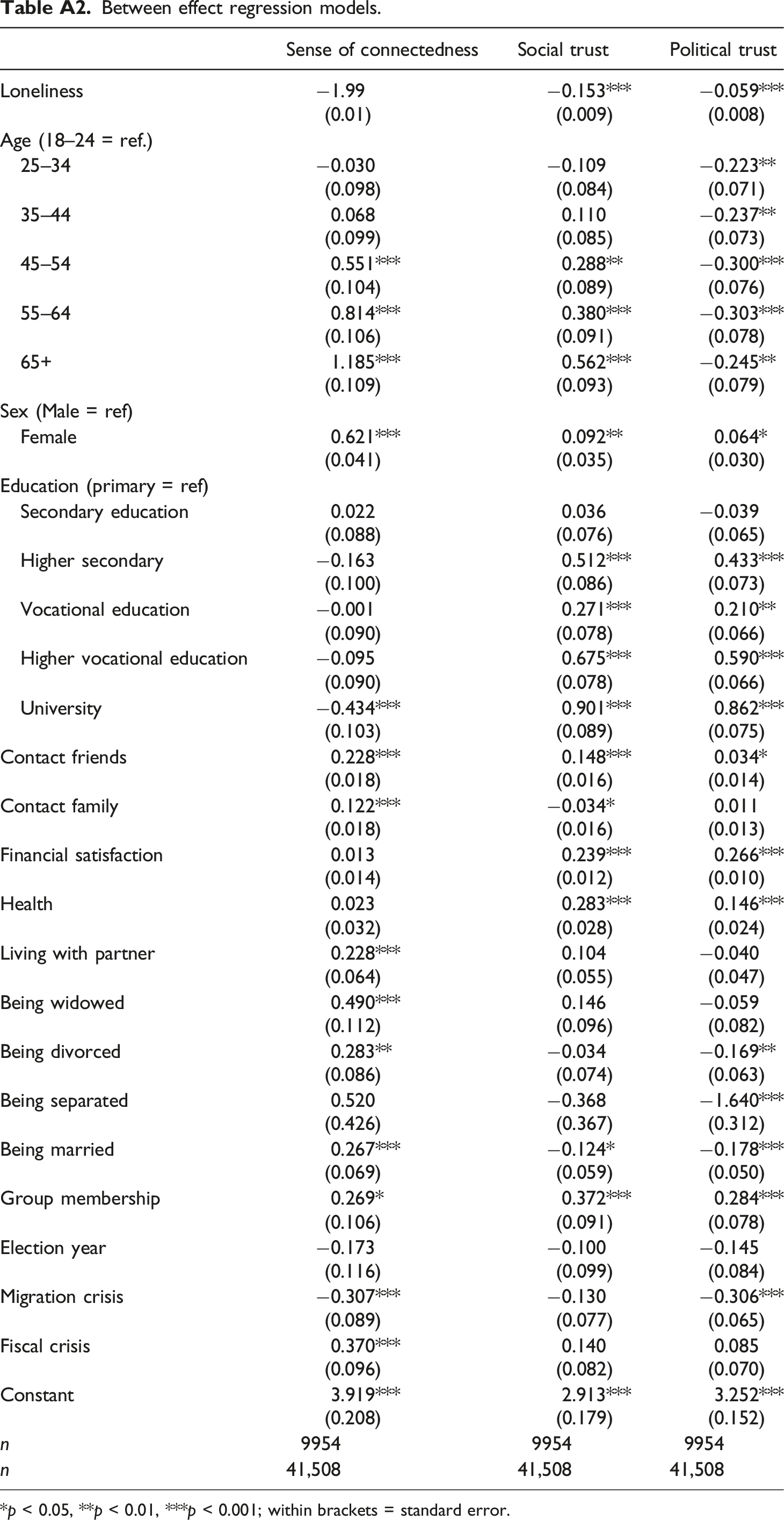
Sense of connectedness
Social trust
Political trust
Loneliness
−1.99
−0.153***
−0.059***
(0.01)
(0.009)
(0.008)
Age (18–24 = ref.)
25–34
−0.030
−0.109
−0.223**
(0.098)
(0.084)
(0.071)
35–44
0.068
0.110
−0.237**
(0.099)
(0.085)
(0.073)
45–54
0.551***
0.288**
−0.300***
(0.104)
(0.089)
(0.076)
55–64
0.814***
0.380***
−0.303***
(0.106)
(0.091)
(0.078)
65+
1.185***
0.562***
−0.245**
(0.109)
(0.093)
(0.079)
Sex (Male = ref)
Female
0.621***
0.092**
0.064*
(0.041)
(0.035)
(0.030)
Education (primary = ref)
Secondary education
0.022
0.036
−0.039
(0.088)
(0.076)
(0.065)
Higher secondary
−0.163
0.512***
0.433***
(0.100)
(0.086)
(0.073)
Vocational education
−0.001
0.271***
0.210**
(0.090)
(0.078)
(0.066)
Higher vocational education
−0.095
0.675***
0.590***
(0.090)
(0.078)
(0.066)
University
−0.434***
0.901***
0.862***
(0.103)
(0.089)
(0.075)
Contact friends
0.228***
0.148***
0.034*
(0.018)
(0.016)
(0.014)
Contact family
0.122***
−0.034*
0.011
(0.018)
(0.016)
(0.013)
Financial satisfaction
0.013
0.239***
0.266***
(0.014)
(0.012)
(0.010)
Health
0.023
0.283***
0.146***
(0.032)
(0.028)
(0.024)
Living with partner
0.228***
0.104
−0.040
(0.064)
(0.055)
(0.047)
Being widowed
0.490***
0.146
−0.059
(0.112)
(0.096)
(0.082)
Being divorced
0.283**
−0.034
−0.169**
(0.086)
(0.074)
(0.063)
Being separated
0.520
−0.368
−1.640***
(0.426)
(0.367)
(0.312)
Being married
0.267***
−0.124*
−0.178***
(0.069)
(0.059)
(0.050)
Group membership
0.269*
0.372***
0.284***
(0.106)
(0.091)
(0.078)
Election year
−0.173
−0.100
−0.145
(0.116)
(0.099)
(0.084)
Migration crisis
−0.307***
−0.130
−0.306***
(0.089)
(0.077)
(0.065)
Fiscal crisis
0.370***
0.140
0.085
(0.096)
(0.082)
(0.070)
Constant
3.919***
2.913***
3.252***
(0.208)
(0.179)
(0.152)
n
9954
9954
9954
n
41,508
41,508
41,508
Fixed effect regression models. *p < 0.05, **p < 0.01, ***p < 0.001; within brackets = standard errors.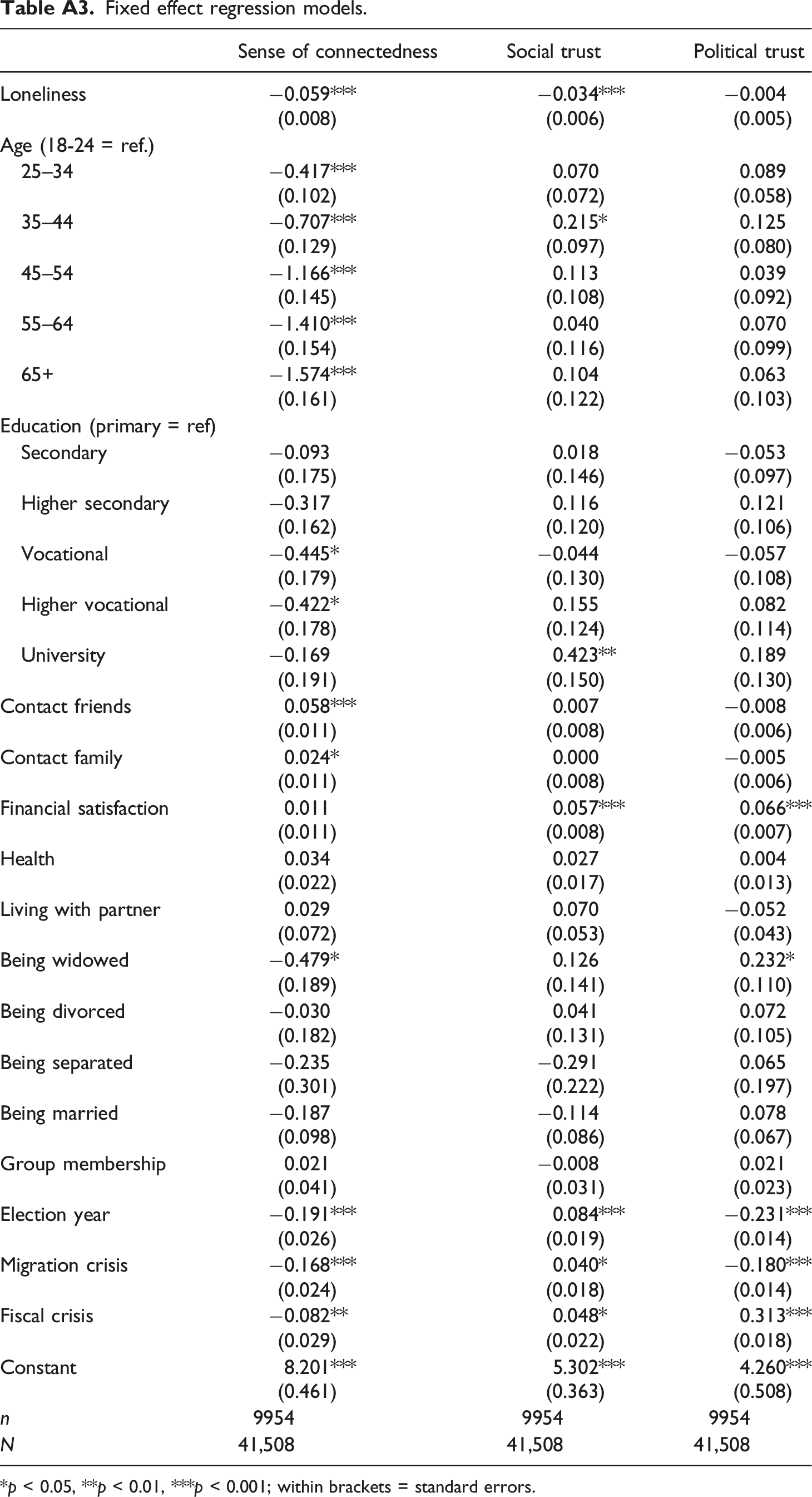
Sense of connectedness
Social trust
Political trust
Loneliness
−0.059***
−0.034***
−0.004
(0.008)
(0.006)
(0.005)
Age (18-24 = ref.)
25–34
−0.417***
0.070
0.089
(0.102)
(0.072)
(0.058)
35–44
−0.707***
0.215*
0.125
(0.129)
(0.097)
(0.080)
45–54
−1.166***
0.113
0.039
(0.145)
(0.108)
(0.092)
55–64
−1.410***
0.040
0.070
(0.154)
(0.116)
(0.099)
65+
−1.574***
0.104
0.063
(0.161)
(0.122)
(0.103)
Education (primary = ref)
Secondary
−0.093
0.018
−0.053
(0.175)
(0.146)
(0.097)
Higher secondary
−0.317
0.116
0.121
(0.162)
(0.120)
(0.106)
Vocational
−0.445*
−0.044
−0.057
(0.179)
(0.130)
(0.108)
Higher vocational
−0.422*
0.155
0.082
(0.178)
(0.124)
(0.114)
University
−0.169
0.423**
0.189
(0.191)
(0.150)
(0.130)
Contact friends
0.058***
0.007
−0.008
(0.011)
(0.008)
(0.006)
Contact family
0.024*
0.000
−0.005
(0.011)
(0.008)
(0.006)
Financial satisfaction
0.011
0.057***
0.066***
(0.011)
(0.008)
(0.007)
Health
0.034
0.027
0.004
(0.022)
(0.017)
(0.013)
Living with partner
0.029
0.070
−0.052
(0.072)
(0.053)
(0.043)
Being widowed
−0.479*
0.126
0.232*
(0.189)
(0.141)
(0.110)
Being divorced
−0.030
0.041
0.072
(0.182)
(0.131)
(0.105)
Being separated
−0.235
−0.291
0.065
(0.301)
(0.222)
(0.197)
Being married
−0.187
−0.114
0.078
(0.098)
(0.086)
(0.067)
Group membership
0.021
−0.008
0.021
(0.041)
(0.031)
(0.023)
Election year
−0.191***
0.084***
−0.231***
(0.026)
(0.019)
(0.014)
Migration crisis
−0.168***
0.040*
−0.180***
(0.024)
(0.018)
(0.014)
Fiscal crisis
−0.082**
0.048*
0.313***
(0.029)
(0.022)
(0.018)
Constant
8.201***
5.302***
4.260***
(0.461)
(0.363)
(0.508)
n
9954
9954
9954
N
41,508
41,508
41,508
References
Supplementary Material
Please find the following supplemental material available below.
For Open Access articles published under a Creative Commons License, all supplemental material carries the same license as the article it is associated with.
For non-Open Access articles published, all supplemental material carries a non-exclusive license, and permission requests for re-use of supplemental material or any part of supplemental material shall be sent directly to the copyright owner as specified in the copyright notice associated with the article.
