




Abstract
Whereas interest in adult sibling relationships has been growing, we are not aware of any quantitative studies focusing on sibling estrangement (that is, lack of contact or emotional closeness). This gap in the literature seems unfortunate, because estrangement in close family relationships has been suggested to be momentous for family functioning and individuals’ well-being. Drawing on four waves of the German Family Panel (pairfam; n = 5,729), covering a 6-year observation period, we therefore assess respondents’ estrangement from up to four siblings in adulthood, focusing on the predictive role of core structural parameters of sibling dyads (especially genetic relatedness) and disruptive family events (particularly parental separation/divorce or death). Whereas 28% of respondents in our sample experienced at least one episode of estrangement from any sibling, estrangement occurred multiple times in only 14% of sibling dyads. Moreover, results derived from discrete-time event history models indicate (a) that genetic relatedness is the single most important risk factor, albeit strongly mediated by childhood co-residence, and (b) that sibling relations tend to become more “vulnerable” over the life course, when adverse family events accumulate.
Introduction
Recent years have witnessed a growing interest in adult sibling relationships (see Gilligan et al., 2020; Walker et al., 2005, for reviews). Studies indicate that siblings remain an important social resource over the life course (e.g., Buchanan, 2021; White, 2001), but also provide evidence of considerable ambivalence and conflicts in sibling relationships (e.g., Bedford, 1989; Tanskanen et al., 2016). Moreover, a recent qualitative exploration by Blake et al. (2022) showed that “siblings both can and do become estranged, [challenging] commonly held assumptions about family relationships, confirming that they are not necessarily or always life-long, significant or supportive.” We are not aware of any studies, though, assessing the quantitative dimension and dynamics of sibling estrangement drawing on a larger-scale population-based sample, which would allow for a more comprehensive and generalizable account of the phenomenon and its determinants. This gap in the literature seems unfortunate, because estrangement in close family relationships has been shown to have potentially far-reaching consequences for family functioning and individuals’ well-being (e.g., Blake, 2017). Importantly, though, family distancing is not inherently negative but “can also be a healthy solution to an unhealthy environment” (Scharp & Hall, 2017, p. 28).
Whereas previous research conceptualized the term “estrangement” in different ways, there is considerable overlap in the various definitions (see Blake, 2017; Conti & Ryan, 2013). It is common, for example, to distinguish between physical and emotional estrangement and to assume that estrangement is a choice or decision made by at least one of the involved parties (e.g., Agllias, 2016). Along these lines, Scharp (2019) regards estrangement as a process in which at least one family member voluntarily and intentionally establishes or maintains distance from another because of an on-going negative relationship. Similarly, Gilligan et al. (2015, p. 909) defined estrangement “as managing unresolved emotional problems with family members by substantially reducing contact or remaining in physical contact but maintaining emotional distance” (also see Arránz Becker & Hank, 2022).
Importantly, these scholarly definitions of estrangement need not necessarily match individuals’ subjective perception of their relationship with siblings, even if they meet the above-mentioned ‘objective’ criteria (e.g., Blake et al., 2022). Moreover, there is only little specific theorizing about family estrangement (but see Whiteman et al., 2011, for a review of more general theoretical perspectives on sibling relationships). A noteworthy exception is Bowen family systems theory (e.g., Titelman, 2003), where withdrawal is one way for family members to deal with unresolved emotional issues with one another. Recently, Scharp and Hall (2019, p. 10) advocated a model of family distancing accounting for the fact that estrangement may evolve and change over time, taking different pathways or trajectories. Predictors of estrangement are therefore likely to be situated in longer-term processes of disconnection and to be embedded in complex family circumstances (Agllias, 2016).
Following-up on these considerations and recent research investigating adult parent-child estrangement (see, for example, Arránz Becker & Hank, 2022; Gilligan et al., 2022), the present study thus takes a longitudinal perspective to investigate sibling estrangement in adulthood. We use four waves of data from the German Family Panel (pairfam) to analyze respondents’ estrangement – conceptualized as lack of contact or emotional closeness – from up to four biological and non-biological adult siblings over a period of up to 6 years.
Because pairfam does not provide information on potentially relevant behavioral characteristics that some studies have shown to affect siblings’ relationship quality and family estrangement, such as parental differential treatment or abuse (e.g., Blake et al., 2022; Meunier et al., 2012; Milevsky et al., 2011), our study’s primary focus is on structural characteristics of the sibling dyad (e.g., gender composition, birth order, sibship size). These determine siblings’ position in the family and give rise to social and psychological processes impacting individuals’ development and adjustment over the entire life course (e.g., Furman & Buhrmester, 1985; Ge & Jiang, 2021; Tanskanen & Danielsbacka, 2021). We are particularly interested in assessing the predictive role of siblings’ genetic relatedness, which evolutionary theory predicts to affect family relationships (e.g., Pollet, 2007; Tanskanen & Danielsbacka, 2014), accounting for the potentially mediating effect of childhood co-residence (e.g., Steinbach & Hank, 2018; Tanskanen & Danielsbacka, 2019). Moreover, because family circumstances may change over the life course, we also explicitly acknowledge potential influences of siblings’ engagement in “cycles of estrangement and reunification” (Agllias, 2016; also see Dattilio & Nichols, 2011) or of other disruptive family events on sibling estrangement, especially parental separation/divorce or death (e.g., Hank, 2021; Poortman & Voorpostel, 2009; also see Spitze & Trent, 2018).
Method
Data & sample
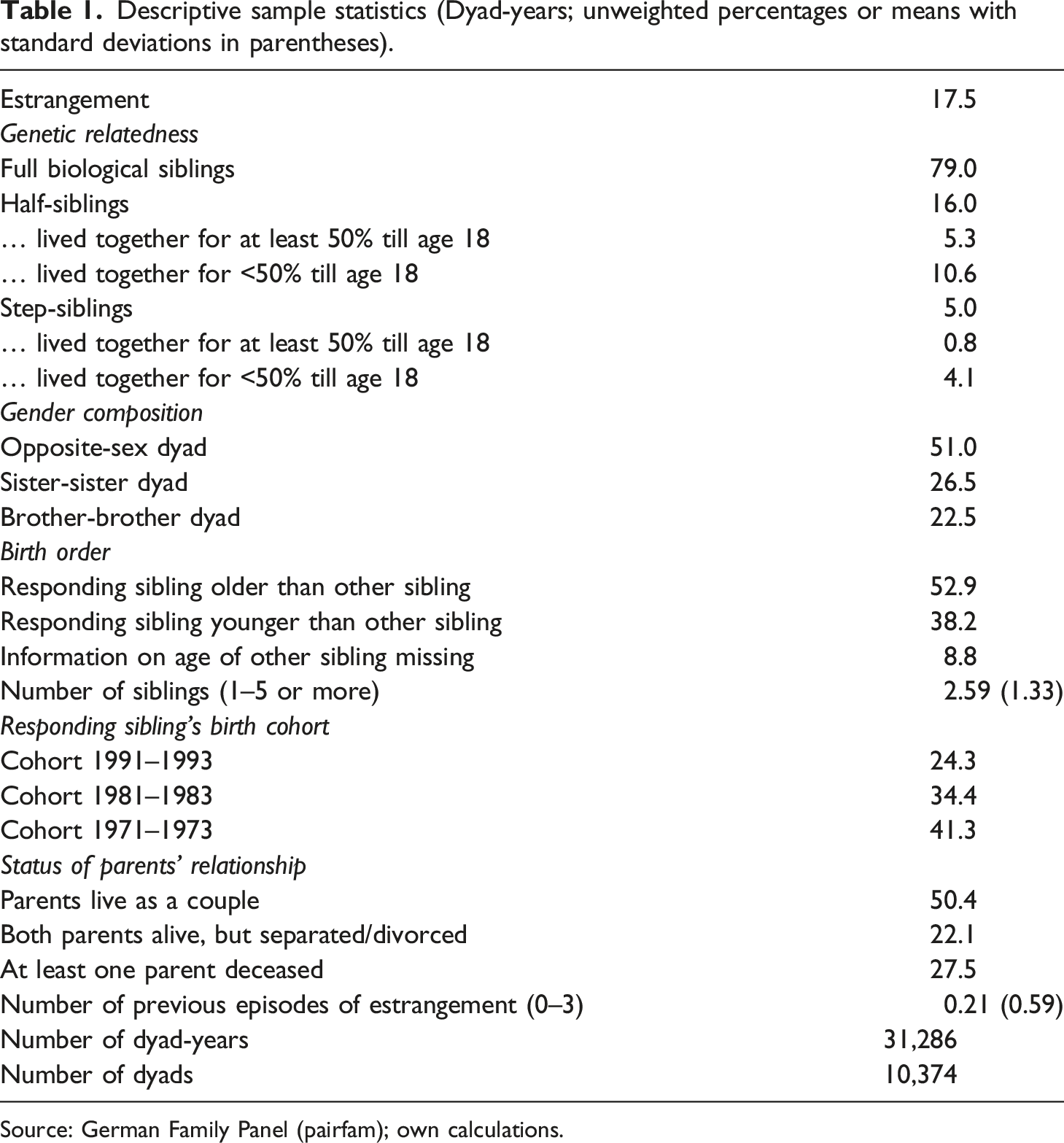
We use data from waves 5, 7, 9, and 11 of the German Family Panel (pairfam; Brüderl et al., 2021), which has been funded by the German Research Foundation (DFG). Nationally representative of three birth cohorts (1971-73, 1981-83, and 1991-93), more than 12,000 computer assisted personal interviews were conducted in Wave 1 (2008/09), followed by annual re-interviews. The ‘baseline’ wave for the present four-wave longitudinal analysis is pairfam's Wave 5 (2012/13), by which the youngest cohort had grown into young adulthood and from which onwards a biannual module collecting information on respondents’ relationships with up to four randomly selected siblings has been included in the survey. Of the 7,248 respondents participating in Wave 5, we kept those who reported having one or more siblings aged 18 or older (n = 5,729). Eventually, this amounted to 10,374 sibling dyads, contributing a total of 31,286 dyad-years of observation to our unbalanced panel.
Measures
Following Arránz Becker and Hank (2022), our time-varying binary dependent variable “estrangement” takes the value 1 if the respondent reported either (a) non-contact (if response to the question “How often are you in contact with your [sibling], adding up all visits, letters, phone calls, etc.?” was “never” or “never had contact”) or (b) contact of any kind less than once per month and emotional distance (if response to the question “How close do you feel to your [sibling] today emotionally?” was 1 or 2 on a five-point scale ranging from 1 “not at all close” to 5 “very close”) to the focal sibling. By questionnaire design, the items on emotional closeness were only presented if the respondent indicated that s/he ever had contact to the respective sibling.
Several core structural parameters of sibling dyads constitute our first set of explanatory variables: (a) Genetic relatedness was assessed based on information regarding whether a specific sibling is a full biological, half-, or step-sibling (resulting in three binary indicators of sibling type; see Steinbach & Hank, 2018). Because it has been suggested that childhood co-residence partly mediates effects of genetic relatedness on siblings’ relationship qualities (e.g., Tanskanen & Danielsbacka, 2019), we also ran a model distinguishing half-/step-sibling dyads by duration of co-residence before the respondent’s 18th birthday (having co-resided for at least half of that time vs. less). (b) Siblings’ gender composition (e.g., Ge & Jiang, 2021; Spitze & Trent, 2006) was measured by three dummy variables indicating an opposite- or same-sex (sister-sister or brother-brother) dyad. Note that the pairfam questionnaire allowed respondents to identify themselves and their siblings only as either ‘male’ or ‘female’. (c) Birth order (e.g., Ge & Jiang, 2021; Pollet & Nettle, 2009) was approximated by a binary indicator of whether the reporting sibling is younger than the other sibling in the dyad, which we complemented by a dummy indicating whether information on the non-reporting sibling’s age was missing. This was the case in 8.8% of our total sample, with much higher proportions in case of half- (24.8%) and step- (35.6%) sibling relationships. Finally, we accounted for (d) the total number of siblings (1 through 5 or more).
Our second set of explanatory variables aims to capture life course influences on sibling estrangement. Next to controlling for (a) respondents’ birth cohort (as defined by pairfam’s sampling design: 1991-93, 1981-83, and 1971-73), we accounted for (b) parents’ relationship status (represented by three dummies indicating whether respondents’ parents live as a couple, have separated/divorced, or died) because such disruptive family events have been shown to affect sibling relations (e.g., Hank, 2021; Poortman & Voorpostel, 2009). Finally, to adjust our estimates for within-dyad correlations of recurrent events, we included (c) a time-varying count variable indicating the number of previously observed episodes of estrangement from the focal sibling (ranging from 0 to a maximum of 3).
Analytic strategy
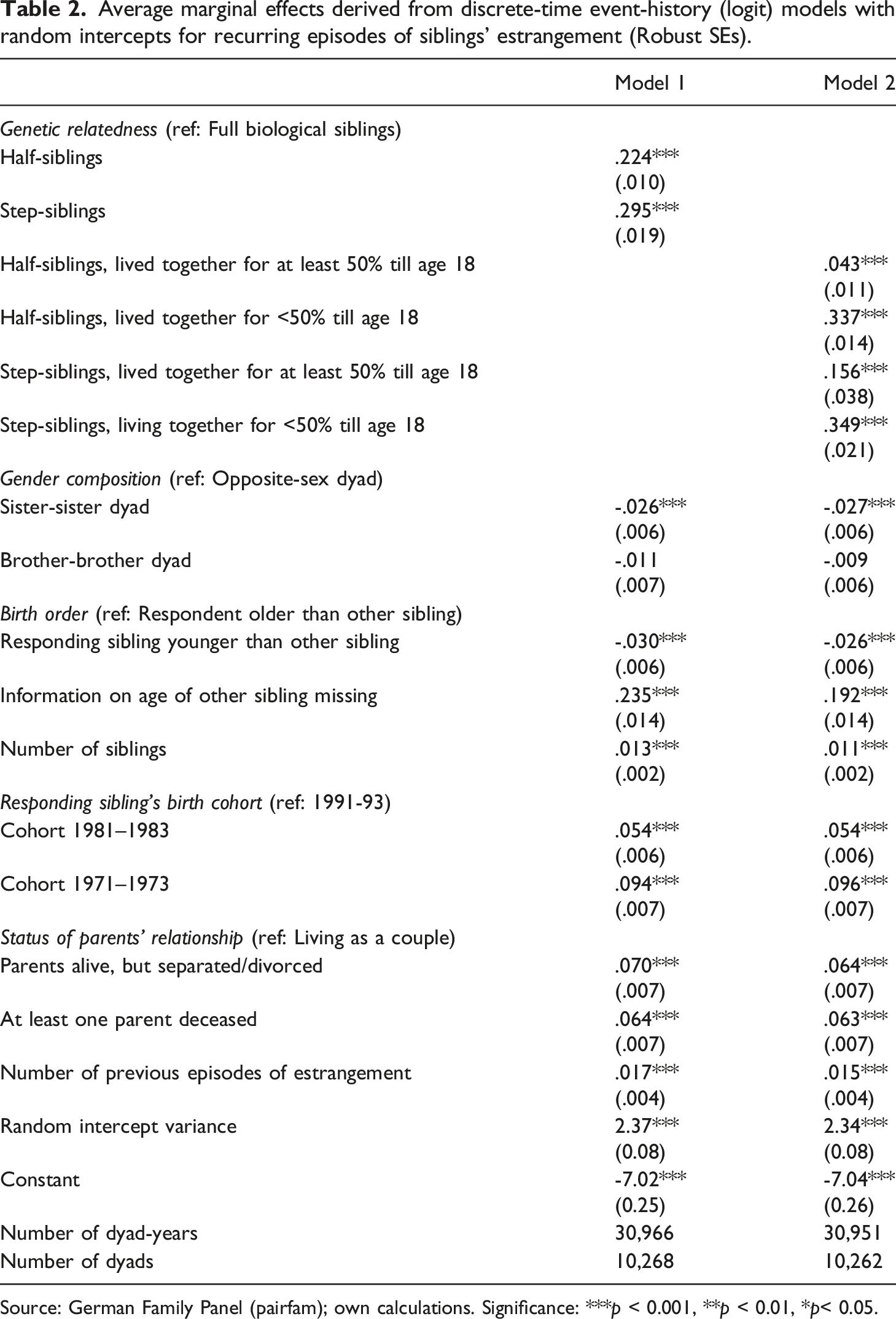
Following Arránz Becker and Hank (2022), we estimated discrete-time event-history (logit) models for recurring events with random intercepts, calculating robust standard errors to account for dependencies within sibling dyads over time. Note that Table 2 displays average marginal effects (AMEs), which – when multiplied by 100 – refer to the average percentage point change in the estimated prevalence of estrangement per one-unit increase in the respective independent variable.
Results
Descriptive sample statistics (Dyad-years; unweighted percentages or means with standard deviations in parentheses).
Source: German Family Panel (pairfam); own calculations.
Average marginal effects derived from discrete-time event-history (logit) models with random intercepts for recurring episodes of siblings’ estrangement (Robust SEs).
Source: German Family Panel (pairfam); own calculations. Significance: ***p < 0.001, **p < 0.01, *p< 0.05.
Other structural characteristics of the sibling dyad also turned out to bear statistically significant associations with our dependent variable: (a) Gender composition mattered insofar as sister-sister (but not brother-brother) pairs were less prone to estrangement than opposite-sex pairs. (b) Compared to later-born siblings, younger ones were less likely to report estrangement. And (c) having a larger number of siblings was associated with a slightly higher risk of estrangement in any given sibling dyad.
We furthermore found that disruptive family events – specifically, separation/divorce or the death of a parent – were paralleled by increases in siblings’ probability to experience estrangement, which was also more likely to be observed in pairfam’s older birth cohorts. Finally, the number of previously reported episodes of estrangement was positively, and strongly, associated with siblings’ risk of estrangement in subsequent survey waves.
Conclusions
We derive three main conclusions from our analysis. First, sibling estrangement in adulthood is a quantitatively relevant, but often merely temporary phenomenon; Arránz Becker and Hank (2022) report a similar finding for adult parent-child estrangement. Whereas 28% of respondents in our sample experienced at least one episode of estrangement from any sibling, estrangement occurred multiple times in only 14% of dyads.
Second, structural characteristics of the sibling dyad, which were already shown to matter for siblings’ relationship quality more generally (e.g., Tanskanen & Danielsbacka, 2021; Steinbach & Hank, 2018), also turned out to be relevant for the specific phenomenon of estrangement. For example, our observation that sister-sister pairs were least likely to be estranged is consistent with Goodsell et al.’s (2015) ‘cooperative networks’ argument, according to which sisters tend to develop the closest sibling ties. Genetic relatedness was identified as the single most important risk factor, which was, however, strongly mediated by childhood co-residence. Half- and step-siblings who lived together for at least half of the time during childhood exhibited a significantly higher probability of experiencing estrangement from each other than full siblings, but non-biological siblings with little or no history of childhood co-residence clearly were at the highest risk of estrangement. This finding can be interpreted as further evidence of co-residence’s function as an effective “kin detection mechanism” (Tanskanen & Danielsbacka, 2019), where co-residence – rather than shared genes – serves as an indirect cue of relatedness (not only with adult siblings, but also with older parents; e.g., Kalmijn, 2013).
Third, and finally, several of our results point to an increasing “vulnerability” of sibling relations over the life course. Not only did older respondents in our sample report being estranged from siblings more often than younger ones, but we also observed significant positive associations of disruptive family events (parental separation/divorce or death) and previous estrangement with the likelihood of being estranged in current interviews. The risk of experiencing such adverse events accumulates over time, and therefore the risk of sibling estrangement also likely increases over the adult life course.
Importantly, these findings do not imply that relationships to siblings necessarily or permanently become less important later in life. Rather, as Scharp and Hall (2017, p. 28) noted, (temporary) estrangement might be a “healthy solution” to a (temporarily) unhealthy family situation; and “[m]oving into mid and later life, individuals go through more transitions that may allow for a reemergence of sibling relationships and contact” (Jensen et al., 2020: p. 2241; italics not in the original; also see Dattilio & Nichols, 2011). Even though siblings both can and do become estranged (Blake et al., 2022), at least for the majority of full biological siblings – and especially sister-sister pairs – these ties can thus still be considered as the longest-lasting relationship, with all the “ups” and “downs” kin relations bring. Future research on adult family relations should therefore consider more systematically intragenerational relationships, complementing its previous focus on intergenerational relationships. This will eventually allow us to obtain a more complete picture of the interdependencies among the subsystems that comprise families (e.g., de Bel et al., 2019; Hank & Steinbach, 2018) and, consequently, the complexities of family solidarity that individuals experience over their life course.
Footnotes
Declaration of conflicting interests
The author(s) declared no potential conflicts of interest with respect to the research, authorship, and/or publication of this article.
Funding
The author(s) received no financial support for the research, authorship, and/or publication of this article.
Open research statement
As part of IARR’s encouragement of open research practices, the authors have provided the following information: This research was not pre-registered. The data used in the research are available. The data can be obtained at:https://dbk.gesis.org/dbksearch/SDESC2.asp?no=5678&DB=d.
