




Abstract
Parents’ ability to manage intense emotions in the face of conflictual sibling interactions is a significant challenge that has been linked with various child and parent outcomes. With existing instruments focused on raising a single child, we lack validated instruments to assess dimensions of parental emotion regulation in the context of rearing siblings. We tested the factor structure, reliability, divergent and concurrent criterion validity of a new instrument designed to measure parental emotion regulation (Parental Emotional Regulation in the Sibling Context Questionnaire) while raising two or more children. Participants, 359 mothers from 35 countries, with two children aged 4- to 8-years, completed the new instrument along with established measures of parental emotion regulation, sibling relationship quality, and children’s emotion regulation. A confirmatory factor analysis supported the utility of the instrument in reliably assessing dimensions of parent emotional regulation (Reactivity and Dysregulation). Evidence for divergent validity stemmed from associations with an established measure of general emotion regulation strategies and evidence for concurrent criterion validity stemmed from associations with children’s sibling relationship quality. Findings have implications for the reliable identification of mothers who are facing emotion regulation difficulties, the design of customized intervention strategies, and the evaluation of prevention and intervention programs.
Keywords
Raising siblings is challenging
Although the addition of a second child may seem like a straightforward task for parents who have experience rearing an infant into early childhood and beyond, the challenges entailed in raising multiple children are actually quite different. Not only must parents raise each child to become a healthy and productive individual, but they are also challenged to support and, often, moderate the relationships among their children as they develop over time. This is no simple task as sibling relationships often vary from the blissfully compatible to the intensely conflictual— sometimes within the span of minutes (Kramer et al., 1999; Perlman & Ross, 1997). How parents manage these complex tasks— including how they regulate their own negative emotions that may accompany parenting multiple children— is a critical (yet understudied) factor that may affect parents’ sense of well-being, their ability to effectively co-parent with a partner, and ultimately, their ability to help their children establish prosocial relationships with one another. This study examines the factor structure, reliability, and divergent and concurrent criterion validity of a new instrument designed to assess parents’ difficulty in regulating intense emotions when their children are not getting along—processes that have been shown to be critical for implementing effective parenting strategies (Dix, 1991) and can help children establish prosocial sibling relationships (Kramer, 2010).
According to Dix’s (1991) model of affective processes in parenting, challenging interactions between parents and children can elicit negative emotional arousal in parents, which can, in turn, reduce the likelihood that parents will engage in adaptive parenting strategies. Deater-Deckard et al. (2005) posited that chronic parenting stress can “set the stage for harsh reactive parenting and interfere with parents’ abilities to respond in constructive ways to their children’s ever-changing competencies and limitations” (p. 111). Applied to the sibling context, children’s conflict and agonism may act as triggers for parents’ experiences of heightened negative emotions (Ravindran et al., 2015) and contribute to difficulties in coordinating parenting with a spouse or partner (Deater-Deckard et al., 2005; DeMartini & Hazen, 2020), both of which can have negative implications for parents’ abilities to support their children’s sibling relationship (Morris et al., 2007). Supporting parents’ abilities to effectively regulate their emotional experiences and behaviors can thus have positive implications for their children’s relationship.
Parental emotion regulation and its measurement
Thompson (1994) defined emotion regulation (ER) as “the extrinsic and intrinsic processes responsible for monitoring, evaluating, and modifying emotional reactions, especially their intensive and temporal features, to accomplish one’s goals” (pp. 27-28). ER was thought to represent processes, such as expressive suppression and cognitive reappraisal (John & Gross, 2004), that individuals tended to draw upon to manage their emotions across many of the stressful events they encounter. For example, Gross and John (2003) found that, in general, the use of cognitive reappraisal was associated with the experience and expression of greater positive and fewer negative emotions as well as better interpersonal functioning and well-being. In contrast, the use of suppression was associated with less positive and more negative emotions along with worse interpersonal functioning and well-being.
In contrast to this view of ER as generic, universal processes, there is growing recognition that different emotion regulation processes may be required to effectively meet the unique demands of different situations, and that parenting, in particular, is a complex and emotionally challenging context that requires its own in-depth examination (Leerkes & Augustine, 2019). Parental emotion regulation (PER), broadly conceptualized as the ability to regulate the experience and expression of intense emotions in the context of child-rearing, is increasingly recognized as a critical component of effective parenting (Zimmer-Gembeck et al., 2022). In their meta-analysis of 53 studies on PER, Zimmer-Gembeck et al. found that, overall, parents with better emotion regulation skills, or those who had fewer difficulties in regulating emotion, reported more positive and less negative parenting behaviors. Additionally, parents with better PER had children with more developed emotion regulation skills and fewer internalizing (but not externalizing) behavior problems. Similarly, other studies of PER have shown that by regulating their emotions, parents can be more sensitive when responding to their children’s needs even when a child is dysregulated (Rutherford et al., 2015). Additionally, PER can enable parents to better align their child-rearing strategies and behaviors with their parenting goals (Gratz & Roemer, 2004). Perhaps even more importantly, PER can prevent “negative feelings, arousal, and behavioral impulses driven by negative emotions from translating into at-risk parenting” (Zhang et al., 2023, p. 21).
Despite the growing acknowledgment of its importance, few studies have examined ER processes using measures that are specific to parenting contexts, favoring instruments that assess general dimensions of adult emotion regulation. For example, Zimmer-Gembeck et al. (2022) reported that most studies included in their meta-analysis of PER used either the global Difficulties in Emotion Regulation Scale (DERS; Gratz & Roemer, 2004), which measures six dimensions of difficulties in ER, or the Emotion Regulation Questionnaire (ERQ; Gross & John, 2003), which taps the general processes of expressive suppression and cognitive reappraisal.
Zhang et al. (2023) also found a strong reliance on single measures of general adult ER in their recent systematic review of 91 studies on parental emotion regulation. Additionally, they observed that inconsistent results emerged when studies used context-specific versus global, context-free measures of ER. For example, in one of the few studies that included assessments of both global and context-specific PER, Lorber et al. (2017) found little evidence to support the value of cognitive reappraisal as an effective emotion regulation tool in the parenting context as previous studies of general ER in adulthood (e.g., Gross & John, 2003) might predict. However, Lorber did find that mothers’ emotional suppression (inhibiting an emotional response or expression), as measured by both context-specific and context-free instruments, capitulation (giving into a child), and escape (withdrawing from the situation) to manage their own emotions while parenting, were associated with harsh parenting, lax discipline, poor maternal adjustment, and parent-child physical aggression. Given the inconsistent findings across studies using context-specific versus context-free measures of PER, Zhang et al. suggested that whereas context-free assessments may be most useful for describing overarching emotional qualities, context-specific assessments of ER measures may be advantageous when the objective is to understand how specific processes of ER develop and are maintained. In the current study, we include measures of both context-specific and global, context-free measures of ER.
Assessing parental emotion regulation in the sibling context
Although a few instruments have recently been validated to assess ER in the context of parenting (e.g., Pereira et al., 2017; Rodriguez & Shaffer, 2021), there continues to be a lack of instruments that specifically assess PER in the context of parenting siblings (DeMartini & Hazen, 2020). Only one study in Zhang et al. (2023) systemic review, Ravindran et al. (2015), specifically examined PER in the context of rearing siblings. When considering that approximately 80% of US families have two or more children (Knop, 2020), the failure to study PER in the context of raising multiple children— siblings— is a significant limitation of the literature to date. Having reliable and valid instruments to assess parents’ experiences while raising siblings is critical for the design and evaluation of prevention and intervention tools aimed at fostering positive family relationships. In the current study, we address this need by both evaluating a recently developed context-specific measure of PER among parents raising young siblings and examining its divergence with a common context-free measure of ER. By studying parental emotion regulation in the context of raising siblings, and by including a measure of global adult ER, the current study is well positioned to add to our knowledge of the regulatory processes that can promote effective parenting.
Additionally, parents’ abilities to regulate their emotions may, in part, be affected by how well children can regulate their emotions. Children who frequently require assistance from parents to down regulate their emotional expressions may place greater demands on parents’ ER capabilities (Gottman et al., 1997). This may be especially true when parents are confronted with multiple children who are dysregulated or are engaged in sibling agonism or conflict. Children’s ER has also been shown to be positively correlated with sibling relationship quality (Kennedy & Kramer, 2008). Therefore, in the current study, we assessed the degree to which PER is related to children’s ER as an additional test of the PERSCQ’s concurrent criterion validity.
Development of the Parental Emotion Regulation in the Sibling Context Questionnaire
To examine self-reports of parents’ emotional responses to sibling interactions, Ravindran et al. (2015) followed Dix’s (1991) model of affective processes in parenting to create the Parental Emotional Regulation in the Sibling Context Questionnaire (PERSCQ). As shown in Appendix A, the PERSCQ consists of 12 items that reflect a range of negative emotions that parents may experience during agonistic sibling interactions. Given the importance of contextualizing PER in the context of children’s developmental levels (Zhang et al., 2023), we focused on PER processes experienced by parents of siblings in early to middle childhood, ages 4–8. To support the instrument’s content validity, items were developed using the results of observational research on parents’ responses to sibling conflict in the home context (Kramer et al., 1999), parental interviews (Kramer & Gottman, 1992), a thorough review of the literature on PER, and consultations with researchers who were subject matter experts, as per Messick (1994).
Ravindran et al. (2015) reported the results of a principal components analysis on the PERSCQ, with varimax rotation, using a homogenous sample of parents which provided preliminary support that the PERSCQ assesses two dimensions of parental emotion regulation when parenting siblings: emotional reactivity (5 items, alpha = .86 and .88 for mothers and fathers, respectively) and dysregulation (7 items, alpha = .82 and .85 for mothers and fathers, respectively). Reactivity, which accounted for 13% (mothers) and 11% (fathers) of the variance, assesses the degree to which parents experience negative emotions when their children are not getting along (“When my children are not getting along, I become very upset”). Dysregulation, which accounted for 32% (mothers) and 38% (father) of the variance, refers to the degree to which parents feel that the emotions they experience when their children are not getting along interfere with their ability to parent effectively (e.g., “It is really hard to be a good parent when I’m aggravated about my children’s behavior towards each other”). Although both reactivity and dysregulation tap parents’ negative affect, dysregulation reflects parents’ perception that their experience of negative emotions has impacted their ability to parent effectively. This study builds on these preliminary findings by examining whether the two-dimensional factor structure and internal consistency of the measure would be supported in a new and larger, more diverse sample of parents of siblings in early to middle childhood.
Using the PERSCQ, Ravindran et al. (2015) found that both mothers who participated in the More Fun with Sisters and Brothers Program reported decreased emotional dysregulation; additionally, both mothers and fathers reported lower levels of reactivity as children were observed to demonstrate lower levels of sibling agonism as a result of their participation in the intervention. That is, as children engaged in fewer agonistic behaviors, both mothers and fathers reported feeling less upset, and mothers felt they could maintain effective parenting when their children were not getting along. In the current study, we tested whether these associations between PER and children’s sibling relationship quality would be replicated with a larger and more diverse sample of parents preparing to participate in a new online version of the preventive intervention. The finding of significant associations between the PERSCQ and sibling relationship quality would provide evidence for the instrument’s concurrent criterion validity as we would expect that parents who experience more difficulty regulating emotions in the context of sibling conflict to have children who engage in more agonistic (and less warm) interactions.
Ravindran et al. (2015) also performed an initial assessment of the PERSCQ’s construct validity by testing the strength of its association with John and Gross’ (2004) global measure of adult ER, the ERQ. Ravindran et al. found that parents who experienced heightened reactivity and dysregulation in response to agonistic sibling interactions on the PERSCQ also reported using less cognitive reappraisal (but not expressive suppression) on the ERQ. This suggests that parents who have trouble accessing or effectively employing adaptive reappraisal strategies across different contexts are more likely to experience regulatory difficulties when their children are not getting along. These findings provide preliminary support for the PERSCQ’s divergent validity as it appears to measure constructs that are distinct, yet related, to those of the ERQ. In the current study, we examined whether such associations between the context-specific PERSCQ and the context-free ERQ would again be found with a new sample, thereby providing additional evidence for the PERSCQ’s divergent validity.
The current study
In summary, the purpose of the current study was to examine the psychometric properties of a relatively new instrument designed to assess parents’ reports of their emotional responses and regulation in response to siblings’ conflictual interactions (PERSCQ). We tested the factor structure, reliability, divergent and concurrent criterion validity of this instrument using baseline data collected from parents as they prepared to participate in a preventive intervention designed to help them assist their children to develop a more positive sibling relationship. A confirmatory factor analysis was conducted to confirm the two factors previously identified in Ravindran et al. (2015), parental reactivity and dysregulation. Reliability was assessed through examination of internal consistency and through the retesting of a sample of parents at 2 months. Evidence for the instrument’s divergent validity was assessed by examining the instruments’ association with an established measure of adult ER. Additionally, evidence for its concurrent criterion validity was assessed through its associations with dimensions of children’s sibling relationship quality.
Based on preliminary findings from Ravindran et al. (2015) using the PERSCQ, we hypothesized that the factor analysis would support a two-factor structure over a single-factor structure of the PERSCQ, indicating that parental reactivity and dysregulation are distinct but related constructs. Based on past findings, we hypothesized that the context-specific PERSCQ dimensions of reactivity and dysregulation (if this factor structure is replicated) would be moderately and positively associated with the general ERQ dimension of cognitive reappraisal but not expressive suppression. Support for this hypothesis would suggest that, following Zhang et al. (2023), context-specific and context-free approaches to measure ER likely tap related but not identical processes, thereby providing evidence for the instrument’s divergent validity. Finally, we hypothesized that reports of greater difficulty in regulating emotions as measured by the PERSCQ (but not the ERQ) would be associated with maternal perceptions of lower warmth and greater agonism and rivalry/competition in their children’s relationship, both at the bivariate level and after controlling for mothers’ global emotion regulation strategies and children’s ability to regulate their own emotions. Support for this hypothesis would provide evidence for the instrument’s concurrent criterion validity in showing that parents who report experiencing greater difficulty in managing their own emotions in relation to parenting siblings also tend to perceive their children to have greater difficulty getting along. Additionally, support for this hypothesis would align with Zhang et al.’s (2023) supposition that context-specific measures of PER may be uniquely predictive of child outcomes over context-free measures of adult ER.
Method
Participants
A total of 397 parents participated in this online study, which included 359 mothers, aged 23–51 years (M = 39.12, SD = 4.26, Mdn = 39.00). The opportunity to participate in the More Fun with Sisters and Brothers Program for Parents study was advertised via announcements on Facebook and the program website. Additionally, several news outlets produced stories about the program which also resulted in requests to participate in the study. These recruitment activities yielded an international sample of parents that spanned 35 countries: 393 parents reported their country of residence, which included North America (n = 327, with 298 from the United States and 29 from Canada), Europe (n = 39), Oceania (n = 11), the Middle East (n = 6), Asia (n = 6), South America (n = 2), and Africa (n = 2). Parents represented a range of racial and ethnic backgrounds. Of the 387 parents who reported their race, 83.2% identified as White, 8.8% as Asian, 1.8% as Black or African American, 0.3% as American Indian or Alaskan Native, and 3.1% as multi-racial. Of the 389 parents who reported their ethnicity, 6.5% identified as Hispanic or Latino. Of the 355 mothers who reported their marital status, 324 (91.3%) reported being married, 14 (3.9%) cohabiting, 8 (2.3%) widowed, 6 (1.7%) divorced, and 3 (0.8%) single/never married. Most mothers reported their highest level of education as having earned at least a Bachelor’s (n = 123, 34.7%), Master’s (n = 137, 38.7%), or an advanced (e.g., PhD, MD, JD; n = 78, 22.0 %) degree, with relatively few reporting earning high school diplomas (n = 3, 0.8%) or some college (n = 8, 2.3%).
The majority of families reported having two children (n = 241, 60.7%); 117 (29.5%) had three children, 34 (8.6%) had four children, 4 (1.0%) had five children, and 1 (0.3%) reported having seven children. Parents were asked to report about two of their children who were both in the 4- to 8-year age range. If more than two of their children fell into this age range, they were asked to focus on the two children who were closest in age. Older siblings were 7.35 years on average (SD = 1.05, Mdn = 7.00, Range = 4–8 years), whereas younger siblings were 5.1 years (SD = 0.98, Mdn = 5.00, Range = 4–8 years). The average age difference between the siblings was 2.27 years. The sample included 28 sets of twins; for the purposes of completing the questionnaires, parents were asked to identify which sibling was born first or considered the “oldest.” The gender constellation of the identified sibling pairs was as follows: 118 (29.7%) were both boys, 89 (22.4%) had an older boy-younger girl, 106 (26.7%) had an older girl-younger boy, and 84 (21.2%) were both girls. Most (94.8%) of the sibling dyads were biologically related.
Procedure
Interested parents completed an online application to join the study. Because of the possibility that application responses could be artificially generated (e.g., submitted by bots), all submissions were carefully reviewed to ensure that the responses were complete and internally consistent. If applicants met the inclusion criteria of being English speakers/readers and having two children in the 4- to 8-year age range, they received an IRB-approved passive informed consent form outlining the study’s procedures.
Upon admission to the study, parents were provided a link that led them to the pre-test questionnaires on Qualtrics which took them approximately 45 minutes to complete. Whereas parents in the experimental group were next given access to the More Fun with Sisters and Brothers Program for Parents lessons, the wait list control group was told that the program was at capacity and were asked to wait until access could be granted. At that point (2 months), the wait list control group was asked to complete the pre-test questionnaires a second time, so that we had the most recent information about their family. Their responses were used to estimate the test-retest reliability of the instruments. Finally, the Institutional Review Board of Northeastern University approved the procedures used in this study. The study was not preregistered.
Measures
Parental emotion regulation in sibling context
To assess parents’ perceptions of the degree to which they experience negative emotions while parenting siblings, participants completed the 12-item Parental Emotion Regulation in the Sibling Context Questionnaire (PERSCQ; Ravindran et al., 2015). Ravindran et al. conducted a factor analysis (i.e., a Principal Components Analysis) which provided support for two scales: (1) reactivity (5 items) which taps the degree to which parents experienced negative emotions when their children were not getting along but a connection to parenting per se was not indicated (e.g., “When my children fight with one another, I sometimes lose my cool”); and (2) dysregulation (7 items) which taps the degree to which parents felt that the emotions they experienced when their children were not getting along interfered with their ability to parent effectively (e.g., “When I’m frustrated by my children’s behaviors towards one another, I have trouble helping them find ways to get along”). Because the 12 items each addressed difficult emotional experiences, two non-scored “filler” items were included that tapped more positive dimensions of parenting siblings to enhance parents’ experience with the instrument (e.g., “I’m proud of my children when they are kind to one another”). Parents responded to each item using a 5-point Likert scale (1 = strongly disagree; 5 = strongly agree). Higher subscale scores indicated higher levels of reactivity and dysregulation. The initial validation of the PERSCQ was performed with a relatively small and homogenous sample of US parents and provided evidence for the internal consistency of these two scales, with alphas ranging from .82 to .89 (Ravindran et al., 2015).
Global emotion regulation strategies
Gross and John’s (2003) Emotion Regulation Questionnaire (ERQ) was administered to assess the degree to which parents generally utilize emotion regulation strategies in a variety of contexts (as aspects of their “emotional life”), not restricted to raising siblings. The ERQ focuses on two basic strategies: Cognitive Reappraisal (e.g., “I control my emotions by changing the way I think about the situation I’m in”) and Expressive Suppression (e.g., “I control my emotions by not expressing them”). Parents respond to the 10 items on a 7-point Likert scale (1 = strongly disagree, 7 = strongly agree). A commonly used measure of parental emotion regulation, the ERQ possesses good test-retest reliability and high levels of validity (Gross & John, 2003). In the current study, internal consistency (alpha) was .82 and .72 for cognitive reappraisal and expressive suppression, respectively.
Parents’ perceptions of children’s sibling relationship quality
Parents were asked to provide their perceptions of their children’s relationship using an online version of the Parental Expectations and Perceptions of the Children’s Sibling Relationship Questionnaire (PEPC-SRQ; Kramer & Baron, 1995). Using a 5-point Likert scale (1 = never, 5 = always), parents rated how frequently they observed their children engage in each of 24 behaviors and affects. Parents’ reports were summarized using three scales: Warmth (13 items; e.g., “protectiveness such as looking out for the other’s welfare”); Agonism (8 items; “physical aggression such as hitting or pushing”); and Rivalry/Competition (3 items; “jealousy”). Kramer and Baron (1995) reported that each of the scales has adequate internal consistency and satisfactory test-retest reliability. The instrument has been used in a variety of studies of children’s sibling relationship quality. In the current study, internal consistency was satisfactory for Sibling Warmth (α = .90), Agonism (α = .85), and Rivalry/Competition (α = .83).
Child emotion regulation
Gottman et al.’s (1997) Emotional Behavior Questionnaire (EBQ) was used to assess parental appraisals of down regulation, i.e., how well each of their children were able to moderate and control their own emotional responses or required parents to help them to “down regulate.” Parents rated the degree to which parental intervention is typically needed to regulate their child’s behavior using a 5-point Likert scale (1 = never, 5 = very often) for each of 12 items. Mothers and fathers completed the EBQ for each of their children. Higher scores indicated that children needed more parental intervention. Internal consistency (alpha) of the EBQ with the current sample was .84 for older siblings and .85 for younger siblings. Test-retest reliability were .996 and .997 (ps < .001) for older and younger siblings, respectively.
Data analytic strategy
A Confirmatory Factor Analysis (CFA) was conducted to examine the factor structure of the PERSCQ measure using the Lavaan package in R Studio. Given the low number of fathers (n = 38) in the sample, analyses were conducted with only mothers’ data. Two models were tested, and model fit statistics were compared. Model 1 was the single factor loading model, and Model 2 was a variation of Model 1 with a two-factor loading, utilizing two subscales, Reactivity and Dysregulation. By testing two a priori models outlined for the whole sample, we first established the differences in model fit between Model 1 and Model 2. Model fit was assessed using the following indices of goodness of fit: a comparative fit index (CFI; Hu & Bentler, 1999; West et al., 2012) and Tucker-Lewis index (TLI; Tucker & Lewis, 1973) of .95 or higher, a root-mean-square error of approximation (RMSEA; MacCallum et al., 1996) and standardized root-mean-square residual (SRMR; Hu & Bentler, 1999) of .08 or less. We also report Chi-squares and 95% confidence intervals for each model.
With the resulting factor structure of the measure, we conducted analyses to examine the reliability of the scale. We used Cronbach’s alphas and correlations to assess internal consistency and test-retest reliability of the measure, respectively. Finally, to assess divergent and concurrent criterion validity of the measure, we examined correlations between the PERSCQ measure and: (1) mothers’ global emotional regulation strategies; and (2) maternal reports of children’s sibling relationship quality. Additionally, we tested a path model in Mplus version 8.3 (Muthén & Muthén, 1998-2019) to examine whether the PERSCQ predicts unique variance in children’s sibling relationship quality, after controlling for parents’ global emotion regulation strategies. Unstandardized betas for path models are reported in Table 3, and standardized betas for significant paths are reported in the text. The comparative fit index (CFI), the Root mean square error of approximation (RMSEA), and the standardized root mean square residual (SRMR) were used to assess model fit for this model.
Children’s ages, sibling gender constellation, and mothers’ reports of children’s down regulation were considered as covariates, given they might be related to sibling relationship quality. Only children’s down regulation was associated with sibling relationship quality, and therefore both younger and older children’s down regulation were included as covariates in the path model.
Results
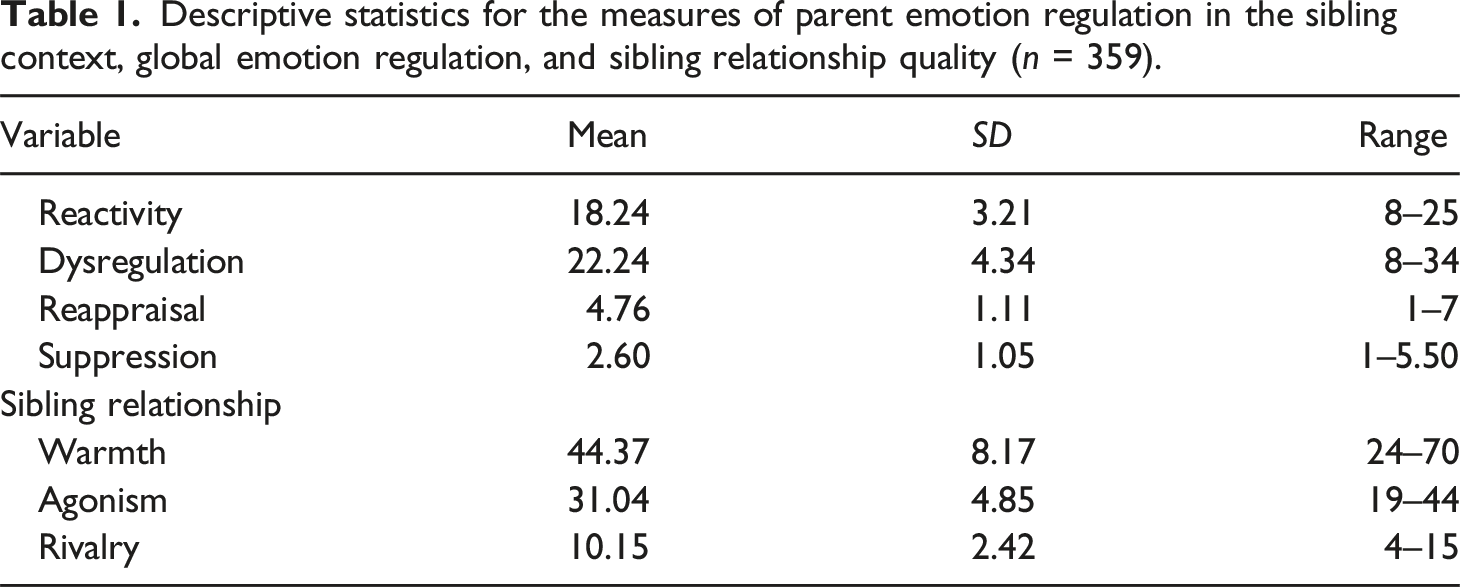
Descriptive statistics for the measures of parent emotion regulation in the sibling context, global emotion regulation, and sibling relationship quality (n = 359).
Correlations among maternal emotion regulation, sibling relationship quality, and children’s down regulation (n = 359).
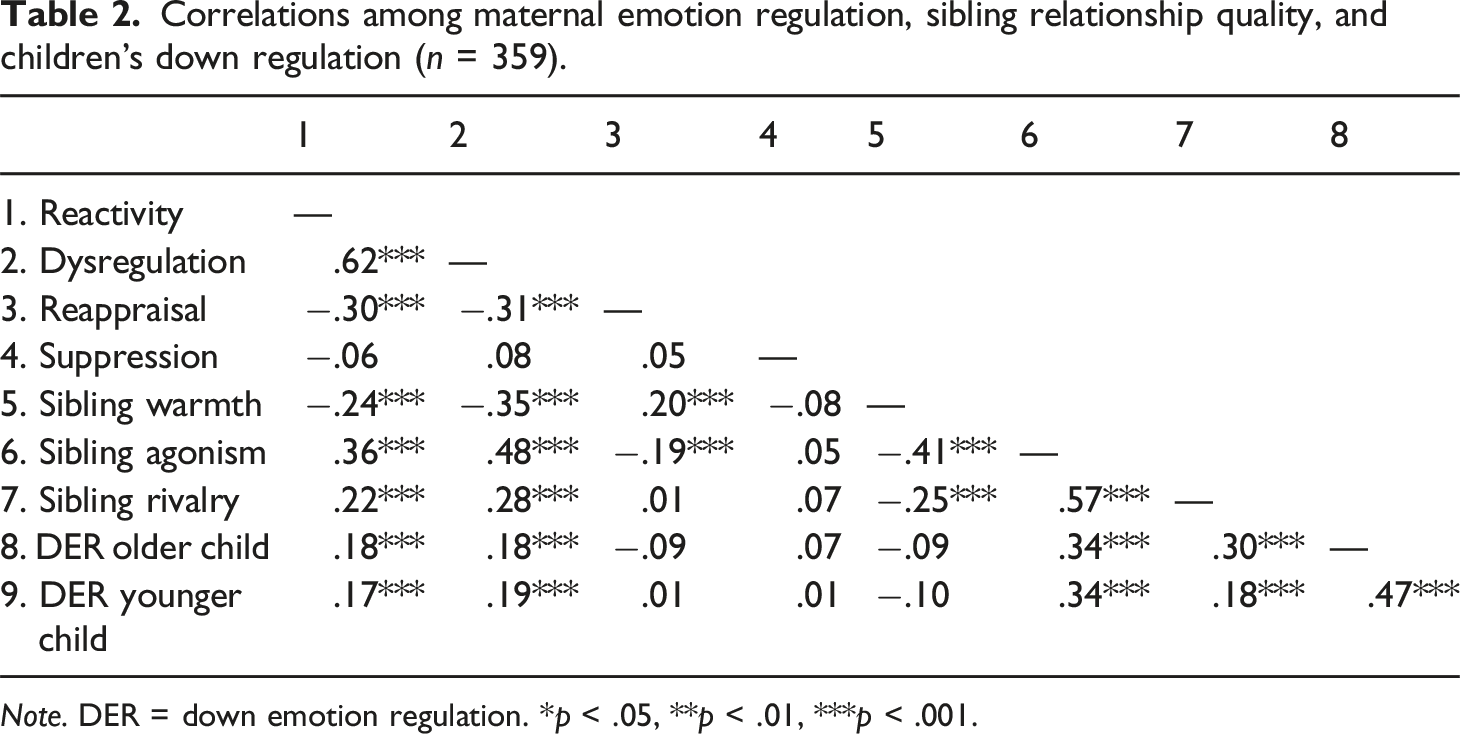
Note. DER = down emotion regulation. *p < .05, **p < .01, ***p < .001.
Factor structure
The CFA showed that Model 1, with all items from the PERSCQ loading on a single factor, did not have adequate fit by the outlined standards (X2(54) = 344.82, p < .001, CFI = .82, TLI = .78, RMSEA = .12, 90% CI [.11, .14], SRMR = .07). All factor loadings were significant and above .40. Model 2, with the two latent factors (reactivity and dysregulation) had improved fit compared with Model 1 (X2(53) = 1682.1, p < .001; CFI = .96, TLI = .95, RMSEA = .06, 90% CI [.08, .11], SRMR = .04) with factor loadings above .40. Modification indices (MI) were utilized as a guide for model adjustments and applied to both models, with two modifications found to improve overall model fit and once again applied to both models for comparison. Because of common themes and wording, two items (“When I’m upset about my children’s difficulty in getting along, I don’t know what to do to help them” and “When I’m frustrated by my children’s behaviors towards one another, I have trouble helping them find ways to get along”) were found to have the highest MI (116.079) and so we adjusted the measurement of these items to be correlated. An additional pair of items (“Even though I really dislike it when my children shout at each other, I can put my anger aside and help them solve the problem” and “It’s really hard to be a good parent when I’m aggravated about my children’s behaviors towards each other”) had the next highest MI, so these items were also correlated with each other. This step improved model fit in both Model 1 (X2(52) = 205.18, p < .001, CFI = .91, TLI = .88, RMSEA = .09, 90% CI [.08, .10], SRMR = .06) and Model 2 (X2(51) = 79.78, p = .006, CFI = 0.98, TLI = 0.98, RMSEA = 0.04, 90% CI [.02, .06], SRMR = 0.03), with Model 2 showing significantly better fit than Model 1 (X2(1) = 122.4(, p < .001). Thus, Model 2 with the two latent factors was retained and confirmed the presence of two factors with reference to PER in the sibling context: emotional reactivity and dysregulation (see Figure 1). Confirmatory factor analysis of the final model with two-factor loading. Note. Model fit: χ2(51, N = 357) = 79.78; CFI = .98; TFI = .98; RMSEA = .04; 90% CI [.02, .06]; SRMR = .03. Values are standardized. All values are significant (p < .001).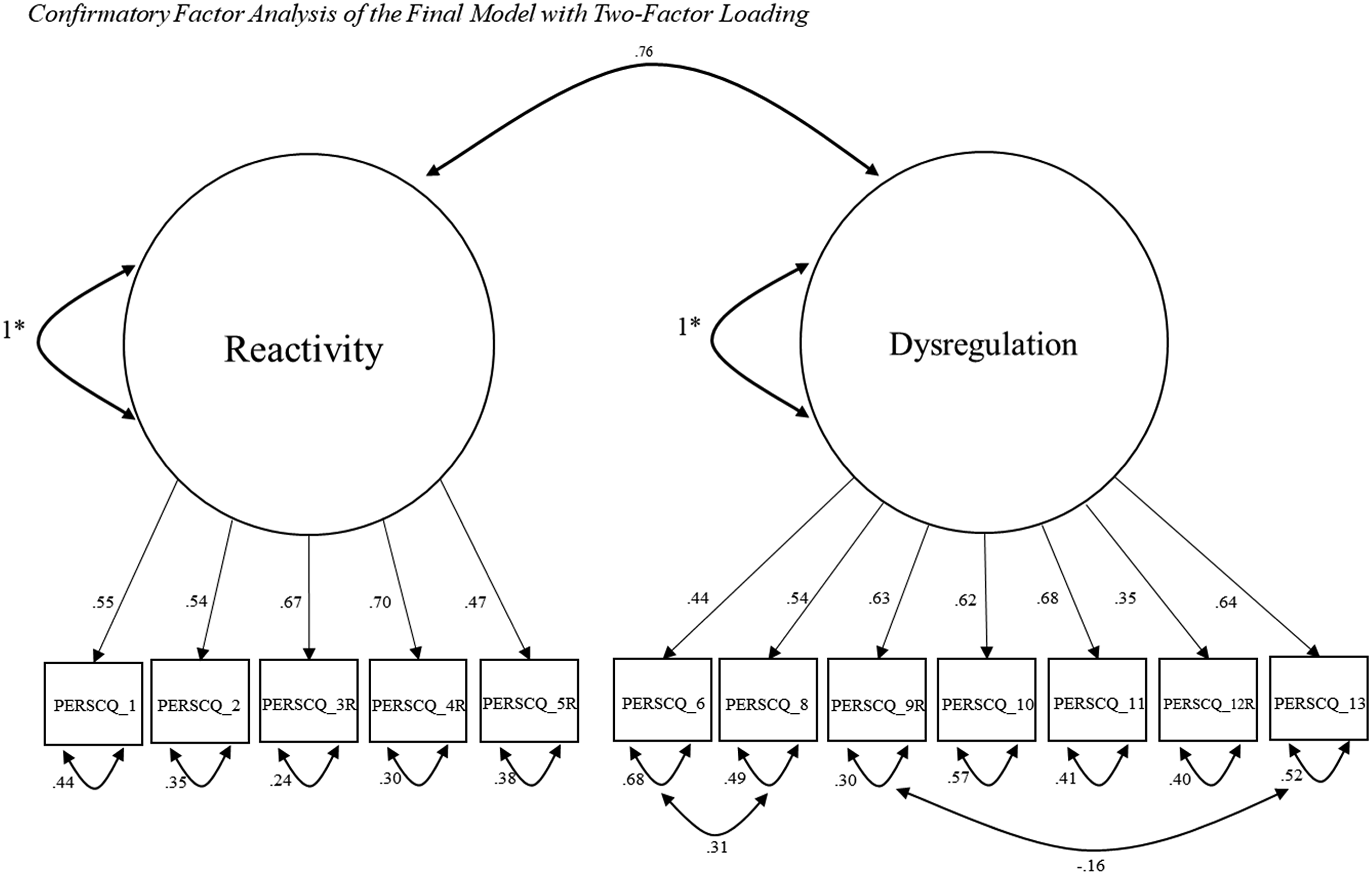
Reliability
Based on the results from the factor analysis, we assessed reliability for the two subscales: reactivity and dysregulation. Test-retest reliability, measured over a 2-month interval, was .54 and .71, ps < .001, for reactivity and dysregulation, respectively. Alphas for reactivity were .85 at both pre-test and the 2-month re-administration, respectively. Similarly, alphas for dysregulation were .80 and .85 at the 2-month re-administration, respectively, with both sets of alphas indicating good internal consistency.
Divergent validity
The two subscales, reactivity and dysregulation, were moderately positively correlated (r = .62, see Table 2), suggesting they may be related but distinct dimensions of PER. We further assessed divergent validity by examining whether mothers’ PERSCQ reports of greater emotional reactivity and dysregulation in the sibling context were associated with poorer global emotion regulation strategies on the ERQ. As hypothesized, both maternal reports of reactivity and dysregulation were modestly negatively associated with the use of cognitive reappraisal (rs = −.38 and −.35 for reactivity and dysregulation, respectively, ps < .001). Neither maternal reactivity nor dysregulation was significantly associated with mothers’ expressive suppression.
Concurrent criterion validity
To assess concurrent criterion validity, we examined whether mothers’ reports of greater emotional reactivity and dysregulation in the sibling context were associated with poorer sibling relationship quality. Both maternal reactivity and dysregulation were positively associated with sibling agonism (rs = .36 and .48 for reactivity and dysregulation, respectively, ps < .001) and sibling rivalry (rs = .22 and .28, ps < .001) and negatively associated with sibling warmth (rs = −.24 and −.35, ps < .001).
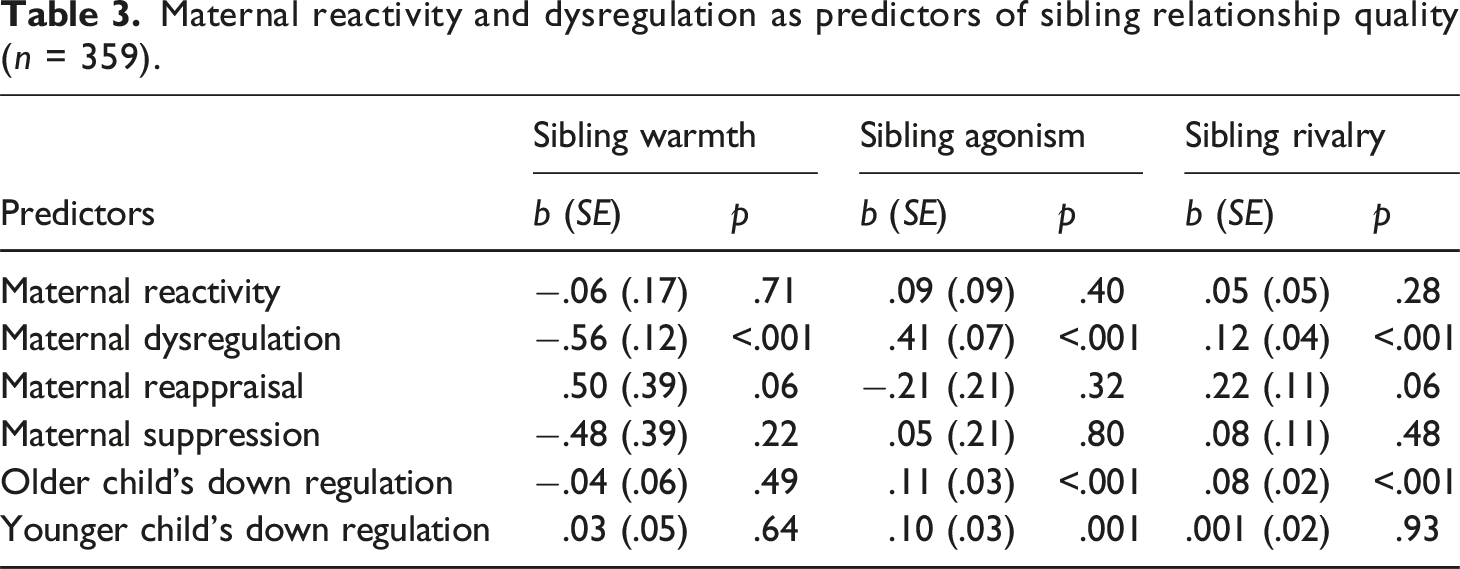
Maternal reactivity and dysregulation as predictors of sibling relationship quality (n = 359).
Discussion
Raising multiple children can present significant challenges for parents. Not only are parents confronted with additional tasks as they attend to the needs of multiple children, but they also face challenges—possibly accompanied by intense emotional reactions— as they coordinate their efforts to promote positive interactions among their children (De Roose et al., 2018; Mönkediek et al., 2020). Following Dix’s (1991) model of affective processes in parenting, challenging interactions between parents and children can elicit negative emotional arousal, which can, in turn, reduce the likelihood that parents will engage in adaptive child-rearing strategies. In the context of parenting siblings, conflict, anger, and other forms of agonistic sibling interactions may elicit pronounced frustration and anger in parents, which may reduce their parenting effectiveness (Kojima et al., 2005). How parents regulate negative emotions such as these, so that they can engage in effective parenting, is a critical factor that may affect their ability to help their children establish prosocial sibling relationships.
With a paucity of validated instruments to assess parental emotion regulation in the context of rearing siblings (DeMartini & Hazen, 2020; Zhang et al., 2023), this study tested the factor structure, reliability, divergent and concurrent criterion validity of a relatively new instrument: the Parental Emotional Regulation in the Sibling Context Questionnaire (PERSCQ), which assesses how parents regulate intense emotions. These processes have been shown to be critical for implementing effective parenting strategies (Deater-Deckard et al., 2005; Morris et al., 2017) that can help children establish prosocial sibling relationships (Kramer, 2010). Having reliable and valid instruments to assess parents’ experiences while raising siblings in early to middle childhood is critical for the development and testing of new prevention and intervention tools aimed at fostering positive relationships among siblings.
Parental emotion regulation in the sibling context
Cast within a study of the effectiveness of an online preventive intervention program for parents, we found support for the factor structure, reliability, and validity of the PERSCQ. As hypothesized, the reactivity and dysregulation scales that were identified via a confirmatory factor analysis demonstrated adequate internal consistency. These findings replicate those of Ravindran et al. (2015) with a larger, more diverse international sample and support the further testing of the PERSCQ as a valid assessment tool. Moreover, the instrument also demonstrated good test-retest reliability for both subscales, although the test-retest reliability was lower for reactivity than dysregulation. This may have occurred because the items that comprised the reactivity scale largely tap parents’ experiences of negative emotions when their children are not getting along—phenomena that have been demonstrated to change rapidly even within the space of minutes (Kramer et al., 1999). Thus, reactivity may be more susceptible to recent or immediate challenges and changes in the sibling relationship. In contrast, the items comprising the dysregulation scale tapped the degree to which parents report some degradation of their parenting effectiveness, a process that may be less driven by immediate changes in sibling interaction and that is more stable over time. This suggests that parents’ reactivity may be more sensitive to moment-to-moment changes in sibling interaction quality than dysregulation, thereby producing lower test-retest correlations in comparison to dysregulation. Indeed, Ravindran et al. (2015) reported that maternal and paternal reactivity indirectly decreased for both mothers and fathers via reductions in sibling agonism. It is also possible that reactivity may show greater stability when measured across shorter intervals (e.g., 1 week) rather than the 8 weeks we used in this study.
Divergent validity
Support for the PERSCQ’s divergent validity as a measure of emotional regulation emerged from its negative correlations with Gross and John’s (2003) general ERQ scales of cognitive reappraisal. Mothers who reported higher levels of reactivity and dysregulation on the PERSCQ were likely to also report being less likely, in general (i.e., in contexts beyond parenting siblings), to reappraise or reframe problematic situations in ways that might support coping. Interestingly, mothers who reported feeling that their parenting effectiveness was diminished due to an inability to manage their emotions did not report engaging in more expressive suppression. These findings are similar to those reported by Ravindran et al. (2015) which piloted the PERSCQ with a different sample of mothers and fathers raising 4- to 8-year-old siblings.
Concurrent criterion validity
Support for the concurrent criterion validity of the PERSCQ emerged from the analyses testing associations between maternal emotion regulation and sibling relationship quality. There were modest positive correlations between both dimensions of maternal emotion regulation in the sibling context with sibling agonism and rivalry, and modest negative correlations with sibling warmth. Although other factors, such as mothers’ general emotion regulation abilities and levels of parenting stress, may also affect their emotion regulation in the sibling context, our findings support the validity of the instrument by demonstrating correlations between these dimensions with sibling relationship quality.
Moreover, maternal dysregulation predicted lower levels of sibling warmth, and higher levels of sibling agonism and rivalry, even after controlling for maternal global ER and maternal reports of both children’s emotion regulation. This suggests that children’s sibling relationship quality is less positive when mothers report greater difficulty regulating their emotions in ways that they describe as negatively affecting their parenting effectiveness. No significant associations were found between mothers’ emotional reactivity and sibling relationship quality, suggesting that it is indeed the disruption in parenting effectiveness that accompanies emotional arousal, and not the arousal itself, that is linked to children’s sibling relationship quality. This finding provides further support that reactivity and dysregulation are distinct dimensions of PER in the sibling context. Given these results, it is possible that maternal reactivity is indirectly linked to sibling relationship quality, via maternal dysregulation. Future studies should utilize longitudinal designs to test such mediation effects.
Whereas the results of this study illustrate how maternal emotion dysregulation predicts greater sibling agonism and rivalry/competition as well as less sibling warmth, it is also possible that sibling relationship quality drives variations in maternal emotion regulation. For example, mothers may become emotionally aroused when siblings fight or are not kind to one another in ways that prompt them to use less effective parenting strategies (Deater-Deckard et al., 2005); poor sibling relationship quality may follow. Prospective or short-term longitudinal studies are needed to disentangle the nature of these effects.
Greater reactivity and dysregulation were associated with mothers’ appraisals that their older and younger children were less able to manage their emotions and frequently required down regulation. These associations provide additional evidence for the PERSCQ’s concurrent criterion validity as they show that difficulties in PER are linked with difficulties in child emotion regulation. Child age and gender constellation were not associated with PER. These results are suggestive of the stressful nature of raising siblings, especially when children have emotion regulation difficulties. However, as correlations, the direction of these effects are not clear and longitudinal studies are needed to help ascertain if child and sibling characteristics drive variations in PER or vice versa.
Context-specific versus context-free measures of ER
Children’s emotion regulation was related to parents’ emotion regulation only when the context-specific PERSCQ was used and not the context-free ERQ. This suggests that how parents regulate emotions in child-rearing contexts, such as when moderating sibling conflict, may depend in part on their children’s characteristics, including their ability to regulate intense emotions—and not how parents regulate their emotions in general. Thus, the results of this study are consistent with Zhang et al.’s (2023) finding from their systematic review that measures of ER in the specific context of parenting may yield different patterns of association with parent and child outcome variables than global, context-free measures of adult ER.
To fully understand how processes of PER operate—how they are developed and maintained, the individual and family factors that contribute to enhanced PER competencies, and its correlates—it will be important for future research to take a context-specific approach. Our findings suggest that parenting, and particularly, the parenting of siblings, provides a unique context in which ER processes develop and should be studied as such. The emotional challenges that parents face while responding to their children’s agonism and conflict may require distinct regulatory responses that differ from the types of ER processes individuals may find effective in contexts beyond parenting— or when parenting a single child. Future research should compare PER processes in the contexts of raising a single versus multiple children (i.e., siblings) to establish whether different processes are at play. Additionally, we recommend that future studies investigate PER processes in other specific parenting contexts, such as parenting children who present diverse developmental or behavioral characteristics.
Advancing our understanding of PER
Finally, it is important to recognize that parental emotion regulation is a complex construct, and admittedly, our work has centered on those aspects of PER that reflect parents’ experiences and expressions of reactivity and dysregulation in the face of sibling conflict. Many other dimensions of PER may be relevant, such as parents’ awareness, understanding, and acceptance of emotions, as well as their ability to respond in ways they believe will enable them to achieve their goals, regardless of their emotional state (Gratz & Roemer, 2004). As future research explores the multifaceted dimensions of ER in various parenting contexts, we will form a more nuanced conception of what PER is and how it functions to support effective parenting and child and family well-being. Such research will enable us to further establish the construct validity of PER, and instruments designed to measure it, through the creation and testing of a nomological network (Cronbach & Meehl, 1955; Messick, 1994) that ultimately outlines the core dimensions of PER, how they function, and what they predict. The results of the current study provide foundational evidence of divergent and concurrent criterion validity to support the further development and testing of context-specific instruments of PER.
Implications for practice
The results of this study have important implications for assessment, prevention, and intervention with families where sibling animosity is high and parents report difficulties in parenting or managing negative emotions experienced in the context of parenting siblings. Because of their associations with sibling relationship outcomes, the new tool examined in this study may prove valuable in three major ways. First, the PERSCQ can be used to help identify families who may benefit from education/prevention/intervention strategies, for example, as part of a family relations screening or “check-up.” Second, parents’ responses on the instrument can be used by practitioners and educators to design customized intervention strategies. This can enable practitioners to narrow their focus and provide the specific types of assistance individual families need; for example, they can provide targeted assistance with improving aspects of emotion regulation and/or sibling interaction quality. Finally, the PERSCQ holds potential for research as an assessment tool. For example, if the results of this study are replicated, the instrument could be used to help evaluate the effectiveness of particular educational, prevention, and intervention strategies or programs aimed at improving parent emotion regulation.
Limitations
It is important to acknowledge the limitations of this study. First, although the sample was robust in size, relatively few fathers participated, which limits our ability to examine the psychometric properties of this measure with fathers. Given that the program took multiple hours over several weeks to complete, families may have decided to have only one parent participate, with mothers being more likely to assume this role. Latinx and Black parents were also under-represented. It will be critical for future studies to include reports from both mothers and fathers from diverse backgrounds, particularly when conducting further explorations of coparenting and parental emotion regulation. Such studies will be particularly interesting for examining potential spillover and compensation effects, such as whether one parent’s emotional dysregulation tends to carry over and increase the other parent’s dysregulation as well (spillover) or if the co-parent is able to aid or help compensate for their partner’s dysregulation.
Second, whereas online studies like this one allowed us to include a rich, diverse international sample and enabled us to include families that we would normally not be able to reach in an in-person study (especially during a pandemic), the sample was highly educated. Thus, the parents in this study may have felt more comfortable participating in an online program, had more reliable Internet access, and had more time to dedicate to the online program than parents with fewer years of education. It will be important for future studies to recruit samples that represent a range of educational and socioeconomic backgrounds. Additionally, we recommend that future studies examine the contributions of sexual orientation and disability status to processes of parent emotion regulation and sibling relationship quality as we did not request this information from participants.
Third, whereas the inclusion of an international sample was a strength of this study, questions remain about the cultural relevance of the instruments we used. It is critical that researchers avoid assuming that the instruments they select will be sufficiently sensitive for assessing parenting behaviors that are salient in various cultures. In fact, researchers should expect that instruments will need to be revised, on the basis of pilot tests with different cultural groups, before undergoing tests of validation. The PEPC-SRQ has been successfully translated and validated with parents residing in Spain (Lopez-Fernandez et al., 2023), Portugal (dos Santos, 2013), and China (Wang et al., 2022), albeit with some modifications made to increase cultural responsiveness. Thus, we have some evidence that the major domains of sibling relationship quality that we examined in this study are indeed relevant to parents across at least three cultures. However, because the PERCSQ is a new instrument, future research should prioritize the testing of its applicability to emotion regulation in parenting siblings in different cultures. It should also be acknowledged that asking parents to respond to the instruments in English could represent a limitation of their cultural relevance. However, the request to respond in English was important because we needed to ensure that the participants would fully understand the lessons of the program which were to be delivered initially in English.
Fourth, due to the online nature of the study and the tender ages of the children, we relied on parents’ reports to assess all constructs. To avoid the exclusive reliance on parental report, which may create issues of common method variance, future studies with children in this age range should ideally incorporate observations of sibling and parent-child interactions, which will take into consideration the natural interactions that occur in daily life (McDaniel et al., 2017).
Fifth, despite our attempt to take a holistic view of parents’ experiences with a focus on emotional reactivity and dysregulation, the newly developed instrument likely missed some important dimensions of parents’ experiences with emotion regulation in the sibling context. For example, parents’ differential feelings about each of their children, and their relationships with them, can play key roles in parenting stress (Deater-Deckard et al., 2005) and should be assessed in future studies. Furthermore, additional factors, not examined in this study, may also affect parents’ abilities to regulate their emotions. These factors may include personal characteristics of parents (including dimensions of mental health and external stressors, such as work or financial pressures), the demands and complexity of the family environment, cultural factors and expectations, gender-role beliefs, SES, family size and structure, level of social support, as well as other transitions the family may be experiencing such as parental separation or divorce. Although we found it critical to account for children’s emotion regulation abilities, additional characteristics of both older and younger siblings, such as difficult temperament may also affect parental emotion regulation (Deater-Deckard et al., 2005). It will be important for future studies to examine the ways in which measures of parental emotion regulation in the context of parenting, such as the PERSCQ, also predict other child outcomes. Additionally, future research should also explore the ways in which positive forms of parental emotion reactivity (e.g., excitement, pride, delight) may be linked with sibling relationship quality and other child outcomes.
Finally, as a correlational study, we cannot draw any conclusions about causal relationships, nor the direction of the reported associations, as bidirectional effects are likely.
Summary
In summary, parents of multiple children face a level of complexity and challenge that may be different—perhaps even exponentially greater—than that experienced by parents who are raising a single child. The results of this study reinforce the importance of assessing parents’ abilities to manage difficult emotions that stem from raising siblings, particularly when difficulty in managing emotions contributes to parents’ use of less effective parenting strategies. This information has the potential to significantly help researchers, practitioners, and family educators to better understand, assess, and potentially improve parents’ abilities to help their children establish positive relationships with one another.
Supplemental Material
Supplemental Material - Raising siblings is stressful: Measuring parental emotion regulation in the sibling context
Supplemental Material for Raising siblings is stressful: Measuring parental emotion regulation in the sibling context by Laurie Kramer, Niyantri Ravindran and Kellsie Prather in Journal of Social and Personal Relationships
Footnotes
Authors’ note
Portions of this research were presented at the biennial meeting of the Society for Research on Child Development, March 2023. We are grateful to the many families from around the globe who participated in this research as well as research assistants Tessa Hamilton, Madeline Manning, Jenna Campagna, Payton Carroll, Reshika Sai Devarajan, and Briana Paulo.
Declaration of conflicting interests
The author(s) declared no potential conflicts of interest with respect to the research, authorship, and/or publication of this article.
Funding
The author(s) disclosed receipt of the following financial support for the research, authorship, and/or publication of this article: This work was supported by the USDA National Institute of Food and Agriculture, under Project No. ILLU-793-382.
Open research statement
As part of IARR’s encouragement of open research practices, the authors have provided the following information: This research was not pre-registered. The data used in the research are not available to protect the identity and confidentiality of the participants. The materials used in the research are available. The materials can be obtained by emailing:

Supplemental Material
Supplemental material for this article is available online.
References
Supplementary Material
Please find the following supplemental material available below.
For Open Access articles published under a Creative Commons License, all supplemental material carries the same license as the article it is associated with.
For non-Open Access articles published, all supplemental material carries a non-exclusive license, and permission requests for re-use of supplemental material or any part of supplemental material shall be sent directly to the copyright owner as specified in the copyright notice associated with the article.
