




Abstract
Attachment insecurity (i.e., attachment anxiety or avoidance) puts people at risk for dissatisfying relationships. However, the dyadic regulation model of insecurity buffering suggests that an understanding and responsive partner may help insecure individuals to regulate emotions, thus improving couples’ relationships. It may also be that perceiving partners as understanding and empathic, especially in an exaggeratedly positive way (i.e., positive illusions) will buffer insecurity. In 196 mixed-gender newlywed couples, we investigated whether spouses’ positive illusions about partner’s dyadic perspective-taking moderated the association between spouses’ attachment insecurity and spouses’ and partners’ marital satisfaction over two years. Positive illusions generally predicted more satisfying relationships and attachment avoidance consistently predicted more dissatisfying relationships. There were also several instances where multilevel modeling indicated that positive illusions of dyadic perspective-taking buffered the negative effects of attachment avoidance on relationship satisfaction. However, there was also potentiation such that in two instances, positive illusions about dyadic perspective-taking strengthened the association between spouses’ insecurity (husbands’ attachment anxiety and wives’ attachment avoidance) and subsequent marital dissatisfaction. In the moment, positive illusions about dyadic perspective-taking may allow spouses to feel happy in their relationship despite fear of emotional intimacy; however, positive illusions may not continue to buffer effects of insecurity on subsequent relationship satisfaction and may even be harmful in the face of insecurity.
Keywords
People desire happy romantic relationships, but some are less successful at achieving them than others. Attachment insecurity is robustly related to relationship dissatisfaction (Butzer & Campbell, 2008; Feeney & Noller, 1992; Stackert & Bursik, 2003), but a sensitive and empathic partner may buffer this association (Simpson & Overall, 2014). Partners’ responsive support and communication behavior observed in the lab buffers the effects of insecurity on negative discussion behaviours (i.e., anger and withdrawal) and commitment (Overall et al., 2013; Tran & Simpson, 2009). However, we suggest that perceptions about a partner’s empathy or perspective-taking may also buffer insecurity because perceptions of partners may matter as much as their actual behavior in relationships (Murray et al., 1996a). For example, perceptions that are exaggerated, or positive beyond even what partners see in themselves (i.e., positive illusions), may be particularly powerful in buffering attachment insecurity. Positive illusions about partners’ personality and interpersonal qualities are related to stable and satisfying relationships (Cobb et al., 2001; Miller et al., 2006; Murray et al., 1996a) and buffer negative aspects of relationships (e.g., Murray et al., 1996a). Thus, we predicted that attachment security and positive illusions about partner’s perspective-taking (the cognitive component of empathy) would predict increases or at least maintenance of relationship satisfaction, and that positive illusions about dyadic perspective-taking would buffer the negative association between attachment insecurity and newlywed couples’ marital satisfaction over the first two years of marriage.
Attachment security and relationship satisfaction
Attachment theory provides a framework to understand the formation of romantic relationships and how individual differences in attachment security are related to relationship quality (Bowlby, 1969; Hazan & Shaver, 1987). Individual differences in attachment (in)security are currently conceptualized as two dimensions: attachment anxiety and attachment avoidance (Fraley & Shaver, 2000). Attachment anxiety is associated with feeling unworthy of love and preoccupation with fears of abandonment; attachment avoidance is associated with distrust of others and avoidance of emotional intimacy with romantic partners (e.g., Fraley & Shaver, 2000). Attachment anxiety may have negative effects because it raises fears of abandonment and rejection and attachment avoidance may have negative effects because people are reluctant to become intimate with or to rely on others, making it difficult to negotiate relationship challenges, to communicate constructively (Egeci & Gencoz, 2011), and to provide and accept effective support (Mikulincer & Shaver, 2009). Although there are often gender differences in degree of security on each attachment dimension (e.g., men tend to have higher attachment avoidance and lower attachment anxiety than women), the associations between attachment insecurity and dissatisfying relationships and relationship dissolution are robust and consistent across genders (Butzer & Campbell, 2008; del Giudice, 2011; Feeney & Noller, 1992; Stackert & Bursik, 2003). For example, in a meta-analysis that included 57 effect sizes, attachment anxiety and avoidance were negatively related to relationship satisfaction (Hadden et al., 2014).
Attachment insecurity is detrimental for relationships, but there may be some relational contexts in which the negative effects are minimized. The dyadic regulation model of insecurity buffering (Simpson & Overall, 2014) proposes that partner behavior can buffer negative effects of individuals’ attachment insecurity on relational and personal outcomes. Although there are many ways of buffering insecurity, a key buffering behavior is partner support (Girme et al., 2015; Simpson et al., 2007). For example, partner buffering support includes responding to attachment anxiety with emotional support and reassurance and to attachment avoidance with instrumental support and soft influences (allowing insecure individuals to retain personal autonomy). To date, researchers have observed how couples interact in the lab during conflict, support, and personal goal discussions, and sensitive and responsive partner behavior ameliorates the negative effects of individuals’ insecurity on mood, conflict recovery, and relationship satisfaction (Girme et al., 2015; Salvatore et al., 2011; Simpson et al., 2007). However, whether individuals’ perceptions of partner’s behavior play a similar buffering role to observed behavior is unknown. Given that sensitive responding may be a hallmark of effective buffering behavior, we proposed that perceiving a partner to be understanding may hold similar benefits. In other words, if insecure individuals perceive their partner to be understanding and especially good at taking the individual’s perspective—to the point of exaggerating these positive qualities, as reflected by positive illusions—it may buffer the association between individuals’ attachment insecurity and both partners’ relationship satisfaction. Thus, the more individuals hold positive illusions (i.e., exaggerated positive views beyond how partners might see themselves), the less likely their insecurity will negatively affect their own and their partner’s relationship satisfaction.
Positive illusions and relationship satisfaction
Positive illusions about romantic partners seem to benefit individuals and their partners in the short and long term; positive illusions predict both spouses’ relationship satisfaction contemporaneously and over one year in newlyweds (Cobb et al., 2001), predict less contemporaneous conflict and greater trust (Murray & Holmes, 1997), and predict love and relationship stability for up to thirteen years (Miller et al., 2006). In a meta-analysis of unmarried couples, positive illusions were the strongest protective factor against relationship dissolution, and played a stronger role in relationship outcomes than other important factors such as commitment, trust, and relationship satisfaction (Le et al., 2010). Murray and colleagues (1996a) proposed that positive illusions buffer relationship conflict or doubt about the relationship, thus protecting satisfaction. Seeing the best in a partner may reassure individuals that it is worth staying in the relationship and lead to more positive interactions and better communication, which then fosters greater relationship satisfaction. For example, positive illusions predicted more positive and less negative support behavior during observed discussions in newlywed couples, which in turn predicted relationship satisfaction over one year, at least for wives (Cobb et al., 2001). Positive illusions may help partners give each other the benefit of the doubt (Murray et al., 1996a), and because illusions lead to more effective support seeking and provision (Cobb et al., 2001), partners may feel that they can rely on each other in times of need, which sets the stage for constructive problem resolution and relationship satisfaction down the road (Sullivan et al., 2010).
Despite the robust evidence that positive illusions benefit relationships, there may be times when they lead to problems for individuals and their partners (Huston et al., 2001; Swann et al., 1994). Positive illusions may lead to high expectations for partner’s behavior, which may result in disappointment if partners fall short. Likewise, people who are the object of a partner’s positive illusions may experience feelings of unworthiness if they fail to meet these high or unrealistic expectations (Murray et al., 1996b). Recipients of positive illusions may also feel invalidated if they perceive the partner as misunderstanding who they are as a person and thus feel less close to their partners. One study supports these notions and suggests a “marriage shift,” whereby the role of perceptions changes from dating to married couples. Married (about 6 years) and dating couples indicated that partner’s positive regard that is at odds with individuals’ negative self-image may not benefit, or may even be harmful after marriage whereas it is beneficial prior to marriage (Swann et al., 1994). This raises the possibility that the role of positive illusions could change over the course of marriage, and the unsettling feeling of not being seen accurately or being misperceived may be especially concerning for those in longer term relationships in which a deep understanding of a partner may be expected.
Current study
We examined how positive illusions about dyadic perspective-taking, which is the cognitive component of empathy (Long, 1990), buffered the negative association between attachment insecurity and marital satisfaction over two years in newlywed mixed-gender couples. We focused on newlywed couples because seeing the best in partners in the early stages of a relationship may be especially helpful in fostering well-functioning relationships (e.g., Cobb et al., 2001) and any distress observed over time is likely a result of early observed relationship processes rather than pre-existing distress. We assessed all constructs of interest multiple times over two years, which allowed us to examine contemporaneous associations averaged across time, and whether positive illusions and attachment insecurity predicted later changes in relationship satisfaction. By including couples, we were able to examine dyadic effects using the actor partner interdependence model (Kenny et al., 2006), which allowed for examination of how individuals’ predictor variables were associated with their own (actor effect) and their partner’s (partner effect) relationship satisfaction.
To date, research on positive illusions has focused on specific personality or relationship attributes such as agreeableness and attachment security or a combined rating of multiple interpersonal qualities (Cobb et al., 2001; Miller et al., 2006; Murray et al., 1996a). Positive illusions about dyadic perspective-taking have yet to be examined but may be critically important for relationship outcomes. Evidence for the dyadic regulation model of insecurity buffering suggests that successful buffering behavior is characterized by sensitive partner responses that meet the needs of insecure individuals. Perspective taking requires partners to be sensitive, understanding, and responsive, which promotes successful navigation of romantic conflicts and relationship satisfaction (Khojastehmehr et al., 2014; Long & Andrews, 1990). Therefore, perceiving a partner as someone who skillfully engages in dyadic perspective-taking, even beyond the partner’s self-rated perspective-taking, could be as or more important than actual partner behavior. For example, positive illusions about perspective-taking may buffer the insecurity of people who worry about their partner’s love (i.e., attachment anxiety) because they see their partner as understanding and empathic, which meets their needs for reassurance and connection. Positive illusions about perspective-taking may also buffer the insecurity of people who prefer not to disclose their intimate thoughts and feelings (i.e., attachment avoidance) because they think their partner will understand without explicitly revealing vulnerability.
We specifically hypothesized that spouses’ attachment insecurity would be negatively related to spouses’ and partner’s contemporaneous (Hypothesis 1a) and subsequent (Hypothesis 1b) marital satisfaction; that positive illusions would be positively associated with both spouses’ contemporaneous (Hypothesis 2a) and subsequent (Hypothesis 2b) marital satisfaction; and that spouses’ positive illusions would moderate associations between their attachment security and spouses’ and partner’s contemporaneous (Hypothesis 3a) and subsequent (Hypothesis 3b) marital satisfaction. In other words, we predicted that spouses’ positive illusions about each other’s perspective-taking would weaken the negative association between their attachment insecurity and both spouses’ relationship satisfaction. We tested all hypotheses contemporaneously to examine these associations averaged across time points (Hypotheses 1a, 2a, and 3a) and we tested lagged models to examine how positive illusions and attachment insecurity were related to subsequent changes in relationship satisfaction (Hypotheses 1b, 2b, and 3b).
We were specifically interested in testing whether spouses’ positive illusions buffered the negative effects of spouses’ insecurity on their marital satisfaction and their partner’s marital satisfaction. In other words, do spouses’ perceptions of a partner as responsive, empathic, and understanding (even more than the partner seems themselves) buffer negative effects of spouses’ insecurity on the outcomes of both individuals in the couple. Thus, we did not examine whether spouses’ positive illusions buffered the negative effects of partner’s insecurity on spouse and partner relationship outcomes. Although it is certainly possible that being the object of positive illusions may ameliorate the negative relationship effects of one’s insecurity, our goal was to understand how spouses’ exaggeratedly positive perceptions of partner behavior buffered their own insecurity, not whether being the recipient of a partner’s positive illusion buffered effects of insecurity. Therefore, our key question is not whether being idealized benefits relationships by buffering insecurity, but rather whether holding positive illusions about key partner qualities—perspective-taking and empathy—buffers insecurity in the same way as receiving supportive and responsive partner behavior observed in the lab (Simpson & Overall, 2014).
Methods
Participants
Participants were 196 mixed-gender couples who participated in a longitudinal study on the transition to marriage. At the start of the study (about three months prior to marriage), the average relationship length was 4.12 years (SD = 2.86) and 46.9% of the couples were cohabiting (all couples were cohabiting following marriage). Husbands averaged 29.16 years of age (SD = 4.75; Mdn = 28.26; range = 20.79–46.16) and 16.28 years of education (SD = 3.09), and had an average annual income of CAD $30,000-39,000. Most husbands were employed (92.35%; 88.40% full-time, 11.05% part-time) and some were students (19.90%; 61.54% full-time, 38.46% part-time). Most husbands identified as White (76.53%), followed by 14.29% Asian, 3.06% Indo-Canadian, 1.53% Middle Eastern, and 4.19% identified as “other.” Wives averaged 27.41 years of age (SD = 4.17; Mdn = 26.65; range = 20.42–42.73) and 16.63 years of education (SD = 2.41), and had an average annual income of CAD $20,000-29,000. Most wives were employed (93.81%; 79.67% full-time, 20.33% part-time) and some were students (28.90%; 53.45% full-time, 43.10% part-time). Most wives identified as White (72.45%), followed by 18.37% Asian, 5.61% Indo-Canadian, and 3.06% identified as “other.”
Procedures
The Simon Fraser University Research Ethics Board approved all procedures. Participants were recruited via newspaper advertisements, wedding-related online forums, campus and community bulletin boards, TV/print media coverage of the study, bridal show booths and mailing lists, advertisements in wedding-related service retailers, and notices to religious organizations. Eligible couples were (a) 19–45 years old, (b) engaged with a set wedding date, (c) entering first marriages, (d) childless, (e) proficient at reading and writing in English, and (f) living in the Metro Vancouver area. Of the 617 individuals who contacted the lab expressing interest in the study, 493 completed a 15-minute phone screening interview. Of the 124 individuals who contacted the lab but were not screened, 94 did not respond to our contact attempts and 30 responded after recruitment was completed. Of those screened, 237 couples were eligible, 221 couples received Time 1 (T1) surveys, 201 couples had at least one partner complete some part of the T1 survey, 198 couples completed some part of T1, and 196 couples completed at least one questionnaire included in these analyses (see Poyner-Del Vento & Cobb, 2011 for more information about study procedures and screening).
Once couples were enrolled, each partner received an information email with an electronic copy of the consent form, a unique ID number, a password, and a link to the online survey, which was hosted on a secure server. The first page of the survey was a consent form and participants were required to click a radio button agreeing to participate, which allowed access to the survey. Couples were emailed survey links three months prior to their wedding (T1) and every three months thereafter. Surveys completed at T1 and every six-months took about one hour and included questionnaires assessing marital satisfaction, self- and other-dyadic perspective-taking, and attachment insecurity. Intervening surveys were abbreviated and assessed only marital satisfaction. Six-month intervals for the longer surveys were chosen to capture change over time without unduly burdening participants; this is consistent with published longitudinal marital studies (e.g., Bradbury & Karney, 2004). Couples attended two in-person lab sessions, one three months after their wedding and a second at the end of the study. The focus of this study is on surveys administered at the six-month lags, which are referred to Times 1 – 5 (T1-T5); data from the lab sessions and the intervening short surveys were not included in these analyses because attachment security and positive illusions were not assessed at the intervening time points. Couples completed T1 an average of 2.62 months (SD = 1.18) prior to their wedding and completed T5 an average of 2.27 years (SD = 0.18) later. Couples received $425 for completing the longitudinal study as follows: T1 = $75, T2 and lab session = $100, T3 = $50, T4 = $50, T5 and lab session = $150. They did not receive payment for the short intervening surveys
Attrition
Of the 201 couples in which at least one partner completed some part of the T1 questionnaires, five couples either only did a few questionnaires in the survey (e.g., demographics or questionaries not used in this study) or only one partner completed any part of the questionnaires; of the 196 couples who completed T1, 12 husbands and 12 wives dropped out, four couples (2.04%) separated or divorced, and some spouses did not complete some waves of data; 91.84% of husbands and 92.86% of wives who completed T1 also completed T5. Participants who did not complete the study did not differ from study completers with respect to age, income, race (White vs. non-White), relationship length, cohabitation before marriage, attachment anxiety, attachment avoidance, positive illusions about dyadic perspective-taking, or marital satisfaction measured at T1. Completer wives did not differ on education from non-completer wives, but non-completer husbands had fewer years of education (M = 14.38, SD = 1.96) than completer husbands (M = 16.44, SD = 3.12), t(194) = 2.60, p = .01; d = .79.
Measures
Demographic information
Participants reported the date their relationship began in the phone screening and all other demographic information (i.e., date of birth, wedding date, income, race, work and school status, years of education, cohabitation) in the T1 survey.
Attachment security
The Experience in Close Relationships-Revised (ECR-R; Fraley et al., 2000) consists of 18 items that assess attachment anxiety and 18 items that assess attachment avoidance. Items are rated on a seven-point scale from 1 (strongly disagree) to 7 (strongly agree). Relevant items are reverse scored, and subscales of attachment anxiety and avoidance are computed as a mean; higher scores reflect higher attachment anxiety or avoidance. Over the five time points, coefficient alphas for attachment anxiety ranged from .86 to .93 for husbands and .91 to .95 for wives, and coefficient alphas for attachment avoidance ranged from .87 to .95 for husbands and from .87 to .95 for wives.
Marital satisfaction
The Quality of Marriage Index (QMI; Norton, 1983) is a 6-item measure that assesses marital satisfaction (e.g., “My relationship with my partner is very stable”). Five items are scored from 1 (very strong disagreement) to 7 (very strong agreement) and one item is scored from 1 (very unhappy) to 10 (perfectly happy). A total score is computed by summing items and can range from six to 45 with higher values denoting higher marital satisfaction. Scores below 30 are considered in the maritally distressed range (Funk & Rogge, 2007). Over the five time points, coefficient alphas ranged from .93 to .96 for husbands and from .91 to .97 for wives.
Positive illusions about dyadic perspective-taking
The Self and Other Dyadic Perspective-Taking Scale (Long, 1990) assesses participants’ ability to understand their partner’s point of view (SDPTS) and participants’ perceptions that their partner understands their point of view (ODPTS). The SDPTS is comprised of 13 items (e.g., “I not only listen to my partner, but I understand what he/she is saying, and seem to know where he/she is coming from”) scored on a 5-point scale from 0 (does not describe me very well) to 4 (does describe me very well). Scores were computed by averaging items and higher scores represent greater dyadic perspective-taking. Coefficient alphas for the SDPTS ranged from .89 to .94 for husbands and from .91 to .95 for wives across all waves of data. The ODPTS is comprised of 20 items (e.g., “When involved in an argument with me, my partner is the type of person who will consider and take into account my point of view and compare that with his/her own”) scored on a 5-point scale from 0 (does not describe him/her very well) to 4 (does describe him/her very well). Scores were computed by averaging items and higher scores represent perceptions that the partner engages in greater dyadic perspective-taking. We used 13 of the 20 ODPTS items that were comparable to the 13 SDPTS items. For example, the SDPTS item, “In my relationship with my partner I believe that there are two sides to every question, and I try to look and think about both sides,” matches the ODPTS item, “My partner believes that there are two sides to every argument and tries to look at both sides.” Coefficient alphas for the 13-item ODPTS ranged from .91 to .93 for husbands and from .93 to .95 for wives across all waves of data.
To assess positive illusions about dyadic perspective-taking, we computed a residual difference score by regressing spouses’ rating of their partner (ODPTS) to predict the partners’ rating of themselves (SDPTS) and saving the residual scores. The scores have a mean of zero, with positive values denoting above average positive illusions, and negative values denoting below average positive illusions. We assessed positive illusions by computing residual differences scores rather than other methods such as difference scores, because they do not suffer from ceiling and floor effects and they do not confound positive illusion with the component variables (Griffin et al., 1999).
Data analytic plan
Given the nested and dependent nature of the data, we tested all hypotheses using Multilevel Modeling (MLM) using an Actor-Partner Interdependence Model (APIM; Kenny et al., 2006) analyzed with IBM SPSS (Version 24). Level 1 predictors were grand mean centered and standardized across time and spouses, except for time, which was centered as 0 at T1 with each subsequent timepoint as years from T1. Standardized predictors facilitate interpretation of the intercept so that it represents marital satisfaction across time and spouses when all predictors are at their average (zero) and all predictors are comparable because they have a standard deviation of one. Coefficients in the tables are thus partially standardized. We first ran each analysis with husbands’ and wives’ coefficients constrained to be equal (the most parsimonious model), which provided pooled estimates. We then reran the constrained model with gender as a moderator of all predictors to detect gender differences. Gender differences were present for at least some predictors in our main analyses and thus we reran the models with two intercepts, which provided separate estimates for husbands and wives (cf. Girme et al., 2018). There were no significant gender differences in analyses examining change in attachment anxiety and avoidance, positive illusions, or marital satisfaction, and thus only pooled results are presented for those analyses.
SPSS’s Mixed models uses each case, even if the data is incomplete, to calculate the restricted maximum likelihood estimations, which results in an estimate of variance and covariance parameters unbiased by data missing at random (Enders, 2001; Kenny et al., 2006, pp. 93–94). Interactions were calculated by multiplying mean centered scores (e.g., Attachment Anxiety X Positive Illusions). To test all hypotheses, we ran two multilevel models. First a contemporaneous model that regressed individuals’ and partners’ attachment anxiety, attachment avoidance, positive illusions, and individuals’ and partners’ interactions between attachment anxiety and positive illusions and between attachment avoidance and positive illusions on individuals’ marital satisfaction. Then we ran a time-lagged model to examine how variables at Time(T) were associated with changes in marital satisfaction from Time(T) to Time(T+1), while controlling for marital satisfaction at Time(T). Time-lagged analyses were conducted over four 6-month lags (T1→T2, T2→T3, T3→T4, T4→T5). In each analysis intercepts were specified as random; however, contemporaneous and lagged models failed to converge when actor and partner effects were specified as random. Therefore, we only modeled the intercepts as random unless otherwise specified. As interactions were included in models, the actor and partner effects are conditional effects (i.e., the coefficient of one predictor represents the effect when all other variables are held at their mean value of zero). When interactions were significant, we tested the simple slopes and graphed the interaction using the Simple Intercepts, Simple Slopes, and Regions of Significance in HLM 2-way Interactions software (Preacher et al., 2006). We graphed the association between attachment insecurity (attachment anxiety or avoidance) and marital satisfaction at low (i.e., one standard deviation below the mean) and high (i.e., one standard deviation above the mean) levels of positive illusions.
Results
Descriptives and correlations among study variables
Means and Standard Deviations of Study Variables for Husbands and Wives at Each Time Point.
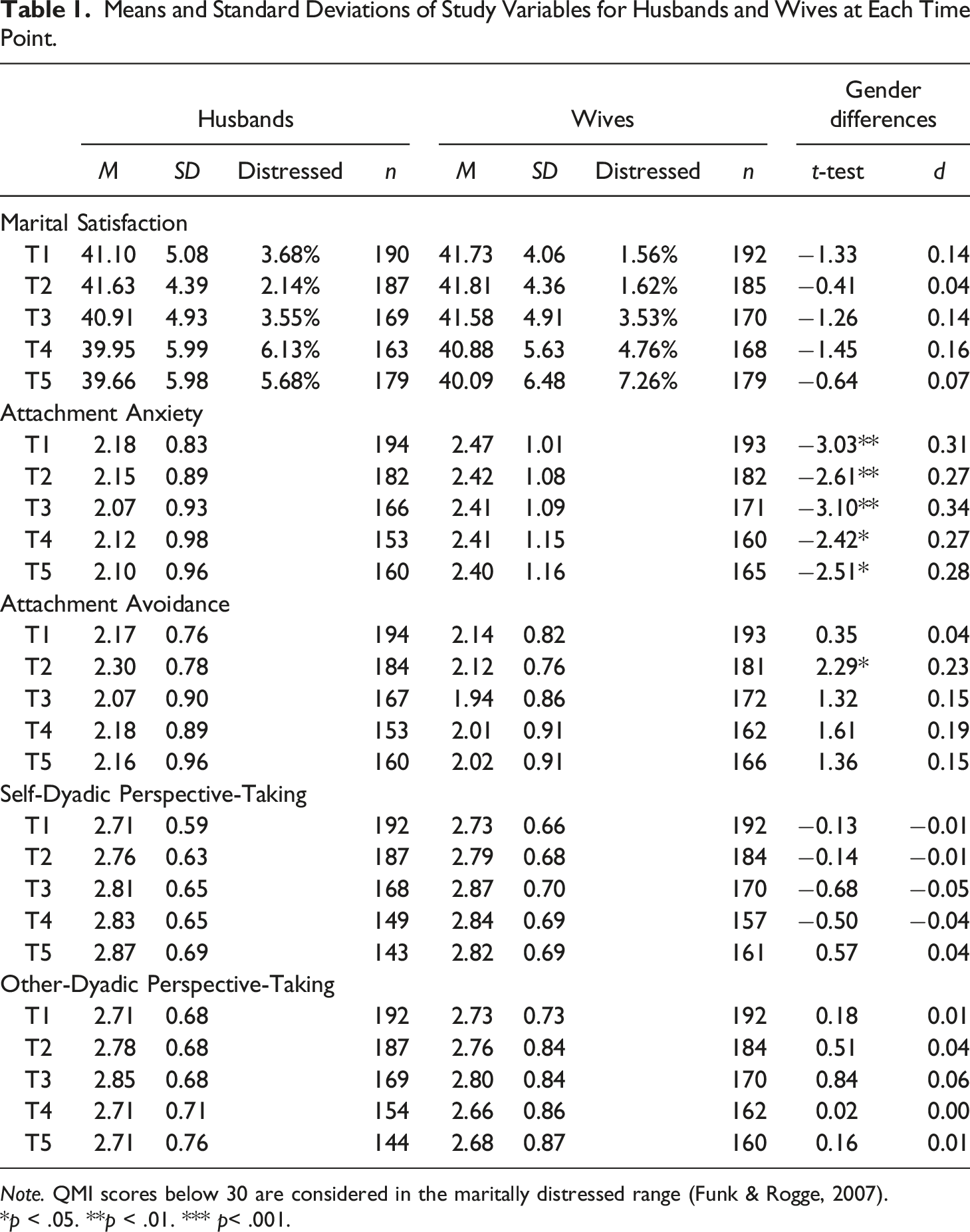
Note. QMI scores below 30 are considered in the maritally distressed range (Funk & Rogge, 2007).
*p < .05. **p < .01. *** p< .001.
Range of Correlations Between Study Variables Across All Time Points.
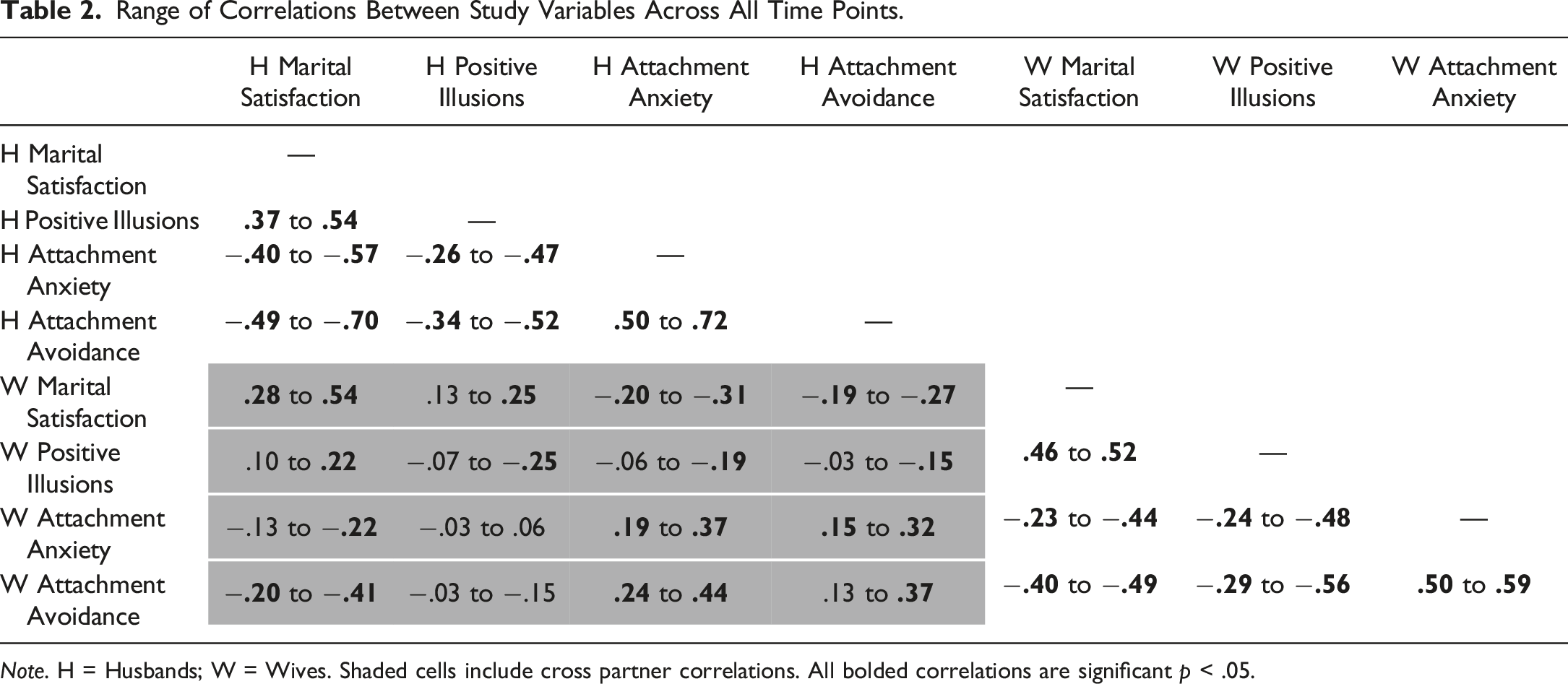
Note. H = Husbands; W = Wives. Shaded cells include cross partner correlations. All bolded correlations are significant p < .05.
Changes in attachment anxiety, attachment avoidance, positive illusions and marital satisfaction
Changes in Attachment Security, Positive Illusions and Marital Satisfaction Over Time.
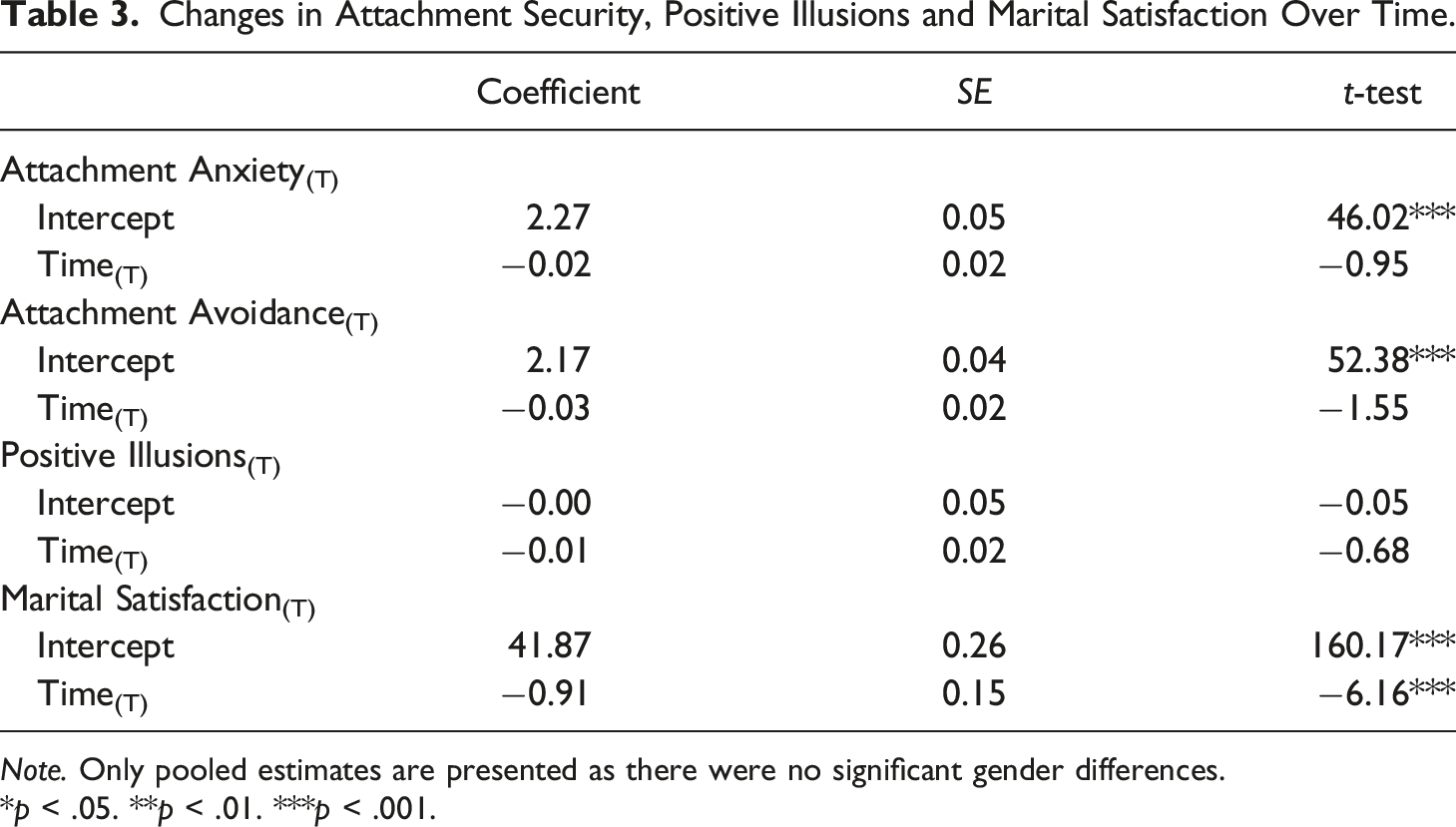
Note. Only pooled estimates are presented as there were no significant gender differences.
*p < .05. **p < .01. ***p < .001.
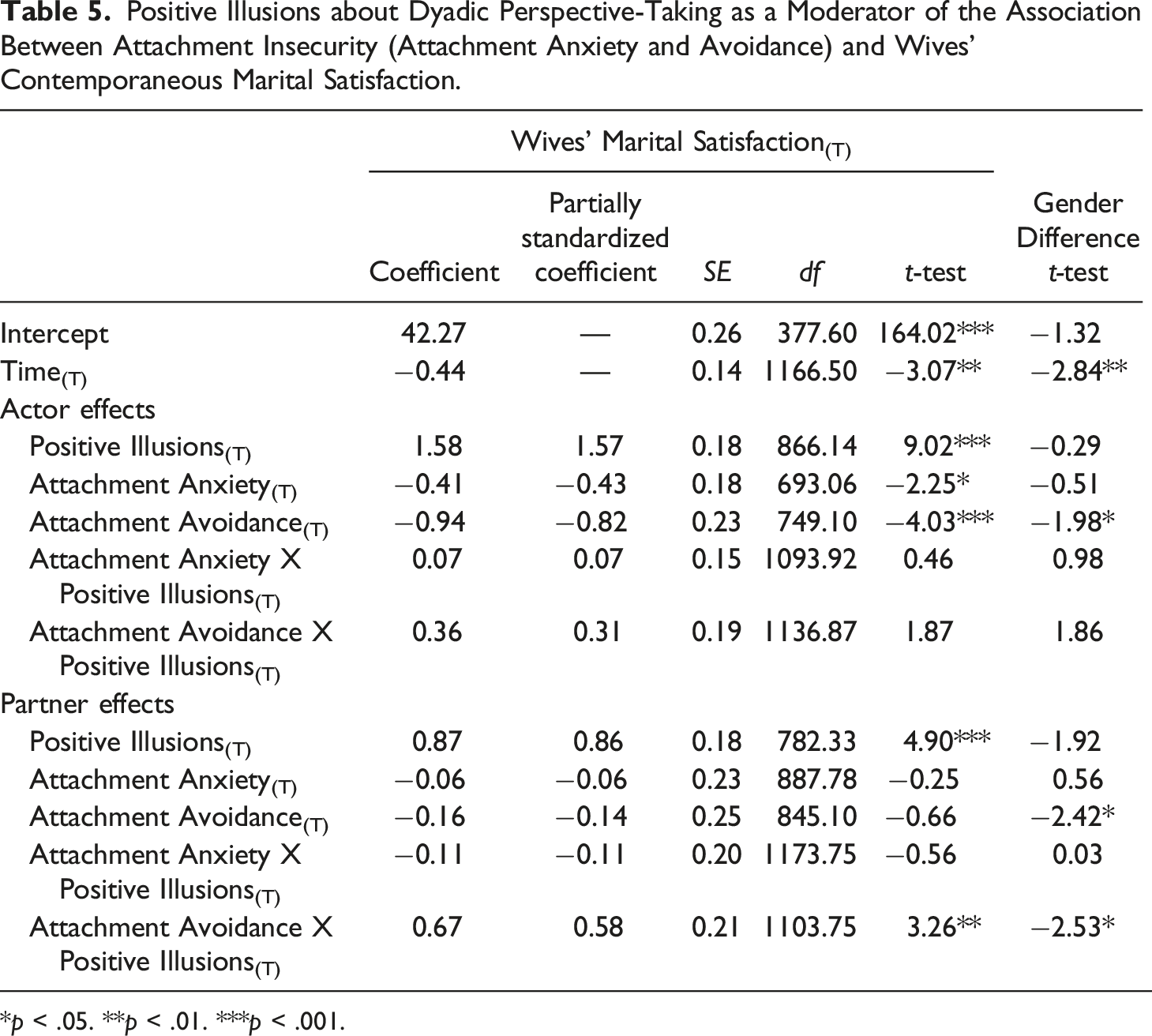
Results for the contemporaneous analysis are in Tables 4 and 5, which include centered and partially standardized coefficients.Gender differences for contemporaneous effects are in Table 5. Hypotheses were partially supported. As shown in the upper half of the Tables 4 and 5, there were actor effects (i.e., the association between spouses’ predictors and their outcomes) for husbands and wives. As expected, spouses’ positive illusions were positively related to contemporaneous marital satisfaction for husbands and wives. Also as expected, spouses’ attachment avoidance and attachment anxiety were consistently negatively associated with contemporaneous marital satisfaction for husbands and wives; the association between attachment avoidance and marital satisfaction was stronger for husbands than for wives. Partner effects (i.e., the association between spouses’ predictors and partners’ outcomes) for husbands and wives are in the lower half of Tables 4 and 5. Coefficients in the lower half of Table 4 represent the association between wives’ predictors and husbands’ marital satisfaction and the coefficients in the lower half of Table 5 represent the associations between husbands’ predictors and wives’ marital satisfaction. Hypotheses were partially supported; as expected, husbands’ and wives’ positive illusions were positively associated with their partner’s contemporaneous marital satisfaction. Unexpectedly, spouses’ attachment insecurity was generally not associated with contemporaneous marital satisfaction with the exception that wives’ attachment avoidance was negatively associated with husbands’ contemporaneous marital satisfaction.
Positive Illusions about Dyadic Perspective-Taking as a Moderator of the Association Between Attachment Insecurity (Attachment Anxiety and Avoidance) and Husbands’ Contemporaneous Marital Satisfaction(T).
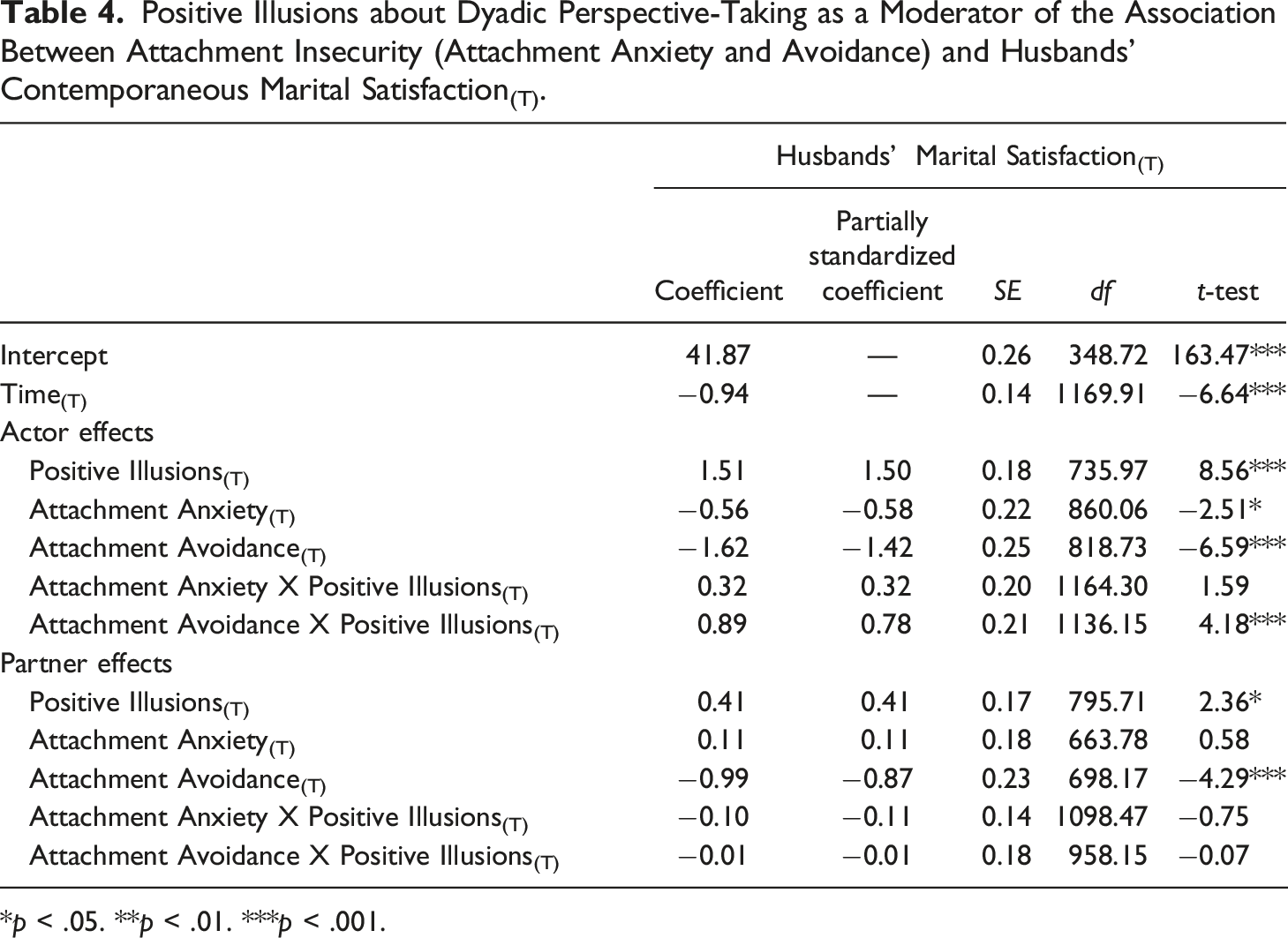
*p < .05. **p < .01. ***p < .001.
Positive Illusions about Dyadic Perspective-Taking as a Moderator of the Association Between Attachment Insecurity (Attachment Anxiety and Avoidance) and Wives’ Contemporaneous Marital Satisfaction.
*p < .05. **p < .01. ***p < .001.
Positive Illusions about Dyadic Perspective-Taking as a Moderator of the Time-Lagged Association Between Attachment Insecurity (Attachment Anxiety and Avoidance) and Husbands’ Subsequent Marital Satisfaction(T+1). *p < .05. **p < .01. ***p < .001. Positive Illusions about Dyadic Perspective-Taking as a Moderator of the Time-Lagged Association Between Attachment Insecurity (Attachment Anxiety and Avoidance) and Wives’ Subsequent Marital Satisfaction(T+1). *p < .05. **p < .01. ***p < .001.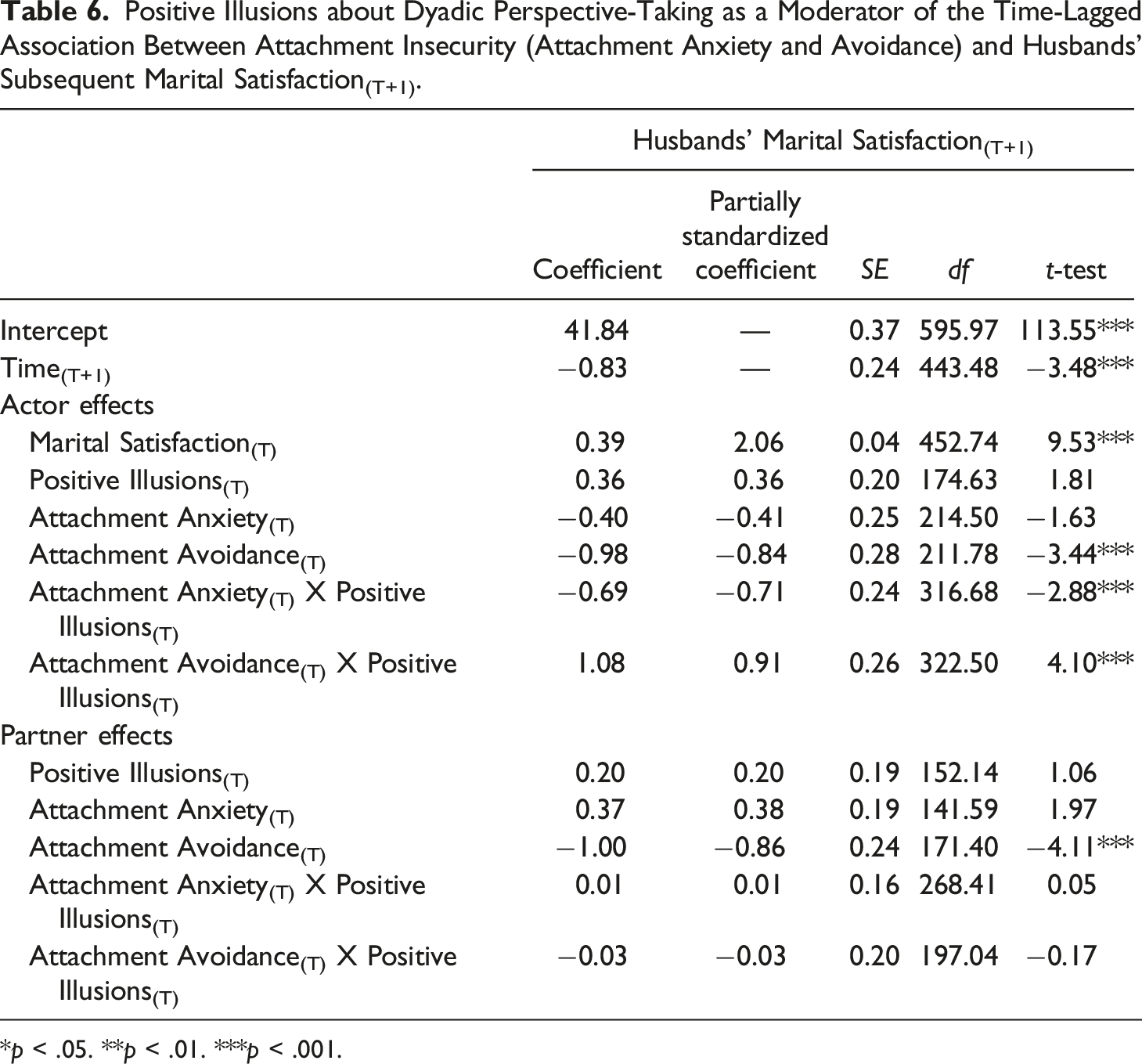
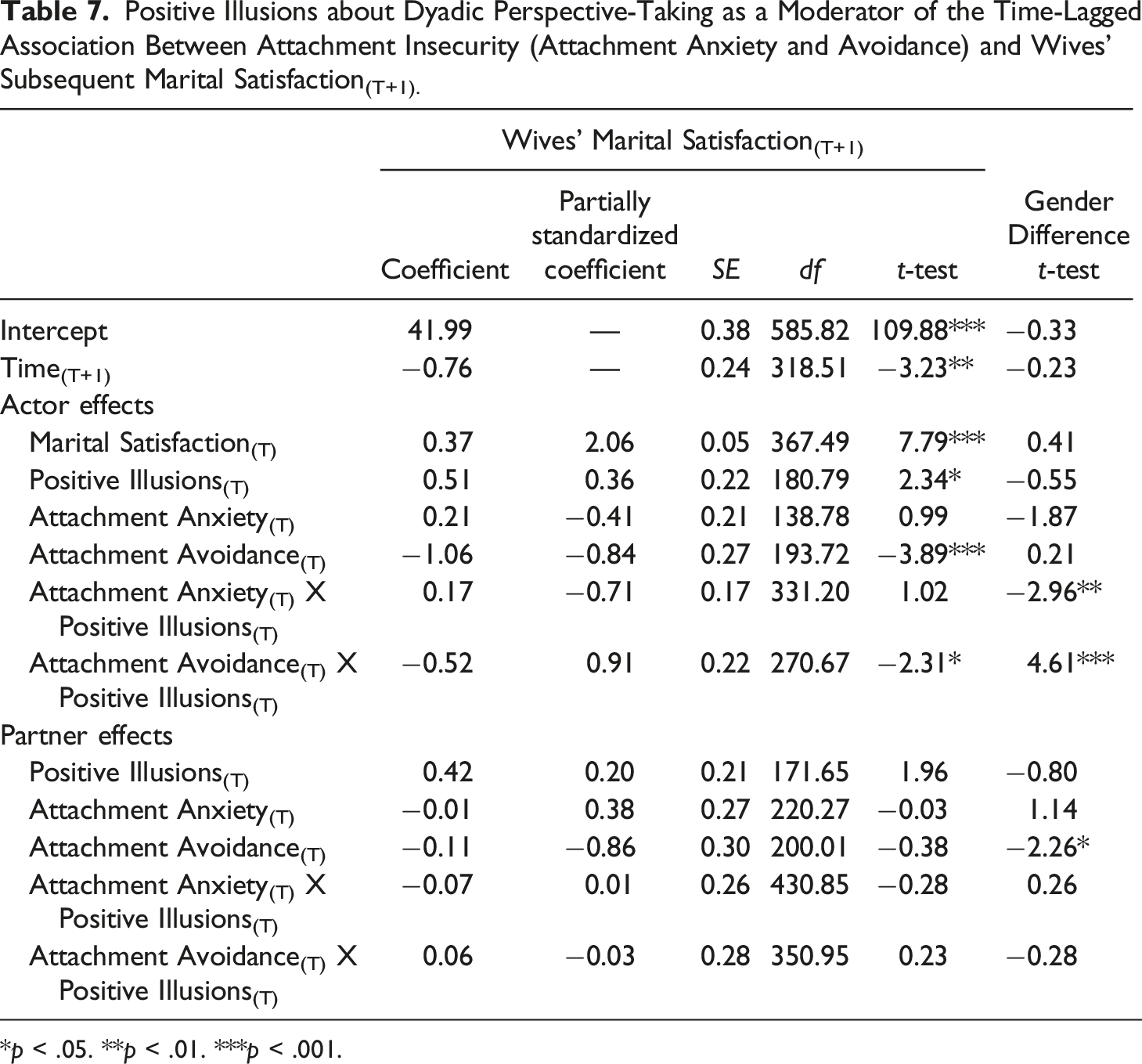
In summary, regarding the contemporaneous and lagged main effects, positive illusions fairly consistently positively predicted contemporaneous marital satisfaction and increases in marital satisfaction over time, with the exception that husbands’ positive illusions did not predict changes in their own marital satisfaction, and spouses’ positive illusions did not predict changes in partners’ subsequent satisfaction. As expected, spouses’ attachment anxiety negatively predicted their own contemporaneous marital satisfaction, but surprisingly not their partners’ marital satisfaction, and attachment anxiety was not associated with subsequent changes in marital satisfaction. The pattern of effects was much more consistent and as expected for attachment avoidance; spouses’ attachment avoidance negatively predicted their contemporaneous marital satisfaction and declines in marital satisfaction, and wives’ avoidance negatively predicted husbands’ marital satisfaction and declines in husbands’ marital satisfaction.
Results of the contemporaneous moderation analyses (actor and partner effects) are in Tables 4 and 5; two of the eight actor and partner interactions were significant and consistent with the buffering hypothesis. Specifically, the association between husbands’ avoidance and their contemporaneous marital satisfaction became weaker as their positive illusions became stronger (Figure 1). Furthermore, there was one cross-partner buffering effect such that the association between husbands’ avoidance and wives’ marital satisfaction became weaker as husbands’ positive illusions became stronger (Figure 2).
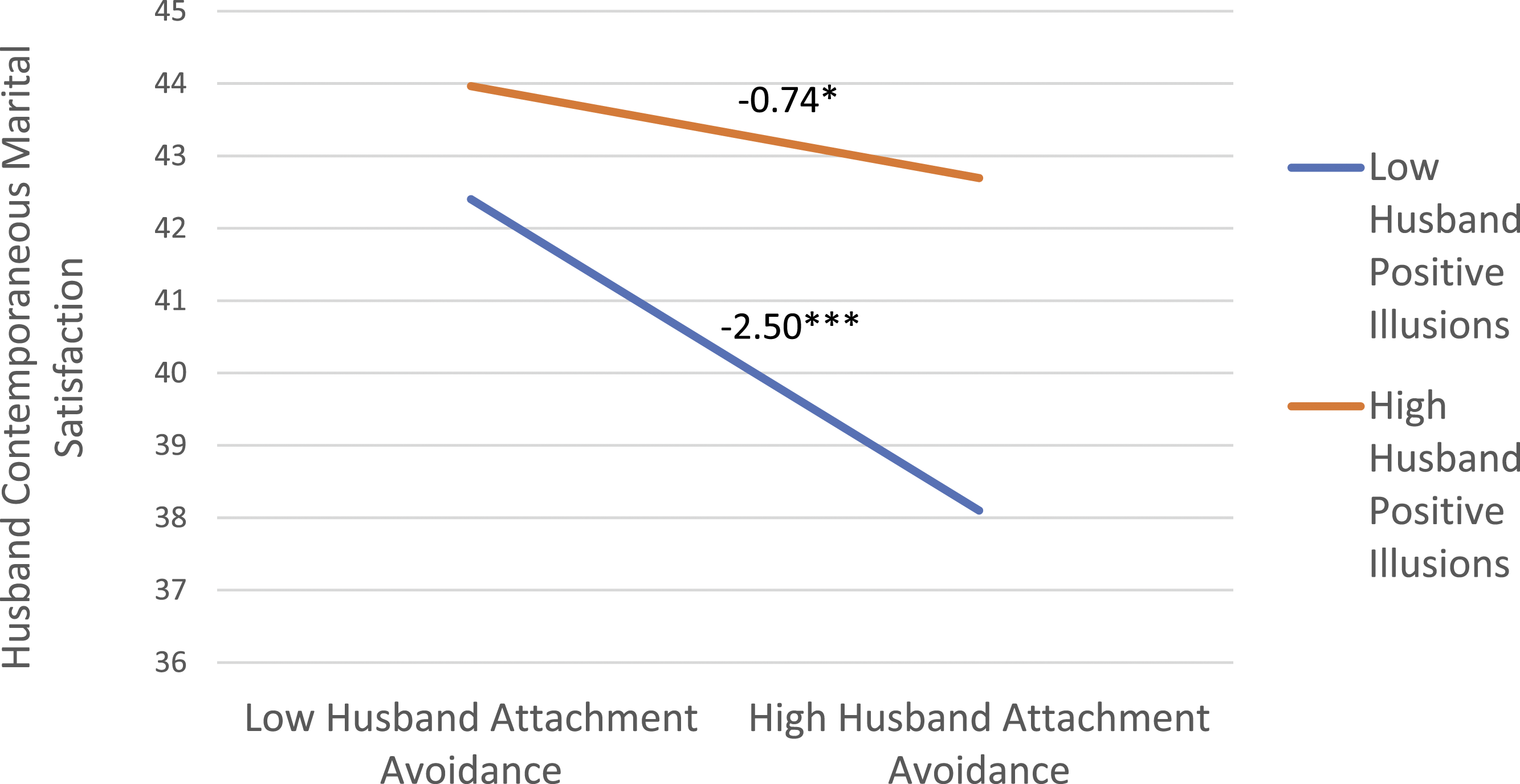
Husbands’ positive illusions about dyadic perspective-taking buffered the association between husbands’ attachment avoidance and husbands’ contemporaneous marital satisfaction. *p < .05. **p < .01. ***p < .001.
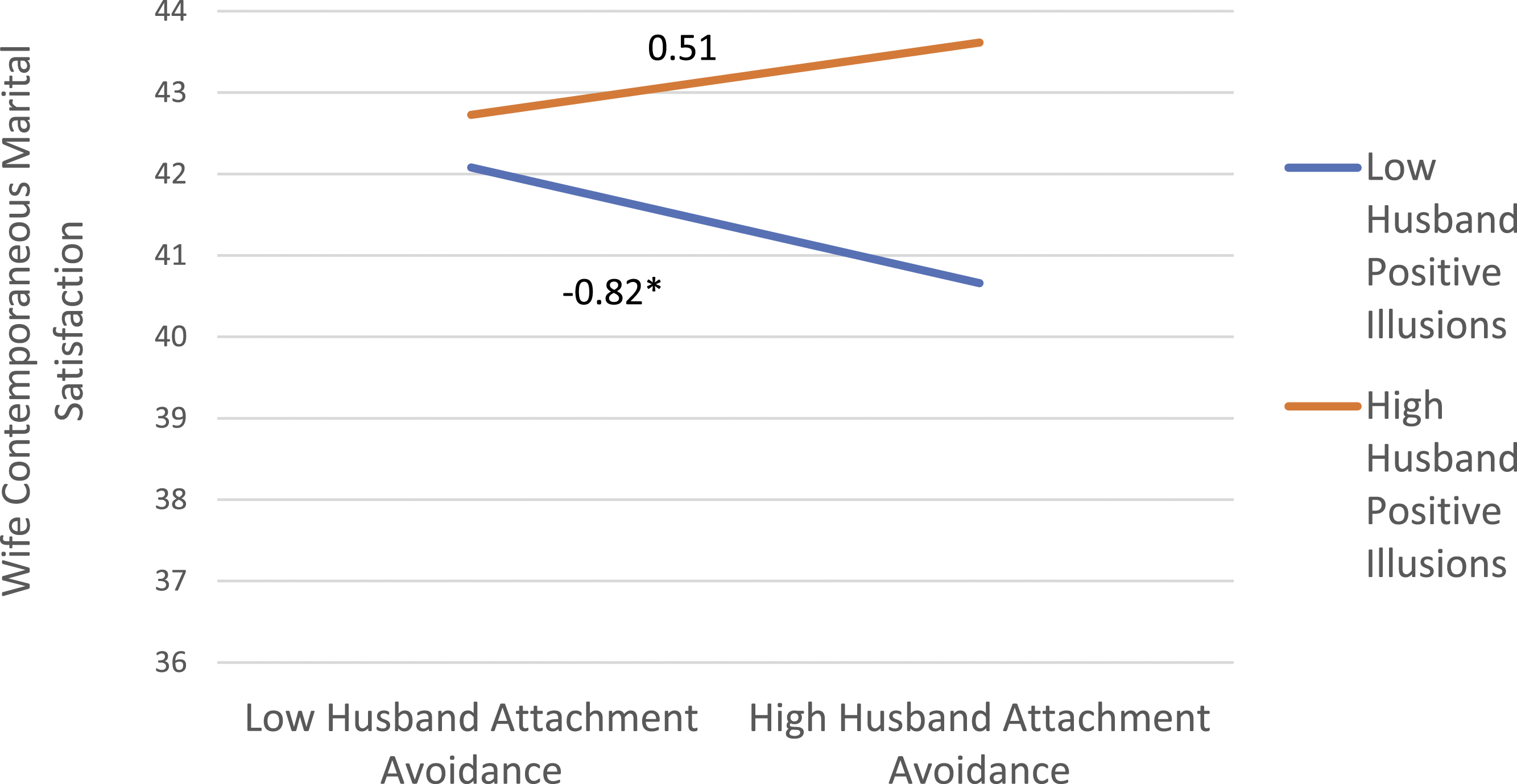
Husbands’ positive illusions about dyadic perspective-taking buffered the association between husbands’ attachment avoidance and wives’ contemporaneous marital satisfaction. *p < .05. **p < .01. ***p < .001.
Results of the lagged interactions are in Tables 6 and 7; three of the eight actor and partner interactions were significant. Unlike the contemporaneous analyses, the pattern of results was inconsistent, and two of the three interactions were the opposite of what we predicted. As predicted, as husbands’ positive illusions became stronger, the negative association between their attachment avoidance and subsequent marital satisfaction became weaker (Figure 3). In contrast and contrary to prediction, the negative association between husbands’ attachment anxiety and marital satisfaction increased as their positive illusions became stronger (Figure 4) and the negative association between wives’ attachment avoidance and subsequent marital satisfaction increased as their positive illusions became stronger (Figure 5). In summary, there were five significant interactions across the contemporaneous and lagged analyses. In three cases (two contemporaneous and one lagged), there were significant negative associations between attachment avoidance and marital satisfaction when positive illusions were low and there were weaker or no associations between attachment avoidance and marital satisfaction when positive illusions were high. In other words, insecurity was buffered by positive illusions about dyadic perspective-taking, and this was more consistent in the contemporaneous analyses. However, there were two interactions that suggested that positive illusions potentiated the negative association between insecurity (husbands’ anxiety and wives’ avoidance) and subsequent marital satisfaction.
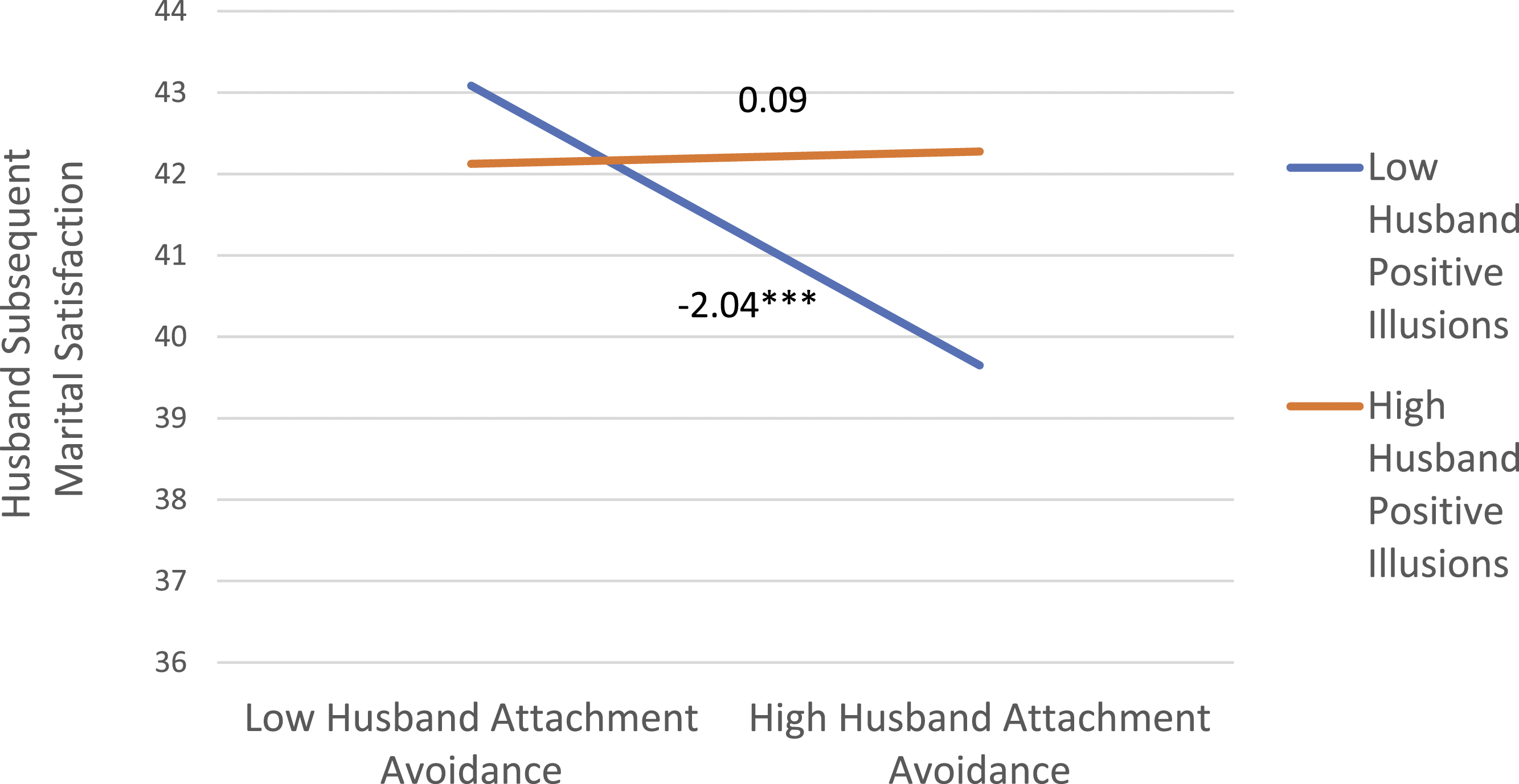
Husbands’ positive illusions about dyadic perspective-taking buffered the association between husbands’ attachment avoidance and husbands’ subsequent marital satisfaction. *p < .05. **p < .01. ***p < .001.
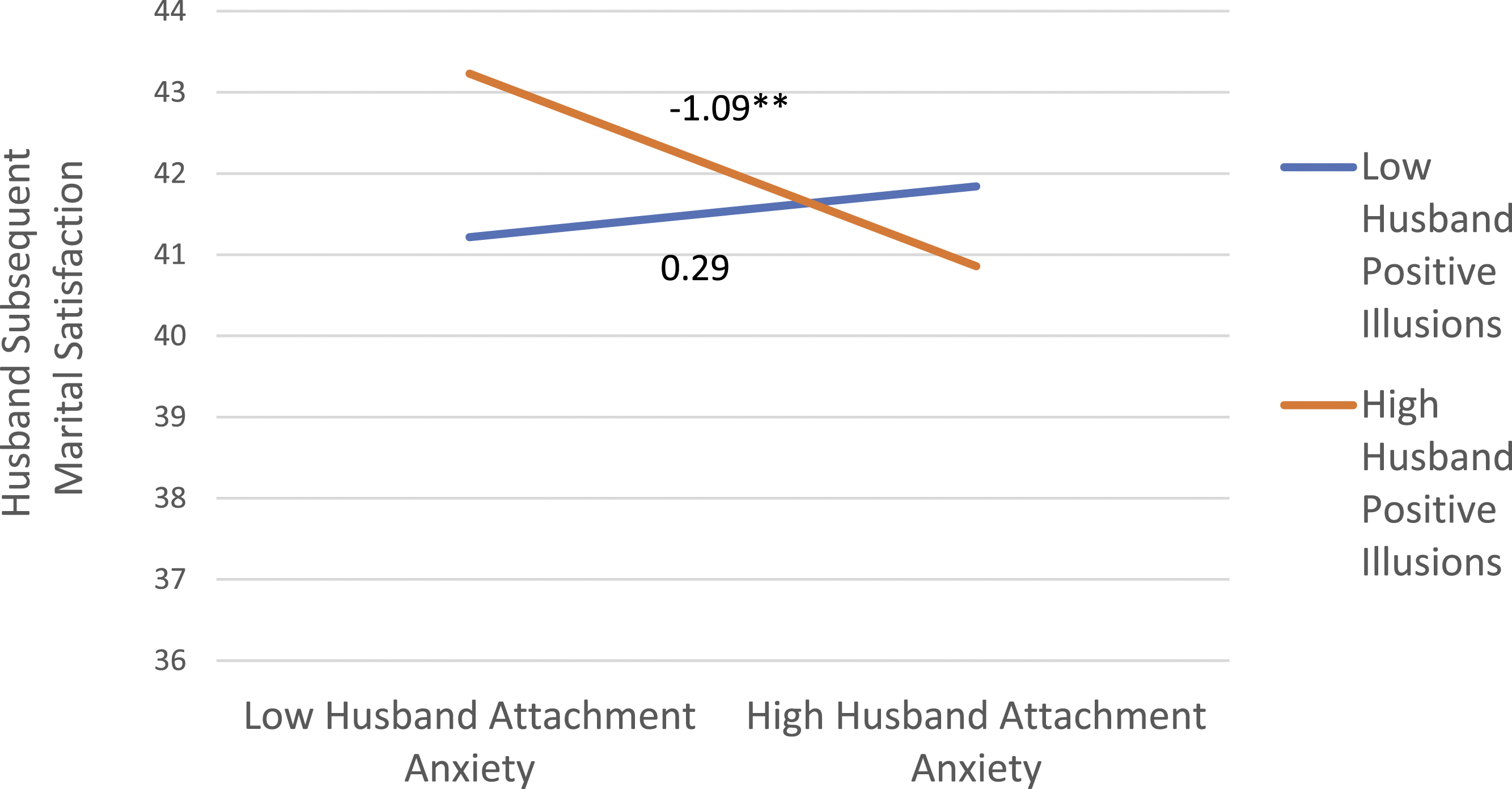
Husbands’ positive illusions about dyadic perspective-taking potentiated the association between husbands’ attachment anxiety and husbands’ subsequent marital satisfaction. *p < .05. **p < .01. ***p < .001.
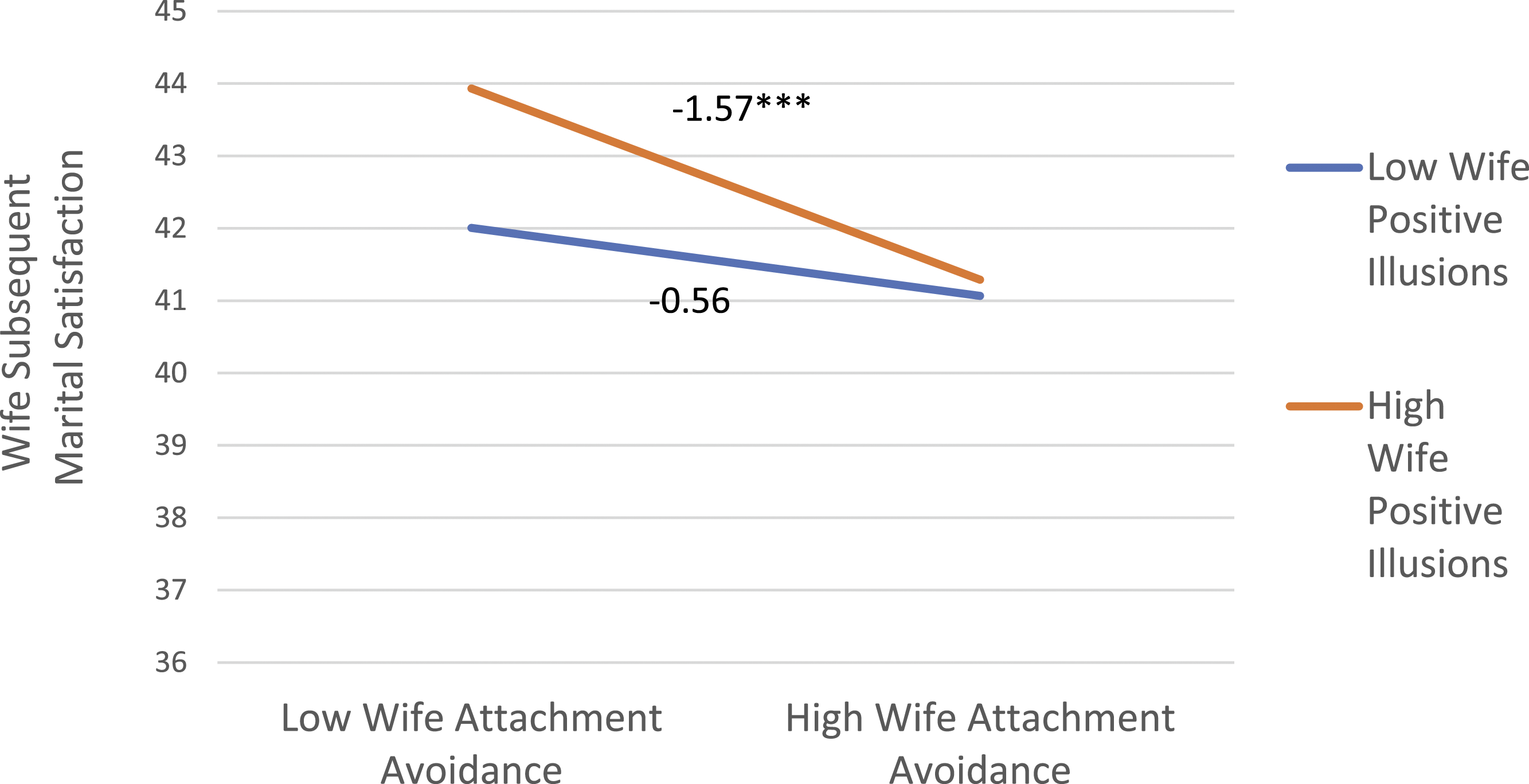
Wives’ positive illusions about dyadic perspective-taking potentiated the association between wives’ attachment avoidance and wives’ subsequent marital satisfaction. *p < .05. **p < .01. ***p < .001.
Discussion
We investigated whether positive illusions about dyadic perspective-taking buffered the negative associations between attachment insecurity and contemporaneous and subsequent marital satisfaction over the first two years of marriage in mixed-gender couples. As expected, positive illusions about dyadic perspective-taking were generally associated with more satisfying relationships for husbands and wives and predicted increasingly satisfying relationships for wives. Attachment avoidance also generally negatively predicted marital satisfaction but there were inconsistent associations between attachment anxiety and relationship outcomes. The more consistent prediction of relationship outcomes by attachment avoidance compared to attachment anxiety is similar to previous research in which associations between attachment avoidance and outcomes were stronger than for attachment anxiety and outcomes (Hadden et al., 2014). Regarding the interactions, there was mixed evidence that positive illusions about dyadic perspective-taking buffered negative effects of insecurity on contemporaneous and changes in marital satisfaction. Specifically, husbands’ positive illusions buffered the negative association between husbands’ attachment avoidance and both spouses’ contemporaneous marital satisfaction and husbands’ subsequent satisfaction. There were two notable exceptions that did not support the buffering hypothesis; husbands’ positive illusions potentiated the negative association between their attachment anxiety and their subsequent marital satisfaction, and wives’ positive illusions potentiated the association between their attachment avoidance and their subsequent marital satisfaction.
Spouses’ positive illusions about dyadic perspective-taking were positively associated with their own and partners’ contemporaneous relationship satisfaction, and wives’ positive illusions predicted their subsequent marital satisfaction. These findings are consistent with previous studies in which positive illusions about romantic partners predicted more satisfying relationships (Murray et al., 1996b). Spouses who have positive illusions and who think their partner is empathic and can take their perspective, even more so than the partner thinks, may feel reassured and believe that their relationship is worthwhile. Recipients of positive illusions also benefit; when spouses saw the best in each other, even if the partner did not see it in themselves, both spouses felt more satisfied in the relationship. However, only wives’ and not husbands’ positive illusions predicted increases in their own marital satisfaction, and spouses’ positive illusions did not predict changes in their partners’ marital satisfaction. The discrepancy in the pattern between husbands and wives is consistent with a previous longitudinal study in which the association between spouses’ positive illusion and relationship satisfaction was weaker for husbands than wives (Murray & Holmes, 1997). Wives tend to take greater responsibility for relationship maintenance than their husbands (Brandeau-Brown & Ragsdale, 2005), thus, how wives see their partner may matter more for their relationship satisfaction than it does for husbands.
There were actor and partner effects of spouses’ attachment avoidance on contemporaneous and subsequent marital satisfaction, which was expected and consistent with previous research (e.g., Butzer & Campbell, 2008; Hadden et al., 2014; Joel et al., 2020). The findings were consistent and striking—suggesting that attachment avoidance may be particularly problematic for these couples who were in the early years of their marriage—it may significantly interfere with creating a happy, strong relationship in which spouses feel connected. In contrast, the pattern of associations between attachment anxiety and relationship outcomes was inconsistent. Although spouses’ attachment anxiety was negatively associated with their own contemporaneous satisfaction, it was not associated with changes in their marital satisfaction or with their partner’s contemporaneous or subsequent satisfaction. Given that attachment anxiety and avoidance were consistently correlated across all time points and attachment anxiety is often associated with partners’ marital satisfaction, this inconsistency may be because of the conceptual overlap and multicollinearity between attachment anxiety and avoidance (e.g., Hadden et al., 2014), which precluded independent associations between attachment anxiety and outcomes.
As expected and similar to previous research on positive illusions (Murray et al., 1996b) and the dyadic regulation model of insecurity buffering (Simpson & Overall, 2014), evidence that positive illusions buffered the negative association between attachment insecurity and relationship satisfaction emerged within and cross partner with some exceptions. Specifically, husbands’ positive illusions buffered the association between husbands’ attachment avoidance and both spouses’ contemporaneous marital satisfaction and husbands’ subsequent satisfaction. Husbands’ who saw the best in their partner’s ability to take their perspective may have been reassured thus reducing salience of attachment insecurity and allowing them to be less driven by their avoidance of emotional vulnerability (i.e., attachment avoidance). In contrast, husbands who were less likely to hold positive illusions may be less apt to feel their partner understand them, and their attachment fears and emotional avoidance may have dominated their behaviors and perceptions and thus eroded marital satisfaction. Regarding cross-partner effects, a husband who holds positive illusions about his wife’s perspective-taking may be more agreeable during conflict because he assumes his wife understands his point of view, which renders his emotional distance less consequential to his wife’s relationship satisfaction. These results suggest that especially in the moment, positive illusions about dyadic perspective-taking may create a buffer that weakens the negative effect of attachment avoidance on relationship satisfaction.
Although some results supported the buffering hypotheses, there were two contrasting and unexpected findings. Husbands’ positive illusions about dyadic perspective-taking potentiated the association between husbands’ attachment anxiety and their subsequent marital satisfaction and wives’ positive illusions about dyadic perspective-taking potentiated the association between wives’ attachment avoidance and their subsequent marital satisfaction. This suggests that positive illusions may ultimately fail to buffer insecurity; potentiation may occur because spouses overestimate their partners’ awareness of their insecurity, and partners may behave in ways that exacerbate spouses’ attachment insecurity, thus disappointing and frustrating spouses. Eventually these “failures” of partner empathy become so obvious that positive illusions lose their potential to buffer insecurity, leading to relational dissatisfaction and difficulties.
The potentiating interactions also suggested a possible gendered pattern whereby positive illusions potentiated associations between attachment anxiety and subsequent marital satisfaction for husbands and between attachment avoidance and subsequent marital satisfaction for wives. It may be that social norms and expectations are driving these differences. Men are expected to be emotionally distant (Fischer & Good, 1997) and women are expected to be concerned about relationship maintenance (Brandeau-Brown & Ragsdale, 2005). Men with attachment anxiety and women with attachment avoidance may have thoughts, emotions, and behaviors that are inconsistent with these norms, for example attachment anxiety is associated with hyperactivating strategies (e.g., preoccupation with abandonment, reassurance seeking) and attachment avoidance is associated with deactivating strategies (e.g., overcontrolled emotional expression and less interest in intimacy; Butzer & Campbell, 2008). Thus, men who engage in hyperactivating strategies and women who engage in deactivating strategies may behave counter to gender norms. If these individuals also believe their partners identify and understand the thoughts and behaviors that are inconsistent with gender norms and view it negatively, it could be threatening for individuals’ feelings about their relationship. For example, a husband’s attachment anxiety coupled with positive illusions about his wife’s perspective-taking might make him think she sees his fears about abandonment, which leads him to feel uncertain and unhappy in his relationship over time. Similarly, if wives’ positive illusions about a partner’s perspective-taking lead them to think their partner perceives them as cold or distant, over time wives could feel unworthy of a satisfying marital relationship. This explanation of gender difference is speculative and should be a focus of future research.
Clinically, results suggest that fostering positive illusions about dyadic perspective-taking may provide some benefit to men with high attachment avoidance and their partners. In the moment, having partners see the best in each other, especially if these perceptions are exaggerated, may provide them with reassurance that their partnership can flourish, may help them give each other the benefit of the doubt, and may create situations where partners behave in ways that are consistent with their partner’s positive illusions (i.e., a self-fulfilling prophesy; Murray et al., 1996a). Partners may not consistently behave in ways that are understanding and empathetic, but if their spouse pays attention to the times when they are (either naturally or through therapeutic intervention), these experiences may become more salient and prominent. Positive illusions about perspective-taking could also be beneficial in the long-term, especially for husbands who have difficulty being emotionally open (i.e., high attachment avoidance), because seeing their wives as empathetic and understanding seems to have downstream positive effects for men when attachment avoidance is high. However, as the few potentiating findings in this study indicate, perceptions that are at least somewhat grounded in reality may be more useful for long term relationship satisfaction.
Limitations and future directions
These results may not generalize to all types of romantic relationships as the sample included mixed-gender, mostly White, newlywed couples. Furthermore, we did not ask participants about their sexual orientation, gender identity, or physical, psychological, and intellectual disabilities, thus, studies that include more diverse populations are needed. The sample was also relatively maritally satisfied and future research that includes participants with greater variability in relationship satisfaction will be important because the buffering effect of positive illusions generally, and positive illusions about dyadic perspective-taking in particular, may not be powerful enough to offset attachment insecurity in clinically distressed couples. Additionally, we examined change over a relatively short span of time with only five waves of data. Longitudinal studies to evaluate the sustainability of positive illusions over long periods or diary methods to evaluate the close temporal associations among positive illusions, attachment insecurity, and changes in relationship satisfaction would be useful. Likewise, although we examined how positive illusions and attachment security predicted subsequent changes in satisfaction, we cannot make conclusions about the direction of effects from this study. In future, studies that prime feelings of attachment security or positive illusions may help to determine causal links.
The exclusive reliance on self-report measures is a limitation as they are vulnerable to social desirability and retrospective bias. Additionally, reporting biases may be problematic when calculating positive illusions. Individuals may have over- or underestimated their own or their partner’s dyadic perspective-taking skills. As perceptions were the focus of this study, partner self-reports were ideal as one component of positive illusions, but there are alternate sources of information that can stand in for self-reports (i.e., the benchmark for “truth”) such as friend or trained observer ratings. However, these ratings introduce other sources of bias and self-ratings are the most conservative benchmark when calculating positive illusion because of peoples’ tendency to exaggerate favorable qualities about themselves (Niehuis et al., 2011) thus reducing the possibility that the illusion is a result of exaggeratedly negative self-ratings.
We measured a specific novel positive illusion about dyadic perspective-taking, and it is possible that the results will not apply to all types of positive illusions. General perceptions of partners are more stable than perceptions of partners’ specific qualities (Karney et al., 2001). Therefore, it is possible that positive illusions about global qualities (e.g., My partner is a good husband) will be more stable over time than positive illusions about specific behaviors or skills (e.g., dyadic perspective-taking). Stable, global positive illusions may continue to buffer the association between attachment insecurity and subsequent marital satisfaction whereas the illusions about specific perspective-taking skills in this study rarely predicted changes in marital satisfaction.
Given the findings of this study, a better understanding of why positive illusions may fail to buffer insecurity or in what circumstances positive illusions are not beneficial will be critical. One promising avenue would be to examine how attachment insecurity may intensify the disillusionment process or whether insecurity makes individuals more prone to negative shifts in perception of their partner’s qualities compared to secure individuals, who may have more stable positive perceptions of their partner. Furthermore, investigation of how gendered beliefs and expectations (e.g., men are emotionally distant, women are nurturing and invested in relationship maintenance) interact with attachment insecurity and positive illusions may be a fruitful avenue to understand the role of positive illusions in relationships.
Conclusion
Understanding the role of attachment insecurity in relationship maintenance and factors that mitigate the negative effects of attachment insecurity are critical. Although positive illusions about partners’ perspective-taking mitigated the negative role of husbands’ attachment avoidance in marital satisfaction in some instances, positive illusions also potentiated the negative role of attachment insecurity at times. This suggests that even though positive illusions can benefit relationships, they may also fail to protect relationships, especially over time, and attachment insecurity may become increasingly influential. However, positive illusions about responsive partner behavior can help couples to weather uncertainty in their relationship especially in the moment, perhaps by overshadowing husbands’ attachment avoidance with exaggerated favorable perceptions or allowing individuals to experience a sense of satisfaction and trust in their partner and to behave in ways that anticipate positive reactions from their partner despite insecurity.
Supplemental Material
sj-pdf-1-spr-10.1177_02654075221127241 – Supplemental Material for Positive illusions about dyadic perspective-taking as a moderator of the association between attachment insecurity and marital satisfaction
Supplemental Material, sj-pdf-1-spr-10.1177_02654075221127241 for Positive illusions about dyadic perspective-taking as a moderator of the association between attachment insecurity and marital satisfaction by Richard A Rigby and Rebecca J Cobb in Journal of Social and Personal Relationships
Footnotes
Author’s note
This work was presented at the International Association for Relationship Research virtual conference (July, 2021).
Declaration of conflicting interests
The author(s) declared no potential conflicts of interest with respect to the research, authorship, and/or publication of this article.
Funding
The author(s) disclosed receipt of the following financial support for the research, authorship, and/or publication of this article: This work was supported by the Social Sciences and Humanities Research Council of Canada Grant 410-2005-0829.
Data availability
Participants did not consent to their data being made public, therefore the data will not be open access.

Supplemental Material
Supplemental material for this article is available online.
References
Supplementary Material
Please find the following supplemental material available below.
For Open Access articles published under a Creative Commons License, all supplemental material carries the same license as the article it is associated with.
For non-Open Access articles published, all supplemental material carries a non-exclusive license, and permission requests for re-use of supplemental material or any part of supplemental material shall be sent directly to the copyright owner as specified in the copyright notice associated with the article.
