




Abstract
Body awareness is tightly linked to motor action. Non-verbal greetings constitute a behaviour through which an awareness of both socio-cultural habits (exteroceptive awareness) and internal bodily states (interoceptive awareness) play out to influence the structure of action. To establish the effect of culture on non-verbal greeting behaviours, naturalistic observations were carried out in two countries (Britain and Spain) that are purported to exhibit differences in greeting types. Interoceptive awareness (IA) was subsequently measured in a proportion of observed participants (N = 33) who filled in the Multidimensional Assessment of Interoceptive Awareness, Version 2 (MAIA-2). As expected, a significant difference in greeting type was observed between British (N = 252) and Spanish (N = 244) greeters. Scores of greeting intimacy and competency did not differ significantly between Britain and Spain. However, independent of culture, several moderate and strong relationships emerged between selective dimensions of the MAIA-2 and scores of intimacy and competency. Specifically, intimacy and competency scores were positively correlated with the ‘Awareness of Mind-Body Integration’ dimension. Greeting intimacy yielded additional positive relationships with the Not Distracting and Trusting subscales, and a negative relationship with the Not Worrying subscale. These relationships suggest that IA facilitates healthy social approach behaviour as expressed through greetings, irrespective of cultural greeting differences. We discuss IA and greeting behaviour in the context of attachment, consider the clinical implications for social anxiety and the future implications for social interactions in a post-COVID-19 era.
Keywords
Introduction
Nonverbal greetings are exchanged via characteristic bodily movements and carry significant social relevance. Although greeting types and greeting mannerisms vary across cultures, they influence the success of human interactions when executed in a culturally propitious fashion (Katsumi et al., 2017; Riggio, 1992). While most research has focused on the social and environmental influences of nonverbal greeting behaviour (Firth, 1972; Riggio et al., 1981), little attention has been dedicated to the role of the body in greetings. In this study, we take a mind-body perspective, drawing on social and biological psychology to explain the competency and intimacy played out in non-verbal greetings that are relevant for establishing successful social and personal relationships. Bodily actions and body awareness are central to the social act of greeting and are expressed through the integration of external (exteroceptive) and internal (interoceptive) bodily information (Maister & Tsakiris, 2014; Mehling et al., 2009). Here, we examine the influence of exteroceptive (cultural) and interoceptive information channels on the competency and intimacy of non-verbal greeting behaviour in the UK and Spain.
Principles of embodied cognition focus on the exteroceptive information channel, suggesting that ecologically inspired bodily actions are guided by external cues (Reed & Bril, 1996; Wilson & Golonka, 2013). In dyadic greeting interactions, external cues may refer to distinct bodily movements observed in the greeter’s culture (Ambady et al., 1996), gender (Hall & Gunnery, 2013), and personality (Riggio et al., 1981). Repeated exposure to external cues results in acquired motor competencies that allow for skilled, yet modifiable bodily actions to deal with environmental variations (Reed & Bril, 1996). Over time, greeting exchanges will therefore incorporate socially infused motor competencies, based on the customs, habits, and routines that are most promising for successful interactions in a given cultural context (Bernstein, 1991). For example, specific styles and expressions of bodily actions may convey culturally appropriate politeness and tact (Ambady et al., 1996), self-presentation and self-esteem (Goffman, 1967) and contribute to the establishment of hierarchy, power, and distance (Brown & Levinson, 1987).
Established motor competencies expressed through greetings provide a window into the different cultural stereotypes that are prevalent and varied even within Europe. When comparing the greetings of Anglo-Saxon with Mediterranean-Latin cultures, Ponton (2014) found evidence for the stereotypical view of British individuals as “cold, stand-offish, distant, reserved” and Italians as “hot, sensuous, spontaneous, open” (p. 62). These stereotypes were mirrored by the greeting types and greeting styles in the respective cultures: when greeting a friend, Britons were satisfied with a distanced, formal handshake that could be interpreted as hesitant, awkward, and clunky in style. By contrast, Italians displayed warmth and cordiality in the style of their handshake, and handshakes were often accompanied by secondary greeting types such as shoulder pats, hugs, and kisses. Concerning greeting intimacy, Mediterranean-Latin cultures tended to be less apprehensive against close physical greeting contact between same-sex greeters than Anglo-Saxon cultures (Ponton, 2014). These findings reflect the functional value of embodied actions expressed by greetings: depending on the cultural background, these bodily actions can either be perceived as emotionally reserved and awkward, or welcoming and approachable.
Recent studies further demonstrated the significant clinical relevance of the perceptions of socially relevant bodily actions, showing that a lack in motor competency was associated with poor social communication skills in children with autism (Craig et al., 2018). Moreover, bodily movements have inspired the field of computer science in producing humanoid robots that greet according to distinct cultural greeting customs, with the intention to reduce perceptions of eeriness and alienation (Trovato et al., 2015). Given the significance of bodily movements in greetings and the distinct variations based on exteroceptive, cultural influences, we examined levels of greeting competency and intimacy in British and Spanish dyads that differ in the cultural expressions of bodily actions (Ambady et al., 1996; Ponton, 2014).
A second aim of our study was to investigate the role of interoceptive awareness (IA) in displaying greeting competency and intimacy. Interoceptive awareness is concerned with the sensing of internal bodily signals such as heart rate, breathing, and gastrointestinal functions. Higher order dimensions of IA further include the appraisal, integration, and regulation of internal bodily signals, all of which promote a sense of wellbeing within one’s body (Chen et al., 2021; Mehling et al., 2012, 2018). Sensations of internal bodily signals affect motor coordination (Mehling et al., 2009), and may therefore contribute to the competency and intimacy of greeting behaviour. Good IA reinforces the experience of being ‘at home in one’s body’ (Mehling et al., 2012, 2018), thus serving as an important internal information channel to enhance self-awareness (Craig, 2010). The feeling of an embodied self is operationalised by the integration of multi-dimensional internal bodily signals with external, sensory information, resulting in a stable sense of body representation (Bekrater-Bodmann et al., 2020; Herbert & Pollatos, 2012).
The integration of internal and external bodily sensations is positively related to social approach behaviour (Ardizzi & Ferri, 2018; Ferri et al., 2013) and therefore well-suited to explain non-verbal greetings that rely on physical closeness and bodily touch. Ferri et al. (2013) found a positive relationship between interoceptive cardiac awareness and people’s autonomic response in a social setting involving human touch within a close peri-personal space. In this study, an experimenter’s hand performed caressing movements, either touching or simulating the caressing touches at various distances from the participant’s hand. Autonomic responses, measured using Respiratory Sinus Arrhythmia, were significantly higher in participants with high but not low IA when the touch simulations were performed at a 20 cm distance, i.e. at the boundary of interpersonal space. Following the author’s interpretations, this indicates that individuals with high IA might be characterised by higher social disposition. For the present study, this could suggest that individuals with high IA might be more attuned to their greeting partner and demonstrate different levels of competency and/or intimacy in greeting dyads. Ainley et al. (2014) demonstrated that higher interoceptive cardiac awareness increased the tendency to mimic and imitate observations of bodily movements, suggesting that the multisensory integration of interoceptive and exteroceptive bodily signals might increase relatability and improve non-verbal communication in a social context.
However, the integration of interoceptive and exteroceptive cues differs between cultures (Maister & Tsakiris, 2014). This was shown in a group of East Asian and Western participants whose interoceptive accuracy was measured (using heartbeat counting) while they observed exteroceptive cues (face images) consisting either of their own or another person’s face that was matched on ethnicity, age, and gender. Among participants with poorer interoception scores (below group average), the Western participants’ interoceptive accuracy was significantly better when viewing their own relative to another person’s face, an effect that was not seen in East Asian participants. This result suggests cultural differences in integrated bodily self-awareness (significant among those with generally poorer interoceptive skills) that may consequently influence socially relevant bodily actions such as greetings.
Most studies have used the heartbeat counting task to examine interoception and its relationship with social interactions, thus focusing on a unidimensional, physiological measure of interoceptive cardiac awareness. However, it is conceivable that higher order dimensions of interoception, such as the appraisal, integration and regulation of internal signals, further contribute to the expression of bodily actions, including greetings. Supporting evidence comes from Oldroyd et al. (2019) who found significant relationships between different dimensions of IA and attachment types. For instance, individuals scoring high for the Body Trust scale of the Multidimensional Assessment of Interoceptive Awareness (MAIA; Mehling et al., 2012) tended to score lower for an avoidant attachment style, suggesting that trust in one’s internal bodily sensations can significantly influence social approach behaviour. Interoceptive dimensions might also be associated with bodily actions displayed in social greeting contexts, reflecting the level of competency and intimacy that feels acceptable and comfortable in greeting dyads.
Based on the above motivations, we carried out a naturalistic observation of greeting behaviours in Britain and Spain. A subset of the observed individuals volunteered to fill in the MAIA-2 (Mehling et al., 2018), allowing for further investigations into IA and its relationship with greeting behaviour. 10 greeting types were identified during the observations. Each greeting type (except for non-physical greetings) was further rated on performance, discriminating between levels of intimacy and competency. Our first hypothesis was that the frequency of displayed greeting types would differ significantly between Britain and Spain. Our second hypothesis was that Spanish greetings would be displayed more intimately and competently than British greetings.
We refrained from predicting significant cultural differences in IA as measured using the MAIA-2. This was due to numerous cross-cultural validation studies demonstrating the suitability and universality of the original instrument’s factor structure for investigating IA in different populations (see method). However, a strength of the MAIA-2 is the multidimensionality with which IA can be investigated, ranging from (1) awareness of body sensations to (2) emotional reactions, (3) regulating attention to sensations, (4) mind-body integration of sensations, and (5) trusting of one’s body. Hence, in a conservative attempt to establish the relationship between IA and greeting behaviour, our third hypothesis was that there would be a significant relationship between selective dimensions of IA and levels of a) intimacy and b) competency in enacting the different greeting types across Britain and Spain.
Method
Participants
Unobtrusive greeting observations were conducted of 252 individuals in Britain (male = 45%) and 244 individuals in Spain (male = 66.80%) who happened to be greeting during observational sessions in six locations across Leeds, UK and Palma de Mallorca, Spain, that were chosen as observational sites. Following the naturalistic observations, the researcher used a combination of convenience and judgement sampling in approaching a subset of participants, asking them to fill in the MAIA-2. Convenience sampling involved choosing participants who were accessible, such as those dwelling in the location after greeting each other (e.g. sitting down in the café or food court to consume drinks).
Judgemental sampling was used to further select individuals, such as those appearing to be under less time-constraints, less rushed or otherwise absorbed in order to maximise the chance of participation. For example, discretion was used to not interrupt dyads who were mutually engaged in looking at mobile devices or those discussing paperwork on the table that indicated work/study-related discussions. Although not of ethical concern, to avoid charges of voyeurism, participants were temporarily deceived as to their involvement in the naturalistic observation (i.e. they were simply asked ‘do you have time to complete a short questionnaire’, without the antecedent statement ‘I have just watched you greet one another, do you have time…’). Only after questionnaire completion, as part of a general debriefing, were participants made aware of the full scope and nature of the study. Questionnaire-completing participants were N = 33 of those 496 observees: British = 23 (female = 47.83%) with a mean age of 51.09 (SD = 13.28; Range = 22–83); (Spanish = 10 (female = 50%) with a mean age of 29.2 (SD = 5.92; Range = 22–40). The research was approved by the University’s Research Ethics Committee and complied with The British Psychological Society’s (2018) Code of Ethics and Conduct.
Procedure
Greeting observations and ratings
Naturalistic observations took place on working days between 9a.m. and 1p.m. (i.e. lasting 4 hours in any one sitting) over a 4-week period in June and July, 2019. The study was piloted the day before data collection took place in each country in order to check the appropriateness of locations, and practice the recording and scoring of greetings. After piloting the study in plazas across Palma de Mallorca, adjustments were made to the intended observational sites due to the confound that tourists posed to the ‘demographic equivalence’ (Matsumoto & Hee Yoo, 2005; pg.265) of the recordings, i.e., the ability of the cross-cultural study to isolate its independent variable: the national-cultural context in which greeters developed their greeting habits. Resultantly, three distinct observational locations were used in both countries: a social location (a central café in Leeds, UK, and a café near to a university just outside of Palma de Mallorca, Spain), a business-professional location (a food court in the business school of Leeds University, and a café in a business park just outside of Palma) and the central train stations of both cities. Observational sessions were split equally between each of the three location types used in both countries.
Scoring criteria for greeting intimacy and competency.
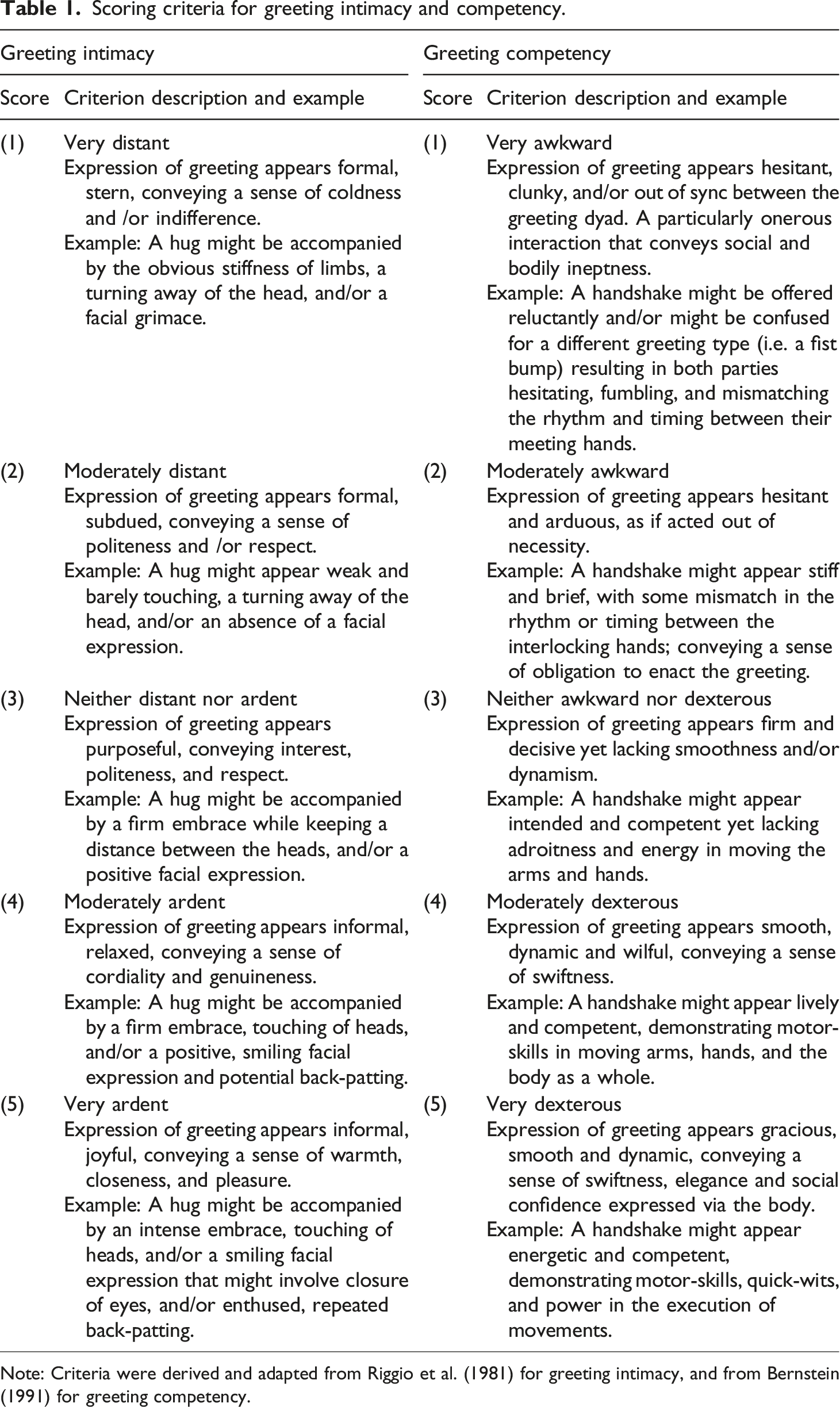
Note: Criteria were derived and adapted from Riggio et al. (1981) for greeting intimacy, and from Bernstein (1991) for greeting competency.
Empirical work points to the influence of various factors in shaping the type and form of greetings, including gender (Kendon & Ferber, 1973), length of separation (Argyle, 1975), topic to be discussed (Firth, 1972), acquaintanceship (Goffman, 1971) and the formality of the occasion (Riggio et al., 1981). To account for these factors as was achievable in naturalistic contexts, we recorded the gender of greeters (1) and distinguished between greetings observed at three different locations. Greetings between intimate couples were excluded (due to the intimacy of the greeting being more a product of the relationship than the cultural norms under study). Characteristics that were deemed to express romantic intimacy included kissing each other on the mouth, hand holding, or touching in an intimate manner such as intimately touching, stroking, or patting body parts, and/or intimately kissing each other.
Attention was paid to whether encounters (and the physical greetings that may have accompanied them) were initial or recurring. It was recognised that how cultural norms play out in the workplace is likely a factor in determining whether colleagues physically greeted one another on their first encounter of the day. However, irrespective of culture, recurring encounters throughout the day are unlikely to be accompanied by a physical greeting. If any doubt as to whether an encounter was initial, the greeting or non-greeting would not be recorded.
Inter-rater reliability in greeting ratings
We assessed the validity with which the study’s observer rated greetings by using the competency and intimacy scales. To do so, inter-rater reliability (IRR) of the competency and intimacy observational scales was established across three observers (the first author and two research assistants) in a reliability check. A potential bias in observing greeting behaviours in the UK was traced to the principal observer’s own British nationality and cultural background in the UK. This bias was minimised, however, through the additional observers who were neither raised in the UK or Spain (both international students from the Philippines and Hong Kong, living in the UK at the time of greeting validation). We further controlled for any potential cultural observation biases by using a multi-coding procedure. Specifically, a sample of 10 greeting displays were observed and rated at the business-professional location in the UK by the three observers. Prior to the observational session, raters familiarised themselves with a predefined coding scheme for observing competency and intimacy behaviours (see Procedure and Table 1). Additionally, roleplaying was utilised to demonstrate and agree on scaling the dynamics of competent/intimate greeting behaviours.
Questionnaire distributions
To assess participants’ interoceptive awareness (IA), the 37-item ‘Multidimensional Assessment of Interoceptive Awareness, version 2’ (MAIA-2; Mehling et al., 2018) was used. The MAIA-2 allows for discrimination between five different dimensions and subtypes of IA as measured by eight distinct subscales (marked with italics): 1. Awareness of Body Sensations: Noticing (awareness of uncomfortable, comfortable, and neutral body sensations). 2. Emotional Reaction and Attentional Response to Sensations: Not-Distracting (tendency not to ignore or distract oneself from sensations of pain or discomfort), Not-Worrying (tendency not to worry or experience emotional distress with sensations of pain or discomfort). 3. Capacity to Regulate Attention: Attention Regulation (ability to sustain and control attention to body sensations). 4. Awareness of Mind-Body Integration: Emotional Awareness (awareness of the connection between body sensations and emotional states), Self-Regulation (ability to regulate distress by attention to body sensations), Body-Listening (active listening to the body for insight). 5. Trusting Body Sensations: Trusting (experience of one’s body as safe and trustworthy).
Example items of the MAIA-2 include: “When I am in conversation with someone, I can pay attention to my posture”; “I am able to consciously focus on my body as a whole”. Responses are given on a 6-point Likert scale (0–5). The MAIA-2 has previously been utilised cross-culturally, having been translated into 22 different languages. Validation studies in western countries such as Italy (Cali et al., 2015) and Germany (Bornemann et al., 2015) have supported the MAIA-2’s original multidimensional factor structure. The only validation study in a Spanish-speaking country was undertaken in Chile by Valenzuela-Moguillansky and Reyes-Reyes (2015), where an equivalent factor structure was found. In light of these validation studies, the original instrument’s factor structure was deemed suitable for investigating IA in a European Spanish population. Valenzuela-Moguillansky and Reyes-Reyes’ (2015) translation of the original version of the MAIA (consisting of 32-items) provided the basis for the Spanish translation of the 2018 version of the MAIA-2 (consisting of 37-items), helping to secure linguistic equivalence. The translation of the additional five questions of the MAIA-2, any changes in the original 32-items, as well as other Spanish participant-facing documentation used in the study, were translated by the first author and reviewed by native-speaking colleagues.
The MAIA-2 was issued to observees whose greetings had been rated, and who were available and consenting for participation. Additional information was obtained from these participants regarding their age and nationality (non-national’s data were excluded from analysis). An open-ended question was used to ask participants which gender they identified with. All participants filling in the MAIA-2 gave verbal confirmation that they were not in an intimate relationship with their observed greeting partners.
Data analysis
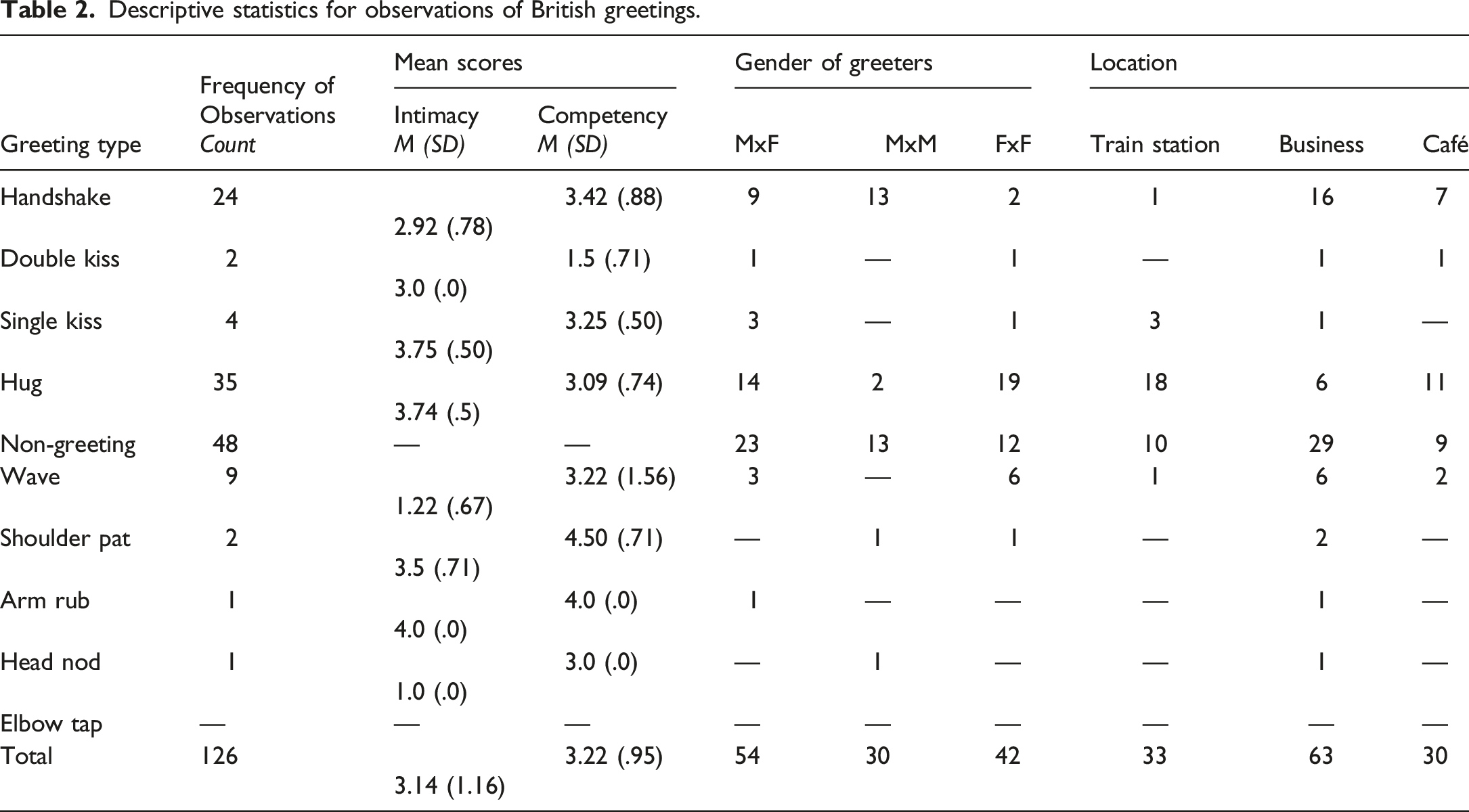
Descriptive statistics for observations of British greetings.
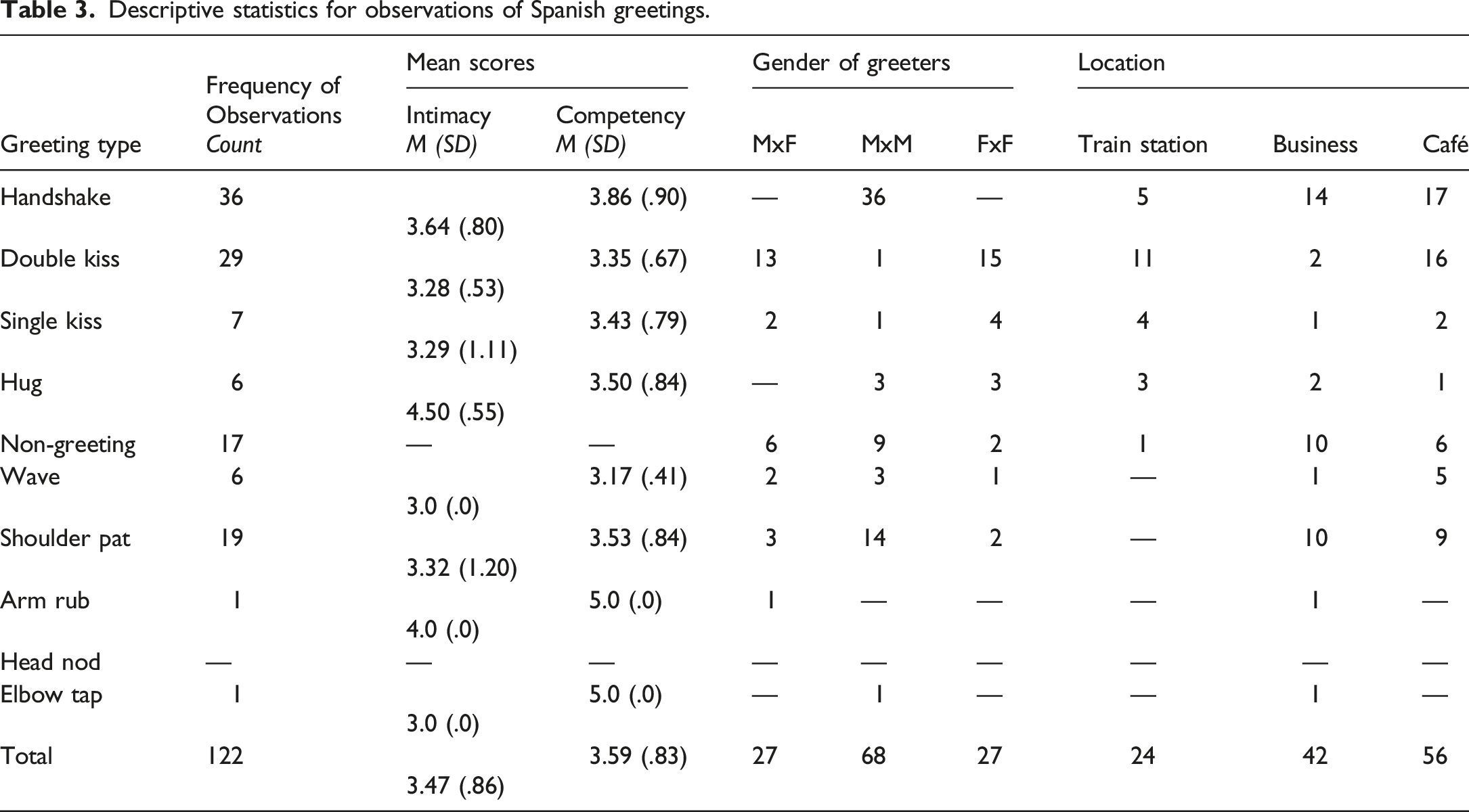
Descriptive statistics for observations of Spanish greetings.
Analyses were carried out using SPSS v.26 (IBM Inc., Armonk, NY, USA). Firstly, Inter-rater reliability was assessed using a two-way mixed, consistency, average-measures intra-class correlation coefficient (ICC; Hallgren, 2012) to evaluate the degree to which the raters provided consistency in their scorings of perceived intimacy and competency in observed greeting displays. Next, a Chi-Square test was computed to test the hypothesis that different nationalities would express different greeting types. Two factorial ANOVA’s were used to test our second hypotheses that Spanish greetings were performed a) more intimately and b) more competently than British greetings. Additional factors such as intra-country location and gender interaction were included, comprising two 2 × 3 × 3 between-subject ANOVA’s with two levels of country (Britain, Spain), three levels of location (business, train station, café) and three levels of gender interaction (Male by Male (MxM); Male by Female (MxF); Female by Female (FxF)).
Concerning the MAIA-2, we computed reliability statistics in the British and Spanish sample using Cronbach’s alpha. We further computed reliability statistics averaged across countries, to demonstrate reliability of the MAIA-2 in different cultural contexts. Spearman Rho correlations were used to test our third hypothesis that selective dimensions of IA would be correlated with scores of greeting intimacy and competency. The mean scores from the eight MAIA-2 subscales (Noticing, Not-Distracting, Not-Worrying, Attention-Regulation, Emotional-Awareness, Self-Regulation, Body Listening and Trusting) were separately correlated with intimacy and competency scores ranking from 1–5. Intimacy and competency scores were entered for each participant individually (i.e. using the same intimacy and competency score for a greeting pair where both individuals opted to fill the MAIA-2). Bootstrapping was performed to generate confidence intervals (95% bias corrected and accelerated) and significance tests of the model parameters. A significance level of p < .05 was applied throughout the analyses, except for the Bonferroni-corrected Spearman Rho correlations where the significance threshold was set at p ≤ .006.
Results
Inter-rater reliability
The resulting ICC for intimacy scores was in the excellent range (ICC = .90), indicating that raters had a high degree of agreement and suggesting that perceived intimacy in greeting displays was rated similarly across coders. Intimacy ratings were therefore deemed to be suitable for use in the hypothesis tests of the present study. The ICC for competency scores was found to be lower (ICC = .46), indicating that raters demonstrated a fair degree of agreement. Thus, the margin of measurement error introduced by the independent coders suggests that results relating to greeting competency should be treated with caution.
Naturalistic observations
In total, 248 greetings between 496 individuals were observed, recorded, and scored. Each greeting between 2 individuals was treated as one unit and given the same intimacy and competency rating along the 5-point rating scales, respectively. Tables 2 and 3 illustrate the 126 British and 122 Spanish greeting observations by greeting type, respectively.
British and Spanish individuals display different greeting types
Descriptive statistics are presented in Tables 2 and 3, showing the frequency of 10 different greeting types observed in Britain and Spain. Three of these greeting types had an observation count of less than 5 across the two countries (arm rubs: N = 2, head nods: N = 1, and elbow tabs: N = 1) and were therefore not included in the Chi-Square test to determine the statistical difference in the proportion of greeting types between the two cultures. The remaining 7 greeting types were subjected to a Chi-Square test, which yielded a significant difference between Britain and Spain in the frequency of expressing the observed greeting types (χ 2 (6) = 76.35, p < .001). Standard residuals were obtained for individual greeting types, revealing that Britain and Spain differed significantly in the use of double kisses, hugs, non-greetings and shoulder pats (cf. Tables 2 and 3). Specifically, based on model expectations, British participants used significantly more hugs (z = 3.1, p < .01) and non-greetings (z = 2.6, p < .01), while using significantly fewer double kisses (z = −3.5, p < .001) and shoulder pats (z = −2.7, p < .01). Conversely, Spanish participants used significantly more double kisses (z = 3.5, p < .001) and shoulder pats (z = 2.7, p < .01), while using significantly fewer hugs (z = −3.2, p < .01) and non-greetings (z = −2.6, p < .01) relative to model expectations. No significant differences between country were observed for the frequency of using handshakes, single kisses, and waves (all z < ± 1.96, p > .05).
Reliability measures
In our Spanish sample, the internal consistency reliability (Cronbach’s alpha) of the MAIA-2 ranged from .46 to .89 and was greater than .74 for six of the eight scales (.56 for “Noticing”; .46 for “Not-distracting”; .75 for “Not-worrying”; .79 for “Attention regulation”; .80 for “Emotional awareness”; .87 for “Self-regulation”; .81 for “Body Listening”; .89 for “Trusting”). Cronbach’s alphas for the MAIA-2 in our British sample ranged from .54 to .93 and were greater than .71 for six of the eight scales (.79 for “Noticing”; .83 for “Not-distracting”; .69 for “Not-worrying”; .54 for “Attention regulation”; .93 for “Emotional awareness”; .93 for “Self-regulation”; .79 for “Body Listening”; .72 for “Trusting”). Averaged across countries, Cronbach’s alphas for the MAIA-2 ranged from .67 to .92 and were greater than .73 for seven of the eight scales (.74 for “Noticing”; .74 for “Not-distracting”; .80 for “Not-worrying”; .67 for “Attention regulation”; .92 for “Emotional awareness”; .91 for “Self-regulation”; .83 for “Body Listening”; .80 for “Trusting”). Readers are cautioned not to put undue reliance on results using scales with estimates below .6 due to poor internal consistency reliability.
Comparable levels of intimacy and competency in Spanish and British greetings
Intimacy: We found no significant main effect of country on levels of intimate greeting behaviour (F[1165] = 2.84, p = .094, ηp2 = .02), suggesting that Spanish and British greetings were displayed with comparable levels of intimacy (Tables 2 and 3). Levels of intimacy were also non-significantly affected by intra-country location (F[2165] = 1.86, p = .159, ηp2 = .02) and by gender (F[2165] = .10, p = .904, ηp2 = .01). No significant interactions were found between country, inter-country location and gender on intimate greeting behaviour (p-values of all two and three-way interactions >.05).
Competency: We observed a significant main effect of gender on levels of competent greeting behaviour (F[2165] = 5.45, p = .001, ηp2 = .09). Bonferroni-corrected post-hoc tests revealed that greeting competency was significantly higher for MxM interactions relative to interactions between MxF (M Difference = .553; SE = .151; p = .001) and FxF (M Difference = .712; SE = .148; p > .001). No significant difference in greeting competency was observed between MxF and FxF interactions (M Difference = .159; SE = .162; p = .98). There were no significant main effects of country (F[1165] = .02, p = .89, ηp2 < .001) and intra-country location (F[2165] = .12, p = .89, ηp2 = .001) on greeting competency. We also observed no significant interactions between country, inter-country location and gender on competent greeting behaviour (p-values of all two and three-way interactions >.05).
Selective dimensions of Interoceptive Awareness (IA) are associated with intimate and competent greetings.
Correlation matrix showing the relationship between scores of greeting intimacy and competency, and measures of interoceptive awareness (subscales of the MAIA-2).
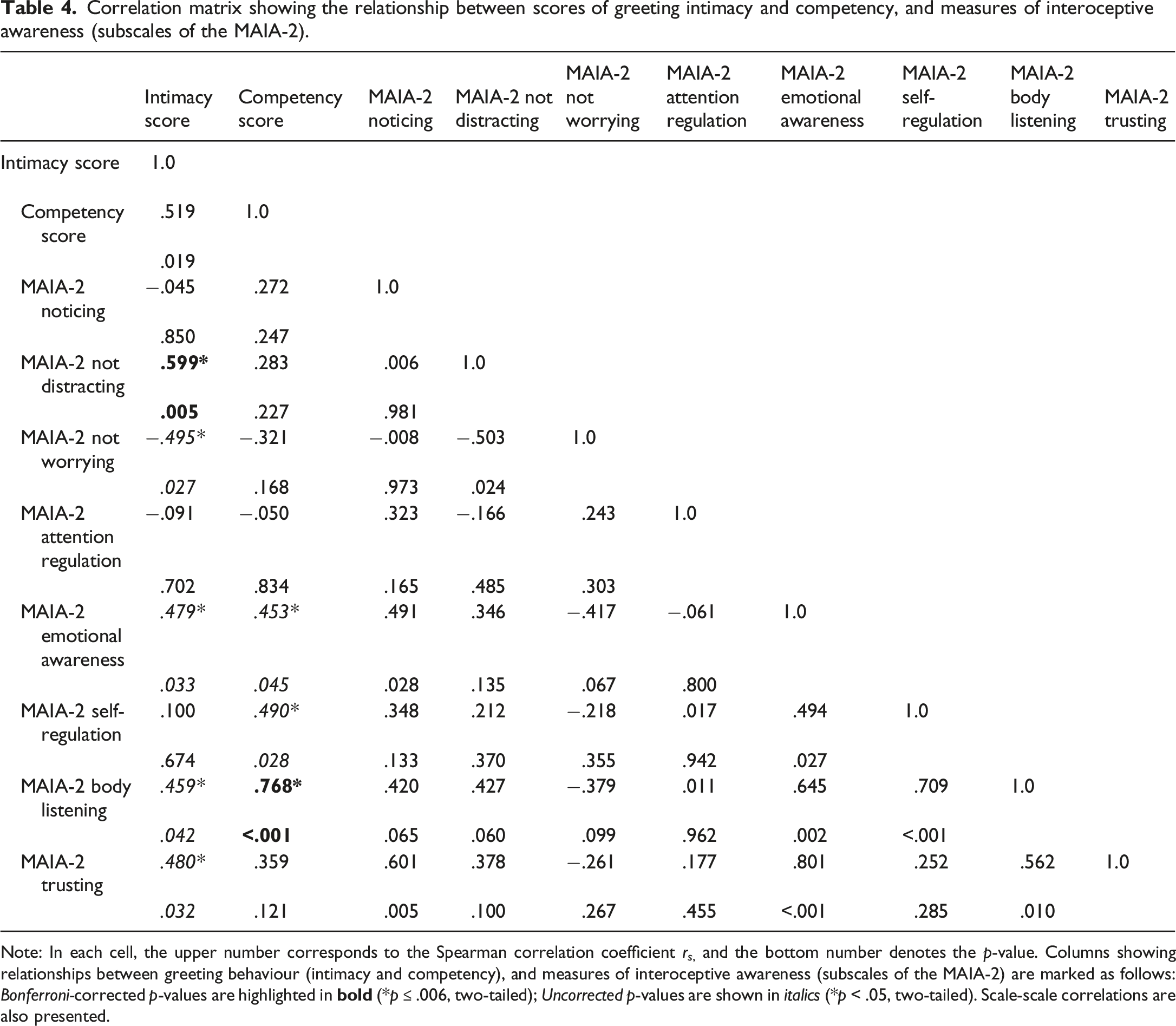
Note: In each cell, the upper number corresponds to the Spearman correlation coefficient rs, and the bottom number denotes the p-value. Columns showing relationships between greeting behaviour (intimacy and competency), and measures of interoceptive awareness (subscales of the MAIA-2) are marked as follows: Bonferroni-corrected p-values are highlighted in
Intimacy was further related with subscales belonging to the ‘Emotional Reaction and Attentional Response to sensations’ dimension (Not Distracting, Not Worrying). Specifically, there was a significant (Bonferroni-corrected) strong positive relationship between intimacy and Not Distracting (r
s
(20) = .599, p = .005), suggesting more intimate greeting behaviour in individuals that were less distracted by discomforting or distressing bodily sensations. Conversely, a moderate negative relationship (not surviving the Bonferroni-correction of p ≤ .006) was observed between intimacy and Not Worrying (r
s
(20) = −.495, p = .027), indicating that greetings tended to be less intimate in individuals with little worry about discomforting bodily sensations. Finally, a moderate positive relationship (non-significant at the Bonferroni-correction of p ≤ .006) between intimate greeting behaviour and Trusting was found (r
s
(20) = .480, p = .032). Greeting behaviours (competency; intimacy) showing moderate and strong relationships with selective MAIA-2 subscales are presented in Figure 1. Scatterplots depicting moderate and strong Spearman Rho relationships between greeting behaviour (intimacy; competency) and selective MAIA-2 subscales. Strong relationships survived the Bonferroni-corrected significance threshold of p ≤ .006*, two-tailed; moderate relationships are presented at p < .05, two-tailed (uncorrected).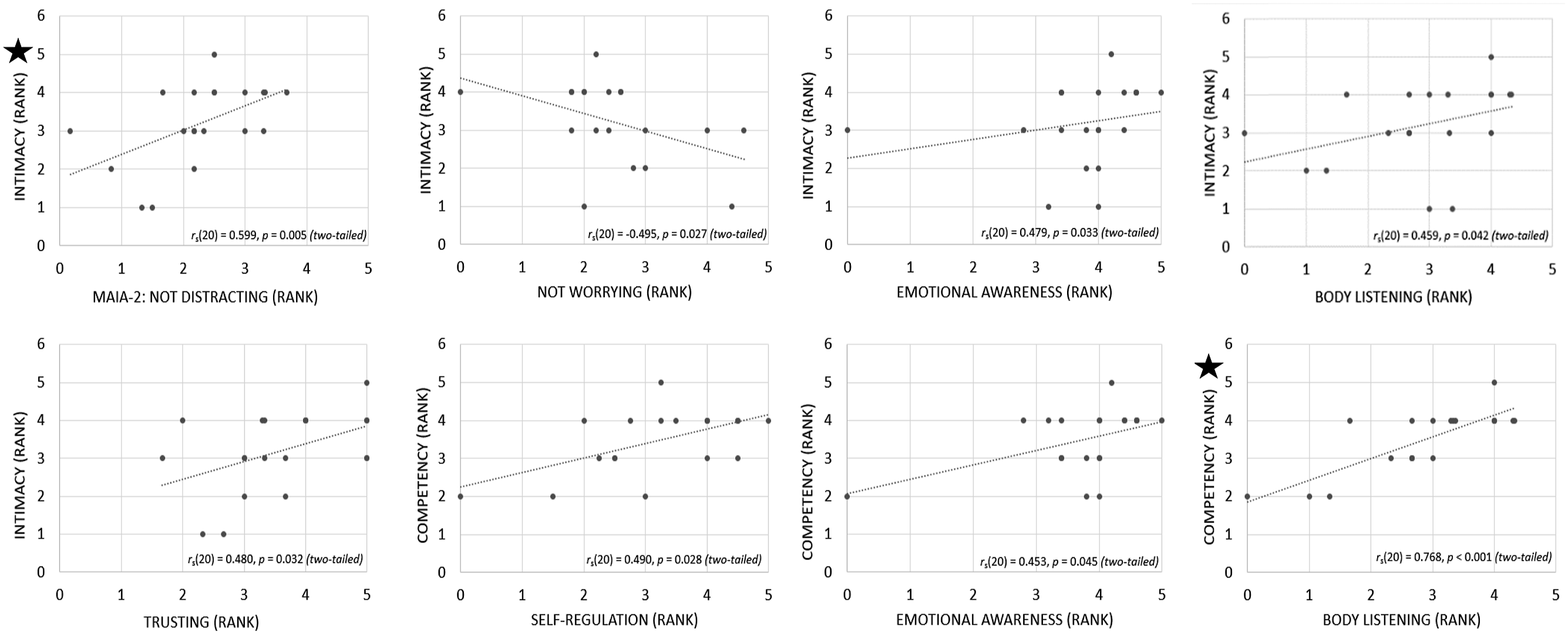
Discussion
The present observational study investigated the effects of exteroceptive and interoceptive awareness on non-verbal greeting behaviour in Great Britain and Spain. Exteroceptive cues were used in this study to refer to culture-specific, acquired bodily actions that might be reflected by different greeting types and levels of greeting intimacy and competency. Similarly, interoceptive awareness (IA), the conscious perception of own internal bodily signals might influence non-verbal greeting behaviour and was observed in a subset of the observed sample using the MAIA-2 (Mehling et al., 2018).
Consistent with our first hypothesis and insights from embodied cognitive science (Reed & Bril, 1996; Wilson & Golonka, 2013), cross-cultural differences were found that largely reflected culture-specific greeting displays associated with the Anglo-Saxon and Mediterranean-Latin cultures (Ponton, 2014). A significant number of British greeters evaded physical interaction entirely or tended towards hugs, while Spanish participants were more likely to deploy greeting types such as the double kiss and the shoulder pat.
Our second hypothesis, that Spanish greetings would be performed more intimately and competently than British greetings, was not supported. This prediction was motivated by variations in the enactment of greeting-related motor actions, which are conveyed and honed by distinct cultural traditions (Ambady et al., 1996; Ponton, 2014). Mediterranean greetings have classically been associated with greater physical closeness, cordiality, and passion relative to northern European cultures (Ponton, 2014). However, most research has concentrated on the physical environment in which greetings were observed, noting that, due to public observations, greetings may inevitably express greater formality to avoid embarrassment (Ponton, 2014). Our observations, too, were restricted to public locations including train stations, cafes, and business parks. Speculatively, at these locations, we might find more frequent interactions between colleagues and business partners where less intimate greeting behaviours are customary irrespective of culture, thus blurring any cultural differences in greeting intimacy. Failure to find a significant difference in the mean competency scores of Spanish and British participants also refutes the notion that the former greet with greater dexterity than the latter. However, there was a disproportionate number of non-greetings in British participants (38.1% of total British greetings) relative to their Spanish counterparts (13.9%), which might reflect British conventions and the tendency to engage less in physical closeness (Ponton, 2014). The abundance of non-greetings observed in the UK is consistent with the view that British greeting norms demand less perceptual-motor coordination from British greeters.
In line with the well-documented gender differences in non-verbal greetings (Hall & Gunnery, 2013), we observed a significant main effect of gender interactions in greeting performance. Our specific finding that male-male greeting interactions were performed more competently relative to male-female and female-female greeting interactions might reflect nonverbal communication styles that have historically been associated with more traditional sex roles. Greeting competency in males was shown to signify influence and status (Carli et al., 1995). By contrast, physical greetings executed by females (e.g. shoulder pats) tended to be perceived with a sense of security, akin to a comforting motherly touch (Levav & Argo, 2010). It is conceivable that our observations reflect such deep-seated, gender-specific connotations, leading to gender differences in greeting competency that conform to socially acceptable, or even desirable, behaviours. Support for this interpretation comes from our observation that a significant proportion of greetings between males constituted handshakes (100% in Spain, 54.2% in Britain). This is consistent with research suggesting that handshakes are a typical male activity, and that male handshakes receive more positive appraisal than female handshakes (Katsumi et al., 2017). The favourable use of handshakes between males might bias observations of greeting competency. Specifically, competent greetings were defined in the present study as showing high dexterous finesse in motor-coordination, an enactment that signals effectiveness and confidence between greeters. In this sense, handshakes might facilitate a sense of greeting competency that is more difficult to express with other greeting types and therefore provide an advantage of greeting competency in male-male greeting interactions relative to mixed gender or male-female interactions.
In line with Riggio et al. (1981), no gender effects were observed when greeting types were judged on levels of intimacy. This may have been due to the appropriateness of intimate greetings in public places. Although females tend to have a more expressive greeting style than males (Briton & Hall, 1995), and intimate greetings between females tend to be appraised as positive (Katsumi et al., 2017), the public locations in which greetings were observed in the present study might have dampened intimate greeting behaviours that can more easily be manipulated in laboratory settings (Katsumi et al., 2017).
Several moderate and strong relationships between greeting behaviour and MAIA-2 subscales supported our third hypothesis, that more competent and intimate greetings would be correlated with selective dimensions of interoceptive awareness (IA). This discussion will interpret both, moderate and strong relationships between greeting behaviour and IA. Note, however, that our correction of multiple MAIA-2 subscale comparisons rendered only the strong relationships significant at a conservative Bonferroni-threshold of (p ≤ .006), while all moderate relationships were significant at the conventional p-value of p < .05 (uncorrected). Relationships were obtained in the UK and Spain independently (although based on small samples of N = 10 from each country), thus supporting associations between IA and greeting behaviour beyond culture. Particularly striking were the positive relationships between greeting behaviour and IA subscales belonging to the ‘Awareness of Mind-Body Integration’ dimension. While elements of all the questionnaire’s dimensions gauge aspects of IA that are relevant to successful greeting, the ‘Awareness of Mind-Body Integration’ dimension appears most suitable in illustrating the importance of integrating exteroceptive and interoceptive information in executing socially relevant bodily actions. Scoring high on this dimension is indicative of “access to more developed levels of body awareness” (Mehling et al., 2012, pg.10), an overall felt sense of the embodied self, and is “opposed to a disembodied sense of alienation and of being disconnected from one’s body” (pg.3). These findings provide support for this paper’s central integration hypothesis, suggesting that competent greeters operate like highly bodily aware agents incorporating external, socially infused motor competencies (Bernstein, 1991; Reed & Bril, 1996). Conversely, the findings demonstrate that less competent greeters exhibit low IA, concomitant with ‘disembodied’ (Bekrater-Bodmann et al., 2020) and ‘incongruent’ (Ainley et al., 2014) styles of movement, showing a lack of interoceptive integration in their greeting displays.
Further examination of the dimension’s subscales underpins the importance of specific types of IA on greeting intimacy and competency. Self-Regulation showed a moderate positive relationship with greeting competency, while Body Listening yielded strong and moderate relationships with competency and intimacy, respectively. Self-regulation is associated with goal-directed behaviour and the ability to regulate distress, and Body Listening with a tendency to actively listen to the body for insight (Mehling et al., 2012, pg.16). Hence, for achieving the goal of socially propitious greetings, those scoring highly on Self-Regulation and Body Listening are more likely to navigate a bodily greeting interaction by intuiting directly from their own bodily feeling, while also keeping a handle on the mental and physiological distress that may blight the same situation for those scoring lower on these scales. Low scorers may be more likely to miss bodily cues and rely on mental mappings of the situation instead. The cumbersome nature of this approach may be reflected in the unwieldy use of the body.
Emotional Awareness, showing moderate positive correlations with intimacy and competency, is the quality of making conscious connections between one’s own bodily sensations and perceived emotional states. Emotional Awareness was shown to exhibit the weakest relationships with measures of anxiety out of the MAIA’s eight sub-domains (Mehling et al., 2012, pg.16), while neural substrates of interoception were found to mediate social anxiety (Terasawa et al., 2013). In the context of our finding, social anxiety would counteract greeting competency and intimacy, suggesting that Emotional Awareness is beneficial for non-verbal greetings that rely on social and physical closeness.
Greeting intimacy was further associated with the ‘Emotional Reaction and Attentional Response to sensations’ dimension of the MAIA-2. This dimension is concerned with primary responses to discomforting internal bodily signals, including emotional reactions (Not Worrying) and paying attention to bodily cues (Not Distracting) (Mehling et al., 2012). Being attuned with our own internal bodily states, and emotionally contained with their presence, might form the basis for setting physical boundaries. In other words, the way we experience and feel about interoceptive signals might determine the level of intimacy in greeting dyads. Intimacy relates to being comfortable with physical closeness and has connotations with attachment (Cassidy, 2001). For example, anxious attachment types are characterised by hypervigilance to social surroundings, frequent disclosure of their distress, and the seeking of closeness and support from others. Recent findings reported a negative relationship between anxious attachment and the Not Worrying subscale (Oldroyd et al., 2019), suggesting that greater worry about discomforting bodily cues is associated with seeking closer social support and reassurance. This would explain our moderate negative relationship between Not Worrying and intimacy, similarly suggesting that individuals who were worried about discomforting body sensations displayed more intimate greeting behaviours. Framed in a positive light, this finding indicates that individuals with healthy, unconcerned evaluations of unpleasant bodily sensations (i.e. scoring high in Not Worrying) demonstrate intimate greeting behaviours that resemble a more poised and collected greeting approach.
Attachment styles also serve to explain our positive relationship between intimacy and the MAIA-2 subscale Not Distracting. Not Distracting is associated with paying close attention to, and not ignoring internal bodily needs. Our significant strong positive relationship between Not Distracting and greeting intimacy therefore suggests that the more distracted or disconnected someone is from their own bodily sensations, the less they engage in intimate greeting behaviour. This is consistent with attachment, whereby the avoidant attachment type withdraws from close social interactions, which is related to their disconnections from own internal bodily states (i.e. low scores on Not Distracting) (Oldroyd et al., 2019).
Likewise, our moderate positive correlation between intimacy and Trusting [one’s bodily sensations] suggests that greetings expressed with greater warmth, cordiality and closeness might come easier to those who developed sufficient trust in their body concerning important bodily signals, consistent with the trust cultivated in securely attached relationships (Oldroyd et al., 2019).
Limitations
A limitation of this study was our awarding of the same intimacy and competency score across two individuals forming a greeting dyad. This could have impacted on the relationships between selective dimensions of IA and greeting behaviour, especially in cases where both individuals of a greeting pair opted to fill in the MAIA-2. However, it is worth emphasising the difficulty in gauging greeting behaviour quantitatively. On the one hand it has been postulated that the “dexterity in each person is qualitatively different and unique” (Bernstein, 1991, pg.19). Conversely, it has been shown that individuals tend to imitate motor actions to match those of other individuals, and that these imitations increase as a function of IA (Ainley et al., 2014). The later argument specifically demonstrates the separation difficulty of greeting scores between two individuals and lends support for the scoring scheme used in the present study. A second, inherent limitation of naturalistic observations was the inability to collect demographic data, including gender, sexual orientation, and socioeconomic status that are known to influence greeting behaviour (Brown & Levinson, 1987; Hall & Gunnery, 2013). A third limitation was the study’s inability to investigate cross-cultural variation in IA using self-report measures, and whether variations in IA may result from culturally distinctive movement patterns, as postulated by the principles of embodied cognition (Reed & Bril, 1996; Wilson & Golonka, 2013). To address the above limitations, future studies investigating mind-body relationships in greeting behaviour could aim for different methodological approaches, such as laboratory settings, as suggested by Mehling et al. (2009), while the present study should be recognised for the quality of observing naturally occurring greeting interactions in uncontrolled environments.
Clinical implications
The relationships between IA and greeting behaviour found in the present study demonstrate the mind-body interactions that govern social greeting situations in a non-clinical sample. Taking a mind-body perspective can inform complementary treatment approaches for social anxiety disorder: While widely used cognitive behavioural therapies help to regulate anxieties around perceived social threat and negative social evaluations (Hyett & McEvoy, 2018), alternative ‘contemplative training’ therapies focusing on bodily awareness (Bornemann et al., 2015) could be used in clinical practice to diminish social anxiety-related physiological reactions such as blushing or heart rate increases in social settings (de Vente et al., 2014).
Implications for greeting behaviour in a post-Covid-19 world
During the COVID-19 pandemic we have seen the most drastic governmental measures taken to control public behaviour in peacetime and greeting behaviour has been a targeted focus of these measures. In March 2020, as Covid cases were beginning to snowball in the West, an advisory panel to the British government, the Independent Scientific Pandemic Influenza Group on Behaviours (SPI-B), published a document warning against physical greetings and urging governments to actively promote this message (see Woodcock, 2020). France’s Health Minister at the time, Oliver Véran, used his platform to renounce ‘la bise’, the traditional French double kiss (Haramis, 2020), and since then, many government websites offering COVID-19 health and safety guidelines have called for the avoidance “of greetings that include physical contact” (Canadian Public Health Service, 2020). At the time of writing this study, public perceptions around physical distancing in the post-covid-post-vaccine era remain conservative: Recent empirical findings suggested that greetings involving physical contact, such as handshakes and hugs were still largely perceived as unsafe, even in a ‘high context culture’ (Saudi Arabia) where non-verbal greetings have traditionally been used to signal respect (Khan et al., 2022). During the pre-vaccine period, greetings have begun to take alternative forms, including no-touch greetings, elbow bumps, footshakes, or hugs in the air (Mondada et al., 2020; Dragomir et al., 2021). Applied contexts of medicine (Ghosh et al., 2021) and education (Smith, 2021) continue to take the safe approach of no-touch-based greetings in the post-vaccine era, avoiding handshakes and other physical greetings in favour of alternative non-verbal greeting forms. Future research needs to examine whether the current public inhibitions in expressing body movements when interacting with others in close proximity will affect the link between interoceptive signals and exteroceptive cues (Maister & Tsakiris, 2014; Mehling et al., 2009); the impact that poor interoceptive-exteroceptive integration might have on establishing stable feelings of an embodied self (Bekrater-Bodmann et al., 2020; Herbert & Pollatos, 2012) and its possible implications for future greeting behaviours.
Conclusion
The present study demonstrated the integration of exteroceptive and interoceptive channels in non-verbal greeting behaviour, notably in the expression of greeting intimacy and competency. Cultural differences between Britain and Spain were found in the type of greetings and are suggestive of culturally specific social norms that dictate their expression. Interoceptive awareness showed moderate and strong relationships with greeting intimacy and competency that were culturally independent. Critically, this finding advances our understanding of social approach behaviour beyond exteroceptive, culturally specific norms, suggesting that greeting expressions might arise from more deep-seated interoceptive bodily representations.
Footnotes
Funding
The author(s) received no financial support for the research, authorship, and/or publication of this article.

Open research statement
As part of IARR’s encouragement of open research practices, the authors have provided the following information: This research was not pre-registered.
The data used in the research are available. The data can be obtained by emailing:
The materials used in the research are available. The materials can be obtained by emailing: