




Abstract
The use of mobile phones and other communication technologies is booming in low-income contexts. Yet there is lack of detailed analyses of their impact to social interactions, including intimate relationships between men and women and gender-based violence. Drawing on Bourdieu’s concepts of habitus and field, we argue that mobile phones reproduce gender inequality and negative masculinities in these relationships. This happens through the diverse use of phones, and the interactive interface of the physical, electronic and social spaces within the broader social and economic context. We analyzed 48 in-depth interviews with men and women in Mwanza, Tanzania to explore how mobile phone use reproduces entrenched masculinities, gender norms, and power struggles in their daily lives and social interactions. Intimate partners navigate these complexities in several ways, including by creating ‘private spaces’ through their phones and concealing their communications. Men draw on negative masculinities to dominate their partner’s phone use, while women engage social recognition and family custodianship to influence their partner’s behaviour. These endeavours redefine concepts such as love and care, trust and faithfulness in the relationships. It is crucial to assess how technological advances are transforming intimate relationships and impacting gender-based violence in low-income countries.
Keywords
Introduction
Communication technologies, gender inequalities and socioeconomic context
Remarkable economic and technological developments are taking place worldwide, including in low-income countries (LeFebvre, 2017; Porter et al., 2020; World Bank, 2016). While welcomed, these transformations drive both positive and negative social and economic changes. Populations across different settings have adopted various measures to keep up with these transformations amidst the waning of the traditional and mostly face to face cultural and social influences. Poverty is one of the main causes, drivers, and consequence of intimate partner violence, a pervasive global problem (Stern et al., 2020; Stöckl et al., 2021). Hence, it is important to explore how technological advances such as use of mobile phones affects intimate relationships in such contexts.
The use of mobile phones in rural and urban Africa has transformed a wide range of interactions and impacted many sectors including health services and agriculture (Chuma, 2014; Dusabe et al., 2013; Hackett et al., 2018; Quandt et al., 2020). In 2016, it was estimated that mobile phone penetration in Africa was 73% (World Bank, 2016). By March 2021, Tanzania had an estimated 52 million mobile phone subscribers, of which 29 million accessed the internet (TCRA, 2021). The use of modern communication technology and access to the internet in Africa will continue to expand rapidly in the next decade (World Bank, 2016). The growth of such technologies on the continent will mostly be driven by increased access and affordability, and the growing young population (Chuma, 2014; Hackett et al., 2018; World Bank, 2016).
Amidst the optimism to the progressive influence of these technological driven changes in low-income settings, it is important to assess their overall impact to the social fabric of communities, including intimate relationships. Studies from different parts of the world have shown that mobile phone use, internet access and social media have several negative effects to different sections of the population (Brown et al., 2018; Xue et al., 2018). This includes reinforcing gender inequality against adolescent girls and women (Fernet et al., 2019; Gibbs et al., 2021; Porter et al., 2020; Stephenson et al., 2018). In some African countries, such changes have had mixed influence to the inequalities between men and women. On one hand, ownership of mobile phones has improved the lives of women by increasing their participation in the economy through income generation activities (World Bank, 2016). Yet, increased ownership of communication devices in households (including mobile phones) has increased the likelihood of intimate partner violence (Cardoso & Sorenson, 2017; Gibbs et al., 2021), a prevalent problem in Tanzania (Jakobsen, 2014; Kapiga et al., 2017; Mchome, Mshana, et al., 2020; Mshana et al., 2021; Vyas et al., 2015). For example, a study in South Africa found that the use of mobile phones increased the likelihood of young women experiencing controlling behaviours from their male partners (Gibbs et al., 2021). The adoption of modern communication technologies introduces new complexities in relationships, including interpersonal power struggles and the different forms of intimate partner violence. These require novel interventions to improve relationships and address violence against women (El Morr & Layal, 2020).
Tanzania is the largest country in East Africa with an estimated population of 57.6 million people and an area of 945,087 square kilometers (National Bureau of Statistics, 2020). The country has among the fastest growing populations in the world (United Nations, 2017). It shares borders with eight countries in Eastern, Central and Southern Africa. Tanzania has regional geopolitical and socio-economic importance as it provides sea access to six landlocked countries: Rwanda, Burundi, Uganda, Zambia, Malawi and the eastern region of the Democratic Republic of Congo. Mwanza, located in north-western Tanzania is the second largest city in the country with an estimated population of 1.1 million (National Bureau of Statistics, 2020).
The economy of Mwanza region is heavily based on agriculture – similar to the rest of the country. Despite Tanzania being reclassified as a lower middle-income country in 2020 with a per capita income of 1,076 (World Bank, 2020), the majority of the population is poor and relies on unstable sources of livelihood such as rain dependent small scale subsistence farming and informal businesses. The main economic activities in Mwanza include fishing and subsistence farming of food crops such as maize, cassava and sweet potatoes. Other main economic activities include cattle keeping, cotton farming, small-scale gold mining, and industrial manufacturing. The Sukuma is the largest ethnic group in the region and city. Given its strategic location as the economic hub of the lake zone area, Mwanza has attracted migration of other ethnic groups for employment and a variety of income generation activities. These include the Haya and Ha from western Tanzania, the Kurya and Luo from eastern part of the country, and a wide range of other ethnic groups from different parts of the country. Therefore, with its current and projected population growth, socio-economic dynamics and high prevalence of intimate partner violence, Mwanza provides a suitable context for examining how modern technology is transforming social and intimate relations within an African setting and other similar contexts.
The habitus, field and power relations
We draw on Bourdieu’s concepts of habitus and field to analyze the use of mobile phones between men and women in intimate relationships in Mwanza, Tanzania. We assess how the use of phones affects their intimate lives and the broader social interactions. Specifically, this analysis explored the question: how does the use of mobile phones influence the nature of intimate relationships between men and women and the manifestations of gender inequalities in such relationships? Bourdieu argues that when humans engage in practice, they reveal underlying conceptual schemes for researchers to observe and analyze (Bourdieu, 1977). Thus, we interpret what the practices of mobile phone use between intimate partners reveal about their relationships within the context of the broader social interactions in a low-income setting.
The habitus is a complex set of dispositions which generates socially and economically grounded practices (Ashall, 2004; Bourdieu, 1977). Three types of capital are linked to the habitus: economic, social and cultural (Bourdieu, 1986; Pinxten & Lievens, 2014). These types of capital reproduce social hierarchies within the habitus and yet obscure their subjective nature (Ashall, 2004; Bourdieu, 1977). Hence in-depth analysis is required to uncover the connection between social hierarchies, including inequalities, to these different forms of capital. It is important to note that the habitus is acquired through socialization. For the purpose of this analysis, it is important to recognize that through socialization, masculinities and norms are entrenched in individuals and society, including ideals about the ‘proper’ functioning of relationships between men and women (Ashall, 2004). The habitus is dynamic (Wacquant, 2016), hence suitable for exploring the evolving relationships between men and women.
Bourdieu engages the habitus to analyze inequality in society, hence its relevance for exploring the socially grounded inequality between men and women (Ashall, 2004). Skewed power relations maintain inequality in intimate relationships (Jewkes et al., 2015; Vyas et al., 2015). Gender norms should thus be understood within the context of social division and unequal power relations which produce the masculine domination of men (Ashall, 2004; Bourdieu, 2001). Unequal power relations and oppressive gender norms may appear as a ‘natural’ occurrence in society through objectification of (the social) structure (Bourdieu, 1977). This ‘objectification’ inhibits men and women from critically appraising their socially defined roles. Even though some may draw on agency to navigate and challenge these norms, the overarching structural environment limits their options (Jewkes et al., 2012). Bourdieu maintains that even though individuals make free choices, these choices are not done within the circumstances of their choice (Bourdieu, 1977).
In producing practices accessible for classification, the habitus is intertwined with the field (Bourdieu, 1977). The field is an arena with social and historical foundations in which interactions and maneuvers happen (Bourdieu, 1990). These interactions and maneuvers are struggles over the use and control of specific resources or stakes (Bourdieu, 1990; Jenkins, 2002). In this case, mobile phones – which are communication resources - embody the ‘stake’ of modern lifestyles through which interactions and struggles of intimate partners occur. In our analysis, we define the interaction of the habitus and field to comprise the norms and ideals on how married couples or those in socially recognized unions relate within the setting of modern communication technology. Thus, intimate partners define and engage in mobile phone communication through these socially defined and historically understood ideals.
It is also important to recognize that intimate couples are influenced by cultural goods – also called stakes - defined to include changing lifestyles (Jenkins, 2002). Our analysis considers mobile phones as goods embodying modern lifestyles. They create a ‘new field’ for the social ideals of the communication between intimate partners to happen. Such communication creates a different avenue for the extension of the inherent interpersonal power struggles between men and women. In the process of conveyance to the ‘new field’, norms and masculinities manifest in ways that require partners to cope appropriately.
Methods
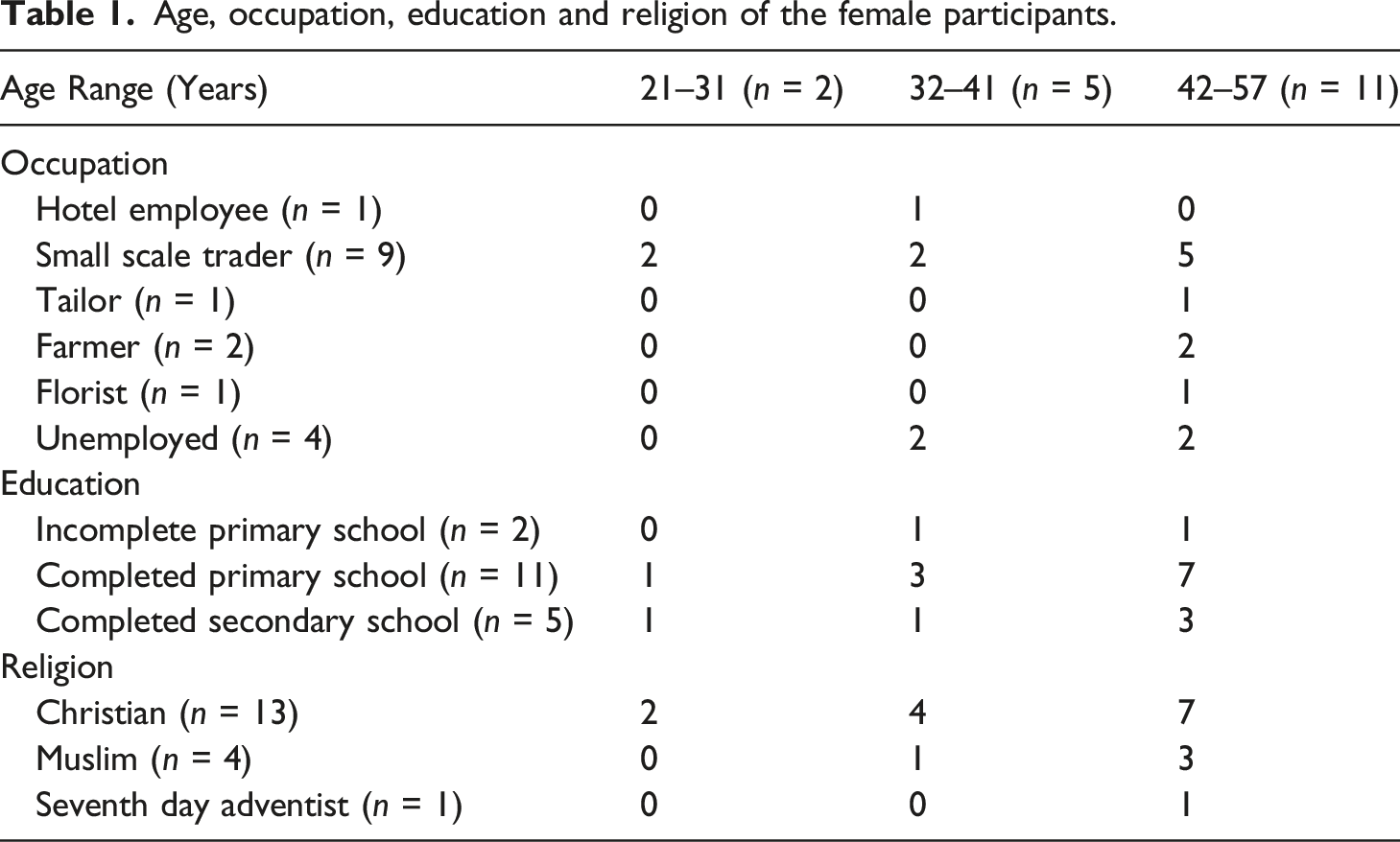
Age, occupation, education and religion of the female participants.
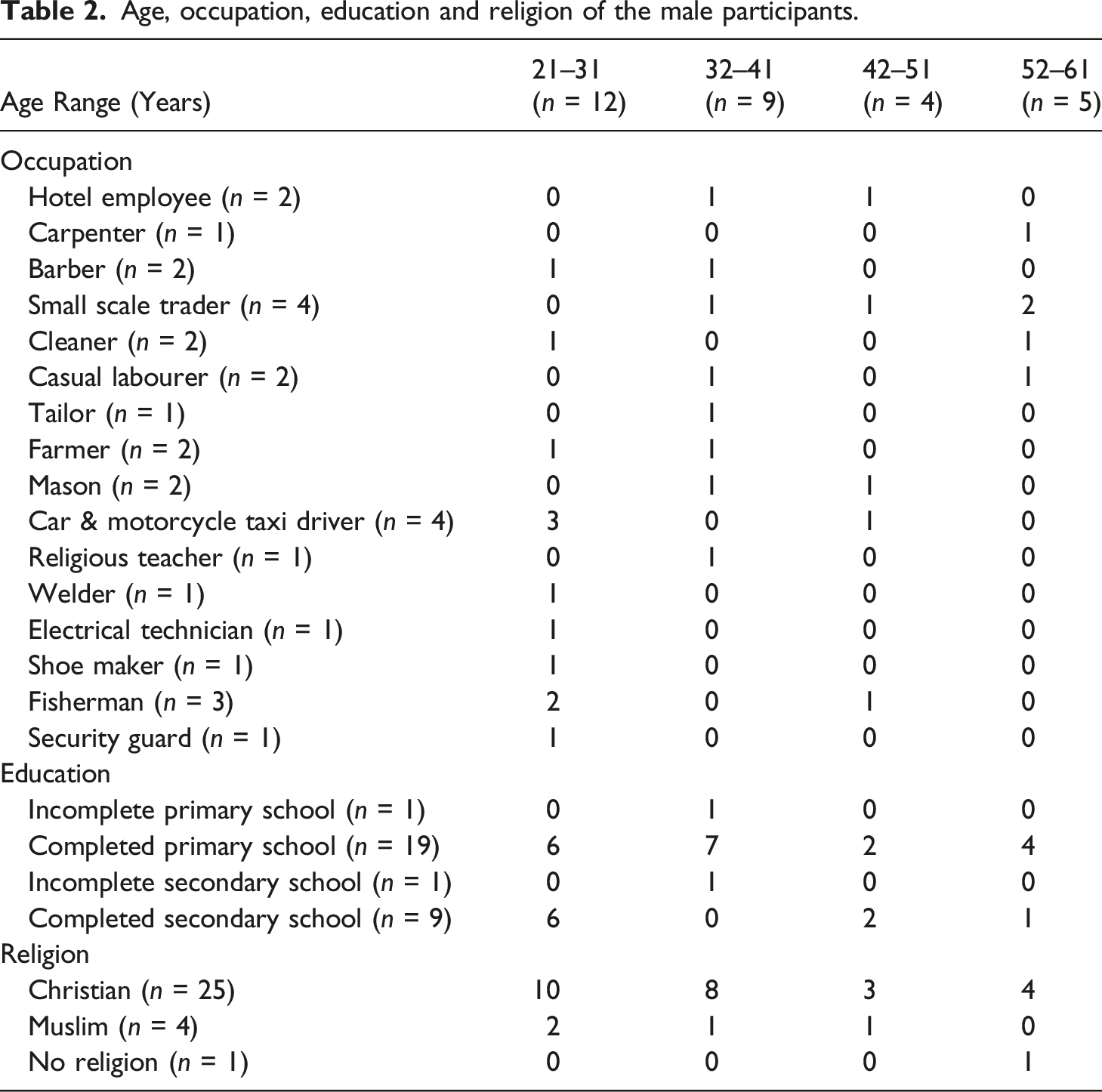
Age, occupation, education and religion of the male participants.
The sex of the interviewers was matched with those of the respondents to allow them feel free to share sensitive information (Vollmer et al., 2021), about their relationships. The interviewers had extensive experience of conducting in-depth interviews with different populations in Tanzania and on challenging topics such as sexual behaviour and alcohol use. Nevertheless, they received further training on how to carry out research on intimate relationships and violence with participants from different backgrounds. The training emphasized the ethics of conducting such research including the importance of confidentiality and handling of sensitive information disclosed by the participants, such as infidelity and perpetration of violence.
The interviews were carried out in Kiswahili, the widely spoken national language in Tanzania. Kiswahili was promoted and given national status as part of the post-independence nation building efforts in the country. On average, the interviews lasted between one and 3 hours. Written consent was obtained from all participants after they read the study information sheet (or having it read to them). All participants requesting help were referred to organisations providing specialized support for victims of gender-based violence in Mwanza city. Both sub studies received the required ethical approvals in Tanzania (NIMR/HQ/R.8a/Vol.1X/2475 and NIMR/HQ.R.8a/Vol.1X/2991) and from the London School of Hygiene and Tropical Medicine.
The semi-structured interview guides for the two sub-studies did not have specific questions on the use of mobile phones among intimate partners. However, during the examination of coded interview transcripts as part of data analysis, it became clear that the use of mobile phones was an important part of the daily lives and social interactions of the partners. Hence the research team decided to explore the topic in-depth. All interviews were audio recorded and transcribed verbatim. Subsequently the transcripts were translated into English. Data were then broadly coded using the NVivo 12 (QSR International Pty Ltd, Melbourne, Australia) software. The initial coding captured the broad descriptions about intimate relationships and the participant’s conceptualization of the different types of violence, before focusing the analysis on the use of mobile phones. To preserve the linguistic richness of the narratives, the analysis included both Kiswahili and English transcripts.
In line with the grounded theory approach (Glaser & Strauss, 1967), we decided to ‘follow the lead’ of the data and systematically examined the coded data and original transcripts for the participants' descriptions of their use of mobile phones. We also analysed how men and women interact with such communication devices and the broader implications to their relationships and social interactions. Charmaz highlights that grounded theoretical analysis is systematic and yet flexible, hence removing the rigidity created by the pre conceptualization of theory before data collection (Charmaz, 2006). Glaser defines grounded theory as the ‘systematic generation of theory from data acquired by a rigorous research method’ (Glaser, 1998:3).
We appraised the emerging findings through repeated circles of data examination and theorization. In the process, a review of a wide range of social theories was done, and found Bourdieu’s concepts of habitus and field consistent with explaining what was observed from the data. This cross examination between data and theory continued until theoretical saturation was achieved (Bryman, 2004). Theoretical saturation means that there is no further need to review or collect more data to examine how well they fit with the developed concepts.
Findings
Two sides of same coin? Same habitus in a new field
Our analysis shows that the use of mobile phones by intimate partners reproduces the habitus of gender inequalities and masculinities grounded in their social spheres. In this case, intimate partners are actors in the complex interaction between the habitus of gender inequalities and masculinities within the field of mobile phones. Additional actors are other people in their social networks including relatives and friends. Despite the adoption of new technologies – in this case phones - and the accompanying benefits, the inequalities between men and women are extended in this new field. In this respect, the dynamism of the habitus (Wacquant, 2016) becomes powerful through the process of reproduction of established inequalities embodied through gender norms.
Good: Reinforcing relationships and social ties
The majority of the participants appreciated that mobile phones have improved communication between intimate partners. They have enabled couples to be in touch with each other more frequently and faster through text messages and voice calls. Women were particularly appreciative when their husbands or partners regularly checked on the progress of their children and sent money through mobile money transfers to meet home expenses. Likewise, they were pleased that through phones, they were able to swiftly inform their partners about the needs at home, including requesting support for children. Others said that phones have enabled partners to check on the safety of each other – especially when one of them worked until late in the night or while travelling away. Yes, we speak often. We communicate through mobile phones because he was given a work transfer to another place. He calls daily. I might inform him early if there is any emergency but he also calls every evening. We speak about the family and how we are both doing. He likes knowing how we are doing. Even back then when he was working around here, I would call him at any time in case of any emergency and he would tell me of what I should do. [Female IDI 13, small scale trader, 57 years] It pleases me because it shows that she wants to know about me when she calls you and asks where you are, it shows that she loves you. [Male IDI 17, motorcycle taxi driver, 25 years]
Phones have also enabled partners to cooperate on joint income generation projects. One female participant narrated about her husband who is based on an island in Lake Victoria engaging in fish trade. He usually sends her fish to sell in Mwanza city, and she sends the money from the sales back to him through mobile money transfer.
Women described how mobile phones have enabled them to draw on social networks of relatives to seek help when in conflict with their partners. This demonstrates how formal recognition by the relatives reinforces such relationships and enable women to claim their legitimate social spaces. Four female participants detailed how they asked for help from their mothers-in-law and other relatives of their husbands when they were in conflict. One sought help after discovering that her husband had a child out of wedlock. Hence, phones have removed the barrier of physical space for intimate partners (especially women) to draw on social reinforcement of their relationships. In this respect, phones save time and money as women do not need to travel from their homes to their relatives. I usually don’t share my problems with anyone… but there is one thing that upset me and I had to call his mother and talk to her about it. I called his mother because of his habits of coming home late at night. He comes home very late yet he doesn’t show me the money he claims to be working for. That’s what made me call his mother. “Mum, there is one, two, three...Your son usually comes home very late. He might get into some problems that might require me to be answerable, so I want you to know and talk to him”-. His mother called and told him that my daughter-in-law is complaining about this situation. She called and told me that she spoke to him. He never told me that his mother called and spoke to him about it, neither did I ask him about it, but that’s how that habit stopped. [Female IDI 12, sells cloth detergents, 30 years]
A thorough assessment of these narratives about the ‘good impact’ of mobile phones revealed how their use reinforces the socially defined roles of men and women in intimate relationships. Women expect - and in many cases demand – that their partner send money to support them and the family through mobile phone transfers. In this case, through the phones, men and women reinforce the gender norms about men being the family bread winners. It is widely described how such as norms perpetuate the inequality between men and women in relationships and the wider society (Dworkin et al., 2012; Hoang & Yeoh, 2011; Jewkes et al., 2015; Schroeder, 1996). For example, not giving money for family needs, not giving her money for her own needs such as buying her clothes or claiming that he does not have money to buy books for the kids. I used to feel bad, it’s abusive because he hasn’t provided for his family. Yes, it is a must for him to provide for his family. [Female IDI 11, small scale trader, 45 years]
Not so good: Aggravation of controlling behaviour
The majority of the participants also reported that mobile phones have enhanced the controlling behaviour of their partners. Specific descriptions from some of the interviews showed how both men and women use mobile phone communication to track the physical movement of their partners. Women complained about excessive control and pressure to monitor their whereabouts from their partners. Men complained about their female partners tracking them, resulting into conflict when they showed their disapproval of such behaviour. Some were accused of being with other women, even when that was not the case. A few male participants disclosed about physically assaulting their partners after uncovering their dishonesty regarding phone communication. When a woman calls because she is worried that I have not arrived home at my usual time, so she calls wanting to know where I am, if I am safe or not or what I am doing, so it's something good unless I am on the bad side. That was something which was good according to me. But something that I don’t agree, is when she calls you asking…where are you, who are you with, what are you talking about, what are you working on, on that side I could say it is annoying. That of wanting to know, who are you with and what are you talking about, that is not normal, it clearly shows that she has doubts about you. [Male IDI 19, motorcycle driver, aged 31] You find that you are using your own phone and you need to communicate with people, and he uses his to communicate with his people. Yet it reaches a point when he denies you freedom to use yours without restrictions. That also feels like violence, it is just gender-based violence
Men drew on masculinity to legitimatize their ‘right’ to know about the whereabouts of their partners. On the other hand, women drew on the norms recognizing them as the wives or formal partners – such as recognition by relatives - to ‘demand’ to know the location and activities of their partners. Some women had a view that as legitimate wives, they had the right to know about the movements of their partners and prevent them from having extra marital affairs.
To deal with the unwelcome controlling behaviour of their partners, men and women resorted to lying about their location when asked about it over the phone. To counter this trickery, suspecting partners devised ways to ascertain physical location by asking to speak to the children if their partner claimed to be at home. Actually…he is a person who may call you at any time. It doesn’t matter you are asleep or not. Right now, he may surprise you by calling me…evening time or on my way back from work. He may call and say, “Let me talk to my children”, I give them (the phone) and they talk with their dad. He asks, “Is everything all right there?” I would reply that we are all right. He would again ask, “Is there no problem at all? I would tell him we are okay. [Female IDI 02, farmer, 45 years]
Learn as you go? Navigating change and dealing with challenges
Good communication is essential for the maintenance of happy intimate relationships. Effective communication between partners and others in their social network maintains respectable relationships and avoids conflict (Parker et al., 2014; Stern et al., 2019; Willan et al., 2020). While mobile phones have eased communication, findings from this study show that their use has exacerbated feelings of dishonesty leading to erosion of trust and in some cases violence.
Our analysis shows that in an effort to uphold their relationships, intimate partners resort to dishonesty and concealment as a way to navigate the changes and challenges introduced by use of mobile phones. Interview narratives described how partners covered about their communication with the opposite sex to prevent suspicion of infidelity and conflict. Some obscured their phone conversations from their partners by picking up their calls away from them – for instance in bedrooms or other secluded locations. Others talked about withholding information concerning sending money though mobile phone transfers to support their relatives, despite the disapproval of their partners. Likewise, a study carried out in rural Mwanza reported how young people managed contradictions between sexual norms and expectations through concealment (Wight et al., 2005). Because I could not keep following up a relationship [extra marital partner], but if you agree on her to keep following up on you, she may bring you other issues, you may receive calls even at midnight when you are asleep. And the time to be called, even if you want [her] to call me through the phone, there is a specific time for that. The time that she is not supposed to call me is beyond five or six p.m. she should not call me after that…that is the method which I use. [Male IDI 11, farmer, 35 years]
Drawing on masculinity and power, men disregarded the concerns of their partners about some aspects of their use of phones. Some were categorical that a woman cannot decide how a man should behave. They held strong views that women should keep off from the affairs of men. On the other hand, given their power disadvantage, women were more careful about managing their phone communication. They made efforts not to upset their partners about it, owing to the inhibiting gender norms expecting them to be submissive (Vyas et al., 2015).
Nevertheless, some women claim their assigned social legitimacy as wives or recognized partners to ‘claim their right’ to know about their partner’s phone communication with other women. Some choose to directly confront the female ‘intruders’ justified by their beliefs that they are obliged to protect the interests of their children and families. My husband took his mistress’s child to the hospital and left behind his own blood in a very critical condition. That hurt me a lot. I had to call home for my brother to come and help me take the child to the hospital where she was admitted. That incidence hurt me a lot. [Female IDI 18, sells soft drinks, 43 years]
Redefining relational concepts
New fields such mobile phone use, introduce novel spaces and complexities in intimate relationships by realigning important concepts in the personal and social spheres of partners. In this study, we identified, faithfulness and infidelity, trust and mistrust, and love and care as the concepts impacted by mobile phone communication.
Faithfulness and infidelity
Suspicion of infidelity increased when doubtful partners saw or heard their partners frequently talking through their mobile phones – to individuals unknown to them. The fact that they could not visually or physically verify those individuals, increased feelings of insecurity and suspected unfaithfulness. Some female participants complained about how their partners would have long phone conversations with other women – even without having any proof.
Interview narratives revealed the predominance of accusations of infidelity originating from phone communication – either through text messages or voice calls. Some participants described how they ‘discovered’ secrets about their partners, for example, about having other children they did not know about. One female participant recounted how she discovered pictures of her husband’s other children in his smart phone.
Interviewer: How did you find out that he had other children?
Participant: I found their pictures in his smart phone. He also admitted that he had other children. They have never come at my house. I also don’t want them to stay here because in the past he refused for my son (the son she had before he married her) to live here with us. So, I don’t want to live with his child either. [Female IDI 05, unemployed, 43 years]
Several participants expressed a sense of loss of control over their partner’s affairs due to phone use. They implied that mobile phones have introduced difficulty for partners to monitor each other’s conversations and interactions. This sense of loss of control was closely linked to suspicion of infidelity, with some saying that mobile phones have made it easier for their partners to initiate communication with the opposite sex and arrange to meet for sex. Some participants understood that phone communication made it easier for unfaithful partners to cheat.
Others gave examples of how mobile phone money transfers have made it easier for men to pay for sex. Most participants assumed that phones have made it possible to quickly arrange for and commit infidelity – compared to physical arrangement or through friends. Two female participants described how they traced the communication of their partners to guest houses where they were with other women. Many people come at my flower shop. So, they [other men] would tell him [her husband], “Brother, can you help us with this woman’s phone number?”. This leaves him so upset and feeling like he is being disrespected and from there he gets this temper. I would tell him, “I don’t even know them. They came as customers like those you are seeing there.” Considering that he has small body structure, and them being men, and they send him to do those foolish things thinking he is my worker (laughter)… he ends up insulting me. [Female IDI 04, florist, 48 years]
Some men drew on norms of masculinity and resorted to physical violence to ‘silence’ their partners after exposure of their infidelity. One female participant recounted how her husband beat her severely after she discovered about his unfaithfulness, leaving her hospitalized. Men also used physical violence when they uncovered suspicious communication between their partners and other men. Some male participants admitted to beating their wives after discovering - through phone communication - that they were cheating with other men. On the other hand, women were left only complaining verbally after making such discoveries, an illustration of the power imbalance in the relationships in favour to men. No, it has only happened once, I slapped her once but we made up later… The reason is like I told you, when she moved here, she found me in a relationship with someone although not romantic, I never had sex with the woman, we would chat on the phone, so when she found the messages we argued, she accused me and I confessed. Later on, in her phone I found a message saying, “How are you, did you arrive safely my wife” when I saw that I did not ask any question. The guy continued calling, so I told her to respond to the phone call, we argued about that situation, I told her was she not the one who saw me as unfaithful, as not treating her fairly, now what about her in this situation? She denied the accusations and said that guy approached her when she was still in school but she refused his advances. However, he continued texting her, I got angry and hit her. [Male IDI 14, barber, 25 years] There was a time he used to come at around midnight when he claimed to be on night shifts. On that day he didn’t come until the next day. I had already called his work mate at night and asked him if my husband was there, but he responded awkwardly that he left me with doubts and I knew something was going on. When he came in the morning and told me he was on a night shift I asked him why his friend would say that he was not there. He insisted that he was there and that’s when the conflict started. He panicked then we started fighting. I remember he beat me a lot that day. I had a young child of about 7 months but he beat me and left me with some bruises, then left. I had to take myself to the hospital. [Female IDI 14, hotelier, 36 years]
Likewise, women drew on social norms giving them social recognition and legitimacy to confront their husbands with discoveries about cheating. As already shown previously, some reported such cases to the relatives of their partners and requested support. Others decided to confronted the other women through phones by insulting them verbally or sending text messages. In rare cases, they resorted to tracing their location and confronting them physically. Some justified such behaviour through belief that they were protecting the family resources - which the men were misusing on the other women. They also saw it as protection of the interest of their children.
Trust and mistrust
Lack of trust wrecks relationships as it creates insecurity, stress and endless conflicts (Parker et al., 2014; Ruark et al., 2019). Some female participants complained that they did not trust their partner as they concealed information from them. They talked about how their partners concealed important information such as construction of family houses. Partners, mostly men, concealed their financial support to their families – until their partners ‘discovered’ about them through phone communication. They would be doing this while claiming to have no money to support their partners. Such scenarios created mistrust between partners leading to verbal conflict – which could result into violence. It’s not like I have heard it from somewhere else. I overheard it from him talking to someone through the phone. “How far are you with the house construction? Let me send you money for that”. He talks obviously like that and I clearly over heard it. “Okay, this time let's deal with the gypsum roof, or let’s work on so and so, or let’s work on the tiles…” That issue disturbed me a lot. I even told the children that I didn’t understand him. I have never asked him about it and they advised me to let it go because doing otherwise could lead into conflict. [Female IDI 02, farmer, 45 years]
The use of passwords to control access to their phones was a good illustration of the lack of trust between partners. Intimate partners created passwords which their partners did not know, in line with their belief that phones were their ‘private space’. Some used coded names to save numbers of their sexual partners. A female participant admitted having extra marital affairs with other men – and saved the number of one of them as ‘customer’ since she is a florist. When her husband discovered about the cheating it led to conflict, even though the man did not resort to physical violence as she was the one sustaining him and the family financially. This example demonstrates eroded men masculinity and power when a woman is economically able. In this case, the man was not able to draw on masculine ideals and power apart of just making verbal complaints.
Mistrust led to some men or women getting suspicious of infidelity when their partners phones were engaged for a long time. They had similar views if there was a delay in their partner picking up their phones. They would then confront their partner with either text messages or call afterwards asking whom they were talking to or about their delay to pick their phone. Such cases suggest preexisting mistrust – which only became apparent through phone use. It is possible he suspects that I have other men because my phone is busy most of the times. I communicate with different people so whenever he hears me speaking to a male voice, he feels like I am already in a relationship with him. He starts changing and giving me an attitude and bad reactions. He has never caught me with a man red handed. [Female IDI 09, sells homemade food to supermarkets, 45 years] The practice of tracking each other becomes normal after hearing a person, I mean being suspicious of mistrust that makes you keeping tracking that, who was that making the phone call? And what time was it, and what was their problem, to whom was she talking to at that time? And that is what makes you not to trust her. [Male IDI 08, tailor, 40 years]
Rumors and information sharing about suspected unfaithful behaviour of one of the partners was passed either through text messages or phone calls. These social interactions further eroded the trust between partners. Some participants recounted how they received information about their partner’s suspected infidelity behaviour from family members and friends. Others decided to act immediately while others confronted their partners later. Some recounted about taking motorcycle taxis to go to the place where their partners had been seen, to confront them or the alleged person of opposite sex.
Care and love
Participants discussed how the use of mobile phones has transformed the expressions about love and romantic expectations between intimate partners. On one hand, it has enhanced the expectations for close intimacy through close communication and contact between partners. Several female participants interpreted receiving frequent calls from their male partners as a sign of love and care. As a demonstration of love, they expected their partners to send them text messages or call them regularly to check on their wellbeing and of the children. A female participant said that her husband calls her every morning to remind her to open their business premises – which she interpreted as a demonstration of love and care. If she keeps quiet all the time, you start asking yourself, does she really love me? But when it just reaches ten, she calls you asking where are you all this night? You are still there and not yet arrived… Ooh, you feel that my wife loves me, she also gets to know my husband is somewhere, he is safe, and she gets a picture of where you are. [Male IDI 04, barber, 33 years]
Mobile phone communication was also viewed positively as an initiator of romantic relationships. Some participants recalled how they started their relationships through phone. They viewed these initial contacts as expressions of love which cemented their relationships. A female participant narrated about how mobile phone communication enabled her husband to establish a relationship with her, and finally enabling her to travel for the wedding to a neighboring region – where her husband was based.
Interviewer: Okay, can you tell me about the first time you met or when he started telling you that he loved you to the point that you agreed?
Participant: The first time I spoke to him was through a mobile phone. We both didn’t know each other. He was in Mwanza, while I was in Karagwe. We talked then later made some arrangement for him to come home
On the other hand, mobile phone communication has raised expectations on the frequency of communication between the partners. It has removed the excuse of physical inaccessibility for lack of expression of care. Some participants felt the pressure from demands for frequent calls by their partners. Male participants felt more pressure about this, and expressed disapproval of such expectations. As already shown, some interpreted these expectations – and accompanying verbal demands –as a form of control by their partners. Men felt that these expectations were contra to their ‘manhood’ as they are not accountable to women. To cope with the pressure, some resorted to lying about not having credit or their phones having some technical problems.
Some female participants complained that their partners did not care for them as they only called when there was a problem. Others were unhappy about their partners hanging up the phone too quickly – having just talked for a very short time -interpreting it as a sign of disinterest and lack of care.
Discussion
This analysis demonstrates how men and women in Mwanza recognize the benefits of mobile phone use to their relationships and their families and yet struggle with the ensuing complexities, some of which put women at risk of gender-based violence. The findings also illustrate how use of modern communication devices such as mobile phones interact with negative masculinities and norms to extend gender inequality through the complex interface of the physical and the technologically facilitated electronic spaces. From these findings, negative masculinities constitute normative ideals about male identity and behaviours which disadvantage women. The binary effects of mobile phones to intimate relationships have also been observed in other African countries and elsewhere in the world (Gibbs et al., 2021; Xue et al., 2018).
As shown in the findings, intimate partners in Mwanza struggle to embrace changes presented by modern communication devices such as mobile phones, and continuously draw on what supports their interests - whether it be gender norms and masculinities - to remain in control. Overall, these intricacies favour men, and hence perpetuate gender inequality. For example, portraying men as family providers may appear as a normal responsibility, and yet when scrutinized, it becomes obvious that it is an objectified product of the habitus perpetuating inequality (Bourdieu, 1977). However in many settings across the world this norm is being challenged as women increasingly provide for their families by engaging in income generation activities (Dworkin et al., 2012; Hoang & Yeoh, 2011; Mshana et al., 2021; Schroeder, 1996).
The use of mobile phones has pushed the boundaries of intimate partner’s understanding and application of romantic terms such as love and care, trust and mistrust and faithfulness and infidelity. As shown in the findings, these concepts have taken a new dimension in the lives of men and women in intimate relationships as their function is no longer only confined to the physical space, but also operate in the electronic space - through mobile phone communication. For example, women in Mwanza and likely in other similar settings, no longer accept physical distance as a barrier for their male partners not to care and support their families. In this case, love and care is expressed (or expected to be expressed) through both financial provision or frequent phone communication to check on each other’s wellbeing. The availability of mobile phone transfers has removed the excuse of partners not being able to physically send money to support their partners and children. Failure of frequent communication and lack of provision invites complaints from women about lack of love and care, and fuels suspicion of infidelity leading to conflict.
Mobile phones have eased the ability of intimate partners to monitor each other’s movement, communication and social interactions. This has pushed the threshold for trustworthy between partners, and gets complicated when there are rumors of infidelity from their relatives and others in their social networks. Suspicion of infidelity causes conflict which may result into partner violence (Pichon et al., 2020). As reported in this study, some men physically or verbally abused their partners when suspicious of infidelity. Further complexity is introduced when mistrust causes some partners to require ‘proof’ of the physical location of their partners apart from what they report through the phone. These examples illustrate how mobile phone use has changed the application of some romantic concepts and intensified insecurity among intimate partners in the study setting.
Cases of women seeking assistance from their mothers in law when in conflict with their partners imply agency (Mchome, Yousefzadeh, et al., 2020), which is argued as one of the benefits of mobile phone use to women in intimate relationships (Gibbs et al., 2021). However, this could also be interpreted as a demonstration of the strength of the negative prescriptive norms on women – requiring them to seek assistance from relatives when facing difficulties with their partners. In fact, it illustrates women’s lack of power to make their partners adhere to their concerns. Instead, they have to draw on the power of their social networks to get their wish. Such cases reveal the underlying paradox of mobile phone communication between intimate partners. On one hand, it has eased communication and support between them, and at the same time it reinforces the habitus of gender inequality through a different field. Interventions should encourage women to communicate and be assertive of their views to their partners.
Balanced interpersonal power relations is key to the maintenance of healthy and equitable relationships (Dworkin et al., 2012; Jewkes et al., 2012). On the contra, inequitable power leads to abuse, health inequalities and other forms of intimate partner violence (Dworkin et al., 2012; Jewkes et al., 2015; Vyas et al., 2015; Wamoyi et al., 2021). These interpersonal power struggles continue as partners strive to maximize their interests. Although masculinities and gender norms advantage men (Dworkin et al., 2012; Hoang & Yeoh, 2011; Jakobsen, 2014; Jewkes et al., 2015), new interactional platforms such as mobile phones introduce a new field for the extension of the maneuvers for power (Jenkins, 2002). As shown in this study, these struggles manifest through the various demands and expectations of partners on each other.
In Tanzania, the documented erosion of social structures and channels for socialization including parental and marriage guidance (Remes et al., 2010; Wamoyi et al., 2011) mean that couples have to deal with ‘emerging fields’ such as use of mobile phones, without much social grounding. As shown in the findings, intimate partners devise pragmatic ways to cope with these complexities by creating ‘private spaces’ in their mobile phone use and concealing their communication. Hence, most draw scantly on their socially defined roles, spheres and networks, to evaluate the specific circumstances and make pragmatic decisions to cope with such challenges, described elsewhere as ‘muddling through’ (Lindblom, 1959).
We make several recommendations from the findings of this analysis. First, there is need for specific interventions to protect women and other vulnerable groups from technological facilitated gender inequality and violence. Such interventions should engage the negative consequences of the interactive interface between the physical and the electronic or virtual spaces in perpetuating inequality and violence. Secondly, modern technologies and gadgets - such as mobile phones - should be used more actively as tools to tackle gender inequality and violence. The COVID-19 pandemic has shown that mobile phones could support the delivery of interventions to address mega problems affecting the public. A good example is how phones have been used to identify individuals exposed to COVID-19 and provide them with timely and appropriate information on what to do. Similarly, more explicit efforts are required to utilize technological devices – such as mobile phones (and software) - to address gender-based violence, a prevalent global problem. Specific examples may include using them to collect information on the vulnerability of women to intimate partner violence and tailor specific responses within their localities – such as linking them to organizations providing support. Phones could also be used to provide communities with context specific information against negative masculinities and norms undermining equitable and healthy relationships. Such efforts are likely to reach large sections of populations in low-income settings such as Mwanza, where mobile phones are already extensively used.
There are some limitations to these findings. First, the analysis is based on data that did not ask the participants specific questions about mobile phone use and how it affects their intimate relationships. Hence, we may have missed deeper insights on the topic. Secondly, the data comes from two sub studies with different sample sizes. Therefore, our analysis used more data from men than women, and this could have underrepresented the views and experiences of women. Thirdly, the two sub studies only included a sample of heterosexual men and women. Consequently, these results are only applicable to these populations as they do not include the views and experiences of residents with different gender identities and sexual orientations. Future studies should include specific questions on how mobile phone use affects intimate relationships, and have more inclusive samples including young people, people with disabilities and wealthier residents. This will provide further insights on how the adoption of modern technologies is shaping intimate relationships across different populations.
Conclusions
This analysis demonstrates how through the habitus of gender inequality and masculinities, men’s dominance in relationships is extended into the mobile phone space. As shown, some men resort to physical violence to ‘stay in control’. Yet, their domination is threatened by other men who connect to their partners through phones. Such men perceive the loss of dominance and control in the relationships as a threat to their masculinities (Dworkin et al., 2012; Hoang & Yeoh, 2011; Kabaga, 2015). Elsewhere, men report emotional stress and complain of marginalization by the socio-economic and policy changes to emancipate women (Dworkin et al., 2012; Hoang & Yeoh, 2011; Kabaga, 2015).
Findings from this study show that harmful gender norms and masculinities extend from the physical spaces and interactions into the phone communication field resulting into tension, conflict and violence. These developments create negative impacts in the relationships based on sustained men’s dominance and exposure of women to intimate partner violence. Such harmful effects are more likely to affect young couples as other studies have shown that young people embrace extensive use of modern communication technology (Abeele et al., 2017; Dusabe et al., 2013; Morwe et al., 2015). In-depth analyses grounded in appropriate social theories should unmask how norms and masculinities extend in emerging fields and assess their impact to the functioning of equitable and healthy relationships and communities.
Footnotes
Funding
The author(s) disclosed receipt of the following financial support for the research, authorship, and/or publication of this article: This research was supported by H2020 European Research Council (716458).

Open research statement
As part of IARR’s encouragement of open research practices, the author(s) have provided the following information: This research was not pre-registered. The data used in the research are cannot be publicly shared but are available upon request. The data can be obtained by emailing: