




Abstract
Crucial for human development and functioning, affectionate touch predicts well-being. However, most research on affectionate touch in romantic relationship is conducted with samples in high quality relationships and relies on quantitative methods. We thus know little to nothing about how touch is experienced in low-quality relationships, namely those characterized by intimate partner violence (IPV). To fill this gap, victims of physical and/or sexual IPV who had received psychological support at one association supporting victims of IPV were invited to participate in the present study. The thematic analysis conducted upon the qualitative data revealed five main themes: (1) the definition of identity by touch, (2) the presence of “undesired” touch, (3) the absence of “desired” touch, (4) the memories and flashbacks triggered by touch, and (5) the self-reconstruction allowed by touch. Analyses are discussed in terms of their link with previous research on affectionate touch and on interpersonal violence. The results suggest that this constitute a meaningful topic of investigation to be further analyzed, as well as a possible therapeutic channel.
Introduction
Research on affectionate touch—defined as “touch intended to demonstrate affection […] or touch behavior that is typically associated with the demonstration of affection” (Jakubiak & Feeney, 2017, p. 228)—has considerably increased over the last decade (see for example Schirmer & McGlone, 2022). The overwhelming majority of research investigating how affectionate touch (e.g., hugging, caressing, or hand-holding) is associated or predicts different types of well-being (psychological, physical, and interpersonal) relies on research within close relationships. These studies converge to show that higher amounts of affectionate touch predict increased well-being (Floyd et al., 2023; Jakubiak & Feeney, 2017). However, increased evidence indicates that the beneficial aspect of touch is conditioned to the quality of the relationship (e.g., Jakubiak, 2022). Relationship research nevertheless tends to rely mostly on people in relatively high-quality relationships (Barton et al., 2020). In the present qualitative study, our goal was to explore how women whose life trajectories have involved a romantic relationship characterized by the presence of intimate partner violence (IPV) talk about their experiences of affectionate touch. To gain deeper insights into those women’s experience and allow them to describe it in their own words, we used a qualitative phenomenological research approach.
Affectionate touch and well-being: The role of relationship quality
Affectionate touch is fundamental to human functioning. For instance, it plays a key role in the development of the social brain (for a review, see Cascio et al., 2019), and touch deprivation in early life is associated with severe developmental problems (Bales et al., 2018; Nelson et al., 2014). Within close relationships, affectionate touch is overwhelmingly experienced as pleasant (Löken et al., 2009) and provides feelings of closeness and security (Debrot et al., 2013; Jakubiak & Feeney, 2016b).
A growing body of literature shows that, within romantic relationships, affectionate touch is associated with well-being (for a review, see Jakubiak & Feeney, 2017). For example, more frequent affectionate touch between partners in daily life is not only associated with improvements in momentary affect (Debrot et al., 2021), but also predicts global well-being over longer periods of time (Debrot et al., 2013). Affectionate touch also benefits on relational well-being (e.g., Jakubiak & Feeney, 2019b). For example, Carmichael and colleagues (2021) showed that daily receipt of affectionate touch predicted increases in daily perceived partner responsiveness, closeness, and relationship quality. Additionally, several studies showed that touch has a buffering effect on different stress reactions (e.g., Coan et al., 2017; Jakubiak & Feeney, 2016a). For example, when holding hands during a conflict discussion, partners showed less self-reported, observer-coded, and physiological stress (Conradi et al., 2020; Jakubiak & Feeney, 2019b). Ditzen et al. (2019) demonstrated that spontaneous affectionate touch before and after a social stress induction (including giving a speech and computing a difficult arithmetical task in front of unexpressive judges) reduced cortisol reactivity and accelerated cortisol recovery.
Yet, it is questionable whether touch is experienced positively and entails similar benefits in high versus low quality relationships. Results on existing research are equivocal. Several studies indicate that the positive experience of touch and its benefits mostly concerns relatively satisfied couples. For instance, being stroked 1 by one’s partner was rated as more pleasant by people in more satisfying relationships and implied a greater decline in heart rate (Triscoli et al., 2017). Coan et al. (2017) have also shown that, when threatened to receive an electroshock, people who perceived greater social support from their partner showed stronger attenuation of subjective distress and activity in a neural network associated with vigilance and regulatory self-control when their partner held their hand.
However, other studies did not find the same moderation effect by relationship quality. First, in a cross-sectional study, relationship satisfaction did not moderate the association between affectionate communication (which includes affectionate touch, but also verbal affection) and different well-being indicators (i.e., trust, closeness, and depression; van Raalte & Floyd, 2021). It is noteworthy, however, that the moderation was significant with stress perception as an outcome. Moreover, in several experimental testing the stress-buffering effect of touch during couple conflict, Jakubiak and Feeney (2019a) showed that only people with low (vs. high) relationship satisfaction showed less destructive conflict behaviors when touched affectionately, showing an inverse pattern than the literature reviewed above.
Nonetheless, research on touch has limited sample diversity, especially regarding relationship quality, which is predominately high (as in couples’ research in general; Jakubiak, 2022; Barton et al., 2020). According to this body of research, the benefits of affectionate touch were especially pronounced when relationship quality was high in samples with a larger range and variance of relationship quality. However, even when considering such variability, experiences regarding affectionate touch of people who are in highly distressing relationship might qualitatively differ from the ones of moderately satisfied individuals. Moreover, relationships characterized by violence and aggression show specific relational dynamics (e.g., O’Leary et al., 2007). Indeed, Viejo et al. (2016) stressed that only certain dimensions of relationship quality seem affected by IPV. Specifically, their study showed that individuals engaged in relationships marked by IPV reported significant higher levels of negative aspects of the relationship (i.e., conflicts, transgressive behaviors, and imbalance of power) compared to those not involved in such relationships, but no significant difference in the positive aspects of the relationship (i.e., communication, commitment, and expectation for the future). Accordingly, we can expect affectionate touch to co-occur along aggressive touch in romantic relationships marked by violence.
IPV, trauma and affectionate touch
To our knowledge, no research has investigated how affectionate touch relates to violence within couples. This gap in the literature deserves further attention, especially since a main criterion for post-traumatic stress (PTS) disorder according to the DSM-5-TR is the exposure to physical or sexual violence (among others), which inherently entails a physical contact between the aggressor and the victim (American Psychiatric Association, 2022), and that PTS symptoms or disorder is a frequent consequence of IPV (for a review, see Pill et al., 2017).
However, some studies investigated how PTS is associated with (tactile) sensory processing and touch. Engel-Yeger and colleagues (2013) showed that people with PTS symptoms reported less touch-related sensation seeking, but a greater sensory sensitivity and more sensation avoidance. Hence, people having experienced a trauma may present a hyper-arousability related to touch and show inefficient regulation of this arousal. Another study focusing on patients with a PTS disorder caused by interpersonal traumatization found that patients showed greater dislike as well as an altered neural response following an interpersonal touch, but not an impersonal touch (Strauss et al., 2019). However, these studies revolved around touching experience with strangers and results could differ regarding touch from trusted people. Other studies found that PTS is associated with a preference for larger interpersonal distance (Bogović et al., 2016; Lüönd et al., 2022). Moreover, Maier and colleagues (2020) revealed that individuals with high childhood maltreatment not only preferred larger interpersonal distance but also rated touch as less comforting than individuals with low or moderate childhood maltreatment.
Hurd (2018) looked at negative attitudes toward touch in general among former victims of sexual or physical violence who are currently in a romantic relationship. These negative attitudes played a significant role in mediating the link between their previous experiences of trauma and the frequency of physical touch, ultimately impacting their overall well-being. Further backing-up these results, Schellenger (2015) demonstrated that female victims of physical or sexual violence reported more depressive symptoms, and that this association was mediated by more negative attitudes toward touch in general. These women also reported lower satisfaction with the level of touch in their relationship and a higher desire for touch with their partner as compared to women who did not live such experiences. Other studies indicate that PTS is related to touch avoidance. Muffly and Gerney (2015) investigated occupational preferences and found that people having experienced sexual assault (contrary to controls and to people having experienced a car accident or mugging) avoided occupations involving interpersonal touch. Finally, a qualitative study suggested that many women victim of sexual IPV, when disclosing their past trauma to their new partner, consider it important that the partner respects their physical boundaries and highlights the need not to be touched at certain times (Lukacena & Mark, 2022). This underlines the importance for victims of IPV to control how and when they are touched in their new relationship.
The present study
The existing literature highlights a lack of investigation regarding how people talk about their experience of affectionate touch in the context of IPV. The present study contributes to filling in this gap using a qualitative approach in psychology. The aim of the present study was to investigate (a) the attitudes of women victims of physical and/or sexual IPV toward affectionate touch, (b) how the experienced violence affects affectionate touch-related attitudes and behaviors, and (c) whether there are associations between currently experienced affectionate touch and flashbacks of the trauma or any other characteristic symptoms of PTS from the victim’s perspective.
Method
Participants
This exploratory study was conducted in Switzerland in collaboration with a local association providing support to victims of IPV. Given that most victims of IPV are women (e.g., Tanha et al., 2010), and that women suffer disproportionately from its consequences in terms of injuries, fear, PTS and decreased relationship satisfaction (Caldwell et al., 2012), the present study focused on female participants. Additionally, given the fact that physical and sexual violence inherently involve touch, and that this is more strongly linked with PTS than verbal violence (Pill et al., 2017), we decided to focus on these types of violence. Accordingly, the eligibility criteria were as follows: (1) being a woman, (2) consulting the association, (3) having experienced physical and/or sexual IPV, (4) not being currently in a state of significant psychological fragility (from the point of view of both the participant and her therapist). Recruitment was carried out in two ways. First, posters presenting the study were placed in the waiting room and in the toilets of the association’s consultation area. Second, the psychologists treating the abused women presented the study to the women meeting the eligibility criteria.
Synthesis of socio-demographic and clinical characteristics of participants.
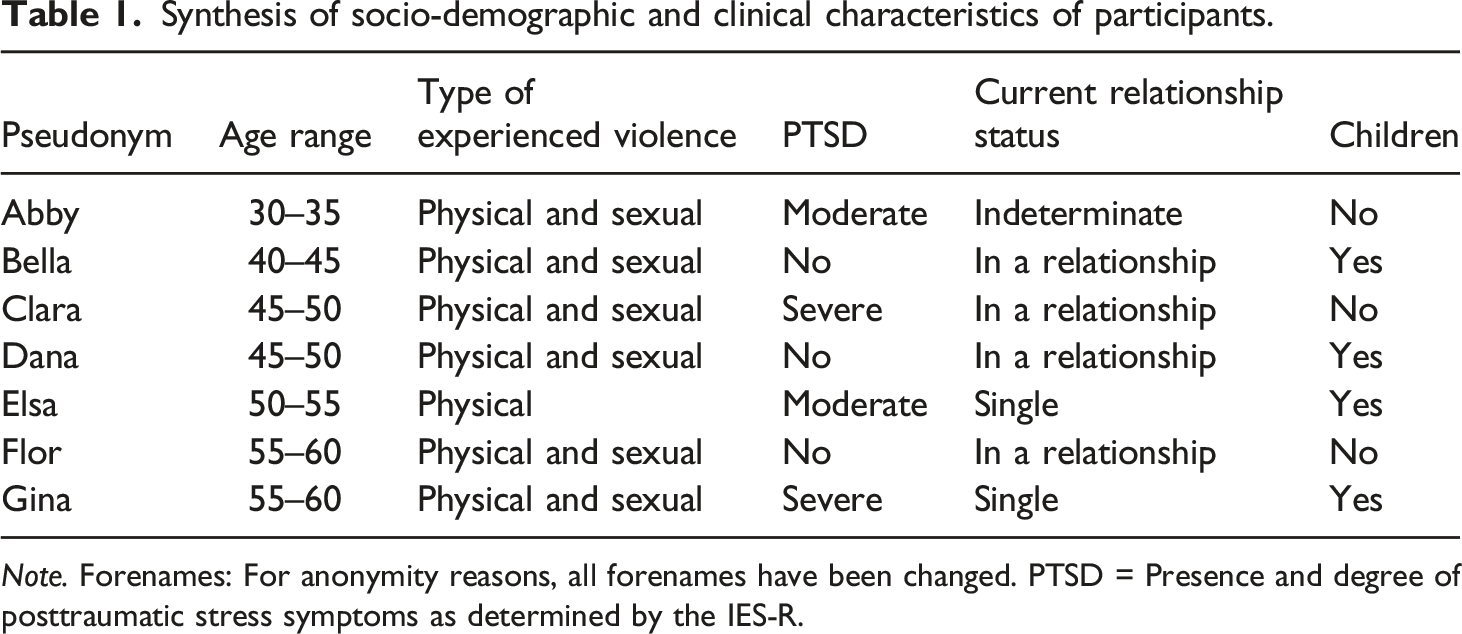
Note. Forenames: For anonymity reasons, all forenames have been changed. PTSD = Presence and degree of posttraumatic stress symptoms as determined by the IES-R.
Data were collected using a semi-structured interview (Clarke & Braun, 2013). The interview grid provided an initial instruction (“What does affectionate touch in general evoke for you?”; see Supplemental Material B), and then addressed four themes focused on the relationship(s) marked by violence: (1) affectionate touch behaviors, (2) thoughts and emotions related to affectionate touch, (3) need for affectionate touch, and (4) affectionate touch and posttraumatic stress symptoms. Participants were prompted to elaborate on these themes through follow-up interventions (Blanchet & Gotman, 2007). Interviews lasted between 41 and 91 minutes, with an average length of 76 minutes.
Procedure
In-depth interviews aimed at exploring accounts on experiences of affectionate touch were conducted among victims of IPV. The interviews were conducted by the fourth author and took place at the association’s premises. Prior to each interview, participants gave written informed consent for participation in the research, and for the audio recording of the interviews. At the end of the interviews, the emotional and psychological state of the participants was assessed by the researcher to ensure that the interview had no adverse effects on the participants. The availability of the referee psychologist to debrief the interview if needed was systematically reminded. All participants signed an informed consent form; the procedure follows the Declaration of Helsinki ethical principles of research on human subjects.
Analyses
Summary of the Main Themes, their Subthemes, Categories, and Sample Contribution.
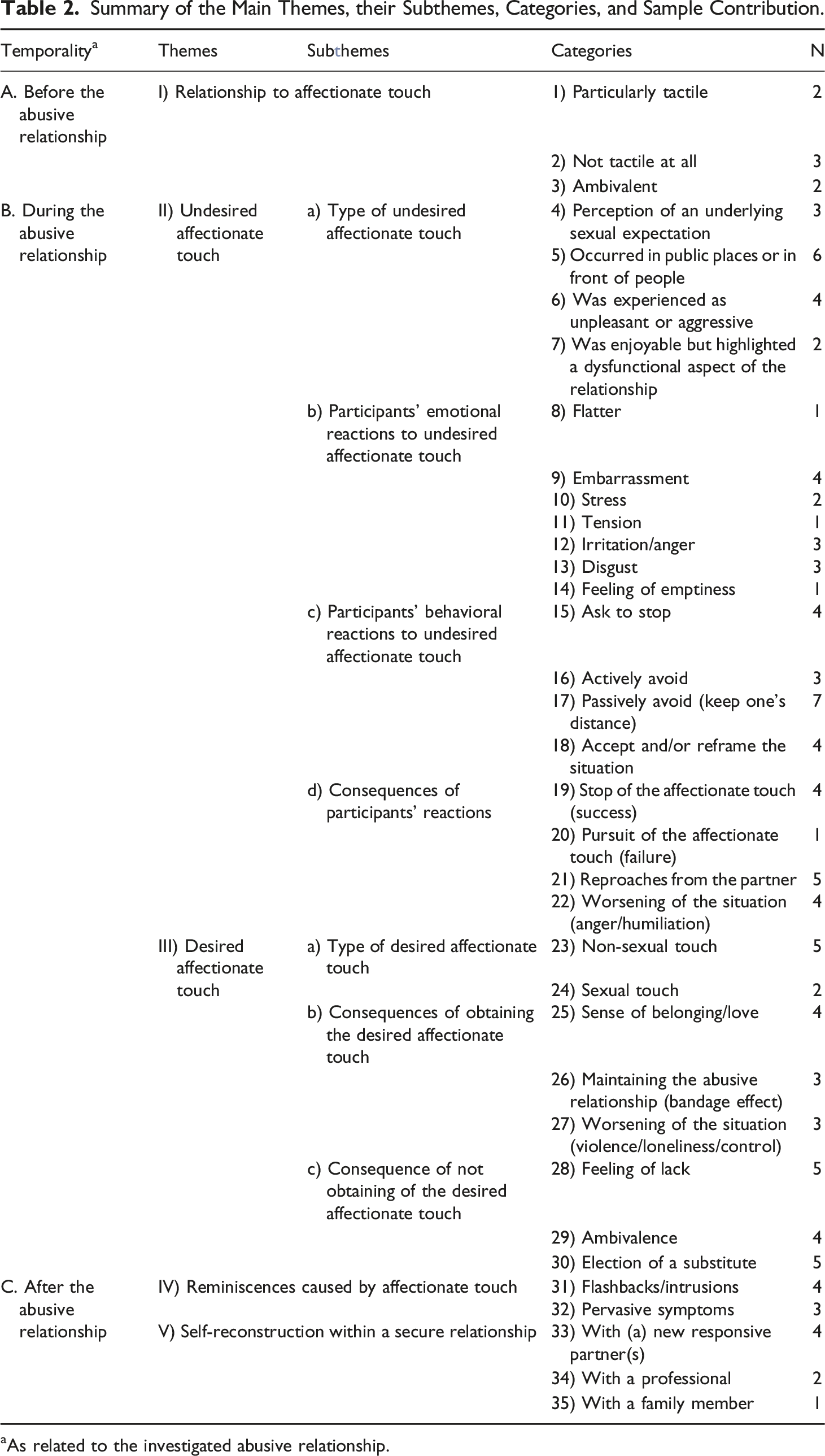
aAs related to the investigated abusive relationship.
Results
The thematic analysis allowed to bring out five main themes: (I) the relationship to affectionate touch, (II) the “undesired” affectionate touch, (III) the “desired” affectionate touch, (IV) the reminiscences caused by affectionate touch, and (V) the self-reconstruction allowed by affectionate touch within a secure relationship. The diachronic restitution of the results led to situate these themes in three temporalities, before, during and after the relationship marked by violence that was under investigation. Table 2 summarizes these five themes, as well as their respective subthemes and categories. In the context of IPV, it is important to note that, per the definition of affectionate touch we rely on (Jakubiak & Feeney, 2017), touch behaviors must not be perceived or experienced as affectionate per se, but it is sufficient that the touch is intended to be affectionate or typically associated with affection (such as a caress).
A. Before the abusive relationship
When participants talked about affectionate touch in general, prior and beyond the experiences within the abusive relationship, they refer to it as a personal preference.
Theme I: Relationship to affectionate touch
The first theme addressed how the women described their preferences regarding interpersonal affectionate touch. For all of them, these preferences were established before the abusive relationship began and continued after the abusive relationship. In this sense, the relationship to affectionate touch is presented as a means of introducing and defining oneself. Accordingly, Bella and Flor 3 spontaneously described themselves as particularly tactile (Category 1), liking, needing, and actively looking for affectionate touch, while Clara, Dana, and Gina unequivocally introduced themselves as “not tactile at all,” and describing their distaste for all kinds of touch (Category 2). For those participants, their relationship with touch appeared as a defining feature of themselves: Well, I’m not a very tactile person […] I’m not someone to hug people or to like being hugged (Clara). For the remaining participants, this definition was less clear and most ambivalent (Category 3), as Elsa described being mostly tactile with some of her family members, but not her friends, and Abby denoted being mainly tactile in her romantic relationships: It’s funny because with my relatives, like, I don’t know, my mother, my sister, my very close friends, I’m not at all tactile, little. On the other hand, as a couple, I am quite tactile. It’s pretty weird. (Abby) 4
B. During the abusive relationship
When affectionate touch is evoked in direct relationship to the experiences lived during the abusive relationship, it had different roles and contributed to several relational dynamics depending on whether it is undesired or desired.
Theme II: Undesired affectionate touch
This second theme addressed how participants perceived negatively certain types of affectionate touch, how they reacted to them and the consequences this had on the relationship. This theme was divided into four subthemes: Types of affectionate touch (Subtheme a), Participants’ emotional reactions to these touch (Subtheme b), Participants behavioral reaction to these touch (Subtheme c), and Consequences of participants’ reaction (Subtheme d).
a) types of undesired affectionate touch
Participants often referred to affectionate touch as a negative experience, and as something undesired within the violent relationship. Further, this meant to participants that their partners were not attuned in terms of the goal of such touch. Several reported that they did not like it when they felt an underlying sexual expectation underlying the affectionate touch (Category 4). Some of them even reported that affectionate touch was always associated with sex: I was rather, “Yes, touch, that’s it! Yes, to do each other good, to reassure each other,” but for him, it was immediately associated with the marital duties. (Gina)
Such gap between partner’s expectations and theirs was also apparent in terms of the ‘appropriate place’ to perform the affectionate touch. For example, almost all participants reported that they did not like it when affectionate touch occurred in public or in front of other people (Category 5), especially because they sensed that this touch was not meant to making them feel loved or cared for: Sometimes, when we were outside, in the middle of a group, and every 2 minutes he came to kiss me, it was really a pain. It was to put himself in the spotlight. (Flor)
Moreover, several participants also said that they did not like certain kinds of touch, namely those that were intended to be affectionate but did not correspond to what participants themselves liked or enjoyed. Consequently, such affectionate behaviors were experienced as unpleasant, inappropriate, disrespectful, or even aggressive (Category 6): I didn’t like it when he tried to touch the breasts, and then he was also basically, he was not a gentle person. It hurt, he wasn’t able to touch me, it wasn’t like “no, like that no!” (Gina)
Two participants talked about how pleasant affectionate touch could also backfire, as it highlighted some dysfunctional aspects of the relationships (Category 7), such as its role in disguising sexual impotence in the case of Flor, or by highlighting the negative spiral of violence in which they were: So, I could put it in the category of pleasant touches as well as unpleasant touches. It goes a little bit in both. It was just after a crisis of violence. It comforted me as it simultaneously put the finger on the fact that I remained in a toxic relationship. It had these two… (Abby)
It should be noted that only one participant did not recall any unpleasant affectionate touch. In this case, it seems that it was more a lack of memories of such touch rather than its lack of occurrence: An [affectionate] touch that generated a negative emotion? [Pause] Yeah, no, I don’t [remember]. Really, it makes you wonder what happened for twenty years. (Dana)
b) Participants’ emotional reactions to undesired affectionate touch
Prompted by the interviewer, the participants detailed their emotional reactions to this undesired affectionate touch. These reactions were diverse in content, but mostly negative in valence. If Bella reported that undesired affectionate touch could be flattering under some circumstances (Category 8), most of the time, the participants reported feelings of embarrassment or uneasiness toward the above-mentioned displeasing types of affectionate touch (Category 9): It was him who came to me, I didn’t like it at all. It was more during the day when you felt, yes, he would need it, he is on hold, but… it made me feel uncomfortable already. At the time, I didn’t like it at all. (Gina)
For some of them, such uneasiness could grow into stress (Category 10), tension (Category 11), or even anger (Category 12): I know, there were times when it made me angry. It was not at all what I wanted and therefore I did not feel taken into consideration at all in fact (Bella). Such negative reactions could also be associated with feelings of disgust toward the partner (Category 13), for example in the following excerpt by Abby: In these touches that gradually change, where one feels the excitement of the other, the sexual arousal rises, well then this: “Bam,” it could give me a kind of thing of hyper-violent disgust (Abby). Furthermore, such undesired affectionate behaviors could leave certain participants with profound feelings of emptiness (Category 14), as Bella described: I had tremendous pain that wouldn’t go away. I felt a huge void so, the more he came, the less it was going. I felt very lonely, so it’s not necessarily an emotion, but uh… yeah a kind of… an immense pain, this time not physical finally because it was something else with a kind of… an emptiness or… not even an emptiness, but something where I wanted to, I don’t know, at the same time I wanted to dive into something and I said to myself, I can’t dive any further because there I don’t see how… So [pause] yeah, actually, I felt inconsolable… (Bella)
c) Participants’ behavioral reactions to undesired affectionate touch
Beyond their emotional reactions, participants were also prompted to explain how their behavioral response to such an undesired affectionate touch. Participants reported using various types of ‘active’ and ‘passive’ strategies. On the ‘active’ side, most of the participants reported having asked their partner to stop touching them (Category 15) or to actively avoid the touch by deploying strategies to escape it or discouraging it (Category 16): I didn’t really want him to stick behind me so uh I pushed him away. (Flor)
Additionally, all participants reported using more “passive strategies,” either keeping their distance from their partner (i.e., passively avoiding; Category 17), or by complying with the touch, sometimes with the help of reframing the situation in a more favorable light (Category 18): I tried to do my best to make it pass and then to convince myself that it will be good or that yes, I like it. (Bella)
d) Consequences of participants’ reactions
The participants then described several possible consequences of their reactions to undesired affectionate touch. Sometimes, their strategies succeeded in making the partner stop to touch them (Category 19). The quote by Elsa portrayed this situation: I froze, then after a while, well, either he gave up, or… well… I knew anyway… There was like something… He tries and then, no, it’s not that… it’s not her… It’s not the one he wanted, so he gave up… It’s as if he had made a mistake, you know…
However, Bella recalled that sometimes these strategies failed and were “useless,” as her partner insisted on touching her anyway (Category 20). It is interesting to note that most participants reported that their attempts at escaping the partner’s touch led their partner to reproach them of a lack of touch (Category 21): So uh, he blamed me for not being tactile, which I have never been criticized for before. He said that all his old relationships were tactile, and I wasn’t. (Flor)
The participants also described that attempts at escaping the undesired affectionate touch could lead to a deterioration of the situation (Category 22) by intensifying the partner’s desire (Bella, Clara), or provoking the partner’s anger (Clara, Flor), and even physical and psychological retaliation, as described by Gina: Because if I start thinking and telling myself, “I’m disgusted, right! I don’t want to, I don’t want!” It froze, and a man, he feels it. It froze and it started with an outburst of anger in him […] He kicks me in bed, I have bruises. I have to go through it, even if I don’t want to. I have to undergo it, because he opens the window at midnight, at two o’clock in the morning, big “My wife does not want to sleep with me!”
Theme III: Desired affectionate touch
The third theme that we captured denoted the presence of positive experiences related to affectionate touch within the relationships marked by violence. These were here described as “desired” affectionate touch. This theme was divided into three subthemes: Types of desired affectionate touch (Subtheme e), Consequences of obtaining this desired affectionate touch (Subtheme f), and Consequence of not obtaining this desired affectionate touch (Subtheme g).
e) Types of desired affectionate touch
Except from Dana who could not remember instances of desired affectionate touch, all the participants recalled occurrences of desirable affectionate touch, which was sometimes actively sought. These types of affectionate touch mostly referred to non-sexual touch (Category 23), such as stroking, kisses, and hugs, which conveyed a feeling of tenderness, affection, and reassurance. For example, Flor recalled: [A type of touch I particularly appreciated was] hugging, kissing, stroking each other’s hair… It is a whole. Unlike most participants, Flor mentioned sexual touch among the desired affectionate touch (Category 24): After touching it, in this relationship… It is true that the sexual aspect is an aspect that has worked the longest, in fact. In fact, that worked well, despite everything else and after, in this relationship.
f) Consequences of obtaining the desired affectionate touch
When the desired affectionate touch occurred in the relationship, most of the participants recalled that it gave them a sense of belongingness and made them feel loved (Category 25). However, although those desired affectionate touch were described as pleasurable, their description is always associated with negative aspects, regardless of whether this type of touch was initiated by them or their partner: [When he expressed his attention through touch] I felt loved, but I think it was wrong. In hindsight, I think it was wrong. That it wasn’t love. (Flor)
In particular, the consequences of such desired affectionate behaviors were depicted as dysfunctional in the long run. This seemed to blur the distinction between the desired and undesired affectionate touch. For example, several participants explained that these types of affectionate touch contributed to maintaining the abusive relationship (Category 26), for example, when it occurred after a burst of violence. Abby coined this effect as affectionate touch playing “the role of a bandage.” Initiating or receiving affectionate touch within the relationships marked by IPV was also described as likely to worsen the situation. In fact, Abby and Gina recalled that such intimate moments could lay the foundation for their partner to engage in psychological (i.e., humiliation) or physical violence (Category 27). Additionally, Bella mentioned that such desired affectionate touch always led to sexual expectations in her partner, and thus contributed to making her feel even more lonely and miserable in the aftermath: No, it was even worse, after all. It didn’t bring what I might have expected… […] In the end, I felt even more alone because I had to know that it would lead to something else and that the demand was different. It wasn’t me he was interested in.
g) consequences of not obtaining the desired affectionate touch
Despite the blurred lines between desired and undesired affectionate touch, participant tended to linger for truly affectionate touch. In fact, when their desire for affectionate touch, whether sexual or non-sexual, was not satisfied, most participants reported a feeling of lack, and of dissatisfaction (Category 28): This lack of touch? How did I feel? It hurts, it just hurts in the bones and nerves, your whole body hurts and I’m still crying now, excuse me [tears in voice]… (Gina)
For Abby, the lack of desired affectionate touch was strongly associated with the feeling of being rejected. However, for some participants, this negative feeling was tinged with ambivalence (Category 29), as experience taught them that nothing good would come out of the satisfaction of this desire in the current relationship: But I was missing this type of relationship where there is nothing at stake, with my husband. That never existed. So yes, I missed it, but no I didn’t miss it because I didn’t want it… It’s a bit ambivalent. (Bella)
Eventually, the dissatisfaction with affectionate touch within the relationship led several participants to look for substitutes (Category 30). Flor engaged in a relationship with a lover “only for [sexual affectionate touch].” Gina, turned to her cats, while other participants looked for such affectionate touch by their children: I probably had less expectation of hugs in the broad sense of the term since there are children, and this proximity, feel the body of the other, all this, one has it with children, one has it. (Dana)s
C. After the abusive relationship
Theme IV: Reminiscences caused by affectionate touch
This theme addressed how participants described the reminiscences they had in the aftermath of their abusive relationship. In most cases, the violent relationship was followed by the experience of reminiscences ranging from the mildest to most severe forms. These could be triggered by several sensory factors (e.g., noises, familiar places, objects), including affectionate touch. In fact, most participants reported that some experiences of affectionate touch (nonsexual and sexual) may have provoked reminiscences related to the violent relationship. The two participants who did not report such experience explain it differently, either because no one touched her anymore (Gina) or because it never happened when affectionate touch was involved (Clara). For the other participants, most of the reminiscences prompted by affectionate touch took the form of flashbacks or intrusions (Category 31), and some of them appear more as pervasive PTS symptoms (Category 32): Yeah, that’s it, it highlights them or there’s something going on, all of a sudden, I overreact because suddenly I tell myself it’s just pressing on a wound and so I’m looking, I look in my memory in which situation I found myself confronted with… uh… I can’t tell you… sometimes it’s either a touch, indeed, clumsiness, I don’t know a particular gesture, but not necessarily ugly, it can also be benevolent, but in the same configuration. (Dana) E: It was the fact, the hand [of my colleague to kiss me] was heavy, I had a feeling of crushing. That feeling of being fixed there… and I couldn’t move. I: And this feeling brought you back to this relationship? E: Yes, because I felt… Sometimes I felt as if I was a bit of a prisoner, even in my own house… (Elsa)
Theme V: Self-reconstruction within a secure relationship
Finally, the fifth theme described how the participants considered that affectionate touch played a positive role in their reconstruction process following their relationship marked by violence. Through the analyses, it appeared that affectionate touch could contribute to the reconstruction of the person following the violent relationship, when it took place under secure conditions. For most of the participants, this was only possible when they started a relationship with a new partner who was respectful and responsive (Category 33). This was notably the case of Clara: In this new relationship, […] I realized uh… how much is it… It felt good, really that he took me in his arms and that it was super comforting and supportive. That, I had never experienced it and I thought it did not suit me, besides. That I might be struggling, well that it was not going to suit me and in fact, it suits me…
Bella even described this as a “rediscovery of my presence and my existence through a touch” with a new lover. She also associated this newness of touch, and this self-reconstruction process to the help provided by a professional masseuse. Similarly, Gina reported a positive and transformative experience with a professional (Category 34) when her yoga teacher hugged her for her birthday. Eventually, Gina also reported that she discovered being very responsive to the affectionate touch of her daughter-in-law who is a tactile person (Category 35): Yes, and now yes, and I am very sensitive. You know, I’m very sensitive to touch now. When the daughter-in-law kisses me, yes, a feeling of well-being, but at the same time of guilt.
Discussion
This study aimed to investigate experiences of affectionate touch through semi-structured interviews with women victims of IPV. Using thematic analysis, we highlighted five main themes that were presented in their relative temporality to the abusive relationship.
It first appears that, when prompted to describe what affectionate touch mean to them in general, the participants defined themselves through how they generally approach affectionate touch, independently of the abusive relationship (Theme I). No general tendency could be highlighted, as some defined themselves as very tactile, others as not tactile at all, and others as ambivalent regarding affectionate touch, as is the case in other populations (see for ex. Burleson et al., 2019; Wilhelm et al., 2001). This mirrors Trotter and colleagues’ (2018) research showing high variability in the attitudes toward affectionate touch, and low correlations between physical and sexual abuse and attitudes toward touch in general in adulthood.
Secondly, throughout the interviews, it appears that most violent relationships are characterized by the presence of undesired affectionate touch (Theme II). Although sometimes associated with unpleasant or aggressive experiences, such affectionate touch is mostly described as undesired first regarding the underlying motive (i.e., sexual expectations). Previous research indicates that the motives for which touch is performed significantly affect the relational well-being of both the giver and receiver (Jakubiak et al., 2021). Second, the context in which it occurs (i.e., inappropriate places) is also another frequent reason for experiencing touch as undesired. The latter might indeed reflect a display of power rather than affection. Correspondingly, based on Henley’s (1973) theory on dominance through touch, several studies showed that unreciprocated touch communicates dominance (e.g., Goldberg & Katz, 1990; Hall et al., 2005; Summerhayes & Suchner, 1978). To our knowledge, this is the first study to show such processes in romantic relationships. This consideration highlights a possible limitation of referring to the current definition of affectionate touch (e.g., Jakubiak & Feeney, 2017) in the context of IPV, as it relies on the interpretation of the touching person’s intention, notwithstanding its actual impact.
Attempts to passively avoid the undesired touch represents the most common participant’s reaction. Victims of physical or sexual trauma in childhood and adulthood tend to avoid interpersonal touch in daily life (Hurd, 2018; Schellenger, 2015), and this significantly more than people who did not experience such trauma (Muffly & Gerney, 2015). Within romantic relationships, such passive and non-verbal avoidant behaviors are akin to what Kim et al. (2020) describe as deflective strategies within their taxonomy of rejection behaviors of partners’ sexual advances. In their non-distressed couples’ sample, deflective strategies were associated with lower sexual satisfaction when they occurred along with hostile rejecting behaviors. However, within our sample, these avoidant strategies were rarely described as effective, and often portrayed as leading to negative outcomes such as reproaches or escalation. This indicates that interactions in IPV relationships might be more sensitive in general, especially to (sexual) rejection behaviors, which can then trigger violent behaviors. Previous research demonstrated that rejection sensitivity predicts not only IPV perpetration (Downey et al., 2000) but also victimization (Inman & London, 2022). As a potential consequence of this sensitivity, our participants only rarely reported assertive rejection behaviors, probably to try and avoid escalation.
A less obvious idea revealed here is that IPV relationships are largely characterized by a longing for desired touch (Theme III; especially non-sexual touch but also sexual). Per Strauss et al. (2019), in their clinical experience, patients who experience physical or sexual trauma often report ambivalence regarding affectionate touch, whereby they both avoid and long for affectionate touch. This resembles what Johansson (2013) observed among people describing themselves as touch avoidant; despite it, they display a high need for bodily intimacy with their romantic partner. Moreover, women with experiences of sexual or physical abuse in adulthood have reported both wanting more affectionate touch from their romantic partner and being more unsatisfied with their partner’s affectionate touch than women without such abuse (Schellenger, 2015). However, our results reveal that the appreciation of the desired affectionate touch with the violent partner is mostly described as detrimental in the long run (e.g., maintaining or aggravating the abusive relationship), even though it might hold some short-term advantages (e.g., conveying a sense of attractiveness or belonging).
It should be noted that IPV is characterized by cyclical patterns of behaviors, starting with gradual escalation of minor incidents in the relationship (tension building phase), leading to violent verbal and physical behaviors (acute battering phase), followed by apologies, and caring by the perpetrator and forgiveness of the victim (honeymoon phase; L. E. Walker, 1977). All our participants were no longer in the violent relationship, but it is hence possible that our participants’ relationship to touch during the abusive relationship might have varied depending on the phase they were in. Accordingly, most participants in the present study reported the need for tactile substitutes (such as animals, children, or other lovers) during the IPV relationship. This supports the nature of affectionate touch as a universal need (see for ex. Cascio et al., 2019; Field, 2002).
Another interesting finding is that, although most participants reported no (n = (3) or moderate (n = (2) degree of posttraumatic stress symptoms on the standardized assessment, almost all of them referred to affectionate touch as a potential trigger for traumatic reminiscences (Theme IV). This is consistent with Strauss et al.’s (2019) study, indicating that interpersonal touch (there enacted by the experimenter) can prompt the reminiscence of traumatic events.
Finally, our study highlights that positive interpersonal touch can also contribute to the recovery of IPV victims, once they are no longer in the violent relationship (Theme V). This mirrors the literature highlighting the beneficial impact of affectionate touch to buffer stress in the general population (e.g., Coan et al., 2017; Ditzen et al., 2019) and to foster intimacy and security within romantic relationships (Debrot et al., 2013; Durbin et al., 2021; Jakubiak & Feeney, 2016b). Our participants emphasized the necessity of being in a secure relationship to get these benefits. This further support research showing that touch is only or mostly beneficial in high quality relationships (e.g., Jakubiak, 2022). Similarly, in another study, women who had a history of sexual trauma but were currently then in healthy sexual relationships underlined how it was important to feel secure in the relationship to be able to voice one’s desires and needs, and how evolving such a process is (Mark & Vowels, 2022).
Strengths and limitations
The present study investigated an innovative research topic conducted among an understudied and difficult-to-access population. It offers a complementary and unique view on the role of affectionate touch in romantic relationships by investigating it in an underrepresented population in relationship research, namely those in low-functioning and violent relationships (see Barton et al., 2020). However, the study also presents some limitations. The sample was small and only composed of women who had received psychological support regarding their past IPV at a particular location. Results might thus differ based on gender, on whether people have received psychological support regarding their IPV experiences and on the timing of the interviews. Moreover, we only assessed one partner of the violent relationship, thus having only part of the story. Even though this would represent a challenge, future research could be conducted based on interviews with both partners of (former) couples marked by IPV. Additionally, all participants had ended the IPV relationship, and we failed to assess how much time has passed since the separation. Future research could longitudinally assess how the perception of affectionate touch evolves over time, before and after ending a violent relationship.
Implication for research
Investigating for the first time the experience of affectionate touch with IPV victims, this study opens important questions and promising research avenues. First, one could test the hypothesis that affectionate touch contributes to perpetuating the known repetitive cycle of violence and reconciliation in relationships characterized by IPV (see for ex. Daligand, 2019; L. E. Walker, 1977). Secondly, we noted that several participants did not make a clear distinction between sexual and nonsexual touch behaviors. Previous research showed that they are overlapping yet distinct types of behaviors (van Anders et al., 2013). It would be interesting to know if victims of IPV tend to differentiate affectionate from sexual behaviors to a lesser extent than non-victims. However, it should be noted that research with such a vulnerable population is delicate and requires to follow strict ethical considerations. In the present case, the interviews took place in the facilities where the participants had already received psychological support, thereby facilitating trust and openness. However, two participants reported feeling bad after the interview, highlighting the importance of offering adequate psychological support for participants to such studies. Moving further in this direction could then involve studying couples with a low relationship functioning, but without violence. Eventually, future research investigating the experience of affectionate touch with IPV victims should explore the possible impacts of race, ethnicity, and socio-economic factors. In fact, these variables were already found to influence both women’s risk of being exposed to IPV (Ince-Yenilmez, 2022), and help seeking behaviors (Lipsky et al., 2006).
Clinical implications
These results hold important implications for counselors and other caregivers of women victims of IPV. First, given the highlighted beneficial effect of affectionate touch in a new romantic relationship, working on bodily sensations and awareness through massage and acupressure could be a meaningful home assignment for couple therapy when the victim is in a new and healthy relationship (see Schellenger, 2015). Such assignments have already proven beneficial in an all-comer population (Holt-Lunstad et al., 2008). Second, the simultaneous presence of undesired affectionate touch and of nefarious consequences of desired affectionate touch within IPV relationships suggests that touch experiences can be a meaningful topic to explore within therapy, especially when affectionate touch also appears as a trigger for traumatic reminiscences. This might be particularly important to have in mind, as most of our participants indicated having never talked or even thought about affectionate touch in their relationships, even after receiving psychological support. Third, the benefits of affectionate touch for the recovery process mentioned by the participants imply that holistic care that includes the body may be helpful for women victims of IPV. In fact, body therapy, which combines body work (i.e., massage, body awareness exercises, and inner body focusing processes) and the emotional processing of psychotherapy, appears as effective to foster physical and psychological well-being, as well as body connection (Price, 2005, 2006), and reduce dissociation symptoms (Price et al., 2007) for women who experienced abuses and violence.
However, such kind of therapy might generate resistance. Participants who rated themselves as touch avoidant indicated that they were repelled by the need to get undressed to receive a massage, while also considering that this could be an interesting avenue to learn to appreciate being touched (Johansson, 2013). For IPV victims who are neither in a trusting relationship nor comfortable with getting professional massages, animal-assisted therapy appears as a promising alternative. Indeed, in both the present study and Johansson’s (2013), some participants reported fulfilling their need for affectionate touch with animals. Moreover, animal-assisted therapy already demonstrated promising results for the treatment of PTS symptoms in children who experienced sexual abuse (e.g., Signal et al., 2017).
Conclusion
This study investigated the perception of affectionate touch in female victims of intimate partner violence. Results show an ambiguous relationship to affectionate touch during the violent relationship, including both strategies to avoid undesired types of touch and strategies to obtain a desired type of affectionate touch. Furthermore, the results stress the importance of affectionate touch for the recovery process and suggest that it could be a meaningful topic to investigate in therapy, as well as a possible therapeutic channel. Affectionate touch in relationships marked by violence appears as an understudied phenomenon which deserves more attention from both research and practice.
Supplemental Material
Supplemental Material - Accounts of interpersonal touch in female victims of intimate partner violence: A qualitative study
Supplemental Material for Accounts of interpersonal touch in female victims of intimate partner violence: A qualitative study by Anik Debrot, Shékina Rochat, María del Río Carral, Prisca Gerber, Oriane Sarrasin, and Fabrice Brodard in Journal of Social and Personal Relationships
Footnotes
Declaration of conflicting interests
The author(s) declared no potential conflicts of interest with respect to the research, authorship, and/or publication of this article.
Funding
The author(s) received no financial support for the research, authorship, and/or publication of this article.
Open research statement
As part of IARR’s encouragement of open research practices, the authors have provided the following information: This research was not pre-registered. The anonymized transcripts of the interviews used in the research cannot be publicly shared given the information provided in the informed consent form to the participants but can be obtained by emailing:  or by emailing:
Supplemental Material
Supplemental material for this article is available online.
Notes
References
Supplementary Material
Please find the following supplemental material available below.
For Open Access articles published under a Creative Commons License, all supplemental material carries the same license as the article it is associated with.
For non-Open Access articles published, all supplemental material carries a non-exclusive license, and permission requests for re-use of supplemental material or any part of supplemental material shall be sent directly to the copyright owner as specified in the copyright notice associated with the article.
