




Abstract
This article presents two experimental studies investigating the impact of language errors in online dating profiles on impression formation. A first study examined whether language errors have a negative effect on perceptions of attraction and dating intention and whether this effect is moderated by the presence of visual information, that is, the profile picture. This 2 (Language Errors/No Language Errors) × 2 (Visible/Blurred Picture) experiment revealed that language errors negatively affect perceptions of social and romantic attraction and that a visible picture on a profile positively affects perceptions of physical attraction. Study 2 focused on mechanical, rule-based, and informal language errors, which can each be attributed to different personality traits. Mechanical and rule-based errors lead to lower scores on, respectively, perceived attentiveness and intelligence, which in turn lead to lower attraction and dating intention scores. These results highlight the importance of error-free language use as a cue for attractiveness.
Forming an accurate impression of someone’s attractiveness and romantic potential is paramount in the initial stages of online dating. To form these impressions about others, people use whatever cues are available to reduce uncertainty (Hancock & Dunham, 2001). In online dating, people form first impressions based on the cues that are available on the dating profile. Usually, such a profile consists of both pictures and a textual description of the profile owner, and both have been shown to shape daters’ impressions of overall attractiveness and romantic appeal (Fiore, Taylor, Mendelsohn, & Hearst, 2008).
Earlier research has highlighted the importance of profile pictures in dating profiles on attraction (e.g., Hitsch, Hortaçsu, & Ariely, 2010; Whitty, 2008), while the effect of the profile text on perceptions of attractiveness has been relatively understudied. The textual component, though, may be especially relevant in forming impressions because it does not only contain cues that people intentionally construct but also contain cues that people unintentionally give off (Ellison, Heino, & Gibbs, 2006). Examples of such unintentional cues are language errors, typographic characteristics (Lea & Spears, 1992; Walther & D’Addario, 2001), message length (Donath, 1999), and last login date (Ellison et al., 2006). Such cues have high warranting value because they are provided unintentionally and may therefore be useful for obtaining a more accurate impression of the profile owner’s actual self (Walther & Parks, 2002; Wotipka & High, 2016). Regarding dating profile texts, such implicit cues are considered to be equally or even more important for impression formation than the explicit content due to their high warranting value (Ellison et al., 2006).
Language errors may be one such cue that is given off and therefore have high warranting value. Language errors convey information that can strongly affect impressions and can help to make inferences about the profile owner (Ellison et al., 2006; Sharabi & Dykstra-DeVette, 2019). Research on written texts in other online environments, such as housemate e-mail advertisements (Queen & Boland, 2015), direct mail letters (Kloet, Renkema, & van Wijk, 2003), and product feedback comments (Stiff, 2012), has shown that in general texts with language errors are rated more negative than texts without errors. Moreover, these studies have shown that errors negatively affect perceptions about others’ cognitive and intellectual abilities, level of education, or attentiveness. Different types of language errors could affect these perceptions differently. For example, whereas mechanical language errors (e.g., typographical errors) tend to be associated with writers’ attentiveness and lack of interest, rule-based errors (e.g., grammatical and spelling errors) are attributed to writers’ competence and intelligence (Kreiner, Schnakenberg, Green, Costello, & McClin, 2002; Queen & Boland, 2015).
Thus far, the effect of language errors on impression formation has not been investigated in an online dating context and particularly not in a naturalistic online dating context with a large sample of actual dating site users. Since most online daters search for a partner who is intelligent, competent, and attentive (Ellison et al., 2006; Whitty, 2008), it is likely that they use cues tied to these attributes to develop impressions. Although online daters indicate that cues given off, such as language errors, are important for impression formation (Ellison et al., 2006), little online dating research has focused on how such unintentional cues affect impression formation. To that end, this article presents two studies in which dating site users read fictitious dating profiles with and without language errors and then rate profile owners’ attractiveness.
The goal of the first study is to determine whether language errors in online dating profile texts affect perceptions of attraction and dating intention. The profile picture and profile text being the two most important components people use in impression formation (Fiore et al., 2008), this study investigates to what extent (a) language errors in dating profiles affect perceptions of the profile owners’ attractiveness and (b) whether these effects persist when visual cues in the form of profile pictures are added to the available cues on the profile.
The goal of the second study is to gain a better understanding in how different types of language errors may affect impression formation. Different language error types can be tied to different personality attributions (e.g., Kloet et al., 2003; Kreiner et al., 2002; Queen & Boland, 2015). Perceptions of these attributions could, in turn, affect a profile owner's perceived attractiveness. In a second study, we therefore investigate the extent to which mechanical, rule-based, and informal language errors affect a profile owner’s attractiveness and whether attentiveness, intelligence, and warmth mediate the relationship between language error type and perceptions of attractiveness and dating intention.
Study 1: Effects of language errors and profile picture visibility
On dating profiles, a limited number of cues are available to form impressions about a potential romantic partner, especially compared to the number of cues available during traditional face-to-face dating (Rosen, Cheever, Cummings, & Felt, 2008). In situations with reduced cues, people try to gather enough social information to be able to form reasoned impressions (Sharabi & Dykstra-DeVette, 2019). According to the uncertainty reduction theory (URT) (Berger & Calabrese, 1975), people have an aversion against uncertainty and try to reduce uncertainty using all available cues to acquire enough information. One of the uncertainty reduction strategies that online daters employ is to seek out cues that give off unintended information in addition to cues that are consciously employed to self-present (e.g., Gibbs, Ellison, & Lai, 2011; Wotipka & High, 2016). Since cues given off are more likely to convey information about the profile owner’s actual self, the warranting value of such cues is high (Walther & Parks, 2002). The higher the warranting value of a cue, the higher the impact of this cue on impression formation.
As language errors are likely to be made unintentionally, they may constitute cues with high warranting value and are therefore useful to reduce uncertainty and form impressions. Following language expectancy theory (Burgoon & Miller, 1985), people develop expected norms as to what language use is appropriate in a specific context. In the context of online dating, even though online language use is considered to be a rather informal genre, dating profiles without language errors are still the norm and so expected (Ellison et al., 2006).
When language expectations are violated in a text, this often results in negative perceptions and attitudes toward the text, the writer of the text, and the writer’s expected cognitive abilities and work ethics (e.g., Figueredo & Varnhagen, 2005; Kloet et al., 2003; Stiff, 2012). For example, a study of Queen and Boland (2015) in which participants evaluated short e-mail responses to a housemate advertisement with or without language errors showed that errors negatively affected readers’ evaluations about the writer’s academic and social skills. A reason for this negative effect is that people associate errors with negative attributes, such as writers being inattentive, clumsy, or ignorant. A qualitative study by Ellison, Heino, and Gibbs (2006), based on telephonic interviews, revealed that online daters perceive language errors in profiles as negative, as it can be indicative of a lack of education or interest in putting time and effort in constructing a profile (text). These negative attributes associated with errors are, in turn, interpreted as important signals that may influence perceptions of attractiveness. We therefore pose the following hypothesis.
Language errors may especially play a role in impression formation when other impression formation cues are absent. Social information processing theory (SIP; Walther, 1992) argues that, in the absence of specific cues that people normally use to form impressions of each other, people turn to the cues that are available and rely on those cues more heavily. Previous research has shown that visual cues, or more specifically profile pictures, influence users’ perceptions of the profile owner to a large extent (Fiore et al., 2008). When visual information about a profile owner’s physical appearance is hidden, people’s focus may shift to other profile components and they have to use these cues to form impressions. This has prompted several dating platforms to initially show dating profiles without pictures or with blurred pictures.
1
In cases of unrevealed pictures, online daters are likely to be more attentive to and rely more on errors in profile texts when forming impressions, which can amplify their negative perceptions about the profile owner. We therefore pose the following hypothesis.
Method
Ethical clearance for data collection was obtained in fall 2018 by the Ethics Committee of the Tilburg School of Humanities and Digital Sciences. To support transparency, rigor, and reproducibility in science (Nosek, Ebersole, DeHaven, & Mellor, 2018), this study was preregistered on the Open Science Framework. The research design, hypotheses, and analysis plan can be found at: https://osf.io/w64mu. 2
Participants
To collect data, we collaborated with Parship, one of the largest online dating sites in the Netherlands, for which everyone can sign up. On this dating site, it is customary that profiles initially show only blurred pictures. Once site users agree upon mutual interest, they are able to unblur and reveal their pictures to each other. Parship assisted by recruiting participants via an e-mail that was sent to all members who had been active on the site the last three months. Participation was on a voluntary basis. Parship was not involved in any further aspects of the study, such as the experimental setup or study outcomes.
Participants who indicated being bisexual or did not want to disclose their sexual preference could not be assigned to a condition and were therefore excluded from participation. Only data from those who completed the entire experiment were included for analyses, which resulted in a total of 373 participants. All participants were 18 years or older (M = 55.6, SD = 11.5) and were native speakers of Dutch. From those participants, 52.5% indicated to be men, 66.7% had a college degree, and the other 33.3% had a vocational or high school level degree. The participants in this study were mostly older adults, while anyone over 18 can become a Parship member. Our sample may therefore not perfectly mirror the site’s overall user demographic.
At the end of the experiment, participants were asked to indicate whether they noticed language errors in the two profiles they had been presented with. From the 373 participants, 125 (33.5%) reported to have noticed errors, while 248 (66.5%) indicated not to have noticed errors or were not sure.
Design and procedure
The experiment had a 2 × 2 design, with language errors (language errors/no language errors) as within-subject variable and profile picture (visible/blurred picture) as between-subject variable. Participants were presented with profiles that matched their indicated sexual preference, that is, male or female profiles with corresponding pictures and textual references (“love of his/her life”). Figure 1 presents two examples of original profiles in Dutch that were part of the experimental material presented to the participants and translations of the profile texts in English.
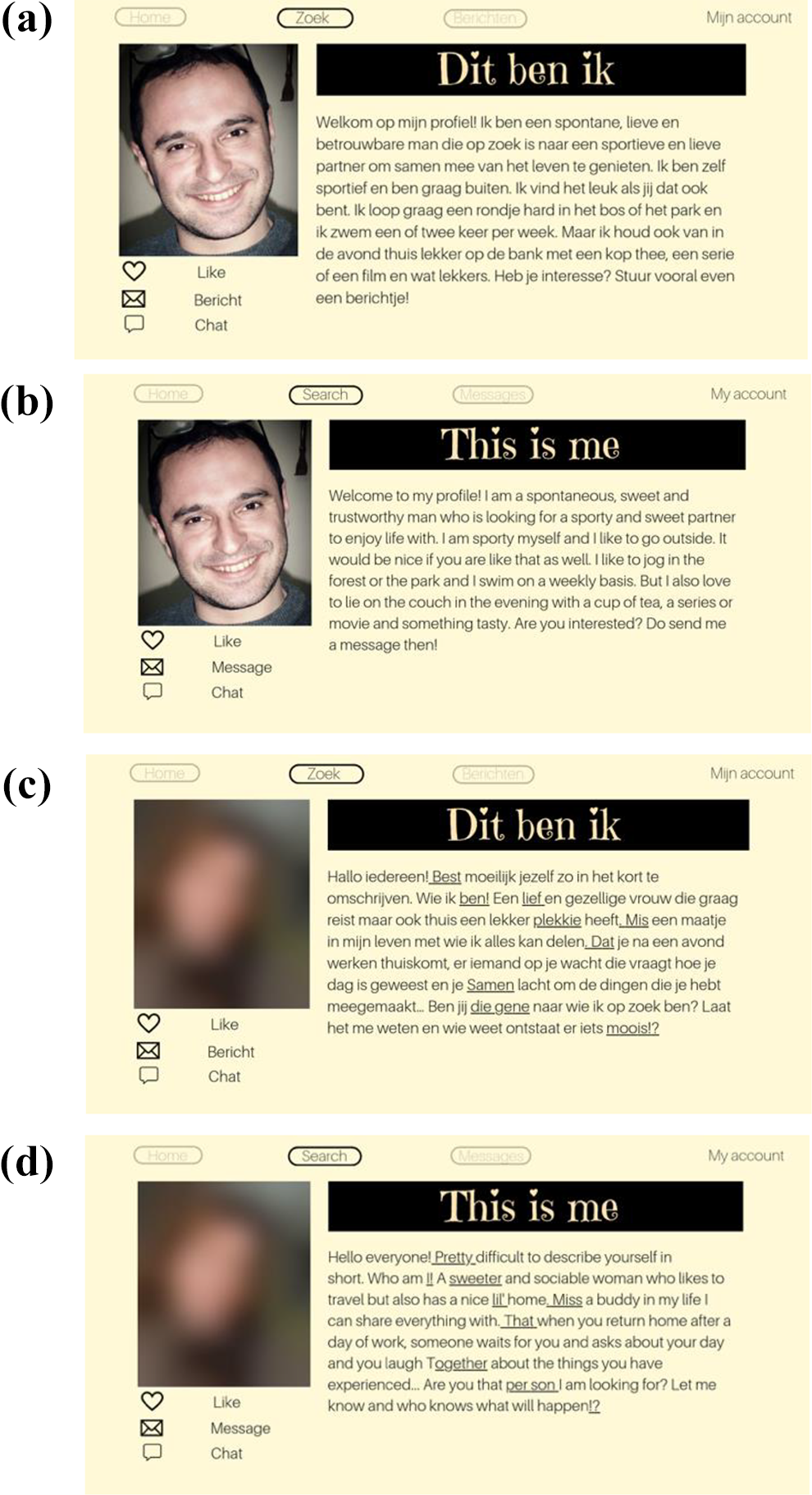
Examples of the original Dutch dating profiles used for the experiment (a, c) and translated English versions (b, d). Profiles (a) and (b) are male profiles with a visible picture and without language errors, and profiles (c) and (d) are female profiles with a blurred picture and with language errors. Note. Language errors are underlined here, but not in the profiles presented to participants.
The experiment was conducted online and took approximately five minutes to complete. First, participants were welcomed, informed, and gave informed consent. Then, some demographic questions were answered and participants were randomly assigned to the visible or blurred profile picture condition. Subsequently, they were presented with a fictitious profile, either with or without language errors, and with a blurred or a visible picture dependent on the assigned picture condition. To assess how well participants examined the profiles, they answered two questions about each profile’s content. These were followed by their ratings on the dependent variables. After the first profile, participants were presented with a second dating profile, with a randomly different profile text, now in the other error condition (i.e., if they had first seen a profile without errors, they now would see one with errors and vice versa), and the same procedure was followed.
To make sure physical attractiveness of profile owners would not influence overall participants’ perceived attractiveness too strongly in the main study, a pretest was conducted to identify pictures of two men and two women of average attractiveness to use in the main experiment. If physical attractiveness of the profile owner would be too extreme (either too high or low), this could obscure any effects of language use. Ten pictures depicting a man and ten depicting a woman, ranging in expected attractiveness, were preselected from a free stock image site. All photos were free to use and licensed under creative commons. None of the 107 participants who took part in the pretest (47.7% men) participated in the main study. Participants scored the attractiveness of the depicted people of their preferred sex on a 10-point scale. The two pictures around the median (i.e., those rated as fifth and sixth in terms of attractiveness) were selected for the profiles in the main experiment. The same four pictures were blurred for the blurred picture condition.
The four profile texts constructed for this study differed in content, each containing seven or eight sentences and ranging between 92 words and 101 words. The texts were based on existing profiles (Van der Zanden, Mos, & Schouten, 2018) and were kept relatively neutral to avoid that participants would be too repelled or attracted by specific interests, such as a preference for death metal music or being vegan. Except for one gender-specific word (e.g., ‘woman’, ‘his’), the texts were identical in content for men and women.
In the language error condition, the texts contained ten errors that were evenly distributed throughout the text and reflected the proportional use of different types of errors observed in a corpus analysis with authentic profile texts (Van der Zanden et al., 2018). Examples of sentences with language errors included in the texts are (translated from Dutch, errors underlined here for clarity reasons): “I just feel like I want to
Measures
All six dependent and control variables were measured on a scale from 1 (completely disagree) to 7 (completely agree). The used items were predominantly derived from existing scales, with the wording translated and slightly adjusted to fit our experiment.
Perceived attractiveness of the profile owner was measured by four determinants: physical attraction, social attraction (McCroskey & McCain, 1974), romantic attraction (Campbell, 1999), and dating intention. Example items include “I think this person is good-looking” for physical attraction, “I think this person and I could be friends” for social attraction, “I would not want to have a relationship with this person” (reverse-coded) for romantic attraction, and “I would like to know more about this person” for dating intention. The nine items of attractiveness formed a two-dimensional scale with social and romantic attractiveness as one factor with a Cronbach’s α of .82, and physical attractiveness as the other (Cronbach’s α = .92). The three items of dating intention were considered as one factor (Cronbach’s α = .87).
Analysis
To analyze the data, linear mixed-effect models were conducted in SPSS. The individual profile assessments served as the unit of analysis. As each participant assessed two profiles, there were two cases for each participant. To control for the nonindependence between cases, participants were treated as a random factor in the design. 3 Fixed factors were profile picture visibility and language error presence and the outcome variables the ratings on social-romantic attractiveness, physical attractiveness, and dating intention. Whether the questions about the text’s content were answered correctly or incorrectly was included as a covariate. The denominator degrees of freedom are obtained by a Satterthwaite approximation.
Results
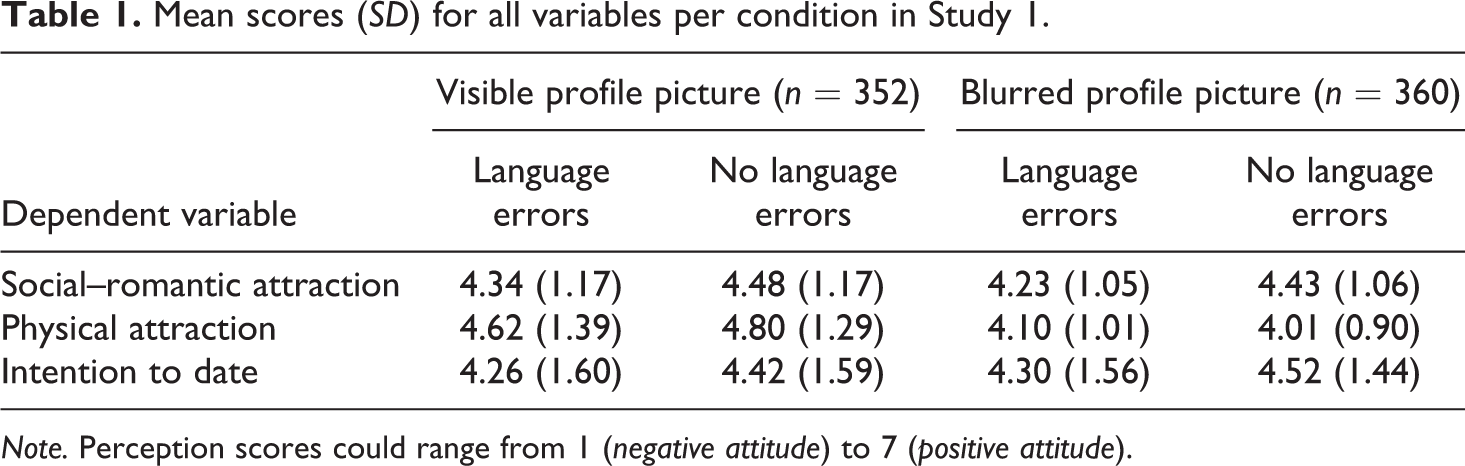
The means and standard deviations for the three dependent variables can be found in Table 1.
Mean scores (SD) for all variables per condition in Study 1.
Note. Perception scores could range from 1 (negative attitude) to 7 (positive attitude).
Profile owners with profile texts with language errors (M = 4.29, SD = 1.12) are rated as less socially and romantically attractive than profile owners with texts without errors (M = 4.45, SD = 1.12), F(1, 370.27) = 5.15, p = .024, d = .15. No main effects of errors on physical attractiveness, F(1, 372.16) = 0.37, p = .543, and dating intention, F(1, 371.12) = 3.72, p = .054, were obtained. Results show that H1, stating that profile owners with errors in profile texts would be rated lower on attraction and dating intention than profile owners without errors in their profiles, was confirmed for social-romantic attractiveness, but not for physical attractiveness and dating intention.
A main effect of picture visibility on physical attractiveness, F(1, 371.23) = 48.83, p < .001, d = .56, showed that profile owners with visible pictures (M = 4.71, SD = 1.34) are perceived as physically more attractive than those with blurred pictures (M = 4.06, SD = 0.96). For social-romantic attractiveness and dating intention, no main effect of picture visibility was found (with both F’s < 0.83 and p’s > .364).
For none of the three dependent variables, any significant interaction effects of language errors and profile picture visibility were found, with F’s < 3.04 and p’s > .08. 4 This means that H2 was not confirmed, as the negative effect of errors on perceived attractiveness perceptions and dating intention was not stronger when a profile includes a blurred picture than when it includes a visible picture.
Because only a third of the participants indicated to have noticed errors in the profiles, we also ran linear mixed-effect models with those who noticed the errors versus those who did not, added as an extra fixed factor. There was a significant interaction effect of language errors and error noticing for social-romantic attractiveness, F(1, 370.65) = 11.85, p = .001. Pairwise comparisons using least significant difference (LSD) adjustments showed that participants who noticed errors in the profiles gave lower social-romantic attractiveness scores when a profile included errors (M = 3.91, SD = 1.15) than when it was free of errors (M = 4.43, SD = 1.27), F(1, 370.81) = 17.15, p < .001, d = .43, while participants who did not notice them or were not sure gave similar social-romantic attractiveness scores to profile owners with (M = 4.47, SD = 1.05) and without errors (M = 4.46, SD = 1.04) in their profiles, F(1, 369.90) = 0.01, p = .912.
While the interaction effect of language error condition and error noticing was not significant for physical attraction, it was for dating intention, F(1, 371.47) = 11.51, p = .001. Pairwise comparisons showed a similar pattern for dating intention as for social-romantic attractiveness. Participants who noticed errors gave lower dating intention scores to profile owners with errors (M = 3.77, SD = 1.61) than to those without errors (M = 4.42, SD = 1.60) in their texts, F(1, 371.63) = 15.26, p < .001, d = .40, while participants who did not notice them or were not sure gave similar dating intention scores to profile owners with (M = 4.54, SD = 1.50) and without errors (M = 4.49, SD = 1.48), F(1, 370.74) = 0.13, p = .722.
Conclusion Study 1
The first study investigated whether language errors in a profile text negatively affect daters’ perceptions about the profile owner’s attractiveness and their intention to date the profile owner. Our findings reveal that profile owners with profile texts containing errors were evaluated as less socially and romantically attractive by participants than profile owners without errors in their profiles. Further analyses showed that this effect was caused solely by the one third of participants who noticed the errors. Apparently, most people do not observe language errors in online dating profiles, but for those who do, the errors severely damage the profile owner’s dating potential.
With regard to attraction and dating intention, we expected to find interaction effects of language errors and profile picture visibility. It was hypothesized that the negative effect of errors would be stronger when a profile contains a blurred picture than when it contains a visible picture. In contrast to H2, no interaction effects were found for both dimensions of attraction nor for dating intention. The lack of visual information does not increase attentiveness to and importance of textual cues. Results did show that profile owners with visible pictures are perceived as physically more attractive than those with blurred pictures, whereas profile picture visibility did not affect ratings on social-romantic attraction and dating intention. It seems to be the case that language errors and picture visibility influence separate dimensions of attractiveness (i.e., social-romantic and physical attractiveness, respectively), which explains the absence of any interaction effects.
Study 1 showed that, overall, language errors negatively affect perceptions of social-romantic attractiveness, regardless of the profile picture’s visibility. However, in this study, we adhered to a formal definition of language errors, that is, anything that violated conventions on standard, formal written Dutch. This results in profiles containing a broad range of rather diverse language errors that reflect the wide error distribution of authentic dating profiles (Van der Zanden et al., 2018). The variation of errors in the experimental materials of Study 1 gives little insight into whether particular types of errors affect impression formation differently. Earlier research has suggested that this might be the case (e.g., Kreiner et al., 2002; Queen & Boland, 2015).
Study 2: Effects of different language error types
To obtain a clearer understanding on how language errors affect impression formation, a second study was conducted, in which we manipulated specific types of errors and investigated their effects on perceived attraction and dating intention. This study focused on three language error types: mechanical, rule-based, and informal language errors. All errors included in the profiles of Study 2 correspond with one particular error type. By constructing profile texts that each contained only one error type, it could be determined whether particular personality attributions that are associated with certain error types mediate the relationship between language error type and perceptions of attraction and dating intention.
When making mechanical language errors, writers mistype as a result of a mechanical problem, such as writing “teh” for “the”. It is assumed that people who make mechanical errors are cognizant with the correct rule, but did not apply this rule correctly at the moment of writing. Such errors are often perceived as a signal of sloppiness, clumsiness, and inattentiveness (e.g., Kreiner et al., 2002; Lea & Spears, 1992). In the case of online dating, inattentiveness can be interpreted as a lack of effort and interest in putting time and effort in constructing a dating profile, which is subsequently likely to be perceived as unattractive. Therefore, we pose the following hypothesis.
Writers make rule-based language errors when they are ignorant of the correct form or spelling convention. This implies one is likely to be unable to correct an incorrect form when the text is reread. Rule-based errors can violate syntactic constraints, leading to grammatical errors, such as using the incorrect personal pronoun “me” instead of “I” in “My friends and me often go out”, but can also violate lexical constraints, resulting in a spelling error (e.g., writing “intellegent” for “intelligent”). The assumption that the writer is ignorant of the correct form or rule is likely to negatively affect readers’ perceptions of writers’ intellectual abilities and competence, especially when it comes to strangers (Vignovic & Thompson, 2010). Intelligence and competence, in turn, are important determinants when assessing the attractiveness of a potential partner (Regan, Levin, Sprecher, Christopher & Gate, 2000).
Informal language errors are incorrect when following the strict rules of formal written standard language, but may not be directly perceived as incorrect on computer mediated communication (CMC) platforms. Examples are usage of emoticons (e.g., :-D), abbreviations (e.g., w8), and expressive punctuation (e.g., hello!!!!). These cues are mostly used to compensate for the lack of paralinguistic and prosodic cues in CMC, enhancing the richness of a written text (Hård af Segerstad, 2002). Writers can strategically decide to make such informal errors, as it adds meta-communicative meaning to texts, helps people to express themselves, and can enhance feelings of spontaneity, directness, and intimacy. In addition, informal errors can regulate the reader’s interpretation and can provide signals about a writer’s character, disposition, and attitude (Huffaker & Calvert, 2005).
Method
This study’s preregistration can be found at: https://osf.io/7gkju/.
Participants
Recruitment of participants was similar to Study 1; 365 other members of the Dutch dating site Parship participated voluntarily. The distribution of participant’s self-indicated gender (48.2% men), education level (68.8% college degree), and Mage = 54.6 years (SD = 12.2) was comparable to Study 1. From all participants of this study, 221 (60.5%) indicated to have noticed language errors, while 144 (39.5%) did not or did not know.
Design and procedure
Since the results of Study 1 showed that errors affect attraction regardless of the profile picture’s visibility, only language errors were manipulated in Study 2, while the picture was kept constant. Only blurred pictures were used in this study, being the same as those used in Study 1. Starting from the same four profile texts used in the first study, four versions of each text were made that differed in the type of errors they contained: eight mechanical errors (“spotnaneous,” “in short::”), eight rule-based errors (“your self,” “intrested”), eight informal errors (“:-D,” “w8”), or no errors (control). Each of the three language error types corresponded with one or more categories of a coding scheme used in a corpus analysis (Van der Zanden et al., 2018).
Study 2 followed the same procedure as Study 1, with the same general instruction, demographic questions, content-related questions, and again the question whether they noticed errors in the profiles or not. Similar to Study 1, each participant assessed two profiles consecutively. First, the participant was shown one of the four profile texts in one of the four conditions. Next, the participant was presented with one of the other profile texts, this time in another condition. Again, the individual profiles served as the unit of analysis, so each participant contributed two cases to the data set.
To check whether texts with mechanical, rule-based, and informal errors were perceived as less attentively written, more ignorant, and more informal than those without errors, a pretest was performed with 29 people (not part of the main study; 34.5% men). They rated four texts with different language error types on their attentiveness, ignorance, and informality on a 7-point scale. Results showed that compared with profiles without errors, profiles with mechanical errors were rated as less attentively written, profiles with rule-based errors as more ignorant, and texts with informal errors as more informal, with for all t’s (28) > 7.42 and p’s < .001. Moreover, a one-way analysis of variance (ANOVA) indicated that for all four conditions profile text content did not affect ratings on attentiveness, ignorance, and informality, all F’s (3, 28) < 2.24 and p’s > .11.
Participants in the pretest were then asked to identify and categorize the errors in the text, by selecting and categorizing the incorrect word (group) or punctuation in one of the three language error types. In 73.4% of the cases, the errors included by the authors were also identified as errors by participants. From those identified errors, 84.1% were categorized in the intended language error type. Based on these pretest findings, some minor adaptations were made in the texts used for the main study.
Measures
To measure attraction and dating intention, the same 12 statements were used in Study 2 as in Study 1. Again a factor analysis showed that the nine items of attractiveness form the same two factors: social-romantic attraction and physical attraction (Cronbach’s α = .85 and .90, respectively). The scale reliability of date intention was also good, with a Cronbach’s α of .88.
In addition, participants answered three items with regard to the perceived attentiveness of the profile owner (based on the work of Janssen & Jansen, 2016), for example: “I think this person is attentive.” These items formed a one-dimensional scale (Cronbach’s α = .81). Perceived intelligence was measured by means of three items (based on the work of Leach, Ellemers, & Barreto, 2007), such as “I think this person is intelligent” (Cronbach’s α = .80). In addition, there were three items about the profile owner’s perceived warmth, which together formed one factor with a Cronbach’s α of .71. An example of an item of perceived warmth is “I think this person is friendly.”
Analysis
To test our hypotheses, mediation analyses were conducted (Preacher & Hayes, 2008). Language error type was the independent variable with four levels: mechanical, rule-based, informal, and no language errors. Each error type was compared to the control condition of no errors. Attraction and dating intention were the dependent variables; attentiveness, intelligence, and warmth were the mediators, and the score on the content-related questions was the covariate. We used a bootstrapping approach with 10,000 samples and bias-corrected and accelerated (BCa) bootstrap intervals.
Results
Before conducting mediation analyses, a one-way ANOVA revealed a main effect of language error type on social–romantic attraction, F(3, 729) = 12.38, p < .001. Planned contrast analyses with no language errors as the baseline contrasted with each of the three error types separately showed that when a text was free of errors, participants gave higher social-romantic attractiveness scores than when a text contained mechanical, rule-based, or informal errors, with for all t(726) > 3.62, p ≤ .001, and d > .36. For physical attractiveness, no significant main effect of language error type was found, F(3, 729) = 0.86, p = .462.
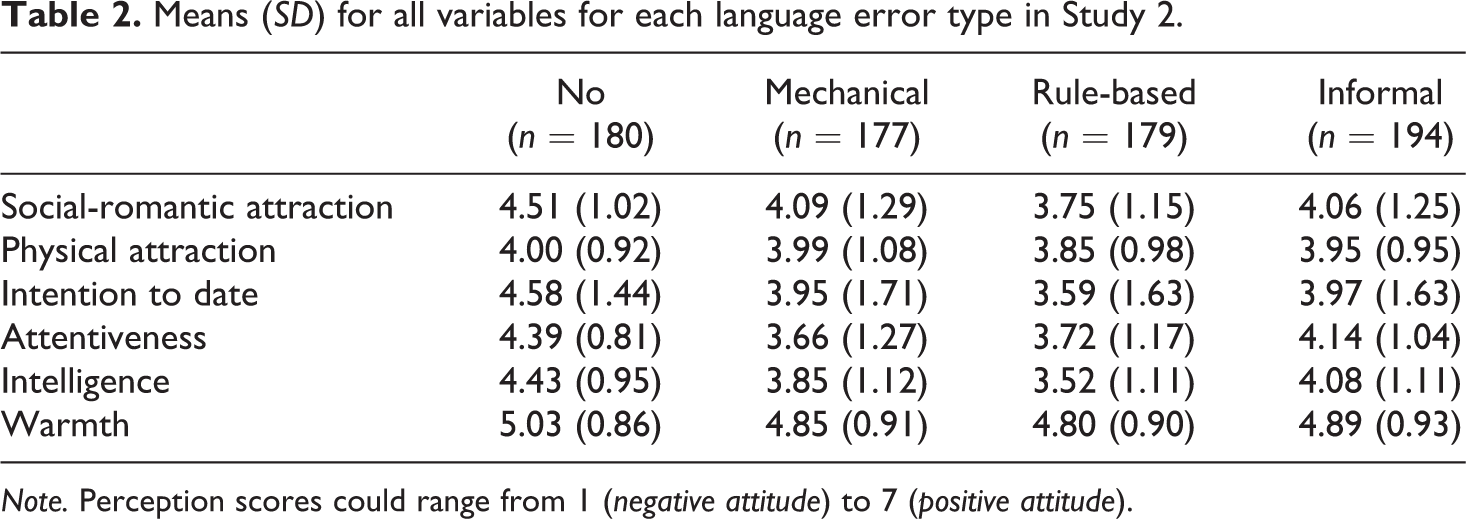
The main effect of language error type on dating intention was significant, F(3, 729) = 11.66, p < .001. When a profile was free of errors, participants gave higher dating intention scores than when a text contained mechanical, rule-based, or informal errors, with for all t(726) > 3.65, p < .001, and d > .38. In addition, results showed differences between language error types on perceived attentiveness, F(3, 729) = 18.74, p < .001, and intelligence, F(3, 729) = 22.87, p < .001, but not on warmth, F(3, 729) = 2.20, p = .087. 5 Table 2 presents for each language error type the mean scores on all dependent and mediator variables.
Means (SD) for all variables for each language error type in Study 2.
Note. Perception scores could range from 1 (negative attitude) to 7 (positive attitude).
Results indicated that mechanical errors in profiles are a significant predictor of perceived attentiveness, b = −.72, SE = .11, p < .001. Attentiveness fully mediated the relationship between mechanical errors and perceived social-romantic attraction, b = −.38, SE = .06, BCa CI: [−0.513, −0.266], physical attraction, b = −.22, SE = .05, BCa CI: [−0.324, −0.138], and dating intention, b = −.49, SE = .08, BCa CI: [−0.656, −0.331]. After controlling for the mediator attentiveness, mechanical errors are no longer a significant predictor of social-romantic attraction, b = −.03, SE = .11, p = .777, and dating intention, b = −.13, SE = .16, p = .402. The direct effect of mechanical errors on physical attraction was still significant after controlling for perceived attentiveness, b = .21, SE = .11, p = .046. The data confirm H3 stating that mechanical errors negatively affect perceptions of attentiveness which then negatively affect attraction and dating intention perceptions (see Figure 2).
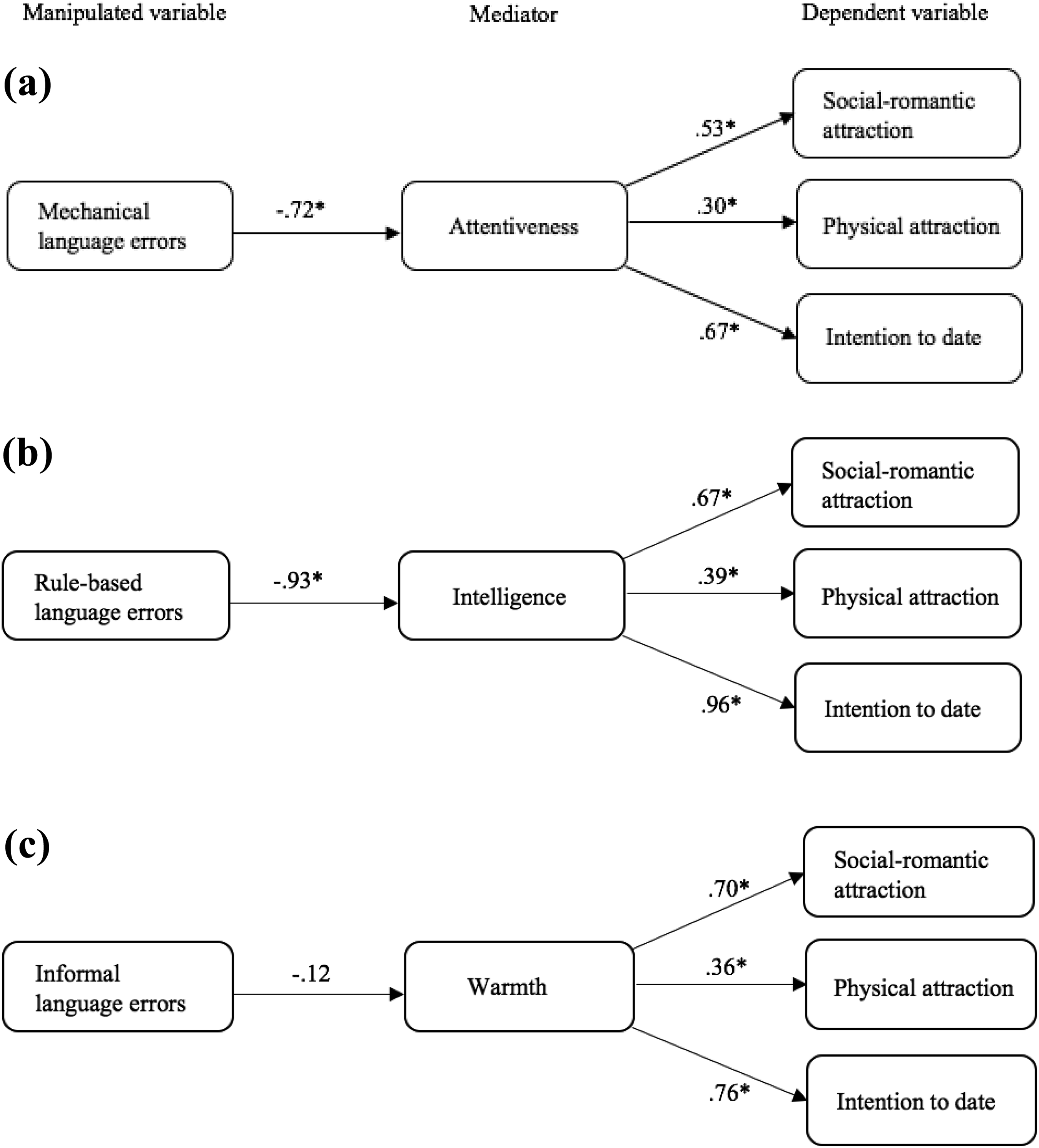
Results of the three mediation analyses displaying (a) perceived attentiveness mediating the effect of mechanical language errors, (b) perceived intelligence mediating the effect of rule-based language errors, and (c) warmth not mediating the effect of informal language errors on all three dependent variables. The coefficients represent the unstandardized coefficients.
Rule-based language errors are a significant predictor of lower intelligence perceptions, b = -.92, SE = .11, p < .001. The occurrence of rule-based errors was thereby a significant predictor of social-romantic attraction, b = -.61, SE = .08, BCa CI: [−0.787, -0.453]; physical attraction, b = -.36, SE = .06, BCa CI: [-0.497, -0.241]; and dating intention, b = -.88, SE = .12, BCa CI: [-1.108, -0.650], when mediated by intelligence. This supports the hypothesis that perceived intelligence mediates the relationship between rule-based errors and perceived attraction and dating intention (H4). After controlling for intelligence, rule-based errors were no longer a significant predictor of social-romantic attraction, b = -.14, SE = .10, p = .169, and dating intention, b = -.11, SE = .14, p = .427, indicating full mediation. Results for physical attraction point at partial mediation, as the direct effect of rule-based errors was significant even after controlling for intelligence, b = .20, SE = .10, p = .046.
H5 posed that informal errors in profiles positively affect perceptions of profile owners’ warmth which, in turn, positively affect perceptions of attraction and dating intentions. However, informal errors did not significantly affect perceptions of warmth, b = -.14, SE = .09, p = .132. Warmth did not mediate the relationship between informal errors and physical attraction, b = -.05, SE = .04, BCa CI: [-0.123, 0.015], and dating intentions, b = -.10, SE = .07, BCa CI: [-0.241, 0.031], but did for social-romantic attraction, b = -.10, SE = .06, BCa CI: [-0.224, -0.028]. After controlling for warmth, the effect of informal errors on social-romantic attraction, b = -.35, SE = .10, p < .001, was still significant, indicating partial mediation.
Additional exploratory analyses of variances were conducted, in which whether participants noticed errors or not was considered as another fixed factor. Only for rule-based errors, interaction effects between errors type and error noticing were found for social-romantic attractiveness, F(1, 354) = 15.13, p < .001, and dating intention, F(1, 354) = 15.79, p < .001, but not for physical attractiveness. Pairwise comparisons with LSD adjustments showed that participants who noticed errors gave lower scores on social-romantic attractiveness when a text included rule-based errors (M = 3.49, SD = 1.18) than when it was free of errors (M = 4.52, SD = 1.06), F(1, 354) = 47.54, p < .001, d = .92. Those who noticed errors also gave lower dating intention scores to profile owners with rule-based errors (M = 3.19, SD = 1.60) than to those without errors (M = 4.54, SD = 1.51), F(1, 354) = 42.52, p < .001, d = .87. Similar to what we found in Study 1, for those who indicated not to have seen any language errors or did not know, there were no differences on ratings of social-romantic attraction and dating intention between language error conditions, with both F’s < 0.361 and p > .549.
Conclusion Study 2
The aim of Study 2 was to examine whether different types of language errors affect impression formation differently. To do so, three language error types were distinguished: mechanical, rule-based, and informal errors. Each of the three types was expected to be associated with a particular personality attribution that would then mediate perceptions of attraction and dating intention.
H3 and H4 were supported, as the results showed that mechanical errors were perceived as a signal of inattentiveness, with lower attentiveness scores when a text contained mechanical errors than when it was error-free. Lower attentiveness scores resulted in lower scores on perceived social-romantic and physical attraction, as well as on dating intention. Rule-based errors lead to lower scores on perceived intelligence which, in turn, lead to lower scores on attraction and dating intention.
In H5, we focused on informal language errors. The expectation was that, in contrast with mechanical and rule-based errors, informal errors would positively affect attraction as mediated by a positive effect of these errors on warmth. This hypothesis was not supported: Warmth partially mediated the relationship between informal errors and attraction but in the opposite direction than expected. Profile owners with informal errors in their profiles are seen as less warm than those without errors, resulting in lower attractiveness perceptions. However, as the mediation is weak, with the main effect of informal errors on warmth not being significant, there seems to be little effect of informal language use on attractiveness perceptions.
General discussion
The two studies reported in this article focused on whether and how language errors in dating profiles affect the impressions online dating site users form of profile owners. Although online daters have mentioned language errors to be a letdown in the dating process (Ellison et al., 2006), this had not yet been empirically addressed. We conducted two experimental studies in which dating site users were presented with made-up dating profiles with or without language errors and rated profile owners’ social-romantic and physical attractiveness, as well as their intention to date the profile owner.
Results of both studies suggest that errors in profiles negatively affect impressions people form of profile owners. First, Study 1 showed that, overall, language errors negatively affect perceptions of social-romantic attraction, confirming H1. People devote attention to language errors as a cue regardless of whether the profile picture was visible or blurred. This effect was not stronger for profiles with a blurred picture than with a visible one (contra H2). Results from Study 1 also showed a main effect of profile picture visibility: Visible pictures led to higher ratings of physical attractiveness than blurred pictures. A possible explanation is that people withhold their judgment of physical attractiveness when they cannot observe someone’s appearance. In the blurred conditions, physical appearance hovered around the midpoint of the scale, while the scores were higher when profile pictures were visible.
Study 2 confirmed the results of Study 1 and showed that attraction and dating intention perceptions were mediated by particular attributes tied to different language error types. Mechanical errors lead to lower attraction and dating intention scores as mediated by lower attentiveness scores, while perceived intelligence mediated the relationship between rule-based errors and attraction and dating intention scores, supporting H3 and H4. Contrary to our H5, results showed that writers of profiles with informal language errors were rated less positively than writers of profiles without errors (cf. Scott, Sinclair, Short, & Bruce, 2014). It seems that even though making informal errors can be a decision made consciously to come across warm, people perceive such errors in a similar manner as errors made unintentionally (i.e., mechanical and rule-based errors).
Additional analyses suggested that the overall negative effect of errors may be driven by the subset of participants who indicated to have noticed errors in the profiles they read. In both studies, participants who did not notice errors or were not sure did not seem to be affected by the errors, as their attractiveness perceptions were similar for profile owners with and without errors in their texts. The interaction effect of error noticing and rule-based errors in Study 2 indicate that primarily those who noticed errors were negatively affected by the rule-based error type, while this was not necessarily the case for profiles with mechanical or informal errors. Taken together, it seems that not all individuals are attentive to language errors. However, for those who do notice errors, perceptions of attentiveness, intelligence, and attractiveness were severely dampened.
Our results may have several theoretical implications for research into online impression formation. First, this study has shown that language errors have relatively high warranting value and serve as an important cue to impression formation, such as about a person’s social-romantic attractiveness and personality traits. These findings support warranting theory, which supposes that cues that are less prone to manipulation have the strongest impact on impression formation (Walther & Parks, 2002). Self-generated cues, such as the profile text, are seen as cues with low warranting value. However, our research shows that people are aware that self-constructed texts can also contain cues that people unintentionally give off, such as language errors, and that people use those cues to form impressions. This accords with findings of Wotipka and High (2016) who showed warranting content (e.g., college attendance details, friend network references) in a dating profile increases impressions of trust.
Second, our results showed that textual and visual cues affected different dimensions of perceived attractiveness. That is, language errors lead to lower scores on social-romantic but not on physical attractiveness, while profile pictures affected perceived physical but not social-romantic attractiveness. As such, impressions on one dimension of attractiveness do not simply seem to spill over into other dimensions. Our hypotheses did not posit different potential cue effects for separate aspects of attractiveness, as we based these on the SIP, which poses people form impressions of others based on the cues that are available (Walther, 1992). However, SIP is not specific about which cues affect which dimensions of attractiveness, instead expecting uniform effects on impression formation (McCroskey & McCain, 1974). According to this theory, to form impressions about, say, physical appearance, people fill in the blanks using other cues in the absence of visual cues. Based on our findings, though, it seems that people are specific about which cues they use to form impressions and need different cues in the profile that fit specific dimensions of impression formation. Inferences about physical attractiveness seem to be made based on visual information of the profile picture, and characteristics of the texts are likely to affect impressions of a profile owner’s social-romantic attractiveness. Future research could investigate which cues in online impression formation are tied to specific dimensions of attractiveness. Moreover, research could test if spill-over effects exist where impressions formed on one dimension also affect other aspects of impression formation.
Third, our research shows that language errors seem to be used as a meaningful indicator for obtaining insights into a profile owner’s personality, such as about one’s attentiveness and intelligence. These attributions then affect perceptions of social-romantic attractiveness and dating intention. Also previous research in other (online) environments demonstrated that language errors are used as a cue to make inferences about a writer’s personality (e.g., Kreiner et al., 2002; Queen & Boland, 2015). Our findings do corroborate SIP and show that people indeed use whatever cues at their disposal to form impression about others, not only concerning general attractiveness but also concerning their personality.
Finally, we would like to point out two possible limitations. First, effect sizes in our study were all somewhere between small and medium. This shows that language errors are but one of the cues that people pay attention to when forming impressions. However, considering the other available cues that language errors compete with, such as profile text content and profile picture, the observed effects of errors on impression formation are not trivial, especially for those who noticed them. Second, the fact that many people did not notice or did not know whether they had been presented with profiles with errors (Study 1: 66.5%, Study 2: 39.5%) raises the question which individuals are prone to notice language errors. While the present study focused on how textual characteristics of dating profiles (i.e., language errors) can influence perceptions of readers, an interesting next step would be to investigate which reader characteristics affect which cues are used for impression formation.
Concluding, our results show that language errors affect impressions of online dating profile owners. Language errors are likely to be seen as a cue that is unintentionally given off and therefore affect perceptions of personality, which in turn affect attractiveness. In general, our research supports that the textual component of an online dating profile is important for impression formation. Future research should further determine which and how other (linguistic) cues in dating profiles influence impression formation, such as the order in which topics in a profile are mentioned, usage of dialect, or word and sentence complexity.
Footnotes
Authors’ note
This article has been presented at the 69th Annual Conference of the International Communication Association, Washington, May 24-28, 2019.
Funding
The author(s) received no financial support for the research, authorship, and/or publication of this article.

Open research statement
As part of IARR’s encouragement of open research practices, the authors have provided the following information: This research was pre-registered. The aspects of the research that were pre-registered were the research design, hypotheses and analysis plan. The registration was submitted to the Open Science Framework. The data used in the research are available. The materials used in the research are available. The data and materials can be obtained upon request by emailing