




Abstract
This study investigates how online dating profiles, consisting of both pictures and texts, are visually processed, and how both components affect impression formation. The attractiveness of the profile picture was varied systematically, and texts either included language errors or not. By collecting eye tracking and perception data, we investigated whether picture attractiveness determines attention to the profile text and if the text plays a secondary role. Eye tracking results revealed that pictures are more likely to attract initial attention and that more attractive pictures receive more attention. Texts received attention regardless of the picture’s attractiveness. Moreover, perception data showed that both the pictorial and textual cues affect impression formation, but that they affect different dimensions of perceived attraction differently. Based on our results, a new multimodal information processing model is proposed, which suggests that pictures and texts are processed independently and lead to separate assessments of cue attractiveness before impression formation.
Keywords
Cues in both pictures and texts on online dating profiles can affect the impressions people form of the owner of the profile. For instance, profile owners with attractive pictures score higher on perceived physical attraction and dating desirability than those with unattractive pictures (e.g., Fiore et al., 2008; McGloin & Denes, 2018), but score lower on authenticity (Lo et al., 2013). Regarding dating profile texts, language errors (Van der Zanden et al., 2020), low self-described ambition (Sritharan et al., 2010), and providing highly selective positive information (Wotipka & High, 2016) have been shown to negatively impact perceptions of a profile owner’s attractiveness, likeability, and dating desirability.
When searching for romantic potential, the single most important determinant is the other person’s physical attractiveness (e.g., Hitsch et al., 2010; Toma & Hancock, 2010). In multimodal dating profiles, this information can mainly be derived from a profile picture. Previous research into initial impression formation has shown that based on pictorial information, people rapidly, intuitively, and effortlessly form impressions about physical attractiveness and use this information to infer personality traits (e.g., Dion et al., 1972; Miller, 1970; Olson & Marshuetz, 2005; Willis & Todorov, 2006). With regards to impression formation in online dating settings, this implies that information from the profile picture automatically leads to an initial impression, after which people could either stick to this impression without much more deliberation or process other available information on the profile more deliberately, such as the profile text. These two ways of processing a multimodal dating profile may be likened to the two processing modes proposed by prevalent dual information processing theories as elaboration likelihood model (ELM; Petty & Cacioppo, 1986) and heuristic-systematic model (HSM; Chaiken, 1980, 1987).
A profile picture may thus function as the profile’s gatekeeper, with the profile owner’s physical attractiveness determining whether there is need for additional information processing from the profile text. The ambiguity of picture information is likely to play a role here: extreme cues with little ambiguity, such as highly attractive or unattractive pictures, oftentimes result in an immediate and (rather) consistent impression about this person (e.g., Miller, 1970; Willis & Todorov, 2006). Picture information will then often be sufficient for impression formation and there may therefore be little need for more information from the profile text. On the other hand, ambiguous pictures, such as those that are neither attractive nor unattractive (i.e., moderately attractive), may not provide enough information to form an impression. To compensate for this, people can develop this impression by being more attentive to the profile text and using the cues within this text.
Previous research on the effects of pictorial and textual cues on impression formation focused primarily on the outcomes of impression formation processes (e.g., Fiore et al., 2008; Lo et al., 2013; Van der Zanden et al., 2020). While inferences can be made about how attentive people are to profile pictures and texts based on these studies, little is known about how attention is actually allocated to these profile components to establish these impressions, and how profile cues affect information processing. An effective way of investigating attention allocation and information processing regarding dating profiles is by means of eye tracking. Eye movement behavior can provide information about which profile component attracts initial and most attention (e.g., Scott & Hand, 2016; Seidman & Miller, 2013 on Facebook profiles), and can shed light on how cues in profile components affect information processing.
The main goal of this study is to investigate how pictures and texts on online dating profiles are visually processed. More specifically, we examine the potential of the profile picture—and its attractiveness—as the profile’s gatekeeper, by investigating (a) whether profile picture attractiveness influences text processing, as measured by frequency and duration of fixations, and (b) whether profile picture attractiveness influences the extent to which textual cues (here language errors) affect impression formation, as measured by ratings on perceived attraction. To do so, participants viewed multimodal dating profiles which comprise a picture that scores high, moderate, or low in attractiveness and a text with or without language errors, and rated the profile owners in terms of perceived attraction.
Processing and Assessing Profile Cues
Pictures often immediately evoke a spontaneous affective response, especially since attractiveness cues are highly salient (Olson & Marshuetz, 2005; Willis & Todorov, 2006). With only a few glances at a picture, people can already gather information ranging from, for example, age, ethnicity, and eye color to physical attractiveness. Without much effort or awareness, information about physical attractiveness can lead to fast, intuitive, and unreflective impressions on other dimensions of attractiveness and personality traits (Locher et al., 1993; Willis & Todorov, 2006). The valence (positive or negative) of the impression about a person’s physical attractiveness is usually consistent with impressions regarding other characteristics of that person. For example, physically attractive people are also perceived as more likeable, trustworthy, careful and confident, and unattractive people as insensitive, less trustworthy and more aggressive (Dion et al., 1972; Miller, 1970; Willis & Todorov, 2006).
Picture information is not only easily accessible to form a quick initial impression, but also carries a great impression formation weight. A visual primacy effect is found before, emphasizing the importance of profile pictures over profile texts when forming impressions about Facebook profile owners (D’Angelo et al., 2014; Van der Heide et al., 2012). Pictures carry more weight in the final assessment (e.g., Fiore et al., 2008) and are also more likely to attract initial attention (Scott & Hand, 2016; Seidman & Miller, 2013). In addition to providing important information about profile owners’ looks, pictures are an easy “point of entry” (Scott & Hand, 2016). In particular, pictorial information is arguably less densely packed than textual information, which suggests that more information can be decoded per fixation on a picture than on a text (Rayner et al., 2001). Taken together, this indicates that it is more efficient for people to first focus on pictorial rather than textual information when being presented with multimodal dating profiles, and we therefore pose:
H1. When viewing online dating profiles, containing a profile picture and text, people first fixate on the profile picture rather than on the profile text.
While profile pictures are likely to attract initial attention regardless of the person’s beauty, the physical attractiveness of a depicted person presumably determines the frequency and duration of the fixations on the picture. Both how often and how long people look at a component can signify which information resources are processed and receive cognitive attention (Rayner, 1998; Scott & Hand, 2016). Studies have shown that beauty captures attention: the more attractive the face, the more and longer people look at it (e.g., Langlois et al., 2000; Leder et al., 2016; Maner et al., 2003; Valuch et al., 2015). In previous studies, eye tracking has been used as a method to demonstrate that gazing varied as a function of physical attractiveness. Particularly within the field of psychology, various eye tracking studies have shown that people tend to look longer at attractive individuals on pictures (Leder et al., 2010, 2016; Maner et al., 2003; Mitrovic et al., 2016) and in (offline) dating contexts (Van Straaten et al., 2010), but also in a social media context where other (non-pictorial) information was available on profiles (Seidman & Miller, 2013).
This bias of gazing at attractive individuals appears to be functional. In relationships, people want to maximize their outputs. In deciding the rewards that people may derive from others, physical attractiveness is one of the most important factors (Dion et al., 1972; Walster et al., 1973). Following this line of research, it is expected that on online dating profiles the attractiveness of a profile picture similarly determines how often and long people look at the picture. This leads to the following hypothesis:
H2. The more attractive the profile picture on an online dating profile, the more and longer people fixate on this profile picture.
When being exposed to attractive or unattractive pictures of potential partners on dating profiles, people form initial impressions about physical attractiveness based on intuitive reactions (Sritharan et al., 2010). The “what is beautiful is good” stereotype poses that physical attractiveness fosters positive attributions about other personality traits that are (socially) desirable (Dion et al., 1972). Considering this stereotype, it is likely that an initial impression based on physical attractiveness is extrapolated to an overall impression about the profile owner: a positive impression of a physically attractive profile owner and a negative impression of a profile owner with an unattractive picture.
In an online dating context, Sritharan et al. (2010) previously examined how intuitive heuristic responses to profile pictures affected assessments of other social information, in their study, profile text information. They conducted two studies among female participants who viewed and rated online dating profiles containing an attractive or unattractive picture and a text with high or low self-described ambition—with high ambition being more attractive than low ambition. They found that only picture attractiveness affected spontaneous affective responses, as measured in an affective priming task, whereas both picture attractiveness and self-described ambition influenced reported scores on likeability. More specifically, text evaluations varied as a function of spontaneous picture evaluations: for both profiles with high and low self-described ambition, likeability scores were higher when an attractive picture evoked a positive spontaneous response than when a negative spontaneous response was evoked by an unattractive picture (Sritharan et al., 2010). These results indicate that the attractiveness-related initial impressions influenced likeability impressions based on profile text attractiveness.
Once an overall initial impression about a profile owner has been formed based on picture attractiveness, people may or may not proceed to put more effort in processing other available profile information, such as the profile text. If the initial impression about physical attractiveness is strongly valenced, that is: very positive or very negative, little further information processing may be needed, because physical attractiveness is such a strong determinant of perceived attraction in (online) dating. After all, people are willing to date highly attractive others anyways (Walster et al., 1966), whereas profile owners with unattractive pictures will presumably be excluded as potential partners based on the picture information that has been evaluated first (Fiore et al., 2008).
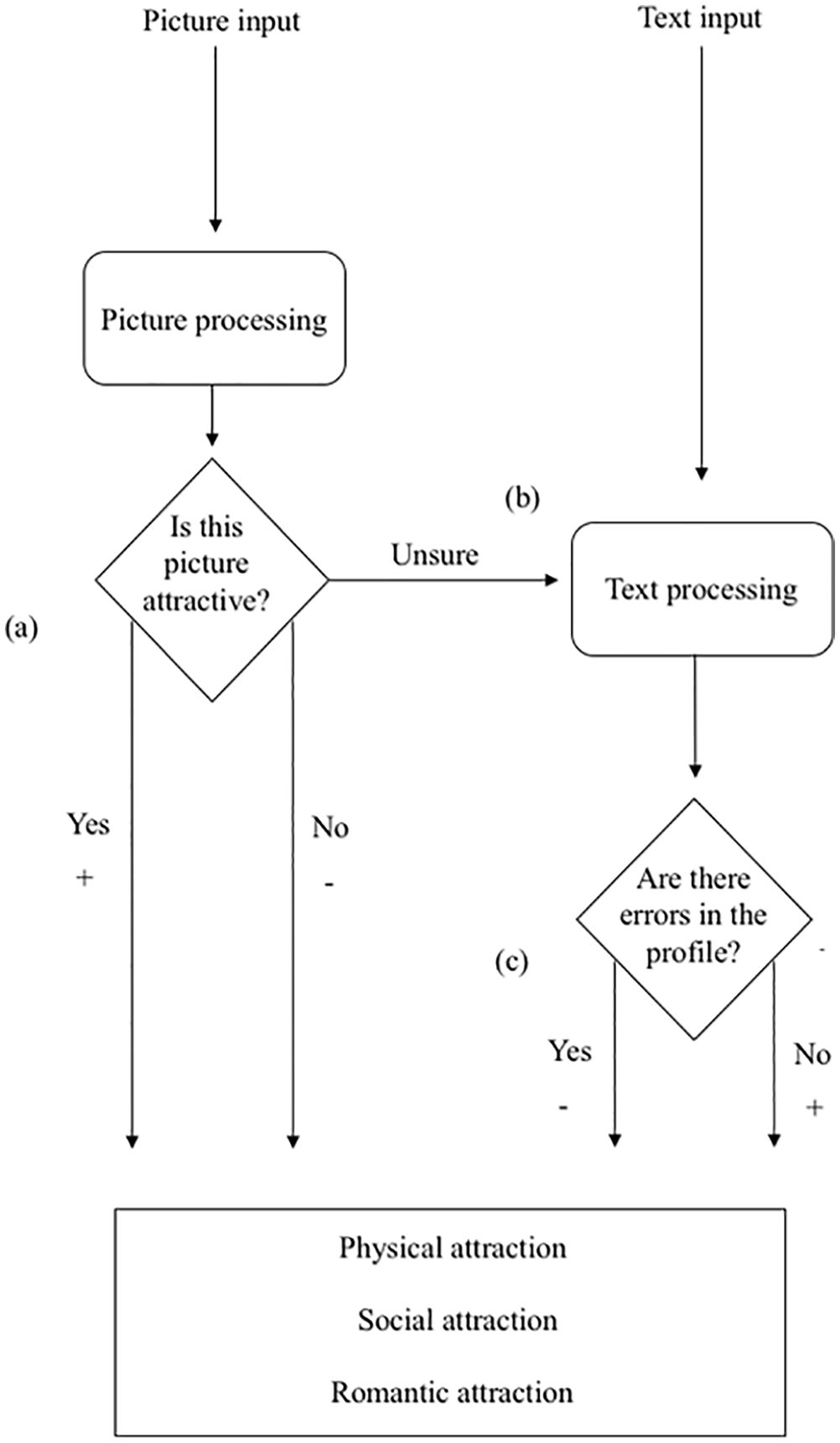
This implies that a profile owner’s physical attractiveness, as depicted in the profile picture, may function as a “gatekeeper” to the rest of the profile: picture attractiveness can determine to what extent profile texts receive attention in addition to the profile picture. This not to say that people will not look at the profile text at all when seeing an attractive or unattractive picture, but that relatively less attention will be paid to the profile texts. We expect people to process the text more heuristically, as the picture provides enough information to form an impression of the profile owner’s attractiveness, diminishing the need for further information processing (Chaiken, 1980, 1987; Petty & Cacioppo, 1986). The schematic representation of this picture gatekeeper model is presented in Figure 1, and here (a) illustrates the extreme case in which the positive and negative impressions formed based on attractive or unattractive pictures, respectively, immediately lead to perceptions on all three dimensions of attraction, with no attention paid to the profile text. 1
Schematic representation of the picture gatekeeper model.
When a person is moderately attractive, information about physical attractiveness remains ambiguous in a picture. Therefore, heuristic processing of the profile may not be possible, as a profile owner can neither be immediately accepted (in the case of an attractive picture) nor rejected (unattractive picture) as a potential romantic partner. In such cases, mental shortcuts or stereotypes may not be applicable. People may consequently seek for additional information to form an impression. In the case of multimodal online dating profiles, this could mean shifting attention from the profile picture to the profile text. Therefore, we pose that when a profile picture provides ambiguous information about physical attractiveness (i.e., when the profile owner is moderately attractive), more systematic (central) processing will take place, resulting in more attention to textual information than when the initial impression is unambiguous (i.e., when the picture is either attractive or unattractive). In this latter case, more heuristic (peripheral) processing of the profile will take place, resulting in less profile text attention. Path (b) in Figure 1 illustrates this alternative route for profiles with moderately attractive pictures compared to that of profiles with attractive and unattractive pictures. We thus hypothesize: 2
H3. People fixate more often and longer on the profile text when a moderately attractive picture is shown on the online dating profile than when the profile contains an (a) attractive or (b) unattractive profile picture.
Our picture gatekeeper model, as depicted in Figure 1, is compatible with prevalent models of dual information processing, such as the elaboration likelihood model (ELM; Petty & Cacioppo, 1986) and heuristic-systematic model (HSM; Chaiken, 1980, 1987), in that it proposes an automatic and a more deliberate information processing route. Our model has, however, been formulated specifically to describe how information on multimodal online dating profiles is processed automatically and systematically, whereas ELM and HSM were introduced in the context of persuasion and have later been applied to general information processing. Notice, incidentally, that while information in pictures can be processed more quickly and holistically, and text processing requires more time and effort (e.g., Barry, 1997; Chaiken & Eagly, 1976), there is no necessary one-on-one link between pictorial information and automatic processing on the one hand, and textual information and deliberate processing on the other hand in theories about dual information processing.
The gatekeeping function of the picture makes it likely that people will not only be more attentive to textual cues when pictorial cues are ambiguous, but will also rely on those cues more heavily to accrue an impression of a profile owner with a moderately attractive picture (Tidwell & Walther, 2002). It is expected that people extend the initial positive or negative impression for profiles with attractive or unattractive pictures to impressions on other dimensions of attraction, such as about the person’s social attraction, which indicates people’s desires to spend time with someone (McCroskey & McCain, 1974), and romantic attraction, that is, how much people feel romantically attracted to someone (Campbell, 1999). This overall impression of attractiveness is then presumably not amplified by attractive or unattractive textual cues in a profile. However, if picture information is ambiguous, people may be more prone to cues that could help them come to an overall impression. Therefore, cues in texts accompanied by moderately attractive profile pictures may carry more impression formation weight compared to the same textual cues in profiles with attractive or unattractive pictures.
To test this in this study, we manipulate language errors in the profile texts. Language errors have been shown to negatively affect perceptions of attraction, especially perceived social and romantic attraction (Van der Zanden et al., 2020). Path (c) in Figure 1 shows how for profiles with moderately attractive pictures, the absence or presence of language errors may affect perceived attraction, where the presence of language errors has a negative effect and the absence has a positive effect. This leads to the following hypothesis:
H4. Language errors in a profile text negatively affect perceptions of profile owners’ attractiveness more strongly when a profile picture on an online dating profile is moderately attractive than when a profile picture is attractive or unattractive.
Method
Before data collection, ethical clearance was obtained in Spring 2019 by the Ethics Committee (ETC) of the school of our university. On the Open Science Framework, the research design, hypotheses, and analysis plan were preregistered: osf.io/cbtv2/registrations.
Participants
In this study, 57 undergraduate students participated, who earned credits for their participation. Due to technical difficulties and calibration problems, data of 48 participants could be included for analyses. All participants had normal or corrected to normal vision, were native speakers of Dutch and were between 18 and 27 years old (M = 21.4 years, SD = 2.34; 67.2% women).
Design and Material
This experiment had a 3 × 2 design, with both profile picture attractiveness (attractive/ moderately attractive/unattractive picture) and language errors (language errors/no language errors) as within-subject variables. Participants were exposed to all conditions, and were presented with a total of 18 dating profiles, three from each condition. We thus aimed for a total of 864 cases, that is, 48 (participants) × 18 (dating profiles). However, due to technical issues 33 observations are missing, resulting in a total of 831 cases. All dating profiles consisted of a picture and text, and whether a participant saw profiles of males or females was determined by asking the participants what gender they feel most attracted to.
Profile pictures
For both male and female profiles, 18 pictures were selected: six attractive, six moderately attractive, and six unattractive pictures. Which pictures belonged to each of the three categories was determined with a pretest, in which 85 participants (Mage = 26.7 years, SDage = 5.47, 68.2% women) rated the physical attractiveness of 50 depicted individuals of their indicated preferred sex on a ten-point scale. The pictures, which were preselected from free stock image sites (e.g., PXhere, Flickr, Pexels) and were licensed under creative commons, ranged in expected physical attractiveness. Any potential confounding picture variables that could affect perceptions of picture attractiveness other than the depicted person’s physical attractiveness were avoided. The set of pictures was homogenous in terms of characteristics and demographics, and matched with the presumed demographics of the participants (e.g., age, ethnicity). All people were frontally depicted with head and shoulders, looked friendly into the camera, and did not depict characteristics that may repel or attract participants immediately, such as with regards to clothing style, piercings, or tattoos.
Scores for the 50 male pictures were between 1.58 and 6.77 with an average score of 3.62 (SD = 1.67) and the 50 female pictures scored between 2.15 and 8.04 with an average score of 4.96 (SD = 1.67). For both sets of pictures, the six pictures that scored highest were selected as the attractive pictures (male pictures: M = 6.18, SD = 1.94, Mdn = 7.00; female pictures: M = 7.46, SD = 1.30, Mdn = 8.00), and the six that scored lowest were categorized as the unattractive pictures (male pictures: M = 1.83, SD = 1.02, Mdn = 2.00; female pictures: M = 2.51, SD = 1.58, Mdn = 2.00). The pictures in the moderately attractive category were those six pictures that scored right above and below the average score given to the 50 pictures. The six male pictures within this category scored on average 3.65 (SD = 1.96, Mdn = 3.00) and the six female pictures 4.95 (SD = 1.75, Mdn = 5.00). Planned contrast analyses of the pretest showed that for both men and women all groups were rated significantly different from each other, with t’s > 13.00 and p’s < .001. Also in the main experiment, attractive, moderately attractive, and unattractive pictures differed significantly in the scores given on perceived physical attraction, with for all contrasts t’s > 15.83 and p’s < .001.
Profile texts
Based on existing dating profiles (Van der Zanden et al., 2018), 18 profile texts were constructed, with different contents for each. This content was kept neutral, meaning that no potentially extreme preferences, interests, or hobbies were mentioned. Primarily, the texts provided a textual description of who the profile owner is, what their hobbies/interests are and what kind of partner and relationship (s)he seeks. The contents of texts supposedly written by male and female profile owners were identical, with the exception of one or two gender-specific word(s) in each text (e.g., “man,” “her”). Texts ranged from 60 to 67 words.
For each profile text, a version with and without language errors was created. The text with errors each contained eight errors, based on observations made in a corpus analysis on language errors in existing dating profiles (Van der Zanden et al., 2018). Different types of errors were included in each text (e.g., grammatical, typographical error). Figure 2 shows two examples of translated versions of the dating profiles used for the experiment. The profile on the right includes language errors, with the first three errors, for example, being a spacing error, a typographical error, and an ellipsis, respectively.

Examples of translated English versions of the original Dutch dating profiles used in the experiment.
A pretest with 55 participants (Mage = 26.3 years, SDage = 7.71, 63.6% women) was conducted to check whether the overall text quality of texts with language errors was rated lower compared to texts without errors. To measure this, for half of the texts participants answered the question “How do you assess the quality of this text?” on a scale from 1 to 10. Overall text quality scores were lower for texts with errors (M = 4.18, SD = 1.32) than for texts without errors (M = 6.29, SD = 1.29), F(1, 52) = 88.58, p < .001, ηp2 = .630. Based on these pretest findings, some minor adaptations were made to 5 of the 18 texts for the main experiment. This was done to make the overall perceived text quality scores of all texts with and without errors more even; parts of two texts were exchanged as the overall score was relatively high for one text and relatively low for the other. In two other texts, one error was replaced by a less remarkable one as the error version of this text scored lower compared to other texts with errors. Finally, the overall text quality score of one error-free text was relatively low, and a sentence was reformulated in such a way it was expected to improve overall text quality.
Dating profiles
A subset of 108 combinations of pictures and texts were made as experimental material for both male and female profiles (6 pictures × 18 texts). All picture-text combinations were unique and randomized to avoid an effect of a particular picture or text. To control for a potential leftward fixation bias (Leder et al., 2016), half of the profiles a participant saw had the picture on the profile’s left side, and the other half depicted it on the right side. The position of the picture and text was fully crossed across conditions. The profile’s picture and text were of equal size (See Figure 2). All materials used for this study are available in OSF, at osf.io/cbtv2/.
Procedure
Participants were seated approximately 70 cm in front of a computer screen (1,680 × 1,050 pixels) at the eye tracking laboratory of our university. Before the experiment started, participants were welcomed and provided written informed consent. Then, the participant’s eyes were calibrated and validated using a nine-point procedure using the SMI RED 2015 device with a sampling rate of 250 Hz. The experiment was opened in Qualtrics after successful calibration, and participants’ eye movements on this site were followed. They were then instructed and answered some demographic questions (i.e., gender, age, sexual preference, relationship status). Participants were told that they would see around twenty mock-up dating profiles that they had to view and judge in a natural manner. Before participants were randomly assigned to one of the available six lists of 18 male or female profiles (based on the indicated sexual preference), they viewed one test profile. The 18 profiles, from which nine contained language errors and nine were free of errors, were then presented to them in a random order. When participants were done viewing a profile, they pressed a key to answer three impression formation statements about the owner of the profile. 3 Once the statements were answered, a cross was displayed on the screen for 3 seconds on which participants had to focus before the next profile appeared. When all 18 profiles were viewed and rated, one last post-test profile with language errors was shown, about which they also had to indicate whether they had noticed language errors in that profile (86.1% indicated to have noticed the errors). The pre- and post-test profiles used were the same across lists, and the data from these profiles were not analyzed. In total, the experiment took approximately 20 minutes, dependent on the duration of the calibration.
Measures and Analysis
Eye tracking measures
Only fixations that occurred on either the profile picture or text were included, and a fixation only counted as one if it lasted 40ms or longer (Bar et al., 2006; Scott & Hand, 2016). As each participant assessed 18 profiles, there were 18 cases for each participant (3.70% missing cases because no fixations occurred on the profile at all). While viewing was binocular, eye movements from the right eye were analyzed with an average tracking ratio of 97.2% (SD = 4.67). Five eye tracking measures were used as dependent variables to test our hypotheses: (a) first fixation location, that is whether the first fixation occurred on either the profile picture or text (H1), (b) picture fixation count (abbreviated as PFC), that is the total number of fixations on the picture (H2), (c) picture fixation duration (PFD), being the total fixation duration on the picture in milliseconds (H2), (d) fixation count on the text (TFC), that is the number of fixations on the text (H3), and (e) fixation duration on the text (TFD), that is the total fixation duration on the text in milliseconds (H3).
Attractiveness perception measures
Impressions of attractiveness were measured with three items, each covering another dimension of perceived attraction: physical attraction, social attraction (McCroskey & McCain, 1974), and romantic attraction (Campbell, 1999). To fit our experiment, the wording of the used items was translated and slightly adjusted. The items were “I think this person is good-looking” for physical attraction, “I think this person is nice to spend time with” for social attraction, and “I feel attracted to this person” for romantic attraction. Each of these items were measured on a scale from 1 (completely disagree) to 7 (completely agree). 4
Analysis
To test whether pictures are more likely to attract initial attention (H1), a chi-square test was performed, with first fixation location (picture/text) and picture position (left/right) as binary variables. To test H2, H3, and H4, linear effect models were conducted in R using the lme4 package (Bates et al. 2014), 5 as well as the lmerTest package to obtain p-values applying the Satterthwaite approximation (Kuznetsova et al., 2014). Picture attractiveness and language error presence were included as fixed factors and a random intercept was included for participants. 6 Interactions between factors were included. For H2 the dependent variables were the picture fixation count and duration and for H3 the text fixation count and duration. The mean scores on all three dimensions of perceived attraction were the dependent variables for H4. The data underlying this article are available in OSF, at osf.io/cbtv2/.
Results
In this section, we first report on the tests of the preregistered hypotheses on both the eye tracking and perception data, followed by an exploratory follow-up analysis section that zooms in more specifically on how the dating profiles are processed.
Independent of picture or text condition, participants fixated on average 10.97 seconds (SD = 6.70) on the dating profiles, from which 2.23 seconds (20.3%, SD = 2.75) were on the picture and 8.74 seconds (79.7%, SD = 4.99) on the text. Within this period of time, people made on average 59.8 (SD = 32.3) fixations per profile, from which 9.5 (15.9%, SD = 11.6) were on the picture and 50.3 (84.1%, SD = 25.4) on the text.
Main Results
Eye tracking data
First fixation location
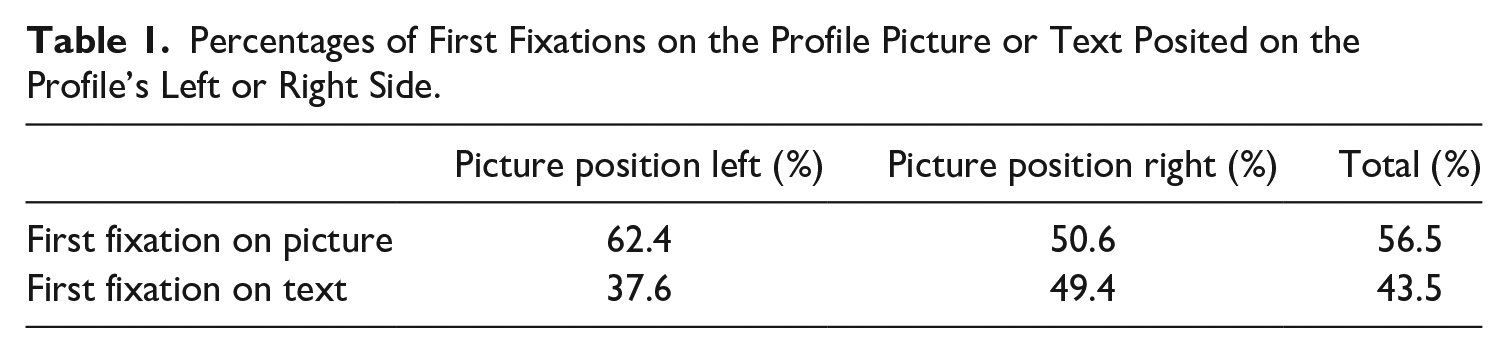
In accordance with H1, the chi-square test with first fixation location and picture position as the variables was significant, χ2(1) = 11.29, p < .001. People were in general more likely to fixate initially on the picture than on the text, and were more likely to initially fixate on the picture when it occurred on the profile’s left side than on the profile’s right side. Table 1 provides the percentage scores. On average, first fixations lasted 164.98 milliseconds (SD = 154.67), with the first fixations on pictures being longer (M = 194.0, SD = 190.5) than those on texts (M = 129.9, SD = 79.7). This is a significant difference according to Welch’s t-test, t(662.1) = 6.58, p < .001, d = 0.44. 7
Percentages of First Fixations on the Profile Picture or Text Posited on the Profile’s Left or Right Side.
Picture fixation count (PFC) and duration (PFD)
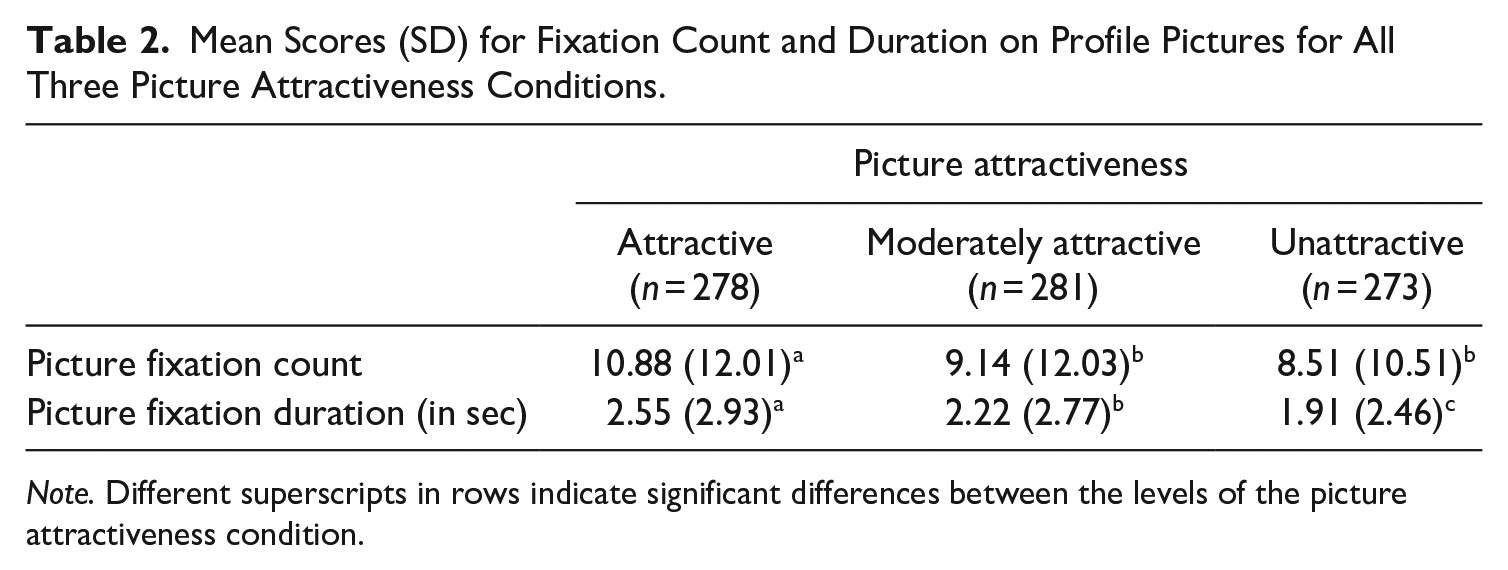
The total PFC and PFD in all three picture attractiveness conditions are presented in Table 2. Picture attractiveness affected PFC, F(2, 783.9) = 9.21, p < .001, ηp2 = .008, and PFD, F(2, 784.0) = 10.99, p < .001, ηp2 = .009. Planned contrast analyses for both PFC and PFD showed that people tend to fixate more and longer on attractive than on moderately attractive and unattractive pictures (all t’s > 2.66, p’s < .008, d’s > 0.210). Furthermore, while fixation durations were longer on moderately attractive than on unattractive pictures, t(783.95) = 2.03, p = .043, d = 0.118, participants did not look more at moderately attractive than at unattractive pictures, t(783.90) = 0.76, p = .443. Robust support was thus found for Hypothesis 2: people looked more often and longer at attractive than at moderately attractive and unattractive pictures, and looked longer, but not more often, at moderately attractive than at unattractive pictures. 8
Mean Scores (SD) for Fixation Count and Duration on Profile Pictures for All Three Picture Attractiveness Conditions.
Note. Different superscripts in rows indicate significant differences between the levels of the picture attractiveness condition.
Text condition did not affect the PFC and PFD and there were no interaction effects (with all F’s < 2.71 and p’s > .100).
Text fixation count (TFC) and duration (TFD)
The number of fixations and the total fixation duration on the profile text did not differ depending on the attractiveness of the picture (TFC: F(2, 784.1) = 0.945, p = .389, TFD: F(2, 784.1) = 0.643, p = .526). This means that people do not pay more attention to the profile text when a profile contains a moderately attractive picture than when it contains an attractive or unattractive picture. Thus, H3 is not confirmed.
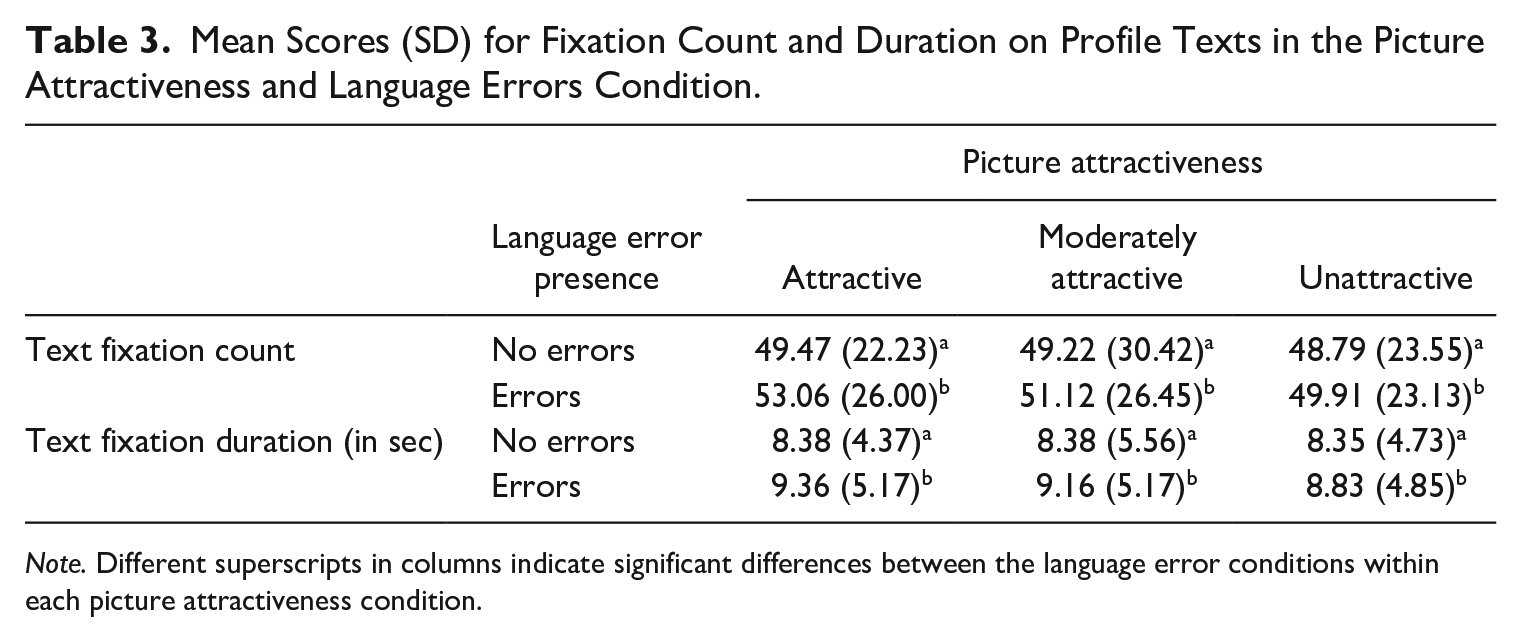
While picture attractiveness did not affect text attention, language errors did. Participants fixated more and longer on texts with language errors than on those without, with both F’s > 4.16, p’s < .042, ηp2’s > .002. There were no interaction effects of picture attractiveness and language errors on text attention (both F’s < 0.604, p’s > .547). The mean scores of text attention are presented in Table 3.
Mean Scores (SD) for Fixation Count and Duration on Profile Texts in the Picture Attractiveness and Language Errors Condition.
Note. Different superscripts in columns indicate significant differences between the language error conditions within each picture attractiveness condition.
Perception data
Picture attractiveness
Results showed main effects of picture attractiveness on perceived physical, F(2, 784.5) = 705.2, p < .001, ηp2 = .545, social, F(2, 785.0) = 37.91, p < .001, ηp2 = .072, and romantic attraction, F(2, 784.6) = 334.3, p < .001, ηp2 = .392. For all three attractiveness dimensions, profile owners with attractive pictures received significantly higher scores than those with moderately attractive pictures, and unattractive pictures got significantly lower scores still (with all t’s > 1.98 and p’s < .048).
Language errors
Profile owners with language errors in their texts scored lower on perceived social, F(1, 784.9) = 20.26, p < .001, ηp2 = .020, and romantic attraction, F(1, 784.5) = 24.27, p < .001, ηp2 = .023, but not on perceived physical attraction, F(1, 784.4) = 2.03, p = .154. Table 4 presents for both conditions the mean scores on all three dimensions of attraction.
Mean Scores (SD) for Both Conditions on All Three Dimensions of Perceived Attraction.
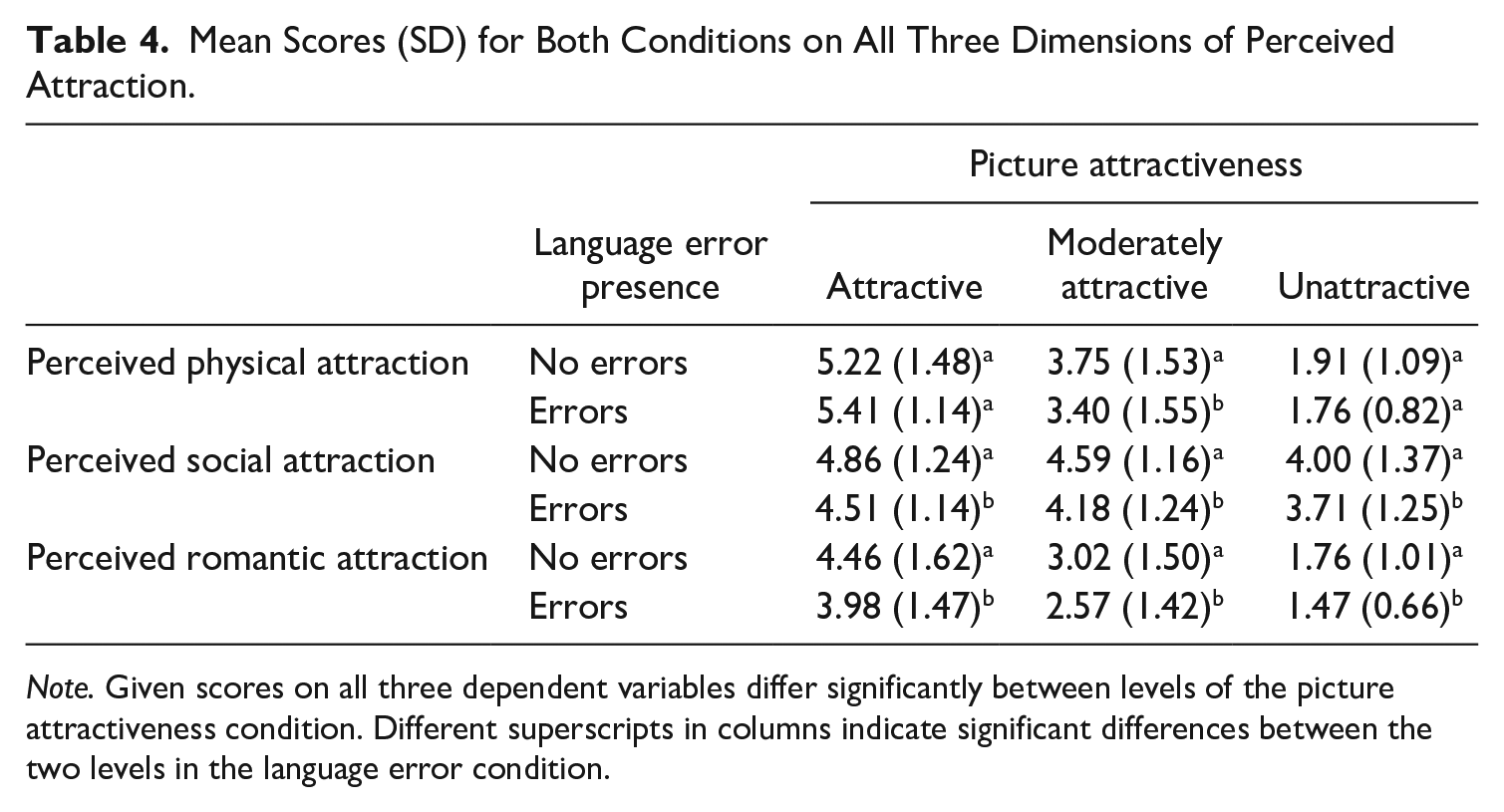
Note. Given scores on all three dependent variables differ significantly between levels of the picture attractiveness condition. Different superscripts in columns indicate significant differences between the two levels in the language error condition.
Interaction
For perceived physical attraction a significant interaction was found, F(2, 784.7) = 4.66, p = .010, ηp2 = .007, but there was none for social nor for romantic attraction, F(2, 784.4) = 0.217, p = .805 and F(2, 784.9) = 0.485, p = .616, respectively. Simple effects analyses for physical attraction showed that when a profile contained a moderately attractive picture, the given scores on physical attraction to profile owners with and without language errors in their texts differ significantly with lower scores for profiles with (M = 3.40, SD = 1.55) than for those without errors (M = 3.75, SD = 1.53), F(1, 784.5) = 7.54, p = .006, while this is not the case for profiles with attractive or unattractive pictures (with F’s < 2.29, and p’s > .131). This means H4 is partially supported: the expected interaction effect of picture attractiveness and language errors was only found for perceived physical attraction. 9
Exploratory Analyses
To further examine how people processed the multimodal dating profiles, we performed additional exploratory analyses. First, we examined how often participants switched between the picture and text during the profile viewing process, then looked into the proportion of fixations on pictures and texts over the course of the process, and finally, we zoomed in on the different profile processing strategies that could have been used, and investigated whether the used processing strategy affected impression formation differently.
General viewing patterns
On average, participants switched 3.12 times (SD = 2.04) between the picture and text on a profile, which is relatively low considering the average of sixty fixations on each profile in total. This suggests that the average profile viewing process consists of four episodes of (in most cases a larger number of) fixations on the profile components, from which two are on the picture and two on the text. The number of switches did not differ depending on the picture or text condition (all conditions ranged between 3.02 and 3.22 switches).
For a general view on the processing order of the two components on the profile, we divided each profile that was processed into 20 bins, each representing 5% of the total number of profile fixations, and then aggregated that data across participants and stimuli. The proportion of fixations on the picture and text was then calculated for each consecutive bin. 10 Figure 3 above shows that during the first 5% of the fixations on the profile, picture processing is most likely to take place. Then, the proportion of text fixations increases to almost full text attention. Toward the end of the viewing process (the last 15–20%), there is again an increase in picture fixations, which could indicate that fixations are directed to both components for integrative processing. Across all six conditions, the viewing patterns were almost identical, with only minimal differences in the proportion scores at the beginning and end of the viewing processes. Note that, overall, the proportion of text fixations is much higher than that of picture fixations, which is not surprising considering the relatively high number of fixations needed to read a text compared to processing a picture. Figure 4 gives an example of the order of fixations on the picture and text on a dating profile, corresponding with the general viewing pattern described.
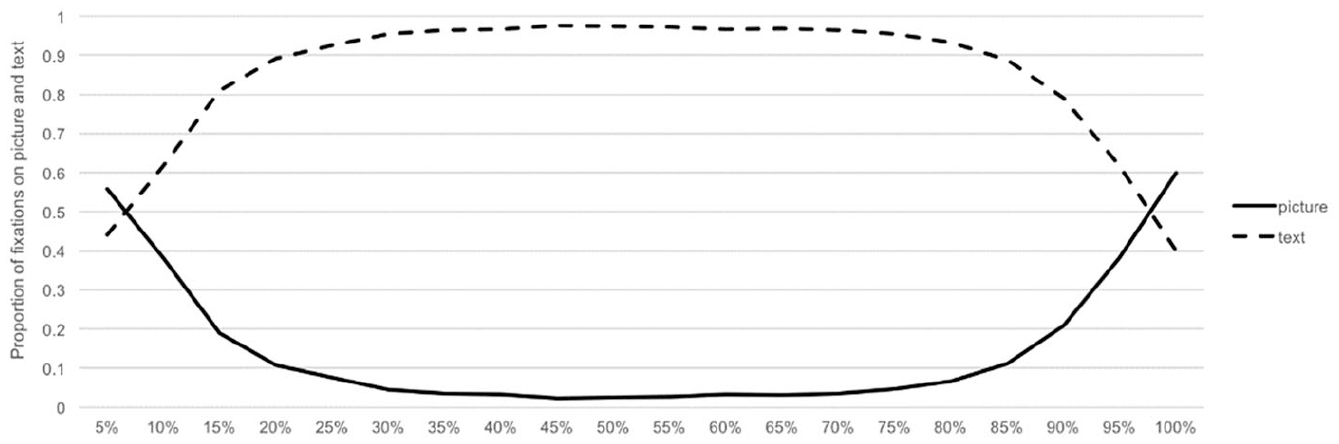
Plot of the proportion of fixations on the profile pictures and texts within bins of 5%.
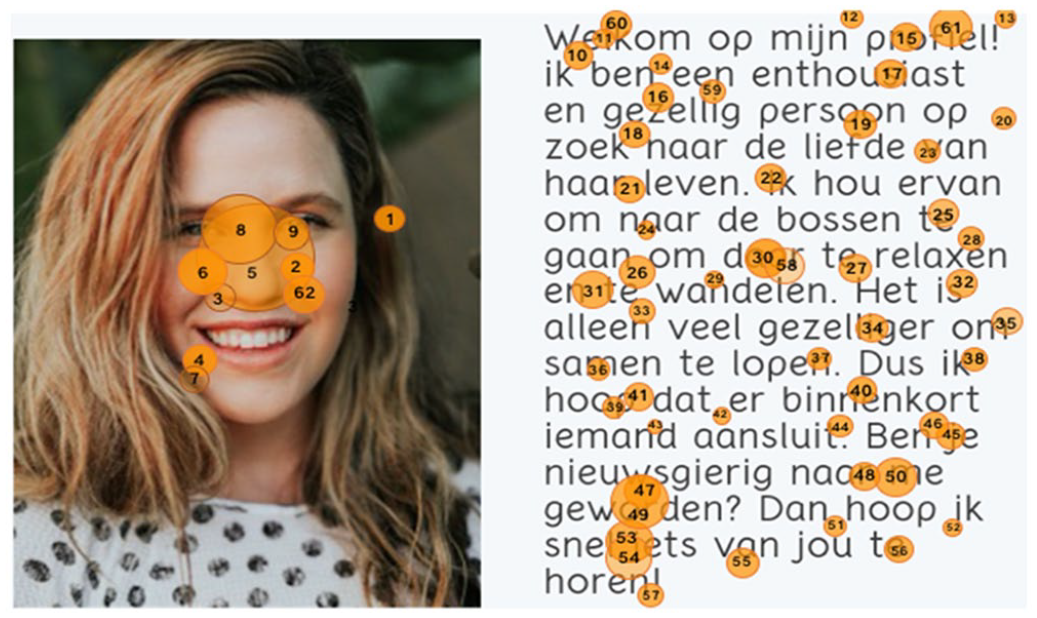
Examples of a scan path of a profile where the picture (moderately attractive) is processed before the text (without language errors).
Different viewing strategies and perceived attraction
There are a number of potential strategies participants could use to process the dating profiles. For each profile process, we categorized whether a multi-switching strategy, a first-picture-then-text strategy, or a first-text-then-picture strategy was used. The unit of analysis was each individual profile that was processed, resulting in a total of 831 cases.
The following criteria were used for categorization: cases with no switches at all (n = 22; 2.6%) were not categorized because one of the two components did not receive any attention. All cases with one to six switches were categorized as either first-picture-then-text or first-text-then-picture processing. Cases in which at least two of the first three fixations were on the picture were categorized as picture-first (50.8%) and cases with two or more of the first three fixations on the text as text-first (40.7%). Furthermore, a case was categorized as multi-switching processing when seven or more switches occurred on the profile (n = 47; 5.6%). This threshold of seven was determined following previous eye tracking research (e.g., Bucher & Schumacher, 2006; Rayner et al., 2001) and empirically, by inspection of the data. We observed that some people first looked briefly at both the picture and text (which could indicate orientating), then attended longer to both components (deeper processing), and then briefly fixated on both components again (merging). As such, seven switches would indicate more switches than if people would look at both the picture and text in each of the three phases.
To examine whether processing strategy led to different effects on perceived attraction, we ran additional linear mixed effect models with processing strategy as added fixed factor compared to the earlier analyses. The picture- and text-first strategies were the two processing strategies that were considered in this factor. Only for perceived romantic attraction a main effect of processing strategy was found, as well as an interaction effect of processing strategy and text condition. In general, lower romantic attraction scores were given when the text was processed first (M = 2.86, SD = 1.71) than when the picture was processed first (M = 3.04, SD = 1.78), F(1, 754.8) = 6.21, p = .013. The interaction effect showed that processing strategy did affect perceived romantic attraction for profiles without errors but not for profiles with errors, F(1, 726.1) = 4.28, p = .039. For profiles without language errors, scores on perceived romantic attraction were significantly higher when the picture was processed first (M = 3.33, SD = 1.84) than when the text was processed first (M = 2.70, SD = 1.66), F(1, 761.8) = 10.4, p = .001, while for profiles with errors there were no differences between romantic attraction scores between picture-first (M = 2.74, SD = 1.66) and text-first views (M = 2.53, SD = 1.52), F(1, 758.7) = 0.258, p = .612. No main or two-way interaction effects of used processing strategy with picture and text condition were found for physical and social attraction (all F’s < 1.91, p’s > .127).
Moreover, a significant three-way interaction effect of used processing strategy, picture condition, and text condition on perceived physical attraction (F(2, 722.1) = 5.02, p = .007) revealed that processing strategy only affected perceived physical attraction for profiles with an attractive picture and without errors: for these profiles, physical attraction scores were higher when the picture was processed first (M = 4.70, SD = 1.57) than when the text was processed first (M = 4.04, SD = 1.59), F(2, 735.8) = 8.70, p = .003. This suggests that when the picture is processed first, attractive pictures have a stronger positive effect. In all other conditions, perceptions of physical attraction were not affected by the order in which the profile components were processed (with all other F’s < 2.96 and p’s > .086).
Overall, the exploratory analyses suggest a clear pattern in the viewing behavior by participants: they look at both the picture and the text, often by focusing on the picture first, then on the text. Switching repeatedly between the two components is rare. Moreover, processing strategies remain relatively unaffected by the picture and text manipulations, suggesting that the viewing patterns are robust. The used processing strategy seems to have some influence on how (strong) the effects of the manipulations on impressions formation scores are.
General Discussion
This study investigated how online dating profiles that contain pictures varying in attractiveness and texts with or without language errors affect profile processing and impressions of profile owner attractiveness. One goal of this study was to test the picture gatekeeper model, which proposes that the attractiveness of a profile picture is key in the impression formation process. It was therefore assumed that pictures on dating profiles would receive first attention and that the picture’s attractiveness would determine how much attention people would pay to the profile text. To investigate this, we collected both eye tracking and perception data.
Eye tracking results revealed that when people are presented with multimodal dating profiles containing a picture and a text, pictures are more likely to attract initial attention (which is consistent with for example Scott & Hand, 2016, and Seidman & Miller, 2013). This confirms H1 and is in line with the picture gatekeeper model. Results also supported H2: the more attractive the picture, the more frequent and longer people look at the picture (in accordance with for example Leder et al., 2016, and Valuch et al., 2015). In addition, people fixated more and longer on profile texts with language errors than on those without errors (see also Rayner, 1998).
While our results highlight the importance of the profile picture, they also indicate that a picture does not necessarily function as gatekeeper to the rest of the profile. Regardless of the picture’s attractiveness, the profile text attention was around 9 seconds and 50 fixations, that is, around 80% of the total profile attention. Inconsistent with H3, there was not more attention for the profile text when a picture was moderately attractive than when it was attractive or unattractive. More specifically, texts on profiles with attractive and unattractive pictures received more attention than was originally expected.
In line with H4 and the picture gatekeeper model, language errors had a negative effect on perceived physical attraction when a profile included a moderately attractive picture but not when it contained an attractive or unattractive picture. This could indicate that when picture information is not (yet) sufficient to form an impression about physical attraction, textual cues carry greater weight. However, inconsistent with H4 and the picture gatekeeper model, these interaction effects of picture attractiveness and language errors were not found for perceived social and romantic attraction. This suggests that both picture and text attractiveness influence impressions about social and romantic attraction, irrespective of the attractiveness of the profile component in the other modality. People may thus use cues about picture and text attractiveness relatively independently to form separate impressions about social and romantic attraction. These differential results imply that it is not just the heuristic of “what is beautiful is good” that leads to impressions about attractiveness.
To get a better view on how multimodal dating profiles were processed, we conducted exploratory analyses. General viewing patterns revealed that people are most likely to process the picture prior to the text, with the first 5% of the profile fixations mostly being on the picture. The absence of differences in general viewing patterns and number of modality switches across picture and text conditions suggests that profile cues have little impact on the general profile viewing process. At the same time, both profile cues do affect impression formation scores, but there are few interaction effects between the two types of cues. This seems to indicate that profile processing and impression formation occur in two relatively independent stages. This is corroborated by the finding that what profile component was processed first had little effect on further impression formation.
Implications
Our study has several theoretical implications. First, finding no interaction effect of picture attractiveness on text attention reveals that people did not look longer at texts of profiles with moderately attractive pictures than at profiles with attractive or unattractive pictures. It seems that even when a profile picture was attractive or unattractive, the initial impression based on pictorial information did not withhold people from further text processing. Participants dedicated significant attention to all profile texts which suggests they processed profile texts deliberately, irrespective of the picture’s attractiveness. In fact, our results may even imply that neither the text nor the picture was processed (solely) heuristically, because both the profile’s picture and text received a considerable amount of attention, and cues in both components affected perceptions of attraction.
Consequently, the main theoretical implication of this study is that our results are not consistent with the picture gatekeeper model. Therefore, based on the patterns we observe in our data, we put forward an alternative model of how pictures and texts on multimodal dating profiles are processed and how the two profile components affect impression formation. We dub this model the multimodal information processing (MIP) model (see Figure 5). Based on the results of this study, we suggest that to develop impressions about a dating profile owner, people take stock of the information provided in each of the two modalities. They seem to do this consecutively, often starting with the picture modality. This MIP model could be an important contributor to theories about (multimodal) information processing and online impression formation on three levels, which leads to three discernable stages in the model: the processing stage, the cue assessment stage, and the impression formation stage.
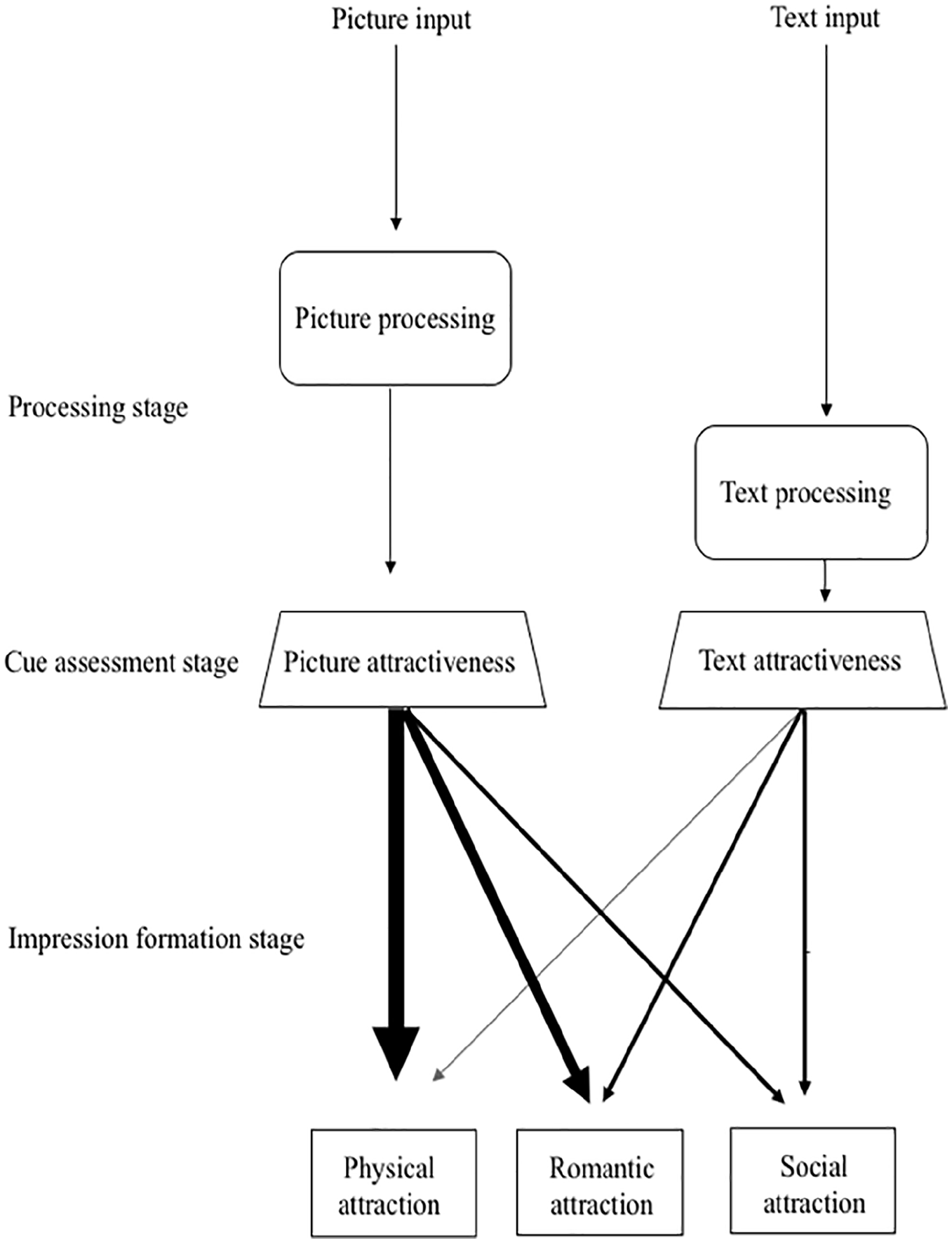
Schematic representation of the processing flow in the multimodal information processing (MIP) model.
In the first stage, people separately process the profile’s picture and text, in which the picture is likely to be processed first. This accords with both H1 and the general viewing pattern of the exploratory analyses. Picture and text processing seem to occur as two relatively isolated events—with little switching between the components (see also Carroll et al., 1992; Rayner et al., 2001). This is potentially in line with extant research indicating distinct picture and text processing (e.g., Barry, 1997; Paivio, 1990; Powell et al., 2019). Paivio (1990) proposed earlier in his dual coding theory that pictorial and textual information is processed in different subsystems in working memory, resulting in a parallel construction of two separate mental models. Prior to the construction of these separate mental models, no interplay is assumed to take place (Eitel et al., 2013).
In the second stage, people assess the different pictorial and textual cues that are available on the profile. In the specific case of this study, this results in separate main effects of the picture (attractiveness) and text (language error presence) manipulations. At this stage, perceptions are attributed to profile cues, such as about the attractiveness of the pictorial and textual cues. As no interaction effects of picture and text attractiveness were obtained on the processing of these two components—suggesting relatively independent picture and text processing—it is most likely that pictorial and textual cues also lead to separate assessments about the attractiveness of these cues.
In the third and final stage, perceptions that are developed about picture and text attractiveness are used to form impressions about profile owners and their attractiveness. Our data suggest that separate impressions are formed for each dimension of perceived attraction instead of one overall impression. This finding deviates from previous research that assumes that people favor to form one general impression rather than evaluating someone on each attribute to form different impressions (cf. Kahneman, 2011; Willis & Todorov, 2006). We found that picture attractiveness primarily affects perceived physical attraction, and to a lesser extent social and romantic attraction, while text attractiveness affects social and romantic but not physical attraction. The finding that pictorial and textual cues differ in impact depending on the specific aspect of attraction that is assessed draws on previous findings of Van der Zanden et al. (2020), who posed that interpersonal attraction may not always be considered a unidimensional construct. The arrows in the model in Figure 5 represent the effects of picture and text attractiveness on each dimension of attraction, with the size of the effects being indicated by the arrows’ thickness.
This study also yields practical implications for online daters. Given our results, online daters are recommended to invest time and effort in both the picture and text of their profile. Profile pictures and texts are not only both likely to receive attention, but online daters should also take into account that both pictorial and textual profile cues affect perceived attraction: attractive pictures positively affect perceived attraction, but regardless of the picture, language errors have a negative effect. The latter finding highlights that online daters should try to avoid language errors in their profiles. Another reason why daters should consider both profile components is because people seem to use pictorial information primarily for impressions about physical attraction, and to a lesser extent social and romantic attraction, whereas language errors most heavily impact impressions of social attraction, which is mostly concerned with perceptions of a profile owner’s personality. This implies that specific impressions are formed on the basis of different pieces of information on the profile.
Finally, our results reveal practical insights for designers of online dating platforms. Our finding that pictures are more likely to capture initial attention when they occur on the left rather than the profile’s right side may suggest that the way dating platforms organize profiles could influence (to some extent) how their members view profiles of others. Most dating platforms seem to anticipate on the relevance of picture attractiveness by placing the picture on the position of the profile where it appears most prominent and almost certainly receives initial attention, that is, either at the top of the profile (e.g., on applications like Tinder) or on the profile’s left side (e.g., on web-based sites like eHarmony). There are however dating platforms that want to place less emphasis on initial picture attention and more emphasis on profile texts or other (textual) information in the initial impression formation phase. For these platforms, it could be relevant to experiment with the position of the profile picture and text as to enhance initial text attention.
Directions for Future Research
Our data seem to fit the MIP model better than the picture gatekeeper model. However, the independent processing of cues in different modalities and the extent to which they lead to separate assessments of attraction should be investigated further, for example by comparing cue assessments when presenting a one-modality profile with a profile that includes that and another component (i.e., two modalities). Moreover, future research could attempt to further disentangle the second and third stage of the MIP model; for instance by collecting assessments regarding the picture, the text, and the profile owner’s attractiveness separately, as based on our data we cannot test whether cue attractiveness assessments occur prior to the impressions formed about the person “behind” the profile. New (preregistered) studies should thus be conducted to further examine the model’s viability and the different stages within the model.
The separate, independent effects of the profile cues on the different dimensions of perceived attraction raise the question how and when the specific aspects of impression formation eventually integrate into one final decision. In the case of online dating, it could be that one eventually integrates the different attractiveness impressions—formed on the basis of different profile cues—to come to a final decision about whether to pursue contact with the profile owner. While in our study the measure of perceived romantic attraction may have been an indication of romantic interest, this was not a statement that inquires actual interest in sending a message to or going on a date with the profile owner. To investigate the relative weight of the different impressions, it would be interesting for future work to also test when people integrate the impressions to one decision, for example by providing them the option to like or dislike a profile after assessing it.
The profile setup that was used for this study matched with how daters on various large profile-based sites (e.g., Relatieplanet, eHarmony) encounter a profile for the first time, that is, with a single picture and a short self-description. On such sites, daters often decide on the basis of this information whether they want to find out more about the profile owner, which they can do by clicking on the profile. Usually, this involves not only more demographic and written answers to questions, but also more pictures. A next step would be to investigate whether comparable viewing patterns would occur when people view the full profile, that is, by looking at all pictures prior to processing other textual information.
The immediate and simultaneous availability of the picture and text on the profiles in this study, may have influenced participants’ perceived importance of both profile components for impression formation. This may have resulted in more attention to the profile and profile cues than may have been given in a real-life dating setting, where immediately accepting or discarding a profile might occur. Especially on photo-based dating platforms, such as Tinder, pictures are primarily used for impression formation and deciding whether to swipe left (no interest) or right (interest). Although in these contexts picture attractiveness may be used as the profile’s gatekeeper, our MIP model may still hold as people may make the decision on an incomplete impression based only on picture attractiveness and the associated physical attraction perception, resulting in little or no consideration of other impression formation dimensions (e.g., social attraction). This, however, should be tested in a future experiment.
The aim of this study was to gain insight in the impression formation process by collecting both eye tracking data and perception data. While viewing dating profiles, eye movement data can reveal in a precise and objective manner (unconscious) cognitive processes and preferences of people, such as what parts of a profile have been attended to, when, how long and often, and in what order. The data can however not tell us why people did—or did not—attend to these different components (Holsanova, 2014). Based on our results, it is for example difficult to ascertain participants’ rationale to look at all profile texts. It could be that picture attractiveness did not immediately lead to an overall impression which made participants shift their attention to profile texts, or participants formed overall impressions based on picture attractiveness but tried to confirm these initial impressions by paying attention to profile texts. Interviews or thinking-aloud methods in which participants try to verbalize the rationales behind their profile viewing behavior could be a way to further extend our understanding of the online impression formation process.
To conclude, our study is the first that used eye tracking to investigate people’s impression formation processes while looking at multimodal online dating profiles. Our results seem to indicate that picture attractiveness and language errors mostly separately affect picture and text processing, which could result in distinct impression formation processes. In general, this research shows that most profile attention is devoted to texts but that pictures have the strongest impact on impression formation. Even though picture attractiveness is highly determining, it does not seem to affect text processing and the resulting effects on impression formation. Thus, pictures and texts are likely to be processed relatively independently and lead to separate impressions on different aspects of perceived attraction.
Footnotes
Declaration of Conflicting Interests
The authors declared no potential conflicts of interest with respect to the research, authorship, and/or publication of this article.
Funding
The authors received no financial support for the research, authorship, and/or publication of this article.
