




Abstract
Social-emotional skills (SESs) are typically acquired through observation and imitation, processes heavily reliant on the visual system. Children and adolescents with visual impairments (VI) may face challenges in developing these skills and may adopt compensatory strategies to overcome these difficulties. General curricula for students with VI, such as the Expanded Core Curriculum (ECC) and the Curriculum Framework for Children and Young People with Vision Impairment (CFVI), consider these skills a specific learning area, while the scientific literature recommends SESs assessment and explicit teaching. However, it seems that a specific curriculum for social-emotional learning (SEL) tailored to students with VI may not yet exist. Thus, the Visual Impairment – Social Emotional Learning (VI-SEL) curriculum was developed to fill this gap. This study, conducted in Switzerland, evaluates its content validity using a two-round Delphi study with a group of experts in the field of VI (N = 15). Consensus was evaluated using a 14-item questionnaire, with experts providing feedback to refine the curriculum. Across both rounds, expert ratings exceeded the consensus threshold, with mean scores of 4.58 (SD = 0.78) in the first round and 4.70 (SD = 0.54) in the second. Qualitative feedback led to further refinements. Experts rated the VI-SEL curriculum content favourably, which suggested it fills an existing gap in practitioner resources with the potential to be integrated into general curricula for students with VI (e.g., the ECC and CFVI). While the findings should be interpreted cautiously, the VI-SEL curriculum may be a valuable tool for practitioners supporting SESs development in children and adolescents with VI. Further research is needed to evaluate the clinical effectiveness of the curriculum.
Keywords
Introduction
Social-emotional skills (SESs) are essential for effective social interaction, friendship maintenance, and a sense of belonging within one’s social environment (Beauchamp & Anderson, 2010; Soto-Icaza et al., 2015). However, children and adolescents with visual impairments (VI) face challenges in developing SESs due to difficulties in perceiving visual cues (e.g., facial expressions, gestures, and eye contact) and the possible inaccessibility of their environment (Roe, 2019; Roe & Webster, 2002).
SESs are defined as the ability to cognitively process social information (e.g., identify the emotions of others) and enact and adapt behaviours for effective interactions in different environments (e.g., behaving differently with classmates, teachers, or parents; Beauchamp & Anderson, 2010). SESs development arises from a dynamic interplay between environmental factors and features related to the maturation of the sensory system (e.g., biological motion processing, eye and face detection, and gaze tracking), the motor system (e.g., basic imitation and triadic activities), and socio-cognitive development (e.g., emotion recognition, joint attention, inner speech, and theory of mind; Fernyhough, 2008; Soto-Icaza et al., 2015). Consequently, children and adolescents mainly learn SESs through observation and imitation. This learning process is supported by their visual and social-cognitive systems and mediated by cultural tools (e.g., language). It occurs through emotionally meaningful interactions with the environment, especially with adults and peers (Vygotsky, 2019; Vygotsky et al., 1997).
Children and adolescents with VI will likely encounter SESs challenges throughout development, although they may develop adaptive strategies (Boettcher & Dammeyer, 2016; Roe & Webster, 2002). Early difficulties can arise in visual attention (Loots et al., 2003), joint attention (Tadić et al., 2009; Urqueta Alfaro et al., 2018), and interaction initiation (Preisler, 1991). Difficulties in symbolic play and theory of mind (Brambring & Asbrock, 2010; Green et al., 2004) are also observed, although these may lessen with age (Peterson et al., 2000). Recognising infants’ specific behaviours (van Eijden et al., 2023) with appropriate caregiver responsiveness (Lang et al., 2017) can help address these challenges (Chen, 2014). At school age, children with VI may face difficulties in pragmatic communication (James & Stojanovik, 2007; Pijnacker et al., 2012; Tadić et al., 2010) and social problem solving (McAlpine et al., 1995; Pring et al., 1998). They may also show stereotypical behaviours (Molloy & Rowe, 2011) and reduced playful social interactions with peers (Caron et al., 2021; Celeste, 2006). During adolescence, these issues can lead to smaller social networks and increased loneliness (Huurre & Aro, 2000; Kef, 1997; Kroksmark & Nordell, 2001). Moreover, these SESs challenges can have lasting consequences in adulthood, including social barriers in the workplace (Basu & Rani, 2023; Naraine & Lindsay, 2011), psychosocial difficulties, and social isolation (Nyman et al., 2010).
Hence, relevant publications recommend assessment and explicit SESs teaching (Roe, 2019; Sacks & Wolffe, 2006) tailored to alternative developmental pathways for these children and adolescents to support their SESs development (Pérez Pereira & Conti-Ramsden, 2020; Warren, 1994). Although specific curricula, such as the Expanded Core Curriculum (ECC; Allman & Lewis, 2014) and the Curriculum Framework for Children and Young People with Vision Impairment (CFVI; Hewett et al., 2022), consider these skills as a compulsory area of learning, SESs are often given secondary importance in teaching (Wolffe et al., 2002), with the responsibility generally falling to support staff (McKenzie & Lewis, 2008). However, evidence from a recent systematic review indicated that interventions for this population can be effective (Caron et al., 2023). SESs can be implemented using various strategies (e.g., verbal instructions, prompting, role-playing, and audio description), augmented toys (Verver et al., 2019, 2020), and adapted augmentative and alternative communication tools (e.g., Picture Exchange Communication System 3D; Schaefer Whitby et al., 2019). While SESs activities exist for early childhood and school-age children (Dale & Salt, 2007; Sacks, 2014), we are unaware of the existence of a specific social-emotional learning (SEL) curriculum for children with VI, while many exist for the general population (Lawson et al., 2019). Consequently, a SEL curriculum for children with VI was developed in response to practitioners’ requests for more assessment and teaching tools (Barras et al., 2023).
The Visual Impairment – Social-Emotional Learning (VI-SEL) 1 curriculum is a SEL curriculum for practitioners teaching SESs to children with VI aged 6 to 12. It includes an overview of SESs development in children with VI, assessment and teaching guides, instructions for use, and ten SEL lessons (e.g., ‘Expressing Your Emotions’, ‘Taking Turns’, and ‘Resolving Disagreements Calmly’). The curriculum also includes digital resources (e.g., audio files and thermo-inflatable pictograms representing emotions).
The VI-SEL’s implementation is structured in two phases. First, the assessment phase uses the Social Skills Improvement System Social-Emotional Learning Edition Rating Forms (SSIS-SEL RFs; Elliott & Gresham, 2021; Gresham & Elliott, 2017) and the Social Skills Assessment Tool for Children with Visual Impairments: Revised (SSAT-VI: R; Sacks, 2014) for general SESs assessment, as well as summative and formative grids for SESs assessment within the VI-SEL curriculum. Second, the intervention phase involves ten lessons with explicit instruction delivered individually or in small groups. Each lesson follows five structured phases (Tardif, 1999): Say – Introduce the skill (e.g., expressing your emotions), Try – Explore the skill independently (e.g., try to express your emotions during role-play), Learn – guided strategy understanding (e.g., learn a strategy to express your emotions), Do – Skill practice (e.g., do the strategy during a role-play), and Discuss – Metacognitive discussion on the strategy and learning. The VI-SEL curriculum cover and an example of the lesson ‘Expressing Your Emotions’ appear in Supplemental Figure 1.
The Delphi method was highly relevant for assessing the content of the VI-SEL curriculum (Green, 2014; Turoff & Linstone, 2002). Consequently, this article presents and discusses the results of a Delphi study assessing the content validity of the VI-SEL curriculum.
Method
Curriculum development
The VI-SEL curriculum was developed by the first author, who holds a master’s degree as a special education teacher. The curriculum development was inspired by the Social Skills Improvement System Social Emotional Health Classwide Intervention Program (Elliott et al., 2022). Once the curriculum was developed, the first author tested four lessons during four sessions with students with VI at the Centre Pédagogique pour élèves Handicapés de la Vue (CPHV) in Lausanne, Switzerland. As a result, the VI-SEL curriculum was refined based on valuable feedback and critical reviews provided by a special needs educator from the CPHV and the second and third authors of the article.
The Delphi method
The Delphi method has been widely used to establish content validity for assessment tools and educational intervention curricula (Green, 2014). This method gathers a panel of experts who review submitted content, validate or invalidate it, and provide valuable feedback to reach a consensus. This method has also been used in VI research (Beach et al., 2024; Hewett et al., 2023; Stribing et al., 2021).
Although no standardised procedure exists, a few key steps are commonly followed (Green, 2014). First, a panel of experts is selected of ‘between 12 and 30 participants’ (Flostrand et al., 2020, p. 3). Second, a survey is distributed to all panellists to collect their opinions and evaluations. Third, responses from the second step are integrated to generate a new proposal for review by the panel. Finally, the process involves determining the number of rounds required to achieve consensus (Keeney et al., 2006).
The Delphi method in the present study
Forty potential Delphi participants were initially contacted via email to form an expert panel to determine the content validity of the VI-SEL curriculum. Of these, 14 did not respond, and 11 declined to participate. Those expressing interest were asked to complete a brief questionnaire based on the following selection criteria, with eligibility for the expert panel requiring a minimum of three of the five criteria:
Professional experience with individuals with VI (e.g., children, adolescents, and adults);
Research experience in the field of VI;
A bachelor’s degree or higher in special education or a similar field (e.g., social work, psychology, or occupational therapy);
Responsibility for assessing or teaching SEL or related areas;
Knowledge of the French language.
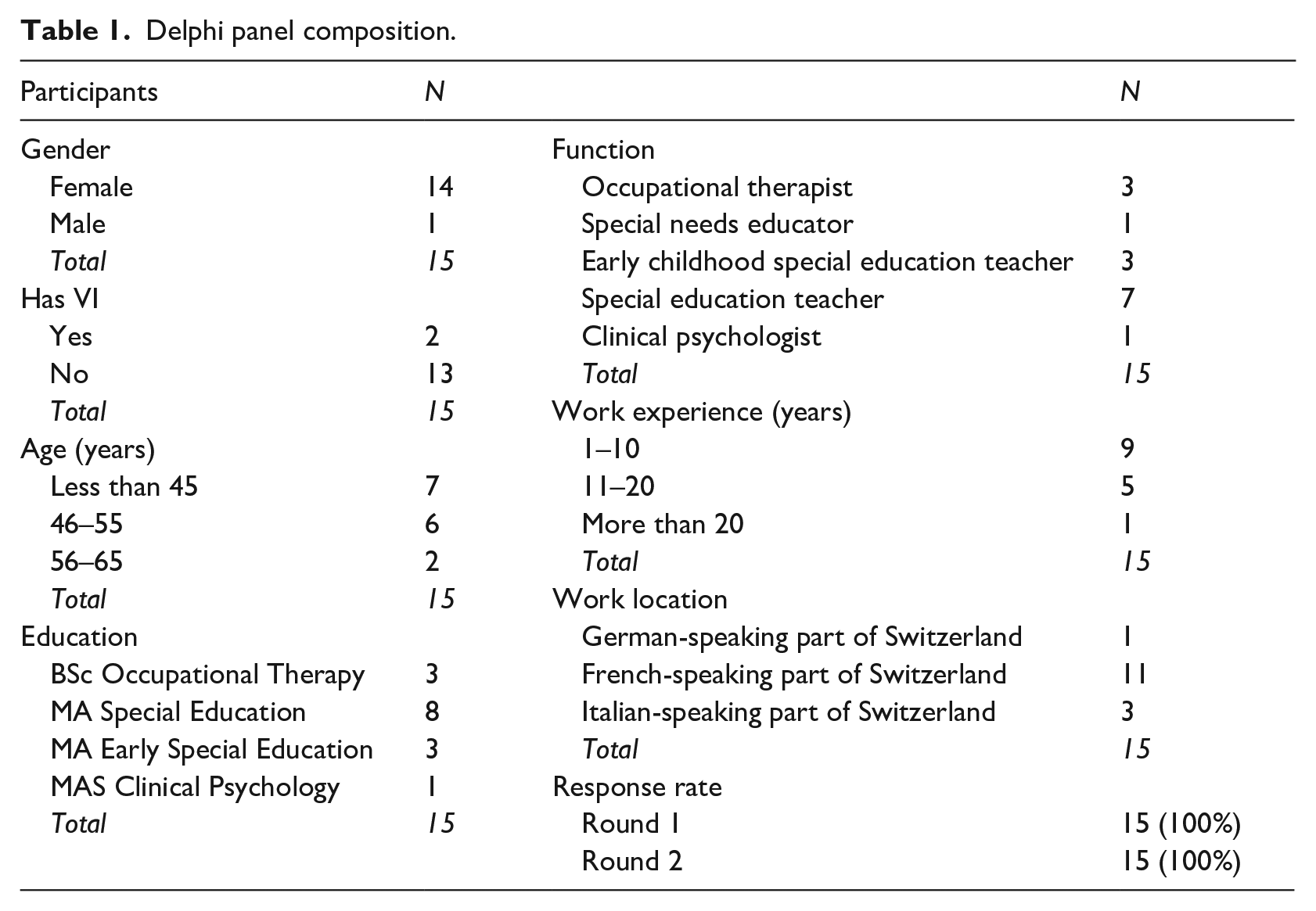
As a result, 15 participants qualified for and joined the panel. They averaged four criteria (range = 3–5). An overview of the characteristics of the Delphi panel members is provided in Table 1.
Delphi panel composition.
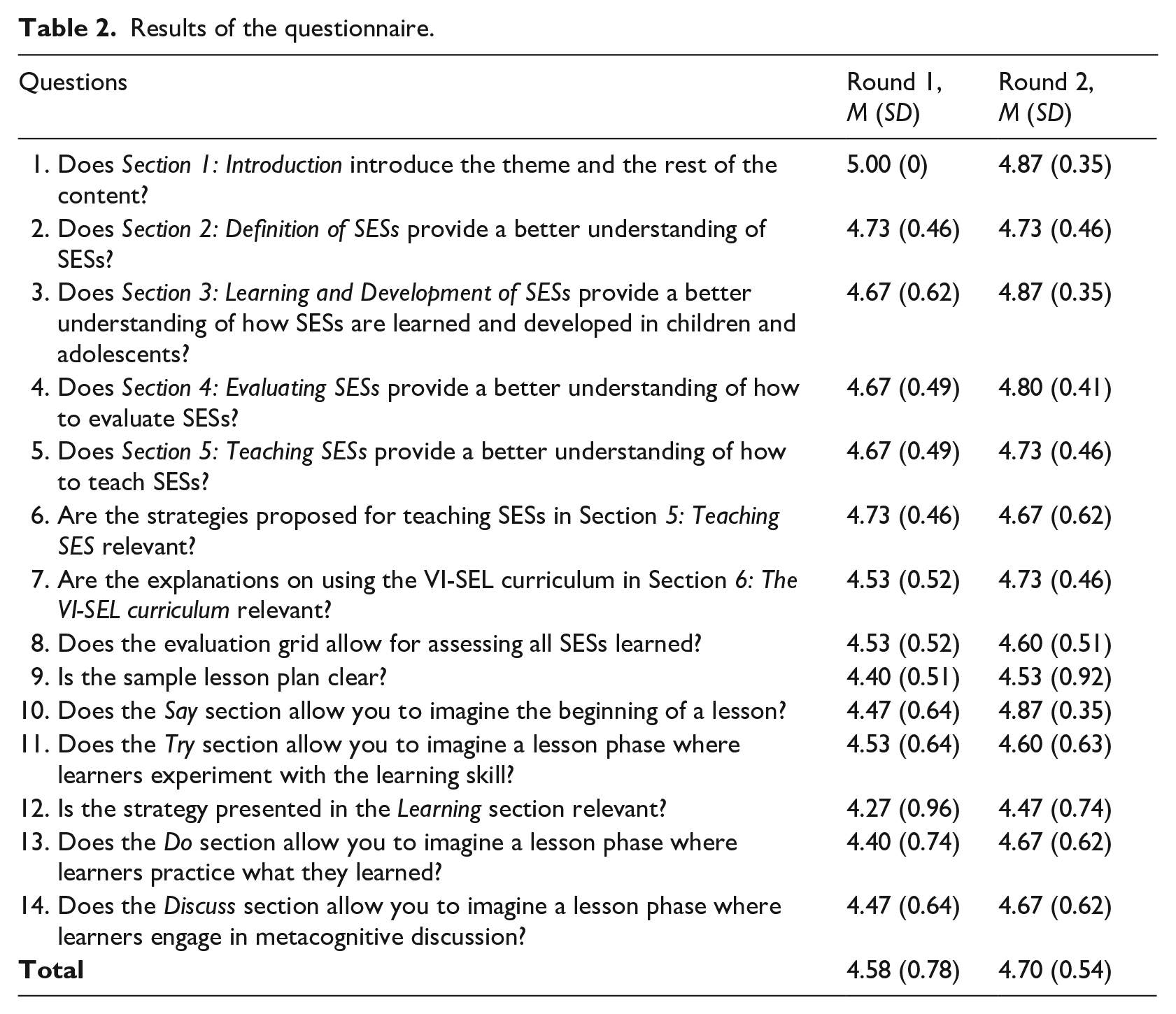
The first round of the Delphi study included the VI-SEL curriculum and a questionnaire in an email sent to the expert panel on April 26, 2024. As shown in Table 2, the questionnaire included 14 questions based on chapters and a lesson from the VI-SEL curriculum. For example, a question asked, ‘Does Section 5: Teaching SESs provide a better understanding of how to teach SESs?’ The participants could answer using a Likert-type scale from 1 to 5 points: 1 = strongly disagree, 2 = disagree, 3 = neutral, 4 = agree, and 5 = strongly agree. In addition, the participants could comment on and edit the VI-SEL curriculum for improvement. In the second round, on June 12, 2024, the revised curriculum was returned to the experts, with the accepted modified parts underlined in yellow. Subsequently, the 15 experts answered the same 14 questions again.
Results of the questionnaire.
Data analysis
Descriptive statistics were used to determine the content validity of the VI-SEL curriculum. Means and standard deviations were analysed to determine whether changes in content between cycles led to improved evaluations (Green, 2014). A mean score of 4.0 out of 5.0 for all questions and the entire questionnaire was established to confirm adequate content validity (i.e., a consensus of 80%) per Turoff and Linstone (2002).
Results
A 14-item questionnaire was used to determine the content validity of the VI-SEL curriculum. Two rounds of comparing the means and standard deviations achieved consensus. The results appear in Table 2.
In Round 1, a full response rate was achieved (N = 15, 100% response rate) with an overall questionnaire mean of 4.58 (SD = 0.78). All items on the questionnaire received scores above 4, ranging from 4.27 (SD = 0.96) to 5 (SD = 0). Following the first round, the experts suggested several revisions to the VI-SEL curriculum.
In Round 2, a complete response rate was again recorded (N = 15, 100% response rate), with an increased overall mean of 4.70 (SD = 0.54). Individual items continued to score above 4.0, ranging from 4.47 (SD = 0.74) to 4.87 (SD = 0.35). A comparison of the means between the first and second rounds resulted in the key findings.
First, the overall questionnaire mean increased by 0.12 from Round 1 to Round 2. Second, 11 of 14 items increased, ranging from 0.07 to 0.40. Third, Item 2, ‘Does Section 2: Definition of SESs provide a better understanding of SESs?’ maintained the same score (M = 4.73, SD = 0.46). However, two items decreased: Item 1, ‘Does Section 1: Introduction introduce the theme and the rest of the content?’ decreased by 0.13, while Item 6, ‘Are the strategies proposed for teaching SESs in Section 5: Teaching SESs relevant?’ decreased by 0.07. Despite these decreases, with the overall mean over 4.0, the content validity of the VI-SEL curriculum was acceptable.
Discussion
The results of this study indicate that both rounds achieved consensus, with general and specific items surpassing the threshold of 4.0 out of 5.0, as defined by Turoff and Linstone (2002). This outcome indicates a strong overall endorsement of the VI-SEL curriculum by the expert group. Although these findings are encouraging, they warrant a more nuanced and critical analysis to fully understand their implications and potential limitations.
The decrease in results for two items – Item 1, ‘Does Section 1: Introduction introduce the theme and the rest of the content?’ and Item 6, ‘Are the strategies proposed for teaching SESs in Section 5: Teaching SESs relevant?’– could potentially be attributed to a reduced element of surprise. By the second round, the content might have appeared less novel or engaging to the expert panel, which could explain the decline in ratings. Conversely, the early achievement of the consensus threshold in Round 1, followed by an increase in scores in Round 2, might reflect factors beyond simple content validation (e.g., the formulation of the questions inadvertently introduced bias, which encouraged participants to provide more favourable responses). Moreover, the Swiss context in which the panel was conducted, marked by a lack of tools for assessing and teaching SESs (Barras et al., 2023), may have contributed to the experts providing more favourable responses.
Nevertheless, an overview of the extant field research highlighted a broader issue. For example, a recent study involving 23 practitioners found a notable gap in the Swiss context regarding assessment tools, teaching resources, and practitioner training in the domain of SESs for children and adolescents with VI (Barras et al., 2023). This finding aligns with research underscoring the secondary emphasis placed on SESs teaching (Wolffe et al., 2002), often delegated to paraprofessionals (McKenzie & Lewis, 2008), in the broader framework of teaching children with VI. Moreover, while specific curricula like the ECC and CFVI designate SESs as a compulsory learning area (Allman & Lewis, 2014; Hewett et al., 2022), the issue of the difficulty of applying this learning area seems to remain relevant (Barras et al., 2023).
Therefore, this study and the development of the VI-SEL curriculum sought to fill a gap in the available tools by addressing the issues of assessment and teaching. Regarding assessment, SESs evaluation should be based on scientifically validated tools (e.g., the SSIS-SEL RFs; Gresham & Elliott, 2017) and specific tools for children and adolescents with VI (e.g., the SSAT-VI: R; Sacks, 2014). Regarding teaching, the instruction should be explicit and incorporate a range of teaching strategies (e.g., role-playing, prompting, verbal instruction, audio description, and peer mediation) that exploit alternative developmental pathways for children and adolescents with VI (Roe, 2019; Sacks & Wolffe, 2006). These elements were considered when developing the VI-SEL curriculum.
Limitations and future directions
Although this study offers valuable insights, several limitations must be acknowledged. First, the absence of open-ended questions and an expert focus group might have limited critical feedback on the curriculum. Second, the study’s sample size and the participants’ geographic concentration within a specific region of Switzerland might have introduced a degree of contextual bias. As a result, the findings and expert opinions might be different if the participants were from different geographical backgrounds.
Several future directions can be considered to improve and further evaluate the VI-SEL curriculum. First, assessing the curriculum’s effectiveness could be pursued through a single-case design (Riley-Tillman & Burns, 2009) or video observation within a dialectical-interactive framework (Hedegaard & Fleer, 2008). Second, expanding assessment possibilities by exploring dynamic assessment methods (Bodrova & Leong, 2007; Haywood & Lidz, 2006) and developing a dynamic assessment protocol tailored for children with VI – similar to Social Thinking® Dynamic Assessment Protocol (Norris, 2018) – would be useful for identifying and teaching developing SESs. Finally, given that SESs develop and change throughout development (Beauchamp & Anderson, 2010; Soto-Icaza et al., 2015), it would be beneficial to link VI-SEL curriculum with similar tools for early learners (Dale & Salt, 2007) and adolescents or young adults (Donohue et al., 1995; Kim, 2003). These efforts would strengthen the curriculum’s adaptability and relevance across developmental contexts.
Conclusion
This article aimed to present and discuss the findings of a Delphi study that evaluated the content validity of the VI-SEL curriculum – a 10-lesson SEL curriculum for children with VI between the ages of 6 and 12. Over two rounds, 15 experts assessed the curriculum’s content validity and provided qualitative feedback contributing to the VI-SEL’s refinement. In both rounds, the results surpassed the established threshold, which indicates the high relevance of the curriculum’s content. In practical terms, the VI-SEL curriculum offers a valuable, open-access tool for practitioners aiming to teach SESs to children with VI by addressing a core learning area in general curricula designed specifically for students with VI (e.g., the ECC and CFVI). In this way, practitioners can support students’ SESs development by potentially improving their social participation and providing a better quality of life.
Supplemental Material
sj-pdf-1-jvi-10.1177_02646196251352365 – Supplemental material for Teaching social-emotional skills to children with visual impairments: Content validation of the Visual Impairment – Social Emotional Learning curriculum through a Delphi Study
Supplemental material, sj-pdf-1-jvi-10.1177_02646196251352365 for Teaching social-emotional skills to children with visual impairments: Content validation of the Visual Impairment – Social Emotional Learning curriculum through a Delphi Study by Alessio Barras, Valérie Caron and Nicolas Ruffieux in British Journal of Visual Impairment
Footnotes

References
Supplementary Material
Please find the following supplemental material available below.
For Open Access articles published under a Creative Commons License, all supplemental material carries the same license as the article it is associated with.
For non-Open Access articles published, all supplemental material carries a non-exclusive license, and permission requests for re-use of supplemental material or any part of supplemental material shall be sent directly to the copyright owner as specified in the copyright notice associated with the article.
