




Abstract
While there has been a long-term commitment to inclusion in mainstream schools for pupils with special educational needs, including vision impairment (VI), the position of these pupils in an inclusive school environment, and the extent to which their educational, social, and emotional needs are met, continues to be problematic. This study investigates the experience of children and young people with VI accessing the curriculum and education, through evaluating the perceived quality of their participation in terms of rights, efficiency, and development. The methodology employed a qualitative approach, comprising face-to-face focus group interviews with pupils with VI. Three focus group sessions took place with 13 pupils with VI aged 8–18 years from primary and post-primary schools. Regarding pupils’ participatory rights, many reported challenges experienced in terms of equal access to education. In some instances, obstacles emerged due to lack of proper engagement with the pupil, or teachers’ actions were seen to reinforce pupil difference, undermining opportunities for more inclusive practice. In terms of development, this was chiefly evidenced by frequent descriptions of ‘missing out’, particularly on the social and peer engagement aspects of school life. Pupils unanimously reported that participation could be more efficient if there was increased awareness of their lived experiences with VI, and positive aspects of empowerment emerged when pupils felt included in decision-making about their needs. This study highlights key challenges for pupils with VI regarding how they access education in Northern Ireland, including issues surrounding their inclusion, everyday discrimination, and a lack of awareness of VI. Although these children and young people demonstrated appeasement and understanding, when insensitivities arose, pupils with VI, while resilient and generally positive about their experience, are faced with challenges that diminish their access, participation, and enjoyment of education.
Background
The role of the school in a child’s life is critical, not just in terms of educational attainment, but also for psychological wellbeing and the development of social skills (Pinquart & Pfeiffer, 2011). Nationally and internationally, there has been a long-term commitment to inclusion in mainstream schools for pupils with special educational needs (SEN), 1 yet the position of these pupils in an inclusive school environment, and the extent to which their educational, social, and emotional needs are met, continues to be problematic. A wide body of research has demonstrated common hindrances to meaningful participation as well as more specific challenges distinctive to individual types of SEN. These are often characterised as knowledge, skills, attitudinal, or resource deficits which, in combination, undermine pupils’ access to, and experience of, education (McClelland et al. 2023). While there is a body of information within the education literature detailing the principles of effective educational practice for pupils with vision impairment (VI; Mason & McCall, 2013; Miyauchi, 2020; Salisbury, 2008); there is scant reference to the voice of young people themselves. The purpose of this article is to explore the intersection between the educational experience of pupils with VI and its participatory quality in terms of rights, efficiency, and development (Head, 2011). It offers suggestions for improving pupils’ access to education.
For children and young people with VI, educational progression is dependent on a range of environmental, practical, and technological modifications. In the United Kingdom, pupils are supported by SEN coordinators (SENCOs) and peripatetic qualified teachers for the visually impaired (QTVIs) who can offer skills-based training to pupils, teachers, and classroom assistants as part of inclusive provision. Adaptations to classroom design and teaching interventions, along with advances in accessible technology have introduced innovative options for pupils with VI to access learning (Alkhawaldeh & Khasawneh, 2021). However, navigation and implementation of these has been complicated by a range of challenges, including inadequate budgets, inferior resources, the heterogeneous nature and severity of VI and lack of teacher and/or assistant confidence and skills (McClelland et al., 2023). Other studies have shown that while the educational attainment of children and young people with VI can be high, this success is not necessarily reflected in subsequent employment rates (Ravenscroft, 2013), nor in transition to higher education (Byrne, 2014; Simui et al., 2018).
Education is an inherently participatory experience: correspondingly, the identification of participation as an international health indicator further underlines its significance in overall pupil well-being educationally, socially, and emotionally. For pupils with VI, this interdependence resonates with capability understandings of SEN, in particular the pivotal position of individual agency as a tool to redress inequality (Mitra, 2006). In this context, the fusion of capabilities (individual freedoms and possibilities) and functioning (activities an individual achieves) mirrors a rights-based perspective, conferring a responsibility on institutions to enact equality of opportunity through greater pupil choice and autonomy (Mihut et al., 2022). Research has shown that the positionality of pupils with SEN in mainstream settings does not always secure an inclusive educational experience; lack of thought and planning around a knowledgeable workforce, accessibility, and resource provision can reinforce a mind-set that they will simply ‘fit in’ (Haegele & Hodge, 2016). There is consensus that the hiatus in education due to COVID-19 pandemic restrictions impacted pupils with SEN disproportionately (Colvin et al., 2022; Bates et al., 2021). For pupils with a sensory impairment, this disconnect in learning exacerbated an already compromised participatory educational experience due to inadequate specialist technology, incompatible online learning platforms in-person orientation, Braille literacy, and sign language interpretation (Battistin et al., 2021; Alshawabkeh et al., 2021).
Participation
Interpretations of participation in policy and practice has been an uneven process, with variations in its development and inconsistencies in implementation (Head, 2011; Koster et al., 2009). Options for youth engagement have evolved from Hart’s (1992, 1997) normative ladder of participation towards a less prescriptive stance that takes greater cognisance of differing experiences and contexts (Francis and Lorenzo, 2002; Sinclair, 2004). Head’s (2011) depiction of participation around three rationales of rights, efficiency and development provide an instructive lens through which to consider the position of pupils with VI in mainstream schools (see Figure 1).
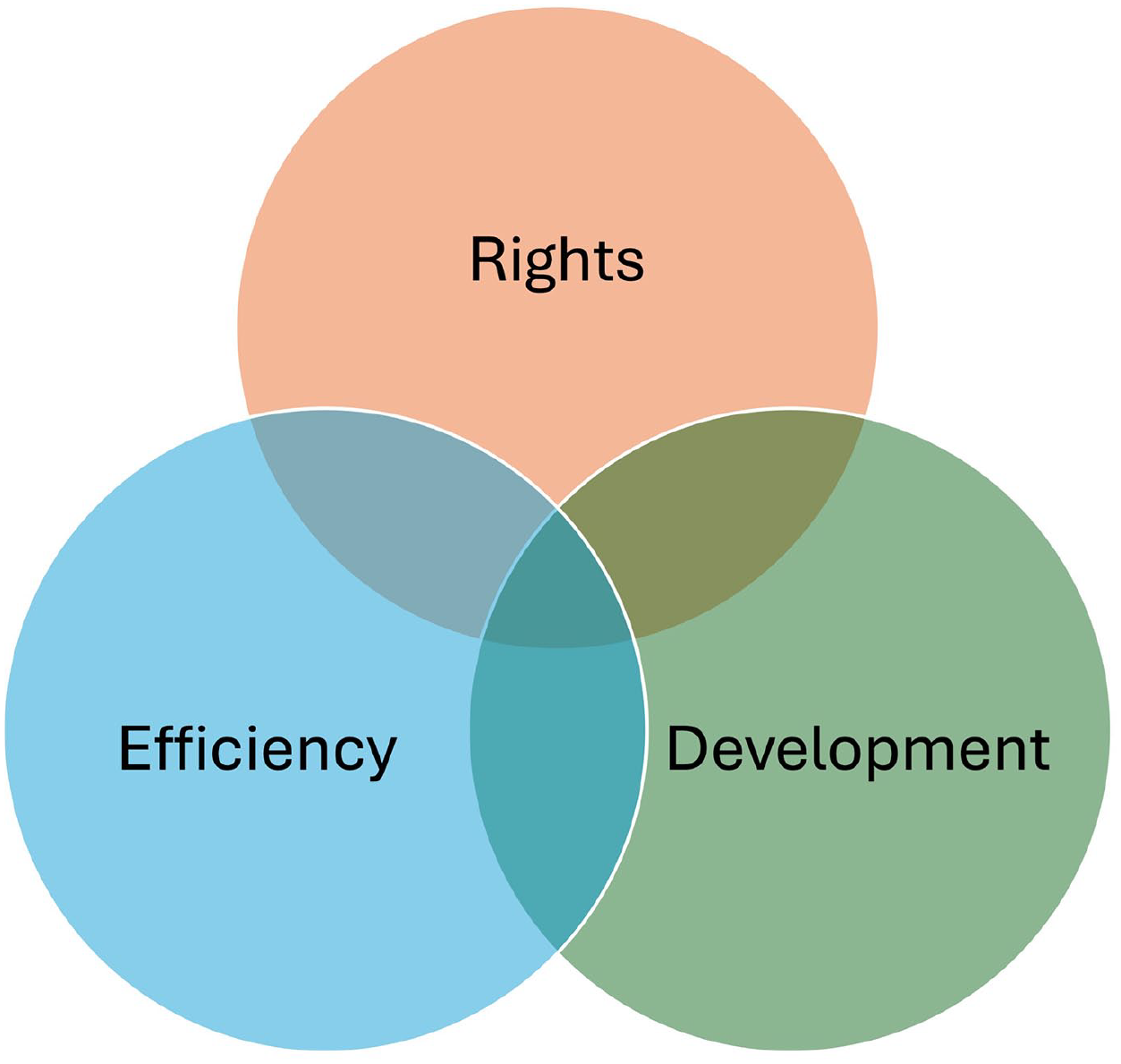
Depiction based on Head’s (2011) rationales for participation.
Participation as rights
The United Nations Convention on the Rights of the Child (UNCRC, 1989) outlines international obligations to fulfil and respect the rights of all children, while also providing a benchmark for their implementation and monitoring (Lansdown et al. 2014; O’Connor et al., 2012). Its underpinning principles of non-discrimination, the best interests of the child, the right to life, survival and development, and respect for the views of the child reinforce their universal influence for the provision, protection, and participation of all children and young people (Stoecklin and Bonvin, 2014). Within the Convention, Article 28 states that every child has a right to an education (Article 28) that develops their personality, talents, and abilities to the full (Article 29) through an inclusive approach to education (Article 23) while respecting the views of children on matters that affect them (Article 12). Similar provision is also specified in the United Nations Convention on the Rights of Persons with Disabilities (UNCRPD, 2006), where equal access to education includes appropriate teacher training (Article 24) and elimination of barriers to participation (Article 9). Commitment to the provisions set out in both the UNCRC and UNCRPD is articulated in many national and international education policies, yet research suggests that endeavours are more aspirational than fulfilled, with the education of certain groups of pupils – including those with SEN and disabilities (SEND) – frequently compromised (UNCRC, 2016). Pupils on the continuum of SEND, including those with sensory impairments, represent a significant population within mainstream education (O’Connor et al., 2022) so it is incumbent on schools to plan for, and resource, accessible and inclusive opportunities for learning (United Nations Educational, Scientific and Cultural Organization[UNESCO], 2017).
Participation as development
The developmental rationale for participation aligns an interactionist ideology that advocates equal access to curriculum, school culture, and extra-curricular opportunities (Haug, 2017). The ownership and empowerment conferred when young people with VI are active participants in the development of their learning reinforces an enabling approach to inclusion (Metatla and Cullen, 2018). Much of the research is premised on the social participation of pupils with SEN – typically in the nature and extent of their friendships, interactions, self-perception, and peer acceptance (Avramidis et al., 2018; Bossaert et al., 2015; Kuutti et al., 2021). In many instances, emphasis on the social dimension is presented as a precursor for pupils’ interaction with schools’ physical, pedagogical, and technical environments since it influences ‘their feelings of being included and accepted as active participants’ (Vetoniemi and Kärnä, 2021, p. 1200). Overall evidence is not conclusive, with other studies reporting higher levels of stress and anxiety among pupils progressing through mainstream schooling (de Verdier, 2016). The variable nature of interaction is, arguably, more evident at subject level. Subject areas, particularly those with a practice component – including Physical Education (PE), Science, Music – are more likely to provoke exclusionary practice, leading to in-class isolation from peers and class teacher (Koehler & Wild, 2019; Haegele and Zhu, 2017; Pino and Viladot, 2019; Teke and Sozbilir, 2019).
Participation as efficiency
Service delivery for children and young people with SEND has tended traditionally towards a top-down approach, with the intended recipients having little or no input in policy development and decision-making on matters affecting them. Challenges to a deficit interpretation of disability and its associated reductionist status can be seen in more reactionary, individualistic approaches to inclusion and participation (Schalock et al., 2016). Overlapping with a corresponding rights-based agenda, it is a fusion of moral, social, and practical imperatives (Merrick, 2020). The right to be heard implies that children and young peoples’ experiences have practical currency and their input, if recorded and acted upon, has a utilitarian efficiency through responsive provision based on genuine need. This can be seen, for example, at school level through school councils, as well as at classroom level through pupil critiques of educational programmes and interventions (Anderson and Graham, 2016; Frederickson and Cline, 2015). Inclusive policy makes certain provisions for children and young people with SEND, including a requirement that schools plan participatively through a continuum of accessible and appropriately resourced support (UNESCO, 2017). Provision that is informed by the lived experiences of pupils with VI undoubtedly increases the potential for genuinely inclusive and participatory learning environments (Prunty et al. 2012). Pupil involvement through inclusive co-design is increasingly viewed as collaborative tool to maximise participation (Brulé & Bailly, 2018). Studies have shown its value as a mechanism to provide insights into the challenges encountered by pupils with VI, an opportunity to reflect on potentially exclusionary practice, and a benchmark from which to develop, monitor, and evaluate more accessible and cost-effective learning environments (Mattheiss et al., 2017; Metatla et al., 2019; Parvin, 2015).
Study context
Researchers from the Centre for Optometry and Vision Science and the School of Education at Ulster University collaborated with regional VI charity, Angel Eyes Northern Ireland (NI), which supports and advocates for blind and vision impaired children. The aim of the initial phase of this collaboration was to develop and deliver a training programme for classroom assistants (CAs; McClelland et al., 2023). In this second phase, the aim was to explore the voice of children and young people with VI to determine their experiences of, and access to, education. The new Department of Education (DE) SEN framework in Northern Ireland seeks to put the child at the centre of discussions and engagement; this study, therefore, represents a timely and relevant opportunity to capture the direct ‘lived’ experience of the child or young person with VI, and findings should provide a strong advocacy tool for future to shape policy.
Methodology
The methodology employed a qualitative approach to address the study aim, comprising focus group interviews with pupils with VI. Focus groups were selected for data collection as this is a commonly employed method for exploring people’s feelings, insights, and experiences on any topic (Krueger & Casey, 2014). For children, it is a particularly useful approach to facilitate conversations to enable participants to interact, share perceptions, and exchange information on particular issues (Adler et al., 2019). Ethical approval was obtained from Ulster University Ethics Filter Committee and the study complied with the tenets of the Declaration of Helsinki. Recruitment was undertaken through Angel Eyes NI. The organisation has an active network of > 50 families throughout NI; through this network, the research team at Ulster contacted parents of children and young people with VI to provide details about the study and invite participation. In addition to parental written consent, parents provided demographic information about their child and their visual status through completion of a questionnaire.
Focus group participation was offered through face-to-face sessions alongside social events for children and young people with VI held by Angel Eyes NI, as it was recognised that children will likely feel more comfortable with familiar people and places such as at events where they spend time socially. These took place between June and November 2022. Two moderators from the research team were involved: C.S. has several years of educational teaching experience and J.-A.L. is an optometrist with a special interest in paediatric VI. The focus group sessions were conducted using a semi-structured question method as a basis for discussion (see Table 1). These questions were developed from engagement between the research team, stakeholders involved in working with children with VI and parents of children with VI, and previous work by Khadka et al. (2012). Moderators encouraged maximum discussion among group members and minimised their involvement. One of the moderators conducted each group discussion and the other managed audio recording and facilitated comfort and well-being of participants. After verbal assent from participants, the focus groups were audio-recorded, transcribed, and analysed using thematic analysis (Braun & Clarke, 2006, 2019) Words and phrases were coded and used to explore patterns in the data and conceptualisation of findings. This approach ensured that common and recurring themes were drawn out, but maintained the rich and detailed nature of discussions to ensure that the broader context and implications of findings could be highlighted. No identifiable information was captured from the interviews and all data were treated and held in strictest confidence, according to ethical and data protection guidelines. The rigour and trustworthiness of data analysis was checked through a process of researcher triangulation (Nowell et al., 2017). One researcher (C.S.) led the analysis, which was independently reviewed by a second researcher (U.O.C.) and then discussed among the research team through peer debriefing and consensus.
List of questions for children with VI about their education experience for focus group sessions.
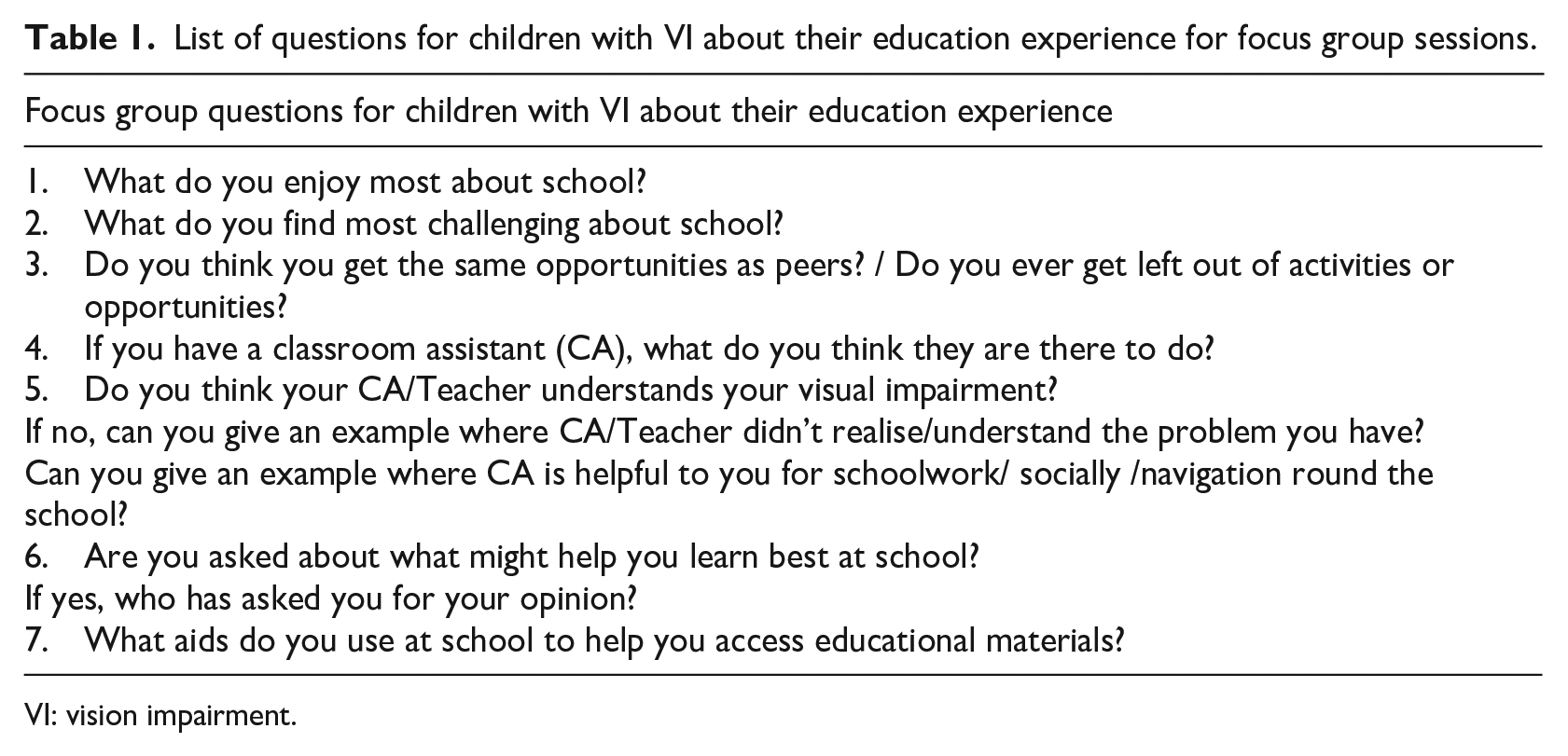
VI: vision impairment.
It was recognised that after the focus group session, there was a possibility that some of the issues discussed might raise concerns or upset for participants. Several steps were taken to mitigate this: first, the benefits of the research were clearly stated in the information sheet, including the potential to encourage positive change; second focus groups were facilitated by an experienced researcher, sensitive to the profile of the participants and independent of school setting; and third, participants were offered a debrief session with the Educational Advocate for Angel Eyes NI.
After informed consent and assent was given, three focus group sessions took place with 13 pupils aged 8–18 years with a range of VI from primary (n = 5), and post-primary (n = 8) schools. Children had a range of aetiologies of VI, including albinism, nystagmus, and glaucoma, with a broad range of reported visual acuities from 6/9 to no perception of light. The majority of children (75%) had a CA, and access to a QTVI.
Findings
Three focus group sessions took place in different locations in Northern Ireland, two with post-primary children and one with primary school children with VI. In total, 3 hr of discussion was recorded and transcribed. Themes that emerged from the findings from these young people provided valuable insights that align with Head’s (2011) participatory model of rights, development, and efficiency.
Participation as rights
Much of pupils’ conversation on their participatory rights was framed around challenges experienced in equal access to education and the potential for discrimination inherent in this. In some instances, obstacles emerged due to lack of proper engagement with the pupil:
‘teachers always point it out, not purposely, but they don’t understand because they’ve lived life as you know, a fully sighted person, . . . they always put me at the front because they think I will be able to see the board but sometimes I don’t even see the board from the front because it’s the light of the projector or something . . . it doesn’t benefit me at all’.
In other instances, teachers’ actions were seen to reinforce pupil difference, undermining opportunities for more inclusive practice:
‘Not really like pointing out, not like purposely but like ‘this is for her’, ‘can you see from back there?’, stuff like that, obviously they have to ask but in front of the whole class, like if they just came up to you and asked [discreetly]’.
‘I feel really different because the teacher has been giving me like, really big pieces of paper but the thing is sometimes the handwriting isn’t done bigger too . . . and people like stare at me when I get pages like that’.
Some of the younger participants noted that teacher timed the class during activities and made them feel under pressure to complete tasks which they found difficult.
‘I find it hard with the literacy, it’s hard to write all the writing. It’s just tiring’.
This extended across subject areas, highlighting the myriad ways in which pupils’ access to education was routinely compromised:
‘I’m not overly sporty, but it’s hard to enjoy physical activity when they don’t put anything in place, I can’t do like rugby or anything . . . it’s very hard for them to accommodate that but they just don’t, I don’t do PE anymore because there’s no point, it just sitting most of the time. I might as well use it for studying or for practising on VI related stuff but it’s just, it is frustrating because it’s just like I’m not getting the full experience that I should’.
‘Yeah, but they also need to have everything, all signs and stuff labelled in Braille or tactile because I use Braille. So yeah, it’s annoying, like all public buildings have it but this schools, the school environment, it’s not integrated into it’.
These challenges were frequently attributed to a gap in both teachers’ and other pupils’ awareness and understanding of VI:
‘. . . like the staff awareness and stuff, there’s been multiple times when staff have walked out in front of me, and then blamed me, even though my peripheral vision is not very good. So, I can’t actually see where they’re coming my way . . .’.
‘I’d say . . . just be more aware of the problems facing VI and that it’s a spectrum, and that as well within this spectrum, someone else who’s totally blind may have different access requirements than me, solutions may work better for them and other solutions work better for me . . . the lack of student awareness, as well, it’s like constantly having to battle them, like my classroom assistant ends up having to shout behind me ‘move out of the way, move out of the way’.
Participation as development
Pupils’ interpretation of participatory development revealed a recurrent pattern of missing out, particularly on the social aspects of school life, impacting on nature and extent of peer acceptance and friendships. In some instances, this was exacerbated by limited interactions in the pedagogical environment, with one pupil commenting:
‘. . . it’s just really isolating in terms of VI. I can’t see anyone so making friends is really hard . . . I can’t really concentrate and focus in a standard study hall so I go, I’m in a room on my own with the CA just because it’s too noisy . . . it just makes it very hard to make friends. Like I only have one friend, but a friend that that’s been friends for about seven years . . . it’s hard to approach people as well, because you don’t know they’re there’.
For older pupils, this could manifest in deficiencies in the technical school environment:
: ‘It’s like before my music exam that I was doing it for my AS. They couldn’t upload the file or something. And I’m like, ‘You should already have that prepared!’ So then it was stressing me out because I was like, ‘I need to start my exam in like five minutes, you don’t have anything!’ It’s just stuff like that that’s so annoying’.
Another pupil described the knock-on effect of being withdrawn from their peers during break or lunch times:
‘I also hate when they’re trying to sort something out and they take you away from your break or lunch time or like away from your friends and it’s so awkward. A teacher was helping me with my Microsoft Pro and he went right into the Sixth form centre and then walked me out of the centre. Like that’s so embarrassing and it takes me away from my friends like for my lunch time you know, I’ve worked all day and I want to have some time where I can like talk to them and you should have this sorted before’.
However, the potential for social isolation was an equally evident feature outside of the formal learning environment:
‘At break and lunch times . . . they always kick balls around which I’m, because of my VI I’m really scared of balls because I’ve been hit so much in primary school by them. But because I can’t see them so now the solution is I basically go and sit inside at break time. Like basically to go straight to the next class and sit inside and on one half, it doesn’t make me nervous because of the no chance of getting hit, but the other half it’s really infuriating, the friends I do have I rarely see them throughout the day, only in form class because . . . I’m usually inside and away from people so it’s like isolation as well as it takes away from opportunities to break time’.
‘Not in primary school, no, I had to sit with my 1-1. I was allowed to walk around and carry my own bag but I couldn’t sit with my friends’.
Older post-primary pupils described the freedom they experienced in Sixth Form and the sense of responsibility this conferred:
‘. . . in terms of sixth form . . . it’s just the freedom you get just as far it allows you to be treated a bit more responsible . . . . I’m part of the student leadership team. So I suppose in a way, it’s the responsibility that I’ve taken on that I really enjoy planning, trying to get sixth form better, and students the best school experience possible they can have by fighting on behalf of students . . . I really enjoy that aspect of it’.
Participation as efficiency
There was unanimous agreement that participation could be more efficient if it was informed by the lived experiences of pupils with VI. On a day-to-day basis, there were challenges in navigating the physical environment, with implications for health and safety:
‘. . . the arrows for the one way system . . . the arrows are so small and you can’t feel them underneath your feet. And it’s so silly, because teachers don’t abide by the one way system. So that is really confusing, because it’s like, what are you doing? Like, you’re going the wrong way and you’re shouting at me?
‘I have to be a guinea pig, basically. And it takes me to have a fall or fall multiple times on some before they fix it . . . They don’t seem to notice or they leave bags lying, or windows left open, and I’m smashing my head into them . . . that makes sometimes school just like a chore, more than anything’.
‘I feel like in school, they should have like better markings and stuff like actual physical things. Like they have put in place yellow tape on some stairs. But some other stairs, they don’t have yellow tape, and it doesn’t really make sense, they should have on every set of stairs’.
In some instances, limitations in the efficiency of school administration exacerbated challenges experienced by students, particularly at exam time, with one pupil, describing the emotional and educational challenges of navigating overly bureaucratic arrangements:
‘it’s just around the educational thing that is exam boards . . . they are basically very bureaucratic in the way they do it . . . I’ve been fighting, the school has been fighting . . . fighting all year to get these access arrangements in place. It’s just a nightmare around the exams and it’s a big issue. It sucks the enjoyment out of education, because you’re always worrying about the exams . . . but it’s out of my control in terms of . . . I can prepare for them, but until they put in the access arrangements, I’m not going to achieve what I can fully do.
The role and contribution of CAs emerged as pivotal dimension for some pupils. These experiences illustrated the range of support provided by CAs, where often the nature of their support was directly informed by pupils’ learning needs:
‘. . . he’s been perfect, he writes notes on the board if I can’t see them, he does a lot after school for me even when he’s allowed to go home, he stays after school and writes out a lot of notes and most of the time he writes out like full maths booklets out for me. Out of his own time and all, he’s really good and the only reason I’ve passed all my GCSEs is because of him, if he wasn’t there, I’d be lost’.
For some pupils, being involved in defining the nature and level of classroom support was a decisive feature of their school experience. In this instance, responsive and adaptable CA input enabled a more inclusive and participatory learning environment:
‘So I’ve got an assistant full time which I don’t need. So, she was with me all the time . . . she was sitting beside me in every class, . . . I was like, ‘Would it be okay, if you would not be in all of my classes?’ . . . I’m actually trying to be really independent in this new school, because in my other school, I was very much sheltered . . . I talked to her, and she listened and she doesn’t sit beside me anymore. She will do my resources, come into the class, give me them and then leave, which is really nice’.
Discussion and conclusion
Applying a participatory model to the educational experiences of pupils with VI offers both constructive and instructive insights at school level, particularly when these experiences are viewed in terms of rights, efficiency, and development.
Participation is inherently bound with inclusive policy, where the expectation is that the rights of pupils with SEN are fulfilled, including participative planning to ensure the availability of accessible and appropriately resourced support (UNESCO, 1994). However, the extent to which a rights-based approach to participation is observed remains a moot point; its implementation, in particular, has been uneven and is typically characterised as inadequate and inconsistent, challenging the notion that pupils with SEN will be routinely included in the life of the school. At school level, shortcomings in teacher training, classroom accessibility, and curriculum adaptation have resulted in practical and pedagogical deficiencies, compromising the commitment to equity, equality, and social justice and contributing to exclusionary learning experiences (Haug, 2017; Radford et al., 2015; Schneider, 2016).
The developmental dimension of participation arguably highlights the influence of models of disability discourse, relative to the access or exclusion they confer. In school contexts, there is an enduring tension between what is perceived as appropriate accommodation and an expectation that pupils will simply ‘fit in’ (Haegele & Hodge, 2016). In the former instance, a holistic understanding of pupils’ educational, social, and emotional needs provides the basis to review, refine, and develop classroom environments, school structures, and pupil services that may not have been previously accessible; in contrast, the latter conveys a reductionist understanding that places the onus of change on the pupil. Although dissemination of good practice provides a valuable benchmark to inform developmental participation (Garrote et al., 2017; de Leeuw et al., 2018), oblique distinction between models of disability can be disruptive, leading to conflicting interpretations of inclusive provision.
Efficiency in participation reinforces the importance of a whole school approach, supported by relevant outside expertise. The presumption to mainstream education for many pupils with SEN places an expectation on the participative learning culture of schools. Characteristics of effective whole-school provision are evident in an inclusive school ethos, consistent teacher training, and adequate, appropriate resources (Abegglen & Hessels, 2018; Kurniawati et al., 2017). School readiness to review, plan, and implement inclusive policies is fundamental to efficient participatory learning environments that are accessible to all pupils (CSIE, 2018). At whole-school level, it is an acknowledgement that pupils with SEN are not a homogeneous group (Berghs et al., 2016). Instead, identification of individual needs is used as an opportunity within a professional community of practice that connects the teaching and learning process in a wider participatory dialogue with pupils at its centre (Mortier, 2020).
The findings from this study have highlighted key challenges for pupils with VI in how they access education in Northern Ireland, including issues surrounding their inclusion, everyday discrimination, and a lack of awareness of VI. Children and young people with VI, while resilient and generally positive about their experience, are faced with challenges that diminish their access, participation, and enjoyment of education. In each focus group, the pupils described instances of a perceived lack of understanding of VI, mainly on the part of their class teacher and also with their CAs and fellow students. There were also descriptions of a lack of inclusion, as well as inadequate and/or inappropriate modifications or teaching strategies. Although pupils with VI demonstrated a tendency to appease and diffuse occasions when misunderstanding or insensitivity arose, they also recognised that this reaction reinforced their perceived ‘difference’ in the classroom. This study underscores the need for increased resourcing for schools and staff training to gain knowledge and skills to manage and promote inclusion of children and young people with VI in education.
Footnotes
Acknowledgements
We are grateful to the children and young people that participated in this study, and for the help of our collaborators in Angel Eyes Northern Ireland (NI): Sara McCracken, Chief Executive and Karen Wilson, Education Advocate.
Declaration of conflicting interests
The author(s) declared no potential conflicts of interest with respect to the research, authorship, and/or publication of this article.
Ethical approval and informed consent
The study adhered to the tenets of the Declaration of Helsinki, received ethical approval through the Ulster University Education Ethics Filter committee and informed consent from participants was obtained.
Funding
The author(s) disclosed receipt of the following financial support for the research, authorship, and/or publication of this article: Invest NI innovation voucher funding was secured by Angel Eyes NI to support this research.
