




Abstract
This article presents the research and development that underpins the Curriculum Framework for Children and Young People with Vision Impairment (CFVI): a new unifying framework that outlines the breadth of support that should be received by children and young people with vision impairment (CYPVI) in the United Kingdom (UK). The study used the Delphi method as a systematic process of participatory consultation with key stakeholders. Three rounds of consultation took place with a panel of 48 participants including young people, parents, professionals, and professional training providers. This process resulted in the agreed 11 curriculum areas of the CFVI with high levels of agreement and satisfaction among participants. The development of the CFVI responds to established evidence of the distinctive challenges to learning associated with childhood vision impairment, and the importance of addressing these through targeted intervention approaches. Drawing on a dual model of access (‘access to learning’ and ‘learning to access’), the framework acknowledges that these approaches should promote inclusive education by balancing universal inclusive practice with specialist skills-based interventions. Such an approach captures ‘what matters’ to the field of vision impairment education – ensuring fair access to a shared curriculum and education system while developing the specialist skills to develop personal agency and increase independence. The article is original in reporting on the development of the first curriculum framework for CYPVI in the UK. The CFVI was launched in March 2022 and provides clarity about what should be taught, when, and by whom. The CFVI promises a transformative contribution to UK policies and practice in ensuring CYPVI and their families will more easily be able to navigate complex education systems and secure equitable access to the services to which they are entitled.
Keywords
Introduction
The unique challenges to learning associated with vision impairment are well documented, as is the importance of addressing these through appropriate and targeted intervention approaches (e.g., Douglas et al., 2019; Hewett et al., 2021; McLinden et al., 2022). It has been argued that these intervention approaches should focus on promoting universal inclusive practice to ensure physical and social environments are accessible for learners with vision impairment, balanced with specialist input in response to individual educational and/or social needs to enable learners to develop their personal agency (e.g., Douglas et al., 2019). The importance of drawing on a specialist curriculum that addresses the development and learning needs associated with vision impairment, and reflects the distinctive skills required by these learners, is widely recognised within the field of vision impairment education (e.g., Keil & Cobb, 2019; Sapp & Hatlen, 2010).
To date, there have been no universally recognised specialist curricula for children and young people with vision impairment (CYPVI) in the context of the UK, which has led to a lack of clarity about how to navigate these tensions, as well as what should be taught, when and by whom (Keil & Cobb, 2019). A challenge in developing such a framework is that the UK is a sovereign state made up of four nations (England, Northern Ireland, Scotland, and Wales) each with its own devolved education policies. Furthermore, specialist curricula should be reflective of the broad spectrum of needs across this population, thus containing outcomes relevant to different developmental and communication stages.
In this article, we report on a research study undertaken as a strand of a UK-wide curriculum development project (RNIB, 2022a, 2022b), which sought to address these issues through the development of a new unifying curriculum framework – the CFVI (Hewett et al., 2022). We start with an overview of vision impairment education and outline the theoretical and empirical rationale for a unified curriculum framework in the UK context. We then describe the aim of the research study, methods, and outcomes, before reflecting upon the validity, conceptual integrity, and practical usefulness of the CFVI.
Vision impairment education in the UK
Vision impairment education has a well-established tradition of focussing on two broad areas of targeted educational outcomes and associated interventions (Douglas et al., 2019):
Ensuring young people have fair and optimised access to the school curriculum (broadly described as Access to Learning interventions);
Ensuring young people have opportunities to develop their independence and social inclusion (broadly described as Learning to Access interventions).
This ‘dual-access model’ has been used in a variety of ways reflecting different stages of development and educator involvement and provides a mechanism for mapping a pedagogical and curriculum response to the distinctive educational and social needs of these learners (Douglas et al., 2019; McLinden et al., 2022). Intervention approaches within ‘access to learning’ are primarily concerned with promoting equal access to education (e.g., environmental adjustments, universal teaching approaches, resource preparation, awareness training of peers and educators). In comparison, ‘learning to access’ intervention approaches are concerned with maximising the development of young people as increasingly independent learners within a given educational context (e.g., teaching of mobility and independence, self-advocacy, and the use of specialist software and low vision devices). This is also part of a broader agenda to promote personal agency, preparation for adult life, and increasingly independent living and employment (see Douglas, Hewett & McLinden, 2019; McLinden et al., 2022). This range of intervention approaches is commonly articulated in the international vision impairment education literature (e.g., Allman & Lewis, 2014; Ravenscroft, 2019; Douglas et al., 2019). Wider literature concerned with definitions of inclusive education from a broad range of positions also recognises the need for both universal and specialist approaches, although there is debate about the selection of such approaches (see for example, Davis & Florian, 2004; Davis & Hopwood, 2002; Lewis & Norwich, 2005; Norwich, 2013). The authors therefore recognise that inclusion and inclusive practice are much-debated terms. Nevertheless, inclusion is not solely defined by educational placement or in a belief that all children should get the same educational experience. Inclusion also recognises that each individual has diverse needs, requiring a range of approaches. In line with literature reviews of evidence-based practice (e.g., Douglas et al., 2019), this includes specialist approaches which are particular to children and young people with vision impairment – these approaches are not at odds with inclusion; in fact, the outcomes they target are vital components in achieving inclusion.
Specialist educators with core responsibilities for teaching these specialist skills and advising on inclusive practice exist in many countries. For example, across the UK, these include the qualified teacher for children and young people with vision impairment (QTVI) and the registered qualified habilitation specialist (RQHS) (although terminology can vary). Currently, there are several specialist curricula and outcomes frameworks for vision impairment education; perhaps, most notable is the US-focussed expanded core curriculum (ECC) (e.g., Sapp & Hatlen, 2010) and the UK-focussed NatSIP Outcomes Framework (National Sensory Impairment Partnership [NatSIP], 2016). These frameworks have no statutory status, however, and are not universally adopted by services in the UK. It is unsurprising therefore that concerns have been raised about inconsistent levels of educational support for CYPVI across the UK (e.g., Keil, 2016). The development of a unified specialist curriculum framework has therefore been targeted as a priority to achieve equitable services for all CYPVI across the UK (Keil & Cobb, 2019).
Aims
The central aim of the research study was to develop a single, UK-wide, specialist curriculum for CYPVI which offers a clear conceptual framework and agreed set of outcomes and approach to intervention. It should guide professional practice in teaching and habilitation from early years through to higher education and/or vocational training (i.e., 0–25 years of age). The research questions investigated during the study were:
What should be included within the specialist curriculum framework and how should this be represented in terms of boundaries/curriculum areas?
How should the specialist curriculum framework take into account the broad spectrum of need within this population, as well as reflecting the diversity across the UK?
Method: development of the framework
Delphi consultation
The Delphi method is a ‘communication structure aimed at producing a detailed, critical examination and discussion [and has been] useful in educational settings in forming guidelines, standards and in predicting trends’ (Green, 2014, p. 1). It is considered to be of particular value when seeking to form a consensus on a complex topic. It does this by systematically drawing on a group of panellists selected for their expertise on the topic, returning to the same panel members over multiple rounds of consultation, each time refining the outcomes until the point at which a common consensus is formed (Linstone & Turoff, 2002; Stone Fish & Busby, 2005).
This method has been used extensively in various disciplines, including in the field of vision impairment education (e.g., Corn & Koenig, 2002; Kaiser et al., 2020; Tellefson et al., 2019; Wall Emerson & Corn, 2006), and allows researchers to purposefully identify a representative group of ‘experts’ (Corn & Koenig, 2002) as panellists. This was particularly important as we sought to engage with, and capture the views of, a wide range of stakeholders with specialist expertise in vision impairment education from across the UK. The concept of ‘expert’ has a controversial status within disability research. Historically, these could often be professionals who impose their expertise upon the ‘non-expert’ disabled person (see for example Oliver & Barnes, 2012). Panel members in this study very deliberately therefore also included young people with vision impairment and parents of young people with vision impairment.
The Delphi method was applied through three rounds of consultation (Okoli & Pawlowski, 2004) with a panel of 48 UK-based members. The consultation was undertaken by researchers with specialist knowledge of vision impairment education, with oversight from a Project Management Group made up of three organisations involved in the representation of vision impairment education professionals, as well as CYPVI and their families. The research team also benefitted from the guidance of a Project Reference Group, represented by 16 organisations from across the UK.
Recruitment of Delphi panel members
Prior to commencing recruitment of panel members, full ethical approval was received from the University of Birmingham ethics committee. The research team worked with the Project Reference Group in designing a sampling matrix (Box 1) with the objective of ensuring a full range of members of the vision impairment education workforce were represented in the Delphi consultation. Four categories of panel members were sought: vision impairment education specialists, providers of professional training, parents, and CYPVI.
Overview of sampling matrix.
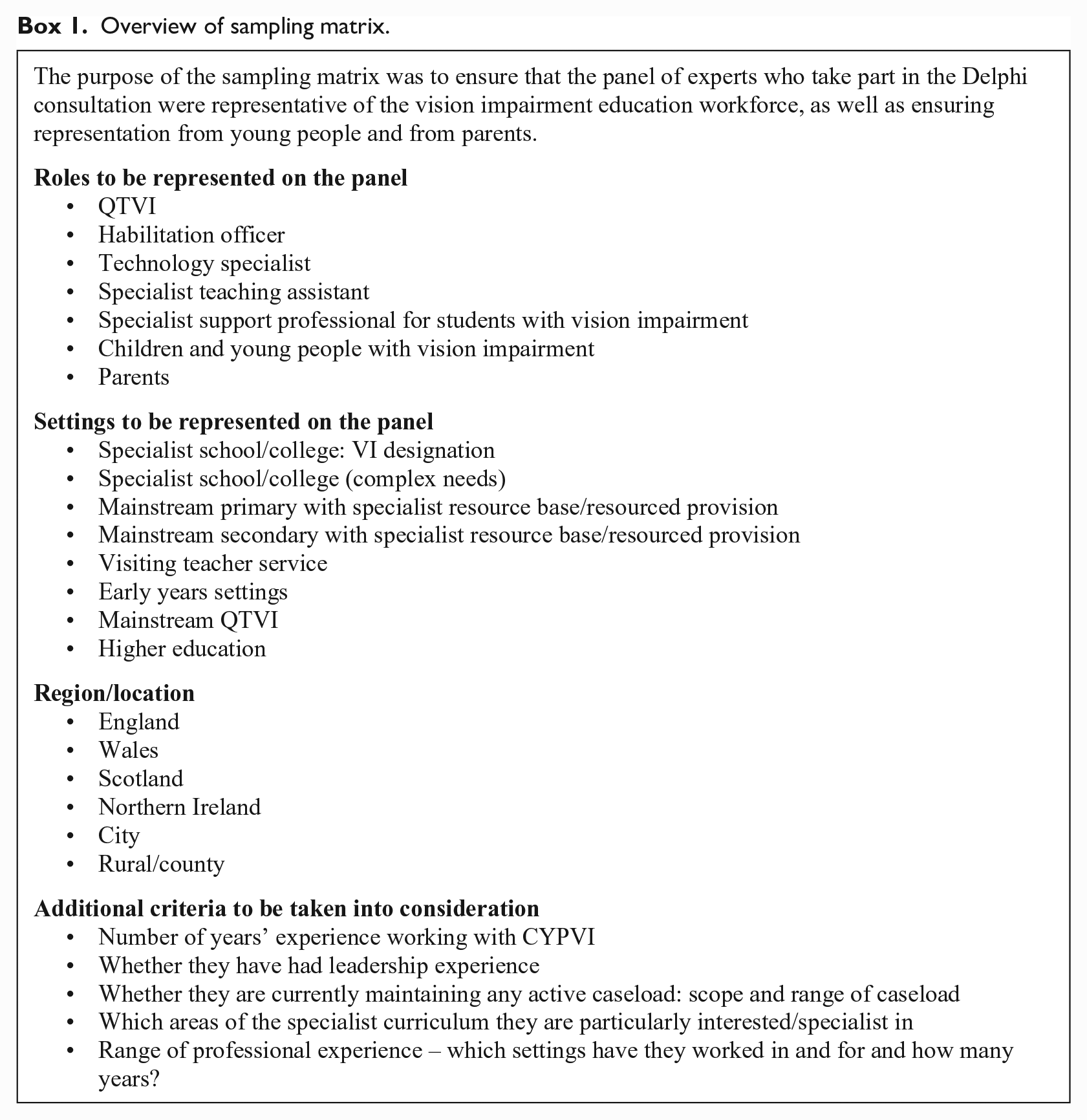
Recruitment information was circulated using a national database of professionals working in vision impairment education, while organisations on the management and reference group helped to send out targeted emails to training providers, parents, CYPVI, and also to address specific gaps in representation. Interested individuals were asked to complete a registration form through Qualtrics online survey software. The registration questionnaire asked a range of questions to help the researchers prioritise respondents for the panel. For example, the questionnaire for professionals asked questions about the respondent’s demographics, type of role, length of time working in vision impairment education, leadership experience, and an overview of their case load of CYPVI (such as geography, age range, and types of setting).
To participate in the project, professionals were required to (1) be working in the field of vision impairment education; (2) be working in either England, Wales, Scotland, or Northern Ireland; and (3) have an active case load. Young people and parents were required to have lived experience of navigating education as a child or young person with a vision impairment, while providers of professional training were targeted directly. A total of 126 professionals, 6 providers of professional training, and 19 parents and young people completed the registration form.
Potential panel members were selected by drawing upon the agreed sampling matrix and, in the case of professionals, prioritising those in leadership roles. Selected respondents were sent a recruitment pack containing an information sheet and consent form in requested formats and invited to formally register their participation in the project. All participants were advised of withdrawal procedures from the project. Table 1 provides a summary of the 48 selected panel members for the Delphi consultation.
Overview of panel members for Delphi consultation (N = 48).
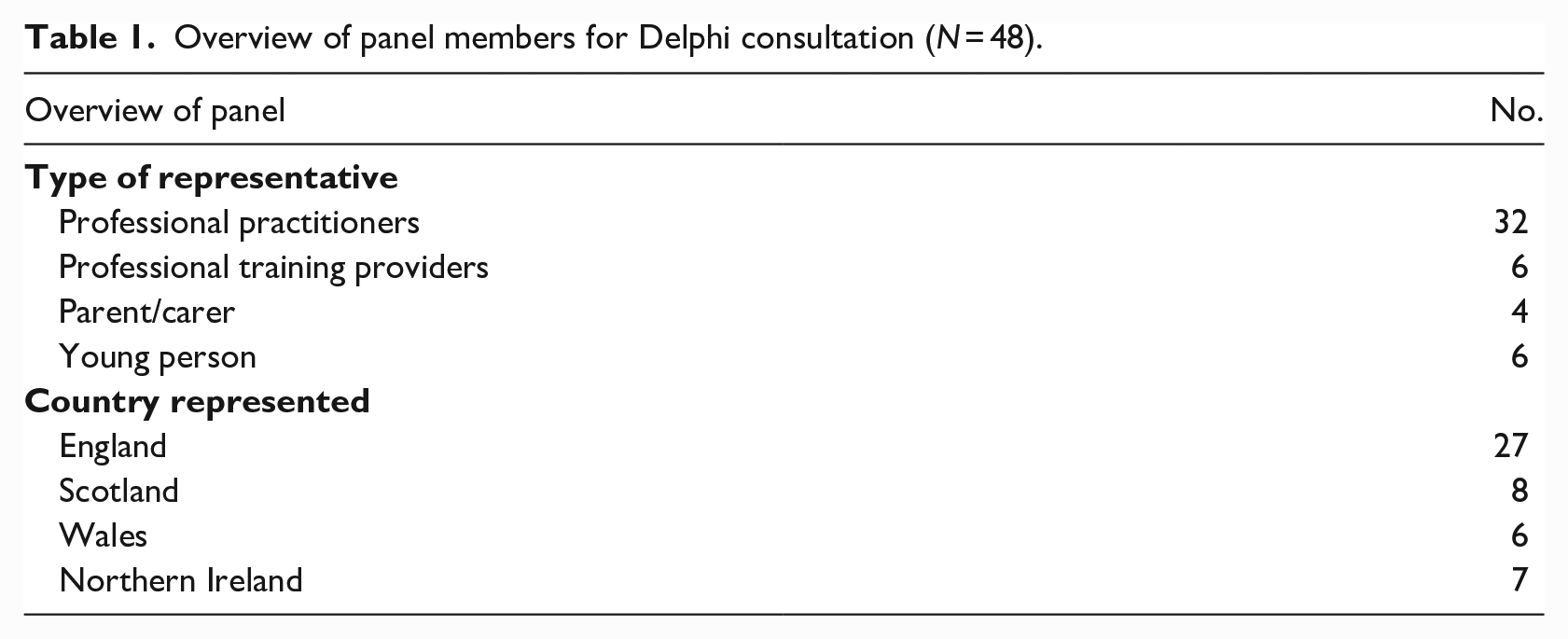
As part of the briefing materials, participants were advised that they were responding as expert representatives for their role, rather than as individuals. Professional practitioner roles represented included: QTVIs in a range of settings (local authority visiting teacher service, specialist VI unit, and specialist school settings) and with different specialisms (e.g., early years, cerebral visual impairment); habilitation specialists (general and specialist settings); speech and language therapist; social worker; educational psychologist; optometrist; head teacher; and occupational therapist. Professional training providers included those leading training of QTVIs, habilitation workers, and paediatric optometry. While we received initial interest from specialist teaching assistants and technology specialists, and sought to recruit specifically to these roles, we were unable to recruit representatives onto the panel.
Data collection: three rounds of consultation
The Delphi consultation was conducted through three rounds (‘idea generation’, ‘refinement’, and ‘confirmation’) over a 10-month period. Prior to each round, the data collection tools were checked for wording and understanding with a pilot group of six individuals who had applied to take part in the consultation panel but had not been selected.
Round 1: idea generation
The first round consisted of eight focus groups that were held online using Zoom, with each lasting 2 hrs. Five focus groups with professionals were organised to maximise the spread of a type of role and location, while representatives from professional training courses, parents, and young people had their own dedicated groups. Prior to attending their focus group, panel members were sent two resources as focal stimuli (Millward, 2012): a link to a summary video that recapped the purpose of the project and their role as participants and a paper outlining the rationale for a new curriculum framework in the UK (Keil & Cobb, 2019). In response to feedback from the pilot group, panel members were also presented with an overview of the questions that featured in the focus group discussion to help the project team to:
find out about areas of the specialist curriculum that are currently being offered in the UK,
outline a rationale for providing a specialist curriculum for learners with vision impairment,
establish what the boundaries might be for areas to be included within a new UK specialist curriculum framework,
explore national and cultural differences that need to be taken into account in developing a framework for the whole UK, and
examine how a framework might be constructed to reflect a learner’s age and individual needs.
Two different members of the author team facilitated each focus group. Drawing upon guidance offered by Millward (2012), the role of the facilitator was to manage the discussion through the agenda, ensure all participants had an opportunity to contribute, and prompt, probe, and sum up. Each focus group was recorded and audio transcribed. The transcripts were imported into NVivo which was used to perform a thematic analysis of the data (Braun & Clarke, 2006). This was considered to be a more appropriate approach than a grounded technique as the analysis was informed by the research teams ‘theoretical or analytical interest in the area’ (p84). To construct an initial outline of the framework, the researchers adopted the following four-step process:
i. generation of initial codes, focusing upon specific examples of specialist support provided to children and young people with vision impairment;
ii. organisation of initial codes into themes, informed by existing curricula and frameworks (notably the ECC, Sapp & Hatlen, 2010; and NatSIP Outcomes Framework, NatSIP, 2016);
iii. collaborative review of the themes generated by the research team;
iv. finalising of 10 themes (each of which reflected a different initial area in the framework) and writing a description of this theme for use in Round 2.
Round 2: refinement
The second round took the form of an online questionnaire, which was distributed using Qualtrics. Each panel member was sent a personalised link to the questionnaire and an initial draft of the framework, which listed 10 proposed curriculum areas generated in Round 1 (plus a description and example outcomes for each). For each proposed area, panel members were invited to provide ratings and feedback on (a) if the area should be included, (b) the title, (c) the description and (d) the example outcomes. Panel members were also asked to provide overall feedback on the draft framework, including identification of any gaps. Professionals on the panel were invited to ‘stress test’ the framework by applying its contents to a case study child/young person. The Round 2 questionnaire received 42 responses (88% of the original panel). These responses were reviewed through descriptive statistics and further thematic analysis to identify where the framework needed further refinement. A summary report was produced entitled ‘You Said-We Did’, which captured the feedback given and the corresponding decisions made. Key changes made included splitting one of the areas of the framework into two separate areas ( ‘Communication’ and ‘Literacy’; therefore giving 11 curriculum areas), adjusting the descriptors and introducing additional example outcomes to ensure they were representative of the broad population of CYPVI. The revised draft of the curriculum framework and the ‘You Said-We Did’ report were drawn upon in Round 3.
Round 3: confirmation
Round 3 followed a similar process to Round 2. Panel members were invited to complete an online questionnaire to rate their satisfaction of the changes made and the justifications given, along with rating possible names for the final framework, based upon suggestions received in Round 1. The research team also posed the panel members with specific questions where there had not been a clear consensus (e.g., choices of wording for some curriculum area names). The Round 3 questionnaire received 43 responses (90% of the original panel), leading to a finalised version of the framework (CFVI) and an overview of feedback on the consultation process.
Final outcomes of the Delphi consultation
Importance of a UK-wide framework
All panel members were supportive of the central project’s aim to develop a UK-wide framework. As well as identifying key areas they felt should be represented within such a framework during Round 1 of the consultation, many of the panel members highlighted why they believed the framework to be so important. This can be illustrated by the following quote: ‘I think there’s a lot of professionals out there who are almost intimidated by the idea of VI. I’m talking about speech therapists, I’m talking about occupational therapists, I’m talking about psychologists. Who almost feel like oh that’s that little bubble over there that the QTVIs deal with. And as a parent I’ve had to demystify this world to many of those professionals’. (Parent, round 1 focus group)
Our analysis of the responses identified a number of themes. First, panel members highlighted the importance of the specialist ‘offer’, due to the low-incidence nature of childhood vision impairment and the complex range of adjustments which may be required. As an example, in discussing the role of the specialist educator, one panel member reported: ‘I think it’s also quite important to remember that a big part of what we do is support schools to provide a more social model of inclusion. And that without us there to remind and train and develop the understanding of the people within the schools (often again and again and again), you can’t get into that really high-quality inclusion where everybody in the classroom knows what this child needs to make sure that they’re fully included’. (QTVI, Wales)
Second, panel members identified situations where, particularly if the child had additional needs, their vision impairment might be overlooked by their setting. The CFVI was viewed as being a potentially important mechanism for ensuring that the broad needs of the child were not forgotten. As an example, one panel member working as an eye-health professional reported: ‘One of the things that I find very frustrating in my job [when] working with children with additional needs now as well as visual problems, is teachers assuming that a child’s difficulty is due to the learning disability and not recognizing that it’s a visual issue’. (Eye-health professional, Wales)
A clear consensus from the panel was that the framework should be organised in terms of developmental stage rather than age and that it should be inclusive of all CYPVI. This meant that the areas contained within the framework and corresponding proposed outcomes should have relevance for the broad spectrum of needs across the CYPVI population.
‘I think a lot of us would prefer stage over age, because it’s unique to that individual child. . .I prefer the idea of a skills sort of progression and an overview of a program that we’re trying to work towards. But to put an age on it, I think, is a really difficult thing to do’ (QTVI, round 1 focus group).
Finally, several of the panel members noted the potential contribution that a new unified curriculum framework might make in overcoming the inconsistency in service delivery between providers within the UK, whereby the level of support received by a child might vary between local authorities and countries due to variations in resourcing decisions. In particular, some panel members noted extreme pressures on their budgets which meant it was not possible to provide a level of support they deemed necessary. As an example, one specialist educator working in Scotland noted: ‘I think when you are short staffed you know – I’ve got a hundred kids on my caseload – how thinly do you spread yourself? [. . .] Or do you concentrate on the ones that that need a lot of support and then you don’t see everybody?’ (QTVI, Scotland).
Naming the framework
A long list of 12 potential names was posed to the panel members for consideration. These were based upon suggestions provided in Round 1 of the consultation with panel members who had been asked to select up to three preferred options. The most popular options selected were ‘Curriculum framework for children and young people with vision impairment’ (19 votes), ‘National VI specialist curriculum’ (17 votes), and ‘Specialist framework of inclusion for children and young people with vision impairment’ (13 votes). While there was no clear consensus, an analysis of the responses received highlighted an overall preference to include the keywords: ‘curriculum’, ‘framework’, ‘vision impairment’, and ‘children and young people’. The final name of ‘Currifulum Framework for Children and Young People with Vision Impairment’ was constructed by the Project Management Committee of the research project through reference to these keywords.
Areas of the framework
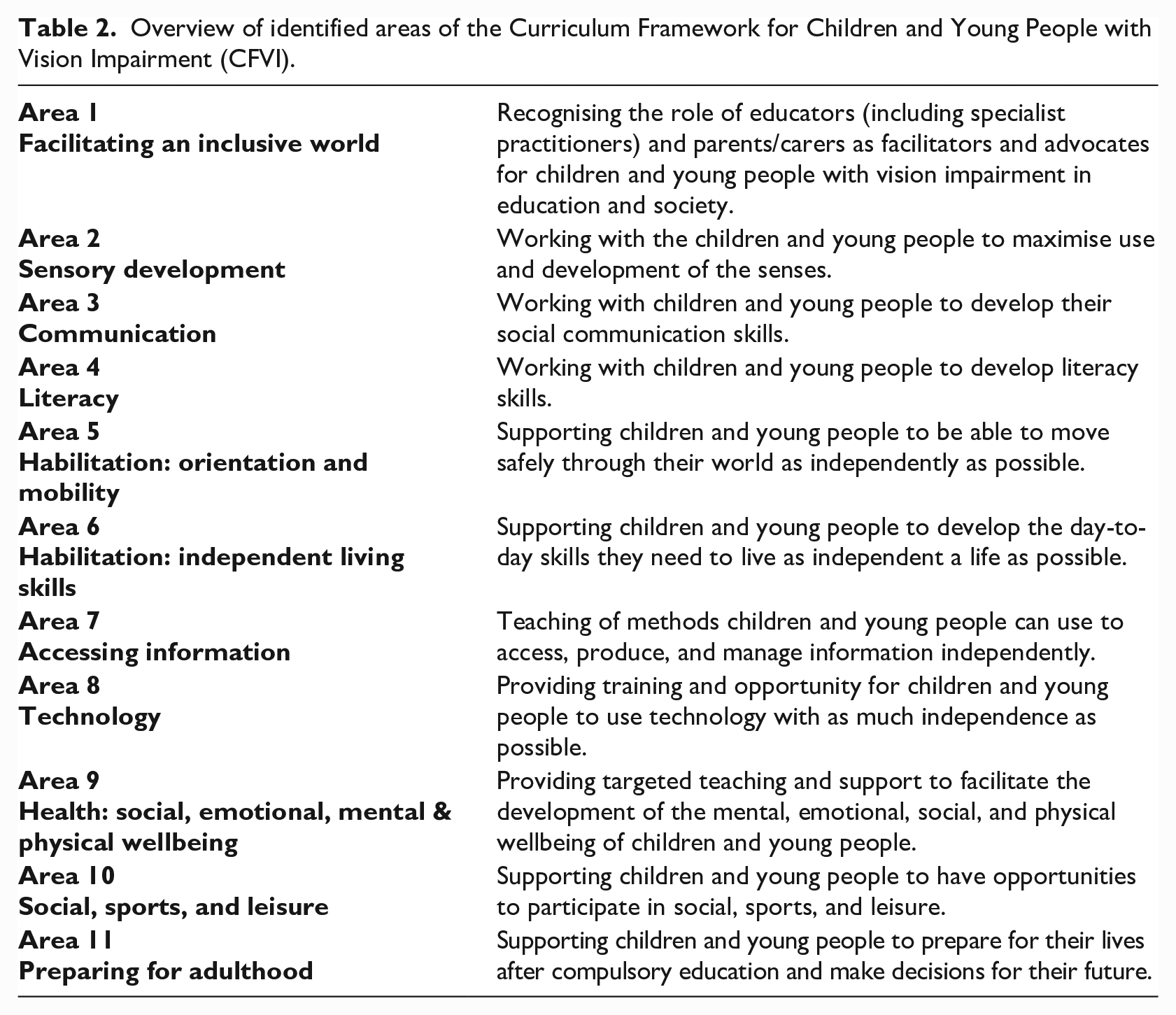
Eleven curriculum areas were identified through the Delphi consultation for inclusion in the CFVI (Table 2). In line with the dual access model (Douglas et al., 2019), the identified curriculum areas have a focus on:
access to learning: universal inclusive practice to ensure physical and social environments are accessible for CYPVI (Area 1);
learning to access: the development of particular skills that CYPVI require to enable them to participate in education with increasing independence, learn how to carry out everyday activities, move around by themselves, and to feel fully included in their respective education setting (Areas 2–11).
Within the framework, each area is defined and has an associated range of outcomes that broadly reflects different stages of development (and is therefore inclusive of those with additional needs).
Panel member satisfaction
The panel members were asked to rate how satisfied they were with how the research team had responded to the feedback that they had given. Across the 11 areas, an average of 95% of respondents reported that they were either ‘very satisfied’ or ‘satisfied’, and the range of satisfaction between different areas was 93%–100%. Furthermore, 93% panel members (40) stated that they were either ‘very satisfied’ or ‘satisfied’ with the revised framework overall, as presented for review during Round 3 of the consultation. Following a multidisciplinary analysis of Delphi studies, Diamond et al. (2014) concluded that 75% is an acceptable threshold for consensus, providing strong justification that the final framework is an acceptable representation of the views of the panel members. The research team therefore judged that it was unnecessary to return again to the panel after responding to the final feedback given.
The panel members were also asked to rate their overall satisfaction with the consultation process. A total of 98% of respondents (41) reported that they ‘strongly agreed’ or ‘agreed’ that their views had been taken into consideration. The main concerns expressed from those who were less satisfied were the lack of specificity within the framework about who should deliver what areas of the curriculum. However, among the panel, and supported by the reference group, the consensus was that these decisions should be made at a local level because of variations in delivery models.
Discussion
We start this section with our reflections on the development of the CFVI and its potential role in providing an important incremental contribution to the field of vision impairment education in the UK. We then examine its alignment with the dual-access model and propose that through drawing on the model, the CFVI captures ‘what matters’ to the field of vision impairment education in that it seeks to balance the common needs of learners with vision impairment with their distinctive and changing individual support needs. We end the section by outlining some limitations of the study and providing recommendations for next steps.
Reflections on the development of the CFVI
The key aim of the research was to develop a single, UK-wide, specialist curriculum for CYPVI through consultation and consensus from across the vision impairment education field. This was enabled by the transparent and democratic nature of the Delphi method, combined with the support of an extensive Project Reference Group. In March 2022, the CFVI was formally launched (Hewett et al., 2022; RNIB, 2022a). The launch was intended to harness the UK vision impairment education community so as to support the adoption of the CFVI as the common reference point within the sector. Further research will focus on the evaluation of the CFVI and development of training materials, plus the continued development of a resource hub for teaching materials to support the CFVI curriculum areas (RNIB, 2022b). It was beyond the research aims to include specifications for service delivery, and this was a concern raised by some participants. Nevertheless, service delivery and resource allocation remain at the discretion of the service or professional working with the child/young person. It is these services that are designed to ensure that support continues to be delivered on the basis of individual need and in accordance with local, regional; and/or national policy and practice. Even so, the Project Management Committee will be seeking ‘statutory’ or ‘guidance’ status across all the nations of the UK to ensure that the core areas of CFVI are recognised as ‘essential’ and not ‘optional’ skills for CYPVI.
The participatory qualities of the Delphi method (i.e., participants recognised as collaborators; research aims that are change-orientated) are commonly associated with research that is judged trustworthy (see, e.g., Fletcher & Marchildon, 2014; Kezar & Maxey, 2014), and this is reflected in the high participant retention in the research and wider engagement by the vision impairment education sector. Nevertheless, the success of the CFVI depends upon its validity (i.e., the extent to which it captures the educational needs and entitlement of CYPVI) and conceptual integrity (how it is underpinned by values and theory). In terms of validity, central to the Delphi method is the consultation with the panel members who in a variety of ways are navigating these issues on a daily basis, whether as education providers or users. Furthermore, the CFVI also demonstrably aligns with interventions identified in systematic reviews of literature (e.g., Douglas et al., 2019) and other proposed curriculum frameworks (e.g., NatSIP, 2016; Sapp & Hatlen, 2010). To this extent, we propose that the CFVI as a unifying national framework offers an important contribution to the field of vision impairment education as it provides greater clarification of what constitutes the areas of specialist curriculum and uses terminology that situates it within the UK.
When constructing the panel we sought to recruit participants to represent the broad spectrum of the need of CYPVI, as well as reflecting the diversity of policy, culture, and provision across the UK. This was of particular importance during Round 2 of the Delphi consultation when we invited panel members to ‘stress test’ the emerging framework by applying it to a range of case studies, with a particular focus on ensuring that the framework was inclusive of children with additional needs as well as a range of vision impairments. The feedback received was incorporated into the next draft of the framework, and validated during Round 3 of the consultation.
Alignment of the CFVI with the dual-access model
The shift towards greater inclusive practice in all countries of the UK has seen significant changes to educational arrangements for CYPVI, in particular in relation to educational placement (e.g., McLinden et al., 2020). Irrespective of the setting (whether mainstream, a specialist school designated for children with vision impairment, or a specialist school designated for children with other primary disabilities), CYPVI must access a shared curriculum with their peers. The specific details and naming of such shared curricula are defined in a given home nation of the UK, although these have similarities and include familiar and traditional core subject areas. It is of note that in the Round 1 focus groups panel members from each of the four home nations commonly made reference to the importance of CYPVI being able to access this shared curriculum. Indeed, while they recognised the vital importance of specialist curriculum areas of particular relevance to CYPVI (‘learning to access’), they raised concerns that ‘access to learning’ must not be neglected. There were concerns raised that an incorrect emphasis would mean that the curriculum framework would only focus on difference, potentially promote a deficit model of vision impairment/disability, and reduce the rights children have to an inclusive and welcoming educational environment.
This finding from the consultation process had an important impact on the eventual design and content of CFVI. The direct impact was the introduction of Area 1 of the framework, Facilitating an Inclusive World. This area is distinct from the other areas in the CFVI given its emphasis is upon universal adjustments of the educational setting rather than focusing on the skills-based development of CYPVI. This builds upon existing specialist curriculum frameworks (e.g., NatSIP, 2016) which do not include reference to these more universal/access to learning approaches. Indeed, specialist curricula by their nature will often focus upon approaches that are additional, alternative, or circumvention in nature (for wider discussion see as an example, Norwich, 2013), and as a result may be criticised for being exclusionary. Area 1 of the CFVI directly deals with this issue by recognising the role of carers and educators as facilitators and advocates for learners with vision impairment in education and society more broadly.
International literature in the area of vision impairment education (e.g., Allman & Lewis, 2014; Ravenscroft, 2019; Douglas et al., 2019; McLinden et al, 2022) highlights that inclusion in education also requires a need for specific interventions to promote greater learner agency and independence throughout a given education pathway. This involves CYPVI learning a range of the more specialist skills that promote independent learning, mobility, everyday living, and social communication. The consultation recognised this under Areas 2–11 of this CFVI, i.e., breaking down these skills into 10 curriculum areas (see Table 2). In comparison with Area 1 of the CFVI, the acquisition of these skills by CYPVI requires educators to give them direct structured support usually not required by their sighted peers. This is because these skills have either been acquired by sighted children incidentally (e.g., Warren, 2000; Webster & Roe, 1998; McLinden et al., 2022), or are skills that sighted children do not require to access their education (e.g., literacy through braille, the use of specialist speech software, use of magnifiers, or long cane supported mobility). As argued in the introduction, specialist educators have a vital role in determining which aspects of the framework are required by or relevant to a particular CYPVI, and when these might be most appropriately introduced. For example, the QTVI will make an informed assessment based on a range of factors as to whether that child should be taught braille as a route to literacy at a given time (e.g., CYPVI’s functional vision, touch sensitivity, coordination, emotional and cognitive readiness). As part of this planning, they will advise the educational setting on when and how best to introduce braille into the classroom. Specialist professionals also have a vital role in working alongside families, to help support the development of the skills captured within the CFVI in everyday life. As noted in the CFVI documentation (Hewett et al., 2022), it is vital that specialist educators use the framework as means to gather and respect the views of the CYPVI, and support and encourage them to advocate for themselves.
Overview of identified areas of the Curriculum Framework for Children and Young People with Vision Impairment (CFVI).
‘Problem Solving is one of the biggies in our job and it’s a question of looking at the age of the child, the visual impairment, the teaching style, [and] their cognitive ability. What their personality is like. And putting that all together. And what works for one child is not maybe working for the second child, even if they’ve got the same VI’. (QTVI, round 1 focus group).
While the literature makes a strong case for a distinction between a shared (or core) and a specialist curriculum, the consultation, and the finalised CFVI illustrates that these cannot be considered to be independent of each other. Indeed, the skills-based elements of the CFVI (Areas 2–11) are fundamental to the child/young person being able to fully access the shared curriculum, as well as enabling them to be as equipped as possible for independent adulthood. Douglas et al., (2019) presents a literature review of educational approaches in vision impairment education mapped against the dual access model. This is adapted in Figure 1 to map the CFVI curriculum areas onto the model. Importantly, Figure 1 captures the values that underpin the dual-access model, and the interaction between access to learning and learning to access.
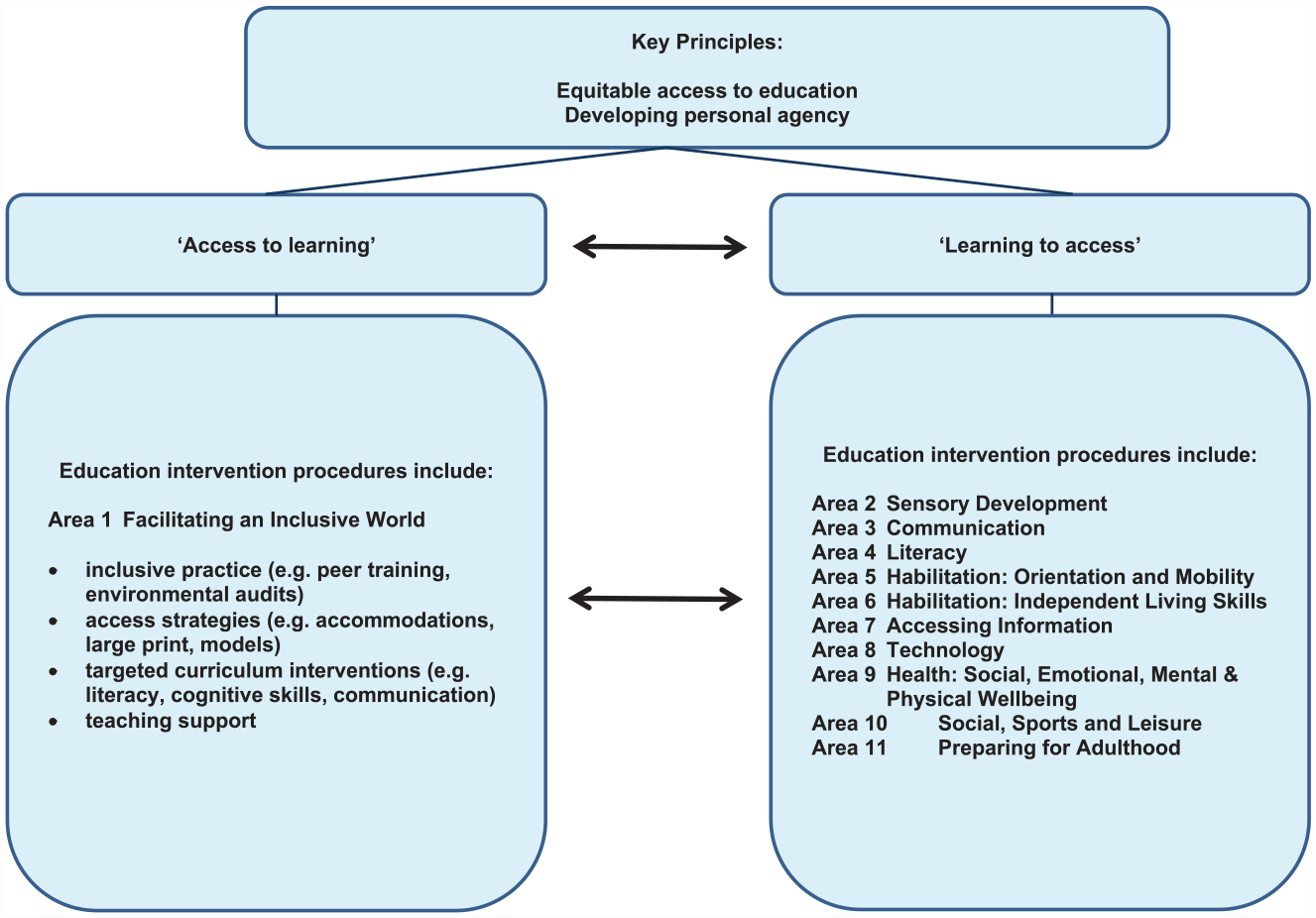
The CFVI curriculum areas mapped onto the dual access model (adapted from Douglas et al., 2019).
We propose therefore that by drawing on the dual-access model, the CFVI captures the values of the field of vision impairment education (i.e., ‘what matters’) in seeking to balance the common needs of learners with vision impairment with their distinctive and changing individual support needs to help them develop personal agency and increase their independence.
Limitations and next steps
It is important to consider the potential limitations of the research. Central to this was the use of the Delphi approach as a method of consultation. While it has been used extensively in social research, some have noted potential limitations, for example, cost and efficiency of the approach, and the potential for participant drop-out over time (e.g., Fink-Hafner et al., 2019; Hsu & Sandford, 2007). As noted by Fink-Hafner et al. (2019), some of the concerns can be overcome by drawing upon electronic approaches (which were partly imposed on the research team during the COVID-19 pandemic, but proved very efficient). The online focus groups (Round 1) meant that we could sample very widely and mix up participants from different regions with ease. Similarly, the use of online survey tools (Rounds 2 and 3) efficiently gathered feedback and satisfaction data. As a result, the dropout rate was very low (most participants took part in all three rounds, and only one participant formally withdrew from the project). Another concern sometimes associated with the Delphi approach is that experts can show groupthink and simply follow conventional lines of thought achieving ‘specious consensus’ (Donohoe & Needham, 2009). Our participants were drawn from a wide range of disciplines and perspectives (notably parents and young people as well as professionals), and rather than group conformity this led to a wide range of ideas that seemed to have ‘additive-affect’ – that is, they were welcomed and respected rather than leading to fundamental disagreements and inability to find consensus. This was partly linked to the aim of the research (to develop a specialist curriculum with no limits on what this might cover), but also Rounds 2 and 3 placed a high emphasis on explanations for the decisions which were made in the analysis (most notably the development of detailed ‘You said, we did’ reports). This is in line with advice from Fink-Hafner et al. (2019) that the Delphi approach ‘depends on the quality of the feedback provided’ and ‘the careful analysis of the responses is a big responsibility of the researcher’ (p.7).
A final potential limitation sometimes associated with the Delphi approach is concerned with generalisability from a relatively small (if highly informed) sample. Triangulation (the use of multiple methods or data sources) is recognised as a way of improving the generalisability in the Delphi approach (Fink-Hafner et al., 2019), and while we did not make use of other sources of primary data, we did triangulate with literature and feedback from an extensive advisory group.
A priority for next steps will be supporting the implementation of the framework in different national contexts, particularly lobbying for recognition of the CFVI in national and local policy. Further research is needed into how the framework might best be applied in a child’s day-to-day education (and building upon existing practice), and in understanding the training requirements to support the delivery of this. As noted in the CFVI documentation, a key objective of the framework is to ‘aid discussions and understanding among all involved in a child/young person’s education of how and when these skills should be taught by suitably qualified specialists and reinforced by non-specialists’ (Hewett et al., 2022). An important focus of future research will be to evaluate how this can best take place.
Conclusion
A transformative contribution of the research study reported in this paper relates to the conceptual integrity of the CFVI. Specialist curricula tend to focus on additional or alternative interventions that are needed by learners with particular disabilities. Such interventions are important but they are not enough on their own, and there is a danger that specialist curricula serve to highlight differences (which might be interpreted as ‘deficit’), and neglect the opportunities for more universal inclusive approaches. The application of the dual-access model as a conceptual framework, and driven by the views offered through the Delphi consultation, means that the CFVI explicitly references both ‘access to learning’ and ‘learning to access’. This can be very helpful in practical terms – stakeholders can recognise the wide range of interventions to be drawn up without concern they are neglecting or missing areas. It is also important because, within inclusive education settings, such conceptual integrity captures a holistic understanding of vision impairment education that is underpinned by evidence, theory, and values.
The CFVI therefore represents a significant step forward in providing more coherent and joined up provision across the UK, and through mapping onto the dual-access model, captures ‘what matters’ to the field of vision impairment education. Embedding the framework in policy and practice in planned future research will mean that education providers (local authorities across the UK and specialist schools) can adopt consistent terminology and ensure that they attend to all areas of the CFVI. Those contributing to individual educational plans in their various forms across the UK can also use consistent language in formulating and evaluating targets. Other professionals outside education (e.g., health and social care) will be better able to identify educational services and link to them. Most importantly, CYPVI and their families will more easily be able to navigate complex education systems and seek access to the services to which they are entitled.
Footnotes
Acknowledgements
We would like to acknowledge the input of parents, children, and young people and the many colleagues in the sector who were involved in the development of the CFVI. This includes colleagues from a range of disciplines who participated in the focus group meetings, as well as those who provided examples of resources.
In addition to focus group participants, the management of the study included collaboration with professionals working for major sector organisations across the UK that included: Guide Dogs UK; Thomas Pocklington Trust; Scottish Association of Visual Impairment Education (SAVIE); Welsh Association of Vision Impairment Educators (WAVIE); Education Authority Northern Ireland (EANI); LOOK; VICTA; HabVIUK; Institute of Education (IOE); New College Worcester (NCW); NatSIP/ HoSS; University of Birmingham- VICTAR; Scottish Sensory Centre (SSC)/ Edinburgh University; Bradford Teaching Hospitals/ School of Optometry, University of Bradford/ NHS England Special School Eye Care Programme, St Vincents School for Blind and Partially Sighted Children, Liverpool
Funding
The author(s) disclosed receipt of the following financial support for the research, authorship, and/or publication of this article: This work was funded by Royal National Institute of Blind People, through a legacy gift.
